
1 Introduction
This article presents a case study that explores the intersection of curated access to digital archives and actual use of these archives, examining how algorithmic search and guided search methods (such as intermediated search) shape interactions of university students with archival content. We offer insights into how students in the classroom engage with institutionally curated audiovisual archives. The premise of our paper is that teaching students—who are media users that have grown up in ‘search engine societies’—requires a pedagogical approach that draws explicit attention to the tension between archival search regimes and students’ ‘Google-informed’ search habits.1 This interplay is part and parcel of the learning experience. Students and teachers continuously adjust search expectations as they tinker, using their tacit search knowledge to understand the workings of digital archives. We argue that this pedagogical approach involves sensitising students to how and in what ways data-driven reconfigurations of archival content afford (serendipitous) information encountering.2 These encounters involve practices of meaning-making at both the data (content) level and the intermediated search (interface) level. Our pedagogical approach aims to ‘de-Google’ our students, equipping them with vital digital literacy skills.
In our case study research, we take a user study approach. User studies draw attention, on the one hand, to how users become configured as users by designers3 and technologies, and on the other hand, to how users configure themselves as users as they learn to use technologies.4 The toolset we focus on is the CLARIAH Media Suite, a digital research environment that is part of the Dutch Common Lab Infrastructure for the Arts and Humanities (CLARIAH). This overarching infrastructure provides access to digital tools, collections of data, information about data standards, and a learning environment that offers users instructional and educational materials about its tools and data. As such, CLARIAH and specifically its Media Suite aim for user-friendly access to digital resources of audiovisual archives. The Media Suite presents users with various search tools,5 including the Search tool that allows the use of facets and collection filters and the linked open data Explore tool that gives users the option to search on the basis of distinct entities such as media objects, people, locations, or concepts. Pre-sorting or pre-selecting search results is, of course, not new; commercial content platforms such as YouTube offer a kind of faceted search as well (on the basis of genre, for example).6 Google’s search engine’s auto-complete functionality also provides a kind of pre-selection of search queries. In the latter case, this can arguably make it more difficult for users to encounter unexpected but valuable search results, and can limit the development of a more critical understanding of search as a skill. Student users, as we will see, are accustomed to commercial content platform searching and, because of their familiarity with the search functionalities of platforms like Google and YouTube, expect a similar search experience when they use curated institutionalised audiovisual archives. We present research insights into how the Media Suite was adopted into the classroom setting in three different courses within the University of Groningen’s Media Studies Bachelor and Master and Digital Humanities Master programs. These three approaches together allow for an overarching vision for teaching and learning digital search skills. The courses focused on (1) digital curation and archival search, employing multimodal inquiry on multimedia platforms; (2) mapping of serendipitous information encountering throughout the search process; and (3) digital storytelling with these found audiovisual archival materials. In the classroom, we introduced state-of-the-art modules to help students acquire search strategies as part of seemingly basic yet complex skills: to find, appraise, select, and reuse digital sources.
Our article is structured as follows: in Section 2, ‘Key theoretical concepts,’ we define and explain how we understand the algorithmic reconfiguration of the archive, intermediated search, and information encountering. In Section 3, ‘Suite Discoveries,’ we turn to our case study. Here, we present our pedagogical practice and methodology that allows students to learn about the algorithmic reconfiguration of archives as the site of user-material interaction. We discuss the teaching modules used to structure their learning process. These hands-on modules focus on developing a critical attitude towards search tools and search habits, whether students are creating compelling audiovisual stories by reusing and remixing existing materials, appraising and curating archival collections, or working to understand how search tools help discover something entirely new. In Section 4, ‘Findings,’ we share our pedagogical perspectives on how intermediated search shapes algorithmic curation and information encountering in the classroom setting, and we reflect on student learning processes and the challenges we faced that hamper the uptake of the toolset and the resulting pedagogical practices to teach students about audiovisual intermediated search. These challenges are, at times practical, such as the fact that a great deal of Media Suite content is in the Dutch language, which makes it difficult to work with for international students. However, the biggest challenge is the discrepancy between student-user expectations of how and what should be retrievable in an archive and the actual affordances of a large digital infrastructure such as the Media Suite. Student-users expect a ‘Google-like’ experience but do not get this user experience while engaging with the Media Suite. They are then encouraged to develop a critical awareness of how search shapes insight by making search and search practices the object of study. Modules consisting of search tasks, comparing search results of the Media Suite and YouTube, search diaries, tool criticism, use case building, and user studies with peers using interviews and think-aloud protocols teach them that search is a craft and skill. Finally, in Section 5, ‘Recommendations,’ we put forward guidelines for practitioners who may want to develop similar teaching approaches. These include teaching students an awareness of search habits, what it means to be a ‘professional user’ of an archive, transferable search skills, and the understanding that research is an iterative process in which search tools can lead to surprising insights.
2 Key Theoretical Concepts
2.1 Algorithmic Reconfiguration of the Archive
The last two decades have shown a significant change in the archival landscape, as archives have become part of a broader development of digitisation, datafication, and platformisation.7 Media archives have been reconfigured into data-rich ecosystems. Archives have integrated some advantages that guide video platforms like YouTube, particularly the sharing of large volumes of historical footage. This availability has become appreciated by a general audience, turning YouTube into a so-called ‘democratic digital archive.’8 As Rick Prelinger already observed in 2009, just a few years after the platform’s inception: ‘YouTube might well be an archive; that in the public mind is not simply an archive but an ideal form of an archive.’9
In addition to the availability and accessibility of millions of records, YouTube’s easy keyword search interface profoundly affects user expectations when accessing an institutionally curated online archive. Scholarly research revealed how video platforms have become severe competition as popular archives10 even though these data-rich platforms curated through algorithms are hindered by biases, probability outcomes, and path dependencies (think: personalization).11 These conditions hinder stable, reproducible results. This is why television scholar John Hartley also discussed new unconventional internet-based archives as probability archives: ‘they are random, complex, uncertain, indeterminate, and evolving as to their content at any given moment.’12
In different European countries, national archives and libraries have transformed into ‘big data organisations’ embedded in digital infrastructures.13 According to Moss et al., archives have shifted from a collection of records into collections of data, reconfiguring the role of hierarchies and original orders determined by archivists: ‘with a click of a key, the order of the catalogue can be changed.’14 The online, data-driven archive in turn provides the user different affordances to play with these rules and facets. As can be expected, a reconfiguration of the archive as data also means that new types of users might approach these with new expectations about search and research methods in using both large-scale data volumes while also aiming to dive into close reading sessions of small data sets.15 Most of all, institutionally curated archives need to accommodate different user expectations because of their search habits.
2.2 Intermediated Search
Algorithmic search practices in a rich online information culture have profoundly changed our search habits. With Google as the default space for tracing digital resources through simple keyword searching, students have become accustomed to ‘dis-intermediation’; it is not so obvious for them to find sources via professional intermediaries such as traditional libraries or archives, or, for that matter, explore digital infrastructures such as CLARIAH’s Media Suite. Students do not automatically appreciate institutional archives as trusted spaces that provide access to reliable and contextualised materials.16 This critical issue should not only be related to undergraduate students, but it is also a challenge that professional scholars are dealing with. Research has shown that novice and advanced scholars need to adapt to the changing opportunities thanks to a digital turn that redefined media studies research.17 The survey of Max Kemman et al. already observed how scholars adapted to the idea of ‘Just google it’ and made it their primary search habit.18 Jane Winters and James Prescott also addressed this ‘paradigm of free form natural language search,’ meaning that users have come to rely heavily on the ease of use of Google search box-like performances.19
Scholars cannot easily assess the result of their findings, or as Ted Underwood observed, he described a Google search output as a ‘Boolean fishing expedition.’20 There is a loss of expertise noticeable in understanding the way archives work:
(…) [I]t is a daunting prospect for those new to the archive, especially those who landed on a record details page from a search engine, unexpectedly propelled into the depths of an archival catalog, possibly unaware of what that is.21
Winters and Prescott remind us that it might be interesting to consider how an appreciation of more classic archival methods of hierarchy and context, combined with new emerging digital humanities research methods, can help overcome these challenges.22 In short, how can we re-establish an appreciation of intermediated – institutionally curated – search and develop critical skills in an intermediated digital archival ecosystem?
2.3 Serendipitous Information Encountering
Scholars searching in audiovisual archives have information needs that correspond with particular kinds of complex search behaviour informed by the domain and search expertise.23 These information needs may be geared towards verification or fact-finding, be consciously topical, or be muddled topical. Borlund, Pharo, and Liu focus on how different search phases point to various search needs of scholars and how, while search is presumed to be an almost mundane activity, scholars also state that there is no ‘mastery’ over the archive: searching the archive means learning something new about that archive.24
While our article does not analyse information needs per se, we deem it fruitful to connect to Borlund, Pharo, and Liu’s use of what they refer to as a ‘muddled topical’ information need or a ‘need experienced by a user who has little or no previous knowledge about the search topic’.25 The students included in our studies are foreseen (or becoming future) users of the CLARIAH infrastructure, interface, and tools that provide access to the audiovisual collections. These students typically employ their ‘dis-intermediated’ search habits to appropriate the (to them, new) CLARIAH tools and interface to search for topics that they are also mostly unfamiliar with. This means that these users have both muddled topical information needs and are unfamiliar with these particular search tools.
In our case study, we look at how students’ search experiences with the CLARIAH Media Suite are informed by moments that are unexpectedly fruitful. These reported instances of serendipitous information encountering26 allow us to better understand user expectations and their search skills. We hope to encourage students to critically consider what happens when they encounter unexpected but valuable information in the archive by highlighting serendipitous information encounters as part of learning experiences. These information encounters not only lead to topical discovery, but also allow students to learn about the conscious practice of searching and what it means to ‘de-Google’ their search habits.
Serendipitous information encountering is difficult to systematically analyse due to its unexpected nature. Yet scholars in the fields of library and information science27 and information studies28 have connected it to the exploratory stage of searching for information, when a problem is complex and open-ended and where users are typically unfamiliar or unsure of the search goals.29 During exploratory search, users alternate between ‘browsing and focused search activities’30 to fine-tune information discovery processes. Serendipitous information encountering has been connected to creative production practices of media professionals who can be seen to seek serendipity as part of their creative retrieval practices.31 Media professionals who use audiovisual archives are attuned to the archives they use to find documents; they have a ‘prepared mind’ and are thus ready to find something that they deem serendipitous.
Serendipity scholarship has underlined and questioned the importance of this ‘prepared mind’ to experience serendipity.32 Preparedness would suggest a certain kind of prior knowledge or expertise (e.g., of what to expect) coupled with an openness to encounter something surprising. Glǎveanu,33 in his argument to overcome dichotomous thinking of a discrete mind that experiences a world and finds something serendipitous, instead underlines how serendipity is co-constituted by mind and context and can become discernible as creative action as it unfolds.34 In our case, students may well be ‘prepared’ to search as they have appropriated particular search regimes in their daily life online search habits, yet – when faced with a new interface and set of search tools – may be hard-pressed to find anything surprising as they are not ‘prepared’ to expect the unexpected in such a new search environment. Their experiences of serendipity, seen this way, can thus point to fruitful information encounters as they appropriate or adapt their search practices to a new search regime. In this process of learning, they not only learn more explicitly about intermediated search and algorithmic curation, but also about their own search habits and skills.
We now turn to our case study and share our pedagogical approach set to ‘de-Google’ our students – and, in this process, to teach them how digital curation, search, and media creation are interconnected practices.
3. Case Study: Suite Discoveries
As explained before, the CLARIAH Media Suite is part of the Dutch Common Lab Research Infrastructure for the Arts and Humanities, which provides researchers access to ‘large collections of digital data’. The Media Suite comprises a set of tools that allow users to inspect, search, and explore datasets of – amongst others – the Netherlands Institute for Sound and Vision, EYE Film Museum collections, oral history interview collections, and collections of the Open Images project. Once logged into the Media Suite, users can create workspaces to create research projects, save and annotate materials to keep track of their analytical processes, search journeys, and insights. Jupyter Notebooks are also available for those researchers who want to access the data through the Suite’s APIs.
We previously investigated to what extent the Media Suite tools afford research insights in, respectively, how humanities researchers create narratives about disruptive events35 and how the Media Suite’s video annotation tool supports mapping Dutch documentary history.36 In our current study, we move away from professionals’ experiences and instead turn to students as future professional users of the Media Suite. We were each granted a CLARIAH-supported Teaching Fellowship to explore how and to what extent the Media Suite affords students ‘Suite Discoveries.’ We worked on three interconnected pedagogical projects (see Figure 1): (1) MAKE focused on teaching students in the international classroom creative multimodal storytelling with archival audiovisual materials and English-language collections; (2) TRACE centred on teaching students different research modes when selecting, appraising, and curating in intermediated archival infrastructures such as the Media Suite; and finally, (3) DISCERN worked to teach students how to discover and evaluate serendipitous information encountering.
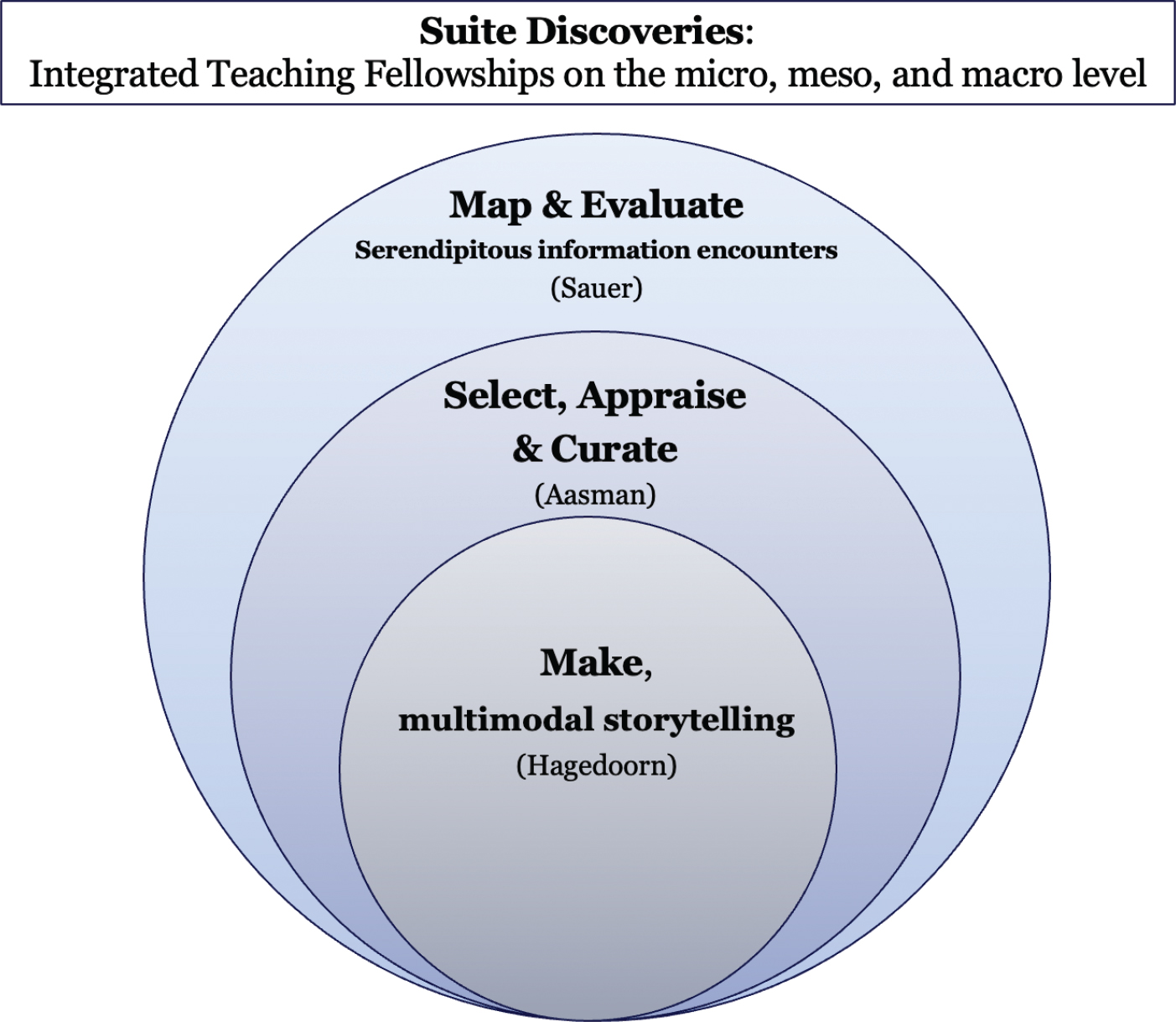
Figure 1
The three sub-projects within ‘Suite Discoveries.’ The three projects have their own learning goals at respectively a micro, meso and macro level.
The three Teaching Fellowships ran in the academic study year 2021-2022 and involved students from the Media Studies Bachelor and Master, and Digital Humanities Master programme at the University of Groningen, the Netherlands. Students were offered specific teaching modules and assignments centred around the CLARIAH Media Suite and digital search. These have remained an integral part of the courses since then. Students concluded their coursework – because of COVID-19 pandemic restrictions – with an open online event in Gather Town where they showcased their work on either digital curation, multimodal storytelling, or serendipitous information encountering (see Figure 2).
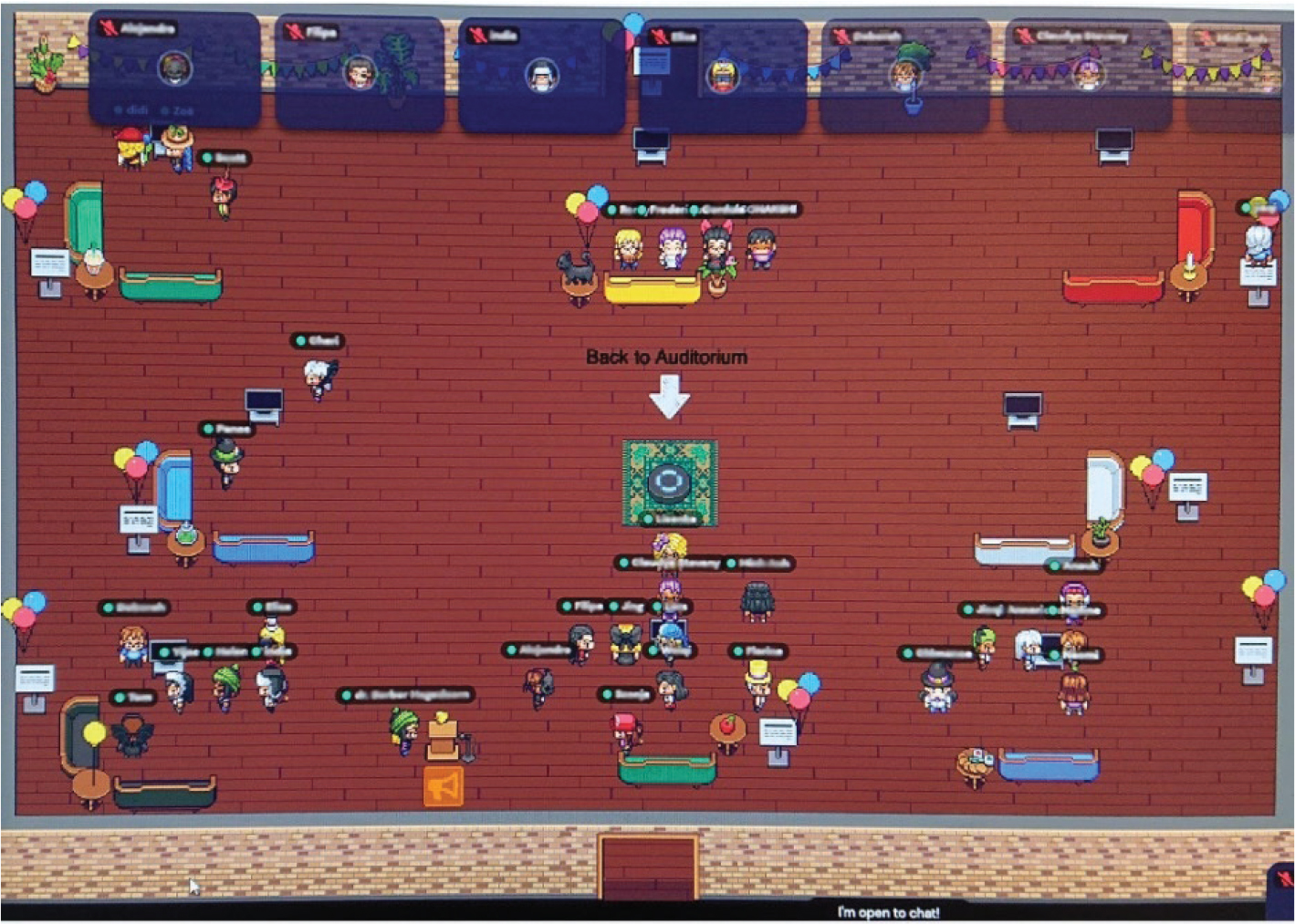
Figure 2
Gather Town ‘Forms and Formats’ room: students present video essays and additional materials based on digital search practices with the Media Suite.
The three projects involved three distinct groups of students: MAKE worked with students of the Media Studies Master course Forms and Formats; TRACE included students from the Bachelor courses Digital Curation and (New) Media Archives; and DISCERN taught Master students of the Digital Humanities course Digital Humanities: Tools & Methods. There were moments when students from the different courses interacted and worked together, specifically when the DISCERN students did user studies with students of the TRACE and MAKE students, using exploratory search tasks they prepared for the latter two groups and asking them to complete these tasks while verbalising their search journeys with think-aloud protocols.
3.1 MAKE: Making Multimodal Storytelling Experiences with Cultural Heritage Materials in the International Classroom
The aim of MAKE has been to develop three teaching modules as well as video lectures to support students’ knowledge-building and critical awareness about the Media Suite’s affordances for reuse and remix, access to different media types, and search strategies. A group of multicultural, interdisciplinary Master students used materials from the audiovisual collections for creative, multimodal storytelling practices.37 Students carried out user tasks in class in order to get to know the tool in a playful and exploratory manner, and reflect on their search experiences as well as on affordances and constraints of the Media Suite for storytelling use, in three tutorials. (1) First, the students get familiar with the tool and its (English-language) content through tasks exploring the different affordances of the tool, and compare the Media Suite to other search tools such as Google. By doing this, the students are able to recognise the importance of being aware of the impact of tool use in their research process. (2) In the second tutorial, ‘Refining your approach: from search to storytelling,’ students search and make creative stories (video essays) reusing and remixing the Media Suite’s cultural heritage content and discussing related issues. In this tutorial, students pay particular attention to the iterative process of doing research for multimodal storytelling creation, using the three steps exploring, refining, and producing stories.38 (3) Finally, students participate in small focus groups on ‘sharing stories about storytelling,’ with a focus on the concept of author vs. audience, which allows for more in-depth reflection on the interaction between search and storytelling. This third tutorial focuses on questions such as: what different ways of storytelling are there (and by using which media types), and how does this impact the way an audience perceives the story? During this tutorial, the students are also encouraged to think about how storytelling is part of the online event in Gather Town and how their academic and personal background impacts the story that is told in their video essays through reflective questions and discussions with their peers.
3.2 TRACE: Teaching Rich Archival and Curational Explorations in CLARIAH’s Media Suite
Within TRACE, the aim was to develop four modules that equip students with skills about (faceted) research practices suited for working in online media archives to (1) create meaning and generate different readings of selected materials; (2) develop skills with regard to searching, comparing, and curating archival sources; and (3) critically engage with (inter)national, public, and commercial online collections and available tools and reflect on their limitations. As explained previously, students have become accustomed to the keyword search strategy that the Google search engine offers. In addition, as Bartlett and Miller have already observed, students have high confidence in their capabilities to explore the internet.39 However, they need help to assess whether their results are optimal, if results are representative of the topic they are exploring, and whether there is a severe bias in their selection. It is, therefore, crucial to help students develop a critical attitude toward their primary search habits and make them try alternative methods. Students need to be made aware that there is a long-standing tradition of archival research in collections that results from a systematic process of appraisal, selection, description, and preservation. Simple questions, like: What is an archive? Where can we locate specific collections? How are these collections organised, and what possible bias do they contain? What is the value of metadata for research? What about access and availability of sources for purposes of analysis and reuse? – these all needed to be addressed explicitly.
3.3 DISCERN: The Discovery and Evaluation of Serendipitous Information Encountering
DISCERN sought to teach students how to research how the Media Suite affords serendipitous information encountering. Digital Humanities students learn about the role of serendipity in research practices from three different perspectives: (1) theoretically, they actively reflect on changing research habits – including changing ideas about what serendipitous information encounters means in a digital environment – as digital research possibilities change; (2) analytically, they study how research practices are shaped by tools like the Media Suite, which allows them to become more versed in specific research practices such as mapping research journeys through methods of personal research diaries and the development of exploratory search tasks as well as tool criticism;40 and (3) practically, classes support their development into independent researchers proficient in doing hands-on user research. Teaching modules within this course centred on four methods. First, students were introduced to (a) exploratory search tasks, and developed their own tasks for their peers based on their own personal (re)search diary to document their search experience, reflecting on the constraints and affordances of the Media Suite, and documenting their search journeys; (b) tool criticism, which helped them to create a report about the functionalities of Media Suite’s tools, and their documentation; (c) use case scenario-building about how the Media Suite can elicit serendipitous research insights, combining insights about personal search journeys and tool criticism, and lastly; (d) user studies, to test their insights by carrying out a user study, using interviews and think-aloud protocols with peers from the Media Studies Bachelor courses that were also part of this project.
The three approaches together allow for an overarching vision of the role of digital search. In the next section, we discuss the main challenges faced and opportunities revealed in how to support students’ digital source exploration, storytelling, and curation of sources, as well as their evaluation of digital tools.
4 Findings
Our study revealed overarching insights about how the CLARIAH Media Suite as a search system and interface affords and limits students’ findings in terms of tracing, curating, and discerning information encounters, and what this implies about our understanding of digital search as both a tool and as a reflection of our contemporary academic search cultures. Looking back, our pedagogical approach faced several challenges around which we designed scenarios and modules for teaching.
First, the initial challenge – which the MAKE project exemplifies – is how to support students in their knowledge-building and critical awareness about the affordances of large digital infrastructures such as the Media Suite. How do they learn about curated access to media content, which includes diverse media types, genres, and languages? What do they bring into the classroom from their daily lives, or how can they critically evaluate their search tactics? Because the Media Suite provides a particular interface and research environment, including a professional/institutional catalogue, using its tools necessitates employing distinct search techniques (e.g., utilisation of the Collection Inspector, Exploratory Search, etc.). How can students gain a better understanding of the possibilities for reuse and remixing with such tools?
Our pedagogical approach addressed such questions through hands-on teaching modules. For example, the MAKE modules teach students how to reuse and remix audiovisual materials to create video essays for specific audiences. Students use the Media Suite to engage in multimodal storytelling and critical reflection, such as comparative analysis, interactive storytelling, historical perspectives via timelines, and case study analysis.41 Students gained a better understanding of how to interpret and present archival material to an audience by utilising the Media Suite’s functionalities for close and distant reading. Consequently, students acquired a deeper understanding of the rationale behind and the techniques for utilising specific materials in the Media Suite, as comprehension is necessary prior to their application. This taught students to reconsider how digital infrastructures such as CLARIAH affect (re)search practices, language barriers, and new forms of discovery, as well as how digital tools and methods necessitate the adaptation of research skills and habits/routines.
Students noted – in written assignments and final presentations – that challenges such as language barriers, translation (of interface and materials), how to critically approach audiovisual materials, and cultural differences prompted their critical thinking and problem-solving skills. Students, for instance, compared the use of the Media Suite with platforms like YouTube for storytelling purposes, noting differences in serendipitous information encountering and copyright considerations (see Figure 3/Video 1). By providing students with tutorials on how to make video essays in a more systematic manner, students found it easier to adjust search habits and explore non-intuitive ways of digital search. We provided students who focused on reusing English-language parts of collections (because the majority of audiovisual materials in the collections, as well as the metadata, are in Dutch) with a necessary tutorial on workarounds for analysing Dutch content in English, including translating search queries from English to Dutch This supported their analysis of such content in English and gave them a helpful overview of the international collections and English language content in the Media Suite. This resulted in more systematic approaches by students to digital search and serendipitous information encountering (see Figure 4/Video 2).
Figure 3 & Video 1
A student example of comparative research using the Media Suite and YouTube. The students have subtitled Dutch content in English.42
Figure 4 & Video 2
A student example of multi-modal using the Media Suite’s. The students have reused English language content available in the Media Suite.43
Second, an essential issue of TRACE was to alert students to the challenges and opportunities of working with algorithmically curated audiovisual datasets (e.g., YouTube) versus institutionally curated archives. Of course, finding records on YouTube might result in thousands of hits, but it will be hard to establish what exactly the context of the collection is, and how the selection of results came about. It lacks transparency, which is so important for more scholarly types of searches.44 That is why the hybrid system of the Media Suite as a virtual research environment can be a solution, as it contains a Collection Inspector tool offering insights in the metadata completeness of the various collections (see Figure 5), but also affords Boolean search, combined with faceted search and browsing features. Introducing hands-on assignments gave students the chance to play with the tools and learn to recognise the advantages of these features.
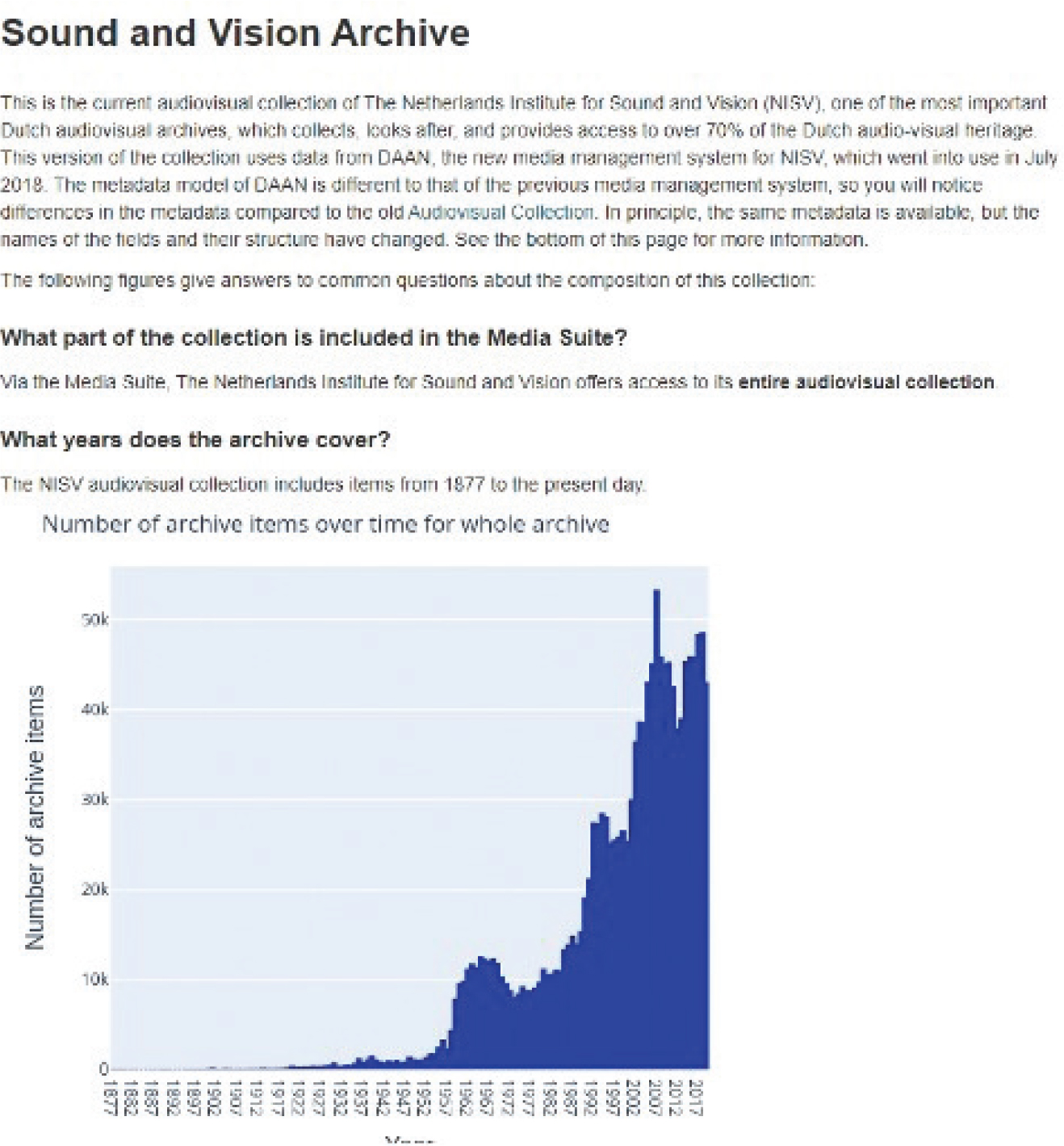
Figure 5
Screengrab of the Media Suite’s Collection Inspector showing a graph of the number of items in the collection of the Netherland of Sound and Vision.
The process of acknowledging the opportunities of such a research environment asked for a professional ‘prepared’ mindset, meaning that it takes time to scrutinise archival collections. Archival research, even if collections are available online, is an iterative laborious endeavour. To help students develop this professional mindset, the class assignments included the request for logbooks, documenting their search journey, keeping track of their time spent, and journaling their failures and dead ends. Time and effort were then also rewarded in the assessment. The idea was that students learn that transforming their intuitive search habit into a skill takes time and effort.
Third and finally, DISCERN taught students to explicate search practices and provided them with insights about how to make sense of algorithmic curation and how intermediated search becomes meaningful to them and their peers. By teaching students particular methods, for instance, how to develop exploratory search tasks, user studies using interviews and think-aloud protocols, or engage in tool criticism, they can become versed not only in critical reflections about search results offered by the archive but also skilled in discerning how they as users are technically enabled to find something in the archive in the first place. Their learning curve was assessed on the basis of the exploratory search tasks they developed, their search diaries, filled-out tool criticism templates, user study reports, and final poster presentation. These forms of assessment let them reflect on how search affords serendipitous information encountering. The step of letting students reflect ‘out loud’ using think-aloud protocols, for example, encourages students to verbalise how they seek and browse. The subsequent step of analysing these protocols allows them to retrospectively trace serendipitous information encounters.
During the final event (or closing symposium) of Suite Discoveries held in Gather Town, students presented their own insights about serendipitous information encountering and their ‘search learning’ journeys in a poster session. There, one student shared his curiosity-informed search practice; critical reflection on his own search diaries let him recognise his tendency to ‘go down rabbit holes,’ which effectively led him to useful video materials that he had never seen before. He was, in other words, surprised about his own exploratory search practices and what these let him encounter. Similarly, another student (see her poster in Figure 6) reported that the modules let her recognise that her search tactic of ‘playing the system’ triggered serendipity; her use of queries to investigate an urban topic like gentrification did not lead to any findings in the archive, which prompted her to describe gentrification in terms that would have been used in the past (e.g., ‘urban renewal’). A key insight here is that by providing students with the vocabulary and skills to explicitly reflect on their search practices, students became aware of how search tools and interfaces afford serendipitous search; that becoming aware of the role of tools helps them better grasp how search technologies shape their learning and knowledge-acquisition processes.
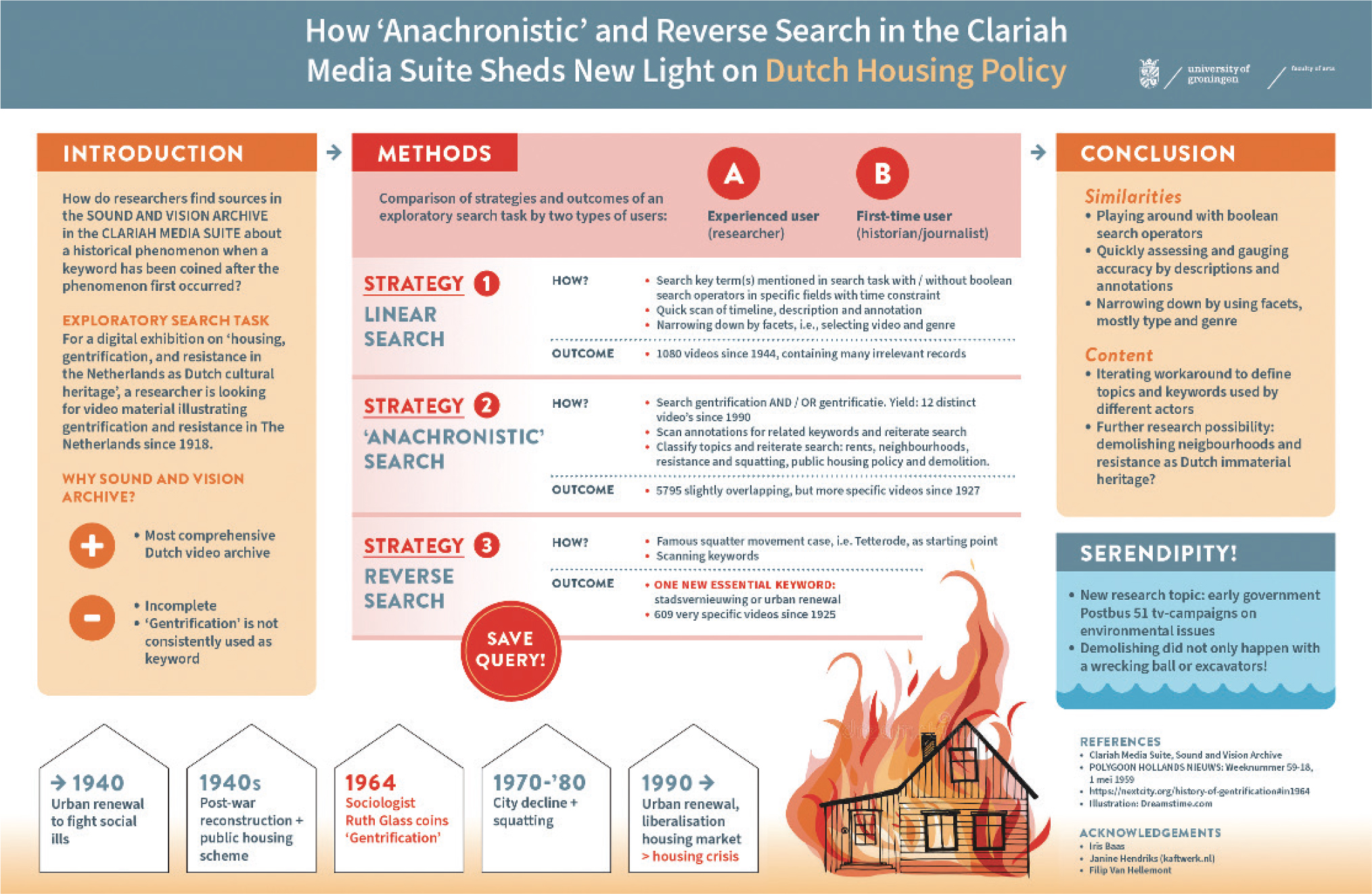
Figure 6
Student poster Suite Discoveries final event, presented in Gather town.
Changing habits is difficult. It is a pedagogical challenge to teach students to develop new search routines, to develop their critical skills in using the affordances of a large digital infrastructure like the CLARIAH Media Suite operates, but also to raise their awareness of how these operate. The main challenge is that students are accustomed to a particular user-centred search regime (for instance, Google), which means that keyword search is how they predominantly search online. This habitual search does not match the intermediated search offered by the Media Suite. Students, therefore faced a steep learning curve as they learnt how to search with the Media Suite tools. This entailed a kind of ‘de-Google-ing’: using a systematic, pedagogical approach that supports students in moving from a user-centred search regime to an archival one. As a highly intermediated archival infrastructure, the Media Suite lacks the intuitive use that disintermediated search engines have, which enforces a specific set of skills. While the students learnt these new skills, for example, by experimenting with search filters and search facets, they also encountered information serendipitously. On the one hand, it was the process of appropriating and tinkering with a new search regime that in part triggered serendipity. Search results were at times unforeseen, yet deemed fruitful, due to unfamiliarity with the Media Suite. On the other hand, information was encountered serendipitously while the students became inspired by the search results that encouraged further exploratory search. Serendipitous information encountering was therefore facilitated by both intermediated search and institutionally curated access to audiovisual collections. Part of the pedagogical challenge was thus to teach students how to discern particular intermediated search experiences as serendipitous, and let them appropriate tactics of serendipitous information encountering into their search skillset beyond these specific Bachelor and Master courses.
5 Recommendations
The Media Suite’s search tools are more artefact-centred than user-centred, meaning the archive adapts less to the user than students expect. Within the user-orientated search regime of dominant online search engines, students are less accustomed to archival search and curation. The teaching modules within the courses, therefore, made students aware of intermediated search regimes and how algorithmic curation works within particular archival settings and interfaces. They had to ‘de-Google’ themselves, turning the habit of searching into craft. This underlines the importance of paying continuous attention to the craft of searching within the academic curriculum and as part of media-making practices.
An overarching issue is the appropriation of digital search tools embedded in a large data infrastructure into the international classrooms that formed the context of our pedagogical practice. The challenge is to transcend a tool-orientated focus. Our paper draws attention to a tension that we observe between teaching about tools and incorporating tools into learning processes. When we teach students about cutting-edge tools, we invariably also draw attention to how specific tools shape particular research practices, such as exploratory search, storytelling, and curation, and how, for example, tool criticism allows for an understanding of what specific tool design indicates about what its developers consider to be knowledge. Learning about the CLARIAH Media Suite and what its tools afford in terms of searching, discovering, and remixing audiovisual sources is one thing. It is quite another step to go beyond that and learn how this particular tool reconfigures research and learning processes and even the notion of what it means to learn anything as such. For instance, how searching, exploring, and refining audiovisual material in the Media Suite shapes the story and production of a multimodal narrative (see Video 1 and Video 2).
Therefore, our case study has implications beyond the observations we share in this article. As such, the following recommendations can be suggestions for a general digital literacy skill that can be helpful to citizens in a datafied society.
Our recommendations for archives, teachers, and students who explore digital archives and learn about digital (re)search are:
Know your audience and their awareness of search habits
Intuitive search does not work in an (inter)mediated institutional search environment, and this provides room to expand a specific set of skills
From habit to craft: acknowledge and bend cultures of search, depending on the learning goal
Cultivate awareness in your user. There are two sides to this in the educational setting: learning about searching the archive and learning about what can be found in the archive
(Inter)mediated search can help raise historical awareness about past events and their specific sensitivities. Keywords matter
Drive engagement with the archive and tool by teaching transferable skills that are useful for (future) image researchers, digital curators, or journalists.
Re(search) is an iterative process: going from tensions between focused search and discovery, to creative reuse and multi-modal storytelling practices (e.g. new stories in video essays)
For archives, the challenge is to balance the complexity of search and retrieval with expectations of and about foreseen use and users. For students and teachers, the challenge is to learn about a tool but also to adapt their tracing and making processes by means of discerned tool use.
Acknowledgements
This research was supported by three CLARIAH PLUS Teaching Fellowships CP-21-F-11, CP-21-F-12, and CP-21-F-13 (CLARIAH-PLUS 2019-2023). The authors would like to thank all the students who participated in the fellowship-related courses, as well as Iris Baas for her research assistance throughout the project.
Ethics Approval Statement
The students who took part in the Suite Discoveries Teaching Fellowships provided informed consent for the use of their data.
Notes
[1] Andrea Bonaccorsi, “Search Regimes and the Industrial Dynamics of Science,” Minerva 46, (2008): 285-315.
[2] Sanda Erdelez and Stephann Makri, “Information Encountering Re-encountered: A Conceptual Re-examination of Serendipity in the Context of Information Acquisition,” Journal of Documentation 76, no. 3 (2020): 731-751.
[3] Steve Woolgar, “Configuring the User: The Case of Usability Trials,” The Sociological Review 38, no. 1_suppl (1990): 58-99.
[4] Nelly Oudshoorn and Trevor Pinch, eds., How Users Matter: The Co-Construction of Users and Technology (Massachussets, MA: MIT Press, 2005).
[5] For a tutorial about the search capabilities within the CLARIAH Media Suite, see: CLARIAH Media Suite - Tutorial: Searching and Bookmarking for Television History, https://mediasuite.clariah.nl/learn/tool-tutorials/tutorial-searching-and-bookmarking-for-television-history
[6] There are also key differences in curatorial practices of accessing and cataloguing between ‘living archives’ such as YouTube and more traditional, institutionally curated archives that impact their digital search, see Alan McKee, “YouTube versus the National Film and Sound Archive: which is the more useful resource for historians of Australian television?,” Television & New Media 12, no. 2 (2011): 154-173.
[7] José Van Dijck, Thomas Poell, and Martijn De Waal, The Platform Society: Public Values in a Connective World (Oxford: Oxford University Press, 2018).
[8] Karen F. Gracy, “Moving image preservation and cultural capital,” Library Trends 56, no. 1 (2007): 194.
[9] Rick Prelinger, “The Appearance of Archives,” in The YouTube Reader, eds. Pelle Snickars and Patrick Vonderau (Stockholm: National Library of Sweden, 2009): 268-675, 268.
[12] John Hartley, “The Probability Archive: From Essence to Uncertainty in the Growth of Knowledge,” Proceedings of The Internet Turning 40: The Never-Ending Novelty of New Media Research?, (2010): 2.
[13] Giovanni Colavizza, Tobias Blanke, Charles Jeurgens, and Julia Noordegraaf, “Archives and AI: An Overview of Current Debates and Future Perspectives,” ACM Journal on Computing and Cultural Heritage (JOCCH) 15, no. 1 (2021): 1-15.
[14] Michael Moss, David Thomas, and Tim Gollins, “The Reconfiguration of the Archive as Data to be Mined,” Archivaria 86, no. 86 (2018): 118-151, 131.
[15] Shawn Graham, Ian Milligan, and Scott Weingart, Exploring Big Historical Data: The Historian’s Macroscope (London: Imperial College Press, 2016).
[16] Arjun Sabharwal, “Digital Humanities and the Emerging Framework for Digital Curation,” College & Undergraduate Libraries 24, no. 2-4 (2017): 238-256.
[17] See: Sabharwal, “Digital Humanities and the Emerging Framework for Digital Curation”; Marc Bron, Jasmijn Van Gorp, and Maarten De Rijke, “Media Studies Research in the Data-Driven Age: How Research Questions Evolve,” Journal of the Association for Information Science and Technology 67, no. 7 (2016): 1535-1554; Liliana Melgar-Estrada, Marijn Koolen, Kaspar Beelen, Hugo Huurdeman, Mari Wigham, Carlos Martinez-Ortiz, Jaap Blom, and Roeland Ordelman, “The CLARIAH Media Suite: A Hybrid Approach to System Design in the Humanities,” in Proceedings of the 2019 Conference on Human Information Interaction and Retrieval, 2019, 373-377.
[18] Max Kemman, Martijn Kleppe, and Stef Scagliola, “Just Google It,” in Proceedings of the Digital Humanities Congress 2012, 2014, HRI Online Publications.
[19] Jane Winters and Andrew Prescott, “Negotiating the Born-Digital: A Problem of Search,” Archives and Manuscripts 47, no. 3 (2019): 391-403; See also: Alexander Halavais, Search Engine Society (Oxford: John Wiley & Sons, 2017).
[20] Ted Underwood, “Theorizing Research Practices We Forgot to Theorize Twenty Years Ago,” Representations 127, no. 1 (2014): 64-72.
[21] Mark Bell, “From Tree to Network: Reordering an Archival Catalogue,” Records Management Journal 30, no. 3 (2020): 379-394, 380.
[23] Pia Borlund, Nils Pharo, and Ying-Hsang Liu, “Scholars’ Searching for Audio-Visual Information in Archives,” VIEW: Journal of European Television History and Culture 12, no. 24 (2023): 87-101.
[26] Erdelez and Makri, “Information Encountering Re-encountered”; Lori McCay-Peet and Elaine G. Toms, Researching Serendipity in Digital Information Environments (London: Springer Nature, 2022).
[27] Sanda Erdelez, Jannica Heinström, Stephann Makri, Lennart Björneborn, Jamshid Beheshti, Elaine Toms, and Naresh Kumar Agarwal, “Research Perspectives on Serendipity and Information Encountering,” Proceedings of the Association for Information Science and Technology 53, no. 1 (2016): 1-5.
[28] Allen Foster and Nigel Ford, “Serendipity and Information Seeking: An Empirical Study,” Journal of Documentation 59, no. 3 (2003): 321-340.
[29] Yaxi Liu, Chunxiu Qin, Yulong Wang, and XuBu Ma, “Exploratory Search in Information Systems: A Systematic Review,” The Electronic Library 42, no. 2 (2024): 308-339.
[31] Sabrina Sauer and Maarten de Rijke, “Seeking Serendipity: A Living Lab Approach to Understanding Creative Retrieval in Broadcast Media Production,” in Proceedings of the 39th International ACM SIGIR conference on Research and Development in Information Retrieval, 2016, 989-992.
[32] Mark de Rond and Iain Morley, eds., Serendipity: Fortune and the Prepared Mind (Cambridge: Cambridge University Press, 2010.)
[33] Vlad P. Glăveanu, “What’s ‘Inside’ the Prepared Mind? Not Things, but Relations,” in The Art of Serendipity, eds. Wendy Ross and Samantha Copeland (Cham: Springer International Publishing, 2022), 23-39.
[34] Wendy Ross and Frédéric Vallée-Tourangeau, “Microserendipity in the Creative Process,” The Journal of Creative Behavior 55, no. 3 (2021): 661-672.
[35] Berber Hagedoorn and Sabrina Sauer, “The Researcher as Storyteller: Using Digital Tools for Search and Storytelling with Audio-Visual Materials,” VIEW: Journal of European Television History and Culture 7, no. 14 (2018): 150-170.
[36] Susan Aasman, Liliana Melgar Estrada, Tom Slootweg, and Rob Wegter, “Tales of a Tool Encounter: Exploring Video Annotation for Doing Media History, VIEW: Journal of European Television History and Culture 7, no. 14 (2018): 73-87.
[37] Stella Sylaiou and Panagiotis Dafiotis, “Storytelling in Virtual Museums: Engaging a Multitude of Voices,” in Visual Computing for Cultural Heritage, eds. Fotis Liarokapis, Athanasios Voulodimos, Nikolaos Doulamis, and Anastasios Doulamis (Cham: Springer, 2020), 369-388.
[38] Sabrina Sauer, “Audiovisual Narrative Creation and Creative Retrieval: How Searching For A Story Shapes the Story,” Journal of Science and Technology of the Arts 9, no. 2 (2017): 37-46.
[39] Jamie Bartlett and Carl Miller, “Truth, Lies and the Internet: A Report into Young People’s Digital Fluency,” 2011, https://demos.co.uk/wp-content/uploads/files/Truth_-_web.pdf
[40] Marijn Koolen, Jasmijn Van Gorp, and Jacco Van Ossenbruggen, “Toward a Model for Digital Tool Criticism: Reflection as Integrative Practice,” Digital Scholarship in the Humanities 34, no. 2 (2019): 368-385.
[41] See Berber Hagedoorn and Iris Baas “Multimodal Storytelling with the Media Suite in the International Classroom,” CLARIAH Media Suite Blog, 9 February 2023, https://mediasuite.clariah.nl/blog/2023/02/09/multimodal-storytelling-with-the-media-suite