
1 A Changing Online Media Landscape
Social media have contributed to a digital environment where misinformation is able to spread rapidly. Even though misinformation can occur on any platform, in this paper we focus on social media platforms because these are widely used and serve as an important source of information. On social media, users engage with content through quick clicks, switching from one message to the other without always critically assessing the credibility of content. Social media platforms have a range of gatekeeping mechanisms that control the visibility and reach of content, but unlike professional journalism, the gatekeeping mechanisms of social media platforms are not necessarily aimed at preventing the visibility and spread of false information. Rather, the gatekeeping mechanisms of social media platforms may boost misinformation via algorithmic amplification of false content and economic incentives that play into the for-profit orientation of corporations operating in the online sphere. All this makes it more likely that users of social media are particularly vulnerable to misinformation1,2.
Despite good efforts on the side of social media platforms to counteract this, it is evident that the self-regulation policies of major online platforms as well as their practices of flagging and blocking false content are not able to keep up with the quantity and speed of misinformation on their platforms (e.g. Global Witness, 2022)3. In response to this, the EU recently introduced the Digital Services Act (DSA), which offers a stronger legal backdrop for regulations of all major digital platforms like FB, Instagram, X, TikTok etc. (European Commission, 2023). This includes more transparency and accountability for online platforms, better protection of users’ fundamental rights online and mitigation of systemic risks for society, like manipulation and disinformation. Under the DSA, social media platforms are asked to provide measures for flagging illegal content, increase transparency about recommender algorithms and allow users to modify this, as well as give researchers access to critical data collected on these platforms. Important for this paper is that the DSA offers a framework for journalists and newsrooms, who are empowered to collaborate with online platforms to detect falsehoods and offer warning messages to users. In an environment where platforms’ existing mitigation strategies against online mis- and disinformation, fall short an active fact-checking community is essential on social media.4
Against this background, this article discusses a number of challenges and practical, evidence-based recommendations on how journalists can respond to challenges and opportunities in the current digital media ecology, where misinformation as well as corrections are often found online. We focus on the journalistic practice of fact-checking, because it is widely considered to be among the most effective journalistic responses to online false information5. Journalism practice is grounded in journalistic ethics and norms, such as dedication to truth and accuracy6. Typically fact-checkers come to a verdict about the veracity of a claim by checking whether it is in line with the best available evidence or expert knowledge7. Despite ethics and norms, the functioning of journalistic practice depends on the communication ecology within which journalists operate, including the affordances of social media platforms, and public perceptions of journalism, which may be undermined by concern around mis- and disinformation and a lack of trust8. As such, journalists who operate on social media platforms may face challenges in upholding journalistic norms and their role as truth defenders.
Our vantage point is that of academic researchers who work closely with fact-checkers and journalists to produce practically relevant research. In general, our normative position is that the fight against mis- and disinformation will be most successful if efforts are combined across various kinds of expertise and strategies. Such a collective civic project is reflected in the European Digital Media Observatory (EDMO), which brings together researchers, fact-checkers, media literacy experts, policy makers and tool developers in a united fight against disinformation. Our approach in this particular paper fits into the tradition of co-production between researchers and journalists where researchers typically focus on engaging with the scientific evidence and journalists are sparring partners who provide perspective, contribute with real-life stories and ensure the utility and relevance for the intended audience9. As such, the concrete output of this paper is a combination of evidence-based recommendations and practical examples of where these are already applied, based on the expertise of fact-checking organisations from the EDMO as well as from the Dutch-Flemish hub of EDMO (BENEDMO) who have supported the writing of this article. The cases and practical examples are by no means exhaustive, but simply serve to illustrate a variety of fact-checking practices that currently occur on some of the most widely used social media platforms.
Despite the focus on fact-checking, the challenges and recommendations laid out in this article are more widely applicable and can directly be translated to other journalistic content and communication of television newsrooms as well as other media outlets. This is especially relevant to consider against the background of emerging technologies like generative AI which pose additional challenges in the social media context. Although disinformation narratives may originate from the fringes of the political spectrum or online communities, they may eventually be covered in the regular news media due to the attention they have generated online. To illustrate this, journalists are known to be active on X and may pick up viral messages and embed them in regular news coverage, even if these stories turn out to be untrue later. Disinformation narratives and the platforms on which these are spread may be legitimised by journalists when covered in the news media10 which makes it important for journalists to act on their roles as fact-checkers or ‘truth crusaders’11.
2 Challenges and Recommendations for Fighting Disinformation on Social Media
2.1 Affordances Differ Across Social Media Platforms
Social media platforms have different affordances such that they differ in the types of content and engagement they facilitate. This presents both a set of challenges and opportunities for communicators who want to boost engagement with reliable information because they need to adjust their communication format and content to the platform. For example, images and polls yield higher levels of online engagement than text-only tweets on platforms such as X12. Moreover, the reach and lifetime of online content differs dramatically across platforms: The half-life of a tweet is 24 minutes, and that of an Instagram post about 20h13. Such intricacies of different platforms have implications for the visibility of journalistic content and fact-checks on different platforms. Accurate online information (e.g., journalistic articles or fact-checks) may increase in visibility if it relies on rich modalities, such as images and videos or interactive formats such as polls. Limited attention and high competition put pressure on corrective information to stand out and be highly visible to be selected – which is a challenge as such information is typically less engaging than sensational disinformation narratives. It also raises the question of how fact-checks can correct false information without driving up engagement with false content.
To boost engagement with fact-checks, fact-checks may be presented in a format that best matches the most attention-grabbing, cue-rich and share-worthy content on these platforms. An example for TikTok would be to create very short micro-tutorials in a video format that teach people how mis- and disinformation can be detected online, involving users in the strategies and mechanisms of fact-checking (see Figure 1). Dynamism and visual stimuli are the key components to engage on TikTok, and it also makes sense to include for example music, which is one of the variables of the algorithm to enhance the visibility of content in the main feed.
For X, a thread with distinct practical tips on how falsehoods are tracked down supported by images and videos may better match the manner in which X is used. A case in point is a thread by the fact-check organisation Factchequeado who verified claims made by Joe Biden and Donald Trump in their presidential debate (link: https://x.com/factchequeado/status/1806491819779252249). In general, fact-checking information is likely most effective when it is transferred to the format that results in the highest level of engagement and tailored to the ways in which content is being shared and consumed on the respective platforms.

Figure 1
Screenshots from Africacheck’s TikTok micro-tutorial on how to verify information online. The video is a dynamic portrait video which involves clear textual graphics of key points. Retrieved from https://www.tiktok.com/@africacheck/video/7358001925515660550
Importantly, as visual misinformation is much more salient than textual misinformation on social media14, fact-checkers nowadays respond to the visual nature of misleading information, by explaining how visuals have been used as ‘false proof’ for deceptive claims (see Figure 2). These explanations can be matched to the visual nature of different platforms, such as Instagram or TikTok, and clearly show the authentic visuals in their actual context beyond simply reporting on how visuals were used in a manipulated way through text. Visual corrections may be a more powerful mode of correcting the visual nature of mis- and disinformation on social media than longer textual formats. Still, visual presentations of fact-checks may benefit from including sufficient background information and evidence to ensure transparency and reproducibility of the underlying investigation. An example is provided by the Romanian fact-check organisation Factual which not only corrects a false video that claims to show people starving because of digital money in Nigeria, but it also explains and debunks in detail the persisting conspiracy theory that underlies the false video (link: https://www.factual.ro/dezinformari-retele-sociale/fals-oamenii-mor-de-foame-din-cauza-banilor-digitali-in-nigeria/) We can learn from this that the visual nature of corrective information can be exploited while also including factual, text-based information to refute false claims.
Visuals are also very suitable as evidence as they bear a closer resemblance to reality than text, a quality that has been referred to as indexicality15. One potential manner of integrating visuals into factual communication is to show experts being interviewed to discuss disputed claims, or to present verifications in the form of infographics, or interactive graphs. An example can be found in the interactive and open-source map by Bellingcat that keeps track of incidents of civilian harm in Ukraine since Russia’s full scale invasion in 2022, presenting counter-evidence against the false claim that the Russian attack did not hit civilian targets in Ukraine. (see Figure 3).
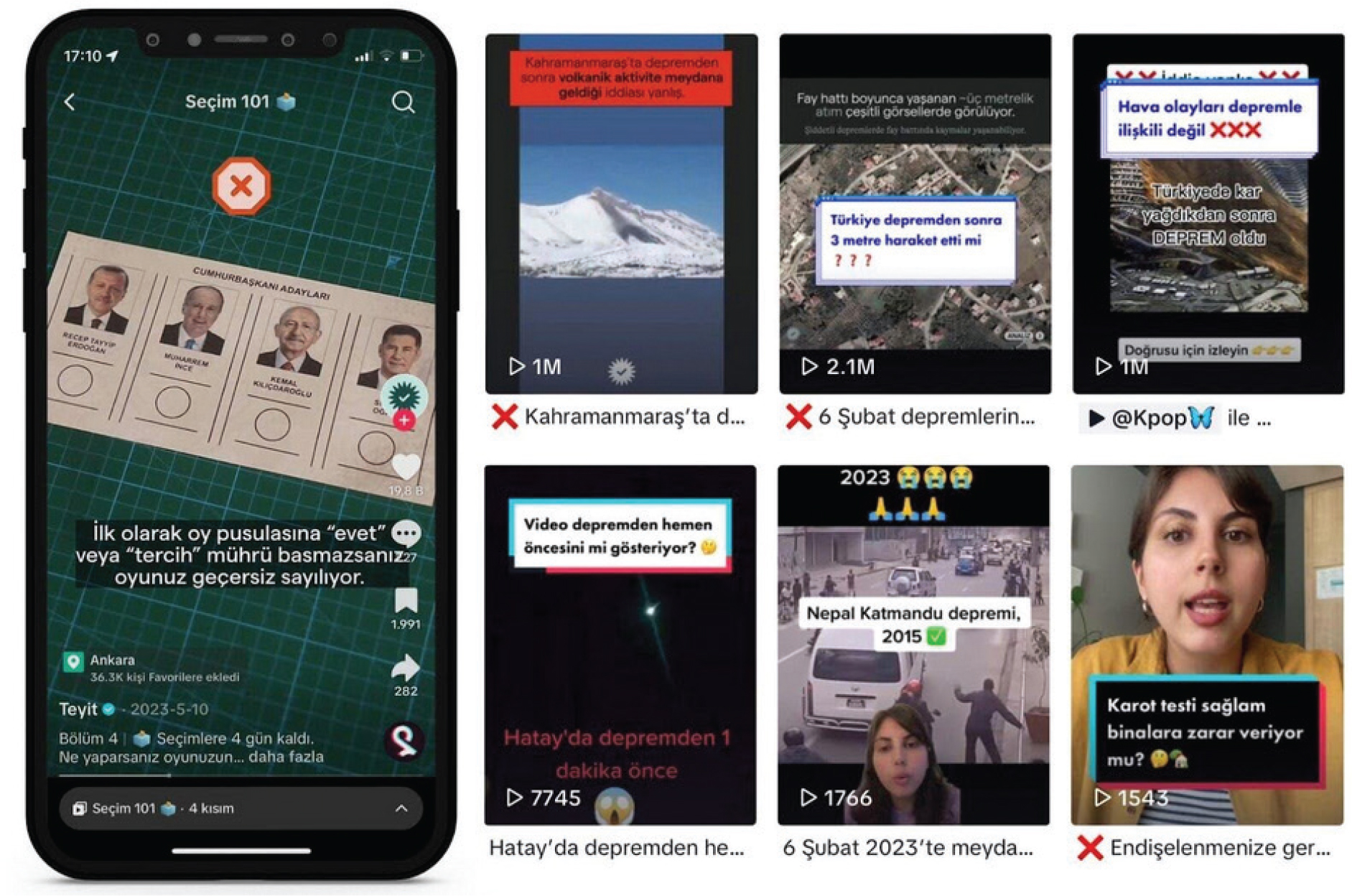
Figure 2
Screenshots of fact-check videos by Turkish Teyit .These videos show how original content is integrated into the fact-checking videos, exposing how videos have been manipulated or why the provided context is false. Retrieved from https://teyit.org/ekipten/kriz-gundeminde-tiktok-2023te-tiktokta-neler-yaptik
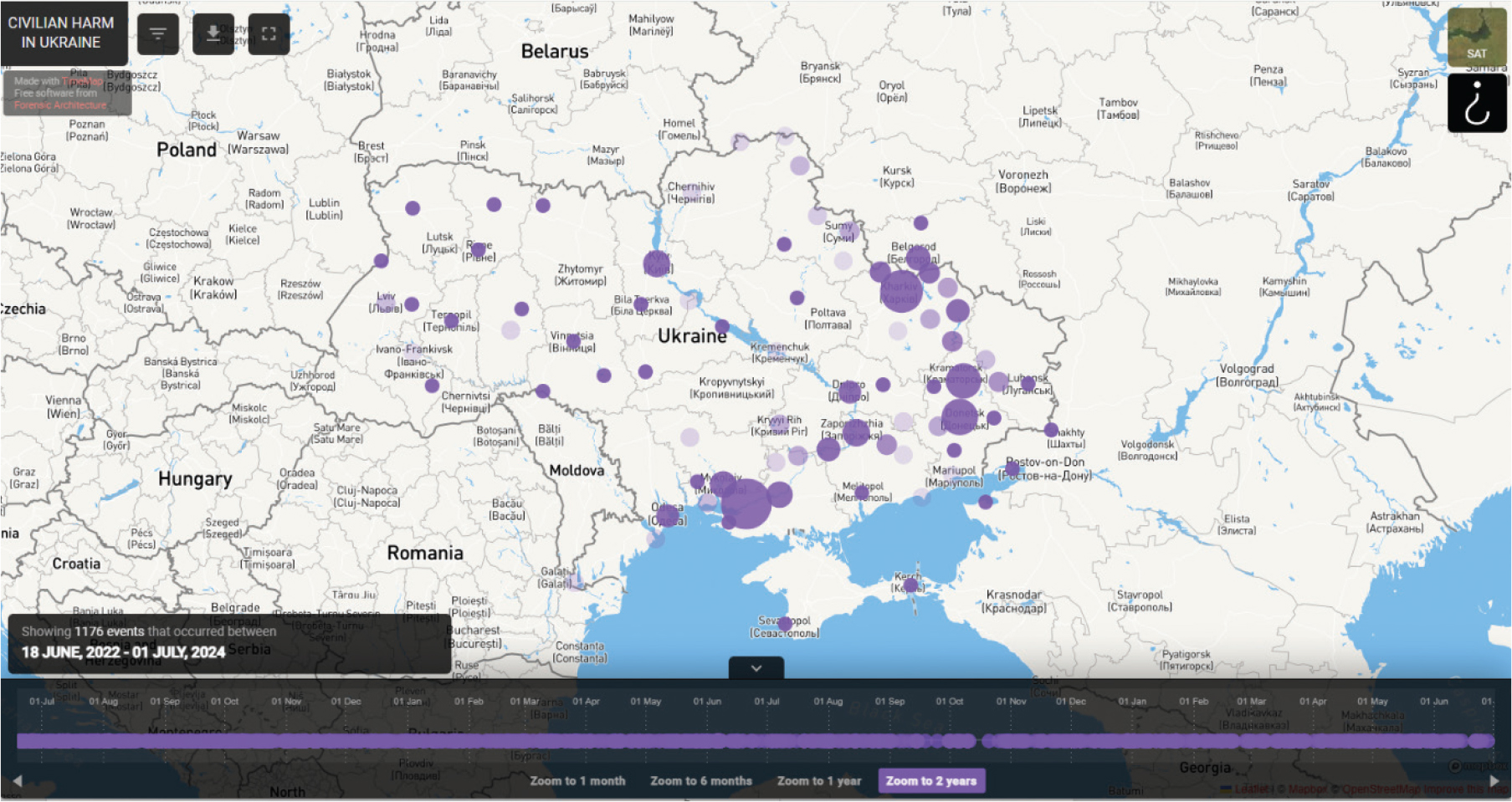
Figure 3
Screenshot of an interactive map by Bellingcat documenting incidents of civilian harm during the Russian war in Ukraine. Retrieved from https://ukraine.bellingcat.com/
Another approach is for fact-checkers to make corrective messages more visible, and to increase the likelihood that people are exposed to them. Using attention-grabbing visuals, clear labels showing the verdict to social media users, and repetition may be ways to enhance visibility. Hence, as misinformation may be much more visible than the fact-checks, the repetition of corrective information may be a viable approach in the battle for attention. While some studies warn of the possible negative side-effects of repeating a false claim, there are also advantages for the visibility of fact-checks on social media. Fact-check posts on Facebook that repeat a false claim were found to trigger more engagement in the form of user comments than fact-checks that did not repeat the false claim16. More engagement in turn increases the visibility of fact-checks on social media.
This strategy of piggybacking on the virality of false content, however, runs the risk of making false content stand out even more. Existing literature therefore recommends to only cautiously apply this for false claims that have already been spread widely17. For false claims that have not yet entered public awareness, many users might not have been exposed to the false claim if it wasn’t for the fact-check. In this case, repetition might unnecessarily contribute to the visibility of false statements. One way to limit the algorithmic amplification of false content is to respond to screenshots of false content instead of the original posts. When repeating or following up on fact-checking information, recipients may benefit from being reminded of the factually accurate interpretation or information, while limiting attention to the false claims. To increase the spread and impact of a fact-check without backfire effects, a simple method is to re-post fact-checks multiple times18. As the stories develop, these re-posts can be elaborated on with follow-up investigations and analyses.
As the above examples show, fact-checkers have already made progress in the direction of adopting formats to the affordances of different social media. Various fact-check organisations are active on social media like X, Instagram and TikTok and adapt content to the logic of those platforms. Factcheck.vlaanderen for example adjusts its long-form fact-check articles to fit the format of stories on Instagram - which is a practical application of the recommendation to present fact-checks in a way that matches the online consumption patterns of social media users. Importantly, there are already important shifts in fact-checking ensuring that disinformation and its correction do not operate on isolated spaces for isolated audiences, as we have seen in the case of Africacheck’s micro tutorials on TikTok (Figure 1). A forward looking perspective would involve the use of even more accessible, easy to process and shorter formats that increase the likelihood that fact-checks stand out and are selected and used.
2.2 The Attention Economy, Virality and Fear of Missing Out
A second challenge is that social media platforms work according to the attention economy where attention is a scare resource that companies and content creators compete for19. Accordingly, disinformation is often created with the intention to gauge as much attention as possible and go viral. False information plays into the logic of the attention economy because it uses controversial, sensational, and emotional headlines and language, which appears to be favoured by the algorithms. Individuals are particularly vulnerable to disinformation in social media settings, in part because social relationships are a key motivation for sharing (fake) news20. This works in a similar fashion as the dissemination of gossip: Individuals can gain reputation by sharing “novel” and “sensational” information. This may relate to the idea of a “Fear of missing out”, where people need to share and feel connected to sensational information as they do not want to miss out on the latest gossip and newsworthy developments21,22. On the other hand, fear of losing reputation in the eyes of the social network, can also function as a deterrent to sharing misinformation23. In other words, people may become less willing to share false information if they fear that this can result in reputation loss.
Virality of content can function as a social cue that the given content is socially accepted2. A focus on misinformation that seems legitimate to high levels of social support may thus have the highest impact as such false information could have the strongest effects on people’s misperceptions. While social media platforms thus far have not fully revealed the workings of their algorithms, under the DSA we might expect more insights and transparency. As users learn about why they see certain content, and have the ability to modify what kind of content is presented to them, we might gain more insights into how to make accurate content more appealing. This is further supported by the DSA requirement to give data access to researchers to better understand the inner workings of social media platforms and how these affect individual online behaviour.
Fact-checks may benefit from using some of the same features that make misinformation appear legitimate in the attention economy. As rebuttals still need to come across as trustworthy, there may be a need to maintain a balance between coming across as trustworthy and authoritative whilst still gaining attention from social media users. To compete with misinformation, it may be worthwhile to make appeals to social relationships and reputation loss that can result from sharing misinformation. Fact-checks can stress the importance of being informed accurately on issues that are breaking and that other people ‘like you’ care about.
Factcheck.vlaanderen has applied this strategy through the format of the Tooties24: a social media account of a cartoon figure that is less elitist and less likely to be avoided by social media users exposed to misinformation (Figure 4). The use of an online cartoon figure allowed the fact-checkers to use a less established and formal style, for example, using humour and personalization (i.e., directly responding to people sharing false information). This is an effective strategy as it avoids the resistance that can be caused by the attack on people’s beliefs offered by a formal fact-check perceived as part of the establishment. The direct interaction with users also helps to present corrective information as more native interactions between users correcting each other. The main issue of this approach is its scalability: It requires a lot of human effort to respond to users sharing misinformation, and the automation of such an approach is still not feasible. However, moving forward, the affordances in AI could make personalised approaches to fact-checking less time consuming and more efficient.

Figure 4
Tooties who are used as messengers of fact-checks and debunks in direct content interventions by Fackcheck.vlaanderen.
Alternatively, fact-checkers can reveal why misinformation may go viral, and disentangle the strategies used by malicious agents to make content go viral online, for example, by explaining how misinformation is aimed to gain attention from audiences. This includes revealing what strategies may have been used by sources of misinformation to boost engagement, and seduce online media users to click on misleading headlines to make false information go viral. Informing social media users on how they are being persuaded to engage may make people more aware of the strategies employed by misinformation agents, and herewith lower the engagement with false information online.
Many fact-check platforms have already employed this reasoning in part. Factcheck.vlaanderen, Nieuwscheckers and many other platforms aim to clearly explain to users how false information was created, and what has been done to make the false content seem real. Existing inoculation approaches such as the ‘bad news’ game25 are currently predominantly used as pre-bunking techniques (link to the game: https://www.getbadnews.com/books/english/). A simulation of the social media logic of mis- and disinformation could also help social media users to better understand the reasons why false information may have a big impact online, and how the affordances of social media may be exploited by malicious actors to get their message across. This could include a demonstration of the ‘black box’ behind the dissemination strategies of misinformation, and interactive approaches that involve users could help to raise awareness about the social media dynamics behind deceptive information. Polls and videos with simulations of virality may be attractive formats that are native to many digital platforms and that could be worthwhile to experiment with more in the future.
2.3 Psychological Needs of Users
A third challenge for communicators on social media platforms is that the large amount of content is particularly likely to fatigue users, which impairs their judgement of the credibility of information. Design choices such as personalised recommendations and infinite scrolling produce an endless stream of content. These design features are intended to keep users engaged on the platform for longer periods, but they can also contribute to information overload. With the increasing number of users and the constant flow of new information, it can be challenging to filter out relevant information. Research that draws on cognitive load theory, found that people who are more overloaded with information are more likely to believe and share unverified information26. In addition, if people experience more information overload, their ability to detect false information drops27. One of the explanations is that misinformation is easy to process as it relies on simple explanations, and attention-grabbing images or videos.
While it is easier to produce a simple, false story, refuting the same or creating a well-founded story often requires more complexity. Still, fact-checks may benefit from considering the cognitive load of social media users. If processing effort is kept as low as possible, fact-checks may be more effective among an audience of fatigued users. This includes presenting the verdict of a false claim clearly and inaccessible language, relying on images over text (e.g., on X and Facebook) and shorter over longer videos (e.g., on Instagram, YouTube and TikTok). In addition, it could be considered that fact-checks are less likely to be selected when they offer an attack on people’s existing beliefs and attitudes28, emphasising the need to avoid resistance from users that perceive the fact-check as an attack on their most profound beliefs and identities.
Many fact-check formats have already engaged with this suggestion. DeCheckers, for example, strategically shares fact-checks in a way to overcome polarisation and a strong attack on people’s existing beliefs. They achieve this via direct content interventions under the disguise of “Anna” or “Anna-Lau”, an individual who gently nudges false information spreaders towards fact-checks and accurate information on social media (see Figure 5). By placing these non-polarizing suggestions as comments underneath posts that contain false information, DeCheckers may overcome psychological resistance among people most inclined to support the arguments of the original false information. Nieuwscheckers, in addition, uses a fixed format of fact-checking with various headers that guide social media users through the verdict - allowing people to find relevant information about the refuted claims without investing too much of their scarce resources.

Figure 5
Screenshot from DeCheckers’ direct content intervention via “Anna-Lau” who nudges a user towards a fact-check by commenting underneath their post that contained false information. Retrieved from https://x.com/Leon_Denkt_Zelf/status/1804814726825697692
An important feature of social media is that communication takes place in a two-directional fashion. Rather than treating the audience as passive receivers, fact-checkers can encourage dialogue and active engagement. Various digital news outlets are already harnessing citizen participation via different participatory approaches, including contributions, crowdsourcing or co-creation29. While these are currently mostly hosted on the websites of those outlets, the logic of involving citizens to participate may equally be applied to social media. Over time, this may build a dedicated community of citizen fact-checkers who are involved in each step the of fact-checking process.
The step of building up a community may be particularly important seeing that blindingly inviting engagement with social media posts containing fact-checks tends to attract engagement from individuals who disagree and distrust the verdict of the fact-check (personal communication with fact-checkers from Pointer). To direct this process, one strategy to consider is tagging opinion leaders and relevant accounts that might be interested and willing to engage in a constructive dialogue. If highly connected and relevant accounts positively respond to the fact-check (e.g., by liking, sharing or commenting on it), this might help fact-checks to gain the attention of relevant followers. This strategy might also help establish credibility, since followers might experience the fact-check as validated by a trusted account.
That said, opinion leaders may not always agree with or support the fact-check, and could discredit the fact-checked information when being tagged on social media. A careful selection of relevant opinion leaders and assessing their willingness to be involved in fact-checking is therefore crucial. Hence, fact-checkers may approach a select group of influencers and actively seek their willingness to help make fact-checks more visible and effective.
2.4 An Uneven Race against the Clock
Checking whether a claim is false can take a substantial amount of time, and this is one of the reasons why false information spreads faster and farther than the fact-checks that aim to correct it30. In addition to conducting the actual investigation and verification, fact-checkers are also asked to translate their findings into an interesting story - traditionally a fact-check article that is published on a website but more increasingly a set of social media posts. While fact-checkers are aware of the limited reach of fact-check articles, a lack of time tends to be a serious barrier that makes it difficult to perform the extra step of creating engaging content for various platforms31.
The conversion of a fact-check article to a social media post or visual content requires time as well as image or video creation skills, while resources available for fact-checking have over time been diminishing at media outlets. As discussed above, different social media platforms have different format requirements: At a minimum, X or Facebook posts require a condensed version of the original fact-check article, while Instagram requires an image, and TikTok and YouTube require videos. To make these tasks more manageable and efficient, fact-checkers have begun to work with re-usable and adjustable templates for the various social media platforms. Creating ready-to-use and reusable templates designed for a certain platform could be one way to speed up the work. Good examples of use of templates are Pointer and the Leiden University’s fact-check initiative Nieuwscheckers. Moreover, several aspects of the conversion from a fact-check article to social media posts as well as the sharing of these posts on various platforms could be automated. Automating these steps would free up resources, and allow fact-checkers to focus on essential tasks in the verification process where their professional skills are most needed.
2.5. Need for Collaboration
Countering misinformation online is a complex task and fact-checkers do not need to fight this battle alone. Especially since the Digital Services Act (DSA) came into force, new opportunities opened up for the collaboration between various actors in the fight against misinformation on social media. In EU member states, social media platforms are now asked to collaborate with the fact-checking community and process their flags with priority. This solidifies the work of fact-checkers by providing a meaningful mechanism for the output of their work. Article 31 in the DSA also provides the first ever legislative framework for researcher access to platform data for the purpose of conducting research on “systemic risks”, such as manipulation or deception. This scope of systemic risks is sufficiently broad to incorporate research on misinformation and fact-checking. The purpose of the risk assessment is to hold companies accountable, and monitor whether the self-regulatory initiatives of the very large online platforms (such as Meta or Google) mitigate the systemic risks effectively enough. However, it must be noted that the data request under Article 31 is possible only for “vetted researchers”. Vetted researcher means researchers which are affiliated with universities but also civil society organisations that conduct “scientific research with the primary goal of supporting their public interest mission.” This is a slight limitation to fact-checkers not associated with an academic institution but on the other hand highlights the need for collaborations between researchers and fact-checkers to gain access to rich, real-life data. Together with researchers, fact-checkers could file an application for the data with Digital Service Coordinator of Establishment, which is the DSA regulator in the country the company has headquarters in. As this process might be a bureaucratic hassle and time consuming, scaling up the request as one collaborative application would help all stakeholders in the field of fact-checking to access data fast and efficiently. By collaborating, fact-checkers and researchers can reach a better understanding of the harm of deceptive disinformation campaigns as well as the efficacy of different fact-checking strategies.
Moreover, under the DSA, users are given the opportunity to flag illegal content on social media. Even in countries where the DSA does not apply, fact-checking organisations can invite users to participate in crowdsourcing efforts to spot false information (e.g., by tipping off fact-checkers). Engagement is the ethos of social media and this measure provides a great opportunity to engage social media users in the fact-checking process. X has recently introduced so-called Community Notes which allow regular users to flag content and add notes to contextualise or correct it (see Figure 6). Being part of the fact-checking process, might not only increase the visibility of fact-checks and fact-check organisations but it might also increase trust and relevance among users. Fact-check organisations have already begun to formalise crowdsourcing efforts by setting up “tip-lines” where users can hint/suggest content to fact-check, or setting up a discourse community of ‘tips-givers’ and ‘spreaders of fact-checks’. This is already applied by fact-check organisations, such as deCheckers, VRTNWS and Nieuwscheckers.
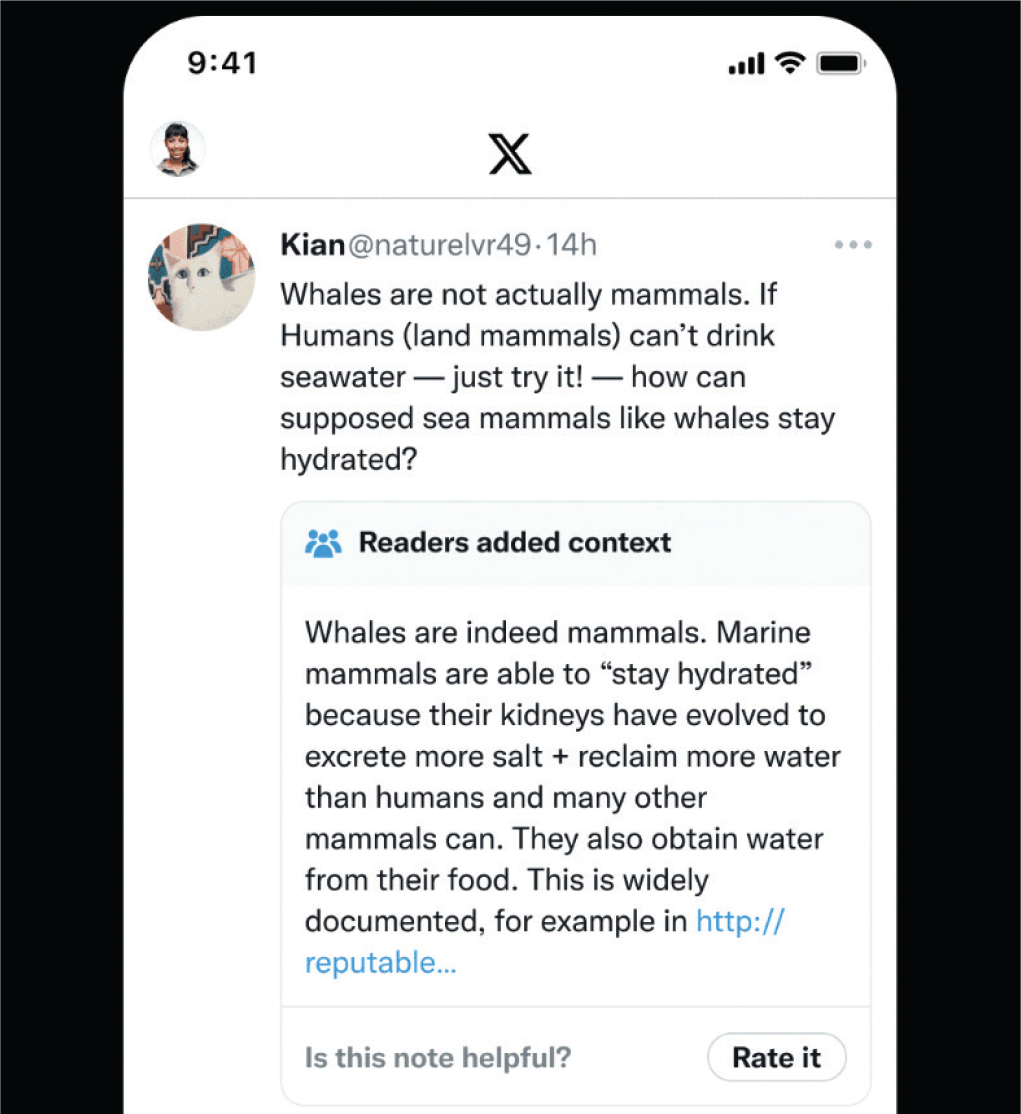
Figure 6
Community Notes on X allow users to provide context and to correct false information. Retrieved from: https://communitynotes.x.com/guide/en/about/introduction
Collaborations with graphic designers and creative professionals might also be particularly effective seeing the general trend towards more visuals in false information as well as in online communication in general. A case in point is the Russian war in Ukraine where false information largely appeared in the form of manipulated images or deceptive videos. To be effective, fact-checks might need to be equally visually appealing. This trend is also reflected in the emergence of new social media platforms. While older social media tend to be text-based (e.g., X, Facebook), more recent social media rely primarily on images or videos (Instagram, TikTok). In order to keep up with this trend, there is a pressure on fact-checks to be communicated in the form of images or videos and fact-checkers might lack the necessary resources or skills related to visual communication. Collaborations with graphic designers and creative professionals can be particularly helpful in this context. They can support fact-checkers in the creation of engaging visual content, such as infographics for Instagram or snappy videos for TikTok. The European Digital Media Observatory as well as its regional hubs provide many examples of collaborations between relevant actors in the fight against false information. Good examples of such collaborative works is Nieuwscheckers’ “teaser videos” for social media which was created with an in-house graphic designer or Factcheck.Vlaanderen’s visualisations for instagram posts. Moreover, FakeNews.pl has created a guide for fact-checkers for how to create content for TikTok (see Figure 7).
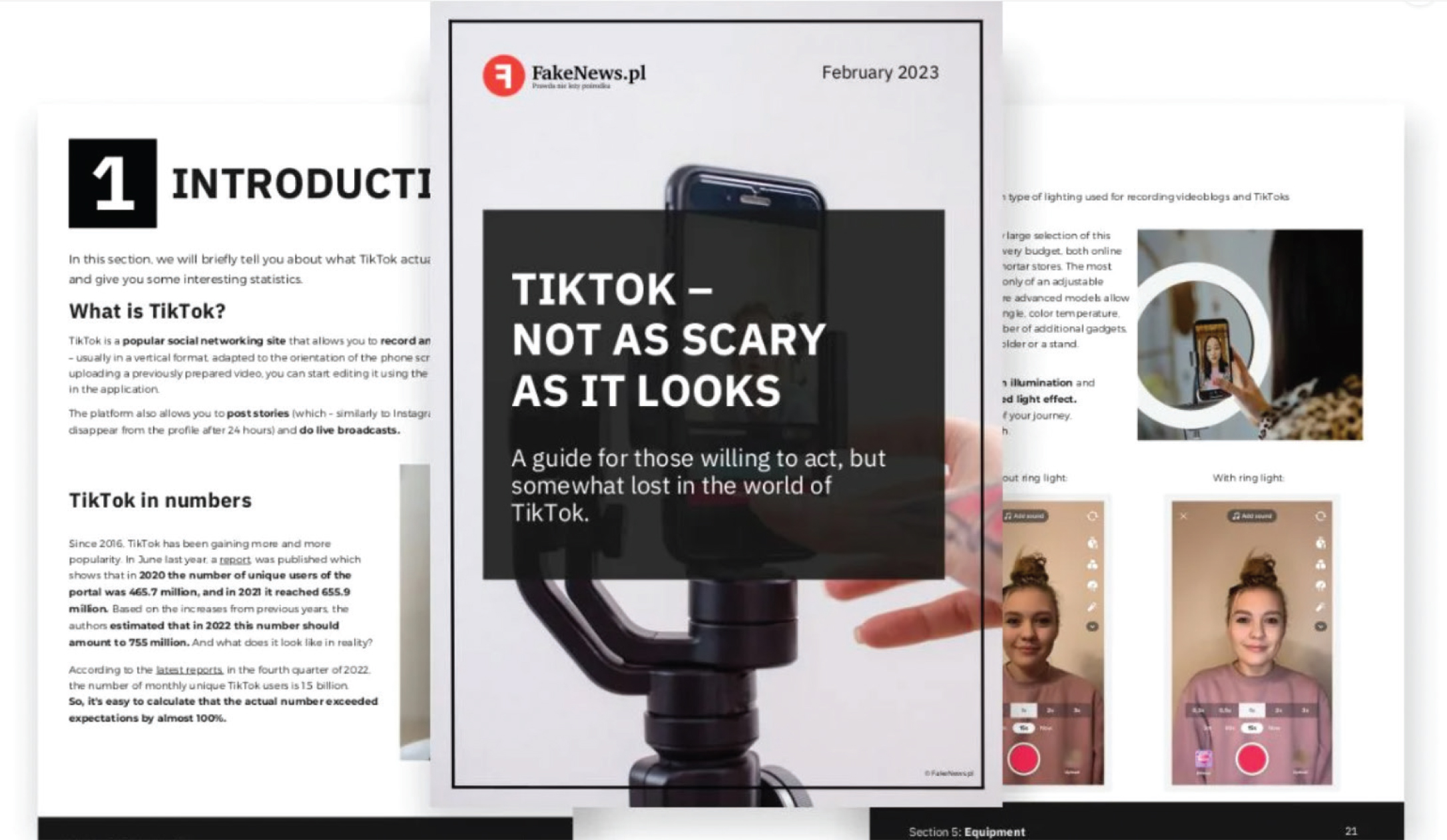
Figure 7
FakeNews.pl provides instructions on how to create visually appealing TikTok videos for the fact-check community. Retrieved from: https://fakenews.pl/en/tiktok-not-as-scary-as-it-looks-a-guide-for-those-who-wish-to-begin-their-tiktok-journey/
Finally, networking events can bring together a variety of stakeholders in the fact-checking community to identify key concerns and build valuable connections, such as at the BENEDMO participant council meetings that invite fact-checkers, scientists, developers and educators32. In the BENEDMO network, collaborations between tool developers and fact-checkers led to the development of technological and methodological solutions that can help improve the workflow for fact-checkers 33. In addition, the tech start-up TextGain collaborates with journalists and fact-checkers on automated detection and monitoring of false information in the online sphere. And fact-checking research labs, such as the BENEDMO research lab can empirically test the efficacy of different fact-check formats and provide evidence-based recommendations on how to make such interventions work more effectively34. Finally, collaborations between fact-checking organisations have been shown to be invaluable. Examples include the fact-checking network of the European Digital Media Observatory, but also collaborations between fact-checkers and OSINT investigators (e.g., Bellingcat) as well as more regional collaborations between fact-checking organisations that work in similar language regions, like the collaborations between VRT, Knack, Pointer, and NieuwsCheckers who work in the Dutch-speaking context. By strengthening collaborations within the fact-checking community, fact-check organisations benefit from existing work, ideas and resources in the community and provide a consolidated response to emerging disinformation threats.
3 Conclusions
Mis- and disinformation mostly reach people via social media channels. This offers a huge challenge to reliable content creators, like fact-checkers, who have to reach a fragmented audience that may be exposed to many mis- and disinformation claims across different platforms. On social media, different false and true claims compete for attention and legitimacy, whereas users spend little attention on a single message in this overloaded attention economy. In this article, we have presented five challenges and summarised five suggestions for communication professionals to make reliable information stand out in this context. The concrete recommendations are based on academic research as well as the practical experience of journalists and fact-checkers, and they include; 1) Boost engagement with reliable information while reducing visibility of false content; 2) Match content formats with the logic of the attention economy of platforms; 3) Tailor content to the psychological needs of users; 4) Automate content creation where possible; 5) Strengthen collaborations between relevant professionals and users.
These suggestions have in common that fact-checkers are present on the same locations as the original mis- and disinformation messages, adjust to the logic of the platforms, and reach the audience that is most vulnerable to the false claims. Existing formats of fact-checks in the European Digital Media Observatory network already make important steps by presenting their corrections on different social media accounts, or by responding directly to mis- and disinformation with a fact-check in the comments. Relatedly, fact-checks are more likely to reach users if they are presented in a format that catches attention and stimulates processing of refutations. The visual nature of both misinformation and social media content will likely continue to be relevant in the future of fact-checking practices.
While the recommendations were framed around the practice of fact-checking, they can effortlessly be applied to the broader spectrum of journalistic practices and the evolving contemporary newsroom. Given the visual nature of both misinformation and the social media landscape, traditional newsrooms are strongly encouraged to embrace diverse media forms to continue to capture their audience’s attention and secure trust. In this context, harnessing the power of multimedia is pivotal. This may entail incorporating captivating visual elements, like videos or interactive infographics into journalism, using striking data visualisations in documentaries, or promoting TV content via interactive tools on social media that grab the audience’s attention while delivering fact-based narratives.
Acknowledgement
The author thanks BENEDMO for supporting the work on this article.
Notes
[1] Ahmed Al-Rawi, “Gatekeeping Fake News Discourses on Mainstream Media Versus Social Media,” Social Science Computer Review 37, no. 6 (December 2019), https://doi.org/10.1177/0894439318795849.
[2] Myojung Chung and Nuri Kim, “When I Learn the News Is False: How Fact-Checking Information Stems the Spread of Fake News Via Third-Person Perception,” Human Communication Research 47, no. 1 (February 8, 2021): 1–24, https://doi.org/10.1093/hcr/hqaa010.
[3] Global Witness and the Cybersecurity for Democracy (C4D) team at NYU Tandon (October 21, 2022). TikTok and Facebook fail to detect election disinformation in the US, while YouTube succeeds. https://www.globalwitness.org/en/campaigns/digital-threats/tiktok-and-facebook-fail-detect-election-disinformation-us-while-youtube-succeeds/
[4] Mathias Vermeulen, “Researcher Access to Platform Data: European Developments,” Journal of Online Trust and Safety 1, no. 4 (September 20, 2022), https://doi.org/10.54501/jots.v1i4.84.
[5] Nathan Walter et al., “Fact-Checking: A Meta-Analysis of What Works and for Whom,” Political Communication 37, no. 3 (May 3, 2020): 350–75, https://doi.org/10.1080/10584609.2019.1668894.
[6] John V. Pavlik, “Innovation and the Future of Journalism,” Digital Journalism 1, no. 2 (2013): 181–93, http://dx.doi.org/10.1080/21670811.2012.756666.
[7] Emily K. Vraga and Leticia Bode, “Defining Misinformation and Understanding Its Bounded Nature: Using Expertise and Evidence for Describing Misinformation,” Political Communication 37, no. 1 (January 2, 2020): 136–44, https://doi.org/10.1080/10584609.2020.1716500.
[8] Mildred F. Perreault and Gregory P. Perreault, “Journalists on COVID-19 Journalism: Communication Ecology of Pandemic Reporting,” American Behavioral Scientist 65, no. 7 (June 1, 2021): 976–91, https://doi.org/10.1177/0002764221992813.
[9] Stephen MacGregor et al., “A Scoping Review of Co-Production between Researchers and Journalists in Research Communication,” Heliyon 6, no. 9 (September 1, 2020), https://doi.org/10.1016/j.heliyon.2020.e04836.
[10] Logan Molyneux and Shannon C. McGregor, “Legitimating a Platform: Evidence of Journalists’ Role in Transferring Authority to Twitter,” Information, Communication & Society 25, no. 11 (August 18, 2022): 1577–1595, https://doi.org/10.1080/1369118X.2021.1874037.
[11] Hon Sophia S Balod and Michael Hameleers, “Fighting for Truth? The Role Perceptions of Filipino Journalists in an Era of Mis- and Disinformation,” Journalism 22, no. 9 (September 2021): 2368–85, https://doi.org/10.1177/1464884919865109.
[12] Dannagal G. Young et al., “Fact-Checking Effectiveness as a Function of Format and Tone: Evaluating FactCheck.Org and FlackCheck.Org,” Journalism & Mass Communication Quarterly 95, no. 1 (March 2018): 49–75, https://doi.org/10.1177/1077699017710453.
[13] Jürgen Pfeffer, Daniel Matter, and Anahit Sargsyan, “The Half-Life of a Tweet,” Proceedings of the International AAAI Conference on Web and Social Media 17 (June 2, 2023): 1163–67, https://doi.org/10.1609/icwsm.v17i1.22228.
[14] Yingdan Lu Yilang Peng and Cuihua Shen, “An Agenda for Studying Credibility Perceptions of Visual Misinformation,” Political Communication 40, no. 2 (maart 2023): 225–237, https://doi.org/10.1080/10584609.2023.2175398
[15] Thomas E. Powell et al., “A Clearer Picture: The Contribution of Visuals and Text to Framing Effects: Visual Framing Effects,” Journal of Communication 65, no. 6 (December 2015): 997–1017, https://doi.org/10.1111/jcom.12184
[16] Aimei Yang et al., “The Battleground of COVID-19 Vaccine Misinformation on Facebook: Fact Checkers vs. Misinformation Spreaders,” Harvard Kennedy School Misinformation Review, August 30, 2021, https://doi.org/10.37016/mr-2020-78.
[17] Ullrich K. H. Ecker, Stephan Lewandowsky, and Matthew Chadwick, “Can Corrections Spread Misinformation to New Audiences? Testing for the Elusive Familiarity Backfire Effect,” Cognitive Research: Principles and Implications 5, no. 1 (December 2020): 41, https://doi.org/10.1186/s41235-020-00241-6.
[18] Jiexun Li and Xiaohui Chang, “Combating Misinformation by Sharing the Truth: A Study on the Spread of Fact-Checks on Social Media,” Information Systems Frontiers 25, no. 4 (August 2023): 1479–93, https://doi.org/10.1007/s10796-022-10296-z.
[19] Thomas H. Davenport and John C. Beck “The Attention Economy,” Ubiquity, no. May 2001. https://dl.acm.org/doi/fullHtml/10.1145/376625.376626
[20] João Pedro Baptista and Anabela Gradim, “Understanding Fake News Consumption: A Review,” Social Sciences 9, no. 10 (October 16, 2020): 185, https://doi.org/10.3390/socsci9100185.
[21] Dorit Alt, “College Students’ Academic Motivation, Media Engagement and Fear of Missing Out,” Computers in Human Behavior 49 (August 2015): 111–19, https://doi.org/10.1016/j.chb.2015.02.057.
[22] Shalini Talwar et al., “Why Do People Share Fake News? Associations between the Dark Side of Social Media Use and Fake News Sharing Behavior,” Journal of Retailing and Consumer Services 51 (November 2019): 72–82, https://doi.org/10.1016/j.jretconser.2019.05.026.
[23] Sacha Altay, Anne-Sophie Hacquin, and Hugo Mercier, “Why Do so Few People Share Fake News? It Hurts Their Reputation,” New Media & Society 24 no. 6 (November 24, 2020), 1303–1324. https://doi.org/10.1177/1461444820969893
[24] Michael Opgenhaffen, “Fact-Checking Interventions on Social Media Using Cartoon Figures: Lessons Learned from ‘the Tooties,’” Digital Journalism 10, no. 5 (May 28, 2022): 888–911, https://doi.org/10.1080/21670811.2021.2011758.
[25] Melisa Basol, Jon Roozenbeek, and Sander van der Linden, “Good News about Bad News: Gamified Inoculation Boosts Confidence and Cognitive Immunity Against Fake News,” Journal of Cognition 3, no. 1, accessed August 14, 2024, https://doi.org/10.5334/joc.91
[26] Samuli Laato, A. K. M. Najmul Islam, Muhammad Nazrul Islam, and Eoin Whelan, “What Drives Unverified Information Sharing and Cyberchondria during the COVID-19 Pandemic?,” European Journal of Information Systems 29, no. 3 (May 2020): 288–305, https://doi.org/10.1080/0960085X.2020.1770632.
[27] Edson C. Tandoc Jr., James Chong Boi Lee, Sangwon Lee, and Pei Jun Quek, “Does Length Matter? The Impact of Fact-Check Length in Reducing COVID-19 Vaccine Misinformation,” Mass Communication and Society 27, no. 4 (July 3, 2024): 679–709, https://doi.org/10.1080/15205436.2022.2155195.
[28] Michael Hameleers and Toni G. L. A. van der Meer, “Misinformation and Polarization in a High-Choice Media Environment: How Effective Are Political Fact-Checkers?,” Communication Research 47, no. 2 (March 2020): 227–50, https://doi.org/10.1177/0093650218819671.
[29] José Sixto-García, Ana Isabel Rodríguez-Vázquez, and Xosé Soengas-Pérez, “Co-Creation in North American and European Digital Native Media: Web, Social Networks and Offline Spaces,” Journalism 23, no. 9 (September 1, 2022): 1955–74, https://doi.org/10.1177/1464884920984698.
[30] Soroush Vosoughi, Deb Roy, and Sinan Aral, “The Spread of True and False News Online,” Science 359, no. 6380 (March 9, 2018): 1146–51, https://doi.org/10.1126/science.aap9559.
[31] BENEDMO (2022). BENEDMO Fact-checking User Research and Research Method Retrieved from: https://benedmo.eu/2022/09/09/benedmo-fact-checking-user-research-and-research-method/
[32] BENEDMO (2022). Terugblik netwerkevenement: factchecken in wetenschap en praktijk. Retrieved from: https://benedmo.eu/2022/09/05/terugblik-netwerkevenement-factchecken-in-wetenschap-en-praktijk/
[33] BENEDMO (2024). Factchecktools voor factcheckers en journalisten. Retrieved from: https://benedmo.eu/2024/03/27/factchecktools-voor-factcheckers/
[34] Michael Hameleers and Marina Tulin. “White Paper: making fact-checks work – evidence-based recommendations for practitioners.” (December 7, 2022) https://benedmo.eu/2022/12/07/making-fact-checks-work-evidence-based-recommendations-for-practitioners/