
1 Introduction
“Speech or music ought not to be mixed with background noise, […] unless authenticity demands it.”1
This quote, found in the Swedish governmental rapport on broadcasting production from 2000, postulates a very specific relationship between speech and noise. This seemingly arbitrary technical recommendation can also be interpreted as the key imperative for a certain time and age in media history. Accordingly, the coexistence between noise and speech, or signal, ought to be decided by the principle of authenticity. This can be argued to be an increasingly popular opinion in the early 21st century.2 Yet, the wager of my article is that this explicit statement is preceded by a practical history of media usage. Thus, the following analysis traces the sonic history of television, in order to map the design choices and technical developments foreboding the statement from the Swedish government in 2000.
40 years earlier, in 1959, head of programming at the Swedish Television Broadcasting Company Henrik Hahr celebrated having brought the world into “the living room of the viewer.”3 One year earlier, the first regular news program had premiered in Sweden, and thus another country was opening its collective window to the world.4 But if television truly was this window at the heart of the 20th century living room, what kind of noises came through it? The history of television, as the name reveals, naturally lends itself to visual metaphors. However, television was no mute medium. On the contrary, the TV was not seldomly conceived as an extension of the sonic medium of radio. In Sweden, television was initially conceptualized as “picture radio.” Upon addressing the television audience, Hahr referred to them as “listeners.”5 Proceeding from the significance of sound in the development of television, this article explores the sonic features of early Swedish news broadcasting. In order to better comprehend the development of audiovisual media, it is necessary to supplement histories of visual aesthetics with their aural counterparts.
The article proposes new approaches to the study of the history of audio-visual media by applying audio signal processing to recorded broadcastings from the first two decades of Swedish television news. The method employs spectral frequency analysis of the audio data, computing the sonic trends and changes from 1958 to 1978. This computational approach both enables effective surveying of tendencies in big data sets and provides a new framework for visualization. Signal processing grants access to study the very audio itself, rendering a new empirical source for the media scholar. Despite remaining on a rudimentary level, comparative analysis of such sonic features enables the study of the historical development of acoustic aesthetics. This is significant because, the role of sounds, speech, noises, and silences were never pregiven in the formation of multimedia. The news reporter might today address us with alluring naturalness, but the look and sounds of television have not always been an uncontroversial matter. With its central position in early television culture, the genre of news broadcasting offers a promising path to explore the historical contingency of an audiovisual contract. My analysis applies computational audio analysis to the first two decades of Swedish news, in order to better understand how the sonic dimension of television was shaped and explored within the confines of the welfare state media monopoly. In doing this, I am guided by questions pertaining to the very audio signal. How did the sound of television news change in Sweden between 1958 and 1978?
2 The Sounds of Swedish Television
The news has been prescribed the “most prominent role” in early western television.6 Yet to its many critics, televised journalism was little more than “radio with images”. This highlights a constitutive dilemma of the genre; how could sound be used to bind together the diverse assortment of short newsreels? Early newsreel, like the ones made famous by Charlers Pathé, were usually just a shorter, silent segments of moving images document an event, screened at film viewings. Critics stressed the necessity of allowing the television medium to develop its unique expression, instead of becoming a visual supplement to the genre of radio journalism. This ideal echoes in the official Swedish government report from 1960, concerning the future of television, as well as in the Swedish technical journal Teknisk Tidskrift from the same time. The news program was supposed to be built upon shorter segments, yet frame them in a new way. Even before the introduction of Swedish television broadcasting, one finds vocal arguments for the need to provide the medium with the infrastructural necessitates to not just replicate the aesthetics of radio.7
In the Swedish case, these stakes were also closely related to ideological matters. The look, and sound of media should be constitutive of the Swedish role as a distinctive middle way between the pervasive ideologies at the time.8 Olof Palme himself, who at the time was the minister of communication, stressed the value of aligning television to the overall set of values propagated by the Swedish state. The state should “safeguard uncompromisingly […] the right of television to make open criticism of society, of the authorities, and of private interests.”9 Much research has been dedicated to the question of public service media and its various expressions in the Scandinavian welfare state countries. To what degree it was a manifestation of political ideals has been debated, yet, from an international perspective, it must also be considered as relative to the BBC.10 The company behind Swedish television, SR, was financed by the Swedish government, but not owned by it, the organizational model borrowed heavily from British public service. Despite this, at the level of production, there was still an ambition to create a specifically Swedish type of content.11 This meant that, whilst taking inspiration from international predecessors, Swedish news had to appear distinct from both American and Soviet television. Producers were put with the daunting task of inventing a new configuration between sound and images which invoked neither the individualistic and sensational news anchor, nor the propagandistic tone associated with soviet media.12 It is therefore important to consider the historical development from the perspective of design. The case of early Swedish television news can thus grant insight into the evolution of media aesthetics between conscious design and technical determination.
The first public television transmissions were appearing on the Swedish ether as late as 1956. At this time, television broadcasting was already prevalent on the continent, and established in the neighboring Scandinavian countries. Despite the late arrival on the scene, Swedish television has been described to be “modern” already from the start.13 After two years, the first regular news show started airing on Swedish television. As in other Nordic countries, news came to be the most popular form of content, and by the 1970s, four parallel shows were in circulation within the Swedish media monopoly.14 However, the first decade of news broadcasting featured only one news show; Aktuellt. This program aired three times a week, at about 20 minutes in length, and featured shorter reportages. Even though it was considered to be technically advanced for its time, there were recurring arguments for the need for competition. Typical for the Swedish media politics of the mid-20th century, this situation was resolved, not by commercialization, but by introducing competition within the state monopoly. Thus, a second channel was launched in 1969, causing a reconfiguration of news programs. Contemporary journalism pitted the two channels against each other, contributing to the spirit of competition.
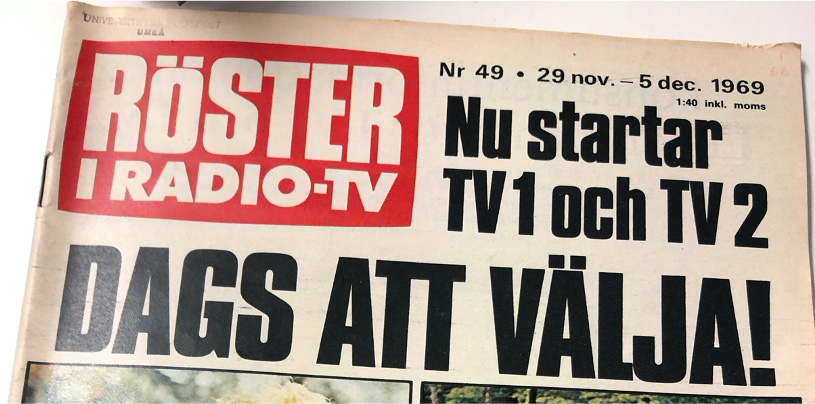
Figure 1
Image from the popular media magazine “Röster i Radio-TV”, 1969. The heading enhances the idea of competition: “Time to choose!”
3 Data
The following research will only focus on the time span prior to the introduction of international television through satellite broadcasting in the 1980s. The time frame thus encapsulates the emergence of television news in 1959 to the settling of the monopoly two-channel structure towards the middle and end of the 1970s. The data in the analysis is composed of a sample set of roughly twenty episodes of Aktuellt and Rapport respectively, from each year in the period. The analysis would have benefited from a larger dataset, however, the time frame concerns a period when only smaller selections of broadcasting were archived. The sampled data correspond close to the total of the archived material. In some cases, where a significantly lesser amount of broadcasting was stored, these years have been left out of the analysis. It is thus important to note that the analysis attends to material that far from corresponds to the total output by each channel. Nevertheless, the broadcasting material utilized in this analysis is the best possible grasp to be had of the content on Aktuellt and Rapport from this period.
The first two decades of Swedish news television constitute an interesting case of a delimited, public service system. All shows were produced by the company Radiotjänst, which in turn was modeled on the BBC, and partially owned by the Swedish government. It provides rich material for studying the competition and diversification within a welfare state media system. By studying how Swedish news tried to solve the riddle of how to add a sound to the newsreel, which was representative of the Scandinavian middle way, it is possible to historicize the production of sound media aesthetics. But how can we study the media acoustics of televisions past?
4 Methodology
The scientific analysis of sound is a lesser-discussed topic within media and cultural studies. Beyond musicology and linguistics, which for obvious reasons has to integrate aural description and audio data within their methodological framework, the humanities largely have neglected tools for the datafication of sound. To find inspiration for a quantitative approach to recorded sound, it is thus necessary to direct attention toward other scientific disciplines. Bioacoustics has a long history of acoustic evidence, and its many trappings. The difficulties involveed in early acoustic measurement devices, such as the analog spectrograph, has contributed to a sophisticated discourse on sound datafication. Bioacoustics was thus quick to adopt new computational tools and methods, some of which I’ve come to integrate into my analysis. Most of all, however, it is this epistemological curiosity that has influenced my own research in considering digital tools as a supplement to qualitative analysis.
My approach is centered around the frequency spectrum. In short, this entails any and all measurements of magnitudes in the frequency register. It is a manner of exploring how something sounds, rather than when it sounds. I employ this technique in order to investigate the sonic palette of the news. A sonic palette is an expression of the characteristic range of sounds within a medium or instrument. The palette is a helpful metaphor for media studies to discuss both the diversity and the intensity of features within a sound production. In order to grasp the changes in the sonic palette, the analysis departs from the application of a specific variation of frequency register analysis called LTAS (Long Term Average Spectrum). This technique is employed within bioacoustics, as well as linguistics. It plots the power of each frequency, independent of the total length of the sound recording, which makes it ideal for studying longer data streams.15 I’ve employed a combination of python libraries, like scipy and librosa, together with the software praat.16 The usage is in this this case experimental, and my hopes are that future scholarship media historical explore more fine-grained and specific methods for the purpose of frequency analysis.
5 New noises
In an official statement on the future of television from the Swedish government in 1960, it was concluded that the medium needed to adjust to the “diverse” character of “modern society”.17 As indicated in the graph above, it appears that, at least in regards to the acoustics of the news, television succeeded its aim to diversify. The graph displays the average sonic palette from every year during the first two decades of the news show Aktuellt. As the graph indicates, we are dealing with a palette in development, progressively changing every year. This change, demonstrated by an LTAS calculation, computes the activity of sound distributed over the frequency range. The left corner corresponds with the very lowest notes, to the right end with high pitch sounds. There is a clear trend towards a more diverse sonic palette, extending towards the middle and high end of the spectrum.
This observation serves as an invitation to consider the historical development of acoustic expression, yet it is necessary to first systematize the different causal factors potentially involved in these results. The trajectory of the sonic content of Aktuellt could be impacted by technical development, predetermining the possibilities and limitations of the sonic palette. The results might also be warped by the archival practices. Finally, the sounds of the news might also be interpreted as the result of changes in content and style. The varying sounds included in the broadcast are sure to affect the aural features.
We can find appealing support for this interpretation in prior research on the history of Swedish television. Professor of film studies Leif Furhammar has argued that the 60s and 70s was an age of great stylistic change in Swedish television production.18 This is a narrative that centers on the agents and producers of documentary television. Furhammar describes the development in two stages – the early 60s witnessed a great surge of artistic ambition, exploring the possibilities of the medium. Towards the end of the decade, the style shifted towards social realism, and the focus turned toward the unmediated depiction of reality. It is possible to interpret the LTAS results above as an expression of such a stylistic choice of content. Furhammars historical depiction offers an interesting explanatory value for the change of direction in the development of the sonic palette after 1967. In the data from the first half of the decade, there is a stringent increase in the amplitude of the midrange frequencies. After 1966, the LTAS instead displays a clear increase toward the higher frequencies in the register. Nevertheless, we need to keep in mind that these results can be the results of other factors than conscious decisions of style. Moving forward, my analysis aims to keep all three factors, content, technology, and archival methods in mind simultaneously.
6 The Spectral Density of the News
In order to explore the significance of the LTAS results, it is possible to render the same data as a spectral density curve. This approach measures the same components, power distributed over the frequency register, but generates a more granular plot in which separate frequency peaks are detectable. Each peak signifies the fundamental frequency of a sound. This does not entail that it is the only pitch in which the sound has an effect, but that its resonance is strongest in this register.
Figure 2 displays the distribution in spectral density in the broadcasting from 1959 to 1975 comparatively. As indicated by the LTAS, there is a similar level of values in the lower registry, roughly spanning frequencies between 10 and 100 Hz (Hertz). The primary reason why this part of the spectrum displays a higher power value is determined by the character of human perception. Our hearing is unevenly distributed throughout the frequency, which means that sound at lower frequency has to be more powerful in order to be perceptible. The graph should thus not be interpreted as if the sounds of Aktuellt were dominantly taking place in the deep bass registry. Rather, in ranges below 100 Hz, there is, for example, a selection of speech sounds, which in our perception are merely audible components of the voice, yet appears stronger on the linear spectrum of the frequency.

Figure 2
LTAS from each respective year in the Aktuellt sample set. Long Term Average Spectrum (LTAS) is a method of representing the frequency distribution in audio data. The Y axis indicates the power at a certain point on the frequency spectrum displayed on the X axis. Each year corresponds to one line, from darker colors in the early decade to brighter colors towards the end of the decade. The sample set demonstrates a gradual increase, both in overall power, and in the frequency range.
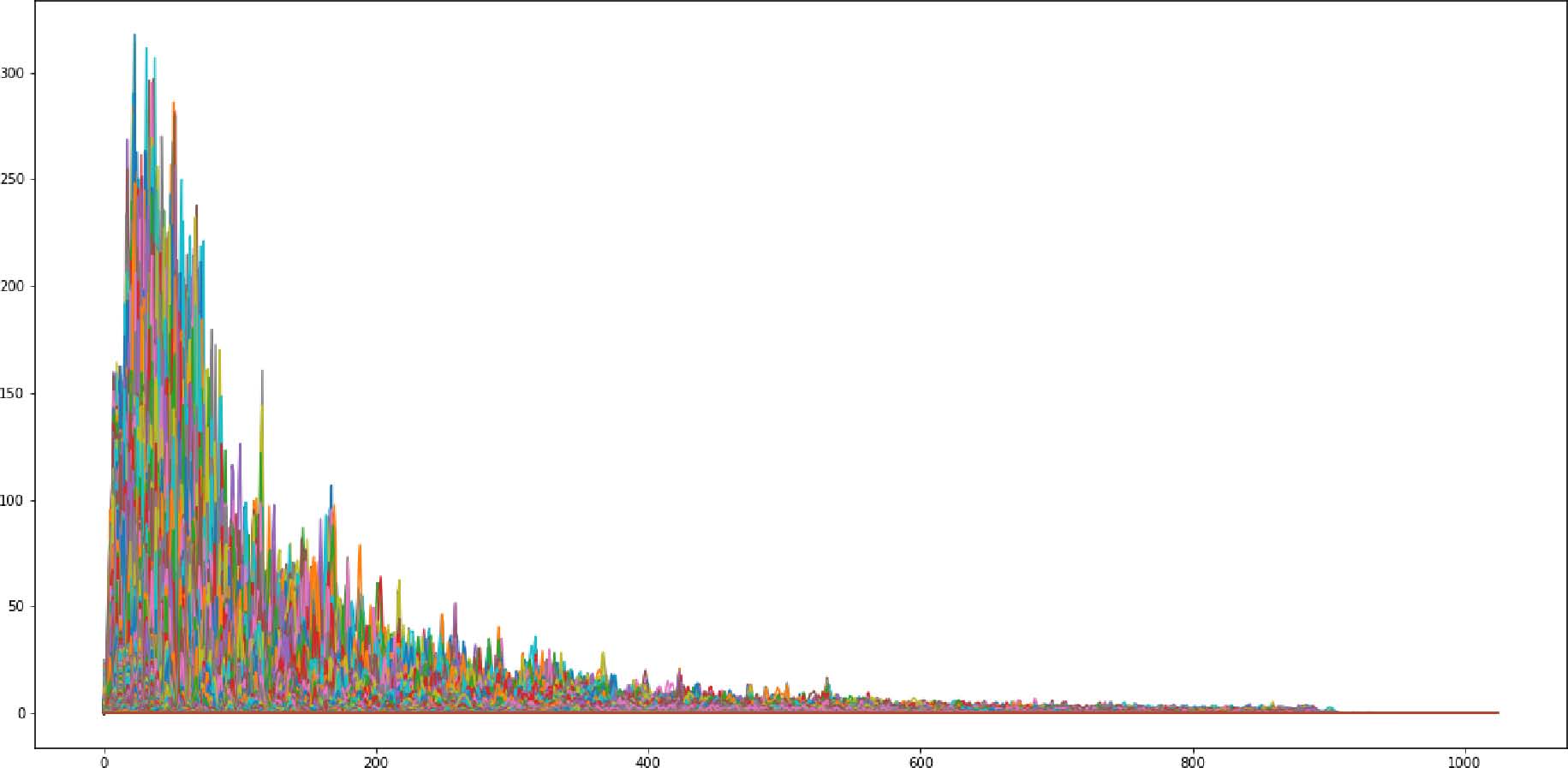
Figure 3
Spectral density plot of the total Aktuellt sample set from 1959 (above) and 1975 (below) respectively. The y-axis designate magnitude, and the x-axis correspond to the frequency in Hz. Each peak corresponds to fundamental frequency activity. The later data demonstrate an increase in activity in the entire spectrum, with a concentration between 100 and 200 Hz.
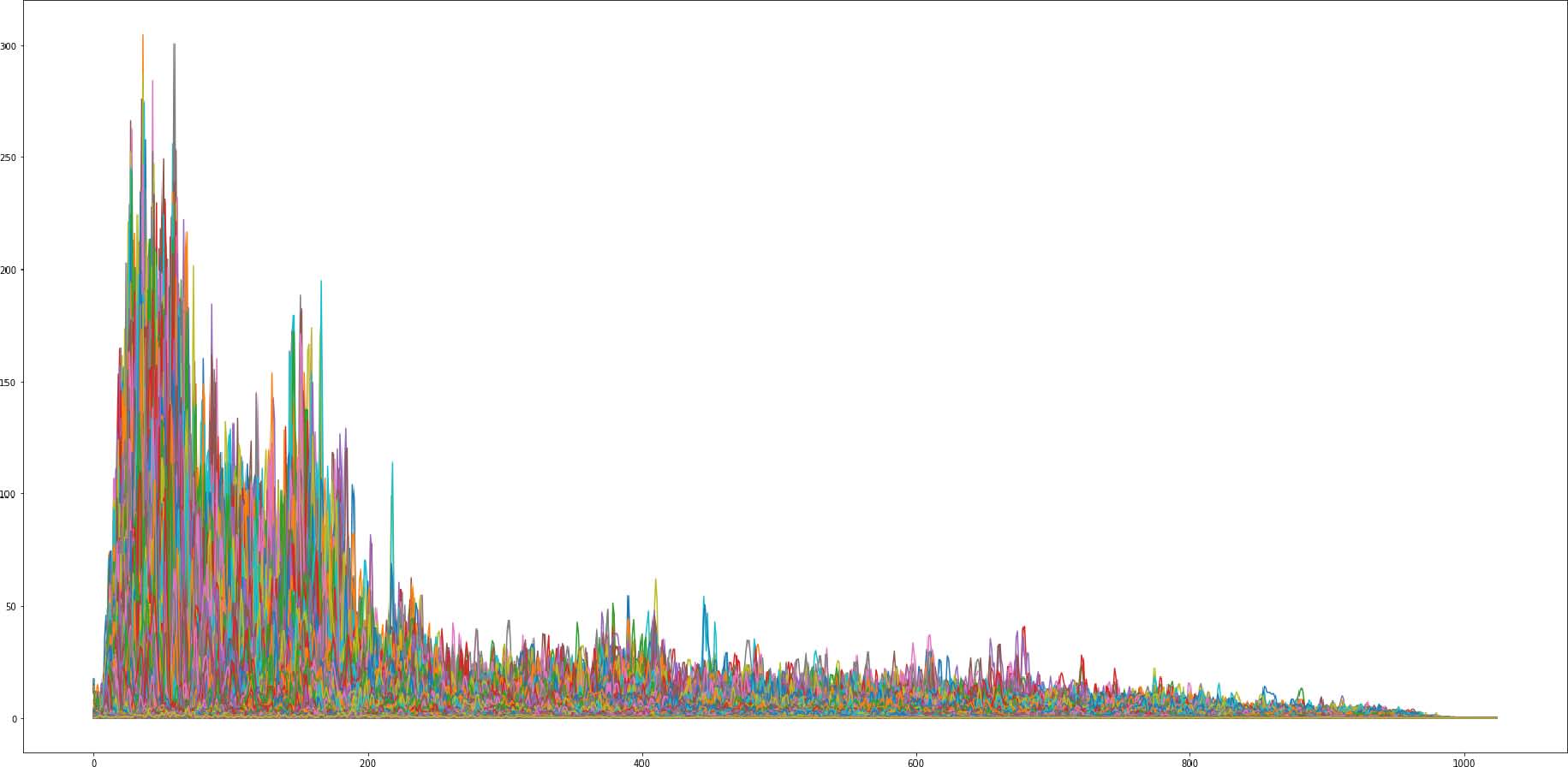
Figure 4
Spectral density plot of the total Aktuellt sample set from 1959 (above) and 1975 (below) respectively. The y-axis designate magnitude, and the x-axis correspond to the frequency in Hz. Each peak corresponds to fundamental frequency activity. The later data demonstrate an increase in activity in the entire spectrum, with a concentration between 100 and 200 Hz.
More interesting is the increase in activities around 180 Hz. There is a variety of sounds with fundamental frequency in this part of the register, yet one clear and typical example is the female voice. Phonetical research has since long determined the most characteristic differences between gendered voices as a matter of resonance distribution. Whilst the adult male voice tends to have a fundamental frequency between 85 and 155 Hz, the female voices range between 165 to 220.19 This is corresponding rather astutely to the increase in display in the comparison above. Such a conclusion can also find support in prior research as it has been observed that in the 1970s, “the news desks were staffed by a growing number of female reporters and producers”.20
The factors behind the increase in the higher register are more difficult to estimate from the fundamental frequency. There is a wide variety of acoustic sources, sound effects, and music that could impact the spectrum above 200 Hz. However, since this spectral density plot is oriented towards repeating occurrences in single frequency registers, it is possible that results in the upper part of the spectrum are caused by the same acoustic phenomena registered in the lower part. Due to the repetitive character of sound waves, a sound that resonates strongly at around 150 Hz, would also have a resonant peak around 300 Hz. The higher values demonstrated in the data from 1975 could therefore also be a result of better recording technology. By means of more advanced types of sound reproduction, the higher frequencies of a sound are captured in more detail. Thus, to further understand the changes in sonic palette throughout the decades, it is necessary to consider the technical circumstances at the time. As prior research has pointed out, there is little textual material left indicating the precise technology in use at the time.21
The closest indications come from industry yearbooks, where larger technological advancements sometimes are noted. It is possible to determine the successive integration of new microphone technology at Aktuellt between 1965 and 1967. However, these microphones only affected the studio production, which mostly pertained to the production of speaker voices. More interesting for the variations in the sonic palette is perhaps the integration of environmental sounds. Prior research has found that field recordings were kept to a minimum, due to the problem caused by the loud noise caused by the video cameras of the time. Instead, for most of the 60s, sound was recorded in the studio. The microphone had the function of a visual prop. The image below displays a playful excursion into the swimming pool with an unplugged microphone in hand.

Figure 5
Picture displaying the explorative utilization of a microphone in television news context. The image is collected from the document “Allt hände i Aktuellt” (Borås: Independent Entertainment, 1998).
In the middle of the 1960s, the technical difficulties of simultaneous sound and video recording were formulated in terms of a “synchronization problem.”22 As media scholar Carin Åberg explains, “documentary reportage successively gave the impression to be more ‘real’ when an authentic sound could be recorded together with the image.”23 In the 1970’s, this ambition started to become more realizable. The emergence of soundproofed video camera systems, like the so-called ENG-system, meant that the equipment no longer constituted a disturbance. With this invention, the sonic environment could be captured simultaneously with the camera running. This in turn opened up for experimentation with better field recording technology. By plotting the spectral density from the year before Aktuellt went off the air against the first year of its return, with the new silent camera technology, it is possible to investigate the effect.
7 Comparative Frequencies

Figure 6
Spectral density plot of the total Aktuellt sample set from 1968 (above) and 1972 (below) respectively. The data from 1972 displays a significant increase in activity between 100 and 400 Hz.
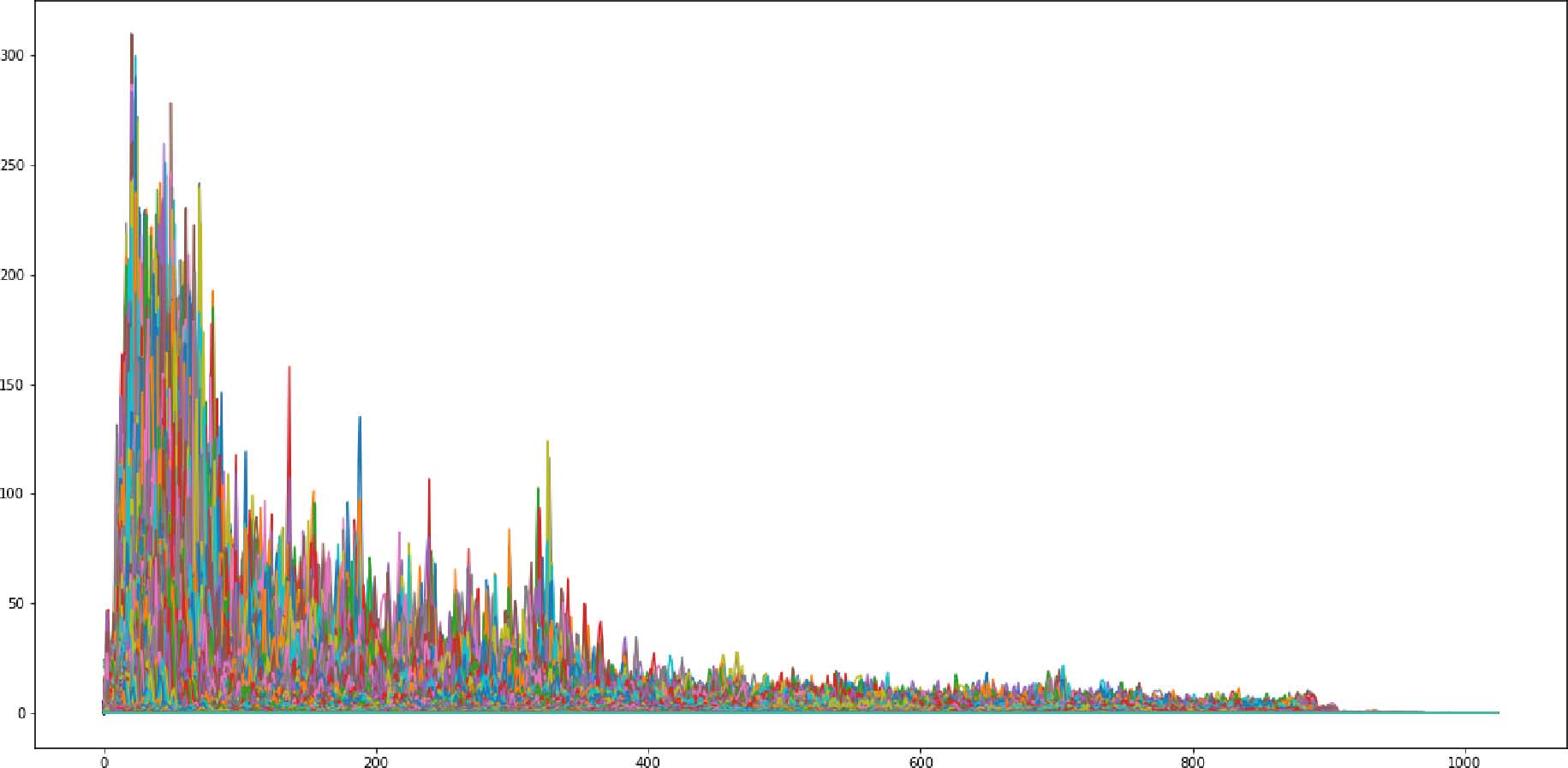
Figure 7
Spectral density plot of the total Aktuellt sample set from 1968 (above) and 1972 (below) respectively. The data from 1972 displays a significant increase in activity between 100 and 400 Hz.
The second graph, from 1972, displays a significant increase in the magnitude between 250 and 400 Hz. One way to interpret this development is that the soundproofed ENG-cameras enabled a more extensive use of ambient sounds. However, in order to better understand these variations, it is necessary to factor in archival circumstances. These documents have their own history in the broadcasting archive which in turn can impact spectral density values. The quality of the tape which was used for archivization and the particular methods of digitation can have a direct impact on the sound quality and thus the resultant frequency spectrum. One available method of estimating the significance of these factors is by comparing the development displayed by Aktuellt to data from other recordings at the time. For this purpose, it is interesting to study the second largest news show in Sweden at the time, Rapport. Rapport came about as a result of the channel split in 1969. When the television monopoly introduced the two-channel system, it also brought about a general reconfiguration of the broadcasting schedule. At first, Aktuellt was replaced by Rapport which was considered a modern update on the news format, but at the start of the 1970s, Swedish television started running both shows parallelly. Rapport has been described as being distinguishing from Aktuellt by virtue of more focus on “current affairs” and that “commentaries applied more stringent news values in its choice of topics.”24 Despite their differences, however, both shows were recorded in the same facilities, by the same institution. It is thus possible to assume that the equipment, and more importantly, the archival measures, were similar between the two channels. Following this conclusion, it is interesting to have a comparative look at the variation in the sonic palette.
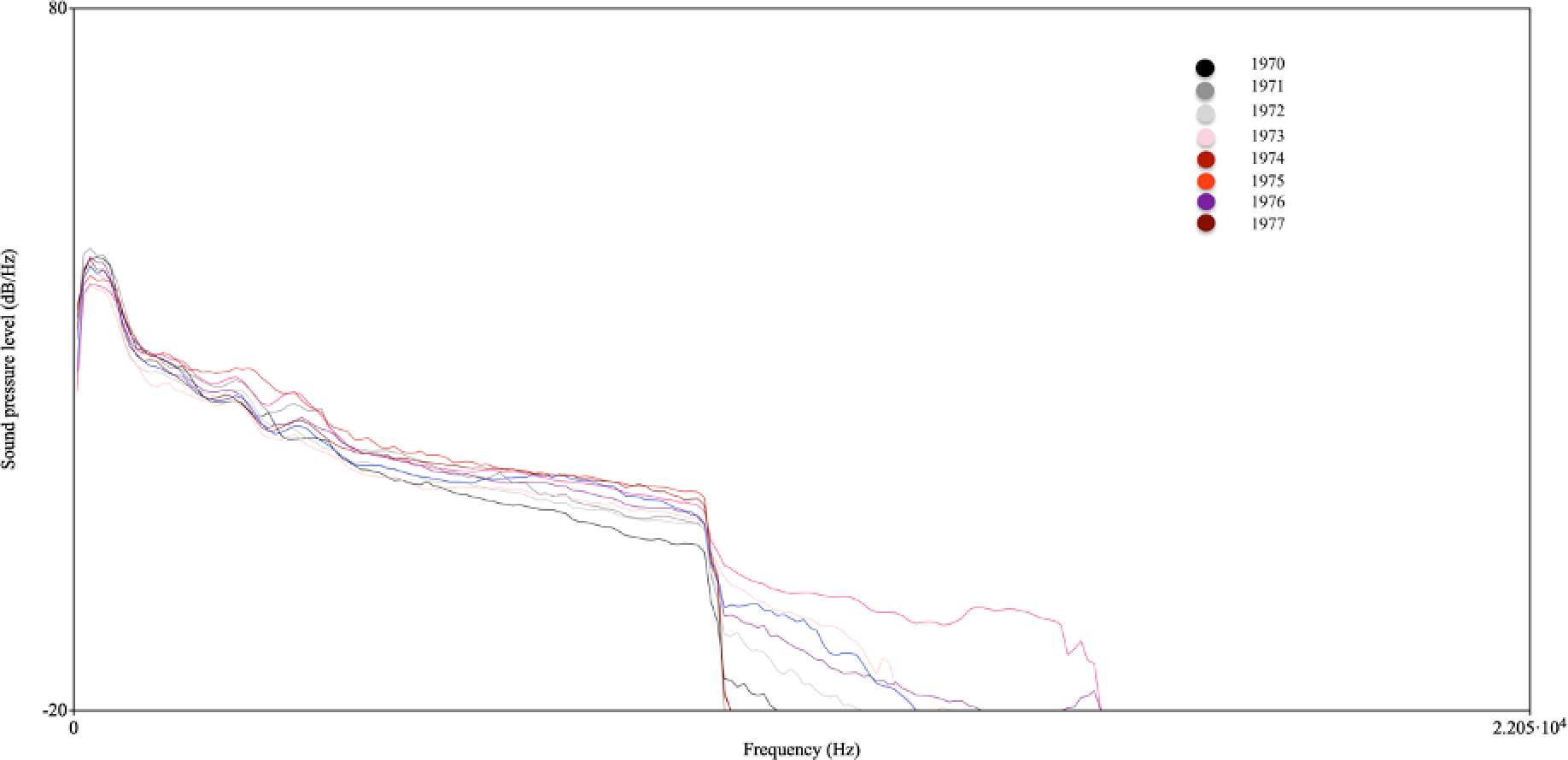
Figure 8
LTAS from each respective year in the Rapport sample set. Each year corresponds to one line, from darker colors in the early decade to brighter colors towards the end of the decade. Whilst the overall power increases for each year, the effect is focused around an invariant part of the spectrum. The exception appears in the data from 1975, indicated by the red line.
These LTAS results demonstrate a significantly different development than that of Aktuellt. Besides the sample set from 1975, which appears as an outlier, the remaining data displays a clear tendency. Instead of a gradual expansion in power toward the upper middle of the frequency spectrum, Rapport remains centered around the same parts of the register. The sound pressure is increasing where there already is previous activity. This discovery is interesting because it supports the theory that the registered shift in the sonic palette of Aktuellt is connected to changes in content, and not only an effect of more detailed technology of sound recording. If Rapport and Aktuellt, recorded around the same years in the same building, archived by the same institution, display such different results, it is an injunction to look for causes in the content of the transmission.
8 The Distributions of Sounds
One way to investigate these differences further is by applying automated listening methods. The ‘edyson’-tool, recently developed at the Swedish Royal Institute of Technology, is well suited for such a purpose. Edyson is a human-in-the-loop framework that uses unsupervised machine learning to allow the user to explore audio data. Sound is segmented into short snippets of equal length and ordered according to similarity. The result is a mapping of the different types of sounds in a recording, which the users can proceed to listen to and manually classify.
Besides offering an effective means of identifying sonic content, it also renders an estimation of the sheer acoustic diversity of the material. In the graph below, the sample sets from Aktuellts broadcasting from the years 1959, 1968, and 1975 have been plotted respectively. By listening to separate instances of the cluster I’ve been able to color code the content according to four prominent features. The blue nodes are sound bites that only contain voice, green nodes have musical content and red nodes are pure environmental sounds or noise. The yellow area is constituted by segments that have voice elements in the foreground but environmental sounds in the background.
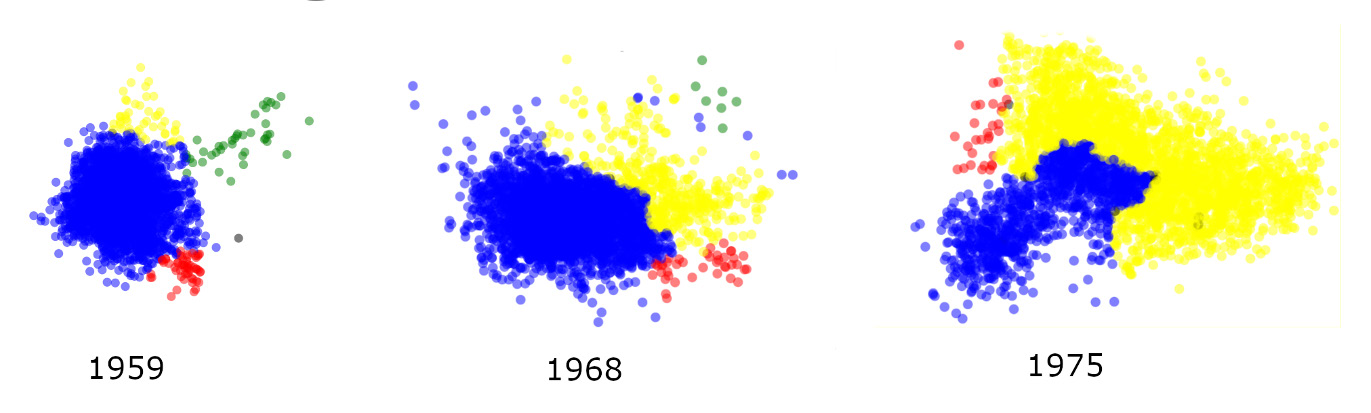
Figure 9
Visualization of the audio content by Edyson. Sample data from 1959, 1968, and 1975 has been disassembled into two second segments and arranged according to similarity. The outcome can be interpreted as a map of the sonic features in the data where a more condensed cluster indicates more homogenous acoustic content. Color-coding has been done by manual listening and designates four categories of sound. Blue nodes are segments that only contain one voice, and yellow nodes contain both voice and other acoustic content. Green nodes correspond to musical content and red notes are environmental sounds.
The results appear to lend credence to the thesis that the sonic content of Aktuellt changes significantly throughout the two decades. Before dwelling on the color-coded content, it is possible to observe that the sheer, automated mapping of the content demonstrates signs of difference and diversification. The cluster widens and develops multiple centers, indicating a less homogenous character in the sonic palette of 1975, than in 1959. The human-in-the-loop annotation enables further distinctions to be made. Involving human perception is neither to be conceived of as a guarantee of improvement, nor a direct impairment to the accuracy of the analysis.25 It is important to note that what is displayed here is the result of my own interpretation of the data. Nevertheless, the method allows us to explore the results in more granularity. It is possible to observe a decrease in musical content to the point where, in the data from 1975, there are no more distinct segments of the kind. This could be regarded as a plausible result. Prior research, based on remaining programme schedules, has postulated that Aktuellt witnessed a diminishing frequency of “soft news” and reports from cultural events throughout the 60s.26 Music disappeared from the news as the focus shifted toward local and international social questions.
Slightly surprising, the frequency of pure ambient sounds maintains a similar and peripheral role in the overall sonic palette. Instead, what can be discerned is a dramatic growth of the content which combines voice and background sounds. It is somewhat difficult to precisely determine at what point the segments with background sounds depart from those containing only voice. By sharing the general characteristics of voice in the forefront, the two categories cluster close together, but the widening of the cluster itself indicates a diversification within the voice content. Such divergence can be interpreted as a sign that the content of speech segments changes with respect to parameters beyond the human voice. Ambiance increases, but only as a simultaneous feature to speech. These results can be considered in light of the gradual affordance of quiet camera equipment. As indicated by the prior spectral density plot, there is a rise in magnitude throughout the entire lower frequency range after the introduction of the ENG technology in the early 70s. The information extracted by Edyson demonstrates how this change is connected to a sharp increase in content specifically containing both voice and ambient noises. It is first with the introduction of technical means to record the ambiance of the very moment where the reporter’s speech, that environmental sounds start to dramatically increase.
9 Noise and Authenticity
In recent years, scholars in film, game, and sound studies alike have directed attention to the role of ambient sounds in the cultural construction of directness and presence.27 Researchers like Mark Grimshaw, Anahid Reiter, and others have discussed the particular role that environmental sounds have in granting authenticity to the mediated experience.28 From this perspective, it would be possible to hypothesize a relationship between the increase of ambient sounds in Aktuellts broadcasting and the strive to create a critical and investigative type of news report. As previous research has pointed out, Swedish television news was marked by a strong turn towards a political and scrutinizing ideal in the late 60s and early 70s. Perhaps, under such production values, environmental sounds were deployed to aid the experience of authenticity. As sound studies scholar Allen Wiess has argued, embedding the audience in the ambience of the place increases the “mimetic” capacity of broadcasting.29 Noise makes the recording appear like the real thing.
This elusive use of sound in Swedish broadcasting might bring to mind Roland Huntford’s media critical speculation in his criticism of the Swedish 60s. According to one of the many charges directed against Swedish culture in his book, “The New Totalitarians”, the countrymen demonstrated an exceptionally uncritical stance towards news and documentary content. “There is also the propensity of the Swede to take appearance for reality. As long as he has the correct scenery and sound effects, he is perfectly happy.”30 Huntford’s musings are perhaps best read with certain distance, and in the historical company of a wave of British criticisms of Sweden spanning the late 60s. His work was the pinnacle of a reversal of the more idyllic depictions of Sweden, springing from a liberal critique of the welfare state as sacrificing “freedom on the altar on social security.”31 It nevertheless testifies to one manner in which these results can be contextualized and understood. Whether the average Swede was exceptionally susceptible to enthralling sound production, the results still say something about the style of broadcasting media in the Swedish welfare state. The authenticity and informational value of broadcasting have previously been pointed out to have had a central role in Swedish postwar media. My results demonstrate how ambient sounds appear to have been instrumental in the establishment of a suitable aesthetics of news taking place in the field.
However, the results might also indicate a tendency that is more relevant to the television medium itself. As the Edyson visualizations demonstrate, the data hints toward something more specific than just the general application of ambient sound for the legitimacy of mediated experience. As the sounds of the environment only start to appear at large in conjunction with speech, it is possible to reconsider the media theoretical concept of the audio-visual contract.32 Much prior research on sound in multimedia environments tends to conceive sound as a reinforcement of other modalities. Just like ambiance has been theorized to grant images presence, other acoustic phenomena, like music and voice, are understood to produce certain experiences in the game or video. Yet, by focusing solely on sound, my research demonstrates how, even in a visual medium like television, the sonic realm contains its own reinforcing feedback relationship. Instead of images that “anchor […] sounds to place,” as proposed by Spigel, sound seems to anchor itself.33 Environmental sounds come to be utilized once they are coupled with the voice of the reporter, thus achieving the relevance of the moment. Simultaneously, this ambiance grants the voice its authentic presence in the field.
10 Conclusions
Already at the dawn of the television medium, Rudolf Arnheim warned against its obsession with the place of transmission. In contrast to radio, where sounds existed free in the ether, detached from any specific location, television was under the risk of becoming just another means of “cultural transportation”. Its allure to bring the audience to the place of transmission, rendered it a “relative of motorcar and airplane.”34 By focusing on the sound of television, my research suggests how these characteristics of television come to shape the sonic palette of news production. However, this tendency does not manifest identically. The closed environment of the Swedish two channel system provides a good case for studying how the internal competition brings about differentiated acoustic aesthetics. This in turn indicates a raising awareness of sound design in broadcasting media. There are few traces of any explicit consideration of sound production in Swedish television in the 60s and 70s, yet my results point towards a practical awareness of a distinguished style.
By applying methods for spectral analysis, it has proved possible to comparatively study the development of the sonic palette of the news. This approach enables a historical perspective on the first two decades of Aktuellts broadcasting. The analysis indicates a constant increase and widening of the frequency spectrum which can be connected to a diversification of acoustic content. This in turn grants a deepening of our understanding of how the relationship between noise and speech has been shaped by historical conditions. In order to produce news that gave the aural impression of presence and authenticity, noise needed to coexist with speech. This recalls the initial statement by the Swedish governmental report. The results in the analysis thus suggest a possible historical trace of the sonic expressions which foreboded the explicit suggestion that authenticity should be the guiding principle in the signal-to-noise ratio. Rather than an invention of the millennium, the ideal can be traced back to the origins of television news.
The aim of this article is also to bring attention to the methodological possibilities of audio data. As the vast repositories of digital media keep expanding, it is increasingly urgent to interrogate the affordances of the digital archive. The sheer size of many of the sound archives today renders the historian in the hands of digital tools. The signal analysis has proven capable of both confirming previous research concerning the gender distribution of the news whilst also giving new insights into the origins of noisiness. But computational methods can also provide other insights into historical data. The objective of this article has neither been to extend the full capacity of big data analysis, nor to dwell on perfecting the statistical ambiguities. Rather, the ambition is to demonstrate what information can be traced from digital audio by applying experimental methods and tools from beyond the realms of the humanities. The media historian can surely learn something from the automated analysis of sound premiered by bioacoustics. There is also interesting potential in a more advanced discussion of applying human-in-the-loop methods in quantitative culture studies. My research thus encourages further exploration of the signal realm of media history, in order to enable future comparative work. In a time when an absolute majority of cultural artifacts, new and old, are created and stored on computers, it is thus of interest to further explore what computational listening can tell us about the past.
Notes
[2] See for example Wolfgang Ernst about the incorporation of noise in audiovisual archiving. Wolfgang Ernst, Sonic Time Machine (Amsterdam: Amsterdam University Press, 2016), 114.
[3] Cited In: Peter Dahlén, ”Från SF-journalen till Aktuellt, en studie av TV-journalen 1955 till 1958” [From SF-journalen to Aktuellt, a study of TV-journals 1955-1958], in Svensk television, en mediehistoria [Swedish television, a media history], eds. Anna Edin & Per Vesterlund (Stockholm: Statens ljud- och bildarkiv, 2008), 31-62, 47.
[5] Lasse Svanberg, TV-bilder: Svensk produktionsteknik under femtio år [TV pictures: 50 years of Swedish production technique], Värnamo: Stiftelsen Etermedierna i Sverige, Värnamo, 2000), 30.
[6] Gabi Schaap, Karsten Renckstorf, and Fred Wester, “Three decades of television news research: An action theoretical inventory of issues and problems”, in Television news research: Recent European approaches and findings, eds. Denis McQuail and Nicholas Jankowski (BerlIn: Quintessence, 2001), 47-90, 48.
[8] Åke Ortmark, “Freedom’s Boundaries”, in Television and Political Life: Studies in Six European Countries, ed. Anthony Smith, (London: Writers’ and Scholars’ Educational Trust, 1979), 144.
[10] For recent perspectives, see, Trine Syvertsen, Gunn Enli, Ole J. Mjøs, and Hallvard Moe, The Media Welfare State: Nordic Media in the Digital Era (Ann Arbor: University of Michigan Press, 2014).
[11] Monika Djerf-Pierre and Lennart Weibull, Spegla, granska, tolka: Aktualitetsjournalistik i svensk radio och TV under 1900-talet [Play, evaluate, interpret: Actuality journalism in Swedish radio and TV in 1900s] (Stockholm: Prisma, 2001), 86.
[15] For more on automated acoustic measurements, see for example: Federico Miyara, Software-Based Acoustical Measurements (Cham: Springer, 2017).
[16] Brian McFee et al., librosa: 0.9.2, 2022, Pauli Virtanenet al., scipy, 2022, Paul Boersma & David Weenink, Praat: doing phonetics by computer, 6.3.02, 2022.
[18] Leif Furuhammer, Med TV i verkligheten [With TV in reality] (Borås: Stiftelsen etermedier i Sverige, 1995).
[19] For a recent example employing this distinction, see, Rafaella Cristina Oliveira, Ana C C Gama, and Max D C Magalhães, “Fundamental Voice Frequency: Acoustic, Electroglottographic, and Accelerometer Measurement in Individuals With and Without Vocal Alteration,” in J Voice 35, no. 2 (2021): 174-180.
[21] Carin Åberg, Den omärkliga tekniken: Radio- och tv-produktionen 1925-1985 [The imperceptible technique: Radio and TV production 1925-1985] (Stockholm: Natur och kultur: 1999), 21.
[25] For more on recent developments in human-in-the-loop solutions, see for example: Tor Grønsund and Margunn Aanestad, “Augmenting the algorithm: Emerging human-in-the-loop work configurations,” The Journal of Strategic Information Systems 29, no. 2 (2020).
[26] Djerf-Pierre and Weibull, Spegla, granska, tolka, 251. The sample set does not contain introduction jingle from the news show, which can explain the apparent lack of any music in the later data sets.
[27] Budhaditya Chattopadhyay. “Reconstructing Atmospheres: Ambient Sound in Film and Media Production,” Communication and the Public 2, no. 4 (2017): 352-64.
[28] Mark Grimshaw, Game sound technology and player interaction: Concepts and developments (Hershey, PA: Information Science Reference, IGI Global, 2011).
[29] Allen Weiss, Varieties of audio mimesis: Musical evocations of landscape (BerlIn: Errant Bodies Press, 2011).
[31] Frederick Hale, “Brave New World in Sweden? Roland Hunford’s The New Totalitarians,” Scandinavian Studies 78, no. 2 (2006): 167-190.
[32] For more on the audio-visual contract, see: Michel Chion, Audio-Vision: Sound on Screen (New York: Columbia University Press, 1994).