
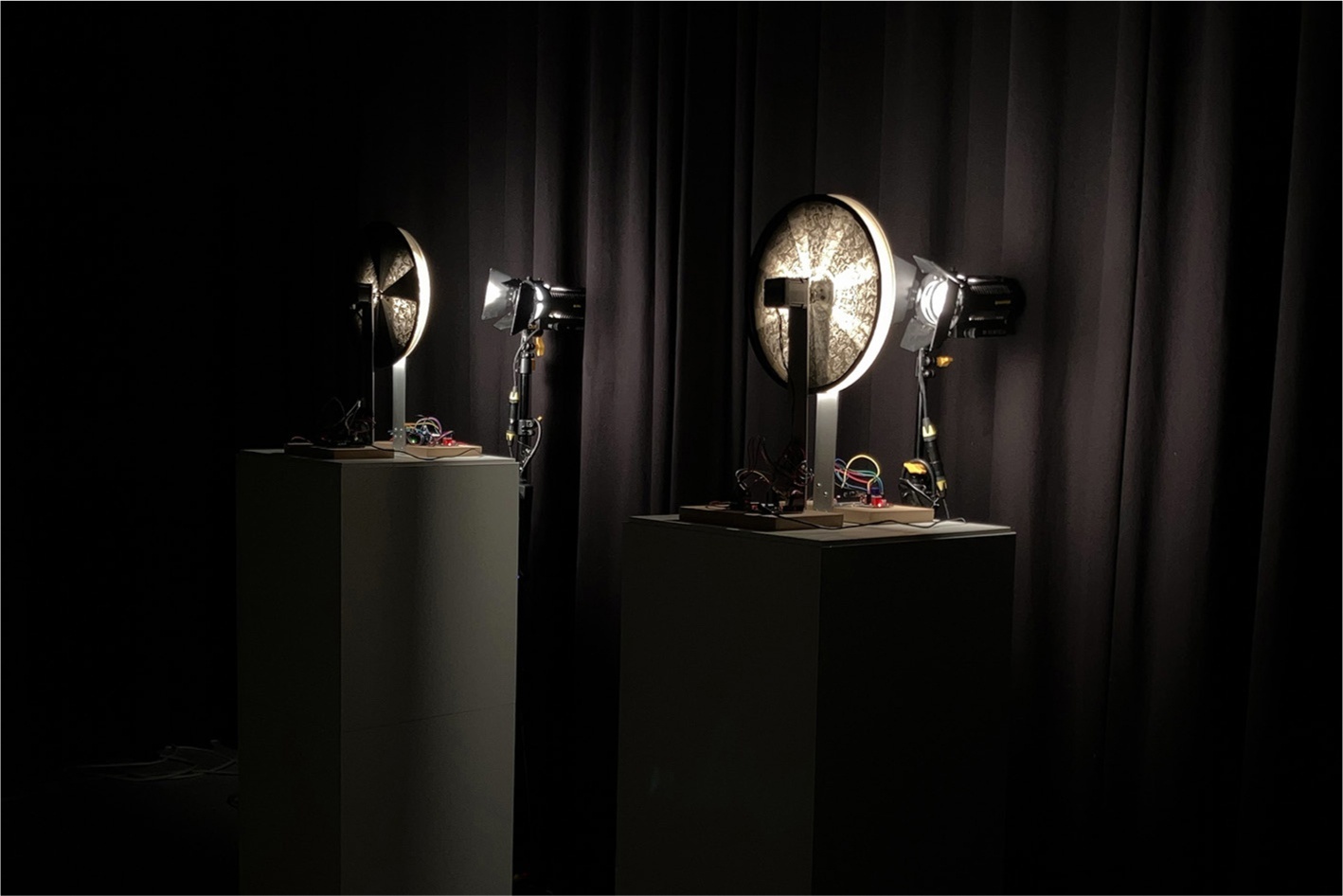
Figure 1
Anortho-phenakistiscopes on display at ENACT Festival: Performing Research at LUCA School of Arts, Brussels, November 6, 2025. Photograph by Guido Devadder

Figure 2
Use of a mirror phenakistiscope (19th-century engraving). Source: Der Gebrauch des Spiegel-Phenakistiskops, CC BY-SA 3.0, via Wikimedia Commons

Figure 3
Left: Diagram of the rotating wheel and vertical apertures illustrating Roget’s optical deception. From Peter Mark Roget, “Explanation of an Optical Deception in the Appearance of the Spokes of a Wheel Seen through Vertical Apertures,” Philosophical Transactions of the Royal Society of London 115 (1825): 141. Right: Anamorphic image disc (A) and perceived as normal image (B) for the anorthoscope. From Joseph Plateau, “Lettre de M. Plateau au Rédacteur, relative à différentes expériences d’optique,” Correspondance Mathématique et Physique, Tome VI (1830), Plate III

Figure 4
Photographs of the hand-painted original anortho-phenakistiscope discs, Joseph Plateau and Jean Baptiste Madou (c. 1844–1849). © GUM – Ghent University Museum. Used with permission
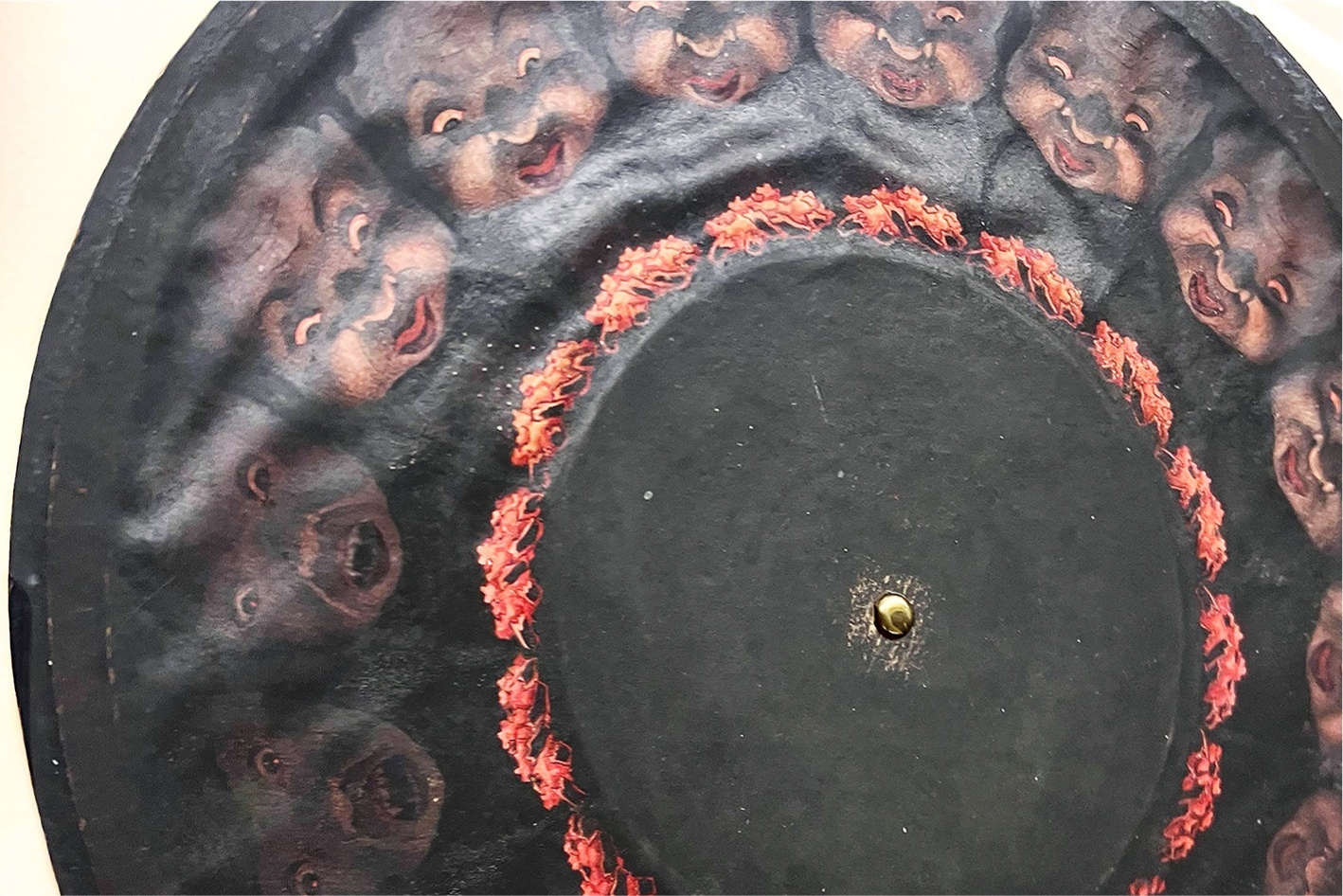
Figure 5
Detail of the hand-painted original of the Demon disc. The photograph shows the cardboard reinforcement and slight warping of the thin paper caused by the paint. Joseph Plateau and Jean Baptiste Madou (c. 1844–1849). Photograph by Guido Devadder, GUM (Ghent University Museum), 2023
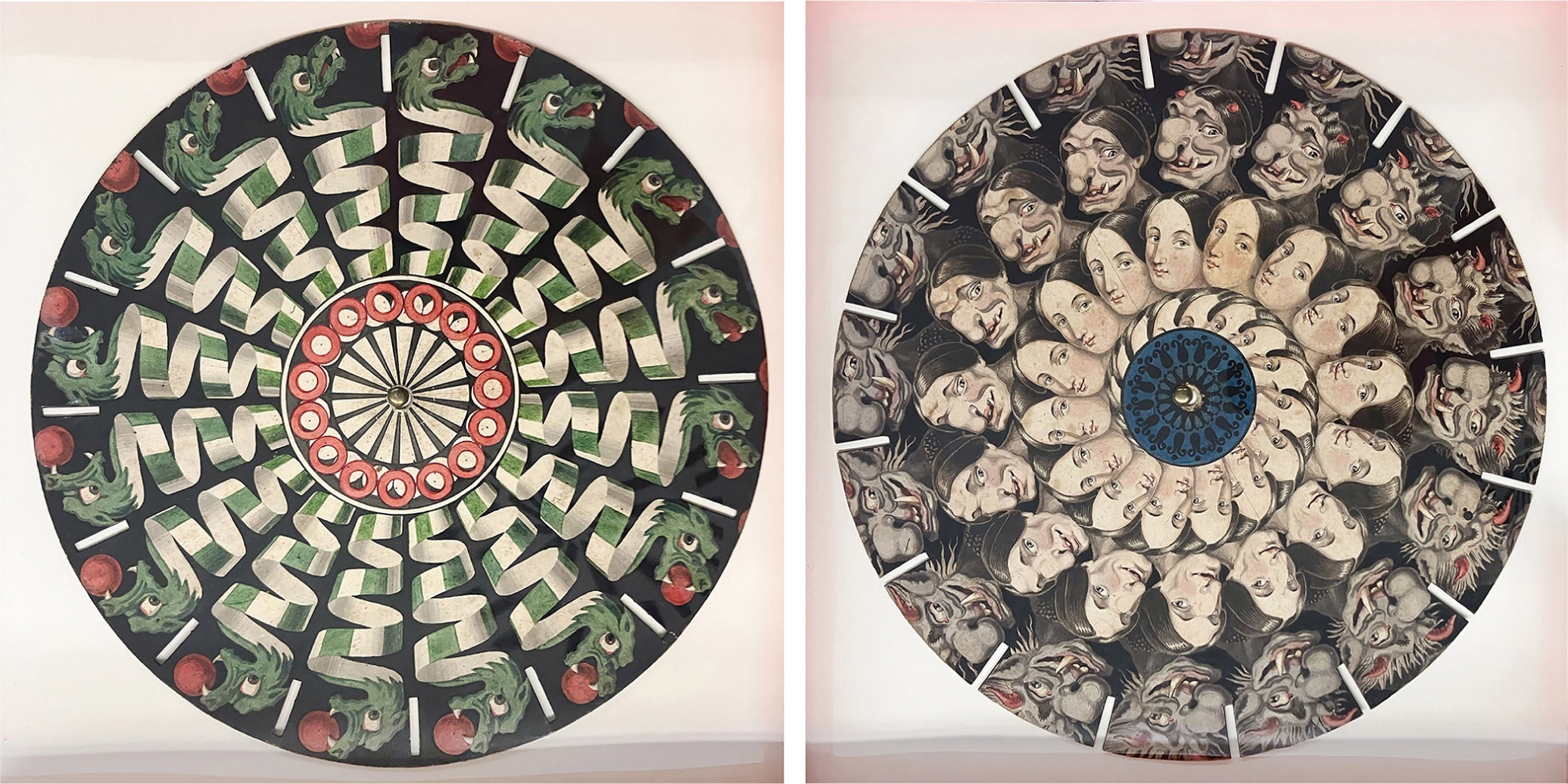
Figure 6
Phenakistiscope discs by Joseph Plateau. It remains uncertain whether Jean Baptiste Madou contributed to these designs, though they show stylistic similarities to the anortho-phenakistiscope discs. Photograph by Guido Devadder, GUM (Ghent University Museum), 2023

Figure 7
Different stages in developing prototypes to reconstruct the anortho-phenakistiscope. Photographs by Guido Devadder, 2025

Figure 8
Laser cutting the shutter disc from MDF board. We later switched to 3D-printed shutter discs to reduce weight. Photograph by Guido Devadder, 2025

Figure 9
GIF animation of the demon disc. Image © GUM – Ghent University Museum. Used with permission. Animation by Guido Devadder

Figure 10
GIF animation of the monk disc. Image © GUM – Ghent University Museum. Used with permission. Animation by Guido Devadder

Figure 11
Recreating translucency: the disc on the left shows oil impregnation on matte high-resolution inkjet paper, resulting in reduced contrast, while the disc on the right was created through inkjet printing on vinyl film. Both discs are backlit on a light table. Photograph by Guido Devadder, 2025

Figure 12
Experimenting with various shutter geometries using 3D-printed discs. Photograph by Guido Devadder, 2025

Figure 13
Angular deformation as a function of relative rotation direction: both images show the same disc, with opposite rotation on the left and the same rotation direction on the right. Artwork and image by Guido Devadder, 2025
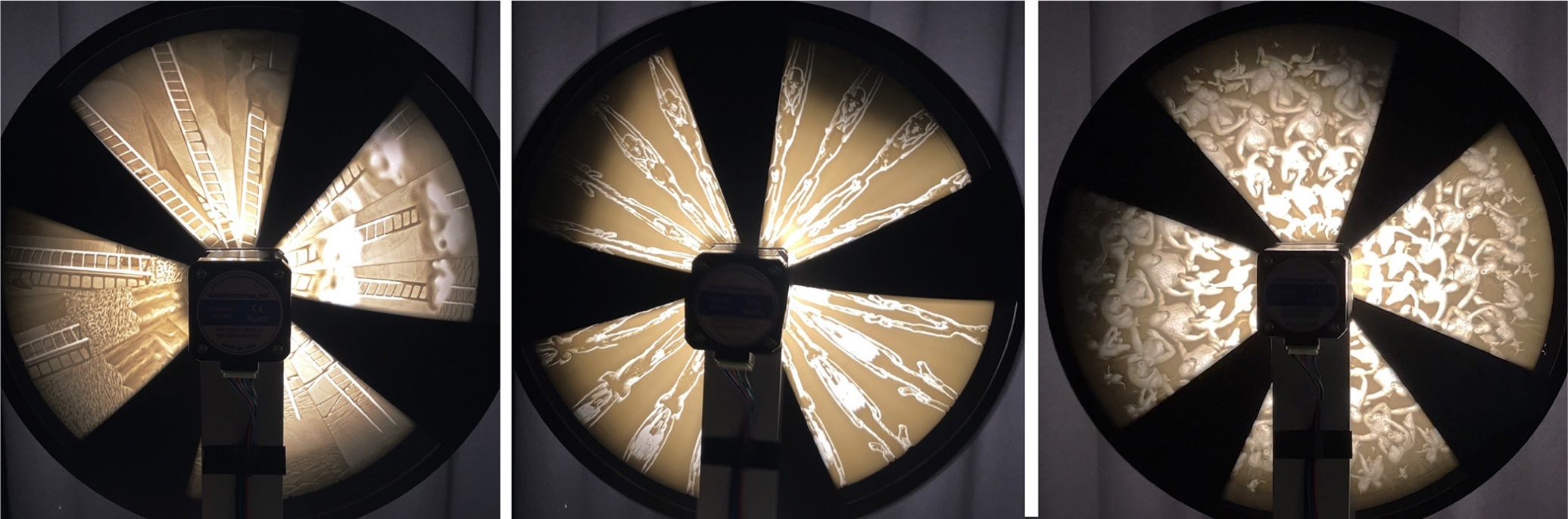
Figure 14
Video stills of three 3D-printed lithophane discs. Left: artwork by Martha Kicsiny (digital drawing); middle: artwork by Ziebe Van Mulders (analogue drawing); right: artwork by Guido Devadder (digital 3D). Images by Guido Devadder, ENACT Festival: Performing Research at LUCA School of Arts, Brussels, 6 November 2025

Figure 15
Video still showing a detail of a 3D-printed lithophane disc with thirty-two image segments and an eight-slotted shutter. The long exposure time blurs the shutter disc, yet through its interaction with the rotating image disc, the image’s sharpness and angular deformation are preserved. Artwork and image by Guido Devadder, 2025
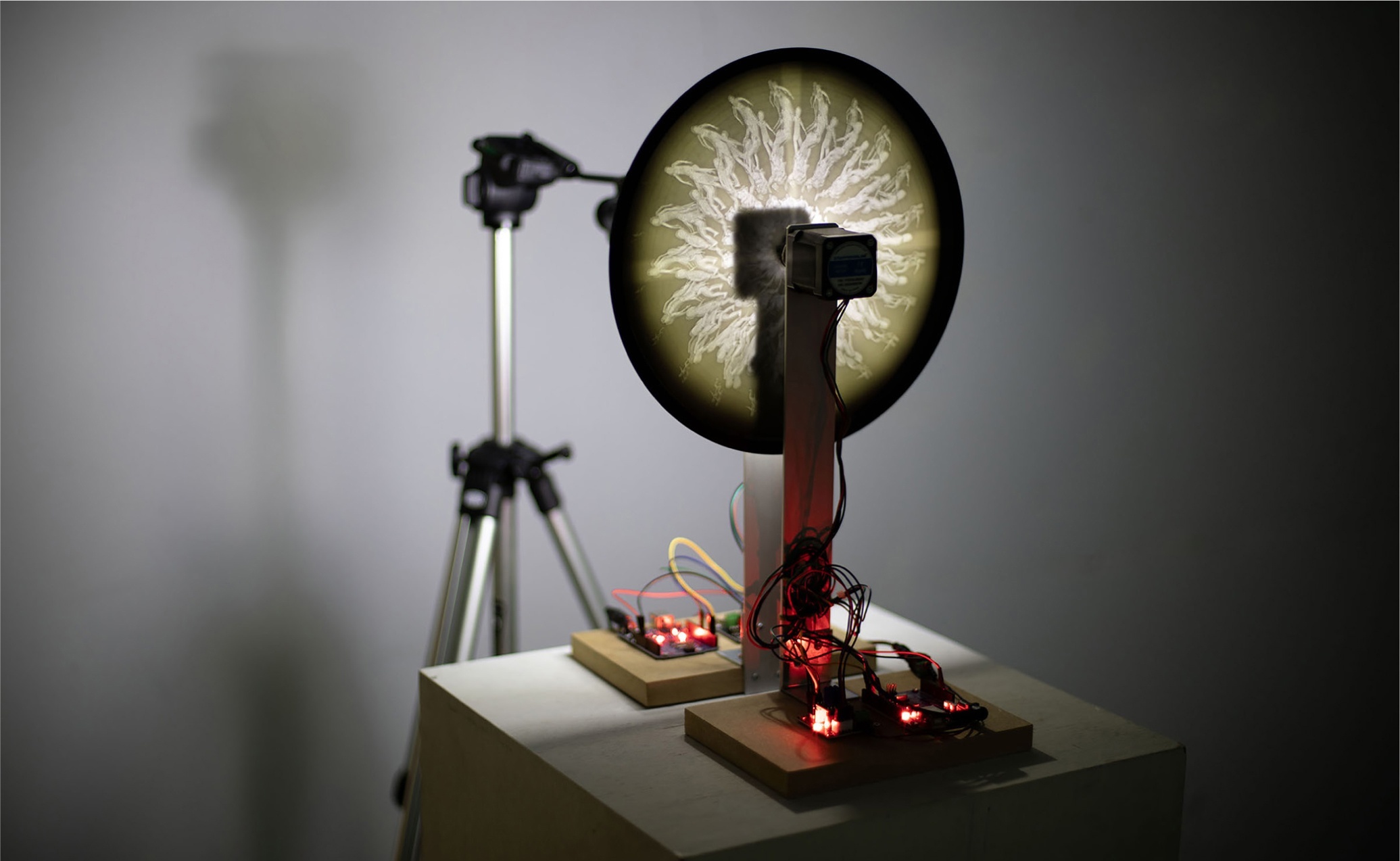
Figure 16
Video still of an intermediate prototype testing different forms of physical interaction between the shutter disc and the image disc by adjusting the code of the Arduino-based rotation system. Artwork and image by Guido Devadder, 2025