
Introduction
Long before the term artistic research entered academic discourse, Joseph Plateau and painter Jean Baptiste Madou collaborated on an idiosyncratic optical experiment in which scientific inquiry and aesthetic practice became materially entangled as a shared experimental practice.1 Although its creators left it unnamed, the device is referred to here as the anortho-phenakistiscope, a hybrid of Plateau’s anorthoscope (1829) and phenakistiscope (1832). Unlike the phenakistiscope, it was designed to be lit from behind, allowing sequential animations to be viewed simultaneously by multiple viewers. However, what remains of it today are only traces: Plateau’s 1849 description in his “Troisième note sur de nouvelles applications curieuses de la persistance des impressions de la rétine” and two hand-painted prototype discs preserved at the Ghent University Museum.2 Yet these discs are not mounted in a working apparatus, nor was the invention ever commercialised, leaving the perceptual characteristics and creative affordances of this abandoned experiment an open question.
It is precisely this gap between description and experience that our project, Reanimating the Anortho-Phenakistiscope, set out to address. The project brings together complementary perspectives from two doctoral research trajectories in the arts through shared material experimentation.3 Our aim was double yet interconnected: first, to uncover the device’s working principles and perceptual qualities through material engagement and hands-on experimentation; second, to reimagine the apparatus in a contemporary artistic context – hence the term ‘re-animation’ – particularly in relation to light art. In doing so, we asked what kinds of perceptual affordances emerge when the device is experienced live and how these findings compare with Plateau’s own account in the “Troisième note.” We further explored how tacit knowledge gained through reconstruction and experimentation could inspire new artistic work (see figure 1), and how this process might reposition the anortho-phenakistiscope within media history.
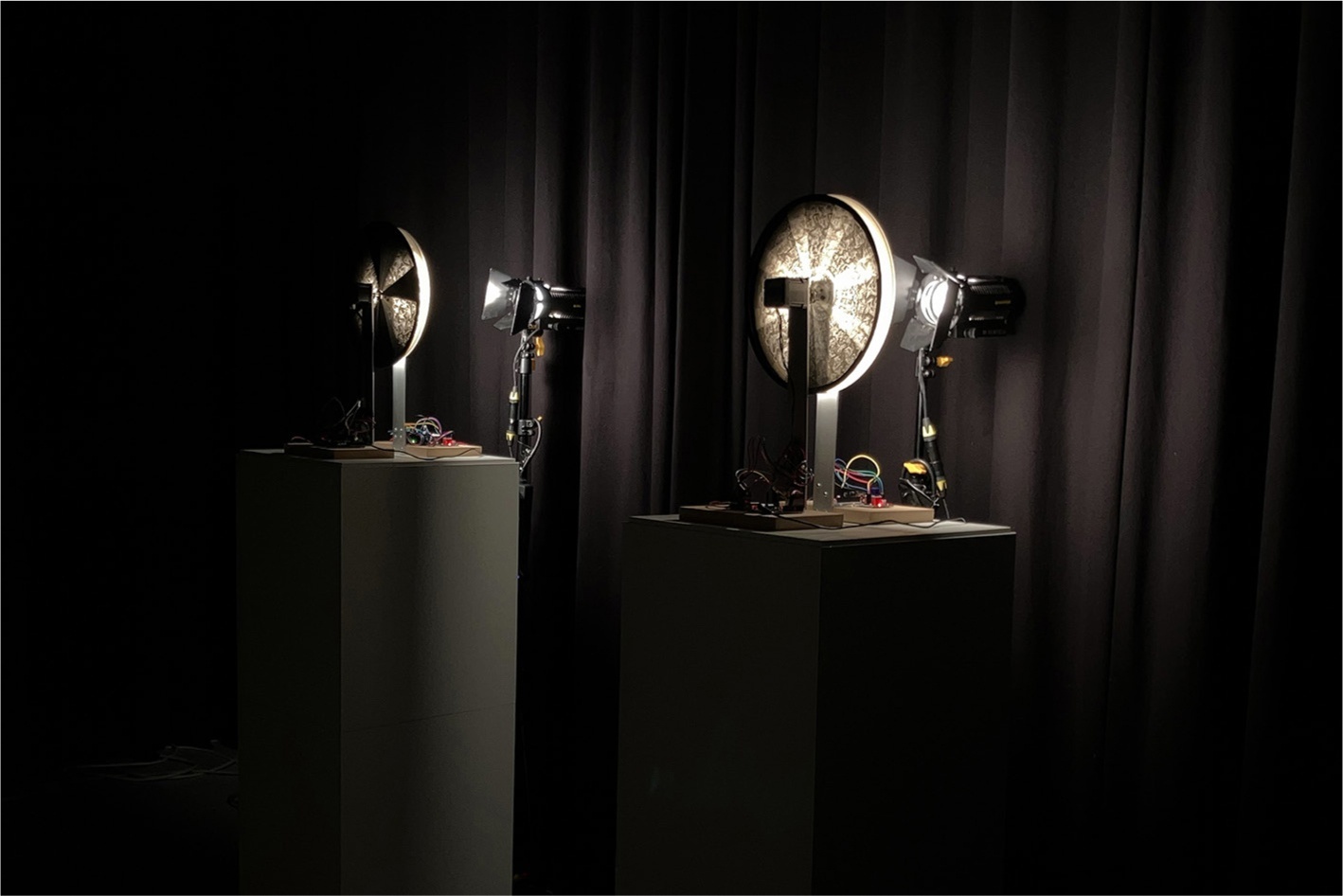
Figure 1
Anortho-phenakistiscopes on display at ENACT Festival: Performing Research at LUCA School of Arts, Brussels, November 6, 2025. Photograph by Guido Devadder
To pursue these questions, we adopted an experimental media-archaeological approach that uses contemporary digital tools to approximate the device’s perceptual experience without adhering to its original materials. This was extended into an artistic research practice structured as a reciprocal dialogue with both historical sources and between our respective artistic practices. Our prototypes were conceived not as fixed, historically accurate replicas but as open platforms, through which parameters such as speed ratios, shutter geometry, and lighting conditions could be varied. Hybrid analogue-digital reconstructions allowed us to iteratively test Plateau’s claims, while probing for unforeseen aesthetic potential.
Because our knowledge emerged through repeated loops of consulting historical sources, making, experimenting, failing, reflecting, and remaking, we describe our method as circuitous epistemology: an iterative, non-linear mode of inquiry in which experimentation and interpretation mutually inform one another. As a result of the sustained oscillation between analogue and digital configurations within this approach, remediation emerged not only as a descriptive account of how media refashion one another, but as an active and deliberate process of transformation, a mode we refer to as bidirectional remediation. We elaborate both concepts later; for now, it suffices to note that our hybrid process repeatedly translated between archival traces and contemporary tools – and back again.
The article proceeds in five stages. First, we situate the anortho-phenakistiscope within Plateau’s optical experiments and outline the knowledge gap that persists due to the absence of a working apparatus. Second, we describe our methodological framework, extending experimental media archaeology into the realm of artistic research. Third, we recount the construction of our prototypes and the optical experiments they enabled. Fourth, we turn to our artistic reimagination of the device as media installation art, with particular attention to the anachronistic integration of 3D-printed lithophanes. Finally, we reflect on how bidirectional remediation can serve as a framework for artistic research informed by experimental media archaeology.
Historical context
In teleological accounts of film history, Joseph Plateau is primarily associated with the invention of the phenakistiscope (1832), which is positioned as a milestone in the genealogy of cinema.4 Yet Plateau’s work exceeds this retrospective framing. Here, we argue for a non-teleological reading of his experiments, foregrounding their speculative, collaborative, and materially situated character. Viewed in this light, the phenakistiscope can be understood not as an origin point for cinema, but as one experiment among several, addressing questions of visual intermittence and motion perception. Central to Plateau’s work was his theory of ‘retinal persistence,’ which later entered film-theoretical discourse under the broader, often simplified notion of ‘persistence of vision,’ even though its role as an explanatory model for moving-image perception was critically reassessed by Gestalt psychology and later developments in cognitive science.5
Plateau’s work emerged in parallel with, and partly in response to, contemporaneous studies of visual perception by Peter Mark Roget and Michael Faraday.6 In Austria, mathematician Simon Stampfer independently developed his version of the phenakistiscope, the Stroboskopische Scheibe (1833), shortly after Joseph Plateau, drawing primarily on Michael Faraday’s earlier research. Like the kaleidoscope or thaumatrope, the phenakistiscope was soon categorised as a ‘philosophical toy,’ a device that translated new perceptual insights into popular amusement.7 In this context, it is often mentioned alongside another of Plateau’s inventions, the anorthoscope, which he first described in his doctoral thesis (1829) and commercialised later in 1836.8 Yet Plateau’s interest lay less in the production of entertaining devices than in the experimental investigation of visual perception, and, despite certain morphological similarities, such as the circular disc format and slit-based viewing, the anorthoscope operates on a fundamentally different principle and does not produce the illusion of motion. To understand how these two devices were combined, it is helpful to examine how the phenakistiscope and anorthoscope functioned.
The phenakistiscope generates apparent motion through a shutter mechanism: either by viewing a single rotating disc through the apertures into a mirror, or by using a separate shutter disc. The apertures must be narrow, and their count corresponds with the number of image segments, so that identical figures appear momentarily stationary in rapid succession, while slight variations between them generate the impression of simultaneous movement. Crucial to the discussion that follows is the fact that the phenakistiscope was essentially a single-user device: a rotating disc with sequential images that produced the illusion of motion only when viewed with one eye positioned close to its apertures (see figure 2).
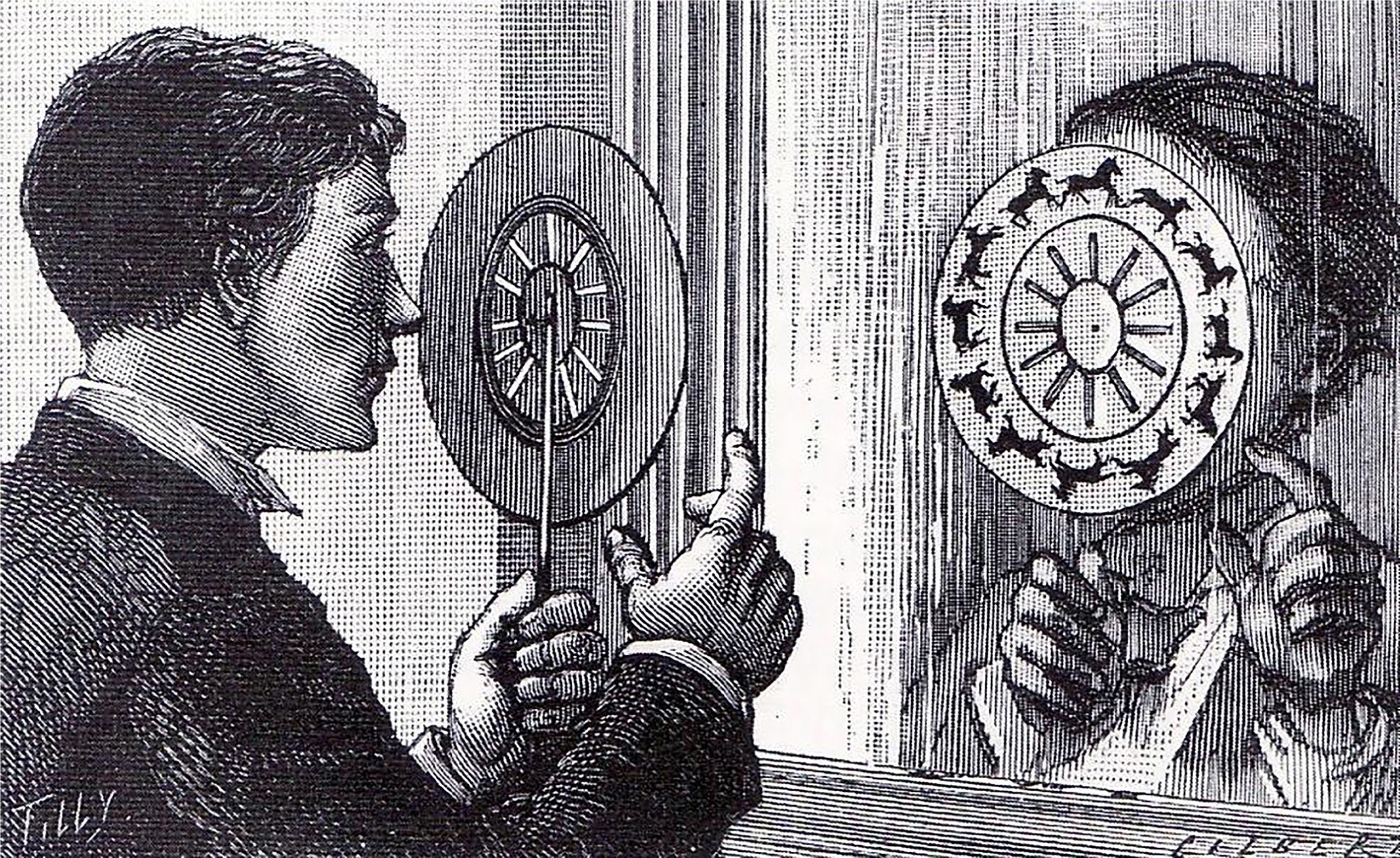
Figure 2
Use of a mirror phenakistiscope (19th-century engraving). Source: Der Gebrauch des Spiegel-Phenakistiskops, CC BY-SA 3.0, via Wikimedia Commons
The anorthoscope, by contrast, does not produce the illusion of motion but paradoxically yields a stable image arising from the interaction of two counter-rotating discs. In his doctoral thesis, Plateau takes Roget’s analysis of the palisade illusion as a starting point.9 In this phenomenon, a spoked wheel rolling behind a fence appears motionless, while its spokes on either side seem to bend into curved forms. What is perceived here is not the moving object itself, but what Roget calls a spectral image, generated by the locus of intersections between the apertures and the wheel in motion.10 Plateau abstracted this phenomenon into a general principle: stable perceptual forms can arise whenever moving elements periodically return to identical relative configurations.
The anorthoscope reverses the optical logic of the palisade illusion by transforming a single, deliberately deformed image into a coherent, immobile figure when observed in motion (see figure 3).11 The anamorphic image is placed on a separate, semi-transparent disc and lit from behind. A black disc containing four radial apertures at 90-degree intervals rotates in front of it. Unlike the phenakistiscope, a single aperture would suffice to produce the effect; however, as Plateau notes in his 1836 text “Notice sur l’anorthoscope,” ‘the multiplicity of slits pierced in the black disc (…) has no other effect than to increase the brightness of the resulting image.’12
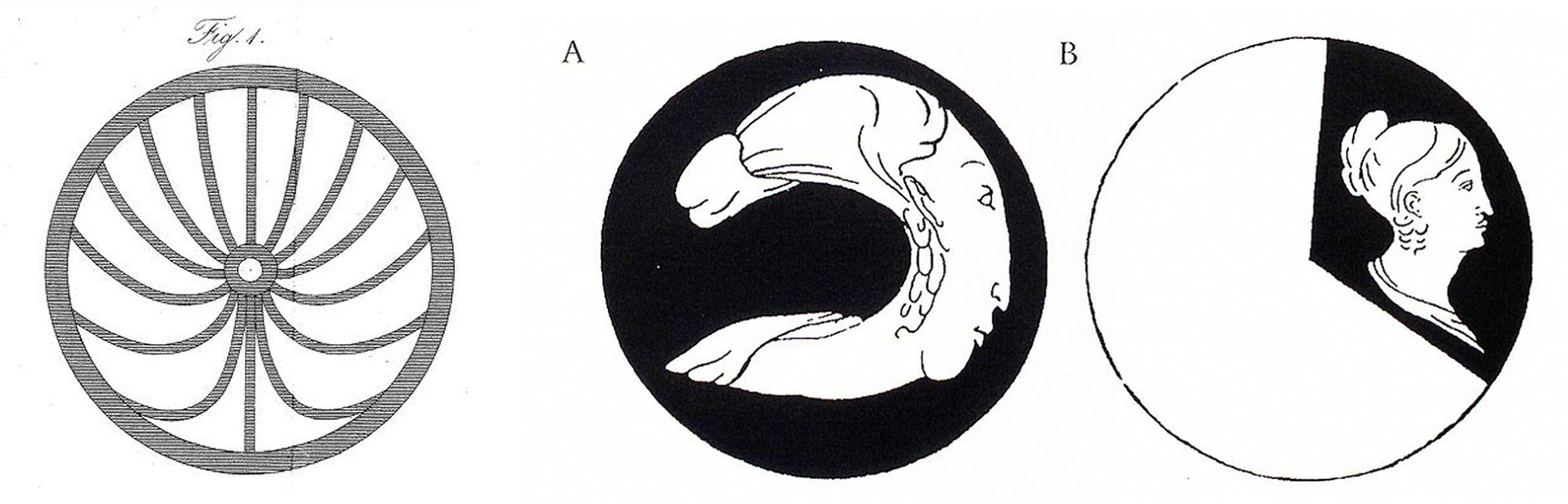
Figure 3
Left: Diagram of the rotating wheel and vertical apertures illustrating Roget’s optical deception. From Peter Mark Roget, “Explanation of an Optical Deception in the Appearance of the Spokes of a Wheel Seen through Vertical Apertures,” Philosophical Transactions of the Royal Society of London 115 (1825): 141. Right: Anamorphic image disc (A) and perceived as normal image (B) for the anorthoscope. From Joseph Plateau, “Lettre de M. Plateau au Rédacteur, relative à différentes expériences d’optique,” Correspondance Mathématique et Physique, Tome VI (1830), Plate III
The synthesis of both devices into the anortho-phenakistiscope dates from a later period, between 1844 and 1849.13 Remarkably little has been published about this hybrid device. Maurice Dorikens provides the most detailed account, while Nicholas Miller highlights the collaborative role of painter Jean Baptiste Madou and cautions against reducing the invention to a ‘stepping stone’ toward cinema.14
The anortho-phenakistiscope’s relative obscurity can be explained by several factors. First, the absence of a commercial model or even a working prototype meant very few people ever saw it in operation. Second, the canonical status of the phenakistiscope and Plateau’s later scientific breakthroughs may have overshadowed this more speculative experiment.15 Third, teleological framing may have played a role: although the device enabled multiple viewers to observe the animation simultaneously, it did so without relying on projection. As such, it doesn’t fit neatly within linear narratives of cinema’s emergence, which may help explain why it has attracted comparatively little scholarly attention.
Fortunately, Plateau’s “Troisième note” provides a detailed description of the device. It paired a translucent image disc, backlit and painted with sixteen sequential images, with an opaque shutter disc containing only four apertures. To function, both discs had to rotate in opposite directions, with the shutter disc rotating at four times the speed of the image disc, ensuring that each aperture was aligned with the correct image segment in sequence. In other words, this 4:1 speed ratio will make the shutter’s sampling frequency equivalent to that of a phenakistiscope. With four apertures rotating at four times the speed of the image disc, each of the sixteen image segments is sampled once per cycle.16
Unlike the traditional phenakistiscope, however, the interaction between the four-slotted shutter disc and the sixteen-segment image disc produces an angular deformation, a slight anamorphic distortion in the sequential images – akin to the effect of the anorthoscope, though far less pronounced. Plateau provides a detailed mathematical account of this phenomenon in the “Troisième note,” but for present purposes it suffices to note that it yields an angular deformation ratio of 4:5.17 In motion, the figures therefore appeared horizontally compressed, reduced to 80 percent of their still-image width. To compensate for this effect, Plateau pre-stretched the drawings by a factor of 5:4, drawing them wider, so that they would appear correctly proportioned when viewed in the operating apparatus.18
Plateau further notes that this device allows a single animated image to be isolated – unlike the traditional phenakistiscope, in which all figures on the disc are visible simultaneously. This is made possible by backlighting the image disc: he recommends placing the lamp behind the upright image and inserting a piece of black cardboard with a trapezoid-shaped opening between the lamp and the disc, so that only a single upright figure remains visible from a frontal view.19
Plateau’s description makes clear how the anortho-phenakistiscope combined features of both parent devices. From the phenakistiscope, it inherited the sequential image disc, though, like the anorthoscope, this disc was rendered translucent and illuminated from behind. The four-slotted shutter disc was likewise adopted from the anorthoscope and introduces angular deformation as a side effect, requiring the figures to be drawn 5:4 wider than they appear in motion. Together, these elements make the anortho-phenakistiscope a genuine hybrid, merging the operating principles of both predecessors in a way that was never taken up by later optical devices.
Two discs have survived (see figure 4): one depicts a demon blowing on embers, lighting up the scene (further addressed as the ‘demon disc’), while the other shows a monk carrying a torch through a vaulted passage (further addressed as the ‘monk disc’). Plateau only discusses the demon disc in the “Troisième note”:
The image represents a demon’s head bending toward a fire of charcoal embers, which it stirs with its breath, then straightening up to take a breath, bending again to blow, and so on. This head is seen from the front; it is about four centimetres high, and stands out, together with the fire, against a dark background. When it blows, its cheeks swell, its lips protrude, its eyebrows frown, and its eyes are directed toward the fire; at the same time, the fire becomes animated, crackles, and projects a bright light, which strongly illuminates the head from below and makes the parts that remain in shadow appear very dark. Then, when the head straightens up and takes a breath, its cheeks flatten, its mouth opens, its eyebrows lift, and its eyes turn toward the viewer; then also the fire becomes less ardent, loses its brightness, and the head, which is now further from it, is seen in semi-darkness.20
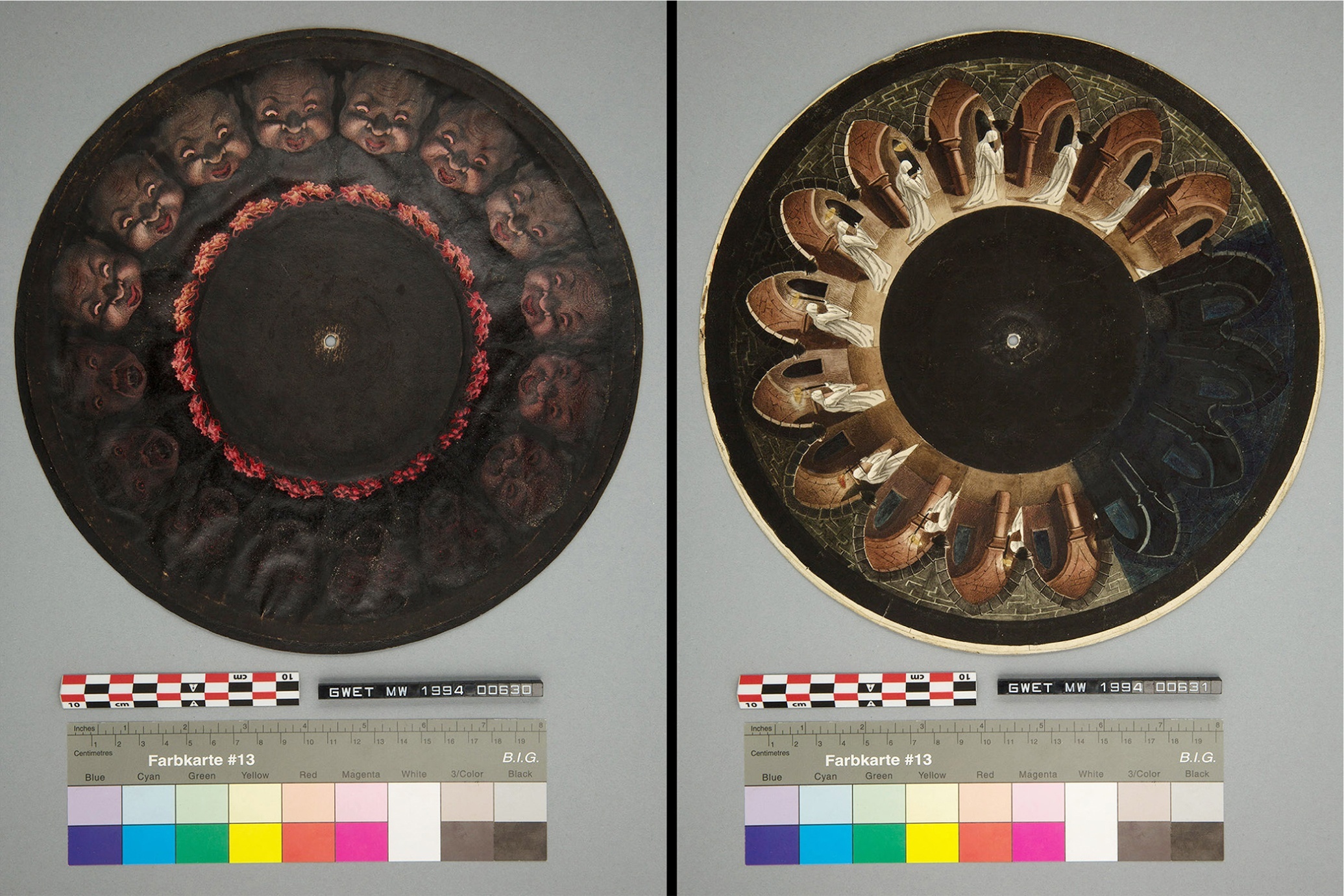
Figure 4
Photographs of the hand-painted original anortho-phenakistiscope discs, Joseph Plateau and Jean Baptiste Madou (c. 1844–1849). © GUM – Ghent University Museum. Used with permission
In both discs, the fluctuation of light is central: the demon animates the glowing embers, while the monk’s torch casts alternating zones of brightness and shadow. Nicholas Miller identifies this modulation of light as their ‘primary movement’.21 Painted in watercolour on thin paper, the image discs were reinforced with cardboard at both the centre and the circumference (see figure 5). Control over translucency was achieved by treating the lighter areas with a clear varnish to increase transparency, while darker areas were rendered opaque by applying paint on the reverse side.22 Using varnish to increase transparency was a variation on the method Plateau used in his earlier anorthoscope discs, where he impregnated the paper with oil.23
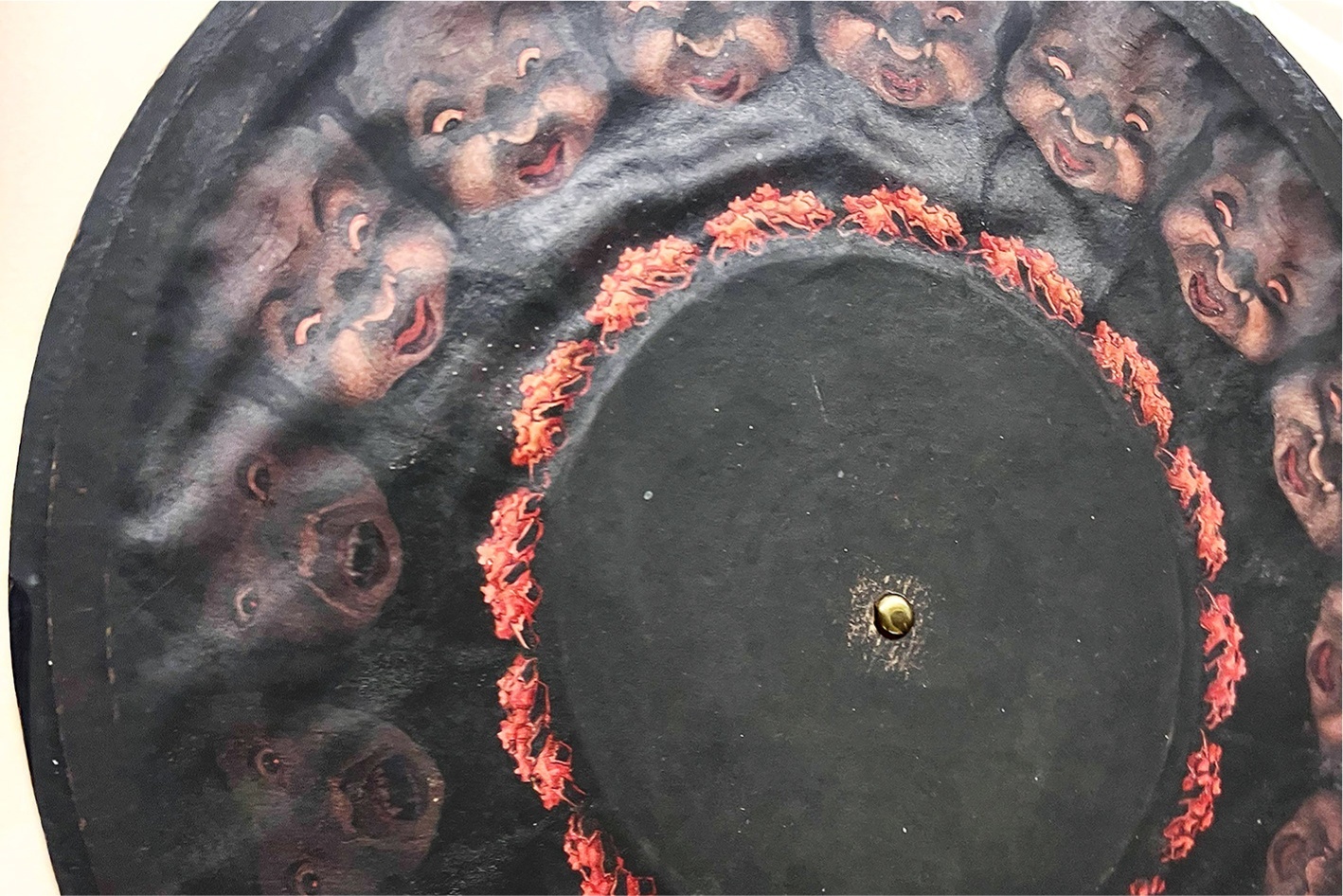
Figure 5
Detail of the hand-painted original of the Demon disc. The photograph shows the cardboard reinforcement and slight warping of the thin paper caused by the paint. Joseph Plateau and Jean Baptiste Madou (c. 1844–1849). Photograph by Guido Devadder, GUM (Ghent University Museum), 2023
The anortho-phenakistiscope also offers a rare glimpse into Plateau’s collaboration with painter and lithographer Jean Baptiste Madou. In the “Troisième note,” Plateau credits him directly:
One of our great artists, Mr. Madou, kindly agreed, at my request, to draw the model of the head at the moment when it blows with the greatest force. I then transferred this drawing into one of the disc’s compartments (…).24
Significantly, Plateau requested the moment of peak exertion – what we would call a keyframe in contemporary animation terms. Plateau, who had received formal artistic training before turning to science, would then transfer the drawing to the disc, deform it to compensate for the angular deformation, and add the other drawings in the sequence.
While Madou’s confirmed contributions are limited to these two discs, the stylistic resemblance to other phenakistiscope designs, especially the metamorphosis of a girl into a monster, suggests his involvement may have extended further (see figure 6). The two had likely met through Plateau’s mentor Adolphe Quetelet, whose half-sister Mélanie Lannuyer married Jean Baptiste Madou in 1833.25 At that time, Madou was not yet the celebrated painter he would later become, but a skilled lithographer – an expertise directly relevant since lithography was also the medium of reproduction for the commercialised phenakistiscope. This raises the question of whether Madou was merely executing Plateau’s ideas or actively shaping the visual conception of these optical experiments. While definitive answers remain uncertain, their collaboration exemplifies the fertile intersection of scientific experiment and artistic craft.
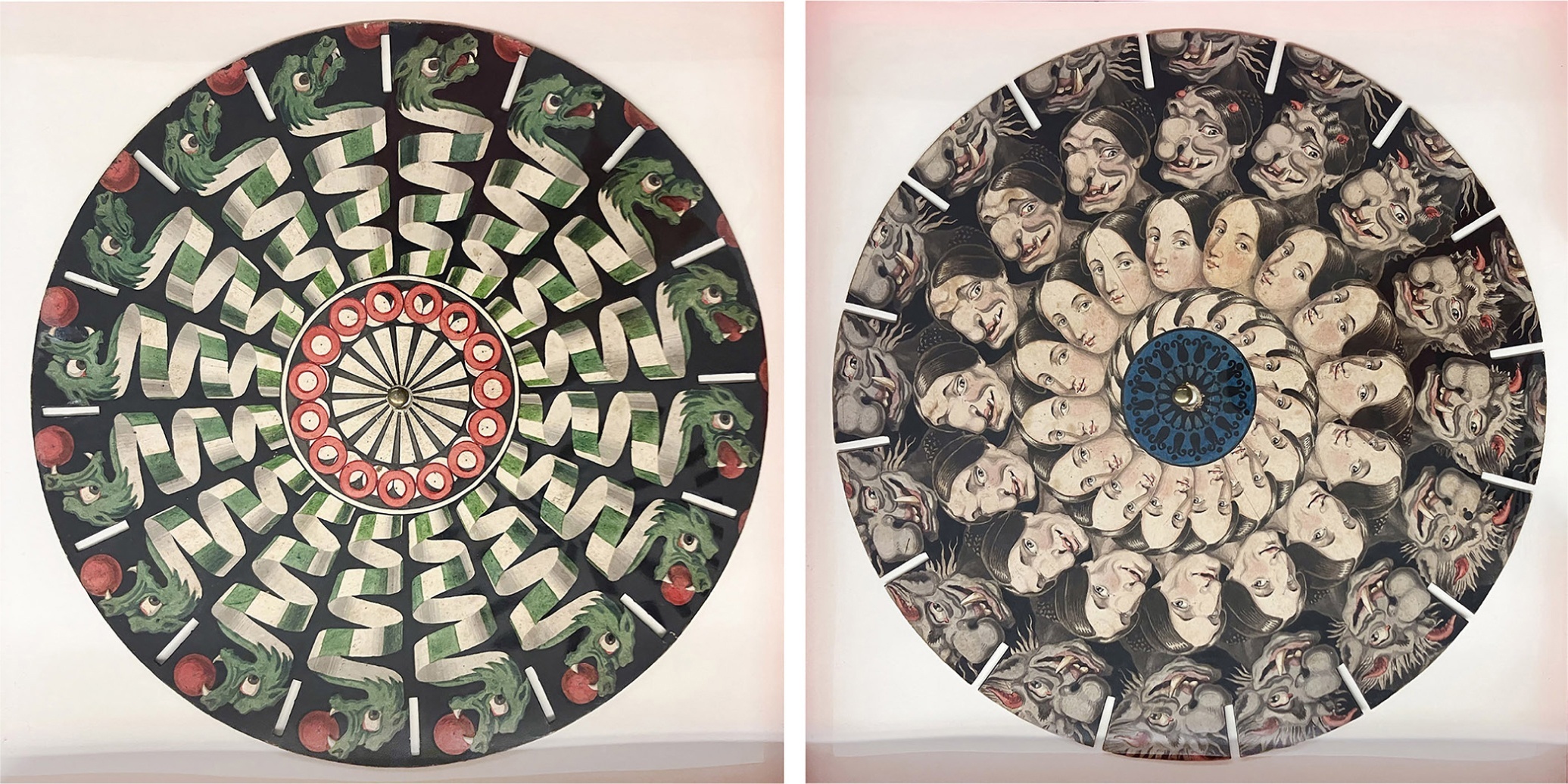
Figure 6
Phenakistiscope discs by Joseph Plateau. It remains uncertain whether Jean Baptiste Madou contributed to these designs, though they show stylistic similarities to the anortho-phenakistiscope discs. Photograph by Guido Devadder, GUM (Ghent University Museum), 2023
The commercial success of the historical anortho-phenakistiscope was, however, very limited, even though Plateau asserts that ‘my little blower has aroused genuine admiration among the people who have seen it in operation’.26 In practice, very few people have encountered the device, as it was neither produced for wider distribution nor presented to a general audience. Plateau’s “Troisième note” also reveals the considerable effort required to fabricate both the mechanical apparatus and the image discs. This complexity may explain why the device was never commercialised. Compared to the relatively straightforward manufacture of the phenakistiscope, the anortho-phenakistiscope required a substantial investment of materials and labour, making it very expensive to produce. Does this make it a ‘failed’ device? Perhaps in commercial terms. Yet when we shift perspective away from market viability and linear media histories, the anortho-phenakistiscope appears less as a prototype for mass production than as a singular, site- and situation-dependent apparatus. While remaining cautious about retrospective labelling, we found that engaging with the device through interpretative frameworks associated with media installation art practices provided a productive basis for our artistic reinterpretation.
At a more fundamental level, however, the absence of a working device points to a significant knowledge gap concerning the anortho-phenakistiscope itself and its place in media history. Plateau’s description makes clear that the device represents an idiosyncratic experiment in the history of motion perception that was not taken up elsewhere. The apparatus enabled simultaneous viewing by several observers, yet without recourse to projection. It relied on a four-aperture shutter disc, a mechanical principle that never reappeared in later devices, and produced an angular deformation effect that differed from those of both its parent instruments. However, because the surviving discs are separated from the apparatus that once animated them, the device’s perceptual effects remain unknown. In correspondence with the Ghent University Museum, we learned that it is also unclear which specific rotational mechanism Plateau employed. This absence raises critical questions. How exactly did the hybridisation of the anorthoscope and phenakistiscope generate the illusion of motion? And, from an artistic perspective, how might we engage the device’s unusual affordances – not as limitations, but as aesthetic opportunities for reimagining light, motion, and spectatorship?
Methodological Framework
The unresolved questions outlined above shaped our double aim. First, to reconstruct and understand a rarely studied cultural object by examining how it combined elements of its parent devices and probing the perceptual affordances emerging from this hybridisation. Second, to extend those affordances within an artistic research framework by exploring the device’s potential as media installation art. This double orientation resists reduction to either a purely historical or a purely artistic approach. Rather, it requires a methodology capable of integrating historical reconstruction, material experimentation, and artistic reimagination.
Within media archaeology, such methods have been articulated in different ways, most notably through Erkki Huhtamo’s well-known concept of thinkering, and Andreas Fickers and Annie van den Oever’s pioneering work in experimental media archaeology.27 While the notion of thinkering originally emerged to describe artistic practices that combine tinkering with technology and critical reflection, experimental media archaeology formalises hands-on, sensorial approaches into a research methodology. Promoting reconstruction, re-enactment, and practice-based inquiry as epistemic tools, this perspective is especially fruitful for artistic research, as it positions experimental reconstructions not merely as demonstrations of media history, but as ways of probing its blind spots and uncovering heterogeneous, non-linear genealogies.
Our dual aim also shaped the project’s working space. Rather than treating the laboratory and the artist’s studio as separate domains, we approached them as a single hybrid environment in which reconstruction, measurement, documentation, and aesthetic practice were developed in tandem. Following accounts of media archaeology as laboratory practice, our method treated hands-on experimentation as a mode of historical inquiry, while remaining open to the productive role of detours, failures, and serendipitous discoveries.28 This hybrid lab-studio orientation is what later motivates our articulation of circuitous epistemology and bidirectional remediation.
The principal starting point for our research was a discursive account, in the absence of any surviving apparatus, patent, or construction drawing. This resonates with the distinction made by Tim van der Heijden and Aleksander Kolkowski between inductive and deductive approaches in experimental media archaeology.29 While the latter starts from theory, such as studying historical sources or user manuals, the inductive approach is bottom-up, grounded in practice, experimentation and thinkering. An integrative approach combines both perspectives. Somewhat unintentionally, our project began in a predominantly inductive mode, before evolving to an integrative one. Because we were unaware of Plateau’s more detailed account at that time, our first prototypes were built from Maurice Dorikens’ condensed description of the device. In retrospect, it proved a fortunate accident that Plateau’s more detailed description in the “Troisième note” only came to our attention later. By initially working without it, we were compelled to formulate open-ended questions through experimentation, questions that might otherwise have appeared as ready-made ‘answers’ had we worked from Plateau’s text from the outset.
This ‘interrogative mode’ was embedded into our continuously evolving prototype of the anortho-phenakistiscope (see figure 7): a device we could actively ‘question’ and modify to explore a broad range of configurations between the anorthoscope and phenakistiscope – a flexibility that also proved crucial for our later artistic creation process. Within this interrogative framework, 3D printing became a key operative tool, allowing us to fabricate and test different shutter geometries and slot counts in iterative cycles. This capacity to rapidly materialise hypotheses transformed 3D modelling and fabrication into a form of experimental probing, aligning with digital humanities approaches that understand critical making as a mode of knowledge production.30
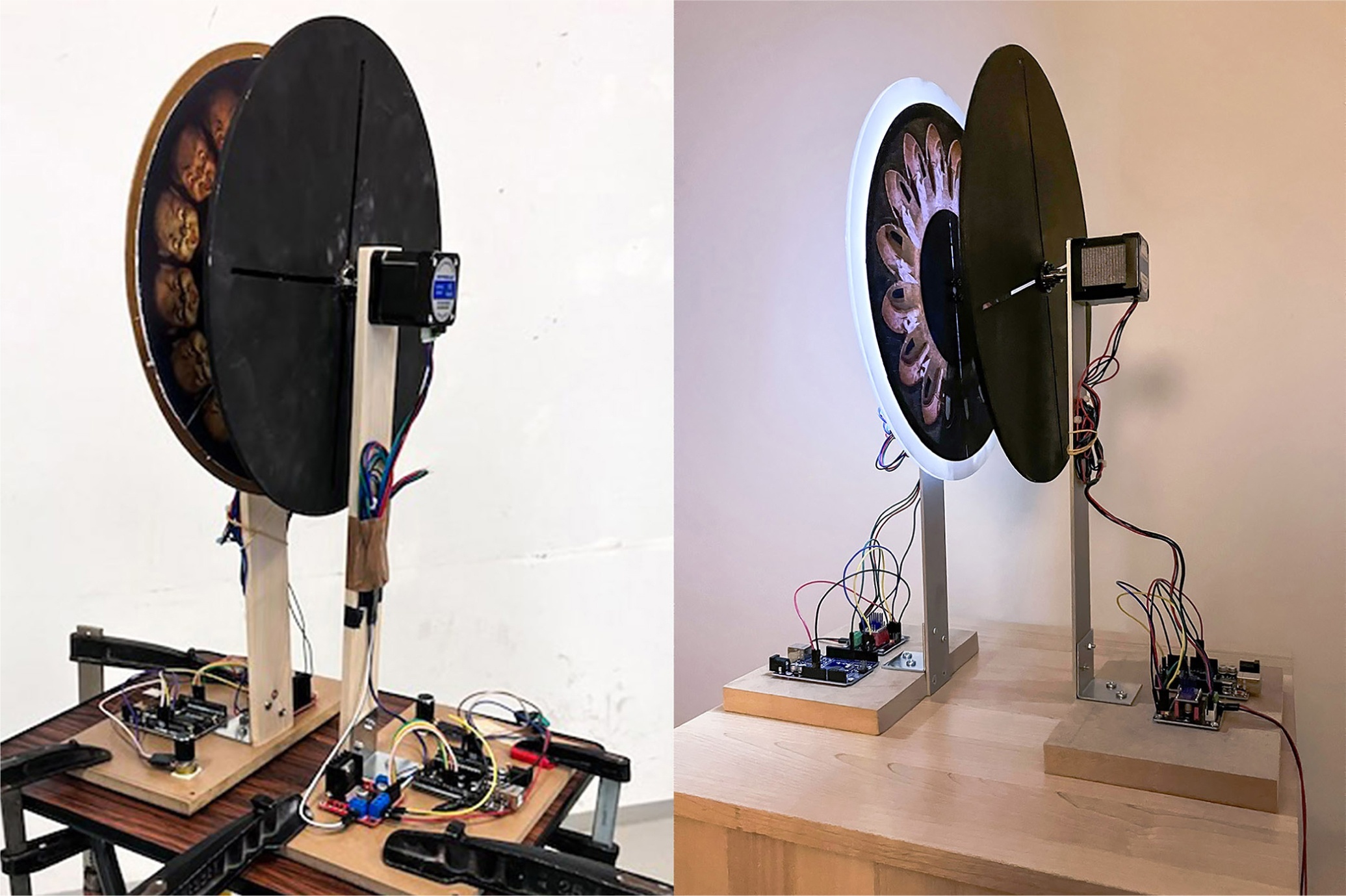
Figure 7
Different stages in developing prototypes to reconstruct the anortho-phenakistiscope. Photographs by Guido Devadder, 2025
In this sense, the prototypes we built were not just artefacts, but heterogeneous constellations containing technical, material, aesthetic, perceptual, historical and discursive elements. This approach echoes François Albera and Maria Tortajada’s notion of a dispositive, departing from the traditional notions of dispositif and apparatus by emphasising relational and configurational aspects rather than power dynamics.31 This aligns with our view on the anortho-phenakistiscope: not just a physical device, but a mutable constellation. Altering one element never occurs in isolation but inevitably reshapes the whole.
The emphasis on interconnectedness suggests an analogy with other domains where knowledge is built through iterative probing. Electronic circuits, for instance, are often explored by switching components or varying resistances, just as coding languages are often learned through ‘exploratory coding,’ tweaking variables to see how outcomes shift. In a similar way, our dispositive can be understood as a circuit: one that can be probed and adjusted not only through technical substitutions – different shutters, light sources, or modes of transparency – but also by shifting aesthetic choices, interpretive frames, and historical references. Each modification ‘reroutes’ the circuit, producing different perceptual and conceptual effects. This iterative logic also extends the circuit metaphor to a temporal level. Our understanding of the anortho-phenakistiscope evolved through recursive loops of making, probing, perceiving, reading, and reflecting, but was shaped equally by technological failures, accidental discoveries, and constant dialogue with historical sources.
Approaching our reanimation of the anortho-phenakistiscope as both a spatial and temporal circuit proved central to understanding its underlying logic and emergent artistic affordances. This led us to articulate the notion of circuitous epistemology: a mode of inquiry that unfolds through recursive iterations of historical research, material experimentation, artistic creation, reflection, and reconfiguration. Rather than following a linear path – which would have been entirely possible given Plateau’s detailed instructions – our project involves detours, breakdowns, and serendipitous encounters that became integral to the production of our knowledge and artistic explorations. In this sense, the perpetually changing prototype was not simply an object of study, but the materialisation of a transdisciplinary and transhistorical dialogue, with historical, technical, perceptual, and artistic dimensions.
Our use of the term circuit also resonates with Hertz and Parikka’s discussion of circuit bending and zombie media, where an electronic device is treated not as a closed system, but as an assemblage, a field of latent relations that can be rerouted, short-circuited, and experimentally explored.32 We adopt this logic in an expanded sense: the ‘circuit’ we worked with was not only electronic but also optical, mechanical, historical, artistic, and discursive. By iteratively altering its constituents, we were effectively ‘bending’ this hybrid circuit to discover what it could do.
In this framework, we found it useful to draw on the concept of affordances – not as fixed properties but as relational qualities that emerge through interaction, both with the device-as-circuit and through the situated practices of our artistic research team, in which different perspectives are brought into dialogue.33 Moreover, these affordances were not limited to what the device had historically enabled for its nineteenth-century users; they also emerged through its contemporary reactivation and artistic reconfiguration. For example, while Plateau masked out all but one image, we exploited the disc’s inherent circularity as an affordance in its own right, foregrounding cyclical temporality in contrast to dominant linear models of screen-based viewing. Likewise, replacing mechanical gearing with microcontrollers and stepper motors allowed us to generate new artistic affordances, extending the device beyond its historical constraints. The following section explores this hybrid analogue-digital configuration in more detail.
Reconstructing and Experimenting
Our research process began with the development of a reconstruction to investigate the perceptual characteristics of the anortho-phenakistiscope, based on the discursive description and the surviving image discs. Direct engagement with the original artefacts was not possible. The two discs preserved at the Ghent University Museum are too fragile and valuable to handle, and there was no certainty as to which specific mechanical base Plateau used to drive their rotation. The museum did, however, provide us with high-resolution photographs and scans of the discs.
These became the foundation of our reconstruction strategy, which strayed from the logic of strict historical accuracy in favour of a more open approach: emulating the device’s functional parameters, such as relative rotation speeds or shutter geometry, rather than attempting a precise mechanical reconstruction. Adhering to the original materials would have left little room for perturbation, variation, or iteration. Each modification would require fabricating new components in historically correct materials, and even minor adjustments would have been costly and laborious. For our purposes, such rigidity was counterproductive. We therefore opted for a hybrid analogue-digital strategy, one that combined digital simulation and creation, computer-aided manufacturing, and physical computing (see figure 8). This approach allowed us to reproduce the key parameters described in Plateau’s “Troisième note” while granting the flexibility to test, modify, and expand configurations as needed.
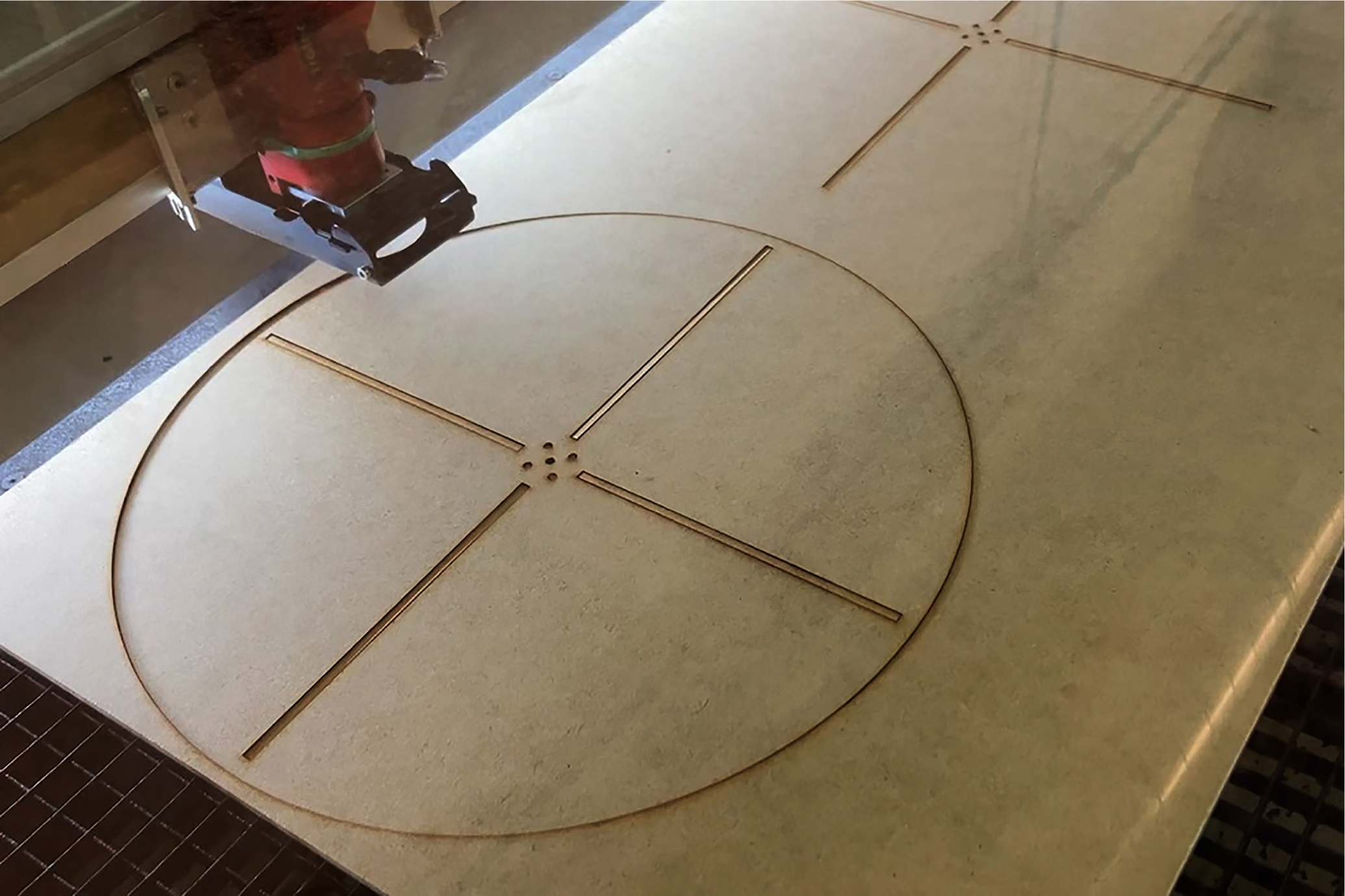
Figure 8
Laser cutting the shutter disc from MDF board. We later switched to 3D-printed shutter discs to reduce weight. Photograph by Guido Devadder, 2025
Before moving to a physical apparatus, a first step was to examine the two surviving discs in motion through digital animation. This allowed us to observe the animations under controlled conditions, unaffected by lighting, motor velocity and – most importantly – shutter interference. As indicated by Plateau’s description, the shutter would introduce an angular deformation, with the images appearing slightly compressed at a 4:5 ratio, against which a digital simulation serves as a reference.
We produced looping GIFs of both discs by digitally rotating the circular image around its central axis, with each segment corresponding to a frame in the digital animation.34 However, this simulation yielded an unexpected result: the two image discs would produce coherent motion only when rotated in the opposite direction. This was unexpected, because both sequences are clearly unidirectional. The demon (see figure 9) exhales with force, after which the light from the embers gradually fades – a sequence that only reads correctly when the disc is rotated clockwise – whereas for the monk (see figure 10) to appear to advance through the vaults, anticlockwise rotation is required. Plateau does not address this asymmetry in his “Troisième note,” leaving its purpose unclear. There is no technical reason that would necessitate the difference, since the sequential imagery could have been arranged in reverse order on the disc. And given Plateau’s extensive experience with phenakistiscope design, it seems most unlikely that the opposing rotation was merely accidental. Why, then, did he design the second disc to run in the opposite direction from the first? This question remained unresolved until our hands-on reconstruction offered a potential explanation.
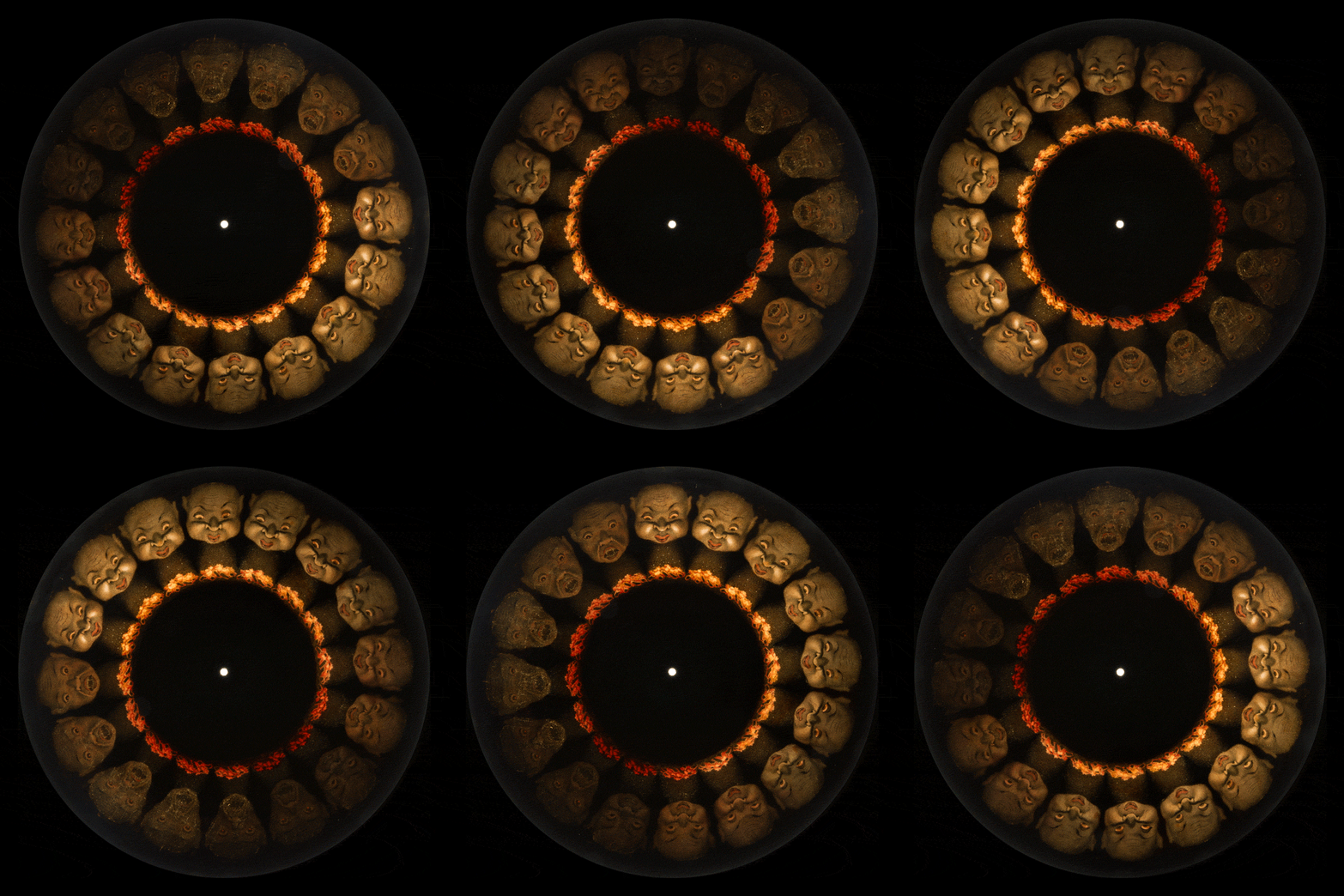
Figure 9
GIF animation of the demon disc. Image © GUM – Ghent University Museum. Used with permission. Animation by Guido Devadder
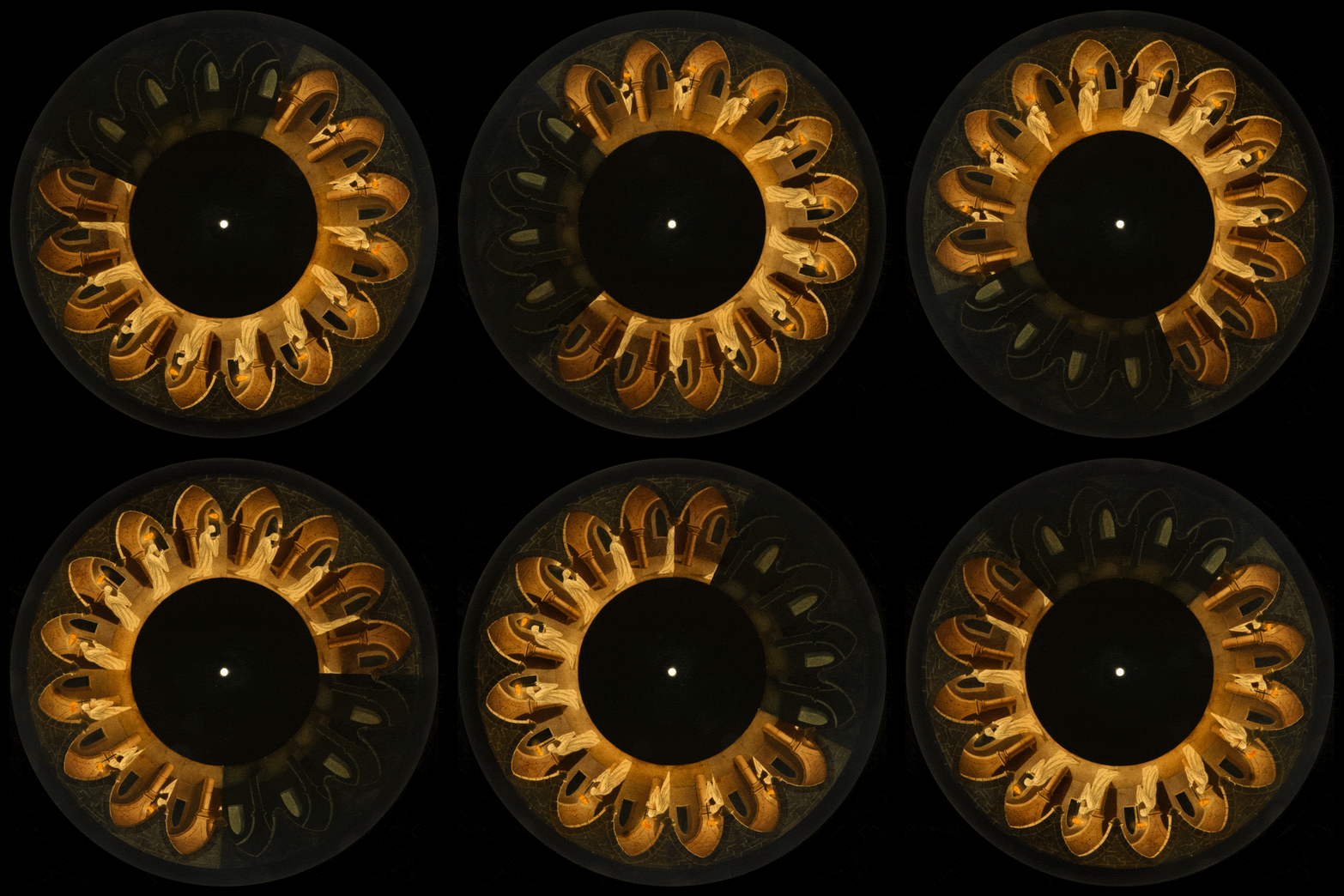
Figure 10
GIF animation of the monk disc. Image © GUM – Ghent University Museum. Used with permission. Animation by Guido Devadder
To establish a workable physical apparatus, we first developed a substitute mechanism to drive the rotation of both the image and shutter discs. As outlined above, maximum adaptability for testing various configurations was a priority. For this reason, rather than building a single device with a compound gear system akin to Plateau’s original, we opted for two mirrored devices: one for the shutter disc and the other for the image disc. Each disc was driven separately by a stepper motor connected to an Arduino microcontroller, allowing us to maintain precise relative speeds.35 Plateau had emphasised the importance of keeping the shutter disc rotating precisely at a 4:1 ratio in the opposite direction to the image disc,36 and our setup not only allowed us to replicate this specification but also to vary or interactively control both discs independently. This mirrored setup also enabled us to test different distances between the discs and to reconfigure the setup with alternative shutters, image supports, and light sources.
Light and transparency were also crucial to both reconstruction and reimagination. In our experiments, we tested various impregnation methods – oil, wax, varnish – that did indeed increase transparency, but at the cost of reducing contrast, as dark areas appeared washed out. Eventually, we opted for inkjet printing on self-adhesive vinyl foil, mounted on transparent PVC sheets. Unlike the oil-impregnated paper, this method preserved sharp contrasts while remaining sufficiently translucent (see figure 11), making it effective for reconstruction but also suggestive of further artistic possibilities. For illumination, we used a stable LED spotlight, whereas Plateau’s device would have relied on a bright oil lamp, such as the Argand type, introducing the possibility that flicker played a role in the original perceptual effect. This historical divergence invites artistic experimentation, as changes in illumination transform the aesthetic and perceptual qualities of the anortho-phenakistiscope.
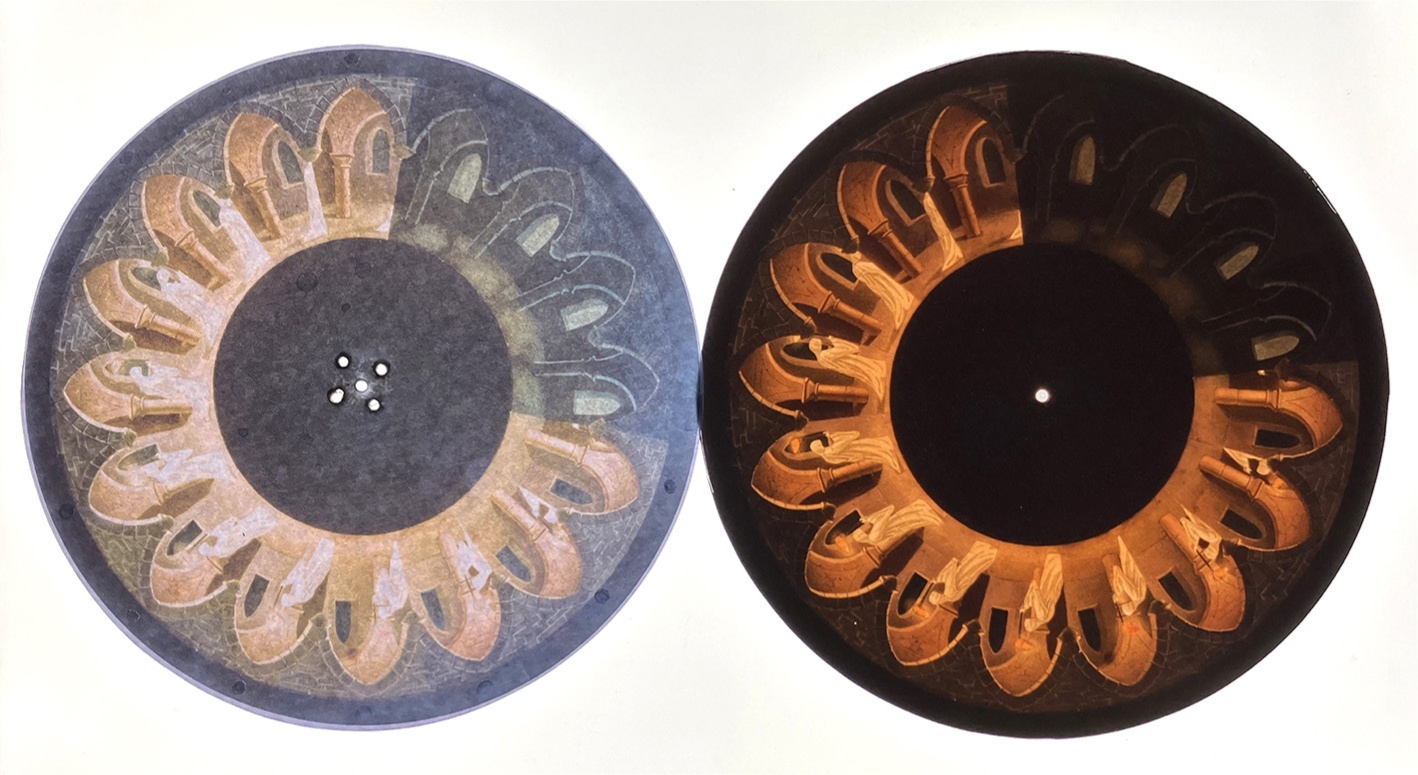
Figure 11
Recreating translucency: the disc on the left shows oil impregnation on matte high-resolution inkjet paper, resulting in reduced contrast, while the disc on the right was created through inkjet printing on vinyl film. Both discs are backlit on a light table. Photograph by Guido Devadder, 2025
After weeks of testing alternatives and resolving technical difficulties, we finally achieved a breakthrough – experienced collectively, as all three of us could see the animation together, as was Plateau’s aim with this device.37 Witnessing Plateau and Madou’s work in motion – perhaps for the first time since the mid-nineteenth century – was a deeply resonant moment, as history suddenly came to life before our eyes. Although fabricated with contemporary tools, our prototype was functionally faithful in reproducing the parameters outlined by Plateau, and our perceptual observations matched his description in the “Troisième note,” except for one crucial detail. In our eagerness to test the setup, we had initially omitted the mask Plateau prescribed to isolate a single animated image, an omission with significant perceptual consequences.
Observing the entire backlit disc revealed something Plateau’s text leaves unmentioned: the animations appeared not only compressed, as predicted in the “Troisième note,” but also strangely multiplied. When set in motion, the disc seemed to host more figures than were visible in the still image, yet it unfolded seamlessly without perceptible discontinuities.38 A plausible explanation for why Plateau did not mention this effect is that his masking technique concealed the disc entirely, except for the upper segment. Encountering this unforeseen perceptual effect proved generative for our artistic explorations, as it suggested new ways of working with multiplicity and spatial presence.
Following the construction of our first replica, we conducted a series of experiments to explore possible reconfigurations between the original anorthoscope and the phenakistiscope. Without detailing every technical variation, these experiments allowed us to actively ‘question’ the device and to develop a clearer understanding of why Plateau may have made certain design choices. Perceptual observations were recorded individually in notebooks and on video, and subsequently discussed collectively within our research team, allowing us to compare and reflect on the effects encountered.
One line of inquiry, for instance, asked why Plateau combined a four-slotted shutter with a 16-image disc, even though this configuration allows significantly less light to pass than the traditional phenakistiscope shutter (see figure 12). Equipping our prototype with a 16-slotted shutter – rotating in the opposite direction but this time at the same speed as the image disc – revealed that it only produced a coherent animation when the eye remained very close to the apertures, blocking neighbouring slits. As soon as the observer moved further away and multiple apertures came into view, overlapping images disrupted the illusion of continuous motion.
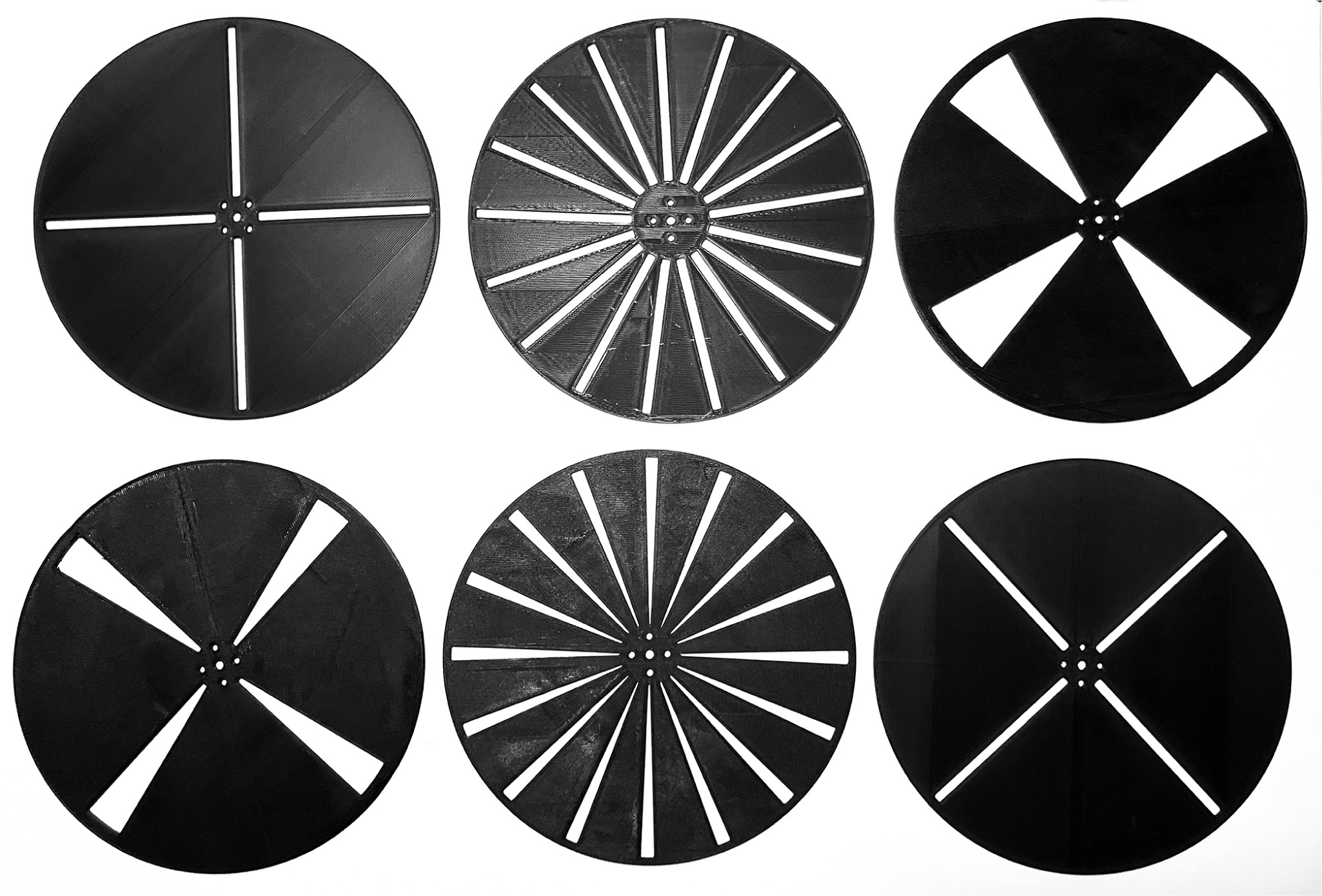
Figure 12
Experimenting with various shutter geometries using 3D-printed discs. Photograph by Guido Devadder, 2025
Whereas the 16-slotted shutter failed to produce a stable animation, further experiments with modified shutter discs revealed that it was possible to double both the number of segments on the image disc and the number of apertures on the shutter disc. Adopting a ratio of 8 slots and 32 images not only enabled more intricate animations for our artistic reanimation but also doubled the amount of light passing through the apertures, resulting in a substantially brighter image.
In addition to our initial research questions, certain affordances emerged serendipitously. One such instance occurred when a wiring error caused both discs to rotate in the same direction at a 4:1 ratio. Unexpectedly, the animation remained legible, but the optical effect inverted: the figures appeared widened rather than compressed, and the disc seemed populated by fewer images than were actually present.
This discovery not only opened up new directions for artistic exploration but also prompted us to reconsider Plateau’s own designs. Could this effect explain why the drawings appear comparatively narrow in the monk disc, when set against the demon’s head in the other disc? While the “Troisième note” only details the demon disc, Plateau’s “Deuxième note sur de nouvelles applications curieuses de la persistance des impressions de la rétine” describes cases in which legible anorthoscope images result from both discs rotating in the same direction.39 It is therefore possible that Plateau conceived the monk disc with this configuration in mind: when testing a reproduction of this disc, we independently perceived the same-direction deformation as more natural than the opposite. This interpretation remains speculative, however, as our perceptions may have been shaped by expectations, and the images on the disc contain no fixed reference points that could serve as material proof.
A final aspect worth highlighting is the viewer’s orientation relative to the device, which sets the anortho-phenakistiscope apart from later projection-based phenakistiscopes such as Duboscq’s projection phenakistiscope (1853–1854) or Muybridge’s zoopraxiscope (1879–1880).40 Whereas projection devices position viewers facing away from the apparatus toward an external screen, the anortho-phenakistiscope requires them to look directly at the apparatus itself: a backlit, semi-translucent surface that emits light rather than casting it. This orientation complicates any straightforward teleological ‘pre-cinema’ narrative, while also positioning the anortho-phenakistiscope as resonating with certain aspects of luminous display media, from television to LCD screens. Plateau clearly favoured an immersive viewing condition and emphasised the need for total darkness. The only light in the room was to come from the oil lamp whose glass chimney had to be covered with a tin sleeve and a smoke exhauster to prevent any stray light, effectively rendering the surrounding apparatus invisible.41
Yet if we shift our perspective from screen genealogy to spatial presence, the anortho-phenakistiscope also invites a different reading: not merely as an image-transmitting surface but as a material, sculptural apparatus that organises light, space, and spectatorship around itself. Accommodating a maximum of three to five simultaneous viewers, its continuous loop was better suited to a mobile, circulating audience than to the seated spectators of a magic lantern show. From the perspective of contemporary artistic practice, this configuration echoes concerns central to media installation art, in which the viewer’s embodied position relative to the apparatus becomes integral to the work.
Artistic Reanimation
Although presented in sequential order for clarity, our artistic exploration of the anortho-phenakistiscope began alongside its reconstruction and cannot be separated from it, either temporally or conceptually. Our research unfolded simultaneously across both tracks, shaped not only by prototype development but also by cycles of reflection, discussion, and artistic creation within the research team. Precisely through our digital interventions, the material and tactile qualities of the device came into sharpest focus: its sculptural circularity, its anamorphic deformation caused by the shutter, and its translucent backlit screen. These material features emerged as the most distinctive perceptual characteristics when experiencing the anortho-phenakistiscope, where seemingly inert materials give rise to a strikingly lifelike sense of motion.
From early in the process, we began designing our own image discs, using diverse animation techniques, including stop motion, hand-drawn sequences, and both 2D and 3D digital animation. Unlike the Plateau-Madou discs, we embraced the circular format as a creative and aesthetic principle in its own right. The historical discs were confined to a single band of imagery because the fragile paper had to be reinforced at the centre and around the edge with cardboard. Freed from this constraint, we could activate almost the entire surface of the disc, opening the door to new possibilities by arranging imagery in multiple concentric bands or in spiralling configurations. Thematically, we were drawn to the tension between the animate and the inanimate: figures that seemed to emerge from inert material into lifelike movement, yet remained trapped in endless loops, more like mechanical apparitions than living beings.42 Central to our process was the question of how such heterogeneous animations could be made to cohere, and how the distinctive angular deformation of the shutter disc might be integrated not as a technical constraint but as an active aesthetic element.
At this level of anamorphic distortion, a particularly fruitful line of exploration emerged when we discovered that the effect reverses depending on whether the discs rotate in the same or opposite directions (see figure 13). Using our mirrored setup, we could manipulate the rotation of both discs independently: shifting speeds, directions, and relative ratios at will. Experimentation with these parameters revealed that we could dynamically transform the loop itself. When the discs spun in opposite directions, the images appeared more densely populated and slightly compressed, while spinning them in the same direction inverted the effect, making the figures seem wider and fewer. Plateau could only have achieved such variations by mechanically reconfiguring his apparatus, but our hybrid setup allowed us to alter parameters in real time. In our artistic reimagination, we deliberately exploited this fluidity – accelerating or slowing down the image disc, then reversing its direction relative to the steadily rotating shutter – so that the viewer continually encounters shifting visual rhythms, rather than a fixed loop. This, in turn, reshaped our understanding of the loop itself: no longer a closed and stable cycle, but a malleable configuration that can be stretched, halted, or twisted.
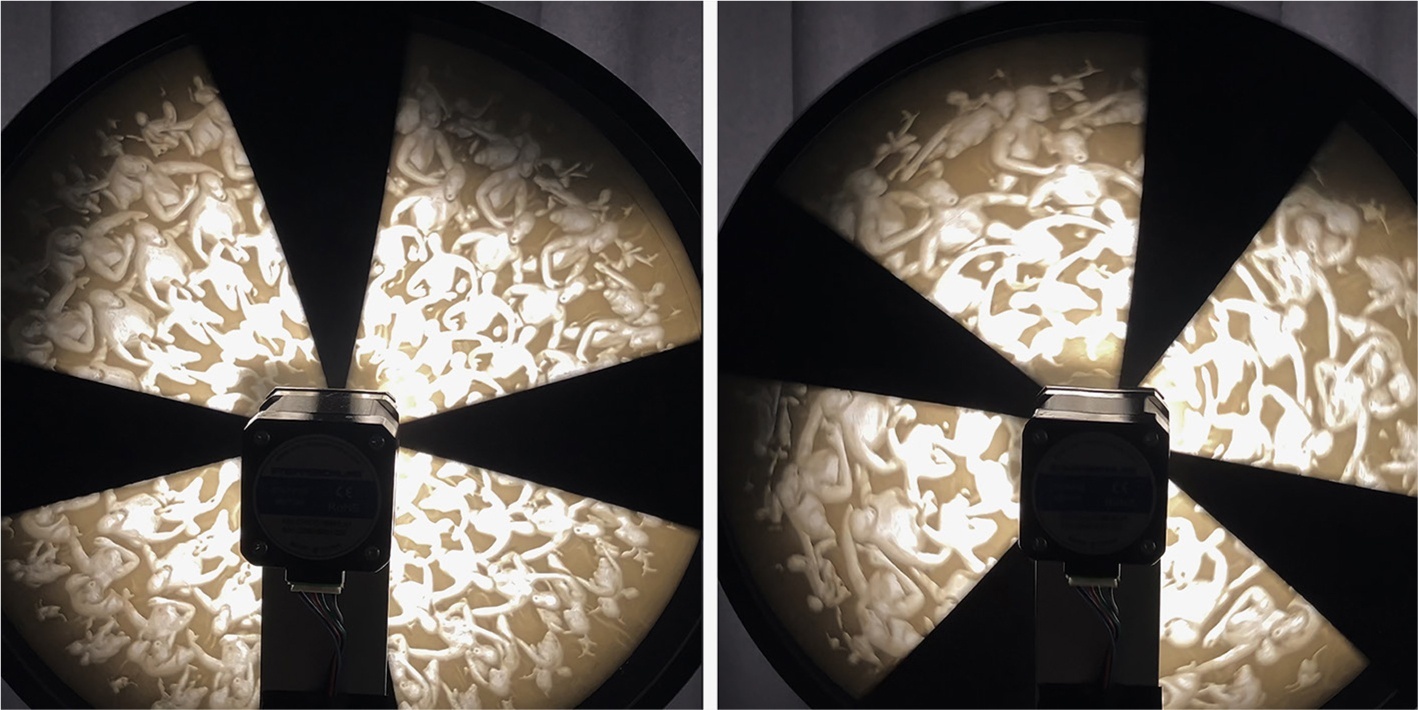
Figure 13
Angular deformation as a function of relative rotation direction: both images show the same disc, with opposite rotation on the left and the same rotation direction on the right. Artwork and image by Guido Devadder, 2025
With this in mind, we pushed our reimagination of the anortho-phenakistiscope into a more speculative direction by translating our two-dimensional imagery into three-dimensional lithophanes. This nineteenth-century porcelain technique embeds an image in porcelain by modulating its thickness, so that the image emerges only when light passes through, while the thin porcelain sheet simultaneously diffuses the light. Traditionally produced by casting porcelain into moulds made from wax-carved reliefs, our lithophanes were fabricated through 3D printing. Like the anortho-phenakistiscope itself, lithophanes require backlighting, at which point they reveal their image in what Erkki Huhtamo describes as ‘remarkable three-dimensional detail’.43
This technique brought new tactile and sculptural qualities to our work. While fully three-dimensional objects are incompatible with the shutter disc, lithophanes produce a parallax-like depth that paper could never achieve. At the same time, using lithophanes helped unify the heterogeneous visual aesthetics within our project through a shared logic of relief (see figure 14). On a more practical level, the sturdiness of 3D-printed lithophanes proved far more durable than the oil-impregnated paper in our first reconstructions – an important consideration when prolonged rotation is required in an exhibition context.
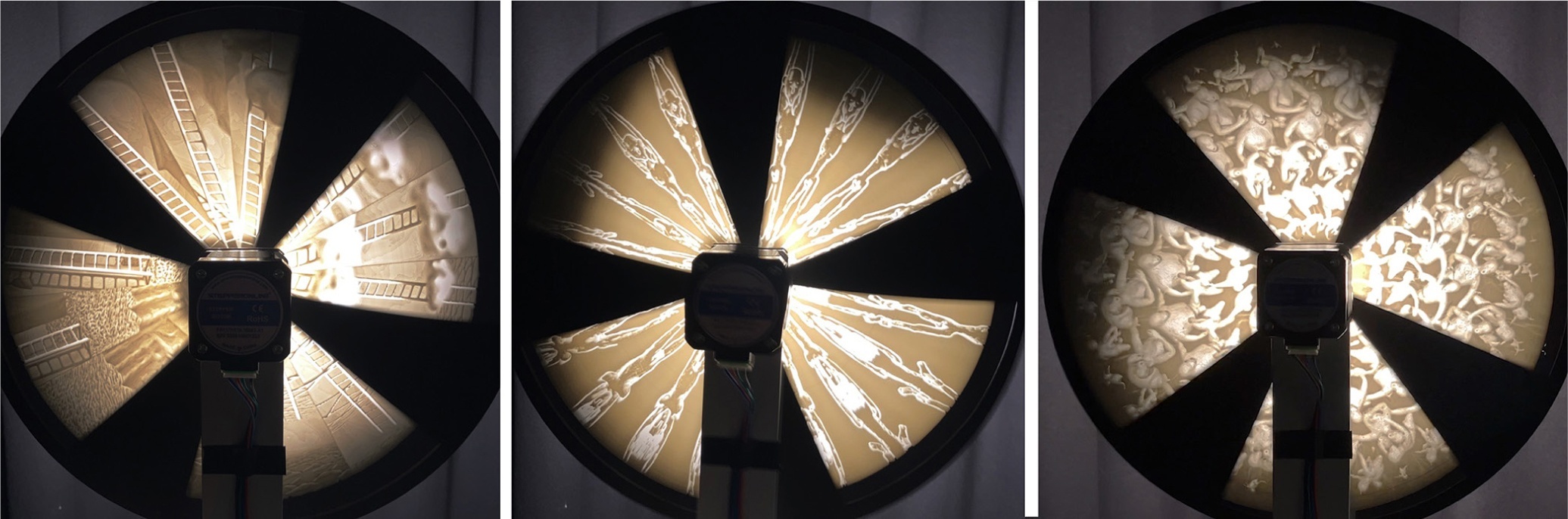
Figure 14
Video stills of three 3D-printed lithophane discs. Left: artwork by Martha Kicsiny (digital drawing); middle: artwork by Ziebe Van Mulders (analogue drawing); right: artwork by Guido Devadder (digital 3D). Images by Guido Devadder, ENACT Festival: Performing Research at LUCA School of Arts, Brussels, 6 November 2025
Historical phenakistiscopes and lithophanes emerged and disappeared within a similar nineteenth-century timeframe, yet they never intersected in that period. Their convergence in our project is deliberately anachronistic – a gesture of media-archaeological playfulness that reflects on what might have been. This aligns with the speculative aspects of media archaeology as outlined by Jussi Parikka and Wanda Strauven: using practice not to confirm existing histories, but to excavate latent alternatives and unrealised trajectories.44
Here too, Plateau offers a highly intriguing precedent. At the close of the “Troisième note,” he imagined a hybrid of the anortho-phenakistiscope and Wheatstone’s stereoscope. Sequential plaster models, stereo-pair daguerreotypes and precisely synchronised discs would result in ‘the illusion of art carried to its highest degree.’45 While this device remained unrealised – and thus points to a compelling direction for future research – it signals a willingness to think beyond the technical constraints of his time. Our integration of lithophanes follows this same speculative impulse, reframing the device not as a step towards cinema but as a device whose affordances can be reactivated in relation to tactile moving-image media, embodied viewing, and luminous display – concerns that are more closely aligned with media installation practices than with cinematic projection.
This perspective also shaped how we approached the viewer’s relation to the device. Whereas Plateau sought immersion, aiming to make the apparatus disappear into darkness so that only the moving image remained visible, our reanimation foregrounds its material presence. We deliberately emphasise the interplay of its tangible components – the discs, motors, and light source – as part of the aesthetic experience. This reframes the anortho-phenakistiscope not as an invisible conduit but as a material object that paradoxically conjures moving images from its physical substance. In Jay David Bolter and Richard Grusin’s terms, rather than pursuing immediacy, which strives to efface the medium in favour of seamless absorption, we embrace hypermediacy, drawing attention to the medium’s material, technical, and processual layers.46 The visible mechanics, the sound of the motors, and the physical presence of the discs resist immersion, underscoring the constructed nature of the experience. It is precisely this friction between material presence and an ephemeral moving image that becomes central to our reanimation, forcing the act of (re)mediation itself into view.
Bidirectional Remediation
From the outset of the process, we became acutely aware of remediation as a structuring factor in our research. As discussed above, it was already at play in our earliest steps, such as producing animated GIFs from scanned historical discs. It also informed our choice between a historically faithful reconstruction or a hybrid analogue-digital approach, which proved decisive for probing affordances and shaping the project’s artistic direction. Even in the visual documentation of our experiments, remediation became operative in very concrete ways.
In still photography, exposure time determines whether the shutter disc appears sharply in focus, obscuring most of the image disc, or largely disappears into motion blur, bringing the entire image disc into view. In the video, lowering the frame rate was necessary to synchronise with the disc’s rotation and extend exposure time, allowing the angular deformation to remain visible, while mostly effacing the shutter disc (see figure 15). Through this recording setup – fine-tuning camera exposure based on the discs’ different rotation speeds – the anamorphic effect produced by their physical interaction was remediated into the digital register.
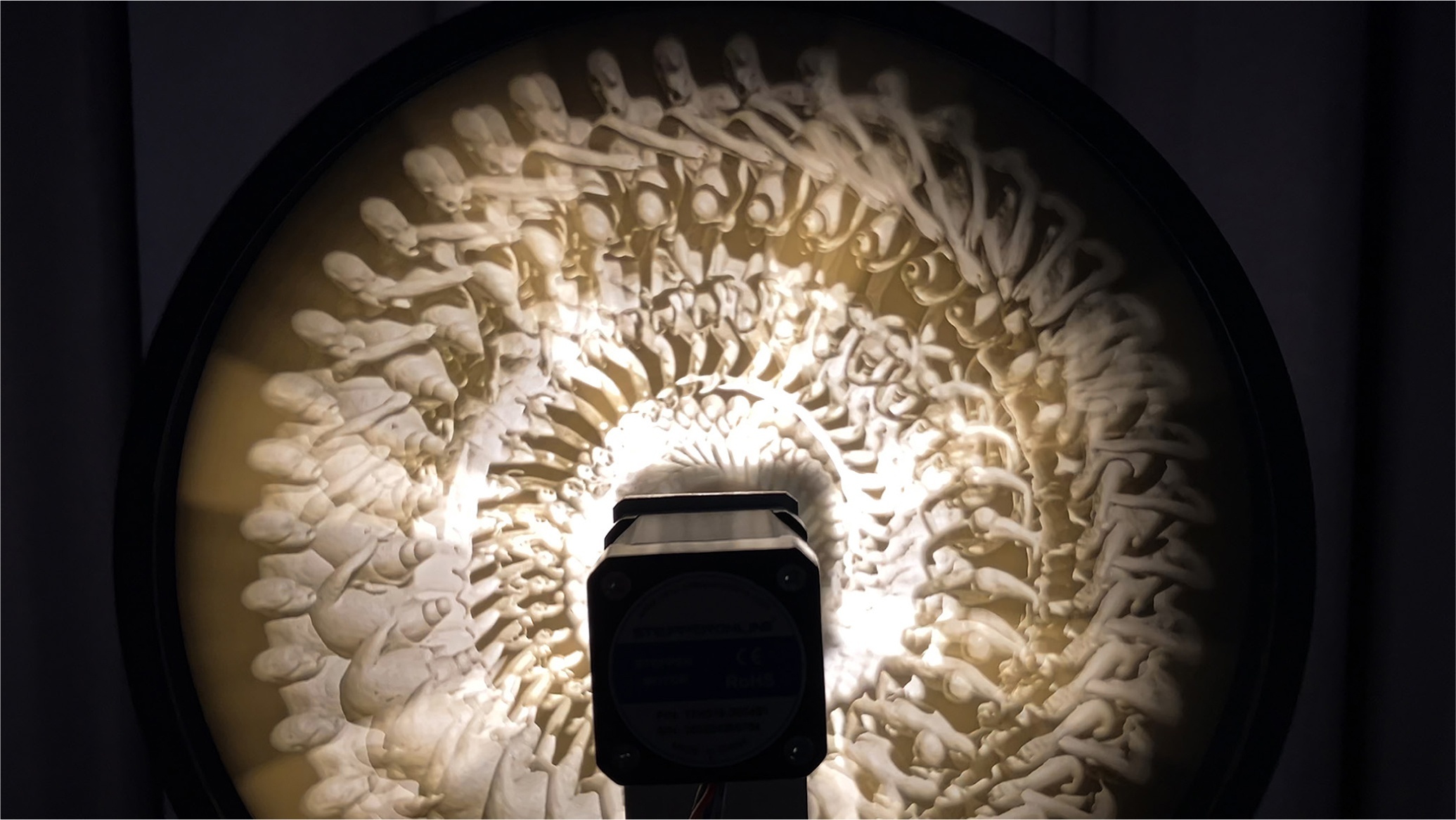
Figure 15
Video still showing a detail of a 3D-printed lithophane disc with thirty-two image segments and an eight-slotted shutter. The long exposure time blurs the shutter disc, yet through its interaction with the rotating image disc, the image’s sharpness and angular deformation are preserved. Artwork and image by Guido Devadder, 2025
While remediation is often understood as the absorption of an older medium into a newer one, Bolter and Grusin have shown that it can operate in both directions, with older media refashioning newer ones as well. In our project, however, this two-way dynamic unfolded over a roughly 175-year temporal gap. Moreover, remediation functioned less as a theoretical framework than as a working practice: a sustained oscillation between analogue and digital processes, historical inquiry, and contemporary artistic experimentation. Affordances discovered through experimentation with our reconstruction could be activated artistically, while artistic interventions, in turn, feed back into historical understanding.
This dynamic operated at multiple levels. Scanning the historical discs and animating them digitally filtered out apparatus-specific perceptual aspects, such as angular deformation and light loss caused by the shutter disc. At the same time, this digital translation allowed us to test our designs extensively in motion before transforming them into physical objects. Within this creative process, contemporary digital tools enabled exploration of the circular format through the mathematical underpinnings of animation software, allowing levels of image density and precision inaccessible to nineteenth-century techniques. Digital interventions also shaped perception at the physical level, from variable rotation speeds to the light source. Historical inquiry identified the flicker of an oil lamp as a perceptually relevant aspect that could be emulated but also exceeded through physical computing or a digital projector. In each case, contemporary tools were bent toward historical media, while historical constraints were reevaluated through digital means, combining aspects that are both historically and artistically relevant. In this sense, bidirectional remediation serves as a bridge between historical research and artistic reimagination: a back-and-forth movement that generates productive tension and mutual reinforcement between them (see figure 16).
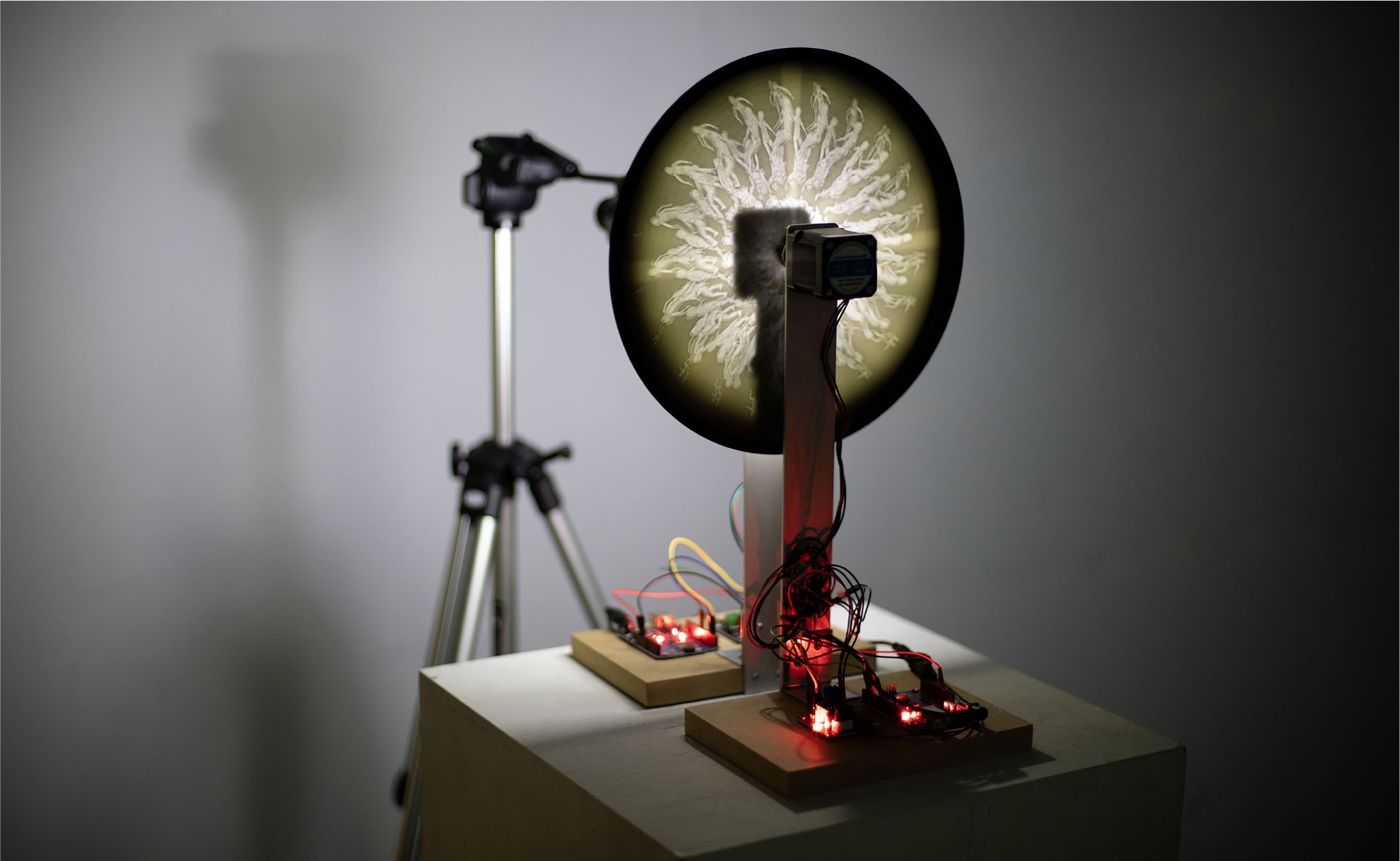
Figure 16
Video still of an intermediate prototype testing different forms of physical interaction between the shutter disc and the image disc by adjusting the code of the Arduino-based rotation system. Artwork and image by Guido Devadder, 2025
Conclusion
Looking back on our research process, what stands out most is how our attempt to recreate the perceptual effect of the anortho-phenakistiscope confronted us with the ingenuity of its original creators. With nothing but mechanical drives, paper, paint, and an oil lamp, Plateau and Madou achieved what challenged us even with powerful digital tools at hand. Our reconstruction experimentally reproduced key parameters from the “Troisième note” – most notably the interplay between the shutter and the image disc, which made the animation accessible to multiple viewers simultaneously, and produced a distinctive angular deformation. But it also revealed something Plateau’s text leaves unmentioned: the apparent multiplication of the figures. Serendipitously, we found that the animation remained legible even with the same-direction rotation at a 4:1 ratio, accompanied by an inversion of both angular deformation and perceived multiplicity. Rather than situating the anortho-phenakistiscope within a teleological narrative of cinema, these findings suggest a different framing: one that foregrounds its luminous, spatial, and perceptual qualities.
Building on the affordances uncovered through hands-on experimentation, we approached our artistic reimagination of the anortho-phenakistiscope as a luminous media installation that foregrounds its material presence. From this perspective, we turned to 3D-printed lithophanes as a deliberately anachronistic fusion of two nineteenth-century media, digitally remediated into a sculptural moving-image dispositive. By leveraging the angular deformation caused by the interaction between the two discs, we explored the loop not as a fixed cycle but as a malleable configuration: through code-based manipulation of the relative speeds and directions of the image and shutter discs, we could stretch, compress, fracture, and multiply the figures. The resulting animations oscillate between lifelike and mechanical, as if they can only exist within their machinic environment.
Conceptually, this process has led us to articulate two methodological frameworks. Circuitous epistemology describes the recursive, non-linear loops of reconstruction, experimentation, perturbation, reflection, and creation through which our understanding emerged. Bidirectional remediation captures how historical media logics shaped our use of contemporary tools, often repurposing them beyond their intended functions. In this sense, deliberate remediation processes function as a hinge, binding together historical inquiry and artistic reimagination. From this perspective, our reanimation treats the anortho-phenakistiscope not as a fixed historical artefact but as an operative platform, which enables alternative ways of making and thinking with light, motion, and material media.
Acknowledgements
The authors gratefully acknowledge the Ghent University Museum for granting access to their collection, and for providing information and high-resolution digital images essential to the development of this project.
Endnotes
[1] Hans-Jörg Rheinberger, “Epistemics and Aesthetics of Experimentation: Towards a Hybrid Heuristics,” in Practicing Art/Science: Experiments in an Emerging Field, ed. Philippe Sormani, Guelfo Carbone, and Priska Gisler (Routledge, 2019), 237–48, who characterises both scientific and artistic research processes as experimental practices.
[2] Joseph Plateau, “Troisième note sur de nouvelles applications curieuses de la persistance des impressions de la rétine,” Bulletin de l’Académie Royale des Sciences, des Lettres et des Beaux-Arts de Belgique, Tome XVI, N°7 (1849): 30–39. Original French text available online: https://ia800106.us.archive.org/4/items/bulletindelacad16acad/bulletindelacad16acad.pdf
[3] Guido Devadder is currently engaged in doctoral artistic research at LUCA School of Arts / KU Leuven in Belgium, focusing on the circular modality of moving images through media-archaeological reconstruction and contemporary artistic practice. Martha Kicsiny is a PhD researcher at the Moholy-Nagy University of Art and Design (MOME) in Hungary, investigating the history and contemporary relevance of lithophanes in relation to digital fabrication.
[4] For classical teleological histories of cinema, see Hugo Münsterberg, The Photoplay: A Psychological Study (D. Appleton and Company, 1916); Georges Sadoul, Histoire générale du cinéma. Tome 1: L’invention du cinéma, 1832–1897 (Denoël, 1946); C.W. Ceram, Archaeology of the Cinema (Thames and Hudson, 1965). See also Laurent Mannoni, The Great Art of Light and Shadow: Archaeology of the Cinema (University of Exeter Press, 2000), which, despite its sensitivity to heterogeneous optical practices and its departure from strictly linear narratives, still situates these practices within a historiographic framework oriented towards the emergence of cinema.
[5] Joseph Anderson and Barbara Fisher, “The Myth of Persistence of Vision Revisited,” Journal of Film and Video 45, no. 1 (1993): 3–12; and Joseph Anderson and Barbara Fisher, “The Myth of Persistence of Vision,” Journal of the University Film Association 30, no. 4 (Fall 1978): 3–8.
[6] Joseph Plateau, Sur quelques propriétés des impressions produites par la lumière sur l’organe de la vue (PhD dissertation, Université de Liège, 1829), 18; Joseph Plateau, “Sur un nouveau genre d’illusions d’optique,” Correspondance mathématique et physique de l’Observatoire de Bruxelles, vol. 7 (1832): 365–68; English translation in Joseph Plateau and Richard George Elliott, “On a New Type of Optical Illusion,” Art in Translation 8, no. 1 (2016): 11–18.
[7] The term ‘philosophical toy’ should not be understood in the twenty-first-century sense of philosophy, but in its nineteenth-century sense, where ‘natural philosophy’ denoted the study of nature. For more on philosophical toys, see Nicholas J. Wade, “Philosophical Instruments and Toys: Optical Devices Extending the Art of Seeing,” Journal of the History of the Neurosciences 13, no. 1 (2004): 102–18.
[8] Maurice Dorikens, Joseph Plateau 1802–1883: Leven tussen kunst en wetenschap (Provinciebestuur Oost-Vlaanderen, 2001), 36. The anorthoscope was commercialised by the French manufacturer Susse in Paris and consisted of a drive mechanism, a shutter disc, and a set of anamorphic image discs. Unlike the anortho-phenakistiscope, however, it relied on a pulley-and-string system.
[10] Peter Mark Roget, “Explanation of an Optical Deception in the Appearance of the Spokes of a Wheel Seen through Vertical Apertures,” Philosophical Transactions of the Royal Society of London 115 (1825): 137.
[11] James L. Hunt, “The Roget Illusion, the Anorthoscope and the Persistence of Vision,” American Journal of Physics 71, no. 8 (2003): 774–77, https://doi.org/10.1119/1.1575766.
[12] Joseph Plateau, “Notice sur l’anorthoscope, instrument de son invention,” Bulletins de l’Académie royale des sciences, des lettres et des beaux-arts de Belgique 3 (1836): 9. Our translation. Original French: ‘Quant à la multiplicité des fentes percées dans le disque noir, elle n’a d’autre effet que d’augmenter la clarté de l’image résultante (…)’.
[14] Dorikens, Joseph Plateau, 39–41; Nicholas Miller, “The Temporality of Seeing: Reconsidering the Origins of the Phenakistiscope,” Animation Studies 2.0, 28 May 2019, https://blog.animationstudies.org/?p=2997.
[15] Dorikens, Joseph Plateau; Kristel Wautier, Alexander Jonckheere, and Danny Segers, “The Life and Work of Joseph Plateau: Father of Film and Discoverer of Surface Tension,” Physics in Perspective 14, no. 3 (2012): 258–78, https://doi.org/10.1007/s00016-012-0087-8.
[20] Our translation. Original French in Plateau, “Troisième note,” 36-37: ‘L’image représente une tête de démon s’inclinant vers un feu de charbons qu’elle active par son souffle, puis se redressant pour reprendre haleine, s’inclinant de nouveau pour souffler, et ainsi de suite. Cette tête est vue par devant ; elle est haute d’environ quatre centimètres, et se détache, ainsi que le feu, sur un fond obscur. Lorsqu’elle souffle, ses joues se gonflent, ses lèvres s’avancent, ses sourcils se froncent, et ses yeux se dirigent vers le feu ; en même temps, celui-ci s’anime, pétille, et projette une vive lumière, qui éclaire fortement la tête par-dessous et fait paraître très-foncées les parties de cette dernière qui demeurent dans l’ombre. Lorsque ensuite la tête se redresse et reprend haleine, ses joues s’aplatissent, sa bouche s’ouvre, ses sourcils se relèvent, et ses yeux sedirigent vers le spectateur ; alors aussi le feu devient moins ardent, perd de son éclat, et la tête, qui, d’ailleurs, en est moins rapprochée, se voit dans une demi-obscurité.’
[24] Our translation. Original French in Plateau, “Troisième note,” 37: ‘L’un de nos grands artistes, M. Madou, a bien voulu dessiner, à ma prière, le modèle de la tête prise au moment où elle souffle avec le plus de force. J’ai transporté ensuite ce dessin dans l’un des compartiments du disque (...)’.
[26] Our translation. Original French in Plateau, “Troisième note,” 37: ‘(…) mon petit souffleur a-t-il excité une véritable admiration chez les personnes qui l’ont vu fonctionner.’
[27] Erkki Huhtamo, “Thinkering with Media: On the Art of Paul DeMarinis,” in Paul DeMarinis: Buried in Noise, ed. Ingrid Beirer, Sabine Himmelsbach, and Carsten Seiffarth (Kehrer Verlag, 2010), 33–46; Andreas Fickers and Annie van den Oever, “Experimental Media Archaeology: A Plea for New Directions,” in Technē/Technology: Researching Cinema and Media Technologies – Their Development, Use, and Impact, ed. Annie van den Oever (Amsterdam University Press, 2014), 272–78. Later, the project Doing Experimental Media Archaeology (DEMA) resulted in a twin volume: Andreas Fickers and Annie van den Oever, Doing Experimental Media Archaeology: Theory (De Gruyter, 2022); Tim van der Heijden and Aleksander Kolkowski, Doing Experimental Media Archaeology: Practice (De Gruyter, 2023).
[28] Darren Wershler, Lori Emerson, and Jussi Parikka, The Lab Book: Situated Practices in Media Studies (University of Minnesota Press, 2022); Wanda Strauven, “Media Archaeology as Laboratory for History Writing and Theory Making,” in New Media Archaeologies, ed. Ben Roberts and Mark Goodall (Amsterdam University Press, 2019), 23–43.
[30] For 3D printing and critical making in media-archaeological research and digital humanities, see Tim van der Heijden and Claude Wolf, “Replicating the Kinora: 3D Modelling and Printing as Heuristics in Digital Media History,” Journal of Digital History 2, no. 1 (2022), https://doi.org/10.1515/JDH-2021-1009; Gert Jan Harkema and André Rosendaal, “From Cinematograph to 3D Model: How Can Virtual Reality Support Film Education Hands-On?” Early Popular Visual Culture 18, no. 1 (2020): 70–81, https://doi.org/10.1080/17460654.2020.1761598; Matt Ratto and Robert Ree, “Materializing Information: 3D Printing and Social Change,” First Monday 17, no. 7 (2012), https://doi.org/10.5210/fm.v17i7.3968; Matt Ratto and Garnet Hertz, “Critical Making and Interdisciplinary Learning: Making as a Bridge between Art, Science, Engineering and Social Interventions,” in The Critical Makers Reader: (Un)learning Technology, ed. Loes Bogers and Letizia Chiappini (Institute of Network Cultures, 2019), 18–28.
[31] François Albera and Maria Tortajada, “The Dispositive Does Not Exist!,” in Cine-Dispositives: Essays in Epistemology across Media, ed. François Albera and Maria Tortajada (Amsterdam University Press, 2015), 21–44.
[32] Garnet Hertz and Jussi Parikka, “Zombie Media: Circuit Bending Media Archaeology into an Art Method,” Leonardo 45, no. 5 (2012): 424–30, https://doi.org/10.1162/LEON_a_00438.
[33] James J. Gibson, The Ecological Approach to Visual Perception (Psychology Press, 2015; originally published 1979). Although the term has recently entered more general discourse, it was originally coined by perceptual psychologist James J. Gibson, whose definition reads: ‘[t]he affordances of the environment are what it offers the animal, what it provides or furnishes, either for good or ill.’ Gibson, The Ecological Approach to Visual Perception, 119 (emphasis in original).
[34] For a more elaborate account of the procedure for creating animated GIFs from phenakistiscope discs, see Guido Devadder, Steven Devleminck, and Roel Vande Winkel, “A Loop with Nine Lives: The Phenakistiscope’s Digital Rebirth as Animated GIF,” in Proceedings of the 30th International Symposium on Electronic/Emerging Art (ISEA 2025) (ISEA / Seoul National University, 2025), 872–78, https://doi.org/10.23362/KOEN2025.07.25.1.114.
[35] Our setup consisted of a NEMA 17-type stepper motor, driven by an Arduino Uno board and a TMC2209 motor controller. The latter component proved crucial as more common motor shields such as the L298N or the DRV8825 were prone to stalling at higher speeds.
[37] Maintaining the correct speed for the shutter disc was crucial, as it had to rotate four times faster than the image disc. Our initial laser-cut shutter discs were made from MDF, but their weight caused reliability issues. Switching to 3D-printed discs significantly reduced the weight, while the use of a TMC2209 motor driver greatly improved the stability of the setup.
[38] When testing an image disc with 16 squares, they appeared as 20 slightly compressed squares, which aligns with the 4:5 ratio mentioned in Plateau’s “Troisième note”. A video registration captured at 6 frames per second with a 1/12s shutter speed (which allows to record ‘through’ the shutter apertures) shows that the images are doubled around the location of the apertures, yet this remains imperceptible to embodied perception.
[39] Joseph Plateau, “Deuxième note sur de nouvelles applications curieuses de la persistance des impressions de la rétine,” Bulletin de l’Académie Royale des Sciences, des Lettres et des Beaux-Arts de Belgique, 1849, Tome XVI, N°6, 588–611.
[40] Mannoni, The Great Art of Light and Shadow, 229–30; Deac Rossell, “The Public Exhibition of Moving Pictures before 1896,” in Quellen und Perspektiven / Sources and Perspectives, ed. Frank Kessler, Sabine Lenk, and Martin Loiperdinger, KINtop: Jahrbuch zur Erforschung des frühen Films 14/15 (Stroemfeld/Roter Stern, 2006), 168–205, 177, https://doi.org/10.25969/mediarep/16047.
[42] Guido Devadder, Steven Devleminck, and Roel Vande Winkel, “Remediating the Uncanny: Visualizing Unconscious Drives in Hungry Ghost,” Gramma: Journal of Theory and Criticism 30 (2025): 241–77, https://doi.org/10.26262/gramma.v30i0.10750. For a broader historical overview, see Nicolas Dulac and André Gaudreault, “Circularity and Repetition at the Heart of the Attraction: Optical Toys and the Emergence of a New Cultural Series,” in The Cinema of Attractions Reloaded, ed. Wanda Strauven (Amsterdam University Press, 2019), 227–44. For a discussion of the phenakistiscope as self-reflexive machine-art, see Rod Bantjes, “Pre-Cinema, Pre-GIFF, or Auto-Erotic Machine Art?” Proceedings of the 9th International Conference on Digital and Interactive Arts, ACM, October 23, 2019, 1–8, https://doi.org/10.1145/3359852.3359897.
[43] Erkki Huhtamo, “Elements of Screenology: Toward an Archaeology of the Screen,” Navigationen: Zeitschrift für Medien- und Kulturwissenschaften 6, no. 2 (2006): 31–64, 44, https://doi.org/10.25969/mediarep/1958.
[44] Jussi Parikka, “Inventing Pasts and Futures: Speculative Design and Media Archaeology,” in New Media Archaeologies, ed. Mark Goodall and Ben Roberts (Amsterdam University Press, 2019), 205–32; Wanda Strauven, “Media Archaeology as Laboratory for History Writing and Theory Making,” in New Media Archaeologies, ed. Ben Roberts and Mark Goodall (Amsterdam University Press, 2019), 23–43.
Biographies
Guido Devadder is an artistic researcher based in Leuven, Belgium, and a faculty member in the Department of Audiovisual Arts at LUCA School of Arts, Brussels. Currently pursuing a PhD in the Arts at KU Leuven / LUCA School of Arts, he explores and reimagines the idiosyncrasies of abandoned visual media and forgotten modes of creating and perceiving moving images. Merging old and new media, his research investigates the materiality of contemporary moving image art and offers a meta-critique on the elusive concepts of reality and illusion through expanded animation. ORCID: 0000-0001-8176-195X
Martha Kicsiny is a British-Hungarian visual artist based in Ghent, Belgium. She is a multimedia art fellow at the Doctorate School of the Moholy-Nagy Arts University (MOME, Budapest, Hungary). Her research aims to unearth and incorporate nineteenth-century Media Archaeology findings into Contemporary Art and, especially Immersive Media discourses. She fuses predigital and digital techniques to understand the deep cultural traits from which our modern technology stems. Her practice includes drawing and 3D printing, video art and 3D-rendered site-specific installations, which she started to develop at the Hungarian University of Fine Art, graduating in 2020.
Ziebe Van Mulders is a visual artist based in Ghent, Belgium. He holds a Master’s degree in Audiovisual Arts (Animation) from LUCA School of Arts in Brussels. He contributed to the project through an artistic research internship while completing the third year of his bachelor’s degree.
Steven Devleminck is Associate Professor at the Computer Science Department of KU Leuven, Human-Computer Interaction Research Group, Faculty of Engineering Technology and a Professor at Mediated Environments (ME) of LUCA School of Arts. He is supervising a team of researchers, Ph.D. students and post-docs working in the area of data visualisation, extended reality, interactive art and mapping with application to art and design. His publications include books and a series of internationally published articles and conference papers. His practice-based work has been shown internationally. Research interests are mediated environments, interactive technology, data visualization, artistic cartography and digital art and culture. ORCID: 0000-0003-1122-6809
Roel Vande Winkel is a film historian, Associate Professor of Film & TV Studies at KU Leuven and Coordinator of the FilmMemory Erasmus Mundus Master at LUCA School of Arts, Belgium. He is co-editor of the Historical Journal of Film, Radio and Television and supervisor (with Steven Devleminck) of Guido Devadder’s PhD research. ORCID: 0000-0003-4723-6048