
Introduction
For newspaper editors dependent upon overseas postal routes before the introduction of steamers, warmer and calmer weather meant faster connections and a steady supply of news. Cold and windy conditions created interruptions and irregular news flows. Routes over land were sometimes faster in the winter, but they, too, were interrupted when blizzards hit. Muddy roads due to rain and melting snow created harsh conditions during autumn and spring. To the seasonal weather variations in the Nordic region can be added another boreal variable, that of light summer nights and short, dark winter days. Winter darkness did not mean interruptions per se but definitely led to lower speeds over longer distances. A highly weather-dependent postal rhythm meant that newspaper content varied with the seasons. To be able to fill their papers when news dried up, editors relied upon their archival resources and a stockpile of texts that could be republished.
In this article, we examine and document the specificities of these seasonal variations in newspaper content from the 1790s to the 1820s. To investigate the shifting temporal layers of newspapers, we have mined and processed material from an open-access database of text reuse, based on the complete digitised repositories of Swedish-language newspapers from 1645 to 1918.1 This database makes it possible to trace the movement of texts over time and space; that is, text loans from newspaper to newspaper facilitated by the postal service. In this respect, one of the aims of the article is to demonstrate the historiographical possibilities of this type of data.
It is well known that steamships, railways and the electrical telegraph made mail faster and more reliable. However, in a preliminary overall analysis of the long nineteenth century, we noted that seasonal shifts in newspaper content diminished even before these breakthroughs in communication technology. Hence, in this article, we focus on these shifts during the decades around the turn of the eighteenth century and show that – even though no actual changes in transmission speed occurred – the seasonal variations decreased over time.
By combining a computer-assisted bird’s-eye view with close readings, we also suggest what we perceive to be the most plausible explanations for both more evenly distributed newspaper content across the seasons and a faster news circulation overall. These explanations are neither improved postal efficiency nor favourable climatic variations, but rather the mere growth of the newspaper landscape and thus the increasing density of the news circulation network in conjunction with cultural and political changes. Previous research has not always been directly technology-deterministic, but nevertheless it has often emphasised technology as the most likely explanatory factor. Our study shows the need to also consider other variables.
We begin by placing these phenomena within an overall theoretical and empirical context. Thereafter, we introduce our computer-assisted method for systematically analysing these traces. We then briefly illustrate the concrete traces left in the newspapers by seasonal variations, before presenting our statistical results. Of course, the data analysed cannot by itself explain the patterns it reveals. In the section that follows, we discuss and evaluate possible historical explanations.
Communication and seasonal rhythms
The consequences of the new communication technologies of the nineteenth century have been described in terms of ‘time-space compression’, ‘the annihilation of space by time’ and the idea that the new technologies ‘freed communication from the constraints of geography’.2 Distances used to be experienced and measured according to the time it took to travel from one place to another. The new communication and transportation technologies meant that the world was effectively shrinking and became more and better connected. Steamers and, later, trains did not do away with physical distances but meant that transportation required less time. As of the 1840s, the electrical telegraph made communication instant – in theory, at least, and only for part of the distance since it rarely linked the entire chain from sender to recipient, relying instead on complementary systems such as ordinary mail and delivery boys.3 These changes have also been interpreted in terms of a gradual acceleration and synchronisation of social life. Modern media have the ability to deliver ‘a simultaneous and shared moment in time to people who are not physically co-present’.4 In short, modern communication technologies have served to overcome some of the communication barriers set by nature.
It makes sense to include seasonal changes among these natural barriers, but research has paid little attention to them. As Henri Lefebvre stated in his Rhythmanalysis (the French original Éléments de rythmanalyse was published in 1992), a certain rhythm is imposed upon human activities by years, months, days and nights, tides and the shifting seasons. These kinds of cyclical repetitions create social rhythms and temporal-spatial logics, setting the boundaries for things like regular working hours, salaries and payments, the school year and many other temporal structures.5 Jon May and Nigel Thrift note that, on a general level, our sense of time is still shaped by the rhythms set by the natural universe, ‘ranging from the diurnal cycle to the rhythms of the seasons, the rhythms of the body to the turning of the tides’.6
Recent research on media infrastructures has emphasised the entangled relationship between infrastructures, the environment and natural resources. The climate, along with the availability of water, energy sources and topography, can determine where data centres are located and cables are laid. While earlier media theory suggested that modern communication technologies had overcome geographical limitations, later approaches have highlighted the many connections and overlaps, a consideration that ‘troubles any clear distinction between what we consider to be media infrastructure, such as a broadcast transmitter, and sites and processes typically thought of as its “environment”.’7 This line of research has also broadened the definition of infrastructures to include elements such as standards, protocols and the human actors who design and maintain them and thus serve as integral links in the networks.8 From such a perspective, the circulation of newspaper texts around 1800 was not just a matter of postal transfer. Publishers and editors were vital links in the communication network, choosing what and when to publish. They were not free to print whatever they wanted, however, as the legal framework placed restrictions on certain topics and opinions.9 The material that ended up in newspapers and got circulated was a result of multiple factors – postal routes and the climate, political decisions and professional ideals, to name just a few.
News media introduce rhythms often linked to the diurnal cycle, the week or the month. Of course, unlike the other periods mentioned, the week is an unnatural rhythm, a human invention.10 Mark W. Turner has suggested that the print culture of the eighteenth and nineteenth centuries created multiple periodical rhythms based on the different cycles of periodicity for newspapers and journals: some papers were dailies, others were biweeklies (that is, published twice a week), weeklies or monthlies. These different but repeated cycles ‘demarcated different kinds of time for readers’ and served to schedule and synchronise their everyday life.11 Apart from the cycles of repetition, however, newspapers were and are primarily directed towards the everchanging new: ‘The natural state of being for periodicals is change and movement, and newspapers and periodicals rely, to a greater or lesser degree, on the “new” and on the very modern concept of advancement, of moving forward, of futurity’.12 However, we propose that examining the different temporal cycles of reprinted texts can historicise this idea of newspapers’ ‘natural state of being’. Much of what was printed was surprisingly old, and one should be attentive to the fact that cultural rhythms were entangled with those set by nature.
The impact of the seasons on news flows before the introduction of steamships and telegraphy has been studied by Jordan E. Taylor. He has examined transatlantic communications to New England, based on newspapers from the late eighteenth century. His study shows a significant difference between newspapers published in the winter (December to February) and issues published during the rest of the year. Winter issues were filled with poetry, fiction, essays, travelogues, instructional texts and similar material – but contained little news. The major reason for this was that ice and harsh weather prevented ships carrying European news from entering the American harbours. When spring came, so did the news. Taylor shows that the climate and the seasons had an impact on newspaper content, or at least on transatlantic news. A winter issue was essentially a different paper compared to a summer issue.13
Fabon Dzogang, Thomas Lansdall-Welfare and Nello Cristianini have detected rhythms of word frequencies in a massive dataset of digitised newspapers spanning the period 1836 to 1922. The word frequencies that change with the seasons mostly reflect seasonal leisure activities, access to food and the religious calendar. Yet, their study presents no historical analysis of how the seasonal rhythms of newspapers changed between the 1830s and the 1920s.14 To the best of our knowledge, Taylor’s study is the only one to examine the seasonal rhythms of news flows and newspaper content from a historical perspective. The temporal dimensions of text circulation at a more general level have been studied by Petri Paju, Heli Rantala and Hannu Salmi, based on Finnish newspapers and journals published between 1771 and 1920. They make a distinction between the rapid and sometimes viral circulation of texts and the slow movement of newspaper content reprinted after many years. The rapid texts mostly contain news items or advertisements, the slow consist of a wide variety of literary works, religious stories and news reprinted for memorial reasons. In the corpus of Finnish newspapers and journals, 85 percent of all detected text-reuse chains were circulated and printed within twelve months. Almost 15 percent of them were circulated between one and 49 years. Only 0.04 percent belong to the category of long-term reuse, with texts reprinted after 50 years or more. Paju et al. do not discuss how the proportion of fast and slow texts changed historically or with the seasons. They do point out, however, that different temporalities have existed side by side in the same newspapers.15
The impact of seasonal changes on financial communications before and after the arrival of new communication technologies in the nineteenth century are hinted at in a number of studies, although it is not their main focus. Hannes Vinnal has calculated the speed of the postal transfer during the period 1750–1825, based on letters sent to two trading houses in the harbour town of Pärnu, located on the Baltic Sea in what is now Estonia. The results show that transfer times changed very little over the years. The median transfer time for a letter from London to Pärnu was 21 days in the 1750s and 20 days in the 1820s. Stockholm–Pärnu took 20 days both in the 1750s and the 1790s (there is no data from the later period). Vinnal calculates a yearly average for every route, based on one observation from every month, but seasonal variations are not calculated. What is indicated, however, is that transfer times varied greatly even during the same year. The fastest delivery from Stockholm to Pärnu was seven days and the slowest was 51 days. Overland routes were generally more reliable and often faster. This led to an ‘information space’ within which distant locations (such as Amsterdam) could be closer in time, and locations geographically closer to home (like Stockholm) more distant in time.16
Yrjö Kaukianen has analysed the transfer times on similar routes, but for the period 1820–1870. His calculations are based on shipping news published in the London journal Lloyd’s List, as well as business correspondence to a major ship owner in the Finnish town of Pietarsaari/Jakobstad. While little variation was observed during the period 1750–1820, significantly faster connections were found during the following decades. Figures for two of the Scandinavian routes illustrate the main trends: London–Gothenburg took 19 days in 1820, only eight in 1830 and five in 1870. London–Stockholm took 21 days in 1820, 14 in 1830 and only seven in 1870. Seasonal differences are not calculated separately, but the analysis shows a decreasing variation between fast and slow transfer times.17 This indicates that transfer times gradually became more consistent and that timetables could be trusted to a greater extent.
Inspired by Taylor’s examination of the seasonal rhythms of transatlantic communication and other scholars’ calculations of the velocities of overseas transfers, our study adds another factor. We do not measure the speed of transnational transmission per se, and so we do not seek to answer the question of how long it took for news from, say, Paris to reach Stockholm. However, the frequency with which foreign mail reached the borders of Sweden, as well as both seasonal variations and more unforeseen interruptions to this flow, are factors that we take into account because they affected the domestic rhythms of the information flows. In other words, while we focus on the seasonal variations, we are also observant of particularities (caused by factors such as political events, domestic bans on certain foreign reporting, climatic variations or quarantine restrictions during epidemics) which might obscure or distort the underlying seasonal trends.
Methods and data
Our statistical analysis is based on the output of an open-access database of text reuse in Swedish-language newspapers and journals spanning the period 1645–1918. The lion’s share of these publications was published in heartland Sweden; from 1771, newspapers in Swedish were also published in Finland (which up to 1809 was part of the Swedish kingdom). For the period under study, 1790–1829, and regarding newspapers, the database is as complete as they get (that is, more or less everything was digitised and processed for the database but there are always lacunae in historical newspaper repositories).18 For this investigation, chains of reuse – clusters – occurring only within Finland after 1809 are excluded.
In the database, a text is classified as a case of reuse if a snippet of at least 300 characters matches at least one other text in the dataset. The algorithm used (Basic Local Alignment Search Tool, BLAST) was originally developed to match sequences of DNA. Biomaterial is often broken, incomplete or polluted – in a similar way as OCR-processed newspaper texts. To match broken sequences, the algorithm allows for a certain amount of noise, in this case primarily misinterpreted characters.
Evaluations show that, on noisy newspapers, BLAST performs better than alternative matching methods.19 That said, it is not perfect. If a reused text is broken up over several columns or pages, due to the layout of individual papers, the different pieces might end up in more than one cluster. False positives are generated when text in tables (such as budgets, statistics and stock-market prices) are identical, but the figures are different. Texts shorter than 300 characters – advertisements, short telegrams etc. – will result in false negatives: registering no match even though the texts are identical.
Texts such as advertisements and telegrams – many of which are actually matched – also indicate that the database covers more than actual text reuse; that is, text items borrowed from one newspaper and republished in another. Advertisements and telegrams were, of course, usually sent to individual papers directly and not copied from one paper and printed in the next (although that happened as well). With all these reservations and imperfections in mind, absolute figures should be used with great caution. However, we are confident that trends and shifts in the data over time provide good indications of actual historical changes, which can be further substantiated using traditional historical methods.
Apart from the texts themselves, the database also contains useful metadata: the newspaper titles where a reused text was published, the publication dates and locations, the duration between the first and last publication and if it crossed national borders (anachronistically defined as today’s borders). The database can be searched for either individual texts or individual clusters of reused texts, and it can be filtered via the metadata to show every text or cluster that matches certain criteria. For this study, we have extracted every cluster that includes a text published in a Swedish newspaper and with a final publication date within a specific decade (1790–1799, 1800–1809, etc.). We excluded duplicate clusters, that is, the same text occurring in two or more clusters with the same start and end dates. With duplicates excluded, we ended up with 58 269 text clusters, and a total of 198 899 reprints.
Text reuse is one of the defining characteristics of newspapers, at least before the twentieth century. When their staff were limited or non-existent, editors relied on other newspapers to fill their own pages, and sometimes also on official publications, stories from books and similar sources, which in turn could be further circulated by other newspapers. Some of the borrowed texts were edited, others were reprinted word for word.20 In traditional press history, text reuse was often neglected in favour of original content and prolific journalists. Yet, the digitisation of historical newspapers, together with the development of software to identify repeated text passages, has facilitated new research into the everyday practices of text reuse. Research from recent years has examined, among other features, how poetry was reprinted in newspapers, how news about specific events spread across national borders and the ways in which texts were recontextualised when reprinted for new readers.21 In this article, however, we use the detection of text reuse for a different purpose. We are less interested in individual text items or events. Instead, we use the data to study the temporal variations of the reprinted texts, for how long they were in circulation and when they were republished. This allows us to identify seasonal variations as well as the shifts in such variations over time.
In order to examine the seasonal variations, we first identified the month of the last publication in every cluster. We calculated the duration of the reprinting chains (that is, the circulation time for a specific text snippet) for every end-month based on the first and last publication date. To avoid the impact of outliers, median values were calculated instead of the arithmetic mean (following the example of Kaukianen and Vinnal). The duration was measured both as a median value per month, and as the number of clusters within four duration categories: 0 to seven days (week), eight to 30 days (month), between one month and a year, and more than a year. Compared to Paju et al., we aimed for a more fine-grained temporal analysis of the clusters reprinted within one year. For the two categories of shorter duration (week and month), the last instance of reprinting gives a direct answer to seasonal reprinting patterns; for the two longer ones (year and more than a year), the end date is more of an indication; or rather, it testifies that the text was indeed reprinted at least once during that particular time of the year, but says nothing about any reprints in between the first and last instance of publication.
To examine the characteristics of texts with different circulation times, top lists of the most dispersed clusters within the different duration categories were extracted and manually labelled. Top lists of text clusters in the four different categories were created by ranking all clusters for each decade based on the number of printing locations – a high number of locations indicates a wide geographical distribution. The top 100 texts in each duration category (that is, 400 texts per decade) were manually tagged to indicate different genres: news, announcements (commercial advertisements as well as official notifications), opinion, advice and stories. The last category, stories, is the broadest, covering poems, anecdotes, short stories, essays, biographical pieces and historical accounts. Texts labelled as advice present practical instructions on agricultural and household matters, such as crops and fertilisers, food preparation and food storage, the cleaning of clothes and extinguishing fires, but also contain pieces on topics such as natural history, innovations and topography. News consists of texts reporting on recent events, often items produced domestically, or texts extracted from official dispatches or foreign papers. The content and style of news items sometimes overlap with the official announcements. Here, we have labelled texts as announcements if they are explicitly presented as such in the papers (Sw. Kungörelse). A few texts that were difficult to classify were labelled as ‘other’. But before we go into the statistics, it is necessary to discuss the concrete discursive traces that the seasonal variations left in Swedish newspapers around 1800.
Seasons in the newspaper content: Qualitative indications
Swedish editors were regularly forced to explain that ‘the foreign post has not yet arrived’ (Götheborgs Tidningar, January 22,1802), ‘since the German post has not arrived, this time there is no foreign news to present’ (Nyköpings Weckoblad, January 21, 1804) and ‘foreign post and news from the theatre of war are still missing’ (Wenersborgs Tidningar, March 24, 1814). It is no coincidence that all three examples were printed during the winter. Of course, postal communications were also sometimes interrupted during the summer, but connections, especially overseas, were more fragile in the winter. Stories about ice and wind preventing ships and postal deliveries from reaching their destinations are frequently found in the papers. Gothenburg was an important harbour town and a vital node for international communications – but not when cold weather hit the Swedish west coast. ‘Foreign posts are still missing. The cold is increasing, and as far as one can see with monocular, the waterways are frozen’ (Götheborgs-Posten, January 21, 1814). Conditions in the Baltic Sea were no better: ‘The Finnish post has arrived at Eckerö [in the Åland Islands], but drifting ice makes it impossible to cross’ (Stockholms Post-Tidningar, February 5, 1801). In 1824, a steamer was introduced on the route connecting German Stralsund and Greifswald and Swedish Ystad. Yet, during its early years, newspaper readers were informed in October or November every year that the steamship season was over and would start again in April. Due to cold temperatures and ice, sailing vessels were used instead of the faster steamers (Stockholms Dagblad, October 17, 1827; Götheborgska Nyheter, November 1, 1828). In this case, the introduction of new technology increased the seasonal differences in transfer times.
Nevertheless, newspapers were still published when there was little foreign news to report. Domestic and local news was printed to some extent, but the most attractive material was foreign news. Yet, much of what was printed was not news at all. The statement in Nyköpings Weckoblad in 1804, quoted above and explaining that no foreign news had arrived, was followed by an anecdote about Frederick II’s favourite dog. A similar remark in Linköpings Bladet of January 11, 1800, ‘2 foreign posts are still missing’, was succeeded by a three-page essay by Voltaire, written as a ‘conversation between the Philosopher and Nature’. A week later, Götheborgs Allehanda on January 17 was missing four posts and instead published the first part of a serialised essay on ‘The consequences of luxury’.
Readers were well aware of the fact that news relied on fragile postal connections. When it failed, the lack of post was itself the only news to report. The news section in many papers often started with reports on weather-related interrupted connections and delays. A letter from Helsingborg, by the Öresund, dated March 7, 1803 and printed in a Stockholm paper five days later, explained that the ‘post expected last Friday has not yet arrived, because of drifting ice in the [Danish] Belts and heavy snow on the roads’ (Stockholms Post-Tidningar, March 12, 1803). In this case, the domestic route was open and reliable, while the Danish post was delayed. The conditions on the route connecting Stockholm and Åbo/Turku were described in similar reports, which were frequently printed during the winter months. In February 1803, it was reported that ‘the passage across the sea is still blocked by drifting ice, to such an extent that a few days of cold weather and northerly winds will be enough to make the sea passable by horse’ (Åbo Tidning, February 2, 1803). The infrastructure that news relied upon – the ships, horses and couriers – left traces in the news that was printed.
Lay contributors could use the seasonal shifts in the supply of news as an argument when they wanted to get published. A letter to the editor of Linköpings Bladet on March 18, 1795 asked if he could possibly publish ‘other things,’ considering the ‘uneven postal service caused by large icebergs in the Belts.’ This correspondent suggested that his (or her) own text about the German Peasants’ War in 1525 would fit the paper. Two years later on November 29, 1797, a letter to the same paper asked to have a ‘story’ published, ‘if some post day you have a shortage of foreign news’. Some publishers even asked their readers to supply them with such material. When in February 1795 a subscriber complained that Upsala Tidning contained little but official announcements, the publisher replied on February 9 that those texts were ‘an invitation to send me something better’.
When newspaper printers around 1800 were searching for texts to publish, they often found them in the archives. Some of them made this clear upfront in the title: Nytt och Gammalt (New and Old) was published in Lund from 1783 to 1812, and there were many publications with Allehanda (Miscellaneous) or Samlaren (the Collector) in their names. The idea, suggested by Turner and discussed above, that newspapers always move forward in search of the new needs to be historicised.
Seasonal publication patterns: Statistical analysis
The shaky postal flow is recognised by most students of this period and its newspapers, but its more specific rhythms and the effects these had on newspaper content are still almost completely unexplored. One reason, of course, is that it is difficult to gather anything but anecdotal descriptions using traditional qualitative methods. Another is that the notoriously noisy OCR-ed newspapers resist most digital methods. However, with the right tools, these patterns can be mapped and analysed. Figure 1 shows the median duration in days based on end dates for each text cluster in the database. The results were calculated based on the month when every reused text was printed for the last time.
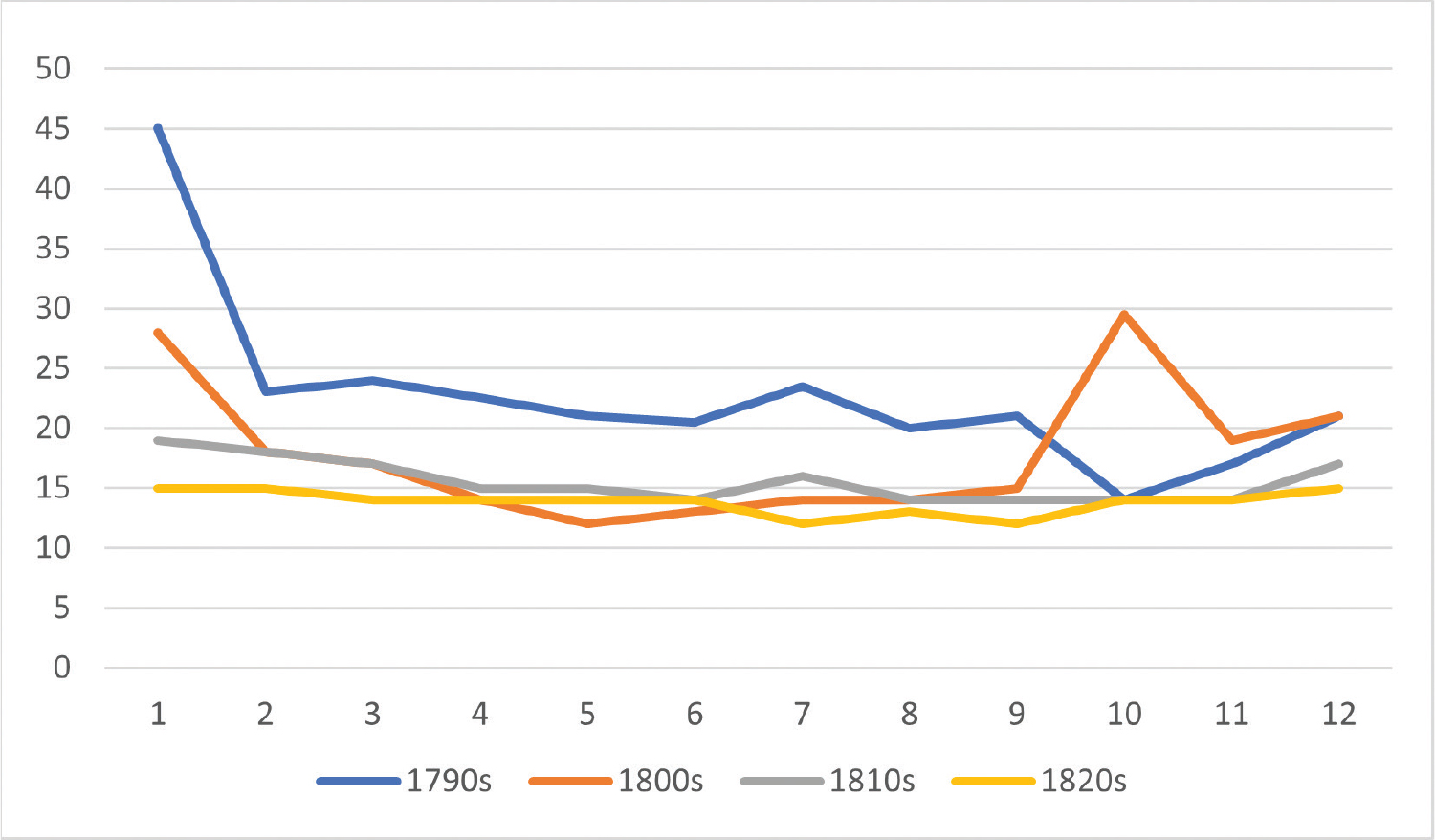
Figure 1
The median circulation time in days of reprinted texts each month based on the last instance of publication. Source: textreuse.sls.fi.
The month of October in the 1790s and, even more so, in the 1800s stands out. A closer analysis reveals that the latter deviation is largely due to exceptional political events in the autumn of 1807; with October 1807 excluded, the median circulation time changes from 29.5 days to 21 days. In the autumn of 1807, the British navy took control of the waters around Denmark for several months – with blockades of harbours and Danish retaliations in the form of extinguished lighthouses and removed seamarks – which affected the flow of mail from the continent to Sweden. Posttidningen quoted on October 1, 1807 a statement from a Danish commander, saying: ‘As the English have blocked the Belt, I have not dared to let anything pass, either Danish or foreign post’. Of 206 newspaper issues from October 1807 in our dataset, exactly half of them contained no news at all. The possibility can also not be excluded that the text traffic of the period was characterised by the fact that these years experienced unusually low temperatures, and therefore possibly also unusually harsh weather during their autumns.22 However, the overall pattern is clear: On average, texts reprinted in January and February are older than those reprinted during spring and summer. The values for December are also higher, at least in the 1810s and 1820s, but the differences here are marginal. January and February constitute the slow season up until the 1810s. After that – based on this particular metric – seasonal variations are limited.
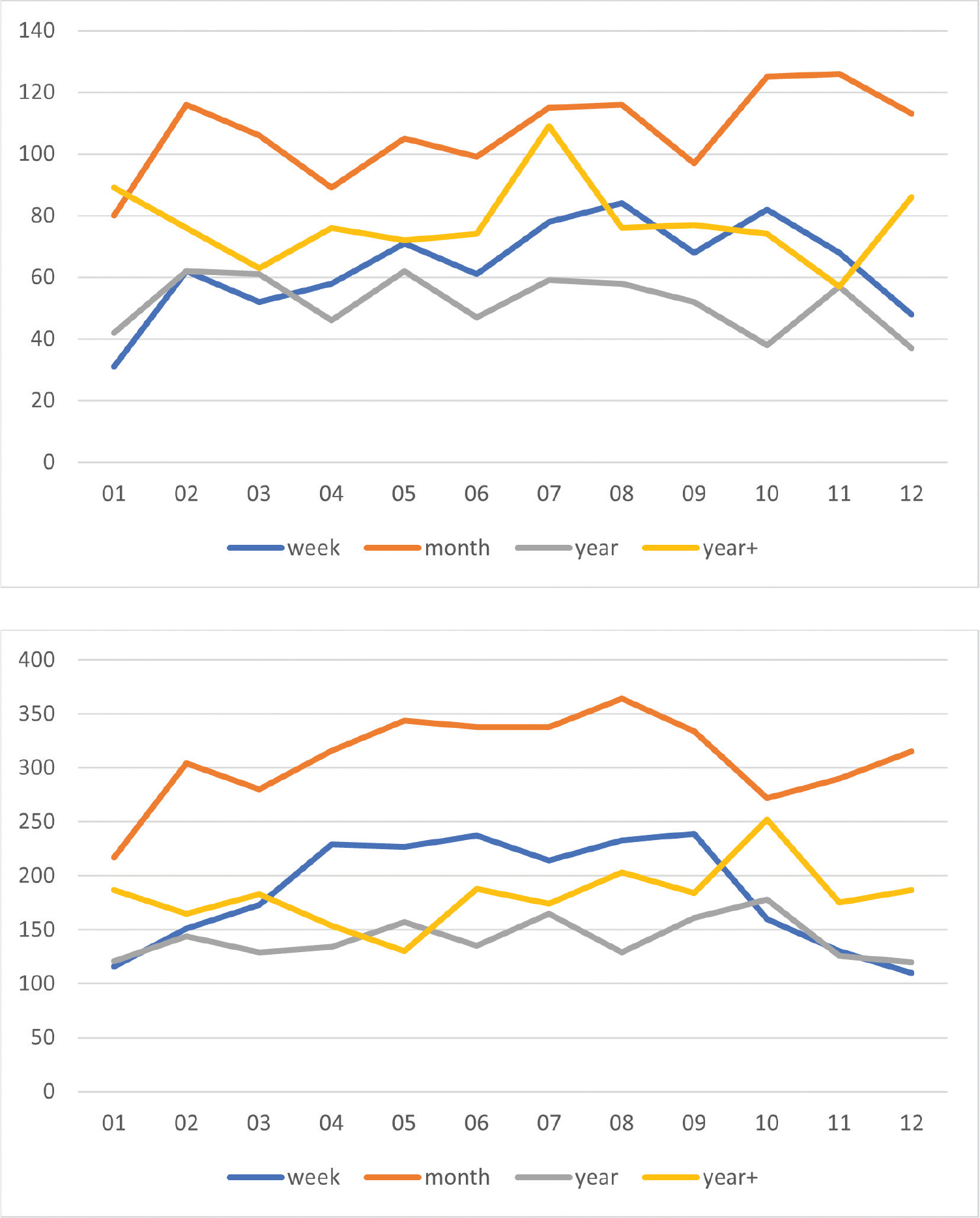
To examine the distribution of texts with different circulation times, as explained above, we divided all clusters from each decade into four different duration categories: text circulating and being reprinted within a week, within eight to 30 days, within 31 days to a year, and finally those texts reprinted over a period longer than one year. Figures 2 and 3 show the result for the 1790s and 1800s.
Figures 2 and 3
The number of text clusters in four different duration categories during the 1790s (top) and the 1800s (bottom), calculated based on the last printing date for each cluster. Source: textreuse.sls.fi.
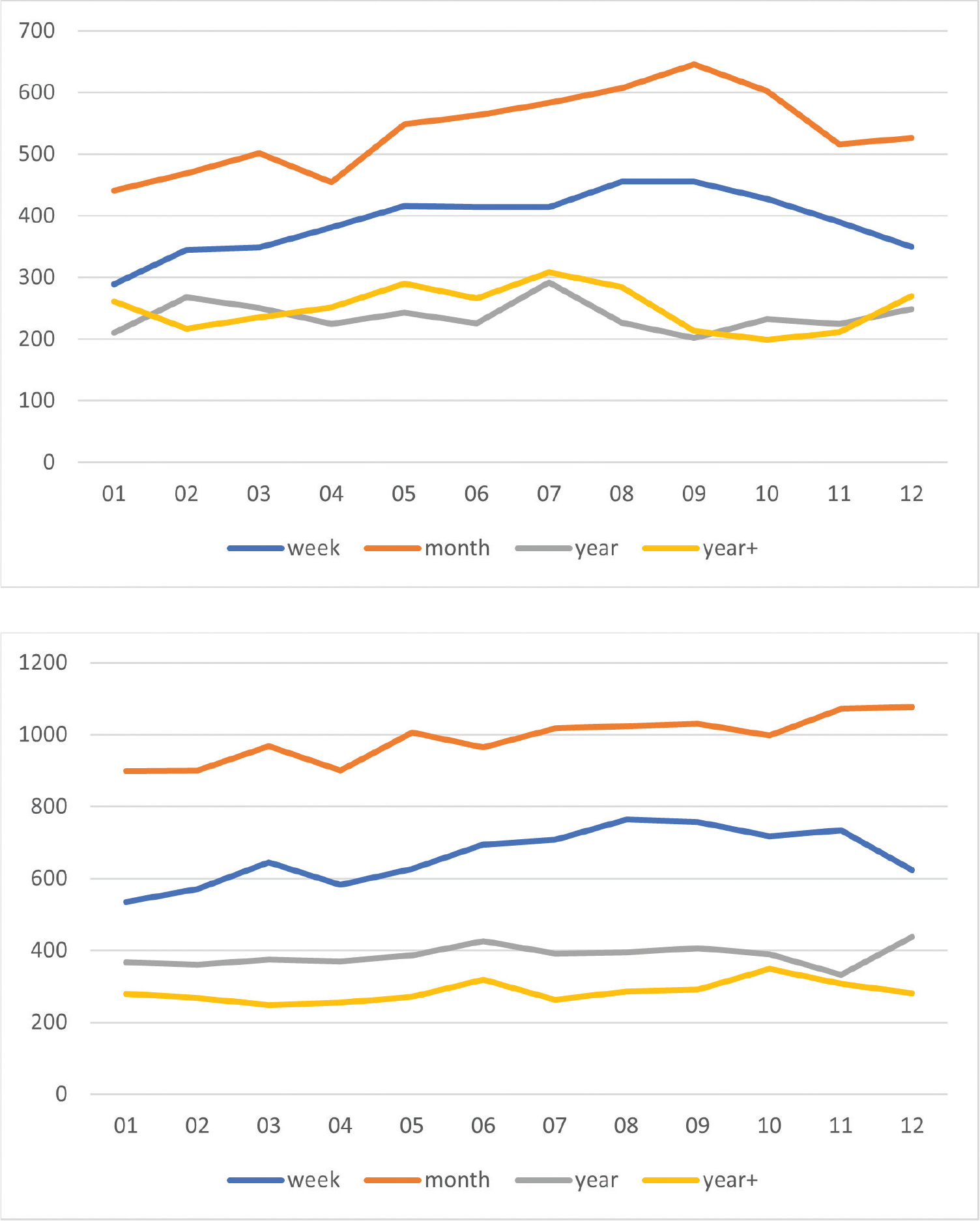
Month is the most common duration category in both decades, except for January in the 1790s, when texts older than one year are more frequent. The shortest duration category – texts circulating and being reprinted within a week – is less frequent during the winter months for both decades. Other figures fluctuate over the year, but it is interesting to note the strong presence of texts with a circulation time of more than a year during the 1790s. Figures 4 and 5 show the distribution of the same duration categories during the 1810s and 1820s. The two shortest duration categories are still less frequent at the beginning of the year, while summer months are characterised by shorter cycles of reprinting.
Figures 4 and 5
The number of text clusters in four different duration categories during the 1810s (top) and 1820s (bottom), calculated based on the last printing date for each cluster. Source: textreuse.sls.fi.
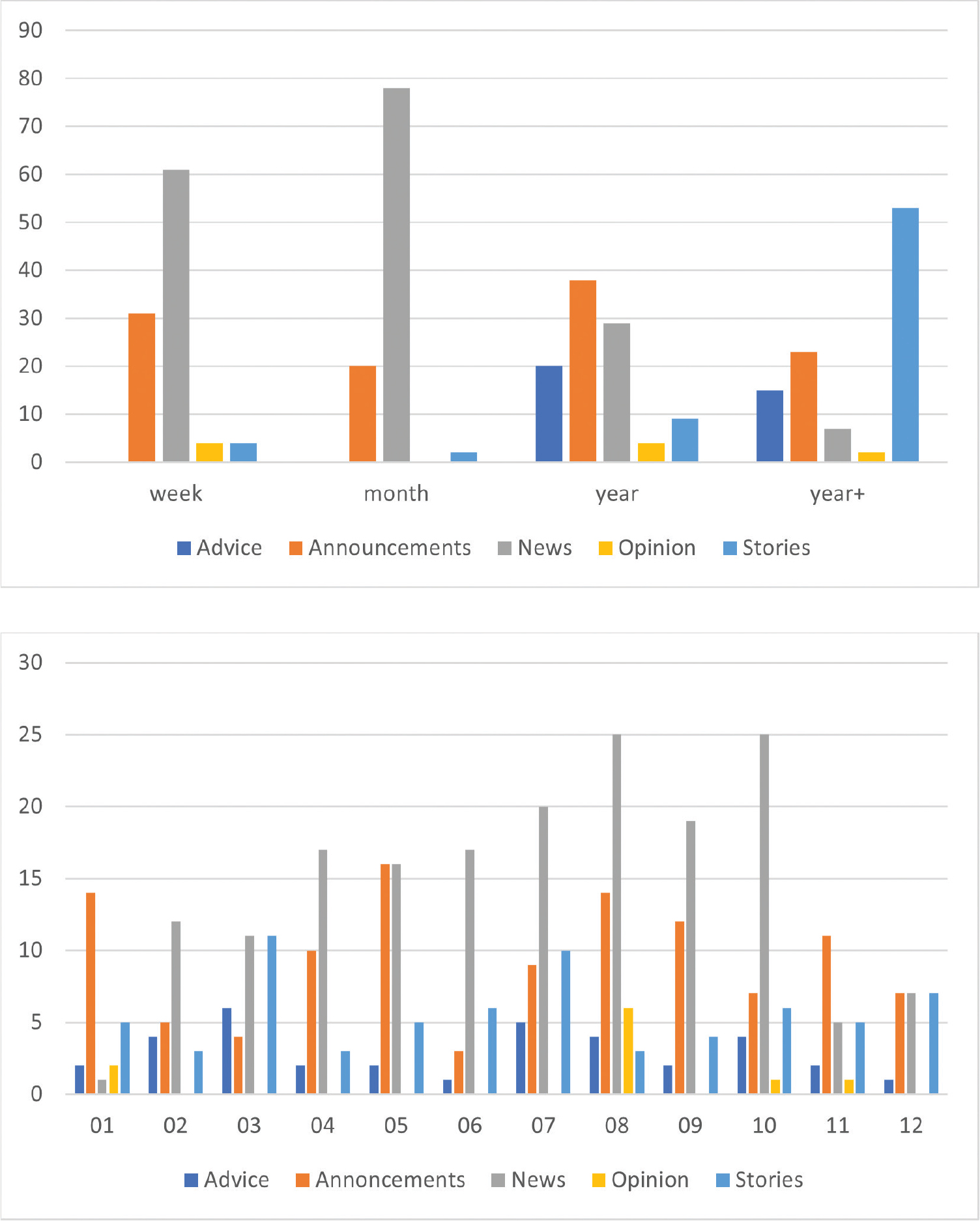
What, then, was being circulated and reprinted? What are the characteristics of texts reprinted within the different duration categories? To examine this, we manually examined and labelled the top 100 most distributed texts for each duration category, as described above. Figure 6 shows the labelled clusters from the 1790s categorised based on duration category, and Figure 7 presents the monthly distribution of the same text clusters.
Figures 6 and 7
Proportion of labelled clusters per duration category and number of labelled text clusters per end-month, respectively, from the 1790s. Source: textreuse.sls.fi.
Unsurprisingly, news dominates in the two short-duration categories, followed by announcements. Among the slow-moving texts, we find a greater variety of genres. Stories represent more than half of the manually labelled texts with a circulation time of more than one year. The labelled text clusters constitute a minor sample of the complete corpus. Yet, this sample represents the most dispersed texts. With this in mind, the monthly distribution of the labelled text clusters shows that widespread news was more frequent from April to October and rare during other months. Only one news item from the top lists was printed in the month of January during the 1790s.
The distribution of labelled text clusters from 1800 to 1809 (see figures 8 and 9) follows a pattern similar to the previous decade, albeit that the week category has now become the most heavily news-dominated duration category. News dominates among the faster clusters, announcements, advice and stories among the slower ones. The most circulated news items are printed during the summer months, stories and announcements during the winter. And in the 1800s, too, only one news item from the top list of the most circulated texts was printed in the month of January.
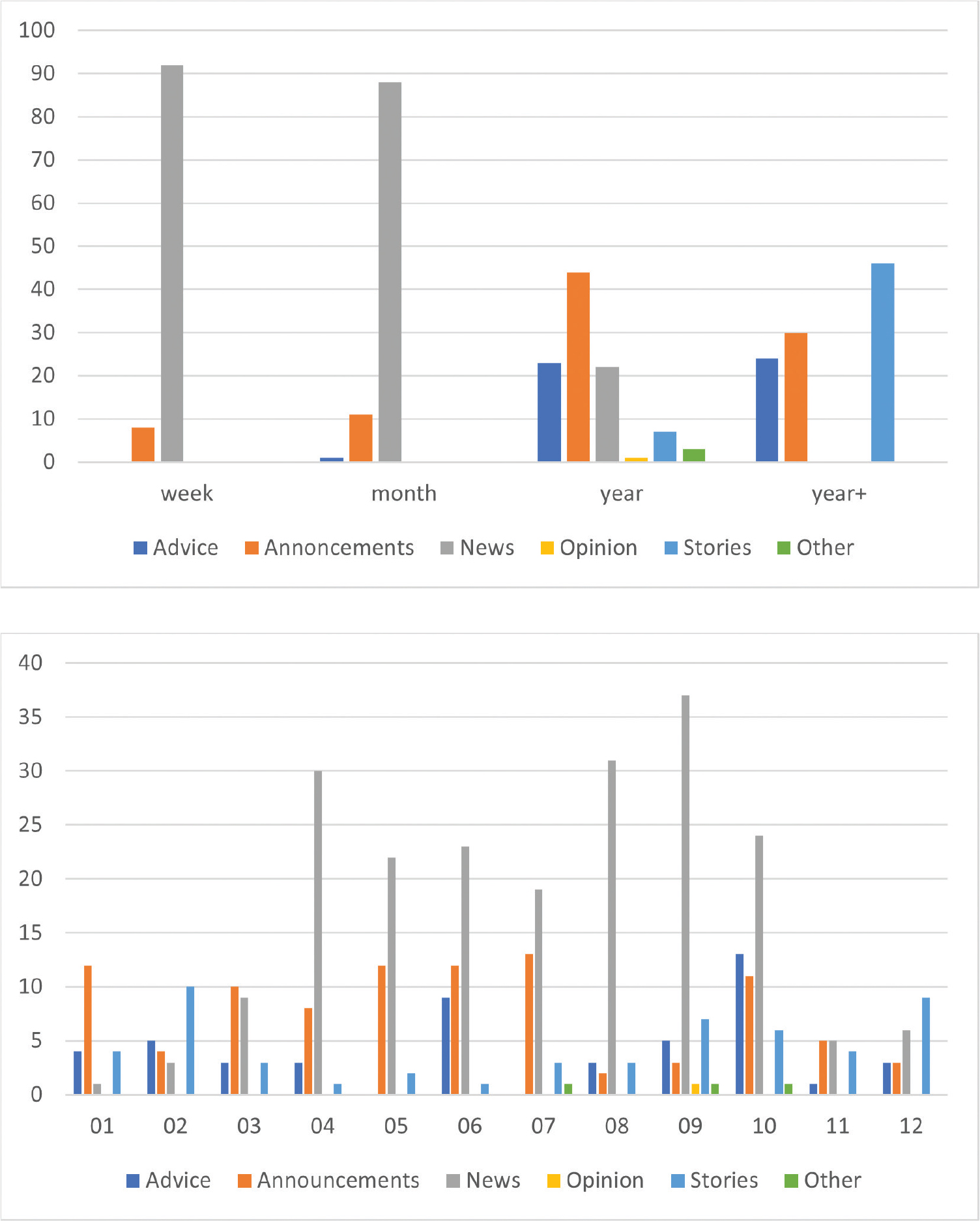
Figures 8 and 9
Proportion of labelled clusters per duration category and number of labelled text clusters per end-month, respectively, from the 1800s. Source: textreuse.sls.fi.
The results from the 1810s and 1820s (see figures 10 to 13) indicate a gradual shift towards a different seasonal distribution of the labelled text clusters. Only a few of the most dispersed news items were published in January and December in the 1810s, but the numbers for May and July are also low. Many of the stories in the sample were published in December, but August has the highest number of texts categorised as advice.
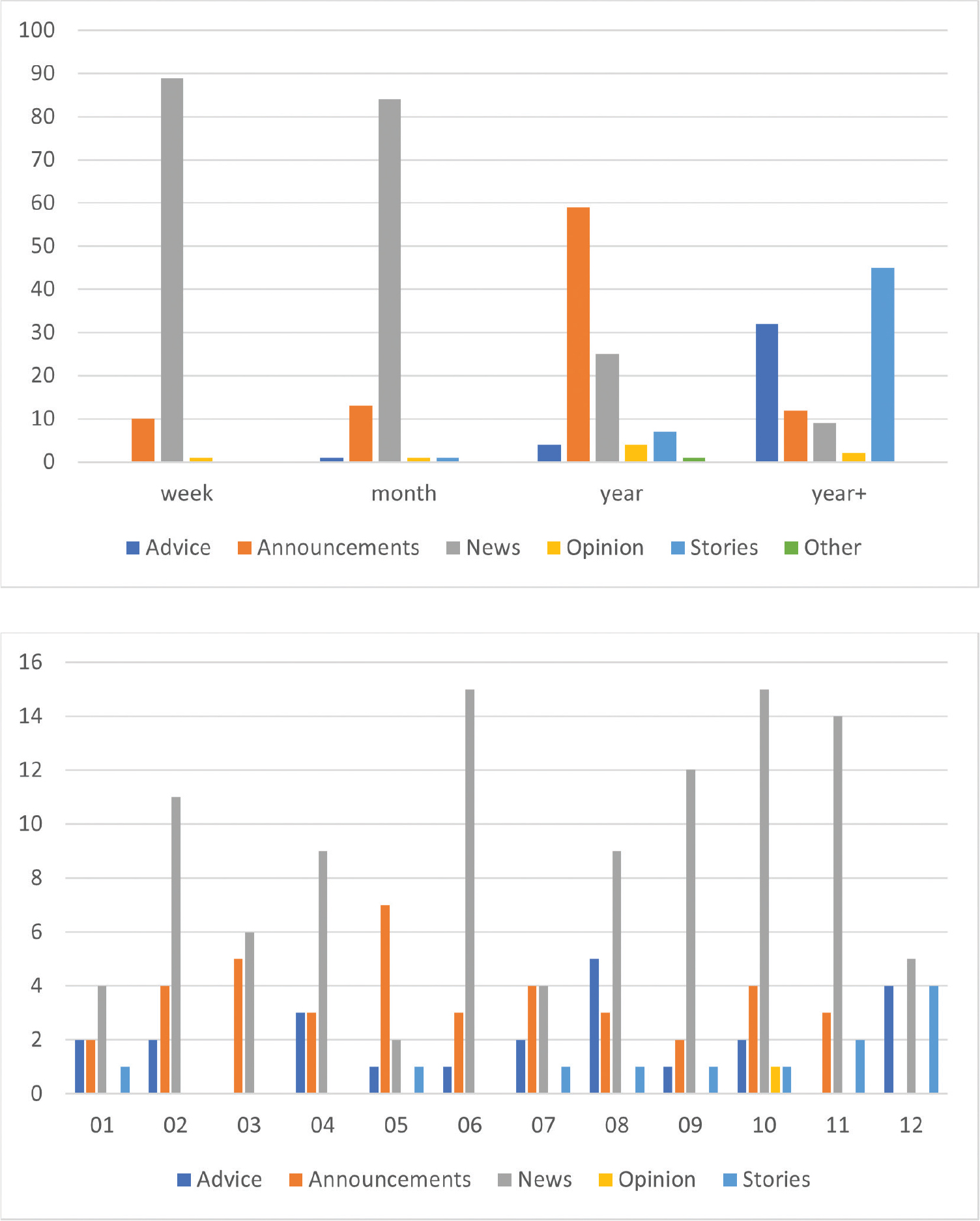
Figures 10 and 11
Proportion of labelled clusters per duration category and number of labelled text clusters per end-month, respectively, from the 1810s. Source: textreuse.sls.fi.
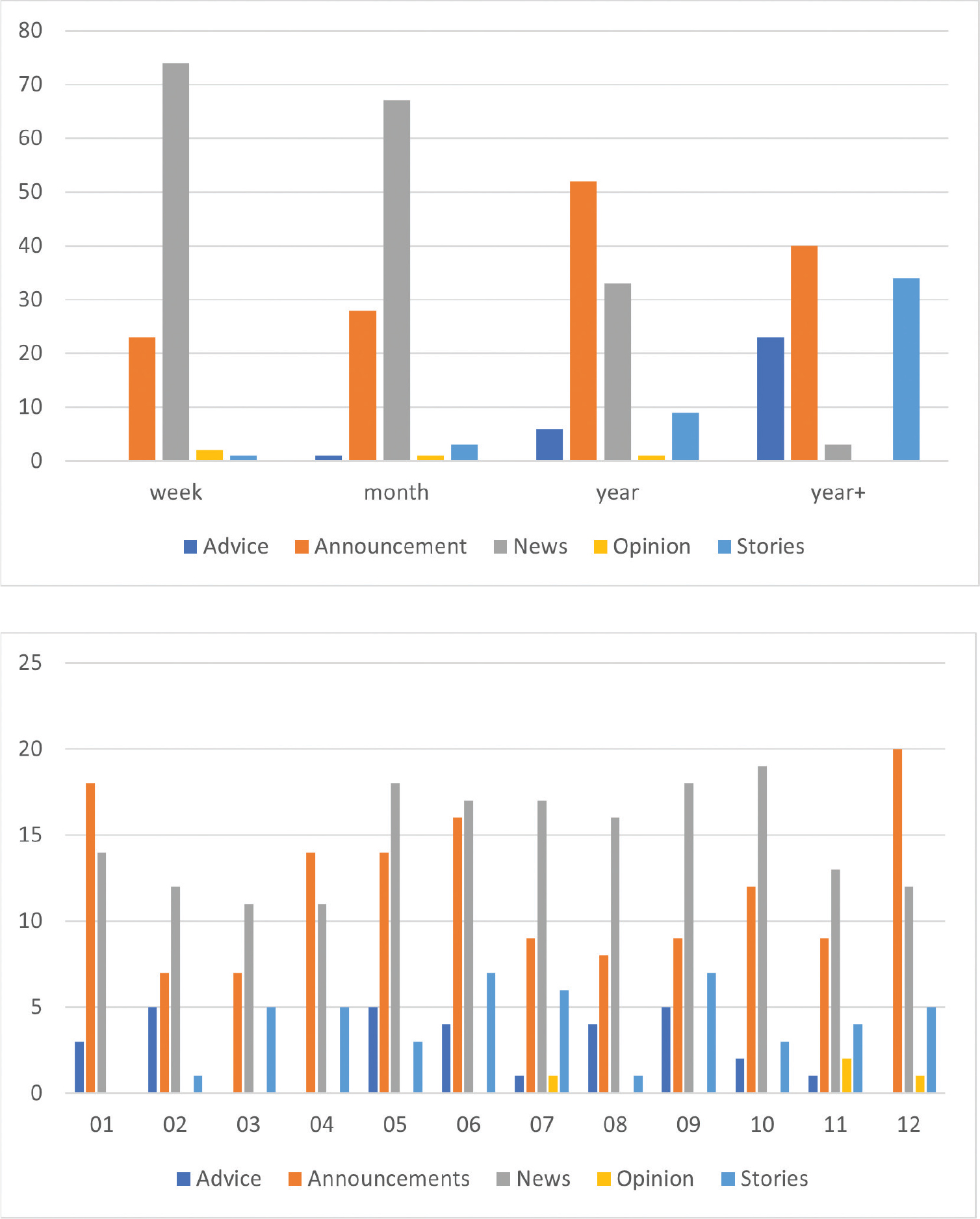
Figures 12 and 13
Proportion of labelled clusters per duration category and number of labelled text clusters per end-month, respectively, from the 1820s. Source: textreuse.sls.fi.
The monthly distribution of labelled text clusters from the 1820s (see figures 12 and 13) shows higher numbers for news from May to October, but the differences are not huge. January is no longer without news – it is indeed the only month without stories. Seasonal differences can still be detected, but they are less prominent during the 1820s than the previous decades.
Discussion: Seasonal variations and levelling factors
In a discussion about newsworthiness and the criteria used in the selection of news to publish in the 1970s, Herbert J. Gans concludes that ‘on a “slow news day”, story selectors may use stories they would ordinarily dismiss, though never happily so’.23 That they would ‘never happily’ do so was perhaps truer in the 1970s than in the 1790s, but then, too, editors certainly gave priority to news when it was available. In announcements to attract subscribers, they usually promised to deliver one issue a week and sometimes more frequently (in Stockholm every day and in Gothenburg up to four times a week). However, newspapers were printed whether there was any news or not. This practice generated newspapers with a great variety of content – and different textual temporalities existed side by side.
As our statistical analysis of different cluster-duration categories (or text-circulation times) shows, both fast- and slow-moving texts were published all year round. However, there were also seasonal differences – greater during the 1790s and gradually diminishing over the following decades. During the spring and summer, newspapers and their readers were better connected to national and international news flows. Texts were reprinted and circulated at a faster pace, creating an information space within which distant locations drew closer. In the winter, news flows dried up (or rather: sometimes literally froze), and regions that had been closely connected became more remote. With little news to report, editors filled their newspapers with more ‘timeless’ material such as poetry, essays and instructional texts. Taylor’s conclusion about newspapers in New England also holds true in the Swedish case: Winter editions and summer editions were different papers.
Nevertheless, seasonal variations in the distribution of different text genres did clearly decrease from the 1790s to the 1820s, from being prominent to becoming more marginal. In addition to the statistics we present above, it can also be noted that, during the winter months of December, January, February and March, compared to the rest of the year, text-borrowing activity, viewed as individual instances of reuse, was generally somewhat lower, and that the differences over time, from the 1790s to the 1820s, also decreased in this respect.
So, how can this more even distribution in terms of genres and the average shorter circulation times of the information flow in general, and the news flow in particular, be understood – before any real impact of steamships on the system as a whole can be registered, and before the introduction of the electrical telegraph and the railways? Rather than settling the issue once and for all, in the following we discuss and evaluate what we perceive to be possible explanations, namely a milder, more postal-favourable climate, a more efficient postal service regardless of climate, system growth in conjunction with cultural and political shifts and system-inherent issues. There might be others, but these are the factors we see as potentially most plausible.
The period examined here, 1790 to 1829, is part of what is commonly referred to as the Little Ice Age (stretching from the early fourteenth century to the mid-nineteenth century). Previous research has calculated historical winter temperatures in Stockholm based on administrative documents relating to ships entering or leaving the harbour (no recorded ships equates to ice), from the sixteenth to the nineteenth century. The data indicates temperatures in the 1790s around the average for the entire time series. The decade from 1804 to 1813, however, was the third coldest during the entire period. Warmer winters followed, with temperatures dropping again in the 1820s.24 In other words, there is not much to suggest that climatic change explains diminishing variations in the newspaper text flows.
Nor does the explanation seem to lie in a more efficient postal service. Seasonal shifts are characteristic of Scandinavian conditions – and, of course, other regions at these latitudes – not only between heat and cold, but also between daylight and darkness. These shifts have structured social life in various ways. William R. Mead remarks that, historically, ‘the contrast between summer and winter is expressed in the varying number of activities. The late-winter peak of unemployment reflects the dearth of jobs; while summer pursuits are multiplied contrastingly to crowd the nightless months’.25 The impact of the winter cold and darkness on communications is indicated not least by the different postal tariffs for summer and winter; a regulation enacted in 1686, and still in force during the nineteenth century, also stipulated that a Swedish mile should be covered by postmen in a maximum of one hour and a quarter, if weather and road conditions were good, otherwise one and a half hours were allowed.26 Before the introduction of steamships – which in Sweden only had any real impact on the mail delivery system as a whole after the period under study27 – and railways, waterways were usually preferred in the summer, overland routes in the winter. The periods in between were often the most critical, when drifting ice blocked lakes and seas and melting snow disrupted land transport.28
In the literature, the Swedish postal infrastructure during the decades around 1800 is described as a system that was difficult to reform, in a country characterised by long distances and limited resources. From the seventeenth to the mid-nineteenth century, the postal service relied on a network of farmers located along the roads. Each farmer was responsible for carrying the mail to the next one on the route, usually on horseback. This system was designed to be cost-effective for the state. The maximum speed was about 10 kilometres per hour, but the normal pace was between three and seven. The improvement of main roads in the late eighteenth century increased these speeds to some degree, but delays and interruptions were common, as well as complaints and failed attempts to reform the system. The number of post offices in Sweden increased from 109 in 1815 to 124 in 1835, but no other major alterations were made during the studied period. The system relying on farmers acting as couriers was gradually replaced during the second half of the nineteenth century, when the post was professionalised, and the railways took over many routes.29
A more plausible explanation is that the system itself was growing in size and, hence, in complexity, reducing the distances within it and increasing the options from which to borrow ever more texts. In the year 1790, the text items constituting parts of the text-reuse clusters on which our statistics rest came from a total of 13 unique newspaper titles published in eight different locations. The equivalent numbers for the final year of our investigation, 1829, are 48 papers in 29 locations, an almost fourfold increase. If we map the printing locations of papers existing in 1790, as well as the papers established during the following decades, we see few outward extensions of the network over time, but new papers in locations within the geographical interior, possibly creating a tighter exchange network (see figure 14).
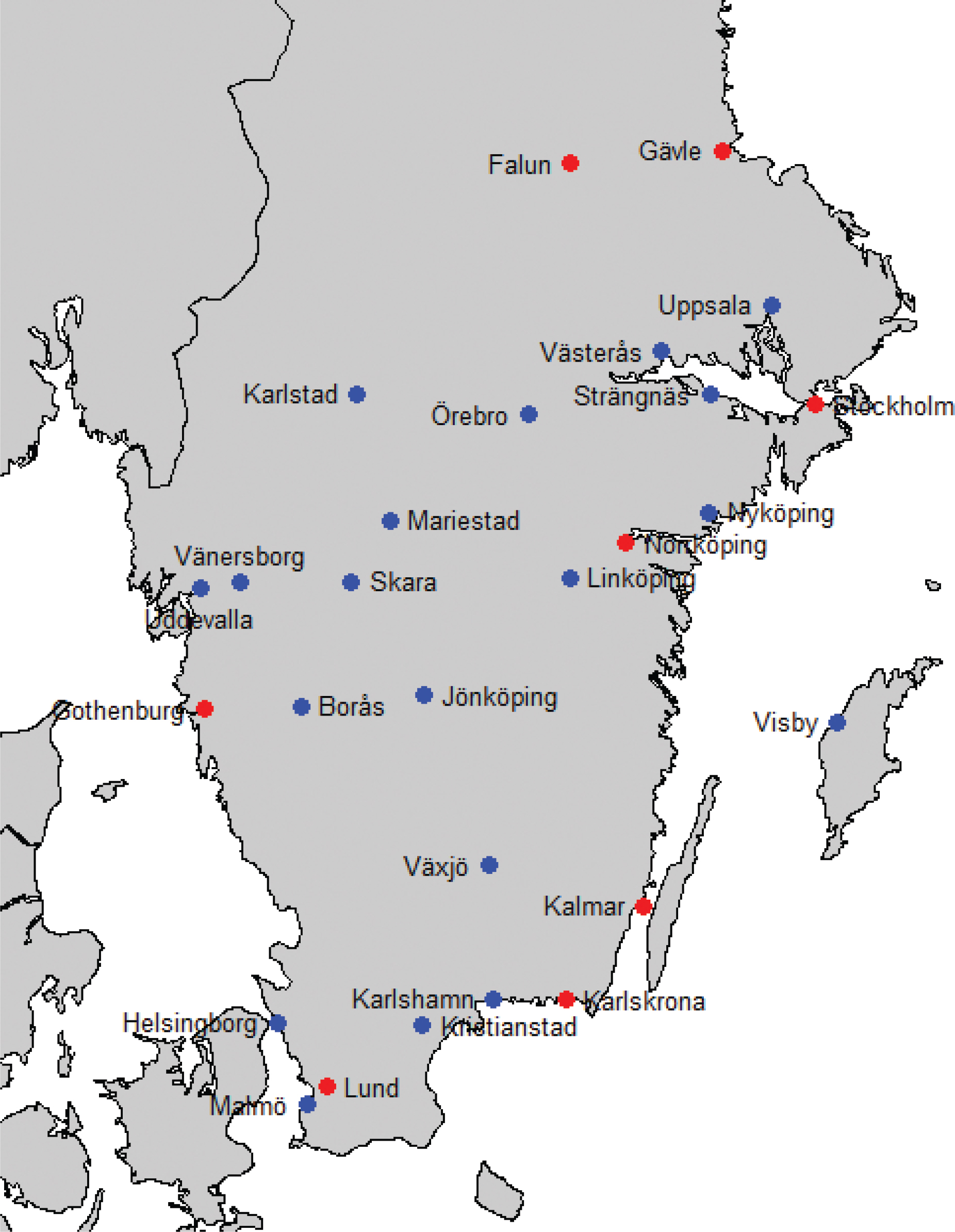
Figure 14
The geographical locations of newspapers published in 1790 (red) and the locations of additional titles published in 1829 (blue). Map generated using R Core Team (2024).
The number of reused text items (the snippets that make up clusters) multiplied by seven – from 12,941 in 1790 to 93,722 in 1829. This confirms that a network’s number of connections is not a linear function of the number of nodes but rises exponentially. Of course, the scale itself does not favour any specific genre, but it does allow for greater freedom of choice for each individual actor in the network. The observation might come across as trivial, but information speed at the local level – that is, as perceived at any given node – is dependent not only upon the sheer velocity of technological transmission but also the availability of content and content providers. This fact has not been given due attention, but it should also apply to more recent media systems, including today’s.
It is also reasonable to assume – and this is clearly a less trivial effect – that the growing system of interconnected newspapers, and the greater freedom of choice this facilitated, gradually changed both readers’ expectations and editors’ ambitions; that is, it changed the culture of the system. Indeed, for a long time, most newspaper editors had tried their best to publish news as rapidly as possible. But to do one’s best and as rapidly as possible are historically relative terms. A few examples can illustrate this point: During the autumn of 1786, letters to the editor of the foreign-news-poor Norrköpings Wecko-Tidningar had discussed and eventually launched a journal reading society, which would hold mainly foreign periodicals. The editor responded quickly and from January 1787 transformed his weekly paper into the twice-a-week published Norrköpings Tidningar, stressing its international news content.30 Norrköpings Tidningar is an early example of a provincial paper. However, the trend of weeklies moving to publish twice a week to deliver news more rapidly is clearly observable during our period of investigation (for example, Handels Tidning, December 12,1800; Lunds Allehanda, December 9, 1813; Calmar-Posten, January 3, 1818). Such measures may indeed have contributed to increasing the information speed of the whole system.
Another aspect of speed relates to the day of publication. When Linköpings Bladet was about to start publication in January 1795, the subscription was unorthodoxly set at one hundred issues and ‘at least’ two issues a week (November 5, 1794). Apparently, not all subscribers registered these subtle terms but as usual counted on an annual supply arriving on fixed days of the week. In some cases, they were upset when the publisher had already produced six issues by mid-January (January 17, 1795), since this would mean, if he kept up the pace, that the 100 numbers would already have been published by the summer. And, indeed, in early July he asked for renewed subscriptions (June 5, 1795). While this innovative Linköping editor is an early exception, there are many later examples of editors who instead changed their day of printing to adapt to the timetable set by the post. The editor of Lunds Weckoblad announced in December 1815 that issues for the following year would be printed on Wednesdays instead of Saturdays, ‘so that foreign news delivered by post could be included as rapidly as possible’ (Malmö Tidning, December 16, 1815). When new issues of Carlshamns Tidning appeared early on Fridays instead of late on Saturdays in 1819, it was for the same reason: ‘Since the publication of foreign news (…) has often been delayed and already printed in other domestic papers, the printing of this paper must move closer to the time when the foreign posts arrive’ (May 1, 1819). Thus, the speed of transmission per se did not increase, but enterprising actors maximised it at the local level, with potential effects at the system level.
Another factor that also contributed to the growth of the system making entrepreneurial initiatives possible was the overarching political situation. It is well-documented that, apart from a brief period of very liberal press laws in 1792, the late Gustavian era was marked by tightening political repression and, hence, limited expansion of the newspaper landscape. Foreign news, particularly French, was considered dangerous, and at times there were severe restrictions on printing it, but the effect on domestic reporting was also unmistakable. The new constitution of 1809, which ended the Gustavian era, and the new and liberal Freedom of the Press Act in 1810/1812 meant a considerable change in this respect.31 To this can be added the end of the Napoleonic Wars in 1815, which of course changed the content of foreign news generally and, not least, turning attention towards domestic matters. In 1828, a critic looking back on the development of the Swedish newspaper landscape since the end of the wars noted: ‘The desire to read newspapers, once aroused [by the wars], would be greater than it had been before if, once the general political unrest had been calmed, attention could be turned to objects that stirred the passions’.32 For this critic, this equated to editors interfering in all matters of domestic politics.
It is to be expected that the conventions or, in the words of Lisa Gitelman, the protocols of a specific medium will be negotiated in significant ways while new media are being established. Once they have become established and the systems are in place, however, we tend to not even recognise them as conventions but perceive them as a natural state of being.33 Although the newspaper as a medium obviously has a much longer history, in local contexts for the years around 1800 it is reasonable to speak about the establishment of a new medium. Publishing more frequently or adjusting the publication date to the postal service were certainly not innovations of the period. But innovations rarely have an immediate practical impact, and they also require the right conditions and a certain level of demand. There are many indications that these conditions emerged, and this demand gradually increased during the decades that constitute our focus here.
Conclusion
A growing number of content providers in closer geographical proximity to each other certainly increased the perceived speed of textual circulation locally – on average, editors considered and readers consumed a decreasing share of old texts. Measures to speed up reprints even from more distant nodes are also likely to have had effects on the system as a whole. The newspaper system itself enabled more and more entrepreneurial initiatives, which in turn, in a self-reinforcing process, contributed both to the growth of the system and to changing its culture.
Previous research has observed seasonal and maritime-related variations in newspaper content. Our study is in line with these results; it documents clear differences in the content of Swedish newspapers between the summer and winter months during the period 1790 to 1829. Our focus, however, is on domestic circulation and its dependence upon, among other things, the foreign, shipped-in flow of mainly news texts. By combining a computer-assisted method that tracks the reuse of texts with close readings, and by breaking down the circulation into different genres and categories of duration – that is, by examining a variety of temporalities – historical change in these seasonal variations is made visible. While previous research has emphasised the explanatory power of technology, our study shows that more factors need to be considered. During a period when technological infrastructural advancements were very limited, the circulation times of the text-borrowing system represented by the newspaper press nevertheless decreased and the seasonal variations in the distribution of its content were evened out. This is best explained, we suggest, by the growth of the system itself, by overall policy changes and by the increased scope for individual actors – producers as well as consumers – to change the culture and the protocols of the system, whether intentionally or not. It is less interesting to determine which of these factors was most important than to emphasise and try to pin down the mutually reinforcing features of the process.
While the story we present is very much about the smoothing out of seasonal variations, new rhythms would later emerge. ‘Stockholm, like every other society, is now in the middle of the dead season’, is the first line of a text published half a century after the period we investigate, in the summer of 1881 (Veckorapport från Hufvudstaden, July 23, 1881). It continues: ‘Nothing happens, and creating from nothing is not something even our Lord can do without remark, let alone a newspaperman’. Summer news droughts, a phenomenon occurring well after our period and very much still with us, can be studied historically and is primarily explained by cultural factors (low season for politics, the authorities, business, culture etc.), which in turn, of course, are dependent upon natural rhythms. Again, this reminds us that the infrastructural environment is an overlapping mixture of elements. It is nevertheless interesting to note that early comments on summer news droughts could make explicit the newspaper industry’s dependence upon text reuse and an archive of old material. ‘Let us now – while the tropical summer heat and strong news drought prevail – undertake a walk “through Malmö fifty years ago”, in the shadow of half-past and obscured memories’, a text in Skånska Dagbladet from June 3, 1895 begins. The rest of the article is richly seasoned with quotes from half-century-old newspapers.
Data accessibility statement
The data that supports the findings of this study is openly available in Aleksi Vesanto, Petri Paju, Heli Rantala, Erik Edoff, Patrik Lundell, Jani Marjanen and Hannu Salmi, Text reuse in the Swedish-language press, 1645–1918: Database, 2023, https://textreuse.sls.fi/. The manually tagged downloads from this database is accessible on github, https://github.com/Stubbendorff/The-disappearing-winter. The authors confirm that the data supporting the findings of this study is available within the article and its supplementary materials.
Funding information statement
This work was supported by the Swedish Research Council, project 2021-01216.
Endnotes
[1] Aleksi Vesanto, Petri Paju, Heli Rantala, Erik Edoff, Patrik Lundell, Jani Marjanen and Hannu Salmi, Text reuse in the Swedish-language press, 1645–1918: Database, 2023, https://textreuse.sls.fi/. The database also includes 21 Swedish-American papers 1856–1906. See also, Petri Paju, Hannu Salmi, Heli Rantala, Patrik Lundell, Jani Marjanen and Aleksi Vesanto, “Textual Migration across the Baltic Sea: Creating a Database of Text Reuse between Finland and Sweden,” in Proceedings of the 6th Digital Humanities in the Nordic and Baltic Countries Conference (DHNB 2022), ed. Karl Berglund, Matti La Mela and Inge Zwart (Technical University of Aachen, 2022), vol. 3232, 361–369, id paper 35, https://ceur-ws.org/Vol-3232/paper35.pdf.
[2] The idea of time-space compression, developed in David Harvey, The Condition of Postmodernity: An Enquiry into the Origins of Cultural Change (MA: Blackwell, 1990), is based on Marx’s theory of the annihilation of space by time, found in Karl Marx, Grundrisse: Foundations of the Critique of Political Economy (Penguin, 1993), 524 and 539; see also, Barney Warf, Time-Space Compression: Historical Geographies (Routledge, 2008); ‘freed communication (…)’: James W. Carey, Communication as Culture: Essays on Media and Society, Revised Edition (Routledge, 2009), 157.
[3] Jonas Harvard, “Nya medier, gamla transporter: Hästar, tåg och ångbåtar i den elektriska telegrafens tjänst,” in 1800-talets medielandskap, ed. Jonas Harvard and Patrik Lundell (Kungliga biblioteket, 2010), 27–42.
[4] Helge Jordheim and Espen Ytreberg, “After Supersynchronisation: How Media Synchronise the Social,” Time & Society 30, no. 3 (2021): 406, DOI: 10.1177/0961463X211012507.
[6] Jon May and Nigel Thrift, “Introduction,” in Timespace: Geographies of Temporality, ed. Jon May and Nigel Thrift (Routledge, 2001), 3.
[7] Lisa Parks and Nicole Starosielski, “Introduction,” in Signal Traffic: Critical Studies of Media Infrastructures, ed. Lisa Parks and Nicole Starosielski (University of Illinois Press, 2015), 14.
[8] Susan Leigh Star and Geoffrey C. Bowker, “How to Infrastructure,” in The Handbook of New Media: Social Shaping and Social Consequences of ICTs. Updated Student Edition, ed. Leah A. Lievrouw and Sonia Livingstone (Sage, 2006), 230–245; John Durham Peters, The Marvelous Clouds: Toward a Philosophy of Elemental Media (University of Chicago Press, 2015); Shannon Mattern, “Scaffolding, Hard and Soft: Infrastructures as Critical and Generative Structures,” Spheres: Journal for Digital Cultures 3 (2016): 1–10.
[9] E.g., Ingemar Oscarsson, “Med tryckfrihet som tidig tradition (1732–1809),” in Den svenska pressens historia, 1: I begynnelsen (tiden före 1830), ed. Karl Erik Gustafsson and Per Rydén (Ekerlid, 2000), 98–215; Jarl Torbacke, “Nu grundläggs den moderna utvecklingen (1809–1830),” in Den svenska pressens historia, 1: I begynnelsen (tiden före 1830), ed. Karl Erik Gustafsson and Per Rydén (Ekerlid, 2000); Cecilia Rosengren, Tidevarvets bättre genius: Föreställningar om offentlighet och publicitet i Karl Johanstidens Sverige (Symposion, 1999); Patrik Lundell, Pressen i provinsen: Från medborgerliga samtal till modern opinionsbildning 1750–1850 (Nordic Academic Press, 2002).
[10] David M. Henkin, The Week: A History of the Unnatural Rhythms That Made Us Who We Are (Yale University Press, 2022).
[11] Mark W. Turner, “Periodical Time in the Nineteenth Century,” Media History 8, no. 2 (2002): 190–191, DOI: 10.1080/1368880022000030540.
[13] Jordan E. Taylor, “Now Is the Winter of Our Dull Content: Seasonality and the Atlantic Communications Frontier in Eighteenth-Century New England,” The New England Quarterly 95, no. 1 (2022): 8–38, DOI: 10.1162/tneq_a_00928.
[14] Dzogang Fabon, Thomas Lansdall-Welfare, FindMyPast Newspaper Team and Nello Cristianini, “Discovering Periodic Patterns in Historical News,” PLoS ONE 11(2016): 1–18, DOI: 10.1371/journal.pone.0165736.
[15] Petri Paju, Heli Rantala and Hannu Salmi, “Towards an Ontology and Epistemology of Text Reuse: Cycles of Information Flows in Finnish Newspapers and Journals, 1771–1920,” in Digitised Newspapers – A New Eldorado for Historians? Reflections on Tools, Methods and Epistemology, ed. Estelle Bunout, Maud Ehrmann and Frédéric Clavert (De Gruyter, 2023), 253–274.
[16] Hannes Vinnal, “The World Refuses to Shrink: The Speed and Reliability of Information Transmission in North and Baltic Sea Region, 1750–1825,” European Review of Economic History 18, no. 4 (2004): 398–412, DOI: 10.1093/ereh/heu016.
[17] Yrjö Kaukianen, “Shrinking the World: Improvements in the Speed of Information Transmission, c. 1820–1870,” European Review of Economic History 5, no. 1 (2001): 1–28, DOI: 10.1017/S1361491601000016.
[19] Aleksi Vesanto, Asko Nivala, Heli Rantala, Tapio Salakoski, Hannu Salmi and Filip Ginter, “Applying BLAST to Text Reuse Detection in Finnish Newspapers and Journals, 1771–1910,” Proceedings of the 21st Nordic Conference of Computational Linguistics, Gothenburg, Sweden, May 23–24, 2017. Linköping Electronic Conference Proceedings, 54–58, https://aclanthology.org/W17-0510.
[20] E.g., Johan Jarlbrink, “Mobile/Sedentary: News Work behind and beyond the Desk,” Media History 21, no. 3 (2015); Patrik Lundell, Hannu Salmi, Erik Edoff, Jani Marjanen, Petri Paju and Heli Rantala, ed., Information Flows across the Baltic Sea: Towards a Computational Approach to Media History (Föreningen Mediehistoriskt arkiv, 2023), DOI:10.54292/s6au8axqht; Brendan Dooley, “International News Flows in the Seventeenth Century: Problems and Prospects”, in News Networks in Early Modern Europe, ed. Joad Raymond and Noah Moxham (Brill, 2016), 158–177.
[21] E.g., Ryan Cordell and Abby Mullen, “‘Fugitive Verses’: The Circulation of Poems in Nineteenth-Century American Newspapers,” American Periodicals: A Journal of History and Criticism 27, no. 1 (2017); Mila Oiva, Asko Nivala, Hannu Salmi, Otto Latva, Marja Jalava, Jana Keck, Laura Martínez Domínguez and James Parker, “Spreading News in 1904: The Media Coverage of Nikolay Bobrikov’s Shooting,” Media History 26, no. 4 (2020): 391–407, DOI: 10.1080/13688804.2019.1652090; Stephan Pigeon, “Steal it, Change it, Print it: Transatlantic Scissors-and-Paste Journalism in the Ladies’ Treasury, 1857–1895,” Journal of Victorian Culture 22, no. 1 (2017): 24–39, DOI: 10.1080/13555502.2016.1249393; and Marianne Van Remoortel, “Scissors, Paste, and the Female Editor: The Making of the Dutch Women’s Magazine De Gracieuese (1862– 64),” Women’s History Review 30, no. 4 (2021): 555–573, DOI: 10.1080/09612025.2020.1773041.
[22] Lotta Leijonhufvud, Rob Wilson, Anders Moberg, Johan Söderberg, Dag Retsö and Ulrica Söderlind, “Five Centuries Of Stockholm Winter/Spring Temperatures Reconstructed From Documentary Evidence And Instrumental Observations,” Climatic Change 101 (2010): 109–141, specifically 131, DOI: 10.1007/s10584-009-9650-y.
[23] Herbert J. Gans. “Deciding What’s News: Story Suitability,” Society 16, no. 3 (1979): 65, DOI: 10.1007/BF02701600.
[25] William R. Mead, An Economic Geography of the Scandinavian States and Finland (University of London Press, 1958), 14.
[26] William R. Mead, An Historical Geography of Scandinavia (Academic Press, 1981), 139. On specifically the 1686 regulation see, Nils Forssell, Svenska postverkets historia, vol. 1 (Kungl. Generalpoststyrelsen, 1936), 283.
[27] Lennart Lundh, “Privata ångfartyg i postverkets tjänst 1824–1869,” Postryttaren: Årsbok för Postmuseum (2015): 109–128; Johannes Rudbeck, Svenska postverkets fartyg och sjöpostförbindelser under tre hundra år (Stockholm, 1933).
[29] Magnus Linnarsson, “Från bondestafett till järnväg: Postväsendet som exempel på infrastruktur och förvaltning i Sverige 1600–1870,” Temp: Tidskrift for historie 9, no. 18 (2019): 62–78. See also Forssell, Svenska postverkets, 215.
[30] A[dolf] F[redrik] R[aam], Prospectus (Norrköping, [1787]), 1; the print can be found in tidningar.kb.se with Norrköpings Wecko-Tidningar 07-01-1786 and misdated to 1786.
Biographies
Johan Jarlbrink is an associate professor in media history and a senior lecturer in media and communication studies at Umeå University, Sweden. His research is mainly focused on the history of journalism, the materiality of media and digital approaches to media history. He has published in journals such as Media History, Journal of Documentation and Northern Lights. His books include Deskbound Cultures: Media and Materialities at Work (edited with Charlie Järpvall, Mediehistoriskt arkiv 2022) and From Big Bang to Big Data: A History of the Media (co-authored with Patrik Lundell and Pelle Snickars, McGill-Queen’s University Press 2023).
Patrik Lundell is a professor of history at Örebro University, Sweden. His research is mainly focused on media ideology, self-images and legitimacy efforts, public participation and extremist media strategies. His books include the co-edited Information Flows across the Baltic Sea: Towards a Computational Approach to Media History (Mediehistoriskt arkiv 2023) and the co-authored From Big Bang to Big Data: A History of the Media (McGill-Queen’s University Press 2023). He is currently leading the project ‘Information Highways of the 19th Century: The Public Sphere as Newspaper Infrastructure and Shared Content’ (2022–2025), funded by the Swedish Research Council.