
Introduction
The 1990s brought the wind of change for countries in Eastern Europe where increased freedom of expression, democratisation processes, and the transition from a centrally planned to a market economy affected media production, consumption, and availability of new technologies. The previous state’s dominance over the media system gave way to the participation of multiple actors from foreign investors and enterprises to local media producers and service providers. This period coincides with the introduction of perestroika and glasnost in the Soviet Union as well as the following transitional period in the former Eastern Bloc. This was also a time for revisiting national identities on a crossroad between the East and the West, between the Soviet past and the countries’ return to Europe. Bulgaria is selected as a case study that enriches the 1990s media historiography by shedding light on media cultures of post-state socialist societies and thus distancing itself from West-centred approaches. The aim of the paper is two-fold: to critically evaluate the symbiosis between 1990s newspapers with old and emerging media formats in Bulgaria’s print media culture at the time and to understand how media and technology of the 1990s are represented in print media discourses and imageries. The research questions tackled by the study are: How does the transitional period affect the convergence of the Bulgarian print press of the 1990s with established and emerging media? What identities or characteristics are communicated through the representation of technology in the 1990s Bulgarian print press?
The data is retrieved from the Bulgarian national library and its media archive. It is a snapshot of the 1990s period by including newspaper publications from 1997 and additional magazines (1993-97). The study applies critical discourse analysis for its data analysis stage. Visuals and advertisements are also assessed. Analysing advertisements in the 1990s Bulgarian newspapers is important because they provide some of the main sources of revenues for the outlets. Secondly, Jesper Verhoef argues that advertisements in print press reflect the spirit of the past and serve as important cultural indicators.1 I align myself with Gabriele Balbi’s2 notions that old and new media must be studied together and are in constant co-evolution and change as well as Sabina Mihelj, and media scholar and historian Simon Huxtable’s3 definition of media cultures as ‘ideas and practices tied to specific forms of mediated communication which shape processes of meaning-formation across instances of production, reception and use.’ This definition is suitable for the current paper since it bridges representations and practices, the production of the newspapers but also their reception and use. Furthermore, the study adapts aspects from cultural studies and operationalises Stuart Hall’s circuit of culture, the discursive construction of identity, and representations.4 Stuart Hall explores the link between technology and identity formation and some more current studies rely on that approach while questioning the primary examples of Hall and exploring the Walkman case further in local contexts.5 Identities are dynamic, multiple, fragmented and are subject of historicization.6 They are discursively constructed and affected by processes of representation.
Technology represents specific social identities (for instance, related to gender, lifestyle, and behaviours) and meaning is constructed in language.7 The article starts with a discussion of previous literature on the transformations of the Bulgarian media system and print culture resulting from the democratisation processes in the country. Secondly, the methodology and primary data are introduced. The following sections present the analysis of practices of convergences between established and new media formats, between the East and West. The largest section of the article provides new insights into cultural and technological representations of the Bulgarian print press in the 1990s and its impact on identity formation. Its focus on the representations of the personal computer, the Internet and networks, the mobile phone, and audio-visual electronics. The entanglement between new and old media formats, technology, and their impact on identity for the Bulgarian case approaches the transformation of the media culture from a different techno-centric perspective unexplored by previous studies on Bulgaria.
The Wind of Change and 1990s: Transformations of Bulgarian Media Systems, Liberalisation, Cultural Representations, Technology, and Identities
The 1990s marked a period of drastic transformation in the Bulgarian political and media system. The state ownership of print press has been lifted which resulted in the emergence of a variety of new newspapers and magazines.8 In addition, the multiparty system resulted in the development of party-related newspapers. For instance, the Bulgarian Socialist Party (BSP) was affiliated with Duma (Word) newspaper while the Union of Democratic Forces (UDF) was linked with Demokratizaciya (Democratisation) newspaper.9 The first business-focused broadsheet newspapers such as Continent, Pari (Money), Cash, and Capital appeared between 1992-93 and included discussions about the political and economic situation, international relations, and markets. The tabloids such as 24 Chassa (24 Hours) and Trud (Labor) became dominant actors on the market with the highest circulation rates and were owned at the time by the German WAZ group.10 Unlike the states from the former Soviet Union, the samizdat (self-publishing) was not a prominent movement among Bulgarians.11
By the mid-and late 1990s, Bulgaria had a vibrant and saturated print press with a variety of newspapers and magazines. The Bulgarian print pages represented a relatively affordable and accessible source of information, popular culture trends, and a platform for reading different viewpoints. Advertising in newspapers and promotion of other media formats such as radio, television, or music were common due to the large readership base. Some newspapers and press agencies established internet webpages where news and ads were published in the late 1990s. More specialised media appeared during the transition era.12 A major type of these specialised media was the economic newspapers (such as Cash, Pari (Money), and Capital) which included business-related, economic, and political information.13 The transition to a market economy, investments, and increasing local entrepreneurship created interest among audiences to understand the new economic model or participate in business ventures. Advertising revenues were crucial for the Bulgarian print press since it was the main source of income.14
Moreover, the 1990s changed the style of communication in the print press – private investments made the layouts more visual while the language of writing became less formal and more conversational. The socialist mass culture was more chaste and conservative.15 In the 1990s, pop culture emerged as a more marketable branch with sensationalist, eroticised content, and interest in true stories genres, and news.16 Smirnova also found major transformations in the language of the print press used in communist and transitional periods comparing the newspaper of the Bulgarian Communist Party (BCP) Rabotnichesko Delo (Workers’ Cause) with the newspaper of the Bulgarian Socialist Party (BSP) Duma (Word).17 Rabotnichesko Delo used more impersonal discursive constructions deemphasising the role of the individual and focusing on the Party while Duma accentuated the importance of social actors, their actions, independent opinions, and individual stories.18 The tabloids such as 24 Hours or Trud often included sensational titles, gossip sections, as well as more graphic materials.19 The style of writing among the tabloids was closer to the colloquial street language rather than more formal institutional communication. Shifts in gender norms and female representations were reflected in the print press of the 1990s. For example, women were represented in terms of their femininity, beauty, and gender stereotypes in comparison with their male counterparts who were framed as masculine, determined, and professional in the editions of Trud and 24 Hours covering the 2005 Bulgarian elections.20 This style of writing persisted throughout the 1990s and converged smoothly with visual and more sensationalist digital communication.
These liberalisation patterns were also reflected in other media formats and genres such as radio, video, television, and music. Rock and heavy metal music had a special political function representing an alternative counter-culture slipping through the Iron Curtain during the socialist era and until the late 1980s.21 Western pop and rock hits were listened to during private gatherings on self-recorded cassettes or intercepted foreign radio waves. However, it was largely absent in public space and media before the 1990s. The private gatherings were time to socialise and enjoy progressive music, not played in clubs or discotheques. The state restrictions boosted audiences’ practices of procuring pirated content. Before the arrival of digital technologies, video recorders were utilised for carrying out the piracy of moving images.22 Video Cassette Recorder (VCR) sets provided a tool for audiences to avoid party monopoly over communication channels and to access Western mass culture.23 Radio and cassette players helped audiences to record music off the radio. During the 1990s, Western pop, rock, and heavy metal music became ubiquitous in public spaces and on emerging radio stations in the country. Coverage of foreign celebrities (mainly musicians and actors) and their lifestyles was a major focal point of magazines such as Blyasak (Flash) or Hai Klub. The first private radio stations were the foreign Voice of America, BBC World, Free Europe, and Deutsche Welle, followed by the Bulgarian FM+ and Darik Radio, respectively in 1992 and 1993.24
During the late 1980s and 1990s, a new music genre emerged among Balkan countries known as chalga or pop-folk in Bulgaria and turbo-folk in Serbia. It is a fusion of folklore, ethno- regional styles from the Balkan region mixed with oriental and pop motifs.25 The emergence of the genre coincided with the loss of the party grip over music production which normally was focused on developing classical, Bulgarian folklore music, and Estrada.26 The pop-folk genre came with its own way of representing gender, social status, identifies as technology was an active part of it. For instance, women in video clips were often portrayed through eroticised and sexual motifs, poses, or attire while males were depicted as businessmen or organised crime figures.27 Mobile phones, Western cars (mainly Mercedes, Audi, BMW), and cash became status symbols of the newly rich even powerful bon vivant of the transition era. The pop-folk music genre and the visual culture deriving from it re-conceptualise socialist legacy with increasing materialist and consumerist values and aesthetics.28 Vladimirova also articulates the ‘self-exoticisation’ of the imagined Balkan identity and temperament by the genre located between Oriental and European influences.29
Aim, Method, and Primary Data
Print media was selected for the data analysis due to three main reasons. Firstly, the print press was a vibrant and diverse space for public discussions during the 1990s transition period. It was the fastest medium to liberalise with multiple new actors and outlets emerging throughout the 1990s. Secondly, it was an affordable and widespread source of information among Bulgarian audiences at the time. Thirdly, television and electronic media were much slower to enter the Bulgarian context in the 1990s due to the delayed pace of infrastructural and economic development. Printed press captures well the tone of the time, and its key topics, and was widely used daily by Bulgarian audiences.
Materials from four newspapers were selected for the data analysis: Trud, 24 Hours (24 Chassa), Cash, and Capital. Trud and 24 Chassa are tabloids while Cash and Capital are business-focused broadsheets. The entire volumes published in 1997 were the subject of analysis including articles, interviews, opinion pieces, and entertainment sections. Specific attention was paid to the 1997 newspaper coverage due to the events in Bulgaria (below) while the magazine coverage was assessed for the period 1993-7. An additional library magazines search, using keywords in Bulgarian such as video, technology, PC, cassette, Walkman, and CD, was carried out for the period 1989-99. This step allowed the exploration of more visuals from magazines, complementing the data from the newspapers, and exploring earlier periods.
All materials were collected and assessed in the national media archive at St. St. Cyril and Methodius National Library in Sofia, Bulgaria. No digital archives or materials were available at the time of the study. Newspaper volumes were analysed for the course of 1997 (see Table 1). This year was selected as a case due to its importance for the development of media, liberalisation, and protest movements, as well as the larger penetration of technology in the everyday lives of Bulgarians which was not available in the first part of the 1990s. 1996 and 1997 were years of civil unrest, hyperinflation, privatisation, and political change when the opposition from the United Democratic Forces (UDF) came into power. The 1997 newspapers are not representative of the entire period of the 1990s but they provide a detailed snapshot and qualitative analysis of discourses and representations of two major tabloids and business-focused broadsheets as well as additional magazines in times of great political, economic, cultural, and social transformations.
Table 1
List of the data sources and volumes analysed in the paper. More information available in section “Aim, Method and Primary Data”.
| Outlet | Time Frame | Number of Volumes Assessed |
|---|---|---|
| Cash (Newspaper) | 1997 | 44 volumes (1 – 44) |
| Trud (Newspaper) | 1997 | 40 volumes (1-40) |
| Capital (Newspaper) | 1997 | 30 volumes (1-30) |
| 24 Hours (Newspaper) | 1997 | 43 volumes (1 – 43) |
| Hai Club (Magazine) | 1996 - 1997 | 50 volumes (all volumes for these years available in the national media archive) |
| Video Hit (Magazine) | 1993 - 1994 | 7 volumes (1 – 7) |
| 7 Days Video and Cinema (Magazine) | 1993 - 1994 | 25 volumes (1 – 25) |
A socio-cognitive approach to critical discourse analysis is adopted.30 This approach is suitable for the current paper because it accounts for cognitive processes of mental representations and perceptions. It accentuates the semantic macro-structures (topics), the effect of ongoing experiences and context over discourse production, knowledge formation, and ideology.31
The Convergence of Bulgarian Print Press of the 1990s: Emerging and Established Media, Old and New Technologies between the East and the West
Similar to other Eastern European countries, Bulgaria is a vivid example of several types of convergences: the transformation of the media system in general; the convergence of old and emerging types of media; the convergence of old and new technologies and devices, and the convergence between the East and the West. These transformations have their impact on identities and are represented in media. The paper assumes that identities (individual, national, regional, supranational) are discursively constructed on different levels (such as media content, state institutions, and organisations, or bottom-up individual views).32 The new technologies and emerging media practices have their reflection in the media of the time.
Despite the economic difficulties of the transition period, technology and electronics became more ubiquitous in Bulgarian households which also derived from more diversified supply chains in the country. The ownership or usage of a particular device communicated images of status, identity, values, and roles.33 The period of the 1990s is key for evaluating these shifts in Eastern Europe since it sets in motion the multidirectional entanglement between new (digital) and old (analogue) media types. Building on Balbi’s34 notions about the relationship between old and new media, the Bulgarian case demonstrates that new mediums are added to the old ones in a system where old and new media formats interact and co-exist. The definition of old and new media formats as understood in this article relates specifically to the period of the 1990s and the Bulgarian local context. The ‘old’ or established mass media in Bulgaria were print press, radio, and television while the ‘new’ or emerging mediums were related to the entry of new technologies, devices, and digital formats (such as video, videocassettes, DVDs, mobile phones, as well as delayed entry of digital media and the Internet). This section provides an analysis of these convergences as represented in the analysed printed volumes (see Table 1) and reflects on their impact on identity and media practices of the time.
The earlier volumes analysed (from 1993-95) present the importance of video, international films, and access to more diverse content as a way to participate in global popular culture or debates. The most represented cases of technology were related to the availability of audio-visual devices (VHS or audio players, colour television sets, or remote controls). Language of collectivism and delayed socialisation of Bulgarians with the trends of global popular culture were key discursive lines among the earlier printed editions. The early magazines from 1993 often contained advertisements about different video rental shops (also known as videoteka), their conditions, and contact details. The advertisements contained pictures from the actual shop or simply the logos of the well-recognised videoteka chains. The videoteka (paid libraries for audio and video cassettes, see Figure 1) provided consumers the opportunity to select, buy and/or rent videocassettes or CDs containing films or series while the print press was used to inform audiences. The depictions of the videoteka in the print press (Figure 1) show how erotic female images were used on the covers of the videotapes to attract customers.35 The cheaper pirated versions amid the loose intellectual property protection laws of Bulgaria in the 1990s were often regarded in terms of a moral dilemma: journalists recognised the copyright issues but it also provided an opportunity for entertainment for a population facing the economic struggles of the transition.
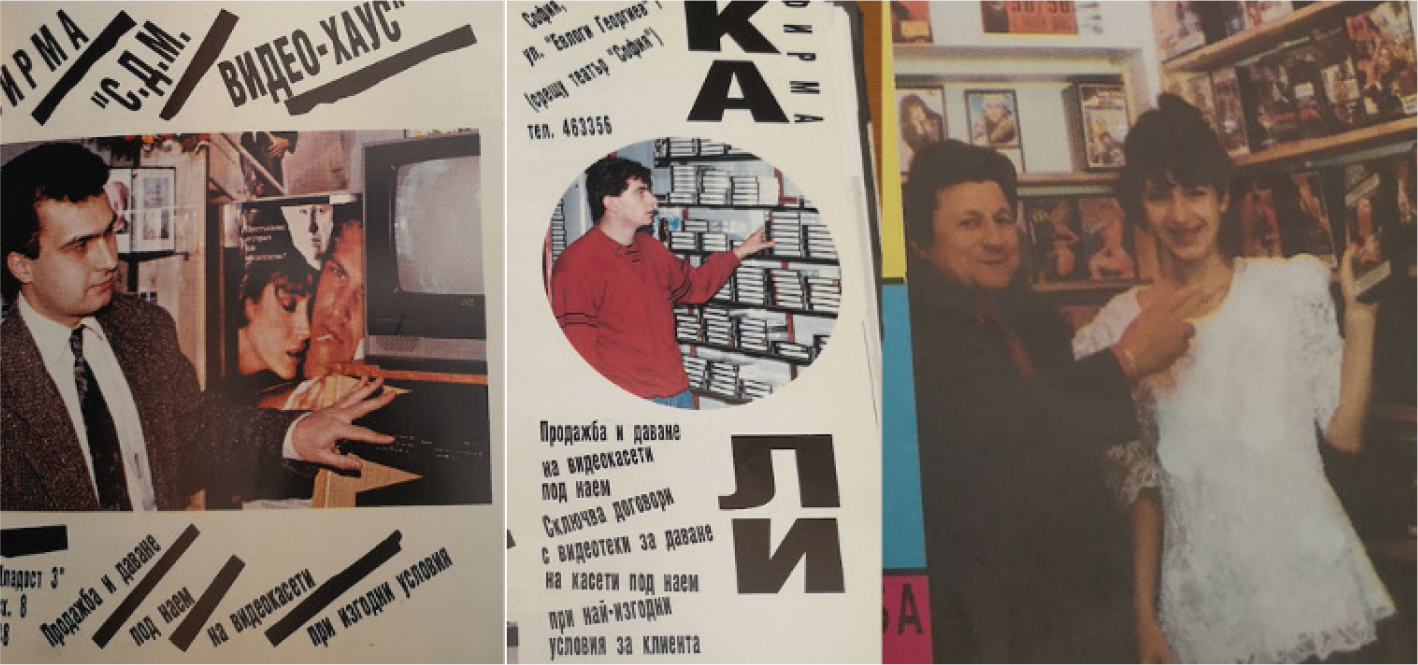
Figure 1
A collage made by the author based on advertisements published in magazine Video Hit depicting the atmosphere of Videotekas in the 1990s (volumes 3, 5, and 6, 1993, Photographer: Unknown). Pictures taken from the National Media Archive in St. St. Cyril and Methodius National Library.
As O’Sullivan and Fortunati outline that convergence can take place not only among old and new mediums but also among different analogue formats.36 The practice of introducing magazines, novels, and supplements to newspapers as creating material and economic value and economic value for audiences and responds to the emerging more visual genres.37 These types of practices emerged among the Bulgarian print press in the 1990s and early 2000s, too. For instance, the tabloid 24 Hours introduced a collection of more than 30 Bulgarian film DVDs in their Thursday issues.38 They also had other similar initiatives with supplementary world literature classics books, famous kids’ books, and encyclopedias of world geography. These special supplements increased the price of the issue and were branded as a ‘long-standing Western media model’ of providing valuable materials to readers.39 This branding suggests that Bulgarian journalistic and media practices are undergoing a process of convergence with Western media production which is perceived as more innovative and visual. Ideas and strategies for creating additional value for readers were borrowed and implemented in local contexts. Capital had a lifestyle magazine called Capital Light alongside the newspaper as well as a special section called Karieri (Careers) with job advertisements and industry information. It was common that Sunday volumes of the dailies would come with supplementary magazines about the TV program for the week providing brief descriptions of key movies and shows for audiences. These supplements became bigger with the emergence of new television channels and larger cable or satellite service packages.
The analysed editions from 1997 accentuate the rise of the Internet and the gradual, yet slow connection of the Bulgarian market with the global ones. Some volumes of the Bulgarian business-focused Capital from 1997 established a link between their printed issues, internet newsletters or webpages, and postal services. For instance, a few of the analysed Capital volumes included a subscription form in English where readers can subscribe to a service called Bulgarian Print Press Digest (see Figure 2). The potential customers should complete, cut the form from the paper (providing name, email address, contact details, and name of the company), and send it back via post. The newsletter was issued every Monday and customers were able to choose between a digital or analogue version of the Press Digest. The printed and posted paper form was a way to connect readers with both printed or digital news bulletins. The service was aimed at expats or business-to-business customers who wanted to keep up to date with local news from countries from Central and Eastern Europe but did not know local languages. The subscription promised to ‘keep an insider track of economic and political processes taking place in Bulgaria and the region.’40 This formulation suggests that Bulgaria or Eastern Europe remained a space not so well understood by foreigners as local, insider knowledge provides a competitive advantage to expats or investors. Foreign investment and the development of digital technologies were communicated in both Cash and Capital in terms of modernity and development opportunities. The hopes for the widespread establishment of web and computer networks were seen as a way to make a profit and find solutions for the transitional economic situation of 1997.
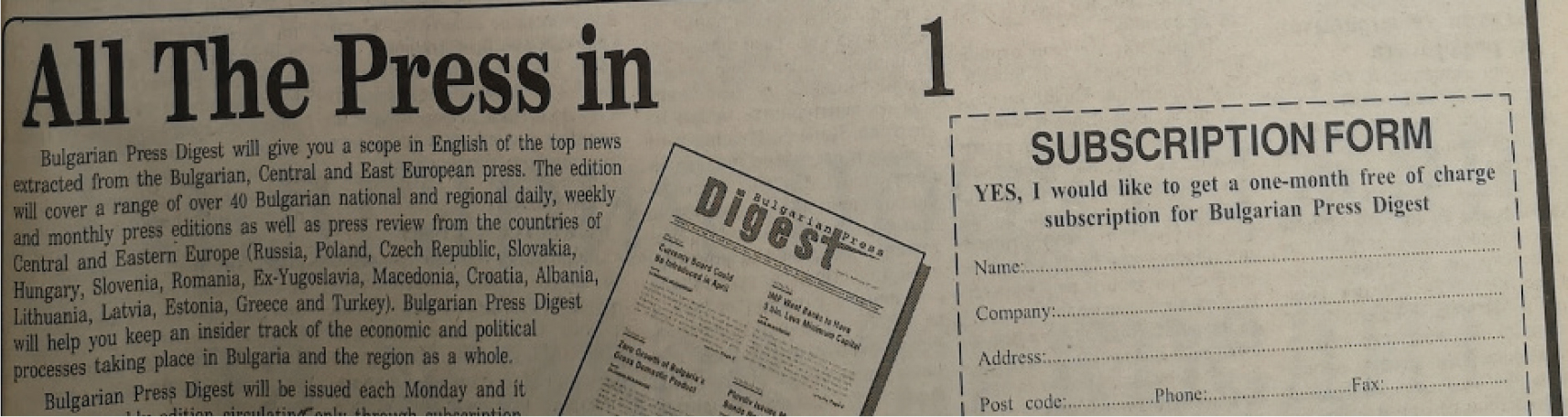
Figure 2
Bulgarian Press Digest Service delivered Capital Newspaper, 1997 (February 3-9), 21. Pictures taken from the National Media Archive in St. St. Cyril and Methodius National Library.
The advertisements in all four newspapers demonstrated links between the print press and other types of media. For instance, all four newspapers analysed included ads about local and national radio channels describing the type of music and themes broadcasted. The most advertised radio stations at the time were Darik Radio, 7 Days, Vitosha, Veselina, and local stations (Sofia, Varna, Burgas, or Plovdiv).41 Magazines related to the newspapers were also advertised. 7 Days Video and Cinema magazine, affiliated with the television channel and radio 7 Dni (7 Days), provided readers with further information about films, cinema programs, and celebrity lifestyles.42 Another example is 24 Hours’ youth and popular culture magazine called Hai Club promising to deliver ‘the most amazing and most current gossip from the intimate life of the celebrities.’43 Hai Club’s articles were mainly focused on American pop culture, Hollywood celebrities, gossip, and entertainment. It had glossy, colourful pages with multiple pictures. American celebrities were depicted in terms of their lavish lifestyles, success, and achievements in a market-driven world. This new order was viewed by the Bulgarian press as the new norm people had to adapt to which created a language of hierarchies. The colloquial word barovets (the word has a nuanced meaning in Bulgarian but generally signifies a person who lives richly and shows off through clothes, belonging, and lifestyle) appears across multiple publications in the two tabloids and Hai Club.44 The articles explored how American barovtsi (plural) lived, what technological devices, brands, or destinations were key for their image, and offered some tips on lifestyle.45 Celebrities were depicted through the local lenses (as barovtsi) and represented an example or a role model for the benefits of the new economic model.
Representations of Technology in the Bulgarian print press: Piracy, Modernity and Imagining the East and the West
The development of technology in the 1990s has an impact on cultural production and symbolism. Relating to Walter Benjamin’s seminal work ‘The work of art in the age of mechanical reproduction’ and the concept of the circuit of culture, Stuart Hall suggests that ‘new technologies of producing, storing, and circulating sounds and/or images (…) transformed culture, communication (…) and meaning.’46 In the case of the Walkman studied by Hall, technology can obtain cultural meaning and shape or depict individual identity through the practice of representation where people identify themselves with the depicted archetypes or situations. These notions are relevant to the Bulgarian case.47
The analysed snapshot of newspapers from 1997 demonstrated different use of technology: the two tabloids (Trud and 24 Chassa) presented technology as a source of entertainment while the two business-focused broadsheets (Cash and Capital) viewed it in terms of business opportunities and development. This is not surprising due to the different focus of the newspapers but technology served as an element for geographies of development. There was no particular electronic item dominating others in terms of content and representation. Trud and 24 Chassa depicted technology such as TV sets, video and audio systems, car audio systems, Tamagotchi, and personal computers. Audio-video systems were part of collective celebrations and were perceived as crucial for Bulgarians who enjoyed music and visual entertainment. While this type of device was presented as established or prioritised by Bulgarians in 1997, digital technological items were viewed as innovative, at times peculiar, and expensive. For example, Hai Klub, 24 Hours, and Trud all included articles about Tamagotchi referring to Japan as a highly developed and technologically advanced country where pets are digitalised.48 Japan was depicted as the epitome of the future of technological development and the penetration of the Internet in society.
The two broadsheet papers Cash and Capital had longer and more analytical articles where technology was more present. Technology was seen as a source of connection to developed economies and investors, innovation, a tool facilitating state administration, research, and even criminology (Trud).49 Two technological items appeared more on the pages of Cash and Capital: the personal computer and the mobile phone. The personal computer was depicted as a key tool connecting Bulgarian reality and aspiring entrepreneurs to global markets. Silicon Valley, Wallstreet, business centres in London, Frankfurt, Paris, and Brussels were seen as an important location of modernity and economic aspiration in most of the analysed issues. The personal computer was emphasised in terms of its use for education, skills development among professionals and students adapting to new working realities. The representation of the mobile phone was quite different: it was an exclusive item typical for successful businessmen demonstrating masculinity, strength, and determination. In the two tabloids (Trud and 24 Hours), the mobile phone was framed in locations associated with business travel and lifestyle such as private jets, airplanes, limousines, and cars. Technologies and their depictions shaped hierarchies between developed and developing countries, between classes, and between perceptions of affordability among Bulgarian consumers.
Another major theme linked to technological representation in the analysed materials (all four newspapers and one of the magazines) was piracy, intellectual property protection laws, and the role of piracy for Bulgarian audiences. This data sheds some light on piracy practices of the 1990s era and their developments in 1997. Issues of the magazine Video Hit from 1993 explore the introduction of copyright law in Bulgaria as ‘timely’ and ‘delayed.’50 The new law is esteemed to have an impact on small ‘video pirates’ (published in 1993 edition of Video Hit magazine): ‘pirate-based videotekas whose owners have never heard of any restrictions on their activities. Their ateliers are located in basements, garages, coffee shops, and even apartments which makes it hard for authorities to find the stealing pirates.’51 This quote provides insights about the pirating media practices. Professional associations also appeared during the 1990s period such as the Bulgarian Association of Video Producers in 1992 (according to Video Hit Magazine).52 One of their members was a sceptic of the early efforts to resist piracy in the country due to the ‘ingenuity and resourcefulness of our pirates.’53 A journalist in another article from the Video Hit magazine claimed that the new legislation will require licenses and will result in the ‘consolidation of video distributors and dominance of the big firms.’54 Curiously, some of the reasons identified for the popularity of video rental services are the higher price of cinema tickets and not good conditions in most of the cinema theatres. The notion of space in transitional realities and the emerging entrepreneurial drive through file sharing among Bulgarians is depicted somewhat humorously:
(…) Each garage – [turned into] a trading area, decided the ones [people] with entrepreneurial spirit. It was offered [to customers] on the shelf: cheese, silk clothes, umbrellas, and car parts. And videotapes. Something for everyone: Yugofolk [Pop-folk music from the former Yugoslavia] and porn, thrillers and cartoons, martial arts and comedy (…) just to die of laughter.55
The quote above demonstrates that at the beginning of the 1990s piracy had a bottom-up organisation and individuals with small video distribution ‘ateliers’ or ‘garages’ provided content to audiences. Some of these spaces where videotekas were located are still visible today in residential buildings, yet abandoned (see Figure 3 and 4). The content was diverse and rules of distribution and consumption were loose. An article distinguishes the quality of pirated movies as the home-made dubbing was unprofessional, monotonous, and often done by one person.56 The second half of the 1990s changed the dynamics of piracy in Bulgaria as pirated content was produced in mass scale.
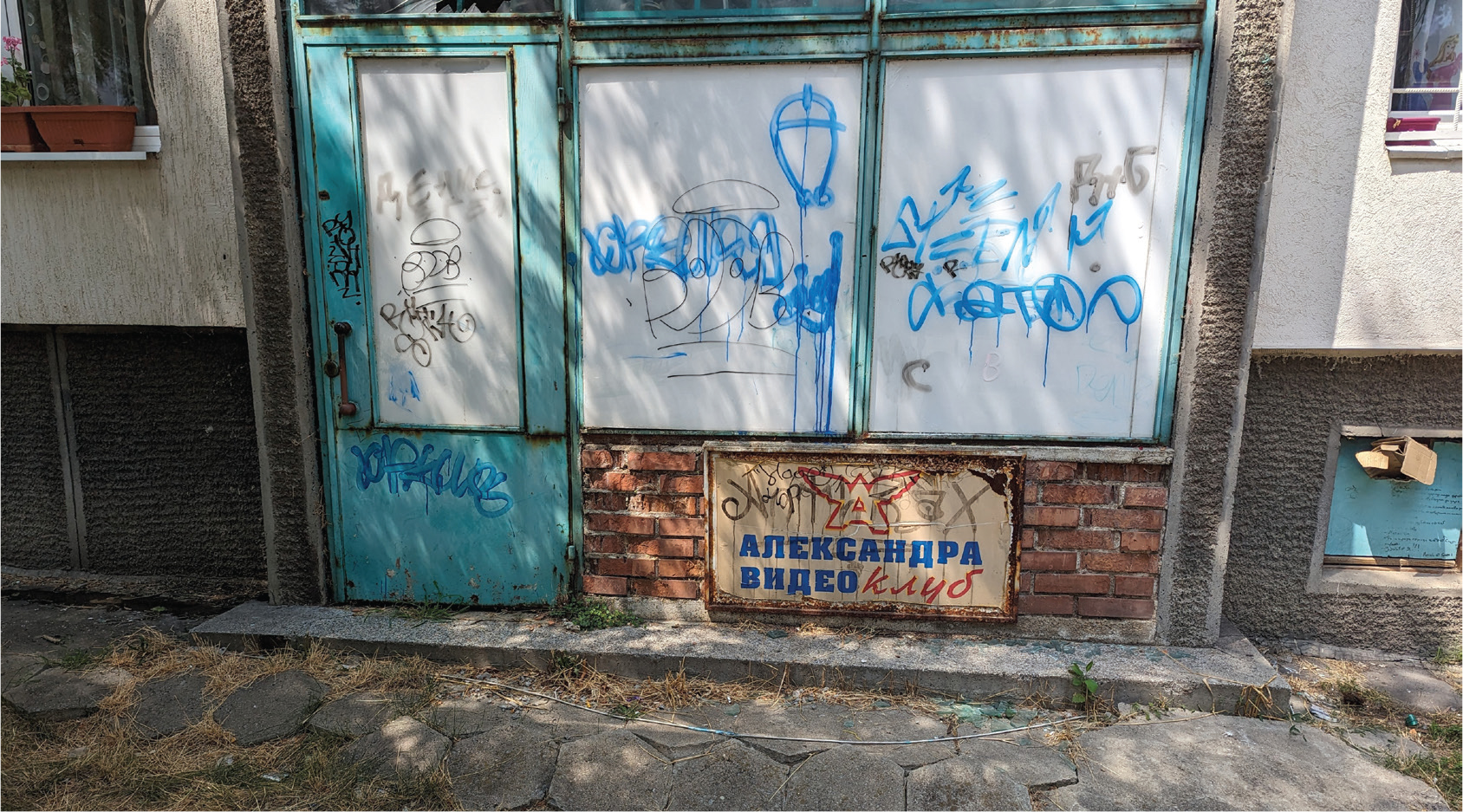
Figure 3
Some remnants of the videoteka are visible now through abandoned spaces in the suburbs of the city landscapes. A branch of the former videoteka ‘Alexandra Video Club’ which used to be one of the biggest distribution chains for video cassette rental. The videoteka was located in a small space on the bottom floor of a residential building (using the back exit or a smaller rental space). The picture was taken by the author in the suburbs of Sofia.
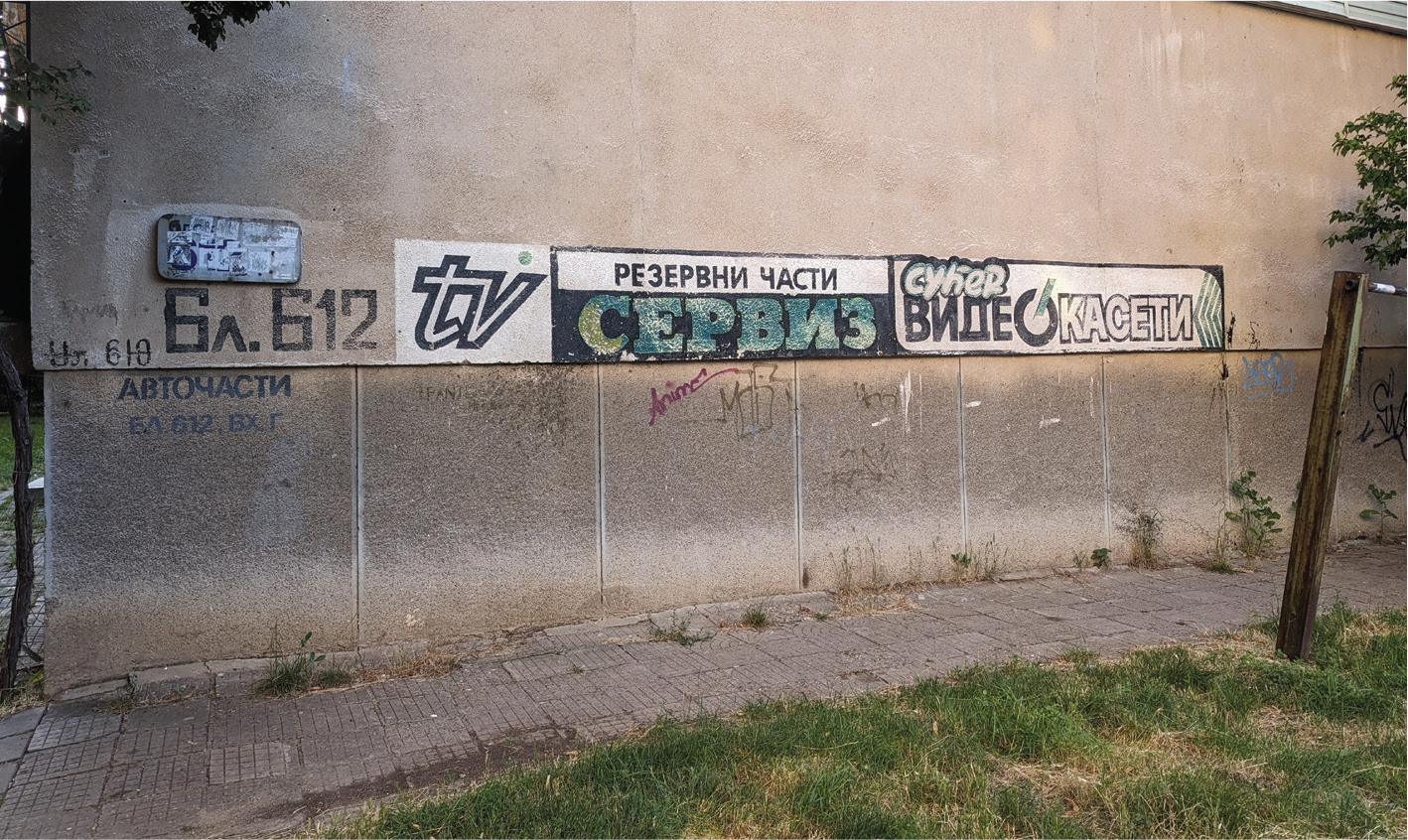
Figure 4
An advertisement of ‘Super video cassettes’ and ‘TV repair shop and spare parts’ still remaining on the facade of another residential building. The shop was located on the ground floor of the residential building, now occupied by other small business owner. Both spaces (Figure 3 and 4) represent an example of these small ‘ateliers’ discussed in the article.The picture was taken by the author in the suburbs of Sofia.
Piracy issues remained throughout the 1990s but transformed into the mass production of compact disks and adopted a more globalised and centralised character. The East-West divide is blurred when it comes to piracy because transitional realities and the rule of law in Bulgaria during this period have created both settings for the organised export of pirated content to both Eastern and Western markets and increasing restrictions. An issue of Capital and Cash from 1997 discusses a newly established Council for the protection of copyrights and the need for Bulgarian authorities to restrict ‘the mass production of pirated disks’ under growing pressure from the international community (mainly the EU and the United States).57 A producer was cited: ‘One should not check the flea market (bitpazar) but the manufacturers and large distributors.’58 In comparison with earlier publications, piracy had a more organised character and international distribution channels in 1997. This quote demonstrated the different levels of piracy at the time differentiating between sporadic individual use and organised channels for pirated content aiming for exports. Another article in 24 Hours provides more information about the production, supply chain, and globalisation of Bulgarian cassette and CD piracy. The article states that there were factories for illegal audio-video reproduction in multiple bigger and smaller cities across the country which exported ‘high-quality CDs, competing successfully with the original products in Europe and Africa.’59 Some of the most popular markets identified were the Russian Federation, Germany, Czech Republic while videocassettes (not CDs) were the majority of produced copies due to their higher margin of consumption and profits.60 During the period, pirated disks ‘were ordered in bulk by clients abroad’ but ended up getting caught at the border checks with Romania and Serbia being stored in secret compartments in larger vehicles or directly on the train (see Figure 5).61

Figure 5
Pirated CDs caught on the border pass with Serbia, 24 Hours Newspaper vol. 30, January 31, 1997. Picture taken from the National Media Archive in St. St. Cyril and Methodius National Library.
News materials also demonstrated pirate activism and the ability to adapt during changing circumstances of the 1990s and the tightening legal grip. According to 24 Hours, pirates were taking advantage of ‘loopholes in the legislation’ as they produced their own compilations of music albums and song selections.62 Newspaper Cash also discussed the mass production of pirated CDs when pirate factories started operating during the night due to police checks and raids during daytime (‘CD Pirates started giving night shifts’).63 Cash also included the pirates’ perspective ‘The attacks against us are aimed at discrediting us (omaskaryavaneto ni) in front of the world and destroying CD production in Bulgaria’ demonstrating pirate activism and presumed contribution towards improving the economic situation in the country.64 Capital also cited anonymous pirates ‘Things are a bit tight around our business, we look around, worry about checks but the business is going giving bread to a lot of people (see Figure 6).’65 Using the metonymy ‘bread’ symbolising the income provision from piracy in times of economic difficulties. Pirates perceive their function as beneficial for the development of the Bulgarian economy but they are facing difficulties due to the increased rule of law, police forces, surveillance, and pressure on Bulgarian policy makers from sources outside Bulgaria. The pirates perceived themselves as employers, activists, and actors having somewhat global markets.
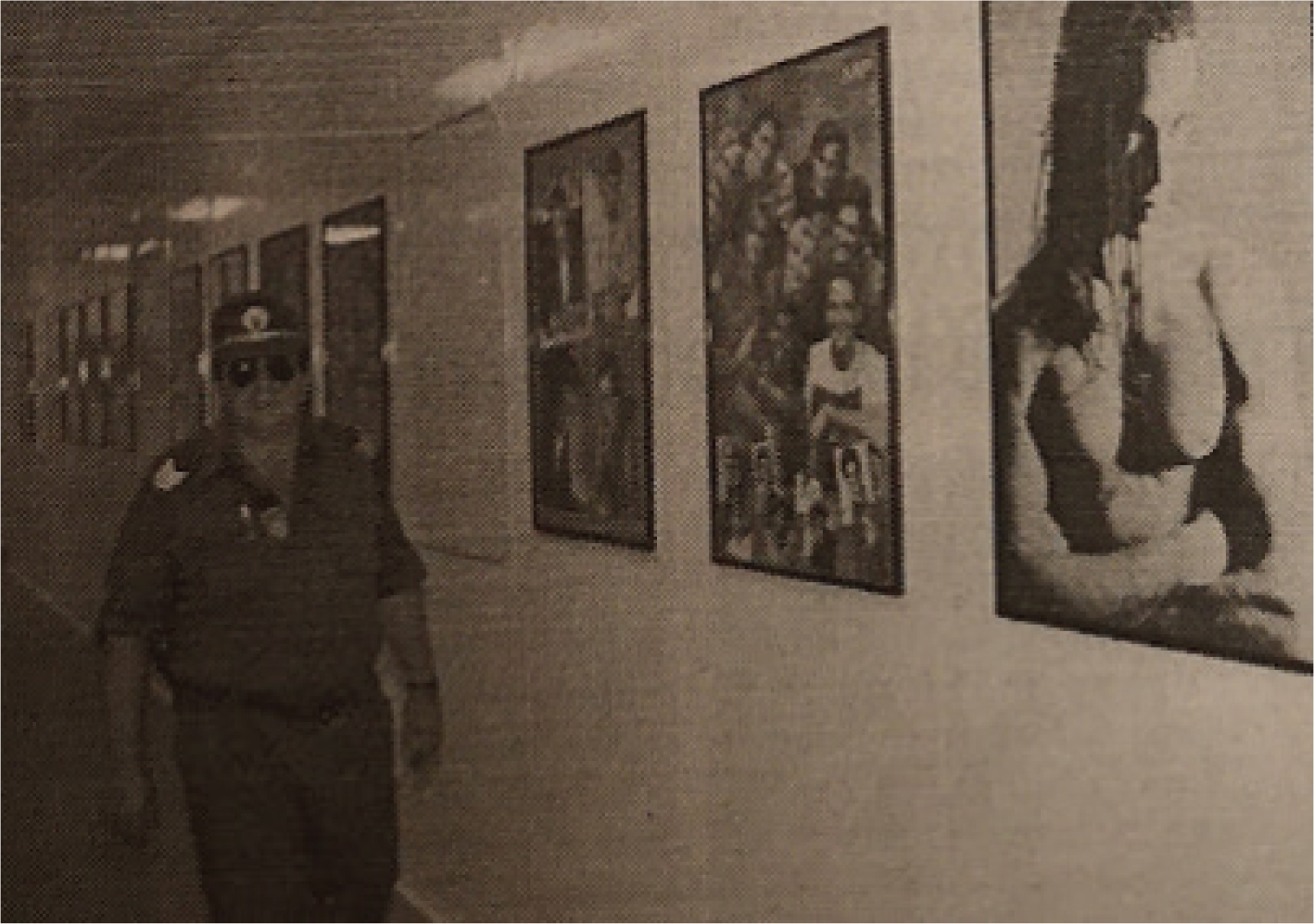
Figure 6
Police check in one of the CD production facilities in Bulgaria, Capital Newspaper. Picture taken from the National Media Archive in St. St. Cyril and Methodius National Library.
Stores, which normally sold legal and authorised video cassettes and CDs, also had hidden printed catalogues they showed to customers after ensuring they were not inspecting authorities (according to a journalist in Capital, 1997).66 Both Capital and Cash discuss that some of the CD producers claim to have licenses and contracts with producers but they further issue other pirated copies creating a level of complexity and dilemma between enforcing the law and preserving the industry.67 Pirates received attention in the 1997 Bulgarian print press as their identities and connection to technology were viewed in a multi-layered manner. Pirates were gaining new status as outlaws in the more regulated market economy with pressure from international institutions. On the other hand, they were a symbol of Robin Hood-like activism as pirates epitomised the roles of employers, content providers for audiences living in a condition of inflation and economic hardships, as well as a distinct economic sector exporting products abroad. The transition period and increased circulation of products also stimulated the transformation of pirate media practices from more scattered individual initiatives in the early 1990s to organised, mass production facilities in 1997. The production of pirated audio and video tapes, CDs, and DVDs in 1997 demonstrated markets both to the East and the West, converging and situating them as actors in more globalised media markets.
The Personal Computer: Modernity, Opportunity, and the Bulgarian Contribution
The computer and development of the Internet was a major theme for the two broadsheets papers and was often related to the notions of Europeanness, modernity, and openness. Computers were also signifiers of individual identities relating to intellectual labour, innovation, and business development. The archetypes depicted in all four newspapers (Trud, 24 Chassa, Capital, and Cash) were specialists working with foreign firms or international forums, students, intellectuals, and business people who are keeping up to date with news and market research trends. For instance, the sociologist Miroslava Radeva (former Yaneva) is depicted working on a computer in business attire while discussing that ‘Bulgaria still does not know how to advertise (brand) itself and is lagging behind from European standards’ while ‘regular political and economic turmoil, and inherited patriarchal closeness’ can be damaging for business.68 Another article by Cash discusses that ‘trading via Internet has a big (promising) future’ as people will be able to buy and trade almost everything: ‘clothes, books, flowers, travels, CDs, Hi-Fi technology, or computers.’69 Computers and new technology here represent modernity, opportunity, Europeanness, and a way to open up and overcome the legacy of closeness through entrepreneurship of a new kind. Another article in Cash newspaper discussed that ‘mastering the computer’ and ‘computer literacy’ are a key requirement for the modern workplace and depicts a young white-collar worker familiarising himself with the device.70 Here, the computer also relates to providing opportunities for employment and realisation.
The Bulgarian President Petar Stoyanov is also depicted by Capital newspaper using a computer and ‘is one first among his European colleagues to have his own webpage (…) demonstrating that he respects (zachita) the cultural revolution’ (see Figure 7). The participation and engagement with digital media was seen as an active part of the cultural revolution and modernity. The president got in touch with Bulgarian students (also labelled as ‘the compatriots of John Atanasoff’) studying abroad mainly in the United States, United Kingdom, Sweden, Germany, and Austria who managed ‘to orient themselves in the web (payajinata)’ and to achieve ‘balance between Cyrillic and Latin alphabets.’71 This data captures very well the processes and national identity formations during the period of the 1990s as the preservation of Cyrillic alphabet was a priority in a more digitalised communication. Bulgaria was on a new path to modernity, democratisation, and technological advancement. The figure of John Atanasoff, who had Bulgarian origins, is used to capture the Bulgarian contribution to the development of the computer. The 1980s, Bulgaria was among the first countries to produce 8-bit personal computers in the Eastern Bloc and later built the first 16-bit personal computer for the country.72 ITCR engineers began mass production of personal computers (PCs) named Pravets after the town where the Microprocessing Technology Plant was based.73 Thus, Bulgarian national identity was entangled with the development of the personal computer and the aspirations of the country to be more represented in global networks.

Figure 7
The President Petar Stoyanov in front of the computer screen depicted by Capital Newspaper, March 31 – April 6, 1997. Picture taken from the National Media Archive in St. St. Cyril and Methodius National Library.
Cash newspaper also pointed out the major share of Bulgarian electronics and computational technology export in the Council of Mutual Economic Assistance.74 However, Bulgaria was lagging behind in terms of technological innovation in 1970s ‘compared to the developed countries (such as Japan and the USA).’75 The article depicted the situation in 1989 – 1990 in the following way: ‘Bulgarian factories stopped producing (…) There was produce no one wanted as well as a storage of raw materials’, facilities in Botevgrad and Pazardzik were ‘liquidated’ as ‘the state did not have a stand for the development of the branch’ altogether.76 A critical position was expressed towards the state as the transitional era brought resource stripping of former factories as well as a loss of know-how and human resources. On one hand, the President Petar Stoyanov, a member of the Union of Democratic Forces, was portrayed by Capital as modern and forward-looking due to his own webspace seen as rare even in the European context.77 Here, Europe was seen as a standard of technological development. On the other hand, Bulgaria was belonging to a long history and tradition in the development of electronics and cybernetics but its innovative potential was presented by Cash Newspaper as wasted both during the Communist past and the transitional period.
The openness of the borders after the fall of the Berlin Wall stimulated patterns of migration to Western European countries and the US for education or professional realisation. An imaginary of the collective West was seen as a geographical boundary of development, globalisation, and opportunity. However, the Bulgarian press of the time also emphasised markers of Bulgarian national identity such as the Cyrillic alphabet or belonging to the nation. The rise of the internet and the need to speak and write in English created some discussions in Capital for the balance between the two alphabets and the preservation of markers of Bulgarian national identity in a more globalised and connected world.
The Internet as the Future and the Solution to the Hardships of the 1990s
The development of the internet was framed in a positive way and its potential of bringing change, opportunity, and entertainment was emphasised by Bulgarian newspapers. Trade online and the benefits of email communication (such as speed, attachments of files, and sounds) were mentioned by Cash newspaper as ‘creating new markets for small businesses.’78 Advertising online was believed to ‘be promising’ and reach a peak in 1997 according to Capital where ‘developed webpages such as CNN, MTV, Discovery Network were popular among both advertisers and users’ and elaborated on the role of cable television for developing brand name on other mediums.79 Another repeating theme from the previous section is the portrayal of Western media outlets and their practices as developed and an example of how to communicate in networked environments. Cash also discussed the benefits and costs of developing newspapers online. The realities of the internet required investment of time and funds but were generally depicted as ‘the future’ and provided a presumed escape from the economic hardships of the 1990s for people who knew how to take advantage of the new technologies. All newspapers discuss the information availability and connections among people ‘in a global village’ as some of the advantages of the Internet (Capital).80
In a humorous article, the tabloid 24 Hours depicts the high interest in Tamagochi in Japan where ‘the obsession’ with the product ‘even made people share information over the Internet on how to best take care of their electronic chicken.’81 Citing the Asahi newspaper, 24 Chassa mentions ‘students discussing on the electronic post’ and represents ‘a woman who opened a special webpage on the Internet for latest shop delivery information of the product.’82 The extensive article describes Japan as a high-tech country where the Internet is embedded in everyday life and communication while being widely used among ordinary citizens. In 1997, this was not the case in Bulgaria and the example above was used to portray or illustrate to the readers how the Internet can be intertwined with daily activities. Some of the functions outlined were finding information through online searches, communicating quickly with a digital community, shopping, and finding delivery information. Japan was portrayed with this futuristic topos and was seen as a technological inspiration. Here, technological development and new technologies were coming not only from the West but from the East, too.
The Mobile Phone: A Symbol of Masculine Power and Determination
Mobile phones were not the subject of lengthy articles among the four newspapers analysed but they were part of building a particular masculine identity as well as notions of power and success during the time of transition. They were depicted sporadically to complement some other topic of discussion. Cash newspaper mentioned mobile phones as ‘a symbol of power image’ (alongside ‘the BMWs, Mercedes, gold chains, and baseball bats’).83 Mobile phones were widely used among the Bulgarian organised crime groups and their bosses from VIS and SIC circles.84 Despite their notoriety and illicit activities, their bosses (such as Iliya Pavlov, Vasil and Georgi Ilievi, Ivo Karamanski, and others) were depicted by newspapers as the powerful and well-off winners of the transition period who were benefiting from the free market and privatisation. In their realities, a mobile phone was a must and a status symbol since mobile devices were expensive and exclusive at the time. In the analysed newspapers, mobile phones were depicted as owned or used by males while females had a subordinate role and were holding landline telephones.
Recently, an advertisement of the former telecommunication provider Mobikom from the 1990s went viral on Facebook and Reddit relating the showman and now politician Slavi Trifonov to the macho and mafia-like cultures of the 1990s. The mobile phone was a key element portrayed when communicating masculinity. The advertisement was framed across Bulgarian web spaces as ‘long forgotten’ but also captured controversies of the 1990s.85 The title of the poster claims: ‘He – the true man uses mobiphone’ as Slavi Trifonov is standing between two females posing in provocative attire. He is dressed all in black and holding a gun (see Figure 8). The subtitles of the ad describe the characteristics of the strong man: ‘He can wait … He is strong and tender … He truly loves the woman with whom he is … he can win while preserving the honour of the others.’ Here, the mobile phone is linked with multiple masculine character traits such as strength, determination, honesty, honour, and a lack of vanity. Vanity in this advertisement is seen as a minor issue which is incompatible with the male figure, his priorities, and his ideals. The male is central while females have secondary roles. Females are not depicted in active but passive voices lacking agency.
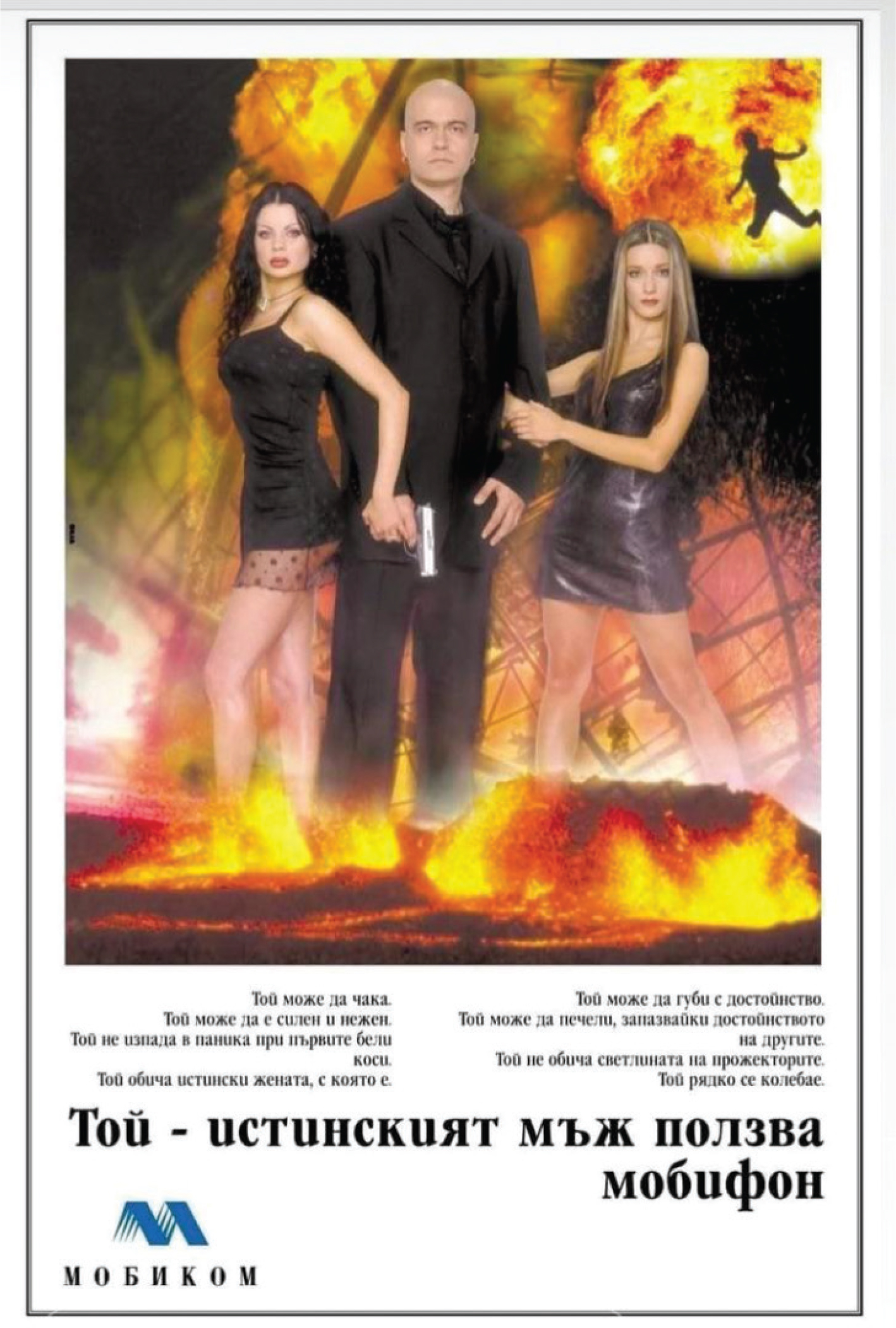
Figure 8
The showman Slavi Trifonov posing for an advertisement of the telecommunications provider Mobikom from the 1990s. Screenshot taken by the author.
A similar strategy was used when representing mobile phones as used by Wallstreet or Tokyo Stock Exchange investors (depicted in Cash, Capital, and Trud).86 The pictures portrayed businessmen holding mobile phones and looking at computer or laptop screens. Their surroundings were dynamic and fast-changing. Interestingly, women were depicted on stationary desks and using landline phones instead. One picture from the tabloid newspaper (Trud) represented a model holding a landline phone in a limousine with the caption below it: ‘The beautiful secretary is an inseparable part of the automobile office of a modern American financier.’87 Similar strategies from the Bulgarian case were applied to the American context where males were in a position of power while women were portrayed in an obedient and rather passive manner. Similar to their Bulgarian counterparts, the American financiers were seen in terms of power in a dynamic, capitalist world where cars, money, and mobile phones were their main attributes.
The mobile phone also found its place in Bulgarian chalga songs as an item epitomising both gendered professionalism and entertainment, connecting Bulgarian, Balkan, and global identities. Cash discussed that Sofia was ‘a temptation even for Europeans due to the great variety of clubs and discos’ and that the ‘neon lights from the advertisements illuminate our otherwise dark capital.’88 The capital Sofia was described as dark due to the limited street lights at the time but neon lights from privately owned clubs were standing out. The newspaper also outlines how modern party culture combines both Bulgarian and foreign elements with titles such as ‘Tiger Tiger and En Vogue shaking the sleep of the residents of the capital.’89 The video clip of Tiger -Tiger starts with a female voice ‘ - Hello, boss. Someone is looking for you on the mobiphone’, the male singer replies on the call ‘Hey, bro… Enough with these pyramids and these pharaohs … Let’s do some business.’90 The lyrics are referring to financial pyramid schemes led by ‘pharaohs’ who were also depicted through male nouns (in Bulgarian nouns have gender). The mobile phone is the main focal point of another chalga song by Milko Kalaydziev called GSM. In the videoclip, the singer drives a Mercedes alone to Sofia but cannot find his love in the big city because he does not have a connection.91 The video depicts the character struggling to use a payphone and singing between erotic female dancers who are holding and talking on oversized mobile phones as the brands Nokia and Motorola are visible. The lyrics depict the mobile as a fashionable item demonstrating a certain lifestyle: ‘I will buy a phone to be in tune. Sony, Siemens, Ericsson, to have a style’ (there is a rhyme in Bulgarian: “Sony, Siemens, Ericson, za da imash ti fason”). There, the mobile phone appears again as a link to a masculine image of the businessman (compared to a tiger and driving Mercedes) and to certain frames of fashionable or cosmopolitan lifestyles. It is an item symbolising power, wealth, and attractiveness.
The Importance of Audio-Visual Electronics for Collective Celebrations
Some of the analysed newspapers in the previous paragraph emphasised that Bulgarian capital was catching up with the European party cultures and audio systems were crucial technological items facilitating these processes. Special loci are framed as a place where collective celebrations take place: namely the krumcha. Krumcha (or pub) was the locale where dining was combined with parting under the sounds of folklore, Estrada, or Balkan chalga music. Live performances of female singers or orchestras were a way to attract more customers to the kruchma while musical instruments, microphones, and big loudspeakers were crucial for the delivery of the overall experience. Cash newspaper makes a distinction between ‘musical Club and kruchma’: ‘Music clubs are the natural home where jazz, blues, and rock are born … with us [in Bulgaria] these music genres existed only illegally in [private] accommodations … to call krumcha a club, you need something more … not written in a book.’92 In this text, the kruchma represents the local locale while music clubs are something foreign which is yet to be adapted in Bulgarian context.
These items and spaces were depicted widely by both tabloids (24 Chassa and Trud) in their Pop-folk sections93 but also by 24 Hours’ magazine Hai Club which they linked to youth culture. Audio systems, loudspeakers, and microphones were portrayed as important items for collective celebrations. All three newspapers (apart from Capital) represented these experiences and emphasised that Bulgarians prioritised going out and enjoying collective celebrations despite the financial and economic difficulties of the time. The newspapers also discussed the role of establishments with live music as income providers for singers amid declining album purchases. Cash newspaper discusses a Hi-Fi exhibition in Sofia and consumption patterns of audio-visual electronics among Bulgarians: ‘Now best-selling is sound and video equipment for the home, as well as for discos, music halls and clubs.’94 These consumer practices reflect the beat of the time when audio and video technology became ubiquitous in households, cultural meaning-making, celebration, and media practices. The assessed newspapers illustrate the collectivist cultural experiences provided by audio and visual technologies.
Conclusion
The article demonstrates how the period of the 1990s was transitional for Bulgaria in many ways: the return to Europe, the role of technologies and innovation in terms of modernity, and the Bulgarian national identity located between the East and the West. The article investigates how the Bulgarian print press of the 1990s converged with other established or new media formats of the time and explores how four Bulgarian newspapers published in 1997 (two business-oriented broadsheets Cash and Capital and two tabloids Trud and 24 Chassa) depicted the link between the representation of technology and identity formation. Building on previous literature on the Bulgarian media system, liberalisation of the Bulgarian print language, and popular genres, the study offers a unique techno-centric perspective on identity construction from a transitional, non-Western context (Bulgaria in the 1990s). The democratisation, liberalisation, shift to a market economy, loose legislation, and inflation were some of the processes affecting media practices. Print media communication became more visual, the language of writing more colloquial, and images more eroticised or sensational. During the period, Bulgarian newspapers (Capital, Cash, 24 Chassa, and Trud) made the first steps to bridge the established media with the emerging digital spaces while considering potential opportunities and limitations (mainly financial) for creating electronic editions and services. The entry of new technologies and the developing consumer markets for electronics resulted in an increased link between technology (its ownership and use) and notions of identity and social status. The economic hardships affected the media consumption patterns of Bulgarians and their reliance on pirated content. Piracy appeared to be a key theme among all four newspapers. In the early 1990s, piracy appeared as a more localised and bottom-up initiative while the second half of the 1990s marked a shift towards mass production of pirated CDs and video tapes in factories and aimed for export in Europe, Africa, and Asia. Pirates had many identities and traits. On one hand, they were criminals in the eyes of the authorities, artists, external actors (mainly the USA and Europe), and tightening copyright regulations. On the other hand, they were activists, employers, producers, and Robin Hood-like figures providing entertainment to and even income for Bulgarians facing economic hardships.
Diverse archetypes, identities, and situational storytelling were represented through technology. While the personal computer was used by scientists, engineers, students, specialists, or business people for exploring international opportunities, trade, and innovation, the mobile phone was depicted in terms of gender stereotypes as an attribute to the male businessmen or organised crime groups’ bosses symbolising power and masculinity. Females were framed in subordinate positions and using landline phones. The personal computer was a device representing both the future of technological advancement but also the Bulgarian mark in its development through the figure of John Atanasoff and the legacy of Bulgarian cybernetics and electronics from the Communist past. A feeling of loss as well as the waste of material assets and human resources were communicated by Cash newspaper as the 1990s brought a lack of strategy for the development of the sector and its cadres. Digital communication brought the question of preserving the Cyrillic alphabet in digital spaces. Video- and audio- systems were widespread among Bulgarians as cheaper and accessible entertainment in times of political, cultural, and economic turmoil. Technology was part of collective celebrations and was often connected with notions of modernisation, and Europeanness but also the intersection of Bulgarian or Balkan imagined collective identities with Western and more capitalist influences. Regional genres or loci were signifying the local or Balkan identities (kruchma, videoteka, chalga, or Yugofolk) while foreign influences were becoming more ubiquitous (music clubs, jazz, pop, rock). Digital innovation came not only from the West (Europe and the USA) but also from the East as Japan appears in different articles as an example of a high-tech society. The legacies of the 1990s remain visible in some digitalised media practices today and the technology of the period is associated with feelings of nostalgia and a perception of an easier past long lost among Bulgarian social media spaces and communities.
Acknowledgements
I would like to express my gratitude to the librarians and administrators at St. St. Cyril and Methodius National Library in Sofia (Bulgaria) who made this article possible and provided support for finding data and materials during summertime. I would also like to thank Vladislava Vladimirova for sharing her personal insights and experiences about the period studied and who discussed the topic with me at the Institute for Russian and Eurasian Studies at Uppsala University.
Biography
Alexandra Brankova is a PhD candidate in Media and Communication Studies at Uppsala University, the Institute for Russian and Eurasian Studies (IRES) and the Department of Informatics and Media (IM). Alexandra Brankova’s PhD project investigates Russian nationalist media ecology, nationalism discourses, and media practices before and during Russia’s full-scale invasion of Ukraine (2018 - 2023). Her main research interests are related to national identity construction, nationalism, digital nationalism, critical discourse studies, digital social science, new media, media practices, media cultures, and digital methods with a specific focus on the Russian Federation and South-East Europe.
Notes
[1] Jesper Verhoef, “The Cultural-historical Value of and Problems with Digitised Advertisements. Historical Newspapers and the Portable Radio, 1950-1969,” TS: Tijdschrift Voor Tijdschriftstudies, 38 (2015): 51–60, http://doi.org/10.18352/ts.344.
[2] Gabriele Balbi, “Old and New Media. Theorizing Their Relationships in Media Historiography,” in Theorien des Medienwandels, ed. Susanne Kinnebrock et al. (Cologne: Herbert von Halem Verlag, 2015), 231 – 249.
[3] Sabina Mihelj and Simon Huxtable, From Media Systems to Media Cultures: Understanding Socialist Television (Cambridge: Cambridge University Press, 2018).
[4] Stuart Hall, Jessica Evans and Sean Nixon, Representation Cultural Representations and Signifying Practices (London: Sage Publications Ltd, 2013); Stuart Hall and Paul Du Gay, Questions of Cultural Identity (London: Sage Publications Ltd, 1997); Stuart Hall et al., Doing Cultural Studies: The Story of the Sony Walkman (London: SAGE Publications Ltd, 2003).
[5] Hall et al., Doing Cultural Studies. ; Jesper Verhoef, “The epitome of reprehensible individualism: The Dutch response to the Walkman, 1980–1995,” Convergence, 28, no.5 (2022): 1303–1319, https://doi.org/10.1177/13548565211060297.
[8] Dimitar Sotirov, “BULGARIAN MEDIA AND THE TRANSITION, 1989 – 1998.” SEER: Journal for Labour and Social Affairs in Eastern Europe, 1, no. 2 (1998): 85–96, http://www.jstor.org/stable/44627798. ; Lilia Raycheva, “Mass Media Developments in Bulgaria,” in Pluralism in Europe: Concepts and Conditions, eds. Andrea Czepek, Melanie Hellwig and Eva Nowak (Bristol: Intellect Books, 2009), 165-176.
[11] Timothy Rice, “Bulgaria or Chalgaria: The Attenuation of Bulgarian Nationalism in a Mass-Mediated Popular Music,” Yearbook for Traditional Music 34 (2002): 25–46, https://doi.org/10.2307/3649188.
[12] Daniela Dimitrova and Petia Kostadinova, “Identifying Antecedents of the Strategic Game Frame: A Longitudinal Analysis,” Journalism & Mass Communication Quarterly, 90. no.1, (2013): 75-88, https://doi.org/10.1177/1077699012468739.
[14] Elza Ibroscheva and Maria Raicheva-Stover, “Engendering Transition: Portrayals of Female Politicians in the Bulgarian Press,” Howard Journal of Communications, 20, no. 2, (2009): 111-128, https://doi.org/10.1080/10646170902869429.
[15] Roumiana Deltcheva, “New Tendencies in Post-Totalitarian Bulgaria: Mass Culture and the Media,” Europe-Asia Studies, 48, no. 2 (1996): 305–315, http://www.jstor.org/stable/153211.
[17] Anastasia Smirnova, “Aligning language to ideology: A socio-semantic analysis of communist and democratic mass media language in Bulgaria,” Journal of Language and Politics, 14, no. 2 (2015): 205-232, https://doi.org/10.1075/jlp.14.2.02smi.
[19] Dimitar Sotirov, “BULGARIAN MEDIA AND THE TRANSITION, 1989 – 1998,” SEER: Journal for Labour and Social Affairs in Eastern Europe, 1, no. 2 (1998): 85–96, http://www.jstor.org/stable/44627798.
[21] Vladimir Trendafilov, “The Formation of Bulgarian Countercultures: Rock Music, Socialism, and After,” East Central Europe 38, 2-3 (2011): 238-254, https://doi.org/10.1163/187633011X597234.
[22] Tristan Mattelart, “Audio-visual piracy: towards a study of the underground networks of cultural globalization,” Global Media and Communication, 5, no. 3, (2009): 308–326, https://doi.org/10.1177/1742766509346611.
[23] Tristan Mattelart, “Transboundary flows of western entertainment across the Iron Curtain,” Journal of International Communication, 6, no. 2, (1999): 106 – 121.
[24] Lilia Raycheva, “Mass Media Developments in Bulgaria,” in Pluralism in Europe: Concepts and Conditions, eds. Andrea Czepek, Melanie Hellwig and Eva Nowak (Bristol: Intellect Books, 2009).
[27] Ulrich Ermann, “Performing New Values: Fashion Brands in Post-Socialist Bulgaria,” Europe-Asia Studies, 65, no. 7 (2013): 1344–63, http://www.jstor.org/stable/24534199.
[28] Vladislava Vladimirova, “’Love for the rich, porn for the people’? Popular music in the Balkans as a locus for negotiation of belonging and social distinction,” Nätverket, 22 (2020): 69-86.
[30] Teun A. van Dijk, “Sociocognitive Discourse Studies,” in The Routledge Handbook of Critical Discourse Studies, eds. John Flowerdew and John E. Richardson (London: Routledge, 2017), 26 – 43.
[32] Michal Krzyżanowski, The Discursive Construction of European Identities: A Multi-Level Approach to Discourse and Identity in the Transforming European Union (Frankfurt am MaIn: Peter Lang GmbH, 2010), 9-29.
[35] The pictures and advertisements appear in the earlier volumes of Video Hit Magazine published in 1993 and 1994.
[36] John O’Sullivan and Leopoldina Fortunati, “Media Convergence: Expanding Perspectives Beyond the Digital,” in Digital Roots: Historicizing Media and Communication Concepts of the Digital Age, ed. Gabriele Balbi et al. (BerlIn: Walter de Gruyter GmbH, 2021).
[38] Bulgaria Media Group, “Допълнителни продукти: над 30 луксозни колекции за 30 години“ [Аdditional products: more than 30 luxurious collections for 30 years], 24 Chassa, accessed September 24, 2023, https://www.mgb.bg/AdditionalServices.
[40] The advertisement about Bulgarian Press Digest was published in Capital Newspaper, February 3-9, 1997, 21 (bottom page).
[41] These advertisements appear repeatedly in the analysed newspaper volumes from 1997 (volume information available in Table 1).
[42] These advertisements appear repeatedly in the analysed 7 Dni volumes (volume information available in Table 1).
[43] The advertisement appears both on the Pages of 24 Chassa and Hai Klub magazine in different volumes. The advertisement can be found in 24 Chassa’s volume 37, February 7, 1997, 9. The advertisement depicts the new volume of the magazine and lists the hot topics of the issue, often labelled as “Here are some of the bombs of the volume” (“Ето някои от бомбите в броя”). The volumes from 1997 promise to deliver a “supererotic story from a reader” as providing extra value for the reader. The Hai Klub advertisements stand out in the printed issues of 24 Chassa because they are red while majority of content is printed in black and white.
[44] “Подаръците на баровците” [The presents of the barovtsi], Hai Club Magazine 3, January 20, 1997, 24-25. The meaning of the word barovtsi is explained in the text of the article.
[48] “Японците купуват като луди електронно птиче” [The Japanese are buying like crazy electronic birds], Trud Newspapers 26 (January 25, 1997).; Maria Petkova, “Електронно пиле побърка японците“ [An electronic chicken made Japanese people go crazy], 24 Chassa Newspaper 36, February 6, 1997.; “Първото електронно животинче“ [The First Electronic Animal], Hai Klub 8, February 24, 1997, 3.
[49] Anna Zakarova,”С …Костадин Бобев разговаря Анна Заркова: И по косъм се стига до престъпника“ [Speaking with Kostadin Bobev, Anna Zarkova: Even with a strand of hair one can reach the criminal], Trud Newspaper 28, January 29, 1997, 13.
[50] Ralitsa Dimitrova, “Който плаща зле, плаща два пъти: по следите на закoна” [Whoever is not paying well, pays twice: following the law], Hit Video Magazine 4 (1993).; Asen Nedyalkov, “В очакване на резултати от закона”[Awaiting results of the law], Hit Video Magazine 5 (1993).
[54] Stefan Belov, “Домашното видео в развитие“ [Home videos in development], Video Hit Magazine 2 (1993).
[57] Kristi Krasimirova, “Може да се правят компактдискове легално: Заплашва ни икономическа война на високо държавно ниво” [One can produce compact disks legally: We are threatened with economic war at a high state level], Cash Newspaper 38, November 7, 1997, 7. ; Kristi Petkova, ”Пирати на компактдискове съдят полицаи“ [CD pirates sue cops], Cash Newspaper 37, October 31, 1997, 11.
[58] Mina Rudozemska, ”Пиратство по ноти” [Sheet Music Piracy], Capital Newspaper 26, June 30 – July 6, 1997.
[59] Georgi Nedelchev and Ralitsa Petrova, “България – най-добрата фабрика за пиратски дискове: изнасяме хиляди перфектни ментета в Европа и Африка” [Bulgaria - the best factory for pirated discs: we export thousands of perfect copies to Europe and Africa], 24 Chassa Newspaper 30, January 31, 1997.
[60] Nedelchev and Petrova, “България – най-добрата фабрика за пиратски дискове: изнасяме хиляди перфектни ментета в Европа и Африка.”
[61] Nedelchev and Petrova, “България – най-добрата фабрика за пиратски дискове: изнасяме хиляди перфектни ментета в Европа и Африка.”
[62] Nedelchev and Petrova, “България – най-добрата фабрика за пиратски дискове: изнасяме хиляди перфектни ментета в Европа и Африка.”
[63] Kristi Petrova, “CD-пиратите минаха в нощна смяна” [The CD pirates are doing night shifts], Cash Newspaper 40, November 21, 1997, 11.
[68] Albena Stoeva, “Българинът трябва да преодолее патриархалната си затвореност“ [The Bulgarian must overcome their patriarchal confinement], Cash Newspaper 27, July 19, 1997, 14.
[69] Katya Georgieva, “Търговия по Интернет: Десетки милиарди долари ще се завъртят до края на века” [Internet Commerce: Tens of Billions of Dollars Will Be Shuffling by the End of the Century], Cash Newspaper 33, October 4, 1997, 22.
[70] Rumyana Nikolova, ”Лятна ваканция – време за учене: език, компютър, златарство или ясновидство – подходящ курс може да промени живота ви” [Summer vacation - time to learn: language, computer, goldsmithing or clairvoyance - the right course can change your life], Cash Newspaper 27, July 19, 1997, 21.
[71] “Стоянов се запали по жицата: Президентът е първият държавник, показал отношение към новите технологии” [Stoyanov got fired up on the wire: the President is the first statesman to show an attitude towards new technologies], Capital Newspaper 31, March 31 – April 6, 1997.
[72] Juan Rogers and Ivan Tchalakov, “Computer Networks as the Embodiment of Social Networks: The Role of National Scientific Communities in the Development of Internet in the U.S. and Bulgaria,” International Journal of Actor-Network Theory and Technological Innovation, 6, no. 3 (2014): 1 – 25, https://doi.org/10.4018/ijantti.2014070101.
[74] Eng. Snejana Hristova, “Накъде без компютрите: Българските информационни технологии: клинична смърт и оживяване” [Where to go without computers: Bulgarian information technologies: clinical death and revival], Cash Newspaper 35, October 17, 1997, 8.
[78] Ilian Kovatchev, “В съобщение по имейл може да изпратите и … звук” [In an email message, you can also send a … sound], Cash Newspaper 40, November 21, 1997, 20.; Dimitar Stanchev, “Високите цени не притесняват абонатите на Интернет: предимствата на мрежата са безспорни, но скъпи” [High prices do not bother Internet subscribers: the advantages of the network are indisputable, but expensive], Cash Newspaper 27, July 19, 1997, 3.
[79] Advertising Age, “Ще успее ли рекламата по Интернет?” [Will Internet Advertising Succeed?], Capital Newspaper 18, May 5-11, 1997.
[80] Advertising Age, “Ще успее ли рекламата по Интернет?” ; “Глобалната мрежа Интернет расте по-бързо от всички останали индустрии” [The global network Internet is growing faster than any other industry], Capital Newspaper 12 (March 24-30, 1997).
[81] Maria Petkova, “Електронно пиле побърка японците” [An electronic chicken made Japanese people go crazy], 24 Chassa Newspaper 36, February 6, 1997.
[83] Kristi Petrova, “Мерцедес, БМВ или джип символ на силните: борци и бизнесмени градят имидж на колела“ [Mercedes, BMW or Jeep symbol of the powerful: wrestlers and businessmen build an image on wheels], Cash Newspaper 34, October 10, 1997, 22.
[84] Marina Tzvetkova, “Aspects of the evolution of extra-legal protection in Bulgaria (1989–1999),” Trends in Organized Crime 11 (2008): 326–351.; “VIS-2” and “SIC” have been the two major silovi grupirovki (mafia-like organisations) which formed insurance companies in the 1990s. These groups have been firstly identified as “wrestlers” (since they derived from wrestling sports clubs) and later as “mutri” signifying their membership in organised crime.
[85] The picture is available on a variety of Facebook groups and Reddit forums. There are ethical considerations to add a link to those groups due users commenting below the picture and the lack of anonymity. The author has taken a screenshot of the advertisement.
[86] The pictures appear through a variety of volumes and in articles not related to technology. The analysed volumes and their numbers are presented in Table 1.
[87] Georgi Sharabov, “На Уолстрийт развързват кесиите, но не за кокаин и черен хайвер“ [On Wall Street they loosen the purse strings, but not for cocaine and black caviar], Trud Newspaper 10, January 11, 1993, 32.
[88] Desislava Raycheva and Desislava Hristova, “Тигре – Тигре и En Vogue разтърсват съня на столичани” [Tiger- Tiger and En Vogue shake the sleep of the capital city residents], Cash Newspaper 13, April 5, 1997, 22.
[89] Raycheva and Hristova, “Тигре – Тигре и En Vogue разтърсват съня на столичани,” 22.; Svetlyo Dukadinov, “Радка и Тигре-Тигре окупираха дискотеките” [Radka and Tiger- Tiger occupied the discos], 24 Chassa Newspaper 3, January 4, 1997.
[90] Tiger – tiger is a Bulgarian chalga (pop-folk) song by Rado Shisharkata and Popa, popular in the 1990s. The dialogue is shown at the start of the video: Rado Shisharkata I Popa, “Tigre, Tigre,” YouTube video, 5:13, September 15, 2007, https://youtube.com/RMtz9aokaio.
[91] Milko Kalaydzhiev, “GSM,” YouTube video, 3:53, June 4, 2022, https://www.youtube.com/watch?v=O3_drgbsLRE.
[92] Rumyana Nikolova, “Кръчма с музика не означава музикален клуб” [A pub with music does not mean a music club], Cash Newspaper 12, March 29, 1997, 21.
[93] These sections were available in each volume and depicted songs, their lyrics, popularity rankings, and articles about singers, videoclips, or events.
[94] Rumyana Nikolova, “Върховете на Hi-Fi техниката не са населени от българи: и като средство за производство, и като луксозни играчки те си остават еднакво недостижими” [The peaks of Hi-Fi technology are not inhabited by Bulgarians: both as means of production and as luxury toys they remain equally unattainable], Cash Newspaper 21, June 7, 1997, 21.