
(1) ‘The mountain tour in the Matterhorn region is shown very vividly and a great number of magnificent high mountain images, which are otherwise only accessible to a few people at the price of great sacrifices of effort, time and money, but remain forever unknown to the great masses, pass the viewer in an admirable manner. Every alpinist, but also every nature lover, will look back fondly on this enjoyable presentation.’1
(2) ‘Of course, in the spirit of the cinema reform that has been cultivated for many years the sentiments, atmosphere and insights contained in the wonderful films were carefully prepared by the accompanying lecture and inserted slides and shaped into an artistic unity with the help of well-matched accompanying music.’2
Intro
The review in the Alpine Ski Association’s magazine (1) on the occasion of the premiere of Im Kampf mit dem Berge at Austria’s main popular education institution, the Vienna Urania, recalls central characteristics that advocates of film have tirelessly put forward since the 1910s at the latest: its vividness as well as its ability to show phenomena that would otherwise be inaccessible to the audience—such as the smallest life forms or the steepest parts of high mountains—were considered important characteristics of film as a valuable teaching aid.3 Nonetheless, they probably did not trust the medium completely; only through contextualisation, combined with words and slides, introduced and prepared by experts, could moving images be understood and become an educational medium, as the in-house announcement of the Urania shows (2).
This article focuses on two cinematic representations of alpinism and its multimedia performance practice in the popular education programmes of the Vienna Urania in the 1920s and 30s. First, Arnold Fanck’s early mountain film Im Kampf mit dem Berge. Teil 1[.] In Sturm und Eis. Eine Alpensymphonie in Bildern (DE 1921; Battle with the Mountain. Part I[.] In Storm and Ice, an Alpine Symphony in Images)4, which was produced by the Berg- und Sportfilm Gmbh Freiburg,5 a key player in developing and popularising the Bergfilm.6 Yet, I will concentrate on Urania’s version created for popular education, which was distributed throughout Austria as a Urania-Kulturfilm. I discuss how the Urania utilised the film as part of a media package and which media-pedagogical methods and practices were employed. How do entertainment and instruction relate to each other? What was to be conveyed with a film whose title focused on struggle and conquest? The second film I will examine is the Austrian amateur film Mit Steigeisen und Eispickel (With Crampons and Ice Axe, c. 1934) filmed by a group of mountaineers. I investigate how this film relates an established repertoire of images to elements of educational films to introduce the audience to new climbing techniques: What techniques of showing and instructing are discernible and to what extent are the film and its performance practice educational?
The two films are from the inventory of educational films which were used in schools, universities, companies, for vocational training and in popular education venues such as the Urania in Austria between 1918 and the 1960s and were researched in the project Educational Film Practice in Austria.7 Of the films dealing with alpinism, mountaineering, skiing and the like, Fanck’s Bergfilm and the amateur climbing film represent the spectrum of popular media/film educational performance practice at the Urania precisely at the time when alpinism was experiencing a peak in its popularity and becoming a widespread leisure activity of city dwellers of all classes. The films stand for two different concepts of film education, both of which had their place at the Urania: While Im Kampf mit dem Berge represents an early high point of Urania’s multimedia film education programme Urania-Filme mit volkstümlicher Erläuterung (Urania films with popular explanations) that relied heavily on visual appeal, Mit Steigeisen und Eispickel (and its screening) corresponds to the educational film in the narrower sense, with its emphasis on imparting knowledge.
Recent researchers have focused on Arnold Fanck’s ‘techno-romanticism’, on discourses or claims of authenticity and modernity regarding mountain films as well as on the possible significance of these films for the touristification and the concomitant influence on the natural space of the Alps.8 Others examined Arnold Fanck and the mountain film by concentrating on aspects of modernity as well as on social and political implications: its popularity across political beliefs, the interpretation of the genre as a reaction to the lost war, or Siegfried Kracauer’s reading of Bergfilms as—to put it briefly—anti-rationalist and proto-fascist.9 However, I will focus on Im Kampf mit dem Berge and Mit Steigeisen und Eispickel in the context of popular education. In other words, I look at the mountain and alpine film as educational film. In doing so, both films are examined form the perspective of the educational dispositif, which means focusing on their performance practice, which includes an analysis of the reciprocal relationships between the policies of the Urania, reception, technique, cinematic form, and combination of media, as well as the positioning of the audience in historical performance contexts. Thus, the notion of the educational dispositif, following Jean-Louis Baudry as well as Frank Kessler,10 and contemporary discourses on film as a teaching aid are important points of reference of my approach, as they allow the contextualisation and mapping of these elements in the various performative situations.
‘Conquering’ the Alps through visual media
During the 19th century, the major peaks of the Alps had been climbed and, by the beginning of the 20th century, large parts had been made accessible by hiking routes, roads or cable cars. This development was received ambivalently: while some welcomed the fact that the Alps had come within reach, others feared a desecration of the sublime and a destruction of the natural environment by technology and the influx of the masses.11 Nevertheless, in the 1920s and even more so the 1930s, the conquest of the Alps with crampons and skis was no longer elitist, but part of a popular leisure activity for all classes. An important prerequisite for this was the new legislation that reduced working hours to eight hours a day or 48 hours a week, a fundamental condition for the emergence of the modern weekend after World War I in countries such as France, Austria, or the Weimar Republic. Thanks to this the majority of working people had more free time at their disposal, which led to an expansion of leisure culture.12 Hiking, mountaineering, and camping boomed; newspapers and magazines, regardless of their political agendas, published hiking routes for weekend trips, introduced climbing techniques or marketed ‘necessary’ weekend consumer goods.13 As well membership in Alpine clubs and other organisations such as the social democratic Naturfreunde or the Pfadfinder that catered to the ‘need’ of townspeople for nature rose rapidly.
In the case of post-war Austria, an additional factor came into play: Historian Christian Rapp sees a significant shift in the tourist gaze and its media representation, which was mainly due to the fact that Austrians now had to focus on a small, mostly vertical country of cliffs and alpine meadows instead of a vast empire—a horizontal way of thinking has become a vertical (and narrower) one.14 So, the Alps became an Ersatz for the seaside of Trieste or the wide landscapes of Austro-Hungary’s eastern provinces. Another relevant factor, especially in German-speaking countries, is that alpinism and mountaineering could be associated with wartime experiences (see ideas of comradeship, heroism, etc.).
In popular education, too, mountaineering gained in importance: the Urania had catered to this trend already around the turn of the century with lectures, including slides, or Kinematogramme illustrated lectures with a mixture of cinematographic recordings, such as scientific films, humoresques or travelogues and musical accompaniment.15 By the 1920s at the latest, though, a shift can be seen: programmes about explorations or travels remained, but more academic lectures on geology or the flora of the Alps decreased, while practically oriented ones on climbing techniques, first aid or map reading were offered more frequently. An early example is the course High Alpine Climbing Technique with slides, 1913/14.16 At the same time visual media played a significant role in popularising alpinism. This was strongly supported by alpine organisations, above all the Alpenvereine (Alpine Associations). From the 1860s on they gradually began to lay out paths and via ferrata’s in previously secluded regions, so they could be photographed and later filmed by mountaineers from perspectives never seen before.17 This and the quality to render ‘the Alps accessible to the masses while upholding Romantic conceptions of nature’18 contributed to the popularity of the mountain film, which became one of the most successful genres in interwar Germany and Austria. In debates about mountain films, the ambivalence regarding the increased popularity of the Alps became once again apparent when experienced alpinists criticised the films’ vividness and alleged persuasiveness as dangerous and seductive. While they acknowledged the images as impressive, at the same time they blamed the rendering of ‘alpine-athletic impossibilities’ for the frequent accidents caused by dilettantes.19
Public education programmes contributed to the hype: in 1921 the full-length Urania-Kulturfilm was introduced. A listing of audience numbers, the number of screenings, and box office results of the films shown in the Urania (in the main venue as well as its various branches) from 1921 to 1924 indicates that mastering the dangers of nature, unknown or nearly inaccessible areas, as well as mountain and winter sports, were the most strongly represented and successful cinematic topics (figure 1).20 Not only did roughly half of the films depict mountains, but the Urania-Kulturfilm programme started with a mountain film, Fanck’s first feature length film Das Wunder des Schneeschuhs (The Marvel of the Snowshoe); the subsequent films Sport und Turnen im Film (Sport and Gymnastics in Film) and the crowd pleaser Shackletons Südpol-Expedition (Sir Ernest Shackleton’s Glorious Epic of the Antarctic) were superseded by yet another Fanck-Film Im Kampf mit dem Berge.
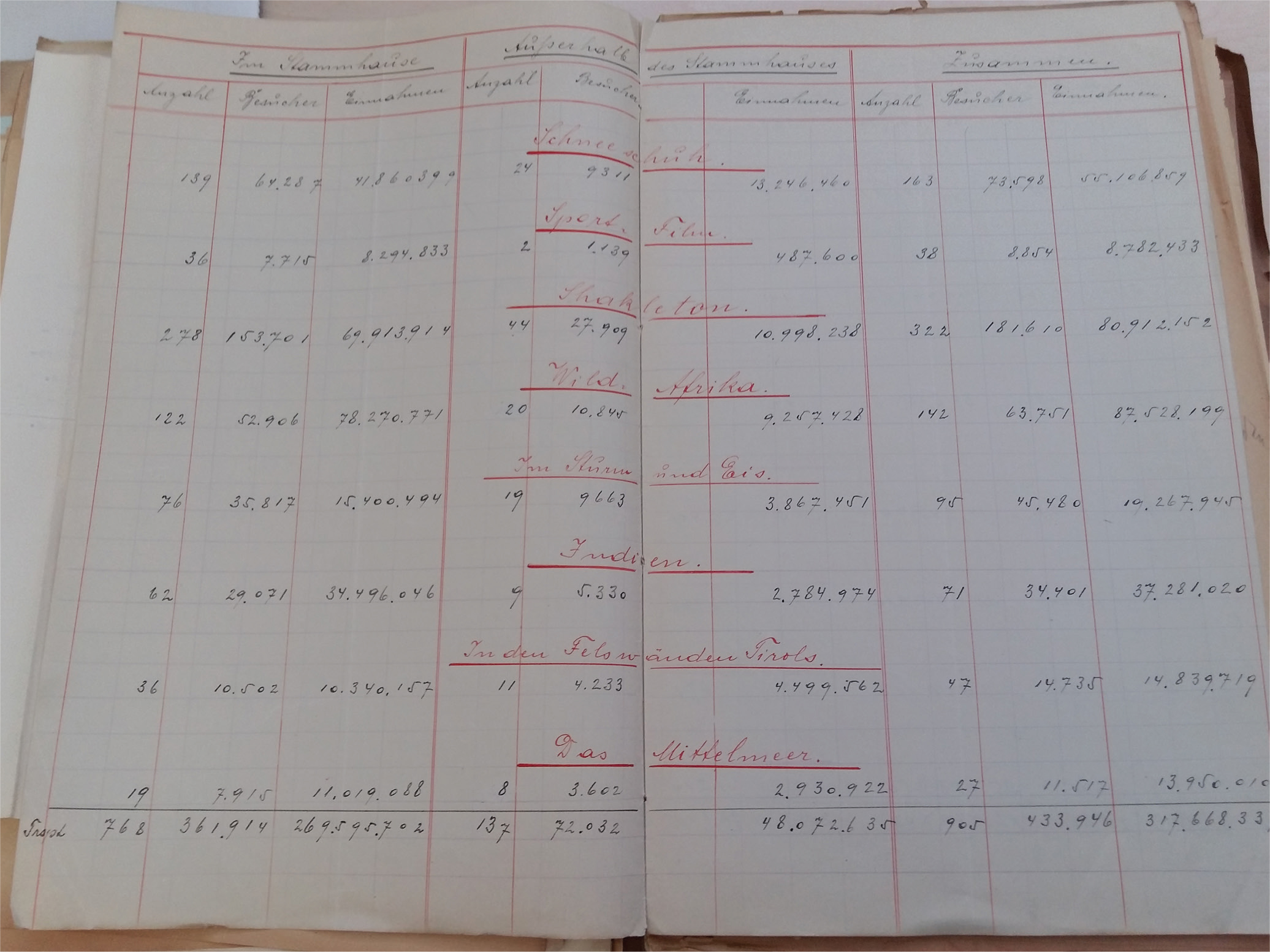
Figure 1
The listing “Uraniafilme vom Februar 1921–29. Februar 1924” (Urania-films 1921–1924) gives an overview of topics and their popularity. Source: ÖVA/Austrian Archives for Adult Education.
‘Almost educational images’21: the Urania version of Im Kampf mit dem Berge
Apart from a minimal frame story at the beginning, this film focuses exclusively on a mountain tour through the snow: the ascent of the Lyskamm in the Matterhorn-Monte Rosa region. This was not Fanck’s first cinematic excursion into the region; with Sepp Allgeier he had already produced a short film about the ascent of the Monte Rosa Mountain in 1913: 4628 Meter hoch auf Skiern. Besteigung des Monte Rosa (4628 Meters on Skis. Climbing Monte Rosa). So when the two shot Im Kampf mit dem Berge in October 1920, they not only knew the terrain, but had already tested its cinematic staging. Fanck and Allgeier are among the most important figures in mountain film. Fanck essentially established the genre and introduced its most prominent protagonists, actors-directors Luis Trenker and Leni Riefenstahl as well as the main cameramen, who were trained by Allgeier, whose style became known as Freiburger Schule. Besides cinematographer Allgeier and Fanck, who directed, produced and filmed certain parts, the small team consisted of the two protagonists ‘portrayed’ by Ilse Rhode, a mountaineer and friend of Fanck, and Hannes Schneider. He was a well-known skier and ski instructor, who had developed a modern style of skiing, the Arlberg technique, about which some (semi-)educational films were made.22
Schneider, Fanck, and Allgeier also pursued the popularisation of this new and more dynamic alpine skiing technique, characterised by speed, combining it with an educational impetus. In 1925 they published the book Wunder des Schneeschuhs. Ein System des richtigen Skilaufes und seine Anwendung im alpinen Geländelauf (The Wonders of Ski-ing. A Method of Correct Ski-ing and Its Applications to Alpine Running) (figure 2), which influenced ski pedagogy internationally for decades. Composed as a visual manual, it combines written explanations, motion graphics, 242 individual frames, and 1,100 image sequences from the second Schneeschuh film Die weiße Kunst (1924; The White Art) that illustrate minute technical manoeuvres—thus, here too, film in the form of still images became a teaching aid.23
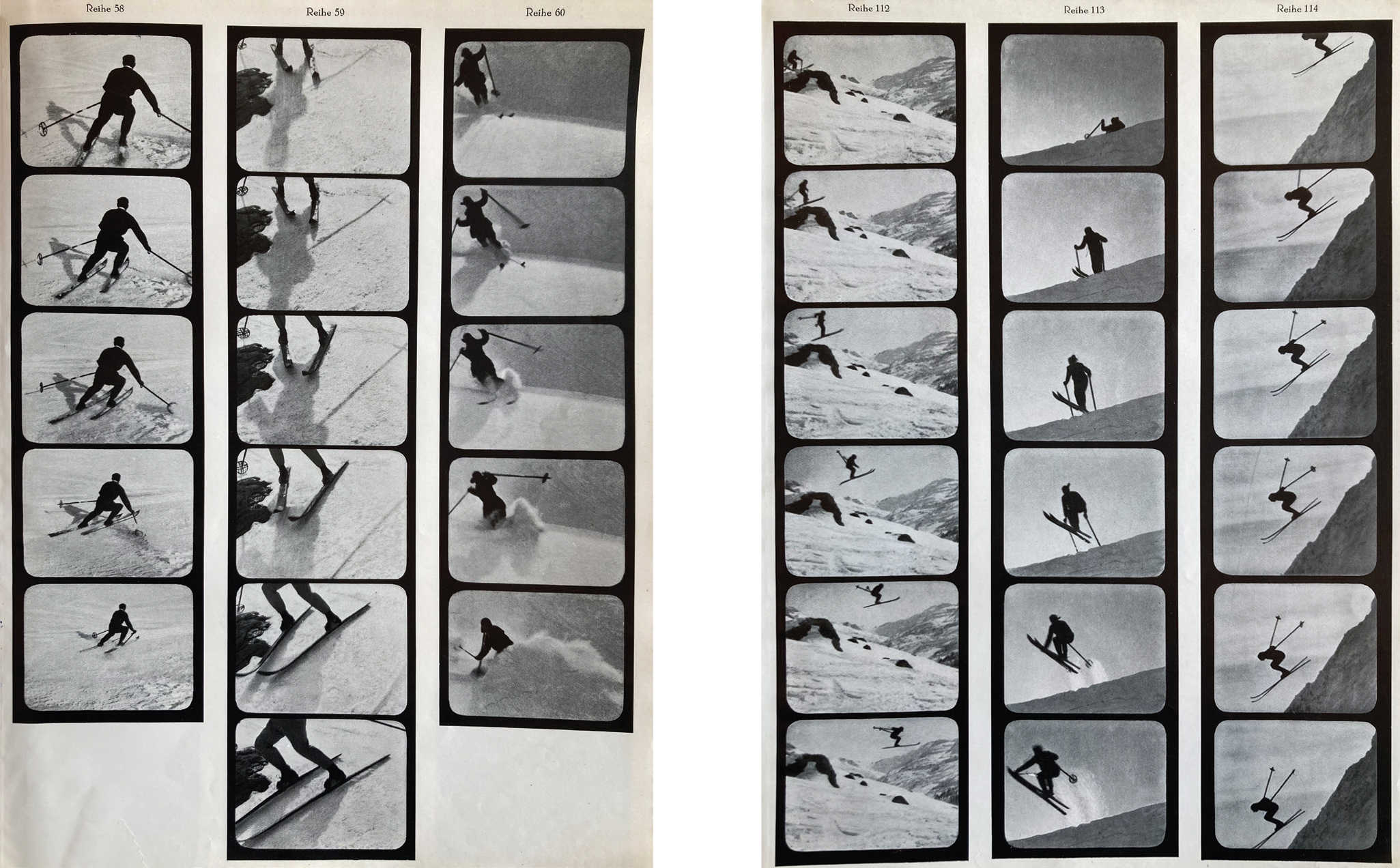
Figure 2
Image sequences from the film in the manual “Wunder des Schneeschuhs” depicting various skiing techniques. Source: Arnold Fanck and Hannes Schneider, Wunder des Schneeschuhs (Hamburg: Gebrüder Enoch Verlag, 1925).
Short films had been part of the Urania lectures since around 1900. But beginning with Fanck’s Das Wunder des Schneeschuhs in February 1921 it was the film and no longer the lecture that became the centre of attention—hence the name Urania-Filme mit volkstümlicher Erläuterung.24 The majority were feature-length Kulturfilme, many of them international productions that could be read about in the media and were prominently promoted in the Urania announcements. Im Kampf mit dem Berge, the third programme in this series, premiered on November 5, 1921 and was shown several times a week in the following years at 5pm, Urania’s main slot for cultural films; the screenings for pupils took place earlier in the afternoon. Over the next years the film was programmed frequently in popular education contexts in Vienna as well as in other Austrian cities, mostly in local Urania branches, but also in alpine clubs or (social democratic) cultural programmes. This is not only indicative of the popularity of mountaineering across class and political divides, but also of the reach of Urania’s distribution system. It provided educational institutions as well as cultural, sporting and political associations with films, slides and lectures, and, when needed, projection equipment, lecturers and projectionists.25
Sources and practices: edutainment through multimedia packages
The editing of the purchased films into Urania Kulturfilme by ‘specialists and popular educators according to scientific and popular educational principles’ meant that they were given new intertitles and that often sequences were deleted or re-edited.26 In the 1920s it was common practice in the Urania to cut the film into individual parts and combine them with an illustrated lecture which became possible with the development of projectors with a device to arrest a film in mid-projection. This combination was considered educational; the audience was thus to be ‘refined’ and educated to become responsible media users in the spirit of cinema reform.27 A screening lasted about 100 minutes and in Im Kampf mit dem Berge it consisted of the lecture, 27 ‘films’ and 59 slides.28 The slides either were provided by the film companies or came from Urania’s archive. Theodor Heinrich Mayer, author of mountain novels, many Urania lecture texts and busy lecturer still in the mid-1930s, wrote the lecture; Urania’s cultural director Karl Jäger took over the direction, at least for the premiere.29
The film prints are considered lost (the Urania film archive burned down during World War II), but the Urania archive still holds 36 slides and three manuscripts of the film lecture Im Kampf mit dem Berge. In Sturm und Eis, one of which is an adaptation for children/pupils. The slides, and above all the manuscripts, are important sources for the practice of media education. They provide information about the educational dispositif of the Urania-Film programme (figure 3): on the interplay of text, slides, and film; on the similarities and differences concerning topics and structure in the programmes for adults and children; on the adjustments made over time, or on audience assessment. Remarks in the manuscripts specify the music to be played by the Urania orchestra (excerpts of mostly contemporary and romantic operas)30, the order of the slides, and notes on intonation or speaking tempo (such as ‘without music, speak slowly to [the film]’), which indicates that the text was intended to be recited in exactly this variant. Handwritten notes by lecturers give information about the film’s content, about corrections, cuts, or alternative terminology for the afternoon programmes.31
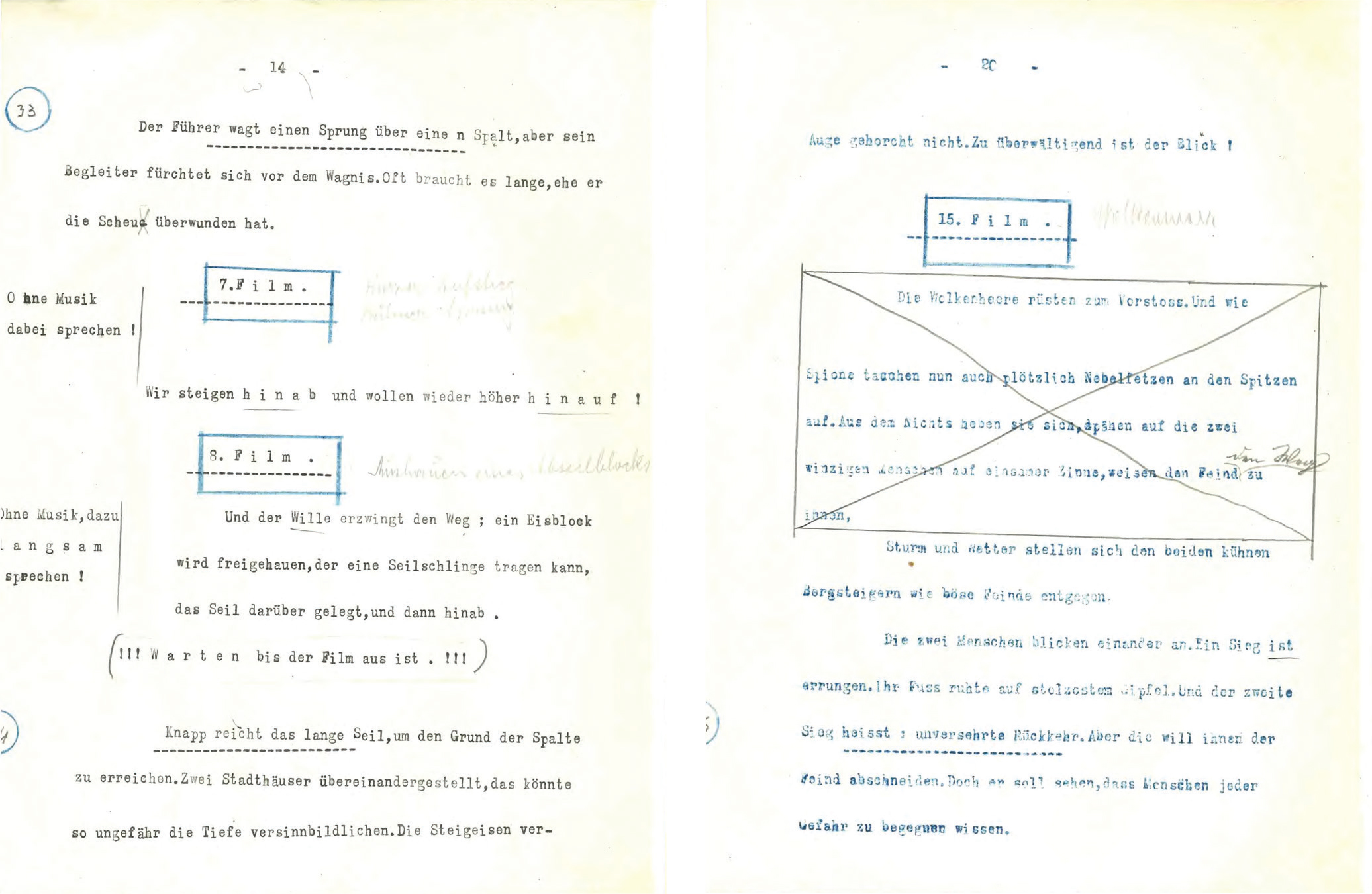
Figure 3
Pages from the manuscript for children/pupil screenings. Source: ÖVA/Austrian Archives for Adult Education.
In the 1920s educators not only discussed whether film would limit or even displace lecturers or teachers, they also debated the pros and cons of providing lecture texts for popular education programmes versus offering short notes with guiding themes, information material on the respective topic, and titles for the slides. In a survey among public educators in the Austrian provinces at the beginning of the 1920s, arguments against prefabricated texts ranged from eliminating the lecturer’s personality to the scepticism that lecturers could not answer questions or lead a discussion when they just read the text without knowing anything about the subject. Proponents of pre-written texts claimed that they would save time in preparation and reduce knowledge barriers, arguments that are still sometimes used in educational contexts today.32 Nevertheless, in the film programmes, instead of associations or improvisations, a ‘synchronization’ between film and text was desired.
In the Schülerexemplar, the script for children, some sentences were simplified, or short explanations inserted; certain terms were deleted, such as the social Darwinist Auslese (selection)—less a political decision than an adjustment to a younger, less knowledgeable audience—and surprisingly, mentions of dangers and factual knowledge such as the explanation of weather phenomena, which could provide education in a stricter sense. Thus, structure and content of the programmes for adults and children were largely identical, as well as the films and slides.33 The audience seemed to have little influence on the text/lecture. Only if the afternoon programmes were attended by school-classes with their teachers, the educational practice changed more fundamentally, as the films were prepared before the film-lecture and afterwards integrated into the lessons—at least this is how the media educators indented it.34
Insert: pedagogics of war?
In the first part of the lecture—both in the adult programmes and in the afternoons—the audiences were given a contextualisation to prepare them for the film(s): a brief history of the changing conceptions of the Alps, modern alpinism and the (positive) effects of the infrastructural developments; the Alps were interpreted as a place of longing and the last challenge of the modern man and—with regard to the film’s female protagonist—the modern woman. And while those who wished to reserve the mountains for the most knowledgeable mountaineers only were criticised as elitist, the fit, athletic (male) body was emphasised as a prerequisite for conquering the steepest sections. Then, as the last slides lead to the film’s location the lecture segues to the film programme. However, before the first film started suspense was built up by means of superlatives and an ‘Ubermensch rhetoric’:
It is perhaps the proudest word coined: “where there is a will, there is a way.” There is no more apt expression for the power of man. And the most obvious, most convincing parable of this we shall now experience in the film; where even the genius of the technician fails, where he cannot clear a path with all his machines, because he cannot find a foothold in snow and ice, the will of man does not retreat. With a few simple tools, with crampons on their feet, with ice axe and rope he conquers the smoothest ice walls, often the most gruesome ice crevasses. The iron strength, the steel nerves of his body accomplish the impossible.35
And the Urania’s announcements for the film stated: ‘Only steely will, spirit, and experience, the well-trained strength of the body and the loyalty of the companions are able to overcome the thousand fold dangers that threaten at every turn.’36 Following current discourses, the ascent was interpreted as a battle against the mountain, won by the best and fiercest. In this respect, Wilfried Wilms’ interpretation of mountain films as ‘vehicles of aesthetic and discursive strategies of recovery aimed at individual, (mass) society, and the German nation as a whole’37 agrees with Urania’s educational concept. This also applies to Christian Rapp’s observation regarding media strategies in early 1920s Austria. According to him the majority of the media suggested that Austrian soldiers had been particularly brave in mountain fighting during World War I and presented the Mountain War as a heroic and sporting achievement: ‘The emphasis on alpine practices and on a mountaineering mentality transformed the anonymous soldier into the adventurer who did not need to be disciplined for this war, because he had internalised his goals.’38
The adaptation of a challenging mountain tour in the Swiss Alps, with no topical references for entertaining popular education programmes was not intended to make audiences forget the lost war. Instead, the programme suggested a ‘refocusing’, following mainstream media discourses as well as an idea of popular education that increasingly prevailed from 1920 on, which aimed at cognitive and emotional education but at the same time became more and more nationalistic.39
Goals of popular film education and the qualities of film
The afternoon programmes for children were aimed both at school classes (and their teachers) and at children who attended in their free time, alone, with friends or parents. In this respect, the film-lectures could be entertaining popular education as well as part of the school education. Accordingly, Adolf Hübl, head of Urania’s film programme and director Ludwig Kössler propagated the ‘popular entertainment films (Urania films)’: ‘Their occasional screening can be described as a valuable educational supplement to school lessons (…) and certainly provides rich material that can be used in the lessons themselves.’40 The Urania films were thus not presented as educational films in the narrower sense, as part of the curriculum, but as an (entertaining) complement: teachers should integrate them into their lessons to make them livelier or more true-to-life.41
Urania’s film education programme wanted to make use of the quality of the liveliness and the vividness of film, its power to stimulate the imagination, and to train attention and associative thinking that media educators and educational film activists attributed to the medium.42 Its ability to show and bring the world into the lecture hall or classroom was not only emphasised by media educators or the Urania-Verlautbarungen. Several newspaper reviews of Im Kampf mit dem Berge, too, credited educational value for different groups the ‘masses’, ‘interested ones’ and ‘specialists’.43 The Neue Wiener Abendblatt for instance praised the film for showing mountaineering techniques hardly known in Austria ‘in individual film images so instructive that one could almost call them alpine educational images’, if the images and lighting effects were not so ‘artistically outstanding’.44 The review thus expressed the widespread perception of educational films as aesthetically deficient. Other reviewers were sceptical and criticised the use of alpine equipment.45 This is precisely a characteristic that, according to the various actors, the Urania film lectures corrected. The assessment that Fanck’s film was full of exaggerations and false depictions was countered as follows:
The management of the Vienna Urania (…) requests to inform the readers that the technical inaccuracies and claptrap that have been criticised will be relegated to the background and will be restored to the correct standard by the explanations in the accompanying lecture.46
From a pedagogical point of view, the screening practices followed the widespread conviction that film itself was not a reliable teaching tool and the lecture should counterbalance the medium’s weakness: ‘[T]he fleetingness of impression inherent in [film] can be remedied by the addition of explanations and still images, thus preparing and deepening the understanding of what is shown.’47 Yet, it seems the assurance that the lecture would compensate for the failings was not fulfilled. The restored print suggests that the words spoken between the films were largely identical to the deleted intertitles and either anticipated what was to come or summarised what had been shown in a descriptive, explanatory, or commentary manner. The slides which consisted of film stills repeated and highlighted spectacular views or the protagonists’ skills (figure 4); so did the lecture, but it refrained from providing more detail. The historical contextualisation in the introduction, which was read before the projection of the film began, reveals an understanding of education that accepts popular culture in an educational framework only when it is linked to elements of a classical-traditional educational canon.
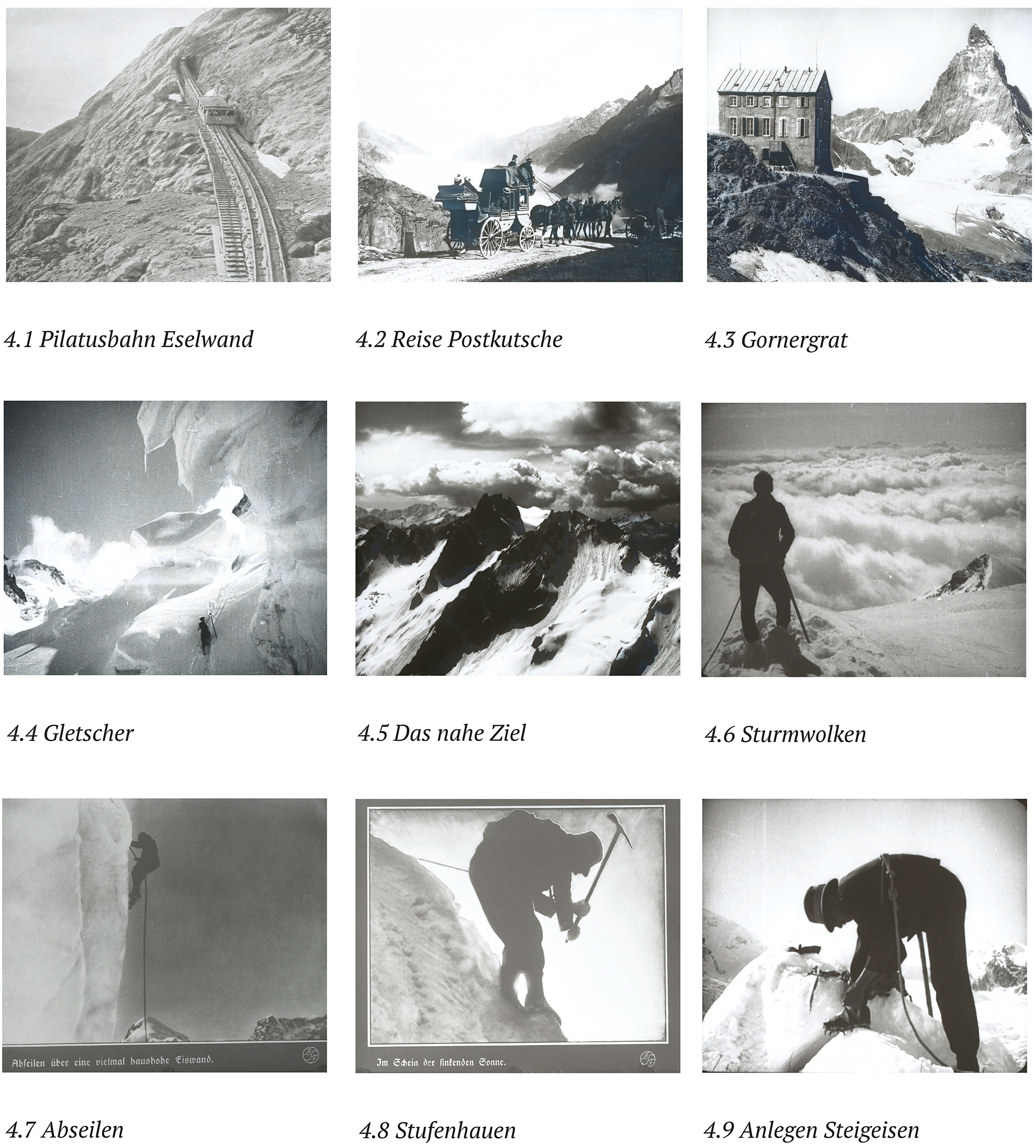
Figure 4
Slides from the film lecture “Im Kampf mit dem Berge”: 1-3 are part of the introduction and visualise the historical framing; 3 depicts the Matterhorn and was projected before the film started. The others are film images showing spectacular views that became iconic for the genre (especially the clouds; 4-6), or they are ‘instructional’ depicting abseiling (7) and the use of crampons and stomping ice steps from a medium-closeup (8-9). Source: ÖVA/Austrian Archives for Adult Education.
On the one hand, the version of Fanck’s film produced by the Urania used aesthetics and spectacle for didactic purposes (figure 4), while on the other hand it was precisely the unrealistic nature of the spectacular, heroic images that was to be contained and domesticated by the multimedia lecture. The performance practice of Im Kampf mit dem Berge was thus not without contradictions.
Mit Steigeisen und Eispickel: amateur film as educational film
About ten years later, on January 4, 1935, the Vienna Urania programmed a climbing film shot in the Großglockner area, Austria’s highest peak: Mit Steigeisen und Eispickel48 (figure 5). Although it was also shown in the form of a lecture, the dispositif, the constellation of its elements had changed since the early 1920s. The film was shot on 16mm and was produced by amateurs, all avid climbers, and introduced by one of them. After its premiere in Urania’s small lecture room, it was subsequently programmed a few times in public education institutions as well as in the Austrian Alpine Club.49
Figure 5
Sequence from the second part of “Mit Steigeisen und Eispickel”: Ice Climbing explained through text, drawing and moving images. The film combines different methods to teach new techniques. Source: Austrian Film Museum.
The surviving version consists of three parts: Its narrative of the arrival and ascent of three alpinists at the foot of the Großglockner in the first part offers images that were familiar in the mid 1930s and served to frame and situate the film. The Großglockner Hochalpenstraße was only opened in 1935—from the beginning, this prestige project of the austrofascist government, meant to reduce the huge unemployment, was intended for tourism and leisure activities (e.g. automobilism) and frequent subject of advertising and amateur films as well as a topic in public education.50 The camera applies a tourist gaze focusing on the brand new street, that is mostly shown from high angles and from the car’s point of view. This is followed by several somewhat shaky pans of the mountain scenery and an ‘easy mountain tour’, according to the intertitle. Typical practices of amateur filmmakers are used, and structure and film language correspond to recommendations in publications such as The Film Amateur in the High Mountains e.g. certain camera angles for staging the demonstrated techniques or ideal filters for filming snow.51 The first part is above all expression and evidence of popular leisure activities of urbanites. It also provides the context and is a prelude for the actual topic depicted in the second part. Titled Ice Climbing, it demonstrates the then quite new technique of crampons and ice pitons, requirements for the high mountain tour shown in the last section. The instructional sequences were probably the reason why the film received the first prize at the International Sports Film Congress in Barcelona in 1934.52
The new climbing techniques are shown and taught according to the principle of progression: from the familiar and simple to the new and challenging, such as from the easier snow slope to climbing an overhang covered in ice. The spectators are first reminded of the old technique of stopping steps with an ice axe, which can also be seen in Fanck’s film. Then, individual elements of the new techniques, for example rope technique, are illustrated. Here, the film combines typical elements of educational films: several times the repetition of movements from varying distances and different perspectives is chosen as a means of instruction; the camera also shows in closeups grips or the correct usage of climbing gear as well as movements or postural changes from high and low angle perspectives. Furthermore, the film clearly separates the learning units by a combination of different cultural techniques: the sequence reading, showing, demonstrating by means of intertitles, instructional sketches (similar to manuals), and moving images is reminiscent of pedagogical concepts that take different learning types into account.
The intertitles give information on the routes, the mountain peaks, and as in many ambitious amateur films the graphic design tries to evoke what is soon to be shown, e.g. by using a triangular shape for ascent and descent.53 They address the audience directly, using many technical terms. Nevertheless, they are often too long and can only be absorbed with difficulty. This corresponds to what media scholar Klaus Kreimeier states about intertitles in cultural films of the 1920s, which he interprets as a pseudo-pedagogic and authoritarian attitude: ‘The spectator has “much to read”, and the reader in the cinema is incessantly beset by the “Remember!” that the blackboard and the teacher’s pointer have already burnt into his soul.’54 The frequent use of climbing terms as well as the focus on techniques instead of spectacular views suggest that Mit Steigeisen und Eispickel was aimed primarily at quite experienced climbers.
Several times they are addressed as ‘the modern ice-man’, relating to recent developments: modern or technical climbing refers to climbers who use tools such as pitons or carabiners as opposed to the so-called traditionalists or purists. Technical climbing became more and more popular from the 1920s onwards, especially among the younger generation and in the Eastern Alps. According to historian Kerwin Klein, it democratised climbing, meaning it allowed a ‘less elitist, less martial, and more accessible approach to the mountains’55 and was therefore increasingly practised by urban working-class people. This is also mentioned in the daily newspaper Der Wiener Tag: ‘Alpinism today is no longer the privilege of the wealthy classes, but a sport deeply rooted in the broad masses of the people.’ Karl Kinzl who is one of the protagonists in Mit Steigeisen und Eispickel demonstrates climbing techniques in the article. Characterised as a ‘shy, young worker’ he embodies the popularisation of climbing among the classes.56 He was a member of the Alpinists’ Guild of the Naturfreunde, for which he gave climbing courses and lectures and from the end of the 1920s he achieved several first ascents, repeatedly with climbing partners who also featured in his films.57 Although not mentioned in the credits as director but as one of the climbers, Kinzl was nevertheless the one who presented Mit Steigeisen und Eispickel; similar to the Urania films with popular explanation sometimes in combination with slides. He did the same with other (instructional) films about skiing and climbing that he produced throughout the 1930s, some of them sponsored by companies and featured in the media.58
Since Fanck’s Im Kampf mit dem Berge, not only new techniques and tools had been popularised that allowed increasingly difficult routes. The release of Mit Steigeisen und Eispickel took also place at a time when several teams of alpinists were setting out to climb the so-called three last great problems of the Alps (the North Faces of the Matterhorn, Grand Jorasses, and Eiger)59 with modern techniques and equipment, popularising mountain climbing even more. That climbing established itself as a modern sport and leisure practice by the mid-1930s is also evidenced by periodicals that targeted not just athletes but a broad audience, such as the daily Der Abend, the culture-cum-lifestyle magazines Die Bühne and Moderne Welt or the Swiss SBB Revue CFF (figures 6 and 7).60 They presented climbing as a challenging, urban sport for the physically fit and courageous, practised in climbing schools near the cities as preparation for the mountain, but also as an end in itself; as a sport in which the knowledge of modern techniques and the correct handling of equipment, especially the process of climbing itself became equally important to ‘the summit’. The Swiss magazine went the furthest in disenchanting the Alps by calling them a ‘playground’.
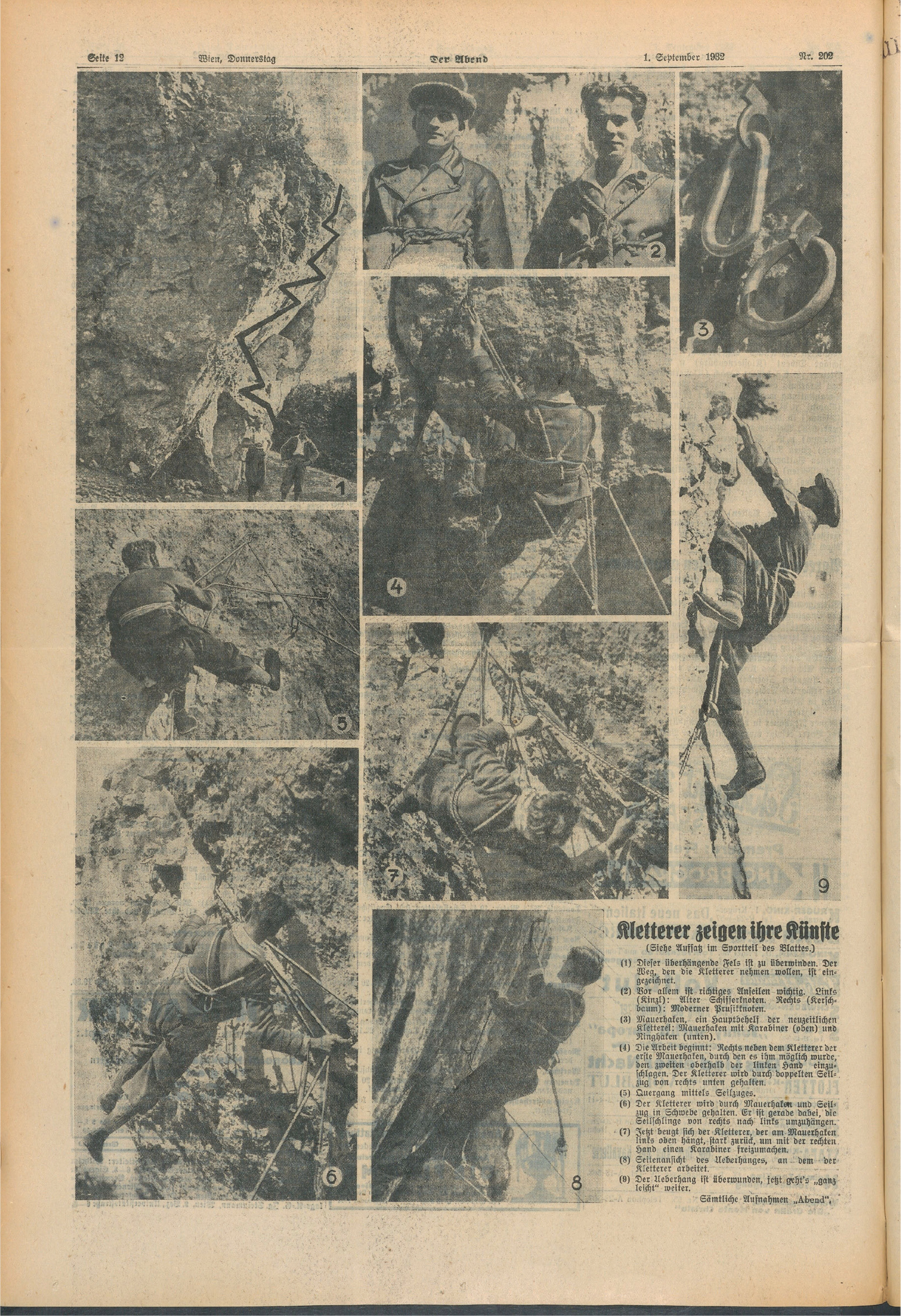
Figure 6
Karl Kinzl is one of the climbers who demonstrate modern climbing in “Der Abend”. The photographs are instructive and resemble illustrations in sports manuals; as in “Mit Steigeisen und Eispickel” techniques are portrayed in detail and explained using technical terms, meaning a certain knowledge was assumed. Source: Anno/Austrian National Library.
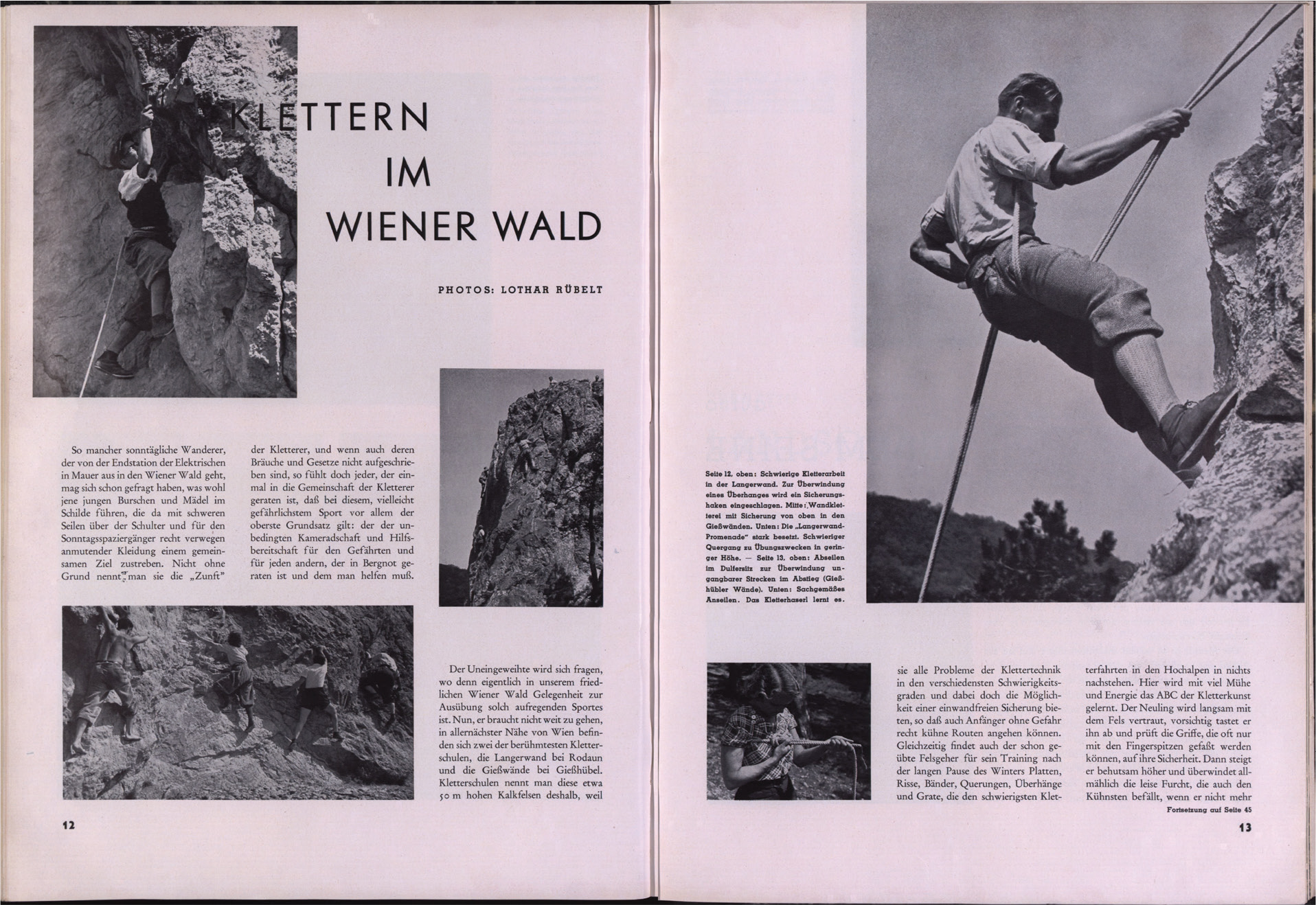
Figure 7
Die “Moderne Welt” visually presents climbing as a trend-sport for the young, fit and urban. The text still speaks of a ‘battle against the mountains’, here already congealed into a cliché. Source: Anno/Austrian National Library.
In the 1930s the heroic view of the Alps had by no means disappeared, but it was one aspect among several: newspapers, magazines as well as films like Mit Steigeisen und Eispickel presented a modern perspective on mountaineering as a popular sport like rowing or skiing, practised on the weekends by young urban men and women. Despite the popularity of climbing in the 1930s, this film was a niche programme at Urania. Firstly, because it was a low budget amateur film; secondly and even more so, because it focused on teaching techniques aimed mainly at specialists, rather than depicting panoramic views, dangers or challenges. References to the latter can be found in the reviews, the film’s images and titles were far more restrained. The lecture has not been preserved, but from the media reviews it is possible to reconstruct to some extent what Kinzl might have said. He not only explained the climbing techniques presented in the film through letters (intertitles), illustrations (sketches) and moving images, adding the spoken word as a fourth didactic means; he also embedded the film in his alpine activities and talked about his mountain and ski tours. Hence his experiences served as contextualisation and were an important part of the programme’s dispositif.61 What was actually not considered necessary anymore in the mid-1930s was a cultural-historical contextualisation as in the lecture Im Kampf mit dem Berge. The frequent use of climbing terms, the sketches, the focus on techniques instead of spectacular views (probably also because it is an amateur film) make it conceivable that Mit Steigeisen und Eispickel was both screened in public education and used as a teaching tool in climbing courses.
From the ‘edutaining’ illustrated lecture to small gauge instruction resembling classroom films
Im Kampf mit dem Berge and Mit Steigeisen und Eispickel are exemplary of the diversity of film education at the Vienna Urania in the interwar years, ranging from popular feature-length (Urania-)Kulturfilme screened in the large hall, with a capacity of 600 people, that aimed at interested adults and children as well as school classes with their teachers, to amateur films mostly for small groups of specialists.
The differences in the performance practice of the two films result both from the temporal context and the changing perspectives on the medium film, technological developments (such as small-gauge film), the type of film (Urania cultural film, amateur film) as well as the intended audience, the producers, and their goals. The practice of cutting-up films into smaller portions and embedding them in a lecture with slides interrupted the cinematic flow. This ended with the introduction of sound when feature-length films were shown in their entirety, so as not to destroy their dramaturgy. The lecture turned into an introductory contextualisation and became (even) less important than at the beginning of the 1920s when the Urania-Filme mit volkstümlicher Erläuterung were launched. In his 1922 systematisation of the cultural and educational film, Edgar Beyfuß categorised cultural films such as Im Kampf mit dem Berge as ‘semi-scientific films’.62 And Fanck’s film was credited some educational aspects: the rendering of ice work, for example, was acknowledged as vivid and instructive in several reviews. However, often the instructional elements of mountain film were emphasised mainly to increase their acceptance and reputation.
Mit Steigeisen und Eispickel produced 15 years later was either shown as one film, divided into three parts, or understood as three individual films as announcements in the papers show.63 It is possible that the film was shot on three reels, since in amateur practice one reel often formed a dramaturgical unit. The introduction of small-gauge film around 1930 not only changed the practice of film education, for instance by allowing to show films in the classroom. Small-gauge film also facilitated amateur film productions and changed the possibilities of filming: e.g., it made detailed shots of the techniques of ice climbing easier or allowed closeups on hand movements and increased the vividness of what was shown. Fanck’s film, by contrast, mostly stays away from the protagonists but focuses on impressive panoramas. Moreover, the screening of parts of Mit Steigeisen and Eispickel (e.g. the second, instructional one at the Alpine Club), the combination with slides and comments followed a different logic than in the Urania-Kulturfilm from the early 1920s. The middle part of the amateur climbing film with its combination of intertitles describing in detail what follows, closeups and visual repetition of techniques as well as embedded sketches clearly corresponds to definitions of educational and instructional film in the narrower sense at that time. It also functioned without additional explanations. Kinzl’s role as lecturer lay more in the fact that he was part of the film and could talk about shooting conditions or his own experiences as a climber, etc. in the sense of a Q and As.
Here, the media combination of film, lecture and (presumably) slides, unlike in the Urania films with popular explanations, such as Im Kampf mit dem Berge, was not aimed at spectacle and evoking emotions and certain moods (albeit ‘tamed’ by the lecture). Rather, the focus was on the comprehensibility of learnable behaviour and concrete instructions, on techniques, procedures, and processes. The amateur film Mit Steigeisen und Eispickel, which offered less spectacular images due to the production conditions, was-in contrast to the cultural films of the 1930s-silent and committed to a functional aesthetic. It represents the main ‘venues’ of the educational film lecture in the 1930s: specialised, non-theatrical spaces such as classrooms, the Alpine Club or small lecture halls in popular education institutions.
Since one of the most important qualities attributed to film was its ability to show what could not be experienced by most of the people it was no coincidence that mountain and climbing films were prominently represented in the Urania. The appeal was by no means only due to the fascination with the unattainable but related to actual modern practices: to the fact that despite nationalist claims and heroism, climbing was a popular modern sport for all classes and genders in the 1920s and 30s. Not only the evidently educational amateur climbing film but also Fanck’s mountain film which clearly focused on the spectacular aspects of a mountain tour was part of this development.
Acknowledgements
The research in this article was funded by the Austrian Science Fund (FWF) P 32343-G (Educational Film Practice in Austria).
Notes
[1] N.N., “Der Kampf mit dem Berge,” Der Schnee. Wochenschrift des Alpen-Skivereines, no. 3 (1922): 14.
[2] Österreichisches Volkshochschularchiv (ÖVA), Verlautbarungen des Volksbildungshauses Wiener Urania, no. 38 (1921), 4.
[3] From the comprehensive writings on film as a teaching tool, see Walter Günther, “Kulturfilm und Jugend,” in Das Kulturfilmbuch, eds. Edgar Beyfuß and Alexander Kossowsky (Berlin: Chryselius&Schulz, 1924), 58.
[5] Founded in 1920 by amateur photographer, geologist, and alpinist Arnold Fanck and Deodatus Tauern, a physician and skier, the company became famous for producing mountain (and sport) films, but also made fairytale and animation films; in 1925 it was bought by Ufa. Klaus Kreimeier, “Naturmagie und Technik-Faszination. Arnold Fancks Berg- und Sportfilmwerkstatt,” in Geschichte des dokumentarischen Films in Deutschland. Vol. 2: Weimarer Republik (1918–1933), eds. Klaus Kreimeier, Antje Ehmann and Jeanpaul Goergen (Stuttgart: Reclam, 2005), 474–492, https://doi.org/10.25969/mediarep/14036.
[6] The original exhibition print (4 acts, 1,536 m, suitable for youths under 18) as well as the censorship card are considered lost. In 1941 Ufa’s cultural department produced a 20-minute version with a score by Giuseppe Becce. In 2013 a reconstruction of the original film was released. See Projekt Im Kampf mit dem Berge, https://www.murnau-stiftung.de/projekt-im-kampf-mit-dem-berge; for the various prints see: https://www.filmportal.de/en/movie/im-kampf-mit-dem-berge_ea43d4a7481d5006e03053d50b37753d.
[7] See the project’s database Educational Film Practice in Austria, lehrfilmpraktiken.at (to be published in May 2023); for information on the project see https://lehrfilmpraktiken.univie.ac.at/.
[8] On mountain film and Fanck focusing on aesthetics, modernity and the nature/history dualism see Nick Baer, “Natural History: Rethinking the Bergfilm,” in Doch ist das Wirkliche auch vergessen, so ist es darum nicht getilgt. Beiträge zum Werk Siegfried Kracauers, eds. Jörn Ahrens et.al (Wiesbaden: Springer 2017), 279–304, https://dx.doi.org/10.1007/978-3-658-13239-2; Alex Bush, “Moving Mountains: Glacial Contingency and Modernity in the Bergfilm,” Journal of Cinema and Media Studies 59, no. 3 (Fall 2019): 1–22, https://doi.org/10.1353/cj.2019.0064. Concentrating on the connection between filmic representations of the alps, modernity and nature/ecology: Seth Peabody, “Image, Environment, Infrastructure: The Social Ecologies of the Bergfilm,” Humanities 10, no. 38 (2021), https://doi.org/10.3390/h10010038. On Fanck’s cinematography see Katie Bird, “Sporting Sensations: Béla Balázs and the Bergfilm Camera,” Journal of Cinema and Media Studies 60, no. 3 (2021): 9–36, https://doi.org/10.1353/cj.2021.0025.
[9] Eric Rentschler, “Mountains and Modernity: Relocating the Bergfilm,” New German Critique 51 (1990): 137–61; Christian Rapp, Höhenrausch. Der deutsche Bergfilm (Wien: Sonderzahl 1997); Wilfried Wilms, “‘The Essence of the Alpine World Is Struggle’: Strategies of Gesundung in Arnold Fanck’s Early Mountain Films,” in Heights of Reflection Mountains in the German Imagination from the Middle Ages to the Twenty-First Century, eds. Sean Ireton and Caroline Schaumann (Rochester, N.Y.: Camden House, 2012), 267–284. For Arnold Fanck see Kreimeier, “Naturmagie”; Thomas Brandlmeier, “Sinngezeichen und Gedankenbilder: Vier Abschnitte zu Arnold Fanck,” in Berge, Licht und Traum: Dr. Arnold Fanck und der deutsche Bergfilm, eds. Jan-Christopher Horak and Gisela Pichler (München: Bruckmann, 1997), 69–83.
[10] Jean-Louis Baudry, “Das Dispositiv. Metapsychologische Betrachtungen des Realitätseindrucks” (orig. 1975), in Der kinematographische Apparat. Geschichte und Gegenwart einer Debatte, ed. Norbert Riesinger (Münster: Nodus, 2003), 41–62; Frank Kessler, “The Educational Magic Lantern Dispositif,” in A Million Pictures. Magic Lantern Slides in the History of Learning, eds. Sarah Dellmann and Frank Kessler (New Barnet: John Libbey, 2020), 181–191; see also Eef Masson, Watch and Learn. Rhetorical Devices in Classroom Films after 1940 (Amsterdam: Amsterdam University Press, 2012) and this issue’s introduction.
[11] For the shifting conceptions of the Alps see Ireton and Schauermann, eds., Heights of Reflection Mountains in the German Imagination from the Middle Ages to the Twenty-First Century. From the extensive research on Alpinism see for the Western Alps: Fergus Fleming, Killing Dragons. The Conquest of the Alps (New York: Atlantic Monthly Press, 2002); about the Eastern Alps, concentrating on political discourses, tourism, (popular) culture: Tait Keller, Mountaineering and Nation Building in Germany and Austria, 1860–1939 (Chapel Hill: The University of North Carolina Press, 2016). On accessing the Alps through mountaineering, technology, tourism, and popular culture from a cultural anthropology perspective see Bernhard Tschofen, Berg Kultur Moderne. Volkskundliches aus den Alpen (Wien: Sonderzahl, 1999).
[12] Kaspar Maase, Grenzenloses Vergnügen. Der Aufstieg der Massenkultur 1850–1970 (Frankfurt/M.: Fischer, 2007), 64–69, 79–88.
[13] Marie-Noëlle Yazdanpanah, “‘Gut Weekend. Das Wochenende ohne Männer”? Zur Inszenierung von Geschlechterrollen im Magazin Die Bühne,” zeitgeschichte 50, no. 1 (2023).
[14] Christian Rapp, “Schnelle neue Alpen. Schnappschüsse der Moderne aus Österreichs Bergen,” in Kampf um die Stadt. Politik, Kunst und Alltag um 1930, ed. Wolfgang Kos (Wien: Czernin 2010), 122–123.
[15] Christian Stifter, “‘Film als verfeinertes Kunstwerk’. Entwicklung und Verbreitung des Kulturfilms durch Volkshochschulen in Österreich,” Spurensuche 15, no. 1–4 (2004): 69–81, specially 72.
[16] The weekly Verlautbarungen des Volksbildungshauses der Wiener Urania list the programmes from 1909 on.
[17] Herbert Spaich, “Bergwanderungen. Film, Mensch, Gebirge,” 110, quoted from Kreimeier, “Naturmagie,” 478.
[20] Uraniafilme vom Februar 1921 – 29. Februar 1924, ÖVA, Urania Wien fonds, folder “Abteilung für Filme und Auswärtiges”. The next page lists more films about mountains: In den Felswänden Tirols, König Dachstein and Mount Everest.
[22] Hannes Schneider lehrt Skilaufen/A Highschool of Ski-ing (Max Zehenthofer, AT 1934) produced for foreign markets to increase winter tourism; Hohe Schule am Arlberg (Bruno Lötsch, AT 1950). Both include detailed depictions of this style, with a commentary and slow motion.
[23] One of the international bestselling skiing books until the late 20th century it influenced several mountaineering and skiing filmmakers. Bird, “Sporting Sensations,” 14–15.
[24] Verlautbarungen des Volksbildungshauses Wiener Urania, no. 37 (1921): 7. See Christian Stifter, “Die Erziehung des Kinos und die ‘Mission des »Kulturfilms«’. Zur sozialen Organisation des »Guten Geschmacks« in der frühen Volksbildung und Kinoreform in Wien, 1898–1930”, Spurensuche 8, no. 3–4 (1997): 54–79; Katrin Pilz, “Aufklärungs-, Lehr oder Bildungsfilm”, Spurensuche 27 (2018), 45–59, specially: 50–53.
[25] Eduard Golias, Entwurf eines Prospekts: Film und Lichtbild im Dienste der Volksbildung, 23.4.1923, ÖVA, B-Urania Wien, folder “Uraniafilm Broschüren”.
[26] Gustav Adolf Witt, Lichtbild und Lehrfilm in Österreich (Wien: Österreichischer Bundesverlag, 1927), 78–79.
[27] The Kinoreformtagung, held in the Vienna Urania in 1924 wanted to exchange experiences between Austrian and German educational film and cinema reform movements. See the special issue “Die Kinoreform-Tagung in Wien” Volksbildung 5, no. 4–5 (1925).
[28] 13/4 hours with a film length of 1,600 metres. 1. Verzeichnis der für das Gebiet der Republik Österreichs verleihbaren Filme vom September 1924, 6, ÖVA, B-VHS Urania Wien 26/1. A list from 1927 mentions 1,400 metres including lectures and slides; Lehr- und Kulturfilm-Archiv des Volksbildunghauses Wiener Urania (Wien, 1927), 6, ÖVA, B.VHS Urania Wien 26/1.
[30] ÖVA, 634, “Sturm und Eis. Hausexemplar,” B-VID Skio-Urania / Dok 170. The original music composed by Paul Hindemith was neither played at the Berlin premiere nor in the Urania. In 2013 the score was integrated into the restored film, for whose reconstruction it was central. See https://www.murnau-stiftung.de/projekt-im-kampf-mit-dem-berge.
[31] These notes were expressly forbidden as can be read on the first page of the in-house copy. ÖVA, 634 “Sturm und Eis. Hausexemplar,” B-VID Skio-Urania / Dok 170.
[32] OeStA, AVA Unterricht Allg. (1848–1940), Volksbildung Lichtbildwesen 1920–1925, Sig. 2D2, K. 503.
[33] This was different for the school version of the Urania-film König Dachstein (1923) created by the Schulkinobund in 1931 where a rearrangement of the slides was suggested for “methodological reasons”. ÖVA, 665 “König Dachstein. Bearbeitet für Schüler von Gustav Greiner,” B-VID Skio-Urania / Dok 182, s.l. The Schulkinobund (1926–1939) was an association of mainly teachers, aiming at the implementation of film as a teaching tool. Founded independently it became tied to the Ministry of Education and closely cooperated with the Urania. The initiative published the media-educational magazine Das Bild im Dienste der Schule und Volksbildung, organised conferences and teacher trainings, produced and lent educational films, explanations, slides. Der Film als Lehrmittel, ed. Film- und Bildseminar des Schulkinobundes (Wien: Verlag für Jugend und Volk, 1928).
[34] Sources are sparse; what has survived are individual contributions by teachers in journals for media education such as Das Bild (Austria) or Der Bildwart (Germany).
[37] He refers to Tony Kaes’ concept study of “Shellshock Cinema” (2009); see Wilms, “Essence of the Alpine World,” 268.
[39] Thomas Dostal, “Volksbildung als Beruf. Zu den Anfängen der Verberuflichung von Volksbildung in der ausgehenden Habsburgermonarchie und am Beginn der Ersten Republik,” Die Österreichische Volkshochschule 67, no. 258 (2016): 44–49, 47.
[40] Ludwig Kössler and Alfred Hübl, “Verehrlicher Lehrkörper,” Beilage zu Verzeichnis verleihbarer Lehr- und Kulturfilme, September 1924, ÖVA, Filmabteilung Verschiedenes.
[41] Heinrich Fuchsig, Rund um den Film. Grundriss einer allgemeinen Filmkunde (Wien/Leipzig: Deutscher Verlag für Jugend und Volk, 1929), 132–133.
[42] Edgar Beyfuß, “Schule und Film,” in Das Kulturfilmbuch, 65–66. See also Ursula von Keitz, “Wissen als Film. Zur Entwicklung des Lehr- und Unterrichtsfilms,” in Geschichte des dokumentarischen Films in Deutschland. Vol. 2, 120–142.
[43] L.S., “Der Kampf mit dem Berge”; Philipp Borchers, “Der Film ‘In Sturm und Eis’ (‘Im Kampf mit dem Berge’ Erster Teil),” Österreichische Touristen-Zeitung 42, no. 9 (1922): 105–107.
[46] N.N., “Der Film ‘In Sturm und Eis’,” Österreichische Touristen-Zeitung, 42, no. 11 (1922): 130.
[48] The title on the surviving copy in the Austrian Filmmuseum is Mit Steigeisen und Eispickel. The Urania announced the film as Mit Pickel und Steigeisen as did most of the newspapers. Sequences missing from the archival copy are mentioned in: N.N., “Mit Pickel und Steigeisen,” Der Wiener Tag, January 6, 1935, 9.
[49] N.N., “Mit Pickel und Steigeisen,” 9; “OeAV-Veranstaltungen in Gablitz,” Der Gebirgsfreund no. 4 (1936): 80.
[50] E.g. the multimedia programme Die Welt der Glocknerstraße with slides, lecture, film, maps and scenic play. ÖVA, Konvolut Glocknerstraße, B-VID Skio-Urania 396.
[52] N.N., “Filmvorführung,” (Wiener) Sport-Tagblatt, December 29, 1934, 4. In 1924, ice pitons were used for (one of) the first time(s) to climb the north-west face of the Wiesbachhorn. Horst Höfler, “Revolution Eistechnik,” Bergsteiger no. 9 (2009), https://bergsteiger.de/bergszene/reportagen/revolution-eistechnik-der-wahre-erfinder-des-eishakens; see also Kerwin Lee Klein, “A Vertical World: The Eastern Alps and Modern Mountaineering,” Journal of Historical Sociology 24, no. 4 (2011): 519–548, specially 540–541, https://doi.org/10.1111/j.1467-6443.2011.01417.x.
[53] Instructions for title design, i.e. Hellmuth Lange, Wie entsteht ein Amateurfilm? (Hackebeil: Berlin, 1930), 26–29.
[54] Klaus Kreimeier, “Komplex-starr. Semiologie des Kulturfilms”, in Geschichte des dokumentarischen Films in Deutschland. Vol. 2, 87–119, specially 89.
[57] In 1938 Kinzl ‘aryanised’ a sports shop in Vienna with the help of a climbing partner. Kinzl’s partner in Mit Steigeisen und Eispickel, Pál Magaziner, who was of Jewish origin, died in April 1945 in a subcamp of Mauthausen whereas the proceedings against Kinzl’s activities during National Socialism were dropped in December 1947. See Marie-Noëlle Yazdanpanah, “Karl Kinzl,” Database “Educational Film Practice in Austria”, lehrfilmpraktiken.at; Gunnar Mertz, “Fritz Kasparek und die Erstbesteigung der Eiger-Nordwand in den österreichischen Erinnerungskulturen,” in Images des Sports in Österreich, eds. Matthias Marschik et.al (Göttingen: V&R unipress, 2018), 253–255.
[59] Until 1938 they were climbed by German and Austrian teams. Klein states that ‘modern alpine technique evolved alongside an increasingly martial and nationalist Rhetoric’ particularly with the ascent of the Eiger Northface in 1938 that was heavily exploited for NS-propaganda. The British then denounced technical climbing as ‘teutonic perversion’, Swiss and French climbers were also skeptical towards pitoncraft. Klein, “Vertical World,” 539.
[60] N.N., “Kletterer zeigen ihre Künste,” Der Abend, September 1, 1932, 9–10, 12; Erwin Czech, “Urlaub am Seil”, Die Bühne 7, no. 281 (1930): 30–31; K. L., “Klettern im Wiener Wald,” Moderne Welt 15, no. 10 (1934): 12–13, 45; H[enry] Hoek, “Klettern”, SBB Revue CFF, no. 7 (1932): 24–25, http://doi.org/10.5169/seals-780380.
Biography
Marie-Noëll Yazdanpanah is a cultural historian. She studied in Vienna and was BTWH/IFK Visiting Scholar at the University of California at Berkeley. Since 2010 research associate at the Ludwig Boltzmann Institute for Digital History in projects that combine research and education (film and urbanism), on Red Vienna, and in the FWF project “Practices of Educational Film in Austria” (2020-2023); also exhibitions and educational projects (e.g. exhibition “Red Vienna”, Wien Museum/MUSA 2019 or at the Austrian Filmmuseum). Currently, she is researching on “Visual Culture and Consumer Culture in the Illustrated Magazine Die Bühne” and on Emancipatory Housing Models in Vienna.