
The answer to the general question, “Are we educating by television?” is a definite “yes” despite much skeptical insistence to the contrary. As an educator, I should be standing before you with my head bowed in shame if the answer were anything else. Educators today have no choice in the matter, and we would be derelict in our duty if we failed to accept our fair share of responsibility to see to it that this newest medium of mass communication is used for something more than entertainment.1
Author of several books on instructional radio and television, and an official at the US Department of Education, Gertrude G. Broderick was an expert of new media and education.2 In the quoted article, published in 1956, she expressed a common view among pedagogues, namely that television henceforth was an inevitable fact of modern life. Consequently, it seemed mandatory for educators, reformers, and financing bodies to embrace its existence and use it for the better good.
Her call followed reform efforts that had promoted instructional film and radio, overhead projectors and slide shows;3 it resonated with similar statements by other experts and school officials promoting television as an instructional tool. In-school educational television (ETV) was in particular hailed for enhancing the quality of teaching (the best teacher of a given field would transmit his teaching to a vast number of pupils) and for reducing costs (only one teacher would be needed to teach a vast number of pupils).4 What is more, according to the many enthusiastic voices such as Broderick’s, ETV promised to attenuate (almost) all problems of the US post-war education system. Multiplying one single teacher’s voice across many classrooms, teaching by television was an answer to overcrowded schools, due to, among others, the baby boom; it would also overcome the shortage of trained teachers (Figure 1).
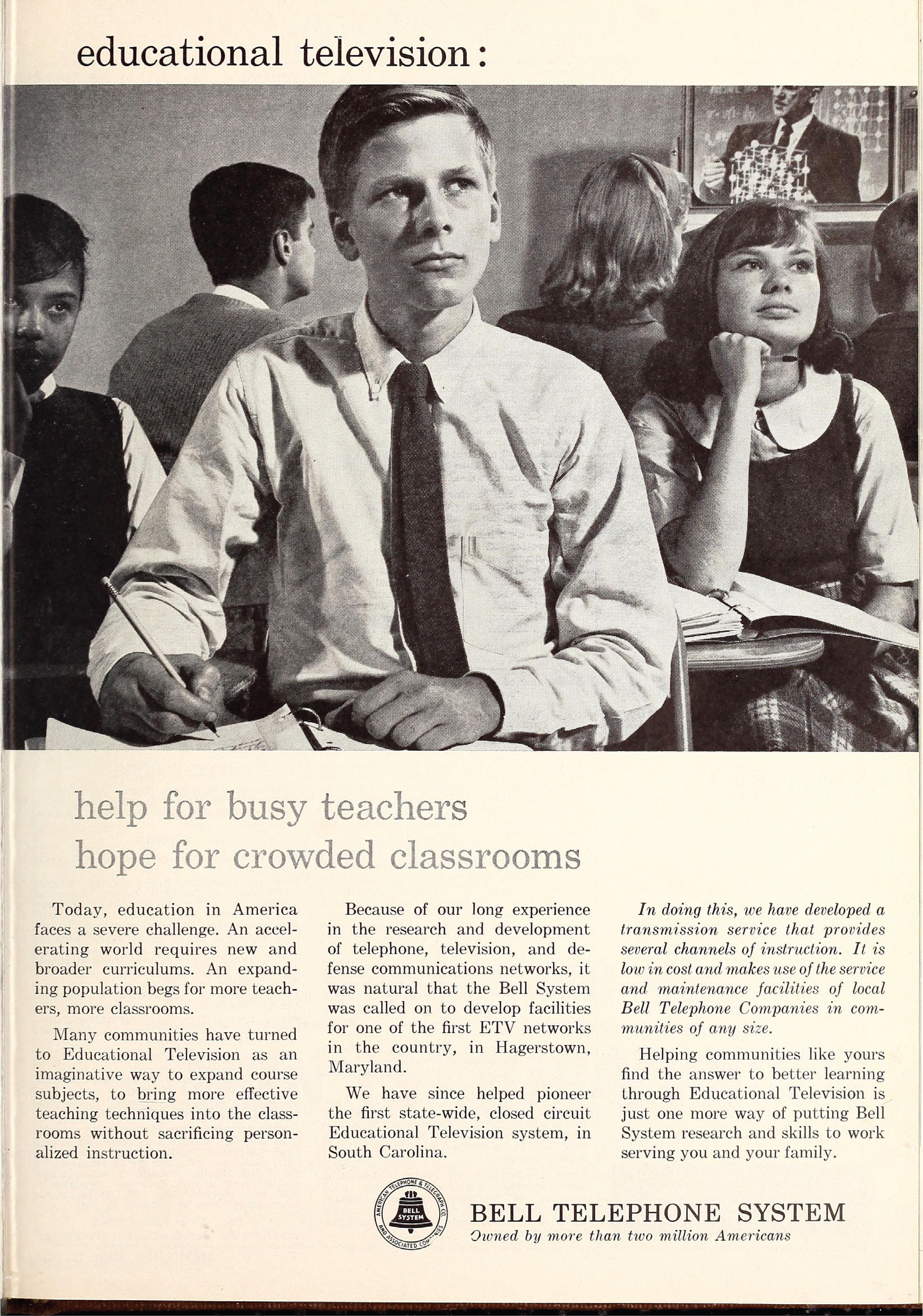
Figure 1
Bell advertisement: ‘educational television: help for busy teachers, hope for crowded classrooms’. Source: Broadcasting Telecasting (Jan-Mar 1963).
Consequently, between the 1950s and the 1970s, the introduction of ETV into classrooms was supported by ongoing experiments regarding the medium’s affordances and technological design: educators and financing bodies tested multiple televisual forms and embraced non-commercial broadcasting, national and regional programming, and even transmissions by planes.
Historians of US media and education have analysed ETV’s development and framed its emergence within the broader context of Cold War policies and technocratic investment.5 They have insisted on the ideological dimensions of television projects,6 and have pointed to the discrepancy between the technophile discourses widely disseminated through publications and pamphlets, and the pedagogical realities on the terrain.7 Focusing on educational television in the USA in the 1950s and 1960s, my paper builds upon this rich body of scholarship, to which it adds an argument regarding one specific educational technology, namely the televisual closed-circuit (CCTV). Appreciated by educators and financing bodies for its low-tech and low-cost nature, the closed-circuit was tested across the country, including in large-scale experiments as in Hagerstown, Maryland, discussed below. While these closed-circuit projects have been widely documented in the post-war period and have received some attention from television and media historians,8 the literature has neglected the closed-circuits widespread use, which included but was not limited to the educational context. In this paper, I suggest a shift in perspective that embeds the educational closed-circuit within a broader history of televisual CCTV. In addition to serving school reforms, post-war CCTV systems were frequently used in military and industrial settings, where they fostered automation, surveillance, and tele-command. The analysis of educational television through the lens of closed-circuits brings to the fore such military-industrial entanglements and their links with the educational sector, and shines a new light on the history of educational TV overall.
More precisely, I unfold my argument in three steps: Introducing a short history of ETV in the USA, the paper’s first part builds upon the notion of audiovisual dispositifs such as used in cinema and media history to analyse the variety of ETV. Together with those television historians, who have highlighted the ‘experimental’9 nature of television and its identity as a medium ‘in constant transformation’,10 my paper emphasises ETV’s fluid assemblages and seeks to analyse the medium’s ‘expanded history’11 that includes but is not limited to broadcasting TV. Stressing the plurality of educational dispositifs, the first part also highlights the closed-circuit’s specificities in comparison to other forms of ETV. The paper’s second part expands upon the closed-circuits’ experiments in schools and embeds the educational infrastructure within CCTV’s broader history. Emerging in parallel to broadcasting television, CCTV was implemented in multiple sectors, from industry to science and medical research; its closed design allowed for almost unlimited flexibility. As I argue, this design and flexibility was linked to CCTV’s origins in military R&D during World War II, when the National Defense Research Committee supported televisual development in relation to its programme for teleguided missiles and drones. Analysed through the lens of CCTV, the history of ETV is thus linked to the military-industrial entanglements forming during the mid-1940s, rather than solely to educational reforms during the Cold War. The third section, finally, suggests understanding this broader history of educational, industrial, or military television as part of the history of useful TV. Instead of serving as information and entertainment, useful TV functioned as a tool for multiple tasks that ranged from targeting and surveillance to research and teaching. Following the work by cinema historians who have unearthed the many non-theatrical uses of film, I argue that useful television as a historiographical category sheds new light on overlooked televisual applications, their affordances, and connections. Moving from ETV to CCTV to useful television, the paper thus proposes an avenue for decentring the educational dispositif—and the medium’s historiography overall.
Short History of ETV in the USA
Very rapidly following the first experiments, US television was envisioned as a commercial broadcasting system (as opposed to the public service institutions in Europe) that left little room for non-commercial, educational programmes.12 As had been the case with radio before, television’s destiny was largely dictated by corporate interests, and in particular the networks NBC, CBS, and later ABC, which received backing from government agencies: interest groups supporting non-commercial media had ‘to squeeze out a space for classroom-instruction and public access educational television in an otherwise commercial environment’.13 In the context of the US broadcasting system, educational TV was thus largely the result of media advocacy for non-commercial stations seeking to offer an alternative to the commercial programmes. While educational programmes were aired already from 1945 onwards via the networks,14 campaigners for ETV celebrated a first major political victory in 1952: the Federal Communications Commission’s Sixth Report and Order allocated 242 channels to non-commercial television. This represented an important acknowledgement for interest groups that had been pushing for such uses, including the Joint Committee on Educational Television (JCET), which had promoted ETV since 1950.15 For the educators united in this umbrella committee— as much as for other campaigners supporting televisual reforms—television promised to bridge social and educational disparities, and aid rural, black, and other underserved communities; for them, the medium possessed a ‘democratic potential’, which translated into potential enlightenment for all.16
More broadly, in the 1950s and 1960s, ETV appeared as the awaited-for solution to Cold War problems (Figure 2). In her analysis of philanthropic and corporate elites appropriating television to govern ‘the people’, Anna McCarthy has highlighted the benefits that private and public actors credited television with in light of (alleged) threats to the American Way of life, its liberalism and individualism.17 The educational sector was deemed crucial for the competitiveness of the USA in an ideological, technological, and economic race among nations, as national education was seemingly lagging behind in comparison with the Soviet Union. Throughout the 1950s, public discourse debated the ‘education crisis’ as demographic growth, a teacher shortage, and failing infrastructures put the national school system on test.18 The problems of US education appeared to government and governing elites in bright light in October 1957 when the successful launching of the first Soviet satellite, ‘Sputnik I’, provided an allegedly material proof for the educational gap between capitalist America and its communist competitor. As a reaction to the ‘Sputnik shock’, President Eisenhower launched the National Defense Education Act, which defined public education as an issue of national security.19 According to historian Barbara Clowse, the Act was meant to produce the new workforce for ‘the struggle between the forces of light and darkness’, and—more concretely—to foster the education ‘of men and women able to develop new weapons (…) and interpret the culture of the enemy’.20 The means for this educational overhaul were technological: according to media scholar Charles Acland, the act ‘sparked a sea change in American educational policy’, since it emphasised the importance of audiovisual teaching aids for the modernisation of the US school system.21 In this context of militarised education, television was hailed as an answer to the challenges of an educational sector put in service of Cold War policies. It would offer high quality education to all pupils, however remote, modernise the classroom, augment quantity and quality of outputs, and thus help educate a larger and more diverse audience.22
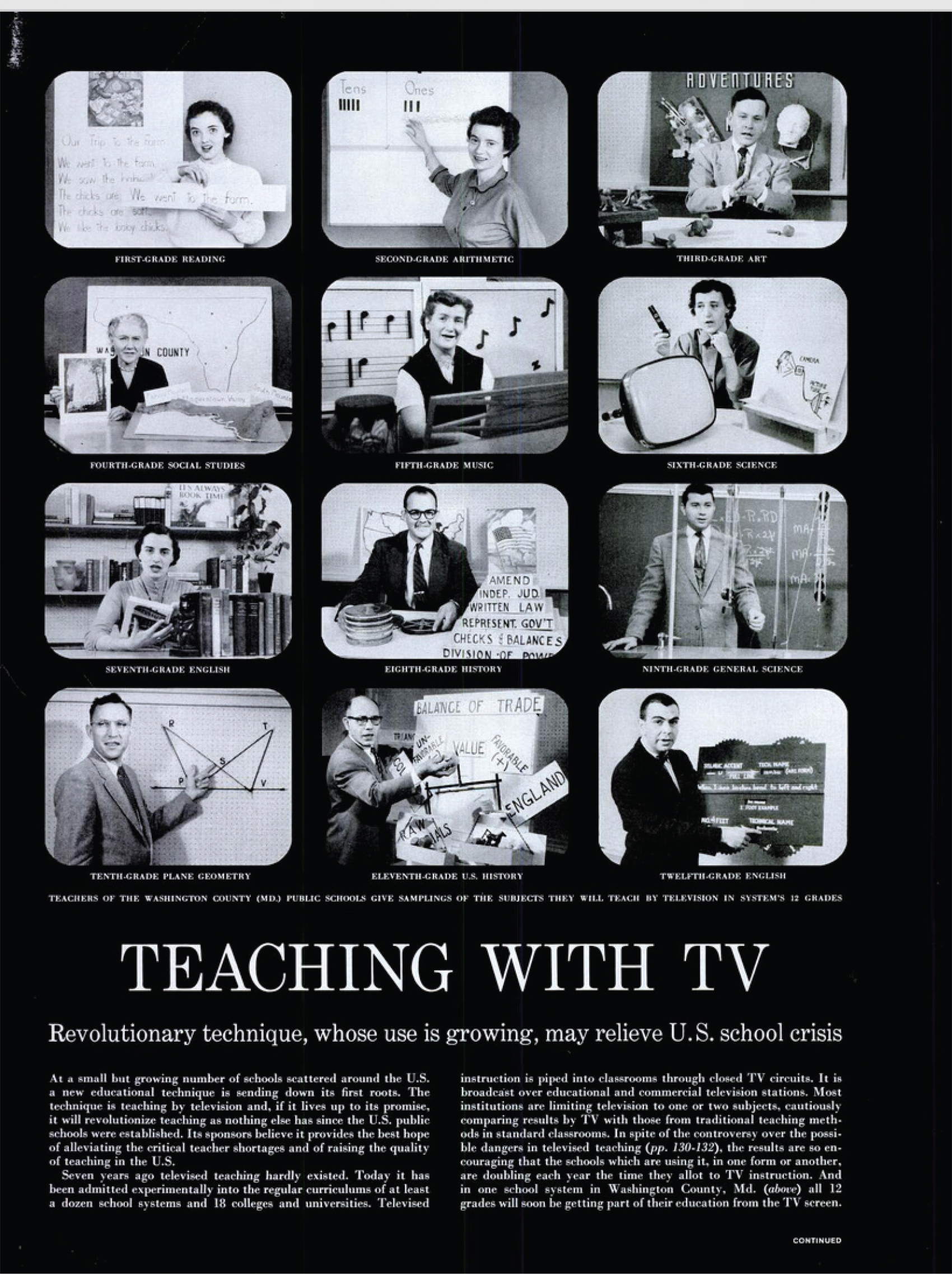
Figure 2
‘Teaching with TV: Revolutionary Technique, whose use is growing, may relieve U.S. school crisis’. Source: Life Magazine, February 25, (1957), 123.
‘Open’ and ‘Closed Circuit’
But what kind of television was tested for education? What kind of education was meant to be provided by ETV? And what were the supposed benefits of ETV? As a glance into the literature of ETV’s heydays in the 1950s and 1960s shows, these questions occupied many pages, as the difference of ETV’s definition as ‘educational’ versus ‘instructional’ or simply ‘public’ was frequently discussed. To untangle this multiplicity of uses and publics of ETV, the notion of dispositif, understood as a historically specific network of technologies, images, and audiences, is particularly helpful. Principally developed by film historians, the dispositif approach frames media objects in their material and discursive existence from a diachronic perspective: it allows to distinguish between different televisual applications, and to highlight the medium’s flexible forms and formats.23 The post-war discourses frequently established televisual categories designating different spaces of reception and modes of transmission for ETV: as a heuristic tool, the dispositif approach provides an analytical framework that helps investigate the ‘network of relations’ between audiences, media content, and media technology.24 It allows one to apprehend the plurality of TVs.
The 1961 report Teaching by Television edited by the Ford Foundation and its Fund for the Advancement of Education, both of whom will be discussed below, defined ETV as embracing ‘two broad categories’25: ETV was either adult television aired to the home and watched alongside with commercial programming, or it was directly sent into schools and classrooms, where it was integrated into the teaching curriculum and addressed pupils and their teacher.26 Similarly, the National Educational Television and Radio Center, a distributor of educational programmes financially backed by the Ford Foundation, published in 1958 a volume on the uses of ETV. There, television in schools and colleges were distinguished from ‘[t]elevision being used in adult education’, which embraced academic training for adults wishing to earn a new degree, as well as ‘programs of a broad cultural nature’.27 Such adult education could be broadcast via commercial stations by setting aside air time for ‘public service programs’.28 However, this arrangement had major disadvantages, including the fact that the providers of these programmes—schools, colleges, community organisations—were not in a position to decide the broadcast schedule, nor guarantee an uninterrupted airing.29 Therefore, the only valid alternative for educators was the ‘educational television station’ as a non-commercial, community-based organisation, which would considerably grow after the accreditation of the abovementioned 242 channels for non-commercial TV.30
Contrary to programmes aiming at a mixed audience watching TV mainly in domestic contexts, in-school ETV was part of the curriculum and viewed exclusively in the classroom. Within the school setting, however, broadcasting constituted only one of two possible solutions, the second being ‘closed-circuit systems’31 or CCTV. In a publication dedicated to the Chelsea ETV project (discussed below), the distinction between a broadcasting dispositif and the closed-circuit was explained in a diagram opposing ‘open’ and ‘closed’ TV (Figure 3). Whereas the ‘open circuit’ is characterised by the reception of a programme produced outside the frame, the closed-circuit is compact enough to fit onto the page. In the ‘open circuit’, the antenna catches free-floating, and universally accessible content off the air; in the ‘closed circuit’, the receiver appears to be tied to the camera via cable, with the information circulating in a sealed machine network. Contrary to the ‘open circuit’, the ‘closed circuit’ thus promised a media environment controllable by its users. Instead of catching programmes aired by stations with their own agenda, the ‘closed circuit’ invited educators to supervise the production and the reception of their own content. In comparison to the broadcasting medium, the ‘closed circuit’ thus appeared as a fundamentally different televisual form.
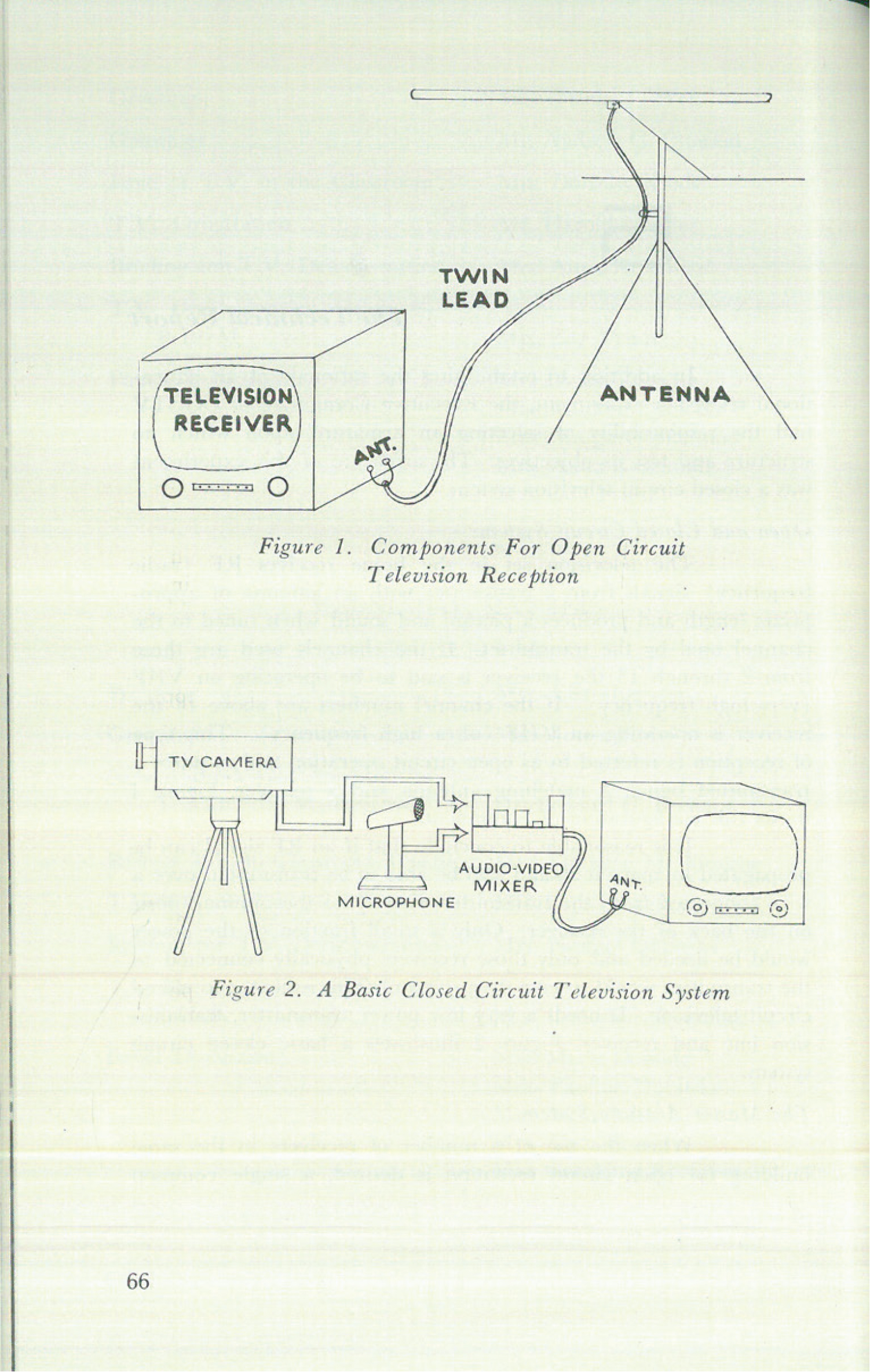
Figure 3
‘Open’ versus ‘Closed’ Circuits. Source: New York City Board of Education and Fund for the Advancement of Education, Closed Circuit Television: A Report of the Chelsea Project (New York, 1962), 66.
Overall, then, at least four educational dispositifs were at play in the early 1960s: two dispositifs for training and general enlightenment, directed towards adult or mixed audiences and domestic reception with programs aired respectively via the networks or non-commercial stations; a dispositif for school teaching based on broadcasting technology and intended for different school grades; the dispositif of closed-circuits built specifically for in-school teaching and mainly working with cable infrastructure. In comparison to the ‘open circuits’, the closed-circuit’s advantages were economic and administrative: it was cheaper to build a closed-circuit infrastructure than a broadcasting network, and the dispositif was free of oversight by federal regulation. Indeed, closed-circuits did not require any formal approval to be operated, whereas ‘open’ educational broadcasting depended on the allocation of airwaves by the Federal Communication Committee.32 The proliferation of educational closed-circuits from the mid-1950s on, however, was mainly the result of the Ford Foundation’s heavy financial backing and its very generous support for educational CCTV.
Automobile meets Philanthropy meets ETV
When educational CCTV was introduced in US classrooms, screens already were ‘a normal feature of the educational landscape’.33 Since the 1920s films had been projected to pupils of all levels. Educators and reformers had hoped that moving images would help instruct their students not only in specific subject matters, but also to turn them into a media literate audience. More broadly, in the interwar period film infused the classroom with the odour of progressive pedagogics and modernity.34 As Larry Cuban shows in his standard work on Teachers and Machines, new educational technologies were rarely launched by the teachers themselves, but enthusiastically promoted by ‘foundation executives, educational administrators, and wholesalers’, who believed in school reforms through technological change.35
In the case of ETV, foundation executives were particularly active in pushing screens into the classroom. Most ETV projects developed in the 1950s and 1960s would not have been possible without the support from the Ford Foundation, the philanthropic branch of the automaker’s empire.36 Created in 1936 with a regional outreach, the Ford Foundation redefined its goals in 1949 and went inter/national. Together with other philanthropic foundations such as Carnegie and Rockefeller, the Ford Foundation’s post-war ambition was global and aimed at building a world shaped after the US model.37 Within the USA, it sought to foster democratic citizenship through educational reforms.38 Its initiatives embraced what historians have called ‘corporate liberalism’, an ideal of governance in which the steering of society towards its greater good was managed by corporate experts and their interests rather than state intervention. As Anna McCarthy has highlighted in her research, television was seen as an efficient tool for corporate elites in their quest for influence, as the medium promised to influence the audience’s attituteds and opinions in a broad range of topics.39
Indeed, without the influx of the Foundation’s money, ETV would have remained a paper project. The Foundation’s financial support was channelled through non-profit organisations such as the Fund for Adult Education and the Fund for the Advancement of Education established in 1951 to ‘support new and experimental programs at all levels of formal education’.40 Through the latter alone, the Ford Foundation spent over $66 million in ten years.41
According to historian Victoria Cain, the two funds and the Ford Foundation converged in their ‘technocratic fantasies’ to use television screens for initiating a radical transformation of the educational system that would draw on new media, centralised control of teaching programmes, and local implementation.42 To achieve its goals, the Ford Foundation developed a capital-intensive strategy supported by television’s inherent flexibility, since it experimented with the plurality of televisual dispositifs. The Foundation’s first engagement with ETV was the ‘Television-Radio Workshop’ created by its means. The Workshop developed the generously publicised programme Omnibus, scheduled Sunday afternoons on network TV. With this first endeavour, the Ford Foundation officials and their affiliates sought to change commercial television from within. Omnibus received extensive praise by media critics and advocates for ‘bettering’ TV through intelligent programming including theatre plays, science demonstrations, and other educational features broadcast into the home. However, its success with the audience—and with the networks— was rather limited and the programme was cancelled in 1959.43 After the allocation of non-commercial channels, the Ford Foundation and its associated funds supported the construction of televisual infrastructures through the ‘Program of Assistance in the Construction of Educational Television Stations’. Between 1952 and 1961, the Fund for Adult Education supported 37 community organisations in their efforts to broadcast educational content.44 An entirely different form of educational TV—and a highly spectacular one —was the Midwest Program on Airborne Television Instruction, MPATI, that combined aviation and TV.45 Using the airplane as a mobile transmitter and antenna, MPATI aired to schoolchildren in the rural Midwest where its educational programme was claimed to reach ‘far more students, at a lower cost per student’ than regular broadcasting stations (Figure 4 and 4a).46 MPATI aired its programmes from the early 1960s to 1968, before it became a videotape library that sent its programmes no longer via air, but through the mail. It shut down in 1971.47 The end of MPATI coincided with a decline of interest for ETV, which, according to educators, had not lived up to ‘initial expectancies’.48 Contrary to the positive reception of educational TV dispositifs in the early stages of its implementation, the technocratic top-down approach by Ford experts and other educators did not fundamentally modify pedagogical practice, nor did it innovate the classroom.49

Figure 4
MPATI: Televisual instruction by airplane. Source: Ford Foundation records. Photographs. Series 3: General, Program, and Project Photographs. Sub series 3_4: Educational Television 9ETV). Box 83. Folder 1370. Midwest Airborne Educational Television Program, 1960-1966. Rockefeller Archive Centre.
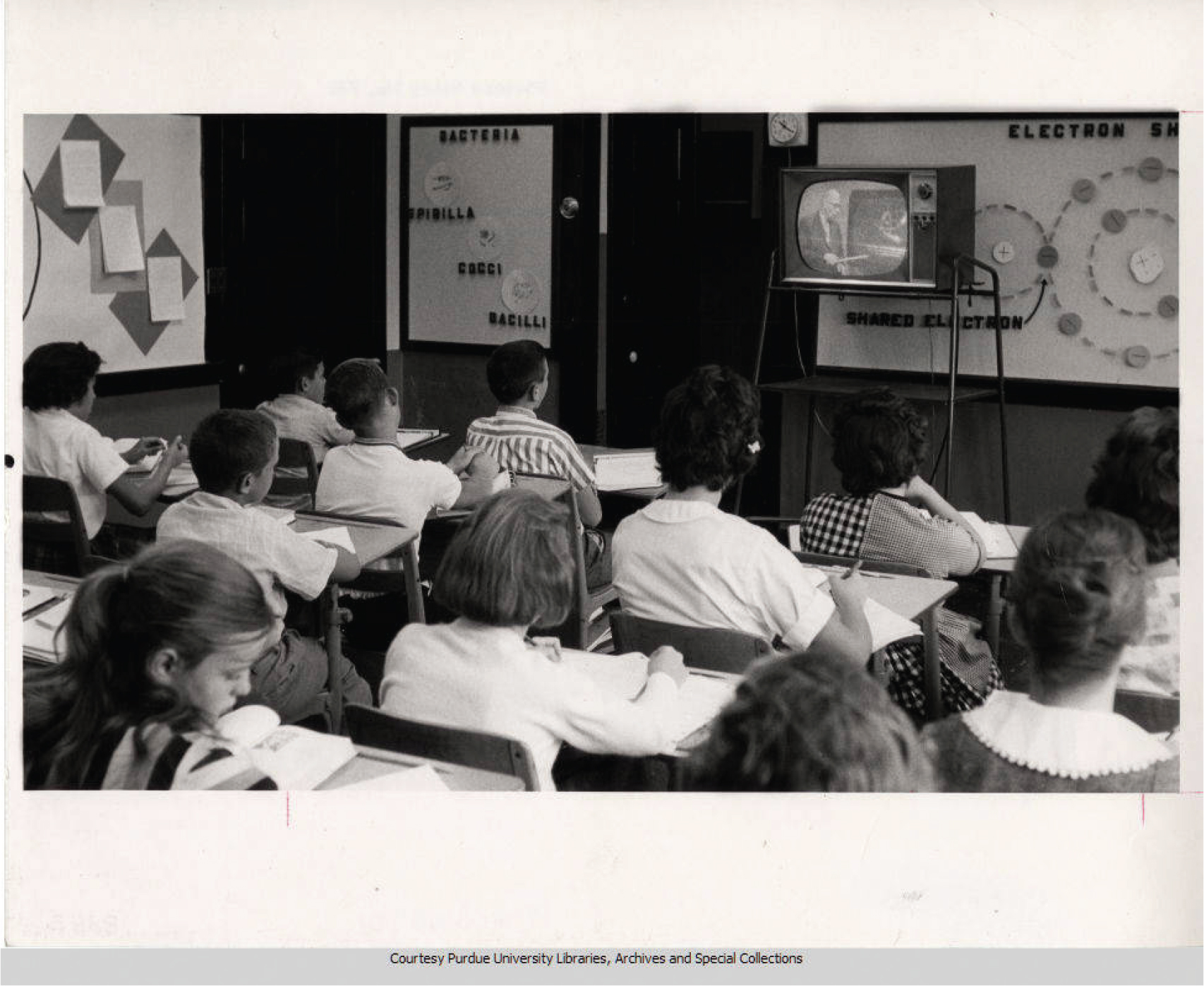
Figure 4a
7th and 8th grade schoolchildren watching a programme broadcast by MPATI, ca. 1962. Source: Purdue University Libraries, Karnes Archives and Special Collections, PADA0000106.
Experimental Closed-Circuits: Hagerstown and Chelsea
The relative failure of ETV would also concern educational CCTV. Nevertheless, in the 1950s and 1960s, the educational closed-circuit offered solutions to some of the issues emerging with the other ETV dispositifs. First and foremost, they were low-cost and low-tech. While MPATI certainly excelled in spectacularity, closed-circuits did not strain the school’s budget (too much). As Alexander J. Stoddard, a Ford Foundation consultant, wrote in his influential Schools for Tomorrow in 1957:
It does not cost any more or even as much to provide adequate closed-circuit television equipment in a new school building, or in an old one, as is frequently spent on equipment for a shop, laboratory, library, cafeteria, gymnasium, or some specialized classroom.50
The Ford Foundation officials obviously agreed with Stoddard’s evaluation of closed-circuits, since around the period of his report two important educational projects supported by Ford Foundation money implemented large-scale CCTV. Both projects, named after their location in Hagerstown, Maryland (Washington County), and Chelsea, New York City, respectively, were closely observed by educators and funding partners.51 They served as experimental platforms for testing the use of television as a teaching tool, generated numerous publications, and brought together private and public partners.
Opened in Fall 1956, Hagerstown was the largest experiment in closed-circuit ETV. In the 1959–1960 school year already 37 out of Washington County’s 49 schools were linked to the closed-circuit network while planning was underway to connect the remaining twelve schools, too.52 Hagerstown overall goal was to ‘answer the question of whether the new medium could be used as a resource to provide the 18,000 students in the county schools a richer education, and at less cost, than was possible by conventional methods of instruction’.53 In other words, this was a televisual experiment of scale. Its experimental character was underlined as ‘[t]housands of educators and lay people’54 poured in the county’s schools to observe television at work as a teacher. Indeed, the closed-circuit imposed its own teaching methods, including the incentive for larger classes, ‘up to four times the county average of thirty-two pupils’.55 Televisual instruction was tested for all grades and covered all subjects, from arithmetic, art classes, music, and French to reading, and more. An evaluation after the project’s five-year anniversary highlighted its efficacy for elementary science. The science curriculum had previously relied on each teacher’s capacities and interests, a situation that was judged insufficient for instructing young generations in modern scientific knowledge. With televisual teaching, expert educators could convey a series of structured courses from elementary school onwards.56
While the Hagerstown project was entirely oriented towards formal education in a school setting, the Chelsea closed-circuit pursued the double aim of improving in-school teaching and of offering language and other instruction to the neighbourhood’s adult community. Programmes were produced live in the Lower West Side Health Center, the Hudson Guild Neighborhood House, and in Public School 33. They were broadcast to the John Lovejoy Elliott Housing complex as well as the 39 classrooms of the Chelsea School. Aiming at a better integration of the Hispanic residents of the public housing complex, the Chelsea project thus not only aired into classroom, but also into living rooms. As the schedule of a typical programme week indicates, the broadcasts prioritised language teaching for pupils and adults and sought creating a televisual community through information exchange (Figure 6).
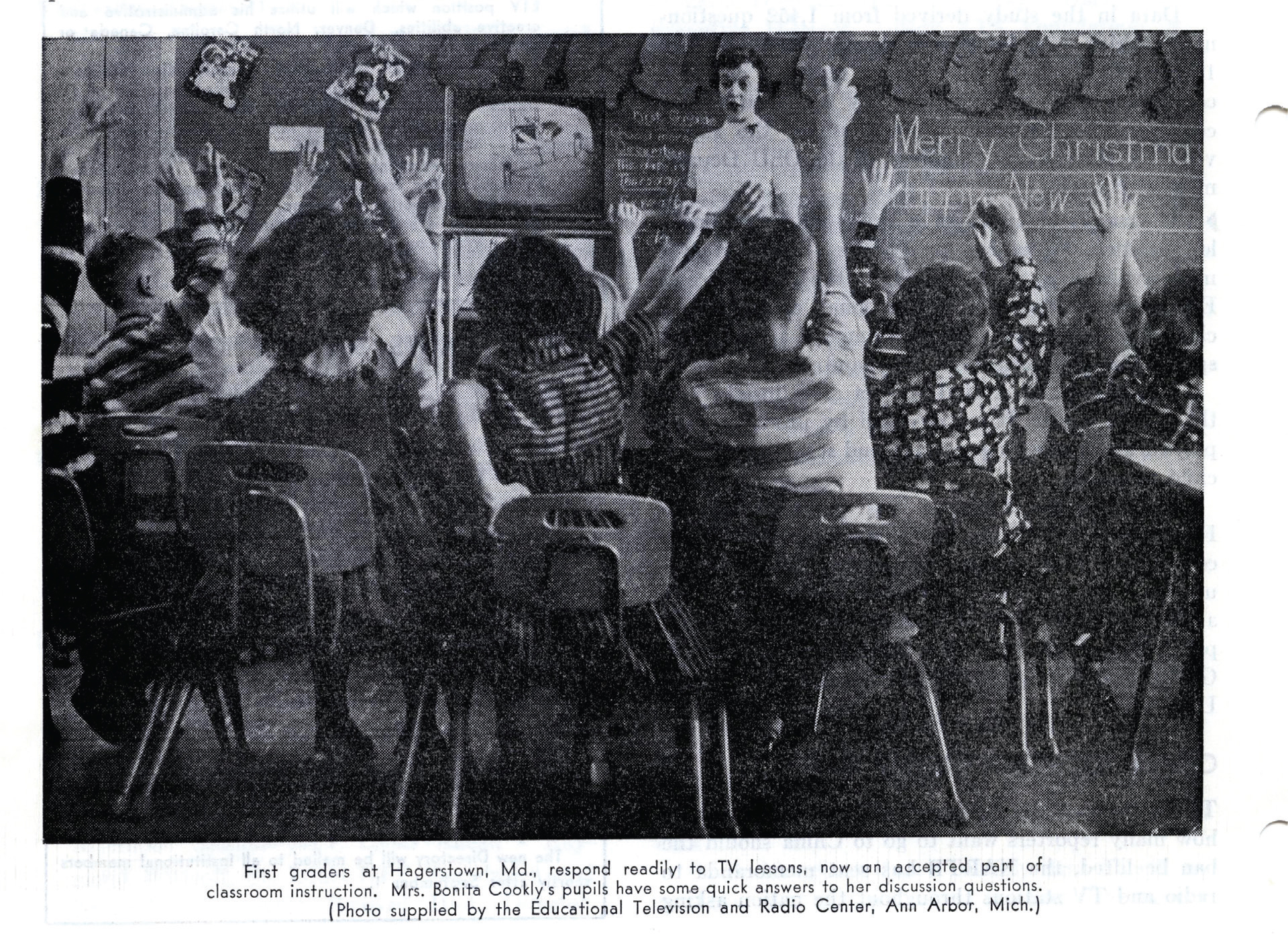
Figure 5
Televisual instruction for first graders at Hagerstown, Maryland. Source: NAEB Newsletter, August 1957.
The Emergence of Closed-Circuits out of WWII
In her analysis of the two CCTV projects, media scholar Amanda Keeler stresses the Ford Foundation’s financial investment that allowed the organisation to shape school programmes through infrastructure, following its own vision of ideal post-war subjects. More broadly, the Ford Foundation’s influence on the educational landscape in post-war US overall has been widely recognized by historians of ETV.57 A lesser observed dimension of educational CCTV’s development comes to the fore when we shift our focus away from funding agencies to the technical infrastructure of closed-circuits: its roots in the emerging military-industrial complex. While the philanthropic branches of the Ford empire conceptualised, financed, and evaluated the different educational programmes, they relied on partnerships with a heterogeneous ensemble of private and public actors for the material realisation of their projects. For Hagerstown, the Ford Foundation was joined by the Chesapeake and Potomac Telephone Company and the Electronic Industries Association. The first provided technical support with regard to the cable infrastructure, whereas the latter sustained the project with equipment and advised its members who ‘tr[ied] to extend the use of television equipment in the educational area’.58 In Chelsea, the initiative was supported by a number of groups, including the New York City Board of Education and Harvard University’s Language research centre. Its technical implementation was managed by the General Precision Laboratories (GPL), responsible for the system planning overall.59 GPL was first and foremost active in the military sector and would earn a reputation throughout the 1960s thanks to its involvement with the NASA space programme. At the end of the 1950s, however, GPL would also market itself as ‘an outstanding developer and producer of broadcast and closed-circuit TV devices and systems’60—a claim the enterprise sought to bolster through its investment in Chelsea TV (Figure 7). GPL’s entanglement with the military-industrial complex was not an exception, but the norm: the closed-circuit—‘an exceedingly flexible medium’61 according to engineers working for the Radio Corporation of America (RCA)—was first developed thanks to public-private collaborations that took shape during World War II. In other words, while corporate liberalism, together with a Cold War preparedness, expressed in the militarised language of the National Defense Education Act, formed a major ideological background for the sponsoring of Cold War ETV projects, their technologies and infrastructures heavily relied upon the wartime convergence of military, industrial, and scientific interests.
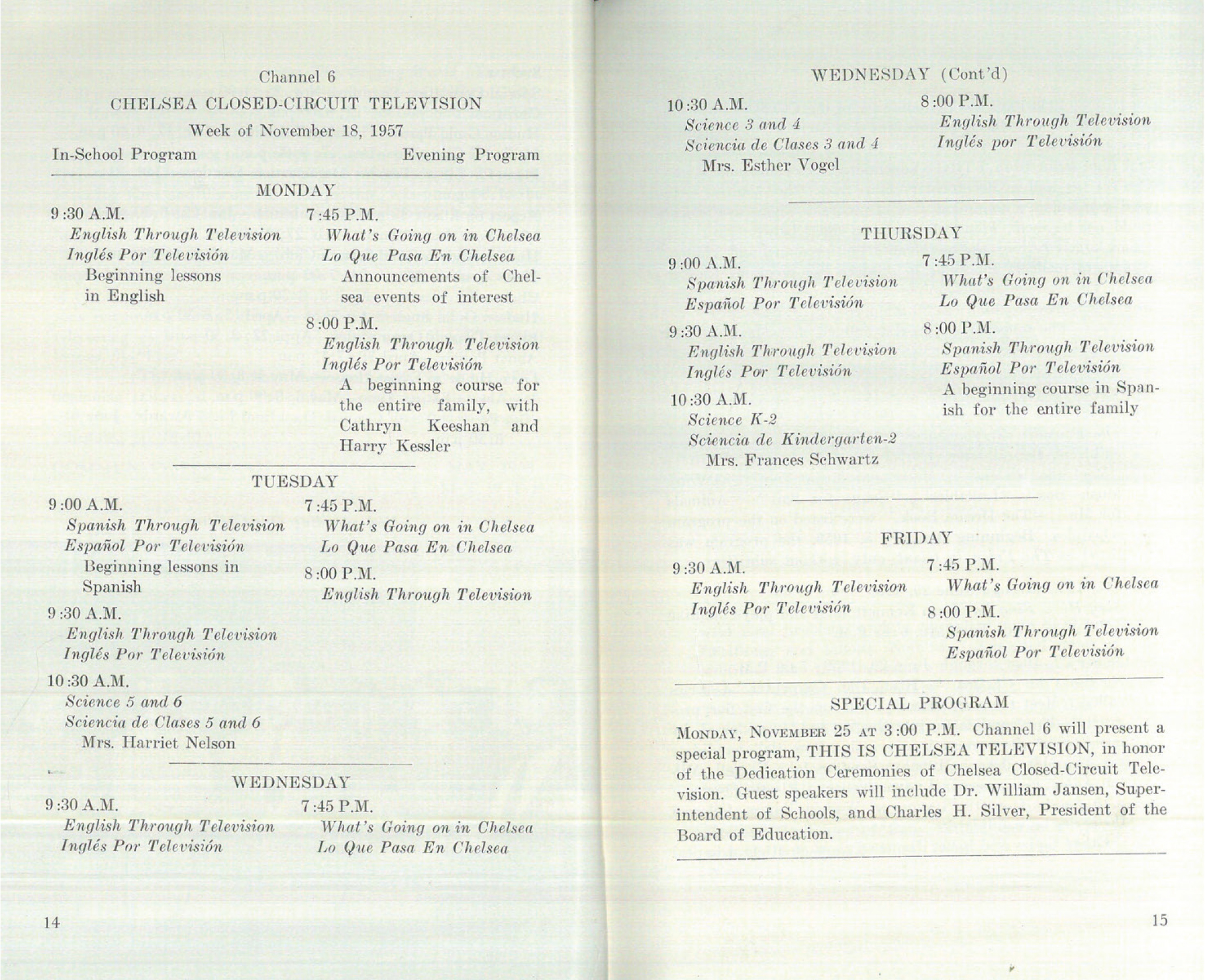
Figure 6
Schedule of the CCTV programme for the Chelsea project. Source: A Report of the Chelsea Project. Board of Education of the City of New York, 1962.
From 1941 onwards, television’s development was adapted to the general war effort, and research into military television was overseen by the National Defense Research Committee (NDRC) and later by the Office for Scientific Research and Development (OSRD). This public body sponsored private weapon and military research and would also launch the Manhattan project and the development of the atomic bomb. In parallel, under NDRC’s supervision several drone and guided missiles programmes were launched, some of which included the development of new television technologies.62 These military television applications were fundamentally different from the medium’s broadcasting forms. First, as targeting and surveiling technologies, they were conceived as closed-circuits, transferring visual data from a single camera to a single receiver. Second, instead of the equivalent of several tons of studio equipment the entire system weighed merely around 150 lb. Simultaneously, the aim was to miniaturise the devices: described as ‘suitcase’ technologies, the new cameras, transmitters, and receivers ‘that once might have filled a large room [were] redesigned, modified and built to “suitcase” compactness for military uses’.63 Lastly, contrary to the civilian televisual systems developed in the 1930s, the entire system was not handled by engineers and television specialists but by military personnel. The ‘overall ease of installation, operation and maintenance’ was thus paramount.64
During World War II, due to ongoing technical issues, military television was of limited effectiveness on the battlefield. These restrictions overall led most historians to consider the various television-military programmes a failure.65 Yet, the closed-circuit dispositif did have a long-lasting impact beyond the war: thanks to its material design, reduced size, and simplified use, it would infuse multiple civilian sectors after the war. Indeed, as an infrastructural system, the closed-circuit embraced characteristics that would greatly benefit its transfer to multiple non-military institutions.
From the Military to the Industry
By the mid-1950s, when the Ford Foundation subsidised closed-circuit projects as well as plenty of brochures on the topic, closed-circuit systems promised to solve not only educational problems, but also to introduce rationalised workflows in industry, facilitate medical research, and modernise administrative processes. Numerous publications outside the educational field were dedicated to Closed-Circuit Television System Planning66 and introduced the uses of Television in Science and Industry67 to a specialised audience. According to a source from 1967 ‘about one thousand closed-circuit TV systems [were] operating in both public and private education, in service agencies, and in industry’.68 With their CCTV projects in Chelsea and elsewhere the Ford Foundation officials jumped on a trend, which they helped to boost further (see figure 8 to 10).
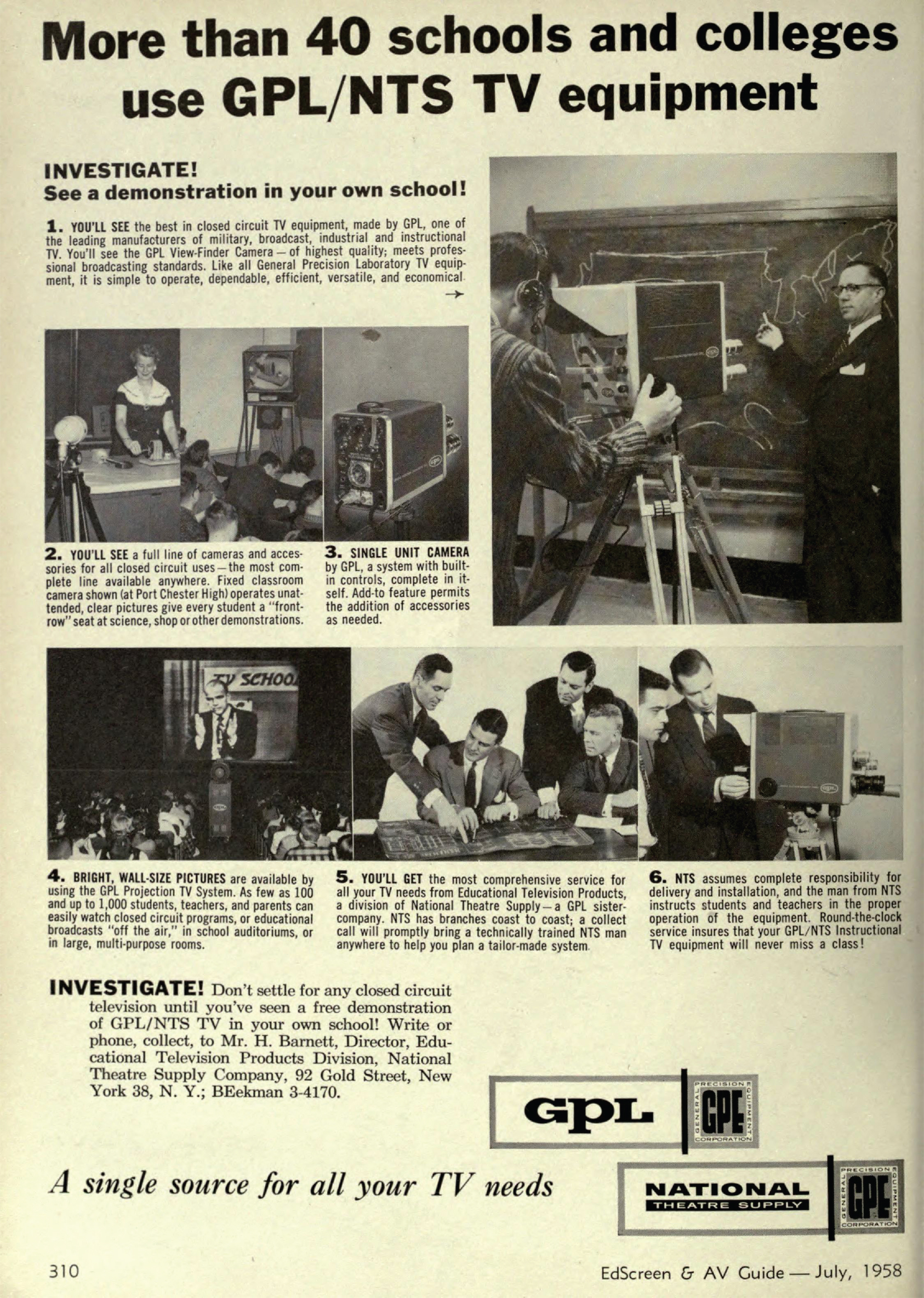
Figure 7
General Precisions Laboratory advertisement for educational CCTV. Source: Educational Screen & AV Guide, July 1958.
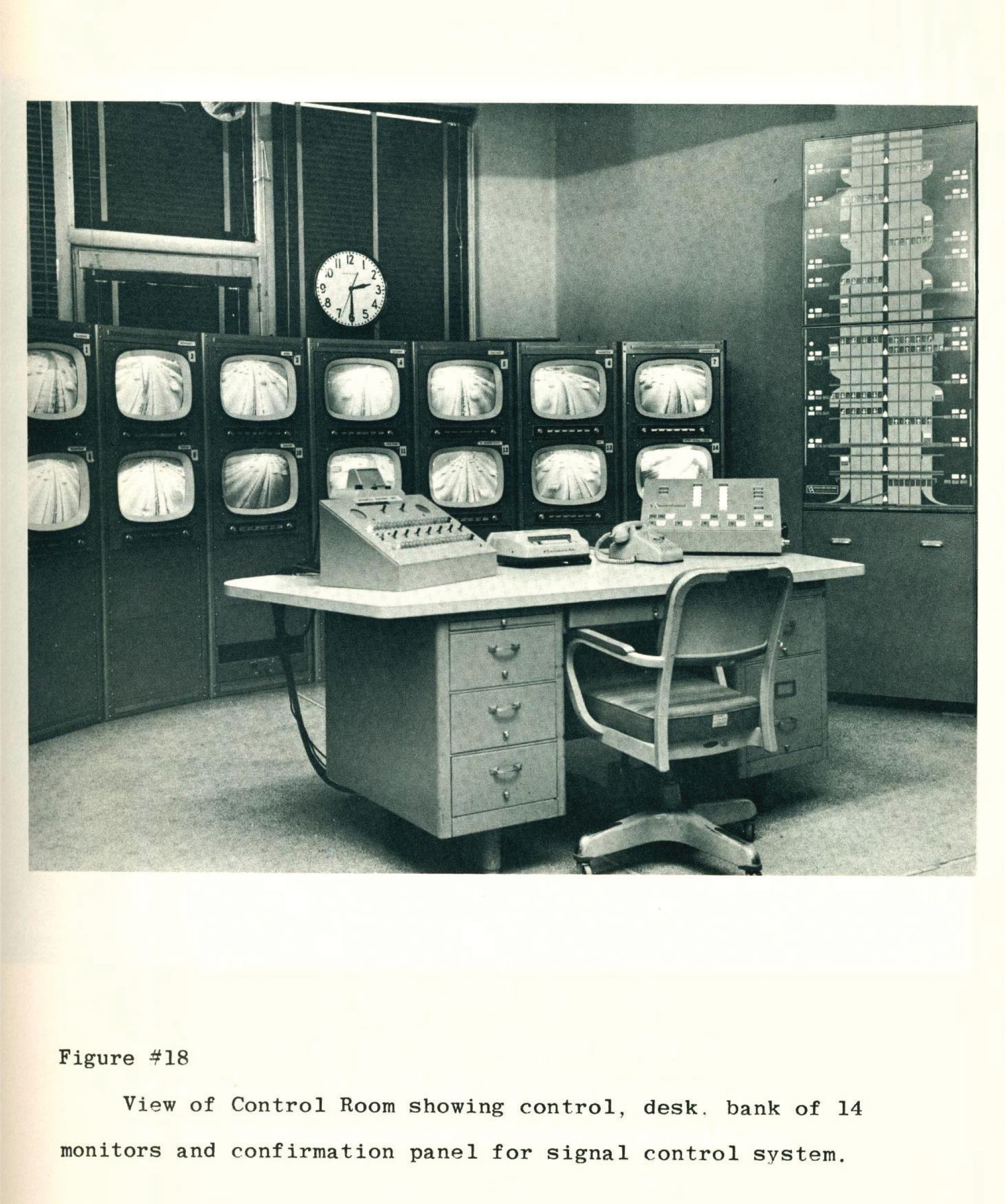
Figure 8
Traffic Control by Television. Source: National Proving Ground for Freeway Surveillance Control & Electronic Traffic Aids, Television Equipment for Traffic Surveillance (1962), 54. Hagley Library and Archives.
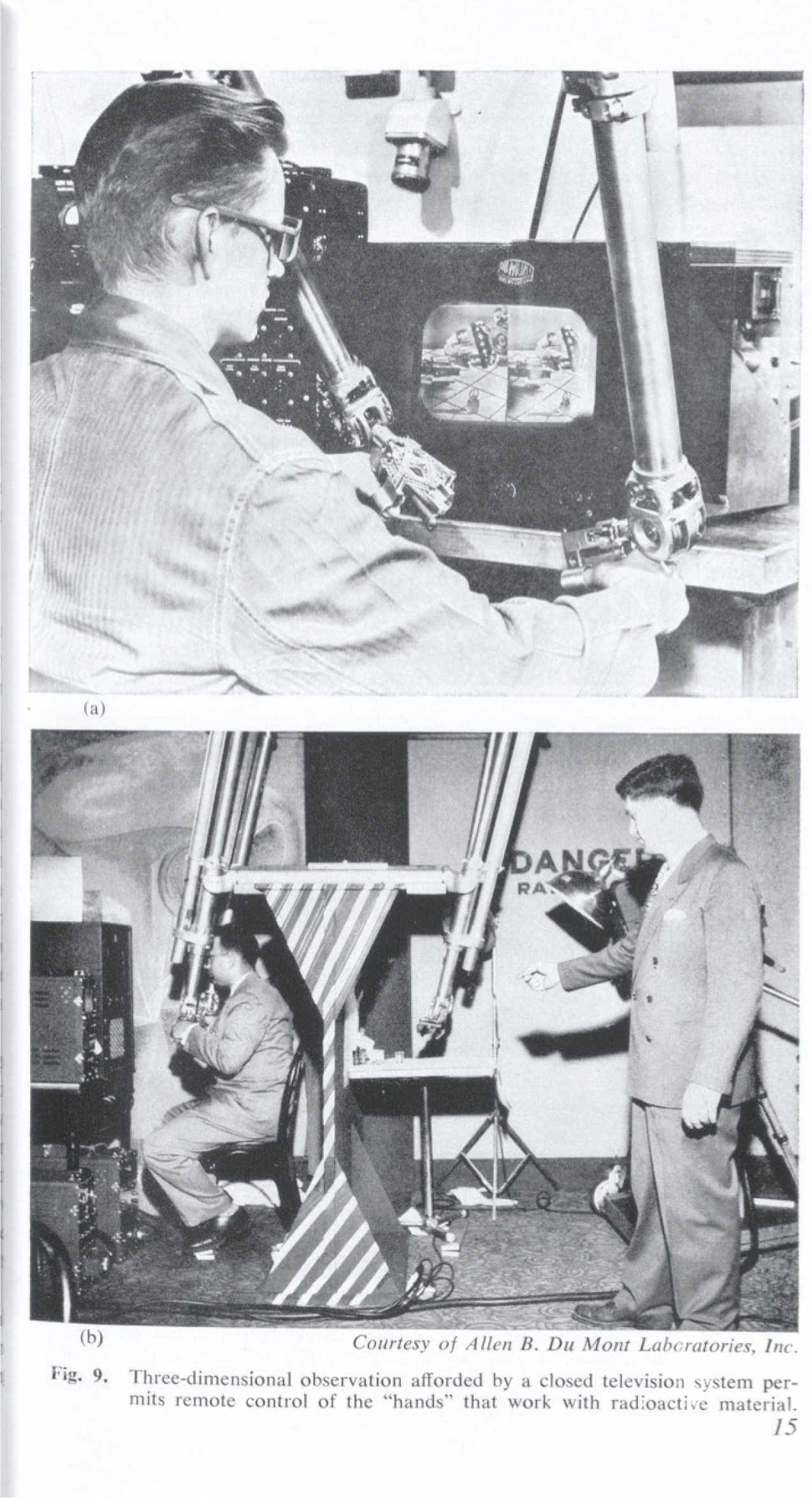
Figure 9
Remote televisual control of radioactive material. Source: Edward M. Noll, Closed-Circuit and Industrial Television (New York: Macmillan, 1956), 15.
Similar to the sources on the dispositifs of educational television, the technical literature presented the closed-circuit as being fundamentally distinct from the broadcasting model. Furthermore, engineers and telecommunication experts emphasised that CCTV applications were almost limitless. According to one author, indeed, the reader’s imagination was the only restriction ‘to the number and kind of conditions under which the closed systems can prove their value’.69 In a publication co-signed by RCA’s Vladimir Zworykin, the idea of CCTV as an ideal instrument was equally explicit: ‘Whenever it is too dangerous; too difficult; too expensive; too inconvenient; too inaccessible; too tiring; too far; too hot; too cold; too high; too low; too dark; too small to observe directly, use television’.70 Functioning as a prosthesis to, as well as an armour for, the human body, televisual closed-circuits allowed live remote viewing in numerous contexts, including surveillance of goods and properties, handling at a distance, information exchange, and more. The medium’s affordances, furthermore, included the possibility for close-ups and enlargements, which were particularly helpful in the case of television as an educational aid. The military itself recognised this multifaceted instrumentality of CCTV: in addition to sponsoring teleguided weapons research, it was also an early and eager adopter of educational closed-circuits. In 1950, the US Army opened the two first military educational centres at Signal Schools in Georgia and New Jersey; eight years later, ten television installations were in use for Army training. From the instruction of large groups to the training of soldiers in the handling of new equipment via televised close-ups, or as an ‘adjunct’ of classroom teaching, CCTV was seen as a fitting tool for the modern Army (Figure 11).71
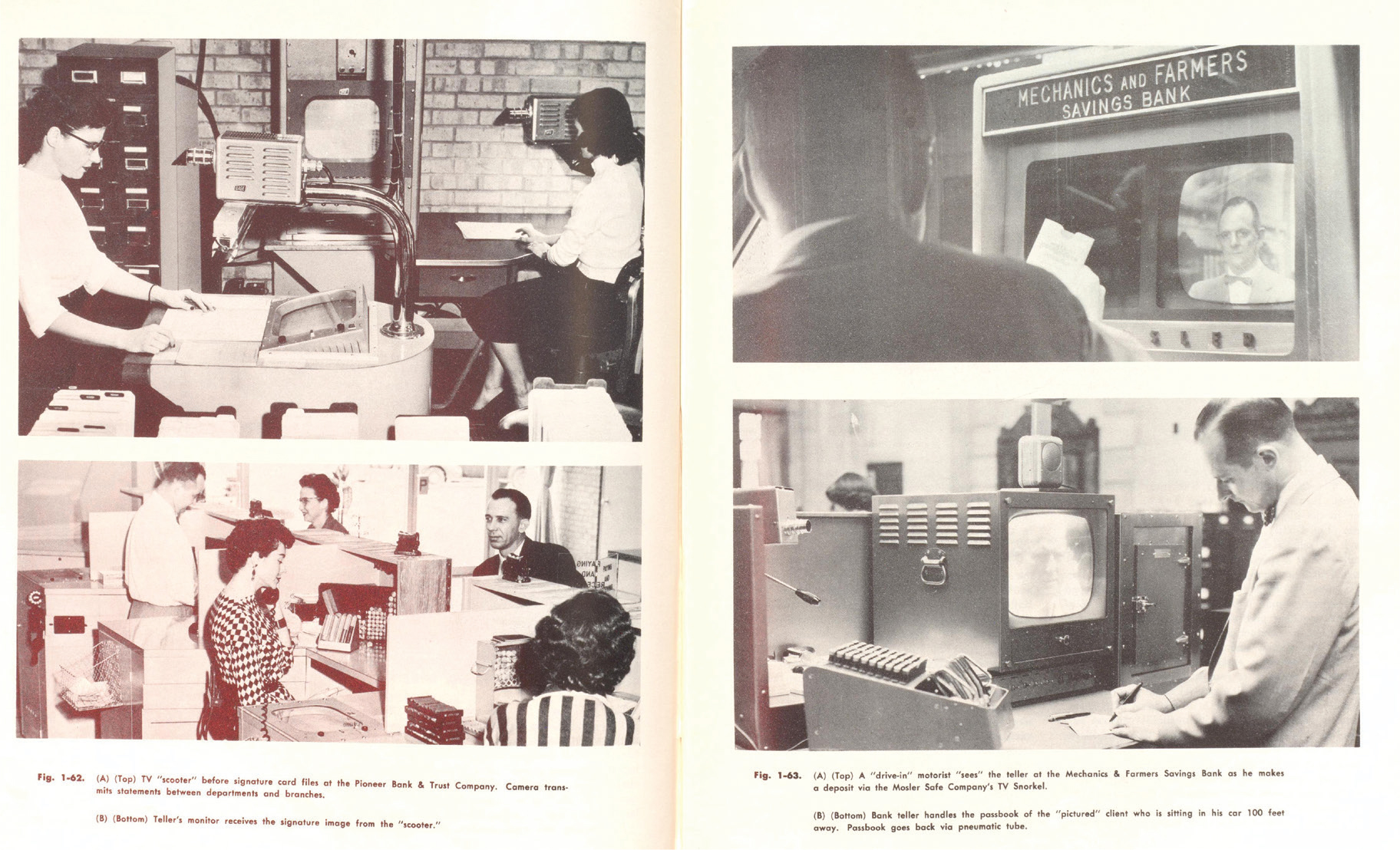
Figure 10
CCTV in administration and banking. Source: Morris A. Mayers, and Rodney D. Chipp, Closed Circuit Television System Planning (New York: J.F. Rider, 1957), 88-89.
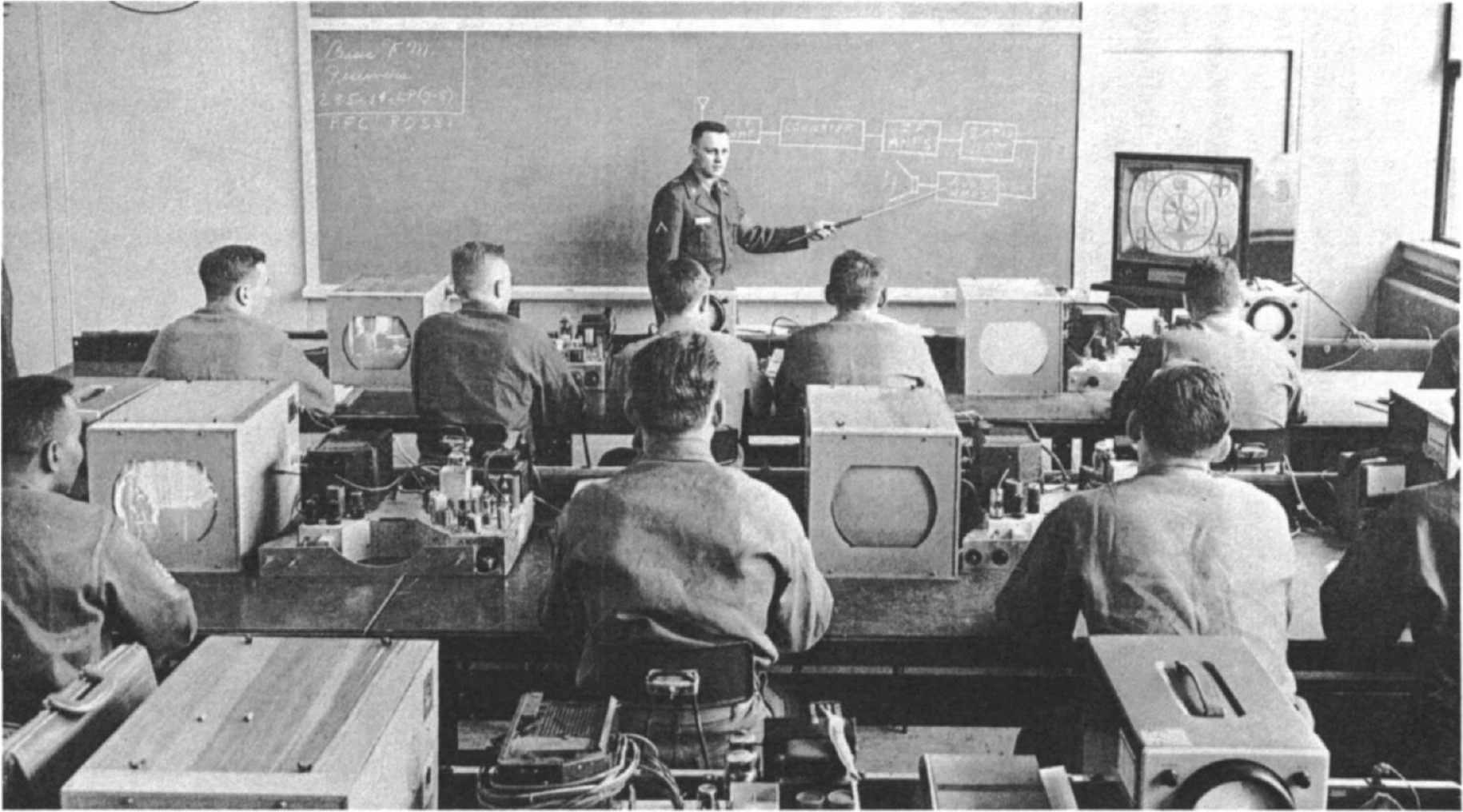
Figure 11
Joseph H. Kanner, “Teaching by Television in the Army: An Overview,” Audio Visual Communication Review 6, no. 3 (1958): 172-188.
As the ‘other’ of commercial broadcasting television, closed-circuit TV thus embraced multiple uses in non-domestic spaces that included, but were not limited to, civilian classrooms. It fostered industrial automation, the surveillance of public spaces, or remote control, and introduced screens in numerous institutional contexts. Through the lens of the history of the televisual closed-circuit ETV becomes part of this broader history of electronic images that acted as tools in the service of knowledge production, the coordination of bureaucratic and military organisations, and the management of bodies and gazes in a broad range of contexts. Instead of writing a television history solely focusing on educational applications, it becomes possible to acknowledge ETV’s entanglement with military-industrial technologies.
Towards a History of Television as a Useful Medium
To reflect upon this expanded history of educational television, it is helpful to turn to the henceforth well-established scholarship on non-theatrical cinema and ‘useful film’. For almost three decades, film historians have engaged in a lively discussion on the role, functions, and publics of such productions, broadly defined as ‘a body of films and technologies that perform tasks and serve as instruments in an ongoing struggle for aesthetic, social, and political capital’.72 Shifting attention from the feature film and theatrical reception, this historical scholarship investigates industrial, military, educational, and medical films and suggests new analytical frameworks to apprehend this important but long-time neglected strand of cinematographic production.73 It emphasises the necessity of abandoning traditional analytical categories, e.g., authorship, in favour of a more contextualised approach: scholars continuously have stressed the need to scrutinise the filmic representations within their contexts of production and reception. Indeed, maybe one of the most fundamental results of this research has been to unearth the over-abundance of useful films over the 20th century, and their implied multiplicity of points of contact between an audience and moving images outside of movie theatres.
For television history, the useful film approach invites scholars to revise common understandings of television as a domestic mass medium conceived solely according to the broadcasting model. Such a historiographical revision has notably been suggested by Anna McCarthy and her work on television in public space; Markus Stauff’s reflection on sports television as useful images; Susan Murray’s history of closed-circuits in the hospital context; Kit Hughes in her monography on corporate uses of television; as well as by my own work on military TV.74 Recently, innovative scholarship has further been conducted among historians of medicine interested in the use of audiovisual technologies for medical research and teaching.75 While this growing body of work signals the interest among historians for these forms of TV, most of useful television’s history— including non-American case studies and / or their transnational circulation—awaits further exploration. Similarly, a broader dialogue among television historians regarding the productivity of useful television as a historiographical category has yet to come.
While such debates have the potential to invigorate the field of Television Studies, the task of doing the history of useful television remains a challenge: contrary to broadcasting television, which is appreciated as cultural heritage and has been valorised through vast public digitisation initiatives, useful television is a mainly ephemeral medium. The case of educational TV is emblematic of this situation: whereas the broadcasting programmes integrated into the regular schedule may have been archived, CCTV and other in-school content is often lost today. This absence of images is partly due to the fleeting nature of useful television’s content, which was often transmitted live. It is equally linked to the medium’s status as an instrument or a tool that has rarely been considered as content worthy to be archived. Yet, educational television’s instrumentality did result in an abundance of reports, evaluations, and general presentations that accompanied the experiments from their first inceptions on. As seen, the Ford Foundation was an eager publisher and sponsored a long line of pamphlets and other publications disseminating its views on ETV. From this perspective, the history of closed-circuit television in educational contexts offers an ideal entry point into the vast history of useful TV, and for decentring television’s history overall. Inversely, the study of useful television sheds new light on educational practices, and on their entanglements with Cold War politics and technologies.
Notes
[1] Gertrude G. Broderick, “Educational Television: Are We Educating by Television?” Journal of the SMPTE 65, no. 1 (January 1956): 20–22.
[2] Among Broderick’s publication in the 1950s and 1960s are: Gertrude G. Broderick, Educational Television: Local Program Survey (School Year 1952-53) (Washington, D.C.: Dept. of Health, Education, and Welfare, Office of Education, 1953); List of Educational AM and FM Radio, and Television Stations by State and City ( Washington: U.S. Dept. of Health, Education and Welfare. Office of Education, 1958).
[3] For a short overview on the development of educational technologies see Robert A. Reiser, “A History of Instructional Design and Technology: Part I: A History of Instructional Media,” Educational Technology Research and Development 49, no. 1 (2001): 53–64. An exhaustive introduction offers Paul Saettler, The Evolution of American Educational Technology (Greenwich, CT: Information Age Publishing, 2004 (1990)). On the history of educational cinema, see Devin Orgeron, Marsha Orgeron, and Dan Streible, eds. Learning with the Lights Off: Educational Film in the United States (Oxford; New York: Oxford University Press, USA, 2012), as well as the articles in this issue.
[4] This argument is for instance made in Educational Television and the Schools: ‘[T]elevision offers unique teaching opportunities. By means of television, an outstanding teacher can reach thousands of students at once instead of the few who can crowd into his classroom. The sight and sound of current news events can be brought immediately to hundreds of classes.’ National Educational Television and Radio Center, Educational Television and the Schools ( Ann Arbor, Mich., 1958), 1.
[5] Anna McCarthy, The Citizen Machine: Governing by Television in 1950s America (New York: New Press, 2010).
[6] Brian Goldfarb, Visual Pedagogy: Media Cultures In and Beyond the Classroom (Durham: Duke University Press Books, 2002).
[7] Victoria Cain, Schools and Screens: A Watchful History (Cambridge, MA: The MIT Press, 2021). Recently, the history of educational television has also attracted renewed attention by historians working on European case studies, see the issue “Education & TV: Histories of a Vision” of VIEW. Journal of European Television History and Culture 11, no. 21 (2022) eds. Sian Barber, Elena Caoduro, and Kai Knörr, https://viewjournal.eu/25/volume/11/issue/21.
[8] Amanda Keeler has discussed the closed-circuit ETV experiments in Chelsea and Hagerstown: Amanda Keeler, “Old New Media: Closed-Circuit Television and the Classroom,” Convergence 24, no. 6 (2018): 538–553.
[9] Judith Keilbach and Markus Stauff, “When Old Media Never Stopped Being New. Television’s History as an Ongoing Experiment,” in After the Break. Television Theory Today, eds. Marijke de Valck and Jan Teurlings ( Amsterdam: Amsterdam University Press, 2013), 79–98.
[10] William Uricchio, “Constructing Television. Thirty Years That Froze an Otherwise Dynamic Medium,” in After the Break, De Valck and Teurlings, 65–78.
[11] François Vallotton and Anne-Katrin Weber, “Introduction,” in Towards an Expanded History of Television (Living Books about History. Infoclio, 2021), DOI: 10.13098/infoclio.ch-lb-0009.
[12] Robert H. Stern, “Television in the Thirties: Emerging Patterns of Technical Development, Industrial Control and Governmental Concern,” American Journal of Economics and Sociology 23, no. 3 (1964): 285–301. For a cultural history on interwar television, see also Anne-Katrin Weber, Television before TV: New Media and Exhibition Culture in Europe and the USA, 1928-1939 (Amsterdam: Amsterdam University Press, 2022).
[13] Robert A. Levin and Laurie Moses Hines, “Educational Television, Fred Rogers, and the History of Education,” History of Education Quarterly 43, no. 2 (2003): 264.
[14] Beverly J. Taylor, “The Development of Instructional Television,” in The Farther Vision: Educational Television Today, eds. Allen E. Koenig and Ruane B. Hill (Madison: University of Wisconsin Press, 1967), 137.
[15] Allison Perlman, Public Interests: Media Advocacy and Struggles over U.S. Television (New Brunswick, NJ: Rutgers University Press, 2016), 21.
[20] Barbara Barksdale Clowse, Brainpower for the Cold War: The Sputnik Crisis and National Defense Education Act of 1958 (Westport, Conn: Praeger Publishers Inc, 1981), 160.
[21] Charles R. Acland, “American AV: Edgar Dale and the Information Age Classroom,” Technology and Culture 58, no. 2 (2017): 412.
[22] Goldfarb, Visual Pedagogy. As Allison Perlman has shown in her in-depth study of media advocacy for public television, the medium’s potential to operate in remote classes not always served progressive politics. States in the South indeed used ETV to continue school segregation against the Brown v. Board of Education decision of 1954. Supported by the JCET, ETV projects in Alabama or South Carolina were heavily implemented in black schools. In these traditionally neglected districts, television allegedly got rid of the need to abolish segregation since previous underserved schools were now benefiting from the most modern technology. In this context, ETV fuelled the racist structures of regional school systems and urban infrastructure, rather than contribute to solve problems highlighted by the Civil Rights Movement. Perlman, Public Interests, 38–42.
[23] See François Albera and Maria Tortajada, eds., Cinema beyond Film. Media Epistemology in the Modern Era (Amsterdam: Amsterdam University Press, 2010); Susan Aasman, Andreas Fickers and Joseph Wachelder, eds., Materializing Memories: Dispositifs, Generations, Amateurs (London: Bloomsbury Academic, 2018).
[25] Ford Foundation and Fund for the Advancement of Education, Teaching by Television; a Report from the Ford Foundation and the Fund for the Advancement of Education, 2nd edition (New York, 1961).
[26] For a history of television for adult education, see Laurie Ouellette, Viewers Like You: How Public TV Failed the People (New York: Columbia University Press, 2002). In contemporary sources, the distinction between ‘voluntary’ and ‘formal’ education is also used to design programmes aimed at adults v. content provided for in-class teaching. See Ford Foundation, The History of Ford Foundation Activities in Non-Commercial Broadcasting, 1974, report 002027.
[30] National Educational Television and Radio Center, Educational Television, 14–15. Following the accreditation of the over 200 channels for non-commercial TV, the first of such stations was launched in 1953; in 1954 eight new stations started and in 1961, a total of 54 stations was counted. In 1976, finally, all 252 channels were occupied, and non-commercial ones made for more than one-quarter of all TV stations. Concomitant to the institutionalisation of non-commercial broadcasting, the National Education Television (NET) produced programming on film or tape, which was exchanged among affiliated stations; in 1967, its successor, the Public Broadcasting Service (PBS) was launched, which strengthened the nation-wide circulation of educational programmes, and shifted the debate on non-commercial broadcasting from its focus on ‘educational’ TV to a broader notion of ‘public’ service.
[32] New York City Board of Education and Fund for the Advancement of Education, Closed Circuit Television: A Report of the Chelsea Project (New York, 1962), 73.
[34] Larry Cuban, Teachers and Machines: The Classroom Use of Technology Since 1920 (New York: Teachers’ College Press, 1986).
[36] With regard to the Ford Foundation’s investment in ETV, Larry Cuban writes that ‘few technological innovations have received such a substantial financial boost from a private organisation as classroom television did throughout the 1950s and early 1960s.’ Cuban, Teachers and Machines. Another Foundation active since the 1930s in the EdTech sector was the Payne fund, see Acland, “American AV”.
[37] Ludovic Tournès, “Introduction. Carnegie, Rockefeller, Ford, Soros: généalogie de la toile philanthropique,” in L’argent de l’influence (Paris: Autrement, 2010), 5.
[40] John J. Scanlon, “The Fund for the Advancement of Education,” AIBS Bulletin 7, no. 3 (1957): 12.
[45] Between 1959 and 1962, the Ford Foundation supported the MPATI project with $10 million. Ford Foundation, The History of Ford Foundation Activities, 13.
[47] See Allison Perlman for a detailed analysis of MPATI’s history. Allison Perlman, “Television Up in the Air: The Midwest Program on Airborne Television Instruction, 1959–1971,” Critical Studies in Media Communication 27, no. 5 (2010): 477–97. James C. Foust provides the ‘prehistory’ to the MPATI-programme, which used Westinghouse’s Stratovision developed in the mid-1940s: James C. Foust, “The ‘Atomic Bomb’ of Broadcasting: Westinghouse’s ‘Stratovision’ Experiment, 1944–1949,” Journal of Broadcasting & Electronic Media 55, no. 4 (2011): 510–25.
[48] Jerrold Ackerman, “Introduction to Special Issue,” Educational Technology 16, no. 5 (1976): 5. This article introduces a special issue titled ‘A Second Chance for Instructional Television?’ in which educators and experts discuss why EVT did not encounter the success they had hoped for initially.
[49] Cain, Schools and Screen, 107 et sqq. As Cain shows in her in-depth study, television did not vanish from classrooms. Its influence on children and the youth, enhanced through increasing media consumption, was widely recognized in the 1960s already. Consequently, in the 1970s and 1980s, (network) TV was employed to train students in media literacy and critical media use.
[50] Alexander Jerry Stoddard, Schools for Tomorrow; an Educator’s Blueprint (New York: Fund for the Advancement of Education, 1957), 31. On Stoddard, see Cain, Schools and Screens, 51 et sqq.
[51] For a more detailed discussion of the Hagerstown and the Chelsea project, see Keeler, “Old New Media”.
[52] Philip Lewis, Electronic Industries Association, and Educational Coordinating Committee, Educational Television Guidebook (New York: McGraw-Hill, 1961), 64.
[54] Ford Foundation and Fund for the Advancement of Education, Teaching by Television, 45. 55. Ford Foundation and Fund for the Advancement of Education, Teaching by Television, 45.
[55] William M. Brish, “Washington County Closed Circuit Television,” Teaching Aids News 4, no. 16 (1964): 3–4.
[59] Advertisement “Atmosphere”, Lehigh University Brown and White 70, no. 25, 10 (February 1959): 11.
[60] Vladimir K. Zworykin, E. G. Ramberg, and L. E. Flory, Television in Science and Industry (New York: John Wiley & Sons, 1958), 39.
[61] See Hugh H. Spencer, Vannevar Bush, and James Bryant Conant, National Defense Research Committee, Guided Missiles and Techniques (Washington, D.C.: Office of Scientific Research and Development, National Defense Research Committee, Division 5, 1946). For a discussion of RCA’s television development during
[62] World War II see Katherine Chandler, “American Kamikaze: Television-Guided Assault Drones in World War II,” in Life in the Age of Drone Warfare, eds. Lisa Parks and Caren Kaplan (Durham: Duke University Press, 2017), 89–111.
[63] David Sarnoff, “Introduction to Technical Papers on Airborne Television,” RCA Review. A Technical Journal 7, no. 3 (September 1946): 291–92. The notion of suitcase media was not invented for TV, but already used for portable cinema projectors in military context. See Haidee Wasson, Everyday Movies: Portable Film Projectors and the Transformation of American Culture (Oakland, CA: University of California Press, 2020), in particular chapter 1.
[64] M. A. Trainer and W. J. Poch, “Television Equipment for Aircraft,” RCA Review. A Technical Journal, December 1946: 469–502.
[65] See for instance Jennifer Burton Bannister, “From Laboratory to Living Room: The Development of Television in the United States, 1920–1960” (Ph.D. diss., Pennsylvania, Carnegie Mellon University, 2001) and Antoine Bousquet, The Eye of War. Military Perception from the Telescope to the Drone (Minneapolis: University of Minnesota Press, 2018).
[66] Morris A. Mayers and Rodney D. Chipp, Closed Circuit Television System Planning ( New York: J.F. Rider, 1957).
[68] Allen E. Koenig, “The Development of Educational Television,” in The Farther Vision: Educational Television Today, eds. Allen E. Koenig and Ruane B. Hill (Madison, University of Wisconsin Press, 1967), 4.
[71] Joseph H. Kanner, “Teaching by Television in the Army: An Overview,” Audio Visual Communication Review 6, no. 3 (1958): 172–188.
[72] Charles R. Acland and Haidee Wasson, eds., Useful Cinema (Durham: Duke University Press, 2011), 3. See also Patrick Vonderau and Vinzenz Hediger, eds., Films That Work – Industrial Film and the Productivity of Media (Amsterdam: Amsterdam University Press, 2009); Yvonne Zimmermann, “Dokumentarischer Film: Auftragsfilm und Gebrauchsfilm,” in Schaufenster Schweiz: dokumentarische Gebrauchsfilme 1896-1964, ed. Yvonne Zimmermann (Zürich: Limmat Verlag, 2011), 34–83.
[73] In addition to the volumes mentioned so far, see also Kirsten Ostherr, Medical Visions: Producing the Patient Through Film, Television, and Imaging Technologies (Oxford, New York: Oxford University Press, 2013); Vonderau and Hediger, eds., Films That Work; Haidee Wasson and Lee Grieveson, eds., Cinema’s Military Industrial Complex (Oakland, CA: University of California Press, 2018); Zimmermann, “Dokumentarischer Film: Auftragsfilm und Gebrauchsfilm.”
[74] Anna McCarthy, Ambient Television: Visual Culture and Public Space (Durham: Duke University Press, 2001); Markus Stauff, “Instant Replay. Fernsehen und Video als Gebauchsfilme des Sports,” montage AV. Zeitschrift für Theorie und Geschichte audiovisueller Kommunikation 14, no. 2 (2005): 106–24; Susan Murray, “The New Surgical Amphitheater: Color Television and Medical Education in Postwar America,” Technology and Culture 61, no. 3 (September 1, 2020): 772–97; Kit Hughes, Television at Work: Industrial Media and American Labor (Oxford, New York: Oxford University Press, 2020); Anne-Katrin Weber, “ L’œil électrique’ et ‘la torpille volante’: pistes pour une histoire du drone à partir de l’histoire télévisuelle,” A contrario, no. 29 (2019): 81–98; see also my website www.dronetv.lu, which presents short case-studies of useful TV.
[75] Angela Saward, “‘Television Discourses’: How the University of London’s Audio-Visual Centre Professionalised and Democratised the Televisual Lecture for Postgraduate Medical Students”, Gesnerus 76, no. 2 (2019): 192–224; David Freis, “When Teleconferencing Was the Future: The 1970 ‘Medizin Interkontinental’ Transmission and West German Medicine in the Space Age,” European Journal for the History of Medicine and Health 1 (2022): 1–35.
Biography
Dr. Anne-Katrin Weber is a television historian interested in non-broadcasting uses of TV. She currently is a SNSF PRIMA fellow at the University of Basel and researches the long history of closed-circuit television. She is the author of Television before TV. New Media and Exhibition Culture in Europe and the USA, 1928-1939 (AUP, 2022) and the co-editor of several journal issues and volumes, including “La télévision du téléphonoscope à Youtube” (Antipodes 2009, with M. Berton) and “Towards an Expanded History of Television” (infoclio 2022, with F. Vallotton).