
In an archival inventory of discs stolen from the Belgian broadcaster NIR-INR during the German occupation (1940-1944), compiled in 1945, a salient detail can be observed: each of the roughly 2,700 missing recordings were referred to according to the German-language abbreviated classification assigned during the occupation, such as ‘Wo’ for Wort (spoken word) or ‘Ta’ for Tanz (dance music).1 Similarly, the logbook of archival recordings for the Belgian radio-in-exile service in London (1940-1944) listed its French- and Flemish-language recordings together, yet stored them separately according to similar main categories, for which the category ‘Divers’ was placed in storage boxes labelled ‘V’ as a shortcut for its English translation ‘Various.’2 Each example presented here points to how the organisation of recorded sound collections in radio – in this case, at the level of classification – was affected by the contexts of occupation and exile. These brief examples serve as a departure point for this article, which seeks to consider the ‘archival lives’ of radio’s recorded sound collections created in – and for – the Netherlands and Belgium, and the (trans)national dimensions to their historical creation and organisation, as well as ongoing conditions informing their treatment and re-use.
The paper focuses on early radio recorded sound collections. It will generate fewer insights into dynamic relations between both countries, but rather how – in each broadcasting context – the growing threat of war and German occupation was responded to, and subsequently affected the collections, along with the post-war process of reorganising disc (and also tape) collections, and contending with missing, destroyed and newly-added materials. The proposed lens will be used to the respective recorded sound collections in terms of international relations (primarily with National Socialist Germany), but also highlight certain trans(national) dimensions to this history, which will be explained further below. For this reason, the paper draws on archival research conducted in Germany, as well as the Netherlands and Belgium. Yet it is crucial to keep in mind that the proposed paper is forced to reckon with the legacy of ‘broken’ archives produced by fascism, war and occupation, also in combination with a rather weak tradition of print-based archiving of radio broadcasting in Belgium and the Netherlands.3 Nonetheless, the task of acknowledging the gaps and omissions in this historical record remains a crucial imperative for a critical reconstruction necessary for tracing the archival lives of radio and how radio came to be valued in Belgium and the Netherlands as a significant site of (national) history and heritage in the 1930s to 1950s. Accordingly, the present paper emphasises the necessary ‘piecing together’ from an uneven source base, which in this case has involved a diversity of sources spanning official reports, correspondence and memos, through to photos, sound recordings and oral history interviews.4
In terms of periodisation, this paper takes 1930 as its starting point, since it was at this time that the introduction of electrical recording and disc cutting facilities in European radio stations led to a rapid growth of recorded sound collections, largely consisting of radio programmes, musical performances and sound effects, along with commercial music recordings. The chosen time frame will be used to identify patterns in the establishment and growth of collections during the 1930s, the context of German occupation during the Second World War, and the post-war reconstruction of radio services and recorded sound collections, on disc and magnetic tape, and with a growing ‘archival consciousness’ around the historical significance of the Second World War-era radio recordings. The periodisation ends in the late 1950s, by which time magnetic tape had become the dominant archival format, the Dutch radio union’s joint archival services had appointed its first dedicated archival curator (in 1958), and the Belgian NIR-INR had formally split into separate broadcasters (in 1960).
The main questions considered in this article concerning the archival lives of early recorded sound collections in radio pertains to three key periods. Firstly, for the period 1929-1939, characterised by a growing investment in recorded sound, I ask how were the collections created? How were they valued, managed and used? And what kinds of international dynamics or entanglements can be observed? The second key period pertains to the outbreak of war in September 1939 through to the liberation of both countries in 1944/1945. While posing similar questions to the first period examined, this second part additionally asks what changes (or relocations) occurred with recorded sound collections, their management and use, and takes into account the effects of the experience of wartime occupation radio (1940-1944/45). The final and concluding section will investigate the re-building of these collections after varying degrees of looting and destruction to radio facilities in Brussels and Hilversum.5 Here I will evaluate the expanded post-war attention to historical archives that partly informed the management and re-use of recorded sound collections, and trace how various parts of the collections (in terms of content, origin, or technical format) were dealt with in the period roughly 1945-1960, with the establishment of ‘modern’ facilities to help meet the enormous demand for music and historical radio materials in post-war radio.
This paper takes its cue from recent debates in radio and media history, which have sought to de-emphasise the dominance of ‘national’ frameworks for making sense of broadcasting. An important strand of this recent scholarship has emphasised the ‘transnational,’ examining, for instance, relations between policymakers in the framework of the International Broadcast Union (IBU) and related organisations, or examining forms of cooperation between radio engineers or producers in making radio transmissions possible across national borders.6 In this vein, there has been an attention to how radio has been ‘entwined in networks and relationships beyond those framed by nations – and that even the national structures of radio were formed in transnational processes.’7 More recently, the notion of ‘entangled media histories’ has been proposed as a conceptual framework that helps the researcher to acknowledge how ‘people, things and events in the past were far more complex, intertwined or indeed entangled than he or she first anticipated.’8 This scholarship contends that attending to entanglements of media history can help problematise neat distinctions of national historiographies of media, yet it also acknowledges that making comparisons between national media histories remains fruitful in helping to sharpen or clarify particular aspects of those respective contexts.9
In choosing to take up a largely comparative focus on recorded sound collections of Belgium and the Netherlands, I acknowledge that there are certainly important commonalities, not least with the common experience of radio systems under German occupation, along with the establishment of a resistance radio service by the governments-in-exile – themselves in close contact – in London. Yet it is crucial to note several key differences between each of the broadcast contexts for these two relatively smaller, adjacent countries, which are geographically situated between Germany, France and Great Britain. Dutch radio, with commercial and international ambitions, was pioneered from 1919 on, yet the subsequent development of a non-commercial, public broadcast system in the mid-1920s divided airtime between four major broadcasters representing political and religious affiliations (liberal, socialist, Catholic, Protestant), and which, in 1947, came under the jurisdiction of the NRU national radio board.10 Belgium’s early radio had also developed with a diversity of amateur, commercial and public interests, but it was reorganised in 1930 with the BBC as its model for regulated public broadcasting, with multi-lingual services (French, Flemish and later German) managed by a national broadcasting institute (NIR-INR, 1930-1960). Such distinctions in radio organisation, audiences and outlook will serve in part to highlight certain national differences in the investment in recorded sound collections, the creation and use of sound recordings, and an overall ‘archive-mindedness’ across the period 1930-1960.
Establishing Recorded Sound Collections in Interwar Radio (1929-1939)
While the establishment of recorded sound collections, consisting of commercial music, sound libraries and ‘own recordings’ (pre-recordings and full programme recordings), largely took place in national broadcast contexts, it is constructive to consider their formation and development in a broadcast landscape that was also European and international. During various diplomatic crises during the 1930s, European countries and radio organisations not only expressed concern about Germany’s radio propaganda and military aggression, but also undertook action in the context of international organisations, such as the International Broadcast Union (IBU/UIR). In 1936, for instance, Belgium and the Netherlands were signatories of the International Convention for the Use of Broadcasting in the Cause of Peace, in the wake of Germany’s remilitarisation of the Saarland and Rhineland, which was followed by their annexation of Austria (1938) and Czech lands (1938-1939).11
Despite rising political tensions, the European members of the IBU continued to participate in international long-distance relay programmes and special events in an internationalist spirit. Recordings of a number of these programmes, featuring music from Belgium, the Netherlands and other members, were considered significant enough for inclusion in the RRG (Reichs-Rundfunk-Gesellschaft) sound archive in Berlin, which, at great cost, was significantly expanded in the context of the National Socialist regime from 1933 onwards.12 During this same period the IBU discussed (but did not achieve) its desire to organise an international ‘discothèque’ in Geneva, which helped to further facilitate the exchange of recordings (musical performances, recorded music and radio programmes). Given the prohibitive costs and copyright challenges such a centralised archive would entail, alternative plans were proposed for an international convention on ‘decentralised national collections, registrations and exchanged musical recordings’ for European music, which was not ratified or implemented prior to the war, although the IBU did encourage its national members to build their own recorded sound collections.13
In line with such developments, an illustration of the investment in recorded sound collections can be found in the Belgian delegation’s participation in an exchange of discs between other European countries during the 1938 IBU meeting, which was hosted at the NIR-INR’s newly opened modernist ‘House of Radio’ in Brussels.14 This understanding of the recorded sound collections as a locus of cross-border exchange is further suggested by the Dutch and Belgian radio’s ordering of programme recordings from each other, but especially from the BBC and RRG, with ‘transcription discs’ being bought or rented, usually centred on special ‘newsworthy’ events or diplomatic visits (e.g. a visit of the Dutch Queen to Belgium).15 In a similar vein, we can observe how the prestige invested by national broadcasters in their recorded sound collections took shape in their international promotional activities during the late 1930s. In early 1939, for instance, all Dutch and Belgian broadcasters responded to a request from the Dutch radio journalist J.J.L. van Zuylen to supply photographic images for his radio encyclopaedia, with the majority of images submitted and included in the publication highlighting the use of new sound technologies and creation of recorded sound collections within new modern broadcast facilities, thereby putting them ‘on show’.16
We can observe a fledging archival awareness at public broadcasters in Belgium and the Netherlands.17 In the case of Belgium, the predominant context was the newly-reorganised public broadcast institute NIR-INR in Brussels.18 The initial emergence of the recorded sound collection occurred in tandem with the introduction of new sound recording devices, acoustical devices, experiments with new radio genres, and a strong emphasis on music programming, with the 1938 move into the new ‘House of Radio’ allowing for radio programme production to be located in the same facilities as the music library and recorded sound collections.19 In terms of the organisation of music recordings, in 1938, specialised staff from the ‘library, documentation, and translation’ department assisted with the task of producing an index card system for the recorded sound collection, which consisted of over 21,000 commercial music records [see Fig. 1].20 From the early 1930s, composer and music programmer Gaston Brenta served as head of recorded sound services, which supported the reportage department in making ‘own recordings’ for actuality programming, although prior to 1934 the NIR-INR had to outsource some recording tasks due to a lack of outdoor broadcast equipment.21 In addition to wax discs produced in-house during the 1930s, radio recordings were also made with lacquer discs, steel band (Blattnerphone) and magnetic tape (Magnetophone).22 These mainly consisted of field recordings or ‘raw material’ from which extracts were used for programme production, and were collected in a ‘disc archive’ that had almost 2,300 recordings by late 1938 and roughly 3,500 recordings by late 1939.23 Overall, few full recordings of entire programmes are believed to have been made during the 1930s, and no pre-war printed catalogues are available today; those few early programme recordings that are in the VRT archives today are mainly related to national cultural heritage, such as folkloric customs and events.24
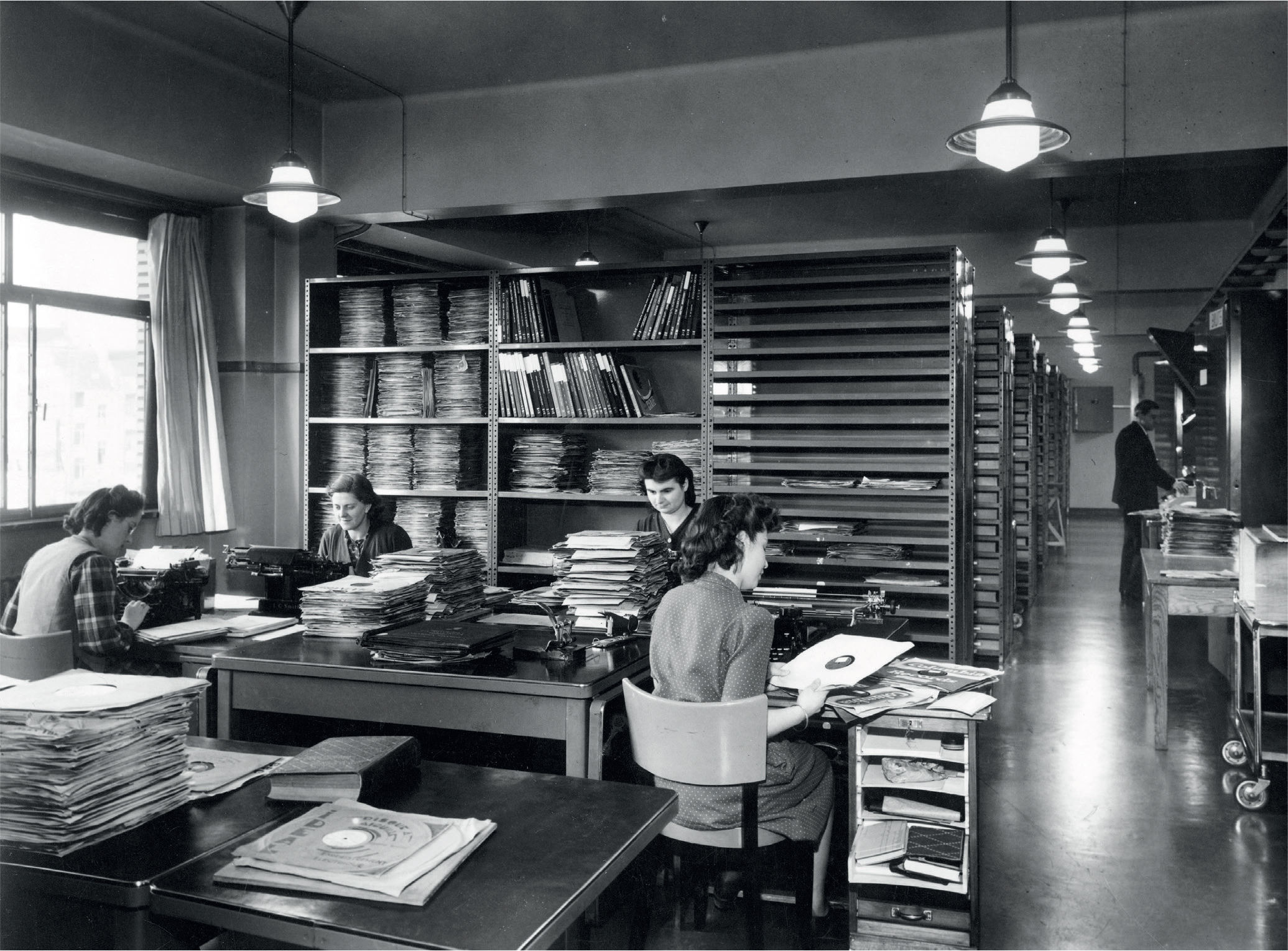
Figure 1
Photo depicting staff at work and behind them, rows of storage shelves for sound recordings in the NIR-INR recorded sound collection (discotheek), Brussels, Belgium. Dated as 1930s. Source: VRT Archive.
Radio broadcast services in the Netherlands during the 1930s were primarily monolingual and decentralised, with the four main broadcasters all concentrating their operations at studios in Hilversum.25 One other important difference is that there was a stronger continuity of staff working in recorded sound, library and archival roles in the Dutch broadcast system across the 1930s to 1950s, including the war and occupation period.26 At the VARA (Vereeniging van Arbeiders Radio Amateurs, or Association of Worker Radio Amateurs), the first production of ‘own recordings’ started in 1933, while a recorded sound librarian (discothecaris) was appointed in 1932, who was also responsible for preparing commercial recordings for special request programmes.27 The larger AVRO (Algemeene Vereniging ‘Radio Omroep’) station appointed a staff member to the recorded sound collection in 1934, who was responsible for the largest recorded sound collections and facilities of all broadcasters, and housed in the station’s new studio complex built 1934-1936 [see Fig. 2].28 While no pre-war catalogues are available for the recorded sound collections, the AVRO gramophone department published a series of articles in 1936 devoted to the growing importance of ‘own recordings’ for their programmes starting from 1933, and outlining the various disc formats (black wax, cellulose-covered aluminium and zinc, gelatine-covered glass) they had used for recordings and ‘still lie in our archive.’29 In this context, the author notes that the AVRO preserved the recordings in a ‘special cupboard’ for which the recordings were numbered, classified and stored horizontally.30 During the Dutch pre-mobilisation in 1939-1940, L.H. Waterbeek, an early-career sound technician, was given the official task by AVRO director Willem Vogt to reorganise the recorded sound library. As Waterbeek later recalled in an oral history interview, the AVRO ‘was the first [Dutch broadcaster] to have [their in-house sound collections] well organised. A flood of records then came in from the other broadcast organisations, and an extensive card system was created.’31 The AVRO clearly had a growing sense of being in possession of historically valuable original recordings, and the increasing growth of the recorded sound collection contributed towards introducing improved organisation with the aid of an index card system.
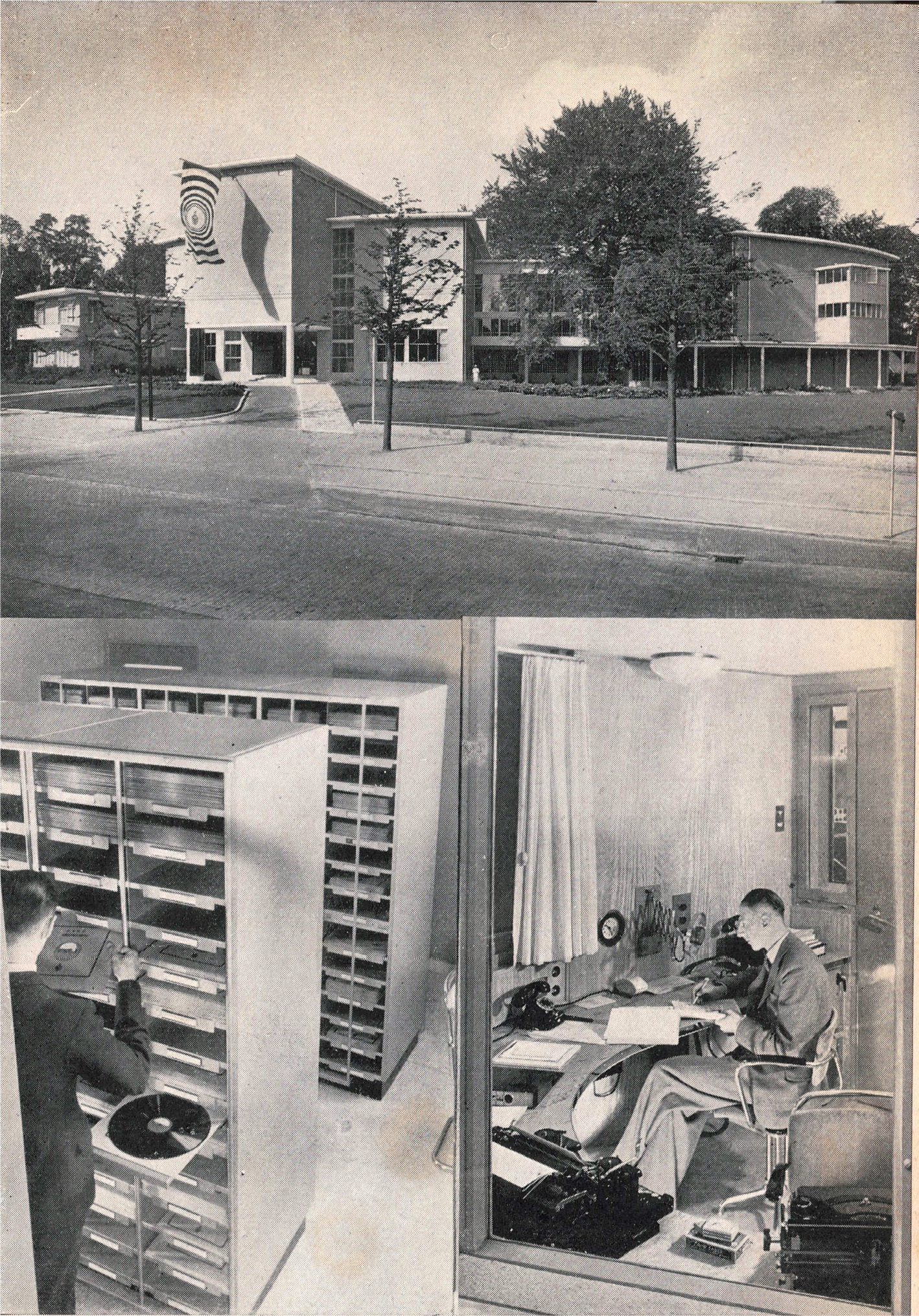
Figure 2
AVRO’s studio complex in Hilversum, The Netherlands (top), the recorded sound collection (bottom left) and the announcer Guus Weitzel preparing a programme (bottom right). Source: J.J.L. van Zuylen, Encyclopaedie voor Radio-Luisteraars (Baarn: Schuyt, 1939), 16-17.
Impact of Wartime Occupation on Recorded Sound Collections (1940-1944/45)
Following Britain and France’s declaration of war on Germany in September 1939, broadcast organisations in both Belgium and the Netherlands expressed concerns about an imminent attack and during the subsequent period of the mobilisation, starting from May 9-10, 1940, a number of crucial developments can be observed. In the Netherlands, broadcasters received warnings to restrict criticism of Germany in their programming, while at The Hague offices of the Radio Board (Radioraad) an emergency studio had been established from autumn 1938 for the intended purpose of communicating to the Dutch population in the event of war with Germany. With the outbreak of war on May 10, 1940, personnel at the VARA started to burn archive materials fearing that German occupiers may get hold of materials documenting involvement in the Labour Wireless International organisation and anti-fascist campaigning within socialist radio clubs.32 At the AVRO, starting from May 1940 coveted historical speeches by Dutch royal family members were initially hidden under a lift, and once they were discovered there, a plan was developed for records ‘at risk’ of confiscation (and destruction) to be copied at night by a sound engineer and then taken out of the building for safekeeping by trusted broadcast personnel.33 This reflects a conscious effort to safeguard radio recordings with perceived national heritage or cultural value in the context of occupation, including both historical radio speeches and commercial music recordings. In the case of Belgium, the national radio network was used for military announcements during the mobilisation, and with the fall of Belgium’s defences in May 1940, NIR-INR staff helped to destroy their transmitters, while several radio reporters continued to broadcast to the Belgian population from improvised transmitters in northern France and, finally, in Paris, until its fall on June 14, 1940. Upon occupation, Belgium was placed under German military administration between May 1940 and September 1944, while the Netherlands was assigned a civilian governor by the German occupiers.
Prior to the occupation, Dutch military personnel had already destroyed the Hilversum transmission tower on May 13, 1940. When the surrender agreement was signed on May 15, propaganda troops who had advanced along with German military and been designated with the task of taking over central governance of Dutch radio arrived in Hilversum at the AVRO studios.34 Under the leadership of Karl Gunzer, the radio propaganda group arrived with the expectation of finding all stations destroyed, and had equipment for setting up a temporary transmitter.35 As part of these preparations, the group brought a collection of roughly 1,000 RRG discs, including pre-recorded Dutch language programmes, which had been prepared prior to the invasion, and would have been sufficient for two weeks of radio programming. Having initially established itself in the AVRO buildings, the group set up its own offices a week later, in a nearby Hilversum villa, and was subsequently renamed as the Rundfunkbetreuungsstelle (radio supervision unit). The head of the AVRO recorded sound collections, Bep van den Brink, noted that within the radio station, she mainly feared the Dutch National Socialist party representatives (Nationaal-Socialistische Beweging, or NSB) who came to inhabit station management positions, and sought to catch out staff members like herself for not following protocol. Leading a team of 23 staff members, Van den Brink was one of the few heads of department who was a young woman. Even though she was under suspicion for and eventually fired on the grounds of ‘insubordination’ in 1944, she later noted that she was likely tolerated until then because “radio broadcasting was dependent on commercial music discs and audio recordings” and she was an experienced employee who knew the ropes.36
In Brussels, the NIR-INR was dissolved by the Germans forces in 1940, with two new radio services now operating under the auspices of Sender Brüssel (Radio Brussels) – with many of the same staff members – with broadcasts in French (Radio Bruxelles) and Flemish (Zender Brussel).37 In a similar manner to the invasion preparations for the Netherlands, roughly 570 RRG shellac records with musical performances were brought from Germany, located in the vaults and catalogue entries of the Flemish VRT archive today with the label ‘Deutscher Musik’ (German music). These recordings are mainly dated 1939-1940 and are understood to have been deposited at the NIR-INR buildings soon after the establishment of the military administration for the purposes of making musical programmes with German content.38 As such, new German-produced recordings were added to radio sound collections in German-occupied Europe, along with the ongoing recording of programmes produced by the occupied radio stations and added to the existing recorded sound collections.
The above developments are reflective of how national broadcast systems in occupied Europe were reframed as nodes within Germany’s extended ‘world radio’ network.39 In both Belgium and the Netherlands, a large number of recordings were made in the context of radio broadcast production under German occupation, with Magnetophone tape recording devices frequently used for production purposes, in addition to various disc formats. It remains difficult to easily pin down the exact number of recordings made within broadcasters under occupation, also in part due to the complicating institutional factor, in the Dutch case, of the new centralised structure of a national radio (Rijksradio–De Nederlandsche Omroep) from March 1941, which officially ended the independent status of the four large broadcasters in Hilversum.40 In Brussels, the CegeSoma research centre holds an extensive archival inventory of historical sound recordings remaining from the period of Sender Brüssel, consisting of roughly 1,200 French-language discs, roughly 1,800 Flemish-language discs, and 500 German-language discs, with both in-house disc labels and those for the Reichssender Stuttgart radio station.41 The use of ‘standard procedure’ for the registration of sound recordings in the radio station in Brussels is underscored by the use of a German-language form for controlling disc creation and documentation [see Fig. 3]. This means that not only were the two Belgian occupied stations predominantly using German sound recording technologies, but also the overall workflow for creating, documenting and classifying recordings had been reorganised in line with German guidelines and supervision.42
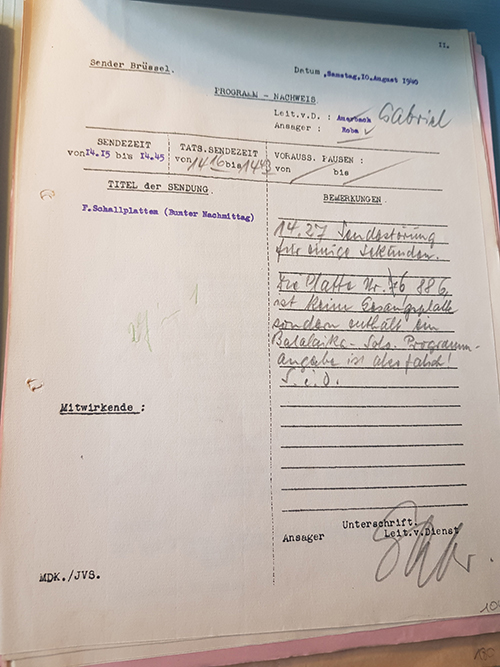
Figure 3
German-language standard form used for registering radio sound recordings including reference to a system of disc numbers, dated August 10, 1940, for the Flemish-language broadcaster Zender Brussel during the German occupation, in Brussels, Belgium. Source: CegeSoma Brussels, file no. AA33 19/09/40.
Aside from the addition of German RRG recordings to existing recorded sound collections, it is crucial to attend to the context of confiscations and looting by the occupiers. While there was a broader context of radio-related confiscations, such as civilian radio receivers,43 for the specific case of radio sound collections, files held at the German Bundesarchiv can elicit some insight into the role of radio archivists in Berlin during the period 1941-1942. An internal memo from May 1941 explains that the SS unit leader Joseph Bosch was assigned the task, on behalf of the Propaganda Ministry, to ‘secure records that are politically and historically important for the Reichsschallarchiv (national sound archive)’ in cooperation with the German ‘propaganda departments’ in the Netherlands, Belgium, and France.44 Half a year later, in correspondence between Propaganda Ministry representative Dr Erich Mehne and the RRG radio sound archivist Konrad von Brauchitsch, it was noted that the RRG’s archival duties had grown substantially due to the recent ‘significant new tasks that have come about due to the acquisition of sound recordings from previously enemy broadcasters, for which there should be a larger amount included in the budget.’45 In a subsequent report as part of a ministerial briefing, in April 1942, Mehne offered a summary of the recent activities of the Reichsschallarchiv, which included an account of its mandate concerning ‘the acquisition of looted materials from the occupied territories.’46 The materials were summarised here as between 8,000 and 10,000 discs (Platten) and acetate discs (Folien) from France, 3,000 discs from Yugoslavia, 2,000 discs from Russia, a small amount from Belgium, Luxembourg, and the Netherlands.47
Since the above correspondence ends by 1943, it remains difficult to ascertain the exact further developments in the confiscation and looting of recorded sound items from Belgium and the Netherlands as well as elsewhere in occupied Europe. However, the total size of recorded sound materials sent to Germany would suggest that the confiscated materials were most likely a combination of broadcasters’ ‘own recordings’ (music and spoken word content, such as speeches) and commercial music recordings. Since Mehne also pointed to a ‘backlog’ of work caused by the influx of discs, requiring the processing of the ‘loot materials’, and evaluation of their propaganda qualities,48 the available evidence would suggest that the radio archivists mainly focused on trying to process the high numbers of recordings created in the context of war reportage and an expanded German Reich Radio (Grossdeutscher Rundfunk), with looted recordings less of a priority.49 As a result, the confiscated materials were probably not processed or appraised by the archive, nor re-used in German radio at this time, and their survival after the war is not known.50 It seems likely that the ‘own recordings’ with spoken word content were most likely seized as having potential content of political relevance, whereas commercial music recordings that were seized may have been destroyed, although it appears that some banned popular music recordings were used as part of English-language propaganda programming directed towards British listeners.51
Post-war Organisation of Recorded Sound Collections (1945-1960)
The chaos of the immediate post-war situation meant that in both cases examined here there were delays and complications in resuming regular radio services, which also affected efforts to restore respective recorded sound collections. In terms of formal interactions, the Treaty of Brussels (signed by Britain, France, the Netherlands, Belgium and Luxembourg and ratified in 1948) was a key development in sparking discussions about collaborative broadcasting between the BBC and the ‘Benelux’ countries, with the BBC establishing its own ‘Western Union’ committee.52 Alongside this, the introduction of the UNESCO constitution in 1945 was also a key development, in particular its strong commitment to addressing wartime damage to cultural collections in Europe, and in directly supporting the formation of the International Association of Music Libraries (IAML) during 1949-1951.53 However, while Belgian and Dutch representatives were highly active in IAML and its ‘radio libraries’ division, there is little evidence of intensive cooperation or frequent disc exchanges between Belgium and the Netherlands, who were mainly engaged in a unilateral relationship in receiving relays or transcription discs from the BBC, in an expanded continuation of the more informal pre-war system.54 It is nonetheless instructive to examine how each country contended with the organisation of their collections in the wake of the occupation and end to the war.
In the Dutch case, Hilversum had been liberated by British forces on May 7, 1945, who found many of the station buildings plundered and emptied of their technical equipment. Later reports noted that only 20,000 sound recordings remained in the Hilversum radio buildings, some of which had been hidden by staff during the course of the war, and others permanently lost due to the confiscations noted above.55 Following the liberation in Hilversum, there was an initial predominance of the representatives of the Herrijzend Nederland station, which had broadcast from the liberated south in 1944-45 on the orders of the Dutch government-in-exile. Their intention to institute a single, centralised national radio was ultimately thwarted, as the pre-war broadcasters managed to gain support for a new model of a federated organisation for broadcasters instituted as a national radio union (National Radio Unie or NRU) in 1947, which included the AVRO, NCRV, KRO and VARA, and international services of Radio Nederland Worldwide (Wereldomroep). While the precedent for a ‘national broadcaster’ had already been established with the German-occupied radio from 1941, in the NRU model, technical services were centralised, yet each broadcaster retained its status as a separate institution, with their own fee-paying members and revenue from programme magazines.
In terms of the recorded sound collections, several historical accounts described the ‘chaos’ of the transition period of 1944-1947, with Herrijzend Nederland in charge of the recorded sound collections for radio production until usual services resumed. In the ensuing period, former sound collection head Bep van den Brink was initially enlisted to help reorganise the collections in May 1945, before being rehired as the head of the AVRO recorded sound collection (discotheek) in 1946 to 1947; she later described a continuation of the wartime system of index cards that were stored in books, and were also used to created lists to share with the Buma association for music authors and publishers.56 The subsequent head J. Bonda, along with 20 female colleagues, worked together on the recorded sound collections, which rapidly grew to a total of 100,000 discs by 1950, and were classified according to title, composer and performer, along with descriptions and notation of recording times.57 In 1947, all the broadcasters had agreed to loan their materials to the centralised recorded sound collection (NRU-Discotheek) that was managed within the AVRO building complex. In re-assembling the collections, the ‘radio heritage’ of the war also comprised the ‘Radio Oranje’ broadcasts from London and Radio Herrijzend Nederland (broadcasting from Eindhoven from September 1944), along with Allied-controlled radio broadcasts from Luxembourg and Belgium.58 The recordings were housed in cramped rooms and cellars of the AVRO studio buildings, among other dispersed locations.59 Compared with Belgium, the Netherlands was initially slower to introduce magnetic tape recording (with the Magnetophone), having made a stronger investment in producing disc-based ‘own recordings’ of music and spoken word programmes.60
In terms of other legacies of the German occupation, as late as 1955, the NRU-Discotheek was reported to be keeping their fragile sound recordings, such as the extremely flammable Philips-Miller tapes made in the 1930s, in a nearby bunker that the former German commander for Hilversum had commissioned for his private use [see Fig. 4]. The rationale given was that the bunker was an ideally climate-controlled environment, and relieved the library from their space constraints in the AVRO building.61 The rapid growth of the collections and high demand for music and spoken word recordings in radio production contributed to preparations with architects, starting from 1952, for a dedicated recorded sound collections building as part of nascent plans for a purpose-built complex in Hilversum, which was inspired by ‘Radio City’ buildings in New York and Los Angeles.62 While post-war articles started to refer to the existence of a ‘historic archive’ (Historisch Archief), mainly consisting of recordings of spoken-word programmes, the first dedicated curator was appointed only in 1958: former journalist and radio maker Paul de Waart, who declared his intention for proper documentation and organisation of recordings according to a concept of a ‘sound archive’ (Geluidsarchief), set in contrast to a previous radio production ethos of a lending library.63
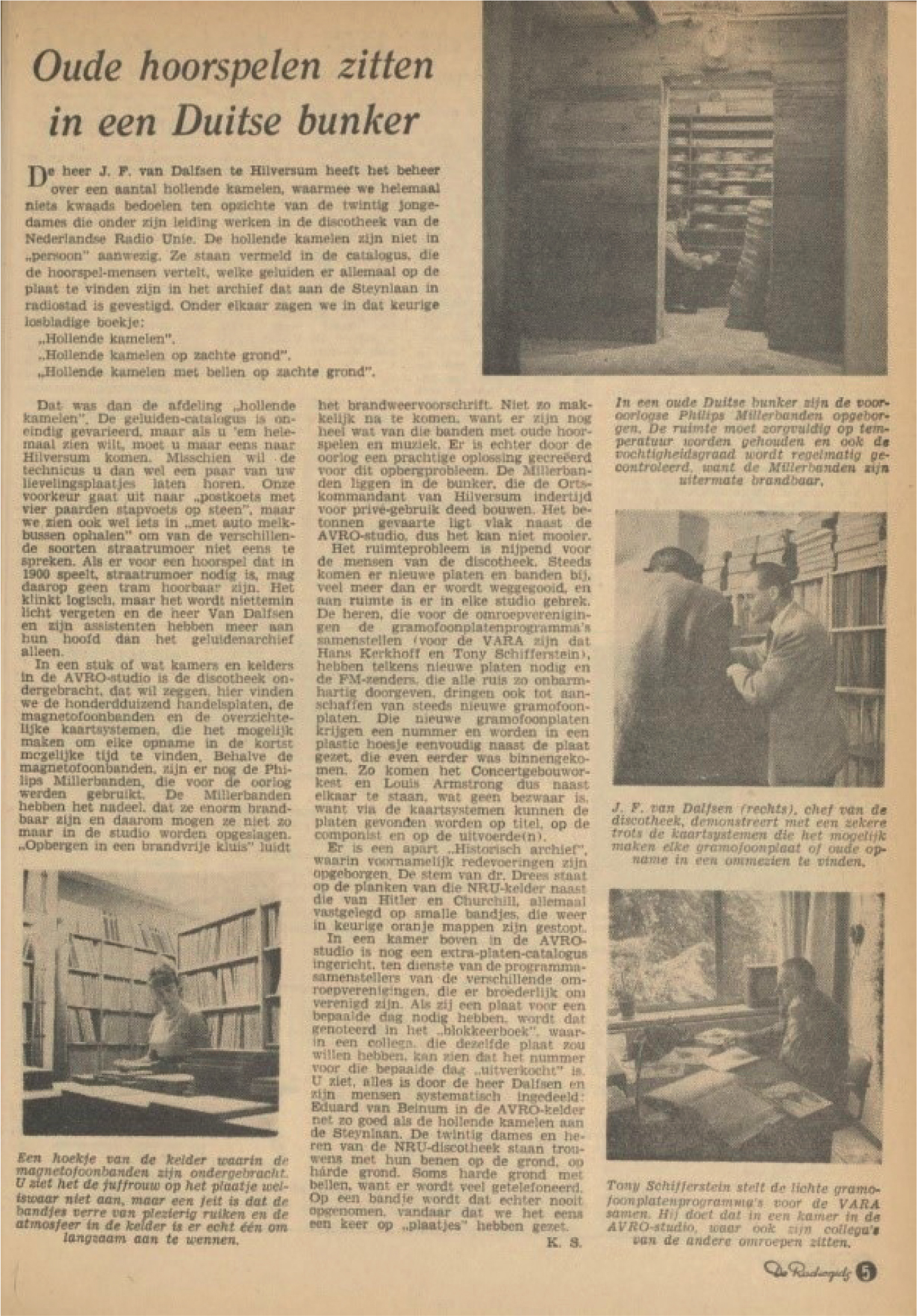
Figure 4
The former German bunker used by the Dutch national radio union soud archive to keep historical tape recordings cool (image top-right), along with images of the recorded sound collections (NRU-Discotheek) located in the AVRO building, Hilversum, The Netherlands. Source: K.S. “Oude hoorspelen zitten in een Duitse bunker.” Radiogids 25 no. 42 (June 1955): 5.
Similar to the Netherlands, the resumption of radio services until a new mandate for radio in September 1945 were difficult in Belgium due to tensions between the BRNO organisation (largely made up of representatives endorsed by or sent from London), pre-war NIR-INR broadcasters, and some 500 staff members who had remained working during the occupation.64 As noted in the opening to this essay, both the archival catalogues for programmes created in London and the music and sound library inventories in Brussels showed the influence of English and German-language classification terms for the recordings. Even though some damage to disc and tape materials was in evidence at the Brussels studios of NIR-INR in September 1944 [see Fig. 5], spoken-word recordings made in French, Flemish and German between 1940-1944 were subsequently requisitioned as evidence for the General Prosecutor formally investigating wartime radio collaboration in 1945-46.65 In NIR-INR’s archival documentation we can find evidence of a heightened sense of the recorded sound collections as a site of valuable heritage. An annual report covering the period 1944-46 noted the high number of recordings lost during the occupation, and that extremely scarce resources led to US and British donations in order to allow gramophone music programmes to be made.66 In this context, the NIR-INR commissioned an archives survey in 1945 to account for which recorded sound materials had been confiscated or destroyed during the period.67
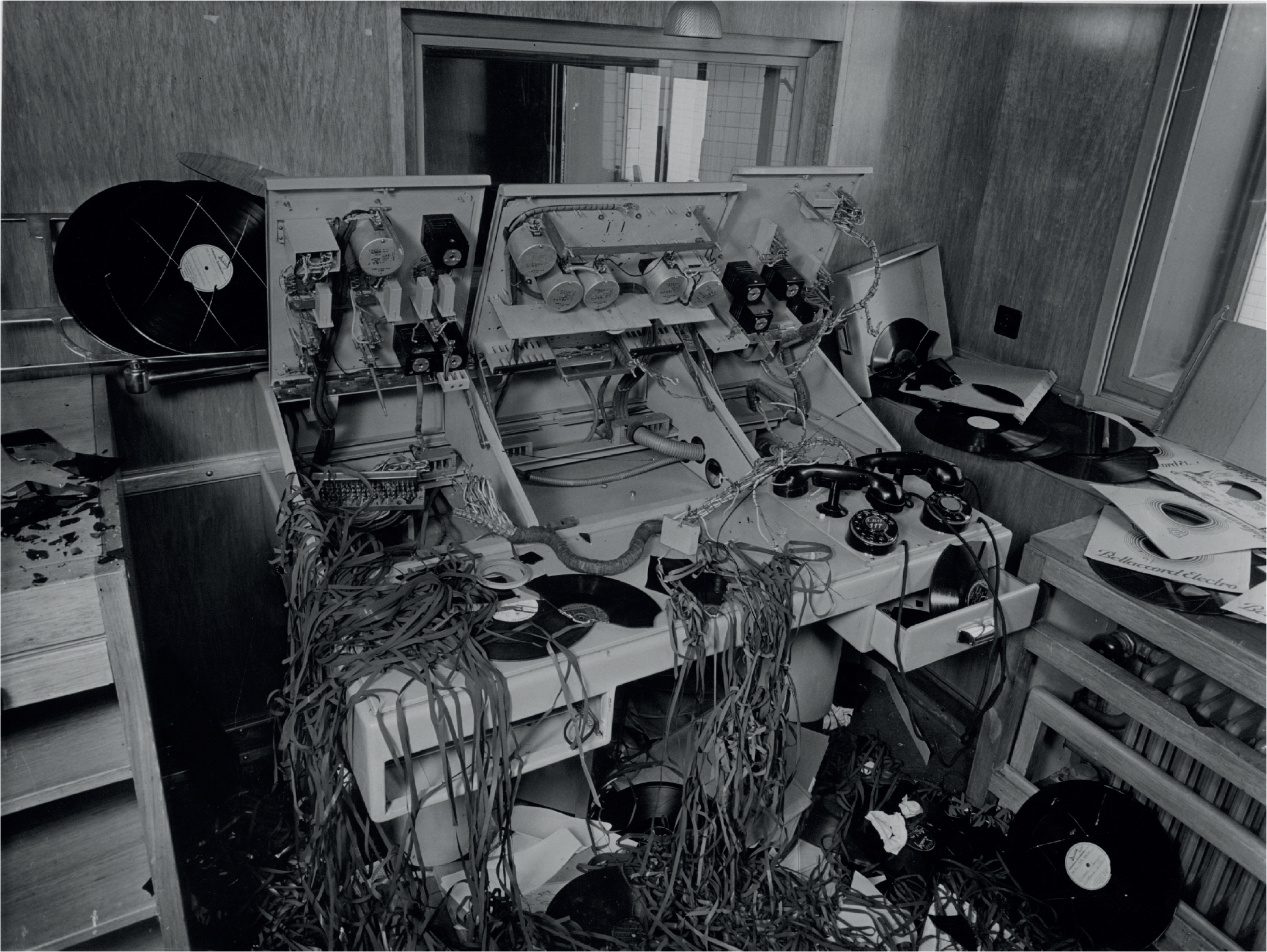
Figure 5
Damage at studio facilities at the NIR-INR building in Brussels, Belgium, including deliberately scratched and broken discs and unreeled tapes, ca. September 1944. Source: VRT Archive.
Soon after this, in 1946, a ‘Permanent Committee’ for the recorded sound collections was established, led by sound engineer Georges Gourski (later head of technical services for Belgian radio), and highly invested in establishing best practices for preserving ‘own recordings’ of spoken word and musical programming.68 In terms of re-assembling different parts of Belgium’s ‘wartime radio’ for the historical collection, the recorded sound collection department sourced the recordings from the Radio Belgique/Radio België services in London that had been documented in handwritten logbooks, as well as some limited documentation for Belgian-language services from Léopoldville (then Belgian Congo) and New York (Belgian Information Center).69 This also included broadcasts made by Jan van Overloop, who joined Allied forces in Luxembourg between 1944-45 to create programmes addressing Belgian prisoners and slave labourers in Germany, which is today still prioritised as an important ‘milestone’ in Belgium’s radio history.70 In 1952, the Permanent Committee reported that recordings of music as well as programmes made with temporary transmitters in northern France in May-June 1940 had been brought back from Paris by then NIR-INR director Jan Boon, for which an inventory shows more than 50 recordings listed, with a number of these put aside in a separate archival box ‘HIST 820-849’ that indicates their privileged status as ‘historical’ within the larger collection [Fig. 6].71 In general, the archival documentation emphasises the strong uptake of tape recordings in programme production from the late 1940s, with some archival materials in the radio collections from the late 1940s being selected for archival preservation by being re-recorded from disc onto tape.72 Moreover, catalogues for the late 1940s show a huge influx of commercial music recordings (from the US, UK and elsewhere in Europe), along with off-air recordings of BBC transmissions and high-quality transcription discs.73
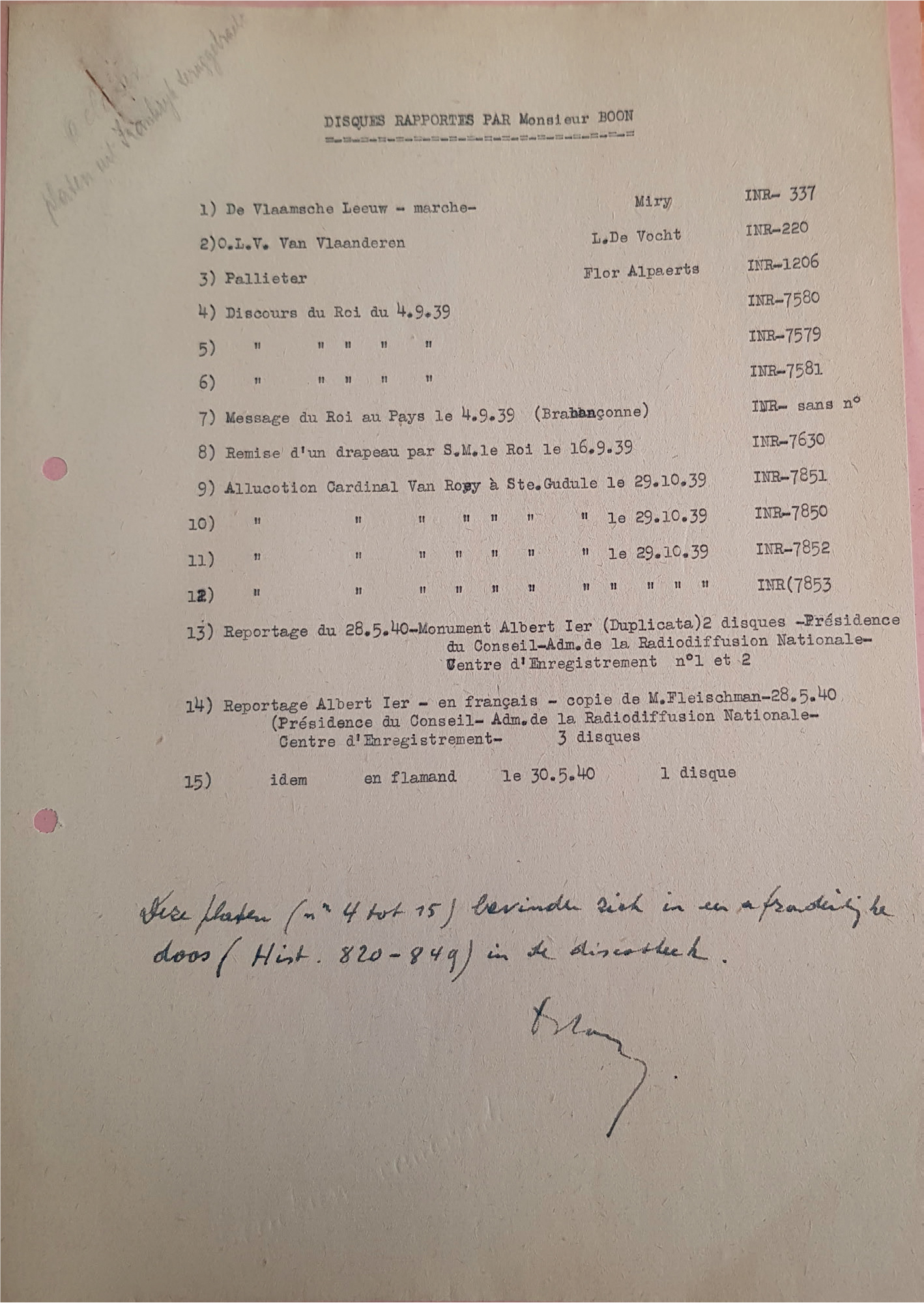
Figure 6
Archival list of the records (May-June 1940) that NIR-INR director Jan Boon brought back from France to the broadcast house in Brussels, Belgium. Source: National Archives of the Belgische Radio en Televisie (BRT), Inventory I 503, file no. 90.
Conclusion
The previous section has examined the immediate and long-term effects of military conflict and occupation on collections that were partly damaged, looted or dispersed, and how the awareness of the Second World War as ‘historical’ also fuelled subsequent attempts to recompile partly dispersed recorded sound materials from multiple radio services in a European and international framework. Indeed, the final examples discussed above underscore how the conditions of post-war restoration and centralisation of recorded sound collections, in combination with a growth in size and increased demand for re-use in radio programmes, contributed to more institutional attention to the historic significance of radio recordings, and the perceived need for dedicated spaces for recorded sound collections, as evidenced by new purpose-built facilities planned for Hilversum in the early 1950s (although not in operation until 1968).74
As such, this article has sought to trace the growing ‘archive-mindedness’ among radio broadcasters across the 1930s to 1950s, during which time recorded sound collections grew substantially in size and scope, and came to include ‘own recordings’ of music, spoken word, and sound effects, fuelled by new types of programming increasingly reliant on recorded sound content such as actuality reportage and radio plays. The analysis has largely been comparative in assessing how Belgian and Dutch broadcasters respectively created, managed and used these growing collections, and how they were situated within new, purpose-built radio facilities from around 1930 onwards. This effort to establish international comparison was extended to the question of the common experience in Belgium and the Netherlands of German military occupation. This attention has uncovered how, upon arrival, German occupiers added new materials to broadcasters’ recorded sound collections, while also confiscating recordings, and instituting new systems for the management of recorded sound collections. The legacy of broadcasts directed to Belgian and Dutch listeners from London and other locations between 1940 and 1945 add further sources of recorded sound heritage from the Second World War in both countries. The comparison of the two cases also casts light on the key differences; whereas in Hilversum the four main broadcasters created separate recorded sound collections that were ultimately combined at the AVRO building, the once unified recorded sound collection in Brussels served two (and later three) language-based services, which, in turn, were formally split into three separate divisions in 1960, with the music library and recorded sound collections managed as part of unit for joint services to the two new broadcasters, along with a decision to start with a new archival numbering.75 While the presence of a growing ‘archive awareness’ has been largely treated in national comparison, it should be necessarily contextualised in line with international developments in the post-war era, such as UNESCO cultural heritage funding, best practices in professional organisations like IAML, and by a growing commercial market supplying new archival storage and preservation products.76
The account presented here is the result of a process of piecing together insights from an uneven source base, in part due to the rapid institutional changes and various forms of damage to archival artefacts and documentation during and after the Second World War, and in part due to a weak track record in both countries in developing and maintaining a strong mandate for print-based documentation of radio broadcasting. This paper has explicitly sought to craft a narrative that re-inserts the significance of recorded sound collections into the existing treatment of early Belgian and Dutch radio, across the interwar, war and post-war periods, while also pointing to the gaps and incomplete documentation that scholars must contend with when seeking to trace the archival lives of radio, and the process by which radio came to be understood as a significant site of history and shared heritage.
Acknowledgements
This publication is part of the project TRACE (Tracking Radio Archival Recordings in Europe, 1930-1960), with project number 016.Vidi.185.219, which is financed by the Dutch Research Council (NWO). Special thanks to Brecht Declercq at meemoo (formerly VIAA); Christine Fettweis, Klaas Janssens, Karin De Greeve, Bárbara Sarmentero and Koen Renders (VRT); Bert Hogenkamp, Jasper Snoerens and Bas Agterberg (Beeld en Geluid); and Rolf Schuursma (former sound archivist); and to Erica Harrison, Corinna Kaiser, and all the participants of the TRACE workshop in October 2021 for their constructive feedback.
Notes
[1] “Inventaris van de uit de Discotheek gestolen platen tijdens de bezetting”, 1945, Inventory I 503, no. 2958, Archives of the Belgische Radio en Televisie (BRT), National Archives of Belgium.
[2] “Registre et liste des disques enregistrés”, 1943–44, Office de Radiodiffusion Nationale Belge, fonds AA1690, Registre et liste des disques enregistrés (avec textes) (1943–44), 1941–1944, CegeSoma (National Archives of Belgium).
[3] Peter Fritzsche, “The Archive and the Case of the German Nation,” in Archive Stories: Facts, Fictions, and the Writing of History, ed. Antoinette Burton (Durham: Duke University Press, 2005), 184–208. For a critical take on print documentation of radio history in Belgium and the Netherlands respectively, see: Jean-Claude Burgelman, “Problemen in verband met consultatie en wetenschappelijke relevantie van het door BRT en RTBF bewaarde omroeparchief in België,” Bibliotheek en archiefgids 64 (1988): 211–220; Flore Plisnier, Inventaire des archives de la Radiodiffusion Télévision Belge (RTB), 1928–1985 (Brussels: Algemeen Rijksarchief, 2017), 19–38; Jasper Snoeren, “Archiving the Airwaves: Accountability of the Dutch Public Broadcasting System” (MA thesis, University of Amsterdam, 2016), https://scripties.uba.uva.nl/search?id=616935.
[4] In terms of online sources, Dutch radio programme magazines and newspapers have been consulted for the period 1930–1960 via the Delpher digital database (www.delpher.nl), while the historical annual reports of the Belgian National Institute of Radio have been accessed in digital form by the Flemish VRT broadcaster (www.vrt.be/nl/aanbod/historiek/tijdlijn/jaarverslagen/). For interviews with former Dutch broadcast employees, see: https://wiki.beeldengeluid.nl/index.php/Oral_History_omroepgeschiedenis.
[5] In the period following 1918, the major company for developing valves and transmission facilities, NSF, chose Hilversum as its main base, as did the first Dutch broadcaster, Stichting Hilversumsche Draadloze Omroep (forerunner to the later fusion forming the AVRO or Algemeene Vereniging ‘Radio Omroep’), followed by the other major broadcasters. See: Anton Kos, Historische Atlas van Hilversum: Van esdorp tot mediastad (Amsterdam: SUN, 2013), 46.
[6] See, for instance: Suzanne Lommers, Europe–On Air: Interwar Projects for Radio Broadcasting (Amsterdam: Amsterdam University Press, 2012); Alexander Badenoch, Andreas Fickers, and Christian Henrich-Franke, eds. Airy Curtains in the European Ether: Broadcasting and the Cold War (Baden-Baden: Nomos, 2013); Carolyn Birdsall and Joanna Walewska-Choptiany, “Reconstructing Media Culture: Transnational Perspectives on Radio in Silesia, 1924–1948,” Historical Journal of Film, Radio and Television 39, no. 3 (2019): 439–478.
[7] Golo Follmer and Alexander Badenoch, “Introduction,” in Transnationalizing Radio Research: New Approaches to an Old Medium, ed. Golo Föllmer and Alec Badenoch (Bielefeld: transcript, 2018), 12–29, specifically 12. My own contribution to this same volume, “Worlding the Archive,” treats the emergence of radio archival practices in Germany and Great Britain with a transnational lens.
[8] Christoph Hilgert, Marie Cronqvist and Hugh Chignell, “Introduction: Tracing Entanglements in Media History,” Media History 26, no. 1 (2020), 1–5, specifically 2; Michele Hilmes, “Entangled Media Histories: A Response,” Media History 23, no. 1 (2017): 142–144.
[10] The AVRO (Algemeene Vereniging ‘Radio Omroep’ or General Association for ‘Radio Broadcasting’) considered itself as having a broad ‘liberal’ outlook. The socialist-oriented station was the VARA (Vereeniging van Arbeiders Radio Amateurs, or Association of Worker Radio Amateurs), established in late 1925. In addition, three religious broadcasters were established in the period 1924–1926: KRO (Katholieke Radio Omroep, or Catholic Radio Broadcaster), the NCRV (Nederlandse Christelijke Radio Vereniging, or Dutch Christian Radio Association) and the VPRO (Vrijzinnig Protestantse Radio Omroep or Liberal Protestant Radio Broadcaster). For the pillarisation of Dutch society that was reflected in the organisation of the media landscape, see: Huub Wijfjes, De radio: Een cultuurgeschiedenis (Amsterdam: Boom, 2019). This article’s treatment of sound archiving will primarily treat recording and archiving activities at the AVRO (which had the largest collections and came to manage joint holdings in the 1940s and 1950s); further research is needed to flesh out a fuller picture of recording and archiving activities at all Dutch broadcasters during this period.
[11] League of Nations, Intellectual Cooperation Organisation, Executive Committee, Paris, December 1st and 22nd, 1936, C.I.C.I.Com.Ex./79 (Geneva: League of Nations, 1936), 1, registry file 5B, R-3999, file 27006/1658, League of Nations, cited in Lommers, Europe–On Air, 215.
[12] For the compilation programmes of national broadcasters and new year greetings in 1937 and 1938, see “Ein glückliches und gutes neues Jahr der ganzen Welt: europäische Ringsendung” (catalogue number 9264 IPA, matrix numbers 33988 to 33994), in Schallaufnahmen der Reichs-Rundfunk G.m.b.H von Anfang 1936 bis Anfang 1939 (Berlin: RRG, 1939), 765–767; “Neujahrssendung 1939” (catalogue number 5717 IPA, matrix numbers 49575 to 49579), in Schallaufnahmen der Reichs-Rundfunk G.m.b.H, 280–281.
[14] An important site for the international circulation of materials from the recorded sound collections was with the radio station in Léopoldville (now Kinshasa), capital of the Belgian Congo (now Democratic Republic of the Congo), for which a shortwave service from Belgium had been established starting from 1931.
[15] See, for instance: NIR Jaarverslag 1939: Vlaamsche Uitzendingen (Brussels: NIR-INR, 1939), 28, 62, https://www.vrt.be/nl/aanbod/historiek/tijdlijn/jaarverslagen/#30. Despite the relative high cost of acquiring such disc recordings, the NIR-INR annual reports for the 1930s suggest that these purchases and exchanges grew substantially between the early and late 1930s, particularly in the context of ‘newsworthy’ diplomatic tensions in Europe, which is evidenced in NIR-INR’s order of BBC transcription discs of key speeches related to the ‘Munich crisis.’ On BBC’s transcription services, see: Simon J. Potter, Broadcasting Empire: The BBC and the British World, 1922–1970 (Oxford: Oxford University Press, 2012), 116–117, 156–167.
[17] A good comparison in this regard is Radio Luxembourg, a commercial enterprise largely backed by French investors during the 1930s, and which did not narrowly conceive of its operations in terms of national radio culture, nor were its operations subject to a concept of centralised bureaucratic organisation. For a comparison with Germany and Great Britain in this period, see: Carolyn Birdsall, “Divisions of Labour: Radio Archiving as Gendered Work in Wartime Britain and Germany,” International Yearbook of Women’s History 37 (2017): 107–133.
[18] The official names for the institute were Nationaal Instituut voor de Radio-Omroep (NIR) and Institut national de radiodiffusion (INR). In 1937 seperate Flemish and French services were introduced. A publicly-funded studio was established in Eupen for German-language services in 1938, for the Deutschsprachigen Rundfunkvereinigung Belgiens (DRB), which was relocated to Brussels after September 1939 due to the outbreak of the Second World War. See: “Inventar Archivbestand Belgischer Rundfunk (BRF),” https://search.arch.be/fr/rechercher-des-archives/resultats/ead/index/zoekterm/VRT+rechtsvoorgangers/eadid/BE-A0531_716025_801274_FRE.
[19] Mark Delaere et al., Het geheugen van de geluidsfabriek: De Vlaamse symfonische muziek in de voormalige muziekbibliotheek van de openbare omroep, 1930–1960 (Leuven: Leuven Universitaire Pers, 2004), 156, 162.
[20] Elza Vehent, “Belgische Radio en Televisie,” Phonographic Bulletin 37 (1983): 21–23, specifically 21. Archival photos suggest a predominance of female staff working with the collection of commercial music recordings, with Hermina Herbosch (1900–1941) described as having the task as a ‘recorded sound programmer and organizer of the recorded sound collection [discotheek].’ See the caption on a framed photo of Herbosch (1900–1941) on display at the VRT Archive in Brussels, which was intended as a dedication to Herbosch following illness and her death in 1941.
[21] Brecht Declercq, “Geschiedenis van het woordarchief van de VRT” (2013), 1, internal memo, VRT Archive.
[22] Jaarverslag van het N.I.R.: Dienstjaar 1938 (Brussels: F. Van Buggenhoudt, 1938), 150, https://www.vrt.be/nl/aanbod/historiek/tijdlijn/jaarverslagen/#30.
[25] The AVRO kept its main offices, including its original smaller studio, in Amsterdam, yet during the 1930s and early 1940s all four major broadcasters moved to new buildings with improved and purpose-built facilities.
[26] To give an example: Henk (H.J.) Huisman (born 1919) started working for the KRO’s recorded sound collection (KRO-Discotheek) in 1934, for which he assembled gramophone disc programmes, up to, during and after the war. See: https://zoeken.beeldengeluid.nl/program/urn:vme:default:program:2101608100081203431.
[27] Willem Ciere, an arranger and composer, who was designated as the caretaker of the VARA gramophone record collection, a role he carried out through to his retirement in 1948. Starting from May 1934, Ciere also started to work on a weekly Saturday evening musical request programme called “People Ask and We Play… Gramophone Records that are Searched for” – which relied on the recorded sound library to assemble the records requested by listeners, and remained on the VARA through the 1930s, into the occupation, and up to the early 1950s.
[28] The AVRO studio complex was designed in the modern ‘Neues Bauen’ style and fitted out according to acoustic design principles and soundproofing. See: Max Cramer, “AVRO-Algemene Vereniging Radio Omroep,” in Kathedralen en Luchtkastelen van de Omroep in Hilversum, ed. Arno Weltens, et al. (Zwolle: Waanders, 2002), 110–191.
[29] In addition, the Philips-Miller optical film sound recording was used during this period, and with the rapid growth of reportage programming in this period, Dutch radio stations also commissioned outdoor broadcast vans to be built for mobile disc recording. See: Marcel [M.L.] van Overeem, “Hoe de A.V.R.O.-huisschijf in huis kwam: Een boeiende vertelling van de ontwikkelingsgang van de eigen opnamen,” Radiobode 9, no. 15 ( April 10, 1936): 10–11.
[30] Marcel van Overeem, “Hoe de A.V.R.O.-huisschijf in huis kwam: Meer bijzonderheden over het zelf-opnemen van gramofoonplaten,” Radiobode 9, no. 25 (April 19, 1936): 12–13, specifically 13.
[31] See: L.H.H. Waterbeek (1913–?), oral history interview May 22, 1989, https://zoeken.beeldengeluid.nl/program/urn:vme:default:program:2101608090077979331. It is not clear from this interview whether or not all the activity described here took place prior to the German occupation in May 1940, but it seems likely.
[32] Where the AVRO organisation ended its contracts with Jewish performers in this period, the VARA, for instance, insisted on maintaining all contracts and including Jewish staff in programming until the forced dissolution of the station in March 1941. See: Huub Wijfjes, VARA: Biografie van een omroep (Amsterdam: Boom, 2009), 123, 125. For Labour Wireless International, see: The League of Nations database, http://www.lonsea.de/pub/org/583.
[33] For the activities of the head of the AVRO-Discotheek (recorded sound collection) Bep van den Brink (born 1916) between 1939 until her firing in July 1944, see: Bep van Heukelom-van den Brink, oral history interview, February 14, 1991, https://zoeken.beeldengeluid.nl/program/urn:vme:default:program:2101608090079256831. In the 1970s, this same account was narrated as a rescue of audio materials related to the Dutch royal family, music by Jewish composers and performers, and English, American and Russian musical recordings, and that these were almost all returned after 1945. See: Dick Verkijk, Radio Hilversum 1940–1945: De omroep in oorlog (Amsterdam: De Arbeiderspers, 1975), 449–451, 456–457, 475, 593.
[34] Hans van den Heuvel, Nationaal of verzuild: de strijd om het Nederlandse omroepbestel in de periode 1923–1947 (Baarn: Ambo, 1976), 66–67.
[35] Prior to this, Gunzer had briefly served as the director of the Breslau (now Wrocław) radio station (1937–38), and German-controlled Vienna radio (1938–39). See: Viktor Ergert, 50 Jahre Rundfunk in Österreich. Band I: 1924–1945 (Vienna: Residenz Verlag, 1974), specifically 179, 183. From June 1942, Gunzer was the new head of the Propaganda-Abteilung Belgien (Propaganda Department Belgium). See: Louis Fortemps and Roel Vande Winkel, “The German Military Propaganda Department Belgium (Propaganda-Abteilung Belgien) vis-à-vis ‘Cultures of Spectacle’ in Occupied Belgium (1940–1944),” Journal of Belgian History 52 (forthcoming).
[37] For the broader context of German-occupied radio in Belgium, see, for instance: Céline Rase, Interférences: Radios, collaborations et répressions en Belgique (1939–1949) (Namur: Presses universitaires de Namur, 2021).
[39] Alfred-Ingemar Berndt, “Der Krieg im Äther: Ein Jahr deutscher Weltrundfunk,” October 26, 1940, CegeSoma Brussels, file no. AA570.
[40] While assurances were given to the broadcasters that they could continue their programming and would not be obliged to broadcast National Socialist propaganda, after being officially disbanded in March 1941, their programme magazines were also ended starting from January 1, 1942. See: Van den Heuvel, Nationaal of verzuild, 10.
[41] The German-language content spans recordings of German “OKW” military announcements through to German-language programming pertaining to Belgium, which appears to have been used for both domestic purposes (targeting German speakers in Belgium) and as recorded broadcast content intended for re-use in German radio. See: “Radio Bruxelles Zender Brussel Archives,” CegeSoma, https://www.cegesoma.be/en/radio-bruxelles-zender-brussel-archives; Florence Gillet, “La collection d’archives radiophoniques du Cegesoma” (2014), internal report, CegeSoma.
[42] See, for instance: the German technical documentation regarding sound recordings, dated 1940–1942 in file 2465, Inventory I 500, Archief van de Belgische Radio en Televisie, State Archives of Belgium, Brussels.
[43] For the documentation of large-scale radio receiver confiscations in the Netherlands between 1941–1944, see, for instance: Gidi Verheijen, Het Radiotoestel in de Tweede Wereldoorlog (Buchten: E.J.M. Verheijen, 2009).
[44] Memo, May 29, 1941, R55/1247, Bundesarchiv Berlin. A subsequent document offered a detailed overview of how Bosch carried out this work, spending roughly six days in Hilversum, four days in Brussels, seven days in Paris, and one day in Luxembourg. See Memo, July 15, 1941, R55/1247, Bundesarchiv Berlin.
[45] Letter [Erich] Mehne to [Konrad] von Brauchitsch, December 5, 1941, R55/1247, Bundesarchiv Berlin.
[46] “Tätigkeitsbericht des Reichsschallarchivs,” January 15, 1941, 3, R55/1247, Bundesarchiv Berlin. In January 1942 a new head of the RRG sound archive submitted a report on the Reichsschallarchiv in which he offered a summary of the materials confiscated by Bosch, and noted that during the summer of 1941, he had arranged for ‘the transport of a large quantity of records, propaganda material from Paris, as politically-important material that has been brought to Amsterdam to be copied to acetate discs (Folien) in the coming period, and sent to the RSA [Reichsschallarchiv].’ For more on Dr Fritz Wilhelm Pauli (head of the RRG sound archive 1942–1945), and his post-war career as a radio music archivist in West Germany, see: Corinna R. Kaiser and Carolyn Birdsall, “Von der Kardex-Kartei zur Einführung der Datenverarbeitungsmaschine: Die archivarische Praxis der ersten 20 Jahre des Deutschen Rundfunkarchivs,” Rundfunk und Geschichte 46, no. 1–2 (2020): 11–25.
[47] Report by [Erich] Mehne, April 8, 1942, 1–3, specifically 2–3, R55/1247, Bundesarchiv Berlin. Due to the multiple languages on the confiscated recordings, Mehne noted that the collections could be assessed by engaging university students studying foreign languages and foreign prisoners of war in Berlin.
[49] In a talk delivered in September 1942, it was estimated that 2 million RRG shellac discs had been cut by the national broadcaster thus far, and in 1941 alone approximately 150,000 wax discs and 86,000 acetate discs, not including the recordings made by propaganda units (Propagandakompanien). See: Herbert Dominik, “Hochwertige Schallaufzeichnung und Dokumentation,” in Die Dokumentation und ihre Probleme, ed. Deutsche Gesellschaft für Dokumentation (Leipzig: O. Harrassowitz, 1943) 46–50, specifically 46.
[50] It is highly possible that such looted recordings were seized along with other RRG recordings after Russian military forces took control of the RRG broadcast building in Berlin on May 2, 1945. See: Dethlefs and Birdsall, “Geschichte der Audiobestände,” 21–23.
[51] For the use of jazz and swing recordings in Germany’s English-language radio propaganda, see: Horst J.P. Bergmeier and Rainer E. Lotz, Hitler’s Airwaves: The Inside Story of Nazi Radio Broadcasting and Propaganda Swing (London: Yale University Press, London, 1997).
[52] By 1950 the programmes of largely spoken-word commentaries were deemed as having been unsuccessful in connecting with domestic audiences; in the same year, the European Broadcasting Union (EBU) was established and assumed the role of offering joint technical solutions and support for European broadcasters. See: Alban Webb, London Calling: Britain, the BBC World Service and the Cold War (London: Bloomsbury, 2014), 95–100.
[53] Brian Redfern and Ruth Hellen, “Fifty Years of IAML (UK),” in Music Librarianship in the United Kingdom, ed. Richard Turbet (Aldershot/Burlington: Ashgate 2003), 1–16, specifically 1.
[54] Prior to this, between 1945 and 1948 any relay arrangements with the BBC had been primarily outgoing to countries like Belgium and the Netherlands. See: Webb, London Calling, 95–100. In the late 1960s, the International Association of Sound Archivists (IASA) emerged out of IAML, with Dutch sound archivist Rolf Schuursma acting as co-founder and later president, and eventually leading to a Dutch national branch of the IASA organisation. For an account of these developments and calls for a Dutch national sound archive from the 1930s onwards, see: Bert Hogenkamp, “‘Van groot belang voor de wetenschap van den mensch’: Het Algemeen Nederlandsch Archief voor Taal en andere Uitingsbewegingen, het Beeld- en Klankarchief en de Stichting Beeld- en Klankdocumentatie, 1938–1970,” Stichting Film en Wetenschap Jaarboek (1994): 7–39.
[55] “NRU-discotheek herbergt grootste platenverzameling van Nederland,” Limburgs Dagblad, August 11, 1965, 5.
[56] Van Heukelom-van den Brink, oral history interview. According to her account, she received a visit from her replacement Bonda in 1947 and was required to show him the ropes before her own departure. She noted that Bonda had worked for the Dutch railways and thus did not have the requisite experience for the position, since she believed it was essential to start at a young age in the recorded sound collections in order to gain the requisite experience and knowledge of all the departments of the radio stations and their needs.
[58] For the online listing of Radio Oranje recordings digitised and held by the Netherlands Institute for Sound and Vision, see: https://wiki.beeldengeluid.nl/index.php/Radio_Oranje.
[60] Overview of British Proposed Standards (November 1948), December 17, 1948, Inventory I 500, no. 2477, Archives of the Belgische Radio en Televisie (BRT), National Archives of Belgium. For the growing presence of spoken recordings and introduction of magnetic tape as a preferred archival carrier, see: Brecht Declercq, “Geschiedenis van het woordarchief van de VRT,” internal document, VRT Archive, 2013, 1.
[64] There were also repeated reorganisations and budget cuts during the first years following the official mandate to resume broadcasting from September 1945. In addition, archival documentation suggests that a number of Belgians working for the German-occupied radio also retreated with German forces, and were making broadcasts from Wuppertal back to Belgium at the end of the war, although no recordings appear to remain from these activities. See: “Zender Brussel” report, 1946, fonds AA305, Archives et documents de la justice belge, CegeSoma.
[65] CegeSoma was created in 1967 as the Research and Documentation Centre for the History of the Second World War (Het Navorsings- en Studiecentrum van de Geschiedenis van de Tweede Wereldoorlog, or NSGWO).
[66] Jaarverslag N.I.R. (1944–1946) (Brussels: NIR-INR, 1946), 15, https://www.vrt.be/nl/aanbod/historiek/tijdlijn/jaarverslagen/#40.
[67] “Inventaris van de uit de Discotheek gestolen platen tijdens de bezetting,” 194, Inventory I 503, Archief van de Belgische Radio en Televisie, State Archives of Belgium, Brussels.
[68] The original title was Commission Permanente de la Discothèque / Permanente Commissie van de Discotheek. During his retirement, Gourski became highly involved in writing on the history of Belgian radio and was involved in the radio museum (Omroepmuseum) in Brussels, now Leuven. See also: G. Gourski, “De Radio-Omroep in België, Technische Mededelingen BRT,” 1970, Fonds G. Gourski, box 30402, Omroepmuseum, Leuven, Belgium.
[70] See an example of a recording with van Overloop, as featured on the centenary of Belgian radio website, hosted by the radio museum (Omroepmuseum) in Leuven: https://tijdlijn.100jaarradio.be/1944_bnroluxemburg/.
[71] Mail correspondence with the VRT archive indicates that this selection of radio speeches remains mainly preserved in the archive today with the archival numbers AIM01241135 and AIM01128754. See also: “Platen teruggebracht uit Frankrijk door Mr. Boon,” Inventory I 503, no. 90, Archives of the Belgische Radio en Televisie (BRT), National Archives of Belgium. Jan Boon was the director of NIR-INR in 1939–40 and again between 1945–60. For another important site of Belgium’s wartime radio heritage, see the scholarship treating the establishment of the ‘Mission Samoyede’ underground station in Vorst (Brussels), which was in operation starting from early September 1944, and used to announce the Allies’ military advance and liberation of Belgium. Ghislain Lhoir, La mission Samoyède: Les maquisards de la radio nationale belge, 1940–1944 (Brussels, Didier-Hatier: 1984).
[72] For the current state of Belgian radio tape collections, see: Brecht Declercq, “De audiocassette: uitdagingen bij conservering en digitalisering.” AVA_net Kennisbank (2021), https://www.avanet.nl/de-audiocassette-uitdagingen-bij-conservering-en-digitalisering/.
[73] On the dominance and influx of US recordings in Europe from 1944/45 onwards, see: Pekka Gronow and Ilpo Saunio, An International History of the Recording Industry (London/New York: Cassel, 1998), 95–100.
[74] In 1968, all recordings were moved to a unified facility for the recorded sound collections and renamed the NRU-Fonotheek, with over 300,000 discs and tapes integrated into a large archive and documentation ‘music pavilion’, which was the first building unveiled in what is now the Media Park in Hilversum, fitted out with climate control and listening booths for programme producers. See: Rob Marx, “Omroepkwartier,” in Weltens, Kathedralen en Luchtkastelen, 430–481, specifically 431–435.
Biography
Carolyn Birdsall is Associate Professor of Media Studies, University of Amsterdam, where she is affiliated with the Television and Cross-Media team. Her publications include the monograph Nazi Soundscapes (2012) and “Listening to the Archives” (2019, ed. with Viktoria Tkaczyk). She currently leads the project TRACE (Tracking Radio Archival Collections in Europe, 1930–1960) funded by the Dutch Research Council (NWO).