
INTRODUCTION
Globally, three out of every four poor individuals reside in rural regions in the developing world and are reliant on livelihoods derived from agriculture, either directly or indirectly (World Bank, 2008). Davis et al. (2017) indicates that the total rural agriculture participation in developing countries could be higher than 90% in some settings. Agriculture remains a particularly major component of rural lives in Sub-Saharan Africa (SSA), employing up to 90% of the households as farmers in some capacity (Davis et al., 2017; Kuwornu et al., 2018). Thus, in SSA, agriculture continues to be the primary source of income for rural communities, accounting for at least 55% of rural household incomes (Davis et al., 2017). It can be safely argued, therefore, that although urban agriculture has made inroads over the years, leading to the characterisation of agriculture as a bidirectional trend between rural and urban areas, global food production is dominated by rural agriculture (Armanda et al., 2019).
Given agriculture’s prominent position in the rural regions of developing countries, specifically in SSA, many researchers and policymakers often view the rural economy as synonymous with agriculture. Historically, agriculture has been seen as the primary force behind rural development (Mulwa and Visser, 2020), especially as the major employer of labour (Alhassan et al., 2025; Lawi et al., 2022), a way of alleviating poverty (Workie, 2023), and a medium for alleviating food insecurity and hunger in rural communities of SSA (Akerele et al., 2017). However, despite the agricultural sector’s crucial role in the economy of most African countries, including Nigeria, the productivity of the farmers, most of whom are smallholders, is low and insufficient (Eshetu and Mekonnen, 2016; Kassegn and Abdinasir, 2023).
According to Reardon and Timmer (2007), the rural economy in SSA is largely characterised by declining agricultural output, severe poverty, and persistent food insecurity. Similarly, Kuwornu et al. (2018) asserted that Sub-Saharan African nations have the lowest agricultural productivity levels in the world. In essence, agriculture fails to provide adequate means of subsistence and livelihoods to rural households in countries like Nigeria, despite being the main occupation for a significant percentage of SSA’s rural population. Omotayo (2016) found that in rural Nigeria, poverty and food insecurity are more pronounced amongst those who rely solely on agriculture-based livelihoods than among those in other sectors of the economy.
Farm households frequently face seasonal food shortages, which restrict their access to sufficient food for consumption, especially in the crop production season (Belonwu et al., 2024; Stringer et al., 2020). However, earnings generated from non-farm employment can potentially help to smooth food consumption and thus curtail declines in consumption, especially during the agricultural off-season (Kolog et al., 2024; Lawi et al., 2025). Therefore, it is increasingly clear that farming cannot be relied upon as the sole means for rural farm households in developing countries to achieve their livelihood outcomes, particularly in terms of improved household food security (Kehinde and Ogundeji, 2023; Omotayo, 2016). Rural non-farm livelihood diversification is attracting considerable interest, and it is increasingly perceived as a pathway to achieving food security, alleviating poverty, driving economic growth, creating employment, acquiring agricultural assets, attaining financial stability, and coping with different livelihood shocks and stress.
The empirical literature emphasises how, contrary to common knowledge, most rural households in Nigeria do not depend solely on agriculture as a livelihood source (Akerele et al., 2017; Lawi et al., 2025); rather, the rural economy in Nigeria is built on a wide range of businesses and activities that cut across both farm and non-farm professions. Given that non-farm livelihood diversification is a crucial part of farmers´ strategy to cope with the risks of farming, ensure better household incomes, improve household food security, and increase agricultural production, coupled with the fact that any successful rural development intervention must address the needs and priorities of its target beneficiaries, it is essential to incorporate non-farm livelihood diversification into the analysis, design, and implementation of effective rural development policies. Yet, while investing in on-farm agricultural growth can be regarded as a signature rural development policy of successive Nigerian governments, the rural non-farm sector receives barely any recognition. In Nigeria, rural development policies primarily focus on the agricultural sector, largely overlooking the promising opportunities presented by the non-farm sector.
One probable reason for this policy neglect is the paucity of robust and up-to-date empirical evidence of sufficient quality and scope that may influence policymakers at both national and sub-national levels to prioritise the promotion of livelihood diversification over sole agriculture dependence in rural Nigeria. This knowledge gap limits the effectiveness of policies in supporting rural households in actualising their livelihood goals through non-farm diversification. However, without a clear understanding of the trade-offs and complementarities between on-farm and non-farm work, there is little sense in arguing a priori in favour of or against concentrating policies on the non-farm or on-farm sector (Gollin, 2014), or even a combination of both.
Patently, the decision of rural smallholder farming households to diversify their livelihood portfolio to encompass non-farm vocations is influenced by various, distinct socio-economic, demographic, environmental, and institutional factors. Despite evidence suggesting that livelihood diversification is actively practised in the northern part of Adamawa State, particularly as a strategy to supplement agricultural income and improve household food security (Lawi et al., 2025), little empirical research has been conducted to document the scope of the non-farm sector and the factors influencing its uptake in the region. This research was mainly undertaken to analyse the factors that determine farmers’ engagement in the RNFE in Northern Adamawa State, Nigeria. This study specifically seeks to: (a) estimate the percentage of farm households that are involved in the RNFE; (b) ascertain the covariates that exert a significant influence on households’ non-farm livelihood diversification in the study area. To the best of our knowledge, there is no available empirical evidence on the predictors of non-farm livelihood diversification in the northern part of Adamawa State. The primary aim of this study is to narrow this discourse gap. Investigating these relationships can help both development partners and policymakers to target interventions and policies more effectively in order to support particular demographic groups in a bid to encourage wider uptake of non-farm work in the study area.
MATERIALS AND METHODS
Study area
The study was conducted in Adamawa, which lies in north-eastern Nigeria, and whose state capital is Yola. It covers 38.741 km2 and lies roughly between latitudes 7° and 11° North and between longitudes 11° and 14° East of the Greenwich meridian (Adebayo, 1999). As of the last population census, Adamawa’s population was estimated at 3.17 million by the National Population Commission (NPC, 2006). Adamawa State has a tropical wet and dry climate and a unimodal rainfall pattern, with an annual rainfall ranging from 700mm to 1600mm, and a mean monthly temperature range of 26.7°C to 27.8°C. Typically, the rainy season spans from April to October, while the dry season lasts a minimum of five months (November–March) (Adebayo, 1997). Adamawa State comprises 21 Local Government Areas (LGAs); however, the study was conducted in five out of the 21 LGAs of the State, which include Mubi South, Mubi North, Maiha, Madagali, and Michika LGAs.
Sampling technique and sample size
Using a survey research design, a multistage (3-stage) sampling method was utilised to choose the households to be interviewed. In the first stage, five LGA’s located in the northern part of Adamawa State - Mubi South, Mubi North, Maiha, Madagali, and Michika - were purposively selected for the study because, in the wake of the Boko Haram (BH) insurgency, Non-Governmental Organisations (NGOs) have proliferated in Adamawa State, creating a local market for salaried employment and also encouraging the participation of local communities in the RNFE. Most NGO activities are targeted in the Northern Senatorial Zone (along with all the study sites), since this is the zone in Adamawa State that bore the greater part of the brunt of the attack by the BH insurgents. The second stage involved a random selection (using the ballot method) of four rural communities from each of the aforementioned LGAs, yielding a total of 20 communities. The final stage employed cluster random sampling to select 20 farming households for subsequent interviews from each of the 20 communities selected in stage two.
The list of Enumeration Areas (EAs) within the selected communities in the LGAs, demarcated by the NPC for the 2006 Housing and Population Census, was adopted as the sampling framework and thus the unit of randomization. Four (4) EAs were selected in each of the 20 communities across the five LGAs, making a total of 80 EAs. Thereafter, a random selection of five households in each selected EA was carried out. In all, this approach allowed for the selection of 80 EAs and 400 households. However, some 38 households were dropped from the analysis due to vague and/or incomplete responses, leading to a final sample count of 362 households.
Information from the households was gathered with the aid of a semi-structured questionnaire involving personal interviews conducted with at least one key respondent from each household, primarily the household head or their spouse, since these individuals are usually the most knowledgeable about household livelihood activities, food acquisition, and food consumption patterns. The design of the structured questionnaire and the interviews themselves followed an extensive literature review, preliminary qualitative inquiries, and a pretesting of the research instrument. Data collection spanned approximately four months, from July to October 2019.
The interview schedule solicited information on such factors as: household head and spouse’s socio-economic information; household livelihoods/income; crop production, livestock production, food consumption; ownership of durable assets, housing and facilities, access to market, services, and credit; and social support.
The survey team comprised local enumerators who had gained significant experience through active participation in data collection exercises for government, Non-Governmental Organisations (NGOs), and international development agencies in Adamawa State. In addition to their experience, the enumerators were trained thoroughly. Verbal informed consent was requested and obtained from each of the household heads or the spouse before the interviews. Moreover, respondents were free to withdraw at any stage of the interview by conveying their desire to do so to the survey enumerators.
Analytical Framework for Non-farm Livelihood Diversification
A farm household is an economic unit that comprises an individual or more that makes multiple and layered production and consumption decisions (Bernard et al., 2020). Farm households conscientiously allot their time to various activities, including non-farm and farm work, as well as to leisure. However, the decision of a smallholder farm household to engage in the RNFE or otherwise is contingent on a vector of variables associated with the household’s resources and constraints. According to the standard farm household model (FHM), a typical farm household is hypothesised to maximize a utility function defined over consumption of a bundle of goods Q and leisure, H, that is, U = f (Q, H) (Ayana and Mosisa, 2025; Chang and Mishra, 2008). To that effect, utility is maximized subject to time, cash income, labour use, and non-negativity constraints, such that the household’s total time (ΣT) is equal to its time allotted to farm work (TL1), non-farm work (TL2), and leisure (TH) (Zereyesus et al., 2017).
The time constraint can be modelled as
where ΣT – is the cumulative time endowment. Therefore, the total cash expenditure of a farm household is subject to its total cash income (Tsiboe et al., 2016), with the household cash income budget constraint stated thus: where M – is the prevailing market price of the consumed good (G); wr and wm represent labour returns from farm work (reservation/shadow wage rate) and non-farm work (market wage rate), respectively; P1 and Q1 stand for the price and annual quantity of farm output produced, respectively; and R represents non-labour income (remittances).The left-hand side of Equation (1) shows the total expenditure of the household on consumption goods (MG), as well as the commodification of the household time allotted to leisure (wmTH). On the other hand, the right-hand side of Equation (1) consists of total time valued at the household’s reservation wage rate (wrTL1), profit from farming (P1Q1), non-farm work income (wmTL2), and all other non-labour income (R), respectively.
Subject to the income constraint, maximizing the household’s utility function with regard to TL1, TL2, and TH entails taking the partial derivatives to obtain the first-order conditions required for utility maximization. Consequently, the optimal labour allocation functions for both farm and non-farm work have been expressed variously in the literature using similar mathematical expressions. In the present study, it is expressed by TL1 = TL1 (wr, wm, P1, P2; Z); TL2 = TL2 (wr, wm, P1, P2, E, Z), respectively. The parameter Z is a vector of individual and household-wide variables that determine the individual’s reservation and market wages, and P2 denotes the price of non-farm labour.
Imai et al. (2015) posited that the productivity and corresponding pay in the agricultural and non-farm sectors are the main factors influencing households’ labour allocation decisions. Likewise, Tsiboe et al. (2016) asserted that participation in the non-farm sector is generally contingent upon the maximal potential utility that can be attained through participation rather than non-participation. That is, workers are indifferent between activities in the two sectors (Gollin, 2014), are heterogeneous in their respective abilities, and choose where to supply their labour (Lagakos and Waugh, 2013). Thus, the condition for optimal labour allocation signifies that, given a fixed asset base, a rational farming household will supply labour exclusively to the farm if the value of the additional output (i.e., marginal utility) generated as a result of employing one more unit (mandays) of on-farm family labour equals, or is greater than, the competitive non-farm wage, wm. On the other hand, if the reservation/shadow wage (wr) is less than the market wage (wm), a household will record a positive number of non-farm work hours (Ayana and Mosisa, 2025; Kehinde and Ogundeji, 2023).
Therefore, the decision to diversify is based on the rational choice of each farm household, with labour productivity, as measured by the wage rate, being a significant factor influencing farm households’ involvement in the non-farm economy (Imai et al., 2015). The threshold for non-farm work participation is set at the reservation/shadow wage for on-farm work on the household’s own farm. This suggests that farm households make their participation decisions based on the comparative advantage of the activity in question. Thus,
where on-farm work is the reference choice, meaning that engagement in non-farm employment (Di) is only determined when the utility of participating in the non-farm sector outweighs that of not participating. In a sense, therefore, the livelihood option chosen by each farm household is its optimal strategy, which invariably reflects its utility-maximising option. In this study, descriptive statistics, basically frequency counts and percentages, were employed to estimate the percentage of farm households engaged in the RNFE.Following previous studies that examine non-farm sector participation (Tsiboe et al., 2016; Zereyesus et al., 2017), individual and household-level characteristics are hypothesised to be related to the choice of a household to participate in the RNFE. To that effect, the probability, Pi, that a household participates in the non-farm sector, keeping its primary farm work constant, can be expressed thus:
where X and H – represent vectors of individual and household-level variables, respectively. Subscript i refers to individuals and j to households. Equation 3 signifies that the probability that the participation variable Pi is one equals the probability that the utility difference is positive. Bezu et al. (2012) stated that if households are at liberty to select employment in any sector and the labour market functions without friction, they will allocate their resource endowment to balance their marginal returns across activities, and the composition of the different activities will not affect the returns. On the contrary, if the ratio of value added per worker between the two sectors is greater than unity, workers will switch from one sector to the other until the marginal value product of labour is equal between the non-farm and farm sectors (Bezu et al., 2012; Fan et al., 2013).The implication is that the movement of labour from one sector to another will result in greater elasticity of labour, with large sectoral changes in employment. Thus, it could be the case that households that adopt agriculture as their primary occupation earn combined earnings from non-farm and farm activities which, on average, match non-agricultural households’ total earnings (Gollin, 2014). Although these differences in wages are not observable in the data, what is observed is the binary indicator that specifies the decision of the individual household to engage in non-farm livelihood. Therefore, this study hypothesises that a farm household will only take on non-farm employment if it can complement its income from farming. This gives rise to two different regimes, where the first comprises households engaged only in the farm labour market and the second includes those participating in both farm and non-farm labour markets.
According to Gollin (2014), when the returns to agricultural labour fall below a certain threshold, it is expected that people will reimagine their relationship with the agricultural sector by either exiting agriculture or by adding non-farm income sources to their portfolio of livelihood strategies. This should lead to a more effective distribution of labour among the most productive tasks, improving the household’s general well-being (Bayissa, 2010). The decision to take up non-farm work (Di) or otherwise can be explicitly specified as a linear function of observed individual and household characteristics, plus an unobservable error term (μi)
where non-farm (Di) = 1 if the household head or spouse of the household head participates in non-farm work, 0 = otherwise; β0 – constant; βi – vector of the main parameters of interest; and μi = error term. The explanatory variables fitted into the binary probit model are as presented in Table 1 and defined thereafter. Variables were selected on the basis of theoretical and empirical considerations, as well as being guided by the analytical framework.Table 1.
Variable description for determinants of non-farm livelihood diversification
| S/No. | Variable | Description and measurement | A priori expectation |
|---|---|---|---|
| Dependent variable | |||
| 1 | NON-FARM | Non-farm livelihood diversification, 1 = household head or spouse of household head is engaged in any non-farm work, 0 = otherwise | |
| Independent variables | |||
| 1 | FSIZE (X1) | Farm size, measured in hectares | + |
| 2 | FBO (X2) | Membership of a farmer-based organisation, 1 = Yes, 0 = otherwise | + |
| 3 | CREDIT (X3) | Access to credit, 1 = farmer obtained credit over the last two production periods, 0 = otherwise | + |
| 4 | AGE (X4) | Age of household head in years | ± |
| 5 | EDUHEAD (X5) | Educational level of household head, in years of formal education | + |
| 6 | EDUSPOUSE (X6) | Educational status of spouse, in years of formal education | + |
| 7 | HHSIZE (X7) | Household size, measured in adult equivalence | ± |
| 8 | TLU (X8) | Livestock ownership, measured in number of Tropical Livestock Units (TLU) | + |
| 9 | SEX (X9) | Sex of household head, male = 1, female = 0 | ± |
| 10 | AID (X10) | Safety net aid, 1 = household has received any form of monetary or in-kind support from the government or NGOs in the recent past, 0 = otherwise | + |
| 11 | EXP (X11) | Farming experience, in number of years of farming | ± |
| 12 | LAND (X12) | Mode of land access; 1 = personal ownership, 0 = otherwise | + |
| 13 | DIST (X13) | Distance to market, in minutes, using the predominant means of transport | - |
| 14 | SHOCK (X14) | Shock, 1 = household experienced any shock in the 12 months before the time the survey was conducted, 0 = otherwise | ± |
| 15 | EXT (X15) | Extension contact, 1 = farmer has had at least 1 extension contact in the past three production season, 0 = otherwise | + |
| 16 | FINCOME (X16) | Gross margin of different farm outputs during the 2018/2019 production season | ± |
RESULTS AND DISCUSSION
Farm households’ engagement in non-farm activities
Figure 1 shows that over 46% of the respondents disclosed that they participated in some kind of non-farm activity, whereas 54% of the farm households indicated that they were involved exclusively in agriculture-based livelihoods. In other words, about four in ten of the farm households had a source of non-farm income, whereas the rest are full-time farmers who partake in no additional economic activity other than farming.
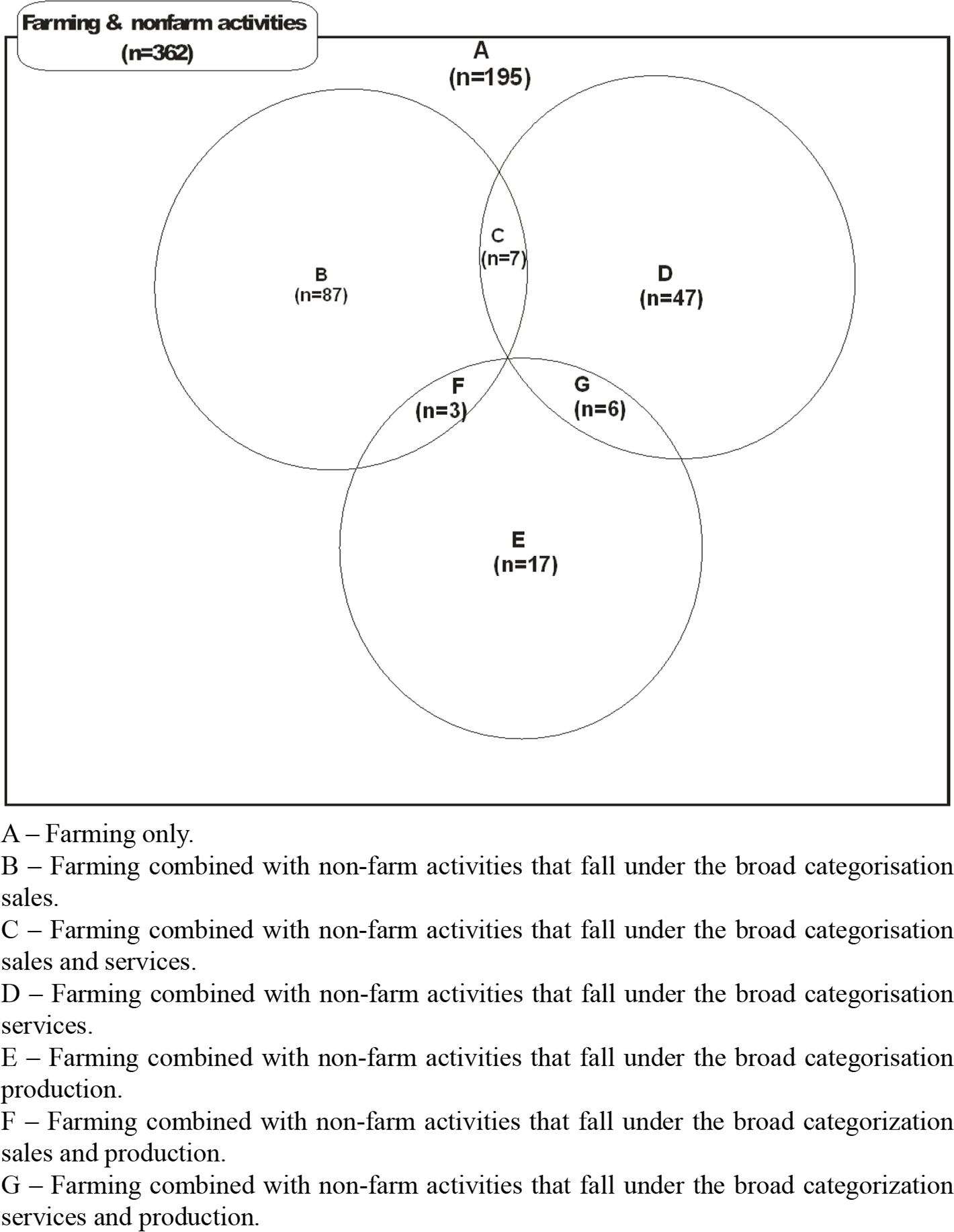
Fig. 1.
Farm households’ engagement in non-farm activities
Source: survey results, 2019.
This means that although a significant share of the surveyed farm households revealed that their primary source of income and sustenance is agriculture, they also diversify their sources of income from solely crop and livestock-based occupations to non-farm activities and enterprises. Thus, our result corroborates the findings of numerous country-wide studies, which generally suggest that a considerable proportion of the farm households in Nigeria’s rural areas do not depend solely on agriculture as a livelihood source; instead, they combine various activities to satisfy their numerous household requirements at different periods (Chinalurum et al., 2024; Dedehouanou and McPeak, 2020).
Likewise, prior studies carried out across different parts of Nigeria concluded that the country’s rural economy is based on a diverse array of activities and enterprises that cut across both farm and non-farm professions. In Kwara State, Babatunde and Qaim (2010) reported that 65% of the sampled farm households participated in off-farm activities. Using the Simpson Index of Diversity, Fabusoro et al. (2010) found moderate diversification (0.42) in Ogun State, suggesting a complementary role of farm and non-farm activities. In a similar vein, Omotayo (2016) established that up to 90% of the farmers in Ekiti State have an alternative source of income. According to Oladapo et al. (2024), about 85% of respondents in Oyo State reported having additional income sources alongside farming. Moreover, sizeable engagement of rural farm households in numerous non-farm income-generating activities has also been reported in Edo State (Belonwu et al., 2024), Gombe State (David et al., 2025), Yobe State (Nawi and Saje, 2025), Adamawa State (Gwandi et al., 2024), Kebbi State (Alhassan et al., 2025), Borno State (Timothy et al., 2025), and Ekiti, Osun, and Oyo States (Adeniyi and John, 2025).
Therefore, even though the farm sector has historically been crucial to the economies of developing nations like Nigeria, the share of non-farm activities has recently increased substantially, implying that the rural economy in Nigeria comprises much more than agriculture. The common practice of farm households cultivating small land units as low-risk, low-cost, “safety net” enterprises in conjunction with other forms of non-farm work, thereby greatly enhancing rural livelihoods and food security, is a perfectly reasonable social system that, with sufficient support, can be relatively sustainable (Stringer et al., 2020).
Classification of non-farm diversification options
A further analysis (Fig. 1) of the broad classification of the different types of non-farm activities carried out by the farm households shows that sales, mostly petty trading, is the predominant activity carried out by the majority (52.1%) of farm households that engaged in non-farm vocations. In addition, 28.1% and 10.2% of such households were engaged in the service sector and production, respectively. A more nuanced look at non-farm activities showed that some farm households engaged in activities spanning multiple categories. The survey data (Fig. 1) show that 3.6%, 4.2%, and 1.8% of these households combined services and production, services and sales, and sales and production, respectively.
The predominance of sales and services as the two most common non-farm vocations in the study area aligns with the findings of Nagler and Naudé (2017), who concluded that for most households in rural Africa, participation in non-farm self-employment activities is concentrated in easy-to-enter activities, such as trade and sales. In a similar vein, the study findings support broader empirical evidence that employment in SSA’s non-farm sector is predominantly in sectors such as informal services and petty trading (Van den Broeck and Kilic, 2019).
Determinants of farm households’ engagement in non-farm activities
Table 2 presents the results of the binary Probit regression used to estimate the determinants of non-farm work participation. While some of the parameter signs do not meet expectations, most align intuitively with the a priori expectation. Overall, the likelihood of farm households engaging in non-farm activities in the study area was positively influenced by factors such as age, gender, household size, membership of a farmer-based organisation (FBO), the educational status of the household head, the educational status of the spouse of the household head, the number of tropical livestock units, safety net aid, experience, access to land, market access, access to extension, and experience of shocks. On the contrary, participation in non-farm work was negatively influenced by age squared, farm size, farm income, and access to credit. Detailed interpretations of the coefficients is limited only to those variables that were found to be statistically significance at the conventional thresholds of 1, 5, and 10%.
Table 2.
Determinants of farm households’ engagement in non-farm activities
| Variables | Coefficient | Std. error | Z value | P > z | Marginal effect |
|---|---|---|---|---|---|
| Age | 0.0723687 | 0.0516166 | 1.40 | 0.161 | 0.0286148 |
| Age squared | –0.000852* | 0.0005023 | –1.70 | 0.090 | –0.0003369 |
| Gender | 0.2715034* | 0.1656078 | 1.64 | 0.101 | 0.107631 |
| Household size | 0.0733389* | 0.0384773 | 1.91 | 0.057 | 0.0289985 |
| Farm income | –0.0812477 | 0.0575791 | –1.41 | 0.158 | –0.0321257 |
| Membership of FBO | 0.3433911** | 0.1604857 | 2.14 | 0.032 | 0.1353513 |
| Farm size | –9.01e-07*** | 3.47e–07 | –2.59 | 0.010 | –3.56e-07 |
| Access to credit | –0.3426819 | 0.3421639 | –1.00 | 0.317 | –0.1306134 |
| Education (head) | 0.0131946 | 0.0176553 | 0.75 | 0.455 | 0.0052172 |
| Education (spouse) | 0.0011869 | 0.0192113 | 0.06 | 0.951 | 0.0004692 |
| Tropical livestock unit (TLU) | 0.0081887*** | 0.0031531 | 2.60 | 0.009 | 0.0032378 |
| Shock | 0.1774353 | 0.2432628 | 0.73 | 0.466 | 0.0694663 |
| Experience | 0.0043255 | 0.0081248 | 0.53 | 0.594 | 0.0017103 |
| Land ownership | 0.4419264** | 0.1984667 | 2.23 | 0.026 | 0.1748762 |
| Market access | 0.0041019 | 0.0046809 | 0.88 | 0.381 | 0.0016219 |
| Access to extension | 0.220912 | 0.1534165 | 1.44 | 0.150 | 0.086825 |
| Safety net aid | 0.2847079* | 0.1675845 | 1.70 | 0.089 | 0.1113634 |
| Constant | –2.949758** | 1.337113 | –2.21 | 0.027 | |
| Number of obs= 362 | |||||
| LR chi2 (16) = 81.27 | |||||
| Prob > chi2 = 0.0000 | |||||
| Pseudo R2 = 0.1627 | |||||
| Log Likelihood=209.1992 |
Age of household head squared
Age squared was found to be negatively related to farm households’ engagement in non-farm activities and significant at the 10% level. The negative effect of age squared and the positive effect of age point to the nonlinear effect of age in the model, which implies that older household heads in the study area are less likely to engage in non-farm activities. This is a plausible finding, as advancing age brings reduced physical strength. Consequently, as household heads grow older, they may simply not be capable of allocating their labour resources to as many livelihood strategies as possible.
Therefore, while younger household heads, who are typically better educated, more skilful and energetic, more adventurous, and enjoy better access to information, are inclined to seek non-farm sources of income, older household heads are more likely to focus on agriculture-based vocations for the purpose of meeting the household’s subsistence needs. In certain cases, this may be combined with pensions and remittance income. This finding regarding the negative effects of “age squared” on non-farm diversification is in line with the results of Bhandari (2013), Seng (2015), and Kassie et al. (2017).
Household size
Table 2 further indicates a significant positive relationship between household size and farm households’ engagement in non-farm activities (p = 0.10). The positive marginal effect implies that larger households in the study area are more likely to engage in non-farm activities. A plausible explanation for this is that a larger pool of active household labour enables farming households to be more responsive to market opportunities and earn diversified income. By allocating part of their “surplus household labour” to the rural non-farm economy, especially during the agricultural off-season, households can supplement their on-farm income and sustain their livelihoods.
Another plausible explanation is that, in the study area, household members who will ordinarily be characterised as dependents (those under 15 and over 65 years of age) provide vital support to the household by shouldering a substantial share of the household work burden, both farm and non-farm. For instance, older family members (over 65 years of age) may support household efforts geared towards non-farm diversification by supplying much-needed childcare, thereby reducing the dependency on hired labour and enabling more active family members to participate in the non-farm sector.
This finding is broadly consistent with the results of previous investigations that reported a direct link between non-farm livelihood diversification and household size (Kassegn and Abdinasir, 2023; Kolog et al., 2024; Kuwornu et al., 2018; Nagler and Naudé, 2017; Timothy et al., 2025). Conversely, however, some empirical studies reported an inverse association between household size and engagement in the rural non-farm economy, wherein a larger household reduces the probability of selecting a non-farm occupation (Adeniyi and John, 2025; Chinalurum et al., 2024).
Gender of the household head
Furthermore, Table 2 depicts a positive and statistically significant relationship between the sex of the household head exhibits and farm household’s participation in non-farm activities, and the association (p = 0.10). This finding implies that farm households in the study area which are headed by male household members have a higher tendency for uptake of non-farm livelihoods when compared to households headed by their female counterparts. This finding can be attributed to several factors.
Research has revealed that women as a group, and female-headed households in particular, are often at a comparative disadvantage regarding social status and economic opportunities (Babatunde and Qaim, 2010; Yeboah and Jayne, 2018). In addition, male-headed households invariably command greater resources and enjoy better access to attractive employment opportunities than their female counterparts, enabling them to diversify their livelihoods more effectively. It has also been reported that female farmers have less access to land, capital, credit, information, and other productive resources than their male counterparts (Quisumbing and Doss, 2021). As Sugden et al. (2014) demonstrated, inadequate assets or a complete lack of assets seriously hampers women’s capacity to invest in non-farm activities.
This finding validates the claim that social norms, culturally defined gender roles, social mobility restrictions, labour market discrimination, and asset inequalities between rural men and women affect their production decisions and income distribution, making non-farm diversification options more burdensome for women. Various scholars have also reported a higher propensity for male-headed households to participate in the rural non-farm economy (Alhassan et al., 2025; Chinalurum et al., 2024; David et al., 2025; Kolog et al., 2024). Nonetheless, some studies indicate that female-headed households are more likely than their male counterparts to diversify their livelihoods to include non-farm enterprises over time (Kassegn and Abdinasir, 2023; Kehinde and Ogundeji, 2023; Oladapo et al., 2024).
Membership of Farmer-based Organisations (FBOs)
Interestingly, membership of FBOs was significant (p = 0.05) and plays a positive role in farm households’ engagement in non-farm activities. This result confirms that farm households in the study area that are members of FBOs have a higher chance of engaging in non-farm activities. This phenomenon may be attributed to the fact that membership in FBOs provides farm households with the means to build a vital social network that stimulates the dissemination of knowledge through collaboration, physical interaction, and peer-to-peer sharing of information and resource exchange among farmers. Consequently, the social capital generated through membership of FBOs spurs innovative and imitative potential, thus encouraging rural farms and households to acquire knowledge, skills, and ideas that will enhance their ability to engage in non-farm revenue-generating activities (Kehinde and Ogundeji, 2023; Nilsson, 2019).
Lewis et al. (2011) assert that positive information externalities arising from face-to-face interactions are particularly crucial for rural regions in developing countries characterised by inadequate communication and information exchange infrastructures. In addition, due to the inefficiency and unreliability of formal lending institutions in meeting the credit needs of farm households, especially those in rural areas of developing countries, FBOs such as Village Savings and Loans Associations (VSLAs) may also serve as a vital source of liquidity for farmers to finance initial costs of participating in the non-farm sector.
Prior research across Sub-Saharan Africa shows that membership of farm-based groups promotes uptake of non-farm enterprises (Alhassan et al., 2025; Kassie et al., 2017; Kehinde and Ogundeji, 2023; Timothy et al., 2025). On the other hand, however, David et al. (2025) found that cooperative membership negatively influenced the likelihood of choosing non-farm activities.
Farm size
Table 2 shows farm size was highly significant (p = 0.01) and inversely associated with the farm household’s engagement in non-farm activities. This implies that the likelihood of a farm household in the study area participating in the non-farm sector decreases as the cultivated farm size increases. This finding can be attributed to a number of factors. As Eshetu and Mekonnen (2016) and Workie (2023) posited, more land tends to encourage farming and also boost employment rates in agriculture, with a consequent reduction in the labour available for non-farm work. This likely lends credence to the premise that farm and non-farm activities compete for the limited resources available to the household, particularly household labour supply.
In addition, large farms typically provide higher incomes to farmers and therefore increase the tendency toward on-farm intensification rather than non-farm diversification (Ajiboye et al., 2025; Kassegn and Endris, 2021). According to Kassegn and Endris (2021), as long as smallholder farming households have access to sufficient production factors that will enable them to cultivate and produce more with a resultant higher level of on-farm income, they are less likely to diversify their income portfolio to encompass non-farm activities.
This work aligns with other empirical studies confirming an indirect association between the size of the farm holding and uptake of non-farm work (Adeniyi and John, 2025; Alhassan et al., 2025; Kehinde and Ogundeji, 2023; Kolog et al., 2024; Workie, 2023). Conversely, however, some studies suggest that larger farms can exploit capital for non-farm work more effectively (Meraner et al., 2015; Timothy et al., 2025).
Livestock ownership
Contrary to some earlier research findings (Ajiboye et al., 2025; Workie, 2023), Table 2 demonstrates that ownership of tropical livestock, measured in TLU, was highly significant (p = 0.01) and relates positively to a farm household’s engagement in non-farm activities. This result implies that farm household in possession of greater livestock units are more likely to participate in non-farm activities in the study area. The effect of this variable is consistent with basic economic reasoning and is greater than that of any other single factor included in the model, which points to the vital role of tropical livestock as a store of value in the study area.
Bhandari (2013) revealed that livestock plays a crucial role for farmers as a means of livelihood, a source of economic capital, and a vital component of household food security. Similarly, the Department for International Development (DFID, 1999) adduced that livestock may serve as a crucial source of social capital for owners, by way of prestige and connectedness to the community. At the same time, it can be deployed as a productive physical resource. Therefore, tropical livestock units, as a store of value, provide an opportunity for farm households in the study area to invest in alternative enterprises.
Abdulai and CroleRees (2001) observed that households can leverage livestock as collateral to secure loans for starting non-farm businesses. In the same vein, Kassie et al. (2017) posit that as the market value of livestock increases, households may dispose of some of their livestock, and the proceeds generated can be used to diversify into non-farm livelihoods.
Social safety net
Furthermore, Table 2 demonstrates how the safety net aid was statistically significant (p = 0.10) and exhibits a direct relationship with farm households’ participation in non-farm activities. Thus, evidence exist that farm households in the study area that have received support in the form of information, training, or financial assistance in the past have a higher tendency for uptake of non-farm livelihoods. This may be due to social safety nets being typically an effective means to alleviate poverty and empower vulnerable households with greater access to resources and opportunities, thereby enabling them to develop resilience by alleviating destitution or undernourishment, which facilitates their engagement in multiple income-generating activities (Oladapo et al., 2024; Ruel and Alderman, 2013). In addition, some of the safety net programmes are geared towards empowering farm households to acquire skills that make them better placed to seize the opportunities offered by the RNFE.
This result highlights the significance of targeted support from the national government and NGOs in promoting economic resilience and diversification in rural areas. The finding is analogous to that of Oladapo et al. (2024), who stated that support from government agencies and NGOs relates positively to livelihood diversification. However, it contradicts the work of Kassegn and Abdinasir (2023), who reported that a productive safety net programme exerts a negative influence on the likelihood of rural farm households engaging in the non-farm sector in Ethiopia.
Land ownership
Finally, it is apparent from Table 2 that the variable land ownership was statistically significant (p = 0.05) and positively related to the engagement of farm households in the RNFE, signalling that farm households that lay claim to personal ownership of the land holdings that they use for their cropping activities have a higher probability of participating in the rural non-farm economy. While this finding may seem counterintuitive, it is quite a reasonable result given that land ownership is a significant measure of the wealth at the disposal of a particular household in SSA (Abdulai and CroleRees, 2001; Nilsson, 2019). Therefore, having land makes it easier for farm households to obtain credit by using their land as collateral, encourages them to make long-term investments, and enables them to earn from selling or renting their land.
Our result adds to the literature showing that small-holder farm households that own the landholdings that they use for their cropping activities are more likely to take up non-farm work. Van den Broeck and Kilic (2019) reported that productive assets, such as landholdings, induce a transition towards non-farm employment. On the contrary, Boisvert and Chang (2009) revealed that land ownership leads to greater commitment in agricultural production, with a resultant negative effect on the likelihood of non-farm job participation.
LIMITATIONS OF THE STUDY
Our study has some important limitations. Firstly, while non-farm livelihood diversification in Adamawa State is not limited to the Northern Senatorial Zone, expanding the fieldwork to other parts of the State was considered beyond the scope of this study, given the additional extensive time and financial resources the project would have required. Thus, extending this study to cover other parts of the State is a useful avenue for future research. A second shortcoming of our work is that this study only accounted for the engagement in non-farm activities by the household head and the spouse; other members of the farm household were overlooked. Future research should therefore extend the analytical framework beyond household-level engagement in the RNFE that focuses on participation by the household head and the spouse to individual-level participation by all the household members.
Furthermore, non-farm work might be influenced by unobserved individual and household-level characteristics, leading to correlation with the error term and biasing the magnitude of the estimated coefficients either upwards or downwards. However, since no credible covariates are available in our data set to support the use of an instrumental variable approach for addressing the endogeneity challenge, we do not claim to establish causality; instead, we interpret the significant variables as mere correlations. Despite this limitation, this study provides strong motivation to conduct further research on the determinants of non-farm livelihood diversification in the study area, with the aim of establishing causality.
CONCLUSION AND POLICY RECOMMENDATIONS
This study contributes to the existing body of work on non-farm livelihood diversification by identifying the key factors influencing farm households’ non-farm livelihood diversification in northern Adamawa State. We found that a considerable proportion of the farm households in the study area do not depend solely on agriculture; they additionally diversify their sources of income from solely crop- and livestock-based occupations to non-farm activities and enterprises. Our results indicate that several important variables influence farm households’ engagement in non-farm activities in the study area, including the gender of the household head, the squared term of the household head’s age, land ownership, tropical livestock units, household size, farm size, membership of farmer-based organisations (FBO), and safety net aid.
Based on these empirical findings, policymakers and development practitioners should take into account the aforementioned factors when putting in place measures to enhance livelihood diversification among rural farming households, particularly in the study area. Specifically, the Nigerian government and other development partners should make efforts to promote livelihood diversification among smallholders in rural Nigeria more inclusive by implementing policies and programmes that ease entry barriers for women. Such policies should also support women with skill-building, access to finance, and business opportunities that facilitate entry into profitable rural non-farm enterprises. Furthermore, there is a need to scale up productivity-enhancing safety net programmes targeted at vulnerable households, with the ultimate goal of improving household welfare.