
INTRODUCTION
Background to study
Entrepreneurial innovation is now an essential part of the interconnected, fast-paced global economy (Dossou et al., 2023). With rapidly evolving products, services, and technologies, enterprises must implement innovative strategies to stay competitive and relevant (Akomea et al., 2023; Osei et al., 2024). This is particularly true for agribusinesses linked to strategic trade routes such as the southern corridor of China-Pakistan Economic Corridor (CPEC) that links areas, including Kohat, Karak, Lakki Marwat, Bannu, Tank and Dera Ismail Khan, in southern Khyber Pakhtunkhwa (KP), Pakistan (Hassan et al., 2022; McCartney, 2022; Shaikh et al., 2025).
Innovation in conjunction with agribusiness is not simply a matter of creating new products and/or innovations, but also entails administrative innovation that enhances internal processes and the capacity of an organization to deliver sustainable competitive advantage (Dossou et al., 2023; Mursid et al., 2018). In relation to CPEC, as market access and connectivity across the region are driving change outside the rural economy, the critical importance of innovation is further reinforced (Zhang et al., 2024). Agribusinesses that operate along the value chain are fundamental to economic development (Goulas, 2025; Katchova and Enlow, 2013). Globally, agribusiness is a significant part of economic activity, particularly in developing countries (Kruja, 2020; Shaikh et al., 2025).
These enterprises contribute significantly to Gross Domestic Product (GDP), and are important sources of employment (Goulas, 2025). Within the CPEC corridor, however, especially in southern KP, agribusinesses, particularly wheat farming, play a vital role in rural livelihoods and in the economic resilience of the entire region (McCartney, 2022; Shah, 2025). Given this context, policy frameworks and regional development strategies must foster entrepreneurial innovation among wheat farmers and agribusiness operators in CPEC-linked regions. Such innovation encompasses new products or services, novel production technologies, improved organizational structures, or strategic planning systems that help agribusinesses achieve a competitive edge, boost productivity, and succeed in increasingly dynamic markets.
Research problem and knowledge gap
Despite expanding scholarly interest in agricultural innovation, there is limited evidence on how technological, administrative, and product innovations interact with farmers’ characteristics and mechanization practices in wheat-based farming systems. This gap is particularly relevant in southern Khyber Pakhtunkhwa, where traditional, semi-mechanized, and mechanized farming systems coexist. Therefore, this study evaluates entrepreneurial innovation and mechanization adoption among wheat farmers to better understand the factors associated with innovation-oriented agricultural development.
Objectives of the study
This study aims to examine entrepreneurial innovation and mechanization adoption among wheat farmers in southern Khyber Pakhtunkhwa. Specifically, the study seeks to:
(i) assess product, technological, and administrative innovation among wheat farmers;
(ii) examine the relationships of technological and administrative innovation with product innovation; and
(iii) assess how farmer and farm characteristics are associated with mechanization adoption.
Research hypothesis
H1: Technological innovation is positively associated with product innovation.
H2: Administrative innovation is positively associated with product innovation.
H3: Farmer characteristics are significantly associated with mechanization adoption.
H4: Farming-system characteristics are significantly associated with mechanization adoption.
H5: Institutional/cooperative support is significantly associated with mechanization adoption.
LITERATURE REVIEW
Conceptual review
Overview of innovativeness
Innovation has become a key factor for contemporary agribusiness enterprises seeking to remain competitive in an environment of fast-paced technological development, fluctuating markets, and regular economic disruptions. Along the southern corridor of the China-Pakistan Economic Corridor (CPEC), covering the districts of Kohat, Karak, Lakki Marwat, Bannu, Tank and Dera Ismail Khan, agricultural innovation is increasingly recognized as a possible keyway for enhancing the performance of agribusiness, especially in the wheat sector (Afzal and Naseem, 2018; Hassan et al., 2022; Shah, 2025).
Innovation is typically understood as the application of new technology or management practices to achieve specified improvements in operations (Lone and Baba, 2024). According to both Lone and Baba (2024) and Kyfyak et al. (2022), innovation is the process of transforming opportunities into novel ideas and translating them into practical, value-generating actions, respectively. Similarly, Gadanakis (2024) defined innovation as the introduction of new or improved processes, services, or products, especially those that capitalize on technical and administrative advances to provide value to customers (Gadanakis, 2024).
Many scholars agree that innovation includes practices new to an organization, such as equipment, products, services, processes, policies, and projects (Dossou et al., 2023; Gadanakis, 2024; Hernández et al., 2025; Katchova and Enlow, 2013). Fostering efficiency and introducing innovation can revolutionize productivity, market reach, and sustainability in rural economies at the southern end of the CPEC, where traditional farming and agricultural methods still prevail (Haq and Farooq, 2016; Marcoulides, 1998; Sati, 2024; Shaikh et al., 2025).
Innovation is widely recognized as a core business function that organizations use to achieve and sustain a competitive advantage. In agrarian economies, where climate variability, resource limitations, and market competition demand constant adaptation, it has become a prerequisite for organizational survival and success (Henseler et al., 2012; Rand et al., 2023; Srejić et al., 2023; Zhang et al., 2024).
Innovativeness denotes a tendency for an enterprise or an individual to strive to generate and facilitate new ideas, creative thinking, experimentation, and research. Successful agribusinesses, especially in the wheat-growing areas of southern KP, are increasingly characterized by their ability to pursue innovative strategies, invest in research and development, and continually adapt to changing conditions (Shaikh et al., 2025).
Zhang et al. (2024) state that innovativeness is essential to the performance of agribusiness. Inspired by the work of Weckowska et al. (2025), they assert that a new type of product and service can disrupt ongoing business in the market, leading to a reallocation of resources and creating new growth opportunities. For wheat farmers along the CPEC route, such disruption can take the form of replacing outdated farming methods with mechanized systems, introducing improved seed varieties, and streamlining administrative and marketing operations (Haq and Farooq, 2016).
Business innovation can be categorized into three dimensions: technological, product, and administrative innovation (Goulas, 2025; Mursid et al., 2018). These dimensions of innovation offer practical solutions to the routine and complex problems agribusiness faces. Dossou et al. (2023) and Rushchitskaya et al. (2024) refer to innovativeness as the company’s capacity to creatively engage with ideas that may have tangible economic value (Dossou et al., 2023; Rushchitskaya et al., 2024).
Innovation enables enterprises, especially those in agriculture, to enhance technological capabilities, adopt modern administrative structures, and improve product quality. It promotes reform and knowledge transfer and catalyzes the development of new technologies and solutions, which are critical to the sustainable development of agribusinesses operating within the dynamic landscape of the China-Pakistan Economic Corridor.
Product innovation
Product innovation is central to sustaining support for competitiveness in the agribusiness sector, particularly in strategic economic zones such as the southern corridor of the CPEC (Awan and Ali, 2022; Shah, 2025). According to Awan and Ali (2022), product innovation is the process of introducing new products to the market in response to customers’ needs, demands, and expectations. Shah (2025) emphasizes that it involves commercializing products that align with consumers’ preferences. Osei et al. (2024) notes that product innovation enables agribusinesses to be early movers, meet the evolving needs of consumers, and gain a competitive edge. For wheat farmers in Kohat, Karak, Lakki Marwat, Bannu, Tank, and DI Khan, product innovation can involve adopting innovations such as improved wheat seed, packaging technology, or storage technologies that increase quality and marketability (Afzal and Naseem, 2018; Shaikh et al., 2025).
Lone and Baba (2024) and Mursid et al. (2018) underscore that product innovation results in differentiation and enhanced quality, as well as increased market reach (Lone and Baba, 2024; Mursid et al., 2018). Osei et al. (2024) identify it as bringing significantly improved products in terms of performance and features (Osei et al, 2024). Similarly, product innovation involves goods or services that differ in significant and relevant ways from previous versions (Etriya et al., 2019). Kruja (2020) elaborates this definition to include improvements in technical specifications, components, software integration, portability, durability, and user-friendliness, which are important for meeting market demands (Kruja, 2020). In the present study, improved wheat quality is considered an aspect of product-oriented innovation rather than a separately measured product-quality construct. Product innovation therefore includes the introduction of new wheat varieties, improvements in product characteristics, and the adoption of new packaging or processing practices.
Technological innovation
Technological innovation is the implementation of new or significantly improved products, processes or services (Baden-Fuller and Haefliger, 2013; Weckowska et al., 2025). Wheat farming along the southern route of the CPEC may require precision tools for agriculture, automated irrigation systems, or a digital farm management platform (Coccia, 2021; Opazo-Basáez et al., 2024). According to Weckowska et al. (2025), technological innovation encompasses non-technological innovations, such as organizational behavior and marketing approaches. Coccia (2021) states that technological innovation generates value by bringing creative solutions in a competitive environment. This innovation improves product quality, increases productivity, and keeps farmers competitive in dynamic agricultural markets (Opazo-Basáez et al., 2024; Rushchitskaya et al., 2024).
Administrative, or organizational, innovation
Administrative or organizational innovation refers to new approaches to management, decision-making, or stakeholder engagement (Hernández et al., 2025; Sati, 2024). Sati (2024) defines administrative innovations as changes that affect an organization’s social and structural systems. In terms of agribusinesses in the southern KP, administrative innovations can include cooperative marketing models, financial record-keeping systems, or farmer-led management committees (Hassan et al., 2022; Kruja, 2020). Hassan et al. (2022) argue that although innovations in administrative processes are less tangible than product innovations, they can have a significant impact on performance. Kruja (2020) defines administrative innovation as implementing new organizing practices that enhance an organization’s internal operations or external relationships. Srejić et al. (2023) report that organizational innovation improves performance through cost-cutting, enhanced staff and customer satisfaction, and more efficient structures. Such innovation can also change how wheat farmers interact with government bodies, buyers, and suppliers (Srejić et al., 2023).
Perceived wheat product quality
Wheat product quality refers broadly to the characteristics that determine the suitability, marketability, and perceived value of wheat produced by farmers (Gadanakis, 2024; Hair et al., 2011). Such characteristics may include grain cleanliness, uniformity, storage condition, milling suitability, nutritional characteristics, and overall market acceptability. In the present study, however, product quality was not determined through laboratory-based physicochemical measurements (Akomea et al., 2023; Gadanakis, 2024). Instead, it represents farmers’ perceived wheat product quality, as measured by the questionnaire indicators in the survey. Therefore, the term perceived product quality is used to distinguish the farmer-reported construct from objectively measured grain-quality parameters (Lino, 2025; Katchova and Enlow, 2013).
Relationship between entrepreneurial innovativeness and performance
Innovativeness is regarded as one of the key facets of Entrepreneurial Orientation (EO), particularly in dynamic environments such as those on the CPEC route, particularly in agriculture. Research has always confirmed a strong correlation between innovativeness and organizational performance (Awan and Ali, 2022; Gellynck et al., 2015; Katchova and Enlow, 2013; Mehsud, 2023). According to both Gellynck et al. (2015) and Mehsud (2023), innovativeness is an attitude toward accepting new ideas and engaging in a creative process that results in technological improvements, and the development of new services or more effective organizational methods. Rushchitskaya et al. (2024) conclude that entrepreneurial innovativeness has a positive impact on the quality of products and services, which in turn boosts market share, sales revenues, and financial performance (Rushchitskaya et al., 2024). For the wheat farmers of the southern region of KP, innovation in products, technologies and administration can enhance their competitiveness and offer new economic prospects in the CPEC framework.
Theoretical review
Resource-based theory (RBT)
Among strategic management theories, Resource-Based Theory (RBT), first formulated by Wernerfelt (1984), is among the most common and widely implemented in terms of actual enterprise competitiveness in the real world. This theory holds that the sustainability of a firm’s competitive advantage is based on its ability to acquire, manage, and utilize valuable, rare, inimitable, and non-substitutable (VRIN) resources (Katchova and Enlow, 2013; Lai et al., 2025; Wernerfelt, 1984).
In the context of agribusiness along the CPEC’s southern corridor, which includes districts such as Kohat, Karak, Lakki Marwat, Bannu, Tank, and Dera Ismail Khan, RBT provides a useful framework for understanding how wheat farming and agricultural enterprises can improve their performance in terms of product innovation, technology use, and administrative improvement.
The theory highlights how firm innovativeness is a strategic capability but also a socially complex, imperfectly imitable resource, constituting a possible source of long-term advantage (Ilić et al., 2024; Marcoulides, 1998). It also goes further and states that innovation capacity enables firms to respond dynamically to changing market and environmental conditions.
Recent research in the agribusiness setting supports this position. Makhdoom et al. (2017) find that market positioning and resilience to price fluctuations significantly improve with the application of innovation-driven strategies among smallholder wheat farmers in Punjab. Moreover, Ullah et al. (2021) report that optimal resource utilization through administrative innovation, especially in logistics and market access under CPC frameworks, results in enhanced performance among agrarian communities. Therefore, in line with RBT, this study considers entrepreneurial innovativeness (at the product, technology, and administrative levels) to be strategic internal resources that determine agribusiness performance in wheat production regions along the southern route of the CPEC.
Empirical review
Empirical evidence from around the world attests to the positive correlation between innovation and firm performance, especially in the agriculture and SME sectors (Cheah et al., 2018). Cheah et al. (2018) examined SMEs and found moderate levels of innovation, with product and process innovations positively affecting performance. Similarly, Cheah et al. (2018) argue that the introduction of technological and organizational innovations significantly improves the output and efficiency of firms (Cheah et al., 2018). Awan and Ali (2022), with the aid of OLS models, were able to show that innovative activities (especially product-based) of SMEs significantly improved their productivity and profitability (Awan and Ali, 2022). Finally, Shaikh et al. (2025) also found strong correlations between innovative elements and better business outcomes.
From an Asian perspective, Hair et al. (2011) discuss SMEs based PLS-SEM, establishing that entrepreneurial innovativeness has a strong positive impact on non-financial and growth-related performance metrics (Cheah et al., 2018; Hair et al., 2011; Sarstedt et al., 2021). Similarly, Sarstedt et al. (2021) confirm the positive effects of product, process, and administrative innovation on an organization’s overall performance. In their 2018 study, Cheah et al. found that innovation across multiple dimensions (product, organizational, market, and process) in Ghana’s banking sector was directly associated with improved performance. Their structural model also indicates that innovation capability moderates the relationship between innovation type and firm output. Based on the literature and theoretical framework reviewed, the relationships examined in the present study are summarized in Figure 1.
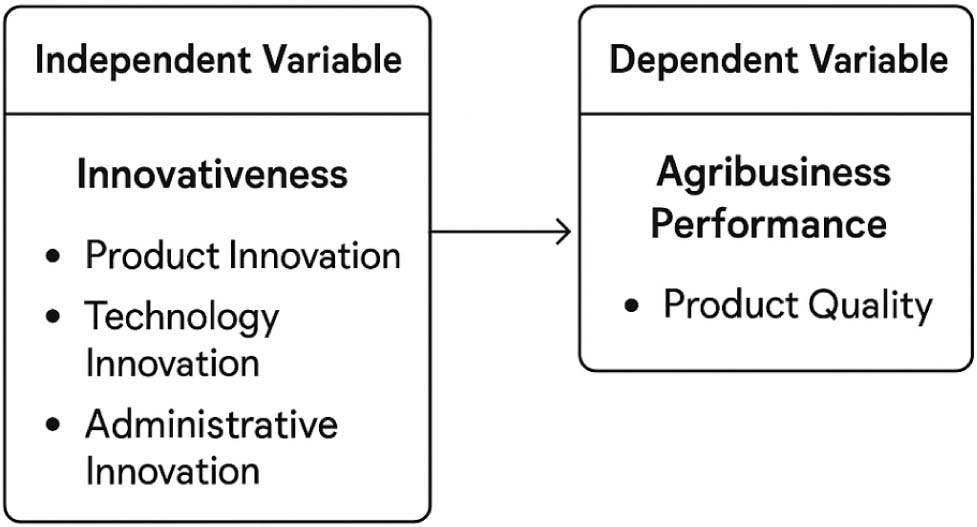
Fig. 1.
Researcher’s conceptual framework
Source: own elaboration.
In the case of Pakistan, Haq and Farooq (2016) discovered that wheat farmers adopting the digital and innovative seed technology under government-supported CPEC schemes in D.I. Khan and Bannu noticeably improved in yield, access to markets, and food security (Haq and Farooq, 2016). Likewise, Shah (2025) observed that the introducing administrative innovations (record-keeping, marketing collaboration) improved operational efficiency and profitability for wheat farmers in southern KP. In contrast, Hassan et al. (2022) found that administrative innovations also increased operational efficiency and profitability among the wheat farmers in southern KP. Furthermore, the interaction between innovation, access to finance, and firm size was highlighted by showing that innovation positively mediates access to finance and negatively moderates firm size (Ilić et al., 2024). This finding is evident in the structure of smallholders in the wheat-farming system of southern KP. These perceptual knowledge findings significantly support the current study’s premise: entrepreneurial innovation, particularly product innovation, is crucial for improving the performance of agribusiness/food security in the CPEC’s southern corridor.
METHODOLOGY
This research adopted a quantitative survey research design, using a semi-structured skills questionnaire, as the primary data collection tool. The survey method was selected to efficiently gather information about large populations, in this case, the southern districts of Khyber Pakhtunkhwa (KP), Pakistan, comprising Kohat, Karak, Lakki Marwat, Bannu, Tank and Dera Ismail Khan, all of which are located along the southern route of the China-Pakistan Economic Corridor (CPEC) (Fig. 2). From a target population of approximately 45,000 farmers, a sample size of 381 was selected using multistage convenience sampling (Raosoft sample size calculator).
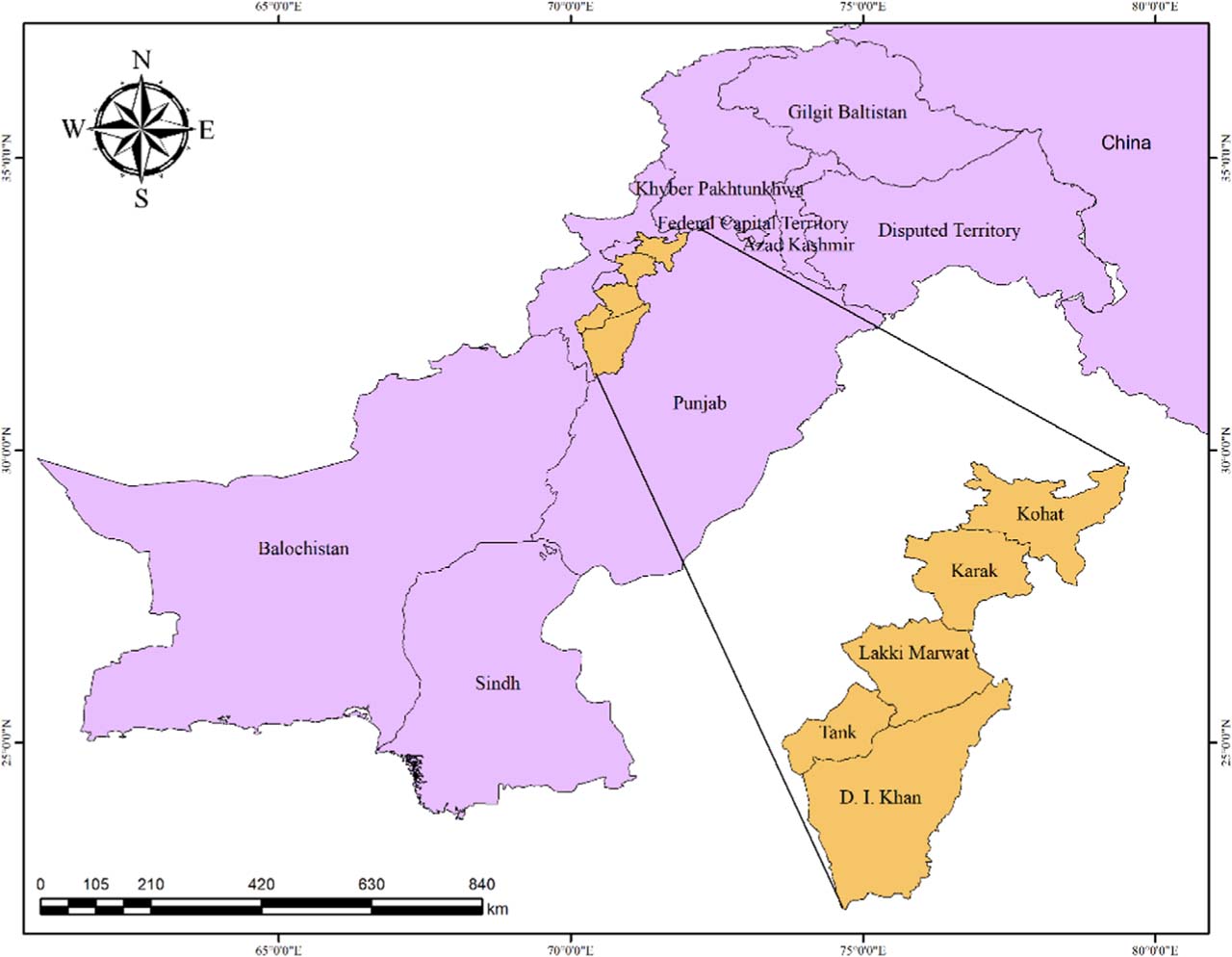
Fig. 2.
Geographical location of the study area
A multistage convenience sampling approach was used to select respondents, with assistance from local agricultural departments and farmer cooperatives to ensure diversity and accessibility. Data were obtained using a self-administered, structured questionnaire that used a five-point Likert scale, with responses ranging from (1) Strongly Disagree to (5) Strongly Agree. The instrument was validated by agricultural economics and rural development experts, who ensured it was clear and reliable by means of a pilot test with a small group of farmers.
The questionnaire was divided into two major parts:
Section A: Collecting demographic and background information of the respondents.
Section B: Capturing data on the topic of entrepreneurial innovation, regarding product, technical and administrative innovation aspects.
Both primary and secondary data were used. Primary data were collected from farmers, while secondary data were obtained from published studies, reports, and academic literature on agribusiness innovation and CPEC development.
The study used the K-means clustering technique and Partial Least Squares Structural Equation Modelling (PLS-SEM) technique for analysis. This method is especially effective at assessing relationships among latent variables and in complex models. As Barclay et al. (1995) note, PLS-SEM allows simultaneous measurement and structural path assessment.
Cluster analysis
The K-means clustering method was used to determine farmer typology based on five variables: age, education, years in farming, farm size, and farming system. The method aims to divide observations into k clusters so that each observation is as close as possible to its assigned cluster. The objective function is:
where:Ci – is the set of points in cluster i
and μi – is the centroid point of cluster i.
The variables used for clustering included age, education, years in wheat farming, farm size, and farming system. The categorical and ordinal variables were converted to numerical values and standardized before the K-means analysis to minimize scale effects. K-means clustering was performed with k = 3. To visualize the resulting cluster structure, principal component analysis (PCA) was applied to the standardized variables, and the first three principal components were used to display the three farmer clusters in three-dimensional space.
Structural model
The structural model is modelled as:
where:y – dependent variable (agribusiness performance)
i – intercept vector
X – matrix of independent (predictor) variable (innovation types)
β – coefficient vector
e – error term (residuals).
This methodological approach enabled rigorous hypothesis testing and provided insights into the effects of different types of innovation on wheat agribusiness performance along the CPEC corridor.
SHAP-based machine learning model
To complement PLS-SEM, a Random Forest model was used:
where:X – socio-economic and farm variables
ŷ – predicted agribusiness performance.
SHAP values were computed as:
where:ϕi – contribution of feature i,
S – subset of features
F – full feature set.
The Random Forest model was implemented using 500 trees (n_estimators = 500). The dataset was randomly partitioned into 80% for training and 20% for testing, with random_state = 42 to ensure reproducibility. Model fit was assessed using the coefficient of determination (R2) and root mean square error (RMSE). The training-set diagnostic produced R2 = 0.819 and RMSE = 0.193. SHAP values were subsequently used to quantify the relative contribution of socio-economic and farm-level predictors to model predictions (Fig. S1 in Supplementary).
RESULTS
Respondent characteristics and farm characteristics
The demographic and background characteristics of the respondents are summarized in Table 1. The table included an analysis of responses from 381 wheat-growing farmers in south Khyber Pakhtunkhwa. A considerable number (34.1%) were between 36 and 45 years of age, with only 4.7% between 18 and 25 years of age. The vast majority were male (97.1%). There was a range of educational levels, with 31.8% having primary education and 21.0% having a postgraduate degree. Farming experience was distributed, with 33.1% having been away from wheat for over 20 years. The sizes of farms varied greatly; 28.9% were 5–10 acres, and 25.2% were over 20 acres. Regarding farming systems, semi-mechanized systems dominated (36.7%), followed by traditional (26.2%), mechanized (21.0%), and mixed (16.0%).
Table 1.
Demographic and farming background information for respondents (N = 381)
| Variable | Category | Frequency (n) | Percentage (%) |
|---|---|---|---|
| Age group (years) | 18–25 | 27 | 7.1% |
| 26–35 | 76 | 19.9% | |
| 36–45 | 190 | 49.9% | |
| 46–55 | 32 | 8.4% | |
| above 55 | 56 | 14.7% | |
| Gender | Male | 370 | 97.1% |
| Female | 11 | 2.9% | |
| Education level | no formal education | 30 | 7.9% |
| primary education | 121 | 31.8% | |
| secondary education | 70 | 18.4% | |
| diploma/certificate | 20 | 5.2% | |
| bachelor’s degree | 60 | 15.7% | |
| postgraduate degree | 80 | 21.0% | |
| Years in wheat farming | Less than 5 | 40 | 10.5% |
| 5–10 | 95 | 24.9% | |
| 11–20 | 120 | 31.5% | |
| More than 20 | 126 | 33.1% | |
| Farmland size (acres) | Less than 5 | 75 | 19.7% |
| 5–10 | 110 | 28.9% | |
| 11–20 | 100 | 26.2% | |
| More than 20 | 96 | 25.2% | |
| Farming system used | Traditional (manual) | 100 | 26.2% |
| Semi-mechanized | 140 | 36.7% | |
| Fully mechanized | 80 | 21.0% | |
| Mixed (crop + livestock) | 61 | 16.0% |
Cluster analysis groups the farmers into 3 distinct groups. Cluster 0 (31.2%) included experienced farmers with a moderate level of education and semi-mechanization. Cluster 1 (33.3%) was the most progressive group, with higher education, larger farms, and more developed farming systems (Fig. 3). Cluster 2 (35.4%) comprised younger, less educated farmers with smaller landholdings, who were dependent on traditional methods. These clusters encompass a range of farming backgrounds and can help inform tailored interventions and policy strategies.
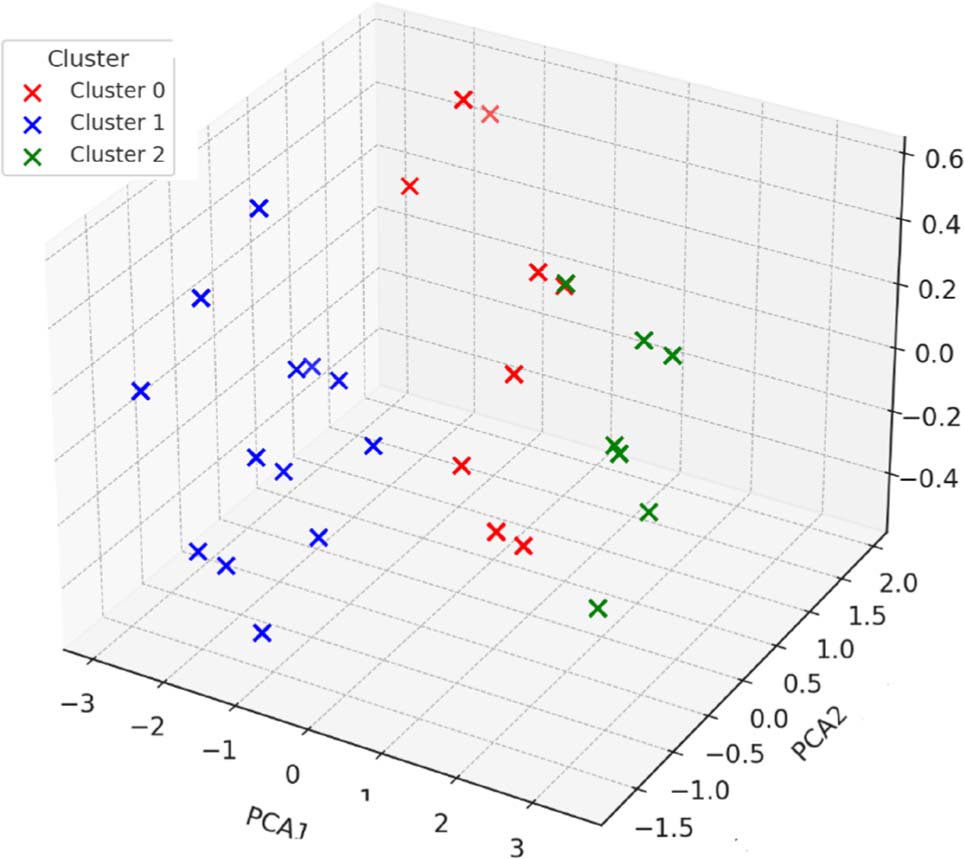
Fig. 3.
Three-dimensional PCA visualization of K-means farmer clusters
Source: own elaboration.
Presenting and analyzing the data
Figure 4 shows the results of the Partial Least Squares Structural Equation Modelling (PLS-SEM) for the factors that affect Adoption of mechanization used by 381 wheat farmers. The model comprises four latent key factors: Farmer Profile, Farming system used, Orseessor (interpreted here as institutional/extension support), and Adoption of mechanization.
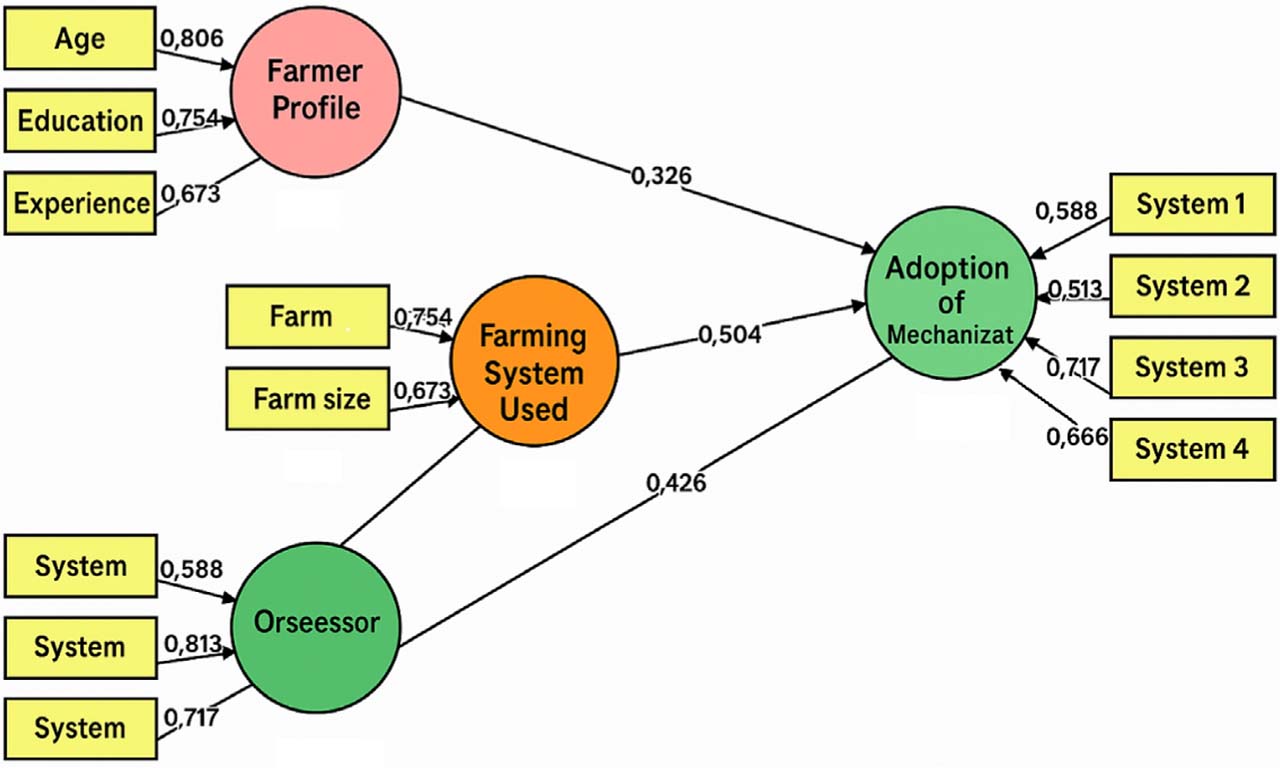
Fig. 4.
Structural model results
Source: own elaboration.
The results show that Farming system used has the most potent direct effect on Adoption of mechanization, with a path coefficient of 0.504, followed by the Orseessor (β = 0.426) and Farmer profile (β = 0.326). This suggests that the adoption of mechanization depends greatly on the structure and nature of farming practices, the provision of institutional support, and the individual characteristics of farmers.
All the observed indicators showed high loadings on their respective latent constructs, with factor loadings ranging from 0.673 to 0.813, confirming that the test items were good measures of these latent constructs. For instance, Education (0.754) and Age (0.806) were highly loaded on Farmer profile, while Farm size (0.673) and Farming system (0.754) were associated with Farming system used. Similarly, the loadings for Adoption of mechanization were highest for Systems 3 and 4, that is, 0.717 and 0.666, respectively. Overall, the model shows that a range of personal, operational, and institutional factors significantly affect mechanization adoption among wheat farmers in the current study area.
Furthermore, a bootstrapping analysis (Fig. 5) confirmed that Product innovation had a substantial and significant effect on Product quality (t = 45.235). Technological innovation (t = 2.736) and Administrative innovation (t = 3.747) had a significant impact on Product innovation, but their direct effects on Product quality were weak. All the measurement indicators showed high t-values indicating good reliability. These results emphasize Product innovation as a significant mediator of the relationship between innovation efforts and product quality.
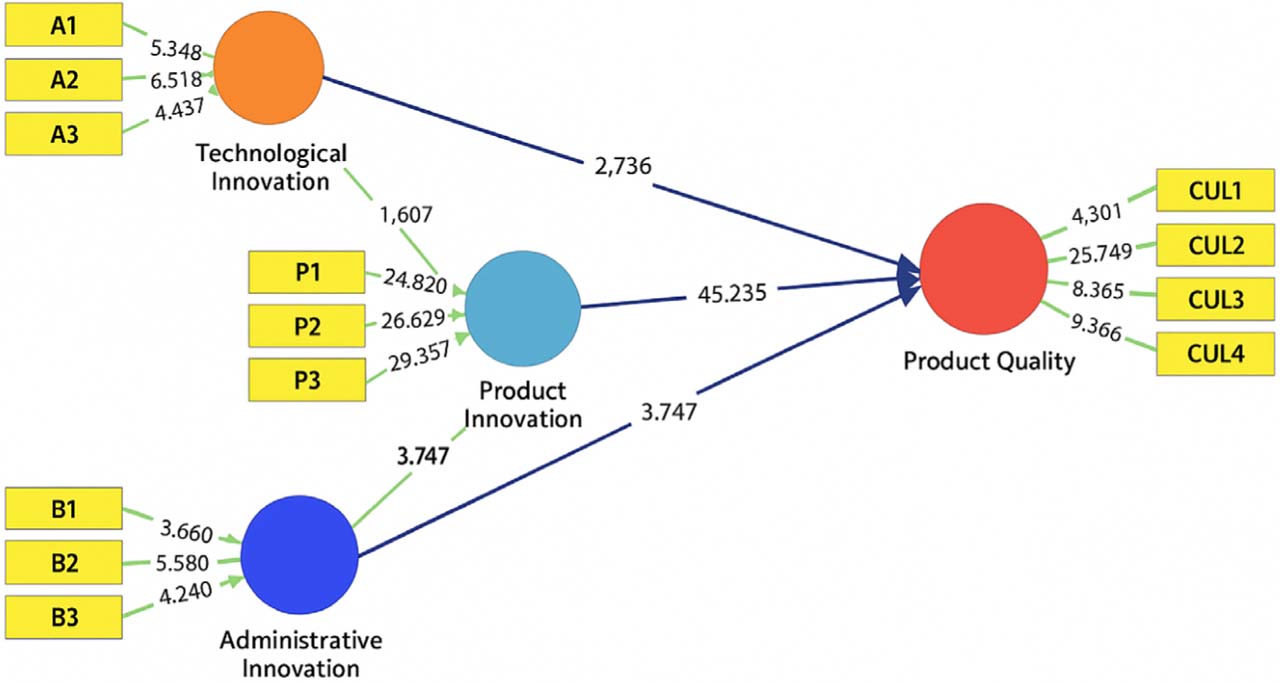
Fig. 5.
Measurement model (bootstrapping result)
Source: own elaboration.
The measurement model is depicted in Figure 4, with additional information in Table 2, which presents the path coefficients, t-values, and standard errors associated with the tested hypotheses. These statistical measures were used to provide a basis for evaluating support for each hypothesis. A bootstrapping resampling procedure was performed to increase reliability. This strategy was adopted to produce empirical distributions of the model parameters, thus allowing for more accurate estimation of the standard errors. The bootstrapping analysis was performed using data gathered from 381 wheat farmers across different districts in the south of Khyber Pakhtunkhwa province, thereby strengthening the statistical validity of the structural model. For each parameter, the standard deviation of the empirical distribution was used to estimate the standard error, and the standard error was used in turn to estimate the t-values required for hypothesis testing.
Table 2.
Statistical analysis (N = 381)
| Constructs | Original sample (β) | Sample mean | Standard deviation | t-statistics | p-values |
|---|---|---|---|---|---|
| Administrative | 0.351 | 0.361 | 0.043 | 3.751 | 0.002 |
| Administrative → Product quality | 0.026 | 0.026 | 0.029 | 0.947 | 0.348 |
| Product innovation → Product quality | 0.946 | 0.965 | 0.026 | 42.864 | 0.001 |
| Tech. innovation → Product innovation | 0.312 | 0.316 | 0.121 | 2.689 | 0.008 |
| Tech. innovation → Product quality | 0.039 | 0.037 | 0.026 | 0.1712 | 0.112 |
The bootstrapping analysis (Fig. 5) showed that Product innovation has a substantial and significant impact on Product quality (t = 45.235). Technological innovation (t = 2.736) and Administrative innovation (t = 3.747) had a significant impact on Product innovation, but their direct effects on Product quality were weak. All the measurement indicators showed high t-values indicating good reliability. These results emphasize Product innovation as a significant mediator of the relationship between innovation efforts and product quality.
Product innovation had the strongest and statistically significant relationship with perceived wheat product quality (β = 0.946, t = 45.285, p < 0.001), confirming its central role in explaining variations in perceived product quality (Table 2). Technological innovation had a significant impact on Product innovation (β = 0.306, t = 2.756, p = 0.006), which in turn had an indirect impact on product quality. However, its direct effect on product quality was insignificant (β = 0.036, t = 0.1607, p = 0.109). Similarly, Administrative innovation had a significant overall influence on agribusiness (β = 0.347, t = 3.747, p = 0.000), but had minimal (direct) effects on product quality, which were statistically insignificant (β = 0.028, t = 0.934, p = 0.351).
The coefficient of determination (R2) is an important measure for diagnosing the explanatory power of structural models in PLS-SEM. It assesses the degree to which the independent variables explain the dependent variable, product quality. As Hair et al. (2011) and Henseler et al. (2012) note, R2 provides important information about model strength. Different scholars propose different benchmarks: according to Falk and Miller (1992), the minimum acceptable R2 should be 0.10, whereas, according to Chin (1998), R2 values of 0.67, 0.33, and 0.19 are considered substantial, moderate, and weak, respectively. Hair et al. (2011) further recommend 0.75, 0.50, and 0.25 as high, moderate, and low indicators of explanatory power, respectively. Cohen (1988) also provides alternative thresholds, assigning values of 0.27, 0.13, and 0.02 to strong, moderate, and weak, respectively. Based on these criteria, the R2 value for product quality, representing the direct impact of innovation variables, is shown in Table 3, revealing the model’s power to explain product quality. The R2 of 96.5% indicates that the independent variables of product innovation, technological innovation, and administrative innovation explain 96.5% of the variance in product quality. This high R2 value exceeds the thresholds proposed by Falk and Miller (1992) and Chin (1998) to establish the robustness of the model in explaining endogenous construction. These results provide strong empirical support for the premise that innovative practices improve product quality in wheat agribusinesses. However, this very high R2 should be interpreted with regard to the strong association between product innovation and product quality, and the conceptual proximity of the innovation-related constructs. As the measures were obtained from the same cross-sectional survey, the value primarily represents strong in-sample explanatory power and should not be interpreted as equivalent evidence of out-of-sample predictive accuracy. The bootstrapping results show that technological innovation was significantly associated with product innovation, supporting H1. Administrative innovation is also significantly associated with product innovation, supporting H2. The results concerning farmer characteristics, farming systems, and institutional support were subsequently evaluated against H3–H5 in the mechanization-adoption model.
SHapley Additive exPlanations based on machine learning
The application of SHAP analysis provides a quantitative, interpretable evaluation of the variables that affect the performance of the agribusiness. The findings show that the most significant variables are the farming system and the size of the farmland, followed by years of farm experience and education level (Fig. 6). These variables always have high SHAP values, indicating that they contribute substantially to the model’s predictions. On the other hand, demographic variables like gender register insignificant impacts on performance variability. The SHAP value distribution further demonstrates that higher levels of mechanization and larger farm sizes positively contribute to agribusiness performance, whereas lower levels are associated with lower outcomes.
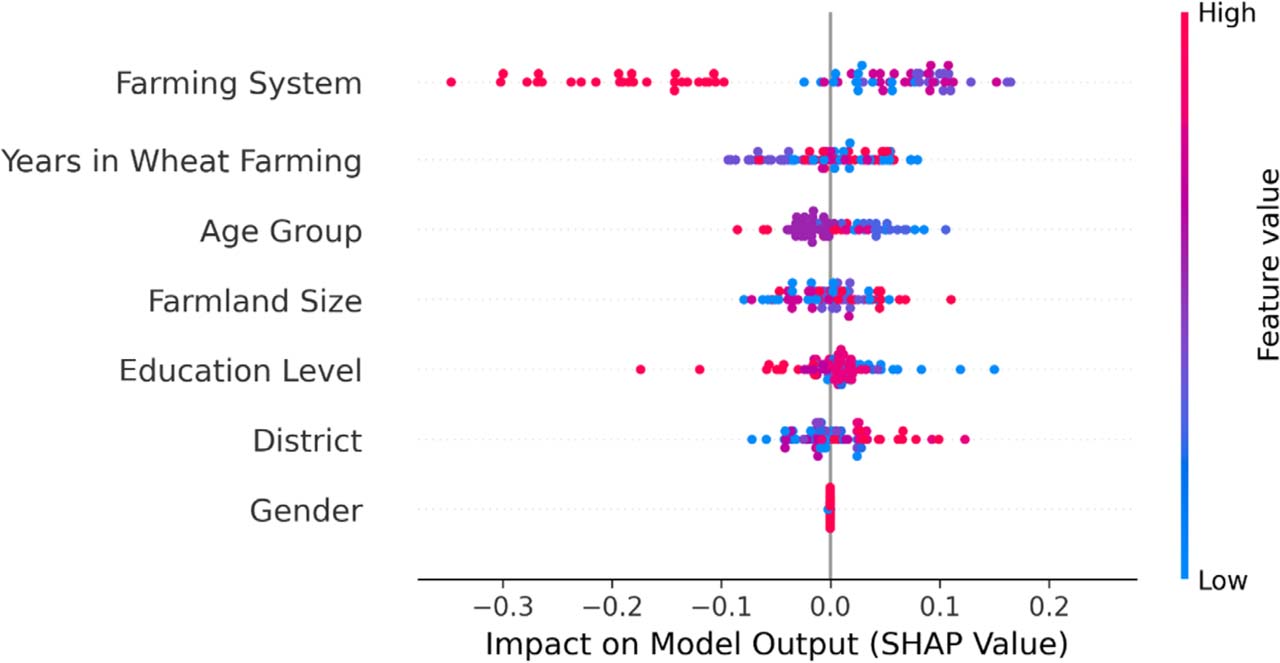
Fig. 6.
Showing SHAP-Based drivers of agribusiness
Source: own elaboration.
DISCUSSION
The present findings demonstrate that particular dimensions of entrepreneurial innovation are associated with perceived wheat product quality. Product innovation showed the strongest direct relationship with perceived product quality, whereas technological and administrative innovation primarily contributed through product innovation. Examining product, technological, and administrative innovation revealed the distinct roles of these innovation dimensions in wheat farming and farm management (Awan and Ali, 2022; Hassan et al., 2022). The sample, which consisted of experienced male farmers, predominantly represented a traditional, though changing, agricultural landscape (Leitão et al., 2024). With various educational backgrounds, and with a dominance of semi-mechanized practices, the farming community is showing promise in the adoption of innovation, although the extent of such engagement remains uneven (Lone and Baba, 2024). With these differences in capacity and readiness, it is probable that some farming profiles are affected less than other farming profiles in terms of innovation impact (Lai et al., 2025; Opazo-Basáez et al., 2024). Product innovation was found to be a significant factor in enhancing the quality of produce and strengthening the need for unique approaches to improving product quality for various farmers, which can also scale to their operational scale and capacity to implement and disseminate knowledge (Akomea et al., 2023; Osei et al., 2024). These results point to the importance of aligning innovation efforts with the specific characteristics and needs of farming communities to improve outcomes in agribusiness (Baden-Fuller and Haefliger, 2013; Dhingra and Tenreyro, 2021).
Administrative innovation primarily reflects changes in farm organization, record-keeping, management, and collaboration. While these practices may facilitate product-oriented innovation and improve farm operations, they should not be interpreted as directly altering the intrinsic physical characteristics of wheat grain (Dossou et al., 2023; Lino, 2025). Instead, improved management, record keeping, coordination, and stakeholder relationships may facilitate the adoption and implementation of product innovations rather than directly altering the intrinsic characteristics of wheat grain (Awan and Ali, 2022; Shah, 2025).
Within the wheat farming sector of southern Khyber Pakhtunkhwa (KP), especially along the south corridor of the CPEC, the results highlight that innovation is the primary driver of enhancing the performance of agribusinesses rather than a secondary complement. Adopting innovative practices helps farmers improve the quality of their products, adapt more easily to consumer preferences, and be more resistant to market competition, which is in constant flux. Recent research corroborates these findings, stating that innovation in agricultural practices drives higher efficiency, improved quality outputs, and long-term sustainability for rural economies (Haq and Farooq, 2016; Shaikh et al., 2025; Ullah et al., 2021).
Moreover, the study highlights the importance of combining innovative practices to make agribusinesses more flexible in terms of product diversification, quality standards, and adaptation to market changes, all of which are critical for continued growth and viability. These findings underscore the urgent need to foster innovation-oriented thinking across rural farming communities. Farming systems and institutional support exhibited significant positive associations with mechanization adoption. Recent research has similarly emphasized the importance of innovation in promoting higher levels of adaptability, productivity, and resilience in agrarian enterprises (Dhingra and Tenreyro, 2021; Srejić et al., 2023).
The addition of SHAP analysis adds a new layer to the assessment of agribusiness performance, as it allows the inclusion of complex machine learning models in a straightforward manner. Compared to traditional methods, this technique measures the contribution of each variable separately and provides a deeper understanding of the dynamics of performance. The findings underscore how structural and management-related factors, including farming systems and farm size, contribute significantly to agribusiness outcomes. This confirms the value of mechanization, technology adoption, and economies of scale in modern agricultural systems. Moreover, the role of human capital in increasing adaptive capacity and decision-making is highlighted by the impact of education and experience. Conversely, the negligible contribution of gender indicates that differences in performance primarily stem from resource availability and management practices rather than demographic differences. However, female respondents accounted for only 2.9% of the sample; therefore, the relatively low SHAP contribution of gender should be interpreted cautiously, as the limited representation of women reduces the model’s ability to detect potential gender-related differences. In general, SHAP-based results enrich empirical data, confirming and deepening knowledge of conventional models.
POLICY IMPLICATIONS
Tis study’s findings have significant implications for food system policy and agribusiness development. Firstly, the strong influence of technological and administrative innovation implies that policy-makers should focus on promoting mechanization, the use of digital technologies in agriculture, and better farm management practices through targeted subsidy schemes and extension services. Secondly, the relatively high importance of farm size and farming systems suggests the need to encourage land consolidation, cooperative farming models, and mechanisms for sharing resources to improve economies of scale. Thirdly, the contribution of education and experience suggests that capacity-building programs, such as farmer education and knowledge transfer programs, are crucial for improving innovation adoption. Furthermore, the identification of distinct groups of farmers suggests that policy interventions should be targeted to different categories to ensure that resource-deprived farmers receive adequate institutional and financial support. Overall, building and strengthening innovative ecosystems and expanding access to technology and knowledge can improve agribusiness performance and build more resilient, efficient food systems.
CONCLUSION
This study demonstrates the important role of entrepreneurial innovation in perceived wheat product quality and mechanization adoption among wheat farmers in southern Khyber Pakhtunkhwa. Product innovation showed the strongest direct relationship with perceived wheat product quality, whereas technological and administrative innovations primarily contributed through product innovation. The identification of distinct farmer groups further demonstrated substantial heterogeneity in farming systems, resource availability, and mechanization adoption. The fusion of Shapley Additive Explanations-based machine learning provides additional insights into the farming system, with only farm size and managerial capacity being among the most significant drivers of performance, and demographic characteristics playing a comparatively less significant role. This supports the conclusion that structural and management-related factors are more important than intrinsic demographic attributes in determining agribusiness success. Overall, strengthening innovation ecosystems, access to modern technologies, institutional support, and farmer capacity can improve perceived wheat product quality and mechanization adoption and, in turn, contribute to broader agribusiness performance, competitiveness, and food-system resilience.
ACKNOWLEDGMENTS
This research was jointly supported by the Xinjiang Production and Construction Corps Social Science Fund Project: Research on Measuring, Regional Difference’s, and Optimization Pathways for High-Quality Development Level of Cold Chain Circulation of Agricultural Products in the Corps (23Y806) and Shihezi University’s High-Level Talent Project: A Study on the Relationship Between Big Data Analysis Capabilities and Manufacturing Supply Chain Performance (RCSK202304).
Notes
SUPPLEMENTARY INFORMATION
Supplementary Method S1. Random Forest model specification and diagnostics
The Random Forest regression diagnostic was implemented using 500 trees (n_estimators = 500). The dataset was randomly partitioned into 80% for training and 20% for testing, with random_state = 42 to ensure reproducibility. The continuous Innovation Adoption Index was calculated as the mean of the nine product, technological, and administrative innovation items. The predictor set comprised farming system, years in wheat farming, age group, farmland size, education level, district, and gender. Model fit was summarized using the coefficient of determination (R2) and root mean square error (RMSE). For the training-set diagnostic, the model achieved R2 = 0.819 and RMSE = 0.193. These values represent in-sample training fit and are provided as a diagnostic rather than as independent validation performance.
Table S1.
Random Forest model settings used for the training-set diagnostic
| Specification | Setting/value |
|---|---|
| Model | Random Forest regression diagnostic |
| Number of trees | 500 |
| Training/testing split | 80%/20% |
| Random seed | random_state = 42 |
| Outcome | Continuous Innovation Adoption Index |
| Predictors | Farming system; years in wheat farming; age group; farmland size; education level; district; gender |
| Training R2 | 0.819 |
| Training RMSE | 0.193 |
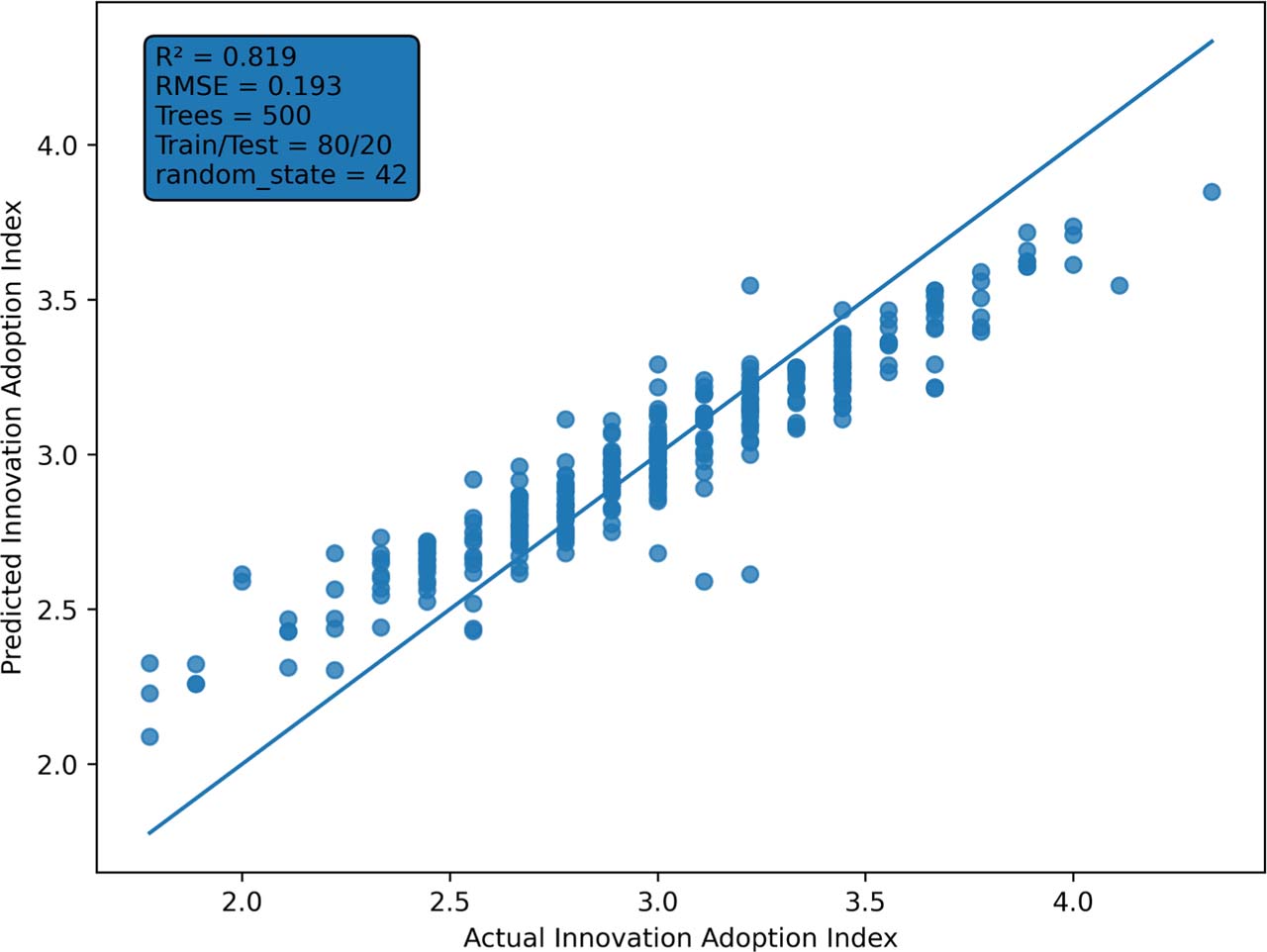
Fig. S1.
Actual versus predicted Innovation Adoption Index for the Random Forest training dataset
The model used 500 trees, an 80:20 training-testing split, and random_state = 42.
Training-set fit: R2 = 0.819, RMSE = 0.193
Source: own elaboration.