
Table 1.
Descriptive statistics of global food price sub-indices (1990–2025)
| Variable | Mean | Std. dev. | Minimum | Maximum |
|---|---|---|---|---|
| Meat | 92.71 | 11.08 | 74.16 | 115.78 |
| Dairy | 92.38 | 27.37 | 51.58 | 146.28 |
| Cereals | 93.70 | 23.16 | 64.66 | 151.33 |
| Oils | 97.55 | 31.52 | 53.94 | 183.73 |
| Sugar | 88.96 | 25.14 | 48.17 | 144.98 |
Table 2.
Correlation matrix of global food price sub-indices (1990–2025)
Table 3.
Volatility measures of global food price sub-indices (1990–2025)
| Variable | Mean | Std. dev. | Coefficient of variation (CV) | Volatility rank |
|---|---|---|---|---|
| Oils | 97.55 | 31.52 | 0.323 | 1 |
| Dairy | 92.38 | 27.37 | 0.296 | 2 |
| Sugar | 88.96 | 25.14 | 0.283 | 3 |
| Cereals | 93.70 | 23.16 | 0.247 | 4 |
| Meat | 92.71 | 11.08 | 0.119 | 5 |
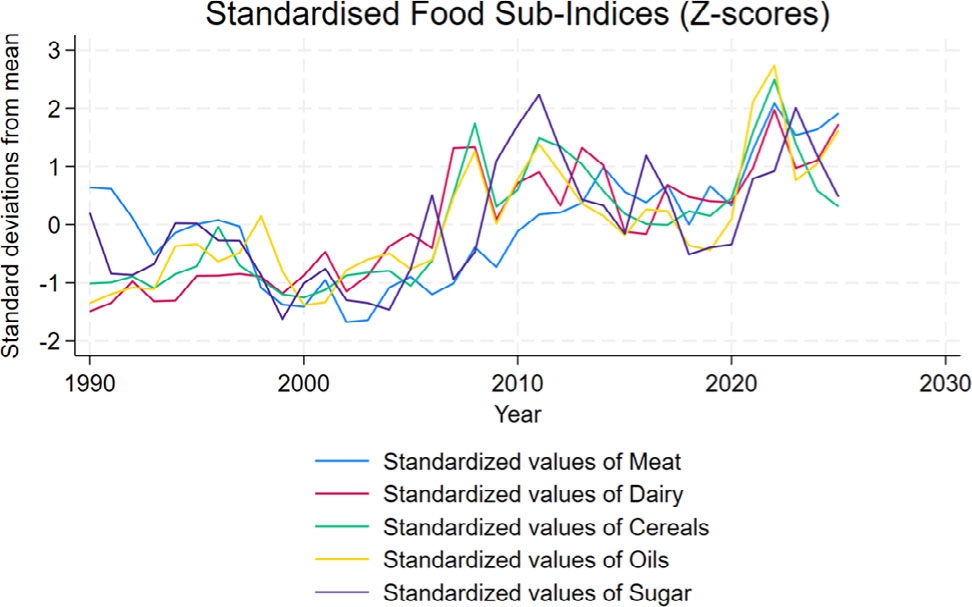
Fig. 1.
Standardised global food price sub-indices (Z-scores)
Source: authors' calculations, 2026.
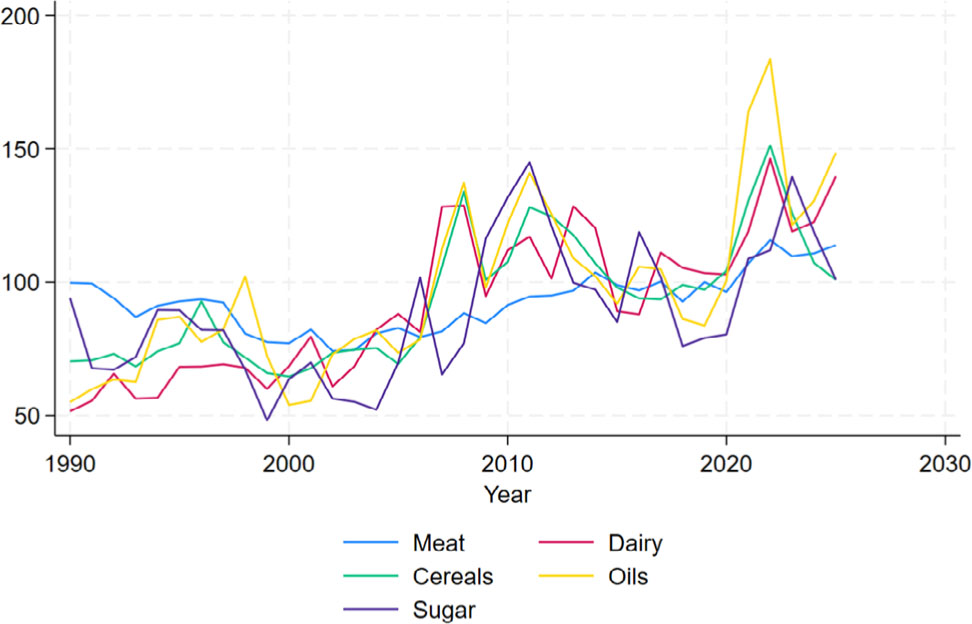
Fig. 2.
Levels of FAO Global Food Price sub-indices
Source: author's calculations, 2026.
Table 4.
Augmented Dickey-Fuller unit root test results
Table 5.
Unit Root Test Results (PP, KPSS)
| Variable | PP Statistic (Level) | PP p-value | KPSS Statistic (Level) | Order of integration |
|---|---|---|---|---|
| Meat | −0.752 | 0.833 | 0.630 | I(1) |
| Dairy | −1.642 | 0.461 | 0.141 | I(1) |
| Cereals | −2.026 | 0.275 | 0.138 | I(1) |
| Oils | −2.214 | 0.201 | 0.088 | I(1) |
| Sugar | −2.421 | 0.136 | 0.160 | I(1) |
[i] Notes: The Phillips-Perron (PP) test evaluates the null hypothesis of a unit root, while the KPSS test evaluates the null hypothesis of stationarity. The combined results indicate that all variables are non-stationary in levels. The order of integration is confirmed using ADF tests (reported earlier), where all variables become stationary after first differencing.
Table 6.
Zivot-Andrews structural break unit root test results
| Variable | Test statistic | 5% critical value | Break year |
|---|---|---|---|
| Meat | −4.756 | −4.800 | 1998 |
| Dairy | −3.359 | −4.800 | 2015 |
| Cereals | −4.795 | −4.800 | 2007 |
| Oils | −4.419 | −4.800 | 2007 |
| Sugar | −3.999 | −4.800 | 2009 |
[i] Notes: The Zivot-Andrews test allows for a single endogenous structural break in the intercept. The null hypothesis is the presence of a unit root with a structural break. All test statistics fail to exceed the 5% critical value, indicating that the series remains non-stationary in levels even after accounting for structural breaks.
Table 7.
Johansen Cointegration Test results
| Null hypothesis (r ≤) | Trace statistic | 5% critical value |
|---|---|---|
| r = 0 | 83.019 | 68.520 |
| r = 1 | 51.019 | 47.210 |
| r = 2 | 24.114 | 29.680 |
| r = 3 | 9.559 | 15.410 |
| Null hypothesis | Max-eigen statistic | 5% critical value |
| r = 0 vs r = 1 | 31.999 | 33.460 |
| r = 1 vs r = 2 | 26.905 | 27.070 |
| r = 2 vs r = 3 | 14.556 | 20.970 |
Table 8.
Vector Error-Correction Model equation diagnostics
| Equation | RMSE | R-sq | χ2 | P>χ2 |
|---|---|---|---|---|
| D_Meat | 5.75054 | 0.0737 | 2.148187 | 0.9512 |
| D_Dairy | 17.0363 | 0.1833 | 6.061607 | 0.5326 |
| D_Cereals | 12.4852 | 0.3396 | 13.88563 | 0.0533 |
| D_Oils | 17.7185 | 0.5069 | 27.75723 | 0.0002 |
| D_Sugar | 19.9395 | 0.0886 | 2.625833 | 0.9173 |
Table 9.
VECM Diagnostic Test Results
| (a) Serial Correlation: Lagrange Multiplier (LM) Test | ||||
| Lag Order | Chi-square | Degrees of freedom | p-value | Conclusion |
| 1 | 36.274 | 25 | 0.068 | No serial correlation |
| 2 | 28.953 | 25 | 0.266 | No serial correlation |
| (b) Normality of Residuals: Jarque–Bera Test | ||||
| Equation | Chi-square | p-value | ||
| D_Meat | 0.961 | 0.619 | ||
| D_Dairy | 2.831 | 0.243 | Normally distributed | |
| Cereals | 0.459 | 0.795 | Normally distributed | |
| D_Oils | 2.270 | 0.321 | Normally distributed | |
| D_Sugar | 0.290 | 0.865 | Normally distributed | |
| (c) Stability Condition: Eigenvalue Test | ||||
| Joint Test | 6.811 | 0.743 | Residuals jointly normal | |
| Criterion | Result | |||
| Maximum modulus of eigenvalues | < 1 | |||
| Stability condition satisfied | Yes | |||
Table 10.
Error-correction term estimates (Long-run adjustment speed)
| Variable | Coefficient | Std. error | z-statistic | p-value |
|---|---|---|---|---|
| Meat | 1.000 | – | – | – |
| Dairy | 2.832 | 1.108 | 2.56 | 0.011 |
| Cereals | 1.802 | 2.064 | 0.87 | 0.383 |
| Oils | −5.822 | 1.124 | −5.18 | 0.000 |
| Sugar | 1.672 | 0.709 | 2.36 | 0.018 |
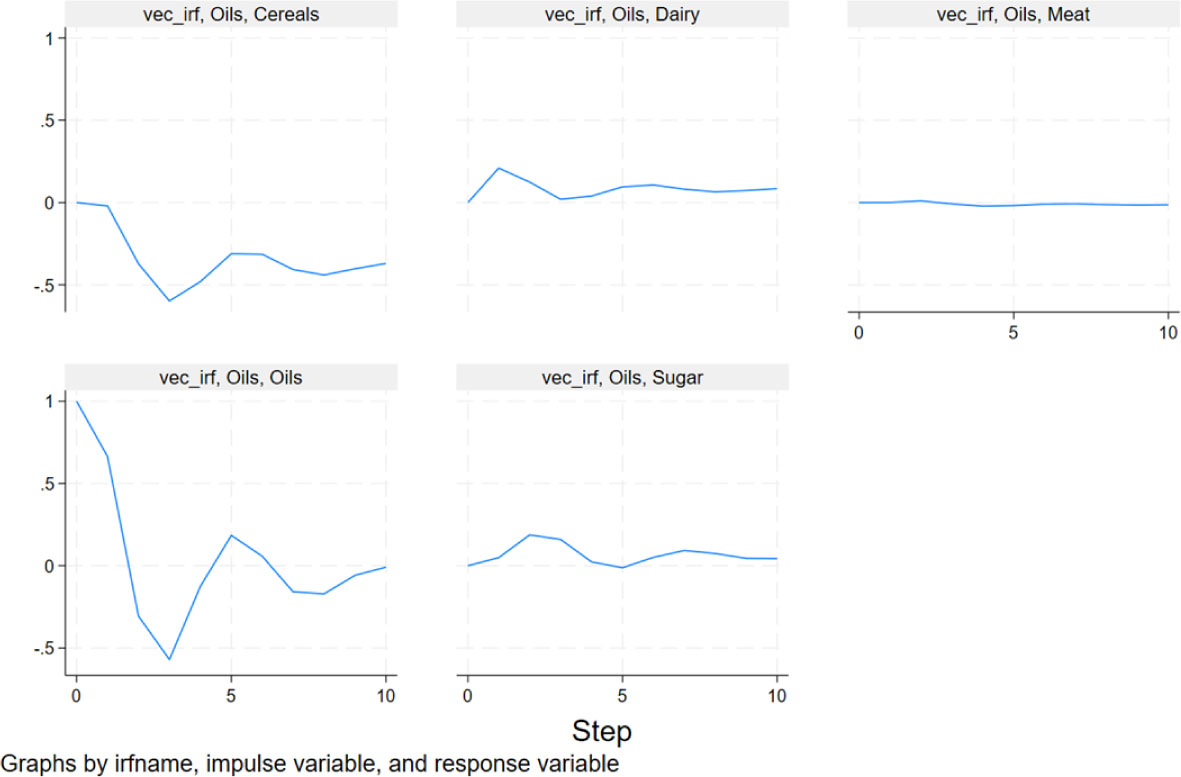
Fig. 3.
Impulse Response Functions (IRFs) to a Shock in Vegetable Oil Prices across Global Food Price Sub-Indices
Source: authors' calculations, 2026.
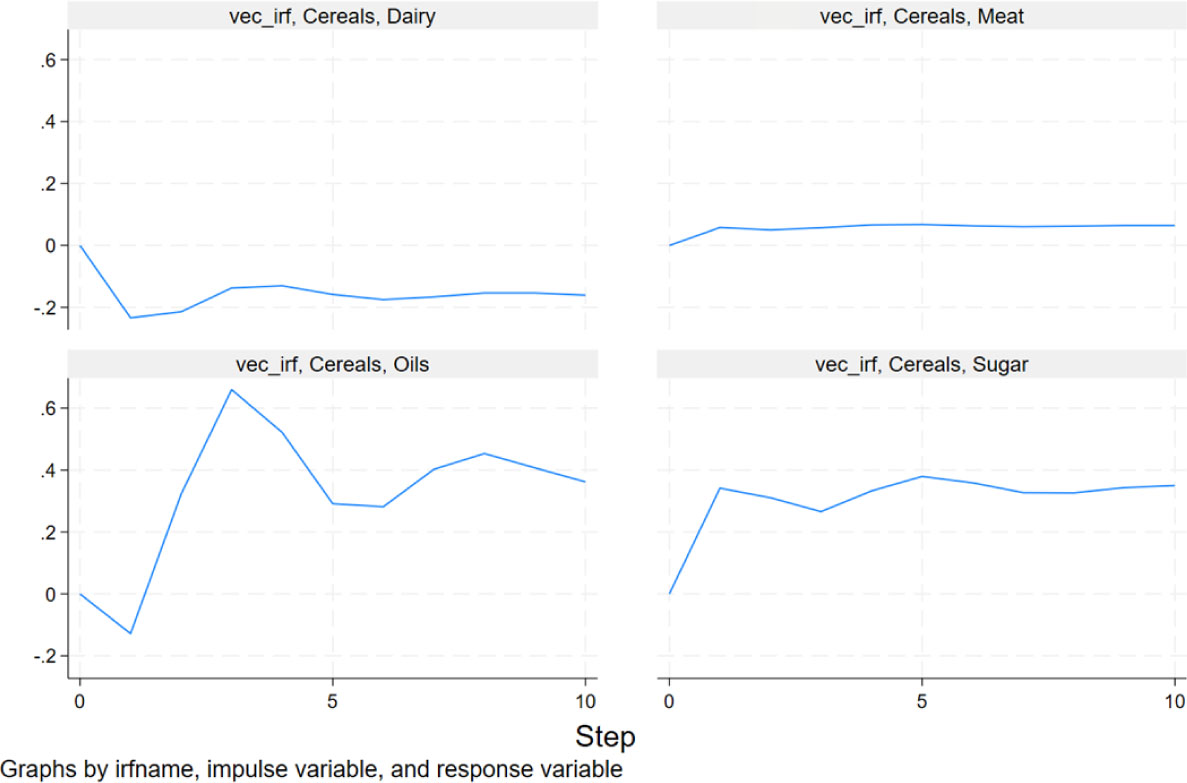
Fig. 4.
Impulse Response Functions (IRFs) to a Shock in Cereal Prices across Selected Global Food Price Sub-Indices
Source: authors' calculations, 2026.
Table 11.
Forecast Error Variance Decomposition (FEVD) of global food price sub-indices showing relative contributions of own and cross-market shocks
| Response variable | Own shock (%) | Oils (%) | Cereals (%) | Dairy (%) | Sugar (%) | Interpretation |
|---|---|---|---|---|---|---|
| Meat | 94.2 | 3.3 | 1.8 | 0.1 | 0.6 | Highly isolated |
| Dairy | 74.6 | 11.8 | 29.4 | – | 9.6 | Moderately integrated |
| Cereals | 42.8 | 12.9 | – | 0.1 | 10.8 | Transmission role |
| Oils | 16.7 | – | 15.7 | 0.2 | 9.7 | System driver |
| Sugar | 58.7 | 30.4 | 12.6 | 3.6 | – | Partial integration |