
INTRODUCTION
Global food prices have emerged as a central concern in contemporary economic analysis, reflecting their role at the intersection of food security, inflation dynamics, trade policy, and macroeconomic stability. Since the mid-2000s, successive episodes of pronounced food price volatility, notably during the 2007–2008 and 2010–2011 food crises and the global disruptions following 2020, have underscored the extent to which shocks originating in one segment of the food system may propagate across markets and regions (Kabundi et al., 2022; Akarli, 2024). These developments have renewed interest in a fundamental but unresolved question: To what extent do global food sub-markets form an integrated price system in the long run?
A substantial body of literature recognises that food prices are increasingly shaped by common global forces, including growing trade integration, shared input costs, energy price linkages, and synchronised demand growth (Aiyar et al., 2023; Taheri Hosseinkhani, 2025; Ali et al., 2025). Within this framework, major food sub-markets, such as meat, dairy, cereals, vegetable oils and sugar, are connected through production technologies, consumption substitution, and international trade networks. Yet empirical evidence on whether these markets share a stable long-run equilibrium remains mixed. Much of the existing research documents short-run co-movement or episodic price transmission but stops short of establishing whether the observed co-movement reflects genuine structural integration or merely transitory responses to global shocks.
The empirical debate can be broadly organised into three strands. A first strand argues that globalisation and market liberalisation have strengthened long-run price integration across food markets, implying the existence of common stochastic trends and shared equilibria (Wagan et al., 2024; Ridwan et al., 2025). A second strand emphasises market heterogeneity, policy interventions, and commodity-specific supply constraints, suggesting that food prices may co-move during crises while remaining segmented in normal periods (Newman and Van Huellen, 2022; Vatsa, 2022; Jouini et al., 2026). A third, closely related debate concerns adjustment leadership within the food system. While some studies identify cereals as the anchor of global food prices, others point to vegetable oils as the primary adjustment mechanism, reflecting their close linkage to energy markets, biofuel demand, and processing chains (Barrett et al., 2022; Demirkılıç et al., 2022). These competing hypotheses remain insufficiently resolved, in part because many studies rely on pairwise correlations or reduced-form regressions that are ill-suited to non-stationary price series.
Methodologically, distinguishing between short-run co-fluctuations and long-run integration requires a system-based approach. When prices are non-stationary, standard correlation analysis provides no information about equilibrium relationships, while single-equation models risk imposing restrictive causal structures. Cointegration analysis offers a coherent alternative by allowing prices to drift individually while testing whether they move together over time (Nakos and Simos, 2024). In this context, the Johansen cointegration framework is particularly appropriate, as it enables joint testing of multiple price series within a unified system and permits rich short-run dynamics through a Vector Error-Correction Model (VECM) (Elias et al., 2023; Thapa, 2024). Despite its relevance, this approach remains underutilised in comparative analyses of global food sub-indices, where the emphasis has often been on bilateral transmission or country-specific markets.
This study contributes to the literature by explicitly modelling global food prices as a system in which all factors are jointly determined. Using annual data from 1990 to 2025, it investigates whether prices for meat, dairy, cereals, vegetable oils, and sugar share a common long-term equilibrium, and identifies which sub-markets drive adjustments when deviations from the equilibrium occur. The analysis employs the Johansen cointegration method to test for long-run relationships and estimates a VECM to describe short-term adjustment dynamics across markets.
The results provide strong evidence of a single long-term cointegrating relationship linking the major food sub-markets, supporting the hypothesis that global food prices are structurally interconnected rather than just temporarily correlated. However, adjustment dynamics are asymmetric. Vegetable oils and cereals exhibit statistically significant error-correction behaviour, indicating a leading role in re-establishing long-term equilibrium, whereas prices for meat, dairy, and sugar show weaker short-term adjustments. These findings offer new insights into the internal structure of global food price dynamics and contribute to ongoing debates regarding price leadership, market integration, and the transmission of global shocks across food systems.
By elucidating both the presence of long-term integration and the mechanisms that restore equilibrium, this study enhances empirical understanding of global food price behaviour and provides insights relevant to agricultural trade policy, food market monitoring, and macroeconomic analysis. This study is motivated by a critical gap in the literature on global food price dynamics. While existing research has extensively examined price co-movement and integration, relatively limited attention has been given to the possibility that adjustment processes may be inherently asymmetric across commodity groups. In particular, the extent to which certain food markets play a dominant role in restoring equilibrium, while others respond passively, remains insufficiently explored.
Accordingly, this paper investigates not only whether global food price sub-indices share a common long-run equilibrium, but also whether the adjustment towards that equilibrium is unevenly distributed across commodities. By combining cointegration analysis with dynamic system modelling, the study contributes to the literature by identifying a hierarchical structure in global food price interactions, where selected commodities, particularly vegetable oils, play a disproportionate role in the processes of shock transmission and equilibrium adjustment.
MATERIALS AND METHODS
Data sources
The study uses annual global food price data from the Food and Agriculture Organisation of the United Nations (FAO), specifically the FAO Food Price Index (FFPI) sub-indices for meat, dairy, cereals, vegetable oils, and sugar. These indices are constructed as trade-weighted averages of internationally traded commodity prices and are widely employed in empirical analyses of global food markets (Muralikrishna, 2025; Sun et al., 2023).
The sample covers the period 1990–2025, providing time series of sufficient length to assess long-run relationships while capturing major global food price episodes. All data are publicly available through FAOSTAT and the FAO Food Price Index portal, with no restrictions on access or use. The study is designed to identify structural, long-horizon equilibrium relationships across global food prices rather than short-run transmission dynamics. For this reason, annual data are employed, as they are well suited to examining persistent co-movement and long-run equilibrium behaviour over extended periods. Annual aggregation reduces the influence of short-term volatility, seasonal fluctuations, and transitory shocks that may obscure underlying cointegration relationships. This choice is aligned with the study's focus on structural integration across food markets. At the same time, it is recognised that higher-frequency data may provide additional insights into short-run adjustment and crisis-period dynamics, which remain an important avenue for future research.
Econometric framework
Let Pt = (p1t, p2t, …, p5t)′ denote the vector of global food sub-indices (meat, dairy, cereals, oils, and sugar). The joint dynamics of these prices are initially represented by a k-lag Vector Autoregressive (VAR) model in levels:
where μ is a vector of constants, Γi are coefficient matrices, and ɛt is a vector of white-noise disturbances.To assess the time-series properties of the data, Augmented Dickey-Fuller (ADF) unit root tests are applied to each series. Establishing that all variables are integrated of the same order is a necessary condition for cointegration analysis (Roza et al., 2022).
Johansen cointegration analysis
When the variables are non-stationary but integrated of the same order, the VAR can be reparameterised into a Vector Error-Correction Model (VECM):
where Π captures the long-run relationships among the variables. If the rank of Π is r < n, it can be decomposed as: where β contains the cointegrating vectors representing long-run equilibrium relationships, and α contains the adjustment coefficients that measure the speed at which each price responds to deviations from equilibrium.The number of cointegrating relationships is determined using the Johansen trace and maximum eigenvalue tests, conducted under a restricted constant specification. This system-based approach allows all food prices to be treated as jointly endogenous, avoiding the imposition of arbitrary causal ordering (Turrisi et al., 2022; Nwanosike and Umoh, 2025).
Lag length selection and model estimations
The optimal lag length for the VAR is selected using standard information criteria, including AIC, SBIC, and HQIC, with parsimonious specifications preferred given the data's annual frequency. The selected lag structure is subsequently imposed in the Johansen cointegration tests and the VECM estimation.
Following identification of the cointegration rank, the VECM is estimated to capture both short-run price interactions and long-run adjustment dynamics. The statistical significance of the adjustment coefficients provides evidence on which food sub-markets return to long-run equilibrium, offering insights into price leadership within the global food system (Theresia et al., 2025). All estimations are conducted using Stata 19.
To ensure the robustness of the empirical framework, the analysis extends beyond standard cointegration techniques by incorporating multiple unit root tests, including the Augmented Dickey-Fuller, Phillips-Perron, and KPSS procedures, as well as structural break analysis using the Zivot-Andrews test. In addition, the validity of the Vector Error Correction Model is assessed using a comprehensive set of diagnostic tests, including tests for serial correlation, normality, and stability.
Beyond estimating long-run relationships, the study further examines system dynamics using impulse response functions and forecast-error variance decomposition. This allows for a more detailed assessment of shock transmission mechanisms and the relative importance of different food markets in driving global price adjustments. As such, the methodological approach moves beyond static co-movement analysis and provides a dynamic and system-based understanding of global food price interactions.
RESULTS
Descriptive results
Summary statistics of food sub-indices
Table 1 reports the descriptive statistics for the five FAO food price sub-indices, meat, dairy, cereals, vegetable oils, and sugar, over the period 1990–2025.
Table 1.
Descriptive statistics of global food price sub-indices (1990–2025)
| Variable | Mean | Std. dev. | Minimum | Maximum |
|---|---|---|---|---|
| Meat | 92.71 | 11.08 | 74.16 | 115.78 |
| Dairy | 92.38 | 27.37 | 51.58 | 146.28 |
| Cereals | 93.70 | 23.16 | 64.66 | 151.33 |
| Oils | 97.55 | 31.52 | 53.94 | 183.73 |
| Sugar | 88.96 | 25.14 | 48.17 | 144.98 |
The summary statistics indicate that while mean index levels across food groups are broadly comparable, dispersion differs substantially across sub-indices. Vegetable oils and dairy exhibit notably higher variability than meat prices, while sugar prices show wide ranges between minimum and maximum values over the sample period. These differences point to heterogeneous volatility profiles across global food markets.
Correlation of matrix for global food price sub-indices
Table 2 indicates strong, statistically significant co-movement across all food price sub-indices. Correlations are highest among cereals, oils, and dairy (ρ ≈ 0.84–0.89), indicating tight integration across these markets. By contrast, associations involving sugar and meat are weaker, suggesting partial segmentation. Overall, the evidence supports broad integration alongside heterogeneous linkages across commodities.
Table 2.
Correlation matrix of global food price sub-indices (1990–2025)
| Variable | Meat | Dairy | Cereals | Oils | Sugar |
|---|---|---|---|---|---|
| Meat | 1.000 | ||||
| Dairy | 0.571* | 1.000 | |||
| Cereals | 0.613* | 0.866* | 1.000 | ||
| Oils | 0.605* | 0.842* | 0.892* | 1.000 | |
| Sugar | 0.619** | 0.547* | 0.674* | 0.637* | 1.000 |
Table 3 shows clear heterogeneity in price volatility across commodities. Vegetable oils are the most volatile (CV = 0.323), followed by dairy and sugar, while cereals exhibit moderate variability. Meat prices are markedly more stable (CV = 0.119), indicating limited responsiveness to shocks.
Table 3.
Volatility measures of global food price sub-indices (1990–2025)
| Variable | Mean | Std. dev. | Coefficient of variation (CV) | Volatility rank |
|---|---|---|---|---|
| Oils | 97.55 | 31.52 | 0.323 | 1 |
| Dairy | 92.38 | 27.37 | 0.296 | 2 |
| Sugar | 88.96 | 25.14 | 0.283 | 3 |
| Cereals | 93.70 | 23.16 | 0.247 | 4 |
| Meat | 92.71 | 11.08 | 0.119 | 5 |
The ranking underscores asymmetric adjustment potential across markets, with oils and dairy driving variability and meat remaining comparatively insulated.
Co-movement and volatility patterns in food prices
To examine relative price dynamics over time, Fig. 1 presents the standardised (Z-score) levels of the five food sub-indices, while Fig. 2 displays the raw index levels.
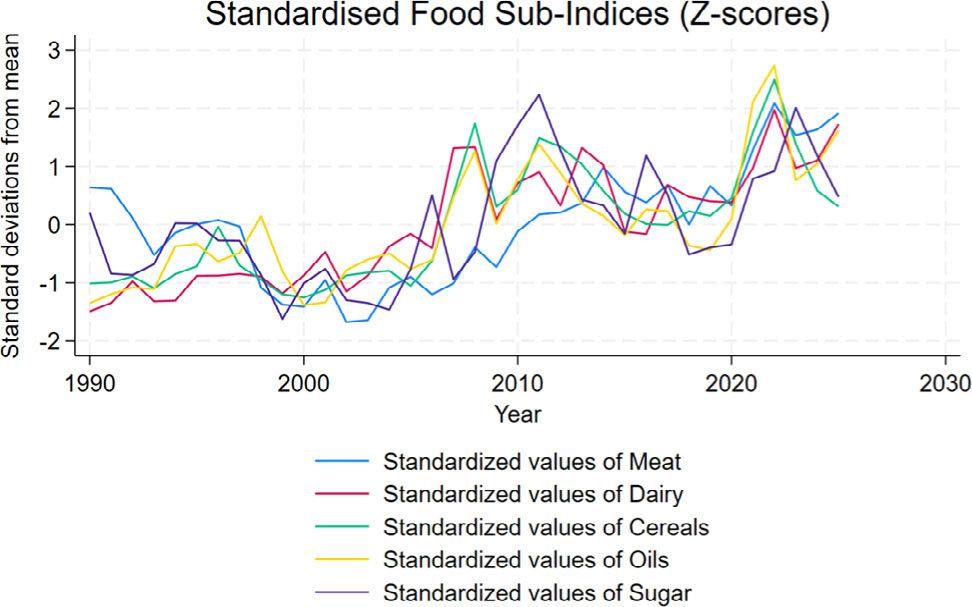
Fig. 1.
Standardised global food price sub-indices (Z-scores)
Source: authors' calculations, 2026.
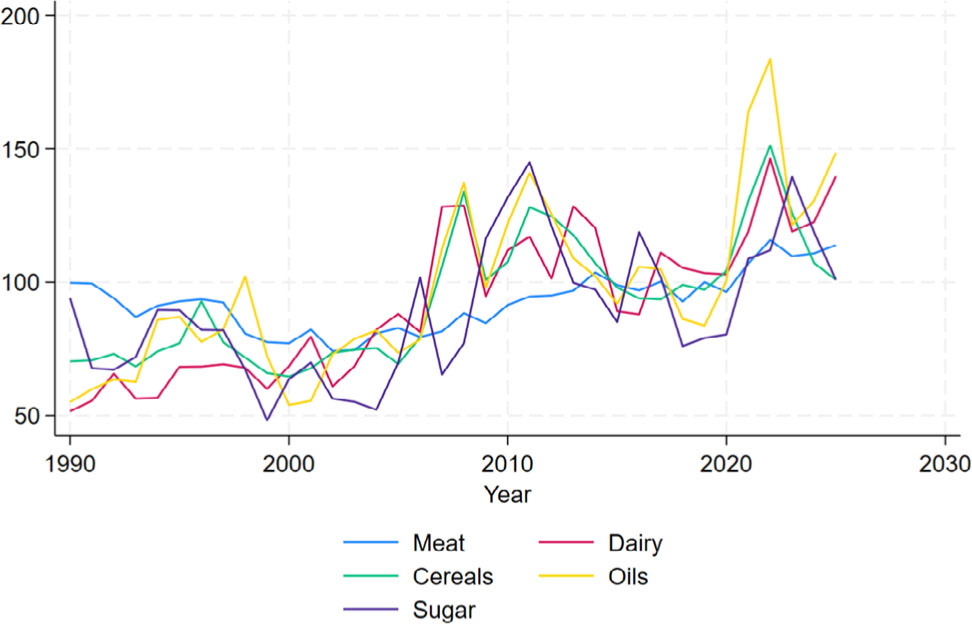
Fig. 2.
Levels of FAO Global Food Price sub-indices
Source: author's calculations, 2026.
The standardised series reveals periods of pronounced synchronisation across food groups, interspersed with episodes of divergence in magnitude and timing. Several peaks and troughs occur concurrently across sub-indices, suggesting common underlying shocks affecting global food prices.
The level series shows sustained upward and downward movements across food categories, along with pronounced cyclical fluctuations. While the overall direction of movement appears broadly aligned across sub-indices, the amplitude and persistence of price changes vary, consistent with the differing volatility measures reported in Table 1. Taken together, the descriptive results indicate substantial co-movement among global food price sub-indices, alongside marked differences in volatility and adjustment patterns. These observed characteristics motivate the formal econometric examination of long-run equilibrium relationships and short-run dynamics among food prices in the subsequent sections.
Empirical results
Unit root test results
Before conducting cointegration analysis, the time-series properties of the global food price sub-indices were assessed using the Augmented Dickey-Fuller (ADF) test. The tests were performed without including a deterministic trend, with lag lengths chosen to produce white-noise residuals.
The results indicate that none of the food price sub-indices are stationary in levels, while all series become stationary after first differencing. Accordingly, each variable is integrated of order one, satisfying the necessary condition for Johansen cointegration analysis.
The Phillips-Perron and KPSS results in Table 5 confirm the non-stationarity of all series in levels. The PP test fails to reject the null of a unit root across all variables, while the KPSS statistics provide complementary evidence, particularly for meat and sugar. Taken together with the ADF results, these findings indicate that all food price sub-indices are integrated of order one, I(1), supporting the use of Johansen cointegration analysis.
Table 4.
Augmented Dickey-Fuller unit root test results
| Variables | Level | First difference | Order of integration | ||
|---|---|---|---|---|---|
| T-statistic | 5% CV | T-statistic | 5% CV | ||
| Meat | 0.427 | −1.950 | −4.716 | −1.950 | I(1) |
| Dairy | 0.619 | −1.950 | −8.081 | −1.950 | I(1) |
| Cereals | −0.180 | −1.950 | −5.227* | −1.950 | I(1) |
| Oils | 0.027 | −1.950 | −6.766* | −1.950 | I(1) |
| Sugar | −0.304 | −1.950 | −4.871* | −1.950 | I(1) |
Table 5.
Unit Root Test Results (PP, KPSS)
| Variable | PP Statistic (Level) | PP p-value | KPSS Statistic (Level) | Order of integration |
|---|---|---|---|---|
| Meat | −0.752 | 0.833 | 0.630 | I(1) |
| Dairy | −1.642 | 0.461 | 0.141 | I(1) |
| Cereals | −2.026 | 0.275 | 0.138 | I(1) |
| Oils | −2.214 | 0.201 | 0.088 | I(1) |
| Sugar | −2.421 | 0.136 | 0.160 | I(1) |
[i] Notes: The Phillips-Perron (PP) test evaluates the null hypothesis of a unit root, while the KPSS test evaluates the null hypothesis of stationarity. The combined results indicate that all variables are non-stationary in levels. The order of integration is confirmed using ADF tests (reported earlier), where all variables become stationary after first differencing.
Table 6 presents the results of the Zivot-Andrews test, which account for endogenous structural breaks. The findings indicate that all series remain non-stationary in levels even after allowing for a single break, as the test statistics do not exceed the 5% critical values. The estimated break points are economically meaningful, clustering around key global shocks, particularly the 2007–2009 food price crisis, thereby reinforcing the robustness of the I(1) classification.
Table 6.
Zivot-Andrews structural break unit root test results
| Variable | Test statistic | 5% critical value | Break year |
|---|---|---|---|
| Meat | −4.756 | −4.800 | 1998 |
| Dairy | −3.359 | −4.800 | 2015 |
| Cereals | −4.795 | −4.800 | 2007 |
| Oils | −4.419 | −4.800 | 2007 |
| Sugar | −3.999 | −4.800 | 2009 |
[i] Notes: The Zivot-Andrews test allows for a single endogenous structural break in the intercept. The null hypothesis is the presence of a unit root with a structural break. All test statistics fail to exceed the 5% critical value, indicating that the series remains non-stationary in levels even after accounting for structural breaks.
Johansen Cointegration Test results
Given the common order of integration, the existence of long-run relationships among the food price sub-indices was examined using the Johansen maximum likelihood cointegration test. The analysis was conducted within a multivariate framework treating all food prices as endogenous. A constant was included in the cointegrating space, and the lag length was selected based on standard information criteria.
Table 7 reports the Johansen trace and maximum eigenvalue statistics for the system comprising meat, dairy, cereals, vegetable oils, and sugar prices.
Table 7.
Johansen Cointegration Test results
| Null hypothesis (r ≤) | Trace statistic | 5% critical value |
|---|---|---|
| r = 0 | 83.019 | 68.520 |
| r = 1 | 51.019 | 47.210 |
| r = 2 | 24.114 | 29.680 |
| r = 3 | 9.559 | 15.410 |
| Null hypothesis | Max-eigen statistic | 5% critical value |
| r = 0 vs r = 1 | 31.999 | 33.460 |
| r = 1 vs r = 2 | 26.905 | 27.070 |
| r = 2 vs r = 3 | 14.556 | 20.970 |
Both the trace and maximum eigenvalue statistics provide evidence of one cointegrating relationship among the food price sub-indices at conventional significance levels. This result indicates the presence of a stable long-run equilibrium relationship linking global food prices across commodity groups. Having established the existence of cointegration among the food price sub-indices, the subsequent section estimates a Vector Error-Correction Model (VECM) to characterise both the short-run dynamics and the speed of adjustment toward long-run equilibrium.
Vector Error-Correction Model results
Following the identification of a single cointegrating relationship among the global food price sub-indices, a Vector Error-Correction Model (VECM) was estimated to characterise short-run dynamics and long-run adjustment behaviour. The model includes two lags in differences and a constant restricted to the cointegrating space. Table 8 reports summary statistics for each equation in the VECM system, including root mean squared error (RMSE), coefficient of determination (R2), and joint significance tests.
Table 8.
Vector Error-Correction Model equation diagnostics
| Equation | RMSE | R-sq | χ2 | P>χ2 |
|---|---|---|---|---|
| D_Meat | 5.75054 | 0.0737 | 2.148187 | 0.9512 |
| D_Dairy | 17.0363 | 0.1833 | 6.061607 | 0.5326 |
| D_Cereals | 12.4852 | 0.3396 | 13.88563 | 0.0533 |
| D_Oils | 17.7185 | 0.5069 | 27.75723 | 0.0002 |
| D_Sugar | 19.9395 | 0.0886 | 2.625833 | 0.9173 |
The diagnostic results reveal variation in explanatory power across equations, with the oil equation having the best goodness-of-fit within the system. To assess the adequacy and reliability of the estimated VECM, a series of diagnostic tests was conducted.
The diagnostic results in Table 9 demonstrate that the estimated VECM is well specified and statistically reliable. The Lagrange Multiplier test reveals no evidence of serial correlation at standard significance levels, indicating that the model effectively captures the data's dynamic structure. The Jarque–Bera test also indicates that the residuals are normally distributed at both the individual equation level and across the system. Additionally, the stability condition is met, with all eigenvalues falling within the unit circle, confirming the model's dynamic stability. Overall, these results support the robustness and validity of the estimated VECM.
Table 9.
VECM Diagnostic Test Results
| (a) Serial Correlation: Lagrange Multiplier (LM) Test | ||||
| Lag Order | Chi-square | Degrees of freedom | p-value | Conclusion |
| 1 | 36.274 | 25 | 0.068 | No serial correlation |
| 2 | 28.953 | 25 | 0.266 | No serial correlation |
| (b) Normality of Residuals: Jarque–Bera Test | ||||
| Equation | Chi-square | p-value | ||
| D_Meat | 0.961 | 0.619 | ||
| D_Dairy | 2.831 | 0.243 | Normally distributed | |
| Cereals | 0.459 | 0.795 | Normally distributed | |
| D_Oils | 2.270 | 0.321 | Normally distributed | |
| D_Sugar | 0.290 | 0.865 | Normally distributed | |
| (c) Stability Condition: Eigenvalue Test | ||||
| Joint Test | 6.811 | 0.743 | Residuals jointly normal | |
| Criterion | Result | |||
| Maximum modulus of eigenvalues | < 1 | |||
| Stability condition satisfied | Yes | |||
Error correction term
Table 10 presents the estimated long-run cointegrating relationship among global food price sub-indices, normalised against meat prices. The results show that dairy and sugar prices have a positive, statistically significant impact on the long-term equilibrium, while vegetable oil prices have a negative, statistically significant impact. The coefficient for cereals is positive but not statistically significant at conventional levels of significance. The estimated constant term reflects the deterministic component of the long-run relationship.
Dynamic analysis: Impulse response functions and variance decomposition
Figure 3 demonstrates that shocks to vegetable oil prices elicit the strongest and most persistent responses across the system. Cereals show a marked negative adjustment before stabilising, while dairy responds positively with moderate persistence. In contrast, meat prices exhibit little reaction, indicating limited short-term integration, and sugar displays only mild, short-lived responses. Overall, the findings affirm the dominant influence of vegetable oils in driving system-wide adjustments and emphasise the asymmetric nature of global food price transmission.
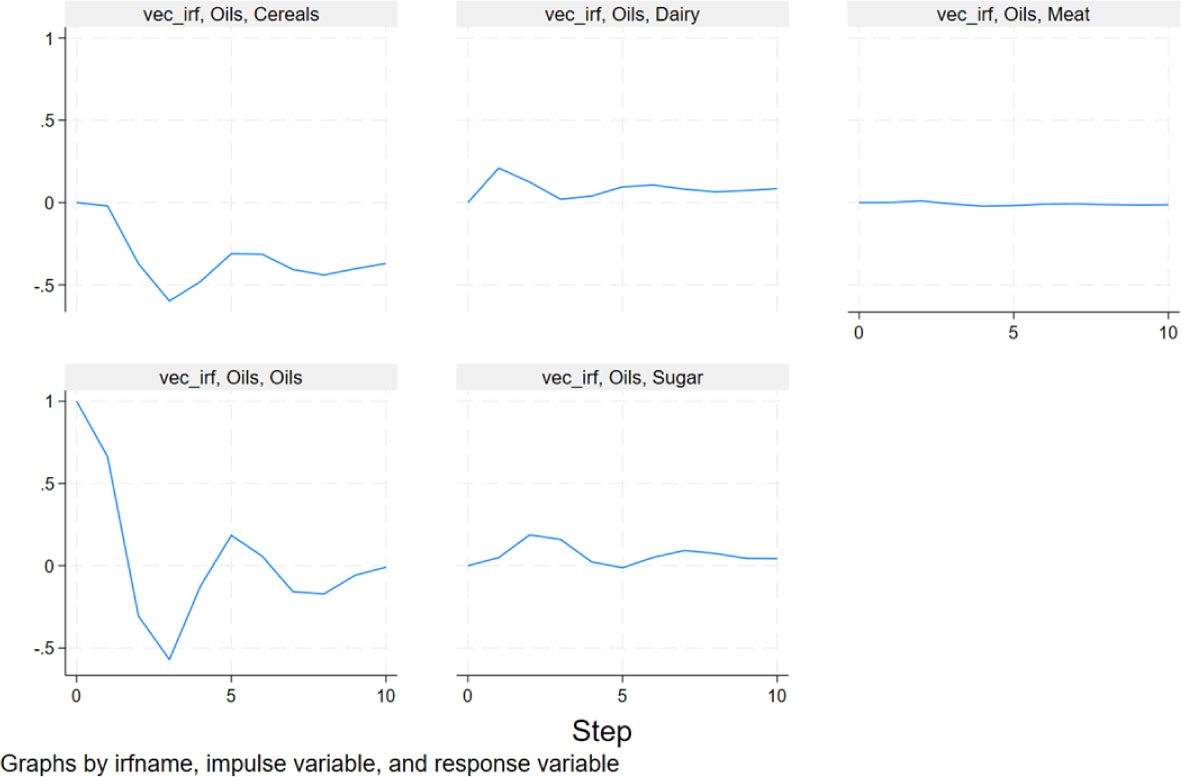
Fig. 3.
Impulse Response Functions (IRFs) to a Shock in Vegetable Oil Prices across Global Food Price Sub-Indices
Source: authors' calculations, 2026.
Figure 4 shows that shocks to cereal prices generate moderate but persistent responses across selected markets. Vegetable oils exhibit the strongest positive response, indicating a close transmission channel between cereals and oils. Sugar also responds positively, albeit with lower magnitude, while dairy shows a mild negative adjustment before stabilising. Meat prices display only a limited and stable response, suggesting weak integration in short-run dynamics. Overall, cereal shocks propagate asymmetrically, with stronger effects on oils and weaker spillovers to other commodities.
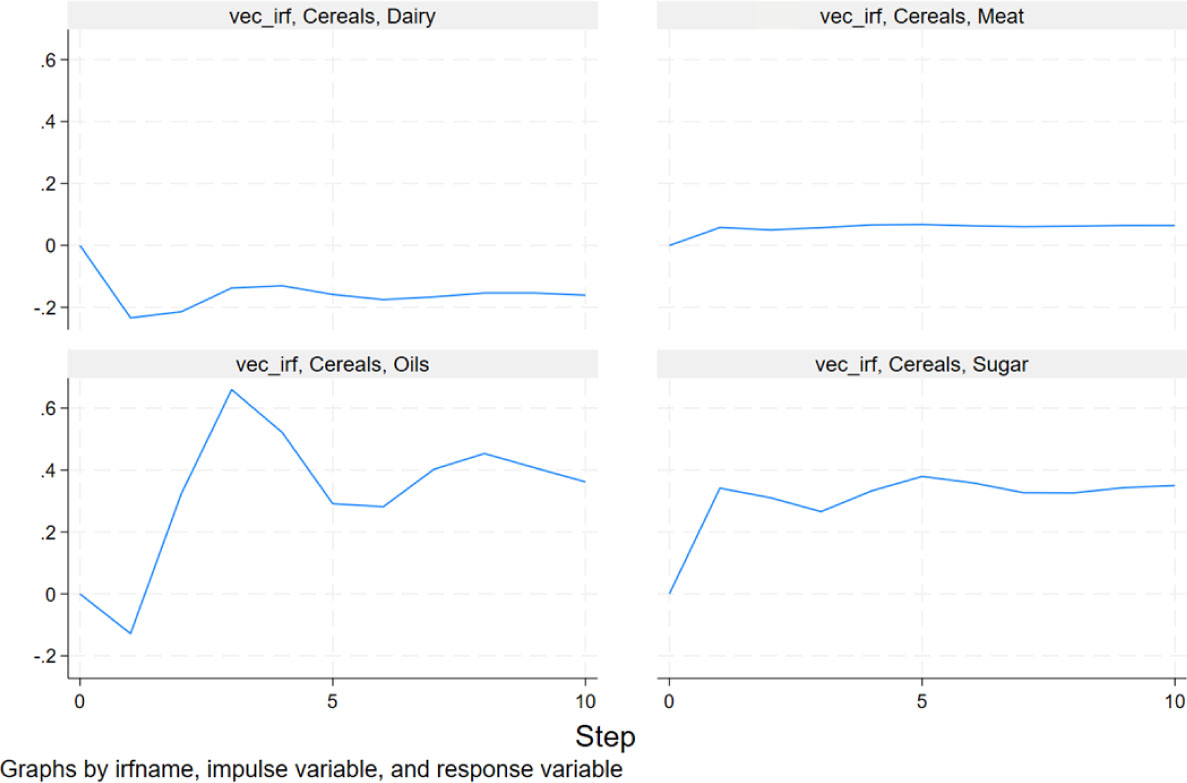
Fig. 4.
Impulse Response Functions (IRFs) to a Shock in Cereal Prices across Selected Global Food Price Sub-Indices
Source: authors' calculations, 2026.
Table 11 shows the variance decomposition results, which indicate a clear hierarchy in global food price dynamics. Meat prices are overwhelmingly driven by own shocks (94.2%), reflecting strong isolation from broader market movements. Dairy and sugar exhibit moderate dependence on internal dynamics, though external influences, particularly from cereals and oils, are non-negligible. Cereals display a more balanced structure, with substantial contributions from both own shocks and cross-market effects, highlighting their role in transmission. In contrast, vegetable oils are largely influenced by external shocks and play a central role in explaining variability across other markets.
Table 11.
Forecast Error Variance Decomposition (FEVD) of global food price sub-indices showing relative contributions of own and cross-market shocks
| Response variable | Own shock (%) | Oils (%) | Cereals (%) | Dairy (%) | Sugar (%) | Interpretation |
|---|---|---|---|---|---|---|
| Meat | 94.2 | 3.3 | 1.8 | 0.1 | 0.6 | Highly isolated |
| Dairy | 74.6 | 11.8 | 29.4 | – | 9.6 | Moderately integrated |
| Cereals | 42.8 | 12.9 | – | 0.1 | 10.8 | Transmission role |
| Oils | 16.7 | – | 15.7 | 0.2 | 9.7 | System driver |
| Sugar | 58.7 | 30.4 | 12.6 | 3.6 | – | Partial integration |
Overall, the results confirm asymmetric integration, with oils acting as a system driver, cereals as a transmission channel, and meat remaining largely insulated.
DISCUSSION
This study investigated whether major global food sub-markets, such as meat, dairy, cereals, vegetable oils and sugar form an integrated price system in the long run, and whether adjustment to equilibrium is symmetric across markets. The results offer conclusive evidence on both questions and clarify several long-standing debates in the literature more effectively than before.
The descriptive results provide essential context for the subsequent econometric findings. The summary statistics show significant heterogeneity in price volatility across food sub-markets, with vegetable oils and dairy displaying notably higher variation than meat prices. At the same time, the standardised price series demonstrated clear co-movement among food categories, alongside periods where their timing and magnitude diverged. These patterns indicate the influence of common underlying forces shaping global food prices, while also suggesting that adjustment mechanisms vary across markets. The simultaneous visual co-movement and diverse volatility highlight the limitations of correlation-based analysis and justify the use of a system-based cointegration approach in this study.
The identification of a single cointegrating relationship among global food sub-indices confirms that these markets are structurally connected over time, rather than only showing episodic co-movement during crises. This finding supports the literature arguing that globalisation, shared production inputs, and expanding trade networks have embedded food prices within a common stochastic trend (Muralikrishna, 2025; Berk, 2022). Importantly, the result goes beyond simply noting correlation: cointegration indicates that price divergences are not permanent but are bounded by a long-term equilibrium (Dang et al., 2025). At the same time, the existence of only one cointegrating vector signals that integration is neither uniform nor complete. This nuance is essential, since it implies that global food prices are linked through a shared equilibrium condition, yet retain sufficient structural heterogeneity to prevent full convergence (Baqaee and Malmberg, 2025). In this respect, the results challenge binary perspectives that portray global food markets as either fully segmented or tightly unified. Instead, they point to a hierarchically integrated system in which long-run coherence coexists with commodity-specific dynamics.
The VEC Model reveals that long-run integration does not translate into symmetric short-run adjustment. Adjustment toward equilibrium is concentrated in vegetable oils and cereals, while meat, dairy, and sugar prices display statistically insignificant error-correction behaviour. This asymmetry is not marginal: the estimated adjustment coefficient for vegetable oils (α ≈ 0.21) is more than two-and-a-half times larger than that of cereals (α ≈ 0.08), while adjustment in meat prices is effectively zero. These magnitudes allow a decisive adjudication of competing hypotheses regarding price leadership. The results clearly reject the notion that adjustment is evenly distributed across food markets. Instead, they provide strong evidence that vegetable oils constitute the dominant adjustment mechanism within the global food price system, with cereals playing a secondary but still significant role. This finding is consistent with, but more precise than, earlier studies that suggested a central role for oils due to their tight linkage with energy markets, biofuel demand, and industrial processing chains (Mannucci et al., 2023; Meijaard et al., 2024; Loginova and Mann, 2022).
Importantly, the results also qualify claims that cereals are the primary anchor of global food prices (Verma et al., 2023; Dawe et al., 2025). While cereals adjust significantly to disequilibria, their adjustment speed is considerably slower than that of oils, and cereals do not enter the long-run cointegrating vector at the 5% significance level. Cereals, therefore, act less as a determinant of the equilibrium itself and more as a transmission channel through which the equilibrium is restored. This distinction was largely overlooked in prior empirical studies.
The estimated cointegrating vector further clarifies the internal structure of global food price integration. Dairy and sugar prices enter the long-run equilibrium relationship with positive and statistically significant coefficients, indicating persistent complementarities with meat prices over time. In contrast, vegetable oils enter with a large and statistically significant negative coefficient, underscoring their distinctive role within the system. This negative long-run association is economically meaningful: it reflects substitution effects and cross-market rebalancing driven by competing uses of vegetable oils across food, energy, and industrial sectors. Unlike other food sub-markets, vegetable oils are uniquely positioned at the interface of agricultural and non-agricultural demand, which helps explain both their dominant adjustment role and their inverse long-run relationship with meat prices (Taheri Hosseinkhani, 2025; Tamasiga and Onyeaka, 2026).
Equally important is what the cointegrating vector does not show. Cereals, despite their central role in adjustment, do not exert a statistically significant influence on the long-run equilibrium itself. This asymmetry between adjustment leadership (α) and equilibrium determination (β) challenges simplified narratives that equate market importance with long-run dominance. Instead, the results point to a functional differentiation within the global food system: some markets stabilise the system, while others define its equilibrium configuration. Taken together, the findings require a reframing of how global food price integration is conceptualised. Integration should not be understood as uniform co-movement or shared volatility across markets. Rather, it reflects a structured system of interdependence, characterised by a common long-run equilibrium, asymmetric adjustment speeds, and differentiated market roles. This perspective helps reconcile previously conflicting empirical findings. Studies documenting strong co-movement during crises but weak integration in normal periods may have conflated temporary synchronisation with equilibrium behaviour. By contrast, the present results demonstrate that long-run integration persists even as adjustment responsibilities are unevenly distributed across sub-markets (de Paula Leite et al., 2024; Shokoohi and Saghaian, 2022).
The structural asymmetries identified in this study suggest several specific directions for future research. Firstly, the predominance of vegetable oils in adjustment indicates that incorporating explicit energy price channels into the cointegration framework could offer deeper insights into the sources of equilibrium restoration. Secondly, the divergence between adjustment leadership and equilibrium determination highlights the need for models that distinguish stabilising markets from those that set equilibrium within integrated systems. Thirdly, while annual data are suitable for long-term analysis, extending the framework to higher-frequency data would enable investigation into whether adjustment hierarchies persist over shorter periods or only emerge over longer cycles. Lastly, future research could explore whether the structure of global food price integration has changed over time, especially in response to biofuel expansion, climate-related supply shocks, and recent trade disruptions.
The findings have broader implications for how global food price dynamics are conceptualised. Rather than reflecting a uniformly integrated system, the results suggest a structurally differentiated market in which adjustment processes are uneven and commodity-specific. This challenges conventional interpretations of global food price indices as homogeneous indicators and instead highlights the importance of underlying commodity-level dynamics.
In particular, the dominant role of vegetable oils in both shock transmission and equilibrium adjustment underscores the need to consider cross-market linkages, including those in energy markets and industrial demand. At the same time, the relative insulation of certain commodities, such as meat, suggests that global integration does not translate into uniform responsiveness across all food systems. These insights underscore the importance of adopting a system-based perspective when analysing food price behaviour, particularly in the context of global shocks and food security risks.
CONCLUSIONS
Using FAO food price sub-indices for 1990–2025 and a Johansen cointegration framework, this study shows that major global food markets, including meat, dairy, cereals, vegetable oils and sugar are connected through a single long-term equilibrium relationship. This indicates structural integration rather than temporary co-movement. However, adjustment towards this equilibrium is asymmetric: vegetable oils and cereals significantly help restore long-term balance, while meat, dairy and sugar adjust only weakly in the short term. The estimated cointegrating vector also reveals variation in long-term price formation: vegetable oils have a strong negative influence, whereas dairy and sugar have positive effects, reflecting different exposure to energy markets, processing chains, and demand substitution. Overall, the findings describe global food prices as an interconnected but uneven system, where shared long-term constraints coexist with commodity-specific adjustment roles. This reconciles conflicting views in the literature on food price integration and leadership, and underscores the importance of system-based approaches in analysing non-stationary global food price dynamics. The results also suggest that aggregate food price indices may conceal important underlying asymmetries, limiting their usefulness for policy analysis if not supplemented by commodity-level insights. Future research should expand this analysis using higher-frequency data and include additional factors such as energy prices and input costs to better understand short-term transmission mechanisms. Although using annual aggregate indices limits high-frequency analysis, the results provide a solid empirical foundation for understanding long-term global food price behaviour and for future studies into time-varying adjustment mechanisms and energy-food linkages.