
INTRODUCTION
Pineapple (Ananas comosus L.) is a tropical fruit that has an overall economic and nutritional value and is generally believed to have an excellent phytochemical profile, including ascorbic acid, bromelain, and a variety of volatile compounds, which are important in terms of sensory and health-promoting effects (Ali et al., 2020; Sharma et al., 2024). It has made the fruit a global brand of fresh commodity besides providing value-added products such as juices, concentrates, jam, canned slices and dried forms, extending shelf life and making it available to the market (Sarkar et al., 2018; Abraham et al., 2023). Pineapple production and processing has also become a key industry in the agricultural sector of sub-Saharan Africa and Ghana in particular, where thousands of smallholder farmers rely on their operations, and pineapple grows to become one of the key sources of export earnings (Kuwornu et al., 2013; Boakye et al., 2024). However, despite its potential, the industry still faces issues with the post-harvest management, productivity and integration in the market, which limits the overall addition of value along the value chain. These restrictions increase the significance in the intensive study of current processing of pineapples in Ghana and particularly concerning the degree of technological incorporation and economic sustainability, as well as the bottlenecks within the system to the growth of the sector.
Poor adoption of modern processing technologies in the value chain of pineapples in Ghana is a major problem with regard to product quality, shelf life and competitiveness in local and foreign markets. Although the use of sophisticated processing techniques has been demonstrated to conserve bioactive compounds and volatile characteristics in pineapple purée, extending the sensory and nutritional value of Ghanaian pineapples, high-pressure processing (HPP) and thermal techniques are technologies that are not accessible to the country’s pineapple processors (Wu et al., 2021). The majority of small-scale businesses still use primitive methods like hand peeling, simple juicing, and open-vat pasteurisation that make them more vulnerable to microbial contamination and nutrient loss (Sarkar et al., 2018). Empirical observations and fieldwork show that in Ghana, less than 15 percent of processed pineapple products are prepared in accordance with standardised hygienic practices, with most of the products sold in informal markets where regulatory processes are minimal (Boakye et al., 2024; Ofori-Appiah et al., 2022). This technological disparity not only undermines the safety of the consumers but also limits these products’ entry to high-end export markets, where processed fruit products are expected to meet stringent regulatory requirements. The sector will not be able to achieve its potential without specific investments in processing infrastructure and technical training, which will further strengthen the process of low value addition and low marginal profitability.
Processing, which is one of the main sources of income and economic sustainability to smallholder pineapple farmers in Ghana, is still the final factor in value addition. However, the existing value chain model provides sole benefits to intermediaries instead of producers. The studies that use value chain analysis and Data Envelopment Analysis (DEA) show that although the processing activities are more profitable at higher profit margins than those of the raw fruit sales, most farmers do not have direct access to processing facilities and therefore must sell their harvest at low farm-gate prices (Boakye et al., 2024b; Boakye et al., 2025). As the example of value-added activities shows, pineapple purée that is processed has an almost threefold higher net return than raw fruit, but not all farmers invest in such activities because of capital, knowledge, and logistical factors (Boakye et al., 2024b). The lack of institutional backing and ineffective coordination among actors, including those who supply inputs and exporters, adds to this imbalance (Danquah and Egyir, 2023; Ametepey et al., 2025). Consequently, although Ghana has good agro-ecological conditions for growing pineapples, the financial sustainability of smallholder production remains a risky business, with a large number of farmers operating at subsistence level. The balance of value distribution may be shifted through enhancing backwards linkages between processors and farmers by creating contract farming, cooperative processing units and extension services, which can boost rural livelihoods (Phrommarat and Oonkasem, 2021; Mivumbi and Yuan, 2023).
Climatic and environmental fluctuation further complicate the production and processing of pineapples in Ghana, bringing uncertainty in the stability of yields and processing time. It is also believed that the changing rain cycles and extended dry periods, as well as rising temperatures, have already started to impact the production of pineapples in major production areas, including Eastern and Ashanti regions (Williams et al., 2017). These climatic disturbances also decrease the quantity and quality of raw fruit to be processed as well as resulting in greater post-harvest losses because of faster spoilage occurring in high ambient temperatures. Williams et al. (2017) established that a 1°C rise in average temperature during the harvest increased the post-harvest deterioration rates by 12%, which directly affected processing operations efficiency. Since the majority of the processing in Ghana is seasonal and relies on the availability of fresh fruit, these climatic shocks may result in underutilization of processing facilities and missed income opportunities. Moreover, the absence of climate-resistant agronomic facilities like cold storage and moisture-controlled drying facilities also diminishes the adaptability level of the sector. To overcome these weaknesses, combined climatic intelligent solutions are needed to connect enhanced agronomic activities to agile processing infrastructure.
Nevertheless, Ghana is working to improve pineapple processing by applying policy interventions, involving the private sector, and implementing research-based innovation. According to recent evaluations, small and medium enterprises (SMEs) are the emerging groups that invest in semi-mechanised processing facilities with the aid of government incentives such as the Planting for Food and Jobs (PFJ) and the One District One Factory (1D1F) programmes (Boakye et al., 2025; Ankrah et al., 2022). These are geared towards narrowing the divide between production and processing in order to facilitate local production of products based on pineapple and the minimization of losses after harvest. Also, institutions of higher education and technology are considering low-cost, scalable solutions like solar dryers and mobile processing units, which are better suited to the realities of smallholder systems (He et al., 2024; Abraham et al., 2023). Pilot projects in the Central and Eastern Regions indicate that integrating farmers into processing cooperatives increases technical efficiency by as much as 35 percent, resulting in products of export quality (Ametepey et al., 2025; Boakye et al., 2024a). This implies that Ghana can turn its pineapple industry into more than a raw-commodity exporter and become a competitive global player in processing fruits, with the due investment, capacity building and being able to coordinate its stakeholders.
Technological modernisation, equal distribution of values, and climate resilience are the three issues that will determine the future of pineapple processing in Ghana (Osei and Aluah, 2021). Although the nutritional and economic potential of this fruit is well-documented (Ali et al., 2020; Mohsin et al., 2020), the transformation of the sector is more than just an agronomic success: the industry needs to be improved at the post-harvest level, supported with institutions, and to gain access to markets. The role of processing in boosting profitability and reducing post-harvest losses is also emphasized on a regular basis by empirical findings (Boakye et al., 2024; Ofori-Appiah et al., 2022), and the overall performance of the pineapple processing businesses in Ghana is still to be studied in terms of its financial performance, cost structure, and sustainability in the long term. Although studies have investigated production efficiency, the profitability of farmers, and climatic issues (Williams et al., 2017; Boakye et al., 2025), there is a considerable gap in analytical studies about the operational economics and financial sustainability of processing enterprises. These aspects need to be better understood to inform investment decisions, policy formulation and develop specific capacity-building programmes that can be used to spur the development of agro-processing industries in rural Ghana.
LITERATURE REVIEW
Value Addition and Its Role in Enhancing Profitability in the Pineapple Value Chain
Value addition is a process of transforming raw agribusiness products into more refined, saleable, and higher-value items through physical, chemical, or packaging alterations (Kaido and Katsuhito, 2020; Das et al., 2024). These are the activities involved in the pineapple value chain: peeling, slicing, canning, juicing, drying, fermenting into vinegar, and packaging into either a retail or an export market. In comparison with fresh fruit sales, which are vulnerable to change in prices, spoilage, and short shelf life, processed pineapple products have a longer shelf life, high marketability, and better income generation, for both the producer and processors (Vidanapathirana et al., 2020; Kagoro-Rugunda and Sebuuwufu, 2023).
The distribution, creation, and extraction of economic value between the input suppliers and farmers to the processors, traders and retailers is rooted in the value chain paradigm theoretical framework popularised by Kaplinsky and Morris (2001). According to this model, process and product improvement would allow firms to reposition themselves and charge a higher price, thus rendering them less dependent on the unstable export market for fresh fruit (Kagoro-Rugunda and Sebuuwufu, 2023; Das et al., 2024).
Although domestic demand for processed fruit products in Ghana’s urban areas is on the increase, opportunities for the local processing of pineapples have not been fully exploited and most pineapples are exported in their raw state (Boakye et al., 2024). Studies conducted in Indonesia and Sri Lanka indicate that processors and exporters receive the highest proportion of the final product value, whereas smallholder farmers get a relatively small proportion because of their weaker bargaining power and inability to enter processing systems (Kaido and Katsuhito, 2020; Vidanapathirana et al., 2020).
Market Access, Quality Standards, and Export Potential for Processed Pineapple Products
The availability of the market is a vital factor that defines the viability and expansion of any business dealing with pineapple processing. Processed pineapple products are a potential opportunity in Ghana to get out of exports of raw products and gain greater significance in the world food markets (Boakye et al., 2024b; Rayaguru and Dash, 2021). To access the lucrative markets in Europe, North America, and regional Africa, it is necessary to comply with high-quality standards, food safety, packaging standards, and logistical effectiveness, which are hard for small and medium-sized processors to achieve on a regular basis.
The markets with high value normally expect internationally recognised certification to include HACCP, ISO 22000, Good Manufacturing Practices (GMP) and adherence to Codex Alimentarius specifications (Leneveu-Jenvrin et al., 2020; Wattanakul et al., 2021). However, at present, most local processing plants in Ghana possess neither the infrastructure nor the technical capability to achieve these standards regularly. Consequently, consignments are rejected, shelf space lost, and access to supermarket and export markets closed.
Thailand, a major world supplier of processed pineapples, has taken over the market with its verticalized supply networks, investment in processing technology, and government assistance in export promotion (Wattanakul et al., 2021). It has also been observed that Indonesia is increasing its market share with value added products and good trade policies (Nadhirah et al., 2025). Although Ghana has favourable trade arrangements, such as AfCFTA and EU-EPA, the country has had limited success in penetrating regional or global markets with its processed pineapple products. This suggests that the country has failed in market intelligence, branding and developing a product aimed at export markets.
Empirical Review
One of the first empirical assessments of certified production and marketing of organic pineapples in Ghana was conducted by Kuwornu et al. (2013). They found that poor accessibility to credit and market relations and high input prices decreased profitability. Nevertheless, their research was more of a description, and it did not directly analyse processing enterprises. Following this, Boakye et al. (2024b) performed a comparative profitability analysis of value-added operations in Ghana’s pineapple value chain and showed that the profits obtained when selling the juice are much greater compared to those obtained when selling the fresh fruit. Nonetheless, the study failed to break down the processing expenses, evaluate the technical efficiency, and assess both the compliance in quality and barriers to accessing markets.
Ofori-Appiah et al. (2022) used a distance-function method to quantify the productivity and efficiency of pineapple farmers in Akwapim South District and established that inefficiency in the use of resources affected the quality and consistency of raw materials to be processed. Likewise, Uddin et al. (2022) explored the value chain organization and financial profitability of pineapple in Bangladesh and determined that processors make more money in Bangladesh compared to farmers. Datta et al. (2023) performed a cost-benefit analysis which involved analysing the economics of production as opposed to the economics of processing. Thai and Indian studies (Wattanakul et al., 2021 and Ansari and Jamaluddeen, 2025) offer some comparative evidence on the competitiveness of exports, although these are highly industrialised settings that do not necessarily apply to Ghana with its small-scale processing setting.
There are a number of unavoidable gaps as a result of this review. To begin with, there is a lack of corresponding research on the financial performance of pineapple processing companies in Ghana; the vast majority of studies consider the production operation or value chain mapping, but they do not cover the economics of processing. Secondly, technical efficiency studies have placed too much emphasis on the agricultural level of production without taking into account the processing-specific factors, including energy, labour productivity, and the utilisation of the machinery. Thirdly, financial outcomes have barely been empirically associated with market access and quality compliance. The gaps are directly addressed in the present study based on the firm-level financial analysis by using structured surveys, KIIs, and investment appraisal.
MATERIALS AND METHODS
Description of Study Area
This study was conducted in Koforidua, the capital of Ghana’s Eastern Region, which was selected as the study area because it is strategically positioned at the heart of Ghana’s primary pineapple-producing zone. The Eastern Region contributes a large proportion of the total production of pineapples in Ghana alongside the Ashanti, Central and Greater Accra Regions, which produce over 85 percent of the country’s pineapples (Boakye et al., 2024b; Williams et al., 2017).
Koforidua has a number of unique opportunities in terms of investment in pineapple processing. The city is located within a 10–30 km radius of the major pineapple-producing regions–New Juaben North, Yilo Krobo and Fanteakwa. This is a guarantee that the city is close to raw materials. It is also linked well to Accra by N6 highway (60 km) and Kumasi (150 km), and Tema Port (90 km), the main export entry point, which can be used to supply the domestic distribution and export logistics. The CSIR-OPRI research station is also located in Kade (15 km away) in the Eastern Region and it offers technical assistance in pineapple agronomy and post-harvest management. Koforidua Technical University (KTU) also trains on the fields of food technology and engineering which produces a source of skilled labour. The comparatively young population of the region – approximately 38 percent are the ages of 15 and 35 (Aryeetey et al., 2021) – forms a workforce that can be trained to work in the processing industry.
Processing already is being done in communities like Asakraka, Apapam and Obo, where women cooperatives and farmer groups make juice and dried pineapple. These informal activities are evidence of local ability and market needs that can be developed into formalisation and scaling. There is also agro-industrial land zoned under the 1D1F programme at places such as Abomosu, Amanfrom and Akrofuom. This land carries fiscal incentives such as a five-year corporate tax holiday and reduced utility charges. The map of Koforidua and its districts presented in Figure 1 below demonstrates that the study area is close to the major areas of pineapple production. As the map has been made in its current scale, it gives a true picture of the geographical distance and the spatial distribution of processing enterprises surveyed.
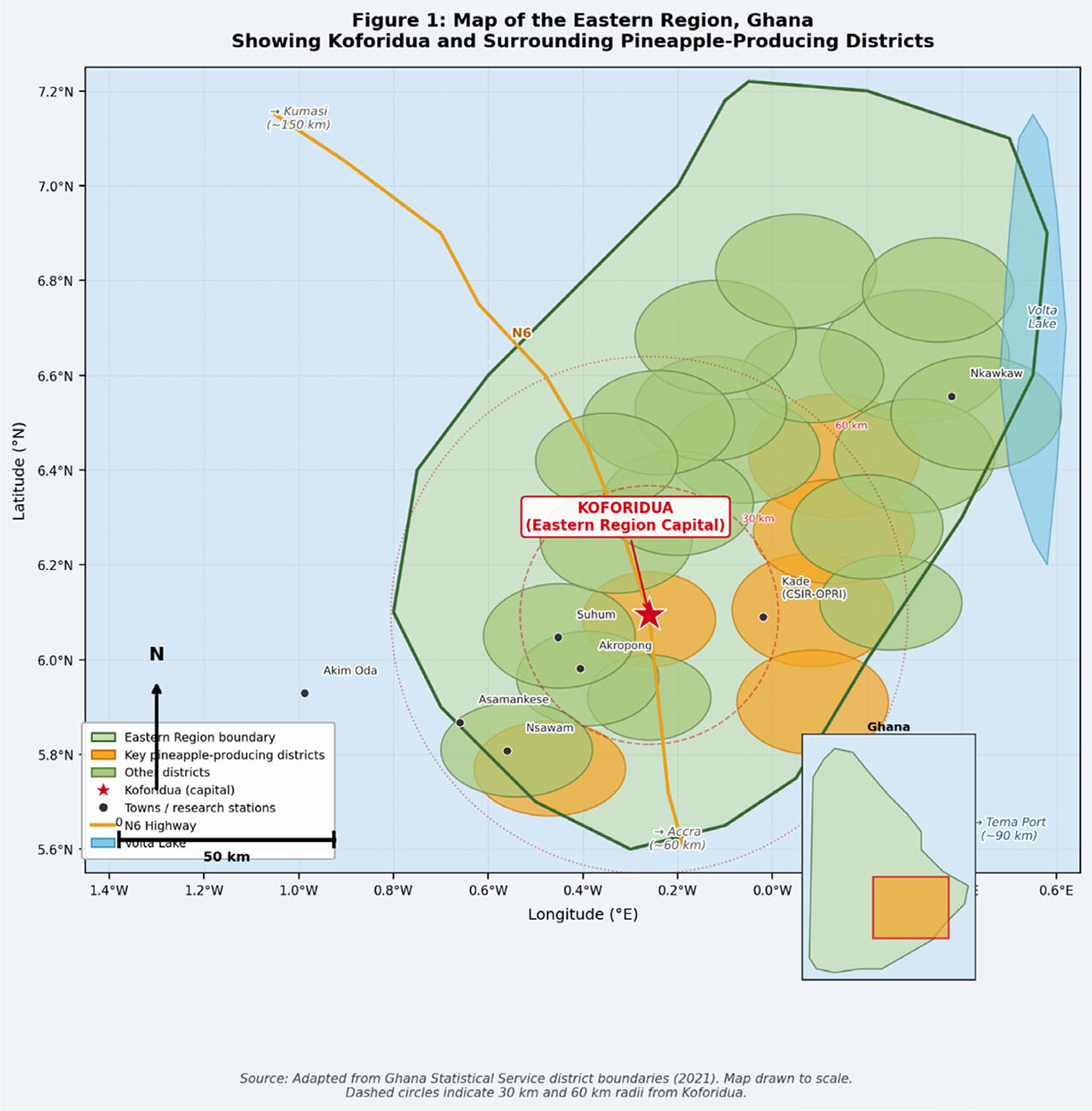
Fig. 1.
Map of the Eastern Region, Ghana showing Koforidua and surrounding pineapple-producing districts
Dashed circles indicate 30 km and 60 km radii from Koforidua.
Source: map drawn to scale; adapted from Ghana Statistical Service district boundaries, 2021.
Research Design and Methods of Data Collection
This study adopted a mixed-methods research design to generate comprehensive and valid data on the economic feasibility and financial performance of pineapple-processing enterprises in Koforidua and its environs. The combination of quantitative and qualitative methods enabled triangulation of findings and enhanced the validity and depth of the analysis.
The three main data gathering tools used were structured questionnaires, Key Informant Interview (KII), and the direct field observation. A questionnaire survey was administered to 60 pineapple-processing enterprises comprising small-scale individual operators, cooperative units, and semi-commercial processors operating in the study area. Stratified random sampling was employed to ensure representative data on the processing scales (micro, small, and medium) and product types (juice, canned slices, dried pineapple, and purée).
The structured questionnaire gathered information on the inputs used in production, the cost of production, production volume, sales, margin of profits, the use of labour, machinery, market outlets, and the challenges of quality standards and market access. The questionnaire was also pre-tested on 10 respondents of a similar (non-sample) community before the actual survey. The pre-testing facilitated the discovery of unclear items, instructions, and inconsistencies in the format of responses. The instrument’s face validity was first assessed by one agricultural economist experienced in financial analysis in the agribusiness sphere and by the lead researcher, a business development consultant. They evaluated whether the items sufficiently reflected the constructs in question. Amendments were subsequently made and finally deployed.
Furthermore, content validity was assessed through an expert review to enhance the overall validity of the survey and the interview instrument. Five subject matter experts agreed to review the interview guide and the survey instrument. Each expert was tasked with rating each question on a 4-point scale for relevance (from ‘not relevant’ to ‘highly relevant’) and clarity (from ‘not clear’ to ‘very clear’).
We computed the Content Validity Index (CVI) at the item level by dividing the number of experts who rated an item as 3 or 4 by the total number of experts, yielding a CVI of 0.86. It is generally recommended that an I-CVI > 0.79 be considered acceptable. Based on the feedback, one question was altered, and one question was removed.
The purposely selected stakeholders were interviewed using Key Informant Interviews (12 in total). Interviews are conducted with officials of the Ministry of Food and Agriculture (MOFA), officers of the Ghana Standards Authority (GSA) and Food and Drugs Authority (FDA), representatives of farmer-based organisations (FBOs), extension agents and managers of selected processing enterprises. The KII guide was semi-formatted, as it dealt with regulatory provisions, support systems, institutional constraints and policy incentives that influenced the industry. All interviews were carried out in English and Twi, recorded on audio with the consent of the participants, transcribed and then thematically coded. A thematic analysis was applied in analysing qualitative data, and codes were sorted under the themes of regulatory compliance, financial access, infrastructure and market linkages.
Peer-reviewed journals, government reports, policy documents and publications provided by CSIR-OPRI and the Ghana Statistical Service (GSS) (data on the trends in pineapple production, climate, market prices, and current value chain research) were considered as secondary sources (Boakye et al., 2024b; Williams et al., 2017; Kuwornu et al., 2013).
Analytical Procedure
In order to assess the economic feasibility and financial sustainability of pineapple-processing companies in Koforidua in Ghana, a set of complementary financial analysis tools were applied. Net present value (NPV), internal rate of return (IRR), payback period, and sensitivity analysis can be considered as a complete evaluation of the performance of the investments, the degree of risk involved, and the efficiency of the operations. These indicators together combine to empower both investors and policymakers to make good judgments about the scalability and long-term prospects of agro-processing businesses.
Net Present Value (NPV)
Net present value (NPV) was used to determine whether pineapple-processing investments generate returns that exceed the cost of capital over a projected five-year period. This approach recognises the time value of money by discounting future cash flows to their present value; it also provides a credible view of the level of profitability considering the current economic situation of Ghana. The discount rate was 25 percent, which is equal to the average lending rate existing in the banking industry in Ghana and the risk profile of agro-processing businesses (see Assumptions section). This rate is the same as the Ghana Reference rate and the average commercial lending rates as of 2024/2025. The NPV formula is as follows:
where CIFt represents cash inflows, COFt denotes cash outflows in year t, r is the discount rate, n is the project lifespan (5 years), and I0 is the initial investment. The inflows of cash were calculated based on the sales of processed foods like juice, tinned slices and dried pineapple each year, while the outflows included the operation expenses like the cost of raw materials, labour, utilities, packing, and work and machinery. A high NPV implies that the business generates a sense of economic value and also that the enterprise would be viable above the necessary threshold. The metric is especially useful in comparing various processing scales and determining which models are viable in the long term as far as finances are concerned.Internal Rate of Return (IRR)
The internal rate of return (IRR) is used to supplement NPV because it determines the actual rate of return that an investment would bring regardless of the discount rate imposed externally. It is the break-even discount rate under which the present value of the cash inflows and cash outflows are equal. A calculation of the IRR was done on each processing enterprise to determine its profitability in regard to the 18% hurdle rate. The IRR formula is given as:
This equation was solved iteratively using spreadsheet software. The higher the IRR, the better the investment is, particularly where capital is constrained and returns per unit of investment is important. As an illustration, the processors that have IRRs that are well above 18% have a high earning power and can be withheld against changes in the cost.
Payback Period (PBP)
Payback period is used to determine the number of years needed by a processing enterprise to pay back the initial investment based on net cash inflows. Given that most small-scale processors have limited financial buffers, payback period is a viable measure of liquidity and risk. A short payback period means that capital is recovered sooner, with less exposure to market and operation risks. To determine the payback period, the formula was used:
where a is the last year with negative cumulative cash flow, and Ca+1 is the net cash flow in the following year. To simplify the computation, for companies whose cash flows were relatively constant, we used the simplified model, that is, the initial investment divided by the average of the net cash flows per year.Sensitivity Analysis
Sensitivity analysis was used to determine the impact of the variation in the important variables on the financial performance of the pineapple processing sector, specifically NPV and IRR. This analysis examined the soundness of investment decisions in Ghana’s agricultural industry under varying conditions because of the fluctuation of input prices, output prices and processing yields. The changes in NPV and IRR obtained were examined in order to determine which variables have the greatest impact on profitability. This analysis helps risk management planning by identifying critical vulnerabilities and mitigation strategies, which may involve entering into contract farming agreements to stabilise inputs costs, product diversification, or focusing on high-end markets with price stability.
Justification of Techniques Used
In this paper, net present value (NPV), internal rate of return (IRR), payback period, and sensitivity analysis are all justified as complementary and well-established methods of assessing the feasibility of pineapple processing business in Ghana, especially in small- and medium-scale agro-processing. NPV is the most useful appraisal instrument used, since it uses the time value of money and also offers accurate value creation, which gives it an advantage of comparing across processing models. Simultaneously, IRR provides a percentage-based return that is easy to estimate and which lets the investor compare the performance of the project to Ghana’s relatively high cost of capital with a realistic hurdle rate. The payback period is added because it is practically relevant to the liquidity-constrained entrepreneurs who are interested in quick capital recovery particularly in rural areas, where the accessibility to finance is limited. Sensitivity analysis is used when uncertainly exists regarding the nature of agricultural processing, that is, the identification of key variables that influence the profitability and risk-mitigation strategies. To sum up, these methods offer a strict but realistic framework that promotes good investments, policy and development decisions, and their existing application.
Methods of Data Analysis
The descriptive analytical statistical tools including frequency distributions, means and percentages, and cost breakdowns, were used to characterise the capital structure, operating costs, revenues and production capacities of pineapple-processing firms in the study area. In addition to a descriptive analysis, discounted cash flow (DCF) methods, namely net present value (NPV), internal rate of return (IRR), and payback period, were used to assess the long-term economic feasibility of processing-pineapple businesses. The methods assess the time value of money and are commonly used in the agribusiness feasibility analysis to determine profitability in realistic economic circumstances (Boakye et al., 2024; Uddin et al., 2022). The evaluation was performed using a period of five years of projection, which is in line with both the projected life of the processing equipment and the planning horizon of small-scale agro-enterprises in Ghana.
Assumptions
All financial figures are expressed in Ghana Cedis (GH¢) and reflect current price levels as of the 2024/2025 production season, with projections adjusted for expected inflation and market trends.
The analysis adopts five years, aligned with the typical economic life of processing equipment such as juicers, peelers, and pasteurisation units commonly used by local enterprises.
The cost of capital is 25%. This is based on a review of several investment returns and the average lending rates offered by commercial banks in Ghana, as shown below, as of August 2025 in Ghana. It is assumed that producers may use a mix of equity and borrowed funds to establish and operate the production facility.
T-Bill Rate (364-day bill) 13.25%
Ghana Reference Rate 19.67%
Average Lending Rate 25%
Interbank Interest Rates 24.12%
Processors are assumed to operate on a semi-continuous basis, with higher activity during the main pineapple harvest season (April to August) and reduced operations during the lean period, resulting in an average annual capacity utilisation of approximately 65%.
Processing efficiency is assumed to yield 0.65 litres of juice per kilogram of fresh pineapple, accounting for average losses due to peeling, coring, and filtration under small-scale processing conditions.
All variable costs, including raw fruit, labour, packaging, and utilities, are projected to increase annually by 12%, reflecting ongoing inflationary pressures in the food processing sector.
The selling price of processed products (e.g., bottled juice, dried slices) is assumed to increase by 5% per year, factoring in gradual market acceptance, branding improvements, and inflation-linked pricing.
Only incremental and direct costs and revenues related to processing activities are included in the analysis; overheads unrelated to production are excluded to maintain focus on the core processing operation.
For enterprises utilising external financing, a loan covers up to 90% of initial capital investment, repayable over five years with a one-year moratorium, monthly instalments, and interest at 25% per annum using the reducing balance method.
A service charge of 0.5% of the loan amount is included to reflect administrative fees commonly charged by financial institutions in agribusiness lending.
Repayment is assumed to be sourced from operating profits, with no additional income streams considered in the base-case scenario.
Equipment maintenance and breakdowns are factored into operational costs, assuming one primary repair intervention over the five years, based on field observations of machine durability under local conditions.
Waste by-products (peels, cores) are assumed to be partially utilised either as animal feed or compost, with minimal revenue generated, primarily for on-farm use rather than commercial sale.
The analysis assumes no major disruptions from climate events, policy changes, or market collapses over the projection period, ensuring a stable baseline for financial modelling.
Due to the nature of the period, loan repayment is expected to be every month.
Financial analysis is computed in Ghana Cedis
The dollar value was converted to Ghana cedis at a rate of GH¢11/dollar.
RESULTS AND DISCUSSION
Background Information of Respondents
Out of the 60 processing enterprises surveyed, 48 (80%) were micro and small-scale owner-operated enterprises with 12 (20%) being medium scale units or cooperatives. The gender composition of operators indicates that in the Eastern Region women play a significant role in the food processing business: 65 percent of enterprise operators were women, the majority of them running units of family-based juice or dried chip production. This is in line with the broader set of evidence of agro-processing in West Africa, where post-harvest and food processing jobs are significantly occupied by women (Boakye et al., 2024).
The operators were found to be between 22 and 58 years of age, with a mean age of 36 years. This is relatively young entrepreneurial base with the ability to develop skills and to use technology. Education-wise, 12 percent had no formal education, 40 percent had completed primary or junior high school, while 33 percent had a senior high school education and 15 percent a tertiary education. This distribution indicates that most processors are well informed about basic literacy and numeracy and that semi-formalised record-keeping and compliance practices would be open to them; on the other hand, specialised training programmes would be required financial management and quality assurance capabilities to be developed.
The business experience ranged from 1 and 15 years, with an average of 5.2 years, and revealed a mix of newly established and more mature businesses. In terms of product focus, 43 percent of these businesses were juice producers, 27 percent were purée producers, and 20 percent were dried chip producers with 10 percent in mixed processing activities. The dominance of juice manufacturers shows the smaller capital needs and more developed local market, whereas the increasing percentage of small manufacturers of purée and dried chip products show a gradual transition to highly value-added products, which is in line with the evolution of revenue and profitability trends presented in the following fields.
Cost of Set-Up
Initial capital cost to start the pineapple processing business was calculated at a production capacity of 2 tonnes of pineapples in a day to produce purée and an extra 2 tonne per day to produce pineapple dried chips. The cumulative start-up cost amount is GH¢8,487,812.50, which is the capital expenditure (CAPEX) and the required working capital. The most significant cost component at GH¢3,620,000 (48.9% of total investment) is plant and machinery, as it reflects the capital intensity of agro-processing and the necessity to have specialised production lines to work efficiently and in a hygienic environment. Land and building investment of GH¢2,500,000 (29.5) encompassed factory building and warehouse facilities to standard industrial sizes and these were constructed by local artisans as a cost-saving measure. A vehicle investment GH¢750,000 (8.8) is used in the collection of raw materials and distribution of products, along with office equipment of GH¢500,000 (5.9), makes a functional office. GH¢1,117,812.50 (13.2% of total start-up costs) working capital gives adequate liquidity during the initial operations to cover the cost of raw materials, labour, utilities, and other short-term needs.
Table 1.
Initial investment outlay (GH¢)
| Pineapple puree and chips factory – capital expenditure | |
|---|---|
| Plant and machinery | |
| Pineapple puree production line | 1,800,000.00 |
| Pineapple chips production line | 1,060,000.00 |
| Other factory equipment (fork lift, etc.) | 760,000.00 |
| Sub-total | 3,620,000.00 |
| Land and building | |
| Factory building | 2,500,000.00 |
| Sub-total | 2,500,000.00 |
| Motor vehicle | |
| Pick-up | 750,000.00 |
| Sub-total | 750,000.00 |
| Office equipment | |
| Furniture and fittings | 200,000.00 |
| Computers and other equipment | 300,000.00 |
| Sub-total | 500,000.00 |
| Total CAPEX | 7,370,000.00 |
| Working capital | 1,117,812.50 |
| Total start-up costs | 8,487,812.50 |
Table 2.
Revenue projections
| Moratorium period | Year 1 | Year 2 | Year 3 | Year 4 | Year 5 | |
|---|---|---|---|---|---|---|
| Expected revenue | 3,004,800 | 7,887,600 | 9,938,376 | 12,174,511 | 14,609,413 | 17,257,369 |
| Expected selling price | ||||||
| Pineapple puree (per 500 ml) | 13.00 | 13.65 | 14.33 | 15.05 | 15.80 | 16.59 |
| Pineapple chips (per Kg) | 11.00 | 11.55 | 12.13 | 12.73 | 13.37 | 14.04 |
| Total expected capacity | ||||||
| Pineapple puree (per 500 ml) | 626,000 | 626,000 | 626,000 | 626,000 | 626,000 | 626,000 |
| Pineapple chips (per Kg) | 626,000 | 626,000 | 626,000 | 626,000 | 626,000 | 626,000 |
| Total expected production | ||||||
| Pineapple puree (per 500 ml) | 125,200 | 313,000 | 375,600 | 438,200 | 500,800 | 563,400 |
| Pineapple chips (per Kg) | 125,200 | 313,000 | 375,600 | 438,200 | 500,800 | 563,400 |
| Utilisation | 20% | 50% | 60% | 70% | 80% | 90% |
| Pineapple fruit requirement (Kg) | 250,400 | 626,000 | 751,200 | 876,400 | 1,001,600 | 1,126,800 |
| Expected pineapple purchases | 564,652 | 1,623,375 | 2,240,257 | 3,005,678 | 3,950,320 | 5,110,726 |
Revenue Analysis
Both the local and the global market dynamics foster the potential of the processed pineapple products in Ghana in terms of revenue. Demand for value-added products that are fruit-based is being created in the country by the advancing urbanisation, increase in middle-income groups, and a greater preference for healthy and natural food products. Pineapple puree is also gaining popularity as an ingredient in beverage formulations and food service, while pineapple chips, though comparatively new to the local markets, are already being sought out in the foreign markets, especially those in Europe and North America.
The revenue generated in the first year is expected to be GH¢7,887,600, which will be based on 50% utilisation of the installed processing capacity as the enterprise begins establishing its supply chain and market share. The revenue in Year 2 increases to GH¢9,938,376 with the utilisation of 60% of the capacity. At 90% capacity utilisation, the revenue in Year 5 amounts to GH¢17,257,369. The selling price of pineapple purée increases by 5 percent per annum, i.e. GH¢13.65/500ml in Year 1 to GH¢16.59/500ml in Year 5 and dried pineapple chips increases by 5 percent per annum, i.e. GH¢11.55/kg in Year 1 to GH¢14.04/kg in Year 5.
Profitability Analysis
The profitability outlook demonstrates a clear trajectory of financial recovery and sustained growth over the five-year projection period. During the moratorium period, the enterprise records a net loss of GH¢1,774,817, representing a net profit margin of −59%. This initial deficit is driven by high financing costs and limited operational activity, a pattern typical of capital-intensive agro-processing start-ups.
Table 3.
Profit and loss analysis (GH¢)
| Income from operation | Moratorium period | Year 1 | Year 2 | Year 3 | Year 4 | Year 5 |
|---|---|---|---|---|---|---|
| 3,004,800 | 7,887,600 | 9,938,376 | 12,174,511 | 14,609,413 | 17,257,369 | |
| Cost of production | ||||||
| Cost of raw materials | 564,652 | 1,623,375 | 2,240,257 | 3,005,678 | 3,950,320 | 5,110,726 |
| Packaging cost | 150,240 | 394,380 | 496,919 | 486,980 | 584,377 | 690,295 |
| Transportation cost | 150,240 | 394,380 | 496,919 | 608,726 | 730,471 | 862,868 |
| Export cost | 90,144 | 236,628 | 298,151 | 365,235 | 438,282 | 517,721 |
| Production overheads | 150,240 | 394,380 | 496,919 | 608,726 | 730,471 | 862,868 |
| Direct labour | 406,800 | 447,480 | 492,228 | 541,451 | 595,596 | 655,155 |
| Depreciation | 462,000 | 462,000 | 462,000 | 462,000 | 462,000 | 462,000 |
| Insurance | 41,200 | 41,200 | 41,200 | 41,200 | 41,200 | 41,200 |
| Maintenance charge | 41,200 | 45,320 | 49,852 | 54,837 | 60,321 | 66,353 |
| Total cost of production | 2,056,716 | 4,039,143 | 5,074,444 | 6,174,833 | 7,593,036 | 9,269,187 |
| Administration expenses | ||||||
| Cost of additional admin staff. | 508,500 | 559,350 | 615,285 | 676,814 | 744,495 | 818,944 |
| General admin expenses | 50,009 | 55,010 | 60,511 | 66,562 | 73,218 | 80,540 |
| Total admin expenses | 558,509 | 614,360 | 675,796 | 743,375 | 817,713 | 899,484 |
| Net profit before interest | 389,575 | 3,234,098 | 4,188,136 | 5,256,302 | 6,198,663 | 7,088,697 |
| Interest charges/service charge | 2,164,392 | 2,519,130 | 2,177,255 | 1,739,406 | 1,178,638 | 460,446 |
| Net profit/(loss) before tax | (1,774,817) | 714,968 | 2,010,881 | 3,516,897 | 5,020,025 | 6,628,252 |
| Tax (25%) | 0 | 178,742 | 502,720 | 879,224 | 1,255,006 | 1,657,063 |
| Net profit after tax | (1,774,817) | 536,226 | 1,508,160 | 2,637,673 | 3,765,019 | 4,971,189 |
| Net profit margin (%) | –59% | 7% | 15% | 22% | 26% | 29% |
Profitability turns positive in Year 1, with a net profit after tax of GH¢536,226 (7% margin). Growth accelerates subsequently: GH¢1,508,160 (15%) in Year 2, GH¢2,637,673 (22%) in Year 3, GH¢3,765,019 (26%) in Year 4, and GH¢4,971,189 (29%) by Year 5. This improvement is driven by rising capacity utilisation from 50% in Year 1 to 90% in Year 5, slower growth in overhead costs relative to revenues, and a declining interest burden as principal repayments reduce the loan balance (from GH¢2,519,130 in Year 1 to GH¢460,446 in Year 5).
Liquidity Analysis
The cash flow trends, the debt service coverage ratio (DSCR) and the current ratio were used to determine the liquidity profile. The business operates a net operating cash inflow of GH¢1,612,969 during the period of moratorium that is underpinned by the initial outlay on working capital. The business shows a net cash flow of GH¢950,543 in the negative in Year 1 on the start of debt servicing obligations; nevertheless, there is a positive balance in the closing working capital reserves. After Year 2, the cash flows become positive and increase at a high rate, i.e. from a cash outflow of GH¢110,000 in Year 2 to GH¢1,766,930 in Year 5, and the cumulative cash balance of GH¢4,577,970 in Year 5. The DSCR band also increases by 0.9 in Year 1 and 1.1 in Year 2, 1.4 in Year 3 and 1.9 in Year 4, which indicates an improvement in operations efficiency and a reduced interest burden. A DSCR in Year 4 above 1.5 is an indicator of good debt-servicing ability. The 5-year average current ratio of 7.8:1 attests to strong short-term solvency, but in a new agro-processing venture, the 5-year average current ratio reflects a conservative financial stance necessary to navigate seasonal changes.
Table 4.
Cashflow and liquidity analysis (GH¢)
| Item | Moratorium Period | Year 1 | Year 2 | Year 3 | Year 4 | Year 5 |
|---|---|---|---|---|---|---|
| Cash inflow | ||||||
| Funds from debtors | 2,504,000 | 6,573,000 | 8,281,980 | 10,145,426 | 12,174,511 | 14,381,141 |
| Receivable | – | 500,800 | 1,314,600 | 1,656,396 | 2,029,085 | 2,434,902 |
| Funds from the bank | 8,487,813 | – | ||||
| Total cash inflows | 10,991,813 | 7,073,800 | 9,596,580 | 11,801,822 | 14,203,596 | 16,816,043 |
| Cash operating outflows | ||||||
| Cost of raw materials | 420,271 | 1,349,110 | 1,836,457 | 2,515,474 | 3,349,075 | 4,379,211 |
| Packaging cost | 150,240 | 394,380 | 496,919 | 486,980 | 584,377 | 690,295 |
| Transportation cost | 150,240 | 394,380 | 496,919 | 608,726 | 730,471 | 862,868 |
| Export cost | 90,144 | 236,628 | 298,151 | 365,235 | 438,282 | 517,721 |
| Production overheads | 150,240 | 394,380 | 496,919 | 608,726 | 730,471 | 862,868 |
| Direct labour | 406,800 | 447,480 | 492,228 | 541,451 | 595,596 | 655,155 |
| Insurance | 41,200 | 41,200 | 41,200 | 41,200 | 41,200 | 41,200 |
| Maintenance charge | 41,200 | 45,320 | 49,852 | 54,837 | 60,321 | 66,353 |
| Cost of additional admin staff. | 508,500 | 559,350 | 615,285 | 676,814 | 744,495 | 818,944 |
| General admin expenses | 50,009 | 55,010 | 60,511 | 66,562 | 73,218 | 80,540 |
| Taxes | – | 178,742 | 502,720 | 879,224 | 1,255,006 | 1,657,063 |
| Payment of creditors | – | 191,435 | 362,492 | 455,207 | 553,989 | 679,965 |
| Purchase of equipment & warehouse | 7,370,000 | |||||
| Total cash operating outflows | 9,378,844 | 4,287,415 | 5,749,653 | 7,300,435 | 9,156,500 | 11,312,184 |
| Net operating cash flows | 1,612,969 | 2,786,385 | 3,846,927 | 4,501,387 | 5,047,095 | 5,503,858 |
| Cash financing outflows | ||||||
| Service charges | 42,439 | – | – | – | – | |
| Interest payment | – | 2,519,130 | 2,177,255 | 1,739,406 | 1,178,638 | 460,446 |
| Principal loan repayment | – | 1,217,798 | 1,559,673 | 1,997,522 | 2,558,290 | 3,276,482 |
| Total cash financing outflows | 42,439 | 3,736,928 | 3,736,928 | 3,736,928 | 3,736,928 | 3,736,928 |
| Net cash flow | 1,570,530 | 950,543 | 110,000 | 764,459 | 1,310,168 | 1,766,930 |
| Opening balance | 6,427 | 1,576,957 | 626,414 | 736,413 | 1,500,872 | 2,811,040 |
| Cumulative cash flow | 1,576,957 | 626,414 | 736,413 | 1,500,872 | 2,811,040 | 4,577,970 |
| Debt service coverage | 0.9 | 1.1 | 1.4 | 1.7 | 1.9 | |
Financial Viability (NPV and IRR)
The NPV was calculated as a result of discounting all the estimated cash inflows and outflows of the next five years at a discount rate of 25%, which is the opportunity cost of capital and risk profile of agro-processing investment in Ghana. The subsequent NPV of GH¢7,196,882 is considerably high, proving that the project offers significant net financial returns in the course of its life, which are far beyond the initial and financing expenses. The IRR was calculated as 77% per annum, which is far above the 25% cost of capital, while the margin of return is wide enough and the risk of financial risk on borrowed money is low.
Sensitivity Analysis
The sensitivity analysis measured the resilience of the enterprise in a negative situation when there is a variation in selling prices and costs of raw materials. With the selling price of the pineapple purée and dried chips decreasing by 10%, NPV will be GH¢4,722,892 and IRR will be 61%, which is still significantly above the hurdle rate of 25%, again indicating that the project is remains viable.
The above two price cuts decrease NPV to GH¢2,222,027 and IRR to 42%, a level that is still above the cost of capital. The 10% and 20% increase in the cost of raw pineapples decreases the NPV to GH¢6,036,036 and IRR to 72% and 67%, respectively. The cumulative worst-case scenario, 10% price and 10% cost reduction decreases the NPV to GH¢3,948,298 and IRR to 56%, respectively, which are above the hurdle rate. Under the extreme combined shock scenario of a 20% price reduction and a 20% cost increase, NPV is GH¢525,366, and IRR is 30%, and still marginally higher than the cost of capital 25%, showing a critical point at which profitability is greatly reduced. These findings prove that the business is financially viable in the case of moderate-to-severe negative conditions, although severe combined shocks would necessitate prudent financial management.
Payback Period
The nominal payback period is 2 years and 7 months, meaning the enterprise recovers the initial investment of GH¢8,487,812.50 through cumulative net cash inflows by the 31st month of operation. The discounted payback period is 3 years. Both periods are within a reasonable range for agribusiness investment in Ghana’s high-inflation, high-interest-rate environment. In the worst-case sensitivity scenario, the payback period could extend to approximately 4 years but remains acceptable.
Qualitative Findings from Key Informant Interviews
Analysis of 12 KII transcripts by means of the thematic analysis revealed 4 main themes: (i) regulatory compliance issues; (ii) inadequate access to finance; (iii) absence of infrastructure; and (iv) market linkage constraints. While these issues were uniform among the stakeholder groups, there was also a greater focus: regulatory and market concerns were foregrounded by the officials at MOFA and FDA, and finance and infrastructure concerns were mentioned most frequently in the interviews with processors and FBO officials. These findings contextualise the quantitative results of profitability and help explain the risk factors identified in the sensitivity analysis.
Theme 1: Regulatory Compliance Challenges: MOFA and FDA officials indicated that most small-scale processors in the study region are not certified and do not have HACCP and FDA product registration certification (at least) due to the high cost, complexity, and time requirements involved. As remarked by one MOFA official: “Most of these processors are aware that they require the certifications, but the costs themselves may run as high as GH¢5,000 or more, and that is not even considering the infrastructure upgrades that they may be required to undertake.” This is an important discovery, since it directly limits entry into the market. Uncertified processors are virtually shut out of the supply chains of supermarkets and other formal export routes and are reduced to earning less in informal markets. In part, this is the reason why the revenue growth pattern simulated in Section 4.3 represents slower market penetration than direct acquisition of value segments.
Theme 2: Limited Access to Finance: FBO representatives and processing enterprise managers consistently reported access to credit as the key limiting factor to growth and equipment investment. Most processors said that they used personal savings, family contribution or funds in susu groups instead of bank loans. One collaborative manager observed: “They will want you to provide collateral with the bank, which is a title of a land, a building and most of us are renting. The business we have, the market we have, but we cannot have the loan…” This resonates with the results of Kuwornu et al. (2013) and the form of structural exclusion of small agro-processors of formal financial services in Ghana. It also directly applies to the financial model in this paper: the 90% bank financing that is assumed to be used in the NPV calculation is an aspirational, but not a realistic, financing scenario of most processors of this size, which underlines the value of specialized agribusiness credit facilities.
Theme 3: Infrastructure Deficiencies: Extension agents and enterprise managers raised concerns about the reliability of the electricity supply and the state of feeder roads connecting production zones to the processing facilities. Intermittent power outages were reported as a regular issue with some processors forced to stop their operations or to use expensive diesel generators. According to one processor: “When the light goes, all is done. You cannot operate the juice machine, you cannot operate the dryer. A single day of non-performance at high season will cost in hundreds of kilos of fruit.” The bad road conditions within the feeder areas also contributed to the high cost of transportation and losses after harvest, especially during the rainy seasons, when these roads are impassable. Such infrastructure constraints have a direct impact on the operating costs assumptions in the financial model and their partial alleviation such as rural electrification programmes or road rehabilitation would significantly correct the NPV estimates reported in Section 4.6.
Theme 4: Market Linkage Constraints: Processing enterprise managers and export-oriented operators complained of great difficulty in securing reliable buyers, especially those in the export markets, and in finding formal buyers in quantity of volume requirements. One manager of enterprises said the following: “The export buyers have ordered 10 tonnes per month, every month, of the same kind, the same packaging. As a small processor, you cannot guarantee that on your own.” This is indicative of the structural coordination issue: individual processors do not have the aggregation ability to address formal buyer specifications, and the cooperative and FBO structures that would facilitate coordination remain underdeveloped and under-resourced. On the domestic front, the threat of cheaper imported fruit products and consumers who were not familiar with dried pineapple chips as a product line were found to pose further market penetration problems, which are in line with the conservative Year 1 capacity utilisation assumptions (50%) incorporated into the revenue estimates.
Collectively, all these qualitative results give credence and further supplement the quantitative analysis. The sensitivity analysis revealed that the financial viability of the enterprise is the aspect most sensitive to combined price-and-cost shocks; the KII data indicates that precisely this type of shock, the inability to access the market, infrastructure-based cost changes, and lack of credit are realities that Eastern Region processors are forced to endure. The results therefore emphasise that the high NPV and IRR potential as found in this research can only be realised through a combination of operational efficiency and policy intervention designed to overcome regulatory, financial, and infrastructural hurdles.
CONCLUSION
This research shows that pineapple processing in Ghana is a profitable and sustainable agro-industrial business venture with a good potential for growth despite the capital-intensive nature of the business and initial liquidity constraints. The initial capital of GH¢8,487,812.50 is justified as the potential value addition is immense and the processing model can easily be scaled. The estimation of revenues increasing annually, GH¢7,887,600 in Year 1 to GH¢17,257,369 in Year 5, shows the potential of the business to take advantage of the increasing domestic and foreign demand of natural and tropical fruit products.
By Year 5, the enterprise has recovered from a net loss and turned its operations to net profit after tax of GH¢4,971,189, with net profit margins continuing to increase gradually to 29%. The main investment appraisal indicators, which include NPV of GH¢7,196,882 at a discount rate of 25%, IRR of 77% and nominal payback period of 2 years plus 7 months, all attest to the high financial case of the investment. The sensitivity analysis also confirms resilience in the face of moderate adverse conditions and, in all but the most extreme combined shock cases, the enterprise will be profitable.
To support the quantitative analysis, the qualitative results of KIIs (Section 4.9) are necessary to determine the structural constraints; regulatory obstacles, insufficient financing availability, inadequate infrastructure, and insufficient market connection, which should be overcome in order to maximise the value of the processing sector potential. The interventions to be taken on the policy front with regard to accessibility of credit, infrastructure development, certification facilitations, and export market development will be pivotal in helping the small and medium-scale agro-processors in Ghana to reap the benefits that this study shows.
To conclude, pineapple processing in Ghana is a commercially viable and promising prospect. Through specific encouragement by policymakers, development financiers and industry players, these businesses will yield high returns, build capacity, and trade in diversifying exports and rural industrialisation in Eastern Region of Ghana and even other regions.