
INTRODUCTION
Arable farmers in Yobe State are increasingly exposed to climate variability, posing serious threats to agricultural productivity and household food security (Umar, 2024). Bade, the semi-arid area where this study is focused, receives 400–600 mm of unpredictable rainfall each year and experiences recurrent droughts and land degradation (Hassan, 2018). Core climate-smart agriculture (CSA) practices offer viable pathways for addressing these challenges; however, their adoption is shaped by a range of interrelated factors. Socio-economic characteristics such as education, income, and farm size influence how farmers interpret, process, and apply knowledge about CSA (Anuga et al., 2019). Understanding these characteristics provides a useful basis for assessing farmers’ capacity to adopt innovations that reduce their exposure to climate risks.
Access to information is central to CSA uptake. Farmers rely on a variety of sources – including agricultural extension officers, farmer associations, radio, and non-government organisations – to obtain guidance on appropriate practices (Waaswa et al., 2021). Interpersonal channels tend to be particularly effective because they provide contextually relevant information and allow for greater feedback. This aligns with findings by Branca et al. (2011), who reported that frequent contact with extension workers increased the likelihood of adopting sustainable land management by a factor of 1.3 times compared with less frequent contact. Leveraging trusted and frequently used information sources can therefore help development actors prioritise and scale the outreach approaches most likely to promote adoption.
However, CSA adoption remains constrained even among farmers who have access to information (Autio et al., 2021). Poor access to improved inputs, limited extension coverage, financial barriers, and insufficient technical knowledge often impede or delay uptake. These challenges reflect broader systemic weaknesses within agricultural support structures. Asfaw et al. (2016) note that farmers in resource-limited settings face economic and institutional constraints that reduce their adaptive capacity and limit their ability to respond effectively to climate threats. Documenting these constraints enables policymakers and development planners to identify critical areas for intervention and to design more effective CSA programmes that reach the most vulnerable farmers.
Socio-economic characteristics also influence how farmers access and respond to CSA information. Farmers with formal education are more likely to understand technical messages (Khan et al., 2022). Larger farms often receive greater institutional support and tend to have more frequent contact with extension agents. Participation in cooperative groups facilitates knowledge sharing and mutual learning. Similar patterns were observed by Enete et al. (2011) in Southeast Nigeria, where literacy levels and group participation enhanced farmers’ capacity to comprehend and apply climate-related information. Insights from these relations can help tailor information delivery systems and support services to the diverse needs of different farmer groups.
This study investigates the relationship between farmers’ socio-economic characteristics and their access to CSA information, as well as the constraints limiting CSA adoption in Yobe State. Specifically, it describes the socio-economic profile of respondents, assesses the information sources available to them, identifies the main constraints they face in adopting CSA, and examines how these characteristics affect access to relevant information. The findings aim to inform context-specific policies and programmes that strengthen the enabling environment for CSA adoption among arable farmers in dryland areas.
LITERATURE REVIEW
Conceptual review
Climate-smart agriculture (CSA) is an approach that combines climate change adaptation, mitigation, and agricultural productivity objectives. The Food and Agriculture Organisation defines CSA as an approach that guides efforts to transform and reorient agricultural systems in response to climate change (FAO and ICRISAT, 2019). Its core aims are to sustainably increase production, strengthen resilience, and, where feasible, reduce greenhouse gas emissions. CSA encompasses a wide range of technologies and practices tailored to specific agro-ecological situations and socio-economic conditions. In semi-arid areas such as Yobe, these practices include the use of drought-tolerating varieties, conservational agriculture, early planting, intercropping, and the application of organic manure.
CSA practices are typically highly knowledge-intensive and context-specific. Adoption largely hinges on farmers’ access to relevant, timely, and credible information, as well as their capacity to act on that information (Asfaw et al., 2016). Interpersonal sources – such as extension agents and farmer organisations – serve as key channels for CSA dissemination, while mass media and ICT platforms also contribute to information delivery. The effectiveness of these channels varies, reflecting differences in both the nature of the information conveyed and farmers’ ability to utilise it. Identifying the most effective communication pathways can help improve extension and advisory services. Beyond information constraints, CSA adoption is further shaped by personal, organisational, and ecological factors such as education, financial resources, infrastructure, and access to technical support.
Constraints to CSA adoption are often multidimensional, especially in dryland contexts where agricultural systems are already fragile (Kpadonou et al., 2017). Farmers may struggle with limited access to improved inputs, credit, and extension services. These challenges also reflect broader structural weaknesses in policy and institutional support systems (Branca et al., 2011). Conceptually, CSA includes not only technological innovations but also the systems through which knowledge, resources, and capacities are mobilised and disseminated.
Conceptual framework
Figure 1 presents the conceptual framework guiding this study, which examines the adoption of climate-smart agriculture (CSA) through the lens of Innovation Diffusion Theory (IDT). The framework posits that farmers’ socio-economic characteristics – such as education and farm size – directly influence their access to CSA information from various sources, including extension agents and radio. Access to information then shapes farmers’ perceptions of key CSA attributes, such as relative advantage and complexity, which constitute the central IDT mechanism driving adoption decisions. At the same time, constraints such as limited access to inputs and financial barriers exert a direct negative effect on adoption. These constraints also influence perceptions by increasing the perceived complexity, cost, and difficulty of implementing CSA practices, thereby functioning as critical barriers throughout the decision-making process.
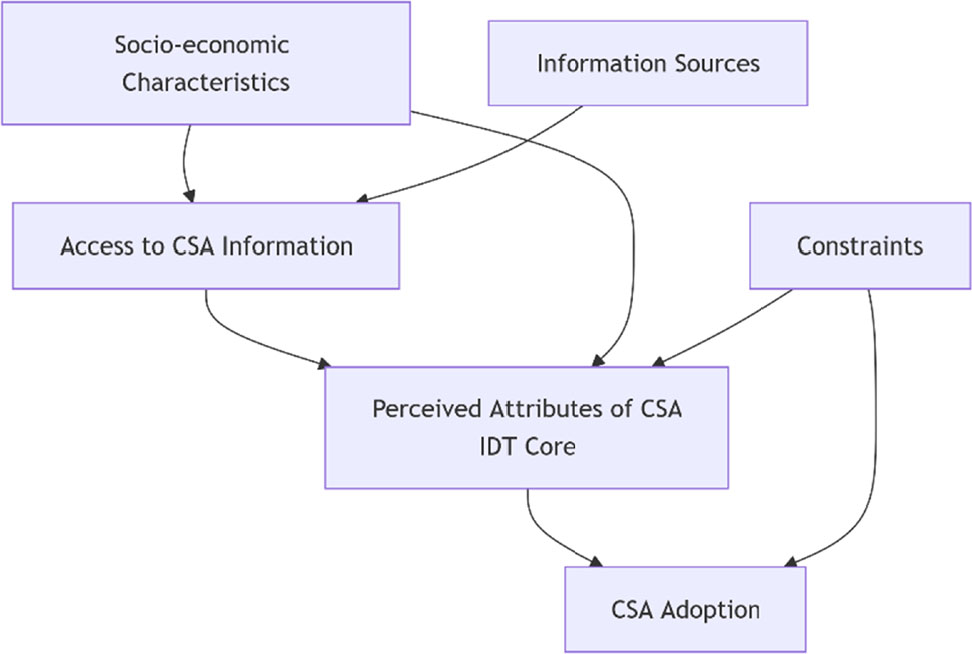
Fig. 1.
Conceptual framework of the study
Source: own elaboration.
Empirical review
Several empirical studies have examined the factors influencing the adoption of climate-smart agriculture (CSA) among smallholder farmers in Nigeria and across sub-Saharan Africa. Enete et al. (2011), in a study conducted in southeastern Nigeria, reported that the majority of farmers relied on personal experience and community knowledge to respond to climate variability. These farmers tended to adopt local drought-resistant crop varieties, adjust planting dates, and apply organic materials to improve soil fertility. Although these strategies align with CSA principles, the study noted that formal extension services were weak and seldom reached remote rural communities, thereby limiting exposure to improved practices.
Banca et al. (2011) provided empirical evidence on the benefits of improved land management under CSA in sub-Saharan Africa. Their experiments demonstrated that simple practices – such as mulching, crop rotation, and the use of cover crops – can substantially enhance soil productivity and resilience. However, uptake varied widely and was influenced by farmers’ access to technical expertise and financial resources. The authors emphasised the need for supportive institutional frameworks to promote large-scale adoption. These findings are consistent with results from the present study, where constraints contributed to low adoption of certain practices, including late planting, which may be perceived as difficult to implement or offer less visible benefits.
Below et al. (2012), in a cross-country analysis of micro-level adaptation strategies, highlighted the critical role of information delivery mechanisms in shaping farmers’ decisions. They found that CSA adoption increased in areas where extension services were active and locally embedded, while a lack of training and information corresponded with significantly lower adoption rates. Group-based learning was also identified as an excellent mode of knowledge dissemination. These insights are relevant to Yobe State, where this study similarly found that access to CSA information was strongly associated with extension contact and group membership.
Asfaw et al. (2016) investigated the influence of external support on CSA adoption in Niger and reported that access to credit and extension services significantly increased farmers’ capacity to adopt CSA technologies. They also found that farmers with higher levels of education were better able to interpret climate information and integrate it into their farming decisions. These findings underscore the importance of human capital in technology adoption and suggest that strengthening rural education systems could positively influence CSA uptake.
Louhichi and Paloma (2014), in a study conducted in Kenya, observed that adoption of drought-tolerant maize depended on the frequency of extension visits and the availability of training programmes. Their results showed that at least one extension-agent interaction per planting season increased farmers’ understanding and adoption of CSA practices. These findings align with the empirical evidence of the present study, which identified extension contact as a key determinant of access to CSA information.
Hassan (2018) examined conditions in Northeast Nigeria and found high awareness of CSA practices but limited actual adoption, due to inadequate access to inputs and weak agricultural institutions. The study recommended greater attention to decentralised service delivery and targeted financing. These recommendations are consistent with the constraints identified in the present study, particularly the lack of improved inputs and limited credit opportunities.
Zemba et al. (2018), analysing the period 1970–2009 in Northern Nigeria, documented significant rainfall and temperature variability and linked these trends to observed changes in cropping patterns. Farmers responded by adjusting planting dates, crop varieties, and land preparation methods. While these adjustments demonstrate adaptive behaviour, the authors noted that training on CSA and improved access to inputs are necessary to support broader and more consistent adoption. Their findings reinforce the dual importance of both knowledge and resources in shaping the speed and extent of CSA uptake.
Theoretical framework
This study employs Rogers (2003) Innovation Diffusion Theory (IDT) to explain the adoption of climate-smart agricultural (CSA) practices. According to the theory, the rate at which an innovation spreads within a social system depends on five perceived attributes: relative advantage, compatibility, complexity, trialability, and observability (Aghadiuno, 2022). Innovations perceived as more beneficial, easier to use, cost-effective, and consistent with existing practices are more likely to be adopted.
IDT outlines a five-stage adoption process: knowledge, persuasion, decision, implementation, and confirmation. Access to reliable information – often through extension services, or farmer groups – is central to these stages (Kaur and Kaur, 2018). This aligns with findings of Bwalya et al. (2023), who argue that adoption of sustainable land management practices is shaped by farmers’ understanding of the technologies and their associated benefits. Uneven adoption of CSA across farmers can therefore be examined through the lens of how different practices are perceived and communicated within the farming community.
A key feature of IDT is the influence of opinion leaders and change agents in accelerating the spread of innovations. Farmer groups and cooperatives create spaces for shared learning, discussion, and validation of CSA practices. Enete et al. (2011) observed that farmers who belonged to such groups adopted innovations more rapidly, largely due to peer influence and shared learning opportunities. This underscores the significance of IDT’s social system component in shaping diffusion outcomes. Applying IDT to the context of Yobe State highlights strategic leverage points for enhancing CSA adoption. Strengthening communication channels and improving farmers’ social networks (Ifeanyi-Obi et al., 2022) can significantly enhance the uptake of CSA practices.
METHODS
Study area
The study was conducted in the Bade Agricultural Zone of Yobe State, Nigeria, located within the Sudan and Sahel savannah ecological zones. These zones are characterised by highly variable rainfall ranging from 400 mm to 600 mm annually (Hassan, 2018), as well as recurrent droughts, land degradation, and other climatic uncertainties that negatively impact crop productivity and food security. Crop agriculture is the primary economic activity in the area, with millet, sorghum, maize, and cowpea as the dominant crops. Because the area is rain-fed, climate-smart agriculture (CSA) practices are particularly relevant and important for farmers’ livelihoods.
Design and population
A descriptive survey design was employed to collect primary data from arable farmers. The study population comprised all registered arable crop farmers in the Bade Agricultural Zone. This design was appropriate for assessing farmers’ socio-economic characteristics, sources of CSA information, levels of CSA adoption, and perceived constraints.
Sampling technique
A multi-stage sampling strategy was used to ensure adequate representativeness across the Bade Agricultural Zone. In the first stage, five wards were purposively selected based on their high levels of agricultural activity, the presence of organised farmer groups, and their documented vulnerability to climate variability, as noted by Hassan (2018). In the second stage, proportionate sampling was applied to determine the number of farmers selected from each ward, ensuring that their representation reflected the relative size of the farming population and prevented over- or under-sampling. A total of 456 arable farmers were ultimately selected. This sample size provides sufficient statistical power for analysis and supports the generalisation of findings within the zone.
Instrument of data collection
Primary data were obtained through a structured questionnaire administered to the sampled farmers. The instrument comprised four sections covering socio-economic characteristics, sources of CSA information, CSA practices adopted, and perceived constraints. Content validity was ensured through expert review, while reliability was assessed through a pilot test conducted with farmers outside the study sample. Items measuring information access and constraints were evaluated using Cronbach’s alpha, yielding coefficients of 0.81 and 0.84, respectively, indicating strong internal consistency. Feedback from the pilot study informed revisions to the questionnaire prior to final data collection.
Model specification
A binary logistic regression model was used to estimate the probability that farmers adopted CSA practices. The model is suitable for dichotomous outcome variables and is expressed as:
Where:P – probability of adopting CSA practices
(1 − P) – probability of not adopting CSA practices
Log(P / (1 − P)) – log-odds of CSA adoption
β0 – intercept
β1…βk – coefficients of explanatory variables
X1…Xk – explanatory (independent) variables
ε – error term
Dependent variable: Adoption of CSA Practices – binary
Explanatory variables: Age – continuous, Education level – categorical, Household size – continuous, Farm size – continuous, Credit access – binary, Extension contact – binary, Group membership – binary
Data analysis
Descriptive statistics were used to summarise socio-economic characteristics, major information sources, and constraints to CSA adoption. Binary logistic regression was employed to identify factors influencing access to CSA information. Model adequacy was assessed using the Hosmer-Lemeshow test, which indicated a satisfactory fit. Variance Inflation Factors (VIFs) were examined to check for multicollinearity, and all values fell below acceptable thresholds. Data analysis was conducted using SPSS, with results presented in tables.
Methodological constraints
The study relied on self-reported data, which may be affected by recall bias. In addition, the cross-sectional design limits causal inference. Only registered farmers were included, which may further restrict the generalisability of the findings.
RESULTS
Table 1 shows that arable farming in the study area is predominantly male-driven, with 76.8% of respondents being men. Most farmers were between 41 and 50 years old (31.1%), while 29.6% were above 50 years, indicating a mature farming population. A large majority were married (82.9%), suggesting the presence of stable household structures that can support agricultural activities. The educational distribution revealed that 29.0% of respondents had tertiary education and 28.7% had secondary education, while 22.8% had no formal schooling. This indicates the presence of a moderate literacy base within the farming population. Household sizes were generally large, with 57.9% having between 6 and 10 members. Farming experience was substantial, as 43.4% had 10–20 years of experience, and 32.0% had more than 20 years. These findings suggest that farmers in the study area are relatively experienced and moderately educated, making them capable of engaging with agricultural innovations such as climate-smart practices.
Table 1.
Socio-economic characteristics of respondents (N = 456)
| Variable | Category | Frequency | Percentage (%) |
|---|---|---|---|
| Gender | Male | 350 | 76.8 |
| Female | 106 | 23.2 | |
| Age | ≤ 30 years | 65 | 14.3 |
| 31–40 years | 114 | 25.0 | |
| 41–50 years | 142 | 31.1 | |
| > 50 years | 135 | 29.6 | |
| Marital status | Married | 378 | 82.9 |
| Single | 37 | 8.1 | |
| Widowed/divorced | 41 | 9.0 | |
| Education level | No formal education | 104 | 22.8 |
| Primary | 89 | 19.5 | |
| Secondary | 131 | 28.7 | |
| Tertiary | 132 | 29.0 | |
| Household size | 1–5 | 78 | 17.1 |
| 6–10 | 264 | 57.9 | |
| >10 | 114 | 25.0 | |
| Farming experience | < 10 years | 112 | 24.6 |
| 10–20 years | 198 | 43.4 | |
| > 20 years | 146 | 32.0 |
Table 2 presents the respondents’ sources of information on climate-smart agriculture (CSA). The most frequently cited source was agricultural extension agents (82.5%), followed by farmer groups (73.7%) and radio (63.8%). Non-governmental organisations (NGOs) were also important, reaching 55.3% of farmers. Less frequently mentioned sources included mobile phones (31.8%), television (30.3%), friends or neighbours (28.3%), and internet/social media (21.5%). These results indicate that interpersonal and community-based channels remain the dominant forms of information dissemination in rural environments. Formal extension systems continue to play a critical role in transferring CSA knowledge, although informal peer networks and farmer associations also contribute substantially. The relatively lower penetration of mass media and digital platforms may reflect infrastructural limitations or literacy-related barriers. Understanding these information pathways is essential for designing effective outreach programmes that can enhance the uptake of CSA practices among arable farmers.
Table 2.
Respondents’ sources of information on climate-smart agriculture
| Source of information | Frequency | Percentage (%) |
|---|---|---|
| Extension agents | 376 | 82.5 |
| Farmer groups | 336 | 73.7 |
| Radio | 291 | 63.8 |
| NGOs | 252 | 55.3 |
| Mobile phone/calls | 145 | 31.8 |
| Television | 138 | 30.3 |
| Friends/neighbours | 129 | 28.3 |
| Internet/social media | 98 | 21.5 |
Table 3 shows the distribution of constraints encountered by farmers in adopting CSA. The most commonly reported barrier was poor access to improved agricultural inputs (71.1%). This was followed by inadequate extension services (64.9%) and lack of financial support (61.2%). More than half of respondents (53.3%) cited limited knowledge of CSA practices, indicating persistent gaps in farmer awareness and technical training. Other constraints included poor market access (47.8%), unpredictable weather conditions (42.1%), high costs of CSA technologies (38.2%), and lack of access to training opportunities (33.6%). These challenges reflect both structural and capacity-related barriers to adoption. Addressing them will require targeted policy interventions, strengthened agricultural support systems, and increased investment in farmer education and institutional capacity to reduce adoption bottlenecks and enhance resilience.
Table 3.
Constraints faced in adopting climate-smart agricultural practices
| Constraint | Frequency | Percentage (%) |
|---|---|---|
| Poor access to improved inputs | 324 | 71.1 |
| Inadequate extension services | 296 | 64.9 |
| Lack of financial support | 279 | 61.2 |
| Poor knowledge of CSA practices | 243 | 53.3 |
| Poor market access | 218 | 47.8 |
| Unpredictable weather conditions | 192 | 42.1 |
| High cost of CSA technologies | 174 | 38.2 |
| Lack of training opportunities | 153 | 33.6 |
The regression results in Table 4 show that five socio-economic variables significantly increased the likelihood of accessing CSA information. Education level (p = 0.007, Exp(B) = 1.478) increased the odds of access by 48%. Farm size (p = 0.010, Exp(B) = 1.369) raised the odds by 37%, suggesting that farmers with larger holdings maintain stronger interactions with service providers. Access to credit (p = 0.002, Exp(B) = 2.134) more than doubled the likelihood of access, implying that financially supported farmers actively seek information related to productive investments. Extension contact showed the strongest effect (p = 0.000, Exp(B) = 3.333), with farmers who frequently engaged with extension agents being more than three times as likely to access CSA information. This is consistent with the Innovation Diffusion Theory, which emphasises the role of change agents in facilitating information flow and persuasion. Group membership (p = 0.003, Exp(B) = 1.977) also nearly doubled the odds of access, highlighting the importance of social networks in enhancing learning. Age and household size were not significant predictors. The model demonstrated strong explanatory power, with a chi-square value of 102.857 (p < 0.001) and a classification accuracy of 79.8%. These findings have important implications for policy design, particularly for strengthening extension services, improving access to credit, and supporting farmer groups to enhance information access and promote the adoption of climate-smart agriculture practices.
Table 4.
Socio-economic characteristics influencing access to CSA information
| Variable | B | Std. Error | Wald | Sig. (p-value) | Exp(B) |
|---|---|---|---|---|---|
| Age | –0.015 | 0.012 | 1.563 | 0.211 | 0.985 |
| Education level | 0.391 | 0.144 | 7.385 | 0.007 | 1.478 |
| Household size | –0.193 | 0.089 | 4.703 | 0.030 | 0.824 |
| Farm size | 0.314 | 0.122 | 6.621 | 0.010 | 1.369 |
| Credit access | 0.758 | 0.241 | 9.882 | 0.002 | 2.134 |
| Extension contact | 1.204 | 0.288 | 17.486 | 0.000 | 3.333 |
| Group membership | 0.682 | 0.229 | 8.859 | 0.003 | 1.977 |
| Model diagnostics | |||||
| −2 Log Likelihood: 377.243 | |||||
| Cox & Snell R2: 0.307 | |||||
| Nagelkerke R2: 0.428 | |||||
| Model Chi-square: 102.857, df = 7, p < 0.001 | |||||
| Classification Accuracy: 79.8% | |||||
DISCUSSION
The findings of this study indicate that socio-economic characteristics, information sources, and institutional constraints significantly influence the adoption of climate-smart agriculture (CSA) in Yobe State. Respondents were mostly male, middle-aged, and moderately educated, a pattern consistent with Enete et al. (2011) and Khan et al. (2022), who highlight education as a key factor in enabling farmers to understand technical messages and use advisory systems effectively. The long farming experience observed among respondents suggests familiarity with seasonal patterns and climate risks. Similar conclusions have been drawn in Nigeria and Ghana, where experience has been shown to increase exposure to new practices and stimulate the search for innovations under climate uncertainty (Anuga et al., 2019; Asfaw et al., 2016). In line with Innovation Diffusion Theory, such socioeconomic factors shape how farmers progress through the knowledge and persuasion stages of adoption. More educated and experienced farmers are better equipped to interpret information on relative advantage and complexity – two core determinants of adoption decisions. These profiles underscore the need for differentiated information delivery, with extension messages tailored to varying literacy levels and knowledge bases.
The study also found that farmers relied predominantly on extension agents, farmer groups, and radio. This is consistent with Branca et al. (2011) and a recent Kenyan study by Waaswa et al. (2021), which identified interpersonal and community-level communication channels as effective for disseminating information in rural contexts. Innovation Diffusion Theory emphasises the role of change agents in persuading individuals to adopt innovations, and this argument is supported by the strong influence of the extension agents observed in the present analysis. Conversely, the low utilisation of digital platforms contrasts with findings from technologically advanced agricultural regions, where mobile-based advisory services are increasingly popular (Khan et al., 2022). In Yobe State, poor connectivity and limited digital literacy hinder digital uptake, indicating that digital innovations will require supportive institutional conditions to be effective. Strengthening farmer groups and community radio, therefore, remains important for widening information access.
The constraints reported by farmers highlight weaknesses in the broader support systems required for CSA adoption. Limited access to quality inputs was the most common barrier, differing from findings in Kenya, where financial constraints were most prominent (Autio et al., 2021). Farmers in Yobe State face shortages of seeds, tools, and other key inputs, which limit their ability to translate knowledge into practice. Additional constraints – such as weak extension contact, low financial access, and inadequate training – further restrict adoption. These challenges align with institutional gaps noted by Hassan (2018) and recent evidence from Adamawa and Borno indicating that adaptation outcomes depend not only on awareness but on functioning support systems (Umar, 2024). Within the Innovation Diffusion framework, these barriers hinder the decision and implementation stages, where farmers require resources and opportunities to test innovations. Strengthening input supply chains, improving extension coverage, and expanding training opportunities should therefore be prioritised.
Regression results reinforce the importance of socio-economic and institutional factors in determining access to CSA information. Education significantly increased the likelihood of receiving information, consistent with Asfaw et al. (2016) and Khan et al. (2022). Larger farm size also improved access, suggesting stronger institutional engagement. Credit access increased the probability of information receipt, supporting findings by Louhichi and Paloma (2014). Extension contact was the strongest predictor: farmers who frequently interacted with extension agents were more than three times as likely to access CSA information. This aligns with Innovation Diffusion Theory, which highlights the role of change agents in facilitating the persuasion phase by reducing perceived complexity and clearly communicating the relative advantage of new practices. Membership in farmer groups further enhanced access, reflecting their function as information networks. Overall, these results indicate that structural and relational factors – more than knowledge alone – determine farmers’ access to CSA information.
These insights have important policy implications. Strengthening extension systems to increase the frequency and quality of contact is essential. Improving input availability and linking farmers to formal credit institutions would reduce material and financial barriers to adoption. Supporting the organisation and training of farmer groups would promote peer learning. Digital advisory platforms should be introduced gradually, using accessible formats such as SMS and local language voice messages to address literacy and connectivity challenges.
Future research could explore interaction effects, such as whether education influences information access differently for men and women. Aligning interventions with extension services, credit access, and farmer networks will facilitate CSA diffusion and contribute to building more resilient agricultural systems in Yobe State.
CONCLUSIONS
The study examined the socio-economic characteristics, information sources, and constraints affecting the uptake of climate-smart agricultural (CSA) practices among arable farmers in Yobe State. The results show that farmers were mostly male, middle-aged, married, and moderately to highly educated, with substantial farming experience. Extension agents and farmer organisations were the primary sources of CSA information, while radio and NGOs played complementary roles. Despite this access, adoption remained limited due to poor availability of inputs, weak extension contact, limited finance, and insufficient technical support. Binary logistic regression revealed that education level, farm size, access to credit, farm group membership, and frequency of extension contact significantly increased the likelihood of receiving CSA information.
These findings highlight that credible information, combined with supportive socio-economic and institutional environments, is essential for facilitating CSA uptake. Extension systems and farmer networks, in particular, play a central role in shaping how information is shared and how farmers build the capacity to apply new practices. However, systemic constraints persist, indicating that expanding CSA adoption in Yobe State will require coordinated improvements across educational, infrastructural, and institutional domains.
Based on the study’s findings, the following recommendations are proposed:
The Yobe State Ministry of Agriculture and the ADP should strengthen extension systems by deploying and training more extension agents to demonstrate CSA practices, and broaden CSA messaging through state radio collaborations to expand reach.
Local Government Authorities should promote the formalisation of farmer groups through a streamlined registration process and provide these groups with prioritised access to subsidised inputs and targeted NGO-led training.
The Central Bank of Nigeria, through Microfinance Banks, should introduce low-interest, seasonal, climate-resilient loan products and require that borrowers receive concurrent extension advisory services to ensure responsible credit use and effective technology adoption.
Local and international Non-Governmental Organisations should deliver modular CSA training in local languages through Farmer Field Schools, with emphasis on practical, low-cost techniques such as composting and water harvesting.
LIMITATIONS OF THE STUDY
This study has several limitations. First, its cross-sectional design restricts the ability to establish causal relationships between variables. Second, the reliance on self-reported data may introduce social desirability bias. Third, the focus on a single region limits the generalisability of the findings.