
INTRODUCTION
Farms are the primary organisational units in agriculture, engaged in production processes aimed at ensuring food security at the macroeconomic level (Pawlak and Kołodziejczak, 2020). They also play an important role in the utilisation of natural resources and preservation of biodiversity (Soini and Aakkula, 2007). However, farms vary considerably in terms of structural characteristics, such as size, specialisation, concentration, and ownership type (Hansen, 2024). As a result, some of them are unable to fully achieve their fundamental objectives at either the micro- or macroeconomic level – namely, to generate competitive advantages through high-quality production and to ensure adequate profitability.
Ensuring food security is not possible without appropriate investment in technological means and production inputs (Didur et al., 2017), which constitute the material and technical foundation determining a farm’s capacity for efficient production (Kołoszko-Chomentowska, 2016). Technical progress in agriculture is primarily driven by private farm investment (Svoboda et al., 2016). Such investments are essential for maintaining effective farm operations and enabling sustainable growth (Czubak et al., 2021). They enhance competitiveness (Femenia et al., 2021), productivity (Adil and Roy, 2024), and modernisation across the agricultural sector (Zając, 2012). Continuous investment facilitates faster development and modernisation, typically reflected in improved economic performance. Higher investment levels directly strengthen the economic standing of farms (Szymańska and Dziwulski, 2022). When making investment decisions, farmers must take into account ongoing trends in agriculture and the agri-food sector. Agricultural investments should serve fundamental objectives such as ensuring food security, improving living standards in rural areas, maintaining satisfactory agricultural incomes, and protecting the natural environment (Jorgenson, 1963).
In Polish agriculture, investment in fixed assets is essential due to the high degree of wear and obsolescence of existing equipment and machinery (Kata, 2024). Such investments contribute to long-term poverty reduction, higher land productivity, and support for nature conservation initiatives (Andrade et al., 2019). They also increase the future potential of farms. The introduction of modern machinery and equipment enhances the efficiency of both crop and livestock production (Szymańska and Dziwulski, 2022) and reduces costs through the adoption of more capital-intensive production methods (Begg, 1998).
Family farms, in particular, tend to focus their investments on production-oriented assets such as machinery, equipment, and agricultural tractors that directly support agricultural processes (Gołębiewska and Grontkowska, 2023). Such investments require significant financial resources (Kusz, 2018) and are influenced by multiple factors, including price fluctuations, capital costs, and technological change, all of which affect farmers’ investment activity (Thijssen, 1996). Among the most important components of capital in agricultural production are investments in machinery, such as tractors. While their use enhances labour efficiency, these machines also contribute to a considerable rise in farm operating costs (Jekayinfa et al., 2005). Agricultural machinery is characterised by high initial purchase costs and a relatively short service life (Griffith and Lorencowicz, 2011). The total cost associated with the use and operation of such machinery comprises several elements, including depreciation, interest, insurance, storage, fuel, and repair and maintenance costs (Lips and Burose, 2012). Each of these components directly affects the overall production costs of farms. Neglecting proper maintenance accelerates equipment wear, leading to higher expenses related to repairs and emergency servicing (Jekayinfa et al., 2005). These costs tend to increase systematically with the age of the machine (Rotz, 1987). Nevertheless, the growing availability of external funds, such as subsidies and loans, has increasingly facilitated the timely replacement of equipment. Consequently, in the 21st century, working conditions and occupational safety in agriculture have improved.
Investments undertaken by farmers require substantial capital outlays. The specific nature of agricultural production demands the use of specialist equipment, which is often unaffordable – particularly for smaller farms in terms of land area or economic scale. This limits the financial resources available for developing agricultural production, which is crucial for ensuring food security. Consequently, the subsidisation of agricultural investments has become necessary. Such investments can be effectively supported through financial assistance provided under EU structural funds (Kusz, 2008). As a result, programmes within the European Union designed to foster farm development have become the most frequently used and preferred source of external financing among farmers.
The most common and best-known form of financial support for farms is direct payments, one of the principal instruments of the Common Agricultural Policy (CAP) (Żurakowska-Sawa and Gruszczyk, 2024). These payments play a vital role by ensuring income stability and financial security for farmers (Hejbudzki, 2021). They serve as a mechanism for maintaining steady agricultural production and market stability, while also promoting CAP productivity growth (Kumbhakar et al., 2023). Such funds are particularly significant for small and medium-sized farms (Czubak, 2024), as they provide the capital needed to implement development strategies. Financial support derived from structural funds strengthens farm equity and reduces financial risk (Kusz, 2008). Furthermore, as shown by Garrone et al. (2019), direct payments may help reduce disparities in employment between agriculture and other sectors by encouraging farmers to invest more labour resources in their holdings. However, it should be noted that despite the benefits of financial support, investments in modern agricultural machinery also increase depreciation costs, thereby raising total production expenses (Jekayinfa et al., 2005).
To ensure long-term farm development, investment subsidies provided under the CAP play an increasingly important role (Czubak et al., 2021). These subsidies are designed to promote the modernisation, growth, and competitiveness of farms (Détang-Dessendre et al., 2018). Analyses of investment activity in Polish farms confirm their importance, particularly given the fragmented structure of agriculture. Modernisation financed through these subsidies improves both productivity and profitability (Kumbhakar et al., 2023). Ultimately, the overarching aim of investment support within the CAP framework is to transform agriculture into a highly efficient, innovative, and environmentally sustainable sector.
The efficiency of agricultural activity is determined by the relationship between the value of output and the costs incurred in its production (Dynowska and Łapińska, 2010). Rational decision making – both operational and strategic – requires a solid understanding of costs and agricultural cost accounting. Due to the unique characteristics of agriculture, cost accounting is more complex than in most other sectors. This complexity arises from limited production capacity and from the frequent omission of depreciation in cost calculations, which can hinder effective financial management. Therefore, awareness of cost structures and their composition is essential (Hajduga, 2013). Accurate cost estimation supports better decision-making, for example, in selecting optimal crops or investing in modern agricultural machinery (Carli and Canavari, 2013). Agricultural production inherently requires fixed tangible assets, machinery, and labour – all of which generate significant costs. Nonetheless, these expenditures enable farms to expand and generate income. Consequently, such outlays sustain economic activity and ensure continued profitability (Hajduga, 2013). A clear trend can be observed in agriculture, where traditional production factors, such as land and labour, are gradually losing their dominant role, being increasingly replaced by capital (Kata, 2024). Capital now plays a central role in production processes, enhancing both labour and land productivity (Fuglie, 2012). Investment expenditure, although initially a financial burden, ultimately strengthens farm competitiveness. In the long term, capital investment is the key determinant of both efficiency and development potential in agriculture (Kata, 2024).
MATERIALS AND METHODS
The analyses were conducted using data from 3,244 Polish farms included in the continuous accounting framework of the Farm Accountancy Data Network (FADN). The FADN is an EU system for collecting and analysing agricultural accounting data. The data processed within this system are unpublished. Farms in the FADN are classified according to two criteria: (1) economic size class, expressed as the sum of standard production units (SO – standard output) from all agricultural activities, and (2) type of farming, determined based of the share of SO values from specific groups of agricultural activities in the farm’s total SO (Pawłowska-Tyszko et al., 2023). Selected characteristics were compared across seven agricultural types; no farms classified as vineyards were present in the Polish dataset.
The analysis covers the period 2007–2019. This timeframe was chosen because the effects of structural and economic changes following Poland’s accession to the European Union had already become apparent, and 2019 was the last year before the COVID-19 pandemic, which introduced data instability. All calculations were performed using data expressed in current prices. Adjustments to constant prices were deemed unnecessary, as deflation could distort the actual ratios when calculating the coefficient of variation.
Analyses of changes in investment levels and costs on Polish farms were based on the following FADN variables (in PLN):
SE516 – Gross investment: the value of purchased and produced fixed assets minus the value of sold assets and fixed assets transferred free of charge within the accounting year, plus the valuation change of breeding livestock.
SE406 – Subsidies on investments: the amount of investment-related subsidies allocated to a given accounting year, to be settled within 12 months.
SE270 – Total inputs: includes direct costs, overheads, depreciation, and costs of external factors. This category covers expenditures related to the farm’s operations within the accounting year and includes inputs of potential commercial value produced on the farm and used for production (e.g. seeds, seedlings, and feeds for grazing livestock and granivores).
Farm taxes and other dues are not included in total costs; instead, they are recorded in the balance of subsidies and taxes related to operating and investment activities. Likewise, the value of purchased animals is excluded, as it is already reflected in the production value.
SE340 – Machinery and building current costs: costs of current upkeep of machinery and equipment (including the purchase of minor equipment), vehicle expenses, building and land improvement maintenance, and building insurance. Major repairs are classified as investments.
For each type of agricultural production, mean values were calculated for the analysed variables. Subsequently, the coefficient of variation (V) was determined using the classical formula:
Where:Vx – coefficient of variation,
Sx – standard deviation,
X̄ – arithmetic mean.
Here, the coefficient of variation (V) was interpreted according to Ręklewski (2020):
Vx < 35% – small variability,
35% < Vx ≤ 60% – moderate variability,
60 < Vx ≤ 75% – high variability,
75 < Vx ≤ 100% and over 100% – very high variability.
The higher the coefficient of variation, the greater the differences among individual statistical units in terms of the characteristic’s value; conversely, a lower coefficient indicates greater similarity among the units (Ręklewski, 2020). Applying this coefficient made it possible to assess the dispersion of the investigated variables, revealing potential regularities related to different types of farming.
RESULTS AND DISCUSSION
The level of investment in agriculture determines the strength or weakness of this sector within the national economy, while on a microeconomic scale, it defines the competitive position of individual farms (Kusz, 2018). Following Poland’s accession to the European Union, the process of farm modernisation accelerated in order to enhance the competitiveness of the sector. The funds made available under the CAP played a crucial role in financing these investments (Czubak and Mikołajczak, 2012).
Analysis of the economic variables of farms reveals strongly asymmetric distributions, characterised by numerous zero values and extremely high maximums (Table 1). In all categories, mean values considerably exceed the medians, which indicates that typical farms achieve lower levels than the averages suggest. High skewness and kurtosis confirm the presence of a few very large farms that strongly influence the overall results. These findings point to significant heterogeneity in the structure of farm costs and investments. The analysis of an unbalanced sample remains important because it reflects the actual structure of the farming population, which is influenced by missing data, organisational changes, and the cessation of operations. Excluding such units could artificially “flatten” the image of the sector and obscure important information about its dynamics. Examining unbalanced data, therefore, provides a better understanding of long-term processes such as farm entry and exit from the market or investment volatility. As a result, the findings have stronger practical relevance for agricultural policy and farm-level economic analysis.
Table 1.
Variable statistics
| Statistics | Gross investment | Subsidies on investments | Total inputs | Machinery and building current costs |
|---|---|---|---|---|
| Mean | 42865,16613 | 3392,435851 | 197645,0462 | 11034,19821 |
| Standard error | 795,1310352 | 44,42140911 | 1487,75965 | 73,53057146 |
| Median | 3369,575 | 0 | 109530 | 6680 |
| Mode | 0 | 0 | 76093 | 0 |
| Standard deviation | 163286,6969 | 9122,301665 | 305523,6788 | 15100,10754 |
| Sample variance | 26662545390 | 83216387,66 | 93344718325 | 228013247,6 |
| Kurtosis | 287,036731 | 477,8542714 | 72,9323865 | 246,4993286 |
| Skewness | 9,216493454 | 11,28652618 | 6,733932371 | 9,104615507 |
| Range | 10836133 | 592951 | 5923112 | 790140 |
| Minimum | −4787339 | 0 | 4299 | 0 |
| Maximum | 6048794 | 592951 | 5927411 | 790140 |
| Sum | 1807709786 | 143065804,7 | 8335086887 | 465334206,9 |
| Count | 42172 | 42172 | 42172 | 42172 |
Accordingly, mean gross investments and investment subsidies were compared by type of farming for two non-consecutive years (Fig. 1).
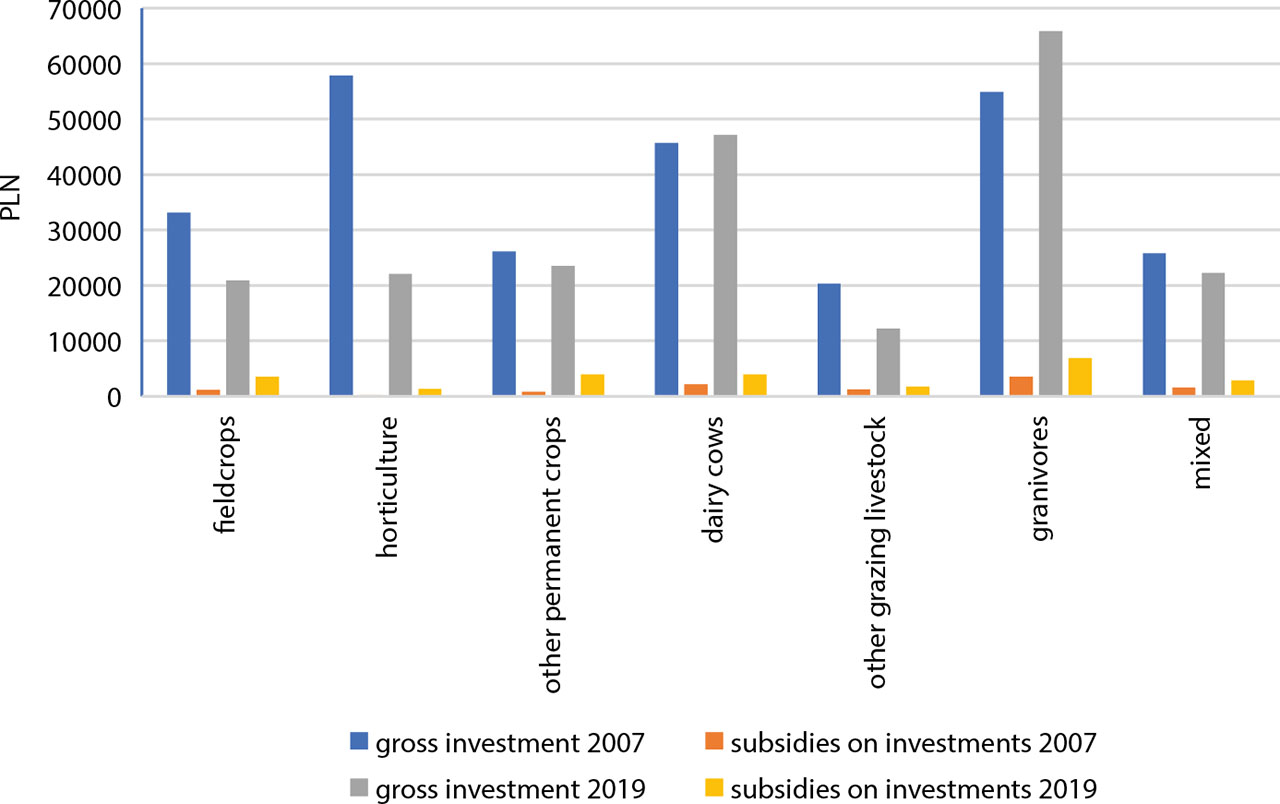
Fig. 1.
Mean values of gross investments and investment subsidies in 2007 and 2019
Source: own elaboration based on FADN, n = 3244.
It was found that in farms specialising in field crops, horticulture, other permanent crops, other grazing livestock, and mixed farming, the mean value of gross investments in 2019 decreased compared with 2007. The high level of investment activity in 2007 was primarily the result of EU funds allocated to support farm modernisation following Poland’s accession. Interestingly, the amounts of investment subsidies were higher in 2019 across all analysed cases, which reduced the financial burden on farm income while supporting the development of investment mechanisms. Increased investment was observed only in farms specialising in milk production and granivores. Moreover, granivore farms recorded the highest investment levels in 2019, consistent with the findings of Zalewski et al. (2017). Assessing investment levels by type of production is essential for understanding diversification and the role of external funding (Nasalski and Juchniewicz, 2023).
In all analysed cases, total costs increased substantially due to rising expenditure in agricultural activity. The largest cost increases occurred in farms specialising in horticulture, milk production, and granivores. This may result from higher investment intensity in these sectors; however, most costs were generated by overheads. Relatively high variability in costs was also observed across production types. Similarly, Nachtman (2015) identified differences in cost structures depending on the type of farming. Overall, agricultural production in Poland and other European countries remains heavily burdened by high costs (Gałecka, 2021).
Mean costs of machinery and building upkeep increased in all types of production between 2007 and 2019, regardless of investment intensity. This indicates that the development of agricultural activity through increased investment did not generate excessive maintenance costs in any of the analysed groups. This outcome is positive both for individual farms and for the sector as a whole, as it may imply higher farm incomes measured by the net value added. The development of mechanisation in agriculture enhances productivity and contributes positively to farm management practices (Khattak et al., 2024; Czubak and Pawłowski, 2024). Nevertheless, due to limited data, it is not possible to clearly confirm these positive effects. The increase in maintenance costs is largely a consequence of higher prices; however, as investment continues, this effect may gradually diminish. To further identify changes in selected characteristics, the coefficient of variation was calculated to assess variability in gross investments by farming type (Table 2).
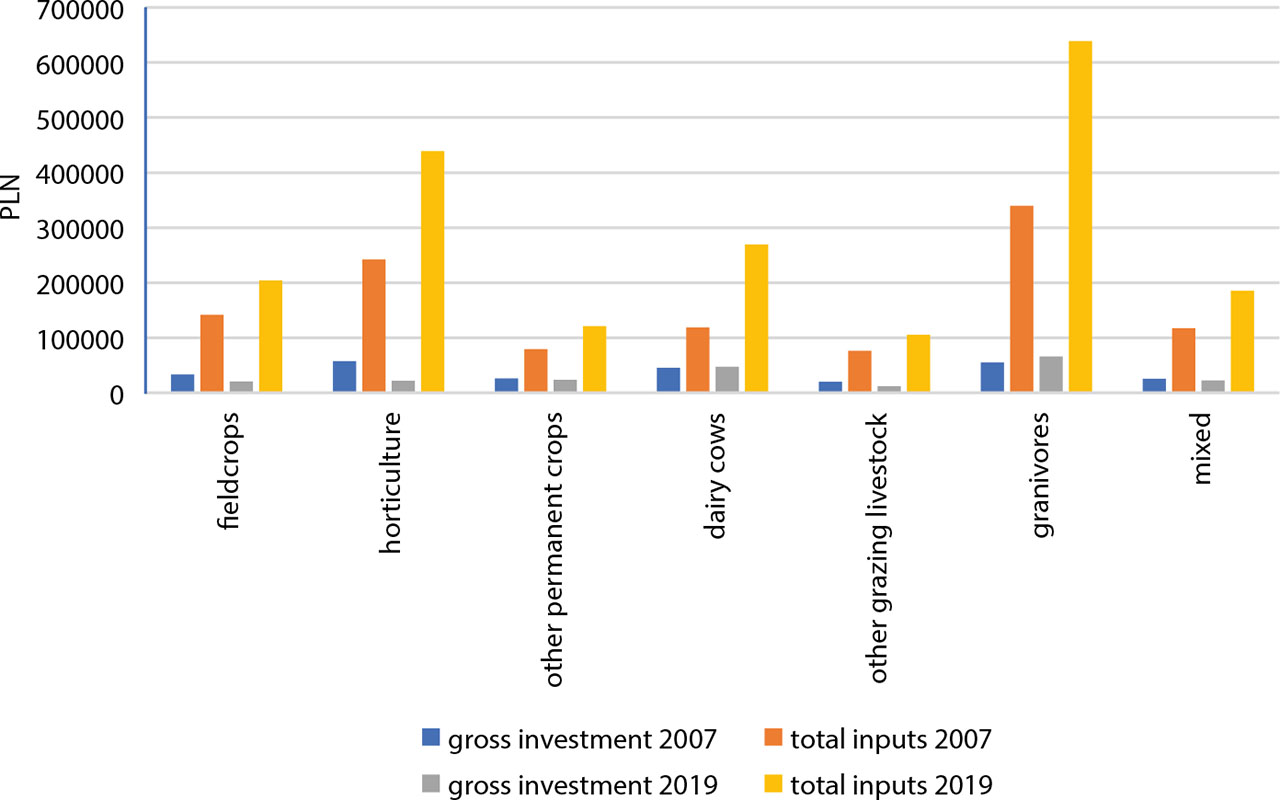
Fig. 2.
Mean values of gross investments and total costs in 2007 and 2019
Source: own elaboration based on FADN, n = 3244.
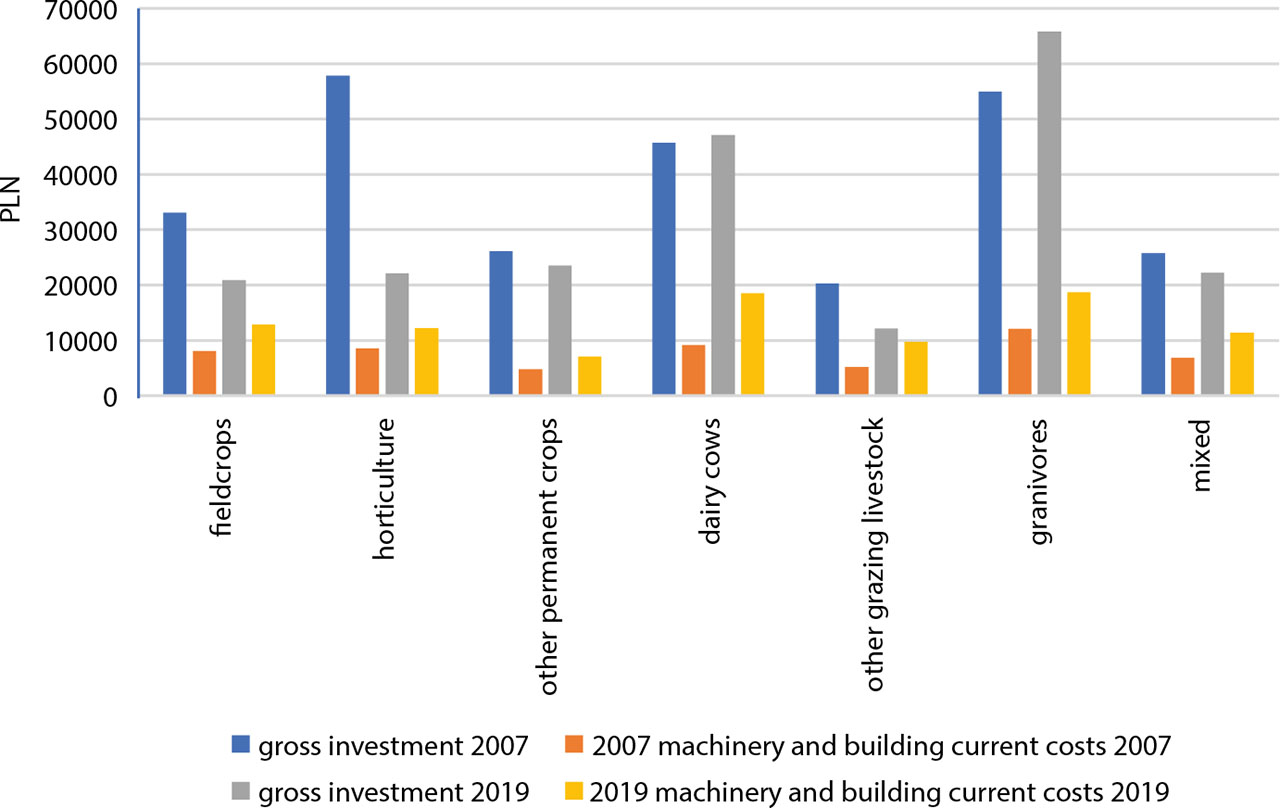
Fig. 3.
Mean values of gross investments and costs of machine and building upkeep in 2007 and 2019
Source: own elaboration based on FADN, n = 3244.
Table 2.
Coefficient of variation for gross investments (%)
| Ve | Fieldcrops | Horticulture | Other permanent crops | Dairy cows | Other grazing livestock | Granivores | Mixed |
|---|---|---|---|---|---|---|---|
| 2007 | 303.47 | 347.14 | 156.52 | 179.10 | 239.78 | 232.01 | 268.79 |
| 2008 | 292.55 | 364.30 | 209.14 | 234.28 | 290.06 | 388.54 | 340.80 |
| 2009 | 317.78 | 237.02 | 184.50 | 274.38 | 501.70 | 241.53 | 331.07 |
| 2010 | 280.20 | 446.01 | 212.10 | 246.07 | 278.46 | 225.17 | 291.73 |
| 2011 | 408.07 | 366.50 | 173.89 | 217.64 | 329.85 | 271.24 | 378.19 |
| 2012 | 343.30 | 386.62 | 223.05 | 198.09 | 297.13 | 239.91 | 280.04 |
| 2013 | 326.26 | 448.87 | 254.71 | 291.81 | 379.58 | 200.29 | 319.65 |
| 2014 | 323.92 | 486.15 | 243.50 | 282.96 | 329.38 | 211.43 | 476.23 |
| 2015 | 312.73 | 398.83 | 292.67 | 320.32 | 533.50 | 324.54 | 337.17 |
| 2016 | 576.85 | 291.76 | 231.78 | 462.21 | 349.95 | 485.69 | 931.29 |
| 2017 | 471.30 | 342.88 | 279.10 | 264.50 | 337.88 | 392.23 | 603.83 |
| 2018 | 882.96 | 622.12 | 226.49 | 246.47 | 357.23 | 360.34 | 422.15 |
| 2019 | 783.37 | 283.21 | 375.92 | 296.61 | 406.15 | 428.02 | 456.29 |
The analysis indicates very high variability in gross investments across all farm types, confirming strong diversification within agricultural production. The highest coefficients were found in field-crop farms, and the lowest – though still high – in dairy farms. This represents a positive relationship that may indicate the development of the analysed farms, although the results should be interpreted in the light of variable heterogeneity. High coefficients of variation result directly from the nature of agricultural data, as evidenced by the descriptive statistics: pronounced skewness, high kurtosis, substantial differences between the mean and median, and numerous zero values. Consequently, a typical farm operates at a significantly lower cost and investment levels than the averages suggest, while extreme values stem from a small number of large farms.
The coefficient of variation for investment subsidies was also high across all farm types, although lower than for investments. The highest values were observed in horticultural farms and the lowest in farms specialising in other permanent crops. Subsidies can provide farms with the potential to finance investments (Aleksandrova et al., 2024), thereby improving quality of life by reducing the burden on income from agricultural activity (Touch et al., 2024).
When examining the total costs, the coefficients of variation were lower than those observed for investments and investment subsidies, yet they still indicated high variability. Lower coefficients were recorded for farms specialising in other permanent crops and grazing livestock. Variation in costs plays an important role in the development of farms, particularly in relation to the financial burden associated with investment activity. In the long term, the successful implementation of production rationalisation measures may lead to the generation of savings (Bragina et al. 2019).
The greatest variability in machinery and building upkeep costs was observed in mixed-type farms, while the lowest occurred in farms specialising in granivores. These costs are linked not only to investment activity but also to depreciation. Therefore, farm modernisation is necessary not only to improve efficiency and profitability but also to reduce repair and maintenance costs (Lorencowicz and Uziak, 2015), which translates into savings for farmers. Each additional year of machine service life increases annual repair and maintenance costs for agricultural equipment (Lips and Burose, 2012).
Table 3.
The coefficient of variation for allocated amounts of investment subsidies (%)
| Ve | Fieldcrops | Horticulture | Other permanent crops | Dairy cows | Other grazing livestock | Granivores | Mixed |
|---|---|---|---|---|---|---|---|
| 2007 | 462.24 | 323.91 | 238.02 | 191.58 | 479.00 | 278.28 | |
| 2008 | 306.78 | 434.88 | 375.55 | 200.58 | 197.60 | 183.68 | 218.10 |
| 2009 | 332.93 | 396.97 | 276.26 | 310.64 | 204.07 | 190.75 | 212.76 |
| 2010 | 392.32 | 296.79 | 235.21 | 202.94 | 203.79 | 184.97 | 244.36 |
| 2011 | 266.90 | 296.22 | 265.48 | 210.78 | 249.51 | 171.41 | 263.37 |
| 2012 | 259.46 | 317.02 | 251.78 | 211.33 | 280.53 | 177.83 | 271.79 |
| 2013 | 241.17 | 293.10 | 215.36 | 216.73 | 262.93 | 169.80 | 265.26 |
| 2014 | 234.95 | 293.91 | 198.49 | 182.54 | 259.17 | 171.02 | 258.85 |
| 2015 | 242.27 | 270.21 | 205.55 | 201.45 | 296.89 | 191.47 | 293.02 |
| 2016 | 228.71 | 297.36 | 191.93 | 195.04 | 287.11 | 187.80 | 269.33 |
| 2017 | 229.44 | 302.35 | 193.61 | 201.24 | 296.46 | 185.78 | 271.29 |
| 2018 | 235.76 | 307.20 | 190.24 | 202.96 | 314.10 | 210.63 | 642.82 |
| 2019 | 231.88 | 326.99 | 192.84 | 212.49 | 331.22 | 223.14 | 263.77 |
Table 4.
The coefficient of variation for total costs (%)
| Ve | Fieldcrops | Horticulture | Other permanent crops | Dairy cows | Other grazing livestock | Granivores | Mixed |
|---|---|---|---|---|---|---|---|
| 2007 | 121.59 | 150.40 | 83.62 | 123.45 | 78.37 | 107.23 | 128.94 |
| 2008 | 121.18 | 140.13 | 90.03 | 114.85 | 78.43 | 109.58 | 121.11 |
| 2009 | 123.28 | 141.72 | 90.56 | 109.49 | 89.35 | 113.26 | 125.52 |
| 2010 | 125.31 | 151.39 | 99.02 | 118.87 | 87.31 | 112.53 | 136.98 |
| 2011 | 121.95 | 163.11 | 99.71 | 120.02 | 85.03 | 113.32 | 139.49 |
| 2012 | 122.84 | 193.10 | 80.66 | 132.53 | 89.12 | 114.69 | 143.93 |
| 2013 | 124.99 | 179.90 | 85.30 | 132.50 | 95.50 | 115.92 | 146.90 |
| 2014 | 124.92 | 182.66 | 85.98 | 139.68 | 101.37 | 115.91 | 150.56 |
| 2015 | 121.91 | 207.33 | 87.01 | 137.52 | 100.33 | 112.38 | 156.69 |
| 2016 | 124.32 | 215.56 | 90.17 | 137.67 | 101.26 | 109.98 | 163.21 |
| 2017 | 124.42 | 203.30 | 97.36 | 137.38 | 102.00 | 110.12 | 164.25 |
| 2018 | 124.79 | 196.80 | 99.83 | 140.58 | 106.95 | 112.38 | 159.29 |
| 2019 | 125.68 | 205.11 | 96.95 | 138.63 | 113.80 | 113.45 | 167.85 |
Table 5.
The coefficient of variation for costs of machinery and building upkeep (%)
| Ve | Fieldcrops | Horticulture | Other permanent crops | Dairy cows | Other grazing livestock | Granivores | Mixed |
|---|---|---|---|---|---|---|---|
| 2007 | 128.35 | 146.54 | 111.88 | 120.51 | 95.60 | 116.39 | 124.92 |
| 2008 | 131.46 | 111.69 | 99.36 | 116.87 | 90.31 | 110.59 | 121.01 |
| 2009 | 127.71 | 132.80 | 105.56 | 95.70 | 91.83 | 110.33 | 114.58 |
| 2010 | 117.89 | 138.86 | 92.97 | 123.03 | 110.79 | 114.24 | 118.18 |
| 2011 | 123.94 | 124.02 | 125.87 | 115.32 | 101.76 | 139.48 | 129.07 |
| 2012 | 135.08 | 119.16 | 104.47 | 134.44 | 102.43 | 99.18 | 152.94 |
| 2013 | 221.62 | 167.14 | 106.21 | 114.50 | 106.93 | 116.67 | 136.56 |
| 2014 | 119.10 | 129.27 | 111.67 | 130.01 | 131.14 | 111.68 | 125.32 |
| 2015 | 122.14 | 128.15 | 204.95 | 131.57 | 113.24 | 141.51 | 137.91 |
| 2016 | 109.64 | 142.64 | 122.93 | 119.36 | 103.48 | 111.10 | 125.70 |
| 2017 | 116.40 | 135.51 | 147.23 | 116.11 | 105.66 | 120.20 | 166.85 |
| 2018 | 118.21 | 111.25 | 141.26 | 124.77 | 120.30 | 106.36 | 131.37 |
| 2019 | 122.21 | 147.97 | 130.33 | 124.23 | 122.21 | 115.58 | 168.38 |
The present study has certain limitations concerning the comparability of farm types, as the data were used without conversion to a common unit, such as per hectare of agricultural land. However, the use of raw data was intentional, aiming to identify underlying trends and provide a deeper analytical perspective.
CONCLUSIONS
Investments are a key driver of farm development, playing an essential role in improving working conditions, increasing labour efficiency, and enhancing farm productivity and competitiveness. However, not all farms allocate a significant share of their income to development activities, and discontinuing such investments can lead to stagnation in agricultural production. The utilisation of CAP funds remains crucial, yet their effective use requires analysing not only the variability of subsidies but also the associated costs, which are inherently linked to the degree of farm modernisation. Nevertheless, a disproportionate rise in these costs, without a corresponding increase in income, may result in negative outcomes.
The conducted analysis revealed clear relationships between changes in the level of gross investments, total costs, and the amounts of allocated investment subsidies across different types of farms. The results confirmed considerable cost variation and a high variability of gross investments between various types of agricultural production. Specialisation plays a significant role in determining investment expenditure and cost levels. Production types requiring high capital inputs, such as dairy farming, generate particularly high costs. In contrast, certain types of farms (horticultural production, other permanent crops, grazing livestock, mixed production) recorded decreases in gross investment values in 2019 compared to 2007. This decline, however, may be associated with intensified investment activity in the intervening years not covered by the analysis. At the same time, horticultural production exhibited a sharp increase in total costs, along with considerable variability in the amount of subsidies received. In analysing the variability of gross investment levels, the variability in machinery and building maintenance costs also proved to be significant. The highest variability in these costs was found in mixed agricultural production, while the lowest occurred in farms specialising in granivores. Most notably, the coefficient of variation for investment subsidies was very high, suggesting a strong dependence on CAP to supplement investment financing.
The study indicates certain emerging trends; however, it is important to acknowledge its limitations, which stem from the inherent characteristics of agricultural data. The heterogeneity of the sector affects the research outcomes and prevents universal conclusions – especially given the fragmented nature of Polish agriculture. Even so, the analysis highlights the need for further studies in this area, for example, by incorporating agricultural land area as an additional value.