
INTRODUCTION
Urban areas often provide more diverse employment opportunities due to greater infrastructure investment and better access to essential services, including education. In contrast, rural regions lag behind in many development indicators such as literacy, electrification, and access to communication technologies, driving migration to cities. Over the past few decades, numerous Sub-Saharan African cities have undergone significant population and economic growth. In Rwanda, this trend is evident in Kigali, the capital city, where expanding economic activity has contributed to both population growth and more varied food consumption patterns (Brou, 2023).
Kigali is the wealthiest province in Rwanda, with an average annual income nearly twice the national rural average (NISR, 2017). This is reflected in household expenditure patterns: food accounts for less than half of total household spending in Kigali, compared to over 70% in rural provinces such as Eastern and Southern Rwanda. Northern and Western provinces fall between these extremes, with households allocating around 60% of their budgets to food. These differences illustrate urban consumers’ higher purchasing power and the greater share of food in rural households’ budgets, which limits demand for costly animal-sourced products (NISR, 2017).
Food consumption in Kigali is further shaped by regional price differences. The Cost of Living Index (COLI) indicates that Kigali has the highest food prices in the country, reflecting its urbanization and economic activity (NISR, 2014). These price differences affect purchasing power and influence household consumption behavior. Most Kigali households purchase food from markets, whereas rural and agriculture-dependent households rely heavily on subsistence farming and home-based production (Baraka, Willis and Ishimwe, 2022).
Seasonal and temporal price fluctuations amplify these differences. Prices tend to rise during the cultivation period (July to September) when supply is low and fall during the main harvest season (January to March) (NISR, 2014). Urban households typically maintain more diversified diets but are more sensitive to market-driven price changes. Rural households rely on seasonal availability and self-produced food, making them vulnerable to environmental and economic shocks such as droughts, floods, and disease outbreaks. According to the World Food Programme (2019), approximately 45% of food-insecure households in Rwanda are rural, where access to diverse, protein-rich foods like meat, milk, and eggs is limited (Nsabimana et al., 2020).
Analyzing food consumption in Rwanda requires attention to differences in demand and expenditure elasticities between urban and rural households. Evidence from Sub-Saharan Africa indicates that rural households spend a larger share of their budgets on staples, whereas urban households allocate more to animal-sourced and discretionary products, resulting in distinct responses to price and income changes (De Vos et al., 2024; George, 2025). Improvements in affordability do not necessarily translate into healthier diets: urban households often shift toward discretionary foods, while rural households remain constrained by the higher costs of nutrient-dense items. Rural households are generally more responsive to income changes, but they continue to face persistent barriers due to limited access to food markets and infrastructure (De Vos et al., 2024). Addressing these disparities requires policies tailored to the unique consumption dynamics and access challenges of both urban and rural populations.
This study aims to estimate how household consumption of animal-sourced products responds to price and expenditure changes across Rwanda’s rural and urban areas. The analysis is based on the hypothesis that urban and rural households differ systematically in their demand elasticities for beef, fish, and eggs. Separate demand systems are estimated for Kigali and for rural provinces. The Quadratic Almost Ideal Demand System (QUAIDS) model is applied to cross-sectional data to examine consumption patterns of beef, fish, and eggs. Structural tests of parameter equality are then conducted to compare the two demand systems (Kigali versus other provinces). This approach enables a detailed assessment of price and expenditure elasticities for rural versus urban households, while also allowing for the evaluation of substitution and complementarity effects among animal-sourced products.
Food demand elasticities capture how quantities or budget shares adjust to changes in prices or total expenditure. The QUAIDS framework is particularly well suited for estimating these elasticities, as it nests the Almost Ideal Demand System (AIDS) framework while allowing for nonlinear Engel curves and flexible substitution patterns (Banks et al., 1997). In Sub-Saharan Africa, rural–urban heterogeneity in spending patterns and elasticities is common. Urbanization is associated with systematic dietary shifts, while microdata from Rwanda indicate distinct Engel relationships and higher expenditure elasticities for several groups among rural households (De Vos et al., 2024; Nsabimana et al., 2020).
Accounting for these differences is critical for demand projections and policy. For example, projections incorporating urbanization and location-specific elasticities produce different trajectories for staples versus animal-sourced foods, with implications for food import needs, market infrastructure, and nutrition (De Vos et al., 2024). Evidence from Rwanda indicates that policy should be location-specific: targeted interventions are more likely to improve rural market access and affordability for nutrient-dense foods – where expenditure elasticities are higher – while in urban areas, policies should consider the greater price-inelasticity of certain demands (Nsabimana et al., 2020). QUAIDS-based elasticity estimates thus provide essential inputs for simulating intervention scenarios, guiding supply chain planning, and capturing rural–urban heterogeneity rather than assuming a uniform national response.
There is a lack of studies estimating demand elasticities for animal-sourced products in Rwanda. These estimates are crucial for demand projections, such as partial equilibrium (PE) models of protein markets. In the absence of country-specific data, researchers and policymakers often rely on elasticity values from neighboring countries, particularly Tanzania (Jean-Pierre et al., 2024), which may not accurately reflect Rwandan consumption patterns, income dynamics, or rural-urban differences. By providing nationally relevant estimates, this study fills an empirical gap and strengthens the foundation for both academic research and evidence-based policy design in Rwanda’s livestock and food sectors.
The estimated elasticities in this study may be used to enhance current food policies and inform the Rwanda Strategy Support Program (IFPRI, 2019), which aims to strengthen the food system and rural nonfarm economy, and reduce food insecurity and malnutrition. These estimates can inform demand projections and guide policies to improve food accessibility and affordability for households in Rwanda and other Sub-Saharan African countries with similar socioeconomic conditions.
DATA
To carry out this study, data on animal-derived product prices, household expenditures, and household demographic characteristics were obtained from the 2022 International Food Policy Research Institute’s (IFPRI) Smallholder Agriculture Commercialization survey. The survey covers farm production, nonfarm employment, expenditures, consumption, prices of crops and livestock in Rwanda. It includes a sample of 2020 households located in four provinces: North, South, East, West, and Kigali City (Figure 1). The survey used multiple-frame sampling. An area frame was created by dividing the regions into non-overlapping geographical units. From this frame, a random sample unit was selected. Within each selected unit, eligible households were listed, and a final sample was drawn for data collection. Participation was voluntary, and the survey was conducted in person from late July to early September 2022.
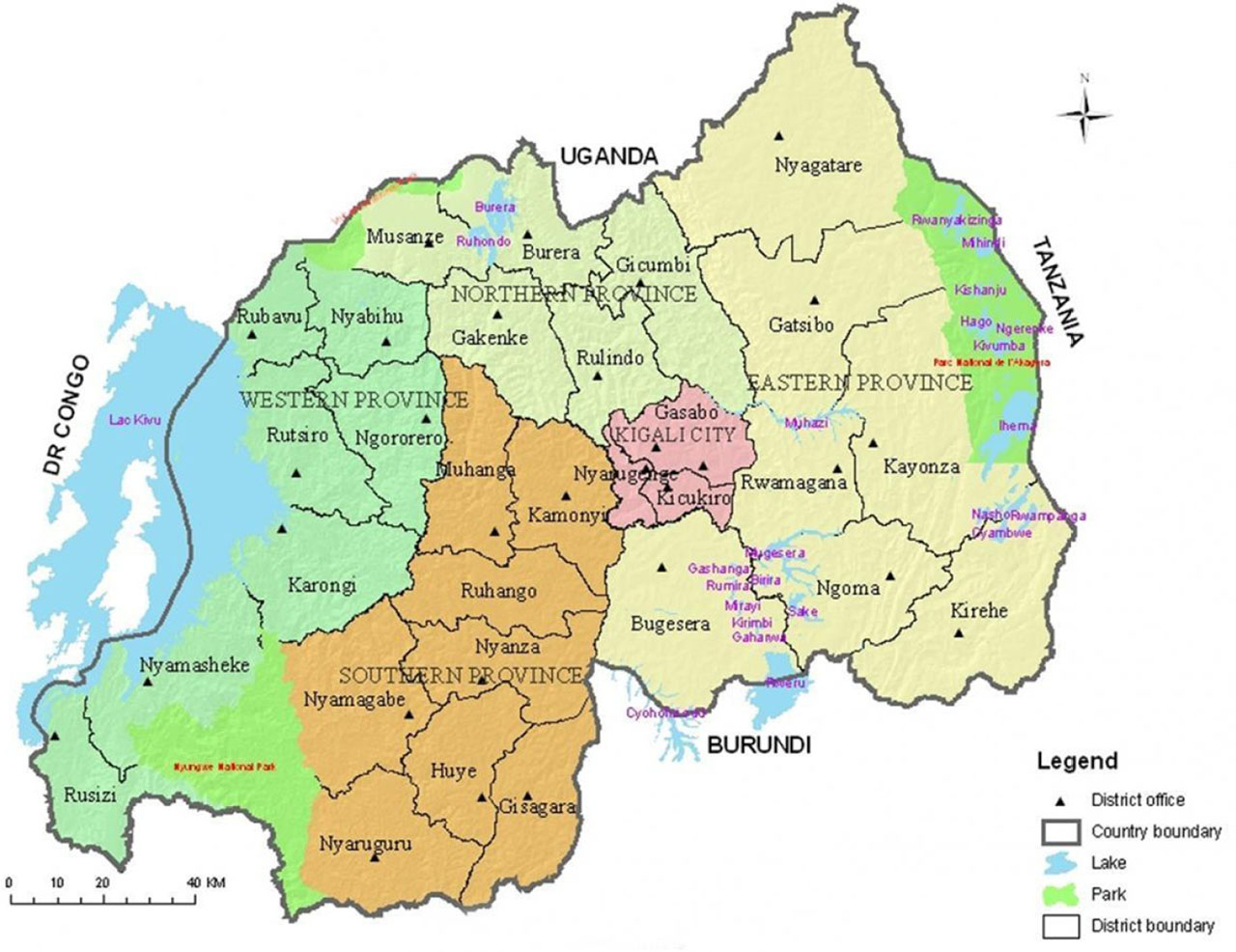
Fig. 1.
Map of Rwanda by Province and District
Source: Maps of Rwanda, https://fr.maps-rwanda.com/le-rwanda-carte-avec-les-districts
The dataset provides cross-sectional household consumption and expenditures, though it required cleaning. Following established procedures in demand system analysis (Deaton and Muellbauer, 1980; Abdulai and Aubert, 2004; Rischke et al., 2015), 64 households with missing values in three or more variables were excluded. Thirteen households with fewer missing values were retained, with missing entries imputed using province-level averages. Some households reported zero consumption of various animal-derived products. These zeros may reflect genuine non-consumption (due to preferences or affordability) or reporting errors, though it is difficult to distinguish between the two. Consistent with previous QUAIDS applications (Caro et al., 2021), zero consumption values were retained to avoid upward bias in mean consumption estimates. Outliers were identified using the interquartile range (IQR) method. Four extreme beef consumption values were detected and winsorized by replacing them with the nearest acceptable boundary within the IQR range.
For this study, households in Kigali are classified as urban, while those in the North, South, East, and West provinces are classified as rural. The National Institute of Statistics of Rwanda (NISR) notes that the urban share of the rural provinces and the rural share of Kigali are both very small, and therefore provincial urban/rural estimates are not provided due to large sampling errors (NISR, 2012, p. 3). This classification is also consistent with previous studies estimating food demand separately for rural and urban households in Rwanda (Nsabimana et al., 2020). Among survey respondents, 7% lived in Kigali, the most urbanized province in the country. Outside Kigali, the survey does not distinguish between rural and urban households. Kigali’s population density is at least four times that of any other province, most of which are predominantly agricultural (Shipsey, 2022).
The IFPRI Smallholder Agriculture Commercialization survey provides information on both food production and the consumption of food and non-food items. This study focuses on the consumption of animal-sourced products, including quantities purchased and amounts drawn from own production. On average, Kigali households spend the most on beef and fish, accounting for 77% and 21%, respectively, of the country’s total animal-sourced food expenditure (Table 1). Among the five provinces, Kigali households allocate the smallest share of their animal-sourced food budget to eggs. In 2022, households in all provinces devoted a higher share of their animal-sourced food expenditure to beef, except in the Northern province, where beef and fish shares were roughly equal (IFPRI Smallholder Commercialization Survey, 2022). Regional variation reflects differences in income, production capacity, market access, and dietary preferences. For example, Northern households may consume more fish due to local availability, while Kigali households with higher incomes and diverse markets devote more to beef.
Table 1.
Average Expenditure and Budget Share Allocated to Beef, Fish, and Eggs in Rwanda’s Five Provinces in 2022
| Province | Expenditures* | Budget share | ||||
|---|---|---|---|---|---|---|
| beef | fish | egg | beef | fish | egg | |
| East | 4 434.28 | 1 021.49 | 722.91 | 0.651 | 0.236 | 0.111 |
| Kigali city | 5 423.52 | 1 536.11 | 436.84 | 0.772 | 0.213 | 0.014 |
| North | 5 775 | 914.34 | 323.52 | 0.416 | 0.416 | 0.166 |
| South | 4 339.53 | 682.97 | 482.04 | 0.729 | 0.162 | 0.107 |
| West | 4 334.28 | 1 459.42 | 608.94 | 0.589 | 0.222 | 0.188 |
Figure 2 presents the average prices of beef, fish, and eggs across Rwanda’s five provinces in 2022. Beef is consistently the most expensive product, followed by fish and eggs. Prices are highest in the Eastern and Western provinces: in the East, both beef and fish are relatively costly, while in the West, beef commands the highest prices nationwide. Kigali also exhibits relatively high beef prices, likely reflecting increased urban demand. These regional price variations are influenced by factors such as local supply constraints, transportation costs, and market infrastructure. The Eastern and Western provinces may face higher prices due to longer supply chains, higher losses during transport, and limited local production of certain animal-sourced products. In contrast, lower fish and egg prices in Kigali may result from better market access, more efficient distribution networks, and greater availability of imported products.
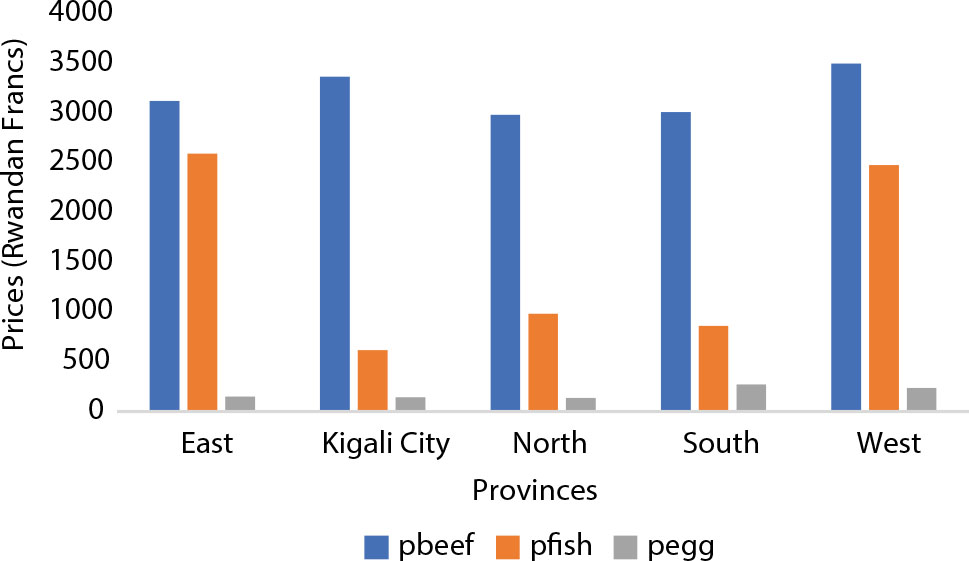
Fig. 2.
2022 Average Beef and Fish Prices (per pound), and Unit Egg Prices in Rwanda’s Five Provinces
Source: own elaboration.
METHODS AND PROCEDURES
The standard Almost Ideal Demand System (AIDS) and its quadratic extension (QUAIDS) are similar in many respects. The primary difference is that QUAIDS includes a quadratic term for expenditure (Zheng and Henneberry, 2010). Xu and Veeman (1996) and Nsabimana et al. (2020) highlight the importance for applied economists of understanding household consumption patterns and budget allocation toward animal-derived products. When assessing consumption changes across households with varying income levels and price exposures – such as urban versus rural households in Rwanda – the choice of functional form can influence the estimated demand parameters (McGuirk et al., 1995; Cranfield et al., 2003). This study applies both joint and individual tests for independence, linearity, and functional specification to ensure robustness in model selection. Selecting an appropriate functional form for analyzing demand for animal-sourced products in Rwanda reduces potential inaccuracies in the estimated expenditure and price elasticities.
The estimation of demand systems using the AIDS model is grounded in consumer theory, where consumer behavior is represented by the maximization of utility subject to a budget constraint. Deaton and Muellbauer (1980) formalized this approach by specifying a class of preferences that permits exact aggregation across individuals. This framework allows market demand to be modeled as if it were derived from a representative rational consumer. Within this framework, consumption at given prices is defined as the minimum expenditure required to achieve a specified level of utility.
These preferences belong to the PIGLOG class and are represented through an expenditure (or cost) function of the form:
Where: a(p) and b(p) – are defined as the cost of subsistence and bliss (respectively). They are positive and homogeneous of degree one functions in a vector of prices p, and u – is a given level of utility. Consistent with cost and utility maximization theory, c(u, p) – is non-negative, non-decreasing in u, non-decreasing in p, and homogeneous of degree one in p, meaning that any change in p is associated with a proportional change in the cost function (Mas-Colell and Whinston, 1995).The AIDS model is derived by differentiating this cost function with respect to prices, yielding a system of demand functions that satisfies key theoretical restrictions. These include homogeneity, which implies that demand is homogeneous of degree zero in prices and income – so proportional changes in both do not alter the quantity demanded (Jehle & Reny, 2011). In addition, additivity restricts expenditure shares across all goods to sum to one for internal consistency of the model. Another restriction is that cross-price effects must be symmetric, a condition that follows directly from applying Shepard’s Lemma to the cost function.
The elasticities derived from this demand system are conditional because the AIDS model assumes weak separability among goods and a multi-stage budgeting process. Weak separability implies that goods can be grouped so that changes in the price of one good affect demand for other goods within the same group in a consistent manner (Edgerton, 1997). Multi-stage budgeting suggests that consumers first allocate their expenditure across broad categories (e.g., food, housing) using price indices and then allocate within those categories. However, these assumptions may not always hold, particularly in contexts with closely substitutable or complementary goods. To address this, the conditional elasticities obtained from the model are adjusted to derive unconditional elasticities, which more accurately reflect total demand responsiveness by accounting for cross-group expenditure effects.
The QUAIDS model is used to accommodate Rwandan household expenditure on animal-derived products. Introduced by Banks et al. (1997), QUAIDS is a generalization of the AIDS model by Deaton and Muellbauer (1980), distinguished by a quadratic term that allows for nonlinear demand relationships. The suitability of either model is often determined by a Wald test on the QUAIDS quadratic term’s parameter (Poi 2002). QUAIDS is typically preferred when using cross-sectional data. In this study, the QUAIDS model is specified with expenditure shares as the dependent variable to analyze consumption of animal-sourced products in Rwanda.
Where: Pi – denotes the price paid for product i ∈ {1,2,3}, Qi – the quantity consumed, and y the total expenditure on all categories of food in the system. The budget share of each household on all food products is constrained to sum to one. The QUAIDS model expenditure share equations are expressed as: Where: p – is a vector of all prices, b(p) – is the Cobb-Douglas price aggregator and a(p) – is the price index, αi, γij, βi, and λi – are the parameters to be estimated, and – is the random error term.The value of α0 is estimated as the minimum expenditure required for subsistence, which can vary across households and income levels (Deaton and Muellbauer, 1980; Poi, 2002; Lakkakula, Schmitz, and Ripplinger, 2016). Deaton and Muellbauer (1980) assume that consumers have a well-defined preference ordering over bundles of goods and face a budget constraint that limits their expenditure on goods. Under these assumptions, it is shown that the value of α0 is equal to the logarithm of the minimum expenditure required to achieve a given level of utility. Therefore, in the Rwandan demand system, the value for α0 is set slightly below the lowest value of log (y) in the data (Banks et al., 1997).
Theoretical restrictions of adding up (Σj=1αi = 1, Σj=1βi = 0, Σj=1λi = 0, Σj=1γij = 0), homogeneity (Σj=1γij = 0), and Slutsky symmetry (γij = γji, for any i ≠ j) are imposed on the demand system to ensure consistency with utility maximization. In addition, the expenditure terms ln(y) and (ln(y))2 in the QUAIDS equation (2) are tested for endogeneity, which could produce inconsistent estimates (Blundell and Robin, 1999; Zheng and Henneberry, 2010; Lakkakula, Schmitz, and Ripplinger, 2016).
A two-step approach was employed to address potential endogeneity in the household expenditure variable, following Dhar (2003). In the first step, instrumental variables were selected, including education level indicators (primary, secondary, and university education). These instruments were selected because they are expected to be correlated with household expenditure but not directly with the demand for specific food products, satisfying the relevance and exclusion criteria for valid instruments. A reduced-form regression was conducted for household expenditure on the set of instrumental variables.
A Wald test was conducted to test for endogeneity. The resulting p-value of 0.8929 > 0.05 indicates that the null hypothesis – that the expenditure variable is exogenous – cannot be rejected. This suggests that household expenditure can be treated as exogenous in the demand system (Table 2).
Table 2.
Rwanda QUAIDS model’s endogeneity and misspecification tests
| Null hypothesis | P-value | Conclusion^ |
|---|---|---|
| Exogenous expenditure | 0.8929 | Fail to reject |
| Joint conditional mean | 0.004 | Reject |
| Nonnormality | 0.429 | Fail to reject |
| Linearity | 0.095 | Fail to reject |
| No structural change | 0.008 | Reject |
| Dependence | 0.565 | Fail to reject |
Misspecification Tests
Given that the functional form can influence food consumption parameter estimates, a set of tests for functional form, nonlinearity, and non-normality are conducted on the QUAIDS Equation (2) for beef consumption, following McGuirk et al. (1995). Normality is tested using D’Agostino-Pearson’s K2 test, which detects departures from normality arising from skewness or kurtosis. The standardized third moment (√b1) and fourth moment b2 correspond to skewness and kurtosis, respectively, and can be computed from the sample data to describe and test for non-normal distributions (D’Agostino and Belanger, 1990). In D’Agostino’s K2 test, normality is assumed under the null hypothesis. Table 2 presents p-values for the misspecification tests. Since the K2 test p-value exceeds 0.05, we cannot reject the null hypothesis of normality in the errors at the 5% significance level.
The joint conditional mean test is applied to simultaneously test structural change, nonlinearity, and dependence and uses the artificial regression:
Where are the predicted residuals and Xi a vector of explanatory variables from Equation (2), allows for spatial dependence and is represented by a lag of the predicted residuals , models structural change with the binary variable that is zero for households located in Kigali and one otherwise; and models non-linearity using a RESET2 test (McGuirk et al., 1995). The null hypothesis of the joint conditional test assumes structural change, nonlinearity, and spatial dependence. Based on the p-value for the joint test (Table 2), we reject the null hypothesis at the 5% significance level. To further investigate the sources of rejection, individual tests of linearity and structural change are conducted. For nonlinearity, the RESET2 test uses the following regression: Which requires δ = 0 under the null hypothesis of linearity. Given the p-value, we fail to reject the null hypothesis of linearity.A Chow test is employed to assess structural change, dividing the data into two sets: one for households located in Kigali and another for households residing in the predominantly rural provinces (Lo and Newey, 1985). For each subset, a similar regression to Equation (2) is employed:
The Chow test’s p-value of 0.008 allows us to reject the null hypothesis of no structural change in the model (Table 2). This indicates that the relationship between household characteristics, prices, and budget shares differs significantly between Kigali and the predominantly rural provinces. Therefore, using a single, pooled model for all households could produce misleading elasticity estimates. To correct this misspecification, equations and elasticities were estimated separately for Kigali and the rest of the country.Elasticity Calculations
Following the estimation of the QUAIDS model parameters described above, the conditional own- and cross-price elasticities can be computed as:
Where the Kronecker delta, δij – is equal to 1 when i = j and 0 otherwise, and the remaining parameters and variables are as described in Equation (2) (Krinsky and Robb, 1986). The equation for expenditure elasticities can be expressed as:These price elasticities are conditional, as the QUAIDS model assumes weak separability among the three animal-derived food groups. Own- and cross-price elasticities are converted to unconditional elasticities following Edgerton’s (1997) procedure. In this approach, the conversion of own-price elasticities to unconditional price elasticities is given by:
Where ηij – is the unconditional own-price demand elasticity for the specified food group (beef, fish, or egg) in the system, eii – is the conditional own-price elasticity, μi – is the expenditure elasticity of animal-derived products i, wi – is the budget share of that same food group i, and η* – is the unconditional own-price demand elasticity of the meat group in aggregate (Mutondo, 2007; Edgerton, 1997). The value of η* derives from expenditure elasticity calculations provided by Nsabimana et al. (2020).A similar process is used to convert the cross-price elasticities into unconditional elasticities:
Where: ηij – is the unconditional cross-price demand elasticity between animal-derived products i and j, eij – denotes the conditional cross-price elasticity between the i and j food product, and wj – is the budget share of j.The unconditional expenditure elasticities can then be estimated as:
Where: τi – is the unconditional expenditure elasticity by product i in the system, and τ* – is the household’s expenditure elasticity for the overall meat group (Rickertsen, 1998). Where: zi – is the quantity of meat consumed by household i, P – is the average price of meat; and TEi – is the total expenditure on animal-sourced products.Standard errors of the estimated conditional elasticities are calculated at the mean using the transformation of a normally distributed random vector formula, based on Equations (9) and (10) (Mdafri and Brorsen, 1993). Those equations can be formulated in matrix form:
Where: R – is a matrix of scalars, n – is a vector of the previously estimated QUAIDS model parameters (γ, λ, α, β), and h – is the vector of estimated elasticities, eij and μi. var(h) – is the variance-covariance matrix of h, which can be expressed as: With: Var(n) – being the variance-covariance matrix of n.RESULTS
The QUAIDS model described in Equation (2) provides estimates of Rwandan households’ budget share responses to price (own-price and cross-price) and expenditure (linear and quadratic) for each food group in the system. The own-price coefficients, located along the diagonal, are all positive and statistically significant at the 5% level, indicating that average increases in the price of beef (0.229%), fish (0.153%), and eggs (0.123%) lead to increases in their respective budget shares (Table 3). The off-diagonal elements capture cross-price effects and are mostly negative and significant, suggesting that these animal-sourced products generally act as substitutes. For example, an increase in beef prices is associated with reductions in the budget shares allocated to fish (−0.130%) and eggs (−0.099%). Similarly, the negative coefficient of −0.024 for eggs in the fish equation indicates that changes in fish prices can influence egg consumption (Table 3).
Table 3.
Quadratic almost ideal demand system parameter estimates for beef, fish, and eggs using Rwanda data, 2022
| Type of expenditure | Price | Expenditure | |||
|---|---|---|---|---|---|
| beef | fish | egg | linear | quadratic | |
| Beef | 0.229* (7.93) | –0.130* (−4.90) | –0.099* (−2.43) | 0.049 (0.92) | 0.020* (6.21) |
| Fish | –0.130* (−4.90) | 0.153* (5.39) | –0.024 (−1.27) | –0.145* (−6.24) | –0.016* (−8.44) |
| Egg | –0.099* (−2.43) | –0.024 (−1.27) | 0.123* (2.67) | 0.096* (2.23) | –0.004* (−1.38) |
The budget share response to expenditure indicates that a 1% increase in total meat expenditure is associated with a 0.049% and 0.096% increase in the beef and egg budget shares, respectively. In contrast, the fish budget decreased by 0.145%, suggesting that fish becomes relatively less important in household budgets as income rises (Table 3). Both beef and eggs are produced locally, and many households in the survey are livestock and poultry producers; therefore, they tend to consume more locally produced meat as their total meat budget grows. Rwanda is a landlocked country, and a large proportion of consumed fish products comes from neighboring countries. The decrease in the fish budget as total meat expenditure increases may also reflect the broad categorization of fish products. The quadratic expenditure terms indicate nonlinear effects. Beef has a positive quadratic term (0.020), which means that its budget share continues to grow at higher income levels. Fish, on the other hand, has a negative quadratic term (−0.016).
Conditional and unconditional elasticities are computed from the estimated QUAIDS model results. There are a few differences between the numerical values of the conditional and unconditional elasticities for several food products, although the signs are generally consistent. The unconditional expenditure elasticities reported in Table 4 suggest that Rwandan households, on average, tend to spend more on each animal-derived product as their total budget increases by 1%. Fish is the most responsive to expenditure changes across Rwanda. This trend is particularly pronounced in areas outside Kigali, where the elasticity reaches 1.49. In contrast, the fish expenditure elasticity in Kigali is lower (1.09), indicating a more subdued response to income changes in urban settings, possibly due to better baseline access to imported fish products. Eggs also exhibit a positive unconditional elasticity for Rwanda overall (0.87) and for predominantly rural areas (1.01). However, in Kigali, the elasticity is negative (−0.22), suggesting that egg consumption may decline as household income rises, potentially due to substitution toward other protein sources or different dietary preferences in more urban areas (Table 4).
Table 4.
Mean conditional and unconditional expenditure elasticities for animal-sourced products using 2022 Rwanda data
| Food group | Conditional | Unconditional | ||||
|---|---|---|---|---|---|---|
| all | Kigali | rural | all | Kigali | rural | |
| Beef | 0.69 (0.18) | 0.86 (0.06) | 0.66 (0.17) | 0.53 | 0.67 | 0.51 |
| Egg | 1.13 (0.63) | –0.29 (0.09) | 1.31 (0.37) | 0.87 | –0.22 | 1.01 |
| Fish | 1.86 (0.67) | 1.41 (0.21) | 1.92 (0.69) | 1.43 | 1.09 | 1.49 |
Unconditional own-price and cross-price elasticities are presented in Table 6, while conditional elasticities are shown in Table 5. Some differences are observed between the two; however, the more policy-relevant unconditional elasticities are the focus of interpretation. These elasticities measure how the quantity demanded of each product responds to changes in its own price (own-price elasticity) and to changes in the prices of other products (cross-price elasticity), holding real income constant. At the national level in Rwanda, all three animal-sourced products exhibit own-price inelastic demand, as the absolute values of their own-price elasticities are less than one. Among these products, fish is the most sensitive to price changes, though it remains inelastic at the national level (Table 6).
Table 5.
Mean Conditional Marshallian Own-Price and Cross-Price Elasticities for animal-sourced products using 2022 Rwanda data
| Price | |||
|---|---|---|---|
| beef | egg | fish | |
| All | |||
| beef | –0.19 (0.21) | –0.27 (1.18) | 0.56 (0.53) |
| egg | –0.02 (0.11) | 0.00 (1.09) | 0.13 (0.15) |
| fish | 0.19 (0.14) | –0.26 (0.25) | –0.69 (0.46) |
| Kigali | |||
| beef | –0.01 (0.06) | –3.02 (0.97) | 0.32 (0.06) |
| egg | –0.17 (0.06) | 2.64 (1.01) | 0.04 (0.02) |
| fish | –0.17 (0.12) | 0.38 (0.04) | –0.36 (0.09) |
| Rural | |||
| beef | –0.22 (0.21) | 0.09 (0.56) | 0.60 (0.56) |
| egg | –0.02 (0.11) | –0.34 (0.42) | 0.14 (0.16) |
| fish | 0.20 (0.14) | 0.25 (0.27) | –0.74 (0.47) |
Table 6.
Unconditional Marshallian Own-Price and Cross-Price Elasticities for animal-sourced products using 2022 Rwanda data
| Price | |||
|---|---|---|---|
| beef | egg | fish | |
| All | |||
| beef | –0.41 | –0.38 | –0.41 |
| egg | –0.31 | –0.07 | –0.37 |
| fish | 0.47 | –0.014 | –0.93 |
| Kigali | |||
| beef | –0.35 | –0.056 | –0.39 |
| egg | –3.03 | 2.64 | 0.037 |
| fish | 0.03 | 0.072 | –0.51 |
| Rural | |||
| beef | –0.41 | –0.37 | –0.38 |
| egg | 0.027 | –0.47 | 0.07 |
| fish | 0.53 | –0.008 | –0.96 |
Price responses vary significantly by region, as shown in Table 5. In Kigali, beef exhibits a relatively low own-price elasticity (−0.35), confirming that demand is inelastic. However, the own-price elasticity of eggs is both positive and elastic. This unexpected result may be partly due to the low consumption of eggs in Kigali. Fish, with an elasticity of −0.51, also shows an inelastic own-price response in Kigali. In contrast, in the more rural provinces, the own-price elasticity of fish (−0.96) indicates that demand is less inelastic than in Kigali or at the national level. This may reflect the limited accessibility and higher cost of fish in rural communities, where underdeveloped distribution channels make fish less available. Fish consumed in Kigali is more likely to be imported and sold in supermarkets. Consequently, rural households are more price-sensitive and more likely to substitute fish with more accessible alternatives, such as eggs or locally available meats, when fish prices increase (Table 5).
Outside of Kigali, demand for beef and eggs is inelastic with respect to own-price changes (−0.41 for beef and −0.47 for eggs), suggesting that households continue to allocate a relatively stable portion of their consumption to these products despite price fluctuations. Cross-price elasticities across all regions are generally low, with most values close to zero and inelastic. However, the large own-price elasticity estimate for eggs with respect to beef in Kigali (−3.03) indicates highly elastic demand. Eggs account for only a very small share of household food budgets in Kigali (about 1.4%). In such cases, the QUAIDS framework can produce unstable elasticity estimates, as Marshallian elasticities are proportional to expenditure shares, and small denominators can amplify the response (Deaton & Muellbauer, 1980). Economically, this implies that while consumers may substitute away from eggs in relative terms when beef prices rise, the absolute effect on total household expenditure and overall food demand remains limited. This pattern has been observed in other applications of QUAIDS and is consistent with the interpretation that goods with small budget shares tend to yield large, but less economically meaningful, elasticity estimates. In areas outside Kigali, cross-price elasticities are much smaller in magnitude and remain negative, suggesting that substitution among animal-sourced products exists but may be limited by accessibility and income constraints. Positive cross-price elasticities of fish with respect to beef at the national (0.47) and rural (0.53) levels indicate that rural households may increase fish consumption when beef becomes more expensive.
In general, beef demand is inelastic across all regions, while the responsiveness of egg and fish consumption varies by location. Urban households in Kigali exhibit stronger substitution among animal-sourced products, particularly between eggs and beef. In contrast, rural households’ choices are more constrained by availability, income, and distribution. These patterns underscore the importance of region-specific strategies to improve protein access and affordability in Rwanda.
These elasticity estimates reveal important trends in household demand for animal-sourced products. From a policy perspective, these findings may be relevant beyond Rwanda, offering lessons for other developing countries with similar disparities in income, consumption patterns, and food markets. In urban areas, where households have diverse diets and greater market access, interventions such as price subsidies, market expansion for protein sources, or public nutrition campaigns could influence consumption patterns and promote healthier diets. In rural areas, strategies should prioritize improving the accessibility and affordability of animal-sourced foods, for example, through support for local production or targeted cash transfer programs. Such efforts can help reduce households’ vulnerability to nutritional deficiencies and strengthen rural food security. Own-price and cross-price elasticities can assist policymakers in anticipating household responses to price changes and income growth, thereby facilitating the design of interventions that enhance protein consumption, reduce nutritional disparities, and improve food security across heterogeneous regions in developing countries. For instance, knowing that rural households’ demand for fish is relatively price-sensitive (own-price elasticity of −0.96) can help guide subsidies or local production initiatives aimed at maintaining affordable access to this important protein source.
There is significant heterogeneity in animal-sourced product consumption across Rwanda’s provinces, as shown in Table 1. For instance, the Northern province allocates nearly equal shares of its meat budget to beef and fish (41.6% each), whereas the Southern province spends a much smaller share on fish (16.2%). These differences suggest that dietary patterns and consumption priorities vary across rural regions, shaped by local production, market access, and cultural preferences. While this heterogeneity is important, estimating separate elasticities for each rural province would reduce sample sizes, potentially leading to less statistically robust estimates. The QUAIDS model results for rural areas, therefore, reflect pooled rural provinces, preserving statistical power while ensuring that the estimated elasticities remain reliable and interpretable.
This approach aligns with guidance from the National Institute of Statistics of Rwanda (NISR, 2012), which notes that provincial urban/rural subsamples are often small, making province-level urban/rural disaggregation susceptible to large sampling errors. By pooling rural provinces, the analysis captures broader regional demand trends while maintaining robust parameter estimates. Nonetheless, Table 1 and other descriptive statistics indicate clear differences in budget shares and consumption patterns among provinces, underscoring the need for policymakers to consider provincial context when designing interventions. Although separate province-level elasticities are not reported, the observed heterogeneity suggests that targeted strategies to improve protein consumption and food security should account for local production systems, accessibility, and household preferences within rural regions.
CONCLUSION
Food insecurity and malnutrition remain pressing challenges across Sub-Saharan African countries, particularly in Rwanda. These issues are most acute in rural regions, where income sources are less diversified and households are more vulnerable to agricultural shocks than in urbanized Kigali. Since the 1990s, Kigali has experienced extensive urbanization and strong economic growth, widening the gap in incomes and food market prices relative to other provinces. Rural households, often reliant on agriculture and consuming part of their own production, are affected differently by price changes than urban households. This study highlights heterogeneity in animal-sourced food consumption patterns between Kigali and the rest of Rwanda.
Demand elasticities were computed using a QUAIDS model, with conditional elasticities estimated for food categories under the assumption of weak separability. Unconditional elasticities were then approximated from the conditional values using the procedure outlined by Edgerton (1997). The findings indicate some differences between conditional and unconditional elasticities, with unconditional expenditure elasticities generally lower than their conditional counterparts. Beef consumption is inelastic in both Kigali and the rest of Rwanda, but substantial differences emerge in the responsiveness of egg and fish consumption to income changes across provinces. A possible explanation for the more inelastic patterns observed in Kigali is that households typically have more diversified sources of income, making food consumption less sensitive to income fluctuations. The opposite appears to hold in other provinces. The estimated unconditional own-price and cross-price elasticities also reveal contrasting responses to price changes, particularly for fish and eggs. These variations in consumption patterns across Rwanda highlight the importance of developing region-specific strategies to address food security challenges and improve household well-being.
In future research, similar studies could incorporate household demographic characteristics to identify attributes that influence the consumption of different animal-derived products in rural and urban Rwanda. Expanding the Agricultural Household Survey to include data on quantities consumed and prices of pork, goat, chicken, and small ruminants would also allow for a broader demand system. Such additions would facilitate a deeper understanding of substitution effects across a wider range of animal-sourced foods.
ACKNOWLEDGEMENTS
This research was funded by the International Livestock Research Institute, the National Institute of Food and Agriculture, the Oklahoma Agricultural Experiment Station (OKL03170), and the A.J. & Susan Jacques Chair.