
INTRODUCTION
Foreign Direct Investment (FDI) is an important element of modern market economies, and plays a significant role in both capital-receiving and capital-sending countries. From the theoretical point of view, their impact is considered in several key areas, including as a source of capital, technology and know-how. First and foremost, FDI contributes to productivity growth and innovation in the economy of the host country. Thanks to the transfer of modern technological solutions and management methods, local companies gain the opportunity to boost their competitiveness in domestic and international markets (Gomółka et al., 2020). In particular, in developing countries, which included Poland in 2004, the inflow of foreign investment was a crucial factor in the modernization of the economy after the period of systemic transformation (Boratyńska, 2003; Puchalska, 2010; Łasak, 2016). Foreign direct investment also influences the labor market by contributing to the creation of new jobs, which in the Polish context was particularly important after 1989, when restructuring and privatization processes required absorbing modern technologies and upgrading workers’ skills. These transformations led not only to increases in employment, but also in workforce competence, especially in high-tech industries. Under FDI, local companies often participate in international supply chains, which promote export growth and the country’s integration into the global economy. In turn, foreign investment leads to a diversification of the economic structure, reducing the country’s dependence on a narrow circle of sectors, and opens up access to new markets, technologies and raw materials (Karaszewski, 2016; Balicki et al., 2021).
Foreign direct investment (FDI) plays an important role in Poland’s economic development, supporting technology modernization, job creation and integration into global value chains. Since the political transformation, Poland has become one of the main recipients of FDI in Central and Eastern Europe, which has significantly contributed to economic growth (Puchalska, 2015).
The study aims to compare the value of foreign direct investment (FDI) in Poland by region and country of origin of investment capital and the sectoral structure of investment. It discusses selected theoretical issues concerning FDI and analyzes the size and structure of origin of FDI in Poland and the prospects for further inflows of investment capital, in terms of FDI’s current and potential impact on the Polish economy.
METHODOLOGICAL NOTES
The present study uses a comparative method, supported by tabular and graphical presentations of the results. The FDI inflows and cumulative FDI values used in the analysis come from the database of the United Nations Conference on Trade and Development (UNCTAD) and the National Bank of Poland (NBP). In the case of UNCTAD data, inflows refer to an increase in the value of FDI in a given year, and the cumulative value is the sum of all FDI inflows from all previous years since these inflows started to be monitored. FDI flows are presented on a net basis, i.e., as credits less debits. Thus, in cases of reverse investment or disinvestment, FDI may be negative. FDI stock is the value of capital and reserves attributable to a non-resident parent enterprise, plus the net indebtedness of foreign affiliates to parent enterprises (UNCTAD, 2021). A different methodology for calculating inflows and the cumulative value of FDI is used by the NBP, which presents the stock of liabilities arising from foreign direct investment rather than the cumulative value of transactions. Unlike cumulative transactions, these balances include the balances at the beginning of the period plus transaction balances, valuation changes, exchange rate differences, and reclassifications (NBP, 2024b).
The scope of the study covers the years 2004–2023. In the case of the number of enterprises and employment in enterprises with foreign capital in Poland and FDI shares by economic sector in public statistics, there are no data for 2004, therefore the time range covers the years 2005 and 2023 (Table 3).
THE IMPORTANCE OF FDI INFLOWS AND FACTORS ATTRACTING INVESTORS
Foreign direct investment can be considered through the lens of various economic models. A key theory in this regard is internalization theory, which explains why companies choose to invest abroad instead of relying on exports (Gorynia and Jankowska, 2007). In turn, the “product life cycle” model points to the role of FDI in the global diffusion of technology (Andrzejczak, 2008; Rozmund et al., 2022). Foreign investment is often treated as a strategic tool, allowing companies to expand globally. However, FDI also carries certain risks, including dependence on foreign capital, which can lead to a loss of control over strategic sectors of the economy. For this reason, many countries are implementing regulations to maximize the positive effects of foreign investment, while minimizing its potential negative effects (Gomółka et al., 2020).
Mention should also be made of the spillover effects of knowledge diffusion to local companies, which can lead to the modernization of entire sectors of the economy, especially in industries such as automotive industry, IT and biotechnology. A side effect of FDI inflows can also be increased competitiveness of domestic companies, which are forced to adapt their production processes to higher quality standards. FDI also has an impact on the labor market, through the creation of new jobs, which often require a higher level of professional skills, but also by raising the competences of employees and increasing the value of their human capital. Consequently, wages and employment standards will be higher. In external terms, foreign investment has a significant impact on a country’s balance of payments and international competitiveness. On the one hand, FDI contributes to export growth by integrating local affiliates into global value chains, while on the other, it can lead to profit outflows in the form of dividends, which negatively affects the balance of payments (Gorynia et al., 2006; Pilarska, 2018). The impact on macroeconomic stability is also manifested in the effect on the exchange rate and foreign exchange reserves. However, excessive reliance on foreign capital can heighten a country’s vulnerability to economic shocks, especially in the case of financial crises (Pach, 2001; Domańska, 2011). From the theoretical point of view, FDI is ambivalent. While it is a powerful factor in modernizing the economy and economic growth, they involve certain risks that require appropriate economic policies. Modern economic models emphasize that the positive effects of FDI are not automatic, but depend on the appropriate level of institutional development, the quality of human capital and consistent economic policies (Lizińska and Marks-Bielska, 2014; Tarasiński, 2023). In the era of globalization, understanding the determinants and effects of FDI poses a key economic policy challenge, which should aim to maximize the benefits of foreign investment while minimizing its potential negative consequences (Karaszewski, 2016).
Literature sources on the determinants of a country’s investment attractiveness indicate that both economic, institutional and socio-technological factors are decisive. The economic dimension includes such aspects as the size of the internal market, the dynamics of economic growth, production costs, especially the level of wages in relation to labor productivity, and the degree of infrastructure development. In the institutional sphere, the key role is played by political and legal stability, the quality of regulation and the efficiency of public administration, which ensure the predictability of business conditions. Also of importance is the system of investment incentives, which is an important competitive factor in attracting foreign capital. The socio-technological dimension, on the other hand, includes the availability of a skilled labor force, the level of scientific and technological development, and the existence of industrial clusters, as well as research and development centers that foster the transfer of knowledge and innovation. The macroeconomic effects of FDI inflows are multidimensional and complex. In the sphere of economic growth, foreign investment primarily contributes to the transfer of technology and know-how, which consequently increases the overall productivity of the economy (Karaszewski, 2016).
RESEARCH RESULTS
FDI flows around the world
Foreign capital flows internationally are a common phenomenon. In the 21st century, foreign investment is among the most dynamic streams of international economic flows. The process of globalization promotes the movement of goods and services as well as production facilities, which, in the form of foreign direct investment, are located in various parts of the world. The value and structure of FDI in the 21st century is changing due to global economic and political processes (Kacperska, 2018). The analysis of the data for the period 2004–2023 presented in Figure 1 reveals several key trends and factors shaping FDI inflows. FDI peaked in 2015, when the global value reached a record high of nearly $2050 billion. This result was possible mainly due to a significant increase in investment in Europe ($727 billion) and North America ($511 billion), a result of the economic recovery after the 2008 crisis and the expansion of transnational corporations, particularly in the technology and energy sectors (UNCTAD, 2010; Alfaro and Chen, 2011). It was also noted, clear declines in investment activity corresponded with global shocks. Such an effect was triggered in 2009 by the financial crisis, but the strength of its impact was noticeable mainly in North America, Latin America, Oceania and Asia, while in Europe, FDI inflows increased. The Covid-19 pandemic of 2020 marked the second significant economic shock, with its impact on FDI inflows was exceeding that of the 2009 financial crisis. Global FDI inflows declined to $985 billion in 2020, representing less than 57% of the 2019 figure ($1729 billion). This was felt most acutely in Europe, where FDI inflows fell to $183 billion a year later, or just 30% of the 2019 value. Another aftershock from the Covid-19 pandemic (OECD, 2020), the outbreak of a full-scale war in Ukraine, further aggravated the situation in Europe, North America and Africa, regions with direct or indirect ties to Russia or Ukraine, usually most strongly through the energy or food sectors (Moosa and Merza, 2020; Arce et al., 2023).
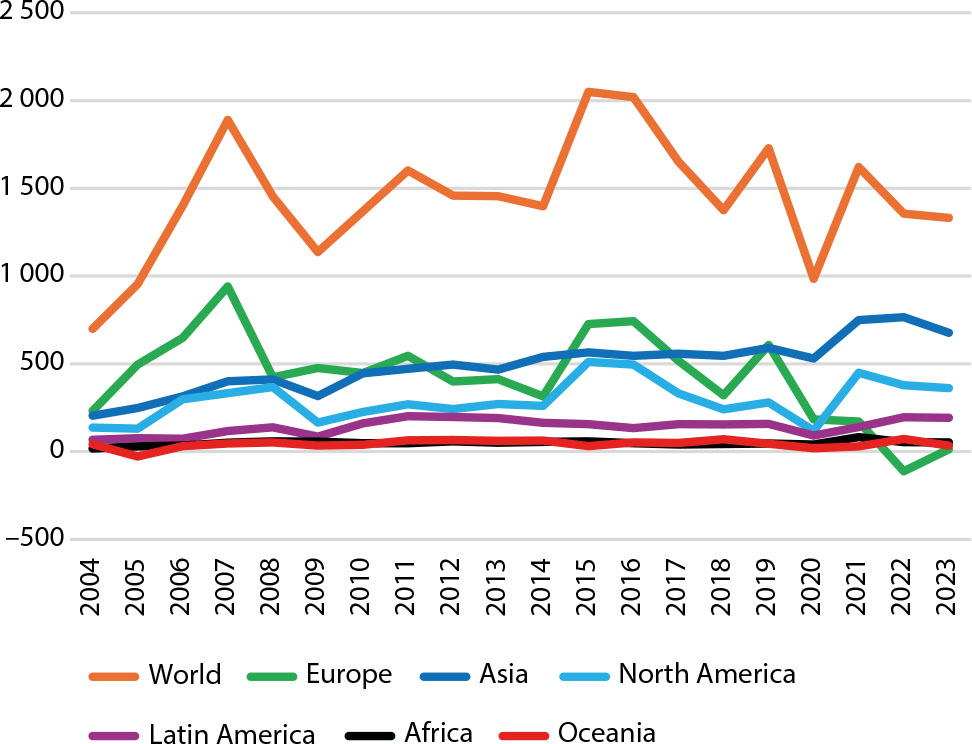
Fig. 1.
Global FDI inflows by region from 2004 to 2023 (USD billion)
Source: own compilation based on UNCTAD, 2025.
A change in the geographic distribution of investment has also been evident over the past decade. Asia, with $765 billion in 2022, has consolidated its position as the new center of global FDI inflows, although this figure declined markedly a year later. The increase was mainly due to multinational corporations seeking both lower costs and access to booming markets by relocating manufacturing to China, India and ASEAN countries. Meanwhile, the traditional developed economies of Europe and North America, while still important, showed greater sensitivity to global shocks, in addition to the ability to improve rapidly due to their potential, as evidenced by the sharp decline in North American FDI inflows in 2020 and their subsequent rapid increase of more than fourfold. Africa and Oceania are characterized by markedly lower FDI inflows than the other regions, while Latin America has relatively high FDI inflows and, presumably, good prospects for increasing them (Australian Government DFAT, 2024; Ecofin Agency, 2025; UNCTAD, 2025).
Table 1 presents a summary of the countries with the highest inflows and Table 2 with the highest cumulative FDI in 2004 and 2023. During the period under review, the position of world leader in FDI has been consistently held by the United States. Annual US investment inflows increased from $135.8 billion in 2004 to $310.9 billion in 2023, while the cumulative value of US FDI in 2023 reached a record high of $12817.1 billion. This reflects the strength of the U.S. economy and its attractiveness to foreign investors. One of the key developments concerns the growing role of Asian economies. China, which ranked third in terms of annual FDI inflows in 2004 ($60.6 billion), had risen to second place by 2023 ($163.3 billion). Also worth noting is the case of Singapore, which rose from tenth place in 2004 ($22.3 billion) to third in 2023 ($159.7 billion). These changes are evidence of a gradual shift in the center of global investment activity toward Asia (cf. Janicka, 2022).
Table 1.
Countries with the highest FDI inflows in 2004 and 2023
| Ranking | 2004 | 2023 | ||
|---|---|---|---|---|
| Country | USD billion | Country | USD billion | |
| 1 | USA | 135.8 | USA | 310.9 |
| 2 | United Kingdom | 61.2 | China | 163.3 |
| 3 | China | 60.6 | Singapore | 159.7 |
| 4 | Belgium | 43.6 | China. Hong Kong SAR | 112.7 |
| 5 | Australia | 39.6 | Brazil | 65.9 |
| 6 | China, Hong Kong SAR | 29.2 | Canada | 50.3 |
| 7 | British Virgin Islands | 28.3 | France | 42.0 |
| 8 | Mexico | 25.0 | British Virgin Islands | 39.9 |
| 9 | Spain | 24.8 | Germany | 36.7 |
| 10 | Singapore | 22.3 | Mexico | 36.1 |
[i] Source: UNCTAD, 2025.
Table 2.
Countries with the highest cumulative FDI in 2004 and 2023
| Ranking | 2004 | 2023 | ||
|---|---|---|---|---|
| Country | USD billion | Country | USD billion | |
| 1 | USA | 2 717.4 | USA | 12 817.1 |
| 2 | Germany | 728.0 | China | 3 659.6 |
| 3 | United Kingdom | 659.8 | United Kingdom | 3 048.9 |
| 4 | Canada | 544.1 | Netherlands | 2 678.2 |
| 5 | Netherlands | 519.5 | Singapore | 2 632.4 |
| 6 | China, Hong Kong SAR | 427.1 | China. Hong Kong SAR | 2 107.0 |
| 7 | Spain | 407.5 | Canada | 1 665.8 |
| 8 | France | 403.4 | Ireland | 1 410.1 |
| 9 | Australia | 291.0 | Luxembourg | 1 183.7 |
| 10 | China | 245.5 | Switzerland | 1 136.8 |
[i] Source: UNCTAD, 2025.
Number of enterprises with foreign capital, employment size, inflow and cumulative value of FDI in Poland by economic sector
Poland’s accession to the European Union in 2004 opened up new opportunities for the developing Polish economy and promoted the inflow of FDI (MSZ, 2010; Bankier.pl, 2024; Portal Samorządowy, 2024). This was of great importance and provided an opportunity for the Polish economy, still suffering from the effects of transformation, underinvested and burdened with high unemployment (Boratyńska, 2003; Nytko, 2010; Puchalska, 2010; Janasz, 2011), although previous experience could also indicate the negative effects of foreign investment (Gładysz, 2003; Pilarska and Wałęga, 2007; Krajewska, 2019). Table 3 shows the number of enterprises and employment in enterprises with foreign capital in Poland and shares by economic sectors of the economy in 2005 and 2023, and Table 4 presents the inflow and cumulative value of foreign direct investment (FDI) in Poland by economic sector in 2004 and 2023. The division by economic sector was carried out in accordance with the methodology of the Central Statistical Office on the basis of the PKD 2007 classification, whereby the agricultural sector includes section A, the industrial sector sections B, C, D, E, and the service sector all other sections (PKD 2025, 2025).
Table 3.
Number of enterprises and employment in enterprises with foreign capital in Poland and shares by economic sectors of the economy in 2005 and 2023
| Sectors of the economy | Number of enterprises | Number of people working | ||
|---|---|---|---|---|
| 2005 | 2023 | 2005 | 2023 | |
| thousand | ||||
| Agricultural sector | 0.5 | . | 6.6 | . |
| Industrial sector | 5.1 | 5.4 | 682.3 | 988.6 |
| Service sector | 11.2 | 19.5 | 1186.1 | 1232.4 |
| Total | 16.8 | 24.9 | 1875.0 | 2221.0 |
| % | ||||
| Agricultural sector | 3.2 | . | 0.4 | . |
| Industrial sector | 30.3 | 21.7 | 36.4 | 44.5 |
| Service sector | 66.5 | 78.3 | 63.2 | 55.5 |
Table 4.
Inflow and cumulative value of foreign direct investment (FDI) in Poland by economic sector in 2004 and 2023
| Sectors of the economy | FDI inflows | The cumulative value of FDI | ||
|---|---|---|---|---|
| 2004 | 2023 | 2004 | 2023 | |
| USD billion | ||||
| Agricultural sector | 0.1 | 0.1 | 0.4 | 1.4 |
| Industrial sector | 5.4 | 7.1 | 35.6 | 115.4 |
| Service sector | 6.9 | 21.3 | 49.2 | 228.7 |
| Total | 12.4 | 28.5 | 85.2 | 345.5 |
| % | ||||
| Agricultural sector | 0.7 | 0.5 | 0.5 | 0.4 |
| Industrial sector | 43.3 | 25.0 | 41.8 | 33.4 |
| Service sector | 56.0 | 74.5 | 57.7 | 66.2 |
In 2005, there were 16,800 enterprises with foreign capital in Poland and in 2023 there were 24.9 thousand (Table 3). Employment also increased during the period under review, from 1,875,000 people to 2,221,000 people, which, with the number of employees in the national economy at 15,178,100 people (GUS, 2024), accounted for 14.6% of all employees. The largest share in the structure of the number of foreign-invested entities operating in Poland and in the structure of employment generated by them (Table 3) was in the service sector, and the smallest in the agricultural sector. In 2023, industrial enterprises accounted for 21.7% of the total number of foreign-invested enterprises, down 8.6 percentage points from 2004, while industry’s share in the employment structure was 44.5%, up 8.1 percentage points from 2004. A different relationship is observed with regard to the service sector. The share of enterprises operating in this sector increased by 11.9 percentage points compared to 2004, to 78.3%, but the share of employment decreased by 7.8 percentage points to 55.5%. These changes in the sectoral structure were accompanied by an increase in the number of industrial and service enterprises with foreign capital from 5,100 to 5,400 and from 11,200 to 19,500, respectively, and an increase in employment in the industrial sector from 1,186,100 to 1,232,400 and in the service sector from 1,186,100 to 1,232,400. It should be noted, however, that the 2023 data is subject to some error due to the failure to include entities operating in the agricultural sector. Since 2016, such data are not available in the resources of public statistics, but given the marginal share of agriculture in the structure of foreign-invested entities and employment, it can be assumed that this does not significantly affect the observed relationships.
In 2004, the cumulative value of FDI in Poland was only $85.2 billion and inflows were $12.4 billion. In 2023, the cumulative value of FDI was more than four times higher ($345.5 billion) and annual inflows were more than 2.3 times higher at $28.5 billion (Table 4). The highest share in the structure of FDI inflows was in the service sector. Foreign capital investment in this sector amounted to $21.3 billion in 2023, compared to $6.9 billion in 2004. This translated into their share in the structure of inflows amounting to 74.5% in 2023, 18.5 percentage points higher than in 2004. FDI inflows in the industrial sector were lower at $7.1 billion in 2023, compared to $5.4 billion in 2004. Despite this increase, the share of industry in the inflow structure declined to 25.0% in 2023, up 18.3 pp. FDI inflows in the agricultural sector stood at $0.1 billion in both years under study and had a minor role in the inflow structure: from 0.7% in 2004 to 0.5% in 2023. The values described are also reflected to some extent in the case of the change in the cumulative value of FDI. It increased in all sectors during the period under review. In value terms, the largest cumulative FDI value characterized the services sector and amounted to $228.7 billion in 2023, compared to $49.2 billion in 2004. In the industrial sector, these values were $115.4 billion and $35.6 billion, respectively. Consequently, the highest share in the structure of cumulative FDI value was also in the services sector and amounted to 66.2% in 2023, which is 8.5 p.p. higher than in 2004. The share of the industrial sector was 33.4% in 2023, which is 8.4 p.p. less than in 2004. The share of agriculture was very low and decreased from 0.5% to 0.4%.
The observed trends are in line with the assumptions of the three-sector theory, according to which economic development sees the share of agriculture decrease in favor of industry and services, while the share of industry decreases in favor of the service sector (Kołodziejczak, 2019; 2025). Thus, the observed increase in the importance of services indicates economic development and modernization of the economy.
It should also be noted that the scale of capital inflows from abroad was greater than the scale of employment growth. This can be explained by an increase in the share of investment in high-tech sectors, enabling high value added without a commensurate increase in employment. These investments were often characterized by a high degree of automation and capital intensity. In the last decade, the increased importance of investments requiring a highly skilled workforce can be observed in Poland, resulting in an increase in the requirements for potential employees rather than a rise in the number of employees (Arendt and Gajdos, 2018).
Another factor in the relatively small increase in employment levels is the reinvestment of profits, which often relates to modernizing existing enterprises and increasing labor productivity rather than labor demand. The balance of transactions related to the acquisition of shares and other equity interests and capital injections also increased (Przeździecka et al., 2024; NBP, 2024a; GUS, 2025).
Also of significance are demographic trends and the increasing level of development of the Polish economy, which has been changing from a model based on low labor costs to one focused on higher value-added sectors. Wage growth and labor shortages in some regions limited employment expansion, despite growing FDI inflows (Kotowska, 2021; Strategia Demograficzna 2040, 2021; Kukołowicz et al., 2024; PIE, 2024).
Inflow and cumulative value of FDI in Poland by region and country of origin
The increasing inflow and cumulative value of FDI (Table 5,Table 6) testifies to investor confidence and Poland’s strengthening position as an attractive investment location. The most pronounced change is the progressive concentration around European capital. Europe’s share of cumulative FDI was 89.2% in 2004 and increased to 94.4% in 2023, while FDI inflows from Europe accounted for 89.8% in 2004 and 98.3% in 2023. This growing dominance reflects Poland’s deepening economic integration with the European market after EU accession and the change in investment strategies of multinational corporations (Tatała, 2024). Also worth noting is Asia’s increasing share of cumulative FDI (from 1.6% in 2004 to 3.9% in 2023 and in nominal terms by almost 9.7 times), but this is not reflected in an increase in the proportion of FDI inflows from Asia, which declined from 3.3% in 2004 to 1.4% in 2023. The cumulative value and inflows of FDI from North America and Latin America declined during the period under review, while these values increased slightly for Africa and Oceania, but did not reach a significant level in the overall FDI structure.
Table 5.
FDI inflows to Poland between 2004 and 2023 by region of origin*
| Years | Total | Europe | Asia | North America | Latin America | Africa | Oceania |
|---|---|---|---|---|---|---|---|
| USD million | |||||||
| 2004 | 12.4 | 11.1 | 0.4 | 0.2 | 0.7 | (0.0) | (0.0) |
| 2023 | 28.5 | 28.0 | 0.4 | 0.0 | 0.0 | 0.1 | 0.02 |
| % | |||||||
| 2004 | 100.0 | 89.8 | 3.3 | 1.2 | 5.3 | (0.0) | (0.0) |
| 2023 | 100.0 | 98.3 | 1.4 | 0.1 | (0.0) | 0.16 | 0.08 |
Table 6.
Cumulative FDI in Poland from 2004 to 2023 by region of origin*
| Years | Total | Europe | Asia | North America | Latin America | Africa | Oceania |
|---|---|---|---|---|---|---|---|
| USD million | |||||||
| 2004 | 85.5 | 76.2 | 1.4 | 6.4 | 1.3 | (0.0) | (0.0) |
| 2023 | 345.5 | 326.0 | 13.5 | 5.3 | 0.2 | 0.2 | 0.3 |
| % | |||||||
| 2004 | 100.0 | 89.2 | 1.6 | 7.5 | 1.5 | (0.0) | (0.0) |
| 2023 | 100.0 | 94.4 | 3.9 | 1.5 | (0.0) | 0.1 | 0.1 |
This geographic structure of FDI indicates that Poland is effectively strengthening its position for European investors, while slightly losing its attractiveness in favor of other foreign sources of capital. This may be advantageous in the short and medium term, but in the long term it makes the Polish economy dependent on European capital and may transmit the negative effects of regional economic shocks to it (Nowak et al., 1997; Zelek, 2025). Therefore, it is expedient to strive to diversify the sources of capital involved in FDI in Poland. Given the existing traditions of cooperation, efforts should therefore be made to attract investors especially from North America and Asia (Wiśniewska, 2023; Dąbrowski, 2024). The emergence of new, albeit thus far small, FDI inflows from Africa and Oceania may also foreshadow an incipient diversification process that may become more important in the future, although geographic remoteness from Oceania and Africa’s position as a less prosperous and underinvested continent may delay this process.
Table 7 presents a list of the 10 countries from which the most FDI flowed to Poland in 2004 and 2023. Significant differences can be seen both in terms of nominal values and ranking the positions of individual countries. In 2004, France ranked first with $3.4 billion and a 27.5% share of the total value of FDI inflows to Poland, followed by the United Kingdom in last place ($0.4 billion and 3.1%). In 2023, the leader’s place was taken by the Netherlands, whose FDI inflows to Poland amounted to $8.1 billion (28.5%) and the last by Belgium ($0.6 billion and 2.1%). The other positions in the ranking and the countries included in it also changed. Between 2004 and 2023, the top 10 investors disappeared from the list: Austria, Cyprus, Luxembourg and Italy. Their place on the list was taken by the Czech Republic, Spain, Ireland and Malta. The value of FDI inflows from countries outside the TOP 10 list increased from $1.5 billion in 2004 to $1.9 billion, but their share decreased from 12.2% to 6.8%.
Table 7.
Countries with the largest FDI inflows to Poland in 2004 and 2023 ($ billion)
| Lp. | 2004 | 2023 | ||||
|---|---|---|---|---|---|---|
| State | USD billion | % | State | USD billion | % | |
| 1. | France | 3.4 | 27.5 | Netherlands | 8.1 | 28.5 |
| 2. | Netherlands | 2.4 | 19.1 | United Kingdom | 5.9 | 20.7 |
| 3. | Germany | 1.3 | 10.4 | Ireland | 3.2 | 11.1 |
| 4. | Austria | 0.8 | 6.2 | Germany | 2.3 | 8.2 |
| 5. | Sweden | 0.6 | 5.1 | France | 2.0 | 7.2 |
| 6. | Belgium | 0.6 | 4.7 | Spain | 2.0 | 6.9 |
| 7. | Cyprus | 0.5 | 4.3 | Malta | 1.1 | 3.9 |
| 8. | Italy | 0.5 | 4.3 | Czech Republic | 0.7 | 2.3 |
| 9. | Luxembourg | 0.4 | 3.2 | Sweden | 0.6 | 2.3 |
| 10. | United Kingdom | 0.4 | 3.1 | Belgium | 0.6 | 2.1 |
| Other countries | 1.5 | 12.2 | Other countries | 1.9 | 6.8 | |
| Total | 12.4 | 100.0 | Total | 28.5 | 100.0 | |
Table 8 lists the TOP 10 countries with the highest cumulative value of FDI in Poland in 2004 and 2023. The Netherlands ranked first in 2004 and 2023, with results of $20.2 billion and $65.0 billion, respectively, and a share of 23.6% and 18.8% of the total cumulative value of FDI. The last place in the TOP 10 investors went to Denmark in 2004 ($2.5 billion and 2.9%) and Switzerland in 2023 ($8.4 billion and 2.4%). The list of the largest investors in 2023 did not include Denmark, which ranked third in 2004, nor Sweden, the US and Italy. New countries among the largest investors in 2023 are Cyprus, Luxembourg and Switzerland. Other countries outside the TOP 10 list held a total of 14.2 billion US and 16.6% in 2004, and $73.4 billion and 21.2% in 2023.
Table 8.
Countries with the highest cumulative value of FDI in Poland in 2004 and 2023 (billion USD)
| Lp. | 2004 | 2023 | ||||
|---|---|---|---|---|---|---|
| State | USD billion | % | State | USD billion | % | |
| 1. | Netherlands | 20.2 | 23.6 | Netherlands | 65.0 | 18.8 |
| 2. | Germany | 14.2 | 16.6 | Germany | 57.3 | 16.6 |
| 3. | France | 11.4 | 13.4 | Luxembourg | 43.8 | 12.7 |
| 4. | USA | 6.2 | 7.3 | France | 24.8 | 7.2 |
| 5. | Austria | 4.3 | 5.0 | Spain | 18.8 | 5.4 |
| 6. | Sweden | 3.5 | 4.1 | United Kingdom | 18.6 | 5.4 |
| 7. | Italy | 3.3 | 3.9 | Austria | 12.4 | 3.6 |
| 8. | Belgium | 3.1 | 3.7 | Belgium | 11.5 | 3.3 |
| 9. | United Kingdom | 2.6 | 3.0 | Cyprus | 11.4 | 3.3 |
| 10. | Dishes | 2.5 | 2.9 | Switzerland | 8.4 | 2.4 |
| Other countries | 14.2 | 16.6 | Other countries | 73.4 | 21.2 | |
| Total | 85.5 | 100.0 | Total | 345.5 | 100.0 | |
Table 7 and Table 8 confirm the earlier observation about the dominant importance of Europe in inflows and the cumulative value of FDI in Poland. The US was the only non-European country on the list of the 10 largest investors, ranking high in fourth place in terms of cumulative FDI value in 2004. However, the country’s investment activity in Poland was too low for the US to appear on the list of the 10 largest investors in terms of inflows and to maintain its position among the 10 countries with the highest cumulative FDI value in Poland.
The strong link between the Polish economy and European investment is natural due to Poland’s membership in the EU. However, an increase in the share of non-European investments could increase the Polish economy’s resilience to the economic fluctuations of European countries. Developing cooperation in the field of energy (nuclear power plants) and the supply and production of armaments could provide an opportunity to increase the importance of non-European countries in the FDI structure, but this depends largely on political factors and is difficult to predict. Similarly, bolstering high-technology cooperation may constitute a strong impetus, especially in view of Poland’s removal from the list of countries subject to US restrictions on the export of advanced integrated circuits which was agreed May 2025 (Moliński, 2025; Phillips-Robins and Winter-Levy, 2025). According to the 2024 Kearney FDI Confidence Index of foreign investors, Poland ranked 23rd in the global ranking and seventh in the emerging markets index, highlighting its technological and innovative potential (U.S. Department, 2025). Development potential exists especially in terms of innovation, which according to international rankings is at a low level in Poland (NBP, 2016).
Customs policy and the growing conflict between the U.S. and the EU over trade policy, among other issues, could constitute a threat (Bouët et al., 2025; Losik, 2025; Parlament Europejski, 2025). For Asian companies, Poland may be an attractive destination due to its EU membership and the associated lack of customs and administrative barriers to accessing rich Western European markets (Sturgulewska i Radziewicz, 2020; Izydorek, 2025). The development of the New Silk Road initiative could also offer opportunities, especially if logistics facilities are prepared early enough, in terms of energy independence, seaports and a high-capacity cargo airport, and efficient land-based TSL infrastructure.
CONCLUSIONS
1) Global FDI inflows by region have fluctuated over the years under study, due to emerging economic shocks. Different regions absorbed these shocks to varying degrees. The 2008 financial crisis affected the value of FDI inflows most strongly in North America, Latin America, Oceania and Asia. The Covid-19 pandemic had the strongest impact on FDI inflows to Europe, and the outbreak of a full-scale war in Ukraine further aggravated the situation in Europe, North America and Africa. Despite this, global FDI inflows nearly doubled during the period under review and Asia was the main beneficiary of the post-2020 developments.
2) Services is the key sector in terms of the number of enterprises with foreign capital operating in Poland and employment in these enterprises, while the agricultural sector is the least important. The share of industry is relatively high, decreasing in terms of the number of entities during the period under review, but increasing in terms of employment.
3) The service sector accounted for the highest share of FDI inflows. FDI inflows in the industrial sector were lower and, despite an increase in nominal values, its share declined, while inflows in the agricultural sector stood at $0.1 billion in both years under study and had little importance in the inflow structure. The cumulative value of FDI in the period under review increased in all sectors. In value terms, the largest cumulative FDI value and the highest share in the structure of cumulative FDI value was in the services sector. Next by share was the industrial sector, and the shares of the agricultural sector were of marginal importance.
4) FDI inflows to Poland and their cumulative value in the years under review increased 2.3 times, from just $12.4 billion in 2004 to $28.5 billion in 2023. The cumulative value of FDI in Poland more than quadrupled from $85.5 billion in 2004 to $345.5 billion in 2023. Poland is an attractive location for FDI due to its membership in the European Union, growing economy, improving infrastructure and relatively stable political situation.
5) The study shows that European investments dominate in Poland, with a noticeable but generally relatively small increase in the importance of Asian investors. This geographic distribution of FDI indicates the need to further strengthen relations with partners from outside the European continent, especially from North America and Asian destinations. An opportunity to increase FDI inflows, especially from outside Europe, may lie in cooperation with the US and Asian countries, especially in the arms industry, high technology and innovation.