
INTRODUCTION
Smallholder farmers in Tanzania face numerous challenges in establishing both backward and forward market linkages, which are essential to their crop productivity and income, respectively (Molela and Kira, 2025). Access to improved seed varieties and other agricultural inputs is facilitated through backward market linkages, which significantly impact production volume relative to input cost (Zozimo et al., 2023). Conversely, Rugeiyamu et al. (2024) associate the successful trading of sunflower seeds, both processed and unprocessed, with strong forward market linkages. The income security of smallholder farmers highly depends on the effective and efficient functioning of both backward and forward market linkages in an integrated manner (Molela, 2017). In Tanzania’s sunflower sub-sector, the forward market involves trading unprocessed oil seeds and processed edible oil – the main product – alongside oil-cake as a by-product (Recha and Demissie, 2023). Among these products, unprocessed sunflower seeds were reported by Mchopa (2025) and George (2020) to dominate forward market transactions, accounting for at least 80% of all business transactions.
Under the prevailing government framework, all cash crops in Tanzania are required to be traded through either the Agricultural Commodity Exchange System (ACX), the Warehouse Receipt System (WRS) or an integrated scheme combining both (Ngendahayo and Nayak, 2024; Narayanan et al., 2024). The introduction of these systems, facilitated through forward market linkages, was designed to enable smallholder farmers not only to access concessionary loans against their inventories but also to connect with potential buyers (Narayanan et al., 2024). More importantly, this initiative aimed to protect smallholder farmers from unlicensed middlemen who exploit them through practices such as using unstandardized weighing machines and offering unfair prices (Molela, 2017). Furthermore, these systems provide a platform for smallholder farmers to unify their voice and strengthen bargaining power concerning pricing and timing of sales (Gunawan et al., 2024). Despite these advantages, the literature remains silent on whether these systems adequately meet the needs of smallholder sunflower farmers who prefer to trade processed products rather than unprocessed seeds. Studies by Msafiri et al. (2023), Isinika and Jeckoniah (2021), and George (2020), among others, indicate income disparities favoring processed sunflower seed trading over unprocessed seed trading. However, these studies do not clarify how farmers benefit from processed products within the existing sunflower trading framework, which was originally designed exclusively for the trade of unprocessed sunflower seeds.
It was also observed that recommendations to improve the prevailing trading arrangement have focused primarily on the unprocessed sunflower seeds business within the warehouse receipt system, as noted in studies by Nyamandege et al. (2024) and Shao et al. (2023), among others. These studies assert that, to enhance efficiency, the operationalization of these systems must become more transparent and inclusive by incorporating informal SMEs through technologies such as blockchain, among other innovations. Nazzala (2023) further emphasized warehouse maintenance and leadership issues as critical areas for improving system performance. While these suggestions aim to enhance the trading of unprocessed sunflower seeds through the designated trading systems, none address the challenges related to processed sunflower products. Therefore, this study contributes to two key areas: first, by assessing income earned by smallholder farmers from both unprocessed and processed sunflower seed businesses, thereby confirming previous findings; and second, by recommending an improved version of the current trading arrangement that accommodates the business of processed sunflower products, including sunflower oil and its associated by-products.
LITERATURE REVIEW
Sunflower Agribusiness in Tanzania
In Tanzania, sunflower is widely grown by smallholder farmers with farm sizes ranging from less than 1 to 8 acres, resulting in approximately 6% of the country’s total land under sunflower cultivation (Molela and Kira, 2025). Key production regions include Dodoma, Singida, and Manyara, with moderate production in Morogoro, Iringa, Mbeya, and neighboring regions (George, 2020). The trading of sunflower is overseen and managed by the Cereals and Other Produce Board (CPB), established under the Grain and Mixed Crops Act, 2009. Among its main duties, CPB safeguards the business rights of smallholder sunflower farmers by facilitating the development of reputable forward market linkages (URT, 2022). The board functions similarly to other commodity boards in Tanzania that govern major cash crops such as cashew nuts, tobacco, sisal, coffee, cotton, and tea (Louhichi et al., 2022; Lukurugu et al., 2022). The enactment of the Sunflower Sector Development Strategy 2016–2020 sought to expand sunflower agribusiness beyond the board’s traditional scope by including oil and cake in the portfolio of traded sunflower products. However, this initiative did not meet expectations, as seeds trading continued to dominate the market among smallholder sunflower farmers (Erasmus and Kaungal, 2024).
The urgent need for immediate cash has often led smallholder farmers to prefer seed trading over other value-added agricultural products (Kimaro and Nnko, 2024). Additionally, farmers frequently engage in sunflower seed trading due to limited knowledge about sunflower value addition and financial analysis (Rugeiyamu et al., 2024). This study notes that smallholder farmers tend to view the sunflower seed, oil and cake business with little distinction. The scarcity of processing plants in rural areas and the associated transportation costs to reach processors are further barriers in preventing farmers from participating in value-added sunflower seeds businesses (Isinika and Jeckoniah, 2021). This study specifically assesses the income difference between farmers engaged in processed versus unprocessed sunflower seed businesses. The ultimate objective is to review the existing marketing system and recommend enhancements that accommodate the trade of processed main products and by-products.
The primary beneficiaries of the proposed upgraded trading system are the smallholder farmers directly involved in the marketing system. It is anticipated that farmers’ income will increase through sunflower agribusiness, which can be viewed as entrepreneurship in this context, as suggested by Pan et al. (2024). The system also cultivates an innovative mindset among smallholder farmers, which is essential for value addition and quality enhancement of agricultural products (Singh et al., 2025). Generally, motivated farmers contribute to increased agricultural productivity, thereby enhancing national food security (Isinika and Jeckoniah, 2021). More specifically, trading value-added agricultural products benefits the country’s economy by generating income tax revenue, unlike exporting raw agricultural products, which are zero-rated for taxation (Nugroho et al., 2021). Ultimately, Tanzania aims to achieve its industrial development goal by 2025, with value addition to agricultural products playing a pivotal role in industrial growth.
Forward Market Linkages
Enhancing small-scale agricultural performance is undoubtedly one of the Tanzanian government’s strategic efforts towards an industrialized economy, as outlined in the Integrated Industrial Development Strategy 2025 (Joseph, 2023). The coordination between agricultural commodity exchange market operations and the warehouse receipt system was intended to strengthen forward market linkages for agricultural products from small-scale farming (Mpogole et al., 2020). Forward market linkages play a significant role in supporting small-scale agribusiness in Tanzania by connecting farmers to potential markets that would otherwise be difficult for individual farmers to access, while also reducing transaction costs (Andre, 2023). The markets in question are structured to serve farmer groups rather than individual farmers, whose production levels often fall short of buyers’ demands (Isinika and Jeckoniah, 2021). Agricultural Marketing Cooperative Societies (AMCOS) are the most common farmer groups in Tanzania and were designated to implement the two main systems – ACX and WRS – under the forward market linkage framework (Molela, 2017).
The Tanzania Mercantile Exchange (TMX) was incorporated in 2014 as a private-public partnership (PPP), with 49% public and 51% private sector ownership (Magambo, 2024; Molela, 2017). Its establishment aimed to oversee operations of commodity exchange markets across the country, including agricultural commodity exchange markets (Kanyangemu et al., 2019). The introduction of a dedicated window for agricultural commodities trading was intended to modernize the market by promoting transparency in market information and enabling fair pricing within Tanzanian agribusiness (Mgole and Yunxian, 2021).
Tripathi et al. (2023) argued that price volatility and the marketing strategies embedded in the WRS were unfavorable to smallholder farmers. Their findings revealed that marketing costs were excessively high, resulting in unfair farm-gate prices for producers. Low bargaining power, limited competition, and inadequate market information were additional factors contributing to the poor performance of the marketing system under WRS (Robbins et al., 2008). It was therefore crucial to shift to a modernized agricultural commodity exchange market, aligning with the objectives of the 10 pillars of Kilimo Kwanza (URT, 2022).
Agricultural commodities are traded through two main mechanisms at the commodity exchange market: spot contracts and derivative contracts (Kaura and Rajput, 2024). The system incorporates collateral management arrangements as a strategy to protect the interests of counterparties, particularly on the demand side (Gundogdu, 2023). The commodity exchange market is vital for farmers in hedging, allowing them to forecast prices under derivative contracts and mitigate risks related to price volatility (Chowdhury and Bhuiya, 2023). However, all operations under TMX have been largely limited to the unprocessed sunflower seed business, among other cash crops. This study specifically analyzes the additional benefits farmers could derive from trading processed sunflower products and proposes a review of the system to accommodate this broader structure.
Another component of forward market linkages is the Warehouse Receipts System (WRS), which is overseen and regulated by the Warehouse Receipt Regulatory Board (WRRB), established under the Warehouse Receipts Act of 2005. The system operates under the supervision of the Tanzania Cooperative Development Commission (TCDC), in collaboration with TMX, and prohibits direct purchases of cash crops from smallholder farmers (Nyamandege et al., 2024). Prospective buyers are required to register their intent to purchase through TMX, which conducts weekly electronic auctions based on inventory reports submitted by WRRB (Narayanan et al., 2024). Smallholder farmers aggregate their produce through their respective AMCOS, which is then transported to cooperative union warehouses, where inventory records are forwarded to TMX. Following the auction, TMX issues release orders for buyers to collect their stocks from the warehouse (URT, 2021).
The primary aim of the system is to strengthen smallholder farmers’ collective bargaining power over produce prices (Nangemeta, 2022). The receipts issued once produce reaches the warehouse can be used as collateral to access loans from participating financial institutions (Molela, 2017). The initial goal of WRS was to combat illegal practices by unlicensed middlemen who exploited farmers’ financial vulnerabilities (Kapuya et al., 2024). Despite these advantages, the WRS has excluded value-added sunflower products such as processed oil and cake from its operations. Both TMX and WRS were designed specifically for trading unprocessed sunflower seeds, thus necessitating a structural review to incorporate the trade of processed sunflower products and other cash crops.
Value Chain Integration Theory
This study is grounded in Value Chain Integration Theory, which emphasizes the flow of information among value chain actors, enabling demand to be anticipated and met through optimal supply coordination (Li et al., 2022). Buyers need to be aware that smallholder farmers can supply value-added sunflower products at predetermined rates through prior information sharing (Tiwari, 2021). Farmers earn more income from trading processed, value-added products than from selling raw materials alone (Zhang et al., 2021). The theory advocates for the collective processing of agricultural raw materials by farmer groups, enabling them to meet market demand more effectively while also enhancing their collective bargaining power (Li et al., 2022). According to Freije et al. (2022), it supports innovation within the production processes, allowing existing operational systems to be reviewed and adapted to accommodate new product features. Suggestions to modify TMX and WRS to incorporate trading of sunflower oil and cake as value-added products did not require significant changes, but rather the introduction of additional features that preserved the original frameworks. In this context, it is feasible to adapt the systems to meet the requirements of the new structure without disturbing the original structure (Belhadi et al., 2024).
METHODOLOGY
The primary data for the first specific objective were collected from 399 smallholder sunflower farmers, who were members of 11 AMCOS purposefully selected from Kondoa and Itigi District councils. Data were gathered using semi-structured questionnaires. A simple random probabilistic sampling technique was employed to obtain sampling units from each AMCOS in equal proportions, based on a cross-sectional survey design. According to the National Sample Census of Agriculture (2022), the population of interest consisted of 313,636 and 126,136 household members in Kondoa (Dodoma) and Itigi (Singida) districts, respectively. The sample size was determined using Yamane’s formula (1967), as summarized below:
The obtained data were then analyzed using the Gross Margin Analysis (GMA) model, where income earned by smallholder farmers from unprocessed and processed sunflower products was compared. The findings served as a basis for comparing the two business models in sunflower product trading. The formula used to compute gross margins from the two business trades is shown below:
Where:GMi – stands for gross margin for quantity Q
Ri – stands for revenue
VCi – stands for variable costs
For the second specific objective, secondary data were collected from documentary sources, including TCDC, TMX, WRRB, and AMCOS. The aim was to understand the operational structures of TMX and WRS in relation to the two sunflower business trades. The document review process was informed by the findings from the first objective.
FINDINGS AND DISCUSSION
Gross Margin from Unprocessed Sunflower Seeds Trading
The majority of smallholder farmers engage in the trading of unprocessed sunflower seeds, either directly with buyers or through TMX under WRS, in accordance with government regulations. On average, farmers earn TZS 900,200.00 in revenue per acre, with an average production yield of 643.00 kg. As shown in Table 1, the average gross margin earned from this business activity is TZS 455,094.60 per acre, equivalent to TZS 917.49 per kg. It is important to note that this figure represents the raw average value and does not account for administrative or fixed costs incurred during the full period of farm management. Nevertheless, the estimated gross margin is comparable to that reported by George (2020) in the context of unprocessed sunflower seeds trading.
Table 1.
Gross margins from processed and unprocessed sunflower seeds trading
| Details | Mean values (95% confidence interval) | |||
|---|---|---|---|---|
| unprocessed seeds | edible oil | seed cake | value added | |
| Revenue | n = 317 (100%) | n = 82 (33.33%) | n = 82 (66.67%) | n = 82 (100%) |
| Yields (kg/l/acre) | 643.00 | 112.50 | 225.00 | 337.50 |
| Price (TZS/kg/l) | 1,400.00 | 5,200.00 | 700.00 | 5,900.00 |
| Total revenue/acre | 900,200.00 | 585,000.00 | 157,500.00 | 742,500.00 |
| Production cost | ||||
| Input seeds (TZS/acre) | 14,456.00 | 4,199.58 | 8,400.42 | 12,600 |
| Farm preparation (TZS/acre) | 38,443.71 | 12,258.56 | 24,520.79 | 36,779.35 |
| First weeding (TZS/acre) | 39,456.95 | 13,882.63 | 27,769.44 | 41,652.07 |
| Second weeding (TZS/acre) | 10,629.14 | 3,285.09 | 6,571.18 | 9,856.27 |
| Booster (TZS/acre) | 3,576.16 | 1,481.83 | 2,964.11 | 4,445.94 |
| Manure/fertilizer (TZS/acre) | 62,450.33 | 21,950.41 | 43,907.41 | 65,857.82 |
| Sowing (TZS/acre) | 22,549.27 | 8,049.99 | 16,102.39 | 24,152.38 |
| Chemical application /acre | 7,523.58 | 2,395.18 | 4,791.09 | 7,186.27 |
| Bird scaring (TZS/acre) | 28,537.80 | 9,511.65 | 19,026.15 | 28,537.80 |
| Harvesting (TZS/acre) | 58,443.71 | 20,054.66 | 40,115.34 | 60,170 |
| Processing (TZS/acre) | 0.00 | 14,998.50 | 30,001.50 | 45,000.00 |
| Packaging (sacks/gallons) | 9,185.71 | 11,000.00 | 2,500.00 | 11,000.00 |
| Cess (TZS) | 10,000.00 | 3,333.00 | 6,667.00 | 10,000.00 |
| Transport | 5,000.00 | 1,666.50 | 3,333.50 | 5,000.00 |
| Total PC | 310,252.36 | 128,067.59 | 236,670.31 | 362,237.90 |
| Unit Revenue (TZS/kg/l) | 1,400.00 | 5,200.00 | 700.00 | 5,900.00 |
| Unit Overheads (TZS/kg/l) | 482.51 | 357.73 | 715.57 | 1,073.30 |
| Unit GM (TZS/kg/l) | 917.49 | 4,842.27 | −15.57 | 4,826.70 |
| GM per acre (TZS/acre) | 455,094.60 | 2,401,862.74 | −7,721.76 | 2,394,140.98 |
Gross Margin from Processed Sunflower Oil and Cake Trading
Processed sunflower oil trading ranks second after the unprocessed sunflower seed business in Tanzania. According to Mchopa (2025) and George (2020), only 20% of harvested sunflower seeds are processed to produce, among other products, edible sunflower oil. As shown in the table above, farmers engaged in this agribusiness earn an average gross margin of TZS 2,401,862.74 per acre, equivalent to TZS 4,842.27 per kg, excluding the sales revenue from sunflower seed cake, which is a by-product. When the value of the seed cake is included, the average gross margin from processed sunflower products is approximately five times higher than that of unprocessed sunflower seeds. However, this figure still represents a raw gross margin, excluding administrative and fixed costs incurred during the farm management cycle.
Since the trading of seed oil (the core product) is often accompanied by the trading of seed cake (the by-product), the actual average gross margin earned from processed sunflower products is TZS 2,394,140.98 per acre. Most smallholder farmers lack the financial capacity to own processing equipment. As a result, they pay TZS 128.57 per kg to processors, either in cash or in kind by leaving the seed cake behind as payment. The sunflower seed cake business is not popular among smallholder farmers, as it is generally a loss-making venture when operated independently. The table summary indicates that farmers incur an average loss of TZS 7,721.76 per acre from seed cake trading. In practice, however, this loss is not strongly felt, as it is absorbed within the revenue generated from trading sunflower seed oil. The majority of smallholder farmers, particularly those not engaged in animal husbandry, tend to leave the seed cake with the processors as payment in lieu of processing fees. The seed cake business would become more viable if farmers had the capacity to further process it into value-added products, such as shoe-shine polish, brake pads, and mosquito repellent, among others.
Upgrading the Operations of Tanzania Agricultural Commodity Exchange Market under the Warehouse Receipt System Scheme
The current agricultural commodity exchange market in Tanzania does not support the trading of value-added agricultural products, such as processed sunflower oil cake. Findings from this study reveal that farmers earn a low gross margin of TZS 455,094.60 per acre when trading unprocessed sunflower seeds, whereas they make a substantially higher profit of TZS 2,394,140.98 per acre through trading processed sunflower products. Given that the existing trading framework – operated jointly by TMX, ACX and WRS – lacks a platform for trading processed agricultural products, there is a clear need to upgrade the system. The proposed upgrade involves establishing a processing plant at the respective AMCOS where farmers hold membership. Since individual smallholder farmers cannot afford processing machines, this system would enable them to own and operate processing equipment collectively under a group arrangement.
The New Proposed Marketing Structure
At stage 1, farmers deliver sunflower seeds to their respective AMCOS, where the seeds are processed into oil and cake. Since individual farmers typically do not profit from the seed cake business independently, it is recommended that the by-product (seed cake) be used to offset processing costs, provided this is agreed upon in their partnership agreement.
At stage 2, AMCOS transfers the processed oil stocks to the warehouse of the cooperative union for storage, pending auction. Farmers receive special receipts as proof of ownership of their stock at the cooperative union.
At stage 3, buyers register their interest in purchasing processed oil through the TMX, selecting contract types from available options, such as spot market and derivatives contracts.
At stage 4, the cooperative union informs TMX about the available stock of processed oil in the warehouse, including detailed records of individual farmers as owners.
At stage 5, TMX conducts electronic auctions, and successful bidders make payments into TMX’s bank account.
At stage 6, upon payment confirmation, buyers collect their purchased stock from the cooperative union.
At stage 7, TMX remits payments from buyers to the cooperative union within 5 days.
At stage 8, cooperative unions forward payments to the respective AMCOS within 24 hours of receiving remittances from TMX.
At stage 9, AMCOS deposits the money into individual farmers’ bank accounts, which are maintained at banks within a consortium.
At stage 10, farmers withdraw funds from their bank accounts, completing the cycle, which then repeats in a continuous manner.
The entire proposed system would be overseen by designated regulatory authorities, including the WRRB, CMSA and TCDC. The WRRB regulates the WRS operations, while CMSA and TCDC oversee the operations of the TMX and AMCOS, respectively. Smallholder farmers benefit through collective group arrangements under cooperative unions, which are formed by groups of related AMCOS.
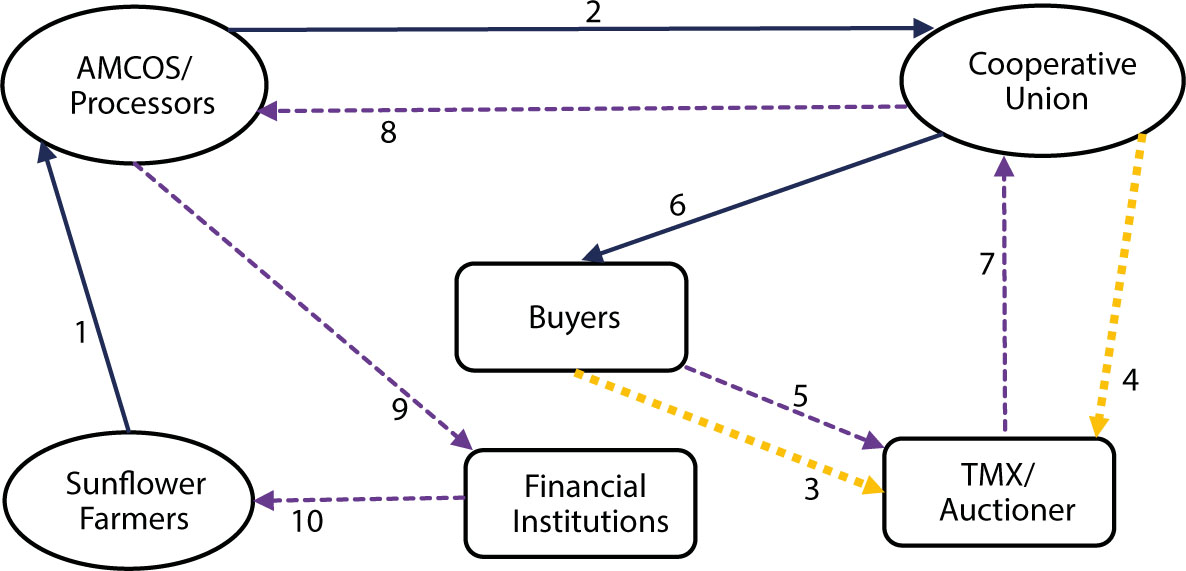
Fig. 1.
Reviewed ACX under WRS Scheme
Source: adopted and modified from Molela, 2017.
CONCLUSION AND RECOMMENDATIONS
Conclusion
The average gross margin difference of TZS. 1,939,046.38 per acre between processed and unprocessed sunflower businesses is substantial enough to justify a critical review of forward market linkages within the sub-sector. It is therefore concluded that creating an enabling environment for smallholder farmers to transition from unprocessed sunflower seed trading to processed sunflower product trading is essential. Establishing a dedicated window for processed agricultural products, including sunflower oil and cake, is crucial for enhancing the performance of small-scale farming in Tanzania. With the higher gross margins acting as an incentive, smallholder farmers are more likely to be motivated to increase their production, reinvest in their farms, and participate more fully in the formal market system. Such improvements at the individual farmer level would have direct, positive implications for the agricultural sector’s overall performance and contribute meaningfully to national economic growth.
Recommendations
It is recommended that policymakers overseeing the financial markets (CMSA), the Warehouse Receipt Regulatory Board (WRRB), and cooperative societies (TCDC) review the current ACX market and WRS frameworks to accommodate the trading of processed agricultural products, in alignment with the upgrade proposal presented in this study. The proposed system would not only lead to increased incomes for smallholder farmers but also help eliminate illegal side businesses run by unlicensed middlemen. To ensure effective implementation, TCDC should introduce a mandatory condition for AMCOS registration: all registered AMCOS must possess or have access to a designated processing machine for any crop intended for trade. This policy shift would ensure that farmers automatically transition from trading raw agricultural materials to value-added, processed products, thus improving both profitability and market efficiency.
ACKNOWLEDGMENTS
The researcher extends since gratitude to the administrations of Kondoa and Itigi District Councils for their invaluable support throughout the data collection process.