Have a personal or library account? Click to login
Policy and Institutional Analysis for Vegetable Commercialization in Ethiopia Cover

Policy and Institutional Analysis for Vegetable Commercialization in Ethiopia

Open Access
|Mar 2025

Figures & Tables

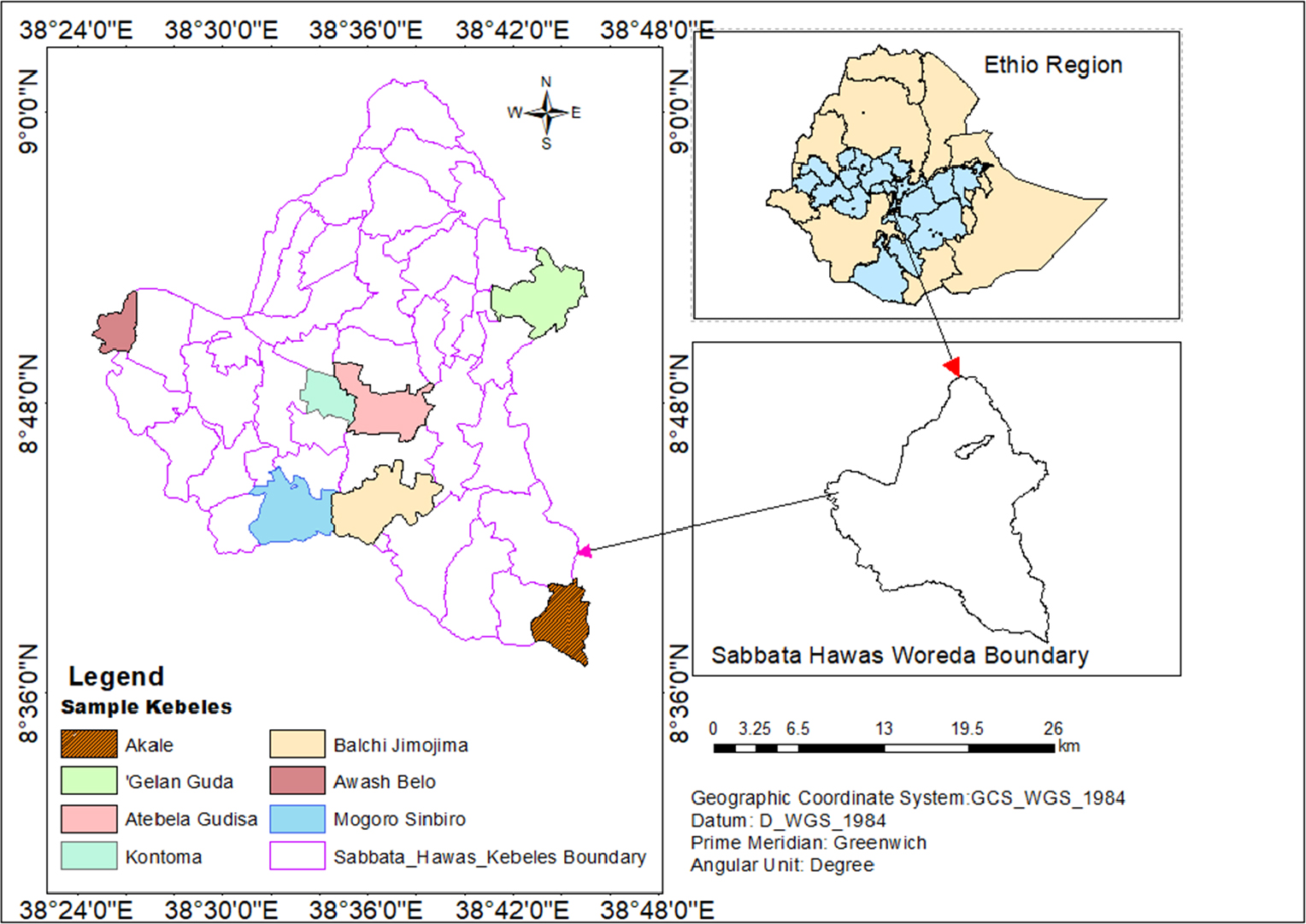
Fig. 1.

Locational map of the study area
Source: developed based on the Ethio-GSI.
Locational map of the study area Source: developed based on the Ethio-GSI.

Description of key informants by institutional levels

No.Federal levelSample size
1Ministry Of Agriculture, Rural Land Administration, and Use1
2Ministry Of Agriculture, Agricultural Investment, and Product Marketing1
3Ministry Of Agriculture, Vegetables and Herbs Development Desk2
4Ministry Of Agriculture, Input Supply Executive Lead2
5Ministry Of Agriculture, Irrigation Design and Construction2
6Ministry Of Agriculture, Extension Service Executive Lead1
7Oromia Bureau Of Agriculture, Crop Development Director2
8Oromia Trade and Market Development Bureau1
9Oromia Bureau of Agriculture, Vegetable Production Experts2
10Officials From the Sabbata Hawas Woreda Agriculture Office2
11Expert From the Woreda Vegetable Development Section2
12Expert From The Irrigation Development Office1
13Expert From the Trade and Market Development Office2
14Representatives From Farmers’ Cooperatives3
15Kebele Administrators4
16Development Agents4
Total32

j_jard_2025_00016R1_Atab_001

DescriptionSample sizeCode
123
Ministry of Agriculture, Rural Land Administration, And Use11
Ministry of Agriculture, Agricultural Investment, and Product Marketing12
Ministry of Agriculture, Vegetables & Herbs Development Desk Head13
Ministry of Agriculture, Vegetables & Herbs Development Expert14
Ministry of Agriculture, Input Supply Executive Lead Head15
Ministry of Agriculture, Input Supply Expert16
Ministry of Agriculture, Irrigation Design & Construction Expert17
Ministry of Agriculture, Water Management and Scheme Administration18
Ministry of Agriculture, Extension Service Executive Lead19
Oromia Bureau of Agriculture, Crop Development Director110
Oromia Bureau of Agriculture, Irrigated Vegetable Production Expert111
Oromia Bureau of Agriculture, Rain-fed Vegetable Production Expert112
Oromia Bureau of Agriculture, Trade and Market Development Bureau113
Oromia bureau of agriculture, Irrigation and pastoralist development bureau114
Woreda Agriculture Office Head115
Woreda Agriculture Office Vice Head116
Woreda Vegetable Development Head117
Woreda Vegetable Development Expert118
Woreda Irrigation Development Expert119
Woreda Trade and Market Development Office Head120
Woreda Market Linkage Expert121
Representatives From Farmers’ Cooperatives122
Representatives From Farmers’ Cooperatives123
Representatives From Farmers’ Cooperatives124
Representative from Gelan Guda Kebele Administration125
Representative from Balchi Jimjima Kebele Administration126
Representative from Mogoro Simbiro Kebele Administration127
Representative from Awash Balo Kebele Administration128
Crop Production exper (DA) From Gelan Guda Kebele129
Crop Production expert (DA) From Bal-chi Jimjima Kebele130
Crop Production expert (DA) From Mogoro Simbiro Kebele131
Crop Production expert (DA) From Awash Balo Kebele132
Total 32

Enabling policies, strategies, programs, and proclamations for vegetable commercialization in Ethiopia

Major enabling policies and strategiesMajor policy and strategies content
12
Rural Development policy and strategy (2003)
  • It directs the efforts towards improving farming skills, disseminating improved agricultural technologies, amending land use policy, creating marketing systems, promoting and strengthening cooperatives, improving and strengthening the participation of private sectors in agricultural marketing, strengthening the linkage between private investors and smallholder farmers, and enhancing rural infrastructure development.

National Horticulture Development and Marketing Strategies (2017)
  • The strategy prioritized encouraging and supporting smallholder producers to use scalable and feasible market-oriented horticulture production and marketing with strong financial backing and professional assistance. Vegetables are one of the horticultural crops that are given special consideration in the strategy due to their productivity per unit areas of land and nutrition values.

  • The strategy also aims to improve seed supply, establish efficient irrigation systems and postharvest management, enhance market information systems, promote contract farming, establish quality and food safety laws and regulations, and enhance transportation services.

Agricultural extension strategy of Ethiopia (2017)
  • The strategy targets smallholder farmers to enable them to become strong economic drivers with control over and access to resources, financial services, and extension.

  • It also intends to increase food security and income for smallholder farmers and their organizations by providing them with increased access to sustainable market systems and production technology, backed by the right type of public and commercial funding as well as regulatory frameworks.

  • It also aims to initiate a farmer-to-farmer knowledge exchange and build local capacity; smallholder farmers create and manoeuvre their own self-help farmers groups and these groups develop into local-level institutions and organizations.

National Food and Nutrition Strategy (2019)
  • The Strategy has designed the key strategies to support the establishment of horticulture nurseries and demonstration sites, strengthen the link between agricultural input suppliers and farmers to produce nutrient-rich crops, promote the use of appropriate irrigation systems, promote farmers' skills, and knowledge and attitude towards postharvest management and food safety and develop and integrate the traceability of system of agricultural produce into agricultural extension services.

  • The existence of a strategy with special attention towards production and productivity improvements is a potential opportunity for the commercialization of vegetable crops. These strategies help to empower smallholder producers to actively participate in the production and marketing of vegetable crops.

National Smallholder Irrigation and Drainage Strategy (2019)
  • It aims to improve the delivery, performance, and sustainability of irrigation schemes focused on smallholder farmers, by strengthening government policies and institutions to effectively transform the irrigation and drainage sub-sector.

Ethiopia’s ten years master plan (2021)
  • It is designed a major strategy for horticulture to modernize the input supply system, encourage area expansion in horticulture production, expand the participation of the private sectors, strengthen the development of modern nurseries in strategic areas, organize marketing centres in areas close to the smallholder farmers, and facilitating cold chain infrastructure with the private sector should be given attention.

  • It also targets the smallholder producers to improve their capacity of utilizing improved inputs and technologies to enhance production and productivity that enable them to meet local and international market requirements.

Ten in ten programs (2021)
  • The program targets two vegetables (onion and tomato) in its ten years operational plan

  • It aims to increase the yields of these vegetable crops and enhance commercialization of them within the program period.

Rural lands administration and use proclamation (2024)
  • The proclamation encompasses guidelines on leasing agreements, sharecropping, inheritance, donations, collaborative development, using land as collateral, obligatory clustering, required consolidation of holdings, and sharecropping are also included in the draft proclamation.

DOI: https://doi.org/10.17306/j.jard.2025.00016r1 | Journal eISSN: 1899-5772 | Journal ISSN: 1899-5241
Language: English
Page range: 33 - 55
Accepted on: Feb 4, 2025
Published on: Mar 15, 2025
Published by: The University of Life Sciences in Poznań
In partnership with: Paradigm Publishing Services
Publication frequency: 4 issues per year

© 2025 Asfaw Shaka Gosa, Tebarek Lika Megento, Meskerem Abi Teka, published by The University of Life Sciences in Poznań
This work is licensed under the Creative Commons Attribution 4.0 License.