
INTRODUCTION
Sustainability issues are prevalent across all sectors of the economy (Mukucha et al., 2025b) but are highly topical in the agricultural sector (Emamisaleh and Rahmani, 2017), especially in Global South countries such as Zimbabwe (Chazovachii et al., 2021). The agricultural sector in Zimbabwe contributes between 15% and 20% of the Gross Domestic Product (GDP), 25% of formal employment, and 40% of export earnings; directly and indirectly, it provides a livelihood for approximately 67% of the country’s citizens, and it is also the source of 63% of the raw materials for the agro-processing industry (World Bank, 2019). Traditionally, the manufacturing sector sources raw materials from the agricultural sector on the basis of cost, quality, and supplier performance (Mukucha et al., 2024b), but recently, there has been a call for supplier assessment and evaluation to include additional metrics, such as suppliers’ use of sustainable production systems (Zhu et al., 2022).
Traditionally, the corporate world has an unbalanced focus on profit maximisation, termed the single bottom line (SBL) (Walker et al., 2020). The SBL principle encourages businesses to concentrate on profit maximisation (Schwartz, 2020) while delegating responsibility for environmental and social issues to relevant specialist authorities such as government agencies and non-governmental organisations (Moldan et al., 2012). The pursuit of economic prosperity has led businesses to seek ways to increase efficiency and effectiveness in order to improve profitability and enhance their market presence (Weidner et al., 2021). Over time, the world has begun to grapple with the negative environmental and social externalities (Lin and Raza, 2019) emanating from the corporate world’s value chains, which are solely primed for economic prosperity (Cai et al., 2023).
Against the backdrop of the above negative externalities, businesses are under increasing pressure to practise sustainable operations (Mukucha et al., 2023b) and select suppliers that are compliant with sustainability requirements (Coşkun et al., 2022). This has led to the concept of sustainable procurement (Chopra et al., 2018). Sustainable procurement is the acquisition of goods and services from suppliers whose operations satisfy the needs of the current generation without compromising the ability of future generations to meet their own needs (Farrington and Lysons, 2020). This involves observing the Triple Bottom Line (TBL) concept. The TBL concept consists of three pillars – profit, planet, and people – which closely align with the economic, environmental, and social dimensions of sustainability, respectively (Elkington, 2018).
In light of this, corporate entities have increasingly turned to sustainable procurement in order to fulfil their sustainability pledges and objectives (Gonçalves et al., 2022). However, the extant literature lacks clarity on the conditions necessary to promote sustainable production in general and sustainable procurement in particular, especially in agro-based processing industries. It has already been suggested that the failure to practice sustainability in the agricultural sector is a function of undercapitalisation resulting from limited access to resources (Mukucha et al., 2024a; Sakata et al., 2022). It is therefore imperative to identify and empirically test plausible conditions for sustainable production systems, such as supplier development through contract farming. While few studies have examined all components of the triple bottom line simultaneously (Weidner et al., 2021), this study addresses that gap by assessing whether they can be achieved concurrently under supplier development conditions. Accordingly, its main research objective is to determine whether supplier development schemes promote more sustainable supplier performance than independent farming.
This study makes both theoretical and practical contributions. The resources that farmers need to maintain the sustainability of their operations may come from external financiers or partners within their supply chains (Ruml et al., 2020). These partners are most likely buyers engaging in contract framing (Shonhe and Scoones, 2022). Support offered to farmers through contract farming is grounded in the resource based view (RBV), which explains supply chain competitiveness in terms of the possession of unique and valuable resources. The resources available to contracted farmers may help them to outperform independent farmers who rely on spot markets in their supply chains (Sakata et al., 2022). Farmers in developing countries often lack key production inputs – such as capital, technology, or reliable access to credit – even though they typically have access to land (Mazwi et al., 2018). As a result, many are unable to participate effectively in contract farming schemes. According to the RBV, inputs provided to farmers increase their competitiveness and productivity (Mukucha et al., 2023a), enabling them to obtain better prices for their produce (Ruml et al., 2020). The rest of the paper is organized as follows: literature review, methodology, results, discussion, conclusions, recommendations, limitations, and future research agenda.
LITERATURE REVIEW
Supplier development
Supplier development is a key concept in supply chain management (Benton et al., 2020) and often takes the form of contract farming in agro-processing value chains (Mukucha et al., 2025b). Therefore, in this study, contract farming is treated as a form of supplier development. It refers to an arrangement whereby poorly resourced farmers are provided with relevant inputs on the condition that they sell their produce to the contracting firm (Ruml et al., 2022). The inputs include, but are not limited to, seeds, fertilisers, pesticides, and working capital to pay labourers (Shonhe and Scoones, 2022). This concept draws from the RBV, which advocates for increasing productivity through the provision of adequate resources (Barney and Hesterly, 2019; Barney and Arikan, 2005).
There are various contract farming models (supplier development) in the extant literature: the centralised nucleus estate, multipartite, intermediary, and informal models. Contract farming models differ on the basis of the product being considered, the nature of the resources available, and the strength of the relationship between the agro-processing merchant and the farmer (Eaton and Shepherd, 2001). In Zimbabwe, the centralised model is common for commercial crops, such as tobacco and cotton (Shonhe and Scoones, 2022). It gained popularity because most farmers benefited from the fast-track land reform programme (FTLRP) without being able to access the necessary input resources and vital extension services (Chambati et al., 2018). Contact farming has been widely adopted across many strategic crops (Mazwi et al., 2019), despite criticism that it contributes to the proletarianisation of smallholder farmers (Shonhe and Scoones, 2022).
Sustainability
This study adopts economic, environmental, and social sustainability as the core components of sustainable procurement, based on the work of Elkington (2018). Sustainability – once dismissed as a buzzword – has evolved into a market capitalisation strategy (Gonçalves et al., 2022). Although firms strive to achieve all three bottom line objectives, trade-offs often emerge in practice (Weidner et al., 2021). The three pillars of the TBL framework may appear to be in tension with each other, but their interaction can generate meaningful sustainable value (Ozanne et al., 2016). It can therefore be argued that firms can achieve economic prosperity without sacrificing environmental integrity or social equity (Varadarajan, 2017).
Economic sustainability
Business operations are never sustainable if they are unprofitable. Production systems are economically sustainable if they are profitable enough to sustain their operations over an extended period of time (Farrington and Lysons, 2020). Productivity is a measure of how well an organisation’s resources are utilised (Jiang et al., 2017). It can also be understood as a quantitative relationship between inputs and outputs (Ait Sidhoum, 2023). The primary importance of assessing productivity is that output may increase disproportionately relative to inputs (Färe and Zelenyuk, 2019). Thus, an increase in output should be evaluated in terms of the inputs invested (Fuglie, 2018). In agricultural value chains, economic sustainability is typically reflected in land productivity, the efficient use of farming inputs (fertilisers, pesticides, herbicides), productivity (Ait Sidhoum, 2023), and the achievement of favourable market prices (Mazwi et al., 2018).
This study argues that the provision of resources increases economic sustainability. However, most farmers in Global South countries only possess pieces of land (Ruml et al., 2022). They tend to rely on the provision of resources from agro-processing merchants in the form of supplier development schemes (Mukucha and Chari, 2024). Drawing from the resource-based view (RBV), supplier development schemes are likely to lead contracted farmers to outperform independent farmers – for example, due to investments in labour-saving equipment and the provision of adequate input resources that ultimately led to lower operating costs (Rajkhowa and Kubik, 2021). This leads to the following hypothesis.
H1: Economic sustainability is higher under supplier development initiatives than it is under independent sourcing arrangements.
Environmental sustainability
Environmental sustainability is another supply chain concept that has been largely neglected in most value chains in the agricultural sector (Lencucha et al., 2022). Environmental sustainability refers to the reduction of one’s ecological footprint through the careful consumption of non-renewable resources (Nhapi, 2019), as well as the reduction of manufacturing waste and the safe disposal of waste in a legal manner (Coyle et al., 2021). Most of the environmental sustainability issues in the agricultural sector are related to the issue of deforestation because of the need for more farming land and firewood for tobacco curing (Chazovachii et al., 2021). Such deforestation generates escalating externalities, such as soil erosion (Zvobgo and Tsoka, 2021), reservoir siltation, water pollution, and a reduction in air quality (Lencucha et al., 2022). It also affects the natural ecosystem that previously existed in the cleared forests (Chakuya et al., 2022). Modern agricultural practices involve the use of fertilizers, herbicides, and pesticides (Lencucha et al., 2022). Chemicals and pesticides tend to kill other insects, such as bees, which are credited with improving the natural ecosystem in general and the pollination of crops and tree flowers in particular (Chakuya et al., 2022).
The negative environmental externalities resulting from farming activities can be reduced by providing adequate resources under contract farming (supplier development) schemes. Specifically, sustainability in the curing of tobacco can be attained by afforestation (Jew et al., 2017); crop rotation for intensive land use (Mazwi et al., 2018); the use of organic fertilisers and pesticides to prevent environmental pollution (Balasha et al., 2019); and the use of alternative sources of energy for tobacco curing, such as energy-efficient barns (Mataruse et al., 2018), rocket barn technology (Omara et al., 2021), and intelligent biomass fuel burners (He et al., 2021). Afforestation, crop rotation, and the use of organic fertilisers require a high initial investment, and farmers need to obtain resources for this from agro-processing merchants through supplier development initiatives. This leads to the following hypothesis:
H2: Environmental sustainability is higher under supplier development (contract farming) arrangements than it is under independent farming arrangements.
Social sustainability
Social sustainability involves shunning practices such as child labour and poor working conditions. Child labour is an unsustainable practice that is rampant in the mining (Maconachie & Hilson, 2016) and agricultural sectors (Hu and Lee, 2015), such as tobacco (Chazovachii et al., 2021) and cocoa farming (Busquet et al., 2021). Child labourers are usually paid extremely low wages (Contzen and Forney, 2017), which has contributed to unprecedented school dropout rates in most parts of Africa (André et al., 2021). Low wages have always been a feature of the agricultural sector (Mazwi et al., 2018). This trend dates back to the colonial era, and has also characterised post-colonial farming systems (Scoones et al., 2018). It has contributed to a significant decline in agricultural productivity across Africa such that, despite hving abundant arable land, most African countries are not food self-sufficient (Chazovachii et al., 2021). Moreover, the conditions in most farm compounds remain poor (Shonhe et al., 2022), with a lack of access to personal protective equipment (Wright et al., 2019) and limited access to health facilities (Lencucha et al., 2022).
Previous research has indicated that the negative externalities of poor working conditions and child labour can be mitigated by addressing labour market failures (Fumagalli and Martin, 2023). In this study, it is argued that supplier development – through the provision of adequate resources and attendant supplier policies – can also address the issue of child labour. Furthermore, by receiving resources from agro-processing merchants, farmers are better positioned to create safe working conditions and pay fair, sustainable wages. Therefore, we posit that:
H3: Suppliers under supplier development initiatives have better social sustainability practices than those under independent operations.
METHODOLOGY
Research Design
In general, there are three research designs: exploratory, descriptive, and explanatory (causal) (Saunders et al., 2018). This study adopted the latter design, because it is closely associated with a positivist research philosophy and a survey research strategy (Bryman, 2016). The main thrust of explanatory (causal) research design is to explain the relationships between constructs (Black and Babin, 2019). Specifically, this study aimed to ascertain the influence of supplier development schemes on sustainability performance.
Population and sample size
The study population comprised registered tobacco growers in Zimbabwe’s Mashonaland Central Province. Mashonaland Central has high tobacco farming agro-ecological potential (Shonhe and Scoones, 2022) and a registered population of 60,781 tobacco farmers (suppliers) (www.timb.co.zw). The sampling frame for this study was obtained from published statistics on the official website of the Tobacco Industry and Marketing Board (TIMB), which is a supervisory authority in the tobacco industry. In quantitative studies, unlike qualitative studies, the sample size is determined prior to data collection (Black and Babin, 2019). The sample size in this study was obtained using the predetermined sample size calculations for different population sizes by Saunders et al. (2018). These sample sizes were within a 5% margin of error. The population size of registered tobacco farmers in Mashonaland Central which is 60,781, falls within the 100,000 category and is associated with a predetermined sample size of 383. To allow for non-responses, the sample size was rounded up to 400 respondents.
Sampling method
Sampling is the process of selecting respondents from a research population (Bryman, 2016). A census is preferable for studies seeking to attain high levels of external validity (Saunders et al., 2018); however, conducting a census usually requires more time and resources (Bryman, 2016). Therefore, representative samples were drawn from the research population (Malhotra et al., 2017).
Some potential respondents were unwilling to participate in this study, despite reassurance from researchers that it was solely for academic purposes and that their identities would remain confidential. As a result, the researchers employed convenience sampling, targeting tobacco farmers who were willing to participate. Although this approach may limit the generalisability of the findings, it was the most viable option given the difficulty of implementing probability-based sampling methods.
Research instruments
This study used a questionnaire as the sole data collection instrument. The questionnaire items are presented in the Appendix. Economic sustainability was assessed using factor productivity items adapted from Mazwi et al. (2018). Environmental sustainability was assessed using items drawn from the ENVPERF (Widner et al., 2020). Social sustainability was operationalised using items adapted from Ait Sidhoum (2023). The indicators were rated on a 7-point Likert scale ( 1 = strongly disagree, 2 = disagree, 3 = somewhat disagree, 4 = neutral, 5 = somewhat agree, 6 = agree, 7 = strongly agree). This scale has become a quasi-standard for most research in the business domain (Black and Babin, 2019). Using a wide range enhances sensitivity to variation in the respondents’ answers (Hair et al., 2019).
Data collection procedures
Data was gathered by contacting the tobacco farmers at their farms. The researchers surveyed farmers on-site to collect data used to assess land and input productivity, as well as producer prices. Farmers were also asked about their use of chemicals and pesticides, as well as their approach to crop rotation and afforestation. Finally, they were asked to provide information related to the working conditions of their farm labourers as well as the remuneration they received.
RESULTS
Response rate
The planned sample size was 400 farmers, but the researchers achieved an effective sample size of 398 respondents.
Profile of respondents
The demographic profile of the participants included age, sex, level of education, farming experience, and type of landholding.
Table 1.
Demographic profile of participants
| Variable | Categories | N | % |
|---|---|---|---|
| Age | 18–30 | 79 | 19.8 |
| 31–40 | 150 | 37.6 | |
| 41–50 | 113 | 28.3 | |
| 51–60 | 40 | 10.0 | |
| Above 60 | 17 | 4.3 | |
| Gender | Male | 223 | 55.9 |
| Female | 176 | 44.1 | |
| Education | Primary | 114 | 28.6 |
| Secondary | 185 | 46.4 | |
| Tertiary | 100 | 25.1 | |
| Farming experience | 0–5 | 107 | 26.8 |
| 6–10 | 171 | 42.9 | |
| Above 10 | 121 | 30.3 | |
| Type of land holding | Communal | 161 | 40.4 |
| A1 | 106 | 26.6 | |
| A2 | 70 | 17.5 | |
| Commercial | 62 | 15.5 |
The 31–40 age group accounts for the highest proportion of tobacco farmers (37.6%), followed by the 41–50 age group (28.3%). A substantial number of young adults (18,230; 19.8%) have also joined the lucrative tobacco supply industry. Most of the sampled respondents held a secondary education certificate (46.4%); among the remainder, 28.6% had completed primary education and 25.1% had completed tertiary education. Most farmers (suppliers) had 6 to 10 years of farming experience (42.9%), while those with 0–5 years of experience represented the minority (26.8%). Finally, the dominant agrarian structure in tobacco farming and supply consists of communal farmers (40.1%). Communal farmers have dominated tobacco farming since the FTLRP (Mazwi et al., 2018). By contrast, commercial farmers were the least common source of tobacco supply (15.5%), a reversal of the pattern that existed before the FTLRP.
Validation of measures
The validation process assessed psychometric properties such as unidimensionality, convergent validity, discriminant validity, and composite reliability.
Unidimensionality
Unidimensionality was assessed using exploratory factor analysis (EFA). Principal Axis Factoring was chosen as the extraction method with the direct oblimin oblique rotation method. The factor loading threshold was fixed at 0.6 for item retention (Watkins, 2018). The factorability of the data was evaluated using the Kaiser-Meyer-Olkin (KMO) measure of sampling adequacy and Bartlett’s test of sphericity (Black and Babin, 2019). Factorability was indicated by the presence of correlations among the items for economic sustainability, KMO index = 0.730, Bartlett’s test of sphericity, χ2 (3) = 640.585, p < 0.001; environmental sustainability, KMO index = 0.871, Bartlett’s test of sphericity, χ2 (15) = 2056.028, p < .001; and social sustainability, KMO index = 0.930, Bartlett’s test of sphericity, χ2 (28) = 2605.102, p < .05. EFA extracted a single factor that explained 80.36% of the variance and an eigenvalue of 2.411, thereby indicating that economic sustainability is a unidimensional construct; a single factor that explained 71.60% of the variance and an eigenvalue of 4.296, thereby indicating that environmental sustainability is a unidimensional construct; and lastly, a single factor that explained 70.68% of the variance and an eigenvalue of 5.655, thereby indicating that social sustainability is a unidimensional construct.
Construct validity and reliability
The prerequisite for assessing construct validity is the determination of model fit (Field, 2024). Model fit was evaluated inferentially by means of the χ2 test and descriptively via overall model fit and model comparison measures. The results for the three-factor model, comprising economic sustainability (Ess), environmental sustainability (ES), and social sustainability (SS), are shown in Fig. 1.
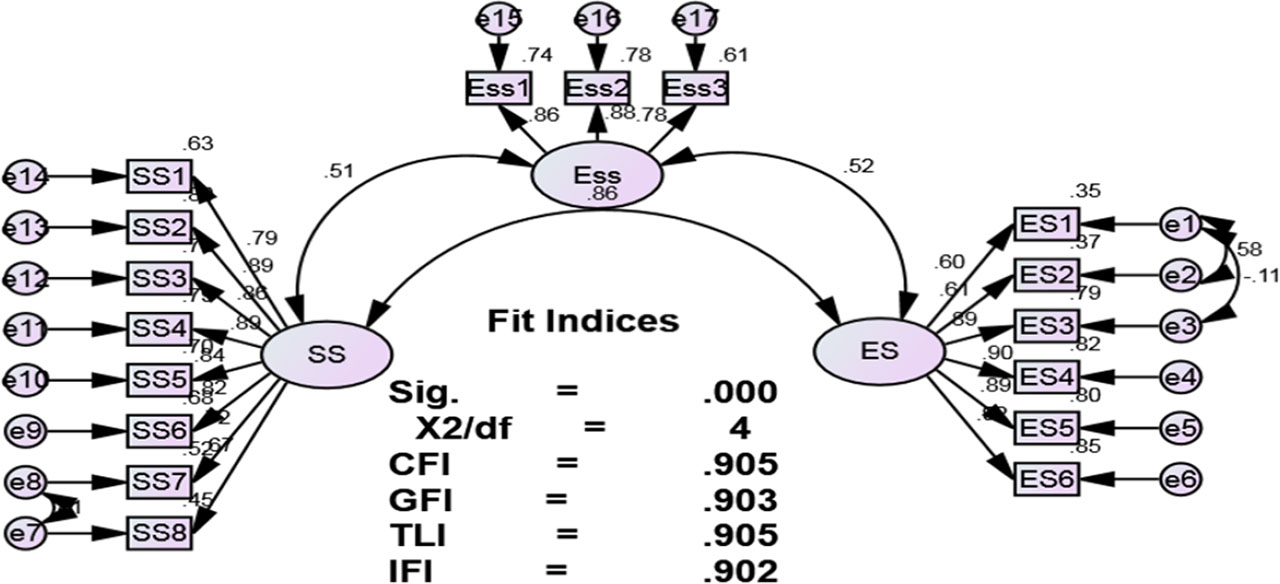
Fig. 1.
MISSING title
Source:
All the fit indices presented in Figure 1 indicate that the fitness of the 3-factor measurement model is good, except for the χ2 value, which is highly significant, p < 0.001. However, since χ2 is easily affected by larger sample sizes (Hair et al., 2019), an adjustment suggested by Jöreskog and Sörbom (1993), which involves assessing the ratio of χ2 to the degrees of freedom, was applied. The obtained χ2/df of 4 falls within the acceptable threshold suggested by Kline (2023), which is less than 5. Other indices were also used to evaluate model fit, such as the Goodness of Fit Index (GFI), the Comparative Fit Index (CFI), the Tucker-Lewis Index (TLI), and the Incremental Fit Index (IFI), which were all close to 1, indicating that the empirical covariance matrix closely matches the implied covariance matrix (Sahoo, 2019).
Having attained an acceptable model fit, the analysis evaluated construct validity by means of convergent and discriminant validity and composite reliability. Convergent validity was assessed using Average Variance Extracted (AVE), and discriminant validity was assessed by comparing the shared variance with the AVE for each pair of constructs under study (Fornell and Larcker, 1981). The construct validity results are presented in Table 2.
Table 2.
Construct validity
| Construct | N | AVE | Shared variance | |||
|---|---|---|---|---|---|---|
| 1 | 2 | 3 | ||||
| Economic sustainability (1) | 3 | 0.7107 | 0.880 | 1 | ||
| Environmental sustainability (2) | 6 | 0.6632 | 0.919 | .394 | 1 | |
| Social sustainability (3) | 8 | 0.6638 | 0.940 | .232 | .159 | 1 |
The AVE was greater than the 0.5 threshold for every latent variable, implying that each had sufficient convergent validity. This suggests that the indicators for each construct share a high degree of common variance (Black and Babin, 2019). Additionally, the AVE for each variable exceeded the variance it shared with other variables, signifying acceptable discriminant validity. After establishing satisfactory construct validity, composite reliability was assessed using the composite reliability (CR) coefficient, and the findings are presented in Table 3. The CR coefficients for the latent variables exceeded the 0.7 threshold recommended by Nunnally and Bernstein (1994) for a latent variable to be considered reliable.
Table 3.
Descriptive statistics
| Construct | Level of supplier development | Mean | Std. Deviation | N |
|---|---|---|---|---|
| Economic sustainability | Contract farmers | 5.9135 | .61384 | 208 |
| Independent farmers | 4.5375 | 1.22626 | 191 | |
| Total | 5.2548 | 1.17790 | 399 | |
| Environmental sustainability | Contract farmers | 6.0120 | .66585 | 208 |
| Independent farmers | 4.1545 | .98326 | 191 | |
| Total | 5.1228 | 1.24715 | 399 | |
| Social sustainability | Contract farmers | 5.5697 | .87846 | 208 |
| Independent farmers | 4.0301 | .98954 | 191 | |
| Total | 4.8327 | 1.20905 | 399 |
Hypothesis testing
After confirming the validity and reliability of the latent variables, the study continued to the hypothesis-testing stage. Hypothesis testing was conducted using Multivariate Analysis of Variance (MANOVA). MANOVA evaluates whether a categorical independent variable explains a statistically significant amount of variance in the criterion variables (Black and Babin, 2019). The main hypotheses suggest that higher levels of sustainability are achieved under supplier-development arrangements than under independent supply arrangements. The results are presented in Tables 3, 4, and 5.
Table 4.
Multivariate tests
| Effect | Fa | Hypothesis df | Error df | Sig. | Partial Eta Squared | Observed Powerb | |
|---|---|---|---|---|---|---|---|
| Supplier development | Pillai’s Trace | 183.030 | 3.000 | 395.00 | .000 | .582 | 1.00 |
| Wilks’ Lambda | 183.030 | 3.000 | 395.00 | .000 | .582 | 1.00 | |
| Hotelling’s Trace | 183.030 | 3.000 | 395.000 | .000 | .582 | 1.00 | |
| Roy’s Largest Root | 183.030 | 3.000 | 395.00 | .000 | .582 | 1.00 |
Table 5.
Univariate tests
| Source | Dependent variable | Df | F | Sig. | Partial Eta squared | Observed power |
|---|---|---|---|---|---|---|
| Supplier development level | Economic sustainability | 1 | 205.764 | .000 | .341 | 1.00 |
| Environmental sustainability | 1 | 495.144 | .000 | .555 | 1.00 | |
| Social sustainability | 1 | 270.974 | .000 | .406 | 1.00 | |
| Error | Economic sustainability | 397 | ||||
| Environmental sustainability | 397 | |||||
| Social sustainability | 397 | |||||
| Total | Economic sustainability | 399 | ||||
| Environmental sustainability | 399 | |||||
| Social sustainability | 399 |
The findings from a one-way MANOVA test indicate statistically significant variations between the two agro-supplier groups (independent and supplier-developed) on the combined criterion variables of economic sustainability, environmental sustainability, and social sustainability, Pillai’s Trace V = 0.582, F (3, 395) = 183.030, p < 0.001, partial η2 = 0.582, observed power = 1.00. Based on these findings, there was sufficient evidence to reject the null hypothesis and conclude that at least one of the dependent variables differed according to agro-supplier classification. A partial eta squared (η2) of 0.582 indicates that approximately 58.2% of the multivariate variance in the dependent variables was attributable to group membership. The observed power was 1.00, indicating very high statistical power. As the multivariate test was statistically significant, we can infer that the group effect was also statistically significant.
The next step was to identify the specific dependent variable(s) responsible for the significant multivariate effect. This involved identifying the specific dependent variables that contributed to the significant overall effect. The three study hypotheses suggest that there are statistically significant differences in all three dimensions of supplier sustainability performance between developed and independent suppliers. One-way ANOVAs were used to test each sub-hypothesis individually. The p values are supposed to consider the additional ANOVAs carried out in order to maintain Type 1 error (Rubin, 2021). Hence, each ANOVA was subject to Bonferroni correction, which divides the 0.05 alpha levels by the number of ANOVAs conducted. Accordingly, all ANOVAs were tested at an adjusted alpha level of 0.002 (0.05/3). Since SPSS reports 2-tailed significance levels by default, and the hypotheses were directional, the resulting p-values were halved, leading to an effective alpha level of 0.001 (0.002/2). The results of each ANOVA are listed in Table 5.
The results are sufficient to reject the economic sustainability null hypothesis, F (1,397) = 205.764, p < 0.001, partial η2 = 0.341, observed power = 1.00; the environmental sustainability null hypothesis, F (1,397) = 495.144, p < 0.001, partial η2 = 0.555, observed power = 1.00; and the social sustainability null hypothesis, F (1,397) = 270.974, p < 0.001, partial η2 = 0.406, observed power = 1.00. The estimated marginal means for independent farmers for economic sustainability (M = 4.54, SD = 1.23), environmental sustainability (M = 4.15, SD = .98), and social sustainability (M = 4.99, SD = 0.073) were lower than those for contract farmers for economic sustainability (M = 5.91, SD = 0.61), environmental sustainability (M = 6.01, SD = .073), and social sustainability (M = 5.5, SD = 0.88), respectively. The effect size was substantial for all ANOVAs. The association between supplier category and each sustainability measure was strong. Group classification accounted for 34.1% of the variance in economic sustainability, 55.5% in environmental sustainability, and 40.6% in social sustainability. The observed power for all tests was 1.00, indicating that the analysis had sufficient power to detect these effects.
DISCUSSION
It is widely acknowledged that sustainability issues have become topical in almost every sphere of life (Walker et al., 2020). In business and procurement practices more generally, sustainability issues have become key performance indicators (Dissanayake, 2021). However, the conditions that promote sustainable procurement remain underexplored in the scholarly literature. This study suggests that supplier development initiatives are enablers of sustainable procurement, given that supplier development improves suppliers’ capabilities (Mukucha et al., 2024a; Pedroso et al., 2021). Earlier research has recognised that supplier development schemes are a predictor of several constructs in the discipline of supply chain management, such as supply chain resilience (Mukucha and Chari, 2022) and operational performance (Mukucha and Chari, 2024). This study extends previous work by empirically testing the influence of supplier development initiatives the three dimensions of sustainable procurement: economic, environmental, and social performance.
The findings of this study indicate that supplier development has a statistically significant influence on economic sustainability in the agro-processing industry. When suppliers are provided with the necessary inputs, they tend to perform well (Powell and Coughlan, 2020). In this study, developed suppliers outperformed independent suppliers in terms of the productivity of land and other inputs, as well as profitability. This is in line with a previous study by Mukucha et al. (2024b) on the same industry, where supplier development was found to be a predictor of lower costs, higher quality, and better delivery performance. There is also a vast body of empirical studies that have found that supplier development schemes (contract farming) lead to economic sustainability (e.g., Ruml et al., 2022). Similar increases in yield have been reported by Khan et al. (2019) in maize contract farming and by Shonhe and Scoones (2022) in tobacco.
The findings also reveal that supplier development is associated with improved environmental sustainability. This result supports previous research by Thakker and Rane (2018) on the automobile industry, where supplier development was found to be a facilitator of green practices. In the chemical industry, Coşkun et al. (2022) found that supplier development can eliminate environmental pollution from hazardous waste material. Supplier development likely contributes to environmental sustainability by enabling suppliers in the tobacco industry, who have limited resources due to agrarian changes (Mukucha et al., 2023a), to invest in infrastructure that supports the implementation of sustainable practices (Mazwi et al., 2018). Such infrastructure may include contour ridges to prevent soil erosion (Mazwi et al., 2018) and solar-powered barns to reduce deforestation (Chazovachii et al., 2021). Ultimately, this will lead to practices that include, but are not limited to, the use of organic fertilisers (Chakuya et al., 2022), herbicides and pesticides (Lencucha et al., 2022), and afforestation (Zvobgo and Tsoka, 2021).
Social sustainability has also been empirically proven to be positively influenced by supplier development. This phenomenon can be explained by the fact that well-resourced businesses are more likely to be registered with various relevant authorities. They operate as registered entities that comply with industry legislation (Alamgir and Banerjee, 2019). Most of this legislation supports safer working conditions for employees as well as a minimum wage (Woolfson, 2007). Thus, in this study, supplier-developed entities were able to create safer work environments than independent suppliers. Supplier-developed entities also paid more sustainable wages to their employees. Sustainable wages have been described as a form of remuneration that enables employees to lead decent lifestyles. The findings in this study concur with the conclusion in a study by Yawar and Seuring (2018) that supplier development schemes result in enhancing suppliers’ capacity to address social sustainability issues. Zhang et al. (2017), in line with the current study, also confirmed supplier development as a vehicle for attaining firms’ social responsibilities.
CONCLUSIONS AND RECOMMENDATIONS
The results of this study reveal that suppliers under contract farming arrangements have greater land, labour, and input producivity than those operating independently. The study concludes that supplier development (contract farming) is associated with economic sustainability. More specifically, farmers under contract farming had higher levels of yield per hectare, which is largely attributable to the use of adequate resources, such as fertilisers and pesticides. There was also improved labour and input productivity as a result of engaging a skilled labour force and applying adequate resources. The use of prescribed resources and management skills results from the provision of inputs by the contracting merchants.
The outcomes of this study reveal that suppliers engaged in contract farming performed better than independent farmers in addressing environmental sustainability issues, such as afforestation and the use of organic fertilisers, pesticides, and herbicides. Most environmentally unsustainable operations in agro-value chains may be due to the unavailability of adequate resources to conduct restoration activities, such as planting of trees after extended periods of farming, making use of organic fertilisers and chemicals to manage pests and diseases, and using recycled water for irrigation purposes (Lencucha et al., 2022). This study concludes that supplier development contributes to improved environmental sustainability.
Lastly, the results in this study show that suppliers under contract farming arrangements performed better than independent farmers in terms of social sustainability practices – for example, by creating safe working conditions, paying sustainable wages, and avoiding child labour. These improvements are attributed to adequate financing provided by contracting merchants. Therefore, the study concludes that supplier development contributes to improved social sustainability.
The study therefore recommends that tobacco merchants adopt supplier development arrangements to achieve economic sustainability. Supplier development should involve providing adequate farming inputs and appropriate extension services. It is also recommended that contract farming schemes be expanded to mitigate environmental degradation caused by deforestation, soil erosion, and water contamination. This should involve direct support for programmes promoting crop rotation, the use of organic inputs, and afforestation. Considering that supplier development initiatives were found to have a positive impact on social sustainability, it is recommended that funding for supplier development programmes be increased, especially in regions identified as child labour hotspots.