
Table 1.
Socioeconomic characteristics of respondents
| Variable | Frequency | Percentage |
|---|---|---|
| Age | ||
| ≤ 30 | 1 | 0.8 |
| 40–49 | 21 | 17.5 |
| 50–59 | 53 | 44.2 |
| Above 60 | 45 | 37.5 |
| Mean (std deviation) | 45 (± 15) | |
| Gender | ||
| Female | 16 | 13.3 |
| Male | 104 | 86.7 |
| Marital status | ||
| Married | 100 | 83.4 |
| Single | 6 | 5 |
| Divorced | 10 | 8.3 |
| Widowed | 4 | 3.3 |
| Household size | ||
| ≤ 5 | 71 | 59.2 |
| 6–8 | 46 | 38.3 |
| Above 8 | 3 | 2.5 |
| Mean (std deviation) | 5 (± 3) | |
| Cassava farm size (hectares) | ||
| < 3 | 58 | 80 |
| 3–6 | 58 | 16.7 |
| Above 6 | 4 | 3.3 |
| Mean (std deviation) | 4 (± 2) | |
| Membership of a cooperative society | ||
| Yes | 17 | 14.2 |
| No | 103 | 85.8 |
| Educational qualification | ||
| No formal education | 71 | 52.9 |
| Primary | 14 | 11.7 |
| Secondary | 35 | 29.2 |
| Farming experience | ||
| 10–29 | 50 | 41.7 |
| 30–39 | 38 | 31.7 |
| 40–49 | 32 | 26.6 |
| Mean (std deviation) | 31 (±17) | |
| Primary occupation | ||
| Crop farming | 98 | 81.67 |
| Other occupation | 22 | 18.33 |
Table 2.
Cassava enterprise budgetary analysis per hectare
| Items | Mean value/ha (₦) | Proportion |
|---|---|---|
| Total revenue | ||
| Cassava tubers | 429,413.40 | 97.27 |
| Cassava stems | 12,030.00 | 2.73 |
| Total | 441,443.4 | |
| Total variable cost | ||
| Cost of cassava cuttings | 18,994.33 | 7.21 |
| Cost of agrochemicals | 13,226.46 | 6.80 |
| Cost of transportation | 23,887.28 | 9.73 |
| Cost of labor | 158,904.16 | 61.24 |
| Total | 215,012.23 | |
| Total fixed cost | ||
| Land | 5,483.333 | 2.02 |
| Machinery(Planter, harvester) | 35,333.33 | 13.00 |
| Total | 40,816.67 | |
| Total cost (TC) = TVC + TFC | 255,828.9 | |
| Gross margin = TR − TVC | 226,431.17 | |
| Net farm income (NFI) = TR − TC | 185,614.5 | |
| BCR (benefit-cost ratio) | 1.73 |
Table 3.
Distribution of respondents by formal postharvest management training
| Formal postharvest handling training | Frequency | Percentage |
|---|---|---|
| No | 115 | 95.8 |
| Yes | 5 | 4.2 |
Table 4.
Distribution of cassava tuber value lost to postharvest handling
| Source | Amount lost (kg) | Expected income generation (₦) | Percentage |
|---|---|---|---|
| Improper storage | 525.5 | 6500.00 | 25.48 |
| Pests and diseases | 454.2 | 5618.00 | 22.03 |
| Poor handling | 352.7 | 4363.00 | 17.11 |
| Inadequate harvesting technique | 285.3 | 3529.00 | 13.84 |
| Transportation | 246.9 | 3054.00 | 11.97 |
| Marketing challenge | 197.4 | 2442.00 | 9.57 |
| Total | 2062 | 25506 | 100 |
Table 5.
Distribution of farmers' sources of information on postharvest handling practices
| Source of information | Frequency | Percentage |
|---|---|---|
| Friends and relatives | 72 | 60 |
| Farmers' groups | 24 | 20 |
| Mass media | 15 | 12.5 |
| ICTs | 6 | 5 |
| Extension agents | 3 | 2.5 |
Table 6.
Distribution of Farmers' postharvest management practices
| Management practices | Frequency | Percentage |
|---|---|---|
| Immediate processed to gari | 75 | 62.5 |
| Immediate processed to Lafun | 68 | 55.0 |
| Immediate processed to Fufu | 63 | 52.5 |
| Immediate processed to Chips | 15 | 12.5 |
| Harvest for target buyers | 45 | 37.5 |
Table 7.
Factors influencing postharvest cassava tubers management
| Variables | Coefficients | Std. Error | t value | Sig. |
|---|---|---|---|---|
| (constant) | 3.689 | 0.026 | 143.070 | 0.00000*** |
| Age (X1) | –0.2010 | 0.095 | 2.11 | 0.03708** |
| Education (X2) | 0.099 | 0.008 | 12.37 | 0.00000*** |
| Farm size (X3) | –0.0914 | 0.040 | 2.23 | 0.02373** |
| Storage facility (X4) | 0.3107 | 0.099 | 3.11 | 0.00237*** |
| Extension visits (X5) | 0.6019 | 0.2651 | 2.27 | 0.02512** |
| Harvesting technique (X6) | 0.0213 | 0.0051 | 4.15 | 0.00000*** |
| Distance to the nearest market (X7) | –0.2417 | 0.118 | 2.03 | 0.04472** |
| R2 = 0.831 | ||||
| Adj R-squared = 0.825 | ||||
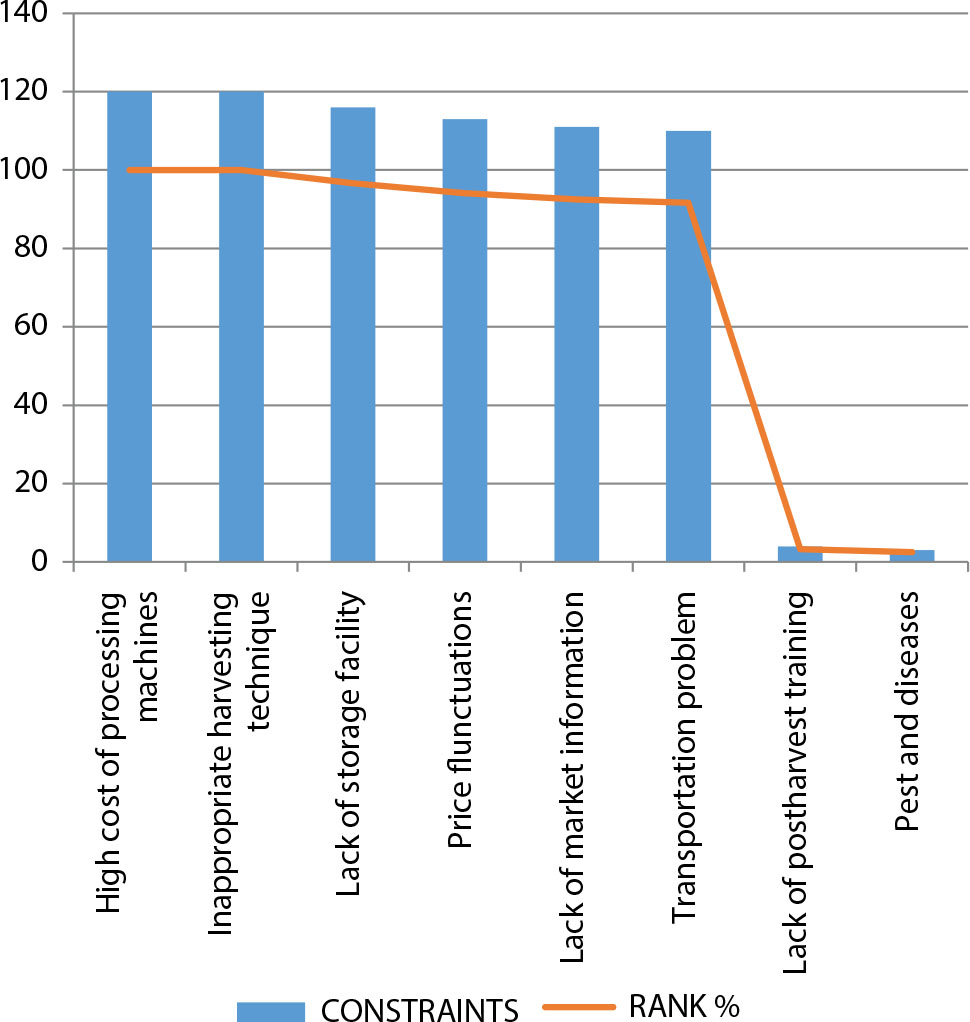
Fig. 1.
Constraints to farmers' postharvest management practices
Source: data analysis, 2021.