
INTRODUCTION
Cassava (Manihot spp.) is consumed by nearly a billion people worldwide, making it the fourth most important crop for farmers in the tropics, following rice, wheat, and sugarcane (FAOSTAT, 2010). Although cassava originated in Brazil, South America, it was introduced to southern Nigeria in the sixteenth century (Adeniji et al., 2005). It is a widely grown staple food in tropical and subtropical regions, known for its drought resistance. The two primary cassava varieties grown in West Africa are sweet cassava (Manihot palmata) and sitta cassava (Manihot utilissima). According to FAO projections, sub-Saharan Africa will account for about 62% of the world's cassava production by 2025. Nigeria, the world's leading producer, produced approximately 42.5 million metric tons in 2013, making up nearly 18% of global output (FAOSTAT, 2013). This share increased to 21.5% by 2018 (FAOSTAT, 2020).
Cassava can be processed into various products, including gari, ethanol, flour, fufu, tapioca, animal feed, glucose, gum and starch. Its roots can be consumed raw, fed to livestock, or used to make starch (Eguono, 2015). The leaves are rich in proteins, minerals, and vitamins. With a shelf life of only 24 to 48 hours after harvest, cassava is one of the most popular foods in Nigeria (IITA, 2010). Over time, cassava has shifted from being a subsistence crop grown on smallholder farms to a commercially grown crop on plantations. A valuable source of carbohydrates, cassava roots also serve as animal feed and biofuel (Adekanye et al., 2013). Due to its importance in Nigeria's non-oil export economy, cassava plays a crucial role in the country's foreign exchange earnings. However, most cassava production in Nigeria is by smallholder farmers who face numerous challenges, such as limited access to advanced farming technologies. According to Kuye (2015), these challenges include illiteracy, lack of access to financing, high input costs, small farm sizes, limited access to agricultural information (including market pricing), high interest rates, and inadequate market and rural transport infrastructure. These barriers result in a production gap where demand exceeds supply. To address this, the Nigerian government launched the Cassava Expansion Program to boost production.
Effective postharvest management, processing, packaging, and storage are essential to ensure the successful large-scale production and use of cassava and its by-products. Proper postharvest management preserves product quality and safety, reduces losses, and enhances food security (Opara, 2013).
However, food shortages and heavy reliance on food imports in Nigeria are exacerbated by inadequate postharvest loss management (Oluwatosin, 2017). Alarmingly, postharvest losses of perishable crops in Nigeria are estimated at 60% (FMANR, 2016). These enormous losses contribute to Nigeria's annual postharvest loss of approximately ₦3.5 trillion—three times the country's entire five-year Federal Agricultural budget allocation of ₦1.13 trillion (Business Day, 2024). Inadequate storage facilities and poor handling practices, among other factors, are significant contributors to these losses (Premium Times, 2024). Furthermore, the prices at which perishable goods are sold often lead to reduced farmer income. Food losses occur throughout the supply chain, from production and postharvest handling to processing. Poor road access, insufficient agro storage and processing facilities, and a lack of produce sales terminals continue to create significant challenges for Nigerian farmers. In addition, the “Missing Food” study emphasizes that reducing postharvest loss is critical for ensuring global food availability (World Bank, 2011).
Because cassava roots cannot be typically stored for long, they must be processed immediately after harvest. However, this is not always feasible, and as a result, harvested tubers often undergo significant value depreciation. This situation has hindered Nigeria's ability to achieve self-sufficiency in food production, forcing the country to import food. To achieve food security, Nigeria must invest in improving postharvest management for cassava production. The AGRA (2013) report also notes that postharvest loss (PHL) in Burkina Faso, Ghana, Mali, and Nigeria has not been well documented at the regional level, despite being influenced by production dynamics, postharvest operations, and Indigenous storage activities. Therefore, this study focuses on assessing farmers' postharvest management practices, evaluating the quantitative and qualitative losses of cassava due to postharvest handling, examining the determinants of these losses, and analyzing the challenges to effective postharvest management among cassava farmers in the Iwo ADP zone of Osun State, Nigeria. This research is particularly timely, as PHL poses a growing existential threat to cassava production and food security in the study area.
CAUSES OF POSTHARVEST LOSSES
Postharvest losses (PHL) in agricultural produce pose a significant challenge to global food security and economic development. These losses occur between harvest and consumption, leading to substantial reductions in both the quantity and quality of harvested crops. Various factors contribute to PHL, spanning the preharvest, harvest, and postharvest stages.
Preharvest Factors:
Inadequate Agronomic Practices:
The use of suboptimal crop varieties, poor soil fertility management, and inadequate pest and disease control can lead to lower yields and compromised produce quality (Pokhrel, 2021).
Climate Change:
Extreme weather events such as droughts, floods, and heat waves can negatively impact crop growth, making them more susceptible to postharvest deterioration (Lobell et al., 2011).
Harvesting Practices:
Improper Harvesting Techniques:
Rough handling, harvesting before or after the ideal maturity stage, and delays between harvest and initial cooling can cause mechanical damage and accelerate physiological deterioration (Kader, 2010).
Inadequate Harvesting Tools and Equipment:
Using suboptimal tools and equipment can lead to physical damage, bruising, and compromised quality of produce (FAO, 2011).
Postharvest Handling and Storage:
Poor Handling and Transportation:
Improper handling during transport, such as exposure to extreme temperatures, humidity, and physical shocks, can promote microbial growth and accelerate spoilage (Prusky, 2011).
Substandard Storage Facilities:
Inadequate storage infrastructure, such as the absence of refrigerated or controlled atmosphere storage, creates conditions that favor pest infestations, microbial growth, and physiological deterioration (FAO, 2011).
Pest and Disease Infestations:
Insect and fungal infestations during storage and transportation can lead to significant losses in both the quality and quantity of produce (FAO, 2011).
Market Constraints:
Limited Access to Markets: Lack of access to markets and inefficient market information can lead to delays in transportation and storage, increasing the risk of losses (Reardon et al., 2001).
Low Market Prices: Low and fluctuating market prices may discourage farmers from investing in postharvest technologies and practices that help minimize losses (Urugo et al., 2024).
SOCIAL AND ECONOMIC IMPLICATIONS
Food Insecurity:
Substantial losses in agricultural produce contribute to food shortages and food insecurity, particularly in developing countries (FAO, 2011).
Increased Food Prices:
Reduced availability due to postharvest losses can drive up food prices, making food less affordable and accessible for consumers (FAO, 2011).
Reduced Farmer Incomes:
Losses can lower farmer incomes, hindering agricultural development and efforts to reduce poverty (Urugo et al., 2024).
Environmental Impact:
Increased food waste resulting from PHL contributes to greenhouse gas emissions and environmental pollution (Gustavsson et al., 2011).
POSTHARVEST LOSS MITIGATION
Improved Harvesting Practices:
Promoting proper harvesting techniques and providing training to farmers.
Investing in Infrastructure:
Developing and enhancing transportation and storage infrastructure, including roads, cold storage facilities, and processing plants, to reduce losses.
Promoting Technology Adoption:
Encouraging the use of appropriate technologies, such as improved packaging materials, modified atmosphere packaging, and effective pest control methods.
Strengthening Market Linkages:
Improving farmers' access to markets and providing timely, relevant market information to help them make informed decisions.
Raising Awareness:
Raising awareness among farmers and other stake-holders about the critical importance of postharvest management, as well as the available practices and technologies that can minimize losses.
NIGERIA'S POSTHARVEST LOSS MANAGEMENT POLICY
In Sub-Saharan Africa (SSA), postharvest losses of root and tuber crops have been estimated at 40%. Alarmingly, postharvest losses of perishable crops in Nigeria were reported at 60% by the Federal Ministry of Agriculture and Rural Development (2016), severely affecting food security and economic development. Although Nigeria does not have a standalone postharvest policy framework, the Nigerian government has implemented various policies and initiatives to mitigate postharvest losses (PHL). These include:
The Nigeria Incentive-Based Risk Sharing System for Agricultural Lending (NIRSAL) (2011): NIRSAL aims to reduce lending risks for financial institutions, encouraging investment in the agricultural sector, including postharvest activities.
Anchor Borrowers' Program (2015): This initiative provides loans to farmers to support agricultural production, covering postharvest activities such as storage and processing.
National Agricultural Policy (2020–2025):
The National Agricultural Technology and Innovation Policy (NATIP) (2022–2027): This policy framework emphasizes the importance of postharvest management in boosting agricultural productivity and food security. It outlines strategies for reducing postharvest losses through improved storage, processing, and marketing infrastructure.
National Agricultural Development Fund (NADF) (2022): The NADF allocates funding to various aspects of the agricultural sector, including postharvest technology.
Silo Construction and Storage Facilities: The government has invested in constructing silos and other storage facilities across the country to improve storage capacity and reduce postharvest losses.
Agro-Processing Promotion Initiative: The government encourages the development of agro-processing industries to add value to agricultural products and reduce postharvest losses.
Research and Development Efforts: Research institutions such as the Nigerian Stored Products Research Institute (NSPRI) focus on developing technologies and strategies to improve postharvest handling and storage.
Despite these policies and initiatives, challenges such as inadequate infrastructure, limited access to finance, and a lack of awareness among farmers continue to hinder the effective implementation of postharvest loss reduction strategies in Nigeria.
MATERIAL AND METHODS
Study Area
This study was conducted in the Iwo ADP Zone, Osun State, Nigeria. According to the 2006 Nigerian National Census, this zone is the most populated local government area in Osun state, with a population of 191,348 and an area of 245 km2. The region experiences high temperatures during the dry season (November to March) and significant rainfall during the wet season (April to October). Additionally, the area features soils that are highly conducive to cassava cultivation.
Method of Data Collection
A three-stage sampling procedure was employed to select cassava farmers for the study. In the first stage, four local government areas (LGAs) were randomly chosen from the seven available within the zone. In the second stage, three villages with a high concentration of cassava farmers were purposively selected from each LGA, resulting in a total of 12 villages. In the third stage, 10 cassava farmers were randomly selected from each village using proportional sampling, resulting in a total sample size of 120 respondents. Data on respondents' postharvest management practices and socioeconomic characteristics were gathered through a structured interview schedule.
Data Analysis
Descriptive statistics, namely mean, standard deviation, frequency, and percentages, and inferential statistics, such as regression and budgetary analysis, were employed to analyze the collected data from farmers in the study area.
Research Instrument
The validity of a research instrument refers to the extent to which the instrument measures what it is intended to measure. For this study, the instruments were faced validated by experts in the field of study.
Reliability, on the other hand, pertains to the consistency or reproducibility of test scores. It involves concepts such as repeatability (or stability over time) and internal consistency (or homogeneity of the measure) (Zikmund et al., 2003). Repeatability or stability over time can be measured using the test-retest method, in which the same scale or measure is administered to the same respondents at two separate points in time (Zikmund et al., 2003). This method compares scores from repeated testing of the same participants with the same test.
Internal consistency, or homogeneity, can be assessed using methods such as the split-half method, alternate-form method, or Cronbach's alpha method. The split-half method, specifically, measures the degree of internal consistency by comparing one half of the results of a set of scaled items with the other half, i.e. comparing scores from different parts of the test.
For this study, the reliability of the instrument was tested using the “test-retest method”, in which the same instruments were administered twice to 25 respondents outside the study area within a two-week interval. The data were then analyzed using Pearson Product Moment Correlation. A correlation coefficient (r) of 0.84 was obtained, which was considered sufficiently high to demonstrate the instrument's consistency.
Assessment of Postharvest Loss in Tubers
Due to logistical constraints, the assessment of postharvest loss in perishable tubers was based solely on farmers' reported losses during harvesting, sorting and grading, packaging, transport, and at the retail point. Respondents were also asked to estimate the volume of commodities handled and the quantity of losses typically incurred at each stage of handling. The total declared weights at each stage were then expressed as a percentage of the overall weight handled.
Model Specification
A multiple linear regression model was used to assess the factors determining the quantity of cassava output by the farmers in the study area. Following Kehinde et al. (2021), the explicit form of the model is expressed in the equation below:
Where:
Y = Cassava postharvest management
X1 = Farmer's age (years)
X2 = Highest education level (years)
X3 = Farm size (ha)
X4 = Storage facility
X5 = Extension visits
X6 = Harvesting technique
X7 = Distance to the nearest market
Ui = Error term
b0 = Constant
b1–b7 = Regression coefficients
Gross Margin Approach
The Gross margin approach was employed to evaluate the costs and returns associated with cassava production in the study area, as expressed by Kehinde et al. (2021). The gross margin (GM) is calculated as follows:
Where:
GM = Gross Margin of cassava (₦/ha)
GI = Gross Income (₦/ha), the product of the unit cost of output and total output
TVC = Total Variable Cost (₦/ha), including inputs costs such as seed, fertilizer, chemicals, hired labor, etc.
The Cassava Net Farm Income (NFI) is calculated as:
Where:
NFI = Net Farm Income (₦/ha)
GM = Gross Margin
TFC =Total Fixed Cost
To appraise cassava production, we also employed the Benefit-Cost Ratio (BCR) analysis, as used by Kehinde et al. (2021):
RESULTS AND DISCUSSION
Socioeconomic Characteristics
Table 1 reveals that the mean age of cassava farmers was 45 years. This suggests that cassava production is largely dominated by farmers in their productive, active years, making them more likely to adapt to technological innovations in the study area. This finding aligns with Jimoh et al. (2024), who reported that oil palm processors were similarly young and active in their study. In a similar vein, Daud et al. (2015) reported a slightly higher mean age of 51 years for cassava farmers in Oyo State, Nigeria.
Table 1.
Socioeconomic characteristics of respondents
| Variable | Frequency | Percentage |
|---|---|---|
| Age | ||
| ≤ 30 | 1 | 0.8 |
| 40–49 | 21 | 17.5 |
| 50–59 | 53 | 44.2 |
| Above 60 | 45 | 37.5 |
| Mean (std deviation) | 45 (± 15) | |
| Gender | ||
| Female | 16 | 13.3 |
| Male | 104 | 86.7 |
| Marital status | ||
| Married | 100 | 83.4 |
| Single | 6 | 5 |
| Divorced | 10 | 8.3 |
| Widowed | 4 | 3.3 |
| Household size | ||
| ≤ 5 | 71 | 59.2 |
| 6–8 | 46 | 38.3 |
| Above 8 | 3 | 2.5 |
| Mean (std deviation) | 5 (± 3) | |
| Cassava farm size (hectares) | ||
| < 3 | 58 | 80 |
| 3–6 | 58 | 16.7 |
| Above 6 | 4 | 3.3 |
| Mean (std deviation) | 4 (± 2) | |
| Membership of a cooperative society | ||
| Yes | 17 | 14.2 |
| No | 103 | 85.8 |
| Educational qualification | ||
| No formal education | 71 | 52.9 |
| Primary | 14 | 11.7 |
| Secondary | 35 | 29.2 |
| Farming experience | ||
| 10–29 | 50 | 41.7 |
| 30–39 | 38 | 31.7 |
| 40–49 | 32 | 26.6 |
| Mean (std deviation) | 31 (±17) | |
| Primary occupation | ||
| Crop farming | 98 | 81.67 |
| Other occupation | 22 | 18.33 |
The Table also shows that 13.3% of the cassava farmers were female, while 86.7% were male, indicating that cassava production remains a male-dominated enterprise. This could be attributed to the patrilineal land inheritance system prevalent in many African societies, which typically grants land ownership land ownership rights to men. This aligns with the findings of Yakasai (2010), who reported that 87% of cassava farmers in the Kuje Area Council of Abuja, Nigeria, were male, while 13% were female.
Additionally, the table reveals that the majority (83.4%) of the cassava farmers were married. This suggests that the involvement of family members in production activities could potentially reduce the cost of hired labor. The mean household size was 5 persons, with about 59.2% of the cassava farmers having households of fewer than 5 people. This indicates relatively large household sizes in the study area. According to Oluwatusin (2017), the high poverty levels among small-scale farmers can be attributed to these large household sizes. Similarly, Adebayo (2009) found that the average family size in Ogun State, Nigeria, was 7 persons.
Furthermore, the mean size of cassava farmers' farmland was 4 hectares. The majority (59.2%) had less than 3 hectares, and 81.67% considered crop farming their main occupation. This indicates that cassava farmers are predominantly smallholders. Notably, 85.8% of the farmers did not belong to any cooperative society, while only 14.2% were members. Cooperative membership can facilitate access to credit facilities and provide a platform for exchanging ideas, which could enhance farm productivity (Oyewole, 2012).
In terms of education, the majority (52.9%) of farmers had no formal education, with only 11.7% having received education at the primary level. Education plays a crucial role in improving farmers' ability to understand and adopt technological innovation in agriculture (Nwaru, 2001). Additionally, the mean farming experience was 31 years, indicating that most of the farmers have been involved in cassava production for a significant period. This experience likely has a positive impact on their production capacity. Nwaru (2004) found that farmers often rely more on their experience than on formal education to increase productivity.
Cost and Returns on Cassava Production
A budgetary analysis of the profitability of cassava farmers in the study area is presented in Table 2. The gross margin for the farmers was estimated at ₦226,431.17. The total fixed costs incurred by the farmers, which included expenses for land, cutlasses, sprayers, and hoes, amounted to ₦40,816.67. The total variable costs, which covered land clearing, fertilizer, planting materials, herbicides, transportation, and labor, totaled ₦215,012.23. The net income for the farmers was ₦185,614.5.
Table 2.
Cassava enterprise budgetary analysis per hectare
| Items | Mean value/ha (₦) | Proportion |
|---|---|---|
| Total revenue | ||
| Cassava tubers | 429,413.40 | 97.27 |
| Cassava stems | 12,030.00 | 2.73 |
| Total | 441,443.4 | |
| Total variable cost | ||
| Cost of cassava cuttings | 18,994.33 | 7.21 |
| Cost of agrochemicals | 13,226.46 | 6.80 |
| Cost of transportation | 23,887.28 | 9.73 |
| Cost of labor | 158,904.16 | 61.24 |
| Total | 215,012.23 | |
| Total fixed cost | ||
| Land | 5,483.333 | 2.02 |
| Machinery(Planter, harvester) | 35,333.33 | 13.00 |
| Total | 40,816.67 | |
| Total cost (TC) = TVC + TFC | 255,828.9 | |
| Gross margin = TR − TVC | 226,431.17 | |
| Net farm income (NFI) = TR − TC | 185,614.5 | |
| BCR (benefit-cost ratio) | 1.73 |
The Benefit-Cost Ratio (BCR) was calculated at 1.73, indicating that cassava production in the study area is profitable, with a return on investment of approximately 70%. This means that for every ₦1.00 invested in cassava production, there is a return of ₦1.73, yielding a gain of ₦0.73. These findings align with those of Nzeh and Ugwu (2014), who reported a similar profitability in Ondo State, Akoko North-West Local Government Area, Nigeria, with a margin return of ₦2.97.
Farmers' Formal Postharvest Management Training
Table 3 presents the distribution of cassava farmers according to their formal training in postharvest handling of cassava tubers. The table shows that nearly all farmers (95.8%) were not formally trained, whereas only 4.2% had received formal training. This suggests that limited postharvest management skills displayed by farmers may have been acquired informally through interactions with friends and relatives.
Quantitative and Qualitative Assessment of Cassava Loss Due to Postharvest Handling
Table 4 shows that, on average, each farmer lost 2,062 kg of cassava, amounting to ₦25,506 in unrealized revenue across all categories of postharvest loss. Approximately 526 kg of cassava tubers, representing ₦6,500 in potential income, were lost due to improper storage. This accounted for about 25% of the total unrealized income from postharvest losses, making it the largest category of loss. Additionally, losses due to pest and disease infestations (₦5,618 or 22.03%), poor handling (₦4,363 or 17.11%), and inadequate harvesting techniques (₦3,529 or 13.84%) were reported. Revenue lost due to transportation issues amounted to ₦3,054 (11.97%), while marketing challenges led to a loss of ₦2,442 (9.75%).
Table 4.
Distribution of cassava tuber value lost to postharvest handling
| Source | Amount lost (kg) | Expected income generation (₦) | Percentage |
|---|---|---|---|
| Improper storage | 525.5 | 6500.00 | 25.48 |
| Pests and diseases | 454.2 | 5618.00 | 22.03 |
| Poor handling | 352.7 | 4363.00 | 17.11 |
| Inadequate harvesting technique | 285.3 | 3529.00 | 13.84 |
| Transportation | 246.9 | 3054.00 | 11.97 |
| Marketing challenge | 197.4 | 2442.00 | 9.57 |
| Total | 2062 | 25506 | 100 |
Morante et al. (2010) found that improper harvesting methods can lead to significant losses, while Danilola et al. (2019) emphasized the importance of proper tuber treatment, as cassava roots are highly susceptible to pests and diseases. These findings highlight the need for farmer education on innovative postharvest handling techniques to minimize the associated losses.
Sources of Information on Postharvest Handling Practices
Table 5 reveals the main sources of information on postharvest handling practices among farmers. It shows that 60% of farmers obtained their information from friends and family, 20% through farmers' groups, and only 12.5% from mass media. Furthermore, just 5% of farmers accessed information through ICT, while only 2.5% received postharvest information from extension agents. These findings suggest that the primary sources of postharvest information for farmers are friends and family, mass media, and farmers' groups. This aligns with the findings of Oluwatusin (2017), who reported that farmers in the study area primarily received postharvest information through friends and relatives. Given that farmers in the study area are missing out on crucial technological advancements and are not making full use of ICT – perhaps due to low literacy levels – it is recommended that development partners prioritize increasing farmers' engagement with extension agents to facilitate training in ICT usage.
Farmers' Postharvest Management Practices
Due to the fragile nature and short shelf life of harvested cassava tubers, farmers must adopt immediate postharvest management practices. The surveyed farmers employed multiple postharvest management strategies simultaneously to minimize losses.
As shown in Table 6, the most common postharvest practice is immediate cassava tuber processing, with 62.5% converting their harvest into gari. Additionally, more than half (55%) process theirs to make Lafun, a dried powdered form used to prepare Amala, a staple food in the Yoruba region of Southwestern Nigeria. Other processing methods include fufu (53%) and cassava chips (13%), while only 12.5% of farmers sold their tubers directly to buyers.
Table 6.
Distribution of Farmers' postharvest management practices
| Management practices | Frequency | Percentage |
|---|---|---|
| Immediate processed to gari | 75 | 62.5 |
| Immediate processed to Lafun | 68 | 55.0 |
| Immediate processed to Fufu | 63 | 52.5 |
| Immediate processed to Chips | 15 | 12.5 |
| Harvest for target buyers | 45 | 37.5 |
These findings indicate that farmers prioritize rapid processing to prevent significant postharvest losses. However, this urgency may limit their ability to maximize profits, ultimately leading to income losses. To address this, we recommend technological innovations along the cassava value chain to reduce postharvest losses and improve farmers' income.
Determinants of Postharvest Losses Among Farmers
Among the four functional forms (linear, semi-log, exponential, and double-log) estimated in the multiple regression analysis, the linear model was selected as the lead equation, as presented in Table 7. This choice was based on the value of the coefficient of multiple determinations (R2), the number of significant variables, and alignment with our a priori expectations. The linear model yielded an R2 value of 0.831, indicating that 83% of the variation in cassava output is explained by the variables included in the model. This result aligns with our a priori expectations, as it also reflects the highest number of significant variables with signs consistent with those predictions. The remaining 17% is unexplained, likely attributed to random error (Ui).
Table 7.
Factors influencing postharvest cassava tubers management
| Variables | Coefficients | Std. Error | t value | Sig. |
|---|---|---|---|---|
| (constant) | 3.689 | 0.026 | 143.070 | 0.00000*** |
| Age (X1) | –0.2010 | 0.095 | 2.11 | 0.03708** |
| Education (X2) | 0.099 | 0.008 | 12.37 | 0.00000*** |
| Farm size (X3) | –0.0914 | 0.040 | 2.23 | 0.02373** |
| Storage facility (X4) | 0.3107 | 0.099 | 3.11 | 0.00237*** |
| Extension visits (X5) | 0.6019 | 0.2651 | 2.27 | 0.02512** |
| Harvesting technique (X6) | 0.0213 | 0.0051 | 4.15 | 0.00000*** |
| Distance to the nearest market (X7) | –0.2417 | 0.118 | 2.03 | 0.04472** |
| R2 = 0.831 | ||||
| Adj R-squared = 0.825 | ||||
The coefficients for age (X1) and farm size (X3) were negatively correlated and significant at the 5% probability level. Specifically, for each year of age increase or each 1% increase in farm size, postharvest management efficiency is likely to decrease by 20% and 9%, respectively. This may be attributed to the physical limitations that come with age, which could impair a farmer's ability to manage larger farms effectively, as well as potential cognitive declines, such as memory loss or resistance to change due to old age. These findings contrast with Oluwatusin (2017), who found a positive correlation between age and postharvest management in his study.
Conversely, the coefficients for farmers' highest education level (X2), storage facilities (X4), and harvesting technique (X7) were positively correlated and significant at the 1% level. This suggests that better-educated farmers are more likely to adopt modern storage methods and cutting-edge harvesting techniques, which can reduce postharvest losses. Additionally, the coefficient for extension visits was positively correlated and significant at the 5% level. This highlights the importance of extension agents in disseminating technological innovations and educating farmers on best postharvest practices.
Moreover, the coefficient for distance to the nearest market was negatively correlated and significant, indicating that greater distance to the market significantly increases postharvest losses. The perishability of cassava tubers, coupled with the risks associated with transportation—particularly in rural areas with poor road infrastructure, as observed in the study area—contributes to these losses.
Overall, the combined effects of the variables in the model explain the variation in postharvest dynamics of cassava tubers in the study area.
Constraints to Farmers' Postharvest Management
Cassava farmers in the study area faced several technical and logistical constraints in managing their postharvest activities. These challenges included the high cost of processing equipment, improper harvesting techniques, and the absence of storage facilities. Additional constraints were transportation difficulties and inadequate postharvest training. Figure 1 shows the severity of these constraints. The results indicate that the high cost of processing equipment, improper harvesting techniques, and a lack of storage facilities were considered the most severe, with nearly all respondents ranking them as major issues. These findings are consistent with Sugri et al. (2021), who identified a lack of improved storage, insufficient processing facilities, and transportation challenges as ongoing obstacles to effective postharvest management.
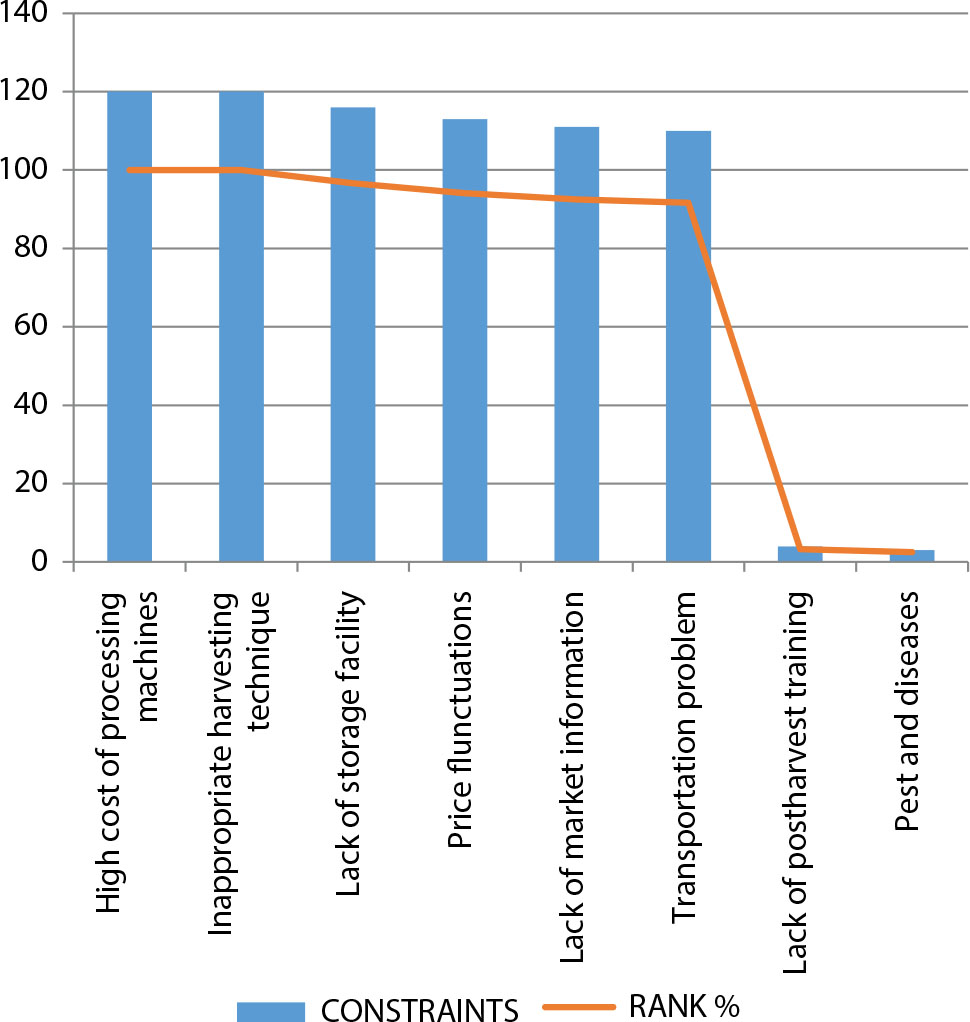
Fig. 1.
Constraints to farmers' postharvest management practices
Source: data analysis, 2021.
MAJOR FINDINGS
Cassava Logistics and Supply Chain
Cassava is grown in many regions worldwide, with Nigeria being one of the leading producers. The harvesting process is mainly manual, and to prevent spoilage, fresh cassava is rapidly transported to local markets. The tubers are then processed into various products, including chips, starch, flour, garri, and fufu. In 2023, the global export market value of cassava was approximately $3.48 billion, a 30% decline from the $4.94 billion recorded in 2022 (OEC, 2023).
Farmers' Age, Farm Acreage Holding, and Postharvest Management
The negative correlation between farmers' age, farm acreage, and postharvest management suggests that farmers should consider joint ownership of farm holdings. This approach would enable them to acquire larger farm areas, share management responsibilities, and divide labor, leading to increased productivity and lighter workloads as they age. To facilitate this, the government should amend the state's cooperative laws to allow the formation of Limited Cooperative Associations (LCAs). Such legal entities would support farmers in creating joint business ownerships, thus enabling large-scale equity acquisition and attracting development partners (Grashuis, 2018).
Farmers' Education and Technological Innovation in the Cassava Value Chain
The econometric results of this study indicate that farmers' education and technological innovations—such as modern storage facilities and innovative harvesting techniques – are significant factors for achieving positive postharvest outcomes. This underscores the importance of prioritizing farmers' education as a prerequisite for adopting innovations within the cassava value chain.
Technologies like advanced harvesting methods, which help minimize harvesting losses, and modern storage facilities, which reduce the urgency for farmers to process cassava tubers immediately after harvest, are crucial for significantly lowering postharvest losses. These innovations can be most effectively adopted through targeted education and awareness campaigns.
Therefore, governments and development partners should focus on farmers' education by promoting the dissemination of innovative information and the introduction of appropriate technologies. This will equip farmers with the necessary tools to improve postharvest management and enhance overall productivity.
Farmers' Constraints to Effective Postharvest Management
The study revealed that farmers faced several logistical and technical challenges in their postharvest management efforts, including the lack of improved storage facilities, inadequate harvesting techniques, and limited transportation options to the nearest market, among others.
To address these challenges, the government should prioritize relevant training for farmers, along with facilitating access to credit through farmers' cooperatives. Additionally, efforts should be made to promote rural-urban transformation and improve infrastructure, all of which are essential for enhancing postharvest management.
CONCLUSION AND RECOMMENDATIONS
The study shows that cassava farmers in the study area are predominantly married, come from male-headed households, and have relatively large families. Most of the farmers are young and in their productive years. The majority are smallholders with little formal education, and most do not belong to cooperative societies. Additionally, virtually all of them lack formal postharvest management training.
Despite cassava farming being profitable, with a net return of ₦0.73 for every naira invested, farmers face significant postharvest losses. On average, each farmer loses 2,062 kg of cassava, amounting to ₦25,506 in income. Most farmers lack proper training, relying on informal sources such as friends and family for postharvest advice, and continue to use outdated harvesting techniques. Furthermore, they face challenges such as inadequate storage facilities, and postharvest activities are often rushed and poorly planned.
Regression analysis indicates a significant negative correlation between farmers' age, acreage holding, distance to the nearest market, and postharvest management practices (at the 5% significance level). On the other hand, factors such as farmers' education, access to improved storage facilities, and the adoption of innovative harvesting techniques are positively associated with better postharvest outcomes (at the 1% significance level). Key challenges identified include the high cost of processing machines, improper harvesting methods, and a lack of adequate storage.
Recommendations for Policy Action:
Promote Collaborative Farming through Cooperatives:
The negative correlation between farmers' age, acreage holding, and postharvest management suggests that the government should amend cooperative laws to facilitate the formation of Limited Cooperative Associations (LCAs). These groups would enable farmers to pool resources, invest in large-scale production, and share workloads, thus enhancing productivity and easing the burden on aging farmers.
Focus on Education and Technological Adoption: Given the critical role of education in promoting innovation, the government should prioritize farmers' education. Training programs should focus on modern harvesting techniques that reduce losses and the use of improved storage facilities that prevent hurried processing. By equipping farmers with these skills, the adoption of these technologies will significantly reduce postharvest losses.
Support Infrastructure Development and Access to Credit:
Development partners should support farmers with relevant training and facilitate easy access to credit through cooperatives. Additionally, rural infrastructure development should be prioritized to provide farmers with modern processing machines, better storage facilities, and improved transportation options. This would help reduce logistical barriers and enhance the efficiency of cassava production and postharvest management.