The agricultural production landscape in Sierra Leone is dominated by small-scale and resource-poor farmers, who produce over 90% of the food consumed in the country in small (<2 ha) dispersed land holdings. Food security is a major component of the first pillar of the four key national development goals NATP-GoSL (2019). The government's overarching strategic policies and programs such as the Agenda for Change (2009–2013), Agenda for Prosperity (2013–2018), and the Smallholder Commercialization Program (SCP), consistently prioritized the transformation of agriculture and the boosting of the incomes of small-scale farmers by supporting value-chain development to move from low-input, subsistence-oriented production systems to a sector that can support the country's aspirations to become a middle-income country. Indeed, the central strategic focus of the NDG goals is to achieve middle-income status and eradicate hunger and promote food security in the country by the year 2030 (NATP-GoSL, 2019). The recent focus has been on the intensification, diversification, and commercialization of smallholder agriculture through value-addition and access to markets (COWI, 2019).
Even though agriculture is the engine and strategic growth sector for Sierra Leone's social and economic development, the sector is constrained by a myriad of challenges. These include issues of access to relevant technologies and improved practices, low agricultural productivity, lack of improved inputs, labor shortages, post-harvest losses, land degradation, deforestation, institutional weaknesses, and deep-rooted problems with the organization and management of agricultural education, research, and advisory systems. These challenges have undermined sustainable agricultural development in the country (GoSL, 2017; REACH, 2018; USAID, 2017). Even though agriculture contributes to the socio-economic transformation of Sierra Leone, food production has not been able to keep pace with the population growth, as a high percentage of the country's population is living in poverty and about 70 percent of the population is still living below the national poverty line, with 35 percent undernourished (IMF, 2015; LDC, 2022). This is attributed to the fact that the sector is characterized by low-input/output production systems, leading to high food importation (GoSL-MAF, 2019).
The food security situation in the country is a national concern and low-income households and smallholder farmers are mostly affected. Ensuring food security has been the most important economic and political issue facing the country for some time (National Agriculture Transformation Programme, 2019–2023; FAO, IFAD, UNICEF, WFP, and WHO, 2022). It is worth noting that in Sierra Leone, the gap between food supply and food demand is widening, which is evident in the observed food deficit and the upward trend in the market price of foodstuffs in recent times. As stated in the national SDGs, food production needs to be doubled to meet its population's food demands by providing food of a sufficient quantity and quality for all (SLNBCC, 2017; COWI, 2019). These multiple challenges are further exacerbated by the compounded effects of climate change (Irish, Aid, 2016; FAO-GoSL-GAFSP, 2020). According to the World Risk Report (2017), Sierra Leone is highly vulnerable and lacks the capacity to adapt to extreme events such as food chain crises and natural hazards which have a direct impact on food security and livelihoods. The country experiences a variety of climatic hazards such as seasonal drought, strong winds, thunderstorms, landslides, heat waves, and floods. Changes in rainfall and temperature patterns are reducing crop yields, and increasing livestock stress levels, and pest and disease outbreaks are becoming more pronounced. These changes have adversely affected rural livelihoods, reduced export earnings and limited the capacity to pay for food imports (Rhodes and Kargbo, 2018).
Climate change poses significant challenges to humankind because of the global nature of the problem, as well as its potentially catastrophic impacts and the unknown nature and unpredictability of its onset (FAO, 2021b). As a predominantly agrarian economic nation, climate change has threatened Sierra Leone's key economic sectors and increased the potential to negatively influence climate indicators, which are subsequently the drivers of agro-climate and farming systems. The country's high dependence on agriculture and natural resources, coupled with high rates of poverty, unemployment, and environmental degradation, all leaves Sierra Leone vulnerable to climate change impacts. The country's climate change projections include more extreme weather, with increases in temperature, more intense precipitation, and raising sea levels. As the country relies heavily on rain-fed agriculture, climate change poses a serious threat to food and livestock production. Moreover, climate change has a negative impact on agriculture communities that depend on agro-based livelihoods. In turn, this poses a threat to agriculture, economic growth and development as the climate continues to change. USAID (2017) predicted the possibility of extreme weather events severely impacting agriculture in Sierra Leone.
In Sierra Leone, agriculture depends on many factors, including the prevailing environmental or agroclimatic indicators such as rainfall, sunshine, temperature, and relative humidity, and physiographic factors such as vegetation and soils. These factors give distinctive characteristics of the various agroecological zones of the country. SLARI (2019) describes an agroecological zone as a land unit carved out of agro-climatic zones superimposed on landforms, which acts as a modifier to climate and length of the growing period. Therefore, it is necessary to delineate the agro-climatic and agroecological zones of Sierra Leone for the planning and development of agriculture. Based on various ecological, climatic, geological, and topographical factors, Sierra Leone is be-delineated into four distinctive agroecological zones, namely the coastal plain, the savannah woodland, the transitional rainforest, and the rainforest. The parameters taken for the classification of these agroecological zones are the characteristics of the physiographical features, soil characteristics, agro-climatic types, and length of the growing period. To a large extent, the agroecological settings coupled with the prevailing climatic indicators determine the types of farming systems practiced.
GoSL-MAF (2019) describes the farming system as a dominant individual farming activity that has broadly similar resource basis, enterprise patterns, household livelihoods, and constraints, and for which similar development strategies and interventions would be appropriate. Agriculture in Sierra Leone broadly constitutes diverse farming systems that include crop farming systems, livestock farming systems, and fishery farming systems (NATP-GoSL, 2019–2023). These farming systems, mainly including crops, livestock, and fishery, serve as a source of livelihood, employment, and income mainly for smallholder farmers in the country. It is worth noting that the prevailing agroecological zones and socioeconomic factors are the overriding considerations in a smallholder farmer's choice of a particular farming system. Since farming is mostly rain-fed, with rainfall being the most critical indicator of climate (GOSL, 2019), climate change is projected to significantly affect crops, livestock, and fishery farming in the country.
Studies have shown that climate change is evident, and Sierra Leone is vulnerable to climate change impacts (Rhodes et al., 2018; IFAD, 2020; GoSL, 2020; and World Risks Report, 2017). Consequently, the agricultural sector, which is the engine of the country's economy, is greatly threatened and these issues tend to exacerbate the low productivity of agriculture and food insecurity in the country (USIAD, 2017). Smallholder farmers, who constitute a high proportion of the agricultural sector and also produce over 90% of the food consumed in the country, are the most vulnerable population to the changing climate. This is because they lack financial, technical, and political means to support adaptation efforts due to a lack of training for extension officers on enhancing productivity, climate change adaptation, and mitigation for sustainable agriculture (World Risk Report, 2017). Food security, poverty, and climate change are closely linked and should not be considered separately. Without strong adaptation measures, and financing to support them, poverty will not be alleviated and food security goals will not be reached (IFAD, 2020). Adaptation measures not only enhance food security but can potentially contribute to reducing greenhouse gas emissions from agriculture. Early action is needed to identify and scale up best practices, build capacity and experience, and help clarify future choices.
In addressing the vulnerability of smallholder farmers to climate change, the concept of climate-smart agriculture (CSA) practices was introduced by FAO as a strategy for creating the technical, policy, and financial frameworks necessary to ensure sustainable agricultural development for food security in the face of climate change (FAO, 2021). Climate-smart agriculture sustainably increases productivity, and resilience (to climate change), reduces/removes greenhouse gases (mitigation), and enhances the achievement of national food security and development goals (FAO, 2021. It combines the three pillars of sustainable development (economic, social, and environmental) by concurrently tackling the problems of food security, ecosystem management, and climate change. It is supported by three major pillars: sustainably increasing agricultural productivity and incomes; adapting and building resilience to climate change; and reducing and/or removing greenhouse gas emissions, where possible. It is an agricultural practice that increases productivity sustainably, and resilience (to climate change), reduces/removes greenhouse gases (mitigation), and enhances the achievement of national food security and development goals. Climate-smart agriculture offers triple wins for food security, adaptation, and mitigation. Such agriculture requires greater attention in African policy processes and strategies, from national to regional levels. While much has been discussed on climate change occurrences and impacts on agricultural production and productivity in recent past years, less is known about the synergies between climate change, farming systems, and climate-smart agriculture practices among smallholder farmers in Sierra Leone. The objective of the study was therefore to examine climate change awareness and incidence across farming systems and agroecological zones in Sierra Leone. The rate of incidence of climate change was also determined among farmers.
Sierra Leone is a country bordered by Guinea, Liberia and, the Atlantic Ocean on the north, east, south and the west, respectively. It has a land mass of about 72,000 km2 and is located within the Upper Guinean Rainforest, ecoregion. Sierra Leone has a tropical monsoon and tropical climate which is currently divided into four main agroecological zones namely Coastal Plain, Savannah Woodland, Transitional Rainforest, and Rainforest (SLARI, 2019); and characterized predominantly by a hot and humid climate with distinct wet (May to October) and dry (November to April) seasons. The study covered 7 districts, including Kailahun, Bo, Bonthe, Moyamba, Kambia, Koinadugu, and, Western Rural District, across the five administrative provinces namely Eastern, Southern, Northern, North-Eastern, Western Areas of the country.
The Statistics Sierra Leone (2022) midterm census provisional report revealed that there are about 7,541,641 (3,716,263 males and 3,825,378 females) million people living in the country, who are distributed within the Agro-ecological Zones (AEZs) with diverse characteristics for a wide range of farming systems. According to SLARI (2017), Sierra Leone is divided into four (4) Agro-ecological Zones (AEZs) and sixteen (16) districts. The AEZs overlapped into 3–4 districts, thus the AEZs are not mutually exclusive of the districts. The agricultural production landscape in Sierra Leone is dominated by small-scale and resource-poor farmers, who produce over 90% of the food consumed in the country in small (<2 ha) dispersed holdings. Food production and other activities from agriculture (crops, livestock, forestry, and fisheries) form the most important contributor to the economy of Sierra Leone (PEMSD/MAFFS, 2015; USAID, 2017).
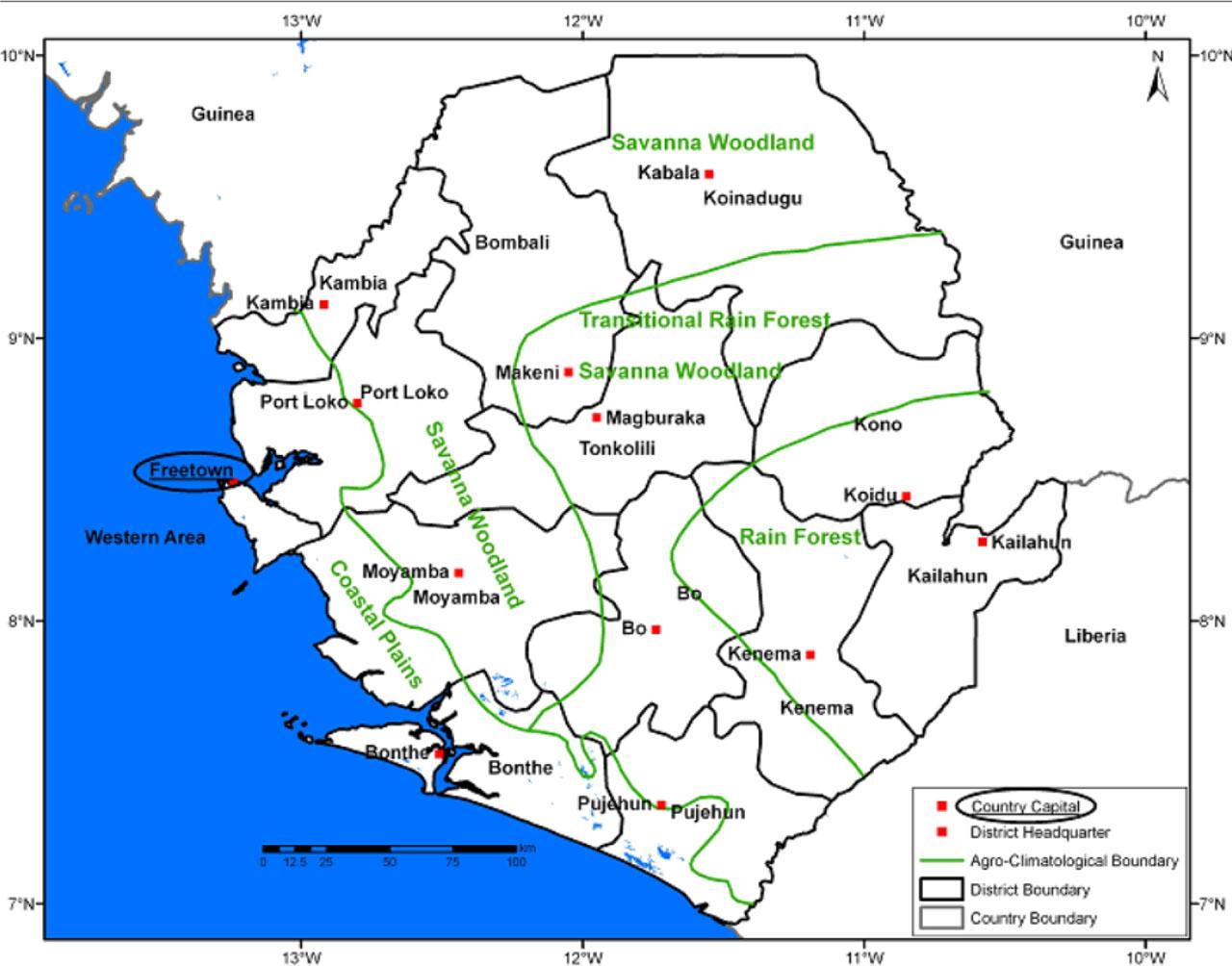
Map of Sierra Leone showing the Agro-Ecological Zones
Source: SLARI Strategic Plan, 2012–2021.
This study uses an expo facto design approach and explains the prediction of possible causes after the occurrence of an effect, so that the effect of pre-existing causal conditions between independent variables and dependent variables are identified (Kerlinger, 1998). Smallholder farmers across the different agroecological zones and practicing various farming systems in Sierra Leone constituted the study population. Sierra Leone was stratified into agroecological zones by Sierra Leone Agricultural Research Institute (SLARI) and each zone covered the government administration. Districts that are predominantly reflective of the agroecological zones were purposively selected. These selected districts across the AEZs and regions of Sierra Leone included Kailahun, Bo, Bonthe, Moyamba, Kambia, Koinadugu, and Western Rural District. To generate a sampling frame, the researchers obtained prior house listings conducted by the Ministry of Agriculture for the selected districts. A Rao Soft sample size calculator was used to obtain sample size from each of the districts with 160, 110, 50, 110, 150, 130, 5, and 150, respectively, from the districts. Data were collected through structured questionnaires which had earlier been subjected to face validity by experts in agricultural extension and climate-smart agriculture and recorded a reliability coefficient of 0.87 using a split-half technique. The questionnaire assessed respondents' levels of awareness and perception of climate change parameters such as rainfall, temperature, and sunshine in the study area over the last 5–10 years. The variables of the study, such as awareness, were measured as yes and no; the incidence of climate change was operationalized as yes and no; and the rate of incidence of climate change was operationalized as high moderate and low. Trained enumerators who understand the local languages in each of the agroecological zones in Sierra Leone were used for face-to-face interview surveys under the close supervision of one of the researchers. The data were analyzed as a reference group and no unique individual identifiers were included in the data or the results. Ethics approval was granted by the committee of the School of Agriculture, Njala University, Sierra Leone. Data were analyzed using percentages, multiple regression, and PCA.
The Multiple Regressio Model is expressed as
Where:
Y – climate awareness, the incidence of climate change
X – independent variables (adoption of smart practices on weather, livestock, crop, nutrient, water; constraints to adoption, socioeconomic characteristics, and agro-ecological zones)
β – coefficient of parameters
β0 – intercept
ɛ – error term
The Principal Components Analysis, as specified by Koutsoyiannis (2003), is presented as follows:
Given variables (Xs… original variables of the composite climate-smart agriculture, awareness, and perception of climate change)
Xs…Xp measured in ‘n’ farmers
P1…Pp: the principal components which are uncorrelated linear combinations of the variables, X1…Xp, given a P1 = α11X1 + α12X2 + … + α1pXpP2 = α21X1 + α22X2 + … +
Pp = αp1X1 + αp2X2 + … + α1ppXpz
The component loadings were chosen on the condition that the principal components were not related, and that the first component would account for the maximum possible proportion of the total variation in the original variables.
The results are organized into five sections on climate change awareness, the incidence of climate change, rate of climate change incidence determinants of climate change awareness and incidence, and principal component analysis of the determinants of awareness and incidence of climate change across farming systems and agroecological zones.
Table 1 presents the results of the climate change awareness by smallholder farmers across farming systems and agroecological zones. The level of awareness and issues covered by the awareness varied across farming systems and agroecological zones. No awareness was recorded for fishery and livestock farming systems under savannah woodland and rainforest agroecological zones because most farmers in these agroecological zones do not practice these farming systems. The most prominent indicators of awareness of climate change among farmers under the crop farming system are: interruption of the farming calendar (33.7%) and crop failure (33.8%); frequent pests and disease outbreaks (71.4) under the livestock farming system; change in the degree of temperature (94.1%); and change in the intensity of rainfall (93.1%) under fishery in the coastal plain agroecological zone. In the savannah woodland agroecological zone, prominent indicators of awareness of climate change are the frequency of rainfall (94.2%), change in humidity (95.6%) and incidence of droughts (34.1%), the appearance of new weed species (32.6%) for livestock and crop farming systems, respectively. In the transitional rainforest agroecology, farmers in crop farming systems are aware of excessive runoff (28.2%), and frequent pest and disease outbreaks (28.9%). A notable awareness factor in the fishery farming system is the prolonged rainy season (12%). Changes in the frequency of rainfall and increased flooding were reported in the crop farming system under the rainforest agroecological zone.
Climate change awareness by smallholder farmers across farming systems and agroecological zones
| Climate change awareness | Agroecological zones | |||||||||||
|---|---|---|---|---|---|---|---|---|---|---|---|---|
| coastal plain | savanna woodland | transitional rain forest | rain forest | |||||||||
| crop | L/stock | fishery | crop | L/stock | fishery | crop | L/stock | fishery | crop | L/stock | fishery | |
| freq (%) | freq (%) | freq (%) | freq (%) | freq (%) | freq (%) | freq (%) | freq (%) | freq (%) | freq (%) | freq (%) | freq (%) | |
| 1 | 2 | 3 | 4 | 5 | 6 | 7 | 8 | 9 | 10 | 11 | 12 | 13 |
| Change in the degree of temperature | 172 (30.6) | 5 (4.7) | 95 (94.1) | 152 (27.0) | 100 (93.5) | – | 119 (21.2) | 2 (1.9) | 6 (5.9) | 119 (21.2) | – | – |
| Change in the intensity of rainfall | 198 (32.1) | 4 (3.8) | 99 (93.4) | 150 (24.4) | 98 (94.2) | – | 120 (19.5) | 2 (1.9) | 7 (6.6) | 148 (24.0) | – | – |
| Change in the frequency of rainfall | 192 (31.7) | 7 (7.3) | 99 (90.8) | 147 (24.3) | 86 (89.6) | – | 120 (19.8) | 3 (3.1) | 10 (9.2) | 147 (24.3) | – | – |
| Change in humidity (Heat) | 157 (28.4) | 3 (3.3) | 84 (91.3) | 150 (27.1) | 87 (95.6) | – | 119 (21.5) | 1 (1.1) | 8 (8.7) | 127 (23.0) | – | – |
| Change in the frequency of wind | 160 (28.8) | 3 (3.0) | 93 (94.9) | 143 (25.8) | 96 (95.0) | – | 118 (21.3) | 2 (2.0) | 5 (5.1) | 134 (24.1) | – | – |
| Change in the intensity of Sunshine | 186 (31.5) | 9 (8.5) | 94 (94.0) | 144 (24.4) | 92 (86.8) | – | 119 (20.2) | 5 (4.7) | 6 (6.0) | 141 (23.9) | – | – |
| A prolonged dry season | 149 (26.5) | 4 (3.8) | 61 (91.0) | 158 (28.1) | 100 (94.3) | – | 118 (21.0) | 2 (1.9) | 6 (9.0) | 138 (24.5) | – | – |
| A prolonged rainy season | 165 (28.3) | 3 (3.4) | 73 (88.0) | 159 (27.2) | 84 (94.4) | – | 120 (20.5) | 2 (2.2) | 10 (12.0) | 140 (24.0) | – | – |
| A reduced harmattan period | 122 (24.4) | 3 (3.9) | 68 (91.9) | 146 (29.2) | 73 (94.8) | – | 114 (22.8) | 1 (1.3) | 6 (8.1) | 118 (23.6) | – | – |
| Warmer harmattan season | 123 (24.6) | 4 (4.2) | 66 (91.7) | 150 (29.9) | 89 (93.7) | – | 109 (21.8) | 2 (2.1) | 6 (8.3) | 119 (23.8) | – | – |
| Drier wetlands | 131 (26.4) | 5 (4.8) | 39 (88.6) | 144 (29.0) | 97 (93.3) | – | 106 (21.4) | 2 (1.9) | 5 (11.4) | 115 (23.2) | – | – |
| Increased flooding | 130 (25.2) | 2 (4.3) | 53 (91.4) | 158 (30.6) | 44 (93.6) | – | 104 (20.2) | 1 (2.1) | 5 (8.6) | 124 (24.0) | – | – |
| Pest and disease resistance to control | 159 (29.1) | 3 (3.5) | 40 (88.9) | 147 (26.9) | 81 (94.2) | – | 106 (19.4) | 2 (2.3) | 5 (11.1) | 135 (24.7) | – | – |
| Drought | 93 (24.2) | 0 (0.0) | 20 (100) | 131 (34.1) | 68 (100.) | – | 88 (22.9) | 0 (0.0) | 0 (0.0) | 72 (18.8) | – | – |
| The appearance of new weed species | 82 (22.3) | 6 (4.5) | 23 (100) | 120 (32.6) | 2 (18.2) | – | 92 (25.0) | 3 (27.3) | 0 (0.0) | 74 (20.1) | – | – |
| Recession of rivers | 71 (28.5) | 4 (8.9) | 39 (100) | 52 (20.9) | 39 (86.7) | – | 68 (27.3) | 2 (4.4) | 0 (0.0) | 58 (23.3) | – | – |
| Excessive run-off | 96 (30.1) | 1 (2.4) | 35 (100) | 58 (18.2) | 39 (86.7) | – | 90 (28.2) | 2 (4.4) | 0 (0.0) | 75 (23.5) | – | – |
| Frequent pests and disease outbreaks | 95 (27.2) | 5 (71.4) | 29 (100) | 80 (22.9) | 2 (40.0) | – | 101 (28.9) | 1 (20.0) | 0 (0.0) | 73 (20.9) | – | – |
| Insufficient flow of water bodies | 89 (28.3) | 2 (4.0) | 41 (89.1) | 110 (34.9) | 73 (93.6) | – | 62 (19.7) | 2 (2.6) | 5 (10.9) | 54 (17.1) | – | – |
| Rise in sea/ocean levels | 59 (100) | 3 (3.8) | 69 (32.4) | 49 (23.0) | 0 (0.0) | – | 50 (23.5) | 28.6) | 0 (0.0) | 45 (21.1) | – | – |
| Interruption of the farming calendar | 199 (33.7) | – | – | 157 (26.6) | 0(0.0) | – | 117 (19.8) | 0(0.0) | – | 118 (20.0) | – | – |
| Crop failure | 204 (33.8) | – | – | 159 (26.4) | 0(0.0) | – | 118 (19.6) | 0(0.0) | – | 122 (20.2) | – | – |
| Less fertile soils | 175 (31.5) | – | – | 156 (28.1) | 0(0.0) | – | 113 (20.3) | 0(0.0) | – | 112 (20.1) | – | – |
| Shifting in seasonal patterns | 187 (31.6) | 10 (9.2) | 99 (90.8) | 152 (25.7) | 94 (86.2) | – | 114 (19.3) | 5 (4.6) | 10 (9.2) | 138 (23.4) | – | – |
| Limit animal productivity | – | 1 (1.1) | – | 0 (0.0) | 89 (97.8) | – | 0 (0.0) | 1 (1.1) | – | 0 (0.0) | – | – |
| Reducing the area for grazing | – | 2 (1.9) | – | 0 (0.0) | 100 (97.1) | – | 0 (0.0) | 1 (1.0) | – | 0 (0.0) | – | – |
| Increase death rate in livestock | – | 10 (9.1) | – | 0 (0.0) | 95 (86.4) | – | 0 (0.0) | 5 (4.5) | – | 0 (0.0) | – | – |
| Disruption of fish habitat | – | 0(0.0) | 93 (100) | 0 (0.0) | 0(0.0) | – | 0 (0.0) | 0(0.0) | 0 (0.0) | 0 (0.0) | – | – |
| Change in animal migration patterns | – | 3 (3.1) | – | 0 (0.0) | 91 (94.8) | – | 0 (0.0) | 2 (2.1) | – | 0 (0.0) | – | – |
| Lead to poverty and hunger | 193 (31.9) | 10 (9.3) | 56 (84.8) | 156 (25.8) | 92 (86.0) | – | 119 (19.7) | 5 (4.7) | 10 (15.2) | 137 (22.6) | – | – |
Source: field survey, 2022.
The trend of the results from Table 1 could be attributed to experiences, observations, and incidences that smallholder farmers have experienced in the past few years. These have culminated in the proportion and linkages of these occurrences to climate change. Akano et al. (2022a) reported that “increasing rainfall and temperature would impact warmer conditions that support rapid crop putrefaction, flooding, droughts, challenging postharvest crop management, pest, and disease proliferation, and ultimately, reduced crop yields, while perpetually low rainfall and temperature conditions will cause poor seedling emergence and growth, seed and total crop loss”. Several authors have reported that smallholder farmers and agro-pastoralists in African countries have a high level of climate change awareness (Ado et al., 2019).
The results for the incidence of climate change among smallholder farmers across farming systems and agroecological zones are presented in Table 2. The level of incidence and issues covered by the incidence varied across farming systems and agroecological zones. No incidence was recorded for fishery farming systems under savannah woodland agroecology nor livestock and fishery farming systems in the rainforest agroecological zone, due to the non-prominence of such farming systems in these agroecological zones. Increased flooding (37.6%), interruption of the farming calendar (35.7%, crop failure (3,5.7%), and less fertile soils (36.3%) were the major incidents attributed to climate change by farmers in the crop farming systems under the coastal agroecological zone. Farmers operating fishery farming systems under coastal agroecological zone reported incidences of the prolonged dry season (96.5%), increased flooding (98.4%), and disruptions of fish habitat (98.6%). Ihenacho et al. (2019) and Hundera et al. (2019) reported an increase in strong winds, low precipitation, drought, and desertification as indicators of climate change among smallholders. Akano et al. (2022b), in their study of awareness and perception of climate change by smallholder farmers in agroecological zones of Oyo state Nigeria, affirmed that the indicators of climate change were more profound and different when savannah is compared to the rainforest agroecological zone; thus, farmers in the savannah agroecological zone had higher awareness of incidences of climate variability. In the savannah woodland agroecological zones, farmers operating in the crop farming system reported incidences of change in the degree of temperature (35.7%) and change in rainfall intensity (33.5%), while farmers in the livestock farming system indicated a change in the frequency of wind storms (95.9%), low animal productivity (97.9%) and increased morbidity and death rate in livestock (92.2%). Farmers in the crop farming system under transitional rainforest agroecology reported incidences of change in the frequency of windstorms (23.3%); while farmers in the fishery farming system indicated a change in heat and the frequency of rainfall at 10.5% and 10.3%, respectively. Only farmers in the crop farming system under the rainforest agroecology indicated incidences of drought (28.3%), excessive run-off (24.9%), and insufficient flow of water bodies (26.1%). Akano et al. (2022b) reported incidences of crop failure, a reduction in crop yields, less fertile soils, and a reduction in organic matter across the agroecological zones of southwest Nigeria. According to Issa et al. (2015) and Vani (2016), harsh growing conditions due to erratic weather patterns were observed by farmers as part of the evidence of climate change. Akano et al. (2022a) also stated that farmers across the agroecological zones of southwest Nigeria reported the incidence of the prolonged dry season, extended periods of the wet season, and the decline in the Harmattan season, and a warmer Harmattan season as evidence of climate change.
Incidence of climate change among smallholder farmers across farming systems and agroecological zones
| Incidence of climate change | Agroecological zones | |||||||||||
|---|---|---|---|---|---|---|---|---|---|---|---|---|
| coastal plain | savanna woodland | transitional rain forest | rain forest | |||||||||
| crop | L/stock | fishery | crop | L/stock | fishery | Crop | L/stock | fishery | crop | L/stock | fishery | |
| Freq (%) | Freq (%) | Freq (%) | Freq (%) | Freq (%) | Freq (%) | Freq (%) | Freq (%) | Freq (%) | Freq (%) | Freq (%) | Freq (%) | |
| 1 | 2 | 3 | 4 | 5 | 6 | 7 | 8 | 9 | 10 | 11 | 12 | 13 |
| Change in the degree of temperature | 130 (30.4) | 8 (7.8) | 79 (91.9) | 153 (35.7) | 91 (88.3) | – | 67 (15.7) | 4 (3.9) | 7 (8.1) | 78 (18.2) | – | – |
| Change in the intensity of rainfall | 133 (28.9) | 4 (4.3) | 77 (89.5) | 152 (33.) | 88 (93.6 | – | 84 (18.3) | 2 (2.1) | 9 (10.5) | 91 (19.8) | – | – |
| Change in the frequency of rainfall | 135 (29.0) | 7 (7.5) | 78 (89.7) | 146 (31.3) | 83 (89.2) | – | 82 (17.6) | 3 (3.2) | 9 (10.3) | 82 (17.6) | – | – |
| Change in humidity (Heat) | 115 (26.8) | 8 (8.6) | 84 (92.3) | 87 (20.3) | 81 (87.1) | – | 87 (20.3) | 4 (4.3) | 7 (7.7) | 92 (21.4) | – | – |
| Change in the frequency of wind | 108 (25.7) | 2 (2.7) | 67 (89.3) | 128 (30.4) | 71 (95.9) | – | 98 (23.3) | 1 (1.4) | 8 (10.7) | 87 (20.7) | – | – |
| Change in the intensity of sunshine | 163 (33.9) | 4 (5.4) | 85 (92.4) | 133 (27.7) | 68 (91.9) | – | 86 (17.9) | 2 (2.7) | 7 (7.6) | 99 (20.6) | – | – |
| A prolonged dry season | 117 (30.2) | 8 (10.8) | 82 (96.5) | 112 (28.9) | 61 (82.4) | – | 67 (17.3) | 5 (6.8) | 3 (3.5) | 92 (23.7) | – | – |
| A prolonged rainy season | 121 (29.2) | 5 (7.7) | 60 (90.9) | 120 (28.9) | 58 (89.2) | – | 73 (17.6) | 2 (3.1) | 6 (9.1) | 101 (24.3) | – | – |
| A reduced harmattan period | 109 (31.5) | 4 (12.9) | 55 (93.2) | 103 (29.9) | 25 (80.6) | – | 67 (19.4) | 2 (6.5) | 4 (6.8) | 67 (19.4) | – | – |
| Warmer Harmattan season | 98 (27.7) | 8 (12.7) | 56 (94.9) | 105 (29.7) | 51 (81.0) | – | 77 (21.8) | 4 (6.3) | 3 (5.1) | 74 (20.9) | – | – |
| Drier wetlands | 112 (30.4) | 0 (0.0) | 73 (97.3) | 92 (24.9) | 43 (100) | – | 81 (22.0) | 0 (0.0) | 2 (2.7) | 84 (22.8) | – | – |
| Increased flooding | 133 (37.6) | 0 (0.0) | 60 (98.4) | 91 (25.7) | 34 (100) | – | 69 (19.5) | 0 (0.0) | 1 (1.6) | 61 (17.2) | – | – |
| Pest and disease resistance to control | 109 (26.5) | 5 (9.3) | 19 (86.4) | 130 (31.6) | 47 (87.0) | – | 86 (20.9) | 2 (3.7) | 3 (13.6) | 87 (21.1) | – | – |
| Drought | 92 (24.1) | 4 (13.8) | 48 (100) | 121 (31.7) | 23 (79.3) | – | 61 (16.0) | 2 (6.90 | 0 (0.0) | 108 (28.3) | – | – |
| The appearance of new weed species | 108 (29.8) | 0 (0.0) | 46 (100) | 91 (25.1) | 31 (100) | – | 80 (22.1) | 0 (0.0) | 0 (0.0) | 83 (22.9) | – | – |
| Recession of rivers | 96 (31.5) | 0 (0.0) | 54 (100) | 71 (23.3) | 30 (100) | – | 60 (19.7) | 0 (0.0) | 0 (0.0) | 78 (25.6) | – | – |
| Excessive run-off | 109 (29.8) | 0 (0.0) | 65 (100) | 81 (22.1) | 11 (100) | – | 85 (23.2) | 0 (0.0) | 0 (0.0) | 91 (24.9) | – | – |
| Frequent crop pests and disease outbreaks | 104 (29.7) | 4 (10.3) | 54 (100) | 88 (25.1) | 32 (82.1) | – | 80 (22.9) | 3 (7.7) | 0 (0.0) | 78 (22.3) | – | – |
| Insufficient flow of water bodies | 72 (24.7 | 0 (0.0) | 69 (100) | 65 (22.3) | 9 (100) | – | 78 (26.8) | 0 (0.0) | 0 (0.0) | 76 (26.1) | – | – |
| Rise in sea/ocean levels | 97 (30.6) | 0 (0.0) | 74 (100) | 81 (25.6) | 21 (100) | – | 68 (21.5) | 0 (0.0) | 0 (0.0) | 71 (22.4) | – | – |
| Interruption of the farming calendar | 169 (35.7) | – | – | 108 (22.8) | – | – | 83 (17.5) | – | – | 113 (23.9) | – | – |
| Crop failure | 177 (35.7) | – | – | 130 (26.2 | – | – | 86 (17.3) | – | – | 103 (20.8) | – | – |
| Less fertile soils | 166 (36.3) | – | – | 119 (26.0) | – | – | 90 (19.7) | – | – | 82 (17.9) | – | – |
| Shifting in seasonal patterns | 143 (31.9) | 8 (11.6) | 86 (93.5) | 112 (25.0) | 56 (81.2) | – | 100 (22.3) | 5 (7.2) | 6 (6.5) | 93 (20.8) | – | – |
| Limit animal productivity | – | 1 (1.0) | – | – | 95 (97.9) | – | – | 1 (1.0) | – | – | – | – |
| Reducing the area for grazing | – | 0 (0.0) | – | – | 100 (100) | – | – | 0 (0.0) | – | – | – | – |
| Increase morbidity and death rate in livestock | – | 5 (5.6) | – | – | 83 (92.2) | – | – | 2 (2.2) | – | – | – | – |
| Disruption of fish habitat | – | – | 71 (98.6) | – | – | – | – | – | 1 (1.4) | – | – | – |
| Change in animal migration patterns | – | 1 (1.0) | – | – | 100 (98.0) | – | – | 1 (1.0) | – | – | – | – |
Source: field survey, 2022.
In Table 3, the rate of incidence of climate change among smallholder farmers across farming systems and agroecological zones in Sierra Leone is presented. The rate of incidence was rated on a 3-point scale of High, Moderate, and Low to elicit the frequency of occurrence of climate change indicators. The results were pooled across farming systems and agroecological zones to give a holistic pattern of farmers' responses. The climate change indicators with the highest and most frequent occurrence are changes in the intensity of rainfall (74.0%), change in the frequency of rainfall (74.7%), changes in the intensity of sunshine (74.8%), prolonged dry season (63.2%), and a prolonged raining season (63.1%). The trend of these results may be because the crop farming system predominates all others in Sierra Leone. Similarly, savannah woodland, transitional rainforest, and rainforest agroecological zones accommodate more farming activities than the coastal plain zone. Nyang'au et al. (2021) and Myeni and Moeletsi (2020) noted that farmers indicated a decrease in rainfall, poor rainfall distribution, late onset of rainfall, and an increase in temperature. According to Mamun et al. (2021), farmers reported incidences of the flood, drought, riverbank erosion, and heat waves; Asrat and Simane (2018) stated that there exists an increasing trend in decreasing temperature trend in precipitation among farmers. Similarly, Asante et al. (2021) reported protracted drought, unpredictable rainfall patterns high temperatures, strong winds, and frequent flood events. According to Ajuang (2016), households reported rising temperatures, declining rains, increased droughts frequency, and changes in water sources. Ayanlade et al. (2017) concluded that farmers' perceptions of climate change based on local climate parameters mirror meteorological analysis.
Rate of incidence of climate change among smallholder farmers across farming systems and agroecological zones
| Climate change parameters | Rate of incidence of climate change | ||||
|---|---|---|---|---|---|
| high | moderate | low | none response | total | |
| freq (%) | freq (%) | freq (%) | freq (%) | freq (%) | |
| Change in the degree of temperature | 617 (71.3) | 131 (15.1) | 50 (5.8) | 67 (7.7) | 865 (100) |
| Change in the intensity of rainfall | 640 (74.0) | 142 (16.4) | 62 (7.2) | 21 (2.4) | 865 (100) |
| Change in the frequency of rainfall | 646 (74.7) | 141 (16.3) | 57 (6.6) | 21 (2.4) | 865 (100) |
| Change in humidity (heat) | 613 (70.9) | 137 (15.8) | 26 (3.0) | 89 (10.3) | 865 (100) |
| Change in the frequency of wind | 570 (65.9) | 178 (20.6) | 39 (4.5) | 78 (9.0) | 865 (100) |
| Change in the intensity of sunshine | 647 (74.8) | 160 (18.50 | 19 (2.2) | 39 (4.5) | 865 (100) |
| Evidence of climate change | |||||
| A prolonged dry season | 547 (63.2) | 222 (25.7) | 39 (4.5) | 57 (6.6) | 865 (100) |
| A prolonged rainy season | 546 (63.1) | 227 (26.2) | 64 (7.4) | 28 (3.2) | 865 (100) |
| A reduced harmattan period | 436 (50.4) | 313 (36.2) | 40 (4.6) | 76 (8.8) | 865 (100) |
| Warmer harmattan season | 476 (55.0) | 241 (27.9) | 101 (11.7) | 47 (5.4) | 865 (100) |
| Drier wetlands | 487 (56.3) | 216 (25.2) | 105 (12.1) | 57 (6.6) | 865 (100) |
| Increased flooding | 449 (51.9) | 259 (29.9) | 66 (7.6) | 91 (10.5) | 865 (100) |
| Pest and disease resistance to control | 488 (56.4) | 211 (24.5) | 71 (8.2) | 95 (11.0) | 865 (100) |
| Increased frequency of strong winds and dust | 498 (57.6) | 186 (21.5) | 100 (11.6) | 81 (9.4) | 865 (100) |
| Ground-water shortage | 387 (44.7) | 236 (27.3) | 114 (13.2) | 128 (14.8) | 865 (100) |
| Water stress and drought conditions | 459 (53.1) | 203 (23.5) | 60 (6.9) | 143 (16.5) | 865 (100) |
| The appearance of new weed species | 439 (50.8) | 187 (21.6) | 51 (5.9) | 188 (21.7) | 865 (100) |
| Recession of rivers | 389 (45.0) | 209 (24.2) | 59 (6.0) | 208 (24.0) | 865 (100) |
| Excessive run-off | 442 (51.1) | 153 (17.7) | 45 (5.2) | 225 (26.0) | 865 (100) |
| Frequent crop pests and disease outbreaks | 443 (51,2) | 197 (22.8) | 69 (8.0) | 156 (18.0) | 865 (100) |
| Insufficient flow of water bodies | 369 (42.7) | 206 (23.8) | 77 (8.9) | 213 (24.6) | 865 (100) |
| Rise in ocean levels | 412 (47.6) | 184 (21.3) | 54 (6.20 | 215 (24.9) | 865 (100) |
| Inundation of coastal low-lying areas | 383 (44.3) | 181 (20.9) | 74 (8.60 | 227 (26.2) | 865 (100) |
Source: field survey, 2022.
The results of the regression model on the determinants of climate change awareness and incidence by smallholder farmers across farming systems and agroecological zones are presented in Table 4. The analysis of the results shows that there is a significant relationship between the independent variables and climate change awareness with an F value of 32.45 and p = 0.05. The R-value of 0.77, R square of 0.59, and adjusted R Square of 0.57 show that multiple correlations exist between climate change awareness and independent variables, such that 59% of the variance in climate change awareness was explained by the independent variables. The independent variables comprised factors related to the adoption of adaptation techniques, constraints in the use of adaptation techniques, information need for adaptation, the incidence of climate change, and socioeconomic characteristics to give a total of 37 variables. Fifteen variables are significant with 11 at 1%, and 2 variables each at 5% and 10%. Eight out of 15 significant variables across the significance levels are inversely (negative) related to awareness of climate change. The significant determinants of awareness of climate change among farmers are: the adoption of crop-smart practices; information needs on water-smart practices; adoption of nutrient smart practices; adoption of energy/carbon-smart practices; adoption of livestock-smart practices; information needs on livestock-smart practices; information needs on weather-smart practices; incidence of climate change; constraints on livestock-smart practices; constraints on fish-smart practices; constraints on nutrient-smart practices. Others are farmers' household size; farmers' position in the community; adoption of water-smart practices; and factors influencing the farming systems practices.
Determinants of climate change awareness and incidence by smallholder farmers across farming systems and agroecological zones
| Variable | Awareness | Incidence | ||
|---|---|---|---|---|
| B(Beta) | t | B(Beta) | t | |
| 1 | 2 | 3 | 4 | 5 |
| (Constant) | 30.068 (4.539) | 6.624*** | 17.355 (8.884) | 1.953** |
| Factors influencing fish smart practices | .016 (.036) | .434 | .988 (.059) | 16.646*** |
| Adoption of crop smart practices | .199 (.047) | 4.192*** | .164 (.071) | 2.328** |
| Information needs on crop smart practices | .057 (.123) | .463 | −.182 (.091) | −1.998** |
| Constraints on crop smart practices | .091 (.060) | 1.516 | .451 (.240) | 1.880* |
| Adoption of water-smart practices | −.084 (.050) | −1.687* | −.243 (.118) | −2.061** |
| Information needs on water smart practices | −.334 (.060) | −5.581*** | .064 (.098) | .657 |
| Constraints on water smart practices | −.070 (.075) | −.921 | .030 (.119) | .251 |
| Adoption of nutrient smart practices | .445 (.042) | 10.592*** | −.379 (.148) | −2.553** |
| Information needs on nutrient smart practices | −.084 (.089) | −.949 | −.033 (.088) | −.369 |
| Constraints on nutrient smart practices | −.069 (.026) | −2.669*** | .282 (.175) | 1.614 |
| Adoption of energy/carbon smart practices | .224 (.070) | 3.206*** | −.103 (.050) | −2.047* |
| Information needs on energy/carbon smart practices | .038 (.082) | .463 | −1.003 (.134) | −7.480*** |
| Adoption of livestock smart practices | .556 (.154) | 3.608*** | .337 (.160) | 2.107** |
| Information needs on livestock smart practices | 2.782 (.496) | 5.606*** | .538 (.304) | 1.773* |
| Constraints on livestock smart practices | −2.053 (.293) | −7.019*** | −5.297 (.979) | −5.409*** |
| Adoption of fish smart practices | .043 (.090) | .474 | 2.980 (.585) | 5.096*** |
| Information needs on fish smart practices | .134 (.098) | 1.356 | .089 (.178) | .499 |
| Constraints on fish smart practices | −.406 (.121) | −3.346*** | .058 (.194) | .300 |
| Adoption of weather smart practices | −.095 (.059) | −1.604 | −.147 (.241) | −.610 |
| Information needs on whether smart practices | .446 (.127) | 3.505*** | .686 (.115) | 5.974*** |
| Constraints on weather smart practices | −.031 (.049) | −.631 | −.496 (.242) | −2.051** |
| Factors influencing the adoption of CSA practices | −.005 (.012) | −.428 | .362 (.096) | 3.761*** |
| Factors influencing the farming systems practices | .085 (.048) | 1.753* | .102 (.022) | 4.574*** |
| Age of the farmer | .007 (.022) | .316 | −.265 (.093) | −2.849*** |
| Gender of the farmer | .598 (.556) | 1.074 | −.093 (.043) | −2.171** |
| Farmers' level of education | −.294 (.227) | −1.300 | −1.156 (1.097) | −1.054 |
| Farmers' marital status | .214 (.558) | .383 | .118 (.447) | .264 |
| Farmers' religious affiliation | −.577 (.492) | −1.174 | .432 (1.101) | .392 |
| Farmers' household size | −.163 (.067) | −2.434** | −.507 (.962) | −.527 |
| Farmers' household members that are below 18 years | −.086 (.135) | −.638 | .318 (.131) | 2.421** |
| Farmers' household status | −.579 (.690) | −.839 | .115 (.264) | .437 |
| Length of stay in the community | .012 (.017) | .682 | .933 (1.362) | .685 |
| Farmers' position in the community | −.351 (.145) | −2.426** | .032 (.034) | .929 |
| Farmers' affiliation with a farming organization | .563 (.826) | .682 | .281 (.286) | .984 |
| Farmers' status in farming organization | −.019 (.206) | −.093 | .016 (1.630) | .010 |
| Agroecological zone | .131 (.248) | .529 | .431 (.406) | 1.062 |
| Incidence of climate change | .252 (.015) | 16.282*** | ||
| R | 0.77 | 0.68 | ||
| R square | 0.59 | 0.46 | ||
| Adjusted R Square | 0.57 | 0.44 | ||
| F | 32.45 | 19.78 | ||
| P | 0.05 | 0.05 | ||
Source: field survey, 2022.
Similarly, the regression model on the determinants of climate change incidence by smallholder farmers across farming systems and agroecological zones in Table 4 shows that a significant relationship exists between the independent variables and climate change incidence with an F value of 19.78 and p = 0.05. The R-value of 0.68, R square of 0.46, and adjusted R Square of 0.44 show that strong multiple correlations exist between climate change incidence and independent variables, such that 46% of the variance in climate change incidence was explained by the independent variables. The independent variables comprised factors related to the adoption of adaptation techniques, constraints in the use of adaptation techniques, information need for adaptation, the incidence of climate change, and socioeconomic characteristics to give a total of 37 variables. Eight variables each are significant at 1% and 5% respectively and 3 variables at 10%. Eight out of 19 significant variables across the significance levels are inversely (negative) related to the incidence of climate change. The significant determinants of the incidence of climate change among farmers are: factors influencing fish-smart practices; adoption of fish-smart practices; information needs on weather-smart practices; factors influencing the adoption of crop-smart practices; factors influencing the farming systems practices; the age of the farmer; constraints on livestock-smart practices; information needs on energy/carbon-smart practices; information needs on crop-smart practices; adoption of water-smart practices; adoption of nutrient-smart practices; gender of the farmer; constraints on weather-smart practices. Other significant variables are: farmers' household members that are below 18 years; adoption of crop-smart practices; constraints on crop-smart practices, adoption of energy/carbon-smart practices, adoption of livestock-smart practices; and information needs on livestock-smart practices.
The significance of adoption factors about adaptation strategies would have been influenced by the awareness of the need for such practices. The incidence of climate change also led to awareness and the adoption of adaptation strategies is responsive to awareness. Variables related to information needs described the information-seeking behavior aroused by the awareness and incidence of climate change among farmers to be able to adapt and cope with the climate variations. The significant socioeconomic factors could be due to the need to ensure food security for the households, and available family labor to help in the application of adaptation methods. Ajuang (2016) reported that gender, education level, and age significantly influenced respondents' awareness of climate change markers, while Akano et al. (2022b) stated that the determinants of climate change awareness and perception to be agroecological zones, land tenure systems, and religion among farmers. Atube et al. (2021) showed that the marital status of the household head, access to credit, access to extension services, and farm income influenced farmers' adoption of planting drought-resistant varieties as an adaptation strategy to cushion the incidence of occurrence of climate change.
The results of the Principal Component Analysis (PCA) of the determinants of awareness and incidence of climate change across farming systems and agroecological zones in Sierra Leone are presented in Table 5. From these results, four factors were extracted based on the responses of the smallholder farmers across farming systems and agroecological zones due to the Kaiser criterion (1960) that was used to select the underlying types and several components explaining the data. All variables in each of the extracted components that had Eigen values (a measure of explained variance) of less than one, which were unaccounted for, while variables with factor loadings greater than or equal to ±0.300 were considered in the depiction of the components. Koutsoyiannis (2001) noted that to indicate a positive degree of relationship, only values in loadings greater than 0.30 were selected. According to Tabachnick and Fidell (2007), “a factor loading significantly contributes to the derived component of the study if it exceeds 0.30”; thus, all the items explaining each derived component on the scale loaded appropriately upon the PCA. The squared multiple correlations between each item and all other items depicted as commonalities show the relationship between each variable and all other variables. They also show the association between variables. The extracted components for the determinants of awareness and incidence of climate change across farming systems and agroecological zones are described as Factor 1 (Impact), Factor 2 (Occurrence), Factor 3 (Evidence), and Factor 4 (Threat), and accounted for 14.96%, 8.27%, 6.41%, 3.50% of the variance, respectively. The cumulative variance was 33.14%. These results are confirmed by a Bartlett's Test of Sphericity value of X2 = 74881.9, p = 0.00 and the Kaiser-Meyer-Olkin Measure of Sampling Adequacy of 0.875. The influence of the variables that belong to the extracted components explaining the farmers' adoption of climate-smart agriculture was measured by the weights of their factor loadings; the value of each element loading represents the strength of the impact of the observed variables on an extracted element. Ozor et al. (2010) reported that poor climate information services and lack of access to climate information services were being major barriers to climate change adaptation among farming households in Southern Nigeria.
Principal Component Analysis of the determinants of awareness and incidence of climate change across farming systems and agroecological zones
| Component matrix | Factor 1 Impact | Factor 2 Occurrence | Factor 3 Evidence | Factor 4 Threat | Communalities |
|---|---|---|---|---|---|
| 1 | 2 | 3 | 4 | 5 | 6 |
| Reduce reproductive efficiency and egg production, quality, and weight | −.924 | 0.950 | |||
| Reduce body size, carcass weight, and fat thickness | −.922 | 0.952 | |||
| Reduce livestock growth | −.922 | 0.953 | |||
| Decrease water availability and quality | −.918 | 0.952 | |||
| Reduce livestock reproductive successes and milk production | −.918 | 0.955 | |||
| High Temp causes heat stress in livestock | −.917 | 0.954 | |||
| Reducing the area for grazing | −.917 | 0.955 | |||
| Increase morbidity and death rate in livestock | −.916 | 0.934 | |||
| Increase livestock water requirement | −.914 | 0.947 | |||
| Change in animal migration patterns | −.912 | 0.947 | |||
| Limit animal productivity/yield | −.907 | 0.938 | |||
| Excessive run-off | .667 | 0.705 | |||
| Reduced crop yields | .665 | 0.880 | |||
| Less fertile soils | .657 | 0.850 | |||
| Insufficient flow of water bodies | .655 | 0.719 | |||
| Inundation of coastal low-lying areas | .627 | 0.671 | |||
| Increased virulence of pathogens, new diseases, etc. | .609 | 0.694 | |||
| Rise in ocean levels | .601 | 0.658 | |||
| Water stress and drought conditions | .599 | 0.581 | |||
| The appearance of new weed species | .589 | 0.642 | |||
| Recession of rivers | .557 | 0.636 | |||
| Frequent crop pests and disease outbreaks | .535 | 0.593 | |||
| Ground-water shortage | .498 | 0.490 | |||
| Artisanal fishermen have to go farther out for catches | .880 | 0.927 | |||
| Social disruptions/new fisher Influx | .879 | 0.927 | |||
| Sea level changes, flooding, and surges | .878 | 0.925 | |||
| Disruption of fish feeding, breeding, and habitat loss | .875 | 0.929 | |||
| Increased dangers of fishing | .875 | 0.925 | |||
| Changes in the proportion of fisheries species | .839 | 0.905 | |||
| Crop failure | -.663 | 0.882 | |||
| Interruption of the farming calendar | -.622 | 0.772 | |||
| Increased frequency of strong winds and dust | .675 | 0.561 | |||
| Pest and disease resistance to control | .636 | 0.476 | |||
| A prolonged dry season | .546 | 0.505 | |||
| Change in humidity (Heat) | .538 | 0.440 | |||
| Warmer Harmattan season | .535 | 0.430 | |||
| Increased flooding | .443 | 0.371 | |||
| A prolonged rainy season | .415 | 0.228 | |||
| Drier wetlands | .388 | 0.312 | |||
| Change in the degree of temperature | .308 | 0.241 | |||
| A reduced harmattan period | .794 | 0.136 | |||
| Change in the intensity of rainfall | .732 | 0.145 | |||
| hDrying out of fish ponds | .731 | 0.068 | |||
| Change in the frequency of wind | .723 | 0.044 | |||
| Change in the intensity of Sunshine | .718 | 0.004 | |||
| Threaten farmers' welfare | .595 | 0.645 | |||
| Reduces income and agriculture-based economies | .402 | 0.571 | |||
| Shifting in seasonal patterns | .469 | 0.554 | |||
| Affect food quality | .421 | 0.608 | |||
| Lead to poverty and hunger | .454 | 0.587 | |||
| Threatens food security and livelihood | .435 | 0.383 | |||
| Change in the frequency of rainfall | .377 | 0.112 | |||
| Percentage of total variance | 14.96 | 8.27 | 6.41 | 3.50 | |
| Extraction method: Principal Component Analysis – 4 components were extracted. | |||||
| Kaiser-Meyer-Olkin Measure of Sampling Adequacy 0.875 | |||||
| Approx. Chi-Square 74881.990 | |||||
| df 1326 | |||||
| Sig .000 | |||||
The prominent items under the impact factor are reduced livestock growth, decreased water availability and quality, reduced crop yields, less fertile soils, the appearance of new weed species, and frequent crop pests and disease outbreaks. Autio et al. (2021) indicated that dissonance in the perception of awareness and utilization of CSA technologies exists between state actors and farmers and thus constitutes a barrier to the adoption of CSA. For the occurrence factor, the items are social disruptions/new fishermen influx, sea level changes, flooding, and surges, increased dangers of fishing, crop failure, and interruption of the farming calendar. Kosoe and Ahmed (2022) reported that current climate services are not comprehensive enough and do not cover several arrays of adaptation needs of farmers, hence there is a need to provide climate information services beyond rainfall and temperature information and include planning, and harvesting dates, among other factors.
Increased frequency of strong winds and dust, pest and disease resistance to control, prolonged dry season, change in humidity (heat), and warmer Harmattan season are the major items under the Evidence factor. Obi and Maya (2021) noted that “climate change awareness creation by targeting remote rural areas as well as institutions ease farmers' access to information contributes to higher adoption rates, and leads to enhanced food security”. According to Kassa and Abdi (2022), farmers have a high awareness of CSA practices and this helped them to adopt smart practices which led to increased farm income and farmland productivity. The threat factor is composed of items such as reduced Harmattan period, change in the intensity of rainfall, change in the frequency of windstorms, change in the intensity of sunshine, threatened farmers' welfare, reduced income and agriculture-based economies, shifting in seasonal patterns, affect food quality and lead to poverty and hunger. “Climate change increases the inabilities of smallholder farmers to meet their present and future needs by threatening agriculture on which they solely depend for their livelihoods” (Derbile et al., 2021). Abegunde and Obi (2022) stated that climate and ecological settings, access to extension services, mastery of the CSA approach, and wide farming system diversity in Africa are barriers to CSA adoption.
The findings from this paper have added to the literature through large-scale evidence of the effects of awareness and incidence of climate change by smallholder farmers in Sierra Leone. Farmers observed many similar climate changes incidences across the different farming systems and agroecological zones although with different consequences and impacts on their farming enterprises. The most common incidents include changes in temperature, the intensity of rainfall, drought, interruption of the farming calendar, crop failure, and increased flooding – these were the most prominent factors reported for climate change awareness and incidences; with high intensity of incidences for change in intensity, frequency of rainfall, the intensity of sunshine, and prolonged dry season. The ability of farmers to become aware and report incidences were also influenced by the socio-economic characteristics and their information seeking behaviour. The awareness and incidence of climate change was determined across agroecological zones and the inherent farming systems so that appropriate and location-specific activities can be tailored across the farming system and the agroecological zones. Farmers in the study area across agroecological zones namely: the coastal plain, savannah woodland, and transitional rainforest had greater awareness and incidence of climate change across the crop, livestock, and fishery farming systems, while crop farming systems predominate in the rainforest agroecology zone. Awareness and incidence of climate change among farmers were influenced by the adoption of climate-smart practices; information needs on climate-smart practices; constraints to the use of climate-smart practices and socio-economic characteristics that enhance exposure and accessibility to information access. Four Principal components, namely Impact, Occurrence, Evidence, and Threat, were extracted and largely explained the variance in the awareness and incidence of climate change among farmers. The study concludes that farmers are aware of the incidence of climate change and are adopting different techniques in response to the different climate changes observed. There is a need to explore farmers' awareness and incidence of climate change to effectively scale up interventions to mitigate the effects of climate change because incidence leads to awareness due to observation of occurrences. This study recommends the identification of specific climate change adaptations and the scaling of interventions for adaptation and mitigation. In the era of pluralistic extension systems, both globally and in Sierra Leone, it is further recommended that the pluralism of extension services should target observed incidences among farmers, before the provision of information services on adaptation and mitigation of climate change in order to prevent top-down services and information overload.