
INTRODUCTION AND BACKGROUND
The importance of cocoa
The stated importance of cocoa and the processes associated with its production are well-established in the literature. The dried beans of this tropical tree crop are a key agricultural commodity, traded and consumed worldwide. Cocoa plays a crucial role in wealth creation and distribution, as it generates economic benefits for producing countries, smallholder farmers, distributors, and the chocolate and confectionery industries by supplying an essential raw material.
The cocoa bean is the primary raw material for chocolate and other cocoa products, with global consumption estimated to involve millions of individuals (Kongor and Muhammad, 2023). During the 2022–2023 cocoa production season, an estimated 4.98 million tons of cocoa beans were produced globally, with Africa contributing 74.8%. The remainder of the output came from the Americas, Asia and Oceania regions (ICCO, 2023). With an export value of US $3.33 billion in 2022, Côte d'Ivoire was the largest producer and exporter of cocoa beans, followed by Ghana, Ecuador, Nigeria, and Cameroon which had export values of US $1.08 billion, US $937 million, US $489 million, and US $450 million, respectively (OEC, 2024).
It is important to note that between 2017 and 2022, the two leading cocoa producers, Côte d'Ivoire and Ghana, experienced significant declines in the export value of their cocoa, with reductions of 8.22% and 39.3%, respectively. These declines were largely driven by net output deficits and unfavorable market conditions during the period (ICCO, 2022). Such fluctuations have far-reaching implications for national economies and other stakeholders in the cocoa sector, including farmers. The direct and negative effects on cocoa-producing households in Côte d'Ivoire and Ghana are particularly pronounced due to the large number of operators involved and their financial vulnerabilities (Gibson, 2007). To mitigate these adverse outcomes, it is crucial to improve the capacity of farmers to operate at the highest levels of production efficiency.
Activities and challenges in cocoa production
The World Cocoa Foundation (2024) outlines eight major activities performed in the cocoa value chain. These are: growing cocoa trees; harvesting and pod breaking; fermentation and drying; sourcing and marketing; packing and shipment; processing – roasting and grinding; manufacturing and distribution; and retail. The Federation of Cocoa Commerce (2024) offers a more detailed breakdown of cocoa production activities, including: establishment of the cocoa farm; cocoa farm maintenance and crop husbandry; cocoa crop protection; crop harvest, post-harvest, on-farm processing and storage; pod breaking; fermentation; drying; packaging and storage; quality control; transportation and shipping practices; cocoa food safety; and farm record-keeping. While these activities are key to creating value in the cocoa value chain, it is important to note that different operators in the industry focus on a subset of these activities, depending on their specific production objectives. Smallholder cocoa farmers perform activities ranging from cocoa tree establishment to fermentation and drying of harvested cocoa beans. Therefore, the value created by the smallholder farmers is the cumulative value derived from the performance of these production activities.
Smallholder cocoa farmers, who produce the majority of cocoa bean output in Ghana, tend to operate with low input levels. They also rely heavily on favorable weather conditions, hoping for adequate rainfall water and suitable temperatures for the crop. Pest and disease management, as well as soil fertility management in the cocoa fields, are often insufficient (Akrofi et al., 2015; van Vliet and Giller, 2017). It is well-established that farmers across much of Ghana's cocoa-producing regions face low productivity and poor livelihoods within the current production system. This leads them to clear forests for farmlands, which negatively impacts the environment, climate, and biodiversity (Kongor and Muhammad, 2023). In extreme cases, some farmers lease their lands to operators of illegal small-scale mining activities, further threatening the efficiency and sustainability of cocoa farming (Alamba, 2023).
Measurement of value created by a firm
Value metrication in a firm is a complex process that businesses and economists need to carefully navigate. Over the last four decades, a number of economic indicators have been developed to measure the value created by the firm (Robu and Ciora, 2010). These measures, which can be financial or market-based indicators, include Economic Value Added (EVA) (Stewart, 1990), Market Value Added (MVA) (Cochran and Wood, 1984; Simerly and Li, 2001), Total Shareholders Return (TSR), Cash-Flow Return on Investment (CFROI), Return on Capital Employed (ROCE), and Weighted Average Cost of Capital (WACC). Operationally, companies choose the indicator that satisfies their own unique needs. According to Robu and Ciora (2010), this choice is based on the manager's role in creating value for shareholders. A brief review of the meaning, determination, strengths and weaknesses of the EVA, a financial metric, and the TSR, a market-based value metric, is presented in the paragraphs below.
In recent years, EVA® has emerged as a financial performance measurement tool that most accurately captures the true economic profit of a business, surpassing other tools. An EVA system helps managers make better investment decisions, identify improvement opportunities and, consider both long-term and short-term benefits for the company (Roztocki and Needy, 1998). According to O'Hanlon and Peasnell (1998), EVA was developed by Stern Stewart & Co. in 1982 to promote value-maximizing behavior in corporate managers. Hence, it attempts to overcome the problems of earlier traditional measures by setting managerial performance targets and linking them to reward systems. In doing so, it sets a single goal of maximizing shareholder value, in contrast to the diversified goals of other traditional measures. A number of studies report that managers are more likely to respond to EVA incentives in the process of making various financial, operational and investment decisions (Biddle, 1998). The EVA is generally calculated as the difference between Net Operating Profit After Tax (NOPAT) and the Capital Charge on the firm's productive activities (Ferracone and Zwingli, 2013). In spite of its attractiveness to business managers, EVA is inadequate for assessing a firm's progress in attaining its strategic goals and in measuring departmental performance (Geyser and Liebenberg, 2003). Wood (2000) argues that EVA alone is an inappropriate measure of financial performance in certain industries. This is especially true in knowledge-intensive industries where investment in technology may not yield immediate returns, a situation that could result in a negative year-on-year change in EVA. Geyser and Liebenberg (2003) further note that another problem with EVA lies in its susceptibility to inflationary distortions, meaning it cannot be used during inflationary periods to estimate actual profitability. This issue, however, can be corrected by the use of the adjusted EVA.
Total Shareholders Return (TSR), as defined by Deelder et al. in Herciu and Serban (2016), is “the sum of the percentage change in earnings plus the percentage change in market expectations – as measured by the price-earnings ratio (P/E) – plus the dividend yield”. Unlike EVA, TSR is a market-based metric related to stock price. It is calculated as the change in stock price plus dividends divided by the initial stock price (Meridian Compensation Partners, 2011). TSR provides a final measure of shareholder value and success, aligns strongly with shareholder interests, captures both financial performance and investor expectations for future growth, is an objective and transparent external metric, and allows for comparison across companies of varying sizes and industries. However, the advantages of TSR may not apply to smallholder farm firms. Additionally, Meridian Compensation Partners (2011) highlights several inherent weaknesses of TSR, including limited incentive effects, a lack of transparency for participants regarding how their actions influence stock prices and relative stock price performance, and the difficulty in identifying a relevant benchmark group.
Few agribusinesses in Ghana are listed on the stock exchange, making it difficult for firms in the industry to assess the economic value they create using market-based metrics like TSR. Instead, financial value metrics, such as Economic Value Added (EVA), are more suitable, as estimating the market value of stock prices can be challenging. This is particularly true for smallholder cocoa farmers, who typically do not meet the requirements to access equity capital from the stock markets for their operations.
The efficiency of value creation in farming businesses is vital for the sustainability and competitiveness of agricultural firms (Sadovska et al., 2020). Thus, the efficiency of agricultural production, including cocoa, has been extensively studied. This study aims to assess the efficiency of cocoa production, with a focus on the Economic Value Added (EVA) generated by cocoa farmers in the study area. EVA efficiency reflects the technical efficiency of EVA production (Pavelková et al., 2018), measuring how effectively operators generate and capture value compared to a frontier firm's value creation and capture mechanisms under similar production conditions.
METHODOLOGY
Research design
The study adopted a mixed research design, incorporating both quantitative and qualitative components. Quantitative approaches were used to estimate the EVA and production efficiency, while qualitative techniques provided complementary data, offering context and perspective to the quantitative findings.
Population and sampling
According to data from the Ghana Cocoa Board, approximately 850,000 farming families are involved in cocoa production across nine cocoa-growing regions. In this study, each cocoa-growing household was treated as a cocoa agribusiness firm to facilitate data collection and align the analysis with the research objectives. The Eastern Region of Ghana was purposely selected as the study area due to its high concentration of on-farm cocoa production activities. The region has a rural population of 1.49 million, constituting 51.5% of its total population (GSS, 2021).
A multi-stage sampling procedure was employed to collect data on farm-based cocoa production. This approach was chosen for its practicality and ability to develop a sampling frame in partial units. Moreover, multi-stage sampling allows for a larger number of units to be sampled at a given cost due to sequential clustering, a feature not typically found in simpler sampling designs (Kothari, 2004). A sample of 110 farmers was selected from each of the three participating districts, resulting in a total of 330 randomly selected cocoa-growing farm firms. The sample size was determined using Bartlett et al. (2001) sample size determination table, which is designed for obtaining data for regression analysis. The alpha level and data type (continuous or categorical) are key factors in determining sample size. This method is particularly useful for populations exceeding 10,000 especially when the exact size is unknown.
Data collection techniques
The structured interview method was used to collect primary data from the selected sample of cocoa agribusiness units. This was done through the use of structured interview guides and with the assistance of enumerators in the selected communities.
Measurement of value added
This study adopted the Economic Value Added (EVA) measure, proposed by Stern and Stewart in Friedl and Deuschinger (2008), as the value created. The measure was also deemed to be the value captured by the firm, as it involves data from the firm's accounting records. The calculation of the EVA involved the following steps:
Calculation of operating profit, that is earnings before interest and tax (EBIT):
Calculation of the net operating profit after tax (NOPAT):
Calculation of the EVA:
A capital charge refers to the product of invested capital and the Weighted Average Cost of Capital (WACC).
The WACC, in turn, is the sum of the costs associated with the following components of capital: short-term debt, long-term debt, and shareholders' equity. Each of these components is weighted according to its relative proportion in the firm's capital structure at the prevailing market values.
Thus, the WACC was estimated as follows:
Where:
i – is the average interest
r – is the return on equity required
t – is the tax rate
d – is the amount of debt capital
e – is the amount of equity capital
In this study, the capital charge was applied as the opportunity cost of using capital for cocoa production. The 364-day Treasury bill rate prevailing at the time of the study was used as the capital charge. This rate represented the least risky application of capital with guaranteed returns – the minimum return an investor expects from an investment devoid of any default risk (Fabozzi, 2017). Its usage also helped to offset the problems associated with obtaining accurate historical human memory data from farmers on their activities in the financial market (Brigham and Houston, 2016).
Measurement of farm efficiency
From productivity literature (Battese and Coelli, 1992; Coelli et al., 2005), the magnitude of EVA can be related to the capacity of the cocoa farmer to optimize input applications; hence, the size of EVA is written as a function of the value of inputs used. The theoretical model was therefore specified as a Cobb-Douglas function:
The EVA function is essentially a production function, with the size of EVA as the output produced from the use of the inputs, Lan, Lab, and Equip. However, the size of the inputs actually represents the costs associated with their usage. Hence, both the output and the inputs of the production function are sensitive to the market. Since the cocoa farmers face similar market conditions, it is the relative proportions of Lan, Lab and Equip that will affect the size of EVA.
The efficiency of a cocoa farmer can therefore be determined by comparing their EVA function with a frontier farmer's EVA function.
Where:
EVAi – is the EVA by the ith cocoa farmer
EVA* – is the EVA by the frontier cocoa farmer
EVAeff – is the EVA efficiency of the ith cocoa
Lan – is the value of land used in Ghana Cedis
Lab – is the value of labor used in Ghana Cedis
Equip – is the value of equipment used in Ghana Cedis of the specific accounting year (2023).
Accordingly, the EVAeff is essentially the technical efficiency (TE) of EVA production (Pavelková et al. 2018).
Equation (5) was transformed into a standardized functional form, and an error term was introduced to make it stochastic. The error term was decomposed into the error inherent in the model and those due to factors external to the model. Thus:
Where:
Xi – are the determinants of EVA
β – are parameter estimates showing the relationship between the determinants and EVA
Ui – is a non-negative random variable associated with model specific factors which contribute to the ith firm not achieving maximum efficiency.
The EVA function of the i-th farmer can therefore be empirically specified as:
Similarly, the EVA function of the frontier farmer can also be specified empirically as:
The efficiency score for each farmer, as denoted in equation (6), is calculated as the ratio of the EVA achieved by the i-th firm to the EVA of the frontier firm and modified as:
Where β0 is the intercept term and β1, β2 and β3 are the parameter estimates for land, labor and equipment respectively.
R Studio, in the R Programming language, was used for the estimation of the efficiencies of the farmers from cross-sectional data obtained from respondent operators in a survey. The efficiency scores of farmers were represented graphically.
To further determine the external sources of EVA inefficiency of cocoa farmers, the inefficiency effects, Ui, in equation (7) have been specified in the equation:
Where:
Zi – is a model-specific factor associated with model inefficiency
δ – is a parameter to be estimated to show the relationship between the model-specific factor and the estimated efficiency.
The equation (12) has been further modified (as shown in equation 13) to illustrate the factors responsible for model inefficiencies:
Where:
δ0 – is the intercept term for the inefficiency model
δ1 to δ10 – are parameters to be estimated, indicating the impact of each variable on inefficiency
The variables are defined as:
FBO – membership in a farmer-based organization (1 if member, 0 if not)
Gender – gender of the farmer (1 for male, 0 for female)
Education – educational background (measured in years of formal education)
OpCapital – operating capital (in Ghana Cedis)
HHSize – household size
YrsOperation – years of operation (experience in years)
Age – age of the farmer (in years)
NumProducts – number of products and services provided by the farm
Grants – amount of grants obtained (in Ghana Cedis)
Subsidies – amount of subsidies obtained (in Ghana Cedis).
Constraints to cocoa farming
The farmers' perceptions of the constraints to cocoa farming were analyzed using SPSS 25 software. Kendall's W was computed to assess the level of agreement among the farmers regarding the relative importance of the identified constraint to cocoa production in the study area.
RESULTS AND DISCUSSION
Summary statistics of variables
The cocoa farmers in the study generated a mean EVA of GH¢ 2181.00, with expenditures of GH¢ 1,121.00 on land, GH¢ 3,286.00 on labor and GH¢ 452.00 on equipment and materials (Table 1). While some farmers generated positive EVA, others created negative EVA, indicating value destruction.
Table 1.
Descriptive statistics of variables used in the analysis (N = 318)
| Variable | Min | Max | Mean | SD |
|---|---|---|---|---|
| EVA | −13 090 | 27 280 | 2 181 | 40 588 |
| LAN | 100 | 44 00 | 1 121 | 809 |
| LAB | 253 | 28 120 | 3 286 | 2 266 |
| EQUIP | 0 | 5 000 | 452 | 357 |
| HHsize | 1 | 15 | 4.25 | 2.05 |
| YrsOperation | 2 | 40 | 13.32 | 8.19 |
| Grants | 0 | 4 000 | 22.08 | 256.84 |
| Subsidies | 0 | 400 | 3.51 | 32.71 |
| FBO | Member – 93.1%; Not a member – 6.9% |
| Gender | Male – 86.8%; Female – 13.2% |
| Education | Basic – 41.5%; Secondary/technical – 52.2%; Tertiary – 6.3% |
| OpCapital | Below 1000 – 0.6%; 1000–10000 – 63.6%; 10 000–100 000 – 26.1%; above 100 000 – 9.7% |
| Age | 18–30 – 16.0%; 31–40 – 50.6%; 41–50 – 21.5%; 51–60 – 9.1%; above 60 – 2.8% |
| NumProducts | Single – 39.3%; multiple – 60.7% |
Cocoa production in the study was primarily the domain of adult male farmers, the majority of whom were members of farmer-based organizations (FBOs). This finding aligns with previous studies that highlight male domination in agricultural production (e.g. Bessa et al., 2021; Kuhn et al., 2023; Doss, 2017; Asamoah and Owusu-Ansah, 2017). Typically, cocoa farmers have limited market power, but their participation in strong FBOs helps address challenges related to market dispersion. This involvement enables them to aggregate both input demand and cocoa bean output, allowing them to benefit from economies of scale (Gayi and Tsowou, 2015).
A slight majority of the farmers had secondary education and more than a decade of experience in cocoa production. Both education and experience are expected to positively influence efficiency in cocoa farming. Despite the majority reporting low operating capital, many received little to no support through grants or subsidies for their operations.
Conversely, a significant proportion of the farmers had diversified economic operations. Cocoa production was conducted alongside other ventures, with many farmers producing multiple products, thus creating diversified streams of income and trying to enhance their financial security throughout the year.
Farm-level efficiencies of cocoa production
The Economic Value Added (EVA) efficiency distribution of the cocoa farmers is shown in Figure 1. The majority of the farmers achieved EVA efficiencies of 90% or more of the frontier firm's EVA output, with a mean EVA efficiency of 94.3%. Although most farmers operated near the EVA frontier, they could still create and capture approximately 5.7% more value using the same productive resources, provided that input and product market conditions remain unchanged.
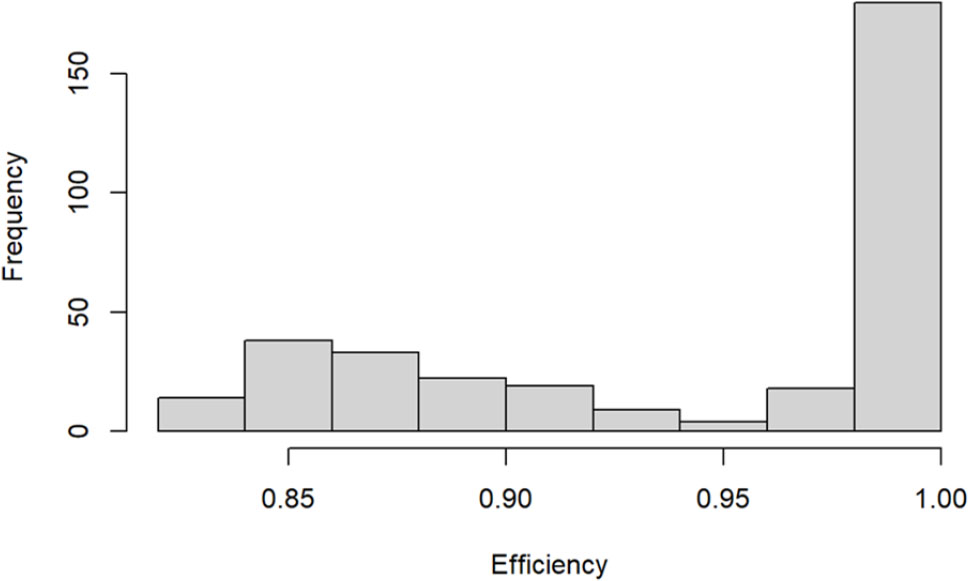
Fig. 1.
Levels and distribution of EVA efficiency scores among cocoa farmers
Source: prepared from author's survey data 2023.
Previous efficiency studies on cocoa production in Ghana have predominantly examined technical, allocative, economic, or profit efficiencies of farmers, revealing a wide range of efficiency scores. Danso Abbeam and Baiyegunhi (2020) and Wongnaa et al. (2022) found contrasting evidence of the prevalence of low and high-efficiency levels among cocoa producers at the farm level. In contrast to this study's findings, the former reported a high prevalence (51%) of low technical efficiency (TE < 40%) among cocoa farmers in Ghana, while the latter found that 71% of farmers achieved profit efficiency levels above 90%, which aligns with this study's results.
A comparison of the mean EVA efficiency score with those from other efficiency studies in farm-level cocoa production reveals discrepancies. For instance, Besseah and Kim (2014) and Danso Abbeam and Baiyegunhi (2020) found mean technical efficiencies of 47.82% and 44%, respectively, among cocoa farmers in Ghana. In contrast, Onumah et al. (2013) reported a higher mean technical efficiency score of 68% among cocoa farmers in the Eastern Region of Ghana. However, it is important to note that EVA is an accounting and finance-based metric, which can be influenced by various market conditions.
The high proportion of farmers achieving high EVA efficiencies in this study has significant implications for the sustainability of cocoa production. The literature suggests that improving efficiency among operators in an industry is crucial for attracting investment and ensuring the long-term sustainability of their production models (Bocken, 2023). Evaluating the factors driving EVA efficiency levels among the farmers will be essential for formulating policies aimed at enhancing cocoa production in Ghana.
Sources of EVA efficiency among cocoa producers
The drivers of efficiency in cocoa production, presented in Table 2, are categorized into two groups: regressor variables and exogenous variables, along with their corresponding parameter estimates from the stochastic frontier analysis (SFA). The model has a gamma (γ) value of 0.1632 (p = 0.0572), which indicates that only 16.32% of the total variance in EVA is due to inefficiency. The remaining 83.7% is attributed to external factors, such as market and weather conditions. The size of σ2 (0.0062, p < 0.001) suggests a good fit for the SFA model and supports the correctness of the specified distributional assumptions.
Table 2.
Maximum likelihood estimates of stochastic frontier EVA function for EVA efficiency of cocoa farmers
| Variables | Parameter | Coefficient | Std. error | Z-value | P-value (Pr(>|z|)) |
|---|---|---|---|---|---|
| Regressor variables | |||||
| (Intercept) | β0 | 0.36748372 | 0.01013412 | 36.2620 | < 2.2e-16*** |
| LAN | β1 | 0.55125676 | 0.06210343 | 8.8764 | < 2.2e-16*** |
| LAB | β2 | −0.76391482 | 0.11157868 | −6.8464 | 7.572e-12*** |
| EQUIP | β3 | 0.07017228 | 0.06571194 | 1.0679 | 0.285576 |
| Exogenous variables | |||||
| (Intercept) | δ0 | −0.07756967 | 0.35846180 | −0.2164 | 0.828679 |
| Age | δ1 | 0.01368408 | 0.00864956 | 1.5821 | 0.113637 |
| Gender | δ2 | 0.01130137 | 0.01831295 | 0.6171 | 0.537153 |
| HHsize | δ3 | −0.00314528 | 0.00428686 | −0.7337 | 0.463129 |
| Education | δ4 | −0.00700958 | 0.01132743 | −0.6188 | 0.536038 |
| YrsOperation | δ5 | −0.01653359 | 0.00418754 | −3.9483 | 7.871e-05*** |
| OpCapital | δ6 | 0.03885501 | 0.01201489 | 3.2339 | 0.001221** |
| Grants | δ7 | −0.00074740 | 0.00017467 | −4.2790 | 1.878e-05*** |
| Subsidies | δ8 | −0.02297409 | 0.00442281 | −5.1945 | 2.053e-07*** |
| FBO | δ9 | 0.17592175 | 0.35604193 | 0.4941 | 0.621233 |
| NumProducts | δ10 | −0.00135253 | 0.01667042 | −0.0811 | 0.935336 |
| Variance parameters | |||||
| Sigma squared | σ2 | 0.00615334 | 0.00057305 | 10.7379 | < 2.2e-16 *** |
| Gamma | Γ | 0.16317262 | 0.08579660 | 1.9019 | 0.057190 |
| Llf. | 394.7104 | ||||
IMPACT OF INPUTS ON EVA EFFICIENCY
The regressor variables (LAN, LAB, and EQUIP) reflect the productive resources utilized in cocoa production. The three inputs showed varied relationships with efficiency, in terms of both direction and significance.
Land exhibited the most significant positive influence on EVA (0.5513, p < 0.001), underscoring the importance of land in cocoa production. The positive effect of increased land use on EVA could be attributed to more efficient land use and the relatively low cost of land compared to other inputs in cocoa production. Conversely, labor showed a significant negative effect on EVA (−0.7639, p < 0.001). Higher labor use reduced the EVA generated by farmers, indicating a potential misallocation or suboptimal use of labor resources. This finding also highlights the labor-intensive nature of cocoa farming in the study area.
Equipment had a positive, but statistically insignificant, effect on EVA. This may reflect underutilization of available equipment or a lack of adoption of modern farming technology.
Determinants of inefficiency
Years of operation (experience), grants, and subsidies were found to have significant negative effects on inefficiency (p < 0.001), indicating that these factors contributed to improved EVA efficiency among cocoa producers. Conversely, the amount of operating capital (OpCapital) had a significant positive effect on inefficiency (p < 0.01), suggesting that larger capital investments were associated with lower EVA efficiency. This may be partly due to the high cost of capital in Ghana or the overstatement of capital by farmers.
Although FBO membership was positively associated with EVA efficiency, this relationship was not statistically significant. It is important to note that previous studies have generally found positive associations between FBO membership and technical efficiency in cocoa production (e.g., Attipoe et al., 2020; Donkor et al., 2023; Salifu et al., 2012). Thus, the results of this study deviate from those expectations.
The remaining variables – gender, education, household size, age, number of products – did not show significant associations with EVA efficiency, as indicated by p-values greater than 0.05. This suggests that these factors do not significantly influence EVA efficiency levels among the cocoa farmers in the study area.
Constraints in the farm-based cocoa production
The results presented in Table 3 highlight the constraints faced by the farmers in cocoa production in the study area, as indicated by the mean rank scores assigned to each constraint. These scores reflect the perceived severity or importance of each constraint according to the farmers. Higher mean scores signify greater perceived significance of a constraint. The table also includes the results of Kendall's W test, the Chi-square statistic, degrees of freedom, and asymptotic significance, which further explain the level of agreement among the farmers regarding the relative importance of the rated constraints.
Table 3.
Constraints to cocoa production
| Constraints | Mean Rank |
|---|---|
| Purchasing price of inputs | 10.67 |
| Ready market for outputs | 9.60 |
| Distribution of products | 9.50 |
| Availability of storage facilities | 9.30 |
| Pests and diseases control | 9.14 |
| Agrochemical application | 8.90 |
| Harvesting and on-farm processing | 8.73 |
| Cultivation and Weed control | 8.56 |
| Planting | 7.99 |
| Availability of materials/equipment | 7.65 |
| Land preparation | 7.55 |
| Access to credit | 7.10 |
| Labour availability | 6.39 |
| Land acquisition | 4.92 |
| N | 337 |
| Kendall's W | 0.119 |
| Chi-Square | 601.212 |
| df | 15 |
| Asymp. Sig. | 0.000 |
The purchasing price of inputs for cocoa bean production emerged as the most significant constraint, with a mean rank score of 10.67. This finding aligns with the FAO Global Input Price Index (GIPI), which reached an all-time high in 2022, the same year cocoa bean production occurred (FAO, 2022). The rising prices of inputs, such as fertilizers and pesticides, were exacerbated by the Covid-19 pandemic and the Russia-Ukraine conflict. These price increases and market volatilities can introduce inefficiencies to any business model reliant on such markets, ultimately undermining its long-term sustainability. Dormon et al. (2004) argue that the true constraint faced by cocoa farmers is the low producer price they receive for their outputs, which limits their purchasing power. As a result, farmers are priced out of essential inputs that could enhance their productivity in subsequent seasons.
The price constraints on the input market were followed by constraints related to market access and distribution of outputs. Ready markets for outputs and distribution of products (beans) received mean rank scores of 9.60 and 9.50, respectively. This finding partially aligns with Monastyrnaya et al. (2016), who identified producer price fluctuations as a major shock experienced by cocoa farmers in output markets. These perceptions by the farmers persist despite the Ghana Cocoa Board's established structure for marketing and distributing cocoa within the country. The Board also sets guaranteed producer prices at the start of each season by forward-selling 70% of next season's crop, with the remaining 30% sold through spot sales to various buyers (GCB, 2022). Under ordinary circumstances, this system should mitigate issues related to market access and ensure stable, fair prices for farmers.
Other significant constraints identified by the farmers included storage facilities (mean rank = 9.30), pest and disease control (mean rank = 9.14), and agrochemical application (mean rank = 8.90). These findings also align with Monastyrnaya et al. (2016) and Bateman and Crozier (2023), who noted the challenge in maintaining cocoa yield quality and quantity due to pests, diseases, inadequate agrochemical use, and insufficient storage facilities. The high mean rank scores underscore the severity of these issues, revealing the difficulty farmers face in ensuring effective pest and disease management, proper agrochemical application and reliable storage solutions.
Similarly, on-farm activities such as harvesting and processing, cultivation and weed control, planting, and land preparation were also highlighted as constraints. This observation aligns with Bymolt et al. (2018), who reported similar challenges among cocoa farmers in Ghana and Côte d'Ivoire. However, the perceived severity of these constraints was slightly lower, with mean rank scores ranging from 8.56 to 8.73. These constraints may arise from the costs and limited availability of resources for such operations in the study area.
Three factors were perceived by farmers as posing minimal constraints: access to credit (mean rank = 7.10), labor availability (mean rank = 6.39), and land acquisition (mean rank = 4.92). Although these factors were considered less significant, they still warrant attention. Access to credit is essential for enabling farmers to invest in inputs and adopt advanced technologies, while labor availability and land acquisition are critical for maintaining adequate manpower and land resources for cocoa cultivation. Farmers can capitalize on the relative ease of access to land and labor to scale up production, thereby improving output and efficiency within their production models.
The results, however, showed a minimal level of agreement among farmers regarding the relative importance of all the identified constraints. This is evidenced by a low Kendall's W test statistic of 0.119.
CONCLUSIONS
The majority of cocoa farmers demonstrated high levels of EVA efficiency, with minimal variability in their efficiency scores. While subsidies, grants, and experience positively influenced farm-level EVA efficiency, high operating capital had a detrimental effect. Cocoa production was further constrained by high input prices, market access challenges, and operational difficulties at the farm level.
To enhance cocoa production, public policies should prioritize strengthening Farmer-Based Organizations (FBOs) to provide robust support and improved facilities for farmers. Key initiatives could include agronomic training programs, expanding access to affordable inputs, and establishing knowledge-sharing mechanisms and platforms. Additionally, targeted subsidy programs and financial assistance should be introduced to mitigate the high input costs that hinder farm efficiency and sustainable practices.
Finally, it is essential to revisit the marketing structure managed by the Ghana Cocoa Board and identify measures to improve its efficiency. Such improvements could alleviate the perceived market access and bean distribution challenges, enabling farmers to achieve greater productivity and economic resilience.