
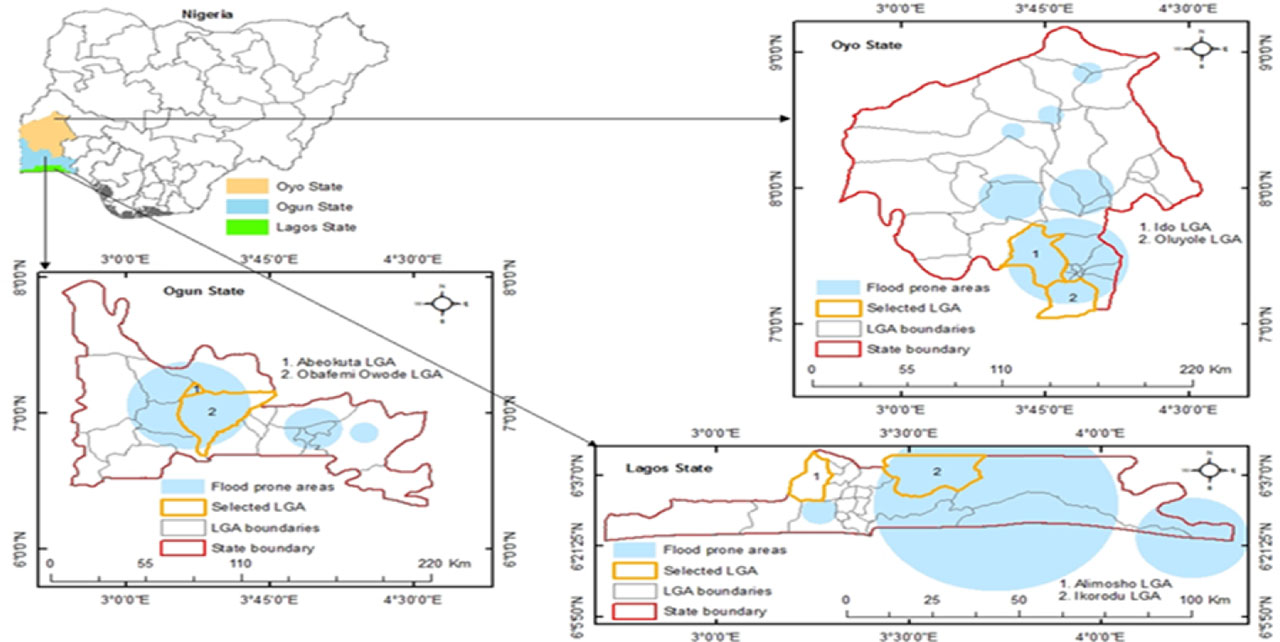
Fig. 1.
Map of the study area showing flood-prone vulnerable areas in the selected states of Southwestern Nigeria
Source: field survey, 2021.
Table 1.
Demographic characteristic of residents (N = 250)
| Variables | F | % |
|---|---|---|
| Sex | ||
| Male | 79 | 31.6 |
| Female | 171 | 68.4* |
| Age (years) | ||
| ≤ 20 | 10 | 4.0 |
| 21–30 | 68 | 27.2* |
| 31–40 | 65 | 26.0* |
| 41–50 | 63 | 25.2* |
| 51–60 | 33 | 13.2 |
| ≥ 61 | 11 | 4.4 |
| Indigene of locality | ||
| Indigene | 182 | 72.8* |
| Non Indigene | 68 | 27.2 |
| Education | ||
| No formal | 15 | 6.0 |
| Adult | 5 | 2.0 |
| Primary | 16 | 6.4 |
| Secondary | 58 | 22.3 |
| HND/BSc | 64 | 25.6 |
| Postgraduate/Higher degree | 92 | 36.8* |
| Marital Status | ||
| Single | 60 | 24.0 |
| Married | 186 | 74.4* |
| Separated | 4 | 1.6 |
| Household size | ||
| 1–4 | 86 | 34.4 |
| 5–8 | 157 | 62.8* |
| 9–12 | 7 | 2.8 |
| Income structure of residents (₦ ,000) | ||
| < 10 | 49 | 19.6 |
| 11–50 | 13 | 5.2 |
| 51–100 | 14 | 5.6 |
| 101–150 | 14 | 5.6 |
| 151–200 | 40 | 16.0 |
| 201–300 | 38 | 15.2 |
| > 301 | 82 | 32.8 |
Table 2a.
Residents’ perception of housing conditions in the study area (N =250)
| Perception statements | SA | A | UN | D | SD | Mean | Rank |
|---|---|---|---|---|---|---|---|
| There has been an increase in the dilapidation of my brick house | 132 (52.8) | 94 (37.6) | – | – | 24 (9.6) | 4.2 | 1st |
| The maintenance cost of brick houses has not improved after the implementation of land use strategies | 68 (27.2) | 78 (31.2) | – | 15 (6.0) | 89 (35.6) | 3.0 | 2nd |
| Serious difficulty in upgrading a mud house to a brick house | 67 (26.8) | 78 (31.2) | – | 15 (6.0) | 90 (36.0) | 3.0 | 2nd |
| The dilapidation of my mud house due to a lack of maintenance is substantial | 66 (26.4) | 79 (31.6) | – | 15 (6.0) | 90 (36.0) | 3.0 | 2nd |
| The maintenance cost of mud houses is much affordable | 2 (0.8) | 73 (29.2) | – | 15 (6.0) | 160 (64.0) | 2.0 | 3rd |
| The brick house we lived in before land use strategies were implemented has become worse | 157 (62.8) | 74 (29.6) | – | 11 (4.4) | 8 (3.2) | 1.6 | 4th |
| Living in unimproved mud houses is the same as before the implementation of land use strategies | – | – | 12 (4.8) | 68 (27) | 170 (68.0) | 1.4 | 5th |
Table 2b.
Residents’ Perception of Food Utilities in the Study Area (N =250)
| Perception statements | SA | A | UN | D | SD | Mean | Rank |
|---|---|---|---|---|---|---|---|
| My household cannot afford adequate meals due to flood volumes | – | – | – | – | 250 (100.0) | 5.0 | 1st |
| Difficulty in provision of daily meals due to poor access to workplace | – | – | – | 46 (18.4) | 204 (81.6) | 4.8 | 2nd |
| Food production and accessibility are still the same as before the implementation of land use strategies | 154 (61.6) | 95 (38.0) | 1 (0.4) | – | – | 4.6 | 3rd |
| There has been no improvement in food intake since the implementation of land use strategies | 168 (67.2) | – | 82 (32.8) | – | – | 4.3 | 4th |
| I can afford to eat balanced meals three times daily | 106 (42.4) | 104 (41.6) | – | 39 (15.6) | 1 (0.4) | 4.1 | 5th |
Table 2c.
Residents’ Perception of Health Facilities and Access in the Study Area (N = 250)
| Perception statements | SA | A | UN | D | SD | Mean | Rank |
|---|---|---|---|---|---|---|---|
| Accessibility and affordability of government hospitals | 250 (100.0) | – | – | – | – | 5.0 | 1st |
| The cost of transportation to government hospitals is expensive | – | – | – | 25 (10.0) | 225 (90.0) | 4.9 | 2nd |
| The cost of orthodox medicine is high for my family | – | – | – | 78 (31.2) | 172 (68.8) | 4.7 | 3rd |
| Healthy life in my family now due to access to good health facilities | 214 (85.6) | – | – | 36 (14.4) | – | 4.6 | 4th |
| Sometimes my health status and my family become concerning | – | 45 (18.0) | – | – | 205 (82.0) | 4.5 | 5th |
Table 2d.
Residents’ perception of social participation in the study area (N = 250)
| Perception statements | SA | A | UN | D | SD | Mean | Rank |
|---|---|---|---|---|---|---|---|
| High preference for social function because of the welfare support it gives | 250 (100.0) | – | – | – | – | 5.0 | 1st |
| Attendance at social function is expensive to maintain | – | – | – | – | 250 (100.0 | 5.0 | 1st |
| Social function is worse because there is a loss of money | – | – | – | – | 250 (100.0) | 5.0 | 1st |
| Social functions are sometimes helpful in meeting other needs | 169 (67.6) | 81 (32.4) | – | – | – | 4.7 | 2nd |
| Social connections engender an ability to cope with environmental and flood hazards | 169 (67.6) | 81 (32.4) | – | – | – | 4.7 | 2nd |
| They are an avenue for meeting important personalities | 169 (67.6) | 81 (32.4) | – | – | – | 4.7 | 2nd |
| Social functions are sources of funding for environmental and cultural development | 169 (67.6) | – | – | 81 (32.4) | – | 4.0 | 3rd |
| Serve as sources of information on social and environmental issues | – | 81 (32.4) | – | – | 169 (67.6) | 2.0 | 4th |
Table 3.
Utilization of FLUS (Forestry Land Use Strategies) (N = 250)
| Forestry Land Use Strategies | NU | US | PU | FU | Mean | Rank |
|---|---|---|---|---|---|---|
| Involvement in tree planting | 4 (1.6) | – | 246 (98.4) | – | 1.8 | 1st |
| Conservation of trees | 55 (22.0) | – | 195 (78.0) | – | 1.6 | 2nd |
| Stream bank stabilization | 56 (22.4) | – | 194 (77.6) | – | 1.6 | 2nd |
| De-silting of streams and rivers in floodplain areas | 123 (49.2) | – | 126 (50.4) | 1 (0.4) | 1.0 | 3rd |
| Sustenance of the natural environment | 162 (64.8) | – | 82 (35.2) | – | 0.7 | 4th |
| Landscaping of the environment | 164 (65.6) | – | 86 (34.4) | – | 0.7 | 4th |
Table 4.
Canonical correlation estimates of residents’ household well-being on the use of FLUS
| Predictor variables (residents’ well-being) | Forestry Land Use Strategies (FLUS) | |||||
|---|---|---|---|---|---|---|
| TP | TCU | SNE | SBS | DS | LE | |
| Housing type | ||||||
| Mud house remains the same | 0.033 (0.28) | –0.414 (0.00*) | –0.059 (0.43) | 0408 (0.00*) | –0.397 (0.00*) | –0.052 (0.52) |
| Brick house worse | –0.028 (0.17) | –0.204 (0.00*) | 0.042 (0.39) | –0.205 (0.01*) | –0.172 (0.01*) | 0.049 (0.36) |
| Difficulty in upgrading | 0.288 (0.00*) | 0.262 (0.06) | 0.133 (0.16) | 0.206 (0.06) | 0.165 (0.21) | 0.140 (0.18) |
| Increased dilapidation | 0.004 (0.83) | 0.029 (0.61) | –0.236 (0.00*) | 0.022 (0.71) | –0.028 (0.61) | –0.230 (0.00*) |
| Dilapidation of mud house | –0.284 (0.00*) | –0.182 (0.19) | –0.169 (0.08) | –0.182 (0.19) | –0.061 (0.66) | –0.172 (0.11) |
| R2 | 0.205 | 0.134 | 0.683 | 0.132 | 0.455 | 0.624 |
| Food utilities index | ||||||
| Food production & access | 0.164 (0.34) | 0.118 (0.85) | 0.446 (0.34) | 0.109 (0.86) | 0.245 (0.67) | 0.549 (0.27) |
| Improvement in feeding | –0.876 (0.00*) | –1.310 (0.21) | –0.585 (0.43) | –1.013 (0.26) | –0.751 (0.42) | –0.361 (0.65) |
| R2 | 0.262 | 0.042 | 0.625 | 0.042 | 0.479 | 0.574 |
| Health condition | ||||||
| Ethno-medicine affordable | 1.697 (0.00*) | 1.001 (0.44) | 3.789 (0.00*) | 1.130 (0.38) | 0.937 (0.42) | 3.558 (0.00*) |
| Preference for trado-healthcare | –1.985 (0.00*) | –0.981 (0.31) | –0.723 (0.36) | –1.013 (0.38) | –0.593 (0.49) | –0.732 (0.38) |
| High cost of orthodox medicine | 2.241 (1.00) | 1.216 (1.00) | –8.892 (1.00) | 1.099 (1.00) | 1.431 (1.00) | –8.537 (1.00) |
| R2 | 0.261 | 0.043 | 0.521 | 0.044 | 0.479 | 0.475 |
| Social participation | ||||||
| Source of funding for social & environmental development | –0.044 (0.75) | –0.010 (0.79) | –0.432 (0.00*) | –0.014 (0.71) | 0.485 (0.00*) | –0.403 (0.00*) |
| R2 | 0.000 | 0.000 | 0.403 | 0.001 | 0.458 | 0.355 |