
INTRODUCTION
The current condition of land or the extent of human intervention in the management of land cover with a view to making life better depends on human needs (Saleh et al., 2014). However, as observed by the Intergovernmental Panel on Climate Change (IPCC, 2000), land use such as grazing, agroforestry, timber extraction and forest conservation is germane to effective land management. Therefore, land use should generally be geared towards sustainable development, environmental sustainability and the growth and well-being of a nation’s people. The presence and activities of man have created serious constraints for survival, as described by Adeoye et al. (2016), who opined that the dysfunctional environment caused by deforestation, erosion, desertification and floods emanated from the activities of man and industrialization. In Oriola’s (2009) opinion, the dependence of local people on the forests and the exploitation of the resources therein for survival explains their resistance to land cover conservation and development policies and by extension environment failure. Adeniyi (2016) considered deliberate exploitation of the forests and oversights in sustainable forest management plans responsible for significant loss of the natural environment. This is further supported by Onwuka et al. (2015), who highlighted torrential rainfall, hydrological factors such as water runoff and land saturation, and anthropogenic factors including population growth, urbanization, and poor waste management.
Furthermore, Ige-Olumide and Salami (2018) observed that land use change (urban development and deforestation) has increased the vulnerability of the environment to flooding in low-lying areas. Flooding is a major devastating natural disaster in Southwestern Nigeria that has affected homes, farmland, and the general well-being of the people (Emeribeole, 2015). Amangabara and Gobo (2010) argue that structural measures are not only costly and far from environmentally friendly but also insufficient for effective flood management. Thus, there is a need to adopt forestry and nature based strategies, which remain cheaper and more eco-friendly over a long period of time, to mitigate flooding in Southwestern Nigeria.
Forestry land use strategies for flood management in western countries have evolved in recent years. Chandler et al. (2018) reported severe flooding as a motivator for land managers in Lancaster, England to adopt effective land use in flood management through tree planting to intercept and reduce surface runoff before it reaches rivers and streams. Nisbet and Thomas (2006) supported tree planting on the floodplains of major river channels to enhance flood flow prevention. Hence, according to Chandler et al. (2018) woodland conservation and constant tree planting can act as a form of nature-based innovation in mitigating flood occurrence in flood-prone areas. In this context, the current study investigates the effects of residents’ perception of households’ well-being on forestry land use strategies for flood management in vulnerable communities of Southwestern Nigeria.
METHODOLOGY
Study area
The selected area for the study is Southwestern Nigeria. It is a geopolitical region in Nigeria and is mainly home to Yoruba people. It has a land size of 191,843 square kilometers and lies between latitude 9° 4′55.1964″ 9.081999° North and longitude 8° 40′30.9972″ 8.675277° East (Oni and Odekunle, 2016). The area was estimated in 2020 to have a population of about 32.5 million with an approximate figure of 20.44 percent of Nigeria’s population according to the National Bureau of Statistics (NBS, 2022). Southwestern Nigeria has six (6) states: Oyo, Osun, Ogun, Lagos, Ondo and Ekiti. It has a typical tropical climate with an average temperature of about 33°C in the dry season and about 24°C in the rainy season, and high humidity. The distribution of rainfall varies between 1000mm and 2000mm (NBS, 2022). Figure 1 features a map of the studied area.
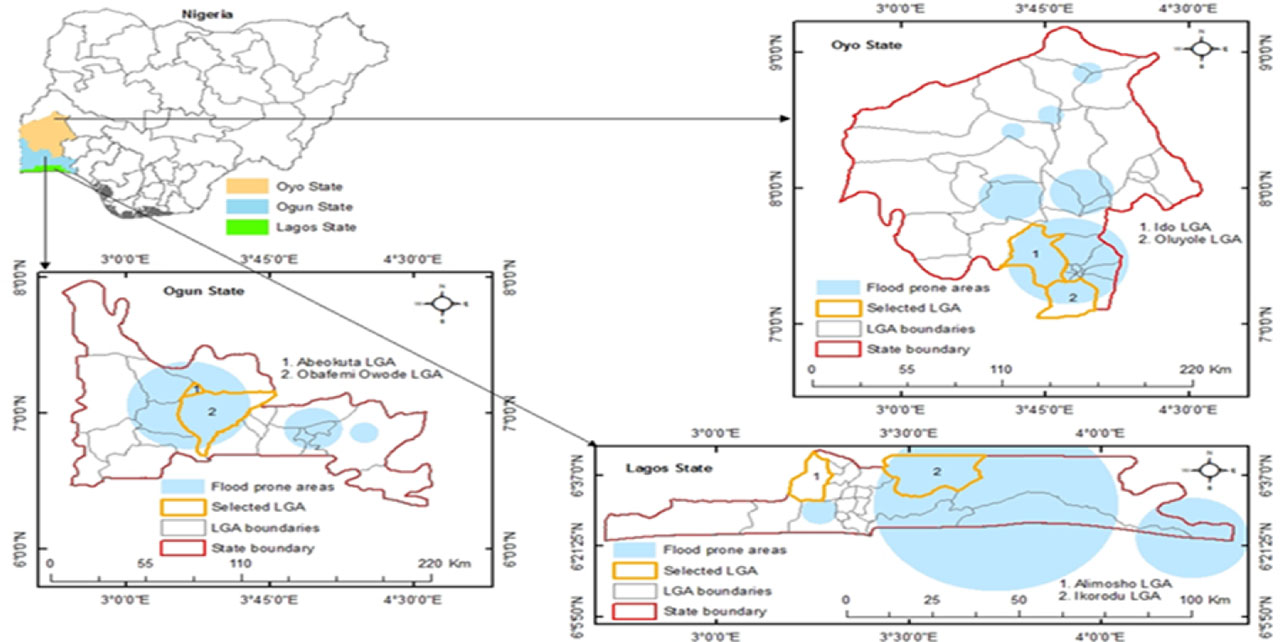
Fig. 1.
Map of the study area showing flood-prone vulnerable areas in the selected states of Southwestern Nigeria
Source: field survey, 2021.
Data collection and sampling procedure
This study adopted qualitative data collection with the use of primary data. The primary data were collected with a structured questionnaire distributed to household heads. A multistage (four-staged) random sampling procedure was used; in the first stage, Oyo, Ogun and Lagos States were purposely selected based on the frequent flooding and high flood volumes in the three states. In the second stage, Local Government Areas (LGAs) with water bodies and with frequent and pronounced flooding were purposely selected. The selected LGAs were Ido and Oluyole in Oyo State, Obafemi Owode and Abeokuta South in Ogun state, and Alimosho and Ikorodu in Lagos state. In all, Ido comprises 10 wards, Oluyole comprises 10 wards, Obafemi Owode comprises 12 wards, Abeokuta South comprises 15 wards, Alimosho comprises 11 wards, and Ikorodu comprises 19 wards. In the third stage, communities which experienced frequent flooding were selected from each ward. In the fourth stage, a household listing was conducted in the selected communities to determine the sample size using a systematic random sampling technique. Every fifth household was selected, resulting in a sample of 250 respondents.
Data analyses
Some analytical tools were employed for data analysis. Data were analyzed with descriptive statistics such as frequency and percentages. Specifically, demographic characteristics were analyzed using frequency and percentages, while residents’ perceptions and forestry land use were assessed using a Likert scale, and mean scores were calculated. Canonical correlation analysis (CCA) was used to test the relationship between two sets of multivariate data: residents’ perceptions and forestry land use strategies in the studied area.
Canonical correlation analysis
Canonical correlation analysis was adopted for the analysis of forestry land use strategies for flood management in Southwestern Nigeria. CCA is a statistical method that extracts the information common to two data tables measuring quantitative variables on the same set of observations (Abdi et al., 2018). CCA generalizes many standard statistical techniques (e.g. multiple regression, analysis of variance, discriminant analysis) and can also be adapted into several related methods that address slightly different types of problems (e.g., different normalization conditions, different types of data). “A canonical variate is a new variable formed by making a linear combination of two or more variates (variables) from a data set” (Abdi et al., 2018). For multiple X and Y, the canonical correlation analysis constructs two variates;
Where: Yi – the six selected (6) forestry land use strategies: tree planting; conservation of trees; sustenance of the natural environment; desilting streams, and landscaping the environment. Xi – residents’ perceptions, which were used as independent variables (including X1 – housing indices of residents; X2 – food index; X3 – health condition; and X4 – social participation of residents).RESULTS AND DISCUSSION
Demographic characteristic of residents
The results in Table 1 show that the majority of respondents (68.4%) were female. This indicates that women were more available and interested in the study than men, corroborating the assertion of Azad and Pritchard (2023) that women bear the burden of disaster and are found regularly on the frontline of adaptive capacity development in the context of disaster response and recovery. Furthermore, about 27.2% of them were within the age bracket of 21–30 years (modal age group), followed by those within the bracket of 31–40 years (26.0%). This implies that most respondents were of an active and productive age. This finding agrees with the findings of Akinbile et al. (2018), which put respondents involved in environmental adaptation strategies in Oyo state as being of an active age. Most of the residents (72.8%) were local to the area. This indicates that most people in Southwestern Nigeria who had experienced flooding for many years were of diverse and heterogeneous ethnic backgrounds, corroborating the results of Macchi et al. (2008), who submitted that indigenous and traditional people are veterans in responding to environmental challenges and are vulnerable to flooding. In addition, residents’ educational backgrounds revealed that the modal group among them possess a higher educational qualification (36.8%), followed by those with Bachelor of Science/Higher National Diploma Certificates (25.6%). This indicates that respondents in the study area were educated to various levels, confirming the findings of Terungwa and Tokwase (2013), who claimed that science and technological education enhance environmental flood strategies and enforce land use control in flood-prone areas. With respect to marital status, 74.0% of the residents were married. This implies that the majority of respondents in the study area had marital engagements. This is in line with the submission of Akinbile et al. (2018) that marriage could contribute towards residents’ inclination to utilise environmental adaptation strategies. Examining the impact of funding on flood management using forestry land use strategies, the study found that 32.8% of the residents earned a little above ₦300,000 ($207.59) on a monthly basis, as shown in Table 1. Invariably, if incomes are low among residents, this reduces their interest in and lessens their chances of practicing FLUS – tree planting, tree conservation in upland areas and stream bank stabilisation with vegetation. This supports the argument of Kavoi et al. (2019) that social and economic limitations are responsible for some proportion of rural residents’ apathy towards nature-based adaptation strategies.
Table 1.
Demographic characteristic of residents (N = 250)
| Variables | F | % |
|---|---|---|
| Sex | ||
| Male | 79 | 31.6 |
| Female | 171 | 68.4* |
| Age (years) | ||
| ≤ 20 | 10 | 4.0 |
| 21–30 | 68 | 27.2* |
| 31–40 | 65 | 26.0* |
| 41–50 | 63 | 25.2* |
| 51–60 | 33 | 13.2 |
| ≥ 61 | 11 | 4.4 |
| Indigene of locality | ||
| Indigene | 182 | 72.8* |
| Non Indigene | 68 | 27.2 |
| Education | ||
| No formal | 15 | 6.0 |
| Adult | 5 | 2.0 |
| Primary | 16 | 6.4 |
| Secondary | 58 | 22.3 |
| HND/BSc | 64 | 25.6 |
| Postgraduate/Higher degree | 92 | 36.8* |
| Marital Status | ||
| Single | 60 | 24.0 |
| Married | 186 | 74.4* |
| Separated | 4 | 1.6 |
| Household size | ||
| 1–4 | 86 | 34.4 |
| 5–8 | 157 | 62.8* |
| 9–12 | 7 | 2.8 |
| Income structure of residents (₦ ,000) | ||
| < 10 | 49 | 19.6 |
| 11–50 | 13 | 5.2 |
| 51–100 | 14 | 5.6 |
| 101–150 | 14 | 5.6 |
| 151–200 | 40 | 16.0 |
| 201–300 | 38 | 15.2 |
| > 301 | 82 | 32.8 |
Residents’ perception of household well-being and utilisation of forestry land use strategies
Perception of housing types indices
An examination of respondents’ perceived housing well-being based on selected indices related to forestry land use strategies, (Table 2a) revealed significant challenges in housing conditions. The findings indicate an increase in the dilapidation of brick houses due to high flood volumes. This is primarily because most block houses were built on waterways and flood paths. The flooding has begun to percolate the foundation of those houses, leading to erosion and damage to household items and other expensive equipment. This concern ranked first among those listed on the questionnaire (mean = 4.2). It seems that the increase in the dilapidation of brick houses has been caused by the volume and continuous occurrence of flooding in vulnerable communities, which underscores the urgent need for the quick deployment of FLUS to protect local properties. The maintenance cost of brick houses has not improved despite the implementation of land use strategies. Additionally, the difficulty in upgrading mud houses to brick houses and the ongoing dilapidation of mud houses (mean = 3.0) ranked second among factors affecting perceived housing well-being. This highlights the destructive impact of flooding on property and underscores the need for FLUS to preserve the natural environment surrounding homes. Affordable maintenance costs of mud houses (mean = 2.0) ranked third among housing well-being factors. This suggests that while flooding may impact mud houses, minimal financial resources from residents’ incomes are required for maintenance. However, achieving active resident participation and commitment to implementing FLUS could prove challenging.
Table 2a.
Residents’ perception of housing conditions in the study area (N =250)
| Perception statements | SA | A | UN | D | SD | Mean | Rank |
|---|---|---|---|---|---|---|---|
| There has been an increase in the dilapidation of my brick house | 132 (52.8) | 94 (37.6) | – | – | 24 (9.6) | 4.2 | 1st |
| The maintenance cost of brick houses has not improved after the implementation of land use strategies | 68 (27.2) | 78 (31.2) | – | 15 (6.0) | 89 (35.6) | 3.0 | 2nd |
| Serious difficulty in upgrading a mud house to a brick house | 67 (26.8) | 78 (31.2) | – | 15 (6.0) | 90 (36.0) | 3.0 | 2nd |
| The dilapidation of my mud house due to a lack of maintenance is substantial | 66 (26.4) | 79 (31.6) | – | 15 (6.0) | 90 (36.0) | 3.0 | 2nd |
| The maintenance cost of mud houses is much affordable | 2 (0.8) | 73 (29.2) | – | 15 (6.0) | 160 (64.0) | 2.0 | 3rd |
| The brick house we lived in before land use strategies were implemented has become worse | 157 (62.8) | 74 (29.6) | – | 11 (4.4) | 8 (3.2) | 1.6 | 4th |
| Living in unimproved mud houses is the same as before the implementation of land use strategies | – | – | 12 (4.8) | 68 (27) | 170 (68.0) | 1.4 | 5th |
Perception of food utilities indices
On food, Table 2b reveals that households cannot afford adequate meals (mean = 5.0) and it was the statement with which respondents most frequently agreed among those addressing food utilities. This indicates that floods could affect food production due to the loss of agricultural land, thus creating scarcity and an increase in food prices in the study area. Hence the need to adopt the utilisation of FLUS. There may also be difficulty in the provision of daily meals because respondents might not have easy access to their work places during serious floods. A statement to this effect on the food utilities index ranked second (mean = 4.8) among respondents. This implies that respondents could not afford adequate daily meals, probably as a result of loss of businesses from flooding, underlining the need to safeguard the environment with FLUS – tree planting, tree conservation in upland areas, sustenance of the natural environment, stream bank stabilization, desilting and landscaping of the environment. Access to food products (mean = 4.6) ranked third on the food utility index because some residents could afford to access food supplies due to their high income. Overall, residents could become food insecure due to the loss of productive land to recurring flooding.
Table 2b.
Residents’ Perception of Food Utilities in the Study Area (N =250)
| Perception statements | SA | A | UN | D | SD | Mean | Rank |
|---|---|---|---|---|---|---|---|
| My household cannot afford adequate meals due to flood volumes | – | – | – | – | 250 (100.0) | 5.0 | 1st |
| Difficulty in provision of daily meals due to poor access to workplace | – | – | – | 46 (18.4) | 204 (81.6) | 4.8 | 2nd |
| Food production and accessibility are still the same as before the implementation of land use strategies | 154 (61.6) | 95 (38.0) | 1 (0.4) | – | – | 4.6 | 3rd |
| There has been no improvement in food intake since the implementation of land use strategies | 168 (67.2) | – | 82 (32.8) | – | – | 4.3 | 4th |
| I can afford to eat balanced meals three times daily | 106 (42.4) | 104 (41.6) | – | 39 (15.6) | 1 (0.4) | 4.1 | 5th |
Perception of health conditions indices
Table 2c reveals that residents have access to affordable government hospitals (mean= 5.0), as the statement about this topic ranked first among those addressing healthcare in the area. This indicates that respondents could have access to low cost healthcare centres in the study area. Even though residents perceived the cost of transportation to the hospital as expensive (mean= 4.9), with the statement on this topic ranked second, the respondents still visit the hospital for their medications. This indicates that respondents are still able to visit hospitals for treatment in spite of the high cost of transportation because sicknesses associated with flooding, like cholera and fungal infections, cannot be left untreated. Respondents would strive to access adequate health care in hospitals irrespective of transportation costs, which might hinder their commitment towards the use of FLUS. The statement that the cost of orthodox medicine is high (mean = 4.7) ranked third. This implies that even though residents might have access to the hospitals, they might not get adequate medical treatment. It suggests that many residents have lost their livelihood to flooding and thus lack the purchasing power to access adequate healthcare. Overall, flooding could affect the health of respondents, rob them of the limited resources they have and deprive them of energy and vitality, reducing their interest in adopting FLUS.
Table 2c.
Residents’ Perception of Health Facilities and Access in the Study Area (N = 250)
| Perception statements | SA | A | UN | D | SD | Mean | Rank |
|---|---|---|---|---|---|---|---|
| Accessibility and affordability of government hospitals | 250 (100.0) | – | – | – | – | 5.0 | 1st |
| The cost of transportation to government hospitals is expensive | – | – | – | 25 (10.0) | 225 (90.0) | 4.9 | 2nd |
| The cost of orthodox medicine is high for my family | – | – | – | 78 (31.2) | 172 (68.8) | 4.7 | 3rd |
| Healthy life in my family now due to access to good health facilities | 214 (85.6) | – | – | 36 (14.4) | – | 4.6 | 4th |
| Sometimes my health status and my family become concerning | – | 45 (18.0) | – | – | 205 (82.0) | 4.5 | 5th |
Perception of social participation indices
On the perceived social participation of residents, the findings in Table 2d reveal a high preference among respondents for social participation because of welfare support (mean = 5.0), which is ranked first among the statements on this topic. Also, social participation was perceived as sometimes helpful in meeting needs, as well as giving respondents the ability to cope with flood hazards (mean = 4.7), which ranked second on the list. Further, social participation was perceived as a source of funding for environmental and cultural development (mean = 4.0), and was ranked third on the list. This implies that social participation could bring residents together to form an association to raise funds and request assistance from forestry-based land use agencies for mitigation of flooding. It suggests that social participation could help synergize residents’ and agencies’ resources as well as arousing the interest of residents in utilising FLUS in Southwestern Nigeria.
Table 2d.
Residents’ perception of social participation in the study area (N = 250)
| Perception statements | SA | A | UN | D | SD | Mean | Rank |
|---|---|---|---|---|---|---|---|
| High preference for social function because of the welfare support it gives | 250 (100.0) | – | – | – | – | 5.0 | 1st |
| Attendance at social function is expensive to maintain | – | – | – | – | 250 (100.0 | 5.0 | 1st |
| Social function is worse because there is a loss of money | – | – | – | – | 250 (100.0) | 5.0 | 1st |
| Social functions are sometimes helpful in meeting other needs | 169 (67.6) | 81 (32.4) | – | – | – | 4.7 | 2nd |
| Social connections engender an ability to cope with environmental and flood hazards | 169 (67.6) | 81 (32.4) | – | – | – | 4.7 | 2nd |
| They are an avenue for meeting important personalities | 169 (67.6) | 81 (32.4) | – | – | – | 4.7 | 2nd |
| Social functions are sources of funding for environmental and cultural development | 169 (67.6) | – | – | 81 (32.4) | – | 4.0 | 3rd |
| Serve as sources of information on social and environmental issues | – | 81 (32.4) | – | – | 169 (67.6) | 2.0 | 4th |
Forestry land use strategies in communities
On identified forestry land use strategies (FLUS), Table 3 shows that some strategies were utilized. Tree planting (mean = 1.8) was the most popular identified forestry land use strategy for flood management. It attracted 34.8%, 33.6% and 30.0% of residents in Lagos, Oyo and Ogun States, respectively, who used tree planting partially as a FLUS. This indicates that the most popular perceived approach among the forestry land use strategies is tree planting, which is practiced by the highest proportion of the population in Lagos, followed by Oyo and Ogun states, but is only partially utilized. In addition, the conservation of trees and shrubs in upland areas (mean = 1.6) was the second most popular FLUS, attracting 14.4%, 33.6% and 30.0% of residents in Lagos, Oyo and Ogun States, respectively, as partial users. The results also showed that stream bank stabilization through re-vegetation (mean = 1.6) was the joint second most popular FLUS and attracted 14.0% of residents in Lagos State, 33.6% in Oyo State and 30.0% in Ogun State as a partially feasible forestry land use strategy. This finding implies that tree planting, tree conservation and stream bank stabilization were the most partially used forestry land use strategies. It also suggests that FLUS was abysmally low in Southwestern Nigeria. Kiedrzynska et al. (2015) proposed eco-hydrology strategies as encompassing all elements of the environment, which could be integrated into floodplain management for flood prevention. BBC News (2022) also reported nature-based flood management as a lifelong measure towards flood mitigation.
Table 3.
Utilization of FLUS (Forestry Land Use Strategies) (N = 250)
| Forestry Land Use Strategies | NU | US | PU | FU | Mean | Rank |
|---|---|---|---|---|---|---|
| Involvement in tree planting | 4 (1.6) | – | 246 (98.4) | – | 1.8 | 1st |
| Conservation of trees | 55 (22.0) | – | 195 (78.0) | – | 1.6 | 2nd |
| Stream bank stabilization | 56 (22.4) | – | 194 (77.6) | – | 1.6 | 2nd |
| De-silting of streams and rivers in floodplain areas | 123 (49.2) | – | 126 (50.4) | 1 (0.4) | 1.0 | 3rd |
| Sustenance of the natural environment | 162 (64.8) | – | 82 (35.2) | – | 0.7 | 4th |
| Landscaping of the environment | 164 (65.6) | – | 86 (34.4) | – | 0.7 | 4th |
Test of the relationship between multivariate variables of residents’ perception of household well-being and forestry land use strategies
The results in Table 4 show the canonical correlation analysis between residents’ perception of household well-being and forestry land use strategies in vulnerable communities. A significant and negative relationship can be observed between residents’ perception that the condition of their mud house has not improved and their practice/use of tree conservation in upland areas – TCU (β = −0.414, p = 0.00, R2 = 0.134), stream bank stabilization – SBS (β = −0.408, p = 0.00, R2 = 0.132) and desilting of streams – DS (β = −0.397, p = 0.00, R2 = 0.455). This implies that the probability of utilizing FLUS – TCU, SBS, and DS – decreases by 13.4%, 13.2% and 45.5%, respectively, as the number of mud houses in the study area increases. It suggests that more respondents who reside in mud houses are aware of the threats of flooding and inclined to take appropriate decision to use TCU, SBS and DS as forestry land use strategies (FLUS). Respondents might not really be predisposed to spend money on such strategies due to a lack of financial power but could participate in tree conservation, TCU, stream bank stabilization, SBS, and desilting streams, DS. Victor (2021) has described households in Southeast Nigeria as highly exposed to and resilient to flood hazards. This study found that most residents had poor housing (shelter), which is associated with poor socio-economic status and living conditions. Examining food utilities as a factor in residents’ well-being, it was revealed that there is a significant and negative relationship between residents’ perception of improvement in food availability and tree planting (TP) (β = −0.876, p = 0.00, R2 = 0.262). This implies that improvement in food availability decreases the practice/use of tree planting by 26.2%. Availability of food may be improved by the deforestation of forest estates for farming. These findings indicate that addressing hunger may be more important than the practice/use of conservation as a FLUS option for mitigating flooding. This indicates that respondents are more inclined to produce food and provide adequate meals for their family rather than participating in the use of FLUS – tree planting, tree conservation, SNE, SBS, DS and LE. The study of Ali et al. (2021) describes forestland cover and croplands as significantly impacting flooding events in many flood-prone communities. However, a positive relationship was established between the perception of the affordability of ethno-medicine by residents and TP (β = 1.697, p = 0.00, R2 = 0.261) and SNE (β = 3.789, p = 0.00, R2 = 0.521) and LE (β = 3.558, p = 0.00, R2 = 0.475). This implies that the more affordable ethno-medicine is to residents, the greater the chances of utilizing FLUS, because tree planting, sustenance of natural environment and landscaping the environment will lead to the production of more non-timber forest products, herbs, tree bark and leaves, which form the basis for ethno-medicine in the study area. This may not be unconnected with World Health Organization (2017) reports of the existence of a range of health care measures to protect rural populations through the development of the flood-health emergency scheme. Residents’ perception of social participation as a source of funding for social and environmental development has a significant and negative relationship with SNE (β = −0.432, p = 0.00, R2 = 0.403) and LE (β = −1.403, p = 0.00, R2 = 0.355). This implies that the probability of utilising FLUS decreases by 40.3% and 35.5% as perceived sources of funding for social and environment development increase among residents. It suggests that the more access residents have to funds for social and environment development, the less likely they are to have an interest in utilising FLUS. This indicates that perceived social participation could influence the utilisation of TP, TCU, SNE, SBS, DS and LE for flood management, because group formation would drive fund raising and requests for assistance from forestry-based institutions to support, educate and motivate residents with materials and methods for FLUS. Ansari (2018) was also of the view that participation and cohesion support resilience, because they increase residents’ intellectual capacity for the management of flood risk tension.
Table 4.
Canonical correlation estimates of residents’ household well-being on the use of FLUS
| Predictor variables (residents’ well-being) | Forestry Land Use Strategies (FLUS) | |||||
|---|---|---|---|---|---|---|
| TP | TCU | SNE | SBS | DS | LE | |
| Housing type | ||||||
| Mud house remains the same | 0.033 (0.28) | –0.414 (0.00*) | –0.059 (0.43) | 0408 (0.00*) | –0.397 (0.00*) | –0.052 (0.52) |
| Brick house worse | –0.028 (0.17) | –0.204 (0.00*) | 0.042 (0.39) | –0.205 (0.01*) | –0.172 (0.01*) | 0.049 (0.36) |
| Difficulty in upgrading | 0.288 (0.00*) | 0.262 (0.06) | 0.133 (0.16) | 0.206 (0.06) | 0.165 (0.21) | 0.140 (0.18) |
| Increased dilapidation | 0.004 (0.83) | 0.029 (0.61) | –0.236 (0.00*) | 0.022 (0.71) | –0.028 (0.61) | –0.230 (0.00*) |
| Dilapidation of mud house | –0.284 (0.00*) | –0.182 (0.19) | –0.169 (0.08) | –0.182 (0.19) | –0.061 (0.66) | –0.172 (0.11) |
| R2 | 0.205 | 0.134 | 0.683 | 0.132 | 0.455 | 0.624 |
| Food utilities index | ||||||
| Food production & access | 0.164 (0.34) | 0.118 (0.85) | 0.446 (0.34) | 0.109 (0.86) | 0.245 (0.67) | 0.549 (0.27) |
| Improvement in feeding | –0.876 (0.00*) | –1.310 (0.21) | –0.585 (0.43) | –1.013 (0.26) | –0.751 (0.42) | –0.361 (0.65) |
| R2 | 0.262 | 0.042 | 0.625 | 0.042 | 0.479 | 0.574 |
| Health condition | ||||||
| Ethno-medicine affordable | 1.697 (0.00*) | 1.001 (0.44) | 3.789 (0.00*) | 1.130 (0.38) | 0.937 (0.42) | 3.558 (0.00*) |
| Preference for trado-healthcare | –1.985 (0.00*) | –0.981 (0.31) | –0.723 (0.36) | –1.013 (0.38) | –0.593 (0.49) | –0.732 (0.38) |
| High cost of orthodox medicine | 2.241 (1.00) | 1.216 (1.00) | –8.892 (1.00) | 1.099 (1.00) | 1.431 (1.00) | –8.537 (1.00) |
| R2 | 0.261 | 0.043 | 0.521 | 0.044 | 0.479 | 0.475 |
| Social participation | ||||||
| Source of funding for social & environmental development | –0.044 (0.75) | –0.010 (0.79) | –0.432 (0.00*) | –0.014 (0.71) | 0.485 (0.00*) | –0.403 (0.00*) |
| R2 | 0.000 | 0.000 | 0.403 | 0.001 | 0.458 | 0.355 |
CONCLUSION AND RECOMMENDATIONS
The study documented the influence of the demographic characteristics of respondents. Most respondents were educated, which could serve as motivation, but their level of income might undermine their support for the utilisation of forestry land use strategies (FLUS) in the study area. The role which residents’ perception of household well-being played in FLUS for flood management in vulnerable communities of Southwestern Nigeria and their prospects in promoting the utilization of FLUS were also identified by the study. It was observed that various housing types require funds for maintenance which would deter respondents’ commitment to the use of FLUS. In addition, due to the loss of productive land and livelihoods as a result of recurring flooding, respondents could become food insecure. Furthermore, attendant health issues, like cholera outbreaks and fungal infections, could rob respondents of their resources and prevent them from using FLUS for flood management. However, social participation could improve synergy and cooperation among respondents and agencies, strengthening the use of FLUS in mitigating floods in the study area. Overall, the study showed significant relevance of residents’ perception of household well-being, as determined by housing indices, food utilities indices, health indices, and social participation indices, to the utilization of FLUS. Therefore, it is recommended that the government should incentivize tree planting, conservation of trees and sustenance of the natural environment among respondents, create adequate and consistent investment in social communication for the engagement of eco-friendly and safe practices among respondents, and engage stakeholders in a public-private partnership to enforce forestry land use strategies for flood management in Southwestern Nigeria. Further policy-oriented studies could explore the development of a framework for sustainable forestry land use planning for flood mitigation in Southwestern Nigeria.