
INTRODUCTION
Background of the study
Cowpea is critically important in sustaining livelihoods for smallholder farmers in Nigeria. Cowpea is rich in protein, its adaptability to different types of soil and intercropping systems, its drought tolerance, its ability to improve soil fertility through atmospheric Nitrogen fixation, and its ability to mitigate erosion make it a vital economic crop in various developing countries. The stems and leaves are used as animal feed, and it also serves as a savings avenue for farmers (IITA, 2023). The crop is widely available in rural markets where the traditional market information system is mostly used. Traditional market information refers to any method of market intelligence that uses offline media to reach a clientele. Despite the proven benefits of Information and Community Technology (ICT) for farmers, digital market information sources remain underutilised. Many farmers and extension staff still lack the necessary skills to effectively leverage these technologies, hindering their potential impact (Nugroho, 2021). As a result, non-traditional media are utilised by only a few farmers who have peculiar features; they are still not optimally used in providing information to market participants (Nugroho, 2021).
Market impact studies are crucial in understanding the effects of various factors on market dynamics and participant behaviour. Traditional market information is important in reaching smallholder farmers who are not connected to the internet, lack cell phones, and are less educated, often unable to read or operate ICT apparatus. On the other hand, traditional market information systems could reach a wider audience than modern market information systems. Conversely, studies on traditional market information provide insights into how access to traditional market information informs the strategies of businesses and ultimately impacts their household commercialisation (the ratio of the value of cowpea sold to the value of cowpeas produced) and farm income. One area where market impact studies are particularly important is analysing traditional market information and its influence on farmers' household commercialisation and farm income. The study adapted Blumler and Katz's (1974) Uses and Gratifications theory (UGT). According to the theory, people utilise media to satisfy particular needs and wants, which, in this case, include HCI and farm income. UGT sees users as active agents who have control over their media consumption, in contrast to many media theories that perceive users as passive recipients of media. The proponents of the theory outlined five fundamental presumptions of a framework for comprehending the relationship between audiences and media. These presumptions are: (i) the audience is thought to be active; (ii) the audience member bears a great deal of the initiative in connecting choice of media and satisfaction in the mass communication process; (iii) the media has competition from alternative sources of fulfilment; and (iv) in terms of methodology, many of the objectives of media use can be obtained from information provided by specific audience members.
UGT (Fig. 1) is operationalised as cowpea farmers use traditional media to satisfy specific needs or desires (HCI and farm income). For example, cowpea farmers may rely on specific traditional sources to obtain market data, while simultaneously using this information to make informed decisions about the quantity of cowpea to sell at a particular market and time to maximise farm income. In this way, the use of traditional market information serves to satisfy both HCI and farm income goals.
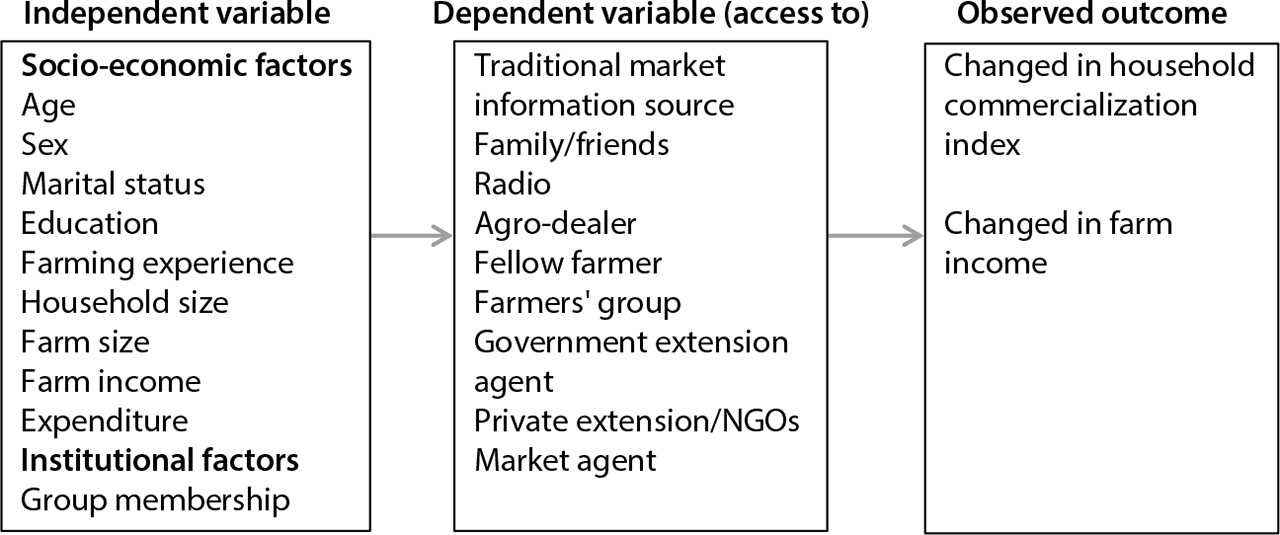
Fig. 1.
Conceptual framework showing the impact of traditional market information sources on HCI and farm income
Source: own elaboration.
Access to traditional market information plays a vital role in the commercialisation of agricultural products and the overall farm income of cowpea farmers. Research has shown that the availability and access to traditional market information have a significant impact on farmers' decision-making processes related to the commercialisation of their cowpea produce (Diaka et al., 2024; Ali et al., 2021; Zondi et al., 2022). A household's ability to access market information affects their level of participation in the market, which, in turn, has implications for their farm income (Kassie et al., 2021; Uneze et al., 2024).
As a result of limited access to market information about produce prices at different marketplaces, as well as the demand and value of their crops, smallholder cowpea farmers often negotiate prices based on the information provided by traders, brokers and middlemen. This leaves the smallholder farmers at a disadvantage, as the exploitative behaviour of these intermediaries reduces their profits (Magesa et al., 2020; Nugroho, 2021). These factors considerably diminish the bargaining power of smallholder farmers and thus encourage the development of uncompetitive markets (Magesa et al., 2020; Nugroho, 2021). According to Nugroho (2021), relying on traditional sources of agricultural market information sources has not been very beneficial for smallholder farmers.
Despite the potential of digital marketing information, its availability and the technological barriers to accessing these services continue to limit their widespread adoption (Kebebe, 2019). To guide policymakers, researchers and cowpea farmers, empirical analysis is needed to assess the impact of traditional market information. However, such evidence is currently lacking, particularly as Nigeria has yet to establish a functional smart cowpea market information system that effectively reaches farmers. In this context, the study aims to examine the impact of traditional market information on household commercialisation and farm income in Borno State, Nigeria.
The Hypotheses of the study were:
H1: Access to traditional market information sources has no impact on HCI
H2: Access to traditional market information sources has no impact on farm income
H3: Access to family and friends, radio, agro-dealers, fellow farmers, farmers' groups, government extension agents, private extension/NGOs, and market agents has no impact on HCI
H4: Access to family and friends, radio, agro-dealers, fellow farmers, farmers' groups, government extension agents, private extension/NGOs and market agents has no impact on farm income
This study contributes to the existing literature on the impact of access to traditional market information on HCI and Farm income. It specifically examines the effects of various information sources – such as family and friends, radio, agro-dealers, fellow farmers, farmers' groups, government extension agents, private extension/NGOs, and market agents – on these outcomes. Furthermore, the study expands on the application of the Uses and Gratifications Theory (UGT) in understanding how traditional market information influences HCI and farm income in a developing economy. It also explores strategies for effectively disseminating digital information systems to uneducated smallholder farmers.
METHODOLOGY
Study area
The study was conducted in the northern Guinea Savannah region of Borno State, where Improved Cowpea Technologies (ICTs) have been disseminated to farmers due to the region's suitability for cowpea production. These technologies were shared through various projects to improve farmers' income and commercialisation, in collaboration with the Borno State Agricultural Development Program (BOSADP). The area comprises four selected Local Government areas: Biu, Kwaya Kusar, Hawul and Bayo.
The study area (Fig. 2) is situated between latitudes 10° 30'N and 10° 45'N and longitude 12° 23'E and 13° 13'E. It has a population of about 352,886 (NPC, 2006) with a projected 2020 population estimate of approximately 704,468, based on a 3.2% population growth rate. The study area covers an area of 6,874.2 km2 (BOSADP, 2020).
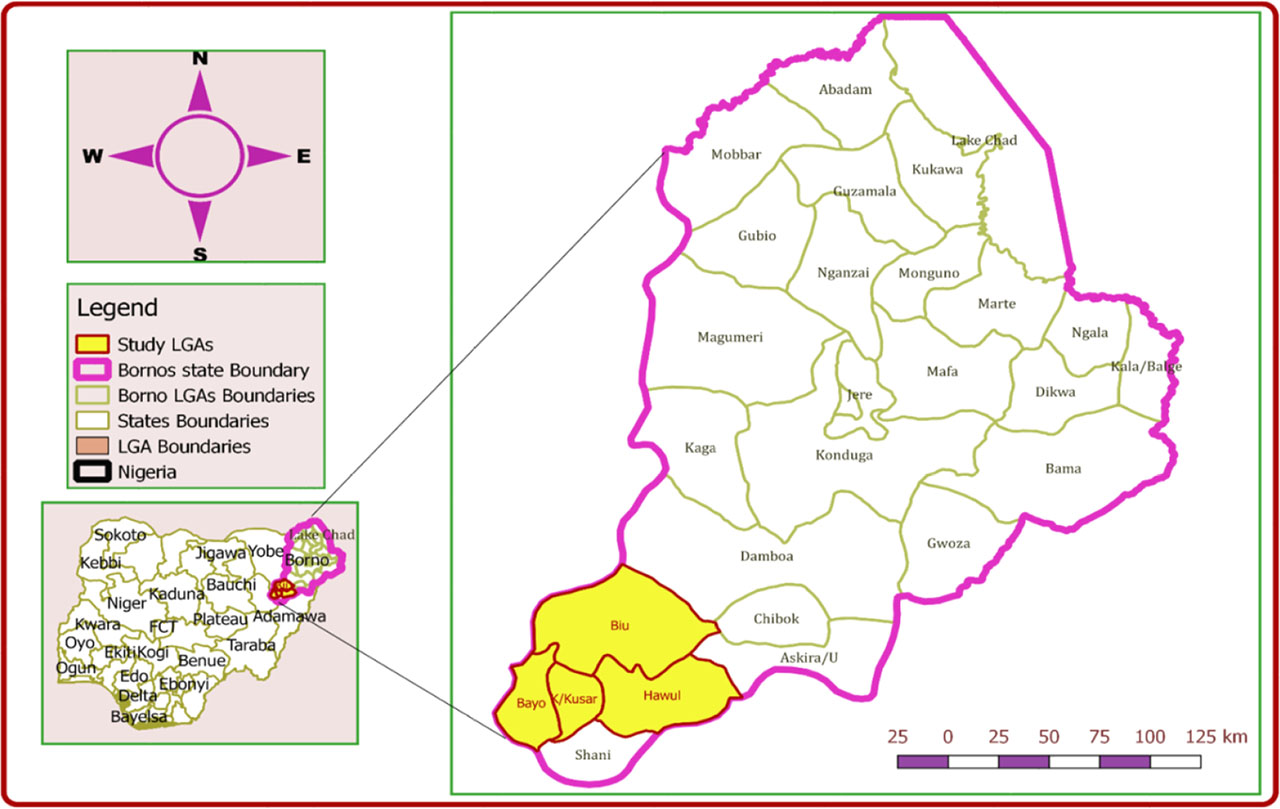
Fig. 2.
Map of Borno State showing the study area
Source: authors, 2024.
The dominant crops grown for home consumption and local markets include cowpea, maize, sorghum, groundnuts, and rice. Livestock species are an integral part of the farming system, providing income and food to households.
Sampling procedure
The multi-stage sampling technique was used to select communities and respondents across the four LGAs. The technique reduces the time and cost of surveying samples from a vast population to a manageable size by passing through several stages to ensure equitable representation (Xie and Lu, 2015).
In the first stage, four Local Government Areas (LGAs) were purposively selected: Bayo, Biu, Hawul, and Kwaya-Kusar, based on factors such as civil unrest and concentration of cowpea production. In the second stage, thirty communities with high concentrations of cowpea production were randomly selected from the four LGAs. This selection was based on the presence of registered households in these communities. In the third stage, respondents were randomly selected from each of the thirty communities.
The list of cowpea farmers in the various communities was obtained from the service department of BOSADP. A total of six hundred respondents were selected for the study; however, seven questionnaires were dropped due to improper completion, leaving 593 for analysis.
Method of Data Collection
Primary data were collected from the cowpea farmers using a structured questionnaire in November 2020. Trained enumerators, under the supervision of the researcher, were used to collect data electronically on annual cowpea production, improved cowpea varieties used, and socio-economic characteristics of the farmers, among others.
Method of Data Analysis
The study used propensity score matching (PSM) and employed different matching estimators to test for robustness. The principal concept behind PSM is to match each cowpea farmer who had access to market information with a similar cowpea farmer who did not have access and then estimate the mean variation in their respective HCI and farm income between the cowpea farmers that accessed market information and their counterparts.
Essentially, the study addresses the question: “How would the HCI and farm income of smallholder cowpea farmers have changed if the farmers who accessed market information had chosen not to access it?” This is given by an average treatment effect on the treated (ATT). According to Imbens and Wooldridge (2009), the ATT is defined as:
where Y(1) and Y(0) are outcome indicators (i.e. HCI and farm income of the cowpea farmers that accessed market information and their counterparts, respectively), and T is a treatment indicator.However, we can only observe ATT = E{Y(1)}/T = 1 in the data set, while ATT = E{Y(0)}/T = 1 is missing. In essence, the study cannot observe what the HCI and farm income of the cowpea farmers would have been if they had not received market information. Once farmers have accessed cowpea market information, the counterfactual outcome – what would have happened without it – cannot be observed.
A simple comparison of HCI and farm income between cowpea farmers with and without access status introduces bias in estimated effects due to self-selection bias. The magnitude of self-selection bias is formally presented as:
By establishing comparable cowpea farmers with and without access to market information, PSM reduces the bias due to observable variables. Once households are matched with observable characteristics, PSM assumes there are no differences in unobservable characteristics between cowpea farmers who accessed market information and those who did not.
Given this assumption of conditional independence and the overlap condition, ATT is computed as follows:
A potential test for robustness involves using different matching techniques. This study employed the nearest neighbour, stratification, radius, and kernel approaches.
RESULT
Description of Continuous Variables by Treatment
The result in Table 1 found no significant differences between cowpea farmers who accessed traditional market information and those who did not, with respect to age, farming experience, household size, Household Commercialisation Index, farm income, expenditure, farm size, value of cowpea harvest and amount of cowpea sold. These variables provide a solid basis for comparison (i.e. comparing cowpea farmers with similar characteristics).
Table 1.
Descriptive statistic of continuous variables by treatment
| Variable | Accessed | Not-accessed | T-value | Df | Mean difference |
|---|---|---|---|---|---|
| mean (n = 228) | mean (n = 365) | ||||
| Age (years) | 45.1 | 45.6 | −0.4 | 591 | −0.5 (1.2) |
| Education (years) | 8.90 | 7.41 | 3.0*** | 591 | 1.5 (0.5) |
| Farming experience (years) | 21.66 | 21.7 | −0.2 | 591 | −0.2 (1.0) |
| Household size (person) | 8.61 | 8.14 | 1.4 | 591 | 0.5 (0.3) |
| Farm income (₦) | 317 848.9 | 379 724.1 | −1.4 | 591 | −61 875.2 (45 725.8) |
| Expenditure (₦) | 187 713.4 | 192 194.6 | −0.4 | 591 | −4 481.2 (12 056.6) |
| Farm size (ha) | 0.9 | 0.8 | 1.6 | 591 | 0.1 (0.1) |
| Value of cowpea harvest (₦) | 262 265.4 | 308 117.7 | −1.1 | 591 | −45 852.4 (40 609.5) |
| Amount of cowpea sold (₦) | 144 887.7 | 187 119.9 | −1.6 | 591 | −42 232.2 (26 715.8) |
| Household commercialization index (%) | 53.9 | 55.6 | −1.1 | 591 | −1.7 (1.6) |
Additionally, the average years of formal education of those who accessed traditional market information and those who did not were 8.90 and 7.41 (P ≤ 0.01) years, respectively. This revealed a significant difference in their education levels.
The average farming experience was 21.66 and 21.7 years respectively, showing no difference in farming experience due to access to traditional market information, with a high level of experience among both groups.
Household sizes were found to be 8.61 and 8.14 people for the cowpea farmers who accessed traditional market information and those who did not, respectively. This showed that the household sizes were similar between the two groups.
Farm income was ₦317848.9 and ₦379724.1 for those who accessed traditional market information and those who did not, respectively. This revealed that farm income for cowpea farmers was similar when segregated by access to market information.
In addition, the expenditure of cowpea farmers was ₦187,713.4 and ₦192,194.6 for those who accessed traditional cowpea market information and those who did not, respectively. The farm size of the cowpea farmers was 0.9 ha and 0.8 ha for those who accessed traditional cowpea market information and those who did not, respectively.
Furthermore, the value of cowpea harvests was ₦262,265.4 and ₦308,117.7 for those who accessed traditional cowpea market information and those who did not, respectively. Additionally, the amount of cowpeas sold by cowpea farmers was ₦144,887.7 and ₦187,119.9 for those who accessed traditional cowpea market information and those who did not, respectively.
Lastly, the household commercialisation index (HCI) of cowpea farmers who accessed traditional market information and those who did not were 53.9% and 55.6%, respectively. These findings suggest that cowpea farmers' HCI does not differ based on access to traditional market information in Borno State, Nigeria. Hence, traditional market information may not have an impact on the HCI of cowpea farmers.
Description of Nominal Variables by Treatment
Table 2 revealed that the Chi-square model was reliable, as shown by the Pearson Chi-square of 9.401 (P ≤ 0.01). The result showed no differences in accessing market information between females and males. However, there is a significant difference (P ≤ 0.01) between group and non-members.
Table 2.
Descriptive statistic of nominal variables by treatment
| not accessed | accessed | |||||||
|---|---|---|---|---|---|---|---|---|
| Sex | Female | Observed frequency | 90a | 60a | 150 | 9.401a | 1 | 0.002 |
| Expected frequency | 92.33 | 57.67 | 150 | |||||
| Male | Observed frequency | 275a | 168a | 443 | ||||
| Expected frequency | 272.67 | 170.33 | 443 | |||||
| Total | Observed frequency | 365 | 228 | 593 | ||||
| Expected frequency | 365 | 228 | 593 | |||||
| Group membership | Non-member | Observed frequency | 188a | 88b | 276 | 9.401a | 1 | 0.002 |
| Expected frequency | 169.88 | 106.12 | 276 | |||||
| Member | Observed frequency | 177a | 140b | 317 | ||||
| Expected frequency | 195.12 | 121.88 | 317 | |||||
| Total | Observed frequency | 365 | 228 | 593 | ||||
| Expected frequency | 365 | 228 | 593 |
Sources of traditional market intelligence of cowpea farmers
Table 3 revealed that 37.81% of cowpea farmers sourced their market information through fellow farmers. Furthermore, 35.04% obtained their traditional market intelligence through family and friends. Other sources of traditional market information included agro-dealers (10.76%), farmers' groups (6.50%), government extension agents (4.15%), radio (3.41%), private extension/NGOs (1.92%) and market agents (0.43%). Farmers accessed more information through their family and friends due to the ease of access and the trust they had in them.
Table 3.
Traditional market information sources
| Market information | Frequency* | % |
|---|---|---|
| Fellow farmer | 355 | 37.81 |
| Family/friends | 329 | 35.04 |
| Agro-dealer | 101 | 10.76 |
| Farmers' group | 61 | 6.5 |
| Government extension agent | 39 | 4.15 |
| Radio | 32 | 3.41 |
| Private extension/NGOs | 18 | 1.92 |
| Market agent | 4 | 0.43 |
| Total | 939 | 100 |
Propensity score matching of the respondents
Table 4 showed that a significant LR Chi-square (10) = 35.59 (P ≤ 0.01) demonstrating the reliability of the model, as shown by the log-likelihood of −374.37. Marital status, education, group membership and farm size were found to be positively significant (P ≤ 0.01, P ≤ 0.01, P ≤ 0.05 and P ≤ 0.1, respectively). Sex and farm income were found to be negative but significant (P ≤ 0.01 and P ≤ 0.1, respectively).
Table 4.
Propensity score matching of the respondents
| Variable | Coef. | S.E | Z-value |
|---|---|---|---|
| Age | −0.0037 | 0.0069 | −0.53 |
| Sex | −0.5016 | 0.1593 | −3.15*** |
| Marital status | 0.5959 | 0.2040 | 2.92*** |
| Education | 0.0267 | 0.0102 | 2.62*** |
| Farming experience | 0.0070 | 0.0084 | 0.83 |
| Household size | 0.0050 | 0.0139 | 0.36 |
| Farm size | 0.1615 | 0.0844 | 1.91* |
| Group membership | 0.2761 | 0.1118 | 2.47** |
| Farm income | −1.91e-07 | 1.13e-07 | −1.69* |
| Expenditure | −1.91e-07 | 1.13e-07 | −0.38 |
| Constant | −0.8731 | 0.3050 | −2.86 |
| Log likelihood | −374.37 | ||
| LR chi2 (10) | 35.59*** | ||
| Pseudo R2 | 0.045 |
Marital status was found to be positively significant (P ≤ 0.01), indicating that it was a significant determinant of accessing traditional market information in Borno State, Nigeria. The results showed that if a cowpea farmer was married, the likelihood of obtaining market intelligence from traditional sources increased by 0.5959, assuming other variables were held constant. This is probably because married individuals have dependents they need to provide for, motivating them to seek market information to make informed marketing decisions.
Similarly, education was found to be positively significant (P ≤ 0.01). This showed that as the farmers' formal education level increased by one year, the propensity to access market information from traditional sources also increased by 0.0267, assuming other variables were held constant. Educated farmers tended to utilise available sources of market intelligence to make wise decisions regarding the appropriate time and place to sell their cowpea produce.
Group membership was also found to be positively significant (P ≤ 0.05). This indicates that if a cowpea farmer was a group member, the probability of accessing traditional market intelligence increased by 0.2761, assuming other variables were held constant. This might be because cowpea farmers form groups to gain benefits, particularly agricultural-related information, that helps them make informed decisions.
Similarly, farm size was found to be positively significant (P ≤ 0.1). This indicates that as farm size increased by 1 ha, the propensity to access market information from traditional sources also increased by 0.1615, assuming other variables were held constant.
In addition, sex was found to be negative but significant (P ≤ 0.01). This indicates that if a cowpea farmer was female, the likelihood of accessing traditional market information increased by 0.5016, assuming other variables were held constant.
Likewise, farm income was found to be negative but significant (P ≤ 0.1). This revealed that if farm income increased by ₦1, the tendency for the cowpea farmer to access traditional market information decreased by 1.91e-07, assuming other variables were held constant. This is probably because wealthier individuals are more likely to strive to access non-traditional market information for their farm produce.
Impact of Access to Traditional Market Intelligence on Cowpea Farmers' Household Commercialisation
Table 5 showed that access to traditional market information had no significant impact (P ≥ 0.1) on HCI. This lack of impact is likely due to the activities of brokers and middlemen, who make traditional market information inefficient and exploit the market situation, leaving cowpea farmers with limited benefits.
Impact of access to traditional marketing intelligence on cowpea farmers' farm income
Table 6 revealed that there was no significant (P ≥ 0.1) impact of access to traditional market information on farm income (i.e., no benefit), possibly due to the activities of traders, brokers and middlemen who create an uncompetitive market and exploit the situation, leaving cowpea farmers at a disadvantage.
Impact of access to different forms of traditional market information on household commercialisation and farm income
Table 7 showed no impact from most sources of traditional market information (no benefit) on HCI; only market agents were found to have a positive impact (P ≤ 0.1) on HCI. This indicates that if a farmer sources information from a market agent, their HCI improves by 4.001% compared to those who use other sources. However, the results showed no impact on cowpea farmers' farm income (P ≥ 0.1).
Table 7.
Impact of traditional market information on household commercialisation and farm income
| Variable | Matching algorithms | Household commercialization index | Farm income | ||||
|---|---|---|---|---|---|---|---|
| No. of treated | No. of control | ATT | No. of treated | No. of control | ATT | ||
| Family/friends | Kernel | 328 | 258 | 1.978 (1.668) | 328 | 258 | 78,322.227 (43558.99)* |
| Stratification | 322 | 257 | 1.852 (1.574) | 322 | 257 | 39,246.196 (38303.202) | |
| Radius | 328 | 258 | 1.688 (1.594) | 328 | 258 | 96,446.012 (43416.320)** | |
| Nearest neighbor | 328 | 158 | 1.537 (2.193) | 328 | 158 | 74,872.091 (56849.034) | |
| Radio | Kernel | 32 | 505 | −4.116 (3.550) | 32 | 505 | −73000 (34741.877)** |
| Stratification | 32 | 505 | −3.567 (3.908) | 32 | 505 | −75,500 (34091.713)** | |
| Radius | 32 | 505 | −4.423 (3.682) | 32 | 505 | −76400 (35727.559)** | |
| Nearest neighbor | 32 | 30 | −1.680 (5.139) | 32 | 30 | −294,000 (209,000) | |
| Agro-dealer | Kernel | 99 | 478 | −1.322 (2.351) | 99 | 478 | −42400 (29749.645) |
| Stratification | 99 | 478 | −1.215 (2.077) | 99 | 478 | −49100 (31911.602) | |
| Radius | 99 | 478 | −1.481 (2.151) | 99 | 478 | −36200 (33417.561) | |
| Nearest neighbor | 99 | 92 | −1.588 (2.897) | 99 | 92 | −42200 (42067.008) | |
| Fellow farmer | Kernel | 353 | 235 | −0.008 (1.860) | 353 | 235 | 42384.078 (43579.499) |
| Stratification | 348 | 232 | −0.088 (1.595) | 348 | 232 | −7423.472 (34368.802) | |
| Radius | 353 | 235 | −0.403 (1.612) | 353 | 235 | 40837.476 (41625.786) | |
| Nearest neighbor | 353 | 165 | −0.006 (1.954) | 353 | 165 | 29790.229 (47964.206) | |
| Farmers' group | Kernel | 61 | 496 | −3.5 (2.715) | 61 | 496 | 22279.666 (44574.657) |
| Stratification | 61 | 496 | −3.835 (2.569) | 61 | 496 | 17268.522 (39049.190) | |
| Radius | 61 | 496 | −3.744 (2.644) | 61 | 496 | 18458.284 (38370.516) | |
| Nearest neighbor | 61 | 56 | −4.426 (3.222) | 61 | 56 | 14663.115 (47312.762) | |
| Government extension agent | Kernel | 39 | 505 | 2.682 (3.613) | 39 | 505 | −130000 (60171.328)** |
| Stratification | 37 | 499 | 3.764 (3.749) | 37 | 499 | −95700 (41706.487)** | |
| Radius | 39 | 505 | 2.737 (3.683) | 39 | 505 | −67400 (42508.149) | |
| Nearest neighbor | 39 | 34 | 9.903 (5.019) | 39 | 34 | −429000 (251,000)* | |
| Private extension/NGOs | Kernel | 18 | 481 | −7.025 (4.414) | 18 | 481 | 51761.348 (68591.872) |
| Stratification | 18 | 481 | −6.75 (4.673) | 18 | 481 | 31591.209 (55124.718) | |
| Radius | 18 | 481 | −7.038 (4.948) | 18 | 481 | 63716.311 (80036.586) | |
| Nearest neighbor | 18 | 17 | −5.444 (6.129) | 18 | 17 | 67594.444 (88942.490) | |
| Market agent | Kernel | 4 | 226 | 3.855 (2.866) | 4 | 226 | 447000 (391,000) |
| Stratification | – | – | – | – | – | – | |
| Radius | 4 | 226 | 4.001 (2.128)* | 4 | 226 | 453000 (398,000) | |
| Nearest neighbor | 4 | 4 | 9 (15.426) | 4 | 4 | 598000 (402,000) | |
Furthermore, in the farm income model, family and friends were found to have a positive impact (P ≤ 0.05) on cowpea farmers' farm income in the radius matching algorithm. Negative but significant impacts were found for radio and government extension agents (P ≤ 0.05 and P ≤ 0.05, respectively).
Radio was found to have a negative but significant impact (P ≤ 0.05), indicating that if a cowpea farmer accessed market information through radio, their farm income decreased by ₦73000 to −₦75,500 compared to their counterparts. Government extension agents were also found to have a negative but significant impact (P ≤ 0.05).
DISCUSSION
The study found that cowpea farmers, regardless of their primary information source (traditional or otherwise), were predominantly middle-aged, suggesting they were in their prime agricultural years. However, their level of education significantly influenced both their access to and use of information. Less educated farmers tended to rely more on traditional sources, such as family and friends, while more educated farmers were likely to explore a wider range of sources, including digital technologies.
The findings align with existing literature. Chen and Lu (2020) highlighted the role of marital status in information-seeking, noting that married individuals prioritise survival and skill-related information. Similarly, Masegela and Oluwatayo (2018) emphasised the positive impact of education on farmers' access to market information.
Farm size also played a crucial role. Larger farms tended to adopt improved technologies and utilise diversified information sources due to higher affordability and the need for advanced management practices. This is consistent with the findings of Abiri et al. (2023), Maru et al. (2018), and Deichmann et al. (2016).
The study raised concerns about the effectiveness of certain information sources. Although market agents are widely used, they are often perceived as serving their own interests more than those of the farmers – a view supported by Asad et al. (2019). Additionally, radio as an information source was found to be less effective due to its limited availability and lack of real-time updates, corroborating findings by Kassie et al. (2021).
Government extension agents were also identified as an inefficient source of information. This is likely due to limited resources and staff shortages in Nigeria's agricultural extension system. Kassie et al. (2021) further emphasised the importance of timely and accurate market information for improving farmer outcomes.
CONCLUSION AND RECOMMENDATIONS
Based on the findings of the study, we can conclude that, on the whole, access to traditional market information had no significant impact on both HCI and farm income of cowpea farmers in Borno State, Nigeria. However, when analysed separately, accessing market information from market agents increased the HCI by 4.001%, though this did not translate into improved farm income. Relying on family and friends as a traditional source of market information increased cowpea farmers' income by ₦96,446.012, while reliance on radio programs and government extension agents reduced farmers' income by ₦75,500 and ₦95,700, respectively.
It is therefore recommended that, given farmers' generally low education levels, which lead them to rely heavily on traditional market information, along with the exploitative practices of traders, brokers and middlemen in cowpea markets, a more decentralised digital approach should be adopted to reduce these dependencies. This could be achieved through a mobile-based Voice & Image Recognition Application, enabling farmers to use voice commands or take pictures of their produce to access real-time market information. This will overcome literacy barriers and limited internet access in rural areas while providing relevant market information.
Additionally, an Interactive Voice Messaging System could allow farmers to receive market information through pre-recorded voice messages in their local language, delivered via mobile phones. This would work on phones with minimal internet connectivity, with trusted institutions managing the content to ensure reliability while reaching a large number of farmers.
Furthermore, Digital Farmer Cooperatives, an online platform that links farmers directly to consumers or fair-trade establishments, could bypass exploitative middlemen. Utilising existing social networks, such as farmer cooperatives and community centres, could provide training on accessing market information through digital platforms.
Contract farming offers another promising strategy. This method, which promotes cooperation and negotiation among farmers, addresses asymmetric information issues while ensuring that small-scale producers in Nigeria continue to participate in markets. Contract farming has been shown to help smallholder farmers in developing economies increase their wealth, income, and productivity (Nazifi et al., 2021; Ruml and Qaim, 2020; Yusuf et al., 2021).
The main limitation of this study was its restriction to observable variables. Future studies could improve upon this by controlling for non-observable variables through the use of endogenous switching regression and inverse probability weighting with regression adjustment (IPWRA) in addition to propensity score matching (PSM). Alternatively, panel data or an experimental approach could be used to address the issue of endogeneity. The study could be extended to examine gender differences in the impact of traditional market information on HCI and farm income.
ACKNOWLEDGMENT
We acknowledge the effort of our enumerators that follow us to the field despite the security situation in the area.