
1. Introduction
An interview with Chester Whittier Newton (1920–2017) in 1990 as part of input to a mentorship project, Carl-Gustaf Rossby as a Mentor (Lewis 1992), has provided information about Newton’s early career that complements information found in Lewis (1992), Fankhauser and Shapiro (1987), and Madden (2017).
This paper focuses on information in Chester Newton’s two-hour interview with the author at National Center for Atmospheric Research (NCAR) (Lewis 1990). A photograph of Newton on the day of the interview (June 18, 1990) at National Center for Atmospheric Research (NCAR) is shown in Figure 1. The paper reveals evidence of Rossby’s unique way of training young scientists in the company of a coterie of like-minded professors and visitors to “his institutes”, Institute of Meteorology at University of Chicago and the International Meteorology Institute (IMI) at the University of Stockholm. In this milieu, students were exposed to new and untouched phenomena that provided the grist for their meteorological research mills. Through Newton’s accurate and enlightening discussion of events, we are brought back to those early years of discovery in meteorology. This narrative is followed by an Afterword where materials delivered to the author by Newton in the early–mid 1990s provide evidence of Rossby’s continued guidance.
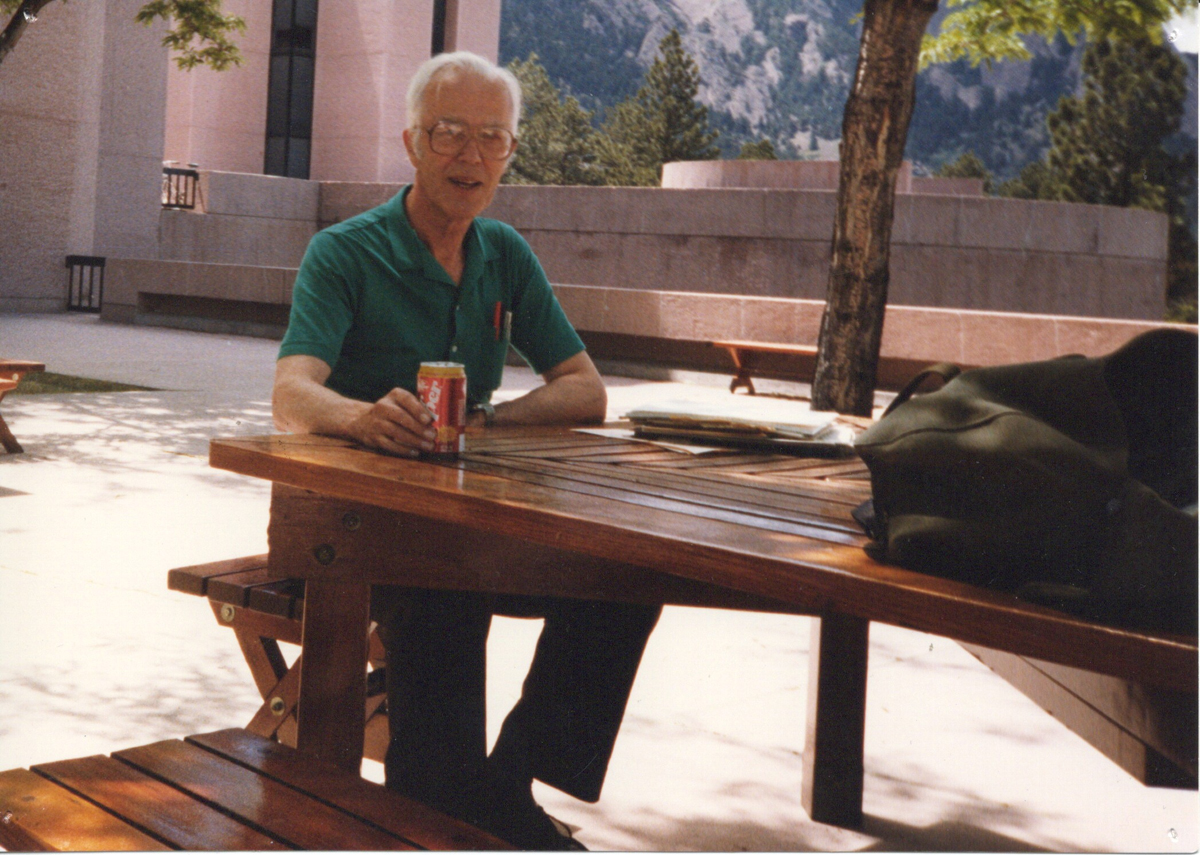
Figure 1
Chester Newton seated on a bench outside NCAR’s Mesa Laboratory.
2. Interview with Chester W. Newton (1990)
The material in this interview are the words of Chester Newton. However, material in the following sections do not necessarily follow the order of information in the interview. The subject matter dictates the part of the interview where information is extracted. At two junctures, Remarks 1 and 2, information in the preceding section of the interview is expanded upon by the author. Within the interview, the author’s inserted information is found in brackets.
2 a. Entry into Meteorology
Before the war, I was a weather observer for the United States Weather Bureau (USWB) at Phoenix, AZ. I was an observer for 3 years (1939–1942) which I got accidently, never having heard of meteorology. I wanted to be a pilot. I was rejected by the Army Air Corps since I was so skinny, 25 pounds under weight. I then tried to join the Navy as an aerographer or whatever it was called. I was rejected because I didn’t have a college degree, just a junior college degree from Phoenix Junior College. I don’t know how I learned about the Cadet program,1 but I was given a waiver because of my weight and also given a waiver for college because of my work as a weather observer. I was sent to University of Chicago (U of C) for Cadet training. I was given a commission as a lieutenant after the 1-year training and was an Air Corps weather forecaster in California for a short time and in Burma and India for a longer time. I really didn’t know what I was doing as a forecaster, although we were trying to apply the principles learned at Chicago. I remember we got a ship load of Rossby diagrams that we used to classify air masses (tropical or polar air masses).
2 b. Rossby’s View of Research in Meteorology
At war’s end, I returned to U of C having remembered the lectures by Rossby (Figure 2). There was a powerful group of instructors: Rossby, Starr, Riehl, Platzman, and Fultz (Figure 3). As I look back at that time, and with the benefit of having become a research meteorologist, I see Rossby as an innovator who had a unique view of meteorology. In the late 1930s when he was associated with the USWB, he and [Francis]2 Reichelderfer [Chief of the USWB from 1938–1963] introduced American meteorologists to the Polar Front theory and also introduced them to isentropic analysis. He was very impatient with the old-line meteorologists who were reluctant to accept new ideas. He was more interested in the upper air and its connection with fronts at the surface, but he was especially interested in the three-dimensional structure of the polar front. He left the work on this problem to the visitors at U of C, especially [Erik] Palmén and [Alf] Nyberg.
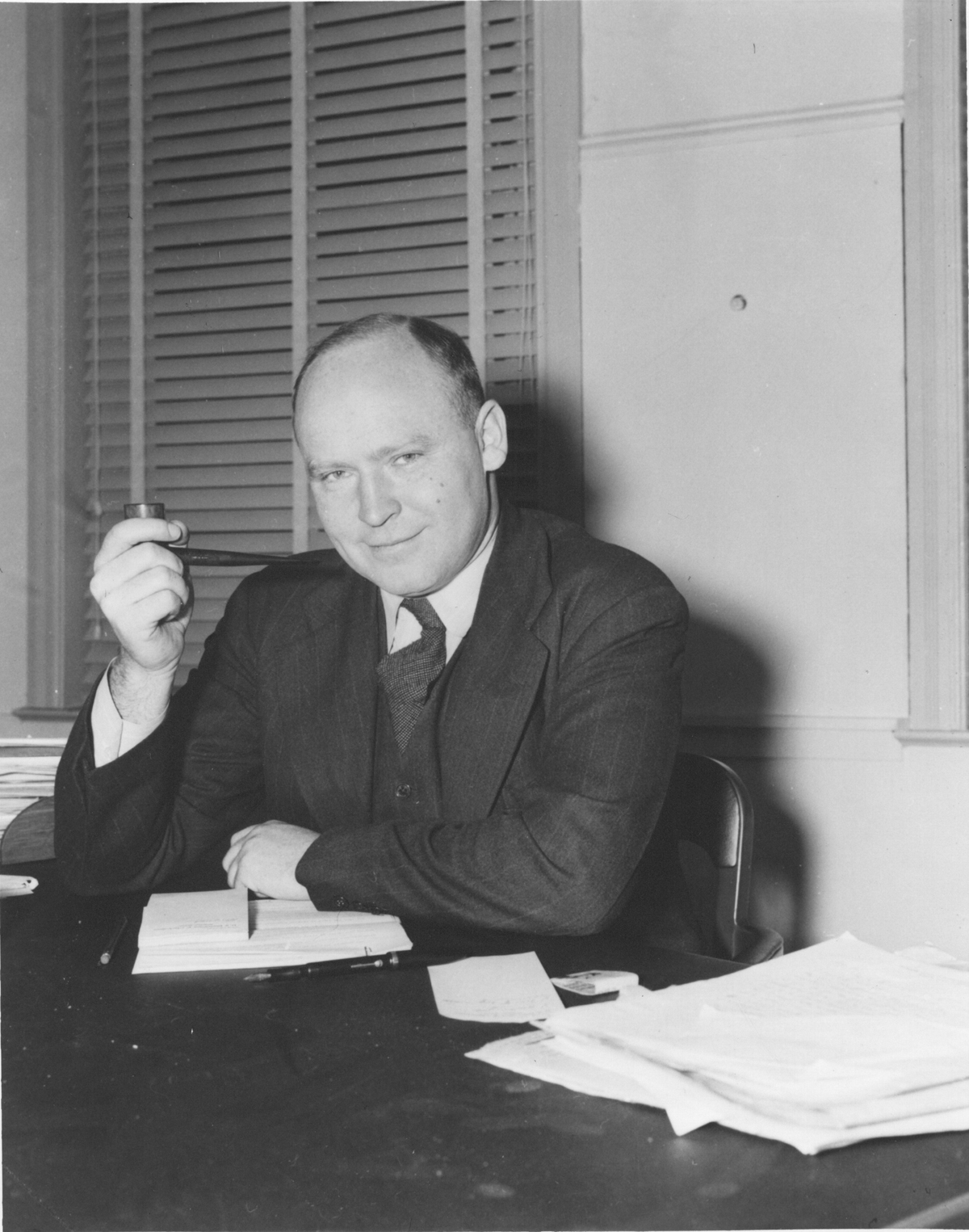
Figure 2
Carl-Gustaf Rossby at his desk in the USWB building (ca. 1939). Reproduced with permission of Library of Congress, Manuscripts Division.
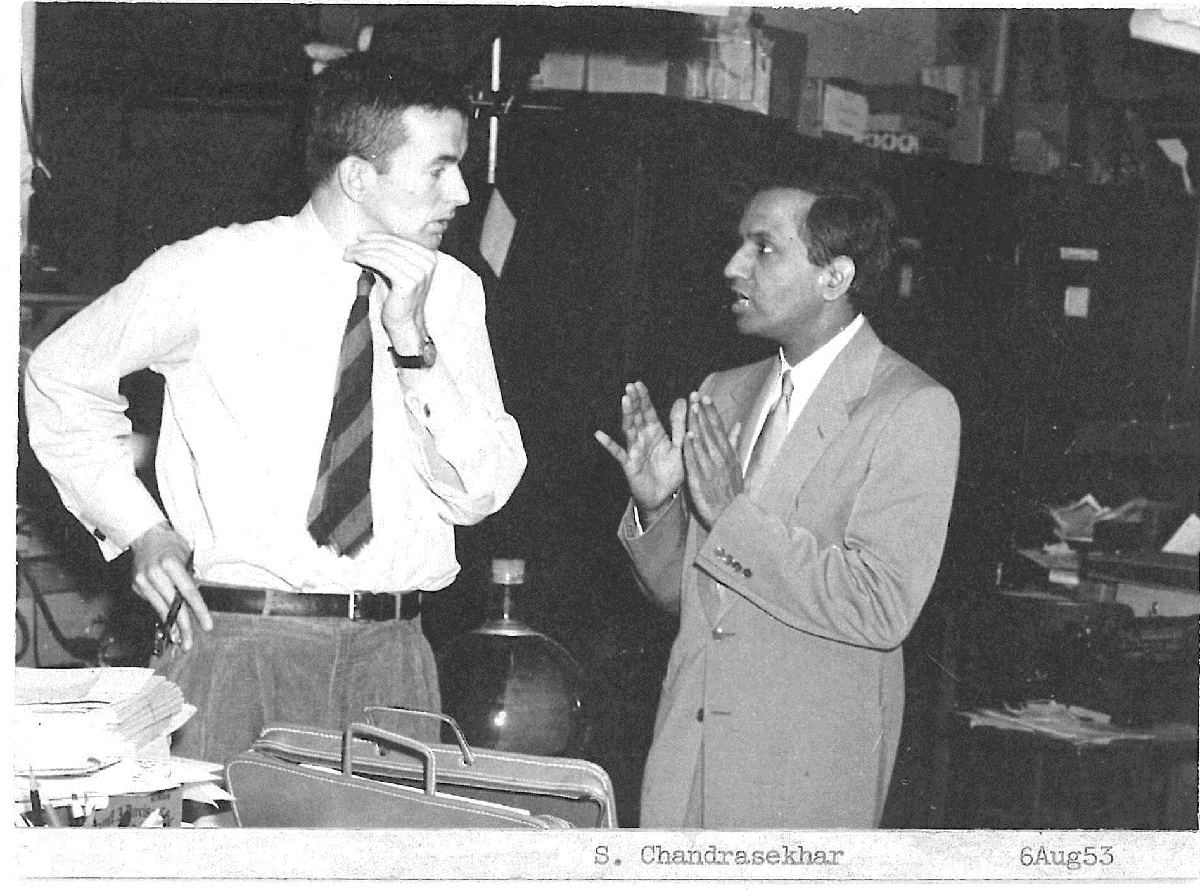
Figure 3
Discussion between Professors Dave Fultz (left) and Subramanyan Chandrasekhar (right) in the Hydrodynamics Lab, the laboratory used for instruction in geophysical fluid dynamics starting in the late-1940. Reproduced with permission courtesy of Dave Fultz.
Rossby considered synoptic meteorology of equal importance to dynamics, as a real-world basis of what had to be explained. It’s for that reason he set up the daily hemispheric weather map analyses under George Cressman (Figure 4; later Director of the National Weather Service]. I was assigned to help George prepare maps for the daily discussions. That was my first job at U of C. Attendance at these discussions was mandatory for staff and all graduate students. It wasn’t a 15-minute job, it would sometimes go on for a couple of hours. These people argued back-and-forth. Rossby took the helm along with Palmén (Figure 5). Regardless of the special research interests of staff and students, everybody was expected to attend.
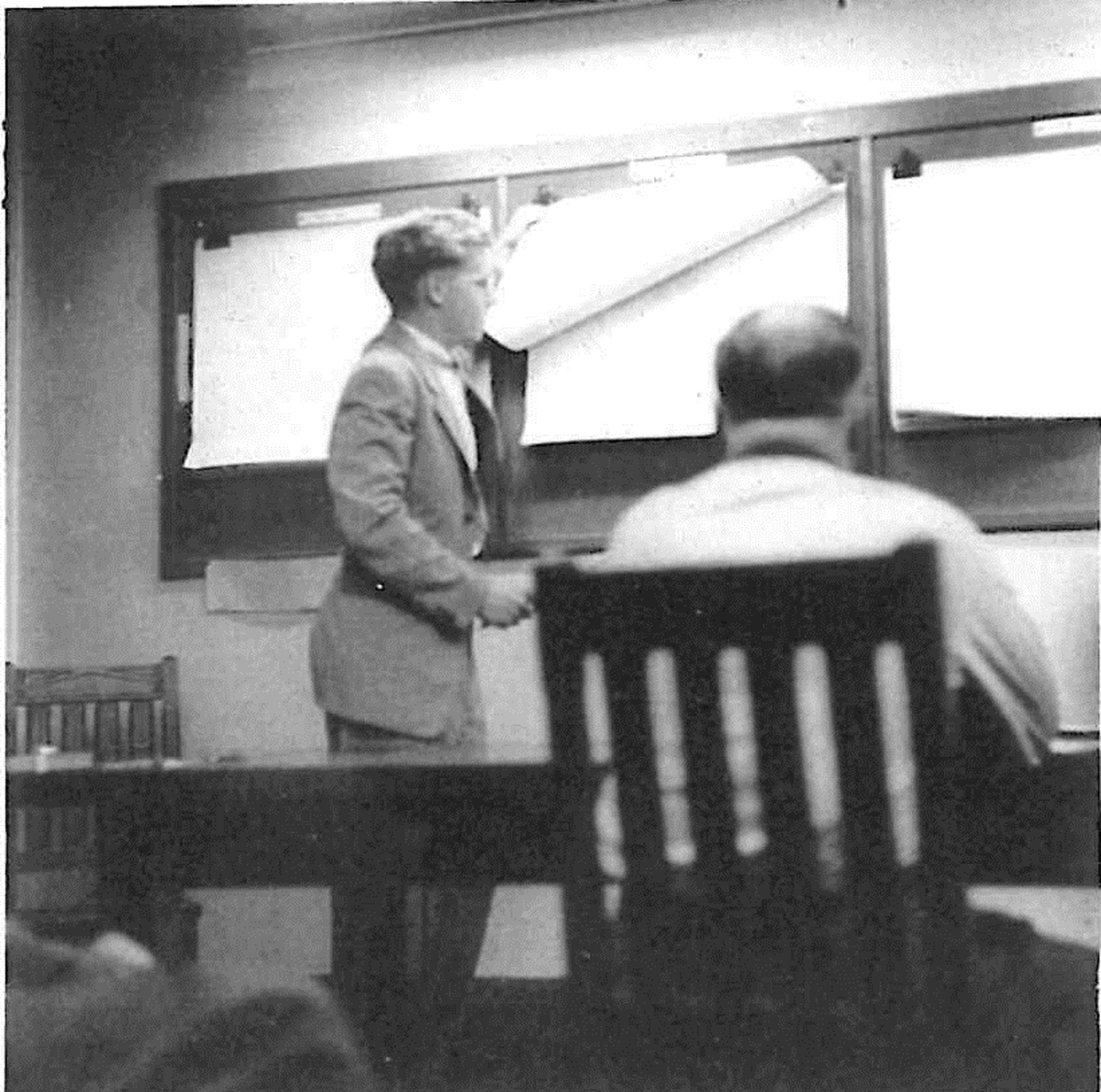
Figure 4
George Cressman leading a map discussion at 5727 University Avenue, Institute of Meteorology, University of Chicago. Seated in the first row (back turned) is Erik Palmén (ca. 1947). Reproduced with permission courtesy of Department of Geophysical Sciences, University of Chicago).
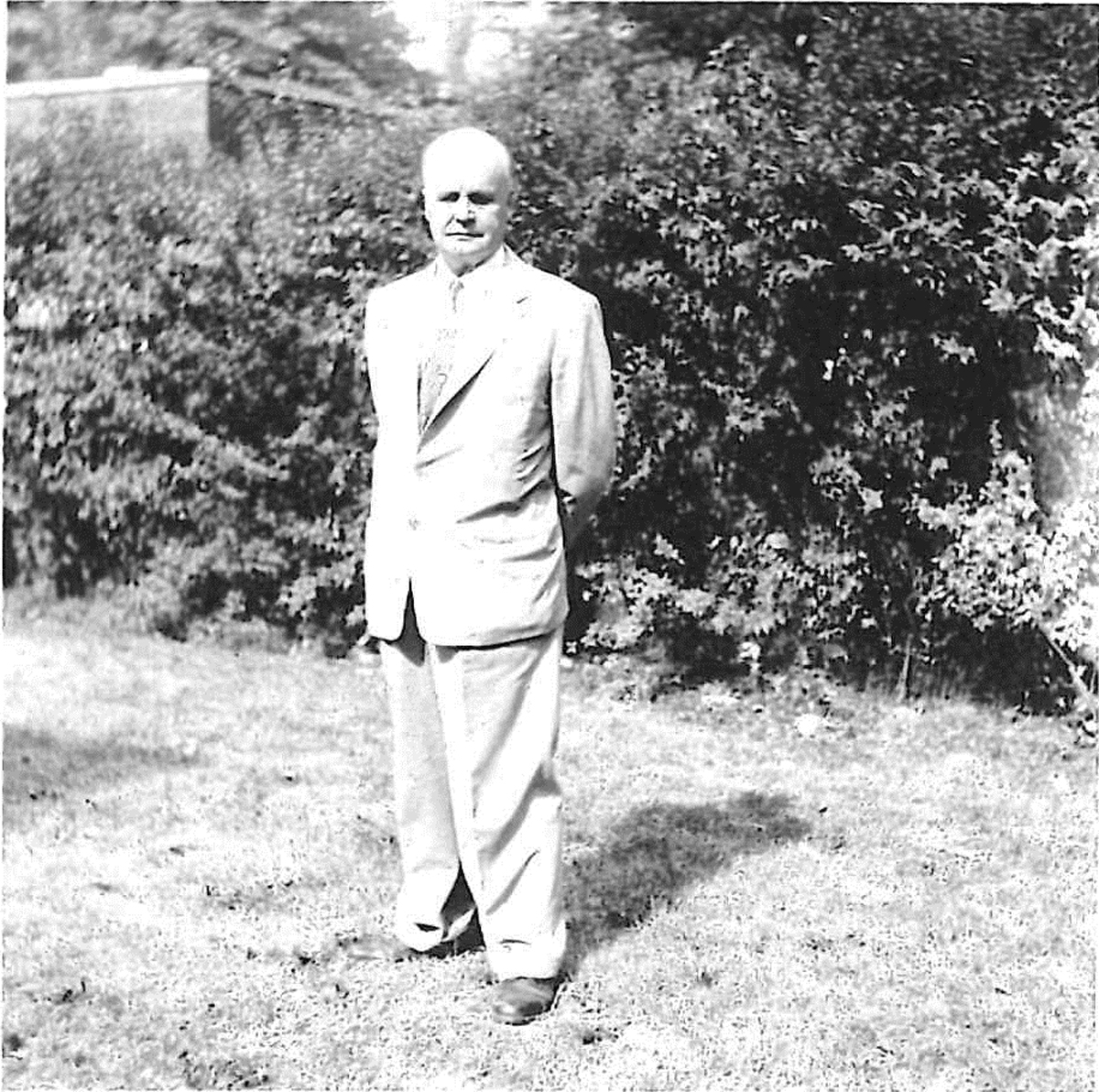
Figure 5
Erik Palmén standing outside the Institute of Meteorology building (ca. 1947). Reproduced with permission courtesy of G. Platzman.
Along with the theory of upper-level waves, Rossby considered the jet stream as a unifying concept for understanding the general circulation of the atmosphere. Other institutions at this time [late-40s into the 1960s] were also involved in general circulation projects with support from ONR [Office of Navy Research]. Starr, who went to MIT [Massachusetts Institute Technology] from U of C, was one of them. They were interested in the mean structure, angular momentum and heat transport by eddies and that sort of thing. Rossby was more interested in finding out the mechanisms by which the atmosphere worked rather than just statistical structure. Interaction between upper-level waves and surface disturbances and their development and how they impacted development downstream.
The daily hemispheric map discussions enabled an actual demonstration of these connections centered around Rossby’s original wave formula extended to group velocities and things of that sort. This became a rich source of research ideas exploited by George Cressman’s presentations where he and Yi-Ping Hsieh’s [Founder of the Geophysics Department at Beijing] worked on the theoretical side. Rossby was fascinated by the jet stream as a connector between regions where atmospheric properties of temperature gradients and momentum are concentrated. He also had a theory of lateral mixing of vorticity that differed from Palmén’s view [discussed later in Remark 2].
What we all gained from Rossby was a notion of a unifying concept of the jet stream with the atmosphere’s general circulation. A rich variety of phenomena came from this unifying concept where description was important but where physical interpretation is always essential as part of the story. At this time, perhaps more than any other time in the evolution of meteorology, there was an increase in upper-air observations and communication so that we could get these things on time. For the first time after WWII, the framing of the jet stream concept that unified overall atmospheric structure revealed untouched phenomena for everybody to have a share. It was especially important for students to share it. It was not difficult to find new phenomena that had not been discovered as it is now [1990]. All of us felt that we owned a bit of it and went out into the world feeling we could do more. We were given confidence that we could do it.
2 c. The impact of visiting meteorologists
I first met Eric Palmén when he regularly visited U of C after the war. He became my dissertation advisor. As you probably know, Germany occupied Finland during the war. Palmén’s research was interrupted at this time. He had made important contributions before the war, especially his study in 1937 with Jack Bjerknes [Bjerknes and Palmén, 1937]. Palmén was Director of the Finnish Institute of Marine Research. During the war, a lot of the activities at the Institute revolved around collection of observations at sea, practical applications. Palmén was given new life when he came to U of C. The visitors came with their own agenda as expected, but they were instrumental for the vitality they brought to the U of C and the International Meteorological Institute (IMI) at Stockholm University. They fertilized our minds with ideas brought from their countries. Great minds were all around us. Another thing that people forget about the visiting meteorologists is that not only did they give to us, but they took something from us and brought it back to their countries. Further, some of the foreign grad students who got their doctorates under Rossby and Palmén, brought the U of C meteorology philosophy back to their countries. The ones I remember in particular are Yi-Ping Hsieh, who studied under Palmén, and Tu-Cheng Yeh, who studied under Rossby. They brought the philosophy and teaching methods back to the Peoples Republic of China. My wife Harriet, also a recipient of a master’s degree from U of C, and I were good friends of these fellow Chinese students and had them over to our house regularly. When they returned to China, they became leading figures in science and meteorology, Yeh becoming the Director of the Academy of Science in China, and Hsieh a teacher and head of the Department of Geophysics at Peking University. He trained 100’s if not 1000’s of meteorologists. They came to USA in 1946 as part of USA’s Lend Lease Act and remained in USA for three years. [As remembered by Yi-Ping: ‘Palmén discovered the cold vortex, I tried to find out its structure and life cycle, I did the choice myself. Finally, I presented the manuscript to Rossby and Palmén. They accepted my dissertation’ (Hsieh, Personal communication, 1990)].
Remark 1 Author’s expansion on section 2 c
Among the visitors to the U of C’s Institute of Meteorology were the following: H. Almann, T. Bergeron, E. Biel, G. Godske, E. Hoiland, A. Nyberg, E. Palmén, Z. Sekera, and P. Queney.3
Those who came to the (IMI) at Stockholm were the following: A. Bedient, H. van de Boogart, P. Bergthórsson, E. Barrett, A. Chaudary, F. Defant, E. Eady, A. Elliasen, H. Ertel, R. Fjortoft, O. Haug, K. Hinkelmann, E. Kleinschmidt, F. Ludlam, W. Malkus, B. Mason, K. Mohri, C. Newton, H. Newton, E. Palmén, N. Phillips, C. Ramaswamy, J. Malkus-Starr, and J. Van Meigham.4
A visitor’s first lecture in a series at U of C was usually to a roomful (in the upstairs large classroom at 5727 University Avenue, home of the Institute of Meteorology), but succeeding lectures were typically deeper and more specialized so the audiences were smaller (Saucier, Personal communication, 1991). As remembered by Saucier:
I decided to miss the 3rd lecture of one of our visitors and thought my time would be better spent searching for materials in the downstairs library for my next lecture in synoptic lab. The audience was especially small for this 3rd lecture, and who comes into the library, nobody else but CGR, and he admonishes me to attend the lecture, and of course I did, along with several other graduate students he had corralled from the other rooms, and this led to a halfway respectable audience!
It is further interesting to consider reasons for Rossby’s move to Sweden in 1948, with regular visits to U of C and Woods Hole Oceanographic Institution between 1948 and 1957 (year of his death). At the International Meteorological Organization (IMO) 1946 meeting in London, Rossby and Russian Academician Evguenij Federov strongly argued for reestablishment of international cooperation in operational meteorology, cooperation of all countries including former enemy countries (the Axis powers) and neutral countries in WWII [See Rossby 1946a; 1946b]. But the climate was not favorable for an all-encompassing international institute in the USA according to Philip Thompson (P. Thompson, 1990), Director of the Atmospheric Analysis Laboratory at AFCRL (Air Force Cambridge Research Laboratories) in 1948 (Tribbia and Kasahara, 1987); furthermore, Sweden had a long tradition of neutrality. At the same time, Rossby’s wife, Harriet Rossby-Woodcock, indicated that her husband made a point of not staying in one place longer than 10 years and not that long in most. His next planned move from Stockholm was to the Middle East where his interest was tending toward world water problems (H. Rossby-Woodcock, Personal communication, 1991). Bert Bolin, a protégé of Rossby who inherited the directorship of the (IMI), added: ‘…during the year before his death, Rossby was deeply involved in an attempt to establish a World Meteorological Organization (WMO) research project on the meteorology in the arid-zone and the possible creation of a department of meteorology at the American University in Beiruth [Beirut], Lebanon (Bolin, Personal communication, 1990)’.
2 d. Newton’s Dissertation
Well, I was working under Palmén, but I felt my degree should have also recognized ‘the department’. We were on our own as we noticed new phenomena in the atmosphere, many times during map discussions. I noticed these shear lines near the tropopause, lines that Rossby called ‘cracks’ in the atmosphere as opposed to waves in the atmosphere. Rossby became very interested in these cracks and wanted me to supply him with one of the analyzed maps for some presentation he was going to make (Figure 6).
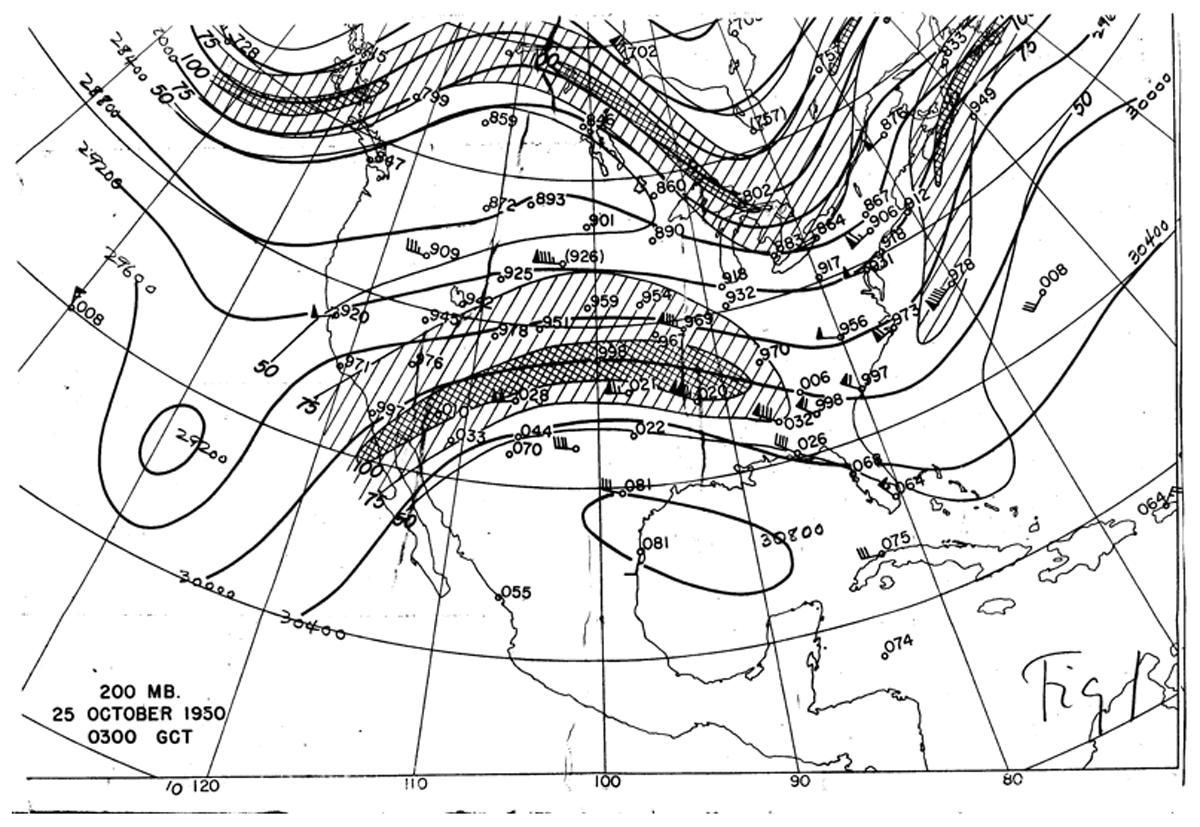
Figure 6
Weather map drawn by Newton at the 200 hPa level on 25 October 1950, 0300 UTC, showing geopotential contours (meters), wind observations (standard flag format), and isotachs (wind speeds). The hatched zones outline winds greater that 100 kt. Rossby’s hand labeled the figure, Figure 1, in the lower right corner. Reproduced with permission courtesy of C. Newton.
Remark 2 Authors expansion of section 2d
Since little information in the interview related to Newton’s dissertation (Newton 1951a), it is appropriate to briefly review this work.
A sizable portion of Newton’s dissertation is contained in the publication Newton et al. (1951b). Palmén had been a key member of the ‘jet stream team’ at the University of Chicago (Staff, 1947), he was also on the verge of discovering the subtropical jet stream (Newton, 1986) and was strongly arguing for the role of angular momentum in the transformed 3-cell depiction of the atmosphere’s meridional circulation. Newton had co-authored two important papers with Palmén: (1) dynamic concentration of wind and temperature fields near the polar front (Palmén and Newton, 1948), and (2) the three-dimensional motions in outbreak of polar air (Palmén and Newton, 1951).
Both Hsieh (1950) and Newton (1951a) [his dissertation] had become inspired by the presence of these ‘cracks in the atmosphere’, the shear lines in mid-latitude synoptic weather regimes. Hsieh’s problem definition related to wintertime situations where cut-off low pressure systems formed. In these situations, where cold air aloft is subsiding, the width of the low-level trough gradually decreases and its amplitude increases. In these cases, the trough becomes so sharp that it can be treated as a shear line. In Newton’s problem, the shear lines form near the tropopause in summertime where an upper-level cold-air mass is typically absent. His explanation for development of shear lines rests on the convergence of the isotach pattern bounding the trough of a jet stream. This, in turn, demands a vertical packing of isentropes to satisfy quasi-geostrophic balance as shown in Figure 2 of his dissertation (copied and appearing as Figure 7 in this paper). As Newton further states (Newton, 1951a, p. 6), ‘The shear lines to be studied in this paper are restricted to the latter type [compared with Hsieh’s type], and to the type which forms by deformation of a typical long-wave trough in the westerlies.’
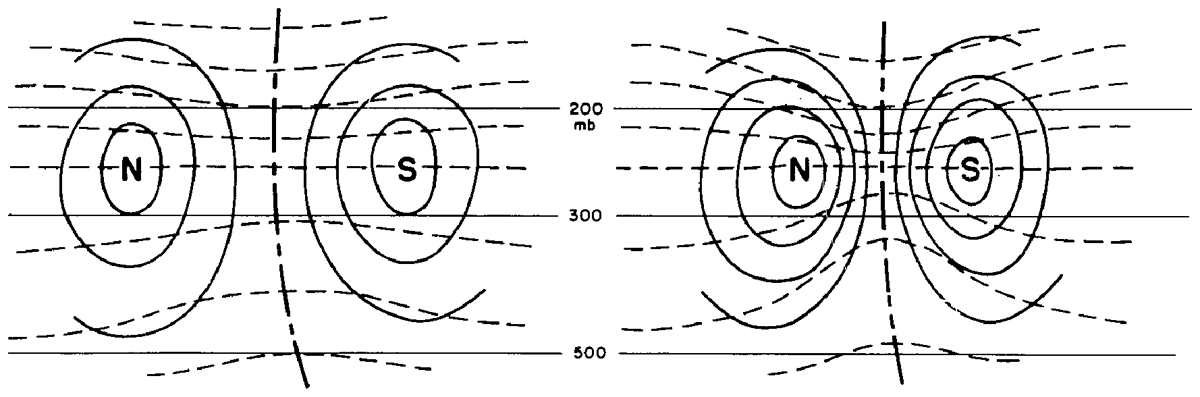
Figure 7
Figure 2 in Newton’s dissertation (Newton, 1951a) showing local changes in the isotach field (solid lines, N: North wind, S: South wind) during formation of a shear line near the tropopause. Dashed lines are isentropes. Reproduced with permission courtesy of University of Chicago Archives).
The key event studied in Newton (1951a) follows the evolution of two distinct jet-stream systems at different latitudes. The question of conservation of vorticity for the case study took importance based on concurrent numerical weather prediction (NWP) work by Charney (1949) and Charney et al. (1950). That is, conservation of potential vorticity was the governing constraint for the quasi-geostrophic prediction model. To determine whether potential vorticity, , where, ζ is the relative vorticity, f is the Coriolis parameter, and Δp is the pressure difference, was conserved for this case, Norman Phillips constructed a series of trajectories for the isentropic layer 340°K–360°K (Phillips, 1951). Following individual air columns within this layer led to the result that ‘potential vorticity may not have been conserved during the formation of the shear line’ (Newton, 1951a, p. 25).
An important conclusion from Newton (1951a) is the relevance of the shear lines to the general circulation. In particular, the transfer of angular momentum from lower latitudes to maintain the upper-level westerlies in mid-latitudes. This subject came under intense debate in 1949 when Palmén (1949), Starr and Rossby (1949), and Starr (1949) argued the relative importance of Hadley circulation (Palmén) and eddy-transport of angular momentum in the transport (Starr-Rossby). Both parties used the theoretical foundation of angular momentum transfer from Jeffreys (1926) classic investigation. The argument was not resolved in 1949. It waited for conclusions from Phillips’ numerical experiment on the general circulation (Phillips, 1956). As stated by Phillips in Lewis’ review of the experiment (Lewis, 1998, p. 49): both parties ‘…had missing features in their respective views’.
Newton (1951a) used the eddy transport mechanism to calculate the northward transport of angular momentum. This calculation only depended on the correlation between the easterly and northerly components of the wind. Palmén’s retrospective view on the debate, which he called a polemic, is found in Hassam Taba’s interview of him in 1981 (Taba, 1988, p. 30). Palmén was quite conciliatory in that interview, yet remained convinced that ‘…in order to transfer angular momentum from the source region in the tropics to the extratropical zones, it is absolutely essential to have a relatively strong Hadley circulation’.
Newton’s statement concerning the transport calculation follows:
Shear lines represent the most extreme form of trough development; since the winds bounding the shear line are often 180° opposed in direction, it is natural to expect
the shear-line troughs to be very effective in accomplishing the local meridional exchange of relative angular momentum, provided they possess an orientation other than north-south or east-west. Examination of all cases of shear-line formation appearing on the charts in the University of Chicago files since 1947 disclosed that in practically all instances the shear lines possessed a general NE-SW tilt. The rare cases of NW-SE tilt were mainly confined to the higher middle latitudes.
To add substance to his explanation, he calculated the northward transport of relative angular momentum at isobaric surfaces (100, 200, 300, 500, 700, 850 mb) between 25°N–60°N latitude for a case in August 1949. He compared his results with William Widger (1949), a student at MIT under the direction of Professor V. P. Starr. Widger made his calculations for a 30-day period 1–31 January 1946. Results from Newton (1951a) compared admirably with Widger’s even though Widger’s calculations were for wintertime. Newton concluded: ‘Even though the values calculated for… a single trough is compared with winter values, the local transfer appears very large and that on a quantitative basis the shear line must be regarded as a very effective mechanism for accomplishing the angular momentum transport.’ (Newton, 1951a, p. 54).
2 e. Interview’s End
I loved Rossby as I loved my own father. I feel so fortunate that I came under Rossby and Palmén at Chicago and IMI at Stockholm in those late 40s and early 50s.
3. Afterword
Chester Newton was a student of Palmén and Rossby, but he was more than a student in Rossby’s case. He became a confidant, a close friend who could share private matters. This became evident to me when Newton shared letters (in the early–mid 1990s): letters from Rossby to Chester (and Harriet), and letters from Chester to Professor Rossby. These letter exchanges took place between 1953–1957.
Following graduation from U of C, Chester Newton and his wife Harriet were invited to work at the IMI in Stockholm. This was a two-year visit where Newton and Harriet conducted work on squall lines. When they returned to the United States in 1953, they spent time at Woods Hole Oceanographic Institution,1953–1954, arranged by Rossby. One of the letters sent from Rossby to both Harriet and Chester Newton in 1953 was a 10-page hand-written letter penned by Rossby. The first page of this letter in found in Figure 8. These letters brought Newton up to data on matters at the IMI such as who was visiting and who was about to arrive. The warmth expressed in these letters reminded one of letters between parents and their children.
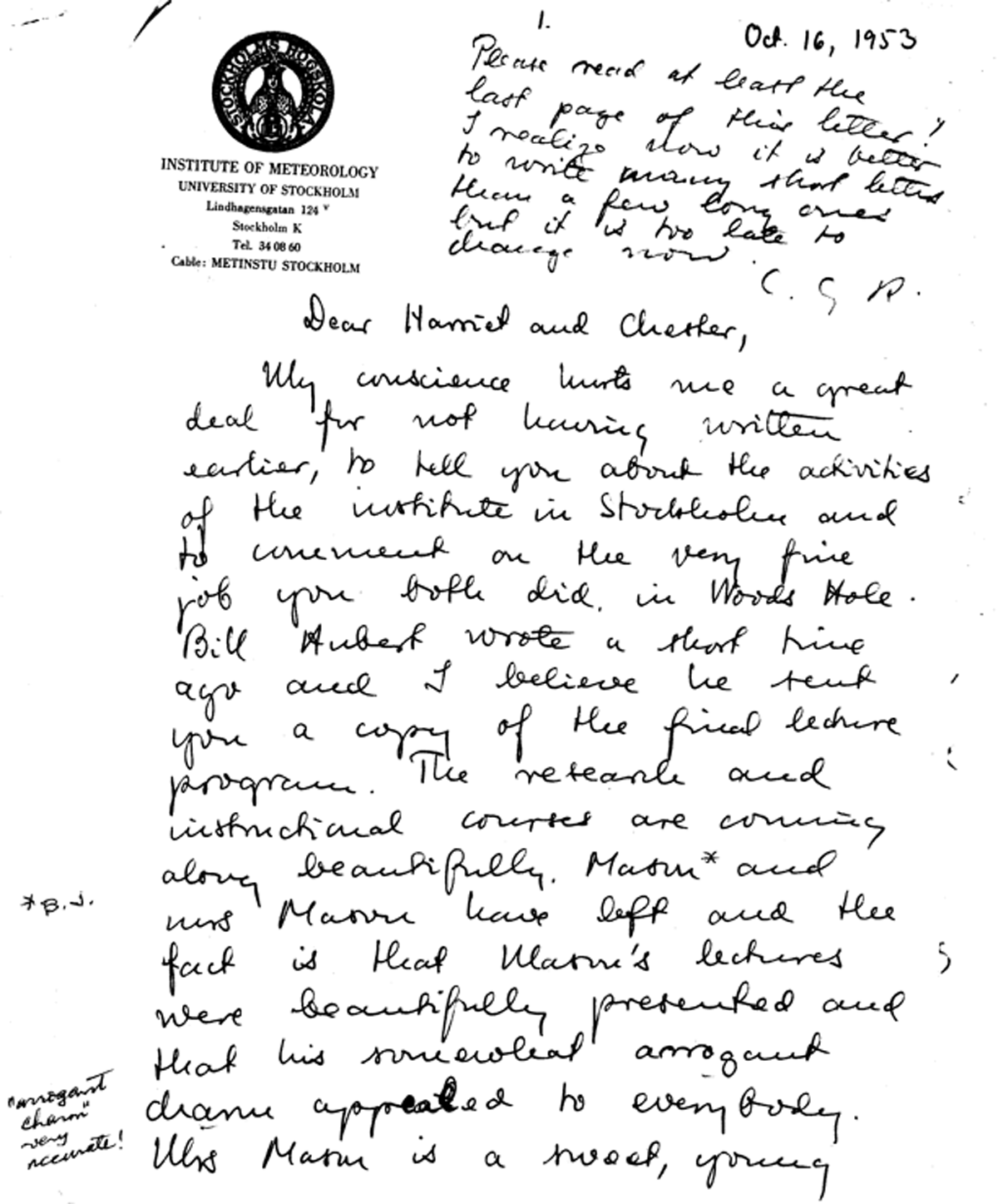
Figure 8
First page of a 10-page hand-written letter from Rossby to Harriet and Chester Newton on October 16, 1953. Reproduced with permission courtesy of C. Newton.
In 1955 Newton returned to U of C and started working with Sverre Petterssen, chair of the meteorology department. He was offered an assistant professorship by Petterssen in 1955 (and accepted) as discussed in the letter Newton wrote to Rossby on August 31, 1955 (Figure 9). Newton’s hand-written paragraph at the top of this page reads:
These three letters included just to show that CGR took an interest in my affairs on a continuing basis. He had earlier tried to persuade me to join the Princeton group to provide synoptic interpretations of the then-new numerical experiment–and now was working on me to do something in oceanography. Instead I chose stubbornly to continue to plod along the ‘synoptic path’ I had trod earlier keeping my focus narrower rather than branching out as Rossby encouraged us to do. I have often wondered since (and so has my wife Harriet) how my (our) life might have been different if I had gone through one of the doors CGR helped open for me.
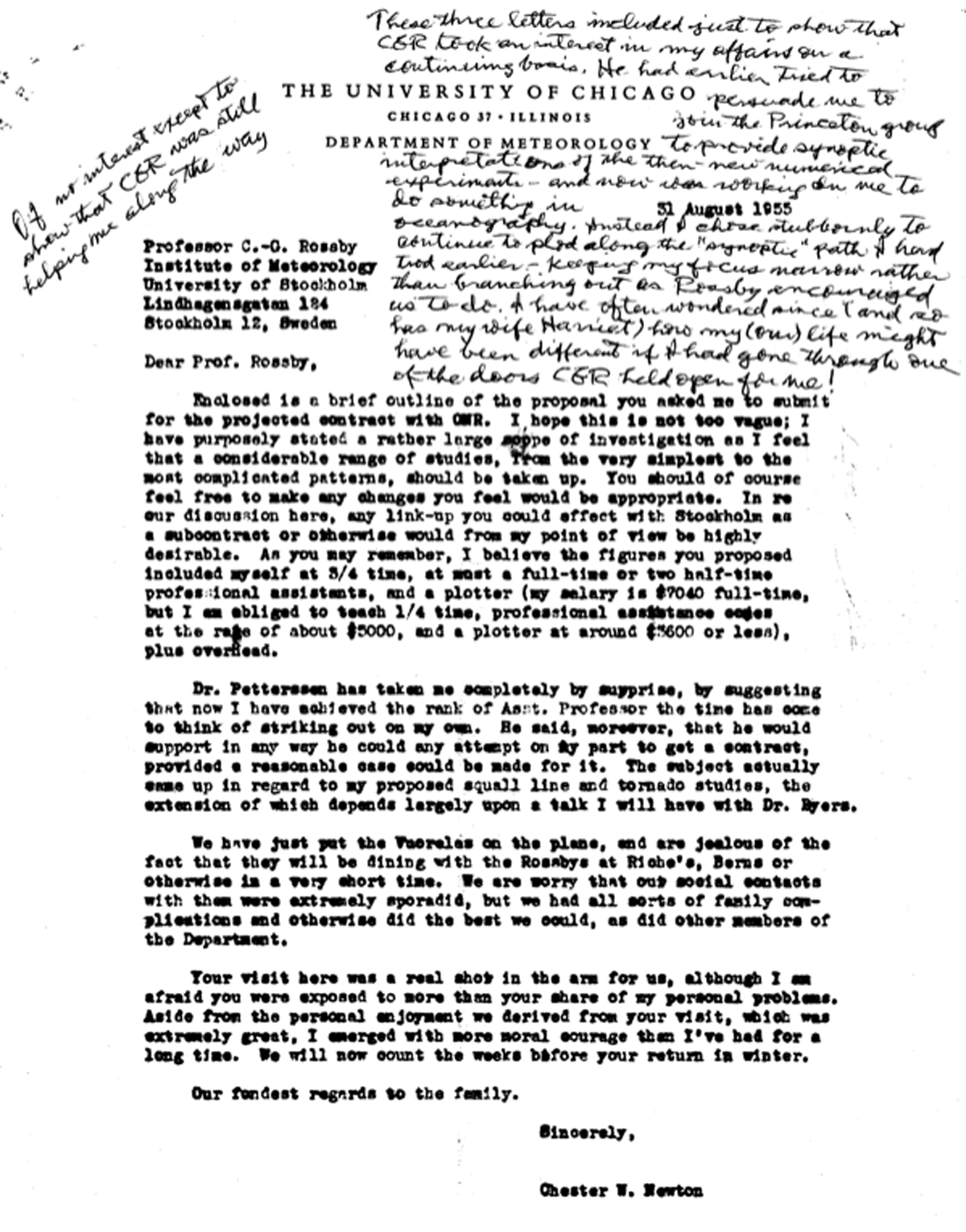
Figure 9
Letter from Newton to Rossby on 31 August 1955. Reproduced with permission courtesy of C. Newton.
In that second paragraph of the letter to Rossby, Newton mentions the proposal he was writing to ONR. This proposal, written in 1955, was sent to Rossby. This 2-page proposal is found in the Appendix. It is clear from the objectives in this proposal that Newton was firmly intrenched in the large-scale’s influence on medium scale flow patterns. The shear lines appear prominently in item 1. In item 6, however, he has neglected to include the theoretical advances in cyclone formation that came from the works of Charney (1948, 1949) and Eddy (1949).
Chester Newton started his meteorological career inauspiciously as a weather observer, served as a United States Army Air Corps weather forecaster in the Burma and India during WWII where he admitted he knew little about the practical job of weather forecasting, but remembered principles he learned in the Cadet Program, and especially remembered Rossby, and decided to return to U of C for further training in meteorology at war’s end. He joined a ‘family’: excellent teachers and researchers, multi-talented graduate students, vital visiting scientists from across the world, all exposed to new and untouched atmospheric phenomena through actively argued daily map discussions. Newton and his fellow students started their own research by typically choosing one of the untouched phenomena, oft times revealed through Cressman’s map discussions. As Newton definitively stated, mentors were in the ‘the department’, the scientific family in Rossby’s Institutes. The milieu was a perfect setting for allowing the students to become independent and confident.
Appendices
Appendix
This proposal was sent to the author in the early 1990s by Newton. It has been re-typed for clarity. In the upper right-hand corner of the proposal’s first page, an ink pen was used to write ‘31 Aug 55’ and ‘to CGR’.
Proposal for Study of the Structuree and Dynamics of Medium-Scale Flow Patterns
Objectives
Select and analyze in detail certain situations comprising simple current systems, cyclones and possibly anomalous features such as shear line, with a view of evaluating the processes involved in accounting for the thermal distribution and momentum concentrations observed.
Particular emphasis would be placed on processes involved in formation and changes in structure of frontal layers in the free atmosphere, and of jet streams associated or not associated with fronts. An attempt would be made to to examine variations of atmospheric stability and vorticity due to processes other than horizontal divergence, including those variations associated with non-geostrophic motions.
The method of attack would include construction of detailed charts at all pertinent isobaric levels, isentropic charts, kinematic (isotach) analyses, vertical cross sections, frontal contours, etc. Fields of vertical motion, divergence, vorticity, etc., would be analyzed in much detail as possible, incorporating some form of space-time interpolations in an effort to approximate instantaneous rather than time-mean values. Vertical motion computations would be in general be based kinematic-thermodynamic considerations, rather than, for example, being based purely on vorticity analysis which may be subject to different interpretations depending on assumptions involved. Orographic effects would be included.
One of the principal objectives is to obtain a complete description of the structure and behavior of a typical cyclone throughout its life cycle. In particular, an attempt would be made to link variations in frontal structure and structure of the wind ffield with the developmental and descriptive phases of the cyclone. A particular case which would be analyzed is a cyclone development over the eastern slope of the Rocky Mountains, 16 to 20 November 1948. Most of the charts for this case have already been prepared and many are analyzed. Findings from the case would be augmented by studies of more recent cases, for which aerological data are more abundant.
Most of the investigation would involve the study of flow patterns over North America, where aerological data are relatively homogeneous over a large area. However, observations suggest that certain types of cyclones in North America and over western Europe may be fundamentally different in structure and behavior, and analysis and comparison of cyclones in different regions would be a desirable part of the investigation.
There is more evidence to suggest that cyclones, although to a considerable extent self-developmental, derive their initial impulse by injection of kinetic energy from an upstream source. There is also reason to believe that cyclones create a considerable amount of kinetic energy which is exported downstream, in the form of travelling velocity maxima as well as through the accepted process of energy dispersion (propagation of pressure changers). It is proposed eventually to make an attempt to study theee details of energy transfer between a cyclone near the east coast of North America and a subsequent cyclogenesis over western n Europe, utilizing the data from weather ships over the North Atlantic to define the velocity field in the connecting ridge.
Notes
[1] The Cadet program was designed to train weather forecasters for WWII. Rossby organized this training program at five universities including the University of Chicago (Kutzbach 1975).
Acknowledgements
Informal reviews of this history paper by Roland Madden and David Schultz have gone far to improve the paper’s structure and readability. This input has been invaluable. I am grateful to the University of Chicago Archives for supplying me with letters from Rossby to University of Chicago’s Chancellor Robert Maynard Hutchins (March 12, 1946) and Director of Scripps Institution of Oceanography Harald Sverdrup (March 16, 1946), letters describing Rossby’s interest in reestablishing international cooperation in the operational meteorological field at the end of WWII. Photographs were supplied by: George Platzman, Dave Fultz, Department of Geophysical Science (University of Chicago), University of Chicago Archives, and the Library of Congress. Tape-recorded interviews of George Platzman and Phillip Thompson along with oral history letters from Yi-Ping Hsieh, Bert Bolin, Walter Saucier, and Harriet Rossby-Woodcock added valued information to commentary. Those who supplied photographs, letters, and interviews have passed away, so I acknowledge them posthumously along with the memory of their generosity to share their memories with me. And, of course, the 2-hour interview and the rich collection of documents provided by Chester Newton were the essential ingredients for this study.
Competing Interests
The author has no competing interests to declare.