
Background
The global greenhouse gas concentrations are increasing, mainly due to the continuing use of fossil fuels, leading to rapid climate warming. On the other hand, natural and technical sinks are not enhancing significantly, and there are even risks of reductions of natural sinks in various land ecosystems (e.g., Pan et al., 2024; See et al., 2024). Besides reducing emissions and enhancing sinks, solar radiation modification (SRM) has also been suggested as a potential tool to combat climate change. Stratospheric aerosol injection (SAI) was suggested to slow down climate warming already in the mid-70s (Budyko, 1974). Since then, it has been the most widely studied method for solar radiation modification (SRM). As the idea for SAI originated when large volcanic eruptions had been observed to lead to long-lasting global cooling, sulfur injections have been the primal focus of SAI studies (Crutzen, 2006; Huynh and McNeill, 2024). However, sulfur might not be the optimal choice for SAI.
A big fraction of atmospheric SRM research (UNEP, 2023) involves injecting sulfur dioxide (SO2), which can produce sulfuric acid (H2SO4) and subsequently form new particles, into the atmosphere, particularly to mimic volcanic eruptions in the stratosphere. In the condensed particle phase, the sulfur is ultimately found in the form of sulfate (SO42–). However, these particles are strongly acidic and therefore will potentially participate in ozone layer depletion (World Meteorological Organization, 2022). Depleting the ozone layer can lead to more harmful types of UV rays from the sun reaching the Earth’s surface, increasing the potential for skin cancer and eye damage (Blaustein et al., 2024).
Furthermore, due to air quality and acid rain issues, international treaties and governments have aimed to reduce anthropogenic sulfur emissions. At present, global SO2 emissions are almost half of their peak level of 120-140 Tg/yr in the mid-1970s. (Smith et al., 2011). Global sulfur emissions are projected to decrease over the 21st century, even under scenarios with the highest greenhouse gas emissions (SSP5-8.5) (50 Tg/yr at the end of the 21st century). Possible injections of sulfur-based compounds could slow or reverse this trend, diminishing the positive impacts on air quality and the environment. Even though the regional distribution of sulfur deposition from SAI differs from that of anthropogenic sources and does not concentrate as much on high-population areas, increased deposition in otherwise pristine regions could potentially create new environmental problems. Although the stratospheric sulfur cycle, sulfur chemistry, and new particle formation from sulfuric acid are relatively well understood and included in many aerosol-climate models, which are further evaluated by comparisons to observations of large explosive volcanic eruptions (Quaglia et al., 2023), the impacts of Stratospheric Aerosol Injection (SAI) on radiation and climate remain uncertain (Laakso et al., 2022; Laakso et al., 2024).
SAI requires continuous or gradual injections to maintain an aerosol field in the stratosphere. In a case of sulfur dioxide injection, an additional problem is that the average particle size becomes larger than optimal at the required injection rates (Laakso et al., 2022; Weisenstein et al., 2022). The reason behind this is that earlier injections have resulted in enhanced aerosol concentrations in the stratosphere, which provide a large sink for the H2SO4 formed from the most recent injection. In other words, rather than nucleating to form new particles, much of the injected material will cause excessive growth of the existing aerosol particles. This will produce an aerosol population that is less efficient at scattering solar radiation and more efficient at absorbing long-wave radiation than optimally wanted. Coagulation is also most efficient between fine and coarse particles, so large aerosols are effective coagulation sinks for the newly formed particles that do form.
Aerosol particles are most effective at scattering radiation when their diameter is around 600 nm and become less effective at larger sizes (Dykema et al., 2016). Larger aerosols also have reduced lifetimes and absorb more infrared radiation. One consequence of the absorption of radiation is the weakening of the hydrological cycle. Because the atmosphere has a relatively low heat capacity, it quickly adjusts to a state where the incoming and outgoing energy fluxes are balanced. It has been shown that the increased energy flux due to absorption of aerosols is compensated by a reduction in latent heat flux from the surface, which results in a decrease in average precipitation (Laakso et al., 2024; Samset et al., 2016). Stronger absorption would also lead to heating the lower stratosphere, which changes both stratospheric ozone chemistry and stratospheric dynamics. Some studies have shown that an injection load greater than 10 Tg(SO2)/yr could lead to a permanent westerly phase locking of the quasi-biennial oscillation (Franke et al., 2021; Laakso et al., 2022). This has further consequences as it leads to decreased meridional transport and stronger aerosol confinement in the tropical pipe (Visioni et al., 2020). This results in even greater sulfate aerosol growth.
Some studies have suggested injecting solid particles instead of sulfuric acid precursors to mitigate the afore-mentioned problems and limitations (e.g., Pope et al., 2012; Weisenstein et al., 2015; Dykema et al., 2016; Vattioni et al., 2024). These solid particles, such as calcite, alumina, or diamond, would have similar or even better backscattering efficiency than sulfate, with lower absorption efficiency. However, depending on the type of solid particles, they might be expensive to produce, and most of the suggested solid particle types do not naturally occur in the atmosphere. Natural mineral dust could be a choice; however, its size is typically too big for effective backscattering. Also, the impacts of solid particles on atmospheric chemistry, environment, and human health are poorly understood. Even if these knowledge gaps were filled, injecting large amounts of solid particles, especially such that they do not naturally occur in the atmosphere, could conflict with environmental legislation and provoke opposition to this already controversial proposal to mitigate global warming. In addition, although some solid particle types have higher backscattering efficiency compared to sulfate aerosols, the amount of scattered shortwave radiation per unit mass of injection might be smaller than when sulfur is injected as SO2 (Vattioni et al., 2024). This is because SO2 forms sulfate aerosols in combination with existing stratospheric species, mainly OH and H2O, and only about half of the particle mass comes from the injection itself.
Therefore, an ideal compound for stratospheric aerosol injection would be one that efficiently scatters shortwave radiation; does not absorb short- or longwave radiation; does not grow into too large particle sizes; occurs naturally; and is light enough (e.g., can form from gas-phase precursors) to be carried to the stratosphere, where it interacts with species in the background atmosphere to produce enough new particles to significantly impact solar radiation. Here we present an alternative way for SAI, namely solar radiation modification based on secondary organic aerosol (SOA) rather than sulfate.
Basic Idea of Organic SAI
In the lower troposphere, sulfuric acid is known to be the most important compound for forming new aerosol particles (e.g., Kulmala et al., 2014; Zhao et al., 2024, and references therein). A key thing that makes sulfur special in this regard is that the highly volatile SO2 oxidizes into the extremely low-volatile H2SO4 in practice in a single chemical reaction. For most other species, such as organics, there tend to be more intermediate steps between these extremes in volatility, which consequently leads to the condensational loss of the products before they reach the extremely low vapor pressures needed for particle formation.
One exception to this is the formation of extremely low-volatility organic compounds (ELVOC) through autoxidation and accretion (Bianchi et al., 2019). Under stratospheric conditions (–50°C), new particles can likely be formed from a much broader range of vapors, as the saturation vapor pressures decrease rapidly with a decreasing temperature—over 5 orders of magnitude when going from room temperatures to –50°C (Stolzenburg et al., 2018). Therefore, sulfur is not necessarily any more ‘special’ under stratospheric conditions, as many organic oxidation products can start to form new aerosol particles efficiently (Simon et al., 2020).
For the reasons outlined above, we have investigated the concept of utilizing injections of organic species, rather than SO2, into the lower stratosphere. Similar to sulfur injections, we can expect oxidation of organics to form low-volatile products that are able to produce aerosol particles via a new particle formation process. One critical difference compared to sulfate aerosol is that carbon in the organic aerosol is not in its most oxidized state, and it will therefore continue to undergo reactions until reaching the highest oxidation state, namely forming CO2 (Kroll et al., 2011), whereas sulfur is already at its most oxidized state as sulfate and therefore unreactive. Therefore, the organic material injected into the stratosphere will not significantly deposit back into the troposphere, avoiding many of the negative effects associated with sulfate aerosols in the troposphere and on the Earth’s surface.
The summary of the OSAI concept consists of the following steps (see also Figure 1):
A suitable organic vapor (e.g., isoprene/monoterpene/sesquiterpene) injected/transported to the lower stratosphere
Oxidation of the organic vapor by stratospheric O3 and OH to produce ELVOCs
Clustering of ELVOCs to form new aerosol particles (nucleation)
Growth of the initial ~1 nm particles to 300–600 nm (SOA formation)
Scattering of radiation back to space by the formed SOA particles
Further oxidation making more volatile compounds and evaporation of the particles. The end product is CO2, and the produced amount of CO2 is less than 0.1% of current global anthropogenic CO2 emissions.
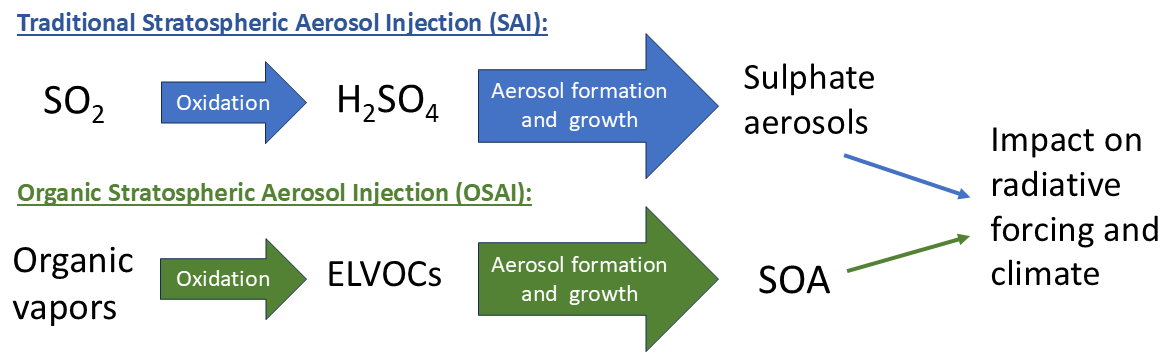
Figure 1
Schematic figure on traditional (sulphur-based) and organic SAI.
All, or at least most, of the above steps take place in the stratosphere, so OSAI is expected to have very limited effects on the troposphere.
Our proposed concept thus seems worthy of further investigation to estimate how organic SRM could behave and, specifically, how it would be critically different from sulfate SRM (see Table 1).
Table 1
Comparison of organic aerosols vs sulfate aerosols. Calculated per 1 Tg SO2. The detailed calculations are given in SI material.
| PARAMETER | SULFATE SAI CASE | ORGANIC SAI CASE |
|---|---|---|
| Precursor vapor | SO2 | VOC (e.g., isoprene or some monoterpene or sesquiterpene) |
| Oxidants | OH. Slow oxidation (weeks to months) to H2SO4 | OH and O3. Fast oxidation (hours to days) to ELVOCs |
| Nucleation | Sulfuric acid + water | Pure biogenic mechanism |
| Mass yield from injected precursor | ~150% | Depends on precursor, but likely around 20–200% |
| Growth | Slow (0.1–1 nm/h) but relatively constant over weeks or months. | High GR (>10 nm/h) initially, slower later as vapors deplete |
| Resulting particle size | Larger particles (>700 nm) | Smaller particles (~400–600 nm) |
| Lifetime | Long lifetime (years) | Shorter lifetime (months) |
| Evaporation | None | Evaporation within 500–10000 h |
| Acidity | Highly acidic | Less acidic |
| Needed amount | ca 10 Tg/year | ca 15 Tg/year |
| Radiative forcing | ‒3.5 W/m2 | ‒3.5 W/m2 |
| Environmental impacts | Acidification, effects to ozone layer due to acidic aerosols | Minor: SOA will evaporate within a year |
VOCs, NPF and SOA Formation in the Conditions of the Lower Stratosphere
There is very limited knowledge about the behavior of VOCs and SOAs under stratospheric conditions. However, there are a number of direct observations of organic aerosols in the lower stratosphere (Breuninger et al., 2025; Martinson et al., 2019; Sharpe et al., 2026), where the particles can be transported from the troposphere in different ways (Shen et al., 2025). In other words, organic aerosols already exist in the stratosphere, and dedicated studies might even be able to utilize these to constrain some features of the organic aerosol dynamics. However, the earlier observations normally relied on sampling during flights and thus mainly provided glimpses into the composition of the aerosol but were not able to assess, e.g., organic aerosol lifetimes or formation mechanisms or rates. In this work, we therefore instead attempt to utilize the (albeit also very limited) laboratory observations that may be able to provide estimates for certain relevant processes in the stratosphere. The recent experiments conducted at the CLOUD (Cosmics Leaving OUtdoor Droplets) chamber at CERN have contributed valuable insights into new-particle formation (NPF) and the initial growth from purely organic vapors (Kirkby et al., 2016; Tröstl et al., 2016; Dada et al., 2023). In particular, these experiments show that the oxidation products from both the monoterpene α-pinene (Simon et al., 2020) and isoprene (Shen et al., 2024) are able to form particles very efficiently at stratospheric temperatures (–50°C) and that these pure biogenic particle formation pathways can compete with sulfuric acid-initiated particle formation at similar vapor concentrations at these temperatures (Simon et al., 2020; Stolzenburg et al., 2018).
For the total SOA formation, Saathoff et al. (2009) showed that SOA yields from α-pinene ozonolysis increased from about 20% at 25°C to about 100% at –30°C, while Gao et al. (2022) demonstrated an increase from 20% to 40% SOA yield for ozonolysis of the sesquiterpene beta-caryophyllene over the same temperature range. Clark et al. (2016) showed that the SOA yield from isoprene photo-oxidation increased from a few percent at room temperature to around 30% at 0°C. Clearly, SOA formation from these biogenic VOCs can be assumed to be very efficient at stratospheric temperatures, lending credibility to the concept of OSAI.
One critical question remains, and that concerns the lifetime of the formed SOA. The chamber studies mentioned above lasted less than a day and do not, therefore, tell us about the further evolution of the formed SOA. For sulfate, the rate of conversion from SO2 to H2SO4 and subsequently to sulfate aerosol via this pathway can be fairly well estimated, as can be the losses that are related to coagulation and gravitational settling. In the case of SOA, we can only roughly estimate how further oxidation or photolysis reactions transform the SOA into more volatile species that will evaporate. Nevertheless, knowledge of this, in addition to knowing the formation and growth rates of organic particles in stratospheric conditions, is critical for estimating number concentrations of particles formed and their sizes and lifetimes, which ultimately determine the efficiency of SRM or the potential for unwanted side effects of the stratospheric injections. Below, we try to estimate the key parameters based on the knowledge that exists in the literature.
In CLOUD experiments made at –50°C and monoterpene concentrations of around 100‒1000 ppt, the formation rates of 1.7 nm (diameter) particles are in the range 1‒10 cm‒3 s‒1, and the concentrations of ELVOCs are around 106–107 cm‒3 (Simon et al., 2020). At similar monoterpene oxidation rates (5 × 10⁵–5 × 10⁶ molecules cm‒3 s‒1), the expected particle growth rates are around 1‒10 nm h‒1 (Stolzenburg et al., 2018). If the real particle growth rate is in the range of 0.1‒10 nm/h, it takes about 10‒1000 h (0.4 to 42 days) for particles to grow to the diameter of 100 nm. However, in the stratosphere, ozone concentrations are much higher than in the above-mentioned chamber experiments, while VOC concentrations can be in the same order of magnitude, meaning that the growth rates may also be clearly higher, in particular at the beginning of the injections. It might actually be beneficial if the particles grow initially very fast, but the available vapors deplete within a relatively short time frame, causing the growth to stop before reaching undesirably large particles.
Besides gas-phase oxidation, heterogeneous chemistry could play a role in stratospheric conditions. However, we are not aware of any studies of heterogeneous oxidation or photolysis of SOA under stratospheric conditions, and, therefore, this estimation becomes very uncertain. Nevertheless, some recent studies have estimated the photolysis of fresh SOA under tropospheric conditions (O’Brien and Kroll, 2019; Baboomian et al., 2020), and they found that heterogeneous oxidation is the most important aging process after about one day when the photolabile products have been lost from particles (typically amounting to ~30% of the SOA mass). Baboomian et al. (2020) estimated that under tropospheric conditions (Los Angeles), for α-pinene SOA, the remaining mass fraction after 400 h was 20%, with other SOA types having slightly higher fractions remaining. However, the calculations were based on an OH concentration of 1.5 × 106 cm‒3, about five times higher than OH concentrations in the stratosphere, which means that the lifetime could be thousands of hours instead. The colder temperatures are also likely to reduce reaction rates, and the expected higher viscosity of the SOA is likely to hamper the oxidation further. Then again, Baboomian et al. (2020) also concluded that at much lower temperatures, the photolysis may be more important than heterogeneous oxidation for these same reasons. Photolysis rates may also be several times higher due to the higher UVA intensities at 20 km compared to surface values (Pinedo-Vega et al., 2017). Overall, it is hard to know how all these effects will play out, and presumably they can be varied considerably by the choice of VOC precursors, as the SOA composition varies accordingly. Nevertheless, we expect that the lifetimes will be clearly shorter than for sulfate aerosols but can still be long enough to make OSAI a feasible option.
Results: Conceptual Modeling
The lifetimes of aerosol particles in the stratosphere with respect to gravitational settling are typically from months (~1,000 h) to more than a year (10,000 h), and therefore we performed simple conceptual modeling up to these timescales. Losses due to evaporation, e.g., following additional oxidation of organic compounds, may shorten the lifetimes, but the conceptual studies are useful as a background for model simulations with a state-of-the-art climate model with an accurate size-segregated representation of aerosol microphysics (e.g., ECHAM-HAMMOZ) (Kokkola et al., 2018). Such modeling can be used to assess the actual impact of stratospheric organic aerosols on radiative transfer, accounting for temperature-dependent oxidation reactions, NPF rates, particle growth rates, and volatility of organic aerosols. But before utilizing the global model, we performed two types of conceptual model investigations of a single injection of SO2 or organic aerosol precursors to assess time scales and realism of different steps of the process. In the first investigation the emphasis was on the formation rates of condensable vapors from different aerosol precursors, and in the second investigation we tested different types of growth and evaporation rates of the stratospheric particles.
Figure 2a shows the rates at which alpha-pinene (AP), isoprene, and SO2 are oxidized in the stratosphere following an injection (model details and assumptions are described in more detail in the SI). Evidently, AP is consumed the fastest, which is due to its high reaction rate with ozone, while SO2 has the longest lifetime because it only reacts with OH with a relatively slow reaction rate coefficient. The lifetime of AP is around three and isoprene around two orders of magnitude shorter than that of SO2, meaning that the choice of organic precursor (or mixture of precursors) can be varied to achieve desired removal rates. Each precursor is oxidized to its corresponding oxidation products, with SO2 forming H2SO4 and the organic compounds forming first-generation (with O3 or OH) and second-generation (with OH) oxidation products, referred to as AP-OX1 and AP-OX2 for α-pinene. All products are assumed to be lost to condensation. For the organics, the vapor concentrations are very high in the beginning but are also depleted much faster than for H2SO4, which stays at a relatively constant level for several hundred hours. This behavior is also reflected in the cumulative condensation, as shown in Figure 2b.
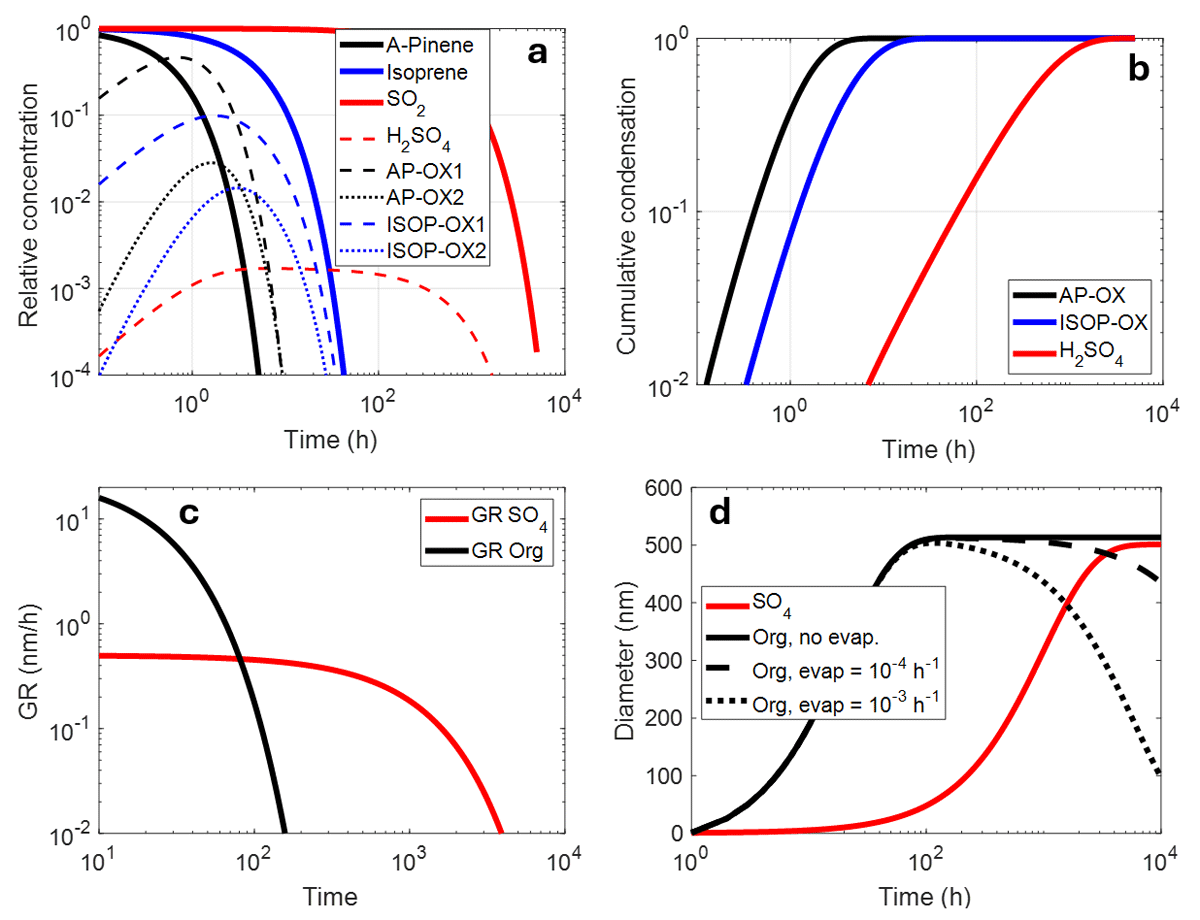
Figure 2
Conceptual box model calculations of oxidation (a, b) and particle growth (c, d) in the stratosphere following a single injection of aerosol precursors. (a) Aerosol precursor removal due to oxidation and formation of oxidation products that may condense to form aerosol. SO2 has the longest lifetime, converting slowly into H2SO4, while different organics (here exemplified by α-pinene and isoprene) react away at different rates, forming first (OX1) and second (OX2) generation oxidation products. (b) Cumulative condensation of vapors in the same model case as in a. (c) Particle growth rates (GR) used to model sulfate and organic particle dynamics following a stratospheric injection. Note that the particle growth model was not coupled to the oxidation model, and growth rates were merely defined as shown here to mimic slower initial, yet more persistent, growth for sulfate aerosol while organic growth was initially fast but decays over time to reflect faster depletion of condensing vapors. (d) Particle diameters as a function of time. The organic particles are modeled without evaporation and with two different evaporation rates, corresponding to lifetimes of 1,000 and 10,000 hours.
The particle growth rate is related to the concentration of condensable vapors, and thus the organic particles will grow much faster but for a shorter time compared to the growth driven by H2SO4. We probed this behavior using another conceptual model where only particle growth and evaporation were assessed. We tuned the particle growth rates in the model to reflect sulfate and organic particles separately (Figure 2c). While the total ultimate growth would be the same for both particle types, the sulfate particles grow more slowly in the beginning, but their growth rate decreases more slowly, while the organic growth rate is high in the beginning (to reflect the faster formation of condensable vapors) but decays faster (to reflect the faster depletion of the precursor). The results of the particle size evolution are shown in Figure 2d. The organic aerosol mass is modeled with two different evaporation rates (10–3 h–1 and 10–4 h–1).
A first key point from the figure is that the evaporation rate will clearly be a crucial parameter for assessing the radiative impacts of the SAI, but unfortunately this parameter suffers from limited existing constraints on organic aerosol lifetimes under real stratospheric conditions. Another implicit result from this conceptual modeling is that the number of particles that form initially following the injection will impact their final size as well. If more particles are formed, the condensing vapors will also be distributed over more particles and thereby not be able to grow the particles as large before the vapors are depleted.
The above conceptual models indicate that there is clear potential for organic SRM to be an efficient competitor to sulfate SRM. However, these simple models could be tuned quite freely and did not couple together nor account for all important parameters. For this reason, the next step was to test OSAI using a state-of-the-art global model.
Results: Global Model
The cooling potential of stratospheric aerosols is attributed not only to their scattering properties but also to the lifetime of particles in the stratosphere, which is typically about a year in SAI simulations (Laakso et al., 2022). Thus, when estimating the cooling potential of organic aerosols, their lifetime becomes an even more critical property because, unlike sulfate aerosols, they also evaporate in addition to being lost through deposition. To test the impact of evaporation and to account for the more realistic situation of continuous injections of precursors (rather than the single injections tested in the conceptual models), global model simulations with the aerosol-climate model ECHAM-HAMMOZ (Kokkola et al., 2018) were performed.
These simulations were performed using virtual organic aerosol injections based on the following assumptions: (a) New particle formation is assumed to be similar for sulfur and organic compounds. (b) Because the model does not include detailed organic chemistry, we assume oxidation processes analogous to those of sulfur compounds, while testing a range of oxidation rates. (c) Based on current knowledge, there are substantial uncertainties in the refractive indices of secondary organic carbon aerosols, as these depend strongly on precursor compounds, oxidants, and atmospheric conditions. Nevertheless, existing studies generally indicate that SOA refractive indices are similar to those of sulfate aerosols, particularly in the 300–800 nm wavelength range (Kim and Paulson, 2013; Moise et al., 2015; Nakayama et al., 2018). In contrast, much less information is available for longwave (LW) radiation, which plays a crucial role in organic SAI. In the absence of better constraints, and to enable direct comparison with sulfur injections as well as assessment of the effects of aerosol evaporation and different oxidation pathways on radiation, we adopt sulfate refractive indices for our pseudo-organic aerosols. Based on these assumptions, we performed sulfur injection simulations and applied additional adjustments to oxidation and evaporation rates to represent virtual organic aerosol simulations. However, for this reason, and because our primary focus was on simulating aerosols produced solely by SAI, all ECHAM-HAMMOZ simulations included only stratospheric injections and excluded all other anthropogenic as well as natural aerosol emissions. Detailed descriptions of the model and simulation setup are provided in the Supplementary Material.
The global mean values for shortwave, longwave, and net all-sky radiative forcings from the global model are presented in Figure 3. Radiative forcings were calculated using a double radiation call with and without aerosols. As expected, the results are sensitive to the defined evaporation rate; however, with an evaporation rate of 10‒4 h‒1, the radiative forcing is 76% of the simulations involving SO2 injections without evaporation. To achieve the same magnitude of radiative forcing, approximately 50% more material needs to be injected (the scenario with a 15 Tg/yr injection in Figure 3). In simulations where the evaporation increased by an order of magnitude (10‒3 h‒1), radiative forcing was 14% of the value observed without evaporation. Additionally, simulations were conducted to test the influence of more rapid oxidation of organics compared to SO2, which was achieved by using an oxidation rate that was 100 times faster than for SO2. This modification did not significantly impact the global mean radiative forcing in the case of continuous injections, which makes sense as the ultimate oxidation rate becomes equal to the injection rate. However, similar injection rates, but conducted once per week or month, resulted in a 5% and 10% increase in radiative forcing, respectively. These situations are closer to the scenarios tested with the conceptual models, where larger amounts were injected at a time, rather than a small amount continuously.
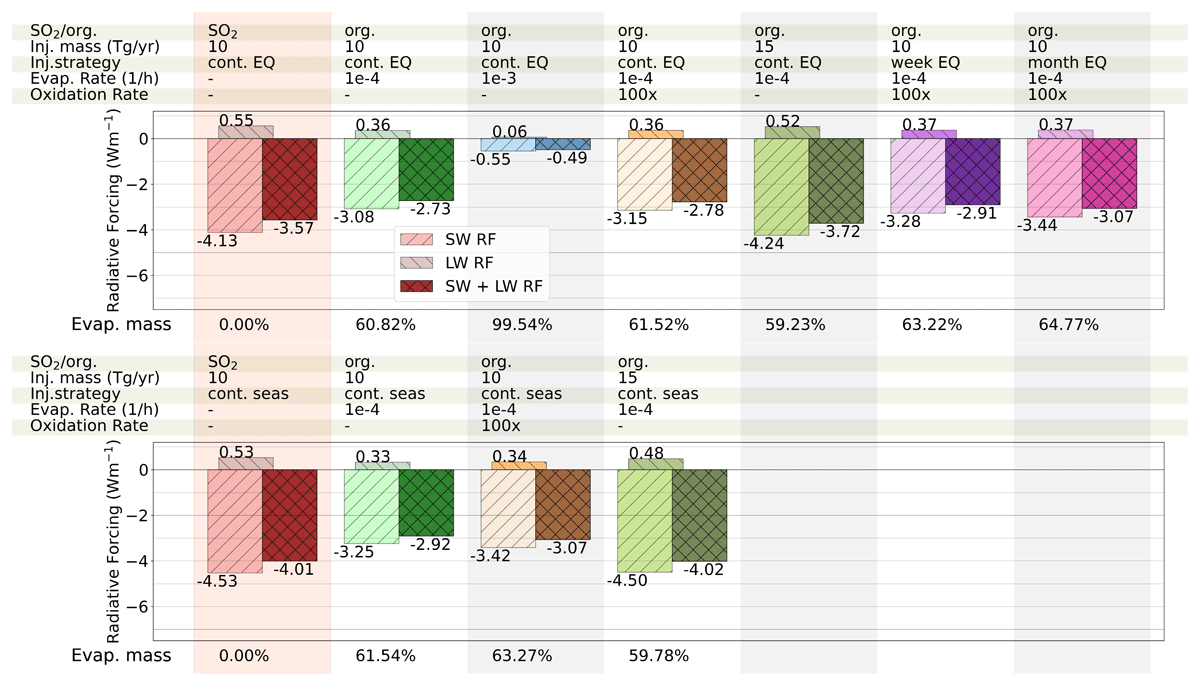
Figure 3
All-sky shortwave (SW), longwave (LW), and net (SW+LW) radiative forcings, along with the fractions of evaporated masses ((emitted mass – deposited mass)/emitted mass), in various simulated scenarios. The simulations were conducted with either SO2 injection or SO2 injection accompanied by evaporation (pseudo-organic). For the pseudo-organic injections, sensitivity simulations were performed with two different injected masses: 10 Tg/yr and 15 Tg/yr. Additionally, two evaporation rates were tested: 10–4 h–1 and 10–3 h–1, as well as two oxidation rates with OH: the original rate and a rate increased by 100 times. Three injection timings were considered: continuous, once a week, and once a month. For continuous injections, two strategies were simulated: equatorial injections and changing the injection area with the seasons.
The above simulations show that there is potential for our outlined approach for organic SRM, but they also confirm the conclusions from the conceptual modeling that the choice of an organic precursor will be crucial for achieving optimal effects. This choice will determine the lifetimes of the injected precursor, the rate and yield of the aerosol formation, and ultimately the effective radiative forcing impact. The latter will also be strongly governed by the evaporation, which, in turn, is driven by the rate of heterogeneous oxidation that leads to evaporation, and this is also very likely to be affected by the type of organic molecule being injected, but this remains one of the most uncertain parameters in our simulations. In addition, while too fast evaporation will decrease the benefits of increased scattering, it should also be remembered that a suitably slow evaporative loss would have the benefit of decreasing the mass deposited to Earth’s surface. In our simulations (Figure 3), the evaporated mass fraction was between 60 and 99%, compared to 0% with sulfate. Although 50% more injected material was required to achieve the same global mean radiative forcing with pseudo-organic aerosols compared to the SO2 injections, the mass deposited at the surface is still only 60% of that from the SO2 injections. Notably, there is significantly less deposited material over the northern mid-latitudes, including Europe, the United States, Russia, and China (see Supplementary Figure S2).
Figure 4 presents the size distributions for scenarios in which 10 Tg/yr of SO₂ and 15 Tg/yr of organic precursors are injected at three latitudes: the Equator, 20° N, and 50° N, at altitudes where aerosol mass concentration is high. The size distributions are relatively similar between these scenarios. However, with pseudo-organic aerosols, the size distribution is slightly more optimal for SRM. Specifically, the number concentration in the size range where aerosols efficiently scatter radiation is larger, while the number concentration and mean size of the largest bin particles are smaller. Calculating the mean effective diameter of all aerosols also supports the conclusion of a more optimal size in the case of pseudo-organic aerosols. Despite injecting 50% more mass, the effective diameter of the organic molecules remains below 700 nm, whereas for sulfur injections, it is around 800 nm (Figure 5). However, because the aerosol number concentration was higher for the 15 Tg/yr pseudo-organic aerosol injection compared to the 10 Tg/yr SO₂ injection, the difference in average absorbed longwave radiation between the scenarios is small. Thus, there is not much difference in atmospheric heating between these two scenarios, and the heating is even slightly greater for pseudo-organic aerosols within the injection region (see Supplementary Figure S6).
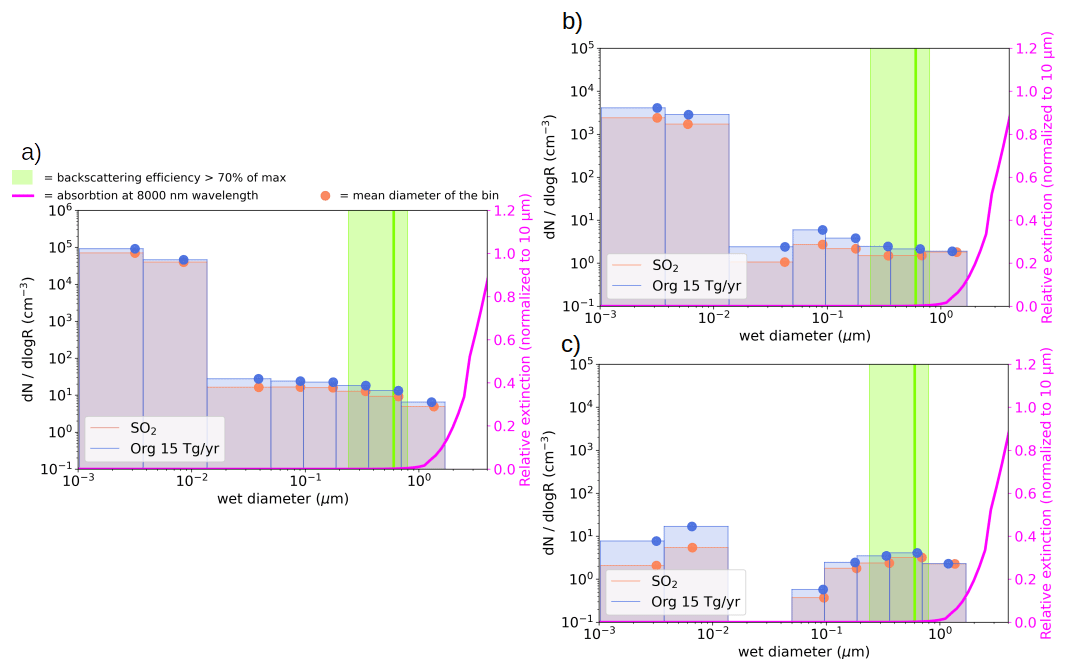
Figure 4
Aerosol number size distribution is shown for three locations: a) at the Equator and an altitude of 20–22 km, b) at 20° N and an altitude of 18–20 km, and c) at 50° N and an altitude of 12–15 km. Figure shows scenarios of SO2 injection at a rate of 10 Tg/yr and pseudo-organic aerosols at a rate of 15 Tg/yr. The dots at the top of the size bins represent the mean diameter of each bin. The green line, reproduced from Figure 5 of Vattioni et al. (2019), indicates the size at which backscattering is maximized. The green shaded area represents the radius where aerosol backscattering is 70% of the maximum, according to Dykema et al. (2016). The magenta line (unitless) shows the relative dependence of absorption at an 8000 nm wavelength on the (dry) diameter of the sulfate aerosols, based on the radiation calculation module of SALSA, using a linear, not logarithmic, scale.
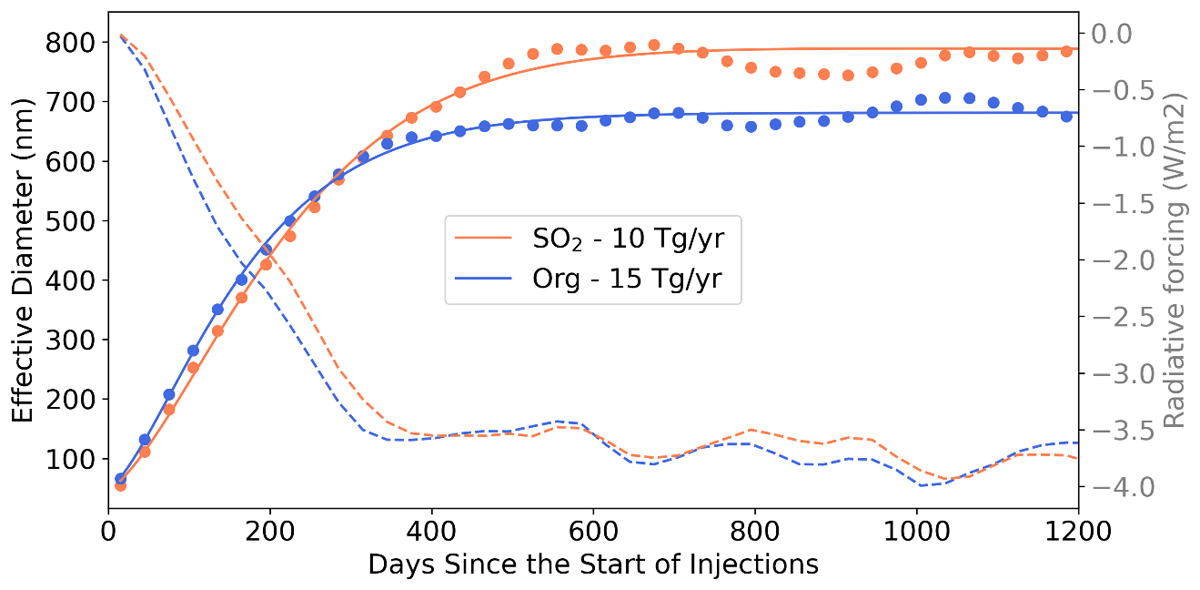
Figure 5
Effective diameter and all-sky radiative forcing as a function of days since injection started for two scenarios: SO2 injection at a rate of 10 Tg/yr and pseudo-organic aerosols at a rate of 15 Tg/yr with an evaporation rate of 1e-4 h.
One consequence of injecting more material above the equator, which causes the aerosol particles to be formed relatively quickly but then later evaporate, is that radiative forcing is amplified in the injection area compared to the case of non-evaporated aerosols. This is evident when comparing the regional distribution of radiative forcing between 10 Tg/yr SO2 and 15 Tg/yr pseudo-organic aerosols (Figure 6). Although the global mean radiative forcing, both all-sky and clear-sky, is about the same, it is significantly more pronounced over the equator with injections of pseudo-organic aerosols. Several studies have suggested that using a uniform reduction in solar constant or equatorial injections to counteract average GHG warming may result in cooling in the tropics and residual warming at higher latitudes (e.g., Visioni et al., 2021). Therefore, amplifying radiative forcing over the tropics may not be desirable. To concentrate radiative forcing more toward the midlatitudes, Laakso et al. (2017) proposed a seasonal injection strategy, where injections follow the seasonality of solar radiation. Applying this injection strategy to pseudo-organic aerosols would result in the greatest radiative forcing at high mid-latitudes (Figure 6c). Simultaneously, this approach increases the global mean radiative forcing compared to equatorial injections and slightly reduces the longwave radiative forcing of the injected aerosols.
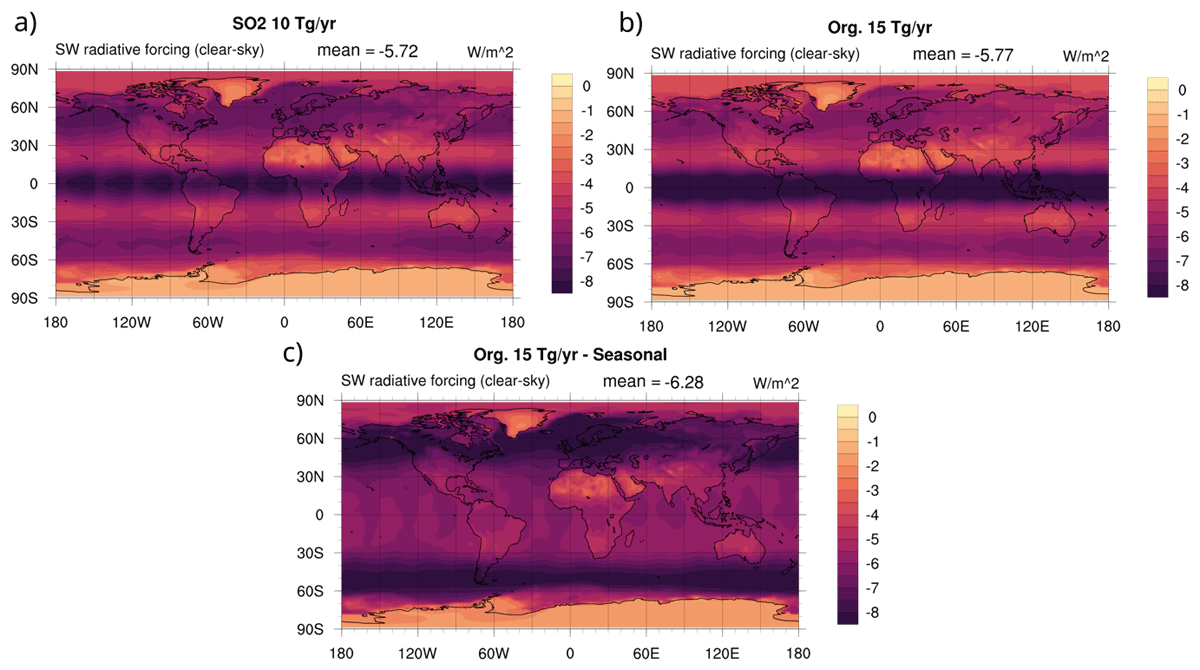
Figure 6
Clear-sky radiative forcings in different scenarios: a) SO2 injection at a rate of 10 Tg SO2/yr, b) pseudo-organic aerosols at a rate of 15 Tg/yr, and c) pseudo-organic aerosols at a rate of 15 Tg/yr with the injection area changing seasonally instead of continuous equatorial injection. In these pseudo-organic simulations, the evaporation rate was 10‒4 h.
Summary and Conclusions
Here, we have introduced the concept of organic solar radiation modification through stratospheric aerosol injections and compared it to sulfate SAI through conceptual calculations and simulations (see Table 1). The main conclusion is that particle formation and growth rates could be similar, leading to similar radiative forcing. Moreover, organic aerosols will further oxidize and start to evaporate: only a minor fraction of organic aerosols will deposit in the troposphere, which could potentially lead to less severe unwanted environmental impacts in the troposphere and Earth’s surface compared to sulfate SAI. For accurate quantification of the process, realistic oxidation, formation, growth, and evaporation rates at stratospheric conditions would be needed, as shown in our results (Figures 2, 6) and sensitivity studies (see also SI material).
The annual amount of injected organic material needed for organic SMR is estimated to be around 15 Tg, which can be compared to annual global CO2 emissions (40,000 Tg), i.e., about three orders of magnitude less. The present estimate of the price of organic material (isoprene or monoterpene) is ca. 4 € per kg, which may go down if it is bought in large quantities. The total annual cost would be on the order of 60 billion €, which can be considered a reasonable sum compared to the expected total costs of climate change. Using carbon pricing for emissions with an estimated value of 100 € per ton, the value of current annual carbon emissions is around 10–100 more than the annual expenses related to organic SRM.
One of the primary motivations for studying organic precursor injections instead of sulfur precursors was to produce an aerosol size distribution that scatters more solar radiation and absorbs less longwave (LW) radiation than sulfate SAI. Based on our global model simulations for pseudo-organic aerosols, the size distribution was indeed more optimal. This resulted in more aerosols within the size range for significant backscattering and fewer large, absorbing aerosols. Ideally, this means that the same cooling impact could be achieved with lower absorption, leading to a smaller reduction in global mean precipitation and less atmospheric warming caused by the injected aerosols. However, when the magnitude of pseudo-organic aerosol injection was adjusted to match the radiative forcing of the SO2 injection, there was only a minor reduction in LW radiative forcing compared to the SO2 injection. This feature is probably dependent on the magnitude of the injection rate, which was not studied here. Larger injection rates could result in larger differences between pseudo-organic and SO2 injections because larger injection magnitudes lead to larger aerosols, and the absorption of LW radiation increases strongly for aerosols larger than 1 µm (see Figure 4). There, relatively small differences in the number of largest aerosols between the pseudo-organic and SO2 injection can lead to large impact.
Since the lifetime of evaporating aerosols is shorter than that of non-evaporating aerosols, their regional distribution of radiative forcing is more concentrated near the latitudes where the injection takes place. Therefore, in general, evaporating particles might be more effective than non-volatile particles in concentrating radiative forcing at the desired latitudes. This allows for better planning and control of geoengineering efforts compared to injections with sulfur compounds or solid particles. The same effect could be achieved with heavy non-evaporating aerosols, but at the cost of increased deposition.
There are two important aspects related to organic SRM, not considered here, that should be explored in future studies. The first one is stratospheric ozone depletion associated with high stratospheric aerosol concentrations, as demonstrated for volcanic eruptions (e.g., Stone et al., 2021) and predicted for sulfate SAI (WMO, 2022). There is strong evidence that organic aerosols from lifted wildfire emissions cause stratospheric ozone loss (Bernath et al., 2022; Salawitch and McBride, 2022; Solomon et al., 2023; Ma et al., 2024; Stone et al., 2025), but the complicated chemistry and dynamics of this phenomenon make it difficult to estimate whether and to which extent aerosols due to organic SRM could harm the ozone layer. The direct reactions between ozone and injected VOCs can cause local decreases in ozone concentrations that may slow down the initial oxidation rates of the VOCs, but the overall stratospheric ozone concentrations greatly exceed the yearly VOC injection amounts. The second important aspect is the potential short-wave and long-wave absorption and subsequent stratospheric heating by aerosols associated with organic SAI. Secondary organic aerosols are known to contain brown carbon, which absorbs light at near ultraviolet and visible wavelengths (Laskin et al., 2015); however, there is practically no information on whether monoterpene or isoprene oxidation would be able to produce brown carbon under stratospheric conditions. Some studies (e.g., Nakayama et al., 2018) indicate significant light absorption at short visible and ultraviolet wavelengths, for example, for secondary organic aerosols generated from isoprene, and this could reduce the effectiveness of organic SAI and lead to stratospheric warming. These two aspects remain a key priority for future research.
Here we have shown that organic SRM is a plausible mechanism to cool the climate, potentially with fewer risks, compared to sulfate SAI. However, more detailed investigations, including model simulations and small-scale experiments, are needed before planning actual implementation. In any case, the first priority should be to reduce fossil fuel emissions significantly and, at the same time, enhance both natural and technical carbon sinks before implementing any SRM techniques.
Additional Files
The additional files for this article can be found as follows:
Supplementary Material 1
Description of the methods. Supplementary results. Figures S1–S2. DOI: https://doi.org/10.16993/tellus.4133.s1
Supplementary Material 2
Reviews of “Organic Solar Radiation Modification”. DOI: https://doi.org/10.16993/tellus.4133.s2
Acknowledgements
We acknowledge the following projects: ACCC Flagship funded by the Academy of Finland grants numbers 337549 (UH) and 337552 (FMI); Academy professorship funded by the Academy of Finland (grant no. 302958); and European Research Council (ERC) project ATM-GTP Contract No. 742206.
Competing Interests
The authors have no competing interests to declare.