
Gaia and Tellus
The most iconic article on Gaia, by James Lovelock and Lynn Margulis, was published in Tellus in 1974 (Lovelock & Margulis, 1974). ‘Atmospheric homeostasis by and for the biosphere: the Gaia hypothesis’ came out two years after a short letter from Lovelock that introduced Gaia in Atmospheric Environment (Lovelock, 1972). The Tellus article, however, has come to be seen as the foundational exposition of the Gaia hypothesis. These articles present Gaia both as the name of a new entity – the total ensemble of all living beings (‘Life’) and the parts of the Earth with which they interact – and a new ‘hypothesis’ – that living beings’ collective influence on their environment can explain the long-term maintenance of Earth’s habitability – including maintaining equable temperatures despite increasing solar luminosity (Figure 1).
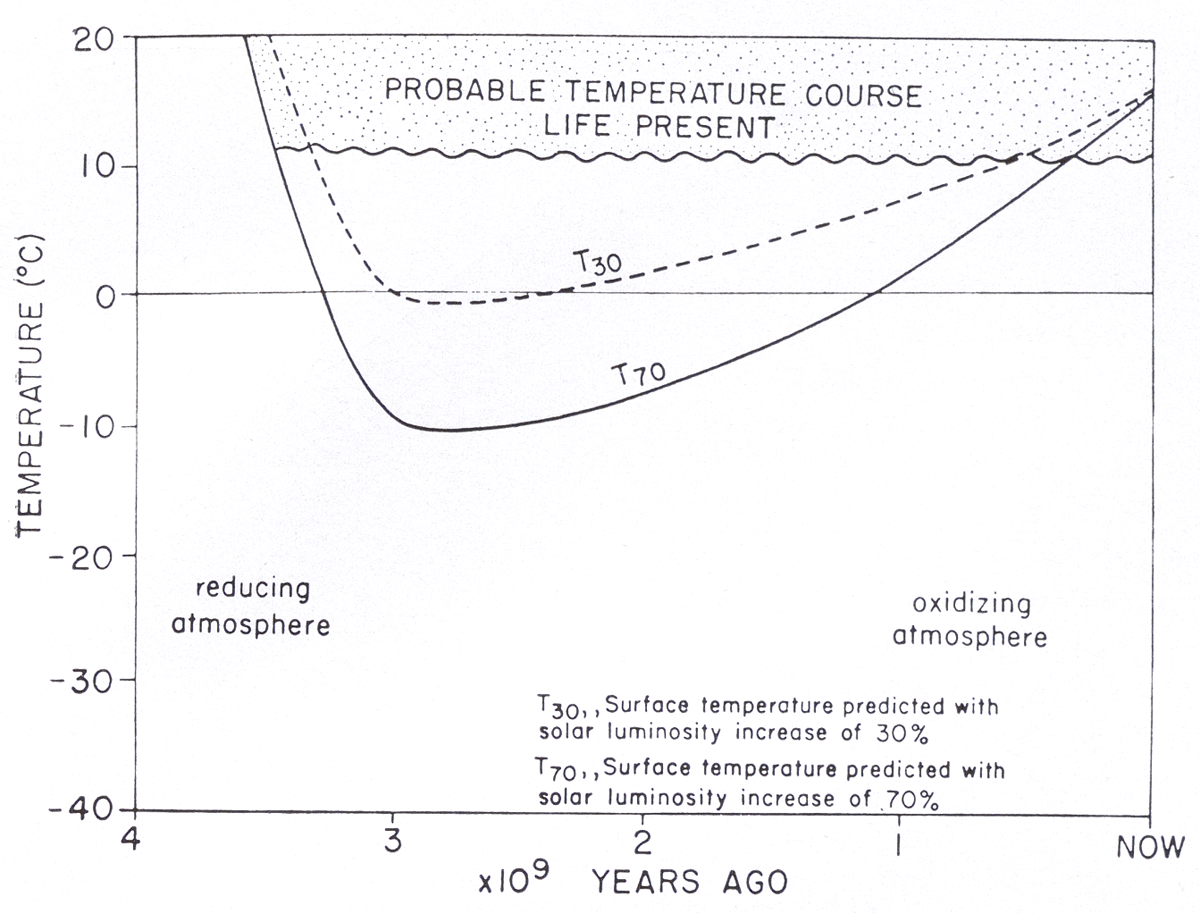
Figure 1
The mean surface temperature of the Earth as portrayed by Lovelock & Margulis (1974), highlighting the faint young Sun puzzle – that with current atmospheric composition the early Earth would have been frozen. The shaded area is described as the ‘temperature range deduced from the geological record and the persistence of life’. Nowadays a 30% increase in solar output since the formation of the Earth (4.56 × 10⁹ years) is considered realistic, and an interval of considerable early stellar mass loss producing cooling from high temperatures is considered unrealistic (Basinger et al., 2024) – thus exacerbating the faint young Sun puzzle. Reproduced from Lovelock & Margulis (1974) under CC BY (DOI: https://doi.org/10.3402/tellusa.v26i1-2.9731).
As both the content of the article and the audience of Tellus suggest, Gaia was principally addressed to Earth and environmental scientists. It is often portrayed that the article’s teleological phrasing (‘by and for the biosphere’) triggered a controversy with evolutionary biologists. They certainly have a long-lasting acquaintance with this issue and take for granted that teleological functions can only be assigned to a narrow class of entities that have evolved by natural selection (Ruse, 2013). A couple of prominent biologists later argued that Gaia cannot arise by natural selection because it is a population of one (Dawkins, 1982) or would require untenable altruism on the part of its constituents (Doolittle, 1981). But scrutiny shows there was no real controversy as (these exceptions aside) evolutionary biologists were mostly just not interested in Gaia (Dutreuil, 2024). By contrast the Tellus article instigated a rich, deep, and often passionate relationship between Gaia and the Earth and environmental sciences.
It is often said that the name Gaia was to blame for a mixed reaction from Earth scientists: science is a serious thing not to be interwoven with mythological phrasings. Some did indeed dismiss Gaia as pseudo-science. However, ‘Tellus’ is not just the name of a (serious) scientific journal but also Gaia’s name in Roman mythology. So, we need to look elsewhere to explain Earth scientists’ mixed reactions. In the following we first trace Gaia’s scientific legacy. Then we unpack the relationship between Gaia and later conceptions of the Earth system, including the different entities at stake, the different scientific questions addressed, and their different scientific practices and relationships with politics. This offers a different scientific history of Gaia. We close with an outlook for Gaia research.
Gaia’s Scientific Legacy
The scientific history of Gaia is challenging to decipher for a practical reason. A traditional method of science studies is to search for keywords to map controversies, but that misses the biggest part of the story, because taboo around the name Gaia led to much of its legacy continuing under another name.
Searching for Gaia as a keyword in scientific literature yields roughly a couple of hundred articles and a dozen scientific books. This is a decent tally compared to what one would expect if Gaia were pseudo-science. Much of this literature stems from a further seminal paper in Tellus, by Andrew Watson and James Lovelock introducing the ‘Daisyworld’ model (Watson & Lovelock, 1983). ‘Biological homeostasis of the global environment: the parable of Daisyworld’ demonstrates in an idealized way that self-regulation of climate by Life is, in principle, possible in the presence of natural selection at lower levels without requiring unworkable altruism (Figure 2).
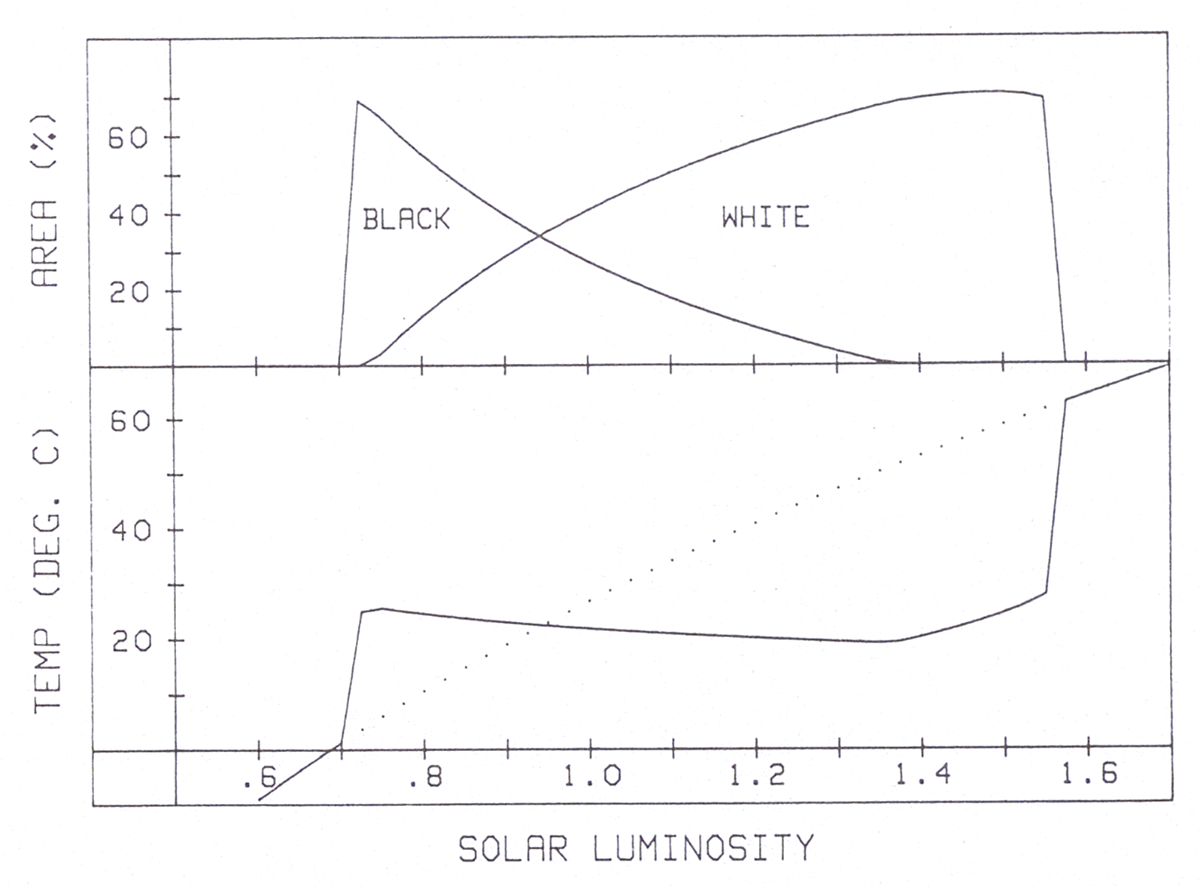
Figure 2
The Daisyworld model as introduced in Tellus (Watson & Lovelock, 1983). The top panel shows the areal coverage of black and white daisies (albedos 0.25 and 0.75, respectively). The bottom panel shows global temperature, as solar luminosity is increased (the dotted line indicates the temperature of the planet without life). Reproduced from Watson & Lovelock (1983) under CC BY (DOI: https://doi.org/10.3402/tellusb.v35i4.14616).
The original Daisyworld model was conceived as an illustration of how Gaia could work without contradicting established theory (Dutreuil, 2014; Kirchner, 1989). The growing Daisyworld literature that followed provided a theoretical framework for Gaia – a mathematical approach to spanning the space and time scales between the growth and evolution of organisms and planetary habitability. The reaction of John Maddox, the editor of Nature, is telling of the interest in Gaia in the 1980s: he wrote to Lovelock to lament that Nature missed the paper and urged him to send the next Gaia piece to him (Letter from Maddox to Lovelock, 24 April 1985, for details see Dutreuil (2024)). Lovelock later obliged with what became known as the ‘CLAW’ hypothesis (after the initials of the authors Charlson, Lovelock, Andreae, & Warren, 1987).
Yet, the Gaia scientific literature remains a ridiculously small one when compared to, physical climatology, or to claims sometimes made by Lovelock or those researching Gaia that Gaia represents a scientific and philosophical revolution; perhaps as important as the one which laid the foundation of modern science. It also comes mostly from a small group of less than twenty scientists, many of them in the UK, with personal connections to Lovelock. This constantly intrigued Bruno Latour (Latour, 2017): how could an idea of such scientific and philosophical magnitude be worked upon by only a handful of scientists in the world?
Lovelock often complained that Earth and environmental scientists have tacitly accepted Gaia’s major points – that living beings have a major influence on the global environment; and that this influence may be ‘regulatory’ – but have abandoned Gaia’s name, and often, Lovelock’s credit. There is a major scientific legacy, involving thousands of scientists, but Gaia’s name was taboo and dropped along the way in favor of another label ‘Earth system science’. This is why just looking for the keyword Gaia can miss the whole story.
Earth system science emerged in the 1980s out of an institutional effervescence targeting ‘global change’ in all major scientific institutions structuring and funding sciences in the US and at an international level. It gained traction in the late 1990s and early 2000s, when IGBP made a point to promote the label ‘Earth system’, which initially originated at NASA. In response, Lovelock, Margulis, and other Gaia researchers consistently argued that Earth system science was Gaia by another name, or as Lynn put it ‘none other than Gaia herself decked in futuristic garb and made palatable to the ‘hard rock’ scientists’ (Margulis, 2004).
The argument that Earth system science is the major institutional legacy of Gaia, even though the names of Gaia, Lovelock, and Margulis are infrequent, has two sources. One is the fact that Gaia’s scientific legitimacy was disputed: in the turmoil, those researching Gaia grabbed whatever they could to restore Gaia’s scientific image. The other is that there is a truth to it: Gaia did put to the fore a new conception of the Earth in the 1960s and 1970s, which was then very influential in the definition of the ‘Earth system’ in the 1980s and 1990s. Many Gaia researchers have driven Earth system science. This was not sufficiently recognized in the late 1990s, but it is now commonly accepted and can be traced in minute detail (Dutreuil, 2024).
Because Gaia’s important scientific legacy in the constitution of Earth system science is now recognized, we take it as a given. This new starting point invites a different question: in which ways do Gaia and Earth system science differ? Here we show that although ‘Gaia’ and the ‘Earth system’ are related entities, they are distinct, they address different scientific questions, and there are key differences in scientific practices and their relationship with collective action.
Different Entities at Stake
The label Gaia ‘hypothesis’ has driven some Popperian scientists to argue that it lacks ‘scientific’ testable propositions (Kirchner, 1989; Kirchner, 1991). This misses the central point: Gaia’s major scientific contribution is an ontological one not a testable hypothesis. Gaia changed the sciences by presenting a new entity. For a historical parallel, think about how a new ontological partition between living and non-living entities paved the way for the constitution of biology in the early 19th century, out of the remnants of Natural History (Foucault, 1966; Huneman, 2008).
The greater scientific effects do not come from the formulation of a hypothesis about the causal relationships between two entities (e.g. the atmosphere and the biosphere), but from the presentation of a new object to be studied (e.g. Gaia). While testing a new hypothesis can lead to theoretical refinement within existing fields, introducing a new entity can lead to the constitution of new fields of study, raising an array of questions about the new entity. In the case of Gaia, the major effects, in terms of the number of scientists concerned, are clearly those resulting from the presentation of a new entity (Dutreuil, 2024). The discussion of the ‘hypothesis’ and then ‘theory’ concerned a much smaller scientific literature.
Gaia differed from the major conceptions of the Earth at stake at the time in the 1960s and 1970s. Without being exhaustive, we can list several of these. The basis of climatology and plate tectonics came from the geophysics of the Cold War: the climate system (Figure 3) (NRC, 1975) and the solid Earth are both physical systems thought of in terms of their mechanical and thermal properties. Meanwhile geochemistry conceived the Earth as a huge chemical factory made of reservoirs and fluxes of matter (Figure 4) (Siever, 1968). In contrast, Gaia put to the fore living beings (Figure 5) (Lovelock, 1986) and their underrecognized influence on the physical, chemical, and geological properties of Earth’s surface. Gaia was also distinct from other trendy contemporary conceptions of the Earth, such as ‘Spaceship Earth’, popular in economic circles and the United Nations (Höhler, 2015; Selcer, 2018).
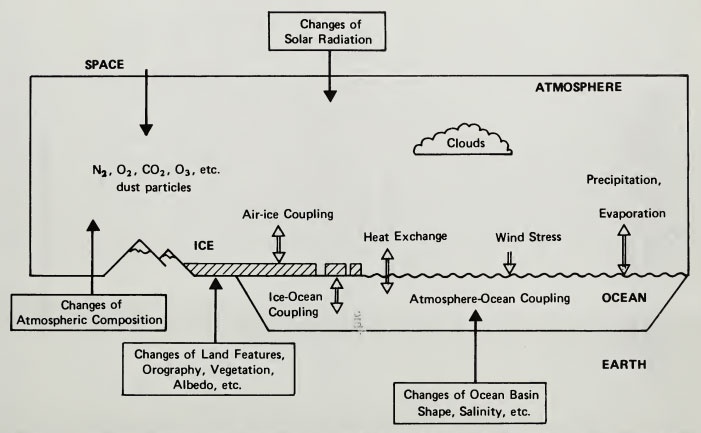
Figure 3
A 1970s rendering of the physical climate system, where ‘The full arrows are examples of external processes, and the open arrows are examples of internal processes in climatic change’ (National Research Council, 1975, p. 14). Life (‘vegetation’) is viewed as external to the climate system. Credit: National Research Council, 1975. Understanding Climatic Change: A Program for Action (DOI: https://doi.org/10.17226/27501). Reproduced with permission from the National Academy of Sciences, courtesy of National Academies Press, Washington, DC.
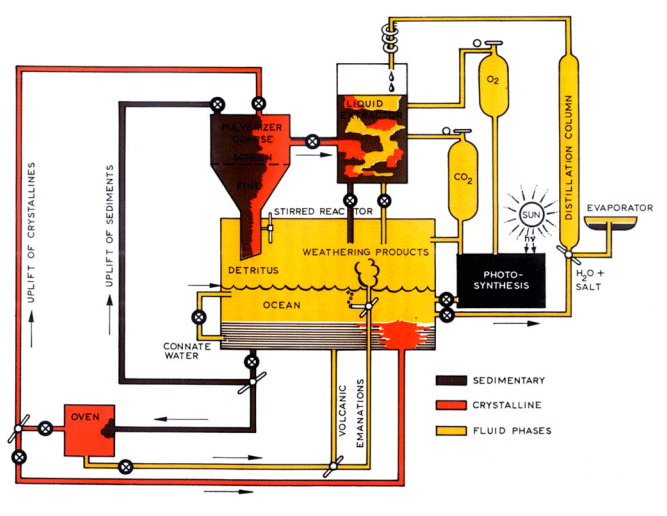
Figure 4
A late1960s rendering of geochemical cycling described as ‘A chemical engineering analogy to the surface geochemical cycle’ (Siever, 1968). Life (‘photosynthesis’) is one part of the chemical factory. Reproduced from Siever (1968) (DOI: https://doi.org/10.1111/j.1365-3091.1968.tb00837.x) with permission from John Wiley and Sons.
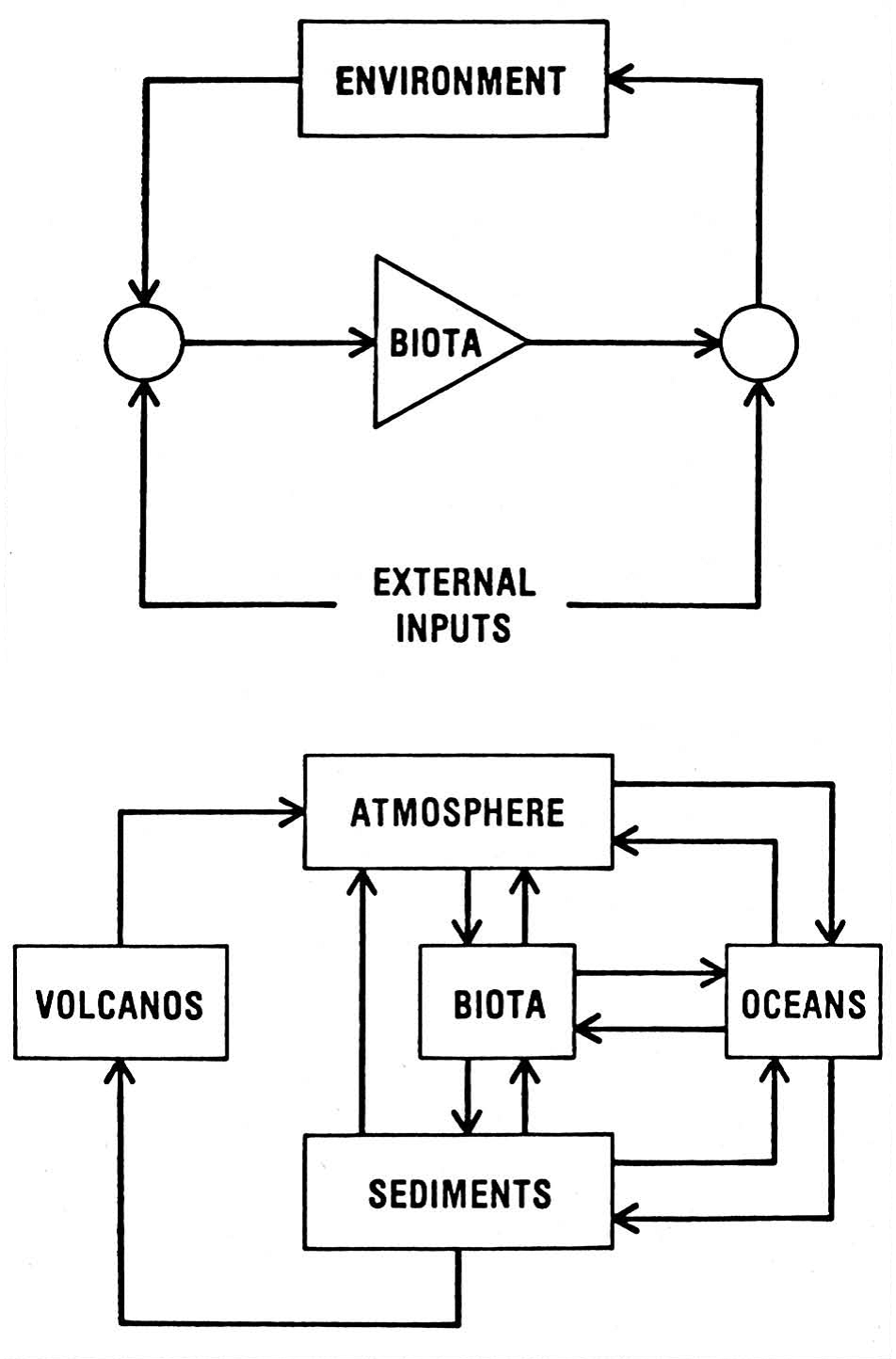
Figure 5
Lovelock’s (1986) contrasting of (top) a geophysiological (Gaian) model, and (bottom) a biogeochemical model. Reproduced from (Lovelock, 1986) (DOI: https://doi.org/10.1175/1520-0477-67.4.390) with permission from the American Meteorological Society.
Biogeochemistry developed alongside Gaia, but despite adding the influence of living beings to geochemistry, Lovelock (1986) accurately noted several distinctions (Figure 5). Notably, biogeochemistry failed to recognize the central importance of the regulation of the global environment through feedback loops involving living beings. Furthermore, Gaia considers all properties relevant to Earth’s habitability (e.g., climate), not just chemical ones (as in biogeochemistry).
After Gaia, two different guises of the ‘Earth system’ arose in the 1980s, which also considered an interconnection of the biosphere, hydrosphere, atmosphere, and parts of the lithosphere studied through cybernetics and system thinking (IGBP, 1989; NASA, 1986).
One guise came from NASA (1986), faced with the threat of massive cuts in funding from the Reagan administration, the space agency turned towards the Earth and formulated Earth system science as a bold new global change research program (Conway, 2008; Goldstein, 2009). This necessitated defining the Earth system, and needing the political support of solid Earth geophysics, NASA’s Earth system included the whole inner planet on geologic timescales (Figure 6) (NASA, 1986).
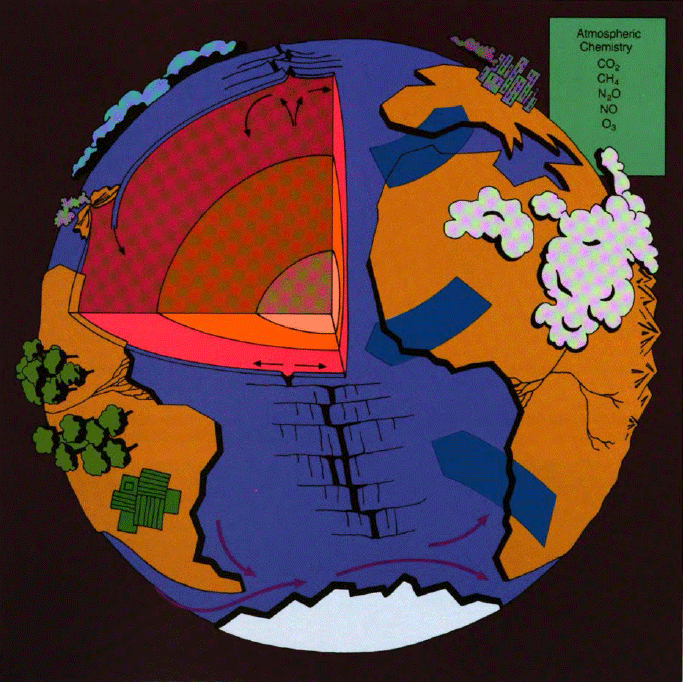
Figure 6
NASA’s schematic view of the Earth system including the whole inner planet, from NASA (1986). Credit: National Research Council. 1986. Earth System Science: Overview: A Program for Global Change (DOI: https://doi.org/10.17226/19210). Reproduced with permission from the National Academy of Sciences, courtesy of National Academies Press, Washington, DC.
At the same time (1986), IGBP was founded (IGBP, 1989) and started to define the Earth system by identifying human conditions of existence and connecting these conditions of existence to all known materials and processes affecting them, including human activities. IGBP’s Earth system only considers shorter timescales – study of Earth’s past is restricted to recent history – and thus it only scratches the surface of the lithosphere.
These Earth systems, especially IGBP’s, inherit several aspects from Gaia: living activities are considered, a language of ‘whole’ and ‘complexities’ pervade both perspectives, and the tools of complexity sciences are used to study the system. Still, there are important differences.
NASA’s Earth system is fundamentally abiotic in that it predates (and will postdate) Life (and therefore Gaia) and there can be, for example, a Mars system. It also carries a narrow, abiotic notion of habitability: the presence of liquid water. IGBP’s Earth system in contrast focuses on habitability for humans, but this takes for granted several conditions of existence created by other life forms, such as an oxygen-rich and CO2-poor (and therefore cooler) atmosphere.
When Will Steffen led IGBP (1998–2004) he put the question ‘What is the nature of the Earth?’ at the center of Earth system science’s theoretical efforts (Steffen, 1998). The corresponding 2001 Amsterdam Declaration on Global Change states that ‘The Earth System behaves as a single, self-regulating system comprised of physical, chemical, biological, and human components’. Yet something about Gaia is missing: the Declaration does not say towards which state the system self-regulates – there is no linking to habitability.
More deeply, reading Lovelock (and other Gaia researchers), a key attitude prevails: Life is not just one part of the Earth system among others – such as the atmosphere or hydrosphere – it is special and central. It is the very starting point of the definition of the entity: if you want to draw the boundaries of Gaia, it’s easy, you just need to start to recognize all living beings on Earth, then track down all their interactions with their outside environment. Gaia is the result of these interactions (for a philosophical analysis of this mode of individuation see Huneman 2014a; 2014b).
The material boundaries of living beings no longer stop at their membranes; they expand as far as their influence on the ‘geological’ environment can reach. What was beforehand thought of as ‘abiotic’ such as the atmosphere, can now be seen as a living part ‘like the fur of a mink or the shell of a snail’ (Lovelock, 1979). The resulting Gaia phenomenon has extended itself in space and time within the frame of reference provided by NASA’s Earth system.
IGBP’s Earth system in contrast shifts the focus from ‘all living entities’ to ‘humanity’: Gaia raised the problem of Earth’s habitability for all Life since its origin and for the coming billion years; IGBP’s research program inherited the importance of ‘habitability’ but centered the question on what mattered for humanity in the coming centuries (Steffen et al., 2020).
Different Scientific Questions
Because Gaia introduced a new entity with Life at its core, and habitability as a central concern, it asked different scientific questions to other views of the Earth system, leading to new discoveries. Here we consider the small scientific literature which accepted using the label ‘Gaia’ and discuss the questions it raised, the reactions of Earth scientists, and the responses.
Firstly, Gaia asked what are all the global environmental consequences of the actions of Life? The exercise of tracking these down led, for example, to the discovery of the biogenic gases dimethyl sulphide (DMS) (Lovelock et al., 1972) and methyl iodide (Lovelock et al., 1973) in the remote marine atmosphere. Further tracing the consequences of DMS emissions led to recognizing their role as cloud condensation nuclei affecting cloud albedo and climate, with possible feedback(s) on DMS production, encapsulated in the ‘CLAW’ hypothesis (Charlson et al., 1987).
Second, Gaia asked how could aspects of the global environment be regulated in a habitable state through mechanisms involving Life? This led to new proposals of feedback mechanisms. For example, experiments showed the sensitivity of ignition and thus terrestrial vegetation to atmospheric oxygen levels (Watson et al., 1978), inspiring proposals of oxygen regulators (Kump, 1988; Watson et al., 1978).
Third, Gaia asked how could planetary-scale self-regulation in a habitable state come about? This inspired the formulation of new models and theory, starting with Daisyworld (Figure 2), which demonstrated one way in which self-regulation of climate by Life is possible (in principle) (Watson & Lovelock, 1983).
More broadly, Gaia tackled new theoretical questions: What is a ‘global environment’? What is the relationship between Life and its global environment?
How did Earth scientists respond to the new entity, Gaia? Several objected to it. Their early criticisms can be summarized (non-exhaustively) as: (i) Abiotic mechanisms can explain Earth’s long-term habitability (i.e. Gaia is redundant). (ii) Regulation is imperfect (i.e. Gaia is not optimizing; or the ‘benefit’ that Life gains from regulation is ill-defined). (iii) Life causes environmental instability as well as stability (i.e. Gaia is not homeostatic).
An abiotic regulator (i) was proposed in the ‘WHAK’ hypothesis of a negative feedback mechanism for the long-term stabilization of Earth’s surface temperature (named after the initials of the authors Walker, Hays, & Kasting, 1981). This involves the CO2 and temperature sensitivity of silicate weathering, a key long-term removal process for CO2. However, Gaia researchers were quick to point out that terrestrial biota enhance weathering and are sensitive to CO2 and temperature levels, thus strengthening this regulator and lowering its set point (Lovelock & Watson, 1982; Schwartzman & Volk, 1989). Thus, Life could prolong its lifespan on Earth (Lovelock & Whitfield, 1982), enhancing habitability.
Geochemists responded by recognizing that the regulation of atmospheric CO2 and climate involves biotic as well as abiotic factors, but they continued to query the relative importance of Life (Holland, 1991). They also noted that atmospheric oxygen regulation involves abiotic (tectonic) as well as biotic processes (Berner, 1991; Holland, 1991). Lovelock’s response was that he was always talking about the self-regulation of a system with both biotic and abiotic components (Lovelock, 1986; Lovelock, 1988).
Earth scientists further noted that (ii) regulation of atmospheric oxygen, CO2 and climate is imperfect (Berner, 1991; Holland, 1991; Schidlowski, 1991). Therefore, Gaia is not optimizing (Kirchner, 1991). Indeed, defining an optimum for Life at any given time is problematic (given that different life forms have different environmental preferences), and if one can be defined it must have changed e.g. from an originally anaerobic to an aerobic biosphere (Kirchner, 1991).
The claim of optimality stemmed from Lovelock (1972), reflecting his transferring physiological knowledge directly to Gaia. Margulis and Lovelock (1974) recognized, however, that Gaia has had different regulatory regimes (and therefore different optima), notably before and after the Great Oxidation of Earth’s atmosphere.
Thus, Margulis and Lovelock (1974) already recognized that (iii) Life has caused environmental instability as well as stability, most notably the Great Oxidation of Earth’s atmosphere. This led Margulis especially to favor the descriptor homeorhesis (over homeostasis) – meaning the ability of a dynamic system to return to a particular trajectory after being disturbed (Waddington, 1957).
Earth scientists noted this and other instances of Life destabilizing environmental conditions as a critique of homeostasis (Kirchner, 1989; Kirchner, 1991). They also noted that Daisyworld is a special case, concocting variants of the model with life forms that destabilize environmental conditions for each other (Keeling, 1991; Kirchner, 1989). However, in a sufficiently complex system, containing a source of novelty, there are always going to be instances of destabilization.
The real (Gaia) question thus became whether there is any probabilistic tendency towards outcomes that regulate the environment in a habitable state, or not? Critiques of Gaia from evolutionary theorists also led to this question (Lenton, 1998). Meanwhile, there was a shift in emphasis of the properties of Gaia to be explained. It was recognized that a key contributor to habitability in a nearly materially closed Earth system is the recycling by Life of all the elements it needs to flourish (Lenton, 1998; Volk, 1998). So, how could the extraordinary recycling of some elements be explained?
This reframing of the Gaia debate inspired new theoretical and modelling approaches. Evolutionary models were developed where different effects of organisms on their environment could arise (at random) with resultant feedback and selection (Arthur & Nicholson, 2017; Downing & Zvirinsky, 1999; Lenton, 1998; Williams & Lenton, 2007; Williams & Lenton, 2008; Williams & Lenton, 2010). The aim was to understand whether recycling and/or regulation were expected or improbable outcomes.
The models showed that there could be a probabilistic tendency towards recycling (Williams & Lenton, 2007) and environmental regulation (Williams & Lenton, 2008). To understand this tendency, researchers have drawn on principles of cybernetics, statistical mechanics (maximizing informational entropy) (Arthur & Nicholson, 2017; Arthur & Nicholson, 2022; Lenton, 2025) or have generalized natural selection (Doolittle, 2017; Lenton, 2025; Lenton et al., 2018).
This research has had little influence on Earth system science, because it is not concerned with the evolutionary question of how regulation or recycling could arise. Here, the relatively small scientific literature on Gaia can be explained by lying at the intersection of life sciences (ecology, evolutionary biology) and Earth and environmental sciences and requiring training and interest in both fields. Gaia’s fundamental questions dealt with objects and scales entirely foreign to evolutionary biologists (global climatic and chemical properties are ‘external constraints’ to evolutionary biologists, not their objects of study); and they required a theoretical familiarity with, and interest in, life sciences rarely taught in Earth science curricula.
However, the elucidating of Life’s role in specific feedback mechanisms has had a clear legacy. Following NASA’s Earth system science, the biological enhancement of weathering has become an established part of long-term carbon cycle models, tested against geologic data (e.g. CO2 proxies) (Bergman et al., 2004; Berner, 1997). Fire- and vegetation-mediated atmospheric oxygen regulators have also become integral to these models, tested against geochemical records (Bergman et al., 2004; Lenton & Watson, 2000; Vitali et al., 2026). Following IGBP’s Earth system science, Earth system models of contemporary global change have increasingly incorporated feedback involving Life (Bonan & Doney, 2018; Dahan, 2010; Lashof, 1989; Steffen et al., 2020).
That said, the different entities at stake in Gaia and Earth system science, and the latter’s focus on Earth’s short-term habitability for humanity, has led to a different relationship with environmental politics.
Different Practices and Politics of Science
Physical climatology, Gaia research, and Earth system science all aim to produce scientific knowledge about the global environment, and by so doing, somehow change the course of collective action. But the way this scientific knowledge is produced, the kind of knowledge produced, its audiences and relationships with collective action are different in all three cases. To offer some caricatures (while recognizing that many researchers lie on a spectrum between these extremes, and may identify with more than one of these labels):
Climatologists talk collectively (and almost anonymously) to political leaders through massive scientific reports from Working Group 1 of the Intergovernmental Panel on Climate Change (IPCC, 2021). These review scientific facts about changes in the climate and quantitative predictions made by climate models based on different scenarios. Science aims to be policy relevant but not policy prescriptive. Political leaders and stakeholders are expected to take the ‘right’ decision by evaluating the different predictive outcomes of the possible scenarios (although, in reality, they decide based on their own values).
Earth system science, defined in a narrow sense, functions very differently, although it is often confused with climatology. The medium is different: the most recognized products are scientific articles in high impact journals, publicized by IGBP and now Future Earth. The authorship differs: mostly a handful of theoreticians with long-standing collaborations. The most visible scientific achievements are not quantitative predictions and facts, but concepts such as the Anthropocene, planetary boundaries, and tipping points, which are meant to change the way we think about the Earth as an entity and our place within it. Finally, the audience is broader: in the same paper, Earth system science talks to the global change science community, political leaders, economic actors, civil society, climate activists – whoever is up to branding the concepts. It aims somehow to reach cultural representations, albeit through respectable scientific journals.
Before Earth system science, Gaia already insisted on changing our views of the Earth (ontology) rather than solely on facts, data and predictions. Beyond presenting a new entity for scientific consideration (Gaia), Lovelock and Margulis developed a new scientific practice, reminiscent of 18th century theories of the Earth (Rudwick, 2005; Rudwick, 2014). Biologists and physicists are used to thinking about the nature of their objects – witness journals such as Biological Theory in which reflections on the nature of life are common. But this kind of practice was somehow absent in Earth Sciences in the 1960s and 1970s. This practice tends to be more normative than the IPCC approach: the task is not to collect objective facts on which everyone would agree but to show that there are different ways to think about the Earth, and to promote one of these views as the most correct or useful for action (e.g. seeing the Earth as a complex system susceptible to abrupt transitions rather than responding linearly to perturbations).
But what ultimately separates Gaia from Earth system science is that Lovelock used all available media to reach not only scientific colleagues, political leaders (e.g. he advised Margaret Thatcher) but also to trigger a large cultural appropriation of Gaia. The same idea was written in scientific journals, popular books, the press, and all the outlets and networks of the environmental counterculture (e.g. the Whole Earth Catalog in the US, Resurgence and The Ecologist in the UK). The mythological name of Gaia and the liberal attitude of Lovelock also favored the idea that Gaia was not just to be elaborated within scientific circles: propagating the ‘right’ view of the Earth is not the privilege of theoreticians, as in Earth system science.
So, if the historical link between Earth system science and Gaia is true, why was Gaia taboo in the Earth and environmental sciences? Lovelock’s political position on environmental matters is an important part of the answer, as the outcome of the relationship between Gaia and Tellus suggests. Bert Bolin had originally welcomed Gaia in Tellus, in the early 1970s, but later tended to keep his distance from Lovelock after the latter took a controversial political position in the ‘ozone war’ – the intense scientific, industrial, and political battle during the 1970s and 1980s regarding the destruction of the stratospheric ozone layer by man-made chemicals (Dotto & Schiff, 1978). Specifically, Lovelock opposed an absolute ban on CFCs and testified to US Congress in 1974 on behalf of DuPont.
Paul Crutzen’s position is also telling. Crutzen knew about Gaia from its inception. Crutzen and Lovelock, with the same chemical and engineering background, were two of the most prominent actors of the CFC and ozone affair in the 1970s. But the only interval when Crutzen wrote about Gaia (Crutzen, 2002; Crutzen, 2004) is exactly when he was busy promoting the Anthropocene concept (Crutzen & Stoermer, 2000). Crutzen’s message is clear: given Lovelock’s controversial position on environmental issues, ‘the Anthropocene’ is a better ‘buzzword’ (Bensaude Vincent, 2014) than Gaia to direct our scientific efforts on global change.
Outlook
So, given these distinctions from physical climatology and Earth system science, what is the outlook for Gaia research?
Looking ahead, a key scientific task is to go beyond generic understanding of how global environmental regulation involving Life could ‘evolve’ to a more specific understanding of the evolutionary assembly of Earth’s biosphere (Lenton, 2025). Advances in theory, modelling and molecular phylogenetics are bringing new understanding of the origin and evolution of biogeochemical cycles. New theory posits that biogeochemical cycles can be viewed as units of persistence-based selection (Doolittle & Inkpen, 2018) and recent modelling shows how such selection between cycles could work (Boyle et al., 2025; Szathmáry, 2025). A synthesis with molecular phylogenetics to reconstruct the evolutionary assembly of the biosphere and then simulate it, could test predictions of this model against the sedimentary record (Lenton, 2025; Moody et al., 2024; Moody et al., 2025).
Together with advances in the theory and modelling of environmental regulation, and the study of Earth system response to past perturbations, this new understanding can help inform how resilient or vulnerable the contemporary Earth system is to anthropogenic perturbation (Lenton & Watson, 2011). Notably, if current resource cycles and regulatory mechanisms arose purely by chance, then the overall system is less robust than if there is some overall tendency towards recycling and regulation.
While Gaia has already inspired some inclusion of Life in Earth system models, it tends to be a few, fixed functional types of life that do not evolve in response to changing environmental conditions. Progress on evolutionary modelling of Gaia has (in part) inspired more evolutionary adaptive models of marine Life (Clark et al., 2011; Clark et al., 2013; Daines et al., 2014; Toseland et al., 2013; Ward et al., 2019) and more diverse vegetation models (Pavlick et al., 2013). Pursuing this approach can enable simulating the adaptive response of the biosphere to global change. Alongside this, human activities are beginning to be included as an interactive part of Earth system models (rather than a prescribed external boundary condition) (Calvin & Bond-Lamberty, 2018; Donges et al., 2020; Galbraith, 2021).
Gaia is already inspiring extensions of evolutionary theory that also apply to understanding the evolution of clades (in Earth history), of ecosystems, and of human social-ecological systems (Lenton et al., 2021; Lenton & Scheffer, 2024). Gaia can further contribute to sustainability science, elucidating a recipe for long-term sustainability and how human collective self-awareness might become part of planetary self-regulation, offering a distinct perspective on humanity’s possible path(s) forward (Lenton & Latour, 2018).
The developing theory and modelling of Gaia is finding new relevance in the search for life on extra-solar planets (Chopra & Lineweaver, 2016). Gaia has long contributed to astrobiology, providing a fundamental approach to detecting life on extra-solar planets (Lovelock, 1965). More recently Gaia models have started informing the search for life on extra-solar planets, including what biosignatures to expect (Nicholson et al., 2022) and what distributions of exo-biospheres to expect (Nicholson et al., 2018). If, and when, exo-biospheres are detected, their observed distribution can in turn provide a test of the probabilistic reframing of the Gaia hypothesis (Lenton, 2025).
Conclusion
Gaia made a pivotal contribution to the constitution of Earth system science, with lasting effects. Yet Gaia and the Earth system are distinct entities, inspiring different scientific practices and relationships to collective action. Gaia provides a healthy plurality with Earth system science and physical climatology. Some scientists identify with all three fields; others acknowledge an inspiration from Gaia. Looking ahead, Gaia can continue to add to Earth system science: revealing the aspects of habitability it overlooks. Gaia can also make key contributions to evolutionary theory, sustainability science, and astrobiology.
On a more philosophical level, Gaia has brought back from the late 18th century a scientific style and practice relevant to the understanding of the contemporary relationship between Earth sciences, environmental policies, and cultural representations of nature: a theoretical reflection on the nature of the Earth. This is what fueled a renewed interest in Gaia from the humanities and social sciences (Latour, 2017). It also explains why ‘the Anthropocene’ – coming from the same ‘scientific genre’ – has proven so powerful in binding together natural sciences, politics, humanities, and social sciences.
Acknowledgements
Our gratitude to the late Bruno Latour for his extraordinary capacity to assemble collectives and for his deep passion for inquiry that inspired our thinking on these topics. We thank the convenors of the Tellus 75th anniversary symposium for inviting us to contribute.
Author Contributions
The authors contributed equally to conceiving and writing the paper.