
1. Introduction
Children play, and adults work. This is the way the world has been seen for a long time due to traditional societal norms and cultural perceptions that categorize activities into those that are serious, productive, and obligation-driven (work) versus those that are fun, recreational, and chosen freely (play) (Bateson & Martin, 2013). ‘Work and play shall not be mixed,’ was thought all the way from the Industrial Revolution, when the disciplined labor ethic took hold and marked a shift from the more fluid boundaries seen in earlier, pre-industrial societies (Kane, 2004) through to modern times.
The dichotomy between work and play has faced some relevant critique as the significance of play has become more widely recognized. We can even talk about the ludification of work that changes the perspective from serious business to having fun at work while being productive (Kane, 2004). Interest in the possibilities of play has grown not only because of its effects on well-being, but also because playfulness is seen as valuable for creativity, learning, and working life (Brown, 2010). Societies focused on work have slowly transformed into ones that value play and leisure activities (Heljakka, 2021; Koskimaa & Välisalo, 2022; Sutton-Smith, 2001). In this study, playfulness is seen as a vital mindset and an emerging psychological resource in working life as it correlates with several critical aspects in work, such as engagement, stress management, and self-efficacy (Clifford et al., 2022; Pang & Proyer, 2018; Tandler et al., 2024).
To date, various forms of play have been recognized in organizations (e.g., Celestine & Yeo, 2021; Petelczyc et al., 2018; Sørensen & Spoelstra, 2011; Spraggon & Bodolica, 2018; Tökkäri, 2015), and there has been an attempt to outline the values of an ideal playful organization (Warmelink, 2011). However, there is a lack of a comprehensive framework for understanding how play and playfulness can manifest at individual, team, and organizational levels in working life. The purpose of this systematic literature review is to synthesize the current state of knowledge about playfulness in the workplace. Given the increasing interest in well-being and enjoyment at work, understanding the role of playfulness is essential to not only survive but thrive in increasingly demanding work environments. This study aims to address this gap by deepening the conceptual understanding of playfulness in the workplace and providing valuable insights for organizations to enhance employee well-being and workplace dynamics through playful practices, advancing the field of positive organizational scholarship (POS).
2. Theoretical framework
Playfulness and play are a part of the same concept. Play is generally described as an activity or behavior that is voluntary, enjoyable, and intrinsically motivated, done for its own sake and involves interactivity with others or with the environment (Bateson & Martin, 2013; Brown, 2010; Huizinga & Salomaa, 1967) and playfulness as the underlying light-hearted, spontaneous and creative mood state or spirit with which a person might approach those activities or other aspects of life (Bateson & Martin, 2013).
Play might or might not be playful, which is why Bateson and Martin (2013) came up with the term playful play, a play accompanied by a playful spirit, distinct from formal games, theatrical performances, and serious play. Non-playful play can be described as a play activity that lacks key features of playfulness, such as intrinsic joy, in-the-moment attitude, and flexibility (Bateson & Martin, 2013). It may also lean too much toward competition or aggression, as sometimes seen in certain sports or structured performances framed as play (Bateson & Martin, 2013).
Adult playfulness can be examined from two perspectives: as a distinct personality trait and as a more fluctuating, context-dependent state. Playfulness as a personality trait is characterized by Proyer (2017) as an individual differences variable that allows people to frame everyday situations in such a way that they experience them as entertaining, intellectually stimulating, or personally interesting. Additionally, Proyer et al. (2017, 2020) have developed models in which playfulness includes various dimensions, such as other-directed, lighthearted, intellectual, and whimsical playfulness (OLIW-model). Instead of seeing playfulness only as a fixed personality trait, recent research also emphasizes its situational and adaptable qualities: Playfulness can appear differently depending on external factors such as social settings, stress levels, and mood (Shen & Crawley, 2025). In this review, playfulness is viewed as naturally occurring and context-dependent rather than as a personality trait.
While studies have explored the concept of play within the work environment, there is still a lack of consensus on how it should be defined (Petelczyc et al., 2018). Playfulness can be understood through various lenses, but the most common way to describe playfulness in the workplace is by two dimensions: Whether play is diversionary or work-embedded and whether play is informal or structured (Celestine & Yeo, 2021; Mainemelis & Ronson, 2006; Mukerjee et al., 2023; Smith et al., 2022; Spraggon & Bodolica, 2018). Diversionary play, a form of play meant to disengage from work tasks and serve as a break from work, can include enjoyable, non-work-related activities such as humor and playful conversations in the break room or performing leisure activities, such as playing games or daydreaming, during the workday (Mainemelis & Ronson, 2006). In contrast, work-embedded play integrates playfulness into work tasks, enhancing creativity and innovation through approaches such as playful brainstorming or problem-solving (Mainemelis & Ronson, 2006). Informal play is spontaneous and employee-driven, while structured play, often manager-initiated, involves organized activities such as team-building events (Celestine & Yeo, 2021; Smith et al., 2022).
In this research, playfulness in the workplace is described as naturally occurring and a mindset anyone can engage in, distinguishing it from games, structured play, and playfulness as a trait. When play as an activity is overly facilitated, mandatory, or serious, it risks losing its intrinsic value and might restrict engagement by placing too much emphasis on outcomes (Proyer, 2012; Sicart, 2014). A distinction between overlapping concepts, such as fun at work, is also made: Fun can be seen as a part of playfulness, but fun activities do not always meet the criteria of playfulness (Petelczyc et al., 2018).
Earlier research indicates that playfulness positively influences work outcomes such as job satisfaction and innovative employee behavior (Yu et al., 2007). Play reduces individuals’ anxiety, having positive effects—both affective and behavioral—on working life, leading to innovations (Bateson & Martin, 2013; Lee et al., 2021). Play and playfulness are recognized as key elements in intrapersonal relations and effective teamwork (Kloep et al., 2023) and are seen as crucial factors in enhancing individuals’ health and well-being (Tonkin & Whitaker, 2019). Moreover, playfulness is seen as a new trend in management and organizational development and should be actively promoted by leaders (Lee et al., 2021).
The frame of reference in this study is positive organizational scholarship (POS), a field of study that focuses on investigating positive phenomena within organizations (Cameron et al., 2003). It aims to understand positive states, like playfulness, as well as the dynamics and outcomes of those states (Cameron et al., 2003). Another key principle of POS focuses on highlighting strengths and capabilities instead of just addressing weaknesses. Within the framework of POS, playfulness is seen as an inherently positive phenomenon in the workplace, known to lead to positive outcomes, flourishing employees, and thriving workplaces (Celestine & Yeo, 2021; Yu et al., 2007). The multidimensional perspective, including individual, team, and organizational levels, aligns with the foundational principles of POS by showing how behaviors and attitudes interact across various levels and impact each other to build strengths and help organizations thrive (Caza & Caza, 2008).
3. Purpose of the study
This study explores the various manifestations, antecedents, and implications of playfulness in the workplace, examining these aspects at the individual employee, team, and organizational levels to provide a comprehensive understanding of how playfulness influences the workplace. This study aims to answer the following question:
What are the antecedents, manifestations, and implications of playfulness in the workplace within employees, teams, and organizations?
4. Method
A systematic literature review (SLR) was conducted to answer the research question. SLR is beneficial when providing an overview of a specific subject, or when identifying future research directions or gaps in knowledge (Snyder, 2019). By employing clear and systematic methods in reviewing articles used in SLR, bias can be reduced, ensuring reliable results from which conclusions can be drawn (Moher et al., 2009). This review follows the Preferred Reporting Items for Systematic Reviews and Meta-Analyses (PRISMA) statement to improve the review’s transparency, quality, and reliability (Page et al., 2021).
4.1 Developing search strategy
The electronic scientific databases used were Web of Science, Scopus, and EBSCO (Academic Search Elite). These databases were chosen because they offer extensive, multidisciplinary coverage of peer-reviewed literature related to psychology, play, and organizational studies, all of which are relevant to the study of playfulness in the workplace. The saturation point was reached relatively quickly, as only one valid source was identified from the final searched database, EBSCO.
The first search was made in Web of Science using play-related (for example, play, playfulness, fun) and work-related (for example, workplace, organization) terms, but the search was inconclusive because of the multivalency of the search terms. A second search was conducted in all selected databases using more precise search terms and the Boolean operator “OR” to combine different terms to describe playfulness at work.
The term ‘play’ was included alongside ‘playfulness’ to account for their conceptual overlap and to ensure a broader scope in capturing relevant studies. Parallel terms such as ‘humor’, ‘gamification’, and ‘workplace fun’ were excluded because they differ from the main concepts (Bozkurt & Durak, 2018; Petelczyc et al., 2018; Proyer & Ruch, 2011). In addition, the popular research topic of ‘serious play’ was excluded from the search, as the focus of this study is on spontaneous, non-facilitated play.
The final combination of search terms that provided conclusive results was: ‘Play at work’ OR ‘playfulness at work’ OR ‘workplace playfulness’ OR ‘organizational play’ OR ‘organizational playfulness’ OR ‘playful work’ OR ‘playful workplace’ OR ‘playful organization’ OR ‘playfulness climate’ OR (‘informal play’ AND work).
Only peer-reviewed articles and reviews written in English were used to narrow the results further. To enhance the comprehensiveness of the SLR, given the limited existing research, all types of journal articles (empirical, theoretical, and reviews) were included (Page et al., 2021). The literature search was limited to 2014–2024, based on initial database queries showing an increase in scholarly interest in the phenomenon of playfulness at work over the past decade, enabling the retrieval of relevant data for the review.
4.2 Procedure
The search procedure followed PRISMA guidelines and was split into four phases as shown in Figure 1: (1) identification, (2) screening, (3) eligibility, and (4) inclusion.
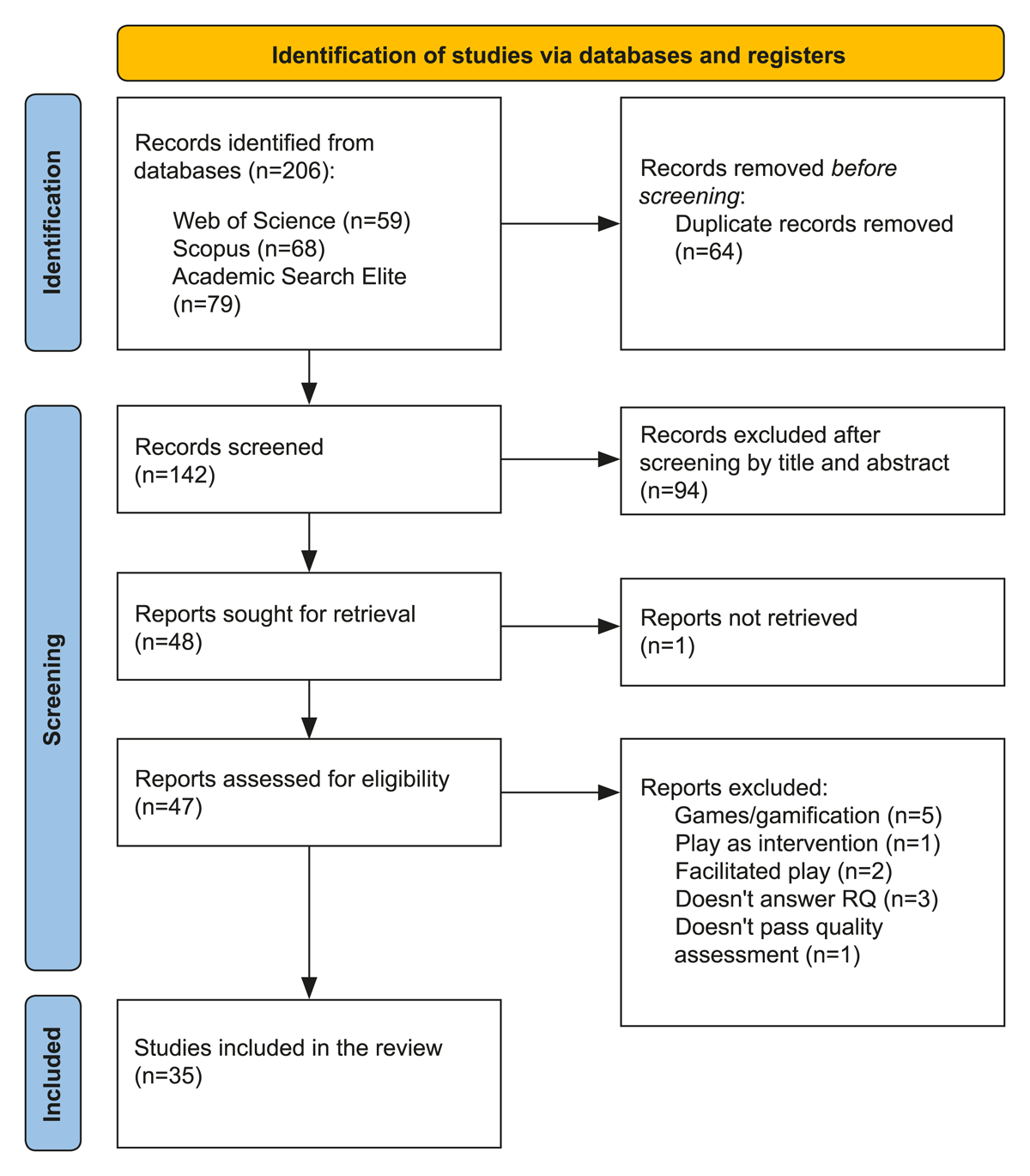
Figure 1
A flow chart illustrating the selection process.
The initial phase consisted of systematically searching electronic databases. Studies were chosen based on the following inclusion criteria:
Articles published between 2014–2024
Written in English
Journal article
Peer-reviewed
The described search process generated 142 results. The second phase involved screening the titles and abstracts of the selected studies. Studies not about play, or playfulness and work were excluded (n = 94). In the screening, 48 relevant articles were identified, of which one was not accessible.
A total of 47 studies were left for eligibility assessment. Evaluation for eligibility was done by thoroughly reading the full-text articles and comparing each to the research questions and the exclusion criteria shown in Figure 1. Finally, 35 studies (listed in Appendix A) that met the criteria and answered the research question were included.
4.3 Quality assessment
All chosen articles were carefully reviewed in a researcher triangulation, consisting of three researchers from different fields (psychology, education, and play studies), to enhance the reliability of the review and to prevent individual researcher bias. All chosen articles were assessed based on the relevance of the study to answer the research questions, as well as the validity, reliability, and credibility of the findings.
4.4 Data coding and analysis
Initial data coding was done based on the article’s research design, methodology, participants, outcomes, and findings. This led to articles being sub-categorized into empirical, theoretical, and literature review articles. Because of this diversity of data, a narrative synthesis approach is used (Popay et al., 2006). Narrative synthesis is a textual method that emphasizes qualitative interpretations of findings from studies with different designs and methodologies, making it particularly flexible and useful when studies have various approaches or limited direct quantitative data (Greenhalgh et al., 2018; Popay et al., 2006).
Thematic analysis was implemented as a tool for synthesis because of its flexibility and theoretical freedom. Braun and Clarke (2006) describe thematic analysis as a six-step process that begins with becoming acquainted with the data and creating codes. The coding was done by extracting information from the articles into the following categories, pre-chosen based on the research questions: 1) Manifestations of playfulness at the workplace, 2) Barriers and facilitators of playfulness, and 3) Implications of playfulness. At this stage, the empirical, theoretical, and literature review articles were analyzed separately because of the differences in the nature of data, methodology, and purposes of the different types of articles. In the next phase, themes were searched, reviewed, and defined based on the initial coding. When forming the themes, all types of articles and the coding were synthesized in accordance with narrative synthesis (Popay et al., 2006).
5. Results
This systematic review includes a total of 35 articles from the broad field of behavioral sciences. Of these, 22 are empirical studies, 9 are theoretical articles, and 4 are reviews (see Appendix A).
Playful work design (PWD), a proactive way to create enjoyable work conditions (see further 5.1.1) (Bakker et al., 2020), was the focus of 16 chosen articles (see Appendix A). All empirical articles researching PWD used surveys as a research method, either as a cross-sectional, two-wave, or diary study. PWD was measured using the questionnaire for Playful Work Design, developed and validated by Scharp et al. (2023), and all articles were conducted between 2019–2024. Sample size varied from 77 participants (Bakker, Scharp, et al., 2020) to 516 participants (Huang et al., 2024). Participants came from a diverse range of countries and industries. It is noteworthy that most of the research was conducted by the same researchers, primarily Scharp (e.g., Scharp et al., 2021, 2023) and Bakker (e.g., Bakker et al., 2021; Bakker, Scharp, et al., 2020).
Playfulness climate, a fun and pleasant work atmosphere perceived by employees (see further 5.3.1) (Zhou et al., 2018), was researched in four articles (Li & Tao, 2023; Liu et al., 2024; Zhou et al., 2018; Zhou et al., 2022). The measurement of playfulness climate used the scale proposed by Yu et al. (2003). The studies about playfulness climate were based in China (3) and Taiwan (1). Sample size varied from 150 employees (Zhou et al., 2018) to 424 participants (Liu et al., 2024). Both employees and supervisors were involved in the studies.
Apart from studies on PWD and playfulness climate, four additional empirical articles were chosen: Two were exploratory case studies (Kinder et al., 2018; Pors & Andersen, 2014), one was an 18-month ethnographic study (Chughtai, 2020), and one was a survey aimed at developing and validating measurement scales for organizational play (Mukerjee et al., 2023). These studies took place in France, Denmark, Finland, Scotland, and New Zealand.
The literature reviews (4) vary from an integrative review (Petelczyc et al., 2018; Smith et al., 2022) to a theoretical review (Celestine & Yeo, 2021) to a qualitative metasynthesis (Tökkäri, 2015). The data used in reviews varies from 12 empirical studies (Tökkäri, 2015) to 326 manuscripts (Smith et al., 2022). Conceptual articles (9) were also included in the data, refining conceptual frameworks related to playfulness at work.
Figure 2 provides an overview of the study’s findings. The antecedents, manifestations, and implications of playfulness are examined from individual, team, and organizational perspectives and classified as intrapersonal playfulness (individual level), interpersonal playfulness (team level), and organizational playfulness (organizational level). Based on the narrative nature of synthesis, placing individual components in these categories does not imply correlations or fixed directional links unless explicitly shown by arrows. For example, manifestations of playfulness at the organizational level might not necessarily lead to organizational implications but can influence other areas, such as intrapersonal outcomes. In the figure, empirically supported findings are presented in bold and underlined text, while theoretical findings are shown in regular formatting without emphasis. Furthermore, individual concepts and categories are not mutually exclusive and can partly overlap. The placement of components into specific categories reflects interpretative choices rather than strict boundaries.
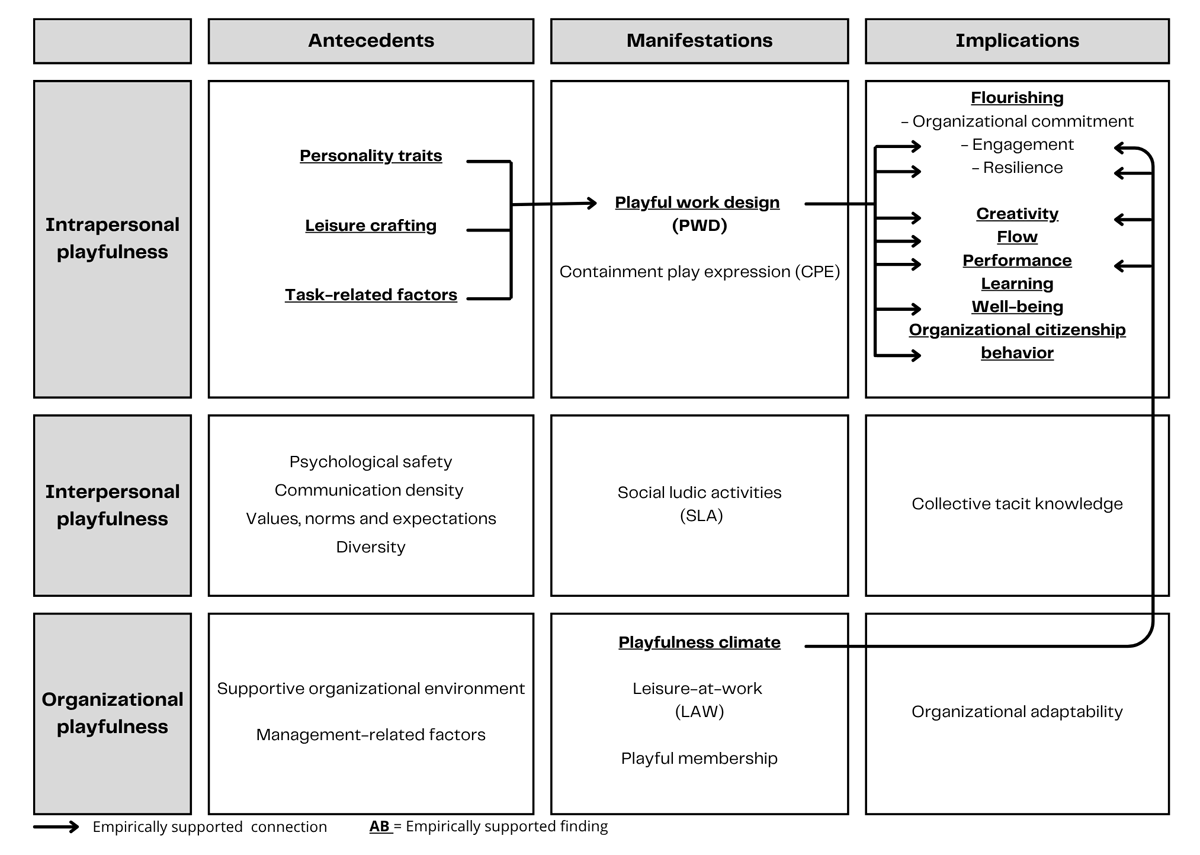
Figure 2
Antecedents, manifestations, and implications of playfulness in the workplace.
5.1 Intrapersonal playfulness
Intrapersonal playfulness (Figure 3) can be defined as employees being playful by themselves, including engaging in mind-wandering, entertaining ‘what-if’ scenarios, and competing against themselves playfully (Bakker, Scharp, et al., 2020; Kinder et al., 2018). Tökkäri (2015) describes employee playfulness as playfully engaging with the world, an orientation of being-in-the-world.
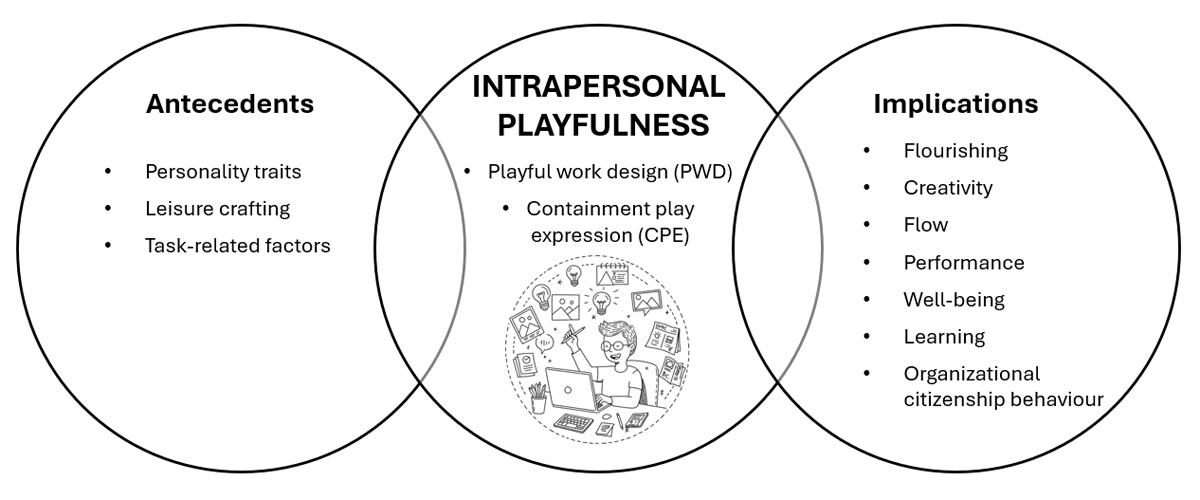
Figure 3
Intrapersonal playfulness and its antecedents and implications. Illustration (middle) created with AI.
5.1.1 Empirically supported findings
According to the results, manifestations of intrapersonal playfulness were mainly discussed within the concept of PWD, self-initiated play as a strategy during work to promote enjoyment and challenge (Bakker, Scharp et al., 2020; Bakker & van Woerkom, 2017; Scharp et al., 2023). By applying PWD, individuals try to proactively enhance their work experience by altering how they perform their tasks, while keeping the core nature of the work unchanged (Bakker, Scharp, et al., 2020; Scharp et al., 2023). PWD is a two-dimensional concept consisting of ludic play, referred to as ‘designing fun,’ and agonistic play, referred to as ‘designing competition’ (Scharp et al., 2022).
Personality traits like proactive personality, conscientiousness, playfulness, and openness to experiences influence intrapersonal playfulness, specifically the use and usefulness of PWD (Dishon-Berkovits et al., 2023; Hoang & Le, 2024; Scharp et al., 2019; Shabeer et al., 2022). A proactive personality positively affects employee ambidexterity and perceived work-life balance through the mediating role of PWD (Hoang & Le, 2024; Shabeer et al., 2022). PWD enhances work engagement, especially for employees who are low in conscientiousness, more playful, and more open to experiences (Dishon-Berkovits et al., 2023; Scharp et al., 2019). People naturally seek out work situations that activate their personality traits: People with proactive personalities will actively pursue opportunities that encourage the expression of this proactive trait, such as PWD, as it is both inherently satisfying and advantageous to their performance (Hoang & Le, 2024). What employees do in their free time also has a connection to playfulness at work: individuals’ leisure crafting can encourage similar proactive behavior (PWD) in the workplace (Chen & Choi, 2024).
Task-related factors influence how playfulness manifests within employees, particularly through the use of PWD (Bakker, Hetland, et al., 2020; Dishon-Berkovits et al., 2023; Scharp et al., 2021). Research has shown that daily hindrance job demands—such as underload, monotony, and conflict—are negatively associated with job performance via reduced work engagement (Scharp et al., 2021). However, PWD has been found to moderate this relationship, enabling employees to maintain engagement even in the face of such demands (Scharp et al., 2021). Moreover, PWD was found especially useful and effective when work pressure was low or workers experienced boredom (Bakker, Hetland, et al., 2020; Dishon-Berkovits et al., 2023). Daily work pressure was found to moderate the link between daily PWD and daily job performance when examining PWD’s relation to job performance, indicating that PWD was more effective when work pressure was low (Bakker, Hetland, et al., 2020), and boredom was found to moderate the indirect relationship of PWD with performance through work engagement, indicating that PWD is most useful for improving work engagement and performance when workers experience boredom (Dishon-Berkovits et al., 2023). However, theory suggests that complex and engaging job designs that provide intellectual stimulation and a sense of ownership can also promote playful exploration and problem-solving (Spraggon & Bodolica, 2014). Furthermore, high demands and an emphasis on productivity can limit opportunities for playfulness as employees may feel they lack time for playful activities (Kinder et al., 2018; Tökkäri, 2015; Wright, 2018).
As indicated by the data, playfulness has many known implications for the individual employee, described here as flourishing, creativity, flow, performance, well-being, learning, and organizational citizenship behavior.
Playfulness at work can enhance flourishing, defined by work engagement, resilience, and commitment to organization (Duerden et al., 2017). PWD as well as playfulness climate was found to increase work engagement (Dishon-Berkovits et al., 2023; Scharp et al., 2022; Scharp et al., 2019; Zhou et al., 2018; Zhou et al., 2022). Scharp et al. (2022) propose that PWDs’ connection to increased work engagement was explained by the use of self-determination strategies to satisfy employees’ basic needs. Similarly, Duerden et al. (2017) propose the idea that when employees participate in playful activities that enable them to express their identity, they may begin to perceive similarities between their identity and the organization’s practices, which can lead to increased organizational commitment.
Playfulness increases resilience (Bakker & Wingerden, 2021; Dodgson, 2016; Duerden et al., 2017; Hoang & Le, 2024; Liu et al., 2024; Scharp et al., 2021). Playfulness climate is shown to enhance employees’ sense of self-efficacy, which supports one’s ability to adapt to changing environments, thereby enhancing resilience (Liu et al., 2024). Furthermore, using PWD can help employees handle challenging situations: Bakker and Wingerden (2021) found that PWD can alleviate the impact of rumination about COVID-19 on well-being, and Scharp et al. (2021) found that incorporating PWD helps counteract the impact of agency and communion hindrance job demands. Playfulness builds resilience by supporting the development of psychological and social resources and aiding in recovery (Bakker & Wingerden, 2021; Duerden et al., 2017), as well as encouraging a mindset that allows employees to try new things, take risks, and learn from mistakes without fear of significant repercussions, creating a culture where failure is a learning opportunity (Dodgson, 2016).
Playfulness promotes creativity (Chen & Choi, 2024; Chughtai, 2020; Kinder et al., 2018; Li & Tao, 2023; Liu et al., 2024; Mukerjee et al., 2023; Petelczyc et al., 2018; Smith et al., 2022; Scharp et al., 2019; Spraggon & Bodolica, 2018; Zhou et al., 2018; Zhou et al., 2022). PWD was found to increase creativity through leisure crafting (Chen & Choi, 2024), flow experiences (Liu et al., 2022), and work engagement (Scharp et al., 2019). Zhou et al. (2018) found that a playfulness climate also increases creativity, drawing upon prior research which suggests that positive interaction activates the parasympathetic nervous system (PNS) and fosters openness to new ideas (e.g., Jack et al., 2013). Playfulness enhances employee creativity and innovation by promoting cognitive flexibility and encouraging a more open, exploratory mindset in problem-solving (Kinder et al., 2018; Li & Tao, 2023; Liu et al., 2024).
PWD can increase flow experiences (Bakker & van Woerkom, 2017; Liu et al., 2022; Smith et al., 2022). Liu et al. (2022) discovered that PWD is positively linked to work-related flow by three main elements, characterized as enjoyment, absorption, and intrinsic work motivation. When individuals approach their tasks playfully, they are more likely to be energized, motivated, and absorbed, leading to greater enjoyment and positive emotions (Bakker & van Woerkom, 2017; Liu et al., 2022).
Playfulness climate and PWD are positively related to performance at work (Bakker et al., 2021; Bakker, Hetland, et al., 2020; Caracuzzo et al., 2024; Dishon-Berkovits et al., 2023; Liu et al., 2024). PWD was also found to support work performance through work engagement (Caracuzzo et al., 2024; Dishon-Berkovits et al., 2023). When individuals engage in play, they become fully absorbed, committed to continuing, and often do so with great energy, leading to increased performance (Dishon-Berkovits et al., 2023; Liu et al., 2024). Conversely, in their review, Petelczyc et al. (2018) observe that play can also lead to poorer task performance if it becomes too much of a distraction.
Playfulness at work can enhance well-being by adding resources, reducing stress, boosting recovery, and serving as a coping mechanism (Bakker & Wingerden, 2021; Celestine & Yeo, 2021; Huang et al., 2024; Mukerjee et al., 2023; Petelczyc et al., 2018; Shabeer et al., 2022; Smith et al., 2022; Tökkäri, 2015). PWD was found to inhibit exhaustion, enhance vigor at work, build work–life balance (Bakker & Wingerden, 2021; Shabeer et al., 2022), and reduce stress in gig workers (Huang et al., 2024).
Playfulness facilitates learning (Chughtai, 2020; Petelczyc et al., 2018; Spraggon & Bodolica, 2018) by creating a unique learning environment, a ‘playspace’ where individuals can experiment with new ideas and challenge existing assumptions (Kinder et al., 2018). In his ethnographic research, Chughtai (2020) discovered that IT professionals’ playfulness was related to the gradual acquisition of complex skills: employees learned IT-related skills by playing with their work and then mastered these skills as if progressing through levels in a game.
Caracuzzo et al. (2024) found that PWD encourages organizational citizenship behavior, especially altruism. By playfully designing work, employees become more willing to help colleagues, leading to a more positive work environment.
5.1.2 Theoretical and review-based findings
Wright (2018) proposes a similar, but less well-known and researched concept to PWD, containment play expression (CPE), which describes how play emerges when individuals find ways to express themselves within the boundaries of workplace containment (e.g., deadlines, company policies, and social norms). CPE involves engaging with work in a more creative, enjoyable, and ultimately productive manner, which can include finding humor in everyday situations, playful communication, or celebrating small wins (Wright, 2018).
5.2 Interpersonal playfulness
Interpersonal playfulness (Figure 4) can involve shared experiences (playing games, telling stories, or working on a project collaboratively), social interactions (joking, teasing, wordplay), or co-creation of meaning (developing a shared understanding of the world through playful dialogue) (Kinder et al., 2018; Tökkäri, 2015). For interpersonal playfulness to emerge, individuals must engage in playful interactions in ‘playspaces’, such as break rooms or virtual spaces (Kinder et al., 2018).
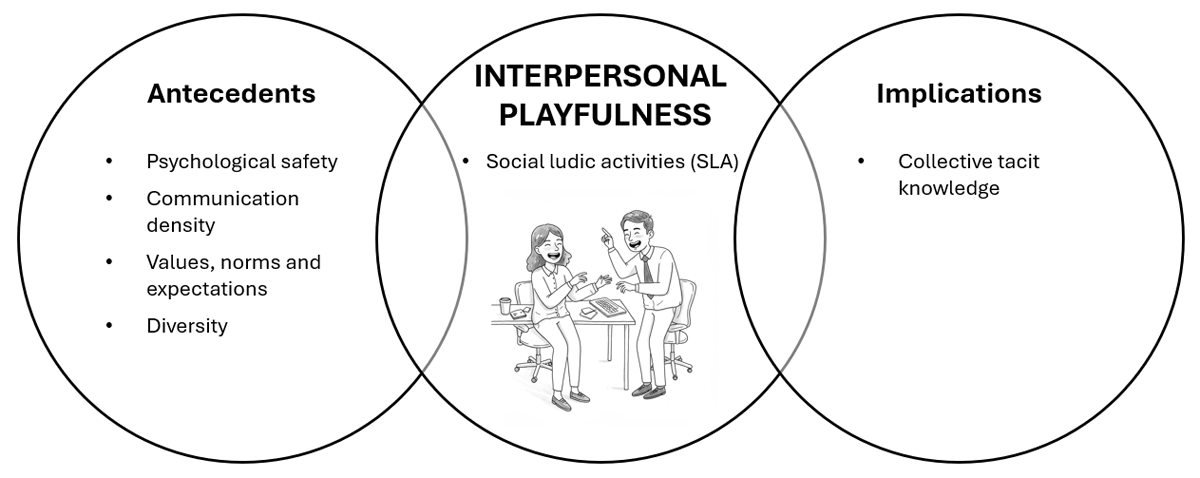
Figure 4
Interpersonal playfulness and its antecedents and implications. Illustration (middle) created with AI.
5.2.1 Empirically supported findings
In the articles chosen for this review, there were no clear empirical findings of interpersonal antecedents or implications of playfulness or empirically supported concepts of interpersonal playfulness.
5.2.2 Theoretical and review-based findings
A key concept of interpersonal playfulness is social ludic activities (SLAs), a distinct form of playfulness in the workplace characterized by spontaneous, voluntary, and playful behaviors employees utilize to address work-related concerns within a psychologically safe environment (Spraggon & Bodolica, 2014, 2017). SLAs involve imaginative, open-ended interactions, often accompanied by shared laughter and a collaborative approach to problem-solving (Spraggon & Bodolica, 2014, 2017).
A psychologically safe environment where employees feel comfortable taking risks, sharing ideas, and engaging in playfulness without fearing judgment is crucial for playfulness to emerge (Kinder et al., 2018; Spraggon & Bodolica, 2014; Wright, 2018). Communication density, described as a frequent, positive, and multimodal interaction between employees, is also needed (Smith et al., 2022; Spraggon & Bodolica, 2014; Zhou et al., 2018; Zhou et al., 2022). Proximity facilitates social interactions, making playfulness at work more likely (Spraggon & Bodolica, 2014; Zhou et al., 2018; Zhou et al., 2022). It is hypothesized that working from home reduces playfulness due to reduced face-to-face interaction (Mukerjee et al., 2023). Social norms and expectations about appropriate workplace behavior can limit or facilitate playfulness at work (Dodgson, 2016; Smith et al., 2022; Tökkäri, 2015). Employees’ attitudes and interpretations of playfulness can influence how playfulness is interpreted in the workplace (Celestine & Yeo, 2021; Tökkäri, 2015). Diversity is essential for playfulness in work: Uniting individuals with varied backgrounds, experiences, and perspectives broadens potential ideas and playful innovation (Kinder et al., 2018).
Playfulness can facilitate collective tacit knowledge (Spraggon & Bodolica, 2017, 2018). Through playful interactions, employees can pool their diverse expertise, experiences, and perspectives to develop novel solutions and insights that would not be possible individually (Spraggon & Bodolica, 2017). This shared understanding and knowledge, often tacit and difficult to articulate, becomes embedded within the group and contributes to the organization’s overall knowledge base (Spraggon & Bodolica, 2017). In the data, many other benefits of interpersonal playfulness were also briefly mentioned: it can improve trust, as well as the climate of meetings, and break down hierarchical barriers (Mukerjee et al., 2023; Petelczyc et al., 2018; Tökkäri, 2015). Shared playful experiences strengthen social ties and team cohesion, creating a more positive and collaborative work environment (Chughtai, 2020; Smith et al., 2022).
5.3 Organizational playfulness
Organizational playfulness (Figure 5) is not about casual fun at work, but rather the strategic integration of playful activities into work processes (Pors & Andersen, 2014). This can manifest via specifically designed games, through facilitated interactions like serious play, or by encouraging playfulness through the design of work and physical workspaces, creating environments that encourage playfulness and collaboration (Dodgson, 2016; Pors & Andersen, 2014).
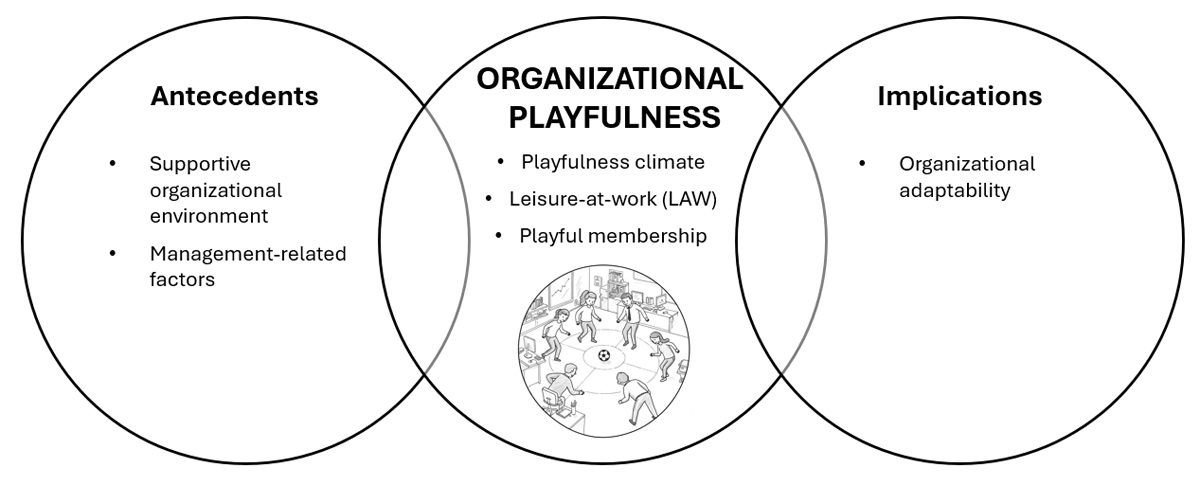
Figure 5
Organizational playfulness and its antecedents and implications. Illustration (middle) created with AI.
5.3.1 Empirically supported findings
According to the empirically supported findings, manifestations of organizational playfulness were mainly discussed within the concept of playfulness climate. A playfulness climate is an atmosphere employees perceive as optimistic, fun, and playful, where employees are encouraged to engage in playful activities (Li & Tao, 2023; Liu et al., 2024; Zhou et al., 2018; Zhou et al., 2022). Playfulness climate is characterized by leadership support, pleasure in leisure, cooperation, and intimacy (Zhou et al., 2022).
5.3.2 Theoretical and review-based findings
Drawing from theoretical frameworks and literature reviews, leisure-at-work (LAW) and playful membership emerge as constructs of organizational playfulness. LAW refers to organizations integrating recreational activities into the workplace, such as providing on-site amenities or sponsoring initiatives like book clubs and sports leagues (Duerden et al., 2017). Andersen and Pors (2014) introduce the concept of playful membership, a mode of engagement characterized by interaction between individual identity and organizational roles and shaped by the organization’s cultural encouragement of flexibility, experimentation, and playfulness. Playful membership emerges when organizations encourage employees to experiment with their roles playfully, avoiding rigid responsibilities and structured expectations, thereby reinforcing a climate of organizational playfulness (Andersen & Pors, 2014).
A supportive organizational environment is essential for organizational playfulness (Kinder et al., 2018; Smith et al., 2022; Spraggon & Bodolica, 2014, 2018; Wright, 2018). Organizations must provide opportunities as well as value playfulness to benefit from it, whereas rigid organizational structures and a protestant work ethic can stifle playfulness (Chughtai, 2020; Dodgson, 2016; Kinder et al., 2018; Spraggon & Bodolica, 2018). Employees need to have organizational trust to perceive organizations’ efforts to boost playfulness positively (Duerden et al., 2017; Spraggon & Bodolica, 2014, 2018). Management-related factors, such as leadership support, are equally important: an empowering management style that promotes employee autonomy can facilitate playfulness (Smith et al., 2022; Spraggon & Bodolica, 2014, 2018; Zhou et al., 2018; Zhou et al., 2022). Conversely, attempting to manage play reduces playfulness and adds resistance, as play is inherently volitional (Chughtai, 2020; Tökkäri, 2015).
It is also hypothesized, but not yet researched, that industry type as well as the age and size of the company might play a role in emergence of playfulness: younger and smaller organizations may be more receptive to play due to their flexible work environments and the presence of younger cohorts (Liu et al., 2024; Mukerjee et al., 2023; Petelczyc et al., 2018). The industry or sector can also impact playfulness; manufacturing sectors, which tend to be more hierarchical and formalized, may provide fewer play opportunities than service sectors (Mukerjee et al., 2023; Petelczyc et al., 2018).
The main organizational level implication of playfulness is organizational adaptability, in which organizations use playfulness as a tool to deal with constant change (Andersen & Pors, 2014; Pors & Andersen, 2014). Pors and Andersen (2014) suggest that the primary consequence of organizational play is a deliberate increase in undecidability: traditional organizational structures often prioritize reducing uncertainty and making firm decisions, whereas organizational playfulness welcomes uncertainty as a resource for innovation and adaptability. By creating a surplus of possibilities and delaying the need for definitive solutions, playfulness allows organizations to remain flexible and responsive to change (Pors & Andersen, 2014).
5.4 Negative implications
Within the data, some negative perspectives of playfulness were examined from a theoretical standpoint. Playfulness can become dysfunctional in specific contexts, especially when play is used excessively to disrupt work or challenge authority, blur work-life boundaries, or create unhealthy competition (Spraggon & Bodolica, 2018; Wright, 2018). Rigid structures, controlling management styles, or poorly managed play can lead to negative outcomes such as resistance, cynicism, decreased productivity and motivation, and burnout (Celestine & Yeo, 2021; Smith et al., 2022; Tökkäri, 2015; Wright, 2018). High integration of work and play can also blur the boundaries between these domains, making it difficult for employees to mentally detach from work (Smith et al., 2022). However, there was no empirical evidence to support these claims in the selected articles.
6. Discussion
This systematic literature review on playfulness in the workplace identifies several key manifestations, antecedents, and implications of playfulness across employees, teams, and organizations. The findings highlight the multidimensional aspects of playfulness, and three distinct forms are identified: intrapersonal playfulness, characterized by employees incorporating playful elements into their work tasks; interpersonal playfulness, marked by collaborative interactions and shared experiences among coworkers; and organizational playfulness, in which playful activities are incorporated into work processes. Empirical findings focus on the intrapersonal level within the frameworks of PWD and playfulness climate, influenced by personality traits and task-related factors, with implications ranging from individual flourishing to creativity, resilience, and well-being. Theoretical and review-based literature expands the perspective to team and organizational levels, suggesting antecedents such as psychological safety, voluntary participation, and management-related factors, as well as implications including collective tacit knowledge and organizational adaptability. These findings suggest that playfulness is a valuable resource for modern organizations, and contributes to flourishing employees and organizational success when properly supported and implemented.
The results align with POS and are supported by POS concepts such as psychological capital, flourishing, and systemic resilience. Playfulness in the workplace can be considered a vital part of psychological capital as both constructs share similarities that enhance employee engagement, creativity, and overall workplace well-being (Celestine & Yeo, 2021; Huang et al., 2024; Luthans & Joussef-Morgan, 2017; Proyer & Ruch, 2011). Organizational playfulness can be an asset for systemic resilience, a collective capacity that organizations can develop by promoting organizational adaptability (Dadich et al., 2015; Pors & Andersen, 2014). Flourishing is the desired outcome of POS initiatives, and playfulness is a facilitator, creating environments that support employee engagement and satisfaction (Caza & Cameron, 2009; Duerden et al., 2017). Based on the results of this review, we argue that playfulness should be considered a vital aspect of POS and integrated into future research in the field, as both share recurring themes such as psychological safety, a shift from problem-oriented to flourishing perspectives, the fostering of creativity and resilience, and the quality of interaction as a key resource for collaboration, trust, and shared growth.
Several key conclusions and research gaps were identified from the results, as illustrated in Figure 2. These will be first discussed in the context of manifestations of playfulness, followed by the conclusions and research gaps related to the antecedents and implications of playfulness in the workplace. Directions for future research based on these conclusions are presented in Table 1.
Table 1
Directions for future research.
| 1. Broader scope of manifestations, concepts, and definitions of playfulness in the workplace |
| 2. Empirical research on the negative sides of playfulness in the workplace |
| 3. Empirical research on interpersonal-level antecedents and implications of playfulness in the workplace |
| 4. Empirical research on organizational-level antecedents and implications of playfulness in the workplace |
| 5. More diverse research designs and methods |
According to the results of this review, concepts of playfulness in the workplace are various, overlapping, and lacking comprehension. Firstly, the concepts ‘play’ and ‘playfulness’ are used almost interchangeably, contributing to the conceptual ambiguity that complicates the systematic study of the topic (Bateson & Martin, 2013). Secondly, playfulness was often expressed in a limited and one-dimensional way, overlooking its various forms, such as the other-directed, lighthearted, intellectual, and whimsical aspects outlined in Proyer’s (2017) OLIW-model, as well as integrating intrapersonal, interpersonal, and organizational representations of playfulness. This may be because this review excludes playfulness as a trait that Proyer’s (2017) model represents, and because of the researchers’ need to stay focused on their conceptualizations of this complex phenomenon. Nonetheless, we think there is still a need for an unambiguous, comprehensive definition of playfulness in the workplace that can include both the trait and situational dimensions, as well as the intrapersonal, interpersonal, and organizational aspects of playfulness, since none of these are mutually exclusive.
Thirdly, a research gap exists regarding the empirical validation of manifestations of playfulness. Two key frameworks—PWD (Scharp et al., 2023) and playfulness climate (Yu et al., 2003)—have gained recognition. There is also some evidence for other concepts, such as SLA (e.g., Spraggon & Bodolica, 2021) and LAW (e.g., Lacanienta, 2018), but most of the empirical research still focuses on PWD and playfulness climate. While valuable, focusing only on these conceptualizations risks excluding broader interpretations of playfulness. For instance, SLA (Spraggon & Bodolica, 2017) emphasizes playfulness’s social and collaborative dimensions in ways other models might overlook.
The results of this study strengthen and build upon insights from prior research. The positive implications of playfulness, such as creativity, stress-reduction, and well-being, have been well-established (Bateson & Martin, 2013; Clifford et al., 2022; Lee et al., 2021; Mainemelis & Ronson, 2006; Styhre, 2008; Tandler et al., 2024; West, 2015). Mainemelis and Ronson (2006) acknowledge that for playfulness to manifest and increase creativity, there needs to be safety, time, and space for playfulness to emerge. Proyer (2013) identifies playfulness as a variable that relates positively to numerous aspects of job satisfaction and interpersonal relationships at work. The positive relationship between resilience and playfulness has also been a rising focus of recent research (Clifford et al., 2022; Heljakka, 2021; Magnuson & Barnett, 2013).
Despite the consensus with previous research, the results also revealed a discrepancy between theory and empirical findings regarding the antecedents and implications of playfulness. According to the results of this review, research is only theoretical regarding the negative implications of playfulness. Empirical research is also almost exclusively focused on the individual level, with a lack of research on interpersonal and organizational-level antecedents and implications. However, playfulness extends beyond individual experiences to positively impact teams and organizational functioning (Caracuzzo et al., 2024; Liu et al, 2024). POS also highlights the need to focus on collective orientation and collective virtues rather than viewing individuals solely as independent actors (Caza & Cameron, 2009; Müceldili et al., 2015).
Although some evidence supports the missing link between inter- and organizational-level antecedents and the implications of playfulness—such as in psychological safety (Plester & Lloyd, 2023) and management practices (Fang et al., 2019)—certain areas, for example, organizational adaptability, still lack empirical validation altogether. A significant body of research also explores the positive implications of related concepts to playfulness, such as gamification (e.g., Manske, 2024), serious play (e.g., Küpers, 2017), and workplace fun (e.g., Owler & Morrison, 2020). To conclude, more empirical research exploring the interpersonal and organizational antecedents and negative implications is needed to support the theoretical claims.
Playfulness at work is still an emerging field, and this is reflected both in the research methods and the scope of studies conducted. Based on the data analyzed in this study, empirical research on workplace playfulness has only gained momentum since 2019, as earlier studies were primarily theoretical. The emerging nature of this field is further reflected in the relatively small yet focused group of researchers driving its advancement. The research designs in empirical studies are also primarily survey-based, with only a few other research designs represented (e.g., Chughtai, 2020). We think the field would benefit from more diverse research methods, including qualitative and mixed-method approaches, to offset the limitations of each method and to address the complexity and interdisciplinary nature of playfulness in the work environment.
In sum, this review highlights playfulness as a promising, yet still underexplored area within organizational research, both conceptually and empirically. The findings reinforce its relevance in POS, yet they also reveal methodological gaps and a need for broader definitions of playfulness at the workplace. The limited empirical research on negative implications and both interpersonal and organizational-level manifestations, antecedents, and implications, along with the dominance of survey-based studies, restricts our understanding of the topic. To support the development of this emerging field, future research should adopt more diverse methods and scopes of research as well as continue working toward a comprehensive framework for playfulness at the workplace.
Conclusions
Grasping the importance and complexity of playfulness in the workplace presents a new outlook on work, one that views playfulness as essential for employee flourishing and organizational success. For an organization to invest in playfulness, it is crucial to establish a psychologically safe environment where employees feel comfortable taking risks and trying new things without fear of judgment. Additionally, sufficient resources, such as time and space, are needed to integrate playful practices into work processes and supportive management. Playfulness may be increasingly important in workplaces because it encourages creativity and innovation, helps manage stress, and improves team collaboration (Chen & Choi, 2024; Chughtai, 2020; Kinder et al., 2018; Li & Tao, 2023; Liu et al., 2024; Mukerjee et al., 2023; Petelczyc et al., 2018; Smith et al., 2022; Spraggon & Bodolica, 2018; Tökkäri, 2015; Zhou et al., 2018; Zhou et al., 2022). As modern work environments become more demanding and complex, playfulness can provide ways to handle these challenges, increasing the meaningfulness of work and employee engagement.
The results of this review may be interpreted by considering the following limitations. The data consists of different types of articles (empirical, theoretical, and review). While this adds to overall comprehension of the concept, it also means not all results are evidence-based, which may limit the generalizability of the findings. Additionally, the quality of this study is influenced by the limited research available on the subject, the small number of contributing researchers, and the narrow range of methodologies employed.
Future research benefits the field, as it increases understanding of playfulness in the workplace and supports the development of this still-emerging area, which needs multidimensional and multidisciplinary research. Currently, research lacks a thorough understanding of playfulness in the workplace at various levels. A broader view of the subject can be achieved by emphasizing how different types of playfulness manifest in the workplace beyond just their implications. Furthermore, examining the team and organizational levels and their interactions could further advance the field. Negative implications of playfulness in the workplace have not been a focus of empirical research and should be given more attention, particularly to explore what causes negative effects within this inherently positive phenomenon. It is also worth considering whether play can be regarded as playful if perceived negatively (Proyer, 2012). As our understanding of playfulness in the workplace evolves, examining its various aspects will lead to a better, more engaging, and innovative working life.
Appendices
Appendix
Appendix A
Chosen articles for the systematic literature review categorized by study type.
| AUTHOR | TITLE | YEAR | PUBLICATION | KEYWORDS | STUDY TYPE |
|---|---|---|---|---|---|
| Bakker, A., Breevaart, K., Scharp, Y., & de Vries, J. | Daily self-leadership and playful work design: Proactiveapproaches of work in times of crisis. | 2021 | The Journal of Applied Behavioral Science | Basic needs, COVID-19, playful work design, self-determination theory, self-leadership | Empirical |
| Bakker, A.B., Hetland, J., Olsen, O.K., Espevik, P., & de Vries, J.D. | Job crafting and playful work design: Links with performance during busy and quiet days | 2020 | Journal of Vocational Behavior | JD-R theory, job crafting, job performance, playful work design, proactive work behavior | Empirical |
| Bakker, A. B., & Wingerden, J. | Rumination about COVID-19 and employee well-being: The role of playful work design. | 2021 | Canadian Psychology / Psychologie canadienne | COVID-19, employee well-being, playful work design, proactive behaviour, rumination | Empirical |
| Caracuzzo, E., Caputo, A., Callea, A., Cortese, C.G., & Urbini, F. | Playful work design in fostering organizational citizenship behaviors and performance: two studies on the mediating role of work engagement | 2024 | Management Research Review | Structural equation modeling, organizational behavior, performance, work engagement, proactivity, organizational citizenship behaviors, playful work design | Empirical |
| Chen, I., & Choi, J.N. | Does leisure crafting improve workplace creativity? | 2024 | European Management Review | creativity at work, leisure crafting, playful work design, smartphone use for leisure | Empirical |
| Chughtai, H. | Instrumental aspects of play at work in information technology organisations. | 2020 | European Journal of Information Systems | Play, workplace play, IT Workplace, ethnography, critical hermeneutics | Empirical |
| Dishon-Berkovits, M., Bakker, A. B., & Peters, P. | Playful work design, engagement and performance: the moderating roles of boredom and conscientiousness. | 2023 | The International Journal of Human Resource Management | Boredom, conscientiousness, job performance, playful work design, work engagement | Empirical |
| Hoang, T. H., & Le, Q. H. | A self-regulatory adapting mechanism to changing work setting: Roles of playful work design and ambidexterity | 2024 | Current Research in Behavioral Sciences | Employee ambidexterity, uncertainty adaptability, playful work design, proactive service performance, proactive personality, Vietnam | Empirical |
| Huang, X.-J., Sun, Z.-Y., Li, J.-M. and Li, J.-H. | Will Fun and Care Prevent Gig Workers’ Withdrawal? A Moderated Mediation Model. | 2024 | Asia Pacific Journal of Human Resources | Caring organizational ethical climate, gig work challenges, playful work design, workplace withdrawal behavior | Empirical |
| Kinder, T., Stenvall, J., & Memon, A. | Play at work, learning and innovation. | 2018 | Public Management Review | Innovation, play, governances, learning | Empirical |
| Li, L., & Tao, H. | Leveraging employee creativity through playfulness climate: The mediating role of working smart. | 2023 | Social Behavior and Personality | playfulness climate, employee creativity, working smart, playfulness at work, workplace culture | Empirical |
| Liu, W., Bakker, A. B., Tse, B. T., & van der Linden, D. | Does playful work design ‘lead to’ more creativity? A diary study on the role of flow. | 2022 | European Journal of Work and Organizational Psychology | Alternative uses task, creativity, flow proneness, playful work design, work-related flow | Empirical |
| Liu, Z., Yuan, L., Cao, C., Yang, Y., & Zhuo, F. | How playfulness climate promotes the performance of millennial employees – the mediating role of change self-efficacy | 2024 | Journal of Organizational Change Management | Playfulness climate, change self-efficacy, task performance, innovation performance, millennial employees | Empirical |
| Mukerjee, J., Thurik, R., Torrès, O., & Wismans, A. | Measuring organizational play in small businesses | 2023 | Management Review Quarterly | Play, scale development, serious play, diversionary play, small business (owners), entrepreneurship | Empirical |
| Pors, J. G., & Andersen, N. Å. | Playful organisations: Undecidability as a scarce resource. | 2014 | Culture and Organization | Undecidability, organisational play, Niklas Luhmann, Gregory Bateson, the paradox of the decision, organisation theory | Empirical |
| Scharp, Y. S., Bakker, A. B., & Breevaart, K. | Playful work design and employee work engagement: A self-determination perspective | 2022 | Journal of Vocational Behaviour | Playful work design, proactivity, self-determination theory, basic need satisfaction, work engagement, play at work | Empirical |
| Scharp, Y. S., Bakker, A. B., Breevaart, K., Kruup, K., & Uusberg, A. | Playful work design: Conceptualization, measurement, and validity. | 2023 | Human Relations | Competitiveness, job and work design, play at work, playfulness, playful work design, proactive work behavior, scale development, work engagement | Empirical |
| Scharp, Y. S., Breevaart, K., & Bakker, A. B. | Using playful work design to deal with hindrance job demands: A quantitative diary study | 2021 | Journal of Occupational Health Psychology | Agency, communion, hindrance job demands, playful work design, work engagement | Empirical |
| Scharp, Y. S., Breevaart, K., Bakker, A. B., & van der Linden, D. | Daily playful work design: A trait activation perspective. | 2019 | Journal of Research in Personality | Creativity, cross-level interaction, daily diary study, multilevel modeling, openness, playful work design, playfulness, proactive work behavior, trait activation, work engagement | Empirical |
| Shabeer, S., Nasir, N., Nasir, S., Fatima, T., Yasir, A. F., Rehman, S., & Chaudhry, A. R. | Moving up without moving forward! managing career plateau in COVID-19: A dual serial mediations: MRN. | 2022 | Management Research Review | Human resource management, work life balance, proactive personality, career adaptability, career plateau, serial mediation, dual mediation, playful work design | Empirical |
| Zhou, F., Wang, N., & Wu, Y. J. | Does university playfulness climate matter? A testing of the mediation model of emotional labour. | 2018 | Innovations in Education and Teaching International | University playfulness climate, emotional labour, emotional regulation, innovation intention, job engagement | Empirical |
| Zhou, F., Zhang, N., & Mou, J. | Universities as incubators of innovation: The role of a university playfulness climate in teachers’ sustainable teaching innovation. | 2022 | The International Journal of Management Education, | University playfulness climate, job engagement, sensitivity to teaching and learning, sustainable teaching innovation | Empirical |
| Andersen, N. Å., & Pors, J. G. | Playful membership: embracing an unknown future. | 2014 | Management & Organizational History | Decision, Luhmann, membership, organizational play, potentiality, semantic history, uncertain futures | Theoretical |
| Bakker, A. B., Scharp, Y. S., Breevaart, K., & de Vries, J. D. | Playful Work Design: Introduction of a New Concept. | 2020 | The Spanish Journal of Psychology | JD-R theory, playfulness, playful work design, proactive work behavior, work engagement | Theoretical |
| Bakker, A.B., & van Woerkom, M. | Flow at Work: a Self-Determination Perspective. | 2017 | Occupational Health Science | Flow, job crafting, playful work design, self-determination theory, self-leadership, strengths use | Theoretical |
| Dodgson, M. | Innovation and play. | 2016 | Innovation | Innovation, play learning, uncertainty | Theoretical |
| Duerden, M. D., Courtright, S. H., & Widmer, M. A. | Why People Play at Work: A Theoretical Examination of Leisure-at-Work. | 2017 | Leisure Sciences | Leisure, work and leisure, work recovery | Theoretical |
| Spraggon, M. and Bodolica, V. | Social ludic activities: a polymorphous form of organizational play | 2014 | Journal of Managerial Psychology | Contextual factors, organizational play, play as engagement with work, play as resistance, social ludic activities | Theoretical |
| Spraggon, M. and Bodolica, V. | Collective tacit knowledge generation through play: Integrating socially distributed cognition and transactive memory systems | 2017 | Management Decision | Collective tacit knowledge generation, play in the workplace, social ludic activities, socially distributed cognition, transactive memory systems | Theoretical |
| Spraggon, M., & Bodolica, V. | A practice-based framework for understanding (informal) play as practice phenomena in organizations. | 2018 | Journal of Management & Organization | Play as practice, serious play, informal play, objects of work, context | Theoretical |
| Wright, J.T. | Liberating Human Expression: Work and Play or Work versus Play | 2018 | American Journal of Play | Alienation, containment play expression, digital games, human expression, play and work, virtual environment | Theoretical |
| Celestine N., & Yeo, G. | Having some fun with it: A theoretical review and typology of activity-based play-at-work. | 2021 | Journal of Organizational Behavior | Energy management, fun, hedonic, instrumental, play at work | Review |
| Petelczyc, C. A., Capezio, A., Wang, L., Restubog, S. L. D., & Aquino, K. | Play at Work: An Integrative Review and Agenda for Future Research. | 2018 | Journal of Management, | Play at work, playfulness, playful culture, fun at work | Review |
| Smith, T. A., Butts, M. M., Courtright, S. H., Duerden, M. D., & Widmer, M. A. | Work–leisure blending: An integrative conceptual review and framework to guide future research. | 2022 | Journal of Applied Psychology, | Work–leisure blending, organizational play, gamification, workplace fun, work breaks | Review |
| Tökkäri, V. | Organizational play: within and beyond managing | 2015 | Qualitative Research in Organizations and Management | Authenticity, organizational play, management, experience, metasynthesis, fun | Review |
Competing Interests
The authors have no competing interests to declare.
Author contributions
Anna-Kaisa Jarkko: Idea construction, data collection, quality assessment of data, data analysis and synthesis, writing – original draft preparation and editing.
Marjaana Kangas: Idea construction, idea development, quality assessment of data, writing – reviewing and editing.
Katriina Heljakka: Idea development, quality assessment of data, writing – rewriting and editing.