
Introduction
Societal and technological developments have considerably transformed the organisation of work, driving a shift towards more flexible work designs (Kaiser et al. 2022). This shift is reflected, among other things, in the fact that knowledge organisations increasingly adopt hybrid approaches, providing employees with the opportunity to combine in-person office days with off-site work using digital technologies (Toscano et al. 2025). However, employees also seek more individualised working conditions due to changing social values and a stronger focus on autonomy and self-fulfilment (Oldham & Hackman 2010). Against this background, they shape their own working conditions through job crafting, a bottom-up approach enabling them to align their job characteristics with personal needs and interests (Tims & Bakker 2010). In work environments characterised by, e.g., physical presence in the office, fixed working hours and places, and hierarchical organisational structures (Allvin et al. 2011), job crafting is widely recognised for its beneficial effects on various health- and work-related outcomes (Rudolph et al. 2017).
However, hybrid work – characterised by, e.g., time-spatial flexibility, use of digital technologies, and blurred work-life boundaries – is associated with a change in job characteristics (Stasiła-Sieradzka et al. 2023). As proposed by the Job Demands-Resources (JD-R) theory (Demerouti & Bakker 2023), new job-related demands and resources have to be addressed by both organisations and employees, increasing the importance of employees’ proactive involvement in shaping their jobs (Demerouti 2025). In this vein, a growing body of research highlights both positive and negative outcomes of working from home as part of hybrid work (Gajendran et al. 2024). On the one hand, employees working from home often experience greater autonomy and flexibility, which allows for better coordination of work demands with private needs (Allen et al. 2021) and increases their job resources to some extent. On the other hand, employees are likely to perceive a loss of social job resources when working away from the office, as less frequent face-to-face interactions with colleagues may diminish access to organisational support (Wang et al. 2021). As a result, obtaining key social and task-related resources might become more challenging (Liu et al. 2021).
However, while empirical evidence shows that working from home entails both benefits and drawbacks, little is known about employees’ related proactive behaviours. In particular, recent research suggests a more complex identification of hybrid work characteristics that is largely shaped by subjective perceptions of certain working conditions (Jaß et al. 2024). From a JD-R perspective (Demerouti & Bakker 2023), this implies that job crafting strategies in hybrid work may be contingent on employees’ subjective evaluations of job-related demands and resources, highlighting the need for an integrative view on how experienced job characteristics are linked to the use of individual crafting strategies. To explore such links, a qualitative approach is particularly suitable, as qualitative research allows an in-depth exploration of behaviours in response to the individual perception of different contexts (Wilhelmy & Köhler 2021).
Although previous qualitative studies have examined job characteristics and job crafting strategies in the context of working from home, they have primarily focused on specific sectors such as public service (e.g., Seinsche et al. 2022; Seinsche et al. 2023). Furthermore, most of these studies were conducted during the pandemic – representing an exceptional crisis and a major stress event marked by a sudden, mandatory shift to full-time remote work (e.g., Ingusci et al. 2021; Rohwer et al. 2024; Stempel & Siestrup 2022). In addition, prior studies have investigated either job characteristics or job crafting activities in isolation, overlooking their potential interconnectivity. Thus, we lack a nuanced understanding of how knowledge workers’ subjective evaluations of job characteristics shape their job crafting strategies in post-pandemic hybrid work settings. Theoretically, filling this gap can provide the basis to conceptualise the role of job crafting as a way to build job resources and manage job demands related to the context of working from home (Costantini & Weintraub 2022).
Against this background, our study aims to explore how employees perceive and craft their job demands and job resources in hybrid work arrangements, with a particular focus on the part of hybrid work conducted outside the formal office (i.e., from home).
Using qualitative interviews, this study contributes to the literature in several ways. First, we enrich the JD-R theory (Demerouti & Bakker 2023) by capturing a broad range of job characteristics and providing in-depth insights into how employees perceive their altered job demands and resources when working from home. While previous research has examined characteristics associated with remote work, our study focuses on the post-pandemic era, thereby expanding prior qualitative findings related to the pandemic (e.g., Seinsche et al. 2023; Stempel & Siestrup 2022). Second, we integrate two research streams by linking perceptions of job demands and job resources when working from home with concrete crafting strategies. In doing so, we contribute to the growing literature on the role of proactive behaviours and bottom-up work design approaches in dealing with changing job characteristics (Constantini & Weintraub 2022). Whereas resource-based crafting has been predominantly studied through quantitative approaches (Tims et al. 2022), our study adds an integrative qualitative perspective that illustrates how subjective perceptions of job characteristics are related to the use of specific job crafting behaviours. Third, by situating job crafting within the context of hybrid work, we advance knowledge on conditions that influence job crafting experiences when working from home. Whereas the literature on crafting telework has largely remained at a theoretical level (Biron et al. 2023), our study provides empirical evidence on how employees adapt their crafting strategies in response to different work settings, highlighting the role of personal factors and situational conditions that can facilitate or hinder job crafting in hybrid work.
Conceptual Background
Role- and resource-based conceptualisations of job crafting
As a specific form of proactive work behaviour at work, job crafting represents a bottom-up approach to work (re)design (Hornung et al. 2010). It refers to the self-directed activities employees undertake to mould and adjust their jobs according to their individual needs, abilities, and preferences (Tims & Bakker 2010; Wrzesniewski & Dutton 2001). The large body of literature on job crafting is characterised by two primary perspectives, differing in their focus on crafting dimensions and outcomes. First, Wrzesniewski and Dutton (2001) introduced a role-based job crafting conceptualisation, distinguishing three types of changes employees make to tailor (1) the content and structure of their work tasks (task crafting), (2) the quality and frequency of their work relationships (relational crafting), and (3) the subjective meaning assigned to their work roles (cognitive crafting).
Second, Tims and Bakker (2010) proposed a resource-based approach by integrating job crafting into the JD-R theory (Demerouti et al. 2001). While job demands refer to job aspects that require sustained physical, emotional, or mental efforts, job resources are motivating aspects that stimulate personal development, growth, and the mitigation of job demands (Bakker & Demerouti 2007). Based on the JD-R framework, Tims et al. (2012) defined four crafting strategies to enhance person-job fit: (1) increasing structural job resources, (2) increasing social job resources, (3) increasing challenging job demands, and (4) decreasing hindering job demands.
Working from home in hybrid work
Hybrid work is characterised by a combination of days working in the organisation’s office (i.e., on-site) and days working from home or other locations outside the formal office (i.e., off-site) using digital information and communication technologies (ICT). In knowledge-intensive organisations, employees frequently alternate between home and office workplaces within a single workweek (Toscano et al. 2025). This shift is associated with changes in job characteristics, introducing both opportunities and challenges for employees’ daily work design. On the one hand, employees working from home often benefit from increased job resources due to greater autonomy (Wang et al. 2021). On the other hand, research indicates a potential decrease in social job resources, as limited socialisation opportunities with colleagues and supervisors may hinder access to organisational support (Liu et al. 2021). At the same time, working from home can lower job demands by reducing workplace interruptions, while blurred work-life boundaries may introduce additional challenges that potentially increase perceived job demands (Allen et al. 2021). However, although previous research has already pointed to this ‘dual coin’ of remote work, establishing a sound understanding of existing job characteristics is an essential foundation for subsequently exploring their links to actual job crafting behaviours. Therefore, to capture employees’ subjective evaluations of job demands and job resources while working from home, we formulate the following first research question (RQ):
RQ1: Which job demands and job resources do employees perceive when working from home?
Job crafting while working from home
Building on the notion that job crafting is shaped by its context (Lazazzara et al. 2020), Wessels et al. (2019) proposed the concept of time-spatial crafting, which comprises three key behaviours: (1) reflecting on work tasks and private demands, (2) selecting workplaces and working hours that align with both work-related and private demands, and (3) adapting either the workplace and working hours or the tasks and private demands to achieve better compatibility. Beyond this context-specific crafting type, recent research suggests that combining job crafting strategies may be essential for addressing employees’ job demands and job resources, particularly in the portion of hybrid work conducted from home (Demerouti & Bakker 2023). Specifically, a perceived increase in job autonomy when working from home might encourage employees to engage in time-spatial crafting efforts (Wessels et al. 2019), allowing them to better manage additional non-work demands (Allen et al. 2021). Moreover, while a reduction in social job resources may hinder job crafting, it could also stimulate certain crafting strategies. For example, employees working from home might proactively redesign work processes that rely on social cues and interpersonal interactions (Liu et al. 2021). However, to date, less is known about how employees’ subjective evaluations of job demands and job resources are interconnected with their crafting behaviours when working from home. To explore links between actual job crafting strategies and perceptions of job characteristics, we formulate our second RQ as follows:
RQ2: How do employees craft their perceived job demands and job resources when working from home?
Method
Procedure and sample
We adopted a qualitative interview design to deepen our understanding of how employees perceive and craft their job characteristics when working from home. Previous research has highlighted several strengths of qualitative interview approaches that align with this study’s objectives (Dunwoodie et al. 2023). First, by capturing participants’ inner experiences and subjective perceptions, qualitative research provides insights into contextual and processual phenomena (Köhler et al. 2022). As job crafting can vary depending on its context and relies on individual experiences (Lazazzara et al. 2020), qualitative analysis is suitable for exploring the behavioural strategies employees use to tailor their working conditions from home. Second, qualitative studies provide nuanced descriptions of how individuals experience certain phenomena, which is particularly useful for answering ‘how’ questions (Moser & Korstjens 2017). Third, by allowing for an elaboration of preexisting conceptual ideas (Fisher & Aguinis 2017), qualitative methods are effective in determining further influencing factors in a novel context. This is relevant to our research interest, as we aim to explore further influencing factors that shape subjective evaluations of job characteristics and related job crafting activities from home.
Data were collected through semi-structured interviews, which allowed us to tailor the interview process to each interviewee’s responses (Gioia et al. 2013). The interviews were conducted in German, the participants’ native language, and carried out via telephone. While this meant that non-verbal cues such as facial expressions, gestures, and personal interaction were absent, telephone interviews inherently provide greater social distance, which can encourage participants’ willingness to disclose sensitive information. Compared to face-to-face settings, this may reduce social desirability bias, particularly when discussing individual work-related behaviours (Ward et al. 2015). Moreover, recent qualitative research reflecting on different interview modalities during the pandemic suggests that telephone interviews can help ensure that participants feel comfortable enough to discuss personal topics (Enoch et al. 2023). Given that our interview topic was less reliant on visual or non-verbal communication, this further supported our decision to conduct telephone interviews. With the participants’ oral informed consent, all interviews were audio-recorded. In addition, prior to the interview, participants received written information about the anonymised processing, storage, and reporting of their data. Interviews were conducted only after obtaining explicit informed consent, based on a clear understanding that the participants’ identities would not be disclosed in any publication or shared beyond the research team.
We conducted 22 interviews between May and July 2023 with German employees working from home at least part-time. The sample was recruited through social and work-related networks as well as snowballing. To minimise sample bias, the research topic of job crafting while working from home was only referred to as ‘individual job design’. We conducted two test interviews to assess the practicability and comprehensibility of the interview questions. As these pretests did not reveal a need for further revisions, they were included in the data analysis. Overall, the semi-structured interview guide served as a flexible framework (Creswell 2014), with core questions ensuring coverage of our key research interests. The full interview guide can be found in Appendix A.
After conducting 22 interviews, the interviewees’ responses became increasingly repetitive, and no new insights or themes emerged in the data collection process, indicating content saturation (Saunders et al. 2017). The final sample comprised 10 female and 12 male German employees working from home at least part-time, with a mean age of 33.14 years (range: 21 to 57 years). University graduates accounted for 86.36% of the sample, and the average tenure was 6.76 years. Among the sample, 22.73% held leadership positions, and 18.18% had childcare responsibilities in their households. On average, participants worked 23.52 hours per week from home and had 4.07 years of experience with remote work. Table 1 contains the detailed sample characteristics.
Table 1
Sample characteristics.
| INTERVIEW PARTICIPANT | GENDER | AGE | NUMBER OF CHILDREN IN NEED OF CARE | TENURE (YEARS) | MANAGERIAL RESPONSIBILITY | AVERAGE WEEKLY WORKING HOURS | AVERAGE WEEKLY WORKING HOURS FROM HOME | EXPERIENCE WITH REMOTE WORK (YEARS) |
|---|---|---|---|---|---|---|---|---|
| I1 | Female | 29 | 0 | 5 | No | 44 | 24 | 3 |
| I2 | Male | 26 | 0 | 2 | No | 42.5 | 30 | 2 |
| I3 | Female | 21 | 0 | 1.5 | No | 20 | 14 | 1.5 |
| I4 | Female | 21 | 0 | 3 | No | 28 | 19 | 3 |
| I5 | Male | 55 | 0 | 5 | Yes | 50 | 22.5 | 15 |
| I6 | Male | 29 | 0 | 1.5 | No | 41 | 24 | 3 |
| I7 | Female | 24 | 0 | 0.5 | No | 20 | 20 | 1.5 |
| I8 | Female | 28 | 0 | 1.5 | No | 40 | 24 | 3 |
| I9 | Female | 27 | 0 | 0.5 | No | 40 | 40 | 3 |
| I10 | Male | 27 | 0 | 0.17 | No | 60 | 20 | 3 |
| I11 | Male | 28 | 0 | 4 | Yes | 50 | 30 | 3 |
| I12 | Male | 57 | 0 | 16 | No | 39 | 31 | 3 |
| I13 | Male | 37 | 0 | 4.5 | Yes | 60 | 36 | 3 |
| I14 | Male | 29 | 0 | 4 | No | 42.5 | 22.5 | 3 |
| I15 | Female | 25 | 0 | 6 | No | 37.5 | 27.5 | 3 |
| I16 | Male | 29 | 0 | 4 | No | 55 | 28 | 8 |
| I17 | Male | 24 | 0 | 1.5 | No | 41 | 14 | 1.5 |
| I18 | Male | 24 | 0 | 1.08 | No | 30 | 23.5 | 2 |
| I19 | Female | 49 | 2 | 30 | No | 24 | 16 | 12 |
| I20 | Female | 46 | 1 | 25 | Yes | 40 | 28 | 3 |
| I21 | Female | 38 | 2 | 11 | No | 22 | 13.5 | 7 |
| I22 | Male | 56 | 1 | 21 | Yes | 50 | 10 | 3 |
Data analysis
The interviews lasted an average of 42 minutes. All interviews were transcribed and anonymised by a professional transcription service. For data analysis, we used a deductive-inductive approach developed by Kuckartz and Rädiker (2019), supported by the MAXQDA 2020 coding software. As this approach combines the strengths of both deductive and inductive reasoning, it enabled us to examine the applicability of established job crafting types while remaining open to uncovering further relevant factors and identifying patterns of interrelationships among evaluations of job demands, job resources, and job crafting.
In detail, we proceeded as follows: After becoming familiar with the data through reading transcripts and listening to audio files, we first developed theory-based deductive main and sub-categories, which aligned with our research questions and the structure of our interview guide. In specific, based on previous job crafting research, the deductive sub-categories for the main category of role-based crafting included task, relational, and cognitive crafting (Wrzesniewski & Dutton 2001). The deductive categories for resource-based crafting included increasing social and structural job resources, increasing challenging job demands, and decreasing hindering job demands (Tims & Bakker 2010). Finally, the deductive categories for time-spatial crafting included reflection, selection, and adaptation (Wessels et al. 2019). Using the JD-R theory as the underlying framework, job demands and job resources represented the two main deductive categories for job characteristics (Bakker & Demerouti 2017). To remain open to participants’ subjective perceptions of job characteristics, we did not build further deductive sub-categories with regard to demands and resources. Although some characteristics of working from home (e.g., autonomy, social isolation) are already established in the literature, we identified the specific demands and resources inductively based on our data material. This procedure ensured their appropriateness to the participants’ individual working experiences and enabled us to explore links between existing job characteristics and applied job crafting strategies based on the interviewees’ statements. We then conducted a deductive coding phase, where we tested the a priori derived categories concerning job crafting against our data and assigned relevant text passages to them. In the case of ‘increasing challenging job demands’, no suitable codes emerged from our data, and we removed this category from the coding system.
In the subsequent inductive coding phase, we refined our category system by generating inductive codes based on themes that emerged from our interview data. Following the guidelines in the manual (Kuckartz & Rädiker 2022), these inductive codes were assigned to the deductive categories where applicable. With regard to job demands, we derived social interactions, use of digital technologies, blurred boundaries, self-discipline demands, and inadequate work environment as inductive codes. Concerning job resources, we identified autonomy, (time-spatial) flexibility, productivity, integration of life domains, health behaviour, and adequate work environment as inductive codes. Further inductive codes emerged from personal factors (i.e., age, career stage, personality, personal resources) and situational boundary conditions (i.e., care obligations, home environment) that potentially influence the subjective evaluation of experienced job characteristics and job crafting. For an overview of the deductively and inductively assigned main and sub-categories, see Appendix B. After the coding, we conducted another inductive analysis step to identify links between perceived job characteristics and applied job crafting strategies. At this point, no new themes emerged from the interview material, indicating data saturation of the categories.
Results
We first present our findings on employees’ perceptions of job-related demands and resources when working from home (RQ1). Based on this, we outline the types of job crafting employees engaged in and derive several patterns of interrelationships between experienced job characteristics and job crafting behaviours (RQ2). To ensure clarity, selected interview statements are reported in quotation marks, with the corresponding interview participant indicated in parentheses. To accurately convey the interviewees’ intentions, the study’s authors personally translated all quotations from German to English.
Perceptions of job demands and job resources (RQ1)
Figure 1 provides an overview of the categories identified in interviewees’ responses regarding the job demands and job resources they perceived while working from home.
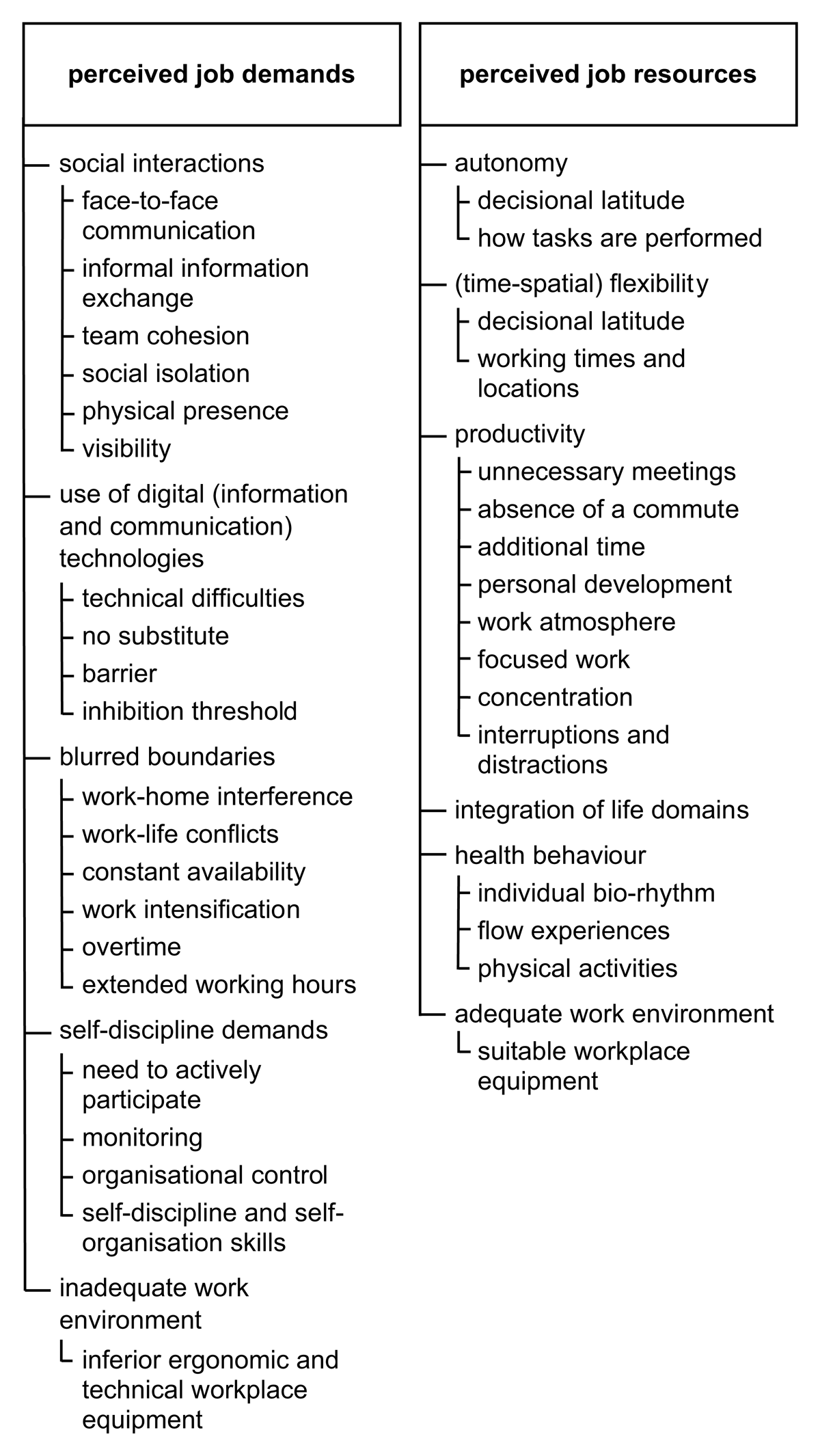
Figure 1
Perceived job demands and job resources while working from home.
Perceived job demands while working from home
Concerning job demands, five main factors were identified that employees perceived as challenging: (1) social interactions, (2) use of digital technologies, (3) blurred boundaries, (4) self-discipline demands, and (5) inadequate work environment. The interviews revealed that the participants experienced a lack of (1) social interactions with other organisational members when working from home compared to office workdays (e.g., I1, I3, I4, I7, I8, I19, I20, I21). Employees emphasised missing face-to-face communication and the accompanying informal information exchange, which contributes to a sense of team cohesion: ‘The big advantage of being in the office is that you can also interact informally with your team. That’s missing when working from home. And I think that’s important, just to have a sense of community as a team.’ (I6 – male, 29 years)
Although the interview participants stated that digital team meetings generally function well in their daily work routines, several employees noted that reduced on-site presence limits creativity and can make it more challenging to connect with colleagues and supervisors, sometimes resulting in feelings of social isolation (e.g., I1, I3, I4, I7, I14). One employee additionally pointed out that working off-site diminishes physical presence and, consequently, visibility within the organisation, which he perceives as ‘detrimental to career development’ (I17). Furthermore, employees holding leadership positions mentioned that it can be challenging to influence followers while working from home, without giving the impression of exercising organisational control (e.g., I5, I13, I20, I22).
Regarding (2) the use of digital technologies, some participants reported encountering technical difficulties, often manifesting as disrupted communication when working from home (e.g., I1, I3, I8, I9, I10, I12, I17, I19). Although the use of ICT enables regular social exchanges, employees stressed that virtual team meetings cannot substitute for spontaneous in-person interactions. Furthermore, some employees perceived a greater barrier to reaching out to supervisors or colleagues via ICT when working from home compared to being in the office (e.g., I3, I6, I7, I8, I17, I18). Employees with less remote work experience and who described themselves as introverted reported a higher inhibition threshold for initiating social interactions at work when relying on ICT for communication: ‘If I want to ask someone a quick question, the barrier is simply higher. And yes, it becomes almost like a small, artificial hurdle to pick up the phone instead of just sending an email.’ (I14 – male, 29 years)
The interviews further revealed that participants perceived (3) blurred boundaries between work and private domains as challenging when working from home (e.g., I3, I4, I7, I9, I12, I15, I21, I22). Along with feelings of constant availability, they reported struggling with work-life conflicts and work-home interference. In contrast, employees noted that office workdays allowed for a clearer separation between work and private time, facilitated by physically transitioning from the office to their home environment:
‘The workday ends naturally because you, well, drive home. But in the home office, it’s different because, since you’re working from home, you’re always kind of checking in here and there, right? You might read an email or write something here and there.’ (I17 – male, 24 years)
The same employee further outlined that the absence of work-life boundaries on home office days caused him to experience work intensification, with overtime and extended working hours becoming more common (I17).
Talking about the challenges of working from home, employees further mentioned increased (4) self-discipline demands (e.g., I3, I5, I7, I8, I9, I10, I15). They specifically described a greater need to actively participate in planning, structuring, and designing their workday. Along with this, some employees pointed out that the reduced monitoring and organisational control when working from home pose new challenges, requiring enhanced self-discipline and self-organisation skills (e.g., I2, I9, I10): ‘You have to create the right [work] environment. In the office, that decision is somewhat taken out of your hands.’ (I18 – male, 24 years)
Finally, several employees reported an (5) inadequate work environment when working from home (e.g., I3, I4, I7, I9, I10, I11). For instance, this occurred when they did not have a dedicated workspace but worked in their kitchen or living room instead, with inferior ergonomic and technical workplace equipment. Under these conditions, employees also indicated experiencing stronger work-life conflicts.
Perceived job resources while working from home
Concerning job resources, six main factors were identified that employees perceived as beneficial: (1) autonomy, (2) (time-spatial) flexibility, (3) productivity, (4) integration of life domains, (5) health behaviour, and (6) adequate work environment. The interviewees emphasised experiencing increased (1) autonomy and (2) (time-spatial) flexibility on days working from home (e.g., I1, I3, I9, I12, I16, I20, I21). This applies not only to decisional latitude regarding working times and locations but also to how tasks are performed: ‘When working from home, I have complete freedom over how I work and when I work.’ (I8 – female, 28 years)
Employees without care obligations stated that they associate working from home with increased (3) productivity (e.g., I1, I2, I6, I9, I10, I14, I17). They attributed this to the elimination of unnecessary meetings and the absence of a commute, highlighting the additional time available to invest in activities such as personal skill development. Compared to working in the office, they also described a more favourable work atmosphere at home (e.g., I5, I8, I11, I16). Fewer interruptions from colleagues were perceived as enabling more focused and concentrated work, thereby reinforcing the sense of increased productivity on home office days:
‘At home, I’m more productive because I have fewer distractions. When I work from home, I don’t have interruptions or disturbances from others. […] That’s why at home, I can concentrate better and generally accomplish more.’ (I6 – male, 29 years, no care obligations)
However, employees with childcare responsibilities in their households expressed a contrasting view, reporting even more interruptions and distractions from their private environment when working from home compared to working on-site (e.g., I19, I20, I21, I22). Nevertheless, some interview participants highlighted better (4) integration of life domains on home office days (e.g., I4, I7, I8, I12, I15):
‘Working from home allows me to integrate it more with my life outside of work. It helps me integrate my life as a whole, and that just makes everything much better overall. It simply makes work as a whole better.’ (I18 – male, 24 years)
In addition, the interviews revealed several aspects of working from home that employees perceived as beneficial for their (5) health behaviour. For example, the opportunity to engage in physical activities during breaks was mentioned as contributing to a positive perception of health (e.g., I4, I9, I18). Employees also emphasised that the flexibility to determine their working hours allowed them to align their work with their individual bio-rhythms, fostering flow experiences. Some participants reported being most productive early in the morning (e.g., I5, I20), while others preferred working later into the evening or at night (e.g., I17, I18): ‘For me, it’s also the case that I tend to work a bit more independently in the home office. And then I get into a workflow.’ (I18 – male, 24 years)
Finally, some employees identified an (6) adequate work environment as a benefit of working from home, valuing the ability to tailor their workplace equipment to individual preferences (e.g., I5, I8, I15, I16, I22).
Job crafting behaviours targeting perceived job characteristics (RQ2)
Figure 2 provides an overview of the categories identified in interviewees’ responses regarding the types of job crafting they apply to shape their job demands and job resources while working from home.
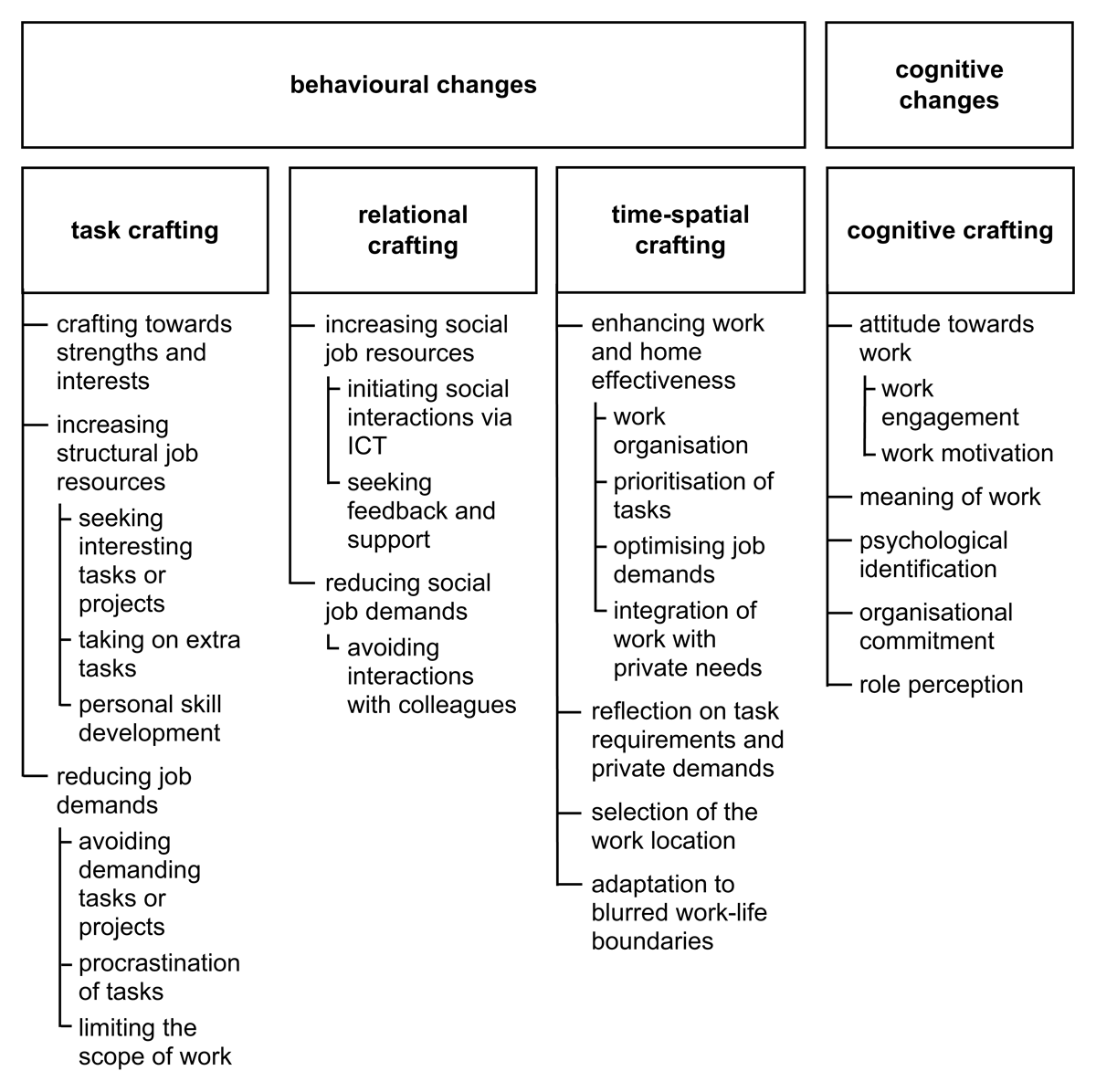
Figure 2
Types of job crafting while working from home.
Four main types of job crafting targeting perceived job characteristics were identified, including (1) task crafting, (2) relational crafting, (3) time-spatial crafting, and (4) cognitive crafting.
Referring to behavioural changes, the interviews revealed that employees engaged in various (1) task crafting strategies on home office days. Based on perceptions of increased autonomy and flexibility as key job resources, employees reported shaping their tasks to align with individual strengths and interests, as well as increasing structural job resources (e.g., I6, I9, I10, I14, I18). Younger employees with career ambitions noted that the additional time saved by eliminating a daily commute encouraged them to pursue interesting projects or engage in activities for personal skill development (e.g., I2, I9, I10, I14, I15). In contrast, especially those employees nearing the end of their careers or of older age indicated that working from home facilitates reducing job demands, such as avoiding uninteresting or overly challenging tasks (e.g., I12, I19). Related to perceptions of lower organisational control and monitoring, one employee also mentioned that it felt easier to procrastinate on tasks or limit the scope of work: ‘When I have more or less finished my work-related tasks, I tend to drift a bit into private matters.’ (I12 – male, 57 years)
Concerning (2) relational crafting, the interview participants emphasised that the lack of face-to-face communication and informal information exchange as key job demands of working from home stimulated them to increase social job resources (e.g., I1, I2, I7, I8, I9, I19, I20, I21). For instance, employees highlighted actively initiating social interactions with favoured colleagues and seeking feedback from supervisors via ICT. Others reported reducing social job demands by deliberately avoiding interactions with less-favoured colleagues. They also noted that the social isolation when working from home made it easier to avoid social interactions with team members they found less enjoyable to work with (e.g., I1, I6, I7, I8, I9, I12). However, linked to the greater barrier to initiating contact via ICT, employees indicated that they perceived increasing social job resources as more challenging: ‘You have to invest more effort into interpersonal relationships when working from home. Because you have to specifically arrange to meet for a coffee that you then drink together virtually. Those natural encounters just aren’t there.’ (I8 – female, 28 years)
Moreover, the interviews suggest that personality can shape experiences with crafting towards individual strengths. Employees describing themselves as extraverted found it more difficult to leverage their communicative strengths when working from home:
‘I am someone who can market and present myself much better in person, I think. Personally, I believe I come across better in face-to-face interactions than in video calls or phone conferences. Because I think body language, facial expressions, and gestures make a big difference. So, in that regard, I would say it’s a bit harder to convey yourself and who you are as a person in the home office.’ (I17 – male, 24 years)
In contrast, employees describing themselves as introverted appreciated the opportunity to concentrate on strategic tasks in a more undisturbed manner at home, allowing them to unfold their strengths in logical thinking and deeply focused working (e.g., I6, I14).
Next, the interviews revealed several (3) time-spatial crafting behaviours that employees engage in, thereby addressing additional job demands consisting of blurred work-life boundaries (e.g., I2, I5, I10, I13, I15, I16). Based on perceptions of increased autonomy, time-spatial flexibility, and a better work atmosphere as job resources, employees mentioned prioritising tasks and optimising job demands (e.g., blocking focus time slots in their calendars). Enhancing effectiveness both at work and home, this approach to work organisation contributed to the integration of work with private needs (e.g., starting work early to accommodate private commitments in the afternoon). Employees further reported reflecting on their task requirements and, based on this, actively selecting the work location best suited for their daily tasks and private needs or vice versa (e.g., I2, I5, I13, I14, I16, I17). This enabled them to optimise the handling of job demands, such as reducing external interruptions in the office when focusing on tasks that require concentration:
‘Since I can work more focused at home, I tend to schedule meetings on office days whenever possible, because I know I don’t make as much progress with tasks that require a lot of concentration. So, I generally do tasks that require focus and thought from home, if that’s possible.’ (I6 – male, 29 years)
In terms of adaptation processes, the gradual adjustment to the perceived absence of clear boundaries between work and private domains was mentioned: ‘There are hardly any boundaries between work and leisure. If you’re aware of this, you can actively shape it and try to deal with it accordingly.’ (I5 – male, 55 years, manager)
Referring to instances of (4) cognitive crafting, the interview participants indicated that the characteristics of working from home influence their cognitive interpretations of their work and work roles. They expressed that the opportunity to work from home positively influenced their overall perception of their jobs. In some cases, this positive attitude towards work led to perceptions of higher work engagement and work motivation (e.g., I2, I13, I16). However, several employees also reported that the partial isolation while working from home led them to reassess and change the meaning of work, with work taking a lower priority in their lives (e.g., I1, I18, I19, I20, I21). Along with this, they mentioned experiencing less psychological identification with and, in turn, reduced commitment to their organisation: ‘On the one hand, it can lead to feeling less identified with the company and one’s own team. On the other hand, I can also imagine that because working [from home] becomes more enjoyable, one develops a more positive evaluation.’ (I6 – male, 29 years)
Finally, some employees mentioned occasionally viewing their own role within the organisation differently, feeling interchangeable or replaceable (e.g., I4, I12, I19). As a result, they noticed a change in their individual role perception while working from home.
Patterns of interrelationships among job characteristics and job crafting behaviours
Analysing the interview data further revealed several patterns linking subjective perceptions of existing job characteristics to specific job crafting strategies when working from home, depending on certain (1) personal factors and (2) boundary conditions (see Figure 3 for an overarching process model).
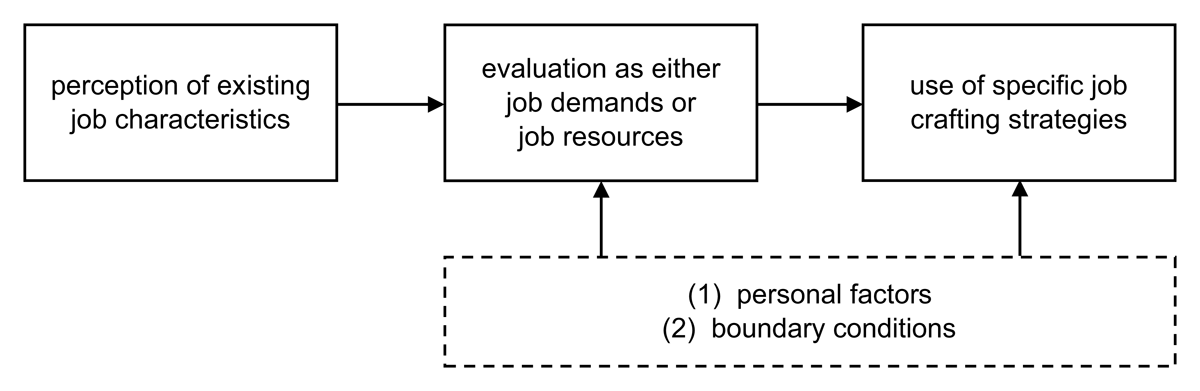
Figure 3
Overarching process model.
As illustrated in Figure 3, the perception of existing job characteristics is followed by their evaluation as either demands or resources, which subsequently informs the use of specific job crafting strategies. Both the evaluation of job characteristics and related job crafting strategies are shaped by personal factors and boundary conditions. The derived interrelationships are of a purely qualitative nature and should not be interpreted as evidence of causal effects.
Concerning (1) personal factors, three main patterns could be identified. The first pattern emerges from participants’ age and career stage, with employees of younger age and/or with career ambitions or managerial responsibility perceiving fewer social interactions with colleagues as a key job demand. Related to this perception, they shifted their focus to the crafting strategies of increasing social and structural job resources when working from home (e.g., I5, I14, I15). In contrast, older employees nearing the end of their careers highlighted lower organisational monitoring as a key benefit of working from home, prompting them to decrease hindering job demands rather than engage in increasing social and structural job resources (e.g., I12, I19).
The second pattern arises from employees’ self-descriptions of their personality. Extraverted employees who perceived the lack of social interactions when working from home as a job demand tended to increase social job resources via ICT (e.g., I17). Introverted employees, however, found it challenging to initiate social interactions due to higher inhibition thresholds in ICT-mediated communication. Instead of increasing social job resources, they sought to reduce social job demands by avoiding interactions with less favoured colleagues and focused on increasing structural job resources (e.g., I6, I14).
A third pattern refers to employees’ personal resources. Employees with lower self-discipline competencies perceived the increased autonomy when working from home as an additional job demand. Related to this, they perceived the increase of social or structural job resources as particularly challenging when working from home, which led them to focus on decreasing hindering job demands (e.g., I4). By contrast, employees with strong self-organisation skills evaluated the increased autonomy as a job resource, having sufficient personal resources to actively engage in various crafting strategies when working from home, including task crafting, increasing social and structural job resources, and optimising job demands (e.g., I5).
Concerning (2) boundary conditions, situational constraints in the home environment shaped how employees evaluated their job demands and job resources, as well as how they crafted in response. Specifically, employees with care obligations and/or an inadequate home environment highlighted lower productivity due to increased work-home interference when working from home, leading them to focus less on increasing social and structural job resources. Instead, they used the increased autonomy and flexibility to engage in time-spatial crafting, enabling them to better manage blurred boundaries between work and private life (e.g., I21). Conversely, employees without care obligations and/or with suitable home environments highlighted fewer interruptions and higher productivity when working from home, which encouraged them to adopt various crafting strategies, including task crafting, increasing social and structural job resources, and optimising job demands (e.g., I8).
Discussion
Our study explored how employees’ perceptions of job-related demands and resources are linked to their job crafting behaviours when working from home in hybrid settings. The qualitative results revealed variations in the subjective evaluation of job characteristics and the related use of job crafting strategies, depending on certain personal factors and boundary conditions. Our findings offer contributions to the JD-R literature and the literature on job crafting in working-from-home settings, which we discuss in the following.
Contributions to research
First, we enrich the JD-R framework (Demerouti & Bakker 2023) by shedding light on a variety of job characteristics that employees perceive when working from home. While altered social interactions and blurred work-life boundaries were identified as key job demands, greater decisional latitude associated with higher autonomy and time-spatial flexibility was identified as a key job resource. These results confirm previous research findings during and shortly after the pandemic (e.g., Brandt & Süß 2024; Rohwer et al. 2024). However, the pandemic represented a major stressful crisis with a forced shift to remote work, whereas hybrid work arrangements provide employees with higher decisional latitude regarding working times and places, but also increase the need to actively participate in their own job design. While our results confirm central advantages and disadvantages of working from home identified in earlier studies (e.g., Stempel & Siestrup 2022), we expand on these findings by capturing a range of working-from-home characteristics in the post-pandemic context. We further contribute to an ongoing theoretical debate on whether the absence of a job demand can be considered a job resource and vice versa (Bakker & Demerouti 2017). In particular, our findings support the idea that the lack of certain demands can function as a resource, while the absence of specific resources can be perceived as a demand when working from home (Stempel & Siestrup 2022). For instance, our results indicate that employees can perceive the reduction of specific resources (e.g., limited social interactions) as detrimental, while the absence of certain demands (e.g., fewer interruptions by others) can be perceived as beneficial.
Taking this further, by shedding light on interrelationships among job characteristics and job crafting behaviours, our findings offer nuanced insights into how perceptions of job demands and resources are related to the use of crafting strategies when working from home. In this vein, recent research conceptualises job crafting as a resource-building process (Costantini & Weintraub 2022), proposing that employees proactively shape their jobs to manage additional non-work demands and address the potential loss of social job resources associated with working from home (e.g., Ingusci et al. 2021; Kerksieck et al. 2022; Liu et al. 2021). Our findings support this proposition, demonstrating that employees’ crafting from home corresponds to both role-based (Berg et al. 2010) and resource-based (Tims et al. 2012) job crafting conceptualisations. This reinforces the idea that employees combine diverse crafting strategies (Mäkikangas 2018) to cope with their perceived job demands and acquire or conserve valuable job resources.
Specifically, our results demonstrate that an increase in central job resources, such as autonomy (Dettmers & Bredehöft 2020), stimulates role- and resource-based job crafting by encouraging employees to align their tasks with personal interests and seek structural job resources. At the same time, other crafting behaviours arise in response to specific job demands, such as seeking social job resources to counteract the lack of social interactions (Liu et al. 2021). These findings underline that the design of work processes relying on social interactions holds high importance when working from home (Demerouti & Bakker 2023). The relevance of addressing context-specific job demands might further explain why the participants in our study focused on increasing their social and structural job resources rather than increasing challenging job demands, which may be less urgent when working from home. Additionally, some employees reported optimising context-specific job demands by finding strategies to better manage blurred work-life boundaries. Whereas reducing hindering demands aims to minimise the emotional, physical, or cognitive intensity of work (Tims et al. 2012), optimising demands focuses on removing obstacles and simplifying work procedures to enhance efficiency (Demerouti & Peeters 2018). Our results imply that the crafting strategy of optimising job demands is particularly valuable to manage additional non-work demands when working from home (Costantini et al. 2021; Seinsche et al. 2023).
Our findings also provide empirical support for the concept of time-spatial crafting (Wessels et al. 2019). Targeting the integration of work and private needs in hybrid work, employees reflected on the available demands and resources of different work locations, tasks, and private needs. Based on this reflection, they actively selected the best time and place to work on a given task and given personal demands. However, adaptation processes were less prominent in our study, as employees mainly mentioned getting used to blurred work-life boundaries. This aligns with previous findings related to the public service sector (Seinsche et al. 2023), suggesting that the opportunity to choose a suitable work location and engage in strategies for optimising job demands may already facilitate better time-spatial demands fit, reducing the need for further adaptation in hybrid settings.
However, enhancing the understanding of job crafting in hybrid work contexts, our findings highlight the need to consider individual differences and the role of subjectivity in evaluating working-from-home characteristics. For instance, despite the generally positive perception of job autonomy as a central job resource in hybrid work (Metselaar et al. 2022), our study supports the notion that high autonomy in terms of how, when, and where to work can also have potential downsides (Dettmers & Bredehöft 2020). Several interviewees reported a greater need to actively participate in shaping their jobs when working from home, emphasising the demanding role of enhanced self-discipline to stay productive at work. Based on this, a work environment characterised by high autonomy may come with additional effort, resulting in the need for employees to proactively design their job characteristics because otherwise, they would not be able to maintain efficiency (Dettmers & Bredehöft 2020). This implies that for some employees but not others, the opportunity to design their own jobs may represent an additional job demand rather than a job resource and further indicates that the impact of high autonomy may depend on employees’ ability to self-organise on days with little external structure.
Based on the identified patterns linking job characteristics to job crafting, our study further adds knowledge on the relevance of personal factors and boundary conditions that can influence how employees evaluate and craft their job demands and job resources from home. In this vein, our findings emphasise that the classification of job characteristics as demands or resources is influenced by personal factors (age, career stage, personality, personal resources) and situational conditions (care obligations, home environment), underscoring the flexibility of job characteristics within the JD-R theory (Bakker & Demerouti 2017; Jaß et al. 2024). As our results demonstrate, these variations in perceived job characteristics can in turn shape the use of specific crafting behaviours, contributing to the literature on job crafting antecedents (Bindl et al. 2019). For instance, younger employees working in a suitable home environment perceive enhanced productivity due to fewer external interruptions and tend to use this favourable work atmosphere to engage in job crafting strategies that foster personal skill development and career advancement. This pattern is consistent with recent research highlighting differences in the prevalence of job crafting between younger and older workers (Schepp & Boehm 2025). By contrast, other employees primarily use job crafting as a strategy for managing challenges – for example, those with childcare responsibilities who experience reduced productivity due to home-related interruptions and therefore focus on time-spatial crafting to better balance additional non-work demands.
In this vein, our results add to the JD-R framework in times of crises (Demerouti & Bakker 2023) by suggesting that working from home increases the importance of personal resources in addressing context-specific job demands. These personal resources may include competencies such as the ability to plan and organise tasks, schedule work time in alignment with both task and private requirements, and intentionally create space for recovery and leisure. According to the JD-R theory’s buffering hypothesis, resources can help cope with job demands (Bakker & Demerouti 2017; Xanthopoulou et al. 2007). As our findings indicate that employees’ perceptions and crafting of job characteristics are shaped by their personal resources, strengthening these resources may be particularly useful for employees dealing with the challenges of working from home (Wang et al. 2021).
Lastly, our study contributes to the growing literature on hybrid work designs and their influence on employees’ perceptions and proactive approaches to job redesign (Demerouti 2025). Our findings demonstrate that perceptions of job characteristics across different work locations are highly individual, emphasising the importance of personal circumstances in shaping employees’ preferences for a work location in hybrid settings. Consistent with research showing that decisions to work in the office or from home depend on the fit between individual factors and specific characteristics of each work location (Appel-Meulenbroek et al. 2022), our results suggest that employees who can maintain focus despite potential private distractions are more likely to perceive working from home as mainly positive. In contrast, employees who need a structured work environment with clear work-life boundaries may prefer working in the office in order to maintain productivity.
Interestingly, we also found that some job crafting strategies are facilitated when working from home, while others can be perceived as challenging, which appears to depend on their promotion- or prevention-focus (Lichtenthaler & Fischbach 2019). In particular, our findings suggest that promotion-focused job crafting (e.g., increasing social job resources by seeking feedback) may be more difficult to implement when working from home. Away from the office, employees might perceive fewer opportunities to increase their social job resources and must rely on ICT rather than directly approaching colleagues who are physically nearby. By contrast, prevention-focused job crafting (e.g., decreasing hindering job demands) may be facilitated in working-from-home situations, possibly because employees experience less organisational monitoring when attempting to reduce demands. This may also explain why increasing challenging job demands was less prominent, indicating that employees adapt their crafting strategies to the characteristics of different work locations (Randel et al. 2024).
Finally, our study reveals that experiences with job crafting in hybrid work settings can be shaped by employees’ personalities (Bakker et al. 2023), with specific traits either facilitating or constraining job crafting when working from home. Besides the fact that increasing social job demands through ICT cannot fully replace in-person interactions and associated creative work processes, employees describing themselves as extraverted may struggle to fully leverage their communicative strengths outside the formal office. Conversely, introverted employees may benefit from the opportunity to focus on strategic tasks in a less distracting environment, allowing them to align their work with individual strengths in logical thinking. In sum, these findings offer a deeper understanding of how job crafting in the context of working from home can be influenced by individual differences and situational conditions.
Limitations and directions for future research
When interpreting the results of this study, certain limitations have to be considered. First, the qualitative design inherently involves constraints, such as the limited breadth of perspectives due to the sample size (n = 22) and a potential selection bias, as the interviewees volunteered for the study. In addition, we could not establish causality. However, as this is not the aim of qualitative research, future quantitative studies should consider applying longitudinal designs to examine the causal relationships between job characteristics and crafting behaviours over time. Experience sampling methods could be used to examine the impact of different work locations on employees’ job crafting strategies and their relation to other influencing factors (e.g., personal resources) and outcomes (e.g., work engagement).
Second, our study has limitations related to the homogeneous sample characteristics. The participants were exclusively German employees and primarily came from knowledge-intensive industries, with 86.36% holding a university degree. In Western Europe, working from home is predominantly undertaken by knowledge workers, who are generally highly educated. This homogeneity may limit the generalisability and transferability of our findings to other occupational groups. To capture a broader range of experiences and perspectives, future studies should include more diverse samples with regard to cultural background, educational level, professions, and age. It is important to note, however, that the aim of qualitative research is to gain in-depth insights into the phenomenon under study rather than to generalise the results to a larger population.
Third, personality traits were not quantitatively assessed in our study. Any conclusions regarding the potential influence of extraversion versus introversion are based solely on participants’ self-descriptions and should be interpreted with caution. As our qualitative findings suggest that personality is a relevant personal factor, future quantitative studies could further investigate how different personality traits shape experiences with job characteristics and job crafting.
Beyond this, given the interrelatedness of work and non-work domains in hybrid work, future studies could employ qualitative or quantitative methods to gain a deeper understanding of individuals’ differential work- and home-related needs and preferences (de Bloom et al. 2020). Investigating the interplay between crafting at work and home could further provide valuable insights into how employees manage the interconnected demands and resources of their professional and personal lives.
Conclusion
This qualitative study enriches the job crafting literature by shedding light on employees’ subjective perceptions of job demands and job resources and their related job crafting behaviours when working from home. Our findings indicate that evaluations of job characteristics as either resources or demands vary depending on certain personal factors and boundary conditions. These variations, in turn, shape employees’ experiences with crafting behaviours, underlining the close link between subjective perceptions of job characteristics and the use of job crafting strategies in hybrid work.
Data Accessibility Statement
The datasets supporting the findings of this study are not publicly available because they contain information that could compromise participant privacy. As research participants did not consent to the full sharing of their data, the interview transcripts cannot be provided.
Additional File
The additional file for this article can be found as follows:
Competing Interests
The authors have no competing interests to declare.
Author Information
An earlier version of this work was presented at the 2023 Workshop of the Scientific Commission Personnel within the German Academic Association for Business Research in Berlin, Germany.