
Introduction
The rapid pace of technological advancements and changes in organizational structures has fundamentally reshaped the nature of work globally. For instance, the arrival of personal computers, computer networks, and the internet has significantly accelerated technological advancements, particularly in artificial intelligence (AI) and robotics (Norman 2017). These technological changes have inevitably been incorporated into work processes and have enabled unprecedented changes in the work environment, the quality of working conditions, and automation of tasks where employees work closely with machines (Liu, Wang & Lin 2024; Norman 2017). The future of work is experiencing a fundamental revolution. More so, the nature of work is changing. AI and automation are predicted to substitute human tasks and alter the skills and expertise that companies are looking for (Harayama et al. 2021). This has raised concerns related to technological changes, and whether their impact and interplay with other organizational factors will be perceived as positive or negative by employees on their work futures.
From the integration of AI and automation to the proliferation of remote and hybrid work models, these shifts are redefining how organizations operate and how employees engage with their work. All of this is happening at a time when the current AI and machine learning technologies seem to outperform humans in many areas (Van Der Aalst 2021). On one hand, the integration of AI and automation is transforming organizational operations by automating routine tasks, enhancing remote and hybrid work models, and creating new job opportunities. At the same time, some studies highlight that AI, particularly in human resource management, can enhance employee engagement, productivity, and job satisfaction by personalizing interactions, improving recruitment and training processes, and fostering a more supportive work environment (Gusti et al. 2024; Rožman, Oreški & Tominc 2022). On the other hand, these developments raise pressing concerns about job displacement, skills gaps, and ethical dilemmas (Frank et al. 2019; Olaniyi et al. 2024; Raisch & Fomina 2024).
This dual nature of technological change, which offers both opportunities and challenges, underscores the importance of investigating employees’ concerns about the future of work. However, these concerns about technological changes, such as fears of job insecurity, feelings of alienation, and the pressure to constantly reskill, are not isolated issues; rather, they are interconnected such that, as a system, they shape how individuals perceive and respond to organizational changes (Jarrahi 2018; Santoni de Sio, Almeida & van den Hoven 2021). For instance, concerns about increased automation may amplify feelings of isolation if employees anticipate working more independently or with less human interaction (Rožman, Oreški & Tominc 2022). Similarly, the pressure to adapt to new technologies can heighten perceptions of job demands, especially in environments with limited support or unclear expectations (Frank et al. 2019; Kellogg, Valentine & Christin 2020). These concerns are also closely tied to broader organizational factors, including the quality of the work environment, opportunities for learning and development, perceived support, and flexibility in work arrangements (Parent-Rocheleau & Parker 2022). Analyzing how these concerns interact, both with each other and with organizational conditions, can help organizations identify which aspects of the work environment exacerbate or mitigate work and health outcomes, and which promote adaptation and innovation (Hu, Oh & Agolli 2025; Parker & Grote 2022).
Norway, as a technologically advanced and progressive nation, provides a unique context to study the future of work. Norway’s work environment, shaped by the Nordic Model, features strong employee protections, collaborative cultures, and widespread technology adoption, fostering equitable labor practices and workforce inclusion (Dølvik & Steen 2018). Technological advancements are accelerating rapidly, influencing Norwegian employees’ views on the future of work through the opportunities and challenges presented by AI, robotics, and automation (Lloyd & Payne 2019; Teufer et al. 2020). These perceptions are deeply intertwined with factors such as organizational work environment, broader working conditions, and work demands, all of which are critical for shaping innovation and addressing concerns related to the current and future technological changes.
This study aims to explore employee concerns related to technological changes in the future work environment, with a specific focus on the Norwegian work environment context. To achieve this, we used a novel statistical approach—psychological network analysis—to examine mutual associations between five technological concerns in future work, to empirically determine and provide specific information about how the five different technological concerns mutually interact and reinforce each other. For instance, the concerns about working in isolation or individualized work can influence concerns about the feeling of alienation in the workplace, and vice versa. With the psychological network analysis approach, it is also possible to explore how multiple constructs interact in a system of complex or combined networks. For example, it is possible to explore how different concerns related to technological changes in future work are related to other organizational work factors in another network community, such as network communities of organizational work factors (organizational environment, conditions, and demands), through so-called bridge connections.
In this way, it is possible to identify important associations between specific concerns related to technological changes in future work and organizational work factors. Understanding the connections between technological concerns and organizational work factors is crucial for proactively managing their impact on the future of work. This knowledge enables us to “shape the future, rather than let the future shape us” as suggested by the Berkeley Interdisciplinary Center for Healthy Workplaces (ICHW 2025). We thus explored how five technological concerns about the future of work are associated with three relevant organizational work factors (organizational work environment, conditions, and demands). In so doing, we contribute to understanding the role and influence of technological concerns in shaping perceptions of workplace innovation and its potential impact on future work organization.
Building on a Delphi study that identified key challenges and opportunities in the Nordic work environment (Christensen et al. 2021), the present study focuses its network analysis on psychologically relevant variables and relationships. By aligning with the specific context of Nordic working conditions and occupational health, this study ensures that its findings address issues of practical and policy significance. To the best of our knowledge, this study is the first to explore the mutual associations between various concerns related to technological changes and the future of work, while empirically identifying the most central aspects of technological concerns through network analysis. Additionally, it is the first study to determine which concerns related to technological changes and the future of work correlate most or least strongly with organizational work factors estimated in a combined network.
The study addressed two research questions. (1) What is the most significant technological concern regarding the future of work among a sample of employees in Norway? and (2) Which technological concern(s) are most strongly or weakly associated with organizational work environment, conditions, and demands? Due to the exploratory nature of network analysis, we adopted an atheoretical approach and made no specific hypotheses. This paper is structured as follows. First, we present our methodology, including the use of psychological network analysis. Second, we discuss the results of the network analysis, highlighting the centrality of technological concerns and their bridging role in a combined network. Finally, we conclude with practical implications and recommendations for organizations and policymakers to foster innovation and employee well-being in the future workplace.
Methods
Participants and procedure
This cross-sectional survey was administered to a panel of Norwegian employees by a market research company. Participants were recruited from the market research company’s existing panel of individuals residing in Norway who were currently employed. Inclusion criteria were that participants must be currently employed, live in Norway, and be 18 years or older. Efforts were made to match the sample to the known distributions in the Norwegian population of working individuals regarding age (18–49 = 52% and ≥50 = 48%), gender (male, 51%, female, 49%), education level (primary/secondary = 40%, university level = 60%), and sector of employment (public = 43%, private = 57%). The survey was administered online, with participants completing the questionnaire at a time convenient for them. A total of n = 441 individuals responded to the survey. The data were collected in October 2024 and subsequently anonymized before being shared with the researchers.
Ethical considerations
Respondents gave informed consent by accepting the voluntary nature of participation before the online survey commenced and were free to cease participation at any time. Due to online anonymity and a limited set of background information, the researchers could not identify who was responding to the survey. The project, therefore, followed the requirements of the Norwegian Centre for Research Data (NSD).
Delphi study
The instruments used in this study were derived from a three-round Delphi study conducted in Norway and Denmark to forecast future challenges and opportunities in the Nordic work environment over the next 10–15 years (Christensen et al. 2021). The Delphi study surveyed experts from various backgrounds using open-ended questions in the first round, then structured the responses into seven key drivers of change: technology, demography, globalization, environment, skills/competence, political/social/cultural developments, and other statements. In subsequent rounds, Delphi participants rated approximately 220 statements on agreement, likely impact, and likelihood of occurrence of events in the statements. They identified potential benefits and risks tied to emerging trends, leading to conclusions that informed future action plans for various stakeholder groups (Christensen et al. 2021).
For this study, six work and organizational psychology experts evaluated the 220 statements generated from the Delphi study in 2021, eliminating overlaps and unclear items. Only statements unanimously highlighted by all experts were retained, supplemented by one item on lifelong learning from the literature, resulting in 43 final statements (see Supplementary file; Table 1). This study focused not only on technology and the work environment but also included items on demography, globalization, new work arrangements, skills, political/social/cultural developments, and other factors deemed relevant. After two rounds of discussions, disagreements were resolved, and consensus items were included, reflecting the complex interplay of technological, demographic, global, environmental, and social factors shaping the future of work.
Instruments
Technological concerns (5 items) explored how employees perceive the impact of technology on their work (e.g., Technology will, to a great extent, determine the organization of work). Organizational work environment (14 items) assessed the psychosocial aspects of the work environment, focusing on stress, health, and job-related factors (e.g., There will be increased work pressure and time pressure). Organizational work conditions (13 items) focused on the practical aspects of the work environment, including questions on working hours and time-related boundarylessness (e.g., Employees will experience increased demands for flexibility and adaptability, for example, regarding working hours). Organizational work demands (11 items) focused on the demands placed on employees, including skill requirements and efficiency pressures (e.g., More tasks will need to be solved with fewer resources). All survey questionnaire items in this study used a 5-point Likert scale ranging from “Strongly disagree (1)” to “Strongly agree (5)” as response options.
Statistical analyses
Statistical analyses were performed in RStudio (R Core Team 2024). Items extracted from the Delphi method were submitted to exploratory factor analysis (EFA) to define and validate acceptable measurement models of the three organizational work factors (organizational work environment, conditions, and demands) before estimating the network models. This data reduction approach ensured precise operationalization and construct definitions. The sample data were split into two halves: Sample 1 (n = 172) was used for EFA, and the hold-out Sample 2 (n = 269) was used for confirmatory factor analysis and network modeling. The following guidelines were used for item and factor selection, including Kaiser–Guttman eigenvalues greater than 1, scree plot test, and parallel analysis. Before performing the EFA, the items’ correlation matrix was inspected, and the assumptions of sampling adequacy were investigated. The EFA was performed using principal factor solution with the fa function in the psych package (Revelle 2022). Missing data in Sample 1 ranged between 4.6% and 6% and were therefore neither replaced nor imputed.
Measurement models obtained from the EFA using Sample 1 were validated in Sample 2 to confirm the underlying factor structures using the cfa function in the lavaan package (Rosseel 2012). Missing data in Sample 2 ranged between 2.2% and 4.8% and were therefore neither replaced nor imputed since the full information maximum likelihood method for handling missing data is commonly applied in CFA models. The CFA model fit was evaluated using multiple indices. A standardized root mean square residual (SRMR) value less than 0.08 was considered indicative of acceptable fit (Browne & Cudeck 1993; Hu & Bentler 1999). Root mean square error of approximation (RMSEA) values less than or equal to 0.06 were interpreted as indicating close fit, with values up to 0.08 reflecting acceptable fit, particularly when the upper bound of the 90% confidence interval was close to or below 0.08 (Hu & Bentler 1999). Comparative fit index (CFI) and Tucker–Lewis index (TLI) values greater than 0.90 were considered adequate fit, and greater than 0.95 were taken to indicate excellent model fit (Hu & Bentler 1999).
Having established precise operationalizations and construct definitions, we proceeded to estimate network models. Prior to estimating the combined network of technological concerns about the future of work, organizational work environment, conditions, and demands, we estimated a network model of only technological concerns in future work to understand how items of technological concerns about the future of work influence each other. Network components in this study were the questions measuring concerns related to technological changes in the future work environment, conditions, and demands referred to as nodes. Putative causal associations between nodes are referred to as edges (Borsboom & Cramer 2013; Epskamp, Borsboom & Fried 2018; Epskamp & Fried 2018). Statistically, edges represent partial correlations between two nodes, controlling for all the other nodes (Epskamp, Borsboom & Fried 2018; Epskamp & Fried 2018). A correlation matrix of the five technological concerns was computed and used as input to estimate a Gaussian graphical model (GGM), which estimates pairwise associations (Epskamp, Borsboom & Fried 2018). Graphical LASSO (i.e., Least Absolute Shrinkage and Selection Operator) was used to regularize parameters resulting from the GGM to avoid spurious connections. The graphical LASSO algorithm calculates the edges between nodes by computing partial correlations between them and then applying an L1 penalty to mask off smaller edges. This returns a sparse network consisting of only edges that are likely to be observed above chance. The network was estimated using qgraph (Epskamp et al. 2012), glasso (Friedman, Hastie & Tibshirani 2019), and bootnet (Epskamp, Borsboom & Fried 2018).
The stability of the network model was assessed using correlation stability (CS) coefficients via the bootnet package (Epskamp, Borsboom & Fried 2018). The CS coefficient reflects the proportion of cases that can be dropped while retaining a correlation of ≥ 0.70 with the original centrality metrics (95% confidence interval [CI]). We used 1,000 case-dropping bootstraps and followed the recommended guidelines of CS ≥ 0.25 as acceptable, and > 0.50 as preferred for stable networks (Epskamp, Borsboom & Fried 2018). The expected influence (EI) metric was calculated to identify the most central technological concerns in the network. The EI is the sum of a node’s connections, weighted by their sign, reflecting both the strength and direction of its associations (Robinaugh, Millner & McNally 2016). Similar to the EI, we computed the bridge expected influence (BEI), which measures a node’s connections to nodes in other communities in the combined network model to identify “bridge nodes” linking technological concerns to organizational factors. Higher BEI indicates stronger bridging effects across communities. Further descriptions of the network analysis are contained in the Supplementary file.
Results
Exploratory Factor Analyses: Sample 1
Organizational work environment
Out of the 14 items assessing organizational work environment, two items were removed due to ambiguous item content. The Kaiser–Meyer–Olkin (KMO) verified the sampling adequacy for the analysis at KMO = 0.81, and individual KMO values, except for two items, were all above the threshold of ≥ 0.70 (Tabachnick & Fidell 2014). Bartlett’s test of sphericity indicated items were acceptably correlated for factorability, χ2(45) = 622.42, p < 0.001. One Eigenvalue (3.81) was greater than Kaiser’s criterion of 1. This was also consistent with the scree plot and parallel analysis (see Supplementary file; Figure S1A and Figure S1B). It explained 74% of the variance. Thus, in a final run requesting one factor (factor loadings: λ ≥ 0.50), six items whose factor loadings were above the cut-off were retained.
Organizational work conditions
The KMO verified the sampling adequacy for analysis of 13 items at KMO = 0.78, and individual KMO values, except for two items, were all above the threshold of ≥ 0.70 (Tabachnick & Fidell 2014). Bartlett’s test of sphericity indicated items were acceptably correlated for factorability, χ2(55) = 405.21, p < 0.001. One Eigenvalue greater than Kaiser’s criterion of 1 (i.e., 3.02) was observed and explained 71% of the variance. The scree plot test was ambiguous, as with parallel analyses (Supplementary file; Figure S2A and Figure S2B). We then requested a one-factor solution in a subsequent EFA. Seven items whose factor loadings were above the cut-off (λ ≥ 0.50) were retained.
Organizational work demands
The KMO verified the sampling adequacy for analysis of 11 items at KMO = 0.79, and individual KMO values, except for three items, were all above the threshold of ≥ 0.70 (Tabachnick & Fidell 2014). Bartlett’s test of sphericity indicated items were acceptably correlated for factorability, χ2(28) = 393.80, p < 0.001. One Eigenvalue greater than Kaiser’s criterion of 1 (i.e., 3.15), consistent with the scree plot and parallel analysis (Supplementary file; Figure S3A and Figure S3B), was observed and explained 77% of the variance. Thus, in a final run requesting one factor solution (λ ≥ 0.50), six items whose factor loadings were above the cut-off were retained.
Confirmatory factor analysis: Sample 2
The measurement model of organizational work environment indicated inadequate fit according to the RMSEA, but the CFI and TLI met the thresholds for adequate fit (χ2 = 37.56, df = 9, p < 0.001; SRMR = 0.05; RMSEA = 0.11 [90% CI = 0.08, 0.14]; CFI = 0.93; TLI = 0.93) with standardized pattern coefficients ranging between λ = 0.59 and 0.83. The model for organizational work conditions reached above adequate to excellent fit (χ2 = 18.79, df = 14, p = 0.173; SRMR = 0.04; RMSEA = 0.04 [90% CI = 0.00, 0.07]; CFI = 0.98; TLI = 0.97; λ = 0.32 to 0.67), as was the model for organizational work demands (χ2 = 12.52, df = 9, p = 0.185; SRMR = 0.04; RMSEA = 0.05 [90% CI = 0.00, 0.08]; CFI = 0.99; TLI = 0.98; λ = 0.55 to 0.73).
Network structure of technological concerns about the future of work
Figure 1A shows a visualization of the network structure of technological concerns about the future of work. Technological concerns about the future of work were positively related to each other. The network model highlighted the strongest connection between alienation and job insecurity, followed by alienation and solitary work, suggesting that employees who are concerned about technological structuring as a threat to job security are also more likely to be concerned about feeling alienated in the workplace. The feeling of alienation is also linked with concerns about working in isolation due to technological structuring in the future of work.
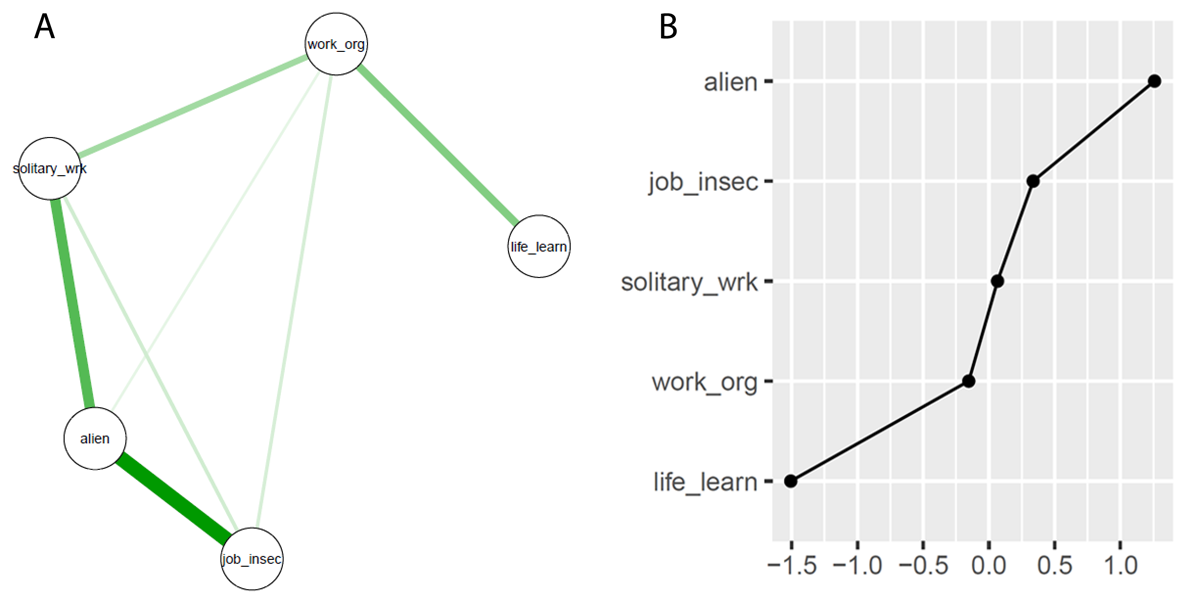
Figure 1
A: Regularized partial correlation network structure containing the five items of technological concerns for future work. Green lines represent positive partial correlations, while the thickness indicates strength of connection. B: Expected influence metrics for each item.
Work_org: Technology will, to a greater extent, determine the organization of work.
Life_learn: There will be a need for lifelong learning.
Job_insec: New technologies will lead job insecurity because tasks are taken over by machines and robots.
Alien: Employees will experience alienation from work because of automation and robotization.
Solitary_wrk: There will be more solitary work.
The next strongest connections were between concerns about work organization by technology and lifelong learning, and work organization by technology and solitary work. On the one hand, the network model suggests that employees’ concerns about work organization by technology in the future of work are linked with the need for continuous learning to adapt in the workplace. On the other hand, concerns about work organization by technology are also linked with increased working in isolation. Finally, the network model highlighted another interesting mediation relationship in which concerns about working in isolation were a mediator in the relationship between work organization by technology and the feeling of alienation due to technological structuring in the future of work.
Figure 1B illustrates estimates of the EI in the network model. Concerns about the feeling of alienation in the workplace showed the highest EI. This means that, feeling alienated due to technological structuring in the future of work organization was the biggest employees’ concern, which was also mostly associated with other technological concerns, whereas concerns about lifelong learning were the least connected in the network model. Figures S1A and S1B in the Supplementary file display stability analyses and centrality indices for the network model.
Combined network structure of technological concerns about the future of work, organizational work environment, conditions, and demands
A depiction of the combined network structure is contained in Figure 2A. Figure 2B shows the BEI values of technological concerns about the future of work with respect to organizational factors (work environment, conditions, and demands). The BEI plot illustrates how much different technological concerns (on the y-axis) bridge connections with different organizational factors based on their EI (x-axis), while accounting for all relationships in the combined network. Overall, technological concerns about the future of work showed much higher BEI on organizational work demands and environment communities than the organizational work conditions community. This implies that employees’ technological concerns about the future of work are strongly connected with employees’ perceptions of increased work demands and a less favorable work environment.
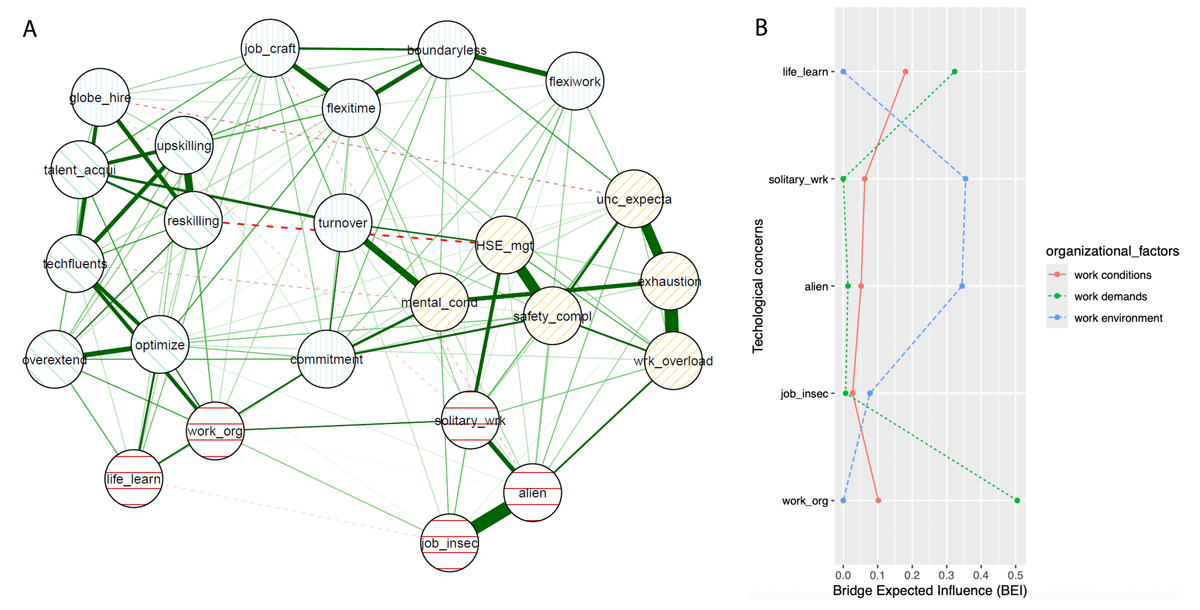
Figure 2
A: Regularized partial correlation network of technological concerns for future work, organizational work environment, conditions and demands. B: Bridge expected influence values for each item of technological concern for future work and their connections to organizational work environment, conditions, and demands. BEI = Bridge expected influence. Green and red lines in the network model represent positive and negative partial correlations, respectively, while the thickness indicates strength of connection. Solid and dotted lines represent significant and non-significant partial correlations.
Specifically, concerns about work organization by technology (0.50) and lifelong learning (0.32) showed the highest BEI in organizational work demands, respectively. This means that employees see work organization by technology and the need for continuous learning as closely tied to increased workload demands. Correspondingly, concerns about the need for continuous learning (0.18), followed by concerns about work organization by technology (0.10), showed the highest BEI values in relation to organizational work conditions, which dominated the organizational work environment. Furthermore, technological concerns about solitary work (0.35) and the feeling of alienation (0.34) dominated the organizational work environment. Thus, employees’ concerns about working in isolation and the feeling of alienation are tied to the effect on the work environment. Figures S2A and S2B in the Supplementary file display stability analysis and centrality indices for the combined network model.
Discussion
Over the past decades, rapid technological developments have not only redefined the tools and processes used within organizations but have also reshaped the work environment, conditions, and demands. Understanding the associations between these concerns related to technological changes and organizational factors is essential for identifying how employees perceive the evolving situation and make sense of their own and other people’s concerns about the future of work. This study, therefore, examined associations between five concerns related to technological changes about the future of work to determine how these factors mutually interact and reinforce each other, and how they are related to specific organizational factors such as organizational work environment, conditions, and demands. One of the key findings is that increased isolation due to technological structuring in the future of work is an important employee concern, which heightens feelings of alienation. This alienation acts as a mediator, linking solitary work to greater concerns about job insecurity. Another interesting finding from the study was that concerns related to technological changes in future work have a much stronger influence on organizational work demands and the workplace environment than on individual work conditions.
The interplay between technological concerns, alienation, and job insecurity underscores the importance of addressing employees’ need for belongingness, which is one of the basic psychological needs in the Self-Determination Theory (SDT; Deci & Ryan 2000). Previous studies discuss how technological disruptions can create one-way flexibility, shifting risks to employees and reducing their sense of engagement, security, and connection (Liu, Carminati & Wilderom 2025). Caselli, Fracasso and Marcolin (2024) show that employees’ perceptions of job insecurity are moderated by the quality of human resource strategies, including training and support systems, which are crucial for fostering belongingness.
The organizational work environment was dominated by employee concerns about solitary work and the feeling of alienation due to technological changes. This implies that employees’ concern about working in isolation and the feeling of alienation are tied to the effect of technology on the work environment. Previous studies have suggested that technological changes shape the work environment by affecting interpersonal relationships, organizational culture, and employees’ perceptions of fairness and inclusion, which can be a predictor of their feelings of alienation (Elliot & Arthur 2020).
Job insecurity was also a concern. For instance, the introduction of advanced technologies may lead to a division between employees with advanced digital skills and those who struggle to adapt, potentially creating an unequal work environment (Bessen 2019). Employees may also feel that technological changes are driven solely by prioritizing efficiency, cost-cutting, and optimization measures over employee well-being, which can erode commitment, trust in leadership, or health, safety, and environment (HSE) management. On the contrary, organizations that proactively implement technological changes through participatory decision-making, clear communication, and clear expectations from employees with robust training programs can foster a work environment that embraces innovation and improves role relations with minimal tech anxiety (Bailey et al. 2022; Barley 2020).
Within organizational work conditions, concerns related to technological changes were dominated by the need for continuous learning and work organization by technology. The dominance of continuous learning concerns in work conditions aligns with SDT, particularly the need for competence, as employees strive to adapt to technological changes through skill development (Deci & Ryan 2000). Correspondingly, the reshaping of working conditions, particularly the arrangement of remote or hybrid work models, is organized and facilitated by technological advancements, creating both opportunities and challenges. Previous studies have found that technological advancements make work more flexible in physical, virtual, social, and temporal aspects (Hesselbarth, Alfes & Festing 2024). However, this flexibility has blurred the boundaries between work and personal life, leading to concerns about work–life balance and increased pressure to be constantly available (Derks & Bakker 2014). Technology can not only improve efficiency and reduce physical strain (e.g., through ergonomic tools) but it can also create new challenges, such as increasing employees’ technostress and, subsequently, reducing job satisfaction (Bai et al. 2024). This implies that flexibility can be both a demand and a resource on the psychological need to be autonomous (Deci & Ryan 2000).
Organizational work demands were strongly associated with concerns of work organization by technology and lifelong learning due to technological changes. This suggests that employees see work organization by technology and the need for continuous learning as closely tied to increased workload demands. Previous studies have suggested that the rapid integration of new technologies in the workplace has led to significant changes in work demands, including an increase in cognitive, emotional, and task-related pressures. The fear of automation and the need to adapt to new systems can heighten work demands by creating uncertainty, job insecurity, and requiring employees to acquire new skills (Coupé 2019; Ivanov, Kuyumdzhiev & Webster 2020; Yam et al. 2022). For example, the need to constantly learn and use new digital tools can lead to cognitive overload, particularly for workers who lack the necessary digital competencies (Morandini et al. 2023). Similarly, tasks involving AI and complex decision-making systems often require high levels of mental effort, which can exacerbate stress when organizational support is inadequate (Sandoval-Reyes, Acosta-Prado & Sanchís-Pedregosa 2019). Concerns related to overextension and optimization goals via technological changes often make employees perceive a loss of control over their work. For instance, automation and algorithm-driven decision-making aimed at increasing efficiency and saving resources may also reduce employees’ autonomy by limiting their ability to influence how tasks are performed with close to inadequate resources available (Harris et al. 2015). This perceived lack of control over work demands can exacerbate feelings of work overload and resource loss, especially in workplaces where technological changes are implemented without adequate training or employee involvement.
Strengths and limitations of the study
The study has strengths and limitations that should be considered when interpreting the findings. One of the strengths of the study is its use of a a novel application of psychological network analysis to explore the complex relationships between technological concerns and organizational work factors, offering a comprehensive understanding of their associations. Another strength is that the study developed its survey based on the findings of a Delphi study about the Nordic work environment to enhance its relevance and ensure that the analysis addresses practical and policy issues. While the lack of validated survey scales is a limitation, the use of Delphi and network analysis represents an important initial step to gather relevant information, given the uncertainty surrounding the future of work. Moreover, the study used multiple data reduction techniques to validate the measurement models of organizational work factors, thus strengthening the rigor of construct operationalization in the study. The study is also limited by its cross-sectional design, which restricts the ability to draw causal inferences about the relationships between variables. Additionally, the sample is drawn exclusively from Norwegian employees, which may limit the generalizability of the findings to other cultural or national contexts, despite Norway’s position as a technologically advanced and progressive nation. Finally, the study’s reliance on self-report data may introduce common method variance, potentially inflating the observed relationships between variables. To avoid this bias, we have defined unfamiliar terms and used procedures such as not using vague concepts in the included items by keeping questions specific, simple, and concise, not double-barreled with complicated syntax.
Study implications for practice, policy, and future research
The practical relevance of the study findings for occupational health and safety practice and policy highlights the need for organizations to proactively manage the impacts of technological changes in the future work environment. This includes addressing concerns related to alienation, continuous learning, and job insecurity, even though currently a lot of discourse on technology advancements seems to focus on the impending loss of jobs, which is a concern to many stakeholders (Acemoglu et al. 2022).
Although the concept of alienation has been a central theme in critical theory and broader critical social sciences, its presence within mainstream work and organizational psychology has been relatively limited. However, it is important to note that changes in technology, automation, and new ways of working (such as remote and hybrid models) can make people feel more alone, less in control, and diminished meaning at work, which are all key contributors to the feeling of alienation at work. Critical perspectives in the social sciences have begun to introduce such concepts into organizational research, providing more understanding of power, control, and employee subjectivity. For instance, Hornung (2024) examines the multifaceted nature of power in organizations, providing a framework that could be applied to analyze how technological structuring may contribute to alienating work conditions. Similarly, Matthijs Bal et al. (2024) explore the psychological implications of automation and AI through the lens of cultural and organizational “fantasies,” pointing to how these technologies may both mask and reproduce alienating tendencies. Tommasi et al. (2025) extend this critical perspective into emerging digital environments such as the metaverse, emphasizing the need to address the socio-psychological risks of technologically mediated work. Our current and future applied organizational research focuses on understanding how technological concerns will shape the future of work and their consequences for employees’ feelings of loneliness and alienation as socially and technologically embedded phenomena in work organizations by examining how they emerge through interactions between technological change and key organizational dynamics such as work organization, control, deliberative democracy, trust, and power.
Policies should promote hybrid work models that balance flexibility with opportunities for social interaction. Organizations should implement digital collaboration tools, foster inclusive workplace cultures, and provide training to help employees adapt to new technologies. Organizations must prioritize creating environments that foster human connections and offer support systems to mitigate the negative effects of technological structuring. Additionally, organizational policies should prioritize employee well-being by incorporating regular feedback mechanisms to assess and mitigate feelings of isolation. By proactively managing these concerns, organizations can enhance employee engagement, productivity, and overall job satisfaction in a technologically evolving work environment.
The concerns also highlight that heavy tech adoption increases demand for cognitive and interpersonal skills such as reskilling or upskilling, collaboration, creativity, and stakeholder management, while reducing the need for routine administrative tasks like scheduling and budgeting (Alekseeva et al. 2021; Alekseeva et al. 2024). Organizations must adapt to these shifting skill requirements to train employees to use advanced technology to augment their daily task completion at work, not to replace them. Policymakers should develop new legislation that addresses the “technological work environment” and encourages collaboration between employers and employees to tackle challenges in human–technology interaction.
Furthermore, while occupational health and safety interventions often focus on isolated workplace issues, our findings suggest that the future work environment is a complex system made up of interconnected organizational, psychological, and social factors. Future research should examine these interactions, rather than breaking the system into separate parts. Of course, these studies are necessary, but they are not enough since they might lead to tunnel vision in work and organizational psychology research. A holistic approach will help ensure that important relationships between various organizational factors are not overlooked.
Conclusion
The findings highlight the complex interplay between concerns related to technological change and organizational work factors. It underscores that these technological change concerns shape perceptions of heightened work demands and a less favorable work environment. We suggest that organizations address these critical issues by adopting emerging practices for future workplace innovation, since the relationships between tech concerns and organizational work factors are mostly perceived in retrospect.
Additional File
The additional file for this article can be found as follows:
Supplementary Material
Network analysis of technological concerns and organizational work factors. DOI: https://doi.org/10.16993/sjwop.395.s1
Acknowledgements
We thank the National Institute of Occupational Health in Norway for granting us access to the initial Delphi study list, enabling us to create a new survey for the psychological network analysis. We also appreciate our colleagues who helped evaluate statements from the Delphi study, removing overlaps and clarifying items.
Competing Interests
One of the authors, Siw Tone Innstrand is part of the extended Editorial Board. All other authors have no competing interests to declare.