
Introduction
The promotion of occupational health and well-being has become a key priority for many organizations and global institutions, particularly as contemporary work environments place new demands on employees (WHO, 2022). Work is increasingly shaped by digitalization, the use of artificial intelligence, and a shift toward greater agility and flexibility in how work is organized (Parker et al., 2025). These developments may offer employees greater autonomy and opportunities for learning; however, they also place higher demands on self-management, adaptability, and personal initiative (Shifrin & Michel, 2022). These characteristics of modern workplaces highlight the importance of identifying resources and strategies that enable employees to remain motivated and manage their work in a health-promoting way.
In 1979, Aaron Antonovsky introduced the concept of salutogenesis, which he proposed as a guiding theory for health promotion (Antonovsky, 1996). Salutogenesis is a complementary approach to the prevailing paradigm of pathogenesis, switching the focus from risk factors and the origins of disease to salutary factors and the origins of health (Antonovsky, 1979). Rather than focusing on risk factors and asking why people become ill, salutogenesis seeks to identify salutary factors and to explain how individuals maintain their health despite encountering stressors and adversity. Sense of Coherence (SOC) is the core concept of the salutogenic theory and explains why some people maintain health even when confronted with adverse life situations. SOC is a personal resource reflecting a global orientation to life, defined by the extent to which individuals perceive life as comprehensible, manageable, and meaningful (Antonovsky, 1987). Empirical evidence accumulated since the introduction of the Orientation to Life Questionnaire to measure individual SOC (Antonovsky, 1987) demonstrates that a strong SOC is consistently associated with high levels of health and well-being (Eriksson, 2022).
From the early years of the formulation of salutogenic theory, Antonovsky (1987) emphasized the importance of cultivating working conditions that promote comprehensibility, manageability, and meaningfulness at work. Building upon this notion, Bauer and Jenny (2007) introduced Work-related Sense of Coherence (work-SOC) as a context-specific construct to guide research and practice in workplace health promotion. Work-SOC is a global orientation to working life defined as the perceived comprehensibility, manageability, and meaningfulness of one’s current work situation. Comprehensibility is the cognitive component and describes the extent to which the work situation is perceived as structured, consistent, and clear. Manageability is the behavioural component and reflects the extent to which individuals perceive that adequate resources are available to cope with demands from the work environment. Meaningfulness is the motivational component and refers to the extent to which the current work situation is perceived as worthy of commitment and involvement (Vogt, Jenny, & Bauer, 2013). Work-SOC is therefore closely related to general SOC; however, it is clearly defined within the work context. General SOC develops through interactions with life stressors and resources and stabilizes around young adulthood (Antonovsky, 1987). Work-SOC is more dynamic, as it is continuously shaped by interactions with characteristics of the work environment (Bauer & Jenny, 2007; Vogt, Jenny, & Bauer, 2013).
Accordingly, work-SOC has been shown to be a stronger predictor of work-related outcomes than general SOC (Broetje, Bauer & Jenny, 2020; Van der Westhuizen, 2018). Cross-sectional studies report positive associations between work-SOC and various work outcomes, including job resources, job satisfaction, work engagement, and affective organizational commitment (Bauer et al., 2015; Broetje, Bauer & Jenny, 2020; Vogt, Jenny & Bauer, 2013). The positive link with work engagement has also been supported longitudinally (Grødal et al., 2019). These findings highlight the occupational benefits of having a strong work-SOC and raise an important question: How can employees strengthen their sense of comprehensibility, manageability, and meaningfulness at work? Prior research suggests that job crafting may serve as an effective mechanism for strengthening work-SOC (Grødal et al., 2019). Building on this proposition and existing evidence, our study examines job crafting as a promising employee strategy to foster the development of work-SOC.
Needs-based Job Crafting: Employee proactive efforts to satisfy psychological needs at work
The concept of job crafting was introduced into occupational health psychology by Wrzesniewski and Dutton (2001) as employees’ proactive efforts to align aspects of their job with their needs, skills, and preferences. It brought a bottom-up perspective to job design, shifting the view of employees from passive recipients of working conditions to active agents in their work. During the past two decades, job crafting has become a central topic in occupational health research, introducing multiple theoretical frameworks and measurement scales (see Tims, Twemlow, & Fong, 2022 for an overview).
Most empirical research on job crafting builds on the Job Demands–Resources model (JD-R; Bakker & Demerouti, 2017), conceptualizing job crafting as employees’ proactive adjustment of job demands and resources to achieve a better person–job fit (Tims & Bakker, 2010; Tims, Bakker, & Derks, 2012). Studies have shown that job crafting benefits employee well-being, motivation, and productivity (Lichtenthaler & Fischbach, 2019; Rudolph et al., 2017; Tims, Twemlow, & Fong, 2022) and can enhance perceived meaningfulness at work (Tims, Derks, & Bakker, 2016).
From a salutogenic perspective, a particularly interesting line of job crafting research builds on psychological needs theories (de Bloom et al., 2020; Laporte et al., 2021; Napier et al., 2024), referred to as Needs-based Job Crafting (NJC; Tušl et al., 2024). NJC captures employees’ intrinsically motivated, proactive efforts aimed at satisfying psychological needs within the work domain. The theoretical framework distinguishes between approach and avoidance needs as crafting motives, which can be addressed through corresponding approach- or avoidance-focused crafting efforts (de Bloom et al., 2020; Green et al., 2017). Crafting for approach needs aims at enhancing positive states, self-development, and the creation of new resources such as learning a new skill or feeling socially connected. In contrast, crafting for avoidance needs aims at avoiding negative states such as decreasing the level of mental and physical effort or reducing sensory stimulation (de Bloom et al., 2020). By explicitly targeting the satisfaction of psychological needs, NJC aligns closely with the salutogenic perspective, and highlights a proactive mechanism through which employees can enhance work-related health and well-being.
The quantitative measure of NJC (Tušl et al., 2024) assesses employees’ job crafting efforts aimed at six core psychological needs, referred to as the DRAMMA needs: detachment, relaxation, autonomy, mastery, meaning, and affiliation (Newman, Tay, & Diener, 2014). Psychological detachment and relaxation reflect avoidance needs, as they aim to reduce mental and physical strain and restore energy. Autonomy, mastery, meaning, and affiliation reflect approach needs, as they stimulate positive states, growth, and the development of new resources. Studies have shown the benefits of NJC for various aspects of occupational well-being such as work engagement, recovery, perceived work ability, and increased daily energy levels (Kosenkranius et al., 2023; Tušl et al., 2024). Initial findings further highlight the distinct roles of approach and avoidance needs. NJC targeting avoidance needs is primarily associated with stress prevention outcomes such as recovery and low burnout complaints, whereas NJC targeting approach needs shows strong associations with well-being and motivational outcomes such as work engagement and job satisfaction (Tušl et al., 2024).
A gain spiral of Needs-based Job Crafting and Work-related Sense of Coherence
The Conservation of Resources theory (COR; Hobfoll, 2001) suggests that those who possess resources are likely to develop and mobilize additional resources. This notion has been described within the workplace context in the JD-R model (Bakker, Demerouti, & Sanz-Vergel, 2023). The model postulates the so-called ‘gain spirals’ in the motivational path, suggesting that motivated employees are likely to engage in job crafting, thus enhancing their levels of job and personal resources and further boosting their motivation (Bakker & Demerouti, 2017).
Previous longitudinal studies have provided evidence for parts of the gain spiral, demonstrating positive associations between job resources and general SOC (Vogt et al., 2016), job resources and work engagement (Xanthopoulou et al., 2009), job resources and work-SOC (Broetje et al., 2020), and even for the full gain spiral of job crafting, work engagement, and psychological capital (Vogt et al., 2016). Previous research has also demonstrated the relationship between work-SOC and future work engagement (Grødal et al., 2019); however, it remains unclear whether work-SOC can be enhanced through job crafting. To our knowledge, only one study has examined job crafting in relation to work-SOC (Lichtenthaler & Fischbach, 2016). In their cross-sectional study, the authors focused on older employees and distinguished between prevention-focused (i.e., reducing job demands) and promotion-focused (i.e., increasing resources and challenging demands) job crafting, which conceptually align with avoidance- and approach-oriented forms of crafting, respectively (Zhang & Parker, 2019). They found that promotion-focused job crafting was positively associated with work-SOC, whereas prevention-focused job crafting showed a negative association. A more recent longitudinal study investigated the relationships between needs-based off-job crafting, general SOC, and mental well-being (Tušl et al., 2022), finding that SOC predicted off-job crafting but not the reverse. Although this study examined crafting in the non-work domain and measured general rather than work-specific SOC, it suggests that the relationship between needs-based crafting and SOC may be domain-specific and directionally complex, further motivating the examination of NJC and work-SOC in the work domain.
Building on the assumption that work-SOC is shaped by perceived working conditions (Vogt et al., 2013), we propose a reciprocal relationship between NJC and work-SOC. Through NJC, employees intentionally reflect on and shape their work in ways that satisfy their psychological needs, involving both behavioural efforts such as organizing tasks or seeking resources, and cognitive efforts such as reinterpreting the meaning of work (de Bloom et al., 2020). Antonovsky (1987) identified consistency, balance between workload and capacity, and participation in decision-making as key work characteristics that foster the experience of work as comprehensible, manageable, and meaningful. We argue that by targeting these characteristics through proactive adjustments to the work environment, NJC can strengthen employees’ perceptions across all three SOC components. Our reasoning applies most directly to NJC for approach needs, while the role of NJC for avoidance needs is less straightforward. Strategies to promote detachment from work and relaxation may contribute to restoring the balance between workload and capacity and thereby support manageability (Antonovsky, 1987). However, the effect on the other two components might be less pronounced compared to NJC for approach needs. Overall, we hypothesize that NJC is positively related to all three components of work-SOC (Hypothesis 1).
In the reverse direction, drawing on the COR theory (Hobfoll, 2001), employees who perceive their work situation as comprehensible, manageable, and meaningful possess a key personal resource that supports further proactive investment. A strong work-SOC may foster the confidence and motivation needed to actively shape one’s work environment in need-satisfying ways, thereby facilitating engagement in NJC. Accordingly, we hypothesize that work-SOC positively predicts employee engagement in NJC (Hypothesis 2). Figure 1 illustrates the proposed reciprocal relationships.
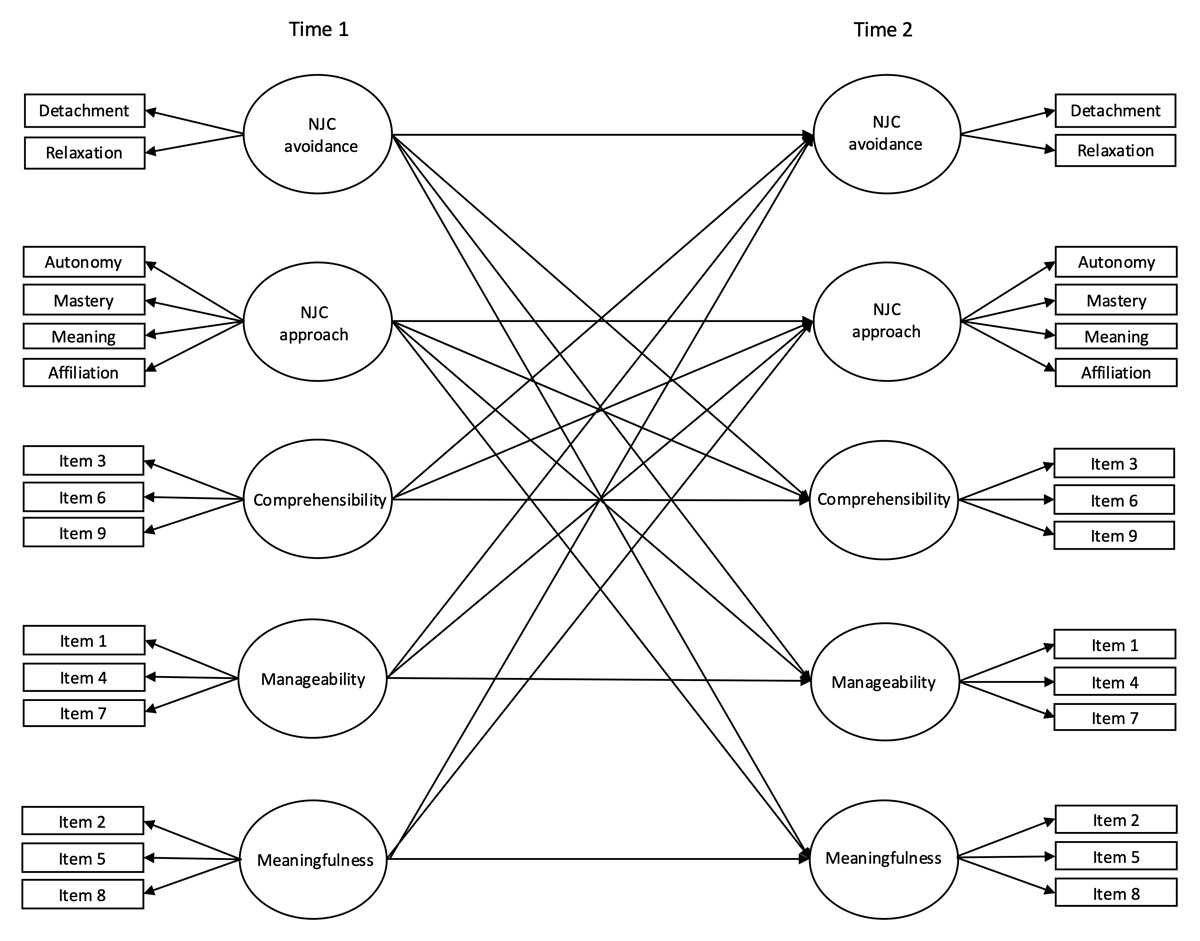
Figure 1
Hypothesized longitudinal model of reciprocal relationships between the NJC and work-SOC dimensions.
Methods
Design
The data used in the present study are part of a larger project, Craft4Health, focused on investigating different forms and patterns of job crafting, off-job crafting, and boundary crafting, as well as their predictors and related outcomes. The project ran a longitudinal panel with multiple data collection points. The present study draws on two waves that included our variables of interest. Thus, the present study has a two-wave longitudinal panel design with a six-month interval between the waves. We used a cross-lagged panel model (CLPM) to examine temporal associations between NJC and the three components of work-SOC (Kuiper & Ryan, 2018). Dormann and Griffin (2015) emphasize that the optimal time lag depends on the stability and causal dynamics of the constructs studied. In line with their discussion, we adopted a six-month lag as a pragmatic and empirically informed choice, which is consistent with prior occupational health research (e.g., Sonnentag & Fritz, 2015; Xanthopoulou et al., 2009).
Participants
The study targeted the general working population from diverse occupational sectors in Germany (comprising 80% of the sample) and the German-speaking region of Switzerland (20% of the sample). The inclusion criteria were as follows: being employed in Germany or Switzerland for more than 20 hours per week, being proficient in German, and being between 18 and 65 years of age. Participants were recruited via the panel data service provider Bilendi (bilendi.de) using quota sampling to reflect the general working population. Data collection was conducted through an online questionnaire administered on the web-based survey platform Alchemer (alchemer.com). The first wave of data was collected between December 2021 and January 2022, followed by collection of the second wave between June and July 2022.
Participation was voluntary and incentivized with a small monetary reward (approximately €2 per completed survey, redeemable as points for online services). Each participant was assigned a unique code to ensure anonymity and prevent duplicate submissions. Key survey items (i.e., NJC, work-SOC) were mandatory, with prompts notifying participants if an item was skipped. The survey included several attention-check items (e.g., ‘Please select number three as your response to this question’) and participants were automatically screened out if they failed one of these.
In total, N = 977 participants completed the survey in the first wave. Of those, N = 53 participants were removed during data cleaning due to careless answers based on extremely low completion time or suspicious answering patterns (i.e., ‘straightliners’) using the careless package in R (Yentes & Wilhelm, 2023). This resulted in a total of N = 924 participants. Of those, N = 740 completed the second wave, enabling us to pair their data (80% participation rate). We included all available data in the analyses, so the full sample included N = 924 participants. The sample characteristics were as follows: 56% of the sample was male, the mean age was M = 48.9 (SD = 10.1), and the average working hours were M = 38.1 (SD = 7.03). In terms of highest completed education, 35% had completed a university degree, 61% had completed secondary education, and 4% had completed primary education.
Measures
Work-related Sense of Coherence
Work-SOC was measured using the nine-item work-SOC scale (Vogt, Jenny, & Bauer, 2013). The scale is introduced with the central question, ‘How do you personally find your current job and work situation in general?’ Responses are given on a seven-point semantic differential scale with nine dichotomous adjective pairs (e.g., predictable–unpredictable). For all items, higher scores indicate more favourable evaluations of the work situation (i.e., greater comprehensibility, manageability, or meaningfulness) and thus higher levels of work-SOC. In the original validation study, four items represented comprehensibility, two items manageability, and three items meaningfulness (Vogt, Jenny & Bauer, 2013). However, we noted that item 1 (manageable–unmanageable) was assigned to comprehensibility in the validation study, although its content clearly reflects manageability. We therefore reclassified this item to manageability, which resulted in a more balanced structure with three items per dimension.
Needs-based Job Crafting
Job crafting was assessed using the 18-item Needs-based Job Crafting Scale (Tušl et al., 2024). This scale measures the extent to which employees proactively sought to satisfy their DRAMMA needs at work during the past two weeks. Three items measure each of the six DRAMMA needs. The items were assessed with a five-point Likert-type scale ranging from 1 = never, 2 = rarely, 3 = sometimes, 4 = often, to 5 = very often. Example items are, ‘I’ve arranged my work so that I distance myself from work-related tasks during off-job time’; ‘I’ve planned my work so that I experience control’; and ‘I’ve organized my work so that I achieve a sense of purpose in what I am doing’.
Statistical and analytical procedure
Statistical analyses were performed in R, version 4.0.2 (R Core Team, 2020), using the lavaan package (Rosseel, 2012). To examine the relationships between NJC and work-SOC, we conducted confirmatory factor analyses, assessed measurement invariance, and fitted a CLPM, using the full information maximum-likelihood estimation (FIML) procedure (Newman, 2014). Model fit was evaluated using the comparative fit index (CFI), root mean square error of approximation (RMSEA), and standardized root mean square residual (SRMR), adhering to standard cut-off criteria. A CFI value above 0.90 indicates an acceptable fit, while values above 0.95 reflect a good fit (Hu & Bentler, 1999). For RMSEA and SRMR, values below 0.08 indicate a good fit (Beauducel & Wittmann, 2005). In the CLPM, error terms for the indicators and first-order latent factors were allowed to covary with their corresponding error terms at the second time point.
Results
Descriptive statistics
Table 1 presents the descriptive statistics of the study variables from both waves, including means, standard deviations, and correlations. Overall, the variables are positively correlated. The associations are stronger between NJC for approach needs and the work-SOC dimensions than those between NJC for avoidance needs and the work-SOC dimensions.
Table 1
Means, standard deviations, and zero-order correlations between the study variables.
| M | SD | 1 | 2 | 3 | 4 | 5 | 6 | 7 | 8 | 9 | 10 | |
|---|---|---|---|---|---|---|---|---|---|---|---|---|
| 1. Comprehensibility T1 | 4.99 | 1.16 | 1 | |||||||||
| 2. Manageability T1 | 4.61 | 1.38 | 0.64 | 1 | ||||||||
| 3. Meaningfulness T1 | 5.18 | 1.34 | 0.48 | 0.46 | 1 | |||||||
| 4. NJC avoidance T1 | 3.80 | 0.82 | 0.23 | 0.15 | 0.19 | 1 | ||||||
| 5. NJC approach T1 | 3.57 | 0.67 | 0.30 | 0.39 | 0.52 | 0.34 | 1 | |||||
| 6. Comprehensibility T2 | 5.05 | 1.09 | 0.64 | 0.49 | 0.41 | 0.25 | 0.34 | 1 | ||||
| 7. Manageability T2 | 4.70 | 1.34 | 0.45 | 0.65 | 0.35 | 0.17 | 0.39 | 0.64 | 1 | |||
| 8. Meaningfulness T2 | 5.08 | 1.32 | 0.38 | 0.38 | 0.74 | 0.21 | 0.51 | 0.45 | 0.40 | 1 | ||
| 9. NJC avoidance T2 | 3.75 | 0.87 | 0.22 | 0.19 | 0.12 | 0.57 | 0.21 | 0.26 | 0.24 | 0.13 | 1 | |
| 10. NJC approach T2 | 3.55 | 0.69 | 0.28 | 0.41 | 0.47 | 0.16 | 0.71 | 0.33 | 0.43 | 0.51 | 0.28 | 1 |
[i] Note. N = 924; all correlations are significant at p < 0.001.
Confirmatory factor analysis
Confirmatory factor analyses were conducted for work-SOC and NJC for both data collection points. Work-SOC was specified as a three-dimensional model with three items per dimension (i.e., comprehensibility, manageability, meaningfulness). NJC is composed of six interrelated dimensions following the DRAMMA needs structure (Newman, Tay, & Diener, 2014). Given the aim of the present study, we modelled NJC as a two-dimensional construct reflecting the approach–avoidance distinction in needs-based crafting literature (de Bloom et al., 2020; Kosenkranius et al., 2021). Given the number of items in the NJC scale (18 items) and given that our goal was to examine construct-level relationships rather than item-level factor structure, we used item parcelling for parsimony (Little et al., 2002). The NJC for avoidance needs factor was specified with two item parcels reflecting the mean scores of detachment and relaxation, and the NJC for approach needs factor with four item parcels reflecting the mean scores of autonomy, mastery, meaning, and affiliation. As NJC for avoidance needs was measured by only two indicators, the latent factor variance was fixed at one to allow both indicators’ residual variances to be freely estimated. Free estimation of the factor variance resulted in an inadmissible solution with a Heywood case, a known issue that can occur in two-indicator latent variable models. Fixing the latent factor variance is an acceptable identification strategy in such cases, particularly when indicators are highly reliable, and the constrained specification results in a stable solution (Bollen, 1989; Kline, 2016). Model fit indices were within the acceptable range at both measurement times, with the SRMR value slightly exceeding the conventional threshold at Time 1: χ²(81) = 434.9, CFI = 0.950, RMSEA = 0.069; SRMR = 0.092; Time 2: χ²(81) = 526.5, CFI = 0.927, RMSEA = 0.086; SRMR = 0.057.
Measurement invariance
The stability of the model over time was investigated by testing configural, metric, and scalar longitudinal measurement invariance. First, we examined invariance separately for each scale to identify potential sources of non-invariance and subsequently tested within the full measurement model. We used differences between CFI and RMSEA as the main criteria, rather than χ² difference tests, given their sensitivity to sample size and model complexity (Chen, 2007; Cheung & Rensvold, 2002). A change in CFI larger than 0.010 and a change in RMSEA larger than 0.015 indicated non-invariance (Chen, 2007). The NJC for avoidance needs factor showed higher RMSEA values at the configural level due to the low degrees of freedom, which is a known limitation of RMSEA (Kenny et al., 2015), and were therefore not used as the primary criterion for invariance evaluation. CFI and SRMR both indicated good model fit, and changes in fit indices supported metric and scalar invariance. The results of the longitudinal measurement invariance indicated that the relationships between latent and manifest variables remained consistent across the two measurement points (see Table 2), and we could proceed with testing the hypothesized model (Cole & Maxwell, 2003).
Table 2
Longitudinal measurement invariance.
| MODEL | χ² | df | CFI | RMSEA | SRMR | Δχ² | Δdf | p | ΔCFI | ΔRMSEA | |
|---|---|---|---|---|---|---|---|---|---|---|---|
| NJC avoidance | Configural | 33.1 | 1 | 0.981 | 0.194 | 0.015 | |||||
| Metric | 33.1 | 2 | 0.981 | 0.135 | 0.015 | 0.0 | 1 | 0.986 | 0.000 | –0.059 | |
| Scalar | 33.7 | 4 | 0.982 | 0.094 | 0.017 | 0.7 | 2 | 0.709 | –0.001 | –0.041 | |
| NJC approach | Configural | 119.5 | 15 | 0.971 | 0.091 | 0.034 | |||||
| Metric | 140.5 | 18 | 0.966 | 0.090 | 0.046 | 21.0 | 3 | <0.001 | –0.005 | –0.001 | |
| Scalar | 151.0 | 22 | 0.964 | 0.083 | 0.047 | 10.5 | 4 | 0.032 | –0.002 | –0.007 | |
| Comprehensibility | Configural | 8.8 | 5 | 0.998 | 0.029 | 0.014 | |||||
| Metric | 9.4 | 7 | 0.999 | 0.019 | 0.015 | 0.6 | 2 | 0.725 | 0.001 | –0.010 | |
| Scalar | 13.5 | 10 | 0.998 | 0.019 | 0.019 | 4.1 | 3 | 0.256 | 0.000 | 0.000 | |
| Manageability | Configural | 15.9 | 5 | 0.994 | 0.049 | 0.018 | |||||
| Metric | 16.9 | 7 | 0.995 | 0.039 | 0.021 | 1.0 | 2 | 0.599 | –0.001 | –0.010 | |
| Scalar | 22.3 | 10 | 0.994 | 0.036 | 0.024 | 5.4 | 3 | 0.144 | 0.001 | –0.003 | |
| Meaningfulness | Configural | 8.9 | 5 | 0.999 | 0.029 | 0.008 | |||||
| Metric | 11.7 | 7 | 0.999 | 0.027 | 0.015 | 2.8 | 2 | 0.245 | 0.000 | –0.002 | |
| Scalar | 17.0 | 10 | 0.998 | 0.028 | 0.017 | 5.4 | 3 | 0.149 | 0.001 | 0.001 | |
| Full model | Configural | 1130.3 | 347 | 0.949 | 0.049 | 0.081 | |||||
| Metric | 1158.8 | 357 | 0.948 | 0.049 | 0.082 | 31.8 | 10 | 0.001 | 0.001 | 0.000 | |
| Scalar | 1187.3 | 372 | 0.947 | 0.049 | 0.083 | 28.8 | 15 | 0.019 | 0.001 | 0.000 |
Cross-lagged panel model testing
To evaluate temporal directionality, we compared four theoretically plausible CLPMs following the hypothesis-driven framework proposed by Browne et al. (2026). We used χ² difference tests and changes in CFI as model comparison criteria (Chen, 2007; Cheung & Rensvold, 2002). In all CLPMs, latent factor variances at Time 2 were freely estimated to reflect the endogenous nature of the Time 2 constructs, whose total variance is decomposed into variance explained by Time 1 constructs and residual variance. This modelling approach resulted in a well-identified and admissible solution and was therefore retained in all tested models. Compared to the stability-only model (M1), both unidirectional models (M2 and M3) showed significantly improved fit, providing evidence for cross-lagged associations in both directions. The reciprocal model (M4) demonstrated the best overall fit, supporting a gain-spiral interpretation in which NJC and work-SOC mutually reinforce each other over time. Model comparisons based on BIC, which penalizes model complexity (Raftery, 1995), slightly favoured the unidirectional NJC → work-SOC model (M2), suggesting that this pathway captures the temporal association in a more parsimonious manner (see Table 3).
Table 3
Model fit indices and model comparisons.
| MODEL | DESCRIPTION | χ² | df | CFI | RMSEA | SRMR | BIC | Δχ² | Δdf | p | ΔCFI | |
|---|---|---|---|---|---|---|---|---|---|---|---|---|
| M1 | Stability | 1251.4 | 376 | 0.943 | 0.050 | 0.088 | 61027.3 | – | – | – | – | – |
| M2 | Unidirectional: NJC → Work-SOC | 1209.3 | 370 | 0.946 | 0.050 | 0.089 | 61026.2 | M2 vs. M1 | 42.1 | 6 | <0.001 | 0.003 |
| M3 | Unidirectional: Work-SOC → NJC | 1209.8 | 370 | 0.946 | 0.050 | 0.082 | 61026.7 | M3 vs. M1 | 41.6 | 6 | <0.001 | 0.003 |
| M4 | Reciprocal: NJC ↔ Work-SOC | 1171.7 | 364 | 0.948 | 0.049 | 0.085 | 61029.5 | M4 vs. M2 | 37.6 | 6 | <0.001 | 0.002 |
[i] Note. Superior models are printed in bold.
Hypothesis testing: Reciprocal cross-lagged panel model
The path coefficients of the final model (M4) are shown in Table 4. Autoregressive paths ranged from 0.61 to 0.70 (p < 0.001). Regarding Hypothesis 1, cross-lagged paths showed that NJC for approach needs positively predicted all three work-SOC dimensions: comprehensibility (β = 0.142, p = 0.002), manageability (β = 0.137, p = 0.003), and meaningfulness (β = 0.166, p < 0.001). No significant effects emerged for NJC for avoidance needs or the three work-SOC components. Thus, Hypothesis 1 was supported for NJC for approach needs but not for NJC for avoidance needs. Regarding the reversed effects, manageability (β = 0.431, p < 0.001) and meaningfulness (β = 0.095, p = 0.023) positively predicted NJC for approach needs, whereas comprehensibility showed a strong negative association (β = –0.341, p = 0.001). No significant effects of the work-SOC dimensions were found on NJC for avoidance needs. Thus, Hypothesis 2 was only partially supported.
Table 4
Path coefficients of the reciprocal model (M4).
| b | SE | z | p | β | H | |
|---|---|---|---|---|---|---|
| Autoregressive paths | ||||||
| NJC avoidance T1 → NJC avoidance T2 | 0.685 | 0.038 | 16.869 | <0.001 | 0.685 | |
| NJC approach T1 → NJC approach T2 | 0.639 | 0.045 | 14.736 | <0.001 | 0.639 | |
| Comprehensibility T1 → Comprehensibility T2 | 0.605 | 0.034 | 17.577 | <0.001 | 0.658 | |
| Manageability T1 → Manageability T2 | 0.639 | 0.037 | 17.272 | <0.001 | 0.668 | |
| Meaningfulness T1 → Meaningfulness T2 | 0.688 | 0.032 | 21.698 | <0.001 | 0.703 | |
| Cross-lagged paths | ||||||
| NJC avoidance T1 → Comprehensibility T2 | 0.080 | 0.052 | 1.556 | 0.120 | 0.077 | H1 |
| NJC avoidance T1 → Manageability T2 | 0.080 | 0.043 | 1.862 | 0.063 | 0.090 | H1 |
| NJC avoidance T1 → Meaningfulness T2 | 0.035 | 0.051 | 0.694 | 0.488 | 0.027 | H1 |
| NJC approach T1 → Comprehensibility T2 | 0.228 | 0.072 | 3.158 | 0.002 | 0.142 | H1 |
| NJC approach T1 → Manageability T2 | 0.190 | 0.064 | 2.943 | 0.003 | 0.137 | H1 |
| NJC approach T1 → Meaningfulness T2 | 0.333 | 0.083 | 4.006 | <0.001 | 0.166 | H1 |
| Comprehensibility T1 → NJC avoidance T2 | –0.032 | 0.078 | –0.415 | 0.678 | –0.039 | H2 |
| Comprehensibility T1 → NJC approach T2 | –0.200 | 0.058 | –3.460 | 0.001 | –0.341 | H2 |
| Manageability T1 → NJC avoidance T2 | 0.164 | 0.095 | 1.729 | 0.084 | 0.164 | H2 |
| Manageability T1 → NJC approach T2 | 0.306 | 0.072 | 4.248 | <0.001 | 0.431 | H2 |
| Meaningfulness T1 → NJC avoidance T2 | –0.055 | 0.029 | –1.898 | 0.058 | –0.077 | H2 |
| Meaningfulness T1 → NJC approach T2 | 0.048 | 0.021 | 2.268 | 0.023 | 0.095 | H2 |
[i] Note. Significant cross-lagged paths are printed in bold; T = Time, H = Hypothesis; R²NJC avoidance T2 = 0.497; R2 NJC approach T2 = 0.640; R2Comprehensibility T2 = 0.564; R2Manageability T2 = 0.600; R2Meaingfulness T2 = 0.660.
The model explained a substantial proportion of variance in all endogenous variables at Time 2. Specifically, NJC for approach needs showed a large, explained variance (R² = 0.640), as did all three work-SOC dimensions: comprehensibility (R² = 0.564), manageability (R² = 0.600), and meaningfulness (R² = 0.660). NJC for avoidance needs showed a lower, but still plausible, proportion of explained variance (R² = 0.497), reflecting fewer indicators and smaller cross-lagged effects observed for this factor. Overall, these results indicate that the model captures substantial variability in NJC for approach needs and work-SOC outcomes, while variance in NJC for avoidance needs is less strongly accounted for.
Given the unexpected negative association between comprehensibility and NJC for approach needs, we conducted additional exploratory analyses to examine whether this finding could reflect a suppression effect. We estimated models in which manageability and, in a second step, also meaningfulness, were excluded as predictors of NJC. When manageability was excluded, the effect of comprehensibility on NJC for approach needs changed but remained small and non-significant (β = 0.034, p = 0.350). When both manageability and meaningfulness were excluded, the effect became somewhat stronger and marginally significant (β = 0.071, p = 0.029). These additional analyses suggest that comprehensibility plays a comparatively small, but likely still positive, role for NJC than the other two work-SOC dimensions. Thus, its negative coefficient in the full model is likely due to suppression rather than a true negative effect.
Discussion
To our knowledge, this is the first longitudinal study to examine job crafting as a strategy to enhance work-SOC. This contributes practical insights for organizational interventions aimed at strengthening employee resources and well-being. Specifically, the study explored reciprocal relationships between two forms of NJC and the three components of work-SOC. Our proposed model demonstrated acceptable fit indices, indicating that the hypothesized relationships were supported by the data. We found partial support for our two hypotheses.
First, in line with our expectations, NJC for approach needs significantly predicted all three components of work-SOC. This suggests that employees can enhance their perception of their work situation as more comprehensible, manageable, and meaningful through proactive satisfaction of their needs for autonomy, mastery, meaning, and affiliation. In contrast, NJC for avoidance needs was not significantly related to any work-SOC components. This difference may be explained by the nature of the two forms of crafting. NJC for approach needs aligns closely with the three components of work-SOC. NJC for mastery involves actively engaging in optimal challenges that foster a sense of achievement, competence, and flow (Csikszentmihalyi, 1990; Newman, Tay, & Diener, 2014), which supports employees’ perception of manageability and meaningfulness. NJC for autonomy involves promoting a sense of control over one’s actions and choices (Deci & Ryan, 2008), which enhances perceived comprehensibility and manageability. NJC for affiliation involves actively building and cultivating social relationships to experience emotional closeness and meaningful connection with others (Baumeister & Leary, 1995), which can support an overall perception of meaningfulness at work. Finally, NJC for meaning involves investing energy in pursuits that are personally purposeful or valuable (Steger & Kashdan, 2013), which directly reinforces the perception of work as meaningful. In contrast, NJC for avoidance needs primarily supports detachment and relaxation and thus recovery from work (Sonnentag & Fritz, 2007; Tušl et al., 2024) but does not appear to promote changes in work that would render it more comprehensible, manageable, and meaningful.
Second, we hypothesized an inverse relationship suggesting that perceiving one’s work situation as comprehensible, manageable, and meaningful enhances employee’s NJC. None of the work-SOC dimensions predicted NJC for avoidance needs. This result mirrors the non-significant findings in the opposite direction and consistently suggests the absence of a meaningful relationship between NJC for avoidance needs and work-SOC. We found that manageability and meaningfulness positively predicted NJC for approach needs, while comprehensibility showed a negative association. These findings suggest that the three work-SOC dimensions are differentially related to NJC for approach needs, which is consistent with theoretical accounts distinguishing their motivational, behavioural, and cognitive functions (Bauer & Jenny, 2007). Meaningfulness, the motivational component, likely promotes approach crafting strategies since employees perceive their work situation as worthy of involvement and commitment. Manageability, the behavioural component, fosters self-efficacy and awareness of available workplace resources, and our model shows a particularly strong coefficient for this dimension, indicating its strongest relevance for approach NJC strategies. This finding aligns with the COR theory, as the perception of sufficient workplace resources motivates employees to proactively develop additional ones (Hobfoll, 2001). In contrast, comprehensibility is a cognitive dimension, referring to the perception of one’s work situation as structured, clear, and predictable. Unlike manageability and meaningfulness, comprehensibility may be less directly linked to proactive efforts aimed at shaping one’s work environment. Employees who already perceive their work as clear and predictable may have fewer reasons to actively change it. The negative coefficient for comprehensibility should nonetheless be interpreted with caution given the potential suppression effect described in the results section, and this finding warrants replication in future research.
Our study contributes to the growing body of evidence on the benefits of job crafting for employee health, well-being (Petrou, Demerouti, & Schaufeli, 2015; Tims, Twemlow, & Fong, 2022; Tušl, de Bloom, & Bauer, 2022; Van Wingerden, Bakker, & Derks, 2017), and perceived meaningfulness of work (Lazazzara, Tims, & de Gennaro, 2020; Tims, Derks, & Bakker, 2016). Importantly, our findings support the proposition by Grødal and colleagues (2019) that job crafting can enhance work-SOC and, from the perspective of the salutogenic theory, that work-SOC is a dynamic resource sensitive to changes (Vogt, Jenny, & Bauer, 2013). Although only NJC for approach needs showed a reciprocal relationship with work-SOC, this provides empirical support for parts of the postulated gain spiral between job crafting and job resources in the JD-R model (Bakker et al., 2023).
Our findings have important implications for practice. Promoting NJC can help employees and organizations create work environments that are more comprehensible, manageable, and meaningful. This, in turn, can benefit employee engagement and foster further proactivity (Grødal et al., 2019). For organizations, this implies establishing conditions that allow for, and actively support, employees’ proactive engagement in NJC. Organizations may benefit from providing flexibility and space for employees to engage in NJC, for instance through job crafting interventions (Van Wingerden et al., 2017). As work-SOC is closely associated with NJC, organizations can further promote NJC indirectly by improving working conditions that shape employees’ perceptions of their work as structured, manageable, and meaningful (Vogt et al., 2013). For employees, engaging in NJC offers a simple and structured framework to reflect on how their psychological needs can be met within their job roles and to take proactive steps in that direction (de Bloom et al., 2020). Our study shows that these actions can strengthen personal resources and promote employees’ sense of the comprehensibility, manageability, and meaningfulness of work.
Directions for future research
Several findings of our study call for further examination. First, some relationships between the observed dimensions were not significant or even had a negative association, suggesting that the relationships between these constructs may be more nuanced than initially assumed. Future research should therefore investigate the conditions under which specific dimensions of work-SOC and NJC reinforce or inhibit one another and explore potential contextual factors that may shape these relationships, such as different professional or organizational contexts. Second, future research could extend the focus to additional work-related outcomes (e.g., work engagement, burnout), thereby examining whether NJC and work-SOC contribute to broader reciprocal resource-building processes. Given the relatively large observed effects between NJC and work-SOC, experimental designs testing job crafting interventions would be particularly interesting to establish causal links. Finally, research might also explore alternative pathways to developing work-SOC, for example by examining the influence of different work characteristics, job design practices, or leadership styles.
Strengths and limitations
A key strength of this study is the use of longitudinal data and CLPM design, which allows for the examination of prospective associations between NJC and the dimensions of work-SOC over time. This design provides a robust basis for investigating temporal relationships and enhances confidence in the observed directionality of the associations. Another strength lies in the novelty of the research topic. Finally, the relatively large sample increases the external validity of our results and supports the generalizability of the findings.
However, the findings of our study need to be considered in light of its limitations. First, although the sample is large and balanced in terms of age, gender, and education, it cannot be considered fully representative of the general working population. Furthermore, respondents were drawn exclusively from western, industrialized work contexts, where employees may be more inclined and have greater opportunities to engage in NJC. This limits the generalizability of findings to non-western or less industrialized contexts. Additionally, as the study focused on the general working population, we did not assess the specific occupational groups to which participants belonged, which might have provided useful contextual information.
Secondly, it is important to acknowledge that data collection took place during the COVID-19 pandemic, a period marked by increased uncertainty and sudden shifts in work demands. These contextual factors may have influenced both employees’ perception of comprehensibility, manageability, and meaningfulness at work, as well as their engagement in job crafting. Although we cannot disentangle these effects, the pandemic context may have amplified or attenuated the observed relationships, and findings should be interpreted accordingly. Future research should seek to replicate the present findings in more stable contexts.
Third, the data are based on self-reporting methods which carry the risk of common method bias (Podsakoff et al., 2003). This methodological concern might influence the results due to shared measurement errors between the constructs. This potential risk is mitigated because we employed a longitudinal design with a substantial time lag and introduced disqualifying items into the scales to filter out careless responses.
Another limitation of the present study concerns the interpretation of the comprehensibility dimension. Our exploratory analyses suggest that the negative association between comprehensibility and needs-based job crafting may reflect a suppression effect arising from the substantial overlap between the work-SOC dimensions. As a result, it is difficult to determine the unique contribution of comprehensibility to needs-based job crafting, and the observed negative association should therefore not be interpreted as evidence of a genuine negative effect. Future research should replicate these findings and employ analytical approaches that more precisely disentangle the unique and shared effects of the work-SOC dimensions.
Finally, while our findings are based on longitudinal panel data and valid measurement methods, our use of a traditional CLPM comes with important limitations. As Hamaker and colleagues (2015) emphasized, the CLPM does not separate within-person from between-person variance, which may inflate effects and obscure the underlying processes. More recently, scholars have cautioned that CLPMs should be interpreted primarily as tests of temporal associations rather than as strong evidence of causality (Lucas, 2023; Zyphur et al., 2020). Since our study only included two waves of data, we could not apply the random-intercept CLPM which would have addressed the conflation of within- and between-person variance by decomposing stable trait-like differences from dynamic within-person fluctuations (Hamaker et al., 2015). Future research with more measurement occasions would be valuable to disentangle within-person dynamics from between-person stability and provide a more rigorous test of the relationships under study. The limitation regarding causal inference, however, remains inherent to panel designs more broadly and cannot be resolved by the RI-CLPM alone (Lucas, 2023; Zyphur et al., 2020).
Conclusion
Our study provides evidence for a reciprocal relationship between NJC and the components of work-SOC, highlighting the key role of employee proactivity in shaping perceptions of the work environment. Our findings show that NJC for approach needs strongly contributes to the development of all three dimensions of work-SOC. This implies that work-SOC, as a measure of health-promoting working conditions, is responsive to changes initiated by employees who proactively shape their jobs in line with their psychological needs. At the same time, organizations play a crucial role in creating work environments that foster perceived manageability and provide adequate resources, as these appear to be key for supporting employee proactivity and motivation. Taken together, these findings extend the field of work-site health promotion and offer valuable insights for organizations aiming to foster healthy workplaces by creating conditions that support NJC.
Ethics and Consent
Informed consent was obtained from all participants, and the study included adult participants (18+ years) only. Participants voluntarily completed the questionnaires, guaranteeing their anonymity. For anonymous surveys on working/living conditions and self-reported health no ethical review was necessary under national, university, or departmental rules (Department of Data Protection at the University of Zurich, www.uzh.ch/en/privacy). The study was conducted under strict observation of ethical and professional guidelines. The manuscript is an accurate and transparent account of the study, and no important aspects of the study or any analyses conducted have been omitted.
Data Accessibility Statement
The datasets used during and/or analysed during the current study are available from the corresponding author on reasonable request.
Author Contributions
All authors were involved in the conceptualization of the study. K.C. carried out the interpretation of results and wrote the manuscript. M.T. carried out data collection and data analysis and contributed to interpretation of results. G.F.B. contributed to data collection and data analysis and contributed to interpretation of results. All authors have read and approved the final manuscript.