
Introduction
Recovery from work stress is the mechanism by which the strain caused by work stressors is alleviated through the replenishment of depleted physical and psychological resources or the acquisition of new ones (Sonnentag & Geurts 2009; Sonnentag et al. 2017). By facilitating the return to baseline levels of physiological and psychological activation, recovery plays an important role in the stress cycle (Meijman & Mulder 1998; Sonnentag et al. 2008). Importantly, recovery is not only a physiological process but also a psychological one, grounded in the recovery experiences that occur during leisure time (Sonnentag 2001). The aim of this systematic review is to investigate how non-standard working conditions—specifically non-standard schedules (e.g., irregular hours, shift work) and non-standard workplaces (e.g., teleworking)—affect employees’ recovery experiences. It responds to Sonnentag et al.’s (2022) call to explore recovery in the context of changing temporal and spatial work boundaries. The review aims to expand the recovery literature by addressing how new work arrangements challenge established recovery processes. By systematically synthesising existing evidence, this review addresses a critical gap in the literature. Existing meta-analyses (e.g., Bennett et al. 2018; Steed et al. 2021) focus mainly on traditional job demands and resources, often neglecting the specific impacts of non-standard work. Economic trends, technological advances, and post-COVID-19 teleworking have significantly increased non-standard schedules and workplaces (Eurofound 2022; Wright et al. 2013), but despite these changes, systematic knowledge of how they affect recovery is inconclusive or remains fragmented. This review contributes to theory by advancing our understanding of how different work modalities influence recovery experiences. It seeks to integrate disparate findings and offer a cohesive framework that captures the complexity of recovery in contemporary work environments. By identifying the specific challenges faced by workers in non-standard conditions, this review aims to inform targeted strategies to enhance recovery and promote occupational health. These insights will be valuable for employers, policy makers, and occupational health professionals working to create supportive environments in a rapidly changing world of work.
Theoretical background
Research on occupational stress has largely focused on its impact on employees’ well-being, health, and performance (Bliese et al. 2017), while the role of non-work time in mitigating these effects remains underexplored (Sonnentag et al. 2022). Interest in recovery has grown since the late 20th century, with the COVID-19 pandemic further highlighting its importance (Sonnentag et al. 2022). Recovery is recognised as critical for reducing stress and promoting well-being (Sonnentag et al. 2022), and it refers to the restoration process that returns an individual’s strain levels to their pre-stressor state (Sonnentag et al. 2017).
The recovery process involves activities that individuals engage in and experience during nonworking hours (Sonnentag et al. 2017), and the recovery experiences include psychological detachment from work, relaxation, mastery and control during leisure time (Sonnentag 2001). Psychological detachment from work is characterised by the absence of work-related thoughts or behaviours and psychological involvement in activities that promote recovery, such as leisure activities (Sonnentag & Fritz 2007). Relaxation involves a state of low activation of the sympathetic nervous system and an increase in positive affect, which can be achieved through activities like meditation or walking in nature (Sonnentag & Fritz 2007). Control ‘may act as an external resource that enhances recovery from work during off-job time’ (Sonnentag & Fritz 2007, p. 207), and it refers to the ability to choose what to do, when to do it, and how to do it (e.g., a person’s decision to exercise during their lunch break). Finally, mastery experiences involve acquiring new skills or completing challenging tasks during leisure time (Sonnentag & Fritz 2007), such as learning a new language.
One of the principal models for understanding recovery is Hobfoll’s Conservation of Resources (COR) Theory (2002), which posits that individuals strive to obtain, maintain, protect, and nurture resources—things that are important to them. According to COR theory, stress results from a threat to or loss of resources, particularly central or key resources, or the failure to gain key resources after significant effort. The theory emphasises the tendency to protect resources in response to stress and to accumulate them to meet future demands (Hobfoll et al. 2018). High job demands deplete resources (e.g., affective), requiring individuals to invest in replenishing them. COR theory suggests that time away from work allows individuals to invest in certain resources (e.g., psychological resources gained through reading), facilitating the replenishment of depleted resources. Key concepts of this theory include: a) the loss of resources has a greater impact than the gain of resources, except when the newly acquired resources are highly valuable; b) resource investment is necessary to protect against resource loss, recover lost resources, or gain new ones; c) resource loss can lead to further resource loss, while resource gain can lead to additional resource gain.
Non-standard working schedules (NSWS) encompass a wide range of arrangements, including shift work (i.e., working irregular hours such as evenings, nights, or weekends); rotating shifts (i.e., where working hours vary); compressed workweeks (i.e., working more than the standard 40 hours per week in fewer days); flexible working arrangements (i.e., flexitime) and on-call work (i.e., being available to work outside normal hours without necessarily doing so) (Costa 2016). The effects of NSWS on recovery and health vary. Costa (2016) highlights key factors, including duty length (6–14 hours), weekend or night work, shift timing, rotation direction (clockwise/counterclockwise), rotation speed (fast, intermediate, slow, fixed), and shift cycle regularity. Understanding these elements is crucial for assessing occupational health risks and recovery challenges associated with diverse scheduling patterns.
The characteristics of NSWS, such as shift patterns and duration, negatively impact recovery (Gifkins et al. 2020; Yamaguch et al. 2023) because they create a high-demand work environment that may reduce the time available for rest or carry work demands into nonworking hours, thereby affecting recovery according to COR theory (Hobfoll 2002). For example, shift work disrupts circadian rhythms (Kim et al. 2015), and shift workers may need to recover during the day, which is often noisier and less conducive to relaxation. The unpredictability of some schedules (e.g., on-call duty) also keeps workers in a constant state of readiness, which impairs relaxation (Sonnentag et al. 2022) and psychological detachment (Barber & Jenkins 2014; Park et al. 2011). The stress of shift work, combined with circadian rhythm disruption, may make psychological detachment more difficult (Bolino et al. 2020; Kim et al. 2015). Moreover, control during leisure time may be compromised because these workers are limited to activities available during their non-standard hours, which might reduce opportunities for developing new skills and thereby hinder mastery.
To better understand the relationship between NSWS and recovery experiences, we propose our first research question.
RQ1: What is the impact of different types of NSWS on recovery experiences?
Telework (i.e., carrying out professional activities outside the organisational context) (Allen et al. 2015) has significantly reshaped the temporal and spatial structure of work. While it offers flexibility, telework also tends to extend employees’ availability, which may disrupt recovery by reducing rest periods and sustaining work-related demands during nonworking hours (Thörel et al. 2022). According to COR, reducing the time available for rest or maintaining work demands during nonworking hours impacts recovery. Importantly, telework often blurs the boundaries between work and private life, a concern highlighted in Sonnentag et al. (2022), who note that this blending of domains poses a major challenge for psychological detachment. When work is always physically and cognitively accessible, as it is in the home environment, employees may struggle to achieve the mental disengagement necessary for recovery. However, does telework necessarily harm all recovery experiences, or could it have some positive effects? Perry et al. (2022) used COR theory to examine how telework affects recovery and found that when teleworkers took breaks for themselves or nonwork-related activities, this time positively influenced resource protection and acquisition. For example, a teleworker watching a television series during their lunch break might experience relaxation, while the ability to choose how to spend that break exemplifies control. Telework reduces commuting time, increasing the time available for other activities, potentially allowing teleworkers to engage in activities that enhance skills and promote mastery.
Given these considerations, we propose our second research question.
RQ2: What are the differential effects of telework on recovery experiences?
Method
The initial phase of this study involved delineating the scope of the literature review in alignment with the study’s objectives. This process followed the methodological framework outlined in the Preferred Reporting Items for Systematic Reviews and Meta-Analyses (PRISMA) guidelines (Moher et al. 2009).
Literature Search
The review methodology and protocol registration preceded the search. The protocol for this study was registered on the PROSPERO database (registration number PROPERO 464067), which was published on 13 September 2023. A systematic search was conducted to identify relevant studies in the literature. We aimed to select every published article that included recovery and non-standard work contexts, so the search terms were divided into two distinct areas: recovery experiences and non-standard work or NSWS. The searches were conducted in the digital databases Scopus (All Selected Bases) and Web of Science (Core Collection), using several combinations of search words, as graphically presented in Table 1. Large umbrella terms (including wildcards, marked with an asterisk [*]) were used to search for studies. One filter was used to obtain only articles in English, and another was used to limit the search to the years 2001 to 2024, inclusive. The year 2001 was chosen as the lower limit because it was the year of the classic article by Sonnentag (2001) that opened the doors to the study of recovery. The searches were conducted in February 2024. This resulted in 2431 studies that could be included in the systematic review.
Table 1
Combinations of search terms.
| RECOVERY | AND | NON-STANDARD WORK | OR | NON-STANDARD WORK SCHEDULES |
|---|---|---|---|---|
| Recovery | Shift work | |||
| Psychological detachment | Telework | Non-standard schedules | ||
| Relaxation | Remote work* | Work* schedules | ||
| Mastery | Telecommuting | Rotating shifts | ||
| Flexible schedules | ||||
| Control | Work* from home | Night shift* | ||
| On-call work* |
Inclusion Criteria
The identified studies were divided equally among the three authors. The studies were then reviewed to assess their eligibility for inclusion. Inclusion criteria were: a) studies published in health or social science journals; b) quantitative studies, namely cross-sectional, diary and longitudinal studies; c) studies published in peer-reviewed journals (i.e., book chapters, dissertations, theses and conference presentations); d) studies exploring any dimension of the recovery experience; e) studies with samples consisting of working participants in telework or NSWS and f) articles should be accessible. Studies were excluded if they: a) did not include adults with non-standard work or NSWS; b) did not explore at least one dimension of the recovery experience; c) included children and adolescents (under 18 years) and older people (over 70 years); d) were qualitative studies; e) were randomised control trials, systematic literature reviews, scoping reviews, narrative reviews and meta-analyses and f) were published in grey literature.
Literature selection
In the first phase of the review, the duplicates were removed. After removing duplicates, 576 studies proceeded to the screening stage. A systematic review of the titles and abstracts of all results was carried out in the second phase. Two reviewers independently screened all titles and abstracts. For all titles and abstracts considered relevant by both reviewers, full-text articles were retrieved if available. The relevance of each study was assessed on the basis of the previously outlined inclusion criteria. Any disagreements were resolved by consensus. Of the 576 studies, 64 were assessed in detail, and 25 met the inclusion criteria based on their relevance. Of the 2,431 articles returned, 25 were selected and included in this study. The PRISMA flowchart (Moher et al. 2009) is shown in Figure 1.
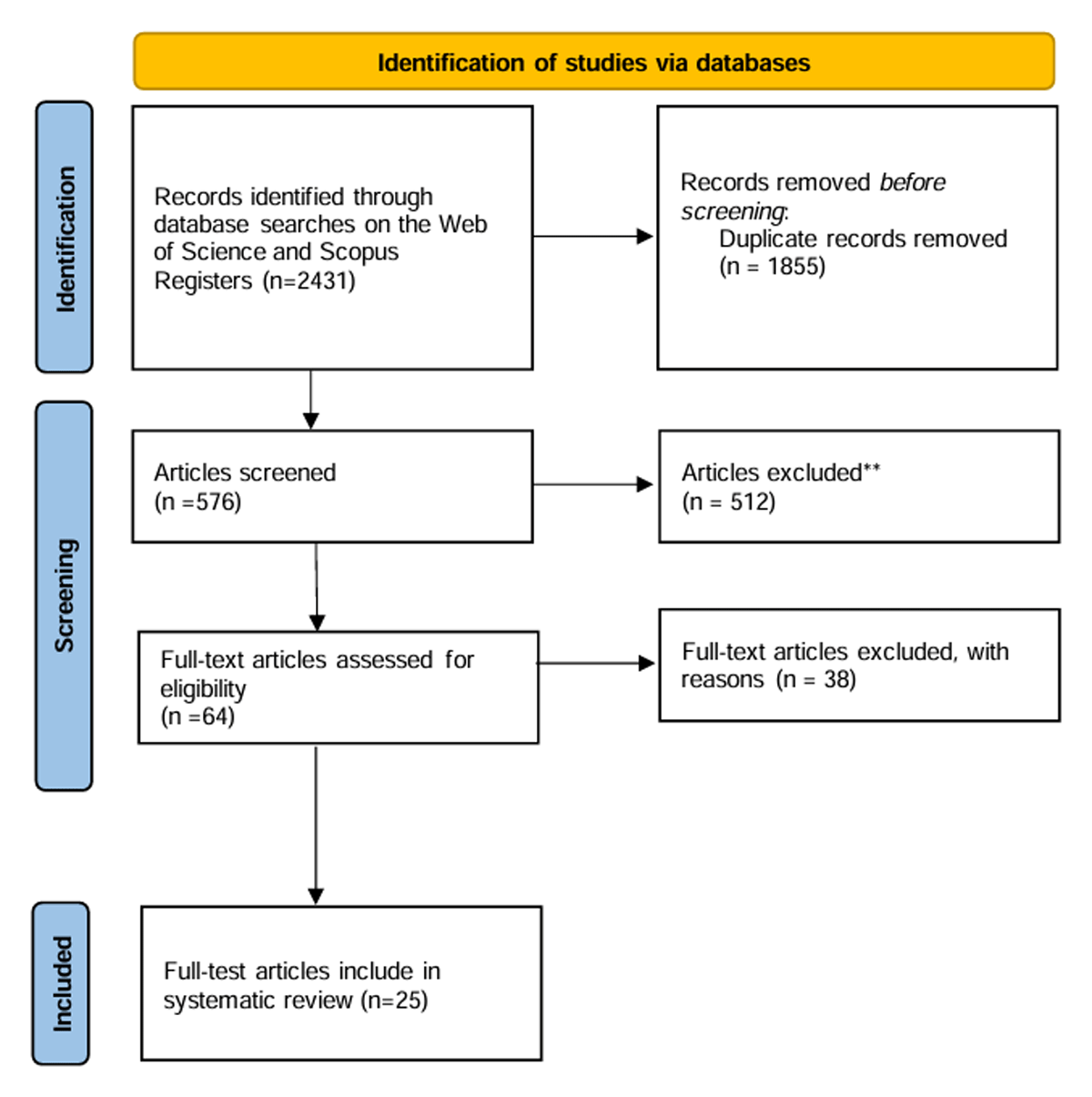
Figure 1
PRISMA flowchart (Moher et al. 2009).
Results
Characterization of studies
In this section, the 25 articles resulting from our digital search and screening are reviewed from a qualitative point of view. All the studies are presented in the tables included in the Supplementary Material. There are 19 articles about non-standard workplaces and six about NSWS.
For the six studies of NSWS, the oldest article in our search dates from 2012, and the latest dates from 2023. Three articles were published between 2012 and 2016, and the remaining three between 2020 and 2023. These studies include night-shift (N = 1), working during weekends (N = 1), on-call workers (i.e., being available to work outside normal working hours but not necessarily doing so) (N = 2) and various NSWS (e.g., flexible, rotating) (N = 2). The samples were made up of nurses (N = 1), signallers and controllers of rail traffic (N = 1), and unspecified (N = 4). These included cross-sectional studies (N = 3), diary studies (N = 2) and one longitudinal design. In terms of geographical representativeness, there was an over-representation of articles from Europe (N = 4), one article from North America and one from Israel (Supplementary Table S1).
All articles concerning non-standard workplaces (i.e., telework) were published between 2020 and 2024. There has been an increase in interest in this area, with an average of five articles per year from 2020 to 2024 (March). Only one article collected data before the period of confinement, and one collected data before and during this period. This is due to the exponential increase in the use of teleworking during COVID-19, with eighteen (95%) of the articles collecting data during the mandatory closure period. In terms of occupational sector, telework studies have samples composed of administrative staff (N = 3), teachers (N = 3) and unspecified roles (N = 13). Regarding the study design, eleven cross-sectional studies and eight longitudinal studies were obtained. In terms of geographical representativeness, there were nine articles from Europe, three from Brazil, two from the USA, two from China, one from Iran, one from the Philippines and one unspecified article (Supplementary Table S1).
Qualitative description of results
Non-standard working schedules and recovery
NSWS have been the subject of several studies examining their direct effects on recovery. A significant focus has been on psychological detachment, with three studies investigating it (Garraio et al. 2023; Querstret & Cropley 2012; Ziebertz et al. 2020). Relaxation and control were also explored in three studies (Drach-Zahavy & Marzuq 2013; Garraio et al. 2023; Ziebertz et al. 2020), while mastery was examined in one study (Drach-Zahavy & Marzuq 2013). Table 2 summarises the main findings. The findings suggest that irregular work schedules and on-call duties negatively affect psychological detachment (Garraio et al. 2023; Ziebertz et al. 2020), relaxation and control (Ziebertz et al. 2020). Employees who took midweek days off reported lower levels of relaxation, control and mastery compared to those who had weekend breaks (Drach-Zahavy & Marzuq 2013), indicating that the timing of respite plays a crucial role in recovery. In contrast, rotating shifts, night shifts and weekend work did not appear to be associated with psychological detachment (Querstret & Cropley 2012), suggesting that some forms of NSWS may not inherently disrupt recovery processes.
Table 2
Key findings on the impact of non-standard working schedules on the recovery experience.
| AUTHOR AND YEAR | STUDY DESIGN | WORK CONTEXT | MEDIATOR | OUTCOME | RESULTS |
|---|---|---|---|---|---|
| Querstret & Cropley 2012 | Cross-sectional | Rotating shifts, night shifts and weekend work | — | Psychological detachment (PD) | Rotating shifts, night shifts and weekend work are not associated with PD. |
| Garraio et al. 2023 | Cross-sectional | Irregular standard schedules | — | PD | Irregular standard schedules negatively impact PD. |
| Combinations of NSWS | Number of hours worked per week | PD, relaxation, and control | A higher number of hours worked per week negatively impacts PD, relaxation and control. | ||
| Ziebertz et al. 2020 | Cross-sectional | On-call | — | PD, relaxation and control | On-call work negatively affects PD, relaxation and control. |
| Drach-Zahavy & Marzuq 2013 | Longitudinal | Two midweek days off | — | Relaxation, mastery and control | Taking two midweek days off negatively impacts relaxation, control and mastery. |
| Dettmers et al. 2016 | Diary study | On-call | Extended availability | PD and control | Extended availability during on-call shifts negatively affects PD and control. |
Two studies explored mediators explaining how NSWS influence recovery outcomes. Dettmers et al. (2016) found that extended availability (i.e., remaining accessible for work beyond regular hours) significantly impairs psychological detachment and control. Similarly, Garraio et al. (2023) demonstrated that total weekly working hours affect psychological detachment, relaxation and control across various work arrangements.
Two other studies examined recovery as a moderating factor interacting with NSWS. Korunka et al. (2012) found that among workers with 12-hour night and day shifts, psychological detachment during breaks plays a crucial role in reducing fatigue. Drach-Zahavy and Marzuq (2013) indicated that weekend respite led to greater overall recovery than weekday breaks. Regardless of timing, relaxation and control were associated with decreased emotional exhaustion and increased vigour following a break.
Collectively, these findings underscore the complex relationship between NSWS and recovery. While irregular schedules and on-call duties negatively impact key recovery dimensions, other forms of NSWS do not appear to have the same detrimental effects. Work intensity and extended availability act as mediating factors, exacerbating negative consequences. Importantly, recovery experiences, particularly psychological detachment, serve as protective factors, mitigating fatigue and enhancing well-being. These insights highlight the importance of promoting recovery strategies in non-standard work environments to support employee well-being and resilience.
Telework and recovery
The impact of teleworking on recovery has been examined in several studies, revealing mixed and sometimes inconsistent findings. A significant portion of these studies, particularly those conducted during the COVID-19 lockdown, have explored both contextual factors—such as job demands and resources—and individual characteristics of teleworkers. Table 3 summarises the main findings.
Table 3
Key findings on the impact of telework on the recovery experience.
| AUTHOR AND YEAR | STUDY DESIGN | WORK CONTEXT | MEDIATOR | EMPLOYEE CHARACTERISTICS | OUTCOME | RESULTS |
|---|---|---|---|---|---|---|
| Ghislieri et al. 2023 | Longitudinal | Telework | — | — | Overall recovery experience | Telework had a positive relationship with recovery before the pandemic. |
| Ghislieri et al. 2023 | Longitudinal | Telework | — | — | Overall recovery experience | Telework was not associated with recovery during the lockdown period. |
| Gillet et al. 2023 | Cross-sectional | Telework | — | — | Psychological detachment (PD), relaxation; mastery and control | Telework positively impacted PD but was not associated with relaxation, mastery or control. |
| Mache et al. 2020 | Longitudinal | Telework | — | — | PD | Telework had a positive relationship with PD. |
| Tejero et al. 2021 | Cross-sectional | Telework | — | — | PD | Telework had a negative relationship with PD. |
| Cheng & Zang 2022 | Longitudinal | Telework | Telework hours | — | PD | Longer telework hours negatively affected PD. |
| Cheng & Zang 2023 | Longitudinal | Telework | Telework hours | — | PD | Longer telework hours negatively affected PD. |
| Varga & Denniston 2022 | Cross-sectional | Telework | Telework hours | — | PD, relaxation, mastery and control | Telework hours were not associated with PD or mastery but negatively impacted relaxation and control. |
| Lazauskaitė-Zabielskė et al. 2023 | Longitudinal | Telework | Higher overwork climate | — | PD | A high overwork climate negatively affected PD, with stronger effects for full-time teleworkers. |
| Mascarenhas et al. 2024 | Cross-sectional | Telework | Work-family boundary violations | — | PD | Boundary violations between work and family negatively affected PD. |
| Dolce et al. 2020 | Cross-sectional | Telework | Job demands | — | Overall recovery experience | Job demands negatively impacted recovery. |
| Job resources | Destructive leadership | Overall recovery experience | Job resources positively influenced recovery, though their effects were weakened by destructive leadership. | |||
| — | Caring for family members | Overall recovery experience | Caring for family members negatively impacted recovery. | |||
| — | Gender | Overall recovery experience, psychological detachment, relaxation and mastery | Women teleworkers experienced poorer recovery outcomes, lower PD and lower mastery. | |||
| Molino et al. 2023 | Longitudinal | Telework | — | Caring for family members | Mastery | Caring for family members was not associated with mastery. |
| Ghislieri et al. 2021 | Cross-sectional | Telework | — | Caring for family members | Overall recovery experience | Caring for family members negatively impacted recovery. |
| Pérez-Nebra et al. 2022 | Cross-sectional | Telework | — | Gender | — | Women teleworkers had worse recovery and lower relaxation levels. |
Three studies explored the direct relationship between telework and recovery, with inconsistent findings on psychological detachment: while two studies (Gillet et al. 2023; Mache et al. 2020) found a positive relationship between telework and psychological detachment, one study (Tejero et al. 2021) reported a negative association. Moreover, no significant relationships were identified between telework and relaxation, control or mastery. The inconsistent results highlight the complexity of telework’s effects on recovery, which may depend on various individual and contextual factors.
Several studies have highlighted the impact of job demands and resources on recovery during telework. Dolce et al. (2020) identified that cognitive demands and the use of information and communication technologies (ICT) outside working hours adversely affect recovery. Conversely, resources like autonomy and social support were found to enhance recovery, though their benefits diminished under destructive leadership. Cheng and Zang (2022; 2023) reported that extended telework hours hinder psychological detachment, while Lazauskaitė-Zabielskė et al. (2023) observed that a high overwork climate impairs detachment, especially among full-time teleworkers. In contrast, Varga and Denniston (2022) found no significant link between telework hours and psychological detachment or mastery but noted a negative association with relaxation and control.
Individual experiences during telework also play a crucial role in recovery. Gillet et al. (2023) examined ‘telepressure’, the persistent urge to respond to work-related messages promptly, finding it negatively impacts overall recovery. Interestingly, this effect was more pronounced among onsite workers than teleworkers, suggesting telework may offer some protection against telepressure. Mascarenhas et al. (2024) highlighted that boundary violations between work and family life adversely affect psychological detachment, emphasising the need for clear work-life boundaries in remote work settings.
Demographic factors significantly shape teleworkers’ recovery experiences. Dolce et al. (2020) and Pérez-Nebra et al. (2022) found that female teleworkers experience poorer recovery outcomes compared to males, reporting lower levels of psychological detachment, mastery and relaxation. Additionally, caregiving responsibilities, such as caring for children or elderly family members, negatively impact overall recovery (Dolce et al. 2020; Ghislieri et al. 2021). However, Molino et al. (2023) found no significant differences in mastery between teleworkers with and without children, suggesting that the impact of caregiving responsibilities on recovery may vary depending on other contextual factors.
Effective management of work-life boundaries is pivotal for teleworkers’ recovery. Haun et al. (2022) demonstrated that implementing temporal boundary tactics—allocating specific times for work and personal life—positively correlates with psychological detachment and a sense of control during leisure time. Similarly, Schade et al. (2021) found that teleworkers who desire and maintain a clear separation between work and leisure report higher psychological detachment. Conversely, Cropley et al. (2023) noted that the absence of regular breaks during the workday detrimentally affects psychological detachment, underscoring the importance of structured work-life boundaries for maintaining recovery in telework settings.
Recovery experiences themselves can moderate the effects of telework. Kalani et al. (2023) found that lower psychological detachment during telework is associated with unhealthy behaviours, reduced well-being and diminished social support, suggesting that psychological detachment serves as a protective factor against negative outcomes in telework environments. LaTorre et al. (2021) examined the moderating role of recovery experiences in the relationship between individualised work arrangements and sustainable well-being, finding that psychological detachment buffers the relationship between high-flexibility arrangements and sustainable work patterns. Ziedelis et al. (2022) further highlighted the protective role of psychological detachment, identifying it as the most effective strategy for preventing the blurring of boundaries between work and personal life in telework environments.
Collectively, these findings illustrate the complex interplay between telework and recovery. While telework offers flexibility and autonomy, it also presents challenges such as increased job demands, telepressure, and blurred work-life boundaries, which can impede recovery. Individual characteristics, demographic factors, and effective boundary management strategies significantly influence teleworkers’ recovery experiences. Organisations should consider these factors when developing policies and interventions to support employees’ well-being in telework settings.
Discussion
NSWS and non-standard workplace arrangements have become prevalent among employees, driven by factors such as technological advances and the globalisation of business (Eurofound 2022; Wright et al. 2013). However, a growing body of empirical literature suggests that these work contexts may impact employees’ recovery experiences (e.g., Thörel et al. 2022). There is a critical need to further investigate the relationships proposed in this empirical literature concerning NSWS and telework and their effects on recovery. This systematic review encompasses 25 studies (six focusing on NSWS and 19 on teleworking) and applies the COR theory to deepen the understanding of these effects.
Non-standard working schedules and recovery
The studies included in this systematic review examined various types of work schedules and recovery experiences. Due to the diversity in the types of NSWS (e.g., rotating shifts), it is challenging to draw robust conclusions about their effects on recovery. Despite this limitation, the studies consistently demonstrate that irregular schedules and on-call demands pose significant challenges to employees’ ability to recover, particularly in terms of psychological detachment, relaxation, and control, primarily due to extended availability and increased working hours (Dettmers et al. 2016; Garraio et al. 2023). Specifically, on-call time has been found to be detrimental to recovery (i.e., psychological detachment, relaxation and control) (Ziebertz et al. 2020). Irregular schedules are negatively associated with psychological detachment (Garraio et al. 2023), and having two midweek days off per week is negatively related to relaxation, control and mastery (Drach-Zahavy & Marzuq 2013).
The characteristics of irregular schedules and on-call time often represent a threat to resources, a loss of resources or a lack of replenishment, which aligns with the COR theory’s premise that these factors can disrupt recovery (Hobfoll 2002). One possibility is that the unpredictability and constant readiness associated with these schedules reduce employees’ control over their own time (i.e., a critical resource), which, in turn, diminishes their recovery experiences, particularly in controlling leisure time. This unpredictability and constant readiness may lead to persistent work-related thoughts, further depleting resources and making it difficult for employees to mentally disengage from work, as they must always be prepared for the possibility of being called back to work (Barber & Jenkins 2014; Park et al. 2011). Additionally, these schedules keep employees in a heightened state of readiness, increasing sympathetic nervous system activation, which consumes more resources and inhibits relaxation (Sonnentag et al. 2022). Furthermore, these schedules may hinder resource replenishment by reducing engagement in recovery activities, such as social interactions, which are resource gains that contribute to recovery (Sonnentag et al. 2017). Extended availability and increased working hours associated with these schedules maintain work demands during non-working hours, creating resource loss situations that impair recovery (Gifkins et al. 2020; Yamaguchi et al. 2023).
The COR theory’s principles of resource gain and loss (Hobfoll 2002) also provide insight into why midweek days off may be detrimental to recovery. When deviating from the traditional five-day workweek followed by a two-day weekend, the cycle of resource depletion and replenishment may be disrupted. Having days off during the week can make it difficult for individuals to establish a consistent routine, potentially reducing the sense of achievement and competence in leisure activities and thereby diminishing mastery. This inconsistent work pattern can lead to incomplete resource replenishment and increased cognitive load as employees continuously adapt to changing schedules, further depleting their mental resources and reducing relaxation.
Rotating shifts, night shifts, and weekend shifts may not significantly affect recovery, particularly psychological detachment (Querstret & Cropley 2012). One explanation could be found in the first corollary of the COR theory, which posits that individuals with more resources are less vulnerable to resource loss (Hobfoll et al. 2018). Perhaps employees with predictable schedules, even if irregular, can plan their non-working hours more effectively, managing their energy and time to create routines that mitigate the negative effects of these schedules on recovery. This possibility warrants further investigation in future studies.
Finally, psychological detachment has been shown to mitigate the negative effects of night shifts on workload and fatigue (Korunka et al. 2012). Regardless of whether the break occurs during the week or on the weekends, relaxation and control during leisure time reduce emotional exhaustion and increase post-break vigour (Drach-Zahavy & Marzuq 2013). This may be due to the COR theory’s resource gain spiral corollary, which suggests that individuals with available resources are better equipped to acquire new resources, though this process unfolds gradually (Hobfoll et al. 2018). For nightshift workers, psychological detachment plays a crucial role in reducing perceived workload by preventing constant preoccupation with work-related thoughts and concerns, thereby avoiding resource depletion. Moreover, psychological detachment allows individuals to fully engage in restful and restorative activities during their non-working hours, facilitating resource replenishment and reducing overall fatigue levels. Relaxation and control during breaks may compensate for the poorer recovery during weekdays compared to weekends. When employees relax and feel a sense of control in their leisure time, they can effectively counterbalance the demands of irregular working hours, replenish their resources, reduce emotional exhaustion and enhance positive outcomes, such as vigour.
In conclusion, NSWS can disrupt the cycle of resource replenishment by preventing adequate resource recovery, which is essential according to COR theory. However, when employees are able to genuinely recover, despite non-standard working hours, they can replenish their resources, thereby improving their well-being.
Telework and recovery
Most of the studies included in this review were conducted during the mandatory COVID-19 lockdown and found no significant association between teleworking and the overall recovery experience (Ghislieri et al. 2023) or specific recovery experiences (Tejero et al. 2021). However, there was an exception in the case of psychological detachment, where findings were inconsistent: one study reported a positive relationship between telework and psychological detachment (Gillet et al. 2023), while another found a negative relationship (Tejero et al. 2021). Job resources were the only mechanism consistently associated with positive recovery experiences (Dolce et al. 2020). Conversely, job demands and destructive leadership (Dolce et al. 2020) were detrimental to all forms of recovery, while psychological detachment was further affected by the number of telework hours (Cheng & Zhang 2022; Cheng & Zhang 2023), a higher overwork climate (Lazauskaitė-Zabielskė et al. 2023), and work-family boundary violations (Mascarenhas et al. 2024). Telepressure negatively impacted overall recovery, but its effects were more pronounced for onsite workers compared to teleworkers (Gillet et al. 2023).
Studies conducted outside the COVID-19 lockdown confirm a positive relationship between telework and psychological detachment (Mache et al. 2020). However, findings differ regarding telework and overall recovery experiences, as telework has been shown to improve recovery (Ghislieri et al. 2023). Moreover, telework hours were not significantly related to psychological detachment (Varga & Denniston, 2022) and showed no significant relationship with mastery but were negatively associated with relaxation and control (Varga & Denniston 2022).
The inconsistent or insignificant findings regarding the effects of telework on recovery experiences suggest that it may not be telework conditions per se that influence recovery. Instead, certain mechanisms may enhance or impair the recovery of teleworkers, which can be better understood through the COR theory. Job demands, destructive leadership, extended telework hours, a heightened overwork climate and work-family boundary violations can threaten, deplete or hinder the replenishment of resources. According to the COR resource investment principle, recovering from resource losses requires investment, and according to the corollary of resource loss cycles, individuals with fewer resources in stressful situations are more likely to experience further losses (Hobfoll et al. 2018). For instance, a teleworker with a destructive leadership style may lose substantial resources after a meeting with their manager, leaving them unable to invest in the resources needed for recovery. This situation could lead to work-related thoughts during their free time, negatively impacting psychological detachment. Empirical evidence supports this notion. For example, Giunchi et al. (2023) found that employees who engage with work-related technologies outside of working hours report a heightened sense of intrusion during leisure time. This intrusion not only blurs work-family boundaries but also exacerbates perceptions of stress, as work demands spill over into personal life. These findings underscore the need to consider contextual and psychological mechanisms that mediate the relationship between telework and recovery, rather than assuming a direct causal link between the two.
On the other hand, job resources improve recovery experiences, possibly due to the acquisition of new resources through these job resources. According to the COR resource investment principle (Hobfoll et al. 2018), employees with autonomy and social support have more resources available, which may enhance their ability to invest in recovery-related resources. For example, a teleworker with autonomy may choose to engage in meaningful activities that promote recovery.
In terms of teleworker characteristics, the lack of breaks throughout the day negatively impacts psychological detachment (Cropley et al. 2023; Haun et al. 2022; Schade et al. 2021), consistent with the findings of Perry et al. (2022). Perry and colleagues used COR theory to explain that when teleworkers take breaks for themselves or non-work-related activities, this time positively affects resource conservation and acquisition. The COR resource investment principle (Hobfoll et al. 2018) could also explain the positive effects of temporal boundary tactics (i.e., separating work and non-work time) on psychological detachment and control (Haun et al. 2022) and why teleworkers who separate work and personal time experience better psychological detachment (Schade et al. 2021). A possible explanation is that individuals who separate work and leisure time have more resources available, enabling them to invest in recovery activities to mitigate resource loss.
Regarding gender differences, female teleworkers experienced worse recovery than their male counterparts, particularly in terms of psychological detachment, mastery (Dolce et al. 2020) and relaxation (Pérez-Nebra et al. 2022). This finding aligns with Hartig et al. (2007), who found that female teleworkers have less effective recovery than men. Caring for family members (e.g., children, older adults) further impairs recovery (Dolce et al. 2020; Ghislieri et al. 2021), representing a threat, loss or lack of resource replenishment consistent with the COR assumption, which could disrupt recovery (Hobfoll 2002). According to COR theory, caregiving demands consume substantial resources (e.g., caring for an elderly person may require physical strength) and reduce the availability of resources for replenishment (e.g., caregivers may have less free time).
Finally, teleworkers with high levels of psychological detachment are less likely to blur the boundaries between work and family (Ziedelis et al. 2022). The first corollary of COR theory explains that individuals with more resources are less susceptible to resource loss and more capable of gaining new resources (Hobfoll et al. 2018). A teleworker who can psychologically distance themself from work avoids work-related thoughts or behaviours during their free time (Sonnentag & Fritz 2007), increasing their available resources. This employee may be less prone to blurring boundaries, thereby preventing further resource loss. Lower psychological detachment during telework is associated with unhealthy patterns (e.g., poorer coping mechanisms in stressful situations and lower well-being) (Kalani et al. 2023). Recovery experiences also moderated the relationship between idiosyncratic deals (i-deals) and sustainable well-being at work (LaTorre et al. 2021). COR theory’s assumptions of a cycle of resource losses and a spiral of resource gains offer an explanation: the loss cycle suggests that individuals with fewer resources struggle to protect them, leading to further losses (Hobfoll et al. 2018). For example, a teleworker who does not recover will enter a spiral of resource loss, increasing stress. Conversely, the resource gain spiral suggests that individuals with available resources are better equipped to acquire new ones, enhancing well-being and productivity.
Limitations
Despite offering valuable insights, this review has limitations. The heterogeneity of NSWS and telework arrangements across industries, countries and organisations introduces confounding variables, limiting synthesis and generalisability. Although guided by COR theory, many studies lacked consistent theoretical frameworks, and recovery models like Effort-Recovery or DRAMMA were applied inconsistently, reducing theoretical clarity. The COVID-19 context further complicates findings, as telework was often involuntary and shaped by unique stressors, limiting relevance to post-pandemic settings. Additionally, moderating and mediating mechanisms—such as leadership style, organisational norms and boundary management—remain underexplored. While negative influences like destructive leadership are noted, positive organisational factors are less studied. Finally, individual differences (e.g., gender roles) are inconsistently addressed, despite their impact on recovery.
Future research
Future research should further investigate the mechanisms influencing recovery and its outcomes. While positive leadership, namely leader-member exchange (LMX) and transformational leadership, has been linked to reduced burnout and distress (Petrilli et al. 2024; Montano et al. 2017), the processes underlying these effects remain unclear. Recovery may serve as a mediating factor, as supportive leadership fosters environments that replenish resources. Applying consistent theoretical frameworks, such as COR theory, alongside models like Effort-Recovery or DRAMMA, would enhance conceptual clarity and comparability. Given the diversity of non-standard work contexts, future studies should use multi-level or comparative designs to account for contextual variation. Research on individual differences in recovery remains sparse, partly due to earlier inconclusive findings (Sonnentag et al. 2022). However, caregiving demands, particularly among women, are associated with resource depletion (Trzebiatowski & Triana 2018), underscoring the need for intersectional approaches. Psychological factors such as motivation and engagement, linked to resilience (Schaufeli & Salanova 2007), may also buffer the negative effects of non-standard work on recovery and merit further study.
Theoretical and Practical Implications
Theoretical contributions to recovery theory (Sonnentag 2001) can be extended by integrating the COR theory (Hobfoll 2002) into the discussion of non-standard work arrangements. NSWS and telework disrupt resource replenishment cycles, affecting employees’ ability to recover. The unpredictability of irregular work schedules creates a continuous resource drain, as employees struggle with diminished psychological detachment and relaxation due to extended availability. Similarly, telework blurs work-home boundaries, leading to resource depletion when demands spill into personal time. However, job resources, such as autonomy and social support, can mitigate these effects by fostering resource gain spirals. Future research should explore interventions that strengthen employees’ recovery strategies.
Our findings suggest strategies for managing telework and NSWS to maintain or promote employee recovery. Given that these work arrangements are likely to prevail in the future, employers and employees should adopt strategies to promote recovery. The most critical measure is to respect employees’ free time and their need and right to take time off. Encouraging regular physical activity is essential, as it counteracts the negative health effects of prolonged sitting and reduces stress (Parent-Lamarche & Boulet 2021). For instance, companies can allocate a daily ‘movement hour’ for employees to engage in physical activity. Fostering open communication creates an environment where employees feel comfortable discussing their workloads and expressing if they’re feeling overwhelmed, which helps in managing stress and preventing burnout (Negruşa & Butoi 2022). Providing flexible work arrangements allows employees to control their work schedules and locations, enabling them to manage their work-life balance more effectively, leading to higher job satisfaction and reduced turnover (Biron & Veldhoven 2016). Establishing ‘no meeting’ periods designates specific times in the work schedule where no meetings are held, allowing employees to have uninterrupted periods for focused work, thereby reducing mental fatigue (Crawford 2022). By integrating these strategies, organisations can create a supportive work environment that prioritises employee recovery and well-being, leading to sustained productivity and job satisfaction (Wöhrmann & Ebner 2021).
Conclusion
This review highlights that both NSWS and telework present distinct challenges to psychological detachment, relaxation, control, and overall recovery. The review supports the COR theory’s core propositions: resource loss is more salient than resource gain, and individuals with greater resources are better positioned to recover and thrive. In both NSWS and telework contexts, job resources such as autonomy, social support, and temporal control serve as critical buffers that enable resource restoration. As flexible and non-standard work arrangements continue to expand, understanding their nuanced impacts on recovery is vital. Organisations must implement supportive policies and recovery-enhancing strategies to foster sustainable employee well-being in the evolving world of work.
Additional File
The additional file for this article can be found as follows:
Competing Interests
The authors have no competing interests to declare.
Author Contributions
M.M. was involved in the problem definition, research protocol definition, screening and article selection, data extraction and analysis, study quality assessment, synthesis, interpretation and presentation of results. V.S.C. and M.J.C. were involved in the definition of the problem, the research protocol and data extraction, and at study quality assessment, synthesis and interpretation of the results. All authors have read and agreed to the published version of the manuscript.