
Introduction
Modern office work is often performed using information and communication technologies (ICT) (Eurofound 2020), and this allows organizations to offer flexible work arrangements (FWAs). Unlike traditional office work with fixed working hours, office workers with FWAs can choose when, where, and how to perform their work (Eurofound 2020; Hill et al. 2008). In Sweden, office workers in the public sector often have regulated opportunities for FWAs, including flextime or trust-based working hours (Arbetsgivarverket 2013). Flextime allows employees to have flexibility within certain limits (e.g., allowing them some flexibility to decide when to start and finish work) while having fixed core hours when they are expected to work. Trust-based working hours allow employees to manage their work times freely with consideration to their work tasks (International Labour Organization 2022; Singe & Croucher 2003). FWAs thus place high demands on the individual to self-regulate working hours and set boundaries between work and non-work time. FWAs can be valuable, as they provide employees freedom to manage their time, which can be used for balancing activities and demands during both work and non-work time (Putnam et al. 2014). However, FWAs also present challenges for employees and employers in managing and organizing work to enable, or promote, employee recovery. According to the 2022 Swedish Survey on Living Conditions, 48% of office workers in the public sector struggled to detach from work during non-work time, which is an increase from 39% in 2020 (SCB 2023). In FWAs, the possibility to work anywhere and anytime allows job demands to extend into normatively non-work time, such as evenings and weekends, during which employees could otherwise recover. This can foster an ‘always-on’ workplace culture (Vargas Llave & Weber 2020) in which individuals not only remain available for work but also actively engage with work tasks using ICT outside of regular work hours (Edvinsson et al. 2023). Therefore, intervention studies in FWAs are urgently needed to guide organizations, employees, and future research (Shiri et al. 2022). These should identify which interventions effectively promote recovery, through what mechanisms they work, and whom they benefit (Karabinski et al. 2021).
Recovery is essential for workers to remain healthy and productive while facing demands at and outside of work (Steed et al. 2021). Recovery has been defined as ‘unwinding and restoration processes during which a person’s strain level that has increased as a reaction to a stressor or any other demand returns to its prestressor level’ (Sonnentag, Venz & Casper 2017, p. 366). The effort-recovery theory explains how the absence of work demands during non-work time can be fundamental for recovery processes and employee health (Meijman & Mulder 1998). If the work arrangements do not allow sufficient recovery, a need for recovery (NFR) will develop. NFR is expressed in symptoms such as psychological pressure, a reduction in the willingness and capacity to perform, and work-related fatigue (van Veldhoven 2008). A high NFR has been associated with negative consequences for the health of the individual and the productivity of the organization (Van Veldhoven 2008). For example, NFR has been associated with increased sickness absence, work disability, production loss, and early retirement (De Croon et al. 2003; Sluiter et al. 2003; Stynen et al. 2019; Van Veldhoven & Broersen 2003). However, NFR can be prevented by enabling individuals to adequately recover between work periods in the short and long term (Van Veldhoven 2008). Therefore, it is important to support work strategies that enable employees to start recovery processes after the workday (Sonnentag 2018; Steed et al. 2021), which may be done by facilitating psychological detachment.
Psychological detachment refers to ‘the subjective experience of leaving work behind, to “switch off” and forget about work during non-work time’ (Sonnentag et al. 2017, p. 4). Successful detachment is associated with lower NFR and better self-reported physical and mental health, well-being, and task performance (Siltaloppi et al. 2009; Steed et al. 2021; Wendsche & Lohmann-Haislah 2017). Conversely, lack of detachment is associated with a higher NFR and indicators of ill-being such as poor sleep and fatigue (Bennett et al. 2018; Sianoja et al. 2018; Sonnentag et al. 2010; Wentz et al. 2020). The possibility for the individual to detach from work may depend on the prerequisites given by the organization, the culture in the workgroup, and the employees’ work strategies and preferences. For example, high job demands at the organizational level (e.g., time pressure and high workload) may require employees to engage in additional work during non-work hours, thus impairing detachment (Bennett et al. 2018; Sonnentag & Fritz 2015). At the workgroup level, a working culture in which co-workers regularly contact each other during non-work time and are expected by colleagues to be constantly available can lead to difficulties in switching off work (Kühner et al. 2023; Mellner 2016). At the individual level, yet with dependence on factors at the organizational level, compensatory work strategies to handle job demands during non-work time, expectations of being constantly available, and overtime work can impair detachment (Mellner 2016; Park et al. 2011; Sonnentag & Fritz 2015; Wendsche & Lohmann-Haislah 2017).
The Job Demand-Resources Model (JD-R) (Demerouti et al. 2001) describes how excess fatigue can be prevented by reducing job demands and/or building and sustaining resources. In this process, increasing detachment can be a mediating mechanism between work characteristics and recovery (Dettmers 2017; Kinnunen et al. 2011; Vieten et al. 2022). For example, detachment has the potential to reduce the time when the individual is exposed to job demands, and building resources that facilitate detachment can support individuals in managing and/or limiting job demands and thus promote recovery from work (Agolli & Holtz 2023; Kinnunen et al. 2011). Interventions may, therefore, promote recovery by introducing work strategies that empower employees with resources to manage job demands and find time to detach (Steed et al. 2021).
A systematic review (Agolli & Holtz 2023) of 159 empirical studies summarizes the evidence on possible strategies to promote detachment. The review highlights that managing the boundaries between work and non-work is vital. The authors suggest that organizations can support their employees in this regard by adopting several practices. At the organizational level, employers can promote recovery by including recovery goals in work design and performance expectations. This may involve offering flexibility in combination with training (targeting both individuals and groups) in strategies to facilitate psychological detachment, as well as ensuring that workload and time pressure are manageable (Agolli & Holtz 2023). At the workgroup level, organizations can create a social environment that offers respect and social support. For example, by creating a culture that restricts availability expectations, establishes agreements between members of the workgroup on work-related communication, and ensures these agreements is a part of any employee’s work strategy. At the individual level, organizations can offer employees training on boundary management strategies for facilitating detachment. This may be achieved by encouraging employees to take time off as well as teaching them to turn off notifications, schedule and handle emails during work hours, and label messages as non-urgent when sent after hours (Agolli & Holtz 2023), and to use end-of-day ‘transition routines’, such as reflection or planning of unfinished tasks (Agolli & Holtz 2023; Kreiner 2009; Smit 2016). Furthermore, a review (Schlachter et al. 2018) on ICT use outside of regular working hours highlights the importance of employers supporting employees in working more efficiently (rather than longer work hours) to promote recovery processes. This implies that employers should provide a supportive organizational culture by equipping the employees with training in setting up boundaries around work-related ICT use (Schlachter et al. 2018). However, while these recommendations are commonly proposed to promote recovery, recommendations are largely based on research that has neither tested practical interventions nor focused on office workers with FWAs as their target population. There is, therefore, from both practical and theoretical perspectives, an overall need for studies of practically tested interventions aimed at promoting detachment and recovery in office workers with FWAs (Bennett et al. 2018; Shiri et al. 2022; Sonnentag et al. 2017; Sonnentag & Fritz 2015; Steed et al. 2021; Verbeek et al. 2019).
A meta-analysis of 34 interventions to promote detachment (Karabinski et al. 2021) found that interventions including boundary management activities at the individual level were more effective than interventions with no such components. Additionally, prolonged interventions were more effective than short-term interventions. Previous interventions to promote detachment have primarily focused on implementing activities at the individual level, such as mindfulness and stress management (Karabinski et al. 2021). However, there is a lack of interventions on new ways of embedding recovery in work strategies. Combining actions targeting multiple levels in the organization (e.g., individual, workgroup, whole organization) might contribute to particularly effective and sustainable outcomes since change at one level may support or complement change at others (Nielsen et al. 2017; Nielsen et al. 2018). There is, however, limited knowledge about the effectiveness of combining activities to target multiple organizational levels in FWAs (Karabinski et al. 2021).
Health-promoting workplace interventions are preferably developed and implemented in co-creation with the target organization. In co-creation, ‘academics, consumers, clinicians, and service organizations work together from the outset to frame relevant research questions, create research designs that map real-world environments, and commit to implementing the research and its findings in the broader health service community’ (Jackson & Greenhalgh 2015). Thus, interventions are developed and implemented in collaboration with the target organization (i.e., stakeholders and employees) so that they are tailored to the prevailing context and address the participants’ specific needs (Leask et al. 2019). However, co-created initiatives to promote detachment that combine practices at multiple organizational levels have not previously been examined in the context of FWAs (Agolli & Holtz 2023; Karabinski et al. 2021). Therefore, the present study aimed to examine the effects of a co-created two-step workplace intervention designed to facilitate psychological detachment and promote recovery in office workers with FWAs by introducing work strategies at both the individual- and workgroup-levels.
The first step of the present intervention was an individual-level course focused on developing employees’ ability to work more efficiently with ICT and manage boundaries between work and non-work time to detach from work in FWAs. To achieve more sustainable effects, the second step of the intervention was a workgroup-level workshop focused on developing the culture in the workgroup to establish common rules and routines for FWAs (for example, regarding availability expectations). The intervention effects were evaluated after each of the two consecutive steps. Accordingly, we tested the following hypothesis:
Hypothesis 1 (H1): The intervention will reduce NFR by improving psychological detachment from work during both phases of its implementation, as seen 1a) after the individual-level course (at 6-month follow-up) and 1b) after the workgroup-level workshop (at 12-month follow-up), reinforcing the effects of the individual-level course.
Individuals with a high NFR are more likely to have a low detachment from work (Wentz et al. 2020). Therefore, it is possible, yet not sufficiently evaluated in research, that interventions will yield greater benefits for workers with a high NFR but be less effective in those with already low levels (Karabinski et al. 2021; Verbeek et al. 2019). Accordingly, we expected the NFR at baseline to moderate the indirect effects of the intervention tested in this study.
Hypothesis 2 (H2): The indirect intervention effects of improved psychological detachment on NFR will be moderated by baseline levels of NFR, with individuals reporting higher baseline NFR realizing greater benefits during both phases of the intervention; 2a) after the individual-level course (at 6-month follow-up), resulting in a reduction in NFR, and 2b) after the workgroup-level workshop (at 12-month follow-up), reinforcing the effects of the individual-level course.
The conceptual model encompassing our hypotheses is illustrated in Figure 1.
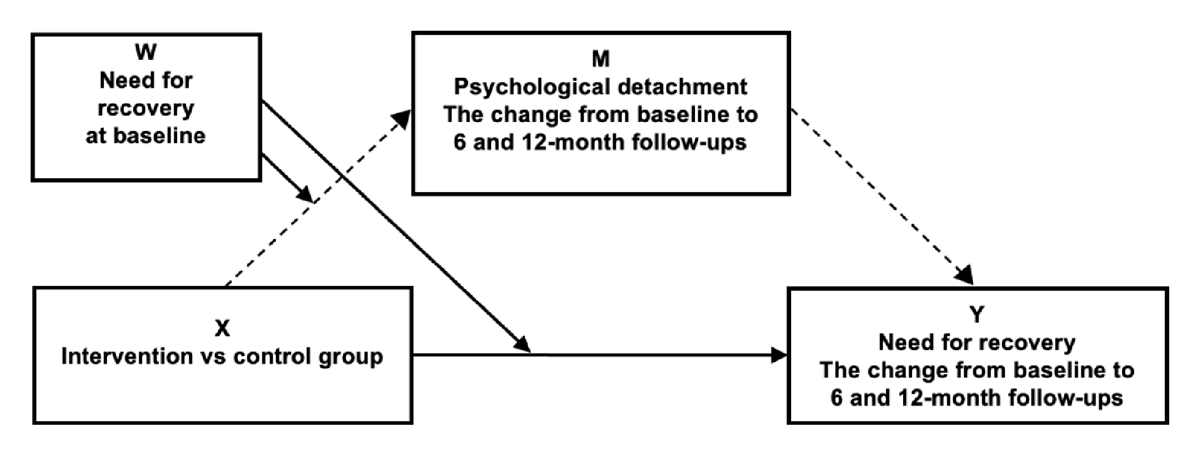
Figure 1
Conceptual illustration of the moderated mediation model addressed in hypotheses 1–2. Hypothesis 1 refers to the indirect effect of the intervention (X) on need for recovery (Y) through psychological detachment (M) at 6- and 12-month follow-ups. Hypothesis 2 refers to a moderation by need for recovery at baseline (W) of the indirect effects of the intervention on need for recovery at 6- and 12-month follow-ups.
Methods
Study design
We conducted a participative workplace intervention with a quasi-experimental design including an intervention group and a control group. Data were collected at baseline before the intervention and at 6- and 12-month follow-ups. The study is part of the research project ‘Flexible Work: Health-Promoting Interventions for Sustainable Digitalized Work’ (Bjärntoft et al. 2020; Bjärntoft et al. 2021; Edvinsson et al. 2023; Pagard et al. 2024).
Sample
The sample consisted of office workers with FWAs working at a Swedish governmental agency. The process of choosing participants was conducted jointly with stakeholders from the Human Resources department and the top management within the organization. A work environment and health survey from 2016 revealed that one division, consisting of 892 workers across 12 departments, had reported particularly high stress levels. All department managers within the division were informed about the intervention at workplace meetings and on the organization’s intranet. One department expressed interest in participating as the intervention group (n = 183). The high levels of stress reported in the 2016 survey likely influenced the department’s interest in participating. A control group (n = 161) was then chosen for its similarities with the intervention group in size and work tasks and because their contracts included FWAs to about the same extent (i.e., flextime or trust-based working hours). The employees within the two departments were geographically located at different offices. The intervention group was invited to participate in both the course and the workshop, whereas the control group did not receive any of the intervention activities. To be included in the analyses, participants had to participate in both parts of the intervention and complete the baseline questionnaire and at least one follow-up questionnaire. In total, 177 workers were excluded, leaving a final sample consisting, at baseline, of 97 participants in the intervention group and 70 in the control group (Figure 2).
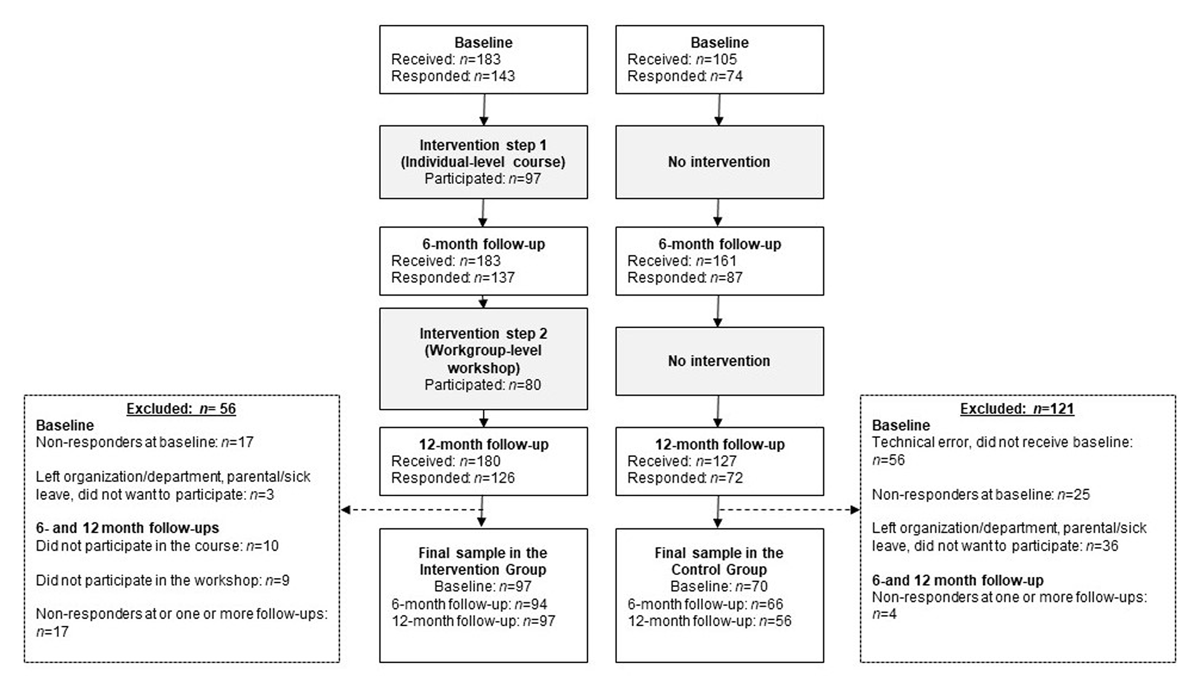
Figure 2
Flowchart illustrating the participants in the intervention and control groups who were included in the analysis after meeting the inclusion criteria (i.e., responding to the baseline questionnaire and at least one follow-up).
Intervention
The intervention tested in this study was developed and implemented in collaboration between the researchers and stakeholders in the target organization, based on two earlier phases in the research project that aimed at aligning the intervention activities with organizational needs and goals (Leask et al. 2019; von Thiele Schwarz et al. 2021). In the first phase (in 2016), we sent out a comprehensive questionnaire to all employees and managers with FWAs (n = 3,259) addressing working conditions and health in the organization (Bjärntoft et al. 2020; Edvinsson et al. 2023). After an initial analysis of the results, we performed focus group interviews in the second phase (in 2017) to collect ideas for interventions (Bjärntoft et al. 2021). The focus group interviews resulted in several suggestions on how to develop a better work environment and support the health of office workers with FWAs. These included, for instance, suggestions for a course in individual work strategies in FWAs, as well as an emphasis on the need to develop common rules and routines within the workgroup, with a particular focus on availability expectations (Bjärntoft et al. 2021). Based on the results from the first two phases and further discussions between the researchers and stakeholders in the organization (i.e., managers and HR representatives), the researchers, with support from the organization, designed and implemented the present workplace intervention. The organization’s long-term goal with the intervention was to reduce stress, promote recovery and work-life balance, increase work productivity, and reduce sick leave.
The intervention consisted of two consecutive steps: an individual-level course and a workgroup-level workshop. The course aimed at changing the participants’ work strategies by enhancing their abilities to work more efficiently with ICT and to manage boundaries between work and non-work time to better detach from work in FWAs. The course comprised instructions, practical demonstrations, and training in digital functions and tools in the Microsoft Office 365 productivity software (i.e., Outlook and OneNote) so that the workers could better organize their work, including managing emails, structuring and prioritizing tasks, minimizing interruptions, and enhancing work control. Additionally, the course encouraged the participants to create a sense of boundary control at the end of every workday. The course was held during three sessions: 1) a webinar covering the use of digital tools and functions (four hours); 2) an on-site seminar covering how to use digital tools and functions to minimize interruptions and support structuring, prioritizing, planning, and creating control by the end of a workday (eight hours); 3) a webinar dedicated to reinforcing and expanding the learned work strategies (four hours). Before each of the three sessions, the participants received information from the educator regarding the session’s content, purpose, and preparations, and an opportunity was offered to ask questions. The educator was also available for questions after each session. The course was offered over four months, from March to June 2019. It was given to 14 groups consisting of 8 to 14 participants. The course was developed and given by an external educator affiliated with a consulting company specialized in teaching individual work strategies and personal efficiency.
The workshop focused on strengthening the culture in the workgroup by developing and agreeing on common rules and routines within the workgroup (for example, regarding availability expectations). Workshops were offered between August and October 2019 to nine workgroups and their respective managers within the intervention department. One group was canceled due to a booking error. The remaining eight groups had 15 to 27 participants. The workshop was headed by a moderator with experience working in the organization. The workshop process model was based on a systematic methodology (Åteg et al. 2004), which was customized for the organization and pilot-tested on the managers in the department. Each workgroup was offered one workshop session. It lasted for about six hours, and the participants were physically present. The rules and routines that were developed during the workshop were specified in an action plan form, including the name and description of each rule/routine, its purpose, and how the group should make it work. If a given rule/routine was not completely described during the workshop, the action plan also included a description of when it should be completed and who should be responsible for ensuring that it would be completed. For a comprehensive description of the details of the intervention, see Figures S1 and S2 in Supplementary File 1.
Data collection
Data were collected using web-based questionnaires distributed by e-mail to both the intervention group and the control group on three occasions: at baseline, 3 months before the intervention; after the first step of the intervention (i.e., the individual-level course), 6 months after baseline; and after the second step of the intervention (i.e., the workgroup-level workshop), 12 months after baseline. The organization allowed participants to complete the questionnaire during working hours.
Measurements
The questionnaire included items for demographics and scales assessing work environment issues, recovery, and health. For the control group, it covered 20 main themes with a total of 225 items. The intervention group had an additional set of questions related to the intervention, resulting in 21 main themes with a total of 235 items. The participants were asked to give their answers based on experiences from the last month. The items not already published in Swedish were translated into Swedish by the authors. The items were then back-translated for validation purposes by one of the authors who is a native English speaker. The present study addresses the effects of the intervention on recovery as mediated by detachment and focuses on variables of relevance for the stated hypotheses. Other outcomes have been addressed in other studies within the overarching project (Pagard et al. 2024).
Need for Recovery
We used the Need for Recovery scale (Van Veldhoven 2008; Van Veldhoven & Broersen 2003) to measure NFR as an outcome of the intervention. The scale is sensitive to changes in work, particularly related to working hours (Van Veldhoven 2008), which aligns with the intervention activities. The scale includes 11 dichotomous (yes or no) items, such as ‘By the end of the working day, I feel really worn out’ and ‘Often, after a day’s work I feel so tired that I cannot get involved in other activities’. After reversal of one positively worded item, the sum of the individual scores (between 0 and 11) was transformed to a scale ranging from 0 (minimum) to 100 (maximum), where higher scores indicate more need for recovery. Employees scoring positives on 6 out of the 11 items (i.e., >54.5% on the 0–100 scale) were considered to have a high NFR, and employees scoring below this cut-off point were considered to have a low NFR. This cut-off point has been proposed to differentiate between a group with poor recovery and a group with adequate recovery, with the former being at risk of developing health problems (Van Veldhoven 2008). Internal consistency (Cronbach’s alpha) for the scale was .77 in our data.
Psychological Detachment
A Swedish version of the Recovery Experience Questionnaire (REQ) (Almén et al. 2018; Sonnentag & Fritz 2007) was used to measure the participants’ psychological detachment as an outcome of the intervention. We included four items: ‘During the time after work…1) ‘I forget about work’, 2) ‘I don’t think about work at all’, 3) ‘I distance myself from my work’, and 4) ‘I get a break from the demands of work’. The response scale ranged from ‘0: completely disagree’ to ‘4: completely agree’. Answers to the four items were averaged to create an index where higher scores indicate a larger extent of psychological detachment during non-work time. Cronbach’s alpha was .88 in our data.
Socio-demographic Variables and Covariates
Age (years), gender (‘0: man, or do not want to categorize’, ‘1: woman’), children at home (‘0: no children at home, ‘1: children at home’) were included as covariates in our analyses, as well as quantitative demands and work pace measured at baseline as these factors may be associated with recovery (Karabinski et al. 2021; Kiss et al. 2008; Lundberg 2002), and NFR at baseline (0–100). To measure quantitative demands, we used three items from the Copenhagen Psychosocial Questionnaire (COPSOQ) (Berthelsen & Westerlund 2014): 1) ‘Is your workload unevenly distributed so it piles up?’, 2) ‘How often do you not have time to complete all your work tasks?’ and 3) ‘Do you get behind with your work?’. To measure work pace, we used two COPSOQ items: 1) ‘Is it necessary to keep working at a high pace?’ and 2) ‘Do you work at a high pace throughout the day?’. Responses were: ‘0: never/almost never’, ‘1: rarely’, ‘2: sometimes’, ‘3: often’, and ‘4: always’. Answers to the items were averaged to create indices where higher scores indicate a larger extent of quantitative demands and work pace, respectively. Cronbach’s alpha was .80 for quantitative demands and .66 for work pace in our data.
For descriptive purposes, we also measured marital status (single/other and married/relationship), organizational position (manager, team leader, employee), employment rate (full-time: 100%, part-time: less than 100%), and work arrangement (flextime, trust-based working hours, other).
Statistical Analyses
The analyses were performed using the Statistical Package for the Social Sciences (SPSS, v.27 IBM, USA). Descriptive statistics (means with standard deviations, frequencies, and proportions) were used to describe the study sample. The extent of clustering was checked to determine whether multilevel analysis was relevant, but we did not find any critical clustering of data (ICC <.01) by units (i.e., workgroups within the department). Independent samples t-test (p) and Chi-Square test were used to assess differences between the intervention and control groups at baseline. Pearson correlations were used to examine associations between the study variables. The level of significance was set to p < 0.05.
The study hypotheses were tested using the PROCESS v4 macro for SPSS (Hayes 2018). The analyses considered two sets of models: one without and one with adjustment for age, gender, children at home, quantitative demands, work pace, and NFR at baseline. We tested a simple mediation model (i.e., model nr 4 in PROCESS) to investigate potential intervention effects on NFR mediated by a corresponding change in psychological detachment at 6- and 12-month follow-up (H1). A moderated mediation model (i.e., model nr 8 in PROCESS) was then run to test if the direct and indirect effects of the intervention on NFR at 6- and 12-month follow-ups were moderated by NFR at baseline (H2, illustrated in Figure 1). To measure the intervention effects on psychological detachment and NFR after the first step of the intervention (i.e., the course), and after the complete intervention (i.e., both the course and the workshop), we subtracted the baseline scores from the scores obtained at the 6- and 12-month follow-up, respectively. Two models (i.e., for the 6- and 12-month follow-up) were then constructed using group (intervention vs. control) as the predictor, the change in NFR as the outcome, and the change in psychological detachment as the mediator. For the moderated mediation model, we included the level of NFR at baseline as a moderator, with participants having an NFR score above 54.4 classified as ‘high NFR’ and others classified as ‘low NFR’ (after Van Veldhoven 2008). The extent of moderated mediation was determined using the index provided by Hayes (2018), which shows the mediation effect at different levels of the moderating variable. We included NFR at baseline as one of the covariates in the models to enhance the precision of the estimated change and minimize potential bias (CHMP 2015; Vickers & Altman 2001). The residuals from the multivariate analyses were visually inspected for normality using histograms, showing no marked deviations. We determined the intervention effects using estimates (beta) with 95% confidence intervals (CI). The intervention effect was considered statistically significant if the confidence interval did not include zero.
Results
Descriptive Statistics
Descriptive statistics for the sample at baseline are shown in Table S1; see Supplementary File 2. The intervention and control groups were comparable at baseline in age, marital status, children living at home, employment, organizational position, work arrangement, quantitative demands, and work pace. There were slightly more women in the control group (12%). All differences were small and not statistically significant (all p > 0.05). Descriptive statistics of the study variables describing psychological detachment and NFR are shown in Table 1. There were no marked or statistically significant differences at baseline between intervention and control groups in NFR and psychological detachment, suggesting baseline balance. The NFR mean scores did not substantially change from baseline to follow-ups when considering the whole group of office workers in the intervention group (0.6%) and control group (1,5%). Among participants with high NFR at baseline, those in the intervention group decreased their NFR by 12.5% from baseline to the 12-month follow-up, and those in the control group had a 2.5% decrease in NFR. Among participants with low NFR at baseline, those in the intervention group had a 6% increase in NFR, whereas the control group had a 2.2% increase from baseline to 12-month follow-up. Pearson correlations of the study variables are shown in Table S2 (Supplementary File 2). There were no statistically significant correlations between the intervention (‘group’ in Table S2) and any of the study variables. Changes in NFR were negatively correlated with changes in psychological detachment at both 6- and 12-month follow-ups. Among the covariates, gender, quantitative demands, and work pace were positively correlated with baseline NFR, while only gender showed a significant correlation with the change in NFR at follow-up.
Table 1
Descriptive statistics of the NFR and psychological detachment variables at baseline, 6-month follow-up, and 12-month follow-up in the intervention and control groups.
| BASELINE | 6-MONTH FOLLOW-UP | 12-MONTH FOLLOW-UP | Δ 6 MONTHS | Δ 12 MONTHS | ||||
|---|---|---|---|---|---|---|---|---|
| GROUP | VARIABLES | SCALE | n | MEAN (SD) | MEAN (SD) | MEAN (SD) | MEAN (SD) | MEAN (SD) |
| Intervention group | ||||||||
| Total | NFR | 0–100 | 97 | 36.2 (26) | 36.8 (28) | 36.8 (26) | 0.6 (21) | 0.3 (21) |
| Low NFR | NFR | <54.5 | 68 | 21.7 (13) | 26.7 (22) | 27.7 (22) | 4.8 (19) | 5.8 (19) |
| High NFR | NFR | >54.5 | 29 | 70.2 (11) | 60.4 (26) | 57.7 (24) | –9.4 (25) | –12.5 (21) |
| Total | PD | 0–4 | 97 | 2.6 (1) | 2.7 (1) | 2.6 (1) | 0.08 (1) | –0.02 (1) |
| Low NFR | PD | 0–4 | 68 | 2.9 (1) | 2.9 (1) | 2.8 (1) | –0.008 (1) | –0.2 (1) |
| High NFR | PD | 0–4 | 29 | 1.9 (1) | 2.2 (1) | 2.2 (1) | 0.3 (0.9) | 0.3 (1) |
| Control group | ||||||||
| Total | NFR | 0–100 | 69 | 34.3 (22) | 34.3 (27) | 32.8 (23) | 1.3 (15) | 1.2 (17) |
| Low NFR | NFR | <54.5 | 52 | 24.1 (13) | 23.6 (18) | 26.3 (19) | 0.2 (14) | 2 (16) |
| High NFR | NFR | >54.5 | 17 | 65.2 (12) | 69.8 (21) | 62.7 (17) | 4.5 (20) | –2.7 (20) |
| Total | PD | 0–4 | 69 | 2.4 (1) | 2.5 (1) | 2.5 (1) | 0.1 (1) | 0.02 (1) |
| Low NFR | PD | 0–4 | 52 | 2.7 (14) | 2.9 (1) | 2.8 (1) | 0.1 (1) | 0.1 (1) |
| High NFR | PD | 0–4 | 17 | 1.6 (1) | 1.8 (1) | 1.5 (1) | 0.2 (1) | –0.3 (1) |
[i] Note: NFR = Need for recovery, PD = Psychological detachment, Δ 6 months = The change score from baseline to 6-month follow-up (after the course), Δ 12 months = The change score from baseline to 12-month follow-up (after the course and the workshop). Baseline values are based on all participants, while follow-up values and change scores are based on those with data at each time point.
Indirect Intervention Effects without Moderation
Neither the course nor the addition of the workshop had any statistically significant direct effects on NFR in our tests of the entire group of office workers. Contrary to hypothesis 1a–b, the intervention had no unmoderated indirect effects on NFR via psychological detachment in the mediation analyses. The effect estimates from baseline to the 6-month follow-up (after the individual-level course) and 12-month follow-up (after adding the workgroup-level workshop) were small, and the 95% CIs included zero. Results did not substantially differ between the unadjusted and adjusted models. However, the changes in psychological detachment were negatively associated with the corresponding changes in NFR in both the 6-month (B = –6.34, CI –10.21 to –2.47) and 12-month follow-ups (B = –7.16, CI –11.18 to –3.15), indicating that increased detachment was associated with decreased NFR (Tables 2, 3).
Table 2
Total, direct, and indirect intervention effects on the NFR, with estimates for the simple mediation model and the moderated mediation model at 6-month follow-up.
| MODEL 1 | MODEL 2 | |||||||||
|---|---|---|---|---|---|---|---|---|---|---|
| n = 159 | n = 152 | |||||||||
| SIMPLE MEDIATION MODEL | B | β | t | p | CI (95%) | B | β | t | p | CI (95%) |
| Intervention → PD (a) | –0.06 | –0.08 | –0.51 | 0.61 | –0.30 to 0.18 | –0.08 | –0.11 | –0.66 | 0.51 | –1.12 to 0.67 |
| PD → NFR (b) | –6.92* | –0.27 | –3.55 | <0.001 | –10.77 to –3.07 | –6.34* | –0.25 | –3.24 | <0.001 | –10.21 to –2.47 |
| Constant | 1.94 | – | 0.38 | 0.71 | –8.23 to 12.10 | 0.12 | – | 0.01 | 0.99 | –20.93 to 21.16 |
| Total effect: Intervention → PD → NFR (c) | –0.68 | –0.04 | –0.22 | 0.83 | –6.78 to 5.43 | 1.83 | 0.10 | 1.59 | 0.56 | –4.33 to 7.98 |
| Direct effect: Intervention → NFR (c’) | –1.11 | –0.06 | –0.37 | 0.71 | –7.00 to 4.79 | 1.29 | 0.07 | 0.43 | 0.67 | –4.68 to 7.26 |
| Indirect effect: Intervention → PD → NFR (ab) | 0.43 | 0.02 | – | – | –1.31 to 2.17 | 0.54 | 0.03 | – | – | –0.95 to 2.37 |
| MODERATED MEDIATION MODEL | B | β | t | p | CI (95%) | B | β | t | p | CI (95%) |
| Intervention → PD (a) | –0.12 | – | –0.87 | 0.39 | –0.22 to 0.70 | –0.11 | – | –0.76 | 0.45 | –0.41 to 0.18 |
| PD → NFR (b) | –6.19* | – | –3.22 | 0.002 | –9.98 to 2.39 | –6.20* | – | –3.20 | 0.002 | –10.03 to –2.37 |
| Moderated direct effect (W1) | –17.44* | – | –2.64 | 0.009 | –30.49 to –4.40 | –15.24* | – | –2.29 | 0.02 | –28.41 to –2.09 |
| Low Baseline NFR: Intervention → NFR | 3.87 | – | 1.14 | 0.26 | –2.86 to 10.61 | 5.25 | – | 1.52 | 0.13 | –1.57 to 12.07 |
| High Baseline NFR: Intervention → NFR | –13.57* | – | –2.40 | 0.02 | –24.74 to –2.41 | –10.01 | – | –1.74 | 0.08 | –21.40 to 31.38 |
| Index of moderated indirect effect (W2) | –1.15 | – | – | – | –5.51 to 1.65 | –0.68 | – | – | – | –5.29 to 2.29 |
| Baseline NFR x Intervention → PD (interaction) | 0.19 | – | 0.67 | 0.50 | –0.36 to 0.73 | 0.11 | – | 0.38 | 0.71 | –0.46 to 0.68 |
| Low Baseline NFR: Intervention → PD → NFR | 0.76 | – | – | – | –0.86 to 2.90 | 0.70 | – | – | – | –1.02 to 3.09 |
| High Baseline NFR: Intervention → PD → NFR | –0.39 | – | – | – | –3.94 to 2.05 | 0.02 | – | – | – | –3.45 to 2.60 |
[i] Note: PD = Psychological detachment, NFR = Need for recovery, w = moderator (i.e., low/high NFR at baseline). Unstandardized (B) and standardized (β) intervention effects are reported (when they were accessible in the output) with 95% confidence intervals. Model 1 shows unadjusted values and Model 2 shows effects adjusted for age, gender, children at home, quantitative demands, work pace, and baseline NFR. A negative B indicates a decrease, and a positive B indicates an increase in the NFR and psychological detachment, respectively, in the intervention group compared to the control group. Statistically significant results (p < 0.05) are marked with *.
Table 3
Total, direct, and indirect intervention effects on the NFR, with estimates for the simple mediation model and the moderated mediation model at 12-month follow-up.
| MODEL 1 | MODEL 2 | |||||||||
|---|---|---|---|---|---|---|---|---|---|---|
| n = 151 | n = 143 | |||||||||
| SIMPLE MEDIATION MODEL | B | β | t | p | CI (95%) | B | β | t | p | CI (95%) |
| Intervention → PD (a) | –0.04 | –0.05 | 0.30 | 0.77 | –0.36 to 0.49 | –0.10 | –0.14 | –0.77 | 0.44 | –0.37 to 0.16 |
| PD → NFR (b) | –7.94* | –0.30 | –3.89 | <0.001 | –11.97 to –3.91 | –7.16* | –0.27 | –3.53 | <0.001 | –11.18 to –3.15 |
| Constant | 2.03 | – | 0.36 | 0.72 | –9.12 to 13.18 | 12.50 | – | 1.16 | 0.25 | –8.75 to 22.76 |
| Total effect: Intervention → PD → NFR (c) | –0.87 | –0.04 | –0.26 | 0.79 | –7.42 to 5.67 | 1.23 | –0.06 | 0.37 | 0.71 | –5.35 to 0.63 |
| Direct effect: Intervention → NFR (c’) | –1.19 | –0.06 | –0.38 | 0.71 | –7.44 to 5.07 | 0.50 | –0.09 | 0.16 | 0.88 | –5.85 to 6.85 |
| Indirect effect: Intervention → PD → NFR (ab) | 0.32 | 0.02 | – | – | –1.60 to 2.33 | 0.74 | 0.03 | – | – | –0.93 to 2.98 |
| MODERATED MEDIATION MODEL | B | β | t | p | CI (95%) | B | β | t | p | CI (95%) |
| Intervention → PD (a) | –0.26 | – | –1.81 | 0.07 | –0.53 to 0.02 | –0.28 | – | –1.90 | 0.06 | –0.58 to 0.01 |
| PD → NFR (b) | –6.59* | – | –3.27 | 0.001 | –10.58 to –2.60 | –6.83* | – | –3.28 | 0.001 | –10.94 to –2.71 |
| Intervention → NFR (c’) | 2.13 | – | 0.61 | 0.54 | –4.76 to 9.02 | 1.85 | – | 0.51 | 0.61 | –5.37 to 9.07 |
| Moderated direct effect (W1) | –7.78 | – | –1.02 | 0.31 | –26.31 to 26.61 | –4.72 | – | –0.60 | 0.55 | –20.16 to 10.72 |
| Low Baseline NFR: Intervention → NFR | 2.13 | – | 0.61 | 0.54 | –4.76 to 9.02 | 1.85 | – | 0.51 | 0.61 | –5.37 to 9.07 |
| High Baseline NFR: Intervention → NFR | –5.65 | – | –0.85 | 0.40 | –18.85 to 7.56 | –2.87 | – | –0.42 | 0.68 | –16.48 to 10.74 |
| Index of moderated indirect effect (W2) | –5.85* | – | – | – | –12.81 to –0.67 | –5.62* | – | – | – | –12.12 to –0.72 |
| Baseline NFR x Intervention → PD (interaction) | 0.89* | – | 2.93 | 0.004 | 0.29 to 1.49 | 0.82* | – | 2.60 | 0.01 | 0.20 to 1.45 |
| Low Baseline NFR: Intervention → PD → NFR | 1.68* | – | – | – | 0.02 to 4.20 | 1.93* | – | – | – | 0.04 to 4.78 |
| High Baseline NFR: Intervention → PD → NFR | –4.17* | – | – | – | –9.94 to –0.15 | –3.69 | – | – | – | –9.01 to 0.06 |
[i] Note: PD = Psychological detachment, NFR = Need for recovery, w = moderator (i.e., low/high NFR at baseline). Unstandardized (B) and standardized (β) intervention effects are reported (when they were accessible in the output) with 95% confidence intervals. Model 1 shows unadjusted values and Model 2 shows the effects adjusted for age, gender, children at home, quantitative demands, work pace, and baseline NFR. A negative B indicates a decrease, and a positive B indicates an increase in the NFR and psychological detachment, respectively, in the intervention group compared to the control group. Statistically significant results (p < 0.05) are marked with.
Indirect Intervention Effects with Moderation
Individuals with a high NFR at baseline had a reduced NFR after completing the intervention (Figures 3 and 4). At the 6-month follow-up, the direct effect of the individual-level course on NFR was moderated by baseline NFR, and the interaction estimate was pronounced and statistically significant (B = –15.24, CI –28.41 to –2.09). Completing the individual-level course was associated with a beneficial reduction in NFR of about 10 units (on a scale from 0 to 100) in participants in the intervention group with a high baseline NFR, while the estimate for low baseline NFR was positive (see moderated direct effects of ‘Low NFR and ‘High NFR’ in Figure 3 and Table 2). In contrast to hypotheses 2a–b, the model indicated no moderated indirect effects of the intervention on NFR via psychological detachment. The CIs included zero in the index for moderated mediation in both the unadjusted model (B = –1.15, CI –5.51 to 1.65) and the model adjusted for age, gender, children at home, quantitative demands and work pace (B = –0.68, CI –5.29 to 2.29) (Figure 3 and Table 2).
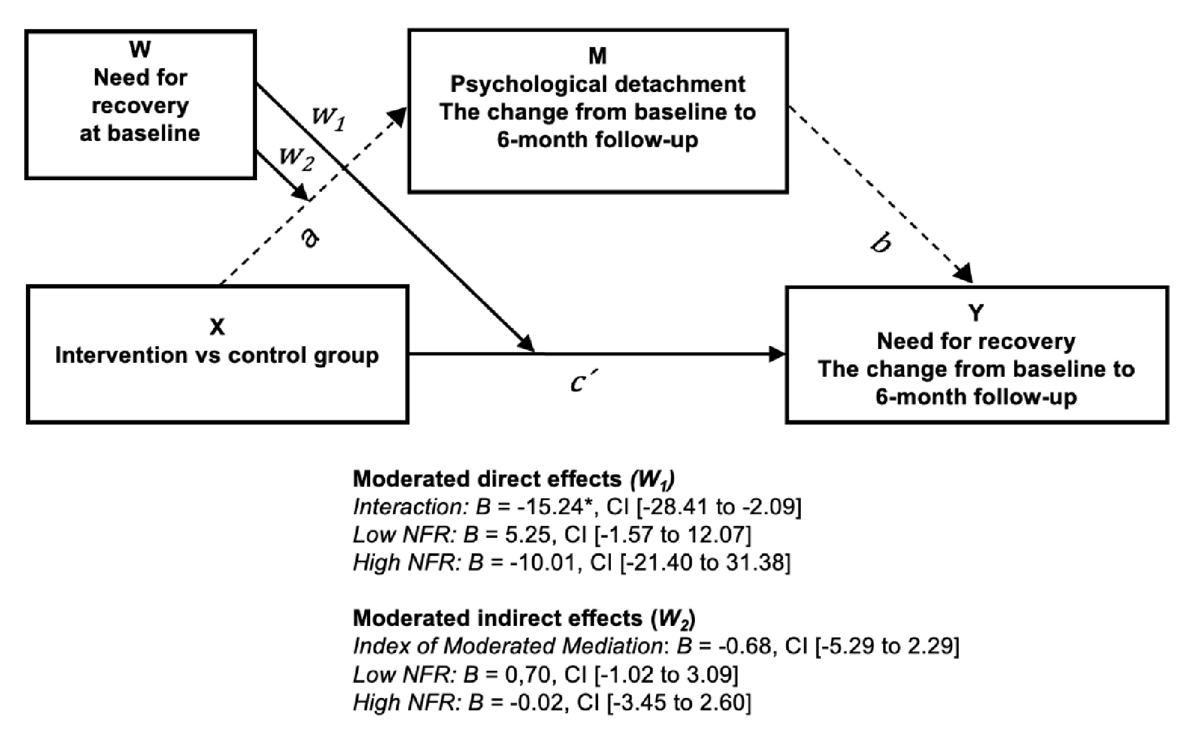
Figure 3
Results from the moderated mediation model for the test of hypothesis 2a (n = 152) on the change in need for recovery (NFR) at the 6-month follow-up. The figure shows estimates (unstandardized B coefficients) with 95% confidence intervals for the moderated direct effects of the intervention on NFR, as well as the moderated indirect effects on NFR through psychological detachment. A negative B means a decrease, and a positive B means an increase in the need for recovery and psychological detachment, respectively, in the intervention group compared to the control group. Statistically significant results with 95% CIs are marked with *. Values are adjusted for age, gender, children at home, quantitative demands, work pace, and baseline NFR.
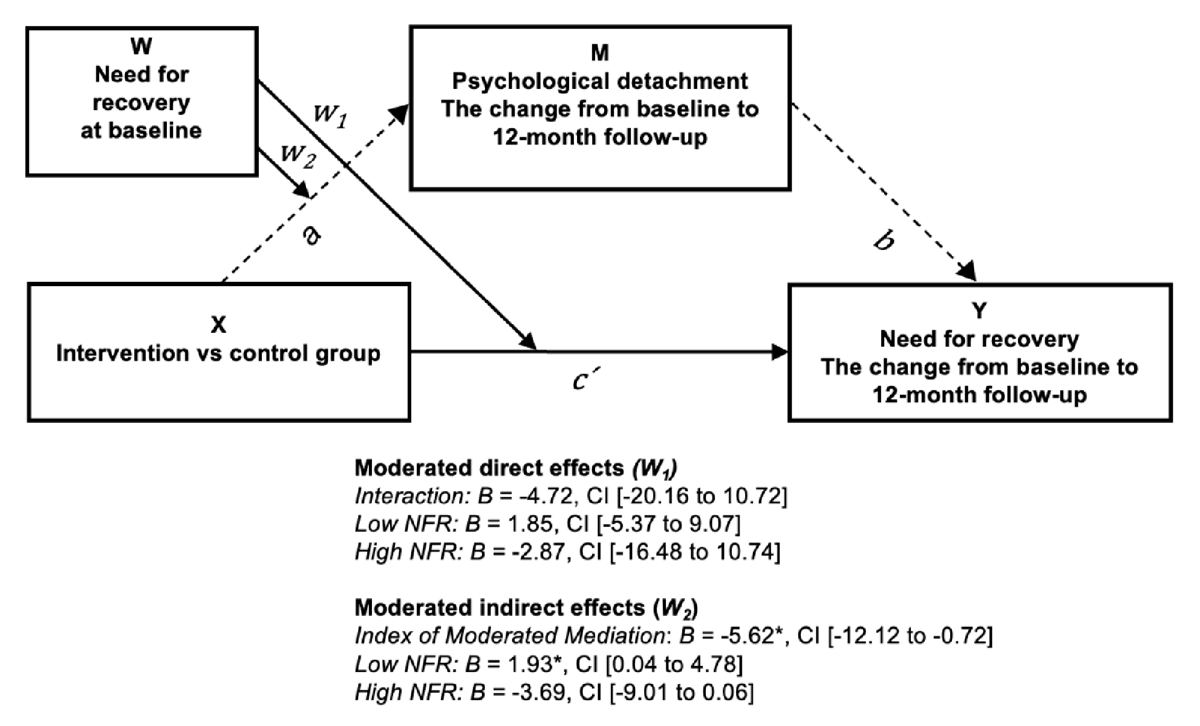
Figure 4
Results from the moderated mediation model for the test of hypothesis 2b (n = 143) on the change in need for recovery (NFR) at the 12-month follow-up. The figure shows estimates (unstandardized B coefficients) with 95% confidence intervals for the moderated direct effects of the intervention on NFR, as well as the moderated indirect effects on NFR through psychological detachment. A negative B means a decrease, and a positive B means an increase in the need for recovery and psychological detachment, respectively, in the intervention group compared to the control group. Statistically significant results with 95% CIs are marked with *. Values are adjusted for age, gender, children at home, quantitative demands, work pace, and baseline NFR.
At the 12-month follow-up (Figure 4), after completing both the individual-level course and the workgroup-level workshop, the direct effect of the intervention on NFR was no longer moderated by baseline NFR (B = –4.72, CI –20.16 to 10.72). However, in agreement with hypothesis 2, we found that the magnitude of the indirect effect of the intervention to reduce NFR via increased psychological detachment depended on baseline NFR. The index of moderated mediation was negative and statistically significant (B = –5.62, CI –12.12 to –0.72). Moreover, the conditional indirect effects pointed in different directions for those with low (B = 1.93, CI 0.04 to 4.78) and high NFR at baseline (B = –3.69, CI –9.01 to 0.06), although the 95% CI included zero for the group with high baseline NFR (Figure 4 and Table 3).
Discussion
This study aimed to examine the effects of a workplace intervention designed to facilitate psychological detachment and promote recovery in office workers with FWAs. The intervention was co-created with the target organization and implemented at both individual- and workgroup levels; it introduced new individual work strategies and common rules and routines within the workgroup. Based on theories about psychological detachment and recovery in the context of FWAs (Agolli & Holtz 2023; Schlachter et al. 2018), the intervention included two steps: first, a course for individual workers on using digital tools and functions to enhance their abilities to work more efficiently with ICT, to manage boundaries between work and non-work time, and so to better detach from work; second, a workshop with workgroups to develop common rules and routines with a focus on availability expectations among workgroup members. Overall, our tests did not find that the intervention significantly reduced the NFR for the entire group of office workers with FWAs. However, the intervention was effective for individuals who initially experienced high levels of NFR. This result suggests that those with greater NFR before the intervention were indeed helped by the implementation of new work strategies and common rules and routines, resulting in better recovery from work. The absence of overall intervention effects on NFR may result from the complexity of implementing interventions in organizational settings (Aust et al. 2023). While the co-creation approach created an attractive intervention for the organization, it may have also increased the risk of the intervention not fully aligning with a program logic that would lead to the desired outcomes. Consequently, issues in the design and contents of the intervention may have prevented it from achieving the expected results on detachment and NFR.
The intervention activities targeted both the individual- and workgroup-levels, an approach considered effective in enhancing employee resources (Nielsen & Christensen 2021). However, implementing interventions at the organizational level might have aligned the present intervention better with the participants’ needs, which is crucial for the success of interventions (Herrera-Sánchez et al. 2017; von Thiele Schwarz et al. 2021). During the focus groups that informed the intervention, nearly all groups of participating employees suggested intervention activities at the organizational level, such as establishing a shared vision, making common guidelines for FWAs, and developing a leadership adapted to flexible work (Bjärntoft et al. 2021). Despite these suggestions, the intervention activities were focused on the individual- and workgroup-levels, and activities at the higher organizational level were deprioritized in the co-creation process. While the leadership and stakeholders within the organization and the research team did discuss initiatives at the organizational level, resource limitations (e.g., money and time) prevented their implementation, and the decision was made to prioritize the activities in the eventual course and workshops.
Concerning the content of the intervention, the course and workshops focused solely on providing work strategies to increase individual and workgroup resources and to better manage job demands without any activities at any level explicitly aimed at reducing job demands. From a theoretical perspective, reducing demands is crucial to facilitating recovery processes (Meijman & Mulder 1998). Additionally, according to the Job Demands-Resources model, interventions are likely to be more effective when they simultaneously target both demands and resources at multiple organizational levels (Nielsen & Christensen 2021). Including activities at the organizational level to reduce job demands might have contributed to a more theoretically complete and practically effective intervention. However, the course and the workshops combined multiple components aiming to facilitate psychological detachment from work, such as limiting work-related ICT use outside of regular working hours, reducing expectations of constant availability for work, and training on boundary management techniques (Agolli & Holtz 2023). Strategies to promote psychological detachment can replenish resources even under high demands (Minkkinen et al. 2021). Yet, contrary to our first hypothesis, we did not find the intervention to promote recovery through an indirect effect of psychological detachment experienced by all the workers (see indirect effect (ab) in Tables 2, 3). The lack of success of the intervention activities in facilitating psychological detachment may indicate that some workers with FWAs may have difficulties in detaching from work (Mellner 2016). Nonetheless, we did find one general effect looking across the two groups: an increase in psychological detachment at both the 6- and 12-month follow-up was associated with a decrease in NFR (see PD → NFR (b) in Tables 2, 3), thus affirming previous research that greater detachment benefits recovery (Bennett et al. 2018; Sonnentag & Fritz 2015; Wendsche & Lohmann-Haislah 2017).
Although our findings did not reveal any general indirect effect on NFR through detachment for the whole intervention group, we did find support for our second hypothesis: that the indirect effects of the intervention on NFR would be moderated by NFR at baseline, both at 6- and 12-month follow-ups. Specifically, the adjusted model for the 6-month follow-up revealed a notable moderated direct effect after the individual-level course, such that participants with high NFR at baseline reduced their NFR by about 10%, while the participants with low NFR increased their NFR by about 5%. This result indicates that individuals with a high NFR indeed were helped in reducing their NFR from the individual-level course that introduced new work strategies. While the direct intervention effect was moderated by baseline NFR (B = –15.24, CI –28.41 to –2.09) (see W1 ‘Interaction’ in Figure 3), the moderated mediation through psychological detachment was not statistically significant at the 6-month follow-up (see W2 ‘Index of moderated mediation’ in Figure 3). This evidence, in the absence of moderated mediation, suggests that the individual-level course worked through a mediating process other than one that generated more psychological detachment.
At the 12-month follow-up, the moderated direct effect was less pronounced and not statistically significant (see W1 ‘Interaction’ in Figure 4); however, we found statistically significant moderated mediation through psychological detachment, indicating that the beneficial effect of the complete intervention on NFR among workers with a high NFR before the intervention acted through improved psychological detachment from work (see W2 ‘Index of moderated mediation’ in Figure 4). The result remained robust when accounting for age, gender, the presence of children at home, the level of quantitative demands, and work pace as well as baseline NFR. Possibly, the addition of the workgroup-level workshops contributed to a stronger effect on psychological detachment compared to the course alone, since workplace interventions are more likely to be effective when implemented at multiple levels in the organization (Herrera-Sánchez et al. 2017). Also, occupational health interventions may require some time before having effects on working conditions and well-being, since employees sometimes need time to adapt to the changes to fully benefit and feel empowered by them (Nielsen et al. 2010), which may support that this indirect effect emerged at the 12-month follow-up.
Overall, our results did not show significant effects across the entire intervention group while demonstrating improvements in those workers with the greatest need for help in detaching and recovering (cf. Karabinski et al. 2021). Note that individuals with low respectively high NFR at baseline experienced changes in opposite directions from baseline to the 6- and 12-month follow-ups; this may have contributed to the overall null effect observed in our analyses of the entire group.
Strengths and Limitations
Strengths of this study are the longitudinal design and that we involved representatives from all levels in the organization when developing the intervention, which contributed to aligning the intervention with the organization’s preferences (Leask et al. 2019). The intervention addressed work strategies that have the potential to promote recovery (Agolli & Holtz 2023), which were implemented at the individual and workgroup levels, in line with recommendations to target multiple levels in the organization when designing workplace interventions (Nielsen & Christensen 2021). Moreover, the two participant groups were selected from two comparable departments with similar work tasks. Regarding measurement, we used a scale (NFR) to assess recovery that has been found sensitive to changes in work, particularly related to working hours (Van Veldhoven 2008), which corresponds with our intervention activities.
Still, the study suffered some limitations. Workplace interventions are complex, and it is not possible in practice to conduct an intervention study that meets all the ‘ideal standards’ for intervention study design and evaluation (Schelvis et al. 2015). First, a consequence of using a participatory approach when designing and implementing interventions is that they may be adapted only to a specific context, which may limit the generalizability of the results to other organizations. Furthermore, the intervention and control groups should ideally be randomized. The sampling strategy in this study, however, used a convenience sample of two comparable departments within the same division, selected by the organization due to high levels of workload and stress. This may hamper the generalizability of results for the whole organization. Further, the control group should not be aware of the ongoing intervention activities, but this was not possible for practical reasons. We had no control over internal communication across the intervention and control groups. Thus, it is possible that the control group was informed about the intervention activities, which may have resulted in attenuated effects due to contamination (Magill et al. 2019). Also, the small sample size limited statistical power, particularly in the moderation analyses on sub-groups with low and high NFR and adjustments for multiple covariates. The sampling process for this study was not initially designed to examine subgroups, but attention to individuals experiencing initial challenges at baseline is a recommended approach in intervention studies (Karabinski et al. 2021). It helps determine who benefits the most from the intervention activities, thus providing richer information regarding the implementation. Furthermore, this study lacks a process evaluation, which might have given us insight into changes within the organization that could have contributed to a more nuanced understanding of the implementation and the outcomes (Nielsen et al. 2006). Information on stakeholders’ (such as middle managers) and participants’ impressions of the design, implementation, and effectiveness of the intervention would have been useful to iteratively develop a more successful implementation process (Leask et al. 2019). Also, we could not exclude that other organizational changes outside the scope of the research project could have contributed to ‘noise’ that made it more difficult to interpret the intervention effects.
Future Research
With the increasing prevalence of FWAs in organizations, intervention studies on promoting recovery in FWAs are in demand. For the design of interventions, we suggest that researchers further test interventions that combine activities on multiple levels to increase job resources and decrease job demands simultaneously. Additionally, intervention activities should be implemented at the organizational level if requested by the employees, and researchers would do well to document the circumstances in which such requests do not translate into actions. Further regarding the implementation of interventions, we encourage researchers to not only examine the intervention effects but also conduct a process evaluation to show more in detail why the intervention may work for some workers, but not for others (Burdorf 2023; von Thiele Schwarz et al. 2021). Furthermore, researchers should evaluate intervention effects not only with self-reports but also with direct measurements of behavioral (e.g., physical activity behaviors) and physiological indicators of recovery (e.g., stress hormones, blood pressure, and/or heart rate variability).
Practical Implications
Enabling employees to detach from work and thus experience better recovery is a common challenge for many organizations offering FWAs. To face the opportunities and challenges accompanying FWAs, employers need to support strategies at different levels in the organization that have the potential to promote recovery from work. In this study, the present intervention was effective in promoting recovery only for employees with a high need for recovery. Since employees at all levels in the organization had requested an intervention at the organizational level (e.g., developing organizational policies and developing the leadership in FWAs), the addition of intervention activities at a higher organizational level might have been more effective in promoting recovery. From a theoretical perspective, employee recovery may be promoted best by a combination of intervention activities that simultaneously reduce work demands and activities that help employees to develop work strategies to manage the demands. Furthermore, we encourage organizations to support compliance when implementing interventions. Changes in work strategies for the individual may require continued support by the organization beyond the period of the intervention and regular discussions within the workgroup to secure a sustained change of culture.
Conclusions
The present study showed that combining an individual-level course providing new work strategies with a workgroup-level workshop addressing common rules and routines in flexible work did not improve psychological detachment and need for recovery for the entire intervention group of office workers with flexible work arrangements. However, individuals who initially experienced high levels of need for recovery benefited substantially more from the intervention. Future studies should focus on identifying the characteristics of successful interventions and the conditions under which interventions can be most effective in improving psychological detachment and reducing the need for recovery. We encourage researchers to further test interventions that simultaneously increase job resources and decrease job demands in office workers with flexible work, including intervention activities at the organizational level, as well as individual and workgroup levels.
Data Availability Statement
The dataset analyzed during the current study are available from the corresponding author only upon reasonable request.
Additional Files
The additional files for this article can be found as follows:
Supplementary File 1
Description of the Intervention Activities (Figures S1–S2). DOI: https://doi.org/10.16993/sjwop.339.s1
Ethical Considerations
The study was approved by the Swedish Ethical Review Authority (2017/528). All participants provided their informed consent when they responded to the questionnaires.
Acknowledgements
We are grateful to all participants from the Swedish Transport Administration for taking part in this study. Also, we are particularly grateful to Camilla Zetterberg, Johan Larsson, Bengt Pontén, Mansur Köyluoglu, and Lina Hammarström for their valuable contributions to the research project.
Open Access
Open access funding was provided by the University of Gävle.
Competing Interests
The authors have no competing interests to declare.
Author Contributions
All authors contributed to the study’s conception and design. Preparation and data collection were performed by Johanna Edvinsson and Sophie Pagard. The analysis was performed by Johanna Edvinsson. Funding acquisition and initial project coordination were performed by Helena Jahncke. The first draft of the manuscript was written by Johanna Edvinsson and all authors commented on previous versions of the manuscript. All authors read and approved the final manuscript.