
Research shows a connection between employee workload and harmful stress experiences, such as exhaustion and job burnout (Alarcon 2011; Crawford, LePine & Rich 2010; LePine, Podsakoff & LePine 2005). Recovery from work demands, e.g., during breaks, evening hours, and holidays, plays an essential protective role in this relationship and can help employees to maintain their health and well-being (Bennett, Bakker & Field 2018; Zijlstra & Sonnentag 2006). Recovery experiences refer to the psychological processes leading up to recovery (i.e., psychological detachment, relaxation, mastery, and control; Sonnentag & Fritz 2007) and have been linked to various positive outcomes such as improved mental well-being and increased personal resources (e.g., self-efficacy), as well as to better job performance through a reduction of exhaustion and an increase of work engagement (Bennett, Bakker & Field 2018; Headrick et al. 2022; Steed et al. 2021). However, there is a ‘recovery paradox’: High work demands, which lead to a high need for recovery, simultaneously inhibit employees’ recovery processes (Sonnentag 2018). Therefore, identifying employee and job characteristics and behaviors that play a buffering role in this paradoxical relationship is vital to better support employees in sustaining high levels of health and well-being.
Proactive crafting efforts across life domains may help buffer the negative effects of workload on recovery by optimizing resources and fulfilling psychological needs in both work and personal life (Kujanpää et al. 2022; Tims & Bakker 2010). Employees can craft their jobs (job crafting) by seeking feedback for social resources, taking on challenging tasks for increased demands, and breaking down complex tasks to reduce hindrances. (Tims, Bakker & Derks 2012; Tims & Bakker 2010). Employees can also craft their lives outside of work (off-job crafting). For instance, they can focus on recovering by participating in relaxing or challenging activities, such as reading or physical exercise (crafting for relaxation or crafting for mastery). A previous study identified three crafting profiles (Active, Average, and Least Active Crafters) based on job and off-job crafting strategies that reflect how individuals distribute their crafting efforts (Ho et al. 2024). Compensatory crafting profiles (with a strong focus on crafting in one life domain) were hypothesized, yet no differences were found, as the identified profiles differed only quantitatively (i.e., in mean levels), not qualitatively. Open questions remain towards associations between crafting profiles and other work experiences, e.g., recovery. In this study, we will re-explore the crafting profiles and scrutinize their role for the long-term workload-recovery association.
Research on employee crafting efforts, both on and off the job, has rarely explored their role in the workload-strain relationship (Otto et al. 2019; Pijpker et al. 2022; Rudolph et al. 2021). Previous research has identified moderators in the workload-recovery association related to attentional processes, personal resources, and job resources (Sonnentag & Fritz 2015), e.g., state mindfulness (Haun, Nübold & Bauer 2018), as well as co-worker social support (Schulz, Schöllgen & Fay 2019). However, these moderators focus on existing resources. Crafting research constitutes a conceptual shift towards viewing employees as agentic beings and recognizes that employees actively influence their work experiences, including demands and resources (Tims & Bakker 2010; Wrzesniewski & Dutton 2001). Further, crafting is a valuable strategy for addressing individual challenges in various life domains, especially in modern work environments with high autonomy, where organizational strategies like top-down job design might reach their limits (de Bloom et al. 2020). Moreover, employee crafting is a behavior that can be encouraged through low-cost interventions (e.g., Sakuraya et al. 2016; van den Heuvel et al. 2015; van Wingerden et al. 2017). Therefore, to support recovery in modern times, it may be crucial to understand the potential buffering role of proactive crafting efforts across life domains for the workload-recovery association.
To understand the combined role of crafting across life domains for the workload-recovery association, we consider job and off-job crafting profiles (Ho et al. 2024). This person-centered perspective acknowledges that crafting efforts do not occur in isolation but in distinct combinations of crafting across life domains. Profiles thereby combine unique constellations or interrelations between crafting, which offers novel insights into the combined role of crafting across life domains and between-person differences for the workload-recovery association. To conclude, we investigate the role of crafting profiles for the long-term workload-recovery association over a three-month period, a timeframe longer than applied in previous workload-recovery studies (Sonnentag, Cheng & Parker 2022). Our research model is presented in Figure 1.
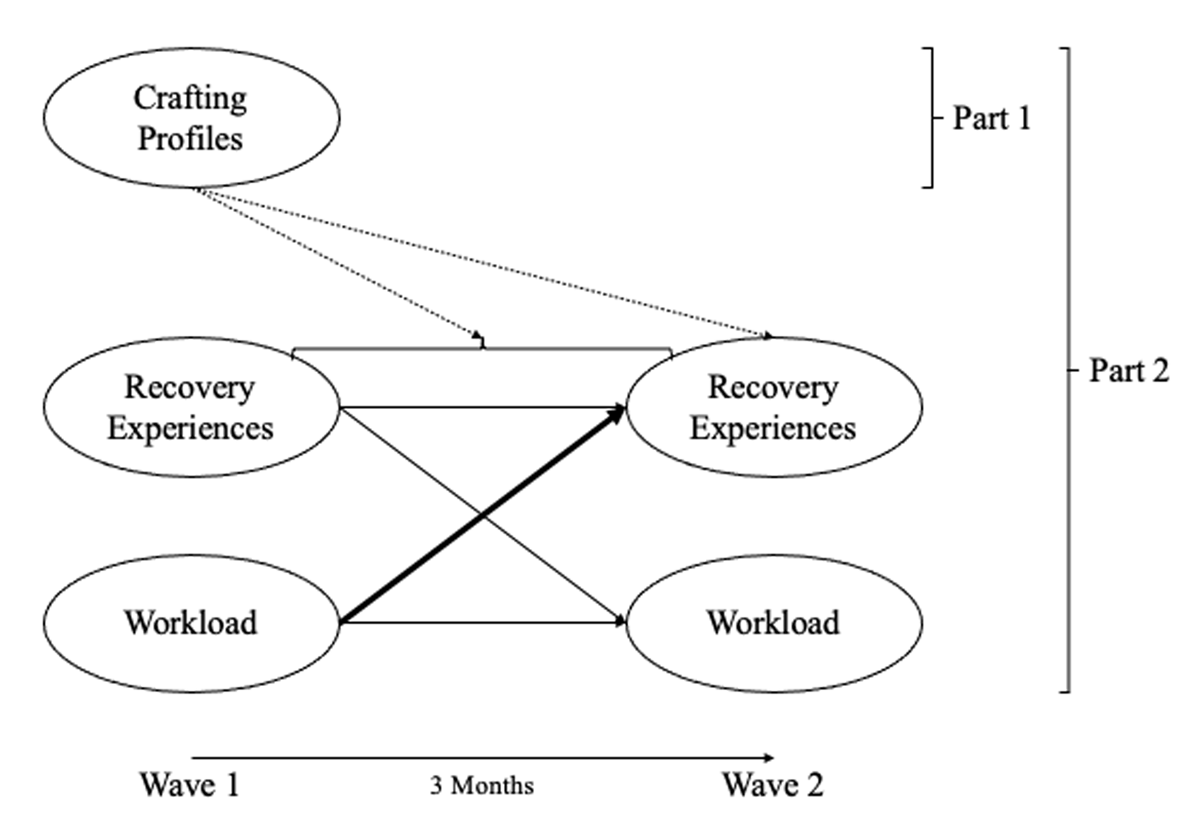
Figure 1
Research Model.
Note. Part 1 of this study focuses on job and off-job crafting profiles. Part 2 focuses on the role of the crafting profiles for the long-term relationship between workload and recovery experiences while accounting for the stability of these constructs. The bold line between workload at Wave 1 and recovery experiences at Wave 2 is of particular interest. Additionally, the broken line between crafting profiles and recovery experiences indicates that mean differences in recovery experiences between the crafting profiles will be assessed with auxiliary analyses.
Our study makes three crucial contributions to the literature. First, we combine crafting and recovery research and introduce crafting profiles as a novel moderator. To the best of our knowledge, no study so far has examined moderators in the long-term workload-recovery association. As outlined before, investigating crafting across life domains in the interplay between work experiences and recovery is important for three reasons:
We acknowledge employees as agentic beings (Tims & Bakker 2010; Wrzesniewski & Dutton 2001) and consider their own efforts to shaping experiences both in the job and off-job domain for their recovery.
In the increasingly complex modern world, crafting is a valuable strategy for addressing individual challenges and may complement organizational strategies that might reach limits (de Bloom et al. 2020).
Research already established the effectiveness of low-cost interventions to encourage crafting (e.g., Sakuraya et al. 2016; van den Heuvel et al. 2015; van Wingerden et al. 2017), therefore recovery intervention may benefit by integrating and encouraging proactive crafting as well.
Second, our study addresses the workload-recovery association from a longer-term (three month) perspective and potential moderators of this relationship (Sonnentag, Cheng & Parker 2022). Recent meta-analyses have reported negative associations between job demands and recovery experiences, mostly limited to either cross-sectional or short-term diary studies (Bennett, Bakker & Field 2018; Steed et al. 2021). By adopting a longer time frame to examine the workload-recovery link, this study contributes to the understanding of how chronic workload relates to recovery over time, rather than focusing solely on short-term fluctuations. Accordingly, this approach offers a more comprehensive view of sustained employee well-being. Two notable studies employing a long-term perspective suggest that job demands are linked to detachment and relaxation over two months and over a one-year time lag (Kinnunen & Feldt 2013; Meier & Cho 2019). Our study aims to corroborate and expand these findings, as we will integrate all recovery experiences (detachment, relaxation, mastery, and control) in this study (Sonnentag & Fritz 2007).
Our third contribution lies in continuing the stream of research regarding crafting across life domains (Brauchli et al. 2022; Haun, Mülder & Schmitz 2022; Ho et al. 2024; Petrou & Bakker 2016), as proposed by de Bloom et al. (2020). Following the approach by Ho et al. (2024), we combine the well-established Job Demands-Resources Model (JD-R; Bakker & Demerouti 2007; Demerouti et al. 2001) for job crafting with the newer DRAMMA needs framework (Newman, Tay & Diener 2014) for off-job crafting to provide a comprehensive perspective on crafting efforts across life domains. Our approach thus also captures experiences individuals craft for outside of work, such as detaching from work or finding meaning (Kujanpää et al. 2022), that are not captured by other conceptualizations of crafting that often closely mirror the JD-R model, e.g., home or leisure crafting (Demerouti et al. 2020; Petrou, Bakker & van den Heuvel 2017; Petrou & Bakker 2016). Therefore, our study examines crafting across life domains following the approach-avoidance perspective of crafting (Bruning & Campion 2018) as an integrative framework and thus bridging state-of-the-art theoretical models.
Background
Part 1: Crafting efforts in different life domains and crafting profiles
Proactive crafting efforts in the job but also in the off-job domain can help employees address challenges of modern working life, however, their joint contribution to health-related outcomes for employees has been scarce in existing literature so far (de Bloom et al. 2020; for exceptions, see: Brauchli et al. 2022; Ho et al. 2024). In the work domain, job crafting linked to the Job Demands-Resources model (JD-R; Bakker & Demerouti 2017; Demerouti et al. 2001) was proposed as an individual strategy to ensure a good fit between one’s job, skills, and needs by reducing job demands and increasing job resources (Rudolph et al. 2017; Tims & Bakker 2010; Vogt et al. 2016; Wrzesniewski & Dutton 2001). In recent years, job crafting has been investigated intensively, demonstrating mainly beneficial relationships to work-related health outcomes, e.g., positive associations with work engagement and negative associations with job strain (Rudolph et al. 2017).
Earlier efforts have been made to review crafting behaviors outside of the job domain closely mirroring the JD-R conceptualization (e.g., leisure or home crafting) (Demerouti et al. 2020; Petrou, Bakker & van den Heuvel 2017; Petrou & Bakker 2016), but we note that this view misses some essential experiences that individuals might craft for, e.g., detaching from work or meaning (Kujanpää et al. 2022). Therefore, we will focus on the recent conceptualization of off-job crafting (Kujanpää et al. 2022), which builds on the needs-based model of crafting (de Bloom et al. 2020). This model refers to the DRAMMA needs (Newman, Tay & Diener 2014) of detachment, relaxation, autonomy, mastery, meaning, and affiliation. According to this model, need satisfaction is not a ‘passive [experience], but can […] be proactively crafted for’ (Kujanpää 2022, p. 10). The DRAMMA needs also contain facets from the earlier recovery experiences concept (Sonnentag, Cheng & Parker 2022; Sonnentag & Fritz 2007). We refer to different conceptualizations for crafting to reflect that crafting in each life domain is unique. The theories may, complement each other by considering both from an approach-avoidance perspective (Bruning & Campion 2018). Avoidance crafting occurs in both life domains as crafting for detachment and relaxation (i.e., off-job crafting) and reducing hindering job demands (i.e., job crafting), and approach crafting is reflected as crafting for mastery (i.e., off-job crafting) and increasing challenging job demands (i.e., job crafting), as well as crafting for autonomy, affiliation, and meaning (i.e., off-job crafting) and increasing job resources (i.e., job crafting).
A recent study focusing on the effects of the COVID-19 pandemic found crafting behaviors in both the job and off-job domain to be protective for health and well-being. However, the study focused separately on high vs. low crafters in the job and off-job domains (Brauchli et al. 2022), limiting our understanding of how individuals tend to allocate their crafting efforts across life domains.
Studies may refer to person-centered analysis (i.e., Latent Profile Analysis, LPA; Marsh et al. 2009) to examine common patterns in the allocation of crafting efforts across life domains. LPA aim to ‘identify potential subpopulations presenting differentiated configurations (or profiles) with regard to a system of variables’ (Meyer & Morin 2016, p. 584). Further, this approach recognizes that, in reality, many characteristics often occur concurrently, and unique configurations are more likely to explain variance instead of simple main effects (as in traditional regression analyses) (Bauer & Shanahan 2007). A person-centered approach aims to retain naturally occurring distinct populations as, e.g., latent profiles. We build our study on previous work that examined job and off-job crafting profiles and their time-lagged associations with mental well-being and work engagement (Ho et al. 2024). While the study expected compensatory crafting profiles, where individuals mainly craft in one life domain, it identified three quantitatively different profiles: Active, Average, and Least Active Crafters (Ho et al. 2024). As expected, mean levels of mental well-being and work engagement were higher for those crafting more actively. In our study, we re-examine the crafting profiles (see ‘Data Usage and Relation to Prior Publication’ for details), allowing the possibility of Compensatory Crafters emerging in a larger sample, as it is possible that this constitutes a smaller group of employees. Specific to the nature of LPA, it is worth noticing that it is a priori unclear how many meaningful profiles can be extracted (Meyer & Morin 2016). Nevertheless, we pose our first hypothesis similar to the one by Ho et al. (2024):
H1: We suggest the existence of at least five crafting profiles: Active Crafters in both domains, Least Active Crafters in both domains, Average Crafters in both domains, and Compensatory Crafters crafting high in one and low in the other domain.
Part 2: Crafting profiles as moderators in the workload-recovery relationship
Long-term association between workload and recovery experiences
Workload is linked to impaired recovery from work, leading to difficulties such as insufficient detachment and low energy to engage in further recovery activities (Bennett, Bakker & Field 2018; Sonnentag 2018; Steed et al. 2021). Most research has focused on short-term, e.g., day-level, effects (Bennett, Bakker & Field 2018), with less attention on long-term associations and moderators (Sonnentag, Cheng & Parker 2022). For day-to-day and up to week-level experiences, it was previously argued that when employees experience high workload, they must invest a considerable number of resources to handle these demands (Meijman & Mulder 1998). The need for recovery due to workload can be explained by the straining pathway of the Conservation of Resources theory (COR; Hobfoll 1989), where loss of resources occurs due to the resource investment required to handle job demands.
Recovery unfolds in two ways: Through detachment and relaxation, where individuals deactivate their cognitive and nervous systems, and through mastery and control, where they actively build resources to handle future demands (Sonnentag & Fritz 2007). High workload increases the need for recovery, but employees often struggle to recover due to the ‘recovery paradox’ (Sonnentag 2018). On busy days, it’s harder to engage in activities that promote mental detachment or skill-building, hindering their recovery (Sonnentag & Fritz 2007; Zijlstra & Sonnentag 2006).
Over longer periods (e.g., a couple of weeks or months), sustained high workload likely also negatively impacts recovery due to ongoing resource depletion. Although short-term recovery experiences can help maintain resources for following days (Bennett, Bakker & Field 2018; Steed et al. 2021), these experiences may not compensate for cumulative losses. Indeed, previous studies indicate that workload is negatively associated with detachment over two months (Meier & Cho 2019) and that job demands are negatively associated with detachment, relaxation, and control over a one-year time lag (Kinnunen & Feldt 2013). Accordingly, we hypothesize:
H2: Workload is negatively associated with subsequent recovery experiences.
Crafting profiles moderating the workload-recovery link
We suggest that the long-term workload-recovery association differs in strength between employees, depending on their belonging to a specific crafting profile (Active Crafters, Least Active Crafters, Average Crafters, Compensatory Crafters). These profiles, based on crafting behaviors reported over the past month, likely reflect more regular patterns of behavior that smooth short-term fluctuations and correspond more closely to personal characteristics than to situational influences. More crafting leads to building up more resources across life domains, therefore, those employees crafting to a higher extent (i.e. Active Crafters) are likely able to buffer the link between workload and recovery experiences.
We suggest that the long-term workload-recovery association differs in strength between employees, depending on their belonging to a specific crafting profile (Active Crafters, Least Active Crafters, Average Crafters, Compensatory Crafters). By capturing between-person differences in crafting, these profiles highlight how employees may vary in their ability to regularly build resources. This resource-building process is assumed to buffer the negative link between workload and recovery experiences.
Both job and off-job crafting have been linked to enhanced recovery experiences (Ellis 2015; Kujanpää 2022; Kujanpää & Olafsen 2024), with resource acquisition explaining these connections. The JD-R model suggests that job crafting increases job resources (e.g., support from colleagues; Demerouti et al. 2001; Tims, Bakker & Derks 2013; van Wingerden et al. 2017), helping employees manage workload and reduce strain. This enhanced resource availability and reduced strain allows for better recovery. Job crafting has been shown to mitigate burnout in high-demand situations (Hakanen, Seppälä & Peeters 2017), buffer the detrimental effects of illegitimate tasks on meaning of work (Mäkikangas et al. 2023) and predict lower fatigue and greater vigor on a daily basis (Shi et al. 2021). Off-job crafting also supports recovery, both directly and through positive resource accumulation. Striving for need satisfaction in off-job activities fosters recovery by addressing facets like detachment and relaxation (Kujanpää 2022; Kujanpää & Olafsen 2024). Further, recovery experiences achieved due to off-job crafting provide replenished energy (e.g., vigor) and further resources (e.g., self-efficacy on a personal level; Steed et al. 2021). Over time, these experiences help employees manage workloads effectively.
From a long-term perspective, our findings focusing on the interplay between crafting profiles, more chronic workload, and recovery experiences should resemble patterns found in short-term studies. Specifically, Active Crafters in both domains may experience the most favorable (i.e., weakest) association between workload and recovery experiences as they benefit from their proactive behaviors in both life domains. Even though they may experience high workload over a longer period, they may also engage to a greater extent in crafting in both domains, thereby simultaneously accumulating various resources. Accordingly, Active Crafters may report the most beneficial recovery experiences, even in times of high workload. Conversely, a period of high workload is assumed to be most detrimental for Least Active Crafters, who are the least proactive in both life domains. They scarcely acquire any resources through crafting and thus have, for example, less social support to buffer against high workload. At the same time, they do not invest much effort, for instance, in detaching from work during the evenings. Taken together, this should result in the most impaired recovery experiences over time. As for Compensatory Crafters, who craft extensively in only one domain, we propose that they benefit from additional resource acquisition in that domain. Accordingly, they have more buffering resources than Least Active Crafters but fewer than Active Crafters. Therefore, the strength of the workload-recovery association should fall in between that of Active and Least Active Crafters. Moreover, Ho et al. (2024) previously identified Average Crafters, whose crafting falls across life domains between that of Least Active Crafters and Active Crafters. Similarly, as for the Compensatory Crafters, we assume that these individuals fall in between Least Active Crafters and Active Crafters in terms of potentially buffering resources. Accordingly, the strength of the workload-recovery association should emerge as ‘average’ as well.
H3: The crafting profile moderates the long-term link between workload and recovery experiences such that the association is least negative for Active Crafters, medium negative for Average Crafters and Compensatory Crafters, and most negative for Least Active Crafters.
Additionally, we expect that the differences in job and off-job crafting between crafting profiles will resemble differences in recovery experiences at a later point in time, e.g., three months later. We expect that the high efforts of Active Crafters in both domains will lead to the most favorable recovery experiences over time, as these Crafters benefit in two ways: through demand optimization according to their own needs and standards and resource acquisition in the job domain, reducing strain reactions, and through their direct efforts toward needs satisfaction in the off-job domain, as well as accumulation of positive recovery cycles over time. Conversely, Least Active Crafters invest the least crafting effort in both life domains and should, therefore, experience the poorest recovery at a later point in time. Compensatory Crafters only craft in one or the other domain and Average Crafters only to an average extent across the life domains; hence, both their recovery experience should fall in between those of Active and Least Active Crafters.
H4: Crafting profiles are associated with recovery experiences over time, such that Active Crafters report the most beneficial recovery experiences, Compensatory Crafters and Average Crafters experience medium, and Least Active Crafters report the poorest recovery experiences at a later point in time.
Methods
Study design, sample, and procedure
Data from a larger longitudinal online panel study surveying a total of N = 2,124 German-speaking employees from Germany, Switzerland, and Austria (panel provider: bilendi, formerly respondi) were used to test the hypotheses. Inclusion criteria were current employment with weekly working hours per contract higher than 20 hours per week, no self-employment, and participation in at least one survey wave. We referred to two measurement points with a three-month interval (NWave1 = 2,117 and NWave2 = 1,476; December 2018 and March 2019). With this timeframe, our study aligns with the shorter, yet longitudinal period presented by Meier & Cho (2019) on a link between job demands and detachment (two months). Given that we currently lack understanding of the stability of crafting profiles, we assume that examining the role of crafting profiles for workload-recovery association should not consider a too long time frame. Within longer time frames, chances are increasing that the initial crafting profile is not retained, which would bias our findings. Therefore, we referred to the shortest time lag available in our longitudinal data collection of three months. Lastly, we additionally follow a call to provide more ‘shortitudinal’ research that could explain processes in relation to time in more detail (Dormann & Griffin 2015).
Of the 2,117 participants in Wave 1, 66.23% lived in Germany, 16.06% in Switzerland, and 17.71% in Austria. In total, 50.02% of the sample identified as female. The mean age was 43.64 years (SD = 11.13, range = 18–65). Most of the participants reported having completed an apprenticeship as their highest educational qualification (42.65%), followed by a higher school certificate (18.80%) or an academic degree (18.52%). Most participants did not have children (66.41%); others had one child (17.34%) or two children (13.32%). Regarding tenure with the current employer, the mean was 10.71 years (SD = 9.67). Most reported working 40–49h per week (46.10%), followed by 30–39h per week (38.40%). Of the participants, 13.60% worked in art, entertainment, and recreation, 10.68% in transportation, and 10.58% in education.
Attrition analyses of those participants not participating in Wave 2 were performed (participants in both waves: n = 1,469, dropout: N = 648). Mean differences in age MFull Participation = 44.81 years vs. MDropout = 40.99 years (t(1167.1) = 7.183, p < 0.001, d = 0.42), tenure MFull Participation = 11.51 years vs. MDropout = 8.92 years (t(1415.3) = 6.048, p < 0.001, d = 0.32), job crafting MFull Participation = 3.13 vs. MDropout = 3.19 (t(1281.2) = –2.862, p = 0.004, d = 0.16), and off-job crafting MFull Participation = 3.72 vs. MDropout = 3.66 (t(1250) = 2.227, p = 0.026, d = 0.13) were significant. In all cases, the group means were close to each other. The effect sizes reported according to Cohen (1969) of the comparison tests indicate that while for age and tenure, differences between dropouts and the remaining sample represent a small effect, for job and off-crafting, the differences are even below the threshold of d = 0.2, indicating a small effect. There were no mean differences between the groups for the auxiliary variables of interest, workload and recovery experiences.
Data usage and relation to prior publication
To ensure transparency, we report data usage overlap with an earlier publication (Ho et al. 2024). Both publications consider crafting across life domains and examined crafting profiles, however distinct research questions were investigated. The publication by Ho et al. 2024 focuses on how various personal, job and home resources relate to time-lagged crafting profiles, and further how crafting profiles relate to time-lagged mental well-being and work engagement. The current study re-examines the crafting profiles at an earlier time point in the overall longitudinal data collection (T1). At this time point, over 700 additional observations were available, so that a re-examination offers additional value, e.g. by potentially allowing previously not found compensatory crafting profiles to emerge due to greater statistical power In this way, this study is also a first effort to overcome issues related to the replication crisis (Maxwell, Lau & Howard 2015). Further, this study addresses different distal associations of crafting profiles (moderation of the long-term workload-recovery association), which have not been considered before.
Measures
Participants completed an online survey at each measurement point to measure the constructs of interest. All variables were assessed in German at each time and anchored using a 5-point Likert scale from 1 = ‘strongly disagree’ to 5 = ‘strongly agree’ if not stated otherwise. Means, standard deviations, internal consistencies using Cronbach’s alpha, and intercorrelations are presented in Table 1.
Table 1
Descriptive Statistics and Correlations Between Variables.
| VARIABLE | M | SD | 1 | 2 | 3 | 4 | 5 | 6 | 7 | 8 | 9 | 10 | 11 | 12 | |
|---|---|---|---|---|---|---|---|---|---|---|---|---|---|---|---|
| 1. Sexa | – | – | – | ||||||||||||
| 2. Age | 43.64 | 11.13 | –0.06** | – | |||||||||||
| 3. No. childrenb | – | – | –0.02 | –0.11*** | – | ||||||||||
| 4. Education | – | – | –0.05* | –0.02 | 0.03 | – | |||||||||
| 5. Tenurec | 10.71 | 9.67 | –0.06** | 0.45*** | –0.12*** | 0.04 | – | ||||||||
| 6. JC RD | 2.94 | 0.68 | –0.04 | –0.07** | –0.03 | –0.02 | –0.05* | 0.66 | |||||||
| 7. JC CD | 2.57 | 0.88 | 0.02 | –0.20*** | 0.08*** | 0.06** | –0.13*** | 0.17*** | 0.79 | ||||||
| 8. JC SOC | 2.91 | 0.60 | 0.01 | –0.18*** | 0.14*** | 0.06** | –0.12*** | 0.18*** | 0.50*** | .74 | |||||
| 9. JC STR | 3.95 | 0.62 | 0.06** | –0.05* | 0.13*** | 0.04 | –0.08*** | 0.19*** | 0.38*** | 0.44*** | 0.79 | ||||
| 10. OJC D | 3.86 | 0.87 | 0.04 | –0.00 | –0.05* | –0.02 | 0.02 | 0.17*** | 0.01 | 0.03 | 0.06** | 0.84 | |||
| 11. OJC R | 3.73 | 0.85 | 0.01 | 0.06** | –0.05* | –0.10*** | 0.02 | 0.20*** | 0.04 | 0.11*** | 0.14*** | 0.64*** | 0.82 | ||
| 12. OJC AU | 3.79 | 0.75 | 0.00 | 0.02 | 0.01 | –0.11*** | –0.01 | 0.21*** | 0.11*** | 0.14*** | 0.22*** | 0.46*** | 0.53*** | 0.70 | |
| 13. OJC MA | 3.44 | 0.82 | –0.04 | 0.03 | 0.04 | –0.03 | 0.02 | 0.25*** | 0.21*** | 0.22*** | 0.34*** | 0.32*** | 0.41*** | 0.64*** | |
| 14. OJC ME | 3.59 | 0.78 | 0.05* | 0.03 | 0.05* | 0.02 | 0.04 | 0.19*** | 0.18*** | 0.21*** | 0.29*** | 0.33*** | 0.37*** | 0.59*** | |
| 15. OJC AF | 3.79 | 0.84 | 0.07** | 0.02 | 0.01 | 0.08*** | 0.07** | 0.10*** | 0.13*** | 0.20*** | 0.25*** | 0.35*** | 0.36*** | 0.46*** | |
| 16. WL W1 | 2.61 | 0.76 | –0.00 | –0.12*** | 0.07** | 0.02 | –0.03 | 0.08*** | 0.07** | 0.11*** | 0.06** | –0.21*** | –0.17*** | –0.15*** | |
| 17. WL W2 | 2.58 | 0.76 | –0.04 | –0.07*** | 0.09*** | 0.01 | –0.00 | 0.10*** | 0.06* | 0.12*** | 0.07** | –0.14*** | –0.14*** | –0.11*** | |
| 18. RE W1 | 3.49 | 0.64 | –0.03 | 0.12*** | 0.00 | –0.15*** | 0.01 | 0.10*** | 0.01 | 0.04 | 0.16*** | 0.38*** | 0.45*** | 0.43*** | |
| 19. RE W2 | 3.50 | 0.63 | 0.01 | 0.08** | –0.01 | –0.14*** | 0.03 | 0.08** | 0.02 | 0.04 | 0.14*** | 0.32*** | 0.35*** | 0.37*** | |
| 20. RE D W1 | 3.44 | 1.10 | –0.02 | 0.06** | –0.07*** | –0.01 | 0.05* | 0.02 | –0.06** | –0.06** | 0.00 | 0.38*** | 0.25*** | 0.19*** | |
| 21. RE D W2 | 3.45 | 1.11 | –0.04 | –0.00 | –0.03 | 0.01 | 0.06* | 0.02 | –0.06* | –0.03 | –0.04 | 0.34*** | 0.19*** | 0.15*** | |
| 22. RE R W1 | 3.74 | 0.90 | –0.02 | 0.06** | 0.02 | –0.13*** | –0.01 | 0.06** | –0.02 | 0.06** | 0.12*** | 0.33*** | 0.48*** | 0.38*** | |
| 23. RE R W2 | 3.76 | 0.89 | –0.01 | 0.02 | –0.03 | –0.13*** | –0.00 | 0.05 | –0.02 | 0.05 | 0.12*** | 0.25*** | 0.39*** | 0.31*** | |
| 24. RE MA W1 | 2.80 | 0.98 | –0.04* | 0.11*** | 0.09*** | –0.02 | 0.00 | 0.12*** | 0.16*** | 0.15*** | 0.23*** | 0.09*** | 0.16*** | 0.25*** | |
| 25. RE MA W2 | 2.79 | 0.97 | 0.00 | 0.14*** | 0.09*** | –0.04 | 0.00 | 0.11*** | 0.16*** | 0.11*** | 0.24*** | 0.05* | 0.09*** | 0.23*** | |
| 26. RE C W1 | 3.97 | 0.88 | 0.02 | 0.08*** | –0.03 | –0.28*** | –0.03 | 0.06** | –0.07** | –0.04 | 0.08*** | 0.21*** | 0.32*** | 0.36*** | |
| 27. RE C W2 | 4.00 | 0.86 | 0.08** | 0.05* | –0.07* | –0.26*** | 0.01 | 0.03 | –0.02 | –0.02 | 0.08** | 0.19*** | 0.28*** | 0.31*** | |
| VARIABLE | 13 | 14 | 15 | 16 | 17 | 18 | 19 | 20 | 21 | 22 | 23 | 24 | 25 | 26 | 27 |
| 13. OJC MA | 0.77 | ||||||||||||||
| 14. OJC ME | 0.64*** | 0.76 | |||||||||||||
| 15. OJC AF | 0.40*** | 0.59*** | 0.86 | ||||||||||||
| 16. WL W1 | –0.03 | –0.05* | –0.11*** | 0.81 | |||||||||||
| 17. WL W2 | –0.00 | –0.01 | –0.07* | 0.77*** | 0.80 | ||||||||||
| 18. RE W1 | 0.32*** | 0.32*** | 0.29*** | –0.28*** | –0.23*** | 0.57 | |||||||||
| 19. RE W2 | 0.31*** | 0.29*** | 0.24*** | –0.21*** | –0.23*** | 0.56*** | 0.56 | ||||||||
| 20. RE D W1 | 0.08*** | 0.13*** | 0.17*** | –0.28*** | –0.23*** | 0.66*** | 0.32*** | – | |||||||
| 21. RE D W2 | 0.10*** | 0.13*** | 0.14*** | –0.23*** | –0.25*** | 0.32*** | 0.64*** | 0.41*** | – | ||||||
| 22. RE R W1 | 0.21*** | 0.24*** | 0.26*** | –0.22*** | –0.18*** | 0.73*** | 0.41*** | 0.29*** | 0.17*** | – | |||||
| 23. RE R W2 | 0.20*** | 0.20*** | 0.22*** | –0.16*** | –0.15*** | 0.43*** | 0.74*** | 0.18*** | 0.24*** | 0.48*** | – | ||||
| 24. RE MA W1 | 0.39*** | 0.32*** | 0.20*** | –0.02 | –0.01 | 0.57*** | 0.34*** | 0.11*** | 0.08** | 0.20*** | 0.16*** | – | |||
| 25. RE MA W2 | 0.38*** | 0.29*** | 0.16*** | –0.00 | 0.01 | 0.32*** | 0.57*** | 0.06* | 0.11*** | 0.12*** | 0.23*** | 0.55*** | – | ||
| 26. RE C W1 | 0.16*** | 0.16*** | 0.15*** | –0.21*** | –0.20*** | 0.71*** | 0.41*** | 0.25*** | 0.14*** | 0.53*** | 0.36*** | 0.19*** | 0.10*** | – | |
| 27. RE C W2 | 0.16*** | 0.14*** | 0.11*** | –0.17*** | –0.19*** | 0.42*** | 0.70*** | 0.16*** | 0.22*** | 0.35*** | 0.56*** | 0.12*** | 0.17*** | 0.52*** | – |
[i] Note. M = Mean, SD = Standard deviation, JC = Job crafting, OJC = Off-job crafting, RD = Reducing hindering demands, CD = Increasing challenging demands, SOC = Increasing social job resources, STR = Increasing structural job resources, D = Detachment, R = Relaxation, AU = Autonomy, MA = Mastery, ME = Meaning, AF = Affiliation, WL = Workload, RE = recovery experiences, C = Control, W1 = Wave 1, W2 = Wave 2. NWave1 = 2,117 and NWave2 = 1,476. Means and standard deviations were obtained using mean scores for the measures. Cronbach’s alpha is reported in italics along the diagonal for constructs with multiple indicators. * = p < 0.05, ** = p < 0.01, *** = p < 0.001.
a 1 = male, 2 = female, b 0 = no children, 1 = 1 child, 2 = 2 children, 3 = 3 or more children, c tenure in months, M and SD reported in year.
Job crafting was assessed with four facets (increasing structural job resources, increasing social job resources, increasing challenging job demands, and reducing hindering job demands) at Wave 1 using a total of 18 items (five, six, three, and four items for the facets) adapted from the Job Crafting Scale by Tims et al. (2012) and a version used by Petrou et al. (2012). This adaptation was made to ensure fit of the items to the broad education levels within our sample, as especially the facet ‘increasing challenging demands’ by Tims et al. (2012) was criticized for its complex wording (Nielsen & Abildgaard 2012). Participants rated the items using a scale from 1 = ‘never’ to 5 = ‘very often’. An example item is ‘I try to develop my capabilities’.
The six facets of off-job crafting (detachment, relaxation, autonomy, mastery, meaning, and affiliation) were assessed at Wave 1 using 18 items (three items per facet) from the Needs-based Off-job Crafting Scale developed by Kujanpää et al. (2022). Participants rated the items using a scale from 1 = ‘never’ to 5 = ‘very often’. As we used the scale for the first time, we offered the residual option of 99 = ‘I don’t know’ in case specific items do not apply. Residuals were coded as missing for data analysis. An example item is ‘Over the past month, I’ve made sure to detach from work-related thoughts during off-job time’.
Workload at Wave 1 and Wave 2 was assessed using eight items from the facet ‘workload’ of the Health and Safety Executive (HSE) Indicator Tool (Cousins et al. 2004). An example item is ‘I have to work very fast’.
Recovery experiences1 at Wave 1 and Wave 2 were assessed using one item each from the recovery experiences facets (Sonnentag & Fritz 2007). The items used were: For detachment: ‘After work, I don’t think about work at all.’; for relaxation: ‘After work, I do relaxing things.’; for mastery: ‘After work, I seek out intellectual challenges.’; for control: ‘After work, I determine for myself, how I will spend my time.’.
Demographics (age, gender, number of children, education, tenure, weekly working hours, and field of activity) were used from the assessment at Wave 1.
Data analysis strategy
For data analysis, R (R Core Team 2020) and Mplus version 8.7 (Muthén & Muthén 1998) were used. The R package MPlusAutomation (Hallquist & Wiley 2018) was used to integrate both programs. We additionally used the R packages tidyverse (Wickham et al. 2019) for data handling, ggplot2 (Wickham, n.d.) for plot creation & careless (Yentes & Wilhelm 2021) for careless responding analyses (speeding, straightlining; Meade & Craig 2012). We referred to recommended cut-off criteria to evaluate model fit: Root Mean Square Error of Approximation (RMSEA < 0.06), Comparative Fit-Index (CFI close to 0.95), Tucker-Lewis-Index (TLI close to 0.95), Standardized Root Mean Square Residual [SRMR < 0.08 (Hu & Bentler 1999)].
To ensure parsimony, the analyses regarding the study’s first part (analysis of crafting profiles) are detailed in our online supplementary materials. In this study, we mainly present and later discuss findings differing from our foundational study (Ho et al. 2024). H1 was tested using latent profile analysis (LPA) based on factor scores from a prior confirmatory factor analysis (CFA) of profile indicators. H4 was tested referring to BCH analysis (Asparouhov & Muthén 2014; Asparouhov & Muthén 2013; Vermunt 2010).
The study’s second part focuses on the crafting profiles’ moderating role for the long-term relationship between workload and recovery experiences. To test the overall long-term workload-recovery association (H2), we first examined measurement invariance of workload, and then a cross-lagged model considering the full sample was specified. In the next step, multigroup analyses were used to test for a moderating effect by the crafting profiles (H3). For the chosen profile solution, the most likely profile membership from the LPA was saved per individual. In the multigroup analyses, the long-term workload-recovery association was modeled again as a cross-lagged model, which also controls for the stability of the integrated constructs, and, where possible, reverse-lagged associations are also specified. This reflects common recommendations for longitudinal analyses (Zyphur et al. 2020) and provides an opportunity to test for differences in the hypothesized workload-recovery association and post hoc for differences in the stability of constructs or the possible reverse-lagged association between crafting profiles. As multigroup analyses do not present interaction effects between predictor and moderator, overall Wald tests using model constraints were performed to assess whether path estimates differed substantially between the groups split by the profiles (for an application, see, e.g., Udayar et al. 2020).
All materials, data, and code used are available upon request from the first author. In the online supplementary materials, we provide Mplus Syntax for the final LPA and the MGA for the cross-lagged panel model.
Results
Detailed analysis reports for the LPA procedure may be found in the online supplementary materials. Given the analysis results and careful consideration of theoretical meaning, we suggest that, similar to the results of Ho et al. (2024), a three-profile solution describes possible crafter subpopulations as ‘Active Crafters’, ‘Average Crafters’, and ‘Least Active Crafters’ in the most parsimonious and meaningful way. In the four- and five-profile solutions, it was evident that the average crafting profile was split into two or three additional profiles without offering qualitatively novel information about these crafting profiles. From the mean scores (see Figure 2 and Table 2), it seems that employees rather crafted conjointly in both work and life domains. We also reviewed the variance of mean scores (see Figure 2) and found quite an overlap between profile indicators, primarily for job crafting facets. This suggests that the indicators did not discriminate equally well between the profiles. As it is impossible to visually review how the sample is distributed in a ten-dimensional space, we provide a simplified scatterplot of job and off-job crafting means and marked the individual observations according to the posterior assigned profile in the three-profile solution (see Figure 3). From this plot, it is evident that the profiles segment the sample well along off-job crafting but less so for job crafting, as the full range of job crafting is included in each profile. To summarize, we found partial support for H1, as we found evidence for Active, Average and Least Active Crafters, but no clear empirical evidence for Compensatory Crafters was observed.
Table 2
Mean Scores of Crafting Profiles, Standard Deviation Provided in Parentheses.
| CRAFTING INDICATOR | ACTIVE CRAFTERS | AVERAGE CRAFTERS | LEAST ACTIVE CRAFTERS |
|---|---|---|---|
| JC – RD | 3.215 (0.737) | 2.946 (0.593) | 2.728 (0.655) |
| JC – CD | 4.308 (0.538) | 3.918 (0.548) | 3.723 (0.632) |
| JC – SOC | 2.842 (0.968) | 2.596 (0.799) | 2.354 (0.857) |
| JC – STR | 3.174 (0.659) | 2.902 (0.525) | 2.744 (0.579) |
| OJC – D | 4.464 (0.599) | 3.988 (0.667) | 3.272 (0.919) |
| OJC – R | 4.452 (0.583) | 3.818 (0.623) | 3.113 (0.812) |
| OJC – AU | 4.568 (0.403) | 3.892 (0.449) | 3.087 (0.605) |
| OJC – MA | 4.346 (0.511) | 3.494 (0.511) | 2.713 (0.621) |
| OJC – ME | 4.421 (0.479) | 3.659 (0.488) | 2.911 (0.634) |
| OJC – AF | 4.496 (0.532) | 3.897 (0.644) | 3.164 (0.789) |
[i] Note. JC = Job crafting, OJC = Off-job crafting, RD = Reducing hindering demands, CD = Increasing challenging demands, SOC = Increasing social job resources, STR = Increasing structural job resources, D = Detachment, R = Relaxation, AU = Autonomy, MA = Mastery, ME = Meaning, AF = Affiliation. N = 2117.
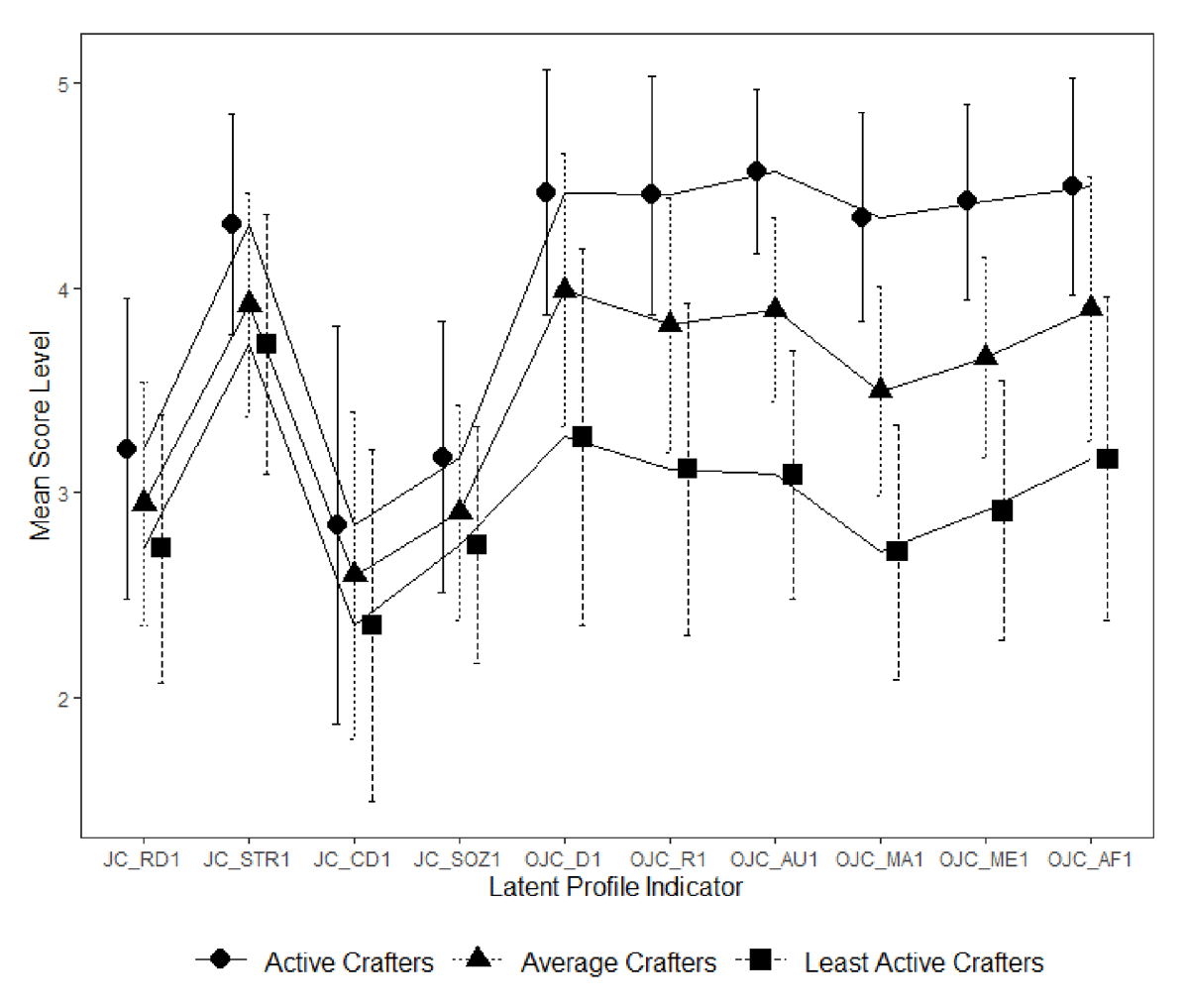
Figure 2
Crafting Profiles with Unstandardized Mean Scores for Profile Indicators.
Note. JC_RD1 = Job crafting facet reducing hindering demands, JC_STR1 = Job crafting facet increasing structural job resources, JC_CD1 = Job crafting facet increasing challenging demands, JC_SOZ1 = Job crafting facet increasing social job resources, OJC_D1 = Off-job crafting facet detachment, OJC_R1 = Off-job crafting facet relaxation, OJC_AU1 = Off-job crafting facet autonomy, OJC_MA1 = Off-job crafting facet mastery, OJC_ME1 = Off-job crafting facet meaning, OJC_AF1 = Off-job crafting facet affiliation. N = 2117. Profile sizes: NActive Crafters = 501, NAverage Crafters = 913, NLeast Active Crafters = 703. For better readability, mean estimates and standard deviation bars were slightly jittered.
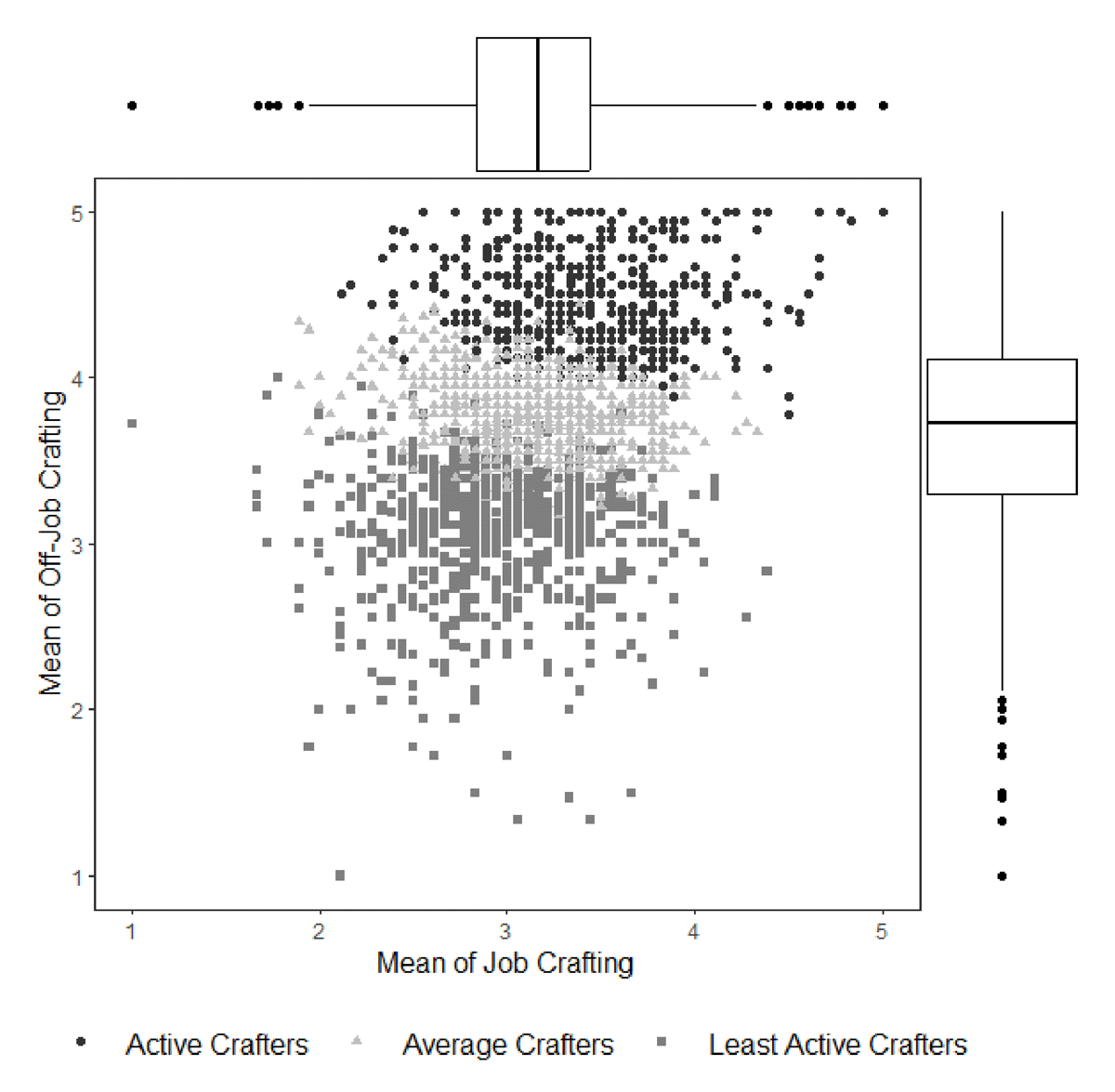
Figure 3
Scatterplot of Job and Off-Job Crafting Means Including Posterior Profile Assignment.
Note. N = 2117. Profile sizes: NActive Crafters = 501, NAverage Crafters = 913, NLeast Active Crafters = 703.
Auxiliary BCH analyses for crafting profiles
To further evaluate the context of the crafting profiles, we report results from auxiliary analyses, testing whether there were mean differences in the distal outcome of recovery experiences at Wave 2 to the profiles using BCH analyses (Asparouhov & Muthén 2014; Asparouhov & Muthén 2013). The overall tests were significant (Detachment: χ2(2) = 39.110, p < .001; Relaxation: χ2(2) = 53.236, p < 0.001; Mastery: χ2(2) = 49.540, p < 0.001, Control: χ2(2) = 155.230, p < 0.001), each indicating the existence of at least one significant pair-wise difference. The pair-wise tests were all significant except the difference test between ‘Active Crafters’ vs. ‘Average Crafters’ for relaxation: χ2(2) = 2.596, p = 0.107 (all other individual tests are not presented for parsimony, available upon request from the first author). For all recovery experiences, the mean differences indicate a linear increment from ‘Least Active Crafters’ to ‘Active Crafters’ (see Table 3). These analyses partially support H4: First, group differences in expected directions were found for almost all group comparisons between Active, Average, and Least Active Crafters regarding recovery experiences. Second, however, no Compensatory Crafters were found, rendering these hypothesis parts obsolete.
Table 3
Auxiliary BCH Analyses to Assess Differences in Individual Recovery Experiences at Wave 2 Between Crafting Profiles.
| OUTCOME | ACTIVE CRAFTERS (ACC) | AVERAGE CRAFTERS (AVC) | LEAST ACTIVE CRAFTERS (LACC) | OVERALL C2 (2) | SUMMARY | |||
|---|---|---|---|---|---|---|---|---|
| M | SE | M | SE | M | SE | |||
| Detachment | 4.046 | 0.065 | 3.853 | 0.042 | 3.53 | 0.056 | 39.11, p < 0.001 | LAcC < AvC < AcC |
| Relaxation | 3.878 | 0.066 | 3.747 | 0.042 | 3.283 | 0.06 | 53.236, p < 0.001 | LAcC < AvC = AcC |
| Mastery | 3.786 | 0.067 | 3.495 | 0.042 | 3.183 | 0.055 | 49.54, p < 0.001 | LAcC < AvC < AcC |
| Control | 4.175 | 0.046 | 3.845 | 0.032 | 3.357 | 0.047 | 155.23, p < 0.001 | LAcC < AvC < AcC |
[i] Note. * p < 0.05 ** p < 0.01 *** p < 0.001.
Cross-lagged association between workload and recovery experiences
Before specifying the cross-lagged model, overall measurement invariance across measurement occasions for workload was modeled for the entire sample using longitudinal CFAs (Putnick & Bornstein 2016). As the facets of recovery experiences were assessed using single items, they technically do not have a measurement model for which invariance can be tested. For workload, model fit results for restrictive models with residual measurement invariance (equal factor structure, factor loadings, item intercepts, and residual variances across time) indicated a good fit to the data (χ2 (117) = 667.582, p < 0.001, CFI = 0.944, TLI = 0.942, RMSEA = 0.047, SRMR = 0.044). Model comparison tests indicate that this model fits equally well compared to less strict measurement invariance models (analyses available upon request from first author). Therefore, the restrictive measurement model with residual measurement invariance for workload was used for the structural equation modeling of the cross-lagged research model.
For the full sample cross-lagged model, model fit indices indicate a good fit to the data (χ2 (245) = 1200.683, p < 0.001, CFI = 0.924, TLI = 0.916, RMSEA = 0.043, SRMR = 0.077). Full model results are presented in Table 4. In this model, the associations from workload at Wave 1 to detachment (b = –0.172, SE = 0.037, p < 0.001), relaxation (b = –0.080, SE = 0.028, p = 0.005), and control (b = –0.085, SE = 0.025, p = 0.001) at Wave 2 are significant. On the contrary, the link to mastery (b = 0.001, SE = 0.028, p = 0.979) at Wave 2 does not reach the significance level of α = 0.05. Therefore, H2 was partially supported. We would like to highlight that, although different in magnitude, the associations between workload and recovery experiences are in the same, impeding direction, except for mastery.
Table 4
Latent Regression Model Results for Cross-Lagged Model on Long-Term Relationship Between Workload and Recovery Experiences (Facets) at Wave 1 and 2.
| PATH | B | SE |
|---|---|---|
| Workload Wave 1 → Workload Wave 2 | 0.812 *** | 0.022 |
| Detachment Wave 1 → Detachment Wave 2 | 0.372 *** | 0.029 |
| Relaxation Wave 1 → Relaxation Wave 2 | 0.411 *** | 0.026 |
| Mastery Wave 1 → Mastery Wave 2 | 0.523 *** | 0.023 |
| Control Wave 1 → Control Wave 2 | 0.448 *** | 0.023 |
| Workload Wave 1 → Detachment Wave 2 | –0.172 *** | 0.037 |
| Workload Wave 1 → Relaxation Wave 2 | –0.08 ** | 0.028 |
| Workload Wave 1 → Mastery Wave 2 | 0.001 | 0.028 |
| Workload Wave 1 → Control Wave 2 | –0.085 ** | 0.025 |
| Detachment Wave 1 → Workload Wave 2 | –0.018 | 0.015 |
| Relaxation Wave 1 → Workload Wave 2 | 0.005 | 0.021 |
| Mastery Wave 1 → Workload Wave 2 | 0.014 | 0.016 |
| Control Wave 1 → Workload Wave 2 | –0.024 | 0.02 |
| Intercept Workload Wave 1 (Mean) | 2.401 *** | 0.023 |
| Intercept Workload Wave 2 | 0.529 *** | 0.124 |
| Intercept Detachment Wave 2 | 2.585 *** | 0.156 |
| Intercept Relaxation Wave 2 | 2.401 *** | 0.134 |
| Intercept Mastery Wave 2 | 1.331 *** | 0.093 |
| Intercept Control Wave 2 | 2.41 *** | 0.123 |
| Covariance Workload with Detachment Wave 2 | –0.063 *** | 0.016 |
| Covariance Workload with Relaxation Wave 2 | –0.021 | 0.013 |
| Covariance Workload with Mastery Wave 2 | 0.003 | 0.013 |
| Covariance Workload with Control Wave 2 | –0.033 ** | 0.012 |
[i] Note. * p < 0.05 ** p < 0.01 *** p < 0.001.
Multigroup analysis with crafting profiles as moderators
Next, we specified multigroup analyses using the crafting profiles as moderators and the postulated cross-lagged model with workload and recovery experiences to investigate differences between the profiles. As for the full sample, the restrictive measurement model with residual measurement invariance for workload was used in the multigroup analysis (results see Table 5). The cross-lagged association between workload and the recovery experiences was only significant for the group of ‘Least Active Crafters’: Workload to detachment (b = –0.217, SE = 0.045, p < 0.001), to relaxation (b = –0.086, SE = 0.036, p = 0.017), and to control (b = –0.081, SE = 0.036, p = 0.022). Just as in the cross-lagged model for the full sample, the link between workload at Wave 1 and mastery at Wave 2 does not reach the significance level of α = 0.05 for any crafting profile (see Table 5). H3 is partially supported, as we expected the link between workload and recovery experiences to be most negative for a group of ‘Least Active Crafters’.2
Table 5
Latent Regression Model Results for Multigroup Analysis of the Long-Term Relationship Between Workload and Recovery Experiences (Facets) at Waves 1 and 2.
| PATH | B | SE | B | SE | B | SE |
|---|---|---|---|---|---|---|
| ACTIVE CRAFTERS | AVERAGE CRAFTERS | LEAST ACTIVE CRAFTERS | ||||
| Workload Wave 1 → Workload Wave 2 | 0.754 *** | 0.048 | 0.827 *** | 0.031 | 0.808 *** | 0.033 |
| Detachment Wave 1 → Detachment Wave 2 | 0.39 *** | 0.059 | 0.353 *** | 0.046 | 0.35 *** | 0.048 |
| Relaxation Wave 1 → Relaxation Wave 2 | 0.288 *** | 0.054 | 0.335 *** | 0.042 | 0.462 *** | 0.038 |
| Mastery Wave 1 → Mastery Wave 2 | 0.525 *** | 0.052 | 0.489 *** | 0.036 | 0.461 *** | 0.042 |
| Control Wave 1 → Control Wave 2 | 0.356 *** | 0.046 | 0.444 *** | 0.04 | 0.473 *** | 0.035 |
| Workload Wave 1 → Detachment Wave 2 | –0.103 | 0.057 | –0.033 | 0.044 | –0.217 *** | 0.045 |
| Workload Wave 1 → Relaxation Wave 2 | –0.029 | 0.042 | –0.019 | 0.031 | –0.086 * | 0.036 |
| Workload Wave 1 → Mastery Wave 2 | 0.004 | 0.045 | 0.032 | 0.03 | 0.005 | 0.036 |
| Workload Wave 1 → Control Wave 2 | –0.054 | 0.034 | –0.031 | 0.029 | –0.081 * | 0.036 |
| Detachment Wave 1 → Workload Wave 2 | –0.038 | 0.044 | –0.036 | 0.034 | –0.018 | 0.034 |
| Relaxation Wave 1 → Workload Wave 2 | –0.118 | 0.071 | 0.003 | 0.046 | 0.06 | 0.048 |
| Mastery Wave 1 → Workload Wave 2 | 0.065 | 0.043 | –0.041 | 0.034 | 0.054 | 0.044 |
| Control Wave 1 → Workload Wave 2 | –0.063 | 0.063 | 0.02 | 0.048 | –0.066 | 0.043 |
| Intercept Workload Wave 1 (Mean) | 3.114 *** | 0.087 | 3.288 *** | 0.08 | 3.578 *** | 0.084 |
| Intercept Workload Wave 2 | 1.483 *** | 0.409 | 0.737 ** | 0.267 | 0.534 | 0.289 |
| Intercept Detachment Wave 2 | 2.596 *** | 0.323 | 2.321 *** | 0.239 | 2.929 *** | 0.271 |
| Intercept Relaxation Wave 2 | 2.997 *** | 0.299 | 2.607 *** | 0.222 | 2.156 *** | 0.201 |
| Intercept Mastery Wave 2 | 1.454 *** | 0.213 | 1.362 *** | 0.146 | 1.311 *** | 0.151 |
| Intercept Control Wave 2 | 2.889 *** | 0.254 | 2.336 *** | 0.205 | 2.3 *** | 0.197 |
| Covariance Workload with Detachment Wave 2 | –0.184 *** | 0.042 | –0.184 *** | 0.042 | –0.184 *** | 0.042 |
| Covariance Workload with Relaxation Wave 2 | –0.077 * | 0.034 | –0.077 * | 0.034 | –0.077 * | 0.034 |
| Covariance Workload with Mastery Wave 2 | –0.001 | 0.036 | –0.001 | 0.036 | –0.001 | 0.036 |
| Covariance Workload with Control Wave 2 | –0.103 ** | 0.033 | –0.103 ** | 0.033 | –0.103 ** | 0.033 |
[i] Note. Within profiles, the latent variable variances were restrained to 1. * p < 0.05 ** p < 0.01 *** p < 0.001.
Discussion
Research on the long-term association between workload and recovery experiences is scarce, as is research on potential moderators of this link (Sonnentag, Cheng & Parker 2022). This study investigated the potential buffering role of crafting profiles for the long-term association between workload and recovery experiences. We examined differences between subgroups of employees in the workload-recovery association depending on their crafting profile, thereby reexamining previous findings of Active, Average, and Least Active Crafters (Ho et al. 2024). Our study provides additional support for three common job and off-job crafting profiles and highlights the risk for long-term impaired well-being for Least Active Crafters. Workload was negatively associated with recovery experiences only for Least Active Crafters, showing that already average crafting across life domains likely buffers these adverse consequences of high workload. We will now discuss the main findings, summarize the strengths and limitations of the study, and discuss practical and theoretical implications.
Profiles of active, average, and least active crafters across life domains
The LPA analyses partly supported H1 by replicating three parallel crafting profiles (Least Active, Average, and Active Crafters), thereby aligning with Ho et al. (2024) despite using a different time point and smaller sample. Notably, no Compensatory Crafters emerged, however, we suggest that exploring this idea in the context of the COVID-19 pandemic or similar disruptive periods could be especially fruitful as employees’ lives were changed quite dramatically (e.g., enforced working from home, limited social interactions with others; (Cho 2020; Tušl et al. 2021). Employees may have been forced to explore new ways of satisfying their needs, which could reveal at least a temporary existence of proposed Compensatory Crafters. Pre-pandemic research has shown that leisure crafting was positively related to meaning-making when job crafting opportunities were low, which would indeed suggest a compensation process (Petrou, Bakker & van den Heuvel 2017).
The quality of crafting profiles may be improved through further investigation. We observed considerable overlap in the variances of profile indicators, primarily the job crafting facets. This suggests that level effects of the off-job crafting facets mainly differentiate the profiles. Profiles driven by level-effects have been previously questioned regarding their added value (for an application, see: Kam & Zhou 2016), yet heuristic value, e.g., due to distinct patterns with co-variates and for practice, is also reported (Bauer & Shanahan 2007; Marsh et al. 2009; Meyer & Morin 2016; Morin, Bujacz & Gagné 2018). In this regard, our results point to a unique position of Least Active Crafters, for whom high workload is associated with impaired recovery over time, and the previous results by Ho et al. (2024) highlight several differences in home resources predicting the crafting profiles and mental well-being and work engagement as time-lagged outcomes. However, in our study, we are unable to distinguish well between those who highly craft their jobs and those who do not. To better differentiate, future research might use a different operationalization of job crafting (e.g., needs-based job crafting; Tušl et al. 2024). Lastly, future research may also explore how domain-specific aspects might be related in the differential performance of job and off-job crafting profile indicators: Potentially, in the off-job domain, personal characteristics, as well as family or life aspects, could drive differences in crafting, whereas in the job domain, more external aspects, e.g., autonomy and availability of others (Park & Park 2021; Parker, Bindl & Strauss 2010), could play a more significant role. Contrasting the two theoretical frameworks used in this study, we observe that needs-based off-job crafting seemed to differentiate between employee groups well in itself, while to explain more chronic job crafting tendencies, the JD-R framework of job crafting might need to consider further aspects (e.g., situational, interpersonal) than only the behavioral efforts.
Long-term workload-recovery association and the special role of least active crafters
In line with prior research, the cross-lagged model for the full sample demonstrates (Bennett, Bakker & Field 2018; Kinnunen & Feldt 2013; Meier & Cho 2019; Steed et al. 2021) that (long-term) links between workload and the recovery experiences of detachment, relaxation, and control can be found (partially supporting H2; the absence of a link to mastery will be discussed later). Thus, our study highlights that chronic work experiences are linked with impaired recovery in the long run, not only on a day-to-day basis, which has been the focus of many studies in the past (as reported in reviews by Bennett et al. 2018; Steed et al. 2021). Additionally, the long-term links between workload and detachment, relaxation, and control were only significant for the ‘Least Active Crafters’ when comparing the crafting profiles within multigroup analyses (partially supporting H3). Therefore, these analyses align with prior research (Bennett, Bakker & Field 2018; Kinnunen & Feldt 2013; Meier & Cho 2019; Steed et al. 2021) and provide further insight that the long-term relationship between workload and recovery does not necessarily exist for all employees. This indicates qualitative differences between the crafting profiles, whereas we hypothesized quantitative differences in the magnitude of the long-term link between workload and recovery. Potentially, Average Crafters and Active Crafters craft in such a way that prevents the cumulation of a detrimental effect of workload on later recovery experiences. Even for average crafting levels, the long-term link between workload and recovery experiences was not found. This provides first evidence that Least Active Crafters constitute a special group at risk for impaired recovery.
Further, our analyses reveal a linear increase in subsequent recovery experiences from ‘Least Active Crafters’ to ‘Active Crafters’ (supporting H4), except for the facet of relaxation when comparing ‘Average Crafters’ to ‘Active Crafters’. The results indicate that employees investing the lowest crafting efforts in both job and off-job domains have the most unfavorable recovery experiences over time, meaning they cannot sufficiently detach from work, are unable to relax in their free time, and experience little mastery and control outside of work. Within our study, Least Active Crafters are noticeably characterized by poorer recovery experiences at a later point in time and impaired recovery when experiencing high workload. This distinctiveness of the Least Active Crafters supports combining the person-centered approach with traditional variable-centered analyses as it points to a specific risk group that could be specifically targeted in interventions. Our study demonstrates that above previously considered resources and personality traits (Haun, Nübold & Bauer 2018; Schulz, Schöllgen & Fay 2019; Sonnentag & Fritz 2015), also proactive efforts of employees make a difference in their long-term recovery and well-being.
Workload did not have an association with mastery as a recovery experience in neither crafting group (not supporting this part of H2), which fits the meta-analytic findings of Bennett et al. (2018) that distinguished links from challenge vs. hindrance demands (LePine, Podsakoff & LePine, 2005; Podsakoff, LePine & LePine 2007) to recovery experiences. Within the meta-analysis, challenge demands (e.g., workload or time pressure) were also not associated with mastery, but hindrance job demands (e.g., role conflict) were positively associated with mastery. The authors suggested that how demands are perceived might be relevant to the behavior outside of work, such that employees perceiving hindrance demands at work might compensate with activities for mastery experiences outside of the job. Future research should investigate further qualitative differences between crafting profiles for the hindrance demands–recovery association. It might be that highly proactive groups such as the Active Crafters perceive and react to hindrance demands more favorably, as suggested by Bennett et al. (2018), which could partially explain their high levels of recovery experiences we found in our analyses.
Limitations
Our study also has several limitations. First, we focused our analyses on the variables of interest (crafting profiles, workload, recovery experiences) and can, therefore, not rule out a potential influence of unmeasured individual differences, such as optimism, baseline energy levels, or general activities.3 To advance our understanding of the role of crafting profiles, future research should examine how such individual characteristics are connected with crafting profiles and include potential confounders in analyses. Nevertheless, our findings suggest that crafting may serve as a valuable, active and intentional behavior for enhancing recovery in the context of high workload.
Second, we measured recovery experiences with single items, which is disadvantageous when using structural equation modeling. We note that our longitudinal dataset did not focus primarily on recovery experiences but on crafting and aimed to repeatedly assess many possible predictors and outcomes in several study waves. To reduce the burden on study participants, reducing the number of items assessed per construct is useful. Using single-item measures meets both needs: assessing many constructs with a low burden. However, the downside is the inability to model and reduce measurement errors (Hayduk & Littvay 2012; Matthews, Pineault & Hong 2022), as well as investigating measurement invariance (Putnick & Bornstein 2016). Future research focusing on specific links between job demands and the recovery experiences facets should instead use the entire scale from the Recovery Experiences Questionnaire (Sonnentag & Fritz 2007).
Lastly, we would like to comment on two broader limitations of our study. First, all our measures are based on employees’ self-reports, potentially contributing to common method bias (Podsakoff et al. 2003). However, conceptually, all measures reflect the internal experiences of employees and cannot be externally observed to provide a different source of variance. Even for the objectively measurable workload (e.g., working hours), in the context of the workload-recovery experience, the perceived rather than the objective workload is relevant. Objective measures of workload, e.g., working hours, do not capture perceived complexity and intensity, which is also part of workload. Therefore, integrating the measure of working hours instead of workload might additionally lead to problems for the comparison across working fields and countries, as markers of complexity and intensity may vary considerably across contexts. We used two time points in our data collection to aid in investigating temporal patterns, thereby reducing error due to common method bias.
Moreover, attrition analyses showed significant differences between the participants who remained in the study and those who dropped out in job and off-job crafting, age, and tenure (cf. method section). The combination of mean differences in age, tenure, and crafting between the groups is unsurprising, as meta-analytic evidence shows negative associations between tenure/age and job crafting (Rudolph et al. 2017). Dropout in longitudinal surveys is a common problem that may lead to biased parameter estimates and inaccurate hypothesis testing if the remaining sample is not representative or inappropriate strategies for handling missing data are selected (Newman 2014). As our retained sample still seems to be representative in terms of demographics, we do not assume that the lost participants have biased our results, especially as we still used all available information by employing full information maximum likelihood methods where possible in our analyses, as suggested by Newman (2014). However, we note that our sample consists solely of German-speaking employees from Germany, Austria, and Switzerland. Future research should aim to replicate our findings in other cultures.
Practical implications
We derive one major or crucial practical implication from the findings of this study. That is the need to support Least Active Crafters in terms of recovery experiences, potentially through targeted crafting and/or recovery interventions, and by ensuring adequate workload for employees, to not overburden single individuals, who might suffer from high workload even months later due to impaired recovery. First, for recovery interventions (e.g., Haun et al. 2011), there is growing evidence of their effectiveness, though programs differ in various characteristics, e.g., their length and whether they target recovery behaviors or recovery experiences directly (Sonnentag, Cheng & Parker 2022). Second, Least Active Crafters might also benefit from investing in crafting behaviors in either both or one life domain. From the results of our study, it does not seem that employees necessarily need to craft a lot to derive benefit – average crafting efforts in both domains were already connected with more favorable and less impaired recovery experiences. Therefore, we suggest targeted crafting interventions for Least Active Crafters. Although intervention research has not focused on recovery experiences as outcomes of crafting directly, a plethora of other positive outcomes of crafting interventions has been reported, e.g., self-efficacy, work engagement, and job performance (Sakuraya et al. 2016; van den Heuvel et al. 2015; van Wingerden et al. 2017). It can be expected that these additional resources, as well as positive experiences, help employees, in turn, to perform better at their jobs but also to recover better from their jobs in their off-job time. Third, even though our study primarily focused on the agentic role of employees within their life domains, organizations still have a responsibility to ensure adequate job design to support employees’ health and well-being. Therefore, organizations should aim to distribute workloads in a fair manner while taking individual capabilities into account, but provide resources, such as autonomy and flexible work designs, as well (Korunka 2017; Van den Broeck & Parker 2017). Temporarily lowering workload for Least Active Crafters might enable them to invest more resources in targeted crafting interventions, thereby improving their well-being and performance in the long run.
Summary and Conclusion
In this study, we investigated the role of crafting profiles for the long-term workload-recovery association. As in a previous study Ho et al. (2024), we find three main crafting profiles (Active, Average, and Least Active Crafters), which are similar in shape but increase in parallel in both life domains. However, job crafting facets differentiated less well between crafting profiles, and additional characteristics might be needed to disentangle crafting profiles further. We found long-term links between workload and the individual recovery experiences of detachment, relaxation, and control for the full sample and for the Least Active Crafters. Additionally, the Least Active Crafters were found to be a particularly problematic group regarding lower recovery experiences over time. Recovery experiences are crucial to maintaining employee health (Steed et al. 2021). Therefore, we suggest as a main practical implication that the group of Least Active Crafters should be targeted with recovery and/or crafting interventions. Lastly, we propose that possible further distinct characteristics of the group of Least Active Crafters should be explored in future research.
Data Accessibility Statement
The data that support the findings of this study are available from the authors upon reasonable request. Study participants were asked to give consent to use the data for research and within research publication, but not for open public access.
Notes
[6] Further, we examined our hypotheses using recovery experiences as a one-factor construct as well, to reflect earlier research findings on same-directed associations of the facets of recovery experiences with job demands (Bennett, Bakker & Field 2018; Steed et al. 2021) in a more parsimonious way. However, even though the measurement model examining measurement invariance for this one factor model indicated good fit (χ2 (25) = 14.376, p = 0.955, CFI = 1.0, TLI = 1.0, RMSEA = 0, SRMR = 0.014), internal consistencies were below recommendations (αWave 1 = 0.57, αWave 2 = 0.56) and to our surprise, we did not find a link at all between workload and recovery experiences as a one-factor construct. The absence of a workload-recovery relationship is an unexpected finding, as this association on a day level has been established through a plethora of research (Bennett, Bakker & Field 2018; Steed et al. 2021), and first longitudinal studies also provided support for such a link over both two-month and one-year time lags (Kinnunen & Feldt 2013; Meier & Cho 2019). We suggest that the modelling as a one-factor construct with only single items available might have masked actual associations. In one study, significant links between day-time engagement and night-time recovery experiences emerged (McGrath et al. 2017). Contrary to our approach, McGrath et al. (2017) assessed recovery experiences with all 16 items of the Recovery Experiences Questionnaire (Sonnentag & Fritz 2007) and then modeled them jointly as one factor. Concluding, modeling recovery experiences as one factor should be replicated in future research using the full scale of recovery experiences. In this paper, we present analyses using the single items of the recovery experiences facets individually. Regarding our hypotheses, we do not expect any change in the associations whether recovery experiences are included as one factor or as individual facets. For full disclosure, the analyses including recovery experiences as a one-factor construct are available upon request from the first author.
[7] We note that given the strong level effects in our profiles and the overlap in job crafting facets between profiles, one could also assume that both job and off-job crafting are rather continuous constructs and review the assumed moderation using a variable-centered approach. Just as the latent profile provide a simplification of the distribution of ten crafting facets, a simplification is needed to review, e.g., a three-way interaction between workload, job crafting and off-job crafting towards recovery experiences. We estimated the full-sample cross-lagged model with job and off-job crafting as latent moderating factors (using the individual crafting facets as item parcels to reduce complexity). Given that this model also includes main effects and two-way interactions for all predictors, it is unsurprising that the three-way interactions do not reach significance. However, we anyways specified simple slopes to be able to compare the trend in results with our main analyses. Overall, the trend seems to be supported that Least Active Crafters (job crafting and off-job crafting at -1SD of the sample) experience the strongest negative link from workload to recovery (detachment: b = –0.258, SE = 0.045, p < 0.001; relaxation: b = –0.148, SE = 0.039, p < 0.001; control: b = –0.133, SE = 0.038, p = 0.001). No simple slope on mastery reached significance. Contrary to the main analyses using latent profiles as moderators, the variable-centered approach indicates significant simple slopes for other configurations of job and off-job crafting, notably also ‘compensatory’ configurations. These are, as initially suggested by our H3, less negative than for Least Active Crafters. Simple slopes for configurations resembling Active Crafters also did not reach significance. We conclude that these analyses point to a similar trend as our main analyses. Full analyses are available upon request.
Ethics and Consent
For this study, no ethical approval based on the author’s institute’s regulations in accordance with Switzerland’s Federal Act on Research Involving Human Beings (Human Research Act, HRA) was required (further information is available: https://www.uzh.ch/en/researchinnovation/ethics/humanresearch.html). This observational study collected anonymized data through a panel provider and did not assess any health-related data. Further, the data collection did not present any psychological distress to participants or use any form of experimental manipulation. We obtained informed consent from all individual participants included in the study. Only participants over 18 years were eligible for participation.
Competing Interests
JdB and AM are members of the editorial board for Scandinavian Journal of Work and Organizational Psychology, which is on a voluntary basis. All other authors have no competing interests.
Author Contributions
AIM: Conceptualization, Data curation, Formal analysis, Methodology, Project administration, Resources, Visualization, Writing – original draft, Writing – review and editing.
AM: Conceptualization, Data curation, Formal analysis, Methodology, Resources, Supervision, Visualization, Writing – review and editing.
KLH: Conceptualization, Data curation, Formal analysis, Methodology, Visualization, Writing – review and editing.
PK: Conceptualization, Data curation, Methodology, Project administration, Resources, Supervision, Visualization, Writing – review and editing.
GB: Conceptualization, Data curation, Methodology, Project administration, Resources, Supervision, Visualization, Writing – review and editing.
JdB: Conceptualization, Data curation, Methodology, Project administration, Resources, Supervision, Visualization, Writing – review and editing.
We thank Rebecca Brauchli for her assistance with data collection.