
Rapid technological advances are reshaping labour markets, requiring workers to continuously update their skills to remain employable (Acemoglu & Restrepo, 2019; Selenko et al., 2022). Organisations must respond to these changes by swiftly adapting to evolving job demands (Asimakopoulos & Whalley, 2017; Liébana-Cabanillas & Blanco-Encomienda, 2024). While such developments create opportunities for innovation, they may also increase concerns about job insecurity–especially for workers whose careers are disrupted by sickness absence (Van Vuuren et al., 1999).
Sickness absence can limit workers’ exposure to workplace innovations, increasing the risk of skills obsolescence (Görlich & De Grip, 2007). In addition to financial challenges across Europe (Antczak & Miszczyńska, 2021), particularly in the Netherlands — where absence rates have risen from 4% to 6% over the last decade (CBS, 2024) — sickness absence affects workers’ long-term employability (e.g., Markussen, 2012). Returning workers may struggle to meet evolving job demands, particularly in technology-driven industries, amplifying their sense of job insecurity (Stengård et al., 2019). In the Netherlands, strict employment laws protect workers’ rights during sickness absence, requiring employers to continue wage payments and reintegration efforts for up to two years, while prohibiting dismissal during this period (Borghouts – van de Pas & Van Drongelen, 2021; Post, 2005). However, despite these protections, workers may still experience job insecurity, as skills obsolescence can influence their perceived employability (Allen & De Grip, 2012; Jones et al., 2004; Joseph & Kuan Koh, 2011; McGuinness et al., 2021; Messioui & Van Vuuren, 2022).
This study examines how sickness absence duration contributes to job insecurity through skills obsolescence. Drawing on Conservation of Resources (COR) theory (Hobfoll, 1989), we argue that sickness absence depletes valuable work-related resources, such as professional skills and workplace connections, which may trigger a downward spiral of further resource loss (Griep et al., 2021; Ten Brummelhuis et al., 2013). While COR theory is often used to explain how job insecurity leads to further resource depletion (e.g., loss of motivation, increased stress), our study examines how sickness absence itself initiates a resource loss process. During sickness absence, workers are temporarily removed from workplace interactions, training opportunities, and evolving job demands, which may erode their professional skills. In line with COR theory, this initial depletion increases their vulnerability to further losses, as obsolete skills may increase their perceived job insecurity. This perspective aligns with prior research demonstrating that interruptions in work continuity can accelerate skill obsolescence and heighten concerns about job retention (Görlich & De Grip, 2007).
We identify skills obsolescence as a key mechanism in this process, distinguishing between two types: technical and economic skills obsolescence. Technical skills obsolescence is primarily internally driven by factors such as ageing or non-use (e.g., due to illness or career interruptions), whereas economic skills obsolescence is externally driven by technological and organisational changes that render previously acquired skills obsolete (Allen & De Grip, 2012; De Grip & Van Loo, 2002; Neuman & Weiss, 1995). While both forms can undermine employability, their impact may vary depending on job demands and industry characteristics.
Using longitudinal survey data from 2,731 employees in a Dutch telecom organisation, of whom 490 participated in all three waves, this study contributes to the literature on job insecurity in three ways. First, we shift the focus from job insecurity as a predictor of sickness absence to understanding how sickness absence can itself increase job insecurity. We extend the literature by exploring sickness absence as a contributing factor to job insecurity, following Griep et al. (2021) and Jiang and Lavaysse (2018), who demonstrate that sickness absence can shape workers’ perceptions of job insecurity. Second, we introduce skills obsolescence as a key explanatory mechanism linking sickness absence to job insecurity, offering a more nuanced perspective on how workplace disruptions shape career stability. Consistent with Görlich & De Grip (2007), we argue that sickness absence disrupts work continuity, illustrating how different forms of skills obsolescence interact with job insecurity.
Finally, we provide practical insights for organisations on how to support returning workers and mitigate the risks of skills obsolescence, ensuring long-term employability in evolving work environments. Given the financial and career-related challenges of sickness absence, we highlight the need for structured return-to-work policies that help workers stay up to date with workplace developments and maintain job security.
Theory and hypotheses
Job Insecurity
Subjective job insecurity is defined as a person’s concern about the future of their job. It consists of the perceived probability and the perceived severity of losing one’s job (Klandermans et al., 2010; Van Vuuren, 1990). This definition of job insecurity aligns with expectancy theory, which analyses an individual’s attitude toward a specific event based on beliefs about the likelihood of the event occurring and the value of the expected outcomes (Feather, 1982; Mitchell, 1982; Porter & Lawler, 1968). In the case of job insecurity, the perceived probability of job loss represents the expectancy component, and its perceived severity represents the value component (Klandermans et al., 2010). Both beliefs about the perceived probability and perceived severity are crucial for affective job insecurity: “The more likely it is that a person will lose their job and/or the more severe the consequences of the loss are, the stronger their feelings of job insecurity will be” (Klandermans et al., 1991, p. 41). Jiang and Lavaysse (2018) describe that both cognitive (beliefs) and affective (emotional state) components are essential for conceptualizing job insecurity. Their results show that it is important to treat cognitive job insecurity and affective job insecurity as two separate constructs. Meta-analyses show that job insecurity detracts from employees’ well-being (Sverke et al., 2002). Jiang and Lavaysse (2018) found that cognitive job insecurity is less connected to employees’ well-being, while affective job insecurity is more closely related to employees’ well-being. Based on these studies, we expect that the experience of job insecurity starts with cognitive job insecurity—the perceived probability of losing one’s job—followed by affective job insecurity, which reflects the perceived severity of this potential job loss. This assumption aligns with Hartley et al. (1990), who argued that one can only experience worry or distress about job loss (affective job insecurity) if one first perceives the probability of job loss (cognitive job insecurity).
In this study, we focus on cognitive job insecurity because it is conceptually closer to its antecedents. Specifically, the factors that predict job insecurity, such as organisational changes, employment protection, and skill obsolescence, primarily shape workers’ beliefs about the probability of losing their job rather than their immediate emotional responses. This distinction aligns with the findings of Jiang and Lavaysse (2018), who demonstrate that cognitive job insecurity is more directly influenced by workplace characteristics, while affective job insecurity is more strongly linked to workers’ well-being.
Sickness absence
Sickness absence refers to a worker’s inability to work due to health-related reasons and is typically measured in two ways: absence duration and absence frequency (Aboagye et al., 2019; Antczak & Miszczyńska, 2021; Ten Brummelhuis et al., 2013). Absence duration captures the total length of time a worker remains away from work, whereas absence frequency refers to the number of separate absence episodes within a given period (Bakker et al., 2003). This study focuses on absence duration, as it more accurately reflects work continuity disruption (Johns, 2003).
The duration of sickness absence varies: some workers may return after only a few days, whereas others remain absent for extended periods. In general, short-term absence can last from a few days to several weeks, whereas long-term absence extends beyond several weeks or months (Bakker et al., 2003; Antczak & Miszczyńska, 2021; Ten Brummelhuis et al., 2013; Virtanen et al., 2006). Although this distinction is often made, what is considered short- versus long-term sickness absence tends to vary across organisational and national contexts. Research on career interruptions and unemployment highlights the negative consequences of prolonged detachment from work, with effects ranging from several months to years (Görlich & De Grip, 2007; Apergis & Apergis, 2020). Particularly, in industries characterised by rapid technological change, even relatively short absences can hinder workers’ ability to return to work, as they risk falling behind on workplace innovations and evolving job expectations (Borghans et al., 2003). Rather than viewing sickness absence as a binary concept, a continuum perspective better captures how sickness absence gradually affects skills obsolescence and job insecurity over time. Our approach aligns with COR theory, which posits that resource depletion occurs progressively rather than as an abrupt event (Hobfoll, 1989).
Sickness absence and job insecurity
Sickness absence has been widely studied in relation to job insecurity, often through the lens of COR theory. COR theory posits that stress arises when individuals perceive a threat to, or actual loss of, valuable work-related resources such as career opportunities, professional standing, or employability (Hobfoll, 1989). Job insecurity is frequently studied as a predictor of unfavourable occupational outcomes. It has been linked to lower job satisfaction, reduced organisational commitment, and adverse physical and mental health effects (Cheng & Chan, 2008; Suari-Andreu et al., 2022; Sverke et al., 2002). Workers experiencing job insecurity often worry about their job stability, which can increase stress, diminish job satisfaction, and negatively impact mental well-being (De Witte et al., 2016; Shoss, 2017; Van Vuuren, 1990). Furthermore, job insecurity has been associated with higher sickness absence rates, as prolonged stress and uncertainty can contribute to psychological and physiological health issues, potentially leading to withdrawal from the work environment (Blekesaune, 2012; Chirumbolo & Areni, 2005; Griep et al., 2021; Suari-Andreu et al., 2022; Virtanen et al., 2006).
While job insecurity can contribute to sickness absence, the relationship may also operate in the opposite direction. Workers with higher absence rates often face an increased risk of job termination and unemployment (Virtanen et al., 2006; Mastekaasa, 1996; Wagenaar et al., 2014) and a lower probability of maintaining future employment (Markussen, 2012). Although Dutch labour laws provide strong legal protections during sickness absence (Borghouts – van de Pas & Van Drongelen, 2021), these protections do not fully eliminate concerns about long-term employability. Upon returning to work, workers may still risk being sidelined, missing career opportunities, or facing negative perceptions. Previous research showed that prolonged sickness absence can reduce employability and can hinder career progression due to missed workplace developments and learning opportunities (Görlich & De Grip, 2007). This uncertainty is particularly pronounced in industries undergoing rapid technological and organisational change, where even short absences can lead to a perceived disadvantage compared with continuously present colleagues (Virtanen et al., 2006; Markussen, 2012). Furthermore, sickness absence may shape employer perceptions. Workers with higher absence rates can be viewed as less reliable or productive, which may influence decisions regarding promotions, training investments, or job retention (Griep et al., 2021). In line with COR theory, this perceived resource loss can trigger further losses, reinforcing job insecurity over time (Hobfoll, 1989). While previous studies have examined the reciprocal relationship between sickness absence and job insecurity (e.g., Griep et al., 2021), our study focuses on sickness absence as the initiating factor in the resource depletion process.
Building on these insights, we argue that sickness absence can trigger a pathway to job insecurity by disrupting work continuity. This aligns with COR theory’s concept of loss spirals, wherein an initial resource depletion—such as sickness absence—may increase workers’ vulnerability to further resource losses, including job insecurity.
Hypothesis 1: Sickness absence is positively related over time to job insecurity.
Skills obsolescence as mediator
According to COR theory, resource loss is particularly impactful because it initiates a spiral effect: once workers experience recource depletion, they may struggle to regain lost recources, leading to further losses (Hobfoll, 1989). Skills obsolescence –defined as the process by which previously acquired skills become outdated or decline in effectiveness– is a key form of resource depletion that can be accelerated by sickness absence (De Grip & Van Loo, 2002). During their sickness absence, restricted access to workplace learning and technological advancements may further impede individuals’ ability to restore their resources upon return (Görlich & De Grip, 2007), leading to skill obsolescence. Consequently, workers who perceive their skills as obsolete may further experience heightened job insecurity, including an increased risk of redundancy or diminished career opportunities (see e.g., McGuinness et al., 2021). This aligns with COR theory’s principle that workers with fewer resources become increasingly vulnerable to additional resource loss, reinforcing a self-perpetuating cycle of stress and insecurity (Hobfoll, 1989). In this way, skills obsolescence serves as a critical mechanism linking sickness absence to job insecurity, further amplifying the loss spiral outlined in COR theory. We distinguish between two forms of skills obsolescence: technical and economic skills obsolescence.
Technical skills obsolescence
Technical skills obsolescence refers to the deterioration of skills due to wear and atrophy (Allen & De Grip, 2012; Van Loo et al., 2001). Wear is associated with aging or physically demanding job conditions, while atrophy occurs when skills are not used for extended periods, such as during unemployment or career interruptions (Apergis & Apergis, 2020; Görlich & De Grip, 2007; Van Loo et al., 2001). Factors like physical demands, illness, and sickness absence are often associated with technical skills obsolescence (see e.g., Antczak & Miszczyńska, 2021; Van Loo et al., 2001). Research has also shown connections between physical workload, disability, and illness with increased sickness absence (Bakker et al., 2003; Kocakulah et al., 2016; Van der Burg et al., 2020). In line with COR theory, we expect that when workers’ skills deteriorate during sickness absence, a depletion of resources will be present, making them more vulnerable to further resource losses, including increased job insecurity. This aligns with previous findings that long-term unemployment exacerbates technical obsolescence and diminishes reemployment chances (Apergis & Apergis, 2020). While sickness absence differs from unemployment, the interruption from work continuity can similarly result in skill deterioration, increasing job insecurity. Hence, we formulate the following hypothesis.
Hypothesis 2: Technical skills obsolescence mediates the relationship between sickness absence and job insecurity over time, such that absence duration increases technical skills obsolescence, which, in turn, increases job insecurity.
Economic skills obsolescence
Economic skills obsolescence occurs when workers’ previously acquired skills become outdated due to technological or organisational changes (Allen & De Grip, 2012; Jones et al., 2004; Joseph & Kuan Koh, 2011; McGuinness et al., 2021). Prior studies have identified relationships between economic skills obsolescence and sickness absence (Messioui & Van Vuuren, 2022; Tsai et al., 2007). However, workers returning from sickness absence may also perceive their skills as outdated due to missed technological advancements, workplace learnings or evolving job requirements and industry shifts (Allen & De Grip, 2012; Görlich & De Grip, 2007; McGuinness et al., 2021). Previous research has established a relationship between economic skills obsolescence and job insecurity (Alcover et al., 2021; McGuinness et al., 2021). McGuinness et al. (2021) found that workers who perceived their skills as outdated reported greater job insecurity. Conversely, Allen & De Grip (2012) did not find this relationship, suggesting that accessible learning opportunities may buffer against economic skills obsolescence. This aligns with findings from Van Hootegem et al. (2023a), who emphasise that limited learning opportunities further deplete workers’ resources, reinforcing the resource loss spiral described in COR theory.
Based on these insights, we expect that sickness absence increases workers’ vulnerability to economic skills obsolescence and job insecurity upon their return and formulate the following hypothesis.
Hypothesis 3: Economic skills obsolescence mediates the relationship between sickness absence and job insecurity over time, such that absence duration increases economic skills obsolescence, which, in turn, increases job insecurity.
Figure 1 gives an overview of our hypothesised relationships between sickness absence, skills obsolescence, and job insecurity.
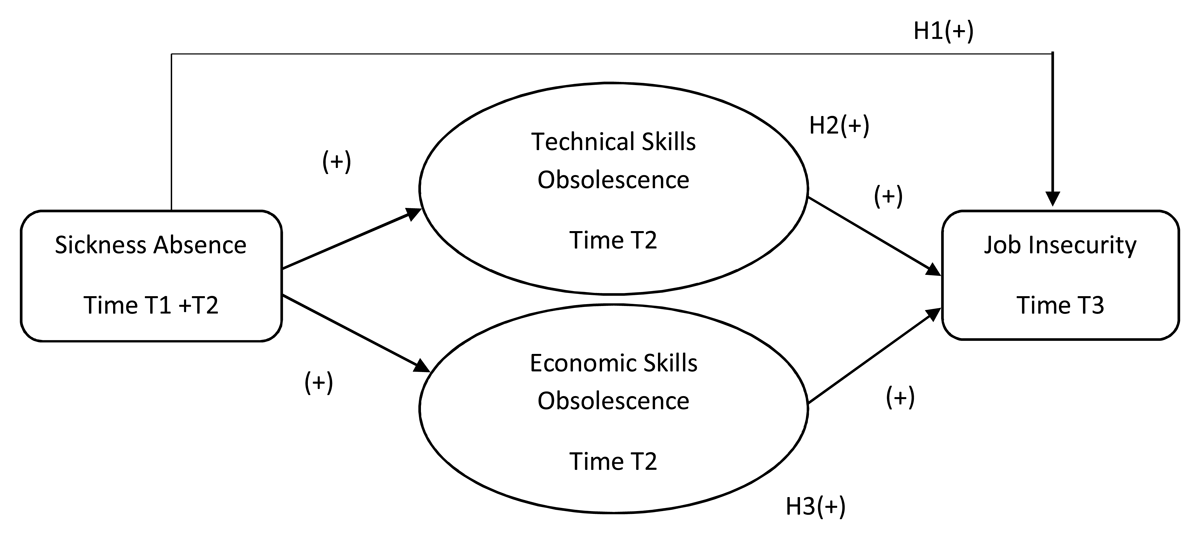
Figure 1
Overview of hypothesized model.
Methods
Participants and procedure
We used longitudinal data from a three-wave study conducted among 2,731 telecom workers in the Netherlands, which was part of a broader longitudinal survey with the aim to monitor workforce development and well-being. The company is composed of 7,000 employees. The invited employees worked in the business unit, which included customer contact centres, a department with installation and maintenance technicians, and some technical and support departments. Also, workers who were on sick leave or who were in the process of returning to work were invited to participate. However, we cannot confirm their participation as participation was anonymous and we did not differentiate between absent and non-absent workers in our data collection. Participants were given three surveys between September 2021 and September 2022. After the announcement, invitations were sent by e-mail with a link to the questionnaire in Qualtrics, an online survey tool. We used short scales or single items to ensure a reasonable survey length while reducing participants’ fatigue (Ohly et al., 2010). Prior to answering the survey, all participants were provided with information about their privacy, and we obtained their written informed consent to participate. The baseline Time 1 (T1) response rate was 52% (n = 1,444). The second survey—Time 2 (T2)—was sent out six months later with a response of 27% (n = 750), and the last survey—Time 3(T3)—again six months later, with a response rate of 24% (n = 665). This study includes workers who participated in all three waves (n = 490), consisting of 169 call centre agents (34.5%), 110 technicians (22.4%), 70 managers (14.3%), and 65 staff (e.g., HR, assistants) (13.3%) and 76 others (e.g., engineers, project managers, and traffic specialists) (15.5%).
Measures
Sickness absence was combined with the measures at Time 1 and Time 2. Sickness absence at Time 1 was measured with a single item of absence duration: “How many days have you been absent during the past year (due to illness, accident, or other health reasons)?”. Respondents could answer with an amount between 0 and 365 days. Sickness absence at Time 2 was measured with a single item of absence duration. Time 2 occurred six months later: “How many days have you been absent during the past six months (due to illness, accident or other health reasons)?”. Respondents could answer by giving an amount between 0 and 183 days. We changed the period to 6 months in the measurement of sickness absence at Time 2 because the period between Time 1 and Time 2 was six months, and we did not want any overlap of sickness absence measurements between Time 1 and Time 2.
Skills obsolescence was measured at Time 2 based upon the typology developed by De Grip and Van Loo (2002), who distinguished between economic and technical skills obsolescence. We measured technical skills obsolescence with three items on a five-point scale ranging from strongly disagree to strongly agree. Sample items included “There are important physical aspects in my job that I cannot handle as well as before” and “Important skills for my work that I used to master have declined” (Cronbachs α = 0.81). Economic skills obsolescence was measured with six items. Sample items included “Technological developments make many of my knowledge and skills outdated” and “I lack ‘new’ knowledge and skills that have become important due to changes in my work”. The answer category ranged from strongly disagree to strongly agree on a five-point scale (Cronbachs α = 0.78).
Job insecurity was measured at Time 3 based on the single item used by previous studies (e.g., Eurofound, 2023; McGuinness et al., 2021): “How likely do you think it is that you will lose your job in the next six months (because of reorganisation, dismissal or non-renewal of contract)?”. This six-month timeframe is consistent with prior research and aligns well with common organisational and financial planning cycles, which typically operate semi-annually or quarterly. This offers a relevant period for assessing job insecurity and for considering job-related changes, particularly in industries undergoing regular technological and organisational change.
The control variables we used for our model included the demographic variables age (years), gender (male, female, and non-binary), education (primary, secondary, vocational, higher professional and academic education), and the work variables organisation tenure (years), job tenure (years) and contract type (temporary and fixed). We dummy-coded the following variables for the analyses: Gender was coded as 1 for male and 0 for non-binary and female. Education was coded as 1 for higher education and 0 for lower and middle education. Contract type was coded as 1 for fixed contracts and 0 for temporary contracts.
Attrition analyses
We conducted attrition analyses to compare the respondents who participated in all three waves with the ones who participated in waves one or two. First, we computed a variable for dropout (1 = dropped out, 0 = respondents remained in the study). Second, we used a binary logistic regression to assess whether the demographic variables (gender, age, and education), the work variables (contract type, job tenure, and organisation tenure), and the study variables were indicative of dropout. The model was significant X2 (12) = 77.973. p < .001. The results showed significant relations with age (B = –.04, p < .001) and organisation tenure (B = –.05, p = .01); thus, younger workers and the ones with less tenure had a higher dropout. No differences were found in the other variables.
Data analysis
We performed reliability tests and computed descriptive statistics to examine kurtosis and skewness. Except for the high kurtosis of absence duration—a known issue of absence data (De Winter et al., 2016)—the variables show an acceptable distribution. Next, we computed Spearman correlations, which are less sensitive to outliers than Pearson correlations. We used Hayes’ PROCESS Model 4 for multiple mediation in Stata 17 to evaluate our hypotheses (Hayes, 2017). To ascertain the significance of the indirect effects, we employed bootstrapping in conjunction with a complete mediation model that included the control variables.
We aggregated sickness absence at Time 1 and Time 2 prior to the measurements of skills obsolescence at Time 2 and job insecurity at Time 3. The aggregation of the sickness absence variables provided us with a composite measure reflecting sickness absence over 1.5 years, with which we aimed to capture a more stable and representative measure of sickness absence that improved the reliability of our analysis (Harrison & Martocchio, 1998). The aggregation also enlarges the variance of sickness absence and partly reduces the period between sickness absence and skills obsolescence measurements. This approach enabled us to examine the longitudinal relationships while considering the potential causal relationships and the time lag between the predictor and outcome variables.
Results
Descriptive statistics and Spearman correlations
The age of the respondents varied from 21 to 66 years, and the mean age was 45.47 years (SD = 10.24). 32% identified themselves as female, 67% as male, and 0.2% as non-binary. The mean organisation tenure was 13.7 years (SD = 8.59), and job tenure was 6.98 years (SD = 6.49). The educational level differed in terms of lower (15%), middle (54%), and higher (31%). The categorical variables were dummy-coded to ensure appropriate statistical interpretation, as described in the method section. The average organisational tenure was 13.70 years (SD = 8.59), while job tenure averaged 6.98 years (SD = 6.49). Mean scores for the main study variables were as follows: economic skills obsolescence (M = 2.30, SD = 0.63), technical skills obsolescence (M = 2.19, SD = 0.91), and job insecurity (M = 2.44, SD = 1.15). The average sickness absence over the observed period was 18.54 days (SD = 48.89), with a skewed distribution (skew = 4.75).
Table 1 shows the Spearman correlations. Most of the correlations were significant. We found positive significant relationships between sickness absence and technical skills obsolescence (ρ = .26, p < .001) and economic skills obsolescence (ρ = .12, p < .001). So, absence duration goes together with higher technical and economic skills obsolescence levels. In return, we also found significant relationships between both obsolescence variables and job insecurity (respectively, ρ = .32, p < .001 and ρ = .10, p < .05), meaning that technical obsolescence as well as economic obsolescence are associated with more job insecurity. However, the relationship between sickness absence and job insecurity was not significant. Technical and economic skills obsolescence seem highly correlated (ρ = .53, p < .001). Of the control variables, age and both tenure variables showed that older workers and those with longer tenures perceive higher levels of skills obsolescence. Age significantly correlated with technical skills obsolescence (ρ = .25, p < .001) and economic skills obsolescence (ρ = .17, p < .001). Organisation tenure and job tenure were significantly associated with technical skills obsolescence (respectively, ρ = .24, p < .001 and ρ = .27, p < .001) and with economic skills obsolescence (respectively ρ = .23, p < .001 and ρ = .21, p < .001). In addition, only age and organisation tenure showed significant positive correlations with job insecurity (ρ = .15, p < .001 and ρ = .10, p < .05).
Table 1
Spearman correlations.
| 1 | 2 | 3 | 4 | 5 | 6 | 7 | 8 | 9 | 10 | |
|---|---|---|---|---|---|---|---|---|---|---|
| 1. Sickness absence | – | |||||||||
| 2. Economic obsolescence | .12** | – | ||||||||
| 3. Technical obsolescence | .26** | .53** | – | |||||||
| 4. Job insecurity | –.07 | .32** | .10* | – | ||||||
| 5. Age | –.14** | .17** | .25** | .15** | – | |||||
| 6. Education* | –.17** | –.14** | –.21** | .00 | –0,08 | – | ||||
| 7. Gender* | -.01 | .00 | .10* | –.04 | .09* | –.03 | – | |||
| 8. Organization Tenure | –.11** | .23** | .24** | .10* | .57** | –.16** | –.12** | – | ||
| 9. Job Tenure | .04 | .21** | .27** | .00 | .39** | –.15** | –.17** | .57** | – | |
| 10. Contract type* | –.07 | .17** | .10* | –.00 | .24** | .04 | –.04 | –.41** | .36** | – |
[i] Notes: n = 489. *p < .05. **p < .01. *Gender was coded as 1 for male and 0 for non-binary and female. Education was coded as 1 for higher education and 0 for lower and middle education. Contract type was coded as 1 for fixed contracts and 0 for temporary contracts.
Hypothesised model
Table 2 presents the results of our hypothesised model. The model was significant (p < .001), and our independent variables can explain 13 percent of the variance in job insecurity. Hypothesis 1 stated that there is a direct relationship between sickness absence and job insecurity over time. However, the results did not show a significant direct relationship between sickness absence and job insecurity. Also, we hypothesised indirect relationships via technical skills obsolescence (H2) and economic skills obsolescence (H3). According to the results, there is a significant positive relationship between sickness absence and technical skills obsolescence (β = .19, p < .001), as well as with economic skills obsolescence (β = .10, p < .001). Although we did not find a significant relationship between technical skills obsolescence and job insecurity, we found a significant relationship between economic skills obsolescence and job insecurity (β = .35, p < .001). Likewise, we found a significant indirect relationship between sickness absence and job insecurity via economic skills obsolescence (β = .07, p < .001) but not via technical skills obsolescence. Hence, we found support for H3 but not H2, so the relationship between sickness absence and job insecurity is only mediated by economic skills obsolescence.
Table 2
(In)direct effects of sickness absence on job insecurity via technical and economic skills obsolescence.
| ECONOMIC SKILLS OBSOLESCENCE | TECHNICAL SKILLS OBSOLESCENCE | JOB INSECURITY | ||||
|---|---|---|---|---|---|---|
| β | SE | β | SE | β | SE | |
| Sickness absence | .10** | .01 | .19** | .01 | –.01 | .02 |
| Economic skills obsolescence | .35** | .09 | ||||
| Technical skills obsolescence | –.08 | .07 | ||||
| Age | .06 | .00 | .12** | .01 | .19** | .01 |
| Gender* | –.05 | .06 | .10 | .08 | –.03 | .10 |
| Education* | –.11** | .06 | –.10** | .08 | .05 | .10 |
| Organization tenure | .10 | .00 | –.02 | .01 | –.02 | .01 |
| Job tenure | .05 | .00 | .18** | .01 | –.10* | .01 |
| Contract type* | –.12** | .11 | .07 | .16 | .04 | .21 |
| Bootstrap indirect effect of Sickness Absence on Job Insecurity via Skills Obsolescence | ||||||
| β | SE | 95% CI | ||||
| Economic skills obsolescence | .07** | .02 | .01–.09 | |||
| Technical skills obsolescence | –.02 | .01 | –.04–.01 | |||
[i] Notes: n = 489. *p < .05. **p < .01. Standardized regression coefficients are reported. Bootstrap sample size = 1000. *Gender was coded as 1 for male and 0 for non-binary and female. Education was coded as 1 for higher education and 0 for lower and middle education. Contract type was coded as 1 for fixed contracts and 0 for temporary contracts.
Discussion
We used longitudinal data from 490 workers aged 21–66 at a Dutch telecom company to examine the relationship between sickness absence and job insecurity. Our study aimed to offer insights into how sickness absence can contribute to job insecurity over time. We expected this process to occur through the distinct pathways of skills obsolescence.
First, our results did not reveal a significant direct relationship between sickness absence and job insecurity, which contrasts with the findings of Griep et al. (2021). However, our findings on this non-significant direct relationship are consistent with the studies of Ishimaru (2020) and Kim et al. (2020). Several contextual factors may explain this outcome, including the longer time lag in our study between measuring sickness absence and job insecurity, which may have allowed other factors or changes in the workplace to influence workers’ perceptions, potentially mitigating the direct impact of sickness absence on job insecurity. Also, only 17% of workers in our sample reported feeling a strong probability of job loss within the next six months, which is significantly lower than the national average of 24% (Eurofound, 2023). Our sample’s high number of workers with permanent contracts may partially explain this discrepancy. Dutch labour laws, which prohibit the dismissal of employees during the first two years of sickness absence, may provide these workers with additional job security. Virtanen et al. (2006) showed that permanent employment protects workers from unemployment, even with high sickness absence. As a result, workers in our study may perceive lower job insecurity despite higher sickness absence rates.
Second, contrary to our expectations, technical skills obsolescence did not mediate the relationship between sickness absence and job insecurity. Several factors may account for this non-significant finding. The recovery effect of being absent from work may counterbalance the effect of technical skills obsolescence on job insecurity. Workers often return with renewed physical and mental capacities, which mitigates any skill deterioration during their sickness absence. Sonnentag et al. (2017) demonstrated that time away from work demands is essential for recovery, allowing workers to replenish depleted physical and mental resources. As a result, workers may have returned with restored energy and cognitive function, reducing the impact of technical skills obsolescence caused by sickness absence.
Another explanation may be found in Selection, Optimisation and Compensation (SOC) theory (Baltes & Baltes, 1990). Our results revealed a stronger relationship between older age and technical skills obsolescence. However, older workers often employ adaptive strategies to remain relevant and effective despite potential declines in physical and cognitive capacities. SOC theory outlines three vital strategies: selection, which involves choosing tasks that align with retained skills; optimisation, which refers to enhancing performance through targeted training or practice; and compensation, which includes using new strategies or technologies to offset skills obsolescence. While we did not explicitly test SOC mechanisms, these adaptive strategies may help workers mitigate the impact of technical skills obsolescence, maintaining their effectiveness despite certain declines. In knowledge-based industries, workers may have greater access to learning opportunities and technological support, which could buffer against some aspects of skill deterioration during their sickness absence. However, in industries where adaptive strategies are less feasible, such as physically demanding jobs, the consequences of technical skills obsolescence may be more severe, as deterioration due to aging, illness, or prolonged non-use is harder for these workers to compensate for through training or technological assistance.
Finally, we found a significant mediating effect of economic skills obsolescence. Our results showed that sickness absence is associated with higher perceptions of economic skills obsolescence, which, in turn, increases job insecurity. Despite the protective legislation that prevents dismissals during sickness absence, workers may still believe their jobs are at risk if they perceive economic skills obsolescence. This significant mediating effect aligns with the COR theory, which posits that stress emerges from threats to, or actual losses of valuable resources (Hobfoll, 1989). Sickness absence can contribute to such perceived obsolescence, as absent workers may feel they are missing crucial opportunities to maintain or acquire necessary skills, thereby, increasing their job insecurity. Van Hootegem et al. (2023b) also highlighted that a lack of training opportunities and perceived job insecurity are seen as a significant threat to workers’ resources. By viewing sickness absence as a disruption that depletes workers’ resources—particularly their skill sets—our findings reinforce COR theory’s emphasis on resource loss spirals.
Moreover, our results indicated a high correlation between economic and technical skills obsolescence, with economic skills obsolescence showing a stronger relationship with job insecurity. While workers may experience some degree of technical skills obsolescence following sickness absence, it is economic skills obsolescence that primarily underpins the link between sickness absence and job insecurity. Economic skills obsolescence arises when technological and organisational changes render previously acquired skills obsolete, necessitating continuous skills adaptation (Allen & De Grip, 2012). By contrast, technical skills obsolescence stems from internal factors such as ageing, illness, or prolonged skill non-use. Given the telecom sector’s rapid technological advancements, workers in this industry are particularly susceptible to economic skills obsolescence (Lovász & Rigó, 2013). This is especially relevant for roles requiring frequent technological adaptation, such as technicians, call centre agents, and engineers, who together constitute a substantial share of our sample. Many of these roles require ongoing familiarity with evolving tools, systems, and industry developments. Sickness absence disrupts this exposure, increasing the risk that returning workers perceive their skills as outdated, thereby heightening job insecurity. These findings underscore the importance of addressing sickness absence as more than a temporary interruption, but as a process that may accelerate skills obsolescence in dynamic work environments.
Limitations and future research
While our study provides valuable insights into the consequences of sickness absence, it has some limitations that future research could address. A primary limitation is using a single-item measure for cognitive job insecurity. While this approach is widely recognised and utilised (see e.g., Eurofound, 2023; McGuinness et al., 2021), it does not capture the multidimensional nature of job insecurity, which generally includes both cognitive and affective components. Additionally, our job insecurity measurement only covered a six-month period, as this reflects a timeframe relevant to industries undergoing technological and organisational changes. However, a more nuanced and extended measurement period might offer a more comprehensive understanding of the differential effects on both components of job insecurity. This would provide a more in-depth analysis of the psychological impacts of sickness absence and skills obsolescence on job insecurity. While our findings indicate an indirect relationship between sickness absence and job insecurity via economic skills obsolescence, the single-time-point measurement of job insecurity limits our ability to assess how perceptions change over time. As Cole and Maxwell (2003) argue, repeated measurement of the outcome variable strengthens mediation claims by capturing temporal dynamics. Future research could build on our findings by including multiple measurement points for job insecurity to more robustly examine how such perceptions develop following absence.
Another limitation is the decision not to distinguish between short-term and long-term sickness absence due to the lack of a consistent threshold in the literature. In fast-changing industries, even short absences may contribute to skills obsolescence, making this distinction less relevant. Additionally, sickness absence data typically exhibit a bimodal distribution, with a large proportion of workers never taking sick leave and a smaller group experiencing longer absence periods. Given this, creating separate categories within our sample would have resulted in small and uneven subsamples, potentially reducing the reliability of subgroup analyses. While our total sample size (N = 490) was sufficient for the primary analyses, subgroup comparisons were more constrained. To account for this, we treated sickness absence as a continuous variable, aligning with the concept of a continuum process. This approach is consistent with COR theory, which conceptualises resource depletion as a gradual rather than abrupt process (Hobfoll, 1989).
Although our sickness absence data address the issue of a long gap between T1 and T2 measurements, the distribution remains skewed. However, this skewness is unlikely to compromise the validity of our findings, as we applied the PROCESS macro (Hayes, 2017) with bootstrapping techniques, ensuring the robustness of results. Future research could benefit from larger and more balanced datasets to explore alternative ways to operationalise sickness absence, particularly in industries with less technological disruption or in studies that aim to examine subgroup effects in greater detail.
A final limitation arises from our data collection, which is confined to a Dutch company. This raises questions about the generalisability of our findings. However, our study suggests that the Dutch legal protections mitigate the direct impact of sickness absence on job insecurity, which aligns with Virtanen et al. (2006) and highlights the importance of considering contextual factors in research on job insecurity. While our study focuses on skills obsolescence as a mediating mechanism, other pathways may also contribute to the relationship between sickness absence and job insecurity, and their influence may vary across institutional and organisational contexts. Future research could involve diverse samples from various national and organisational contexts to enhance the generalisability of findings. Comparative analyses across countries with different social security systems would provide a broader understanding of how contextual factors influence the relationship between sickness absence, skills obsolescence, and job insecurity.
Practical implications
Our findings highlight the importance of structured return-to-work policies to help workers to maintain their job security and employability after sickness absence, particularly in industries undergoing rapid technological change. Given the role of economic skills obsolescence in the relationship between sickness absence and job insecurity, organisations should prioritise continuous learning opportunities that ensure workers remain up to date with technological and organisational developments. First, clear return-to-work activities can help workers regain their professional footing. This includes structured updates on workplace changes, access to targeted training opportunities, and mentorship to facilitate knowledge transfer. Ensuring that workers stay informed about evolving job requirements may help to reduce uncertainty and concerns about job stability.
Second, a learning-oriented work environment is crucial for mitigating skills obsolescence and for supporting long-term employability. While our study did not directly test learning processes or training effects, previous research suggests that access to learning opportunities can buffer against skill obsolescence and can mitigate perceptions of job insecurity (Van Hootegem et al., 2023a). Organisations should therefore offer accessible and flexible learning opportunities—such as on-the-job training, exposure to new tools and systems, and digital learning platforms—to allow workers to maintain and update their skills after an absence. Although our findings did not indicate a significant mediating effect of technical skills obsolescence, organisations should be mindful that workers in physically demanding jobs may experience skill deterioration due to sickness absence. Supporting their return-to-work process may require additional training, gradual reintroduction or specific workplace adjustments.
Third, the social and organisational aspects of returning to work should not be overlooked. Workers who have been absent may risk being sidelined or perceived as less capable, which could reinforce job insecurity. To counter this, managers play a key role in ensuring that returning workers remain integrated into workplace activities and career development processes. Finally, return-to-work strategies should be a shared responsibility between employers and employees, ensuring that workers receive adequate support while maintaining opportunities for professional growth. By providing structured learning opportunities, facilitating knowledge-sharing, and ensuring clear return-to-work processes, organisations can help workers navigate job demands more effectively, reducing the risk of skills obsolescence and job insecurity.
Conclusion
Our study, conducted at a Dutch telecom organisation, highlights the relationship between sickness absence, skills obsolescence, and job insecurity. The findings reveal that economic skills obsolescence—an externally driven process in which workers’ skills lose value due to evolving job demands in the labour market—is significantly associated with job insecurity. In contrast, we found no significant relationship via technical skills obsolescence, which refers to the decline of skills that workers possess due to disuse, aging, illness, or injury. These results indicate that in industries where technological advances frequently alter job requirements, economic skills obsolescence serves as the primary mechanism linking sickness absence to job insecurity. Workers returning from sickness absence are especially vulnerable, as they may struggle to keep pace with these evolving demands. The misalignment between their obsolete skills and the workplace’s changing requirements can increase job insecurity, as it makes workers feel less competent and more vulnerable to possible job loss.
Data accessibility statement
The data that support the findings of this study are available from corresponding author. Restrictions apply to the availability of these data, which were used under license for this study.
Competing Interests
The authors have no competing interests to declare.