
Introduction
Whether it is a general change as a result of technological development and the risk of being replaced by machines; the rise of alternative work arrangements (e.g., contract work) to enable organizational agility (Spreitzer et al., 2017); or a specific change in the workplace, such as budget cuts or colleagues being laid off, these things all have something in common. They can indicate that your job is at risk—a phenomenon called job insecurity. When you come home from work, this worry may still be with you, affecting your life outside of work. You may have questions about job loss—what it means, when it might happen, and how to prevent it or cope with it. You may find it hard to disconnect from work and relax; you might ruminate about the situation, or even proactively think about solutions. Such thoughts can affect how exhausted you feel. With this study, we want to shed light on the following question: through which cognitive and affective processes does job insecurity remain present and is exacerbated during non-work time, thereby affecting employee (work-related) well-being?
Job insecurity is defined as an employee’s individual perception of potential involuntary job loss (Sverke et al., 2002). It has been shown to affect a wide range of feelings, attitudes, and behaviors (Keim et al., 2014) and to negatively impact employees’ personal, family, and social lives (Cheng & Chan, 2008; De Witte, 2005). According to meta-analytic findings (Cheng & Chan, 2008; Jiang & Lavaysse, 2018; Llosa et al., 2018; Sverke et al., 2002), job insecurity has a negative impact on employees’ distress and (work-related) well-being, which is well established in the literature and is also supported by recent studies (Baldissarri et al., 2023; Hu et al., 2022).
Burnout can be seen as an indicator of poor well-being and physical health (Maslach & Leiter, 2021). Job insecurity has been repeatedly associated with exhaustion (De Cuyper et al., 2012; Öztürk et al., 2017), which is the core facet of burnout along with cynicism and professional efficacy (Maslach & Leiter, 2008; Schaufeli et al., 1996; WHO, 2019) and an established marker of employee well-being (e.g., Mäkikangas et al., 2016). These findings are reflected in a substantial meta-correlation between job insecurity and emotional exhaustion (ρ = .30; Jiang & Lavaysse, 2018). Accordingly, we focus on the established link between job insecurity and exhaustion and try to unravel its underlying mechanism.
As pointed out in an integrated review by Shoss (2017), the conceptualization of job insecurity as a stressor (De Witte et al., 2016) aligns with broader models of stress, such as appraisal theory (Folkman & Lazarus, 1985) and conservation of resources theory (Hobfoll, 1989). Previous research (e.g., De Cuyper et al., 2012) has used these frameworks to explain why job insecurity is stressful—primarily as a threat to valuable resources—and how it contributes to exhaustion through coping efforts and resource depletion. The present study complements this line of research by providing a more focused explanation of how the experience of job insecurity manifests and is sustained during non-work time. Specifically, drawing on perseverative cognition theory (Brosschot et al., 2006, 2010) and recovery research (e.g., Sonnentag & Fritz, 2015), we propose that work-related thoughts sustain the experience of job insecurity and explain its impact on employee well-being by prolonging and intensifying psychophysiological activation. Work-related thoughts during non-work time can affect employees’ health and well-being in addition to the work itself (Sianoja et al., 2018, Sonnentag & Fritz, 2015): They prevent employees from mentally leaving their jobs, even when they are physically absent. In the present study, we follow the distinction introduced by Cropley and Zijlstra (2011), which distinguishes between lack of psychological detachment, affective rumination, and problem-solving pondering as facets of work-related rumination. Our conceptual model is presented in Figure 1.
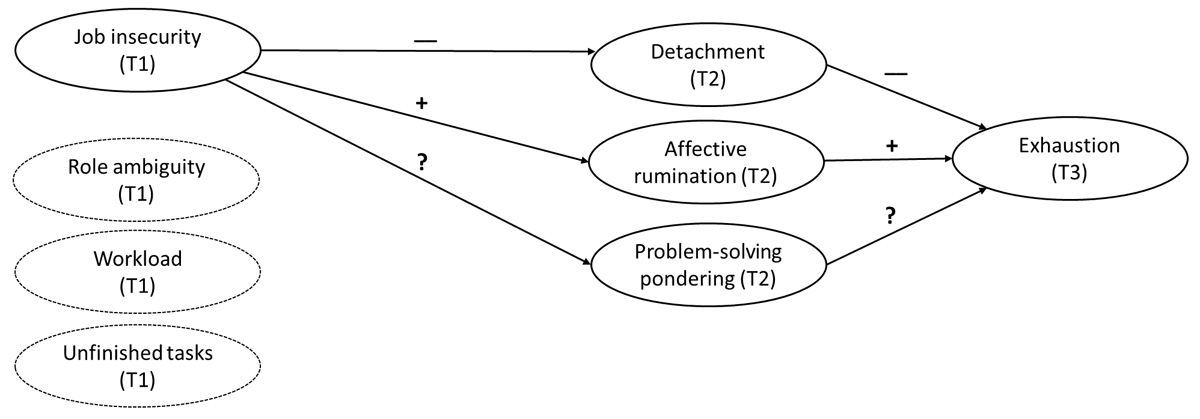
Figure 1
Conceptual model linking job insecurity to exhaustion.
Our study contributes to a deeper understanding of job insecurity as a stressor and of the cognitive and affective processes during non-work time that are triggered in the face of potential job loss. In this study, we take a fine-grained approach to the underlying processes between job insecurity and exhaustion over time, considering different types of work-related thoughts. Such a fine-grained examination of how job insecurity persists beyond the workday allows us to determine whether its effects arise primarily from cognitive representations (a lack of detachment), persistent problem-related thoughts (problem-solving pondering), or intense affective responses (rumination). Understanding these mechanisms is crucial for developing targeted interventions and goes beyond merely documenting the negative effects of job insecurity. While interventions for improving detachment would focus on helping employees disconnect from job insecurity (i.e., boundary management), those targeting affective rumination would specifically address emotional responses during non-work time. Finally, examining problem-solving pondering could reveal whether solution-focused thoughts restore control or exacerbate distress.
By including lack of detachment, affective rumination, and problem-solving pondering as different types of work-related thoughts, we add to the ongoing debate about whether job insecurity is only related to maladaptive reactions, or if it also shows associations with more active, problem-oriented reactions (e.g., De Witte & Van Hootegem, 2021; Piccoli et al., 2019). Problem-solving pondering with its goal-directed nature (Kinnunen et al., 2017) can be viewed as a positive and adaptive part of rumination itself (e.g., Cropley et al., 2012) and may be such an active, problem-oriented reaction to job insecurity.
We also contribute to the understanding of the detrimental nature of job insecurity as a career-related stressor while taking into account task-related and role stressors (Sonnentag & Frese, 2012). Notably, job insecurity is not the only stressor that triggers work-related thoughts. Previous research highlights the generalizability of our proposed mechanisms across different types of stressors, all of which have been linked to exhaustion and work-related thoughts during non-work time. For example, a recent meta-analysis (Wendsche & Lohmann-Haislah, 2017) found that qualitatively different types of stressors were all related to a lack of detachment. Our study aims to demonstrate the relevance of job insecurity—as a career-related stressor—in eliciting these thoughts and their subsequent effects on exhaustion, above and beyond other stressors such as role ambiguity, workload, and unfinished tasks. While similar processes may be activated by various stressors, job insecurity could play a particularly strong role in sustaining work-related thoughts after work, underscoring its relevance for employee well-being.
How Job Insecurity Persists During Non-Work Time
Thinking about work outside of working hours has been recognized to play a crucial role in prolonged occupational stress (Cropley & Zilstra, 2011; Sonnentag & Fritz, 2015). Job insecurity can be expected to give rise to various work-related thoughts. Drawing on Perseverative Cognition Theory (PCT; Brosschot et al., 2006, 2010) and key findings from recovery research (e.g., Sonnentag & Zijlstra, 2006; Steed et al., 2021), we argue that it is particularly these thoughts during non-work time that sustain the experience of job insecurity and help to explain how job insecurity impairs well-being.
PCT suggests that stress persists through the ongoing cognitive processing of stressors. This ongoing cognitive representation of stressful events in the form of stressor-related thoughts, even when they do not actually occur, can be as distressing as the stressors themselves. Repeatedly thinking about stressors, such as the mere possibility of losing one’s job, can reinforce the perception of a psychological problem, amplifying its difficulty and sense of uncontrollability. Both PCT and recovery research (i.e., the Stressor–Detachment Model; Sonnentag & Fritz, 2015) emphasize that it is not the acute stress reaction that is most detrimental to employees’ well-being but rather the sustained activation of stressors (Jimenez et al., 2022). PCT states that cognitive representations of stressors in the form of work-related thoughts can prolong and intensify psychophysiological activation. Similarly, recovery research highlights that prolonged activation prevents the psychophysiological system from unwinding, thereby hindering recovery (Sonnentag & Zijlstra, 2006) and leading to impaired well-being over time (e.g., Steed et al., 2021). This aligns with research that emphasizes the importance of mentally disconnecting from work—psychological detachment—as a key mechanism for recovery (Sonnentag & Fritz, 2015).
In the present study, we adopt the trifold structure of rumination proposed by Cropley and Zijlstra (2011)—detachment, affective rumination, and problem-solving pondering—and examine them as pathways through which job insecurity is sustained during non-work time. The distinct features of these constructs allow us to disentangle cognitive and affective processes during non-work time. Both a lack of detachment and problem-solving pondering serve as markers of cognitive processes. Being unable to psychologically detach refers to experiencing work-related thoughts of any kind, regardless of their content (Jimenez et al., 2022). In contrast, problem-solving pondering is a more specific cognitive indicator, as it involves unemotional thoughts centered on solving a particular work-related problem (Cropley & Zijlstra, 2011). The affective component, however, is unique to affective rumination, which serves as our indicator of affective processing.
Lack of detachment as an explaining link between job insecurity and exhaustion
Psychological detachment refers to mentally disengaging from work during leisure time (Sonnentag & Fritz, 2015). It means to stop thinking about one’s work and to leave the workplace behind oneself (Sonnentag & Bayer, 2005; Sonnentag & Fritz, 2007), which is a crucial recovery experience. Psychological detachment would require pushing aside any thoughts about potential job loss during non-work time. However, job insecurity has been conceptualized and evidenced as a severe stressor (Mauno et al., 2017; Shoss, 2017), and it might be assumed that disengaging from work is particularly difficult for this career-related stressor as—if the threat turns out to be objectively true—the work life will change a lot. Employees might face the need to deal with the stigma of being unemployed for some time, to look for a different job, to live from welfare for some time, etc.
To date, very few studies have focused on how job insecurity affects detachment, and have instead considered recovery experiences (Kinnunen et al., 2010) or psychological detachment (Sora & Höge, 2014; Wu et al., 2022) as moderators in detachment’s relationship with strain, affective well-being, and emotional exhaustion. In contrast to these few previous studies, and drawing on PCT and recovery research, we argue that psychological detachment acts as a mediator linking a stressor (in our case, job insecurity) to strain (here, exhaustion) via (lack of) detachment. Accordingly, we propose our first hypothesis:
H1: Job insecurity is positively linked to exhaustion via decreased psychological detachment from work.
Affective rumination as the mechanism linking job insecurity with exhaustion
Work-related rumination describes repetitive thoughts that are related to work (Cropley & Zijlstra, 2011). The concept of affective rumination is defined as a negative affective state in which one has recurrent intrusive thoughts concerning work, which sustain arousal (Cropley & Zijlstra, 2011; Pravettoni et al., 2007). According to PCT, affective rumination should be a state in which work stressors are present for a longer period of time due to cognitive representations and thus can harm an individual (Brosschot et al., 2006). Previous studies have linked affective rumination to employee well-being (Firoozabadi et al., 2018a; Zoupanou & Rydstedt, 2019), with rumination hindering recovery and fueling the negative effects on individuals (Firoozabadi et al., 2018b; Vandevala et al., 2017). Consistently, affective rumination has been found to predict emotional exhaustion (Vandevala et al., 2017).
As with psychological detachment, there is very little research on the role of rumination for the relationship between job insecurity and strain. By linking job insecurity to turnover, Richter and colleagues (2020) showed that rumination acts as an explanatory mechanism. Another (cross-sectional) study by Konkeland and Heffernan (2021) showed that (affective) job insecurity is related to emotional exhaustion via job insecurity rumination. These two studies provide initial evidence that (affective) rumination may follow when employees perceive their job to be at risk of being lost, which then leads to exhaustion. In line with PCT and extending previous research, we therefore propose our second hypothesis:
H2: Job insecurity is positively linked to exhaustion via increased affective rumination after work.
The unclear role of problem-solving pondering after work
Another type of work-related thoughts in which employees remain mentally connected to work is problem-solving pondering. In this mental state, a person thinks about work-related problems or solutions to improve work (Cropley et al., 2012). After PCT, because of problem-solving pondering work-related stressors remain active through the cognitive representations (Brosschot et al., 2006; Pauli et al., 2023). From this perspective, problem-solving pondering also relates to exhaustion. However, this reflection takes place without an emotional state that triggers arousal (Cropley & Zijlstra, 2011). Although problem-solving pondering and affective rumination share a common component, they are distinct concepts, with problem-solving pondering considered a positive, adaptive aspect of rumination (Cropley et al., 2012; Pauli et al., 2023; Weigelt et al., 2019). If employees like their work and enjoy thinking about work-related topics, the mental activity might be seen as purposeful (Kinnunen et al., 2017). Finding a solution can stop ruminative thoughts and can trigger a positive affect when pondering about interesting things (Firoozabadi et al., 2018a; Martin & Tesser, 1996). Others have argued that even if employees do not come up with solutions, problem-solving pondering can restore a sense of control and confidence, and reduce uncertainty (Syrek et al., 2017). Thus, even though job insecurity may not be easily ‘solved’ by employees, they may benefit from problem-solving pondering as it could lead to potential solutions. Thus, problem-solving pondering with its goal-directed nature (Kinnunen et al., 2017) may be an indication of problem-oriented coping.
Reflecting this unclarity about whether employees benefit from problem-solving pondering after work, studies on the link between problem-solving pondering and strain are inconclusive. Problem-solving pondering is not always associated with poor employee well-being (Kinnunen et al., 2017; Vahle-Hinz et al., 2017; Wendsche & Lohmann-Haislah, 2017). One study found weak to moderate correlations between problem-solving pondering and job stressors (e.g., work environment), depression, emotional exhaustion, and well-being (Pauli et al., 2023). Consistent with the notion that problem-solving pondering may promote recovery, it even negatively predicted fatigue when its overlap with affective rumination was controlled (Querstret & Cropley, 2012). However, most studies found no links between problem-solving pondering and mental impairment such as burnout or depression (Hamesch et al., 2014; Jimenez et al., 2022; Vandevala et al., 2017; Weigelt et al., 2019).
As it remains unclear whether job insecurity also involves more constructive, problem-oriented ways of solving problems (i.e., problem-solving pondering), and even if this is so, how it is related to psychological distress, we derive our first research question:
RQ1: Is job insecurity linked to exhaustion via problem-solving pondering after work?
On the relevance of job insecurity for work-related thoughts beyond other stressors
Finally, it could be argued that our reasoning about the relationship between job insecurity and exhaustion applies to other stressors as well, and that stressors in general lead to reduced exhaustion via work-related thoughts. Previous research underscores that different types of stressors are linked to exhaustion and work-related thoughts during non-work time (e.g., Kinnunen et al., 2017; Wendsche & Lohmann-Haislah, 2017). We selected specific role stressors (role ambiguity), and task-related stressors (workload and unfinished tasks) as important other stressors that should also trigger work-related rumination during non-work time. Furthermore, these stressors have previously been linked to work-related thoughts.1
First, employees with high role ambiguity may struggle to disengage from work during non-work time because they lack a clear understanding of their job role, responsibilities and expected behaviors (Lyons, 1971), making it difficult for them to demonstrate that they are performing their jobs well (Bray & Brawley, 2002). Recent studies show that role ambiguity impairs detachment from work and is linked to fatigue and disrupted sleep (Reis & Prestele, 2020).
Second, workload is a ‘traditionally studied task-related stressor’ (p. 474, Sonnentag et al., 2023), indicating that there is not enough time to complete the assigned tasks at work (Roe & Zijlstra, 2000). Workload has been extensively researched, and prior research shows that workload is associated with work-related rumination, a lack of detachment (Sianoja et al., 2018; Van Laethem et al., 2019), and exhaustion (Gelsema et al., 2006; Häusser et al., 2010).
Third, unfinished tasks may play a crucial role in work-related thoughts, as the completion of work is an important prerequisite for recovery (Larsen & Christenfeld, 2011). Having tasks unfinished at the end of the workday has been linked to a lack of detachment, affective rumination, and problem-solving pondering (Syrek et al., 2017, Reis & Prestele, 2020), and this stressor has been shown to impair employees’ sleep by inducing perseverative cognitions (Syrek & Antoni, 2014).
However, even more than task-related and role stressors, job insecurity implies unpredictability and uncontrollability (De Witte, 2005), and given its severity, it should affect both work and non-work domains (Mauno et al., 2017). Thus, we expect that job insecurity will display associations with exhaustion via work-related thoughts over task-related and role stressors. Regarding the impact of job insecurity when accounting for other types of stressors, namely role ambiguity, workload, and unfinished tasks, we formulate our third hypothesis as follows:
H3: Job insecurity is linked to exhaustion via work-related thoughts, even after controlling for role ambiguity, workload, and unfinished tasks.
Method
Procedure
Data were collected via an anonymous online survey conducted between February and September 2023 using SoSci Survey. Recruitment was conducted in several ways. Circular emails were sent within the university, and the registration link was posted on various social media groups. In addition, personal friends and business contacts were used for recruitment. After registering through an email link, participants automatically received the link to participate in the survey. Participation was voluntary and unpaid, and participants gave informed consent prior to participation. The study was approved by the university ethics committee (approval number 2022-72k).
Eligible participants were individuals over 18 years of age who worked full time or at least 15 hours per week. Three time points (T1–T3) were chosen as recommended for longitudinal mediation in order to examine the direction of relationships (Cole & Maxwell, 2003). Each time point was separated by four weeks. Participants had the opportunity to win one of five $20 vouchers in a lottery to reduce attrition across the three waves.
Sample Description
A total of N = 272 people participated in the study at T1. We excluded 20 individuals because they did not finish the questionnaire. Further, 12 people were excluded because they reported working less than 15 hours per week. After exclusion, the sample consisted of N = 240 participants at T1. The sample included 169 women (70.4%), 68 men (28.3%), and three non-binary individuals (1.6%), ranging in age from 19 to 64 years (M = 36.22, SD = 12.32). At 54.2%, more than half of participants were employed full time, 92.1% were salaried, and 24.2% were in managerial positions. The sample was highly educated, with 49.2% holding a university degree. Participants worked in a range of industries and professions, but the most common sector was health and social care (20%). The participants worked an average of 33.28 hours per week (SD = 11.07) and 46.7% of them worked partially at home 5.36 hours per week (SD = 7.39). Of these, 183 individuals participated at T2 and 160 at T3; our analyses were based on this final sample of 160 participants at T3. The retention rate was 76.3% at T2 and 66.7% at T3.
Instruments
Job Insecurity
Job insecurity was assessed at T1 via the four-item quantitative job insecurity scale as validated by Vander Elst et al. (2014). A sample item was ‘I may lose my job soon’. A six-point Likert scale was used with response alternatives ranging from ‘strongly disagree’ (1) to ‘strongly agree’ (6). Cronbach’s alpha was .85.
Job Stressors
In addition to assessing job insecurity as a career-related stressor, one role stressor (role ambiguity) and two tasks-related stressors (workload, unfinished tasks) were assessed at T1. First, in line with Reis and Prestele (2020), role ambiguity was measured with three items developed by Bowling et al. (2017). A sample item was ‘I am not sure what is expected of me at work’. A seven-point Likert scale was used ranging from ‘strongly disagree’ (1) to ‘strongly agree’ (7). Cronbach’s alpha was .84. Second, workload was measured with five items (e.g., ‘How often do you have to miss or delay a break because of having too much work to do? ‘) of the Instrument for Stress-Related Job Analysis (Semmer et al., 1999). Participants rated the items on a scale from ‘very rarely/never’ (1) to ‘very often/constantly’ (5). Cronbach’s alpha was .84. Third, three items building on Syrek and Antoni (2014) and Syrek et al. (2017) were used to assess unfinished tasks. The items (e.g., ‘I have not completed urgent tasks’) refer to a defined time period, which was the previous four weeks in our study. Responses were given on a scale from ‘strongly disagree’ (1) to ‘strongly agree’ (5). Cronbach’s alpha was .86.
Work-related Thoughts
The three work-related thoughts – psychological detachment, affective rumination, and problem-solving pondering – were assessed at T1 and T2 on five-point Likert scales.
To measure psychological detachment, we used the respective four items from Sonnentag and Fritz (2007). Participants rated items such as ‘During non-work time, I forgot about work’ on a scale from ‘does not apply’ (1) to ‘fully applies’ (5). Cronbach’s alphas were .93 at T1 and .90 at T2.
To assess affective rumination and problem-solving pondering the respective two subscales of the German version of the Work-Related Rumination Questionnaire (WRRQ, Pauli et al., 2023) were applied. For example, participants were asked, ‘Do you get tense when you think about professional things in your free time?’ for affective rumination, and ‘Does thinking about work-related problems in your free time help you to be creative?’ for problem-solving pondering on a scale ranging from ‘rarely or almost never’ (1) to ‘very often or always’ (5). Cronbach’s alphas were .87 at T1 and .88 at T2 for affective rumination, and .78 at both T1 and T2 for problem-solving pondering.
Based on the data at T2, a confirmatory factor analysis was conducted to ensure that our three selected mediators represented different constructs. The comparative fit index (CFI) and the root mean square error of approximation (RMSEA) were used to assess the model fit. According to MacCallum et al. (1996), RMSEA values less than or equal to .08 are considered moderate fit, while values less than or equal to .06 are considered good fit. As incremental goodness of fit index chosen was the CFI; values greater than or equal to .90 indicated an acceptable fit, and values greater than or equal to .95 indicated a good fit to the data (Hu & Bentler, 1999). We contrasted a one-factor model in which all work-related thoughts items were clustered on a global factor (χ2 = 398.41, df = 75, CFI = .74, RMSEA = .16) with the theoretically proposed three-factor model (χ2 = 127.10, df = 72, CFI = .96, RMSEA = .07), which fit the data significantly better, Δχ2 = 271.31, Δdf = 2, p < .001.
Exhaustion
Exhaustion was assessed at T1 and T3 using the Copenhagen Psychosocial Questionnaire (COPSOQ; Kristensen et al., 2005). Specifically, we applied the validated German short-version (Nübling et al., 2005) with three items that were based on the Copenhagen Burnout Inventory (CBI; Kristensen et al., 2005; Nübling et al., 2005). The items asked how often employees had been physically or emotionally exhausted and how often they had felt drained in the past four weeks. Responses were given on a 5-point Likert scale ranging from ‘rarely or almost never’ (1) to ‘always’ (5). Cronbach’s alpha at T1 was .86, and .88 and T3.
Results
Descriptive analyses were conducted using SPSS Version 29 and are presented in Table 1. Overall, the pattern of correlations was consistent with our predictions, with job insecurity at T1 being negatively related to detachment at T2 and positively related to affective rumination at T2 (and T1) and exhaustion at T3.
Table 1
Descriptive statistics and correlation coefficients for all measures used.
| VARIABLE | M | SD | 1 | 2 | 3 | 4 | 5 | 6 | 7 | 8 | 9 | 10 | 11 |
|---|---|---|---|---|---|---|---|---|---|---|---|---|---|
| T1 measures | |||||||||||||
| 1. Job insecurity | 2.15 | 1.05 | . | ||||||||||
| 2. Role ambiguity | 2.60 | 1.14 | 26** | ||||||||||
| 3. Workload | 3.33 | 0.86 | .05 | .11 | |||||||||
| 4. Unfinished tasks | 2.59 | 1.09 | .003 | .24** | .58** | ||||||||
| 5. Psych. detachment | 3.13 | 0.98 | –.15 | –.20** | –.46** | –.48** | |||||||
| 6. Affective rumination | 2.57 | 0.86 | .25** | .33** | .38** | .44** | –.54** | ||||||
| 7. PS pondering | 2.98 | 0.76 | .11 | .14 | .42** | .51** | –.56** | .40** | |||||
| 8. Exhaustion | 3.21 | 0.91 | .07 | .26** | .39** | .38** | –.40** | .61** | .30** | ||||
| T2 measures | |||||||||||||
| 9. Psych. detachment | 3.26 | 0.93 | –.18* | –.28** | –.50** | –.56** | .84** | –.58** | –.56** | –.43** | |||
| 10. Affective rumination | 2.55 | 0.86 | .32** | .31** | .37** | .37** | –.41** | .80** | .28** | .52** | –.52** | ||
| 11. PS pondering | 2.98 | 0.71 | .12 | .14 | .43** | .55** | –.57** | .39** | .81** | .28** | –.64** | .36** | |
| T3 measures | |||||||||||||
| 12. Exhaustion | 3.02 | 0.93 | .16* | .21** | .23** | .30** | –.26** | .58** | .21** | .69** | –.38** | .54** | .22** |
[i] Note. Response options varied across measures, but high scores always indicate strong support for the construct. PS pondering = Problem-solving pondering. **p < .01, * p < .05 (two-tailed).
Latent variable structural equation modeling (SEM) with AMOS 29.0 was used to test the hypotheses. The items in the measures were used as manifest indicators to represent the latent constructs. The SEM model was constructed based on the theoretical model depicted in Figure 1. Baseline levels of work-related thoughts and exhaustion were controlled for. The empirical model, which showed an acceptable fit to the data with χ2 = 1652.67, df = 1072, χ2/df = 1.54, CFI = .90, and RMSEA = .06, is depicted in Figure 2.
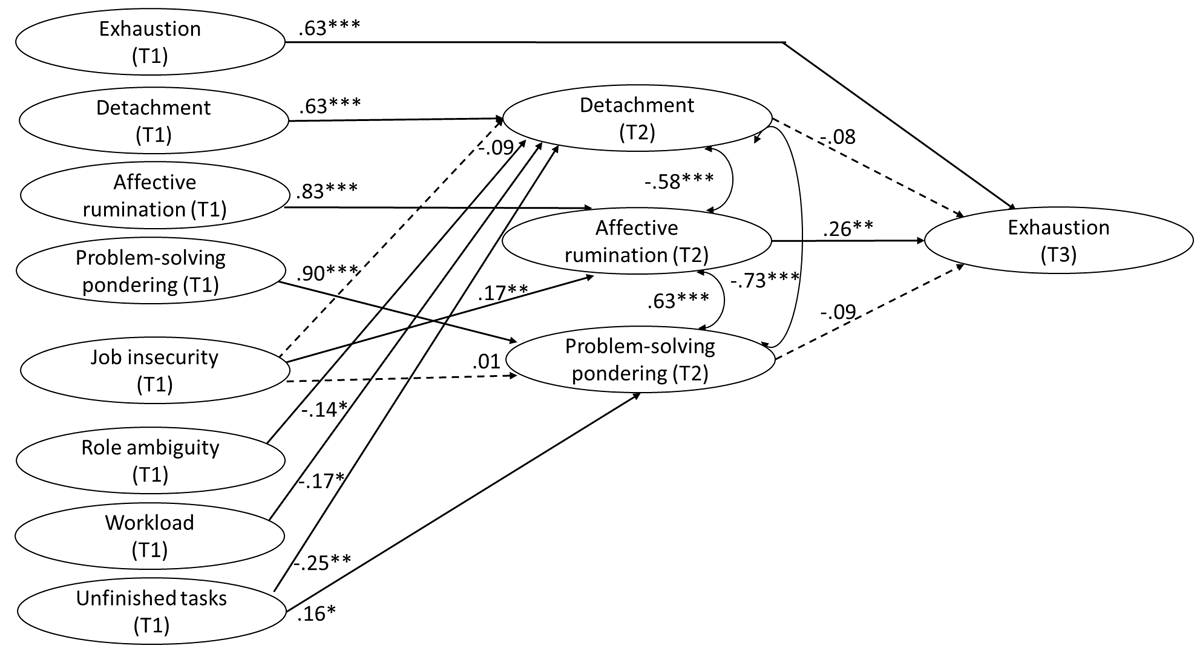
Figure 2
Illustrated are the standardized regression weights for the latent structural equation model. Solid lines indicate significant paths, dashed lines indicate non-significant paths. For the sake of parsimony, the effects of other stressors as job insecurity are only shown in case of significance.
*p < .05; **p < .01; ***p < .001.
We hypothesized that psychological detachment (H1) and affective rumination (H2) would mediate the relationships between job insecurity and exhaustion. As shown in Figure 2, neither job insecurity at T1 and detachment at T2 nor detachment at T2 and exhaustion at T3 were significantly related to each other, leading us to reject our first hypothesis.
In contrast, job insecurity at T1 was significantly related to affective rumination at T2 (β = .17, p = .003), and the association between affective rumination at T2 and exhaustion at T3 (β = .26, p = . 004) was also significant. Based on the bootstrapping, the indirect effect of job insecurity via affective rumination on exhaustion was significant (β = .05, p = .033, 95% CI = .003/.009).2 Accordingly, the analysis confirmed our second hypothesis, which was that job insecurity could lead to exhaustion through increased rumination after work.
In addition, our first research question examined whether problem-solving pondering plays a role in the relationship between job insecurity and exhaustion. Our findings indicate that it does not.
Finally, in our third hypothesis we wanted to test whether the relationship between job insecurity via work-related thoughts and exhaustion is robust to the inclusion of other stressors. Interestingly, our findings revealed a differential pattern of results, indicating that only job insecurity increased affective rumination, whereas other stressors were related to other work-related thoughts.
Discussion
Integrating findings from Perseverative Cognition Theory (PCT; Brosschot et al., 2006) and recovery research (Sonnentag & Fritz, 2015), we aimed to unravel the relationship between job insecurity and exhaustion by focusing on lack of psychological detachment, affective rumination, and problem-solving pondering (Cropley & Zijlstra, 2011) as potential mediators. Using a three-wave sample with a 4-week lag between data assessments of German employees, our pattern of results showed that affective rumination fully mediated the short-term detrimental effect of job insecurity on exhaustion. No such relationships were found for psychological detachment or problem-solving pondering. Thus, our findings underscore that it is not a continued cognitive representation of job insecurity that explains diminished well-being but is specifically the continuous affective rumination about work during non-work time that may function as a risk factor for exhaustion and thus for burnout.
Our study contributes to the literature on job insecurity in particular and on organizational stress research in general.
First, our study builds on and extends previous research on the job insecurity–exhaustion link (e.g., De Cuyper et al., 2012; Jiang & Lavaysse, 2018) by advancing our understanding of how job insecurity manifests and persists during non-work time, thereby impairing employees’ well-being over time. Our findings underscore that potential job loss primarily triggers affective processes. According to PCT, affective rumination reinforces the fear of potential job loss, amplifying its uncertainty and uncontrollability. This highlights how job insecurity—particularly its affective dimension—remains present beyond work hours.
Second, we provide further evidence for the severity of job insecurity. Its association with maladaptive reactions, as shown in this paper, add to the growing body of research that shows that employees are unable to respond to job insecurity in a problem-oriented manner (e.g., Piccoli et al., 2019). One explanation may be the unpredictable and uncontrollable nature of job insecurity (De Witte, 2005), which may hinder employees from engaging in problem solving.
Third, our findings show that job insecurity is uniquely linked to exhaustion through affective rumination, even when controlling for role ambiguity, workload, and unfinished tasks. Unlike job insecurity, these stressors were associated with psychological detachment and problem-solving pondering, but not with affective rumination. For example, only unfinished tasks were related to problem-solving pondering. This pattern is more specific compared with the results of previous research on stressors and work-related thoughts (e.g., Wendsche & Lohmann-Haislah, 2017). Findings are consistent with the idea of a stressor specificity hypothesis (Sonnentag & Frese, 2012), indicating that the affective component of job insecurity may be a distinguishing characteristic. Future research could build on this by developing theoretical assumptions about which stressor characteristics (e.g., controllability) elicit specific cognitive and affective processes. Including additional stressors, such as social stressors, would be important to capture a broader spectrum of workplace stressors (Sonnentag & Frese, 2012).
Strengths, Potential Limitations and Future Research Avenues
Despite strengths such as a three-wave shortitudinal design, which allowed for the investigation of proximal responses to job insecurity (Dormann & Griffin, 2015), a broad assessment of work-related thoughts capturing different affective and cognitive reactions to job insecurity, and the inclusion of different types of stressors, there are a number of shortcomings. They are briefly addressed below, along with recommendations for further research.
Although there are preliminary indications of a possible causal relationship based on the design of the study, no firm causal conclusions can be drawn. Caution should therefore be exercised in interpreting the results of our investigation. Possible reciprocal or reverse effects could not be investigated due to the data structure (i.e., while all variables were assessed at T1, work-related thoughts were additionally assessed at T2 and exhaustion at T3). Causal inferences can be made using crossed-lag or experimental designs.
We used a 4-week lag design in our study, which means that our findings cannot be generalized to other time intervals. Future research should examine a wider range of time lags to better understand whether the explanatory mechanisms that link job insecurity to exhaustion (i.e., the role of rumination or detachment) depend on the time analyzed. Because perceptions of job insecurity also fluctuate on a daily basis (Garrido Vásquez et al., 2019), diary studies that assess job insecurity during or immediately after work, work-related thoughts in the evening, and exhaustion the next morning could be a valuable option to assess whether daily affective rumination links daily job insecurity to psychological distress.
In addition, important questions arise regarding the mediators. Studies indicate a more detailed examination of serial and reciprocal relationships would be valuable (Vahle-Hinz et al., 2017; Sonnentag & Wiegelmann, 2024). Another open question is whether problem-solving pondering triggers opposing processes—on the one hand, allowing individuals to experience a sense of achievement when finding solutions, yet on the other hand, sustaining work-related thoughts (e.g., Firoozabadi et al., 2018a; Martin & Tesser, 1996). Furthermore, while we broadly assessed work-related rumination based on the distinction by Cropley and Zijlstra (2011), the potential impact of other, more recently discussed facets—such as positive and negative work reflection (see Weigelt et al., 2019)—on job insecurity remains unexplored. In particular, differences in the valence (positive, negative), temporal orientation (past, future), content, duration, and timing of work-related thoughts are discussed. This could also be a fruitful starting point for future job insecurity research, as not only different facets of job insecurity, such as cognitive vs. affective job insecurity (e.g., Jiang & Lavaysse, 2018) or qualitative vs. quantitative job insecurity (e.g., De Witte et al., 2010), but also the time frames of job insecurity ratings (Debus et al., 2019) have been discussed.
While exhaustion is a key indicator of burnout and a widely used marker of well-being, further studies should try to decipher the link between (different facets of) job insecurity and other well-being outcomes to substantiate whether the findings can be generalized. Notably, perseverative cognition has been related to physiological concomitants of impaired health and well-being such as blood pressure and cortisol levels (Ottaviani et al., 2016). Although our additional analysis confirmed that our findings hold for both emotional and physical exhaustion, future studies could strengthen this evidence by incorporating objective indicators of well-being.
Practical Implications and Concluding Remarks
Our findings offer some initial implications for practice. They clearly show that job insecurity is a major stressor that affects employees’ well-being. Thus, first and foremost, organizations should avoid inducing fear of job loss in their employees. However, given current developments such as technological advances and the increased use of contract work, job insecurity may sometimes be unavoidable in today’s world of work. Accordingly, it will be essential to create tailored intervention programs. Our findings align with previous research that highlights that interventions should specifically target employees’ affective reactions in the face of job insecurity (Jiang & Lavaysse, 2018). For instance, cognitive-behavioral interventions that focus on the interplay between thoughts and emotions (Querstret et al., 2016) and mindfulness-based approaches that promote present-moment awareness (Querstret et al., 2017) have been shown to be effective in reducing affective rumination.
Beyond individual-level interventions, we should explore how organizations can interrupt the maladaptive process from job insecurity to affective rumination and how they can close the downward spiral to burnout. For example, transparency about the objective risk of job loss through empathic communication might be able to reduce the risk of affective rumination during non-work time. To help employees cope with job insecurity, it may be particularly important for organizations not to exacerbate work-related thoughts with other stressors. For example, role ambiguity was strongly related to perceptions of job insecurity in this study.
We hope that our findings will encourage researchers to investigate the mechanisms by which job insecurity affects employees, and the organizations that employ them, and how it can be mitigated.
Author Note
We are grateful to Jaimy Sarah Kessler and Jennifer Bauer for their help in data collection.
Notes
[2] This selection does not encompass all stressor types identified by Sonnentag and Frese (2012), who also highlighted physical and social stressors, among others.
Competing Interests
The authors have no competing interests to declare.