
Introduction
This literature review concerns the importance of leadership for employees’ well-being and performance when working from home instead of at the regular workplace on-site. The background to the study is the Covid-19 pandemic and the actions of various countries that led to a sharp increase in work from home. In several countries, “lockdowns” were introduced, which made working from home necessary for many people. Several occupational groups shifted from office-based work to working from home in a short time.
Working remotely from home is not a new phenomenon (Kurland & Bailey, 1999). Discussions concerning remote work have been held for several decades due to technological advancements. However, the Covid-19 pandemic brought about a radically accelerated process, where the use of digital tools for meetings, file sharing and other forms of collaboration enabled an unexpectedly rapid transition to new and remote working methods in many organisations (Elg et al., 2021; Lindgren et al., 2019). There are also several reasons – such as increased productivity and sustainable development, including ecological, social, and economic (Gal et al., 2019) – to believe that remote work will be more common even after the pandemic (Barrero et al., 2021; Deloitte, 2021; Pew Research Center, 2021). In addition, a recent survey by Eurofound (2020) revealed that most employees who worked at home full- or part-time during the pandemic had a positive outlook on future home-based work opportunities.
As a result of the Covid-19 pandemic, the interaction between managers and employees for many professions has become increasingly digitally based (Gerdeman, 2021; Gratton, 2021; Schindler, 2021), and this will likely continue in the future when employees are working from home. An overarching question concerns leadership in this new reality and how leadership is exercised when managers and employees do not meet on-site to the same extent (Kohntopp & McCann, 2019). A managerial and leadership role includes achieving the predetermined operational goals without jeopardising employees’ well-being and health.
We face two difficulties when trying to understand the ramifications of the new working patterns from a leadership perspective. On the one hand, during the pandemic, a wide array of advice emerged in popular science explaining how managers should lead employees who work remotely from home. Advice such as “Arrange frequent check-ins”, “Over-communicate”, “Use different technology tools”, and the like were common. This type of remote leadership is often framed as something new and different from traditional on-site leadership. The problem is that such leadership advice had little grounding in empirical evidence – the good intentions behind the advice notwithstanding.
On the other hand, in research the number of individual empirical studies of remote leadership grew very rapidly during the pandemic, making it difficult to see the forest for the trees. Considering this background, we argue that there is a pressing need to systematically overview previous studies and elicit key themes as a basis for future research. Thus, this literature review aims to compile and synthesize previous research regarding the importance of managers and leaders for employee well-being and their work performance when employees are working from home. This aim is also to relate these findings to previous reviews when work was performed on-site to elicit the unique characteristics of leadership when work is performed remotely from home.
Being the first systematic literature review of empirical studies, this review contributes to the field by providing an updated picture of the state of knowledge, identifying the need for future research, and examining the unique characteristics of leadership when work is performed remotely from home.
Previous Literature Reviews and Definitions of Key Concepts
The impact of managers’ leadership on employees has been studied extensively, and today the field consists of various orientations and definitions (Dinh et al., 2014). In this paper, we use Yukl’s highly cited definition: “Leadership is the process of influencing others to understand and agree about what needs to be done and how to do it, and the process of facilitating individual and collective efforts to accomplish shared objectives” (Yukl, 2013, p. 23). The part in the definition about accomplishing objectives has been a topic of interest since the start of scientific leadership studies (Yukl, 2013). Mostly, this part is operationalised as work performance, that is, the employee’s behaviours that contribute to achieving the organisation’s goals (Campbell & Wiernik, 2015). Several previous literature reviews and meta-analyses have confirmed the importance of leadership for employees’ work performance. More specifically, these reviews show that leadership styles such as transformational leadership from the full range leadership model (FRLM) (Judge et al., 2004; Wang et al., 2011), leader-member exchange (LMX) (Dulebohn et al., 2012) and task- and relationship-oriented leadership (Brown et al., 2021) have been associated with increased work performance, while destructive forms of leadership have been associated with decreased work performance (Mackey et al., 2021).
In recent years, other important outcomes have been recognized in the literature. Such an outcome is employee well-being, a multidimensional concept that includes many aspects but primarily concerns an individual’s experience of how he or she feels (Diener, 1984; Keyes et al., 2002; Ryan & Deci, 2001; Warr & Nielsen, 2018). Well-being includes both the individual’s experience and functioning, comprising perceptions of pleasure or absence of discomfort, but also the experience of vitality and health (Grant et al., 2007). Several literature reviews and meta-analyses have shown that leadership is vital for employee well-being. More specifically, transformational leadership (Arnold, 2017; Harms et al., 2017; Inceoglu et al., 2018; Kuoppala et al., 2008; Montano et al., 2017; Skakon et al., 2010; Teetzen et al., 2022), LMX (Harms et al., 2017; Montano et al., 2017; Skakon et al., 2010), and relationship-oriented leadership (Kuoppala et al., 2008; Montano et al., 2017; Skakon et al., 2010) have been associated with increased well-being. Destructive forms of leadership, such as abusive supervision, have been associated with reduced well-being (Harms et al., 2017; Montano et al., 2017; Skakon et al., 2010).
Previous research often investigates well-being or work performance, and to our knowledge, only two previous reviews included both outcomes. In a systematic review, Kuoppala et al. (2008) found support for an association between transformational leadership and relationship-oriented leadership to employee well-being but not their work performance. In a meta-analysis by Montano et al. (2017), transformational leadership, LMX and relationship-oriented leadership were associated with employee well-being, and employee well-being was found to mediate work performance. However, no previous literature review has focused on the importance of leadership for employee well-being and work performance when working remotely from home.
As the introduction notes, working remotely from home is not new. The term “work from home” is used in the present literature review, which implies that the employee carries out work tasks from home that usually are performed on-site in the regular workplace, usually with the support of technical equipment. Thus, the term does not include so-called “mobile workers” that do not have a regular workplace (e.g., drivers, consultants, etc.) or work organized over geographical distances (e.g., branch operations) (Allen et al., 2015; Kurland & Bailey, 1999).
Work from home has been examined in previous research, often with a focus on how this form of work impacts the employees’ well-being, performance, or career development (e.g., Allen et al., 2015; Bailey & Kurland, 2002; Gajendran & Harrison, 2007; Shifrin & Michel, 2022). Conditions for working from home have also been investigated, and a recurring condition concerns the managers’ attitude toward working from home (Allen et al., 2015; Bailey & Kurland, 2002; Beauregard et al., 2019; Shin et al., 2000). However, the roles and leadership of the managers when their employees are working from home have only been addressed in two previous reviews (Beauregard et al., 2019; Contreras et al., 2020). They describe that the managers should 1) trust their employees, 2) let go of control and not micromanage, 3) communicate regularly, and 4) give employees training and support in managing equipment. However, the leadership described in the reviews concerns successful work from home in general, and it is unclear how these behaviours relate to the employees’ well-being or work performance.
When taken together, there is a need for a systematic overview that compile and synthesize previous research regarding the importance of managers and leaders for employee well-being and their work performance when employees are working from home, which is the aim of this literature review. Thus, we investigate the following questions: What managerial/leadership behaviours are important for employees’ well-being and work performance when work is conducted remotely from home? How are these remote behaviours related to on-site leadership behaviours emphasised in previous reviews.
Method
Following guidelines from Booth et al. (2022), the work began by formulating the literature review’s content, focus and boundaries based on the study’s purpose. The inclusion criteria were that studies should 1) focus on working life and workplace contexts where work is carried out remotely from home, 2) examine leadership in terms of styles, behaviours, roles, and similar concepts or synonyms in relation to employee well-being. It’s important to note that, while being a relevant construct of the review, employee work performance was not considered a critical factor for inclusion because that would have limited the search parameters. In addition, the following practical criteria were set: the studies needed to be: 3) scientific articles in international (academic) peer-reviewed journals, 4) published or “in press”, 5) written in English, and they needed to 6) contain empirical material.
The studies would be excluded if they focused solely on 1) contexts other than working life (e.g., studies of teacher-student relationships), 2) alternative forms of remote working, such as mobile work and distributed teams, 3) effects of working remotely, independent of the leader, 4) management and governance and not managers’ leadership in terms of styles, behaviours, roles, and so on, 5) the work performance of employees or working groups without examining the well-being of employees, 6) the self-leadership of employees or working groups, and 7) the leader’s well-being or work performance. In addition, studies would also be excluded if they 8) reported the same results using the same data material published in previous articles or did not meet the practical criteria.
The searches were carried out in March 2022 in Scopus and Web of Science. The search terms were categorised into four distinct areas: Leadership, Well-being, Remote Work, and Covid. It was essential for the search results to incorporate terms from Leadership and Well-being, in conjunction with either Remote Work or Covid (refer to Table 1 for search term examples). While no specific search terms targeted work performance, its relevance was considered during the evaluation of studies.
Table 1
Examples of search terms.
| LEADERSHIP | AND | WELL-BEING | AND | REMOTE WORK | OR | COVID |
|---|---|---|---|---|---|---|
| Leader* | Well-being | Telework | Covid-19 | |||
| Manager* | Health | Work* from home | Corona virus | |||
| Supervisor | Satisfaction | Digital work | 2019-nCoV |
Additional searches were conducted using alternative terms for Leadership and in combination with Well-being terms only, as studies investigating e-leadership may not use terms dealing with remote work. The Emerald and Business Source databases were used as complementary databases but did not provide further studies. After the removal of duplicates, 3692 unique studies remained. Figure 1 presents a summary and overview of the different steps of the process.
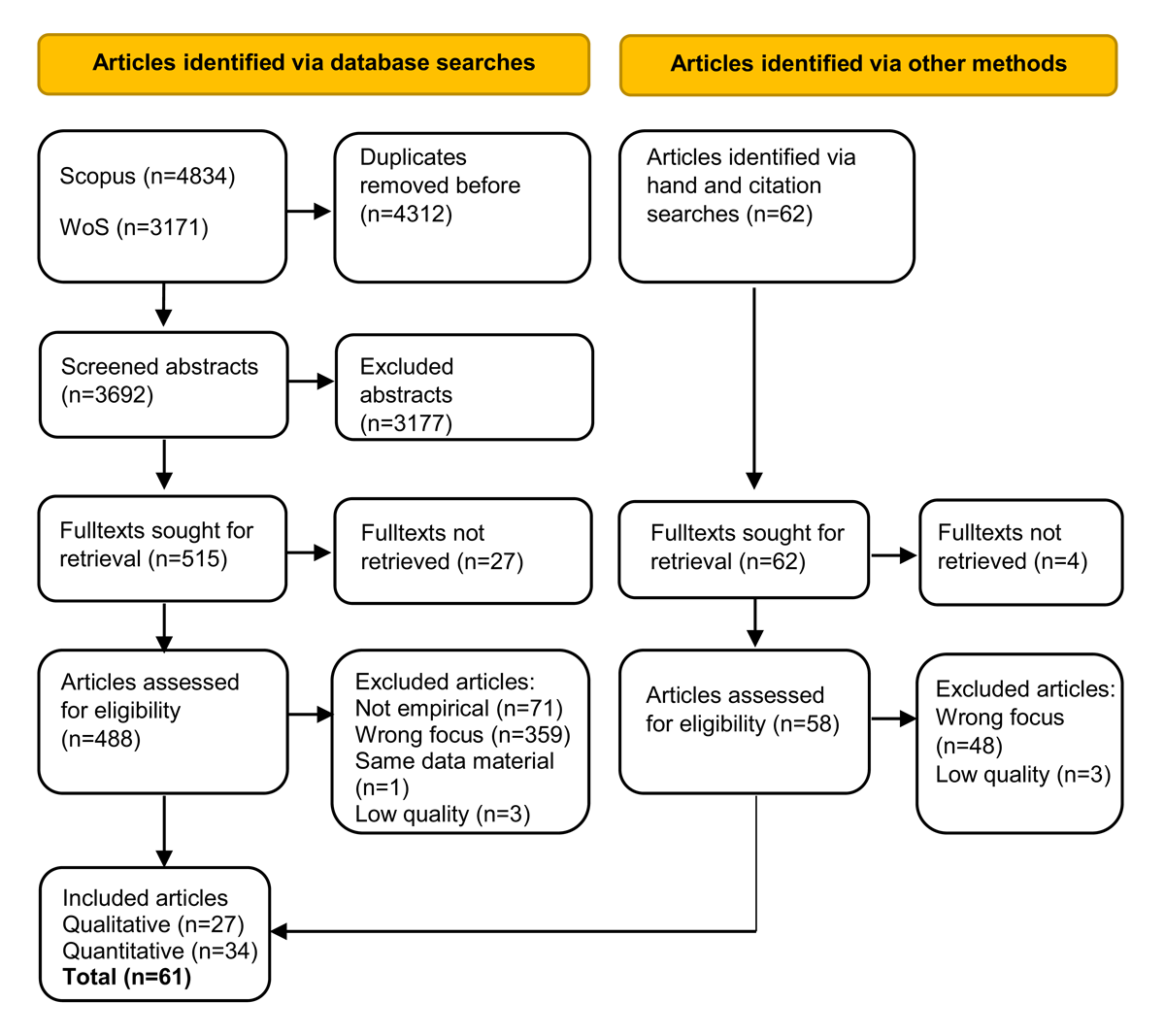
Figure 1
Flowchart of the study selection process.
The review began by reading all titles and abstracts for all search results. Rayyan QCRI software was used to facilitate the work process. Rayyan QCRI is a web-based, open-source software for systematic reviews and meta-analyses, providing a platform for reviewers to screen studies for inclusion in the review. It allows users to mark studies as “included,” “excluded,” or “maybe,” and provides a summary of the screening process. When different assessments about inclusion were made between the authors, the studies were discussed until a joint decision was reached. Previous reviews and conceptual articles were also identified in the screening process. In total, 515 studies passed the screening phase, and a relevance assessment commenced on the full text. A total of 488 studies were assessed, as the full texts of 27 studies could not be accessed. The relevance assessment resulted in 57 studies being judged to meet the inclusion criteria.
A quality assessment was made of the studies that passed the relevance assessment. Studies with a qualitative approach were assessed with a review template consisting of five areas: theoretical substantiation of the study, selection, data collection, analysis and the role of the researcher (SBU, 2020). After weighing up, an assessment was made of whether the study was of high, medium, or low quality. Studies with a quantitative approach were quality assessed with a protocol developed by Tompa et al. (2016). The protocol consists of ten questions that are assessed between 1 and 5 points. The scores are weighed together and result in the study being classified as having high, medium, or low quality. In line with the protocol’s recommendation and previous literature reviews, only high or medium quality studies were included – 27 qualitative and 34 quantitative studies. In addition to database searches, hand searches were conducted involving searches in the reference lists of previous literature reviews and relevant studies. The hand searches resulted in the identification of an additional 62 studies. Of these 62 studies, 58 full texts were downloadable. Ten studies were assessed as relevant and underwent quality assessment. Seven were judged to be of high or medium quality, of which five were qualitative, and two were quantitative. In total, this literature review is thus based on 61 studies.
In the analysis of the included studies, qualitative and quantitative studies were initially analysed separately. The qualitative studies were analysed with the support of NVivo12 and MS Excel. The analysis followed a step-by-step process, where the first step was to get an overall picture of the content. In the next step, an initial coding took place in NVivo12 concerning background information about the respective study and its results. An inductive approach was chosen to allow empirical codes to emerge from the studies. First, the studies conducted before the pandemic were coded and then the more recent studies were coded to allow differences and similarities in their results. A shorter summary of each article with a focus on the content and the conclusions of the studies was also made. In the last step, an overall analysis was made of the inductive coding of the results. The initial coding list was then clustered by combining similar codes into an overall category. In this step, the categories of leadership behaviours were identified. The analysis of the quantitative studies began with all studies being read through and tables being compiled with central information, referred to as narrative synthesis and a standard procedure in systematic reviews (Booth et al., 2022). Such central information included, for example, which country the study was conducted in, on which population, and the association between leadership and well-being and work performance. When the initial analyses of the qualitative and quantitative studies were completed, overall common leadership behaviours were identified regardless of the studies’ methodological approach.
Results
The 61 studies (27 qualitative and 34 quantitative) included in this review were published between 1998 and 2022. However, approximately half of all studies were published in the last two years, likely because of the Covid-19 pandemic. The studies were published in 50 different journals, of which only eight have published more than one study. The empirical material has been collected in about 30 countries, in both public and private sectors. All studies had a cross-sectional design except one (Tietze & Nadin, 2011). More detailed information about the studies can be found in the appendices.
The findings that follow are organized in the following way: Firstly, six different leadership behaviours are described and identified in the included studies and their relation to employee well-being and work performance. Since the included studies were rarely based on established leadership theories but instead examined individual leadership behaviours, the categories of behaviours we found in the studies are presented. The results from both the qualitative and the quantitative studies are reported within each behaviour category. Next, we present the results from the few studies that used comprehensive leadership theories, as such theories involve several different categories of leadership behaviours. Table 2 summarizes the results of the qualitative studies, and Table 3 summarizes the results of the quantitative studies. In conclusion, differences are highlighted between studies conducted before the Covid-19 pandemic and during the pandemic and the studies that examined work from home with those who worked on-site.
Table 2
Identified leadership behaviours in the qualitative studies, illustrative quates and examples of studies.
| CATEGORY | DESCRIPTION | ILLUSTRATIVE QUOTES | EXAMPLES OF STUDIES |
|---|---|---|---|
| Communicate and inform | Rapid and frequent communication, preferrably face-to-face. | Communication was described by almost all leaders as a key health-oriented leadership behavior. A rich and asynchronous communication media appropriate to the purpose of communication was named as a basic principle. (Efimov et al., 2020, p. 9) | Adams et al., 2021; AlMazrouei, 2021; AlMazrouei & Zacca, 2021; Bjärntoft et al., 2021; Bosua et al., 2013; Cooper & Kurland, 2002; Delfino & van der Kolk, 2021; Efimov et al., 2020; Felstead et al., 2003; Kurland & Cooper, 2002; Longmuir, 2021; Montreuil & Lippel, 2003; Ruiller et al., 2019; Schwarzmüller et al., 2018; Shipman et al., 2021; Thornton, 2021; Weideman & Hofmeyr, 2020 |
| Provide and use technological tools, such as video, to ease communication. | The finding of this study indicates that employees have come up with new ways to do their work, involving making substantially more video calls and sending many more emails. This was found to be the case for both managers and employees. Most respondents spoke of making use of novel approaches, mainly involving technology, to complete their tasks. (AlMazrouei & Zacca, 2021, p. 12) | ||
| Difficult to achieve good communication, especially digitally. | When you’re face-to-face, you can immediately see what happens in the meeting. The atmosphere […] Someone who says two or three words on her/his business. In teleworking, you miss that: a colleague who isn’t right for example (Ruiller et al., 2019, p. 17) | ||
| Control and set boundaries | Managerial need to control and sometimes survail employees working from home. | An interviewed manager of a non-Big-4 PSF was very clear about his reasons to monitor his team. Since they’re not controlled [at home], I do not take it for granted that they indeed deliver their work within the agreed deadlines. (Delfino & van der Kolk, 2021, p. 1381) | AlMazrouei & Zacca, 2021; Bjärntoft et al., 2021; Bosua et al., 2013; Chafi et al., 2022; Cooper & Kurland, 2002; Delfino & van der Kolk, 2021; Efimov et al., 2020; Felstead et al., 2003; Hascher et al., 2021; Konradt et al., 2000; Kurland & Cooper, 2002; Longmuir, 2021; Montreuil & Lippel, 2003; Ruiller et al., 2019; Schwarzmüller et al., 2018; Shipman et al., 2021; Yarberry & Sims, 2021 |
| Employee need of receiving feedback on work performance. | My manager should not just be calling me when there are problems. I want to hear from my boss when I am doing a good job too. (Shipman et al., 2021, p. 15) | ||
| Employee need of clear and common guidelines and help to set boudaries. | Leaders have a crucial role in curtailing followers’ stress, such as by making explicit arrangements regarding work during non-office time: ‘Leaders need to ensure that the flexibility of work time and space does not lead to a perceived or actual overload of employees. (Schwarzmüller et al., 2018, p. 123) | ||
| Allow autonomy | Trust the employees to do their job and allow responsibility. Do not require constant visibility. | Trust was repeatedly emphasized by managers as a necessary — indeed, unavoidable — element in the supervision of home-located workers. […] In this context, trust referred to a relationship of reciprocal moral obligations in which rewards and productivity were exchanged without investigation. (Felstead et al., 2003, p. 250) | Adams et al., 2021; AlMazrouei & Zacca, 2021; Bosua et al., 2013; Chafi et al., 2022; Charalampous et al., 2021; Delfino & van der Kolk, 2021; Efimov et al., 2020; Felstead et al., 2003; Montreuil & Lippel, 2003; Ruiller et al., 2019; Schwarzmüller et al., 2018; Senthanar et al., 2021; Shipman et al., 2021; Thornton, 2021; Tietze & Nadin, 2011; Varshney, 2021; Weideman & Hofmeyr, 2020 |
| Leading by involving, allow autonomy and facilitate selfleadership. | According to the participants with managerial roles, the widespread implementation of remote work had led to increased autonomy for employees but posed new demands in terms of supporting employees’ adoption of self-leadership strategies. (Chafi et al., 2022, p. 10) | ||
| Support and show empathy | Support and be available to employees not feeling well. | Organizational management should understand that employees are likely feeling overwhelmed and anxious about circumstances related to the virus. I need the boss to be available to staff to talk about fears, to answer questions, and to reassure them about work and other issues that might come up. (Shipman et al., 2021, p. 18) | Adams et al., 2021; AlMazrouei & Zacca, 2021; Chafi et al., 2022; Collins et al., 2016; Efimov et al., 2020; Felstead et al., 2003; Hascher et al., 2021; Kurland & Cooper, 2002; Lee, 2021; Longmuir, 2021; Schwarzmüller et al., 2018; Shipman et al., 2021; Varshney, 2021; Yarberry & Sims, 2021 |
| Show understanding and empathy to the unique situation of the home worker. | Our findings suggest that supervision of teleworkers can require a greater emotional involvement than with office- based staff as supervisors are drawn into the home domain. (Collins et al., 2016, s. 170) | ||
| Valueing and sactioning | Prioritize and facilitate well-being and health. | The prioritisation of wellbeing over learning over the time New Zealand schools were in lockdown was a feature of all the interviews with the principals, who demonstrated empathy for both students and staff. (Thornton, 2021, p. 399) | Bjärntoft et al., 2021; Collins et al., 2016; Efimov et al., 2020; Felstead et al., 2003; Kurland & Cooper, 2002; Montreuil & Lippel, 2003; Schwarzmüller et al., 2018; Shipman et al., 2021; Thornton, 2021; Weideman & Hofmeyr, 2020 |
| Show approval of working from home. | My managers are very understanding, if there are things that I need to do or if all of a sudden I really did have to leave they’re fully understanding and will try to manage and work with me not against me. (Senthanar et al., 2021, p. 300) | ||
| Lead by example, managers valueing their own health shows the issue is important. | Importantly, leaders should also role-model these arrangements (e.g. by not sending emails on weekends). (Schwarzmüller et al., 2018, p. 123) | ||
| Balancing individual and collective needs | Individuals have different needs when working from home. | An evident theme was how organisations have recognised that employees differ in their approach to work and that one method of management cannot accommodate all individuals. (Weideman & Hofmeyr, 2020, p. 7) | Bjärntoft et al., 2021; Chafi et al., 2022; Collins et al., 2016; Cooper & Kurland, 2002; Efimov et al., 2020; Felstead et al., 2003; Kurland & Cooper, 2002; Ruiller et al., 2019; Schwarzmüller et al., 2018; Shipman et al., 2021; Weideman & Hofmeyr, 2020 |
| Managing employees working from home and on-site to reduce “us and them” thinking and conflicts. | They telephone him up and say ‘Hope I didn’t catch you up the ladder’, you know, ‘mowing the lawn’, or whatever else….That’s all good humoured but it’s…not too great a step between that and…genuine animosity, is it?…It doesn’t take much for some people to feel that they’re unfairly disadvantaged…. And it matters an awful lot because all of a sudden you’ve alienated these people from the business. (Felstead et al., 2003, p. 254) |
Table 3
Identified leadership behaviours in quantitative studies and their relation to well-being and work performance.
Leadership behaviours when working from home
Communicating and informing
The first category of leadership behaviours concerns the importance of managers’ communication for employees’ well-being and work performance. The studies emphasized that communication should be frequent and regular and that the manager should be available and respond quickly to employees’ requests (e.g., Adams et al., 2021; Bosua et al., 2013; Shipman et al., 2021). In the quantitative studies, managers’ communication was directly associated with increased work performance (Shockley et al., 2021) and indirectly with increased job satisfaction (Kelley & Kelloway, 2012). It is also essential how the manager communicates. Communication involving giving directions and showing understanding and empathy was associated with increased employee job satisfaction, while meaning-making was not (Madlock, 2013).
Communication was important when working from home because employees needed to be quickly reached by information and news, increasing the feeling of being involved (e.g., Cooper & Kurland, 2002; Konradt et al., 2000; Kurland & Cooper, 2002). Communication seems to have been particularly important during the pandemic and concerning the organisations’ guidelines for handling the infection (Thornton, 2021). However, it was also crucial that the manager filtered the information so that the employees were not overwhelmed (Thornton, 2021).
In several studies, technical equipment was highlighted as crucial for communication when working from home, maintaining social ties and counteracting isolation (AlMazrouei & Zacca, 2021; Felstead et al., 2003; Ruiller et al., 2019). The increased use of technical tools also imposed new tasks for managers, such as ensuring everyone’s access to technology, encouraging the use of the technology, and providing help and training for employees (e.g., Kurland & Cooper, 2002; Montreuil & Lippel, 2003; Shipman et al., 2021). In several quantitative studies, e-leadership was examined, that is, how the manager leads by example and encourages and supports the technology. These studies found that managers’ e-leadership was associated with increased well-being (Chaudhary et al., 2022), and indirectly associated with increased job satisfaction and work performance (Ibrahim, 2014; Ibrahim & Othman, 2019; Staples et al., 1998).
Achieving good communication was also highlighted as challenging because it was often time-consuming, involved long response times, made it hard to create trust, and limited deeper discussions about the employees’ feelings (e.g., Cooper & Kurland, 2002; Kurland & Cooper, 2002; Longmuir, 2021). Digital technology and online meetings were difficult to manage, for example for the manager to be able to read and decipher the subtle signals or the non-verbal communication to see how the employees are doing. Although technological tools could contribute to communication, the technology did not always work reliably, creating stress for employees and managers (e.g., AlMazrouei, 2021; AlMazrouei & Zacca, 2021; Montreuil & Lippel, 2003).
Controlling and setting boundaries
The second category involves behaviours that concern managers’ formal operational responsibilities. In the studies, there were several examples of how managers checked up on the employees’ work performance as compensation for not being able to see them physically and not fully trusting that they were doing their job properly (Delfino & van der Kolk, 2021; Felstead et al., 2003). In the studies before the pandemic, this was done by documenting work tasks and working hours or attendance levels at meetings (Cooper & Kurland, 2002; Kurland & Cooper, 2002; Ruiller et al., 2019). In the studies during the pandemic, control via digital tools was more common (e.g., AlMazrouei & Zacca, 2021; Bosua et al., 2013; Chafi et al., 2022). The lack of physical, spontaneous meetings meant managers needed to plan more and be more structured in their leadership (e.g., Bjärntoft et al., 2021; Bosua et al., 2013; Chafi et al., 2022).
For the employees, contact with the manager was essential to avoid being overlooked, for example, for promotions. However, the control aspect was perceived as troublesome. It resulted in them feeling micromanaged, not daring to leave the computer in the event that the manager called, or logged in before the working day began (e.g., Delfino & van der Kolk, 2021; Montreuil & Lippel, 2003; Tietze & Nadin, 2011). Instead of control, employees wanted more feedback and appreciation in their contact with the manager because it could be hard to know if the work performance was sufficient when working from home (Konradt et al., 2000; Shipman et al., 2021; Yarberry & Sims, 2021). The quantitative studies also confirmed these results, as task-oriented leadership was not associated with employee tension or work performance (Bartsch et al., 2020). In contrast, relationship-oriented leadership was associated with reduced tension.
The results also showed the need for clarity regarding structures for remote work, such as common rules and transparent guidelines regarding working hours and breaks, availability requirements and meeting culture (e.g., Bjärntoft et al., 2021; Bosua et al., 2013; Chafi et al., 2022). According to the studies, managers and employees should jointly discuss overall visions, common direction for work, and work performance expectations (e.g., AlMazrouei & Zacca, 2021; Bjärntoft et al., 2021; Bosua et al., 2013). The manager also needed to help the employees with boundary setting, priorities, routines and habits, and balance between home and work life (e.g., Bjärntoft et al., 2021; Felstead et al., 2003; Konradt et al., 2000). Without this, experiences of insecurity and the need to work more hours increased (Shipman et al., 2021). However, there were also examples that too strict rules when working from home created frustration for employees (AlMazrouei, 2021). Although the qualitative studies did not highlight leadership as destructive, the quantitative studies showed that destructive leadership was associated with increased stress (Spagnoli et al., 2020) and indirectly with exhaustion (Dolce et al., 2020).
Allowing autonomy
The third category includes results primarily about showing trust in the performance and responsibility of employees. It also involves delegating and giving the employees more influence over their work. The concept of trust recured in several studies, referring to the necessity of developing trusting relationships to eliminate questions of whether the work was performed (e.g., Chafi et al., 2022; Efimov et al., 2020; Felstead et al., 2003). In several studies, trust was raised as a substitute for control and could reduce stress (e.g., Adams et al., 2021; Bosua et al., 2013; Ruiller et al., 2019). Trust should not be combined with other monitoring forms, as it increases the risk of conflicting signals that reduce efficiency (Felstead et al., 2003). Lack of trust resulted in frustration and dissatisfaction (Tietze & Nadin, 2011; Varshney, 2021). While the qualitative studies emphasized the importance of trust, the quantitative studies showed a different pattern. One study found an association between managerial trust and increased job satisfaction (Baker et al., 2006), while another found no association between managerial trust and perceived stress or happiness (Chu et al., 2022). The studies also found no association between managerial trust and work performance.
Moreover, allowing autonomy included giving employees opportunities to take greater responsibility by involving them in decision-making, distributing leadership, and encouraging self-leadership (Bosua et al., 2013; Chafi et al., 2022; Thornton, 2021). Several studies discussed this as giving employees and teams the autonomy to develop collective responsibility (e.g., Bosua et al., 2013; Montreuil & Lippel, 2003; Schwarzmüller et al., 2018). On this note, one quantitative study found an indirect association between participative leadership and reduced exhaustion (Bhumika, 2020).
Supporting and showing empathy
The fourth category is about being available to remote workers on a personal level. The importance of managers providing emotional support, showing empathy, supporting employee development, and paying attention to those who are not feeling well was highlighted in several studies (e.g., Chafi et al., 2022; Collins et al., 2016; Efimov et al., 2020). In the quantitative studies, support from the manager was associated with increased job satisfaction (Gamal Aboelmaged & Mohamed el Subbaugh, 2012; Karácsony, 2021), work engagement (Amano et al., 2021; Karani et al., 2022; Nguyen & Tran, 2021), well-being (Karani et al., 2022; Kumar et al., 2022), and work performance (Gamal Aboelmaged & Mohamed el Subbaugh, 2012). Support from managers was also associated with reduced symptoms of burnout (Da et al., 2022; Lamprinou et al., 2021), exhaustion (Guidetti et al., 2022), symptoms of depression (Platts et al., 2022) and perceived stress (Košir et al., 2022; Platts et al., 2022). Two studies found no associations between managerial support and work engagement (Da et al., 2022) and stress (Johnson et al., 2021).
This category is particularly prominent in the studies conducted during the pandemic when many experienced the situation as a crisis (e.g., Adams et al., 2021; AlMazrouei & Zacca, 2021; Longmuir, 2021). However, the results show that the support from managers during the pandemic was sometimes insufficient (Hascher et al., 2021; Varshney, 2021).
While it seems extra important for remote workers to feel support from the manager, it is sometimes difficult to show them support because the manager becomes involved in the employee’s domain at home (Collins et al., 2016). The manager thus needed to have a greater understanding of how the employee was affected by the family situation (Konradt et al., 2000). It could also be challenging to show support via digital tools (Chafi et al., 2022; Felstead et al., 2003; Kurland & Cooper, 2002).
Valuing and sanctioning work from home to facilitate well-being
The fifth category concerns the leaders showing that health and well-being issues are essential and prioritised when working from home. Health issues arose during the Covid-19 pandemic (Efimov et al., 2020; Shipman et al., 2021; Thornton, 2021). The studies also emphasised the importance of the manager encouraging health and physical activities during working hours and taking breaks during the working day (Bjärntoft et al., 2021; Schwarzmüller et al., 2018).
The studies conducted before the pandemic underlined the importance of the manager clearly showing approval of working from home. Otherwise, there was a risk that working from home could be seen as a benefit, which may result in employees not taking breaks or not taking sick days because of performance pressures (Montreuil & Lippel, 2003).
Another way for managers to show that issues of health and well-being are important was to lead by example, for example, by not sending emails after working hours (Bjärntoft et al., 2021; Schwarzmüller et al., 2018) or by showing that they prioritized their own health, which indirectly affected the health of employees (Efimov et al., 2020).
The quantitative studies confirmed the importance of focusing on health. Health-promoting leadership was associated with decreased stress (Bregenzer & Jimenez, 2021) and indirectly with self-rated health (Nielsen et al., 2019).
Balancing individual and collective needs
The sixth category concerns managers’ adjustment of their leadership to the needs of individual employees while simultaneously keeping the entire working group together by instilling a sense of community. Without a sense of community, conflicts and feelings of injustice quickly arose within the workgroup. When working methods were flexible, leadership needed to be flexible, and the manager needed to have the ability to quickly adapt to new circumstances and find innovative solutions (Bjärntoft et al., 2021; Chafi et al., 2022). Working from home was not the same for everyone. Therefore, managers had to adjust to employees’ different needs and conditions (e.g., Chafi et al., 2022; Ruiller et al., 2019; Schwarzmüller et al., 2018). It could concern adaptations of the technical systems (Bjärntoft et al., 2021) or that some employees required the manager’s attention more than others (Yarberry & Sims, 2021).
At the same time, personalisation could generate a sense of injustice. For example, not all employees were allowed to work from home to the same extent (Felstead et al., 2003). It was vital to create a permissive culture that avoided the emergence of “us and them” thinking (Collins et al., 2016; Tietze & Nadin, 2011). The studies mentioned the importance of everyone seeing the big picture, respecting each other’s use of flexible working arrangements and maintaining the work community (Bjärntoft et al., 2021; Chafi et al., 2022). A quantitative study confirmed the importance of a shared social identity when working from home. This study found that leadership behaviours that uphold group norms and values were associated with increased job satisfaction and reduced symptoms of burnout (Krug et al., 2021). Leadership that involves creating arenas to meet was, however, not associated with job satisfaction or symptoms of burnout. The qualitative studies, on the other hand, highlighted arenas where remote workers and non-remote workers could meet to avoid “us and them” thinking and counteract feelings of isolation or being forgotten about as very important (e.g., Charalampous et al., 2021; Collins et al., 2016; Cooper & Kurland, 2002).
Additional comprehensive leadership styles investigated in the studies
Eight quantitative studies investigated leadership styles that included several leadership behaviours not distinguishable from each other. The first leadership style was LMX, which emphasizes the exchange between leader and follower and includes several behaviours such as mutual communication, trust, support and exchanges (Graen & Uhl-Bien, 1995). LMX was used in three studies. LMX was associated with increased job satisfaction (Golden, 2006; Golden & Veiga, 2008; Kuruzovich et al., 2021) and work performance (Golden & Veiga, 2008; Kuruzovich et al., 2021).
The second leadership style was servant leadership, which involves creating participation, showing support, empathy and making situational adaptations (Spears, 1995). One study found an indirect association with reduced symptoms of burnout (Lamprinou et al., 2021).
The third style was the FRLM, consisting of three leadership styles: transformational leadership, transactional leadership, and laissez-faire leadership (Bass & Riggio, 2006). Most focus has been devoted to transformational leadership in the reviewed studies, only one study examined transactional leadership, and none examined laissez-faire leadership. The studies found that transformational leadership was associated with increased work engagement (Gerards et al., 2018), job satisfaction (Azizah et al., 2020; Kelley & Kelloway, 2012), and work performance (Azizah et al., 2020). Transactional leadership was associated with increased job satisfaction and work performance (Azizah et al., 2020). Whitford and Moss (2009) examined leadership behaviours inherent in transformational leadership. They found that vision and personal recognition were associated with increased work engagement and job satisfaction (even after adjusting for work performance), but not associated with work performance.
Differences in leadership behaviours before and during the pandemic
Of the six identified leadership behaviours, none were unique to studies conducted before or during the pandemic. However, there were some differences in nuances within certain behaviours described in the results. For the first leadership behaviour – communicating and informing – the importance of information was highlighted when working remotely. In studies conducted during the pandemic, information regarding the organization’s handling of the Covid-19 virus was particularly emphasized. In the second leadership behaviour – controlling and setting limits – differences were found between early and later studies regarding how and with what technique control was exercised. For instance, early studies described employees having to report their work, whereas later studies described how digital tools (e.g., Teams, Zoom, Skype) were used to check up on the employees. No differences were found between studies before or during the pandemic for the third behaviour – allowing autonomy. The fourth leadership behaviour – supporting and showing empathy – emphasizes the importance of managers’ support, regardless of when the studies were conducted. However, studies during the pandemic highlighted the need for support in relation to the work situation and the societal and personal crisis that the pandemic created for many. In the fifth leadership behaviour – valuing and sanctioning work from home to facilitate well-being – studies conducted during the pandemic highlighted the leader as a health promoter through various activities. In contrast, studies conducted before the pandemic suggested that the leader could prevent ill health by, for example, clarifying that working from home was acceptable. For the sixth and final leadership behaviour – balancing individual and collective needs – studies conducted during the pandemic focused on the leader’s need to ensure a functioning work situation for the individual employee compared to studies conducted before the pandemic.
Of the comprehensive leadership styles examined only in the quantitative studies, six studies were conducted before the pandemic, and only two during the pandemic. However, all studies showed that leadership was associated with well-being.
Comparing work from home versus work on-site
Only a few included studies used a sample of on-site and home workers. One of the studies performed a moderator analysis (Golden & Veiga, 2008), and the others examined each group separately. Two studies found that supportive leadership was related to employee well-being in both groups (Amano et al., 2021; Lamprinou et al., 2021). Two studies found that supportive leadership was associated with the well-being of home workers but not on-site workers (Da et al., 2022; Guidetti et al., 2022). Finally, one study found that the association between LMX and well-being and work performance was stronger the more days a week the employee worked from home (Golden & Veiga, 2008).
Discussion
The overall results from this literature review suggest that leadership is vital for employee well-being when working from home. Almost all quantitative studies examining this relationship found a direct or indirect association via other factors. Only three studies found no association between leadership and employee well-being (Chu et al., 2022; Johnson et al., 2021; Shockley et al., 2021). The importance of leadership for employees’ work performance does not have the same clear empirical support, mainly since this relationship has been investigated in far fewer studies. The qualitative studies also show that leadership when working from home is important, but it is more difficult to identify the empirical links between specific leadership behaviours and employees’ well-being or work performance. However, the results from the included studies were strikingly similar regardless of the method used. Both qualitative and quantitative studies overall highlighted the same types of leadership behaviours, but where quantitative studies focused on the relationship while the qualitative studies focused more on the behaviour and the context in which it was practised. In contrast, some differences were found. In the qualitative studies, trust was highlighted as vital when working from home, while the two studies that examined this quantitatively obtained different results in relation to well-being and neither found an association with work performance. The qualitative studies highlighted creating arenas to meet as an aspect of leadership when working from home. At the same time, this was unrelated to well-being in one of the quantitative studies. Even if these differences were found, it is necessary to point out that these concern discrepancies in the results of a few studies. Furthermore, only quantitative studies investigated destructive leadership or comprehensive leadership theories.
Few differences were found in studies conducted before and during the pandemic. Thus, there seem to be no significant differences in how leadership can promote employees’ well-being and work performance when working from home between studies done before and during the pandemic. The existing differences can probably be explained partly by technological development, which has enabled more refined possibilities for control in the newer studies and partly by the national rules or recommendations on working from home during the pandemic. Managers, therefore, do not need to sanction working from home. However, they need to address the work situation of employees working from home because they cannot or should not return to on-site work, which they previously could.
At the same time, it is important to clarify that several of the studies conducted before the Covid-19 pandemic did not have the explicit purpose of solely examining the importance of leadership for employees’ well-being or work performance. These studies focused on remote work, and leadership was one of the aspects included. It is mainly studies conducted during the pandemic that explicitly focused on managers’ leadership and employees’ well-being.
Based on the results of the studies, it seems that leadership is related to employees’ well-being when working from home, regardless of whether they work from home of their own volition or due to societal restrictions. However, it is impossible to single out any leadership behaviour or theory with better research support than any other behaviour or theory because the empirical basis is too small.
Comparison to the findings of previous reviews
Previous literature reviews and meta-analyses dealing with the importance of leadership for employee well-being and work performance have not explicitly explored leadership when work is performed from home. There are primarily four leadership styles identified in the previous reviews as significant for employee well-being or work performance: transformational leadership, LMX, and relationship-oriented leadership, as well as destructive forms of leadership for the absence of well-being (Harms et al., 2017; Montano et al., 2017; Skakon et al., 2010). To a relatively low extent, the reviewed studies are based on these more traditional leadership theories and examine individual leadership behaviours. This omission makes it difficult to compare if leadership when working from home differs from leadership in an on-site workplace. However, many of the behaviours identified are mainly found in these theories.
Interestingly, theories incorporating several of the identified leadership behaviours, such as LMX and FRLM, find such clear associations, as it may indicate that it is not necessarily a single significant behaviour but a combination of several. For example, several of the six identified leadership behaviours are more or less pronounced in the transformational leadership style. Transformational leadership emphasizes leadership behaviours concerned with visions and inspiration, encouraging creativity and development, and affirming and supporting (Bass & Riggio, 2006). Transformational leadership thus include several of the behaviours identified in this review, such as good communication, trust, support, and the needs of the individual and the work group.
Previous research recognizes that communication, trust, and support are necessary elements of leadership. However, these behaviours may be more tangible when the work is carried out from home without the same access to a work community. For some employees working from home, the manager becomes one of the few connections to the workplace, and the employee is, therefore, more dependent on the leadership. This conclusion is drawn by Golden and Veiga (2008) in one of the few studies that examined how the amount of working from home affects the association between leadership and well-being, and work performance. This study was, however, conducted many years before the pandemic. Four recent studies have compared employees who work from home with those who have been on-site. Two studies found that leadership was important regardless of the place of work (Amano et al., 2021; Lamprinou et al., 2021), while two found that leadership was significant for those who work from home but not for those who work on-site (Da et al., 2022; Guidetti et al., 2022). This inconsistency highlights the need for more research on this topic. It is positive that destructive forms of leadership have been investigated when working from home, as this form of leadership has been shown to impact employees substantially (Mackey et al., 2021). In addition, if it is the case that home workers are more dependent on the manager as a link to the workplace, the negative effect of destructive leadership is likely to be even more evident. However, more research is needed, as only two studies examined destructive leadership, none of which examined this in relation to work performance (Dolce et al., 2020; Spagnoli et al., 2020).
What appears unique, however, is the importance of technology for communication. Communication is a fundamental part of leadership, and it is difficult to imagine leadership without communication (Yukl, 2013), but when work is performed from home, such communication is dependent on functioning technology (e.g., Allen et al., 2015; Bailey & Kurland, 2002; Beauregard et al., 2019). Therefore, leadership that incorporates and facilitates effective usage of technology becomes central. Consequently, little evidence suggests that leadership exercised when working from home would be different or consist of other types of behaviours compared to leadership exercised in a regular on-site workplace. Leadership is still about making employees achieve goals (Yukl, 2013), which incorporates preserving and promoting their well-being and work performance. However, the tools used to exercise leadership differ.
Knowledge gaps and future research
When reviewing the studies, some limitations have been noted that should be discussed and problematized, as it clarifies future research needs. Of the 61 studies reviewed, only a few have been conducted using developed theories of leadership, well-being or work performance. One advantage of examining individual leadership behaviours, such as communication, trust, and support, without clear anchoring in traditional leadership theories is that the results are more concretized and tangible to translate into practical behaviours for managers. Leadership research has been criticized for the difficulty of translating abstract leadership theories into feasible advice to managers. Leadership styles, such as transformational leadership, involve so many different types of leadership behaviours that it can be difficult to know how to be a transformational leader (Lundqvist et al., 2022). However, it may also be problematic that so many different leadership behaviours have been examined, as it makes it hard to assess these behaviours’ support in the research. There is no theoretical framework that clarifies the different behaviours and their relationship. This review and the six identified leadership behaviours could be a basis for empirical and theoretical contributions in this field. Empirical contributions as future research can start from the identified behaviours and examine their relative contribution to employee outcomes such as well-being and work performance. Theoretical contribution as the six identified behaviours can form the basis for the theoretical development of what leadership can entail when working remotely from home. Since no major differences were discovered between studies conducted before and during the pandemic, such theory formation should be relatively general when working remotely from home. As suggested above, transformational leadership seem to include several of the identified behaviours.
Further empirical and theoretical investigations are needed to tease out potential differences between leadership practised when working remotely and established leadership theories, such as transformational leadership, in how they are exercised and their effects. However, transformative leadership is very generic in its description of behaviours, which means that the theory can fit into several contexts. The behaviours identified in this review can thus provide support for leaders when it comes to remote work. Furthermore, apart from investigating multiple leadership behaviours, the included studies also often investigated different measures of well-being. Therefore, more research is needed that evaluates leadership behaviours simultaneously and their association with well-being and work performance.
All quantitative studies were based on self-rated questionnaires with a cross-sectional design. Thus, there is a risk that the associations are overestimated or reversed (Podsakoff et al., 2003, 2012). The qualitative studies also present similar problems. These are all cross-sectional studies, except one (Tietze & Nadin, 2011), and most are based only on interview data, which may increase the risk that leaders will give the answers they expect the interviewer wishes to hear, or reproduce modern ideas about leadership that they have come into contact with (cf. Alvesson & Sveningsson, 2003). Advantageously, some of the qualitative studies included managers and their direct reporting employees to capture both perspectives. However, relatively few did so.
While quantitative studies have the advantage of easily determining the observed association between the studied phenomenon, qualitative studies can provide more nuances, contextualisations, and possible explanations in a way that is difficult in quantitative studies. Studies combining multiple data collection methods and multiple data sources will likely get closer to the behaviours leaders use in their work and how this affects employees. A combination of interviews, surveys, and diaries should be suitable for reaching employees and their managers working from home and following them over time. A longitudinal study design is vital to indicate the direction of the associations, but it can also increase the understanding of the long-term effects of working from home. The effect of different leadership behaviours when employees work from home over a more extended period is a significant knowledge gap, as none of the included studies provides information about this. An additional limitation in existing research concerns the measure of work from home. In most studies, working from home is treated dichotomously, such as either working from home or working on-site at their regular workplaces. This dichotomisation is likely a simplistic picture of how the research participants have worked, and many have probably combined working from home with on-site work to some extent. Despite this, only one study considered how often work was performed from home in its analysis (Golden & Veiga, 2008). Furthermore, the differences within the group of employees working from home must be considered and analysed to a greater extent. It is, however, crucial that such analyses ensure that investigated jobs and tasks are comparable so that differences are due to the place of work and not the work tasks.
Limitations
There are also limitations to this review that should be considered. The searches conducted have used relevant terms, but there is always a possibility that some related term was overlooked. The searches were carried out in two databases, with two other databases as complements. The databases were chosen as they are broad and cover most scientific journals, but it is possible that some study was overlooked if it was not included in these four databases. Another limitation concerns the difficulty of determining whether the results in the studies are due to leadership during working from home or caused by the pandemic situation that prevailed when the study was conducted. An example is social isolation and loneliness, which several studies highlighted in relation to working from home (e.g., AlMazrouei & Zacca, 2021; Shipman et al., 2021).
Practical Implications
This literature review is relevant for organisations and their managers as it clarifies important leadership behaviours when employees work remotely from home. Hopefully, managers can be inspired by the findings and adapt these behaviours to the conditions within their organisation. However, when it comes to leading employees working from home, there are some challenges compared to leading employees working on-site.
First, regular communication and rapid information dissemination are essential, so the home-based worker does not feel forgotten. Using video solutions may help the manager interpret body language and other non-verbal communication forms. However, it also exposes the home-based worker’s private sphere in a way that can make the participants feel uneasy.
Second, working from home requires high trust between manager and employee. However, managers with operational responsibility also need to be able to control how the work is progressing. In this regard, what the manager sees as a friendly follow-up chat with the home-based worker can be perceived by the employee as a form of control.
Third, employees working from home are vulnerable because they work alone and do not have the same natural contact with colleagues as on-site employees. Therefore, leadership that focuses on creating rules and structure needs to be balanced with more supportive leadership. Here, the manager’s role of creating closeness, but remotely, becomes crucial for the well-being of employees.
Fourth, it is also vital that the leader is given the conditions and support to exercise leadership that promotes well-being and work performance when work is performed from home. This review can be used to reflect on how to organize conditions for good work performance without doing so at the expense of well-being. For example, it may be necessary to evaluate available resources, the administrative burden, and the control span of the manager.
Conclusions
This review has aimed to compile and synthesize empirical research on how managers and leaders can promote employee well-being as well as their work performance when working remotely from home. There seems to be sufficient empirical support to conclude that leadership is essential for employee well-being when working from home. However, the importance of leadership for employees’ work performance does not have similar empirical support, as the issue has been investigated in far fewer studies.
Six different types of leadership behaviours have been identified in the reviewed studies. The leadership that is emphasized in previous studies as central when working from home is that the leader 1) communicates and promotes the use of technology for communication, 2) regularly checks, provides feedback, and steers towards business goals, 3) shows trust in the employee and gives autonomy, 4) shows support and empathy, 5) encourages and promotes health, and 6) balances the need of individual employee with the need of the workgroup. Compared to the findings of previous reviews, it does not seem as if leadership exercised when employees work from home is all that different compared to leadership exercised in a regular workplace. What does seem to differ are the digital tools used to exercise leadership.
The review shows that previous research has examined individual leadership behaviours in relation to different well-being measures, making it difficult to determine the unique contribution of each leadership behaviour. More high-quality longitudinal research is needed that examines the importance of leadership over longer periods, considers how often work is performed from home, and combines different data sources and data collection methods. Further studies that use the same measures and evaluate several leadership behaviours simultaneously are needed to determine the significance of the identified leadership behaviours.
Additional File
The additional file for this article can be found as follows:
Funding Information
This research was funded by Forte: Swedish Research Council for Health, Working life and Welfare.
Competing Interests
The authors have no competing interests to declare.