
According to a retention report from the US Work Institute (2019), 41.4 million US employees left their jobs voluntarily in 2018, a prevalence that represents an 8.3% increase since 2017 and an 88% increase since 2010. Following the recent Covid-19 pandemic which has led to a growth in telework and hybrid forms of working (Roy, 2022), it is likely that the reduced physical presence of employees at the workplace will mitigate loyalty and affective commitment to the employees even further (Chauhan et al., 2022). Indeed, numbers from the US show an elevated rate of people leaving their jobs in the later stages of the pandemic, and the average turnover rate is consistently higher than the pre-pandemic levels.1 Turnover, the process where an employee chooses to leave a job and an employer ‘voluntarily’ (Hom et al., 2017), may incur considerable costs for both the individual employee and for the employer. For the individual employee, turnover may of course be a positive career change towards better payment and better working conditions. However, turnover may also come with considerable personal costs for an employee, including loss of seniority, reduced social recognition and career identity, loss of close personal relationships, reduced or loss of income, and occupational investment costs aimed at preparing for one’s future job, such as time, money and training (Vardaman et al., 2008). For employers, recruitment and training of new employees are time consuming and expensive, and newly hired employees may require years of experience before performing at the same level as their predecessors (Rubenstein et al., 2019). Frequent voluntary turnover is also likely to have a negative impact on employee morale, productivity, and company revenue (O’Connell & Kung, 2007). Hence, preventing unwanted voluntary turnover can save even small companies millions of dollars annually (Podsakoff et al., 2007). Identifying the risk and protective factors for premature turnover in organizations will be especially important for reducing such costs.
Although individual characteristics are likely to contribute to the variance in turnover (Allen et al., 2005; Jenkins, 1993), turnover has primarily been considered a result of working conditions (Clausen & Borg, 2010). However, the work-related antecedents of turnover remain elusive, and few studies have examined the role of multiple psychosocial factors simultaneously and with prospective data. Given the many types of psychosocial factors that have been identified in the literature (Christensen et al., 2018; Knardahl et al., 2017), assessing and comparing the relative impact of various risk and protective factors concurrently is necessary to establish the most consistent predictors of turnover, and of turnover intent. That is, while having intentions about leaving a job does not necessarily have to result in actual employee turnover, turnover intention is considered as key predictor of voluntarily quitting a job (Hom et al., 1992; Matz et al., 2014). Turnover intention is also likely to have indirect negative influences at work in the form of withdrawal behavior which can be manifested through lateness, absenteeism, avoidance behavior, and lowered performance (Kivimaki et al., 2007). For applied and preventive purposes, knowledge regarding turnover intent is therefore particularly important.
Based on the Challenge, Hindrance, and Threat Model of work demands (Tuckey et al., 2015), the first objective of this study was to determine how different types of psychosocial job demands contribute to turnover intentions among employees, across industries. As transformational leadership has been identified as an important factor for employees helping them to maintain well-being in stressful situations (Nielsen et al., 2017), a second objective of the study was to examine whether transformational leadership moderates the effects of the examined job demands on turnover intentions. In the following, we will present the study variables, the rationale for their inclusion, and the theoretical background for this study.
Job demands and turnover
Several theoretical models have been proposed to explain turnover and turnover intent (Hom et al., 2017; Ngo-Henha, 2017), with the unfolding model of turnover (Lee & Mitchell, 1994) and the job embeddedness theory (Mitchell et al., 2001) as the most widely accepted. The unfolding model is a retrospective, classificatory account of voluntary turnover that treats quitting as a decision process based on the compatibility of possible alternatives and existing images of one’s principles, goals, and action plans (Morrell et al., 2008). In contrast, job embeddedness theory explains why people stay in an organization and argues that when an employee is more embedded within their organization, they are less likely to quit (Lee et al., 2014). However, an important limitation of these models is that they are limited to the attitudinal and motivational processes that lead to turnover, such as dissatisfaction-induced and rational decision-making processes, rather than considering the specific job factors that may explain why a worker may consider leaving the job. This focus leaves a large portion of the variance in why people actually choose to quit a job unexplained (Harman et al., 2007) and studies on the antecedents of turnover have therefore been requested (Hom et al., 2017).
Work stress is considered as a distal dimension of turnover in that demands or stressors at the workplace induce strain that subsequently may lead to voluntary turnover (de Croon et al., 2004). This corresponds with organizational stress theory, which explains voluntary turnover as a behavioral reaction to stress and strain encountered in the workplace based on one’s working conditions (Fila, 2014), thus highlighting the occurrence of specific demands and resources at the workplace as important regarding turnover intentions.
Job demands are “those physical, social, or organizational aspects of the job that require sustained physical or mental effort and are therefore associated with certain physiological and psychological costs” (Demerouti et al., 2001, p. 501). Examples of job demands are workload, work pressure, interpersonal conflicts, and role stressors. Following theoretical perspectives such as the Job Demands-Control model (Karasek, 2011), the Effort-Reward-Imbalance model (Siegrist, 1996), and the Job Demands-Resources model (Bakker & Demerouti, 2007), high job demands are associated with an increased risk for ill-health and reduced well-being of a worker. That is, when job demands are high, additional effort must be applied to accomplish work goals and to avoid decreasing performance, which again comes with physical and psychological costs such as fatigue and irritability (Schaufeli & Taris, 2014). Lazarus and Folkman’s (1984) transactional model of stress and coping can explain how such job demands impact health and well-being, and thereby likely also one’s turnover intentions. Whether an incident is perceived as a stressor is governed by two successive appraisal processes (i.e., primary and secondary appraisal). In the primary appraisal process, the encountered incident is cognitively assessed for its potential for harm or loss. If individuals perceive the event as threatening, this leads to a secondary appraisal process which centers on whether one has access to options or enough resources to meet the situational demands, with the aim of avoiding harm or loss. If individuals perceive that the situation is exceeding the available options and resources, individuals will experience strain (Lazarus & Folkman, 1984). Strain over an extended time period will manifest itself through psychological distress and reduced well-being, with turnover intent as a likely outcome and copying strategy.
Since the consequences of stressors on health and well-being are determined by cognitive appraisals, it is likely that reactions to job demands, and in turn employee outcomes, will vary according to the type of demand being assessed (Tuckey et al., 2015). Some demands can even have positive outcomes, such as when they allow workers to utilize and develop their abilities (De Jonge & Dormann, 2003). Consequently, to examine the potential differential impact of various job demands on turnover intentions it is necessary to understand the multi-dimensionality of job demands.
Challenge, hindrance, and threat demands
Following the Challenge, Hindrance, and Threat Model, job demands can be classified into three main categories (Searle & Tuckey, 2017; Tuckey et al., 2015). Challenge stressors are “work-related demands or circumstances that, although potentially stressful, have associated potential gains for individuals” (Cavanaugh et al., 2000, p. 68) and are defined by the level of attention required by job or role demands, pressure to complete tasks, time urgency, and quantitative and subjective workloads (Podsakoff et al., 2007). Stressors classified as challenges include job complexity, job responsibility, pressure, time urgency, and workload (Podsakoff et al., 2007; Tuckey et al., 2015). Hindrance stressors refers to “work-related demands or circumstances that tend to constrain or interfere with an individual’s work achievement” (Cavanaugh et al., 2000, p. 68). Hindrance stressors include constraints, hassles, organizational politics, resource inadequacies, role and interpersonal conflict, role ambiguity, role interference, and role overload (Tuckey et al., 2015). Finally, threat demands are “work-related demands or circumstances that tend to be directly associated with personal harm or loss” (Tuckey et al., 2015, p. 133). Examples of threat demands are exposure to workplace bullying, aggression, and perceived or real job insecurity. It is assumed that an employee will have qualitatively different appraisals regarding exposure to challenge, hindrance, and threat demands. It is thereby reasonable to assume that this difference in appraisal also will influence any outcomes of the demands (Searle & Tuckey, 2017). In the following, we will provide a description of the job demands examined in this study and explore how they may relate to turnover intentions. The examined demands are included as they have been established as prominent predictors of employee health and work ability (Knardahl et al., 2017; Nei et al., 2015; Stansfeld & Candy, 2006), as well as turnover (Podsakoff et al., 2007) in previous research. The examined job demands are categorized as challenge, hindrance, and threat demands in accordance with the classifications from Podsakoff et al. (2007) and Tuckey et al. (2015).
Challenge demands
In the current study, quantitative job demands are included as an indicator of challenge demands. Quantitative demands refer to work situations that require hard and fast work, that is, excessive work, time pressure and competing demands. High levels of quantitative demands indicate a high load and/or having to do work performed at high speed (van Veldhoven, 2014). It has been proposed that challenge demands should have a positive relationship with well-being because the associated positive emotions and active coping behaviors should stimulate greater investment of the self and increased job-related effort in response to such demands (Crawford et al., 2010). Yet, according to the Job Demands-Control model (Karasek, 2011) and the Job Demands-Resources model (Bakker & Demerouti, 2007), high work load is considered stressful, at least in situations where the employee lacks psychological and/or organizational resources to handle the given work load. In addition, a high workload may result in excessive absorption and difficulties detaching oneself from work (Daderman & Basinska, 2016). However, as accomplishing work tasks and thereby reducing the workload can be experienced as rewarding, exposure to a quantitative demand may even lead to a sense of mastery among employees. Consequently, quantitative demands may both diminish employees’ energy and motivate them to put effort in their job, as they yield the promise of goal achievement and need satisfaction (Van den Broeck et al., 2010). Hence, although high quantitative demands are expected to be associated with heightened intent to leave one’s job, at least temporarily, it is unlikely that quantitative demands in themselves should lead to a major increase in turnover intentions.
Hindrance demands
Role conflict and role ambiguity are included as indicators of hindrance demands. These role stressors represent negative conditions related to the nature of the work tasks and the structural organization of the workplace. Role ambiguity (antonym: role clarity) denotes “uncertainty about the expectations, behaviors, and consequences associated with a particular role” (Kahn et al., 1964; Rizzo et al., 1970). Role conflict refers to “incongruence between differing expectations, either associated with one’s job role (‘intra-role conflict’), different roles within a work context (‘inter-role conflict’), or between job requirements and the employee’s opinions and ideals pertaining to how the job should be executed” (Katz & Kahn, 1978; Rizzo et al., 1970). Hindrance demands should be negatively related to well-being because the frustrations that are experienced when trying to overcome blockages are likely to lead to withdrawal of energy and active coping efforts (Crawford et al., 2010). Supporting this expectation, role conflict and role ambiguity are well-established and consistent predictors of lowered employee health and well-being (Eatough et al., 2011; House & Rizzo, 1972; Schmidt et al., 2014). An explanation for this impact on health and well-being is that role conflict and role ambiguity are stressors that tend to evoke negative emotions and attitudes and thereby interfere with employees’ work goal achievement and personal growth (Podsakoff et al., 2007; Van den Broeck et al., 2010). Due to the negative appraisal and increased strain likely to follow from role stressors, it is probable that employees exposed to such hindrance demands will experience lower job satisfaction and organizational commitment, and thereby increased turnover intentions (Podsakoff et al., 2007).
Threat demands
Exposure to workplace bullying is included as an indicator of threat demands. Workplace bullying refers to “a systematic form of harassment where an employee, persistently and over a period of time, is exposed to negative actions from superiors or coworkers and where the employee finds it difficult to defend him-/herself against these actions due to a real or perceived power imbalance towards the perpetrator(s)” (Einarsen, 2000). Bullying is considered as an accelerating process, including both direct (e.g., being shouted at, insulting remarks, etc.) and indirect forms (e.g., rumors, gossip, exclusion, etc.) of harassment, which can vary from sporadic incidences to full-scale episodes of severe aggression (Einarsen, 2000). Furthermore, bullying tends to include an element of social exclusion or at least non-inclusion, for example, in the form of ostracism, which seems to constitute a severe and fundamental threat for most people. Hence, bullying represents a violation of the target’s personal integrity and is therefore difficult to handle for those exposed, with potential devastating long-term outcomes. This kind of appraisal is consistent with the definition of threat demands presented above. Threat demands are expected to have more serious consequences than hindrance demands, because threat demands involve the undermining of basic psychological and even physical needs or the thwarting of professional self-identity. Hence, the expected negative personal impact is more closely aligned with the evolutionary bases for stress than with anticipated delays to goal accomplishment (Tuckey et al., 2015). A consistent body of evidence shows that bullying is associated with reduced well-being and impaired health (Nielsen & Einarsen, 2012; Verkuil et al., 2015) and exposure to bullying has also been associated with turnover intentions and actual turnover (Glambek et al., 2015; Houshmand et al., 2012; Høgh et al., 2011). Based on this reasoning, it is likely that exposure to bullying will have the strongest impact on turnover intentions of the included demands.
Transformational leadership as a protective resource
A central feature of models in occupational psychology such as the Job Demands-Resources model, the Job Demand Control model, and the Effort Reward Imbalance model, is that the effects of stressors on health and well-being are dependent upon whether the employee has available options or enough resources to meet the situational demands to prevent threat of harm or loss. In the context of the workplace, job resources refer “to the physical, psychological, social, or organizational aspects of the work context that (1) can reduce job demands and their health-impairing impact, (2) are functional in achieving work goals, and/or (3) stimulate personal development and learning” (Bakker & Demerouti, 2007).
Transformational leadership, an inspiring and motivational approach to leadership that foster positive change in individuals and social systems, has been argued to be an especially beneficial organizational resource regarding reducing the impact of job demands (Bass et al., 2003; Nielsen et al., 2017; Wang et al., 2011). Transformational leaders “…stimulate and inspire followers to both achieve extraordinary outcomes and, in the process, develop their own leadership capacity. Transformational leaders help followers grow and develop into leaders by responding to individual followers’ needs by empowering them and by aligning the objectives and goals of the individual followers, the leader, the group, and the larger organization.” (Bass & Riggio, 2006, p. 3). Hence, transformational leaders are change drivers who are actively involved in creating a work environment and culture that fosters change and growth.
Syrek and colleagues (2013, pp. 254–255) present four reasons for why transformational leadership may buffer the negative effects of job demands. First, due to their ability to stimulate and inspire followers, transformational leaders can redefine stressful situations and thereby reframe demands, providing a new perspective on them. That is, transformational leaders temper the undesirable impact of job demands by inspiring employees to see the demands as opportunities that can be achieved. Second, transformational leaders develop their followers by empowering the employees to work on their strengths and weaknesses (Bass, 1985). Hence, employees acquire new skills and behaviors necessary for coping with job demands, potentially reducing employee stress and strengthening job satisfaction (Syrek et al., 2013). Third, a transformational leader will respond to individual followers’ requirements and thereby be supportive and attentive to their needs for recognition, which should contribute to employees’ motivation and thereby job satisfaction. Fourth, the negative impact of a stressor is alleviated when followers understand and accept the reasons for the presence of the stressor (Bakker & Demerouti, 2007). As transformational leaders, through their visions and inspirational motivation, communicate a clear sense of purpose, employees comprehend and cope better with stressful situations and this should therefore reduce the overall impact of the stressor in question (Syrek et al., 2013).
As for buffering the effects of challenge, hindrance, and threat demands on turnover intent, we suggest that transformational leadership has a specific impact for each category of demands. As leaders are responsible for the distribution of work tasks and amount of work, a transformational leader should be able to recognize the level of challenge demands, such as quantitative workload, and thereby be responsive to their needs for support and recognition. By reframing the demands as challenge that can be dealt with, a transformational leader is likely to reduce the overall impact of workplace demands while simultaneously foster engagement and commitment, something which should increase the employees’ intent to stay at the workplace.
Since hindrance demands also deal with the organization and structure of the work, a somewhat similar effect of transformational leadership is expected for hindrance demands. However, as it is difficult to reframe hindrance demands into something positive that can be dealt with through increased efforts, it is likely that it is the supportive aspects of transformational leadership that will be most influential regarding hindrance demands. This will help employees to cope with the stressor but will probably not foster engagement and increase the intent to stay at the workplace. Consequently, we expect that transformational leaders will reduce the impact of hindrance demands on turnover intent, but not necessarily increase the intent to stay.
Unlike challenge and hindrance demands that mainly deal with the organization and structure of the work tasks and working situation, threat demands, such as workplace bullying, represent social stressors directly associated with personal harm or loss. Supervisors and managers are responsible both for how the workplace is organized and also for how employees interact and behave while at work. Managers therefore have an especially important role concerning the occurrence and management of workplace bullying (Nielsen, 2013). Nonetheless, it can be argued that the experience of one’s immediate leader as transformational when exposed to bullying can be a mixed blessing. The essence of transformational leadership is about inspiring and motivating followers, and thereby helping the subordinates to adapt, shift perspectives, and make decisions. Hence, a transformational leader may rather try to alter the perspective and perception of the target regarding the bullying situation rather than intervening to end the bullying. That is, in cases of bullying, the transformational leader may provide helpful psychological support to the target, but if the exposure to bullying is allowed to persist, it may actually be that a transformational leader will contribute to increase the likelihood of targets to quit one’s job due to the bullying. We propose two pathways for this relation: First, by discussing the bullying and its occurrence with the leader, reflections about the bullying may lead to an increased awareness of the situation and may thereby convince the bullied worker that things are as bad as they seem, or even worse, something that thereby is likely to increase the willingness to quit the job. Second, if an employee experiences a situation where he/she receives attention and support from the leader, but where bullying is not dealt with, the employee will perceive an inconsistency between the supervisor’s actions and subsequent attempts at support. Consequently, the employee may be left with two conflicting cognitions about the supervisor, and according to dissonance theory, such dissonant cognitions would be a source of discomfort or tension (Beehr et al., 2003). The additive effect of cognitive and emotional dissonance to the person’s strain may thereby lead to a synergistic interaction where transformational leadership increases the turnover intentions of the bullied employee.
Aims of the study
Although several previous studies have shown that job demands are associated with turnover and turnover intentions (e.g., Daderman & Basinska, 2016; Van der Heijden et al., 2019), most studies have been based on cross-sectional evidence only. In this study, we will use both cross-sectional and prospective data from a national probability sample of Norwegian employees to determine the relative impact of multiple job demands on employee turnover intentions. In addition, we will examine the moderating effects of transformational leadership on the associations between the different categories of job demands and turnover intentions, respectively. Based on the above description of different kinds of job demands and their potential interactive effects with transformational leadership, we propose the following hypotheses about direct associations between job demands and turnover intent:
H1a: Threat demands are more strongly related to turnover intentions when compared to challenge and hindrance demands.
H1b: Hindrance demands are more strongly related to turnover intentions when compared to challenge demands.
In addition, we propose the following hypothesis regarding the effect of transformational leadership on the investigated job demands:
H2a: Higher levels of transformational leadership will take away the impact of quantitative work demands on turnover intentions among subordinates.
H2b: Higher levels of transformational leadership will reduce the impact of role conflict and role clarity on turnover intentions among subordinates.
H2c: Higher levels of transformational leadership will increase the impact of workplace bullying on turnover intentions among subordinates.
While prospective data is often considered as superior to data gathered with cross-sectional designs, prospective designs may also have important limitations, including findings being highly dependent upon the use of a “correct” or optimal time-lag to detect associations (Dormann et al., 2015; Spector, 2019). Consequently, longitudinal designs can lead to erroneous inference when the timeframe chosen does not match the timeframe of the phenomenon in question. Hence, when showing non-significant associations in a prospective study with a “wrong” time-lag one risks a Type II error in that one will conclude that there is no effect. As the cross-sectional design can indicate with more certainty whether two variables are related (Spector, 2019), the inclusion of cross-sectional data is therefore an important addition to prospective data.
Methods
Design and sample
This two-wave study used questionnaire survey data from a national probability sample selected from the Norwegian working force. Time lag between baseline and follow-up was six-month time lag. Our choice of time lag is based on previous prospective studies documenting longitudinal associations between work stressors and turnover intentions with similar time lags (Kelloway et al., 1999; Nohe & Sonntag, 2014). This period seems long enough to measure possible changes in individual scores, and not too long regarding non-response. Statistics Norway drew a random and representative sample of 5000 employees from the State Register of Employers and Employees, which is the official data register of employment in Norway. All data for this project were collected between 2015 and 2017 and only adults between 18 and 60 years of age at baseline, employed in a Norwegian enterprise, were sampled for this study. The response rate at baseline (T1) was 32 percent (N = 1,608). Using the same procedure and questionnaire as for the T1-assessment, the following data (T2) was collected six months later. To be able to examine changes in study variables over time, only those who participated in the baseline assessment were invited to participate at T2. Altogether 1149 respondents (72%) responded at T2. The survey was approved by the Regional Committee for Medical Research Ethics for Eastern Norway (approval 2014/1725). All responses were anonymous. Having been provided with information about their right to privacy on the first page of the questionnaire, written informed consent was obtained from the respondents before answering the questionnaire.
Comprising slightly more women (52%) than men (48%), the mean age in the cohort sample was 45.19 (SD = 10.04; Range: 21–61) years. As for marital status, 53.4% were married, 25.8% were common-law partners, 13.7% were unmarried, and 7.1% were separated, divorced, or widowed. Altogether 9.4% had primary school as their highest educational level, 31.0% had completed high school, 32.0% had an undergraduate degree from a university, and 27.8% had an advanced degree from a university. Most of the sample had full-time employment (89.4%), while 6.6% were in part time employment and 4% were on a sick leave or occupational rehabilitation, on disability benefits, or retired. The latter group was not included in this study. Altogether 36% held a formal leadership position. The respondents represented a wide range of occupations in the public and private sector. Most frequent occupations were professions requiring shorter university or college education, academic professions, sales and service, and health and care occupations.
Attrition analyses
T2 respondents (M = 46.75; SD = 18.85) had significantly (t = 4.57; df = 1603, p < .001) higher age than non-respondents (M = 42.49; SD = 10.45). There were no differences in the distribution of gender (X2 = 1.31; df = 1; p > .05), formal leadership responsibility (X2 = 1.94; df = 1; p > .05), or level of education (X2 = 6.48; df = 4; p > .05). With exception of respondents (M = 1.80; SD = .42) having a somewhat lower score on role-conflict (t = 2.40; df = 1599, p < .05) compared to non-respondents (M = 1.85; SD = .45), there were no significant differences in the main study variables at T1 between responders and non-responders at T2. Taken together, the findings indicate that the study cohort is representative for the overall sample.
Instrument
Turnover intentions were measured with a three-item questionnaire (Sjoberg & Sverke 2000) during T1 and T2. The respondents were asked to respond to each item on a five-point Likert scale with response alternatives going from ‘fully disagree’ to ‘fully agree’. The scale items include questions about searching for new jobs (e.g., ‘I am actively searching for a new job’) as well as willingness to quit the current job when given an adequate alternative (e.g., ‘If I had a free choice, I would quit this job’). The internal consistency between the items, as indicated by Cronbach’s alpha, was .89 at T1 and .90 at T2.
Quantitative job demands were measured with four items from the Questionnaire on the Experience and Assessment of Work (Van Veldhoven et al., 1999). An example item is “Do you have to work very fast?” All items were scored using a 4-point scale ranging from “1 = always”, “2 = often”, “3 = sometimes” to “4 = never”. The items were reversed to reflect high levels of demands. Cronbach’s alpha for the Job demand subscales was .87.
Role conflict (3 items; i.e., “Do you receive incompatible requests from two or more people?”) and role ambiguity (4 items; i.e., “Do you know what your responsibilities are?”) were assessed with scales from the General Nordic Questionnaire for Psychological and Social Factors at Work (QPSNordic; Dallner et al., 2000). Responses were given on a 4-point scale ranging from: “1 = always”, “2 = often”, “3 = sometimes” to “4 = never”. Items were scored to reflect high role ambiguity and high role conflict. The Cronbach’s alpha values for the role conflict and role ambiguity subscales were .80 and .67, respectively. The latter may seem somewhat low. Yet it only consists of three items all with satisfactory inter/item correlations and hence should be suitable for further analysis.
Exposure to workplace bullying was measured with The Short Negative Acts Questionnaire (S-NAQ). The instruments include nine items and assesses types of harassment such as being withheld information, being excluded or humiliated, being given unmanageable workloads, and the like yet with no reference to the phrase bullying (Notelaers et al., 2018). The respondents were asked how often they had experienced any of the behavior in the questionnaire over a time-period of six months before the survey. A five-point response scale (1 = “never”, 2 = “occasionally”, 3 = “monthly”, 4 = “weekly” to 5 = “daily”) was used to assess the frequency of the behaviors (e.g., “Being ignored or facing a hostile reaction when you approach”). Cronbach’s alpha for the S-NAQ was .86.
Transformational leadership was assessed with the Global Transformational Leadership Scale (GTL) (Carless et al., 2000). This seven-item short scale represents a global measure of perceived transformational leadership. The items capture the following leadership behaviors: (i) Communicates a clear and positive vision, (ii) develops staff, (iii) supports staff, (iv) empowers staff, (v) is innovative, (vi) leads by example, and (vii) is charismatic. All items were answered on a 5-point scale with the alternatives “never”, “rarely”, “once in a while”, “quite often” and “very often or always” (e.g., “My leader fosters trust, involvement, and co-operation”). Cronbach’s alpha for the GTL was .94.
Statistical analyses
Statistical analyses were performed in SPSS 27.0 and Stata 16.0. For all scales, we calculated mean scores for respondents that had provided answers to at least 75% of the included items. Other respondents were excluded from the analyses (Listwise deletion). Linear regression analyses and dominance analyses were used to determine the multivariate and relative associations between the examined job demands and turnover intentions. Dominance analysis was used as a supplement to the regression analyses to determine the relative impact of the predictor variables on turnover intentions. Dominance analysis produces additive decompositions of r2 or pseudo-r2 indexes ascribing what can be interpreted as the “relative importance” of each variable or set of variables in the prediction of some outcome (Budescu, 1993; Budescu & Azen, 2004). Stata 16.0 using the DOMIN add-on module was used to conduct the dominance analyses. To determine the moderating effects of transformational leadership on the associations between job demands and Turnover intentions data were analyzed by with the PROCESS add-on module developed for SPSS (Hayes, 2013). PROCESS applies an ordinary least squares or logistic regression-based path analytical framework for estimating interactions in moderation models along with simple slopes and regions of significance for probing interactions.
Results
Means, standard deviations, and inter-correlations between study variables are presented in Table 1. All significant correlations were in expected directions. The examined job demands at T1 were positively associated with turnover intentions at T1 and T2, whereas transformational leadership were negatively associated with turnover intentions at T1 and T2.
Table 1
Means, standard deviations, and intercorrelations for all study variables (N = 1606).
| VARIABLES | M | SD | 1 | 2 | 3 | 4 | 5 | 6 | 7 | 8 | 9 | 10 | 11 | |
|---|---|---|---|---|---|---|---|---|---|---|---|---|---|---|
| 1 | Age | 45.17 | 10.02 | – | ||||||||||
| 2 | Gender (reference: males) | – | – | –.03 | – | |||||||||
| 3 | Education | – | – | –.10*** | .13*** | – | ||||||||
| 4 | Leadership position (reference: No) | – | – | .07** | –.20*** | .02 | – | |||||||
| 5 | Turnover intent T1 | 2.07 | 1.05 | –.11*** | –.01 | .05 | –.09*** | – | ||||||
| 6 | Turnover intent T2 | 2.06 | 1.04 | –.08** | –.04 | .04 | –.04 | .63*** | – | |||||
| 7 | Quantitative job demands T1 | 2.52 | .57 | –.01 | .01 | .01 | .21*** | .16*** | .16*** | – | ||||
| 8 | Role ambiguity T1 | 1.61 | .56 | –.09*** | .02 | .20*** | –.04 | .27*** | .21*** | –.04 | – | |||
| 9 | Role conflict T1 | 1.81 | .43 | –.07** | .00 | .05* | .06* | .33*** | .28*** | .35*** | .23*** | – | ||
| 10 | Workplace bullying T1 | 1.20 | .34 | –.05* | –.02 | –.04 | .01 | .36*** | .31*** | .19*** | .22*** | .40*** | – | |
| 11 | Transformational leadership T1 | 3.67 | .84 | –.01 | .04 | .10*** | .04 | –.42*** | –.30*** | –.12*** | –.28*** | –.33*** | –.36*** | – |
[i] *** p < .001; ** p < .01; * p < .05.
Cross-sectional findings
The results from the linear regression analysis of the association between job demands and turnover intentions at T1 with age, gender, education, and leadership position as control variables, are presented in Table 2. All predictor variables were associated with turnover intentions in the bivariate analysis. In the multivariate analyses, workplace bullying (β = .23, p < .001), role conflict (β = .17, p < .001), and role ambiguity (β = .17, p < .001) had weak to moderate associations with turnover intentions, whereas quantitative demands (β = .09, p > .05) were not significantly related to the outcome. The regression model was significant (F = 54.09; df = 8/1543; p < 001), and the predictor variables explained 22% of the variance in the outcome variable. A dominance analysis in Stata was carried out to further compare the relative magnitude of associations between the examined job demands with on turnover intentions at T1. The dominance analysis showed that workplace bullying (rank: 1; β = .40) had the strongest relative relationship with turnover intentions, followed by role conflict (rank: 2; β = .30), role ambiguity (rank: 3; β = 24), and quantitative job demands (rank: 4; β = .06).
Table 2
Cross-sectional associations between job demands on turnover intentions at T1 (Multivariate model: R2 = .22; F = 54.09; df = 8/1543; p < 001).
| VARIABLES | BIVARIATE | MULTIVARIATE | ||||||
|---|---|---|---|---|---|---|---|---|
| B | S.E. | 95% CI B | β | B | S.E. | 95% CI B | β | |
| Age | – | – | – | – | –.01 | .00 | –.02 – –.01 | –.14*** |
| Gender | – | – | – | – | –.07 | .05 | –.18 – .03 | –.01 |
| Education | – | – | – | – | .04 | .05 | –.06 – .13 | .02 |
| Leadership position | – | – | – | – | –.26 | .05 | –.36 – –.15 | –.12*** |
| Quantitative job demands T1 | .34 | .05 | .25 – .44 | .19*** | .16 | .05 | .07 – .25 | .09 |
| Role ambiguity T1 | .48 | .05 | .39 – .57 | .26*** | .31 | .05 | 22. – .40 | .17*** |
| Role conflict T1 | .80 | .06 | .69 – .92 | .33*** | .42 | .07 | .29 – .54 | .17*** |
| Workplace bullying T1 | 1.08 | .07 | .94 – 1.23 | .35*** | .70 | .08 | .55 – .86 | .23*** |
[i] Note: Bivariate relationships between job demands and turnover intentions are adjusted for age, gender, education, and leadership position.
*** p < .001; ** p < .01; * p < .05.
Findings from the cross-sectional analyses of the interactive effect of transformational leadership on the associations between job demands and turnover intent at T1 are presented in Table 3. Adjusting for gender and age, transformational leadership was negatively associated with turnover intentions (B = –.42; p < .001) and had small, but significant, interactive effects with quantitative job demands (B = –.10; p < .05; ΔR2 = .002), role ambiguity (B = –.10; p < .05; ΔR2 = .003), and role conflict (B = –.25; p < .001; ΔR2 = .011), but not with workplace bullying (B = –.01; p > .05; ΔR2 = .000). As graphically displayed in Figure 1 (Slopes for high and low scores on Transformational leadership (TL) in parentheses), the findings show that quantitative job demands (Low TL: B = .28; p < .001/High TL: B = .06; p > .05), role ambiguity (Low TL: B = .37; p < .001/High TL: B = .19; p < .05), and role conflict (Low TL: B = .74; p < .001/High TL: B = .29; p < .001), respectively, had a somewhat weaker association with turnover intentions among respondents reporting high levels of transformational leadership.
Table 3
Interactions between job demands and transformational leadership regarding turnover intentions in cross-sectional and prospective (T2 adjusted for turnover intentions at T1) data. Separate analysis of each interaction effect (linear regressions).
| INTERACTION | CROSS-SECTIONAL | PROSPECTIVE | ||||
|---|---|---|---|---|---|---|
| B | SE | 95% CI | B | SE | 95% CI | |
| Quantitative job demands*transformational leadership | –.10* | .05 | –.19 – –.01 | .00 | .05 | –.09 – .09 |
| Role ambiguity*transformational leadership | –.10* | .05 | –.19 – –.01 | .01 | .05 | –.09 – .10 |
| Role conflict*transformational leadership | –.25*** | .06 | –.36 – –.14 | –.04 | .06 | –.17 – .03 |
| Workplace bullying*transformational leadership | –.01 | .07 | –.16 – .14 | –.03 | .08 | –.97 – .13 |
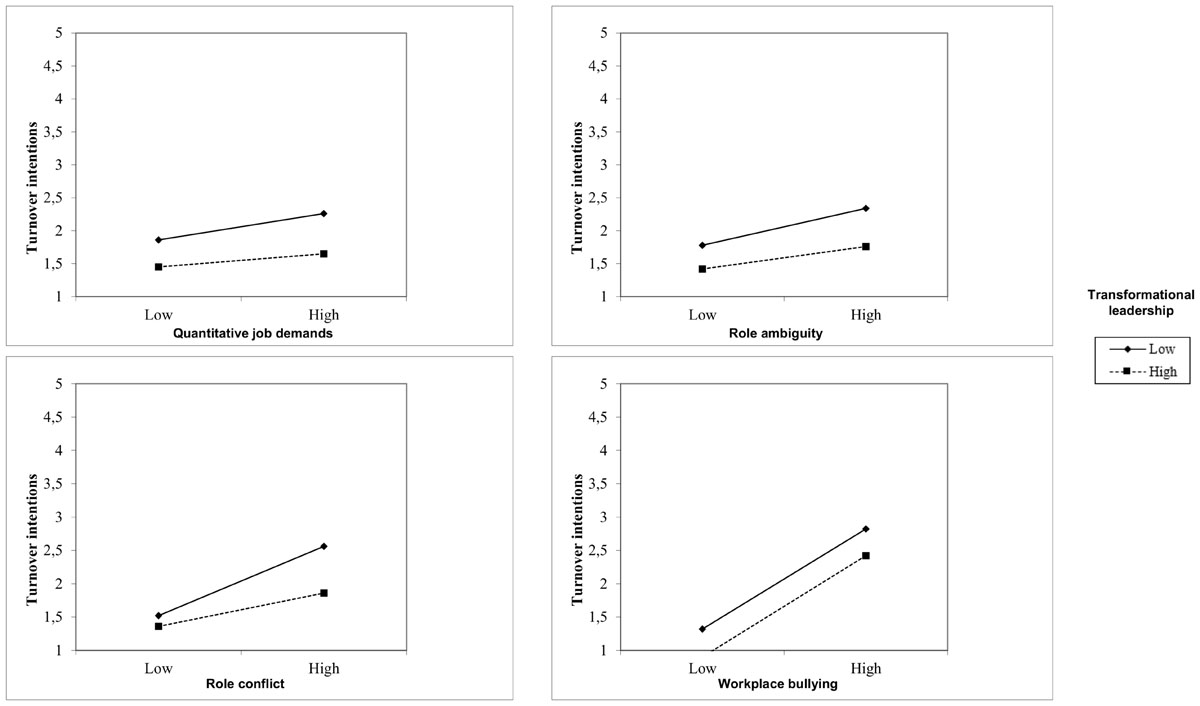
Figure 1
Interactive effects between job demands and transformational leadership on turnover intentions at T1.
Prospective findings
A linear regression analysis was used to investigate the effects of job demands at baseline on turnover intentions at follow-up. To control for stability in the outcome variable, the analysis was adjusted for turnover intentions at baseline. Hence, the findings show whether the predictor variables are associated with an increase or decrease in turnover intentions over time. Unstandardized (B) and standardized (β) regression coefficients, standard errors, and 95% confidence intervals for each of the predictors in the model are displayed in Table 4. Indicating moderately high stability in the variable, turnover intentions at T1 emerged as the strongest predictor of turnover intentions at T2 (β = .57, p < .001). After adjusting for age, gender, education, leadership position, and turnover intent at T1, all predictor variables had significant bivariate associations with turnover intentions at T2. However, in the multivariate analyses, workplace bullying (β = .07; p < .001) emerged as the only significant predictor of changes in turnover intentions over time. Quantitative job demands, role ambiguity, and role conflict were not uniquely associated with changes in turnover intentions when investigated simultaneously. The baseline predictor variables explained 41% of the variance in turnover intent at follow-up (R2 = .41; F = 82.49; DF = 9/1084; p < .001).
Table 4
The impact of job demands on turnover intentions at T2, adjusted for turnover intentions at T1 (Multivariate model: R2 = .41; F = 82.49; df = 9/1084; p < 001).
| VARIABLES | BIVARIATE | MULTIVARIATE | ||||||
|---|---|---|---|---|---|---|---|---|
| B | S.E. | 95% CI B | β | B | S.E. | 95% CI B | β | |
| Age | – | – | – | – | –.01 | .00 | –.01 – –.00 | –.05* |
| Gender | – | – | – | – | –.08 | .05 | –.18 – .02 | –.04 |
| Education | – | – | – | – | .01 | .05 | –.10 – .11 | .00 |
| Leadership position | – | – | – | – | .00 | .05 | –.10 – .11 | .00 |
| Turnover intent T1 | – | – | – | – | .57 | .03 | .52 – .62 | .56*** |
| Quantitative job demands T1 | .12 | .05 | .03 – .21 | 06** | .09 | .05 | –.01 – .18 | .05 |
| Role ambiguity T1 | .09 | .05 | .00 – .18 | .05* | .06 | .05 | –.03 – .15 | .03 |
| Role conflict T1 | .21 | .06 | .09 – .33 | .08*** | .12 | .07 | –.02 – .25 | .05 |
| Workplace bullying T1 | .30 | .08 | .15 – .45 | .10*** | .20 | .08 | .06 – .36 | .07** |
[i] ***p < .001; **p < .01; *p < .05.
A dominance analysis in Stata was carried out to determine the relative influence of the job demands at T1 with turnover intentions at T2, adjusted for baseline turnover intentions. The dominance analysis showed that turnover intentions at T1 (rank: 1; β = .77) had the largest relative relationship with subsequent turnover intentions, followed by workplace bullying (rank: 2; β = .09), role conflict (rank: 3; β = .07), role ambiguity (rank: 4; β = .04), and quantitative job demands (rank: 5; β = .03).
A series of moderation analyses were conducted to determine the moderating effect of transformational leadership on the associations between job demands and changes in turnover intentions. The analyses were controlled for age and gender and examined changes in levels of turnover intentions from T1 to T2 by adjusting for turnover intentions at T1. Transformational leadership was not significantly associated with subsequent turnover intentions (β = –.04; p > .05). As shown in Table 3, there was no significant evidence for any moderating effects of transformational leadership on subsequent turnover intentions.
Discussion
Unwanted turnover incurs large cost for organizations (Jones, 2008). To develop measures that can prevent and counteract turnover, it is crucial to detect factors that may increase intentions to leave one’s job, and in particular, factors that are under the direct influence of the employers and their managers. The first aim of this study was therefore to determine the relative impact of challenge, hindrance, and threat demands on turnover intentions. The second aim was to examine whether transformational leadership moderates the effects of the examined job demands on turnover intentions. The findings from the cross-sectional data showed that threat demands, as indicated through workplace bullying, were most strongly related to turnover intent, followed by indicators of hindrance demands. Challenge demands were associated with turnover intent in the bivariate analyses, but we found no association in the multivariate analyses. Workplace bullying emerged as the only significant predictor of increased turnover intentions in the time-lagged data, thus questioning the potential long-term impact of challenge and hindrance demands. Analyses of interaction effects in the cross-sectional data showed that transformational leadership moderated the associations between quantitative job demands, role ambiguity, and role conflict, respectively, with turnover intentions, but not in the time-lagged data. There was no evidence for any interactive effect of transformational leadership on exposure to workplace bullying.
The impact of job demands on turnover intent
The positive associations between the examined job demands and turnover intentions provide support to the first two study hypotheses in that they show that threat demands (workplace bullying) have a stronger relation with turnover intentions than hindrance and challenge demands (H1a), while hindrance demands has a stronger relation with the outcome variable than challenge demands (H1b). A main theoretical implication of our study is that these findings support the Challenge-Hindrance-Threat demands model by showing that threat job demands can be distinguished from challenge and hindrance job demands, and that each type of demand plays an exclusive role in predicting psychological well-being in employees (Searle & Tuckey, 2017), with threat demands emerging as the most detrimental.
While challenge demands are defined in terms of pressure to accomplish tasks and hindrance demands reflects obstacles to achievement, threats are defined in terms of anticipated personal harm or loss, that is, expecting something bad to happen (Cavanaugh et al., 2000), thus indicating less control over the situation. The less control a person perceives that they have in a demanding situation, the more stressful the situation will be (Lazarus, 1993). Perceiving stressors as uncontrollable creates more negative outcomes than experiencing stressors as controllable (Karasek, 2011). While challenge and hindrance demands are stressors that the individual can deal with him- or herself through increased efforts or by trying to remove obstacles (e.g., clarify roles), workplace bullying represents a long-lasting and systematic hazard for the personal integrity of those targeted, which by definition is difficult to handle for those exposed (Einarsen, 1999; Zapf & Einarsen, 2005). Exposure to workplace bullying is not only an extreme stressor in its own right, but it may also lead to depletion of personal resources and the loss of control due to the treatment itself, thus potentially creating a no-control situation for the target (Zapf Einarsen, 2005). Most persons, in order to stay sane and safe, consider the world as benevolent and meaningful, and themselves as worthy individuals in control of their own life (Janoff-Bulman, 1989). Experiencing bullying may hence be a “shock to the system” (Holtom et al., 2005), in line with the unfolding model of turnover (Lee & Mitchell, 1994). According to this model, one pathway to turnover starts with a “shock” event which is defined as “a very distinguishable event that jars the employee toward deliberate judgments about their jobs and to eventually more or less voluntarily quit their job” (Lee & Mitchell, 1994). Experiencing a negative shock event, such as exposure to bullying, causes the employee to evaluate whether there has been an image violation. Image violation is a set of images that invoke a reassessment of one’s attachment and commitment to an organization. Research shows that shocks are precipitating events that cause voluntary departure more often than more accumulated job dissatisfaction (Mitchell et al., 2001). The finding that workplace bullying is the strongest predictor of turnover intentions corresponds with previous research findings on related outcomes. For instance, in a series of studies based on data from 31 European countries, workplace bullying was among the most important psychosocial predictors of both mental health problems (Schutte et al., 2014) and sickness absence (Niedhammer et al., 2013). Furthermore, in a prospective study of work stressors among Norwegian workers in the petroleum industry, bullying emerged as a more important precursor to mental distress than factors such as job demands, physical safety, and leadership (Nielsen et al., 2012).
The moderating effect of transformational leadership
Having established the associations between different types of job demands and turnover intentions, a pending question is how organizations can provide employees with resources to meet and handle such demands and thereby reduce their negative impact. We expected that transformational leadership should be one important resource to consider. We did find a buffering effect of transformational leadership on the examined challenge and hindrance demands in the cross-sectional data. In contrast to expectations about a synergistic interaction, we found no effect of transformational leadership on the association between workplace bullying as a marker of threat demands and turnover intent. These findings indicate that transformational leadership may alleviate the effect of high work pressure, while also making it easier for employees to handle work related obstacles in the form of role ambiguity and role conflict, but also show that transformational leadership has no impact on turnover intent following threat demands. As discussed in the introduction, transformational leaders serve as role models that stimulate and inspire followers and thereby help their subordinates to recontextualize the exposure and thereby become more likely accept the presence of the demand in question. In doing so, the subordinate will better understand how to handle the demand, thus making it more controllable. As highlighted above, it is well-established that the experience of control is a key factor regarding successful coping with stressors (Karasek, 2011; Stansfeld & Candy, 2006).
The role of controllability may also explain why transformational leadership did not moderate the association between exposure to bullying and turnover intent. That is, since the target of bullying per definition is in power imbalance with the perpetrator (Einarsen, 2000; Salin, 2003) and the behaviors included are perpetrated by someone else, a moderating effect will be dependent upon an active intervention from the leader that can stop the bullying. As discussed in the introduction, a transformational leader that is supportive, or tries to reframe the situation for the target, without being able to reduce the bullying, may even create an experience of cognitive dissonance in the target that will maintain or even increase his/her turnover intentions. In the case of bullying, a leader that prioritize active conflict management, creating a strong climate for conflict management that include organizational policies, practices and procedures for the protection of workers may be more beneficial (Bond et al., 2010; Einarsen et al., 2017; Einarsen et al., 2018).
It must be emphasized that, although significant, the actual moderating effect of transformational leadership on challenge and hindrance demands was limited as the explained variance in the criterion variable in relation to the investigated interactions were quite small. Consequently, there may be other job resources than transformational leadership that are more important regarding job demands and turnover intentions. It should also be noted that we found no indications of a moderating effect in the longitudinal data, thus questioning any long-term impact of transformational leadership on turnover intentions and/or pointing to a more complex causal relationship between the variables.
Methodological strengths and limitations
While most previous research on occupational predictors of turnover have been cross-sectional, this study also included prospective data that allowed for determining changes in turnover intentions over time. The sample was large and heterogeneous and sampled from a representative pool of Norwegian employees. As shown by the analyses of attrition, the T2-sample were in correspondence with the baseline sample. The study variables were assessed with previously validated instruments.
However, there are several limitations that need to be highlighted. The response rate of 32% is low, but it corresponds to the average of survey studies (Stedman et al. 2019). Furthermore, as response rate levels seem to have restricted impact on the internal validity of a study (Schalm & Kelloway, 2001), a response rate of 32% should not have a major impact on the findings on relationships between the variables. Because measurement instruments were self-report measures, it should be noted that the findings may be influenced by response set tendencies and social desirability. There is also a risk of common method variance, although it is likely that this risk is reduced in the longitudinal analyses (Podsakoff et al., 2003). We used a six-month interval and it may be that different results could have been established if we used shorter or longer time-lags (Ford et al., 2014). As discussed by Taris and Kompier (2014), reporting non-significant results based on the use of too short or too long intervals of time may obscure actual causal relationships. As we found significant relationships in the cross-sectional data that were not present in the analyses of prospective data, this indicates that the utilized time-lag may not be optimal for examined relationships. Upcoming research should therefore replicate this study using other time-lags and should also determine potential reverse associations between the work stressors and turnover intent.
As mentioned in the introduction, appraisal is a central process regarding the potential impact of job demands. A final limitation of the current study therefore is that we based our categorization of job demands on previous research, rather than actually assessing the respondents’ appraisal of these factors as challenges, hindrances, and threats. As previous research has found that employees tend to appraise job demands differently (Li et al., 2020), upcoming research should consider extending our study by including information about how the participants appraise the different job demands.
Conclusion and implications
Through examining the impact of multiple job stressors on turnover intentions cross-sectionally and over time, this study have shown that exposure to high levels of challenge, hindrance, and threat demands are associated with intentions to leave one’s job. However, as shown by the longitudinal data, challenge and hindrance demands may be distressing in the short run, but only threat demands seem to have a long-term impact on turnover intentions among employees. The finding that transformational leadership buffers the association between challenge and hindrance demands with turnover intent indicates that recruiting transformational leaders or implementing leadership development programs that focus on training leaders to be more transformational, may be somewhat beneficial with regard to reducing the impact of such demands among followers. However, due to the rather small effect sizes, other measures will also be important. It is well-established that the experience of control is a key factor regarding successful coping with challenge and hindrance stressors (Karasek, 2011; Stansfeld & Candy, 2006). As stressed in theoretical models such as the job demands-control model (Karasek, 1979) and the job demands-resources model (Bakker & Demerouti, 2007), implementing job designs that provide workers with more control over the work pace and decisions may therefore contribute to reduce turnover intent.
The established associations between bullying and turnover intent show the importance of implementing measures and interventions to reduce the detrimental impact of bullying. Previous research indicates that a strong climate for conflict management is associated with reduced occurrence of bullying and with better employee well-being following bullying when it occurs (Bond et al., 2010; Einarsen et al., 2018). Hence, promoting a strong psychosocial safety climate may be especially beneficial for reducing the risk of turnover among employees.
Data Accessibility Statement
The data that support the findings of this study are available from the corresponding author, Morten Birkeland Nielsen, upon reasonable request.
Notes
Competing Interests
The authors have no competing interests to declare.