
Introduction
A recent meta-analysis suggests that although leadership training in general is effective, its effectiveness is highly dependent on how the training is designed and delivered (Lacerenza et al., 2017). Leaders’ ability to transfer new knowledge and skills to their everyday routine is therefore highly dependent on whether the training sessions were designed to maximise learning through, for instance, the provision of feedback, lectures, and exercises.
Even though important characteristics in designing leadership training sessions have now been identified (Lacerenza et al., 2017), less is known about how to design trainings to aid transfer of new knowledge and skills between sessions. In the transfer of training literature, interventions to increase transfer have been recommended before, during, and after a training initiative (Burke, 2001). So far, there are only a handful of studies on the subject, demonstrating small or no effects (Ford et al., 2018). A way forward is to integrate knowledge from other types of interventions, such as behavioural change interventions that have proven to be effective (Ford et al., 2018). Including booster activities between sessions is one such intervention that previous researchers have found effective (Berkman et al., 2011; Kinnafick et al., 2016; Shapiro et al., 2012). Yet, whether booster activities can also be used to improve the effectiveness of leadership training interventions, remains unexplored.
The purpose of the present study was to examine whether booster activities increase the effectiveness of leadership training. Using a mixed methods design including both quantitative and qualitative data, we sought to advance theory and research on leadership training by answering the call in the leadership training literature to further the study of booster activities (Avolio et al., 2009; Su & Reeve, 2011). Although booster activities’ importance has been acknowledged in previous research, they have not been systematically evaluated (Avolio et al., 2009). We add to the current leadership training literature by contrasting the usefulness of two booster activities: telephone coaching, and exercises sent by e-mail.
The effectiveness of leadership training
Given that leadership development is an essential strategic priority for organisations, a majority of organisational funds spent on training is allocated to training leaders (Ho, 2016; O’Leonard, 2014). However, only a minority of organisations consider their leadership training programs to be effective, and organisations continue to report a lack of leadership skills among their employees (Schwartz et al., 2014). This calls into question the general utility of leadership training programs (Lacerenca et al., 2017).
Organisations’ frustration with the lack of effect of their investments in leadership training is reflected in empirical studies. Over the years, several reviews and meta-analyses have been conducted to evaluate the effectiveness of leadership training programs. First, Burke and Day (1986) conducted a meta-analysis of 70 managerial training programs and found that, on average, training programs were moderately effective. Collins and Holton (2004) added another 13 studies and drew similar conclusions, but they emphasised that effectiveness could be improved to ensure that the right development is offered to the right leaders. In 2009, Avolio et al. compared 37 experimental and quasi-experimental leadership interventions and uncovered that leadership training has a 66% chance of resulting in improvement in leadership behaviours, across a wide range of theories, outcomes, and organisational types. Their findings were echoed by Taylor et al. (2009), who also demonstrated that leadership training effectiveness was enhanced when the training content was based on an analysis of task and skill requirements and when the training included opportunities for practice. In 2010, Power and Yalcin conducted a meta-analysis of managerial training programs in the private sector and found that effect sizes were still moderate, and they found no improvement in effectiveness compared to earlier meta-analyses.
The most recent meta-analysis, including 335 independent leadership training samples, suggests that leadership training is more effective than previously thought, and the researchers concluded that leadership training in general leads to a 28% improvement in leadership behaviours (Lacerenza et al., 2017). Interestingly, they also identified a number of training design factors that increased the effectiveness of the training, including needs analysis, feedback, multiple delivery methods (especially practice), spaced training sessions, face-to-face delivery, and an on-site location. These findings suggest that training design is possibly a powerful predictor of leadership training effectiveness. So far, however, the majority of leadership training studies have focused on the design of the training session, and to a lesser extent on how to design the training between sessions. This is somewhat surprising, given that interventions to increase the effectiveness of training both during and after a training initiative have been recommended (Burke, 2001), and proven effective in other settings such as in behavioural change interventions (Ford et al., 2018).
Booster activities to increase the effectiveness of leadership training
Avolio et al. (2009) suggested including booster activities between sessions to improve leadership training effectiveness. In related fields, the utility of such activities has been acknowledged. For example, a meta-analysis of autonomy-supportive interventions concluded that effective interventions tended to offer supplemental follow-up activities (Su & Reeve, 2011). These activities included, for example, take-home informational booklets or manuals, study-specific websites, follow-up group meetings, or structured journaling activities (e.g., each day, try to implement an autonomy-supportive style, then record your reflections and the students’ reactions).
Among previous leadership training interventions, similar strategies have been implemented (Hardré & Reeve, 2009; Yong et al., 2019). For example, Hardré and Reeve’s leadership training (2009) used a training booklet that was designed as a manual to help managers develop strategies to incorporate an autonomy-supportive leadership style into their own managerial practice between sessions. Brown and May (2012) provided managers with follow-up group meetings to maintain the emphasis on the training during a leadership program. However, these booster activities were neither evaluated nor contrasted against other types of booster activities, and therefore their utility remains unknown.
Another type of booster activity that has been used in leadership training is individual coaching between sessions. For example, in a leadership training (Bass & Riggio, 2006), managers received telephone coaching between sessions, which was perceived by managers as meaningful and helpful in staying focused on the goals of the training (Aarons et al., 2015). In another study, virtual coaching was offered to increase transfer, which was perceived by managers as useful in supporting their development and an opportunity to reflect on their own progress (Schwatka et al., 2021). Although these findings are promising, a comparison and evaluation of different kinds of booster activities should be done to advance knowledge on how leadership training interventions reinforces the lessons learned during such training.
With the arrival of new information technology, calls have been made for leadership intervention research to examine how the effects of training can be boosted over time by sending text messages or e-mails to reinforce the lessons learned in a leadership training intervention (Avolio et al., 2009). In other fields, the use of, for instance, text messages to enhance trainee motivation has been successfully applied. For example, in an intervention with the aim to increase physical activity, participants received needs-supportive text messages twice a week, which increased motivation and physical activity (Kinnafick et al., 2016). The usefulness of text messages has been further demonstrated in interventions to facilitate weight loss (Shapiro et al., 2012) and smoking cessation (Berkman et al., 2011). However, within the general leadership training literature, the usefulness of these types of electronic booster activities remains unexplored.
Booster activities in the form of telephone coaching or text messages differ in a number of ways, and one way to understand these differences is through the lens of media synchronicity theory (MST) (Dennis et al., 2008). Synchronicity refers to whether media are used synchronously, so that all participants are communicating at the same time (e.g., telephone calls), or asynchronously, where participants do not work at the same time (e.g., e-mails). MST differentiates media in function of the level of synchronicity. MST suggests that in communication processes where conveyance is the goal (i.e., the transmission of a diversity of new information), the use of lower synchronicity media such as e-mails will lead to better communication performance because it allows the recipient to process the information at his or her own pace. However, when convergence is the goal (i.e., when the objective is to agree on the interpretation of new information), the use of higher synchronicity media such as telephone calls is believed to lead to better communication performance. Translated to the booster activities in leadership training, MST would thus suggest that telephone coaching is suitable to agree on development goals and discuss progress, but to a lesser extent to provide new complex information. On the other hand, an e-mail booster may provide the leader with complex information and instructions on how to develop as a leader but is less suitable to agree on goals or to monitor progress together.
The present study
The aim of the present study is to evaluate the relative usefulness of different types of booster activities in leadership training. Based on MST, we contrast two kinds of booster activities—one based on traditional telephone coaching between sessions that may be seen as the norm in leadership training, and another based on information technology in terms of e-mails that may represent a cost-effective alternative. We examine how these booster activities are related to managers’ transfer of new knowledge and skills (Blume et al., 2010) after attending leadership training. In this case, transfer is measured in terms of managers’ needs-supportive behaviours, as this leadership training is based on SDT aiming to increase managers’ needs-supportive behaviours towards employees. We also examine important facilitators of transfer identified in previous research (Blume et al., 2010), such as manager motivation (Tafvelin & Stenling, 2021), readiness for change (Randall & Nielsen, 2009), and perceived applicability of a leadership training (Burke & Hutchins, 2007). Finally, we use focus group interviews to capture managers’ perceptions of the two booster activities. Although the leadership training in our study is based on SDT, our study merely seeks to contribute to knowledge on type of booster activities in leadership training in general, regardless of leadership theory.
Given that no prior study has examined or contrasted different booster activities during leadership training, we have no formal hypothesis regarding their relative effectiveness. According to MST, the two different booster activities may fulfil different purposes and thereby have different strengths.
Method
Participants and procedure
This study was set in a midsized municipality in northern Sweden. The leadership training was conducted as a part of the municipality’s annual leadership development program, and the participants in the present study were relatively newly employed (i.e., within the last 1–2 years) managers enrolled in this program. Participation in the training program was mandatory, whereas participation in the research study was voluntary. Twenty-one first-line managers employed in various sectors (e.g., childcare, culture, education, elderly care, leisure), were invited and agreed to participate in the present study. One manager quit his job during the training program: he and his employees were therefore excluded from the analysis. Thus, the final sample consisted of 20 managers and 323 of their employees. Manager sample characteristics are presented in Table 1, and employee sample characteristics in Table 2. The current study includes a subsample form a larger research project, and more detailed description of the project, recruitment, and participants can be found in Tafvelin et al. (2019).
Table 1
Means and standard deviations for the managers in the telephone coaching (n = 9) and e-mail (n = 11) group.
| BASELINE (T1) | 1ST WORKSHOP | 2ND WORKSHOP | 3RD WORKSHOP | |||||
|---|---|---|---|---|---|---|---|---|
| TELEPHONE COACHING | TELEPHONE COACHING | TELEPHONE COACHING | TELEPHONE COACHING | |||||
| Perceived applicability | ||||||||
| Q1 | 4.56 (0.50) | 4.41 (0.63) | 3.89 (0.32) | 4.39 (0.51)* | 3.89 (0.32) | 3.90 (0.52) | ||
| Q2 | 4.33 (0.67) | 4.41 (0.47) | 4.00 (0.47) | 4.48 (0.90) | 3.56 (0.69) | 3.72 (0.46) | ||
| Q3 | 4.56 (0.50) | 4.55 (0.89) | 4.11 (0.88) | 4.34 (1.29) | 3.89 (0.57) | 3.90 (0.52) | ||
| Readiness for change | 4.22 (0.52) | 4.43 (0.60) | 4.53 (0.42) | 4.71 (0.47) | 4.06 (0.48) | 4.58 (0.47)* | ||
| Intrinsic motivation | 5.25 (0.97) | 5.55 (0.90) | 5.19 (0.90) | 5.53 (1.14) | ||||
| Identified regulation | 5.64 (0.88) | 5.66 (1.21) | 5.33 (0.87) | 5.21 (1.27) | ||||
| External regulation | 3.17 (1.58) | 4.09 (2.05) | 3.92 (1.33) | 4.66 (1.90) | ||||
| Amotivation | 1.08 (0.24) | 1.25 (0.79) | 1.58 (1.06) | 1.35 (0.58) | ||||
| Age | 42.44 (8.53) | 42.55 (10.14) | ||||||
| Years as manager | 6.11 (6.49) | 6.73 (6.96) | ||||||
| Number of employees | 24.89 (10.65) | 23.64 (10.51) | ||||||
| Females/males | 8/1 | 8/3 | ||||||
[i] Note.
Q1 = This leadership training program provide the training content that I need for my job as a manager.
Q2 = This leadership training program will help me conduct certain tasks I am dealing with as a manager.
Q3 = The leadership training program is of practical value to me.
* Statistically significant difference between the telephone coaching group and e-mail group after the 2nd workshop.
Table 2
Means and standard deviations for the employees with managers in the telephone coaching and e-mail group.
| TELEPHONE COACHING (n = 131) | E-MAIL (n = 192) | |||||||
|---|---|---|---|---|---|---|---|---|
| T1 | T2 | T3 | T4 | T1 | T2 | T3 | T4 | |
| Age | 45.43 (11.01) | 43.16 (12.37) | ||||||
| Sex (females) | 77.2% | 78.4% | ||||||
| Tenure | 9.59 (7.92) | 9.41 (8.63) | ||||||
| Years with manager | 0.86 (0.69) | 1.01 (0.91) | ||||||
| Autonomy support | 3.98 (0.84) | 3.85 (0.83) | 3.73 (0.79) | 3.86 (0.67) | 3.79 (0.79) | 3.86 (0.84) | 3.92 (0.79) | 3.90 (0.82) |
| Competence support | 3.65 (0.82) | 3.50 (0.84) | 3.48 (0.84) | 3.71 (0.70) | 3.66 (0.81) | 3.76 (0.89) | 3.73 (0.90) | 3.72 (0.86) |
| Relatedness support | 4.15 (0.75) | 3.96 (0.80) | 3.87 (0.74) | 4.15 (0.61) | 4.07 (0.85) | 4.12 (0.85) | 4.06 (0.93) | 4.10 (0.87) |
The managers responded to a pencil-and-paper survey at the end of each of the three sessions; however, we collected the first measurement of readiness for change approximately four weeks prior to the first session. We collected data from employees at four measurement points using a web-based survey. The baseline survey was administered approximately four weeks prior to the first session, the second was administered within a week after the second session (approximately two months after the baseline survey), the third was administered approximately two months after the second survey, and the fourth was administered approximately four months after the third survey. All participants provided written informed consent, and the study was approved by the regional ethical review board at the first author’s university. An overview of the design and time points for data collection is displayed in Figure 1.
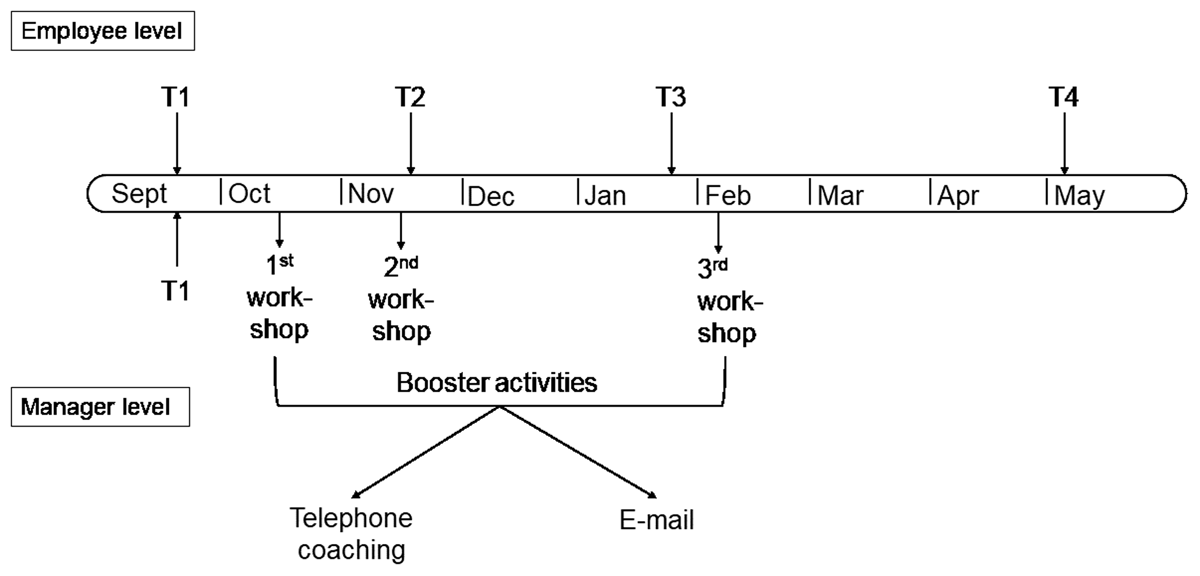
Figure 1
Overview of the study design and timeline.
The leadership training program
Tafvelin et al. (2019) provided a detailed description of the leadership training program. The leadership training program aimed at developing need-supportive leadership behaviours among the participating managers. The leadership training program spanned five months (October 2015–February 2016) and included two two-day sessions, one month apart, and a third half-day session, approximately three months after the second session. During the first session, each manager formulated an individual action plan for how and when they could practice need-supportive behaviour at work.
Booster activities
The participants were randomly assigned to one of two booster activities in between sessions: telephone coaching, or e-mail. These booster activities were designed in line with MST and how different media may best help to reinforce the content of the program between sessions and to facilitate learning. The booster activities commenced the week after the first session of the leadership training and continued for 13 weeks.
Managers in the telephone coaching group were offered coaching calls with a leadership and organisational consultant or one of the two leadership developers. In line with MST, these calls aimed to discuss development goals and progress, providing individualised encouragement and support, as well as an opportunity for the participants to discuss and resolve difficulties in relation to their individual action plan, and to receive positive feedback. As such, these calls can be considered semi-structured and mostly guided by the topics highlighted by the participants. In line with previous leadership trainings, managers were offered three coaching calls (e.g., Schwatka et al., 2021). The first call was conducted between the first and second sessions, whereas the two remaining calls were conducted between the second and third sessions.
In line with MST’ notion that e-mail is a media suited to convey more complex information to aid leaders’ development, participants in the e-mail group received e-mails with a brief text about SDT and suggestions for voluntary tasks that they could perform to practice and reflect upon their needs-supportive behaviours. The tasks were aligned with the content covered in the first two sessions of the training program, and the booster activities were structured as follows. E-mails were sent out on a weekly basis (e.g., Kinnafick et al., 2016).
During Weeks 1–3, participants received three e-mails per week (Monday, Wednesday, and Friday) that focused on autonomy-support (Week 1), competence-support (Week 2), and relatedness-support (Week 3), behaviours. On Mondays, they received a brief text about SDT and encouragement to try one or several needs-supportive behaviours during the week. On Wednesdays, they received a prompt about and specific suggestions for the aspects to consider when trying to engage in needs-supportive behaviours. On Fridays, they received an e-mail with a summary of the week’s e-mails and a suggestion of a structure for evaluating and reflecting on their needs-supportive behaviours.
During Weeks 4–7, the e-mails focused on need-supportive behaviours in relation to specific tasks, such as leading meetings, writing e-mails, and providing feedback. Participants received two e-mails per week: one on Monday, and one on Friday. In Monday’s e-mail, we provided a suggestion to try one or several need-supportive behaviours when engaging in the task, and in Friday’s e-mail, we provided the same evaluative questions as those received in Weeks 1 to 3.
During Weeks 8–12, we focused on strategies for maintaining a need-supportive leadership style and for identifying and reflecting upon how doing so could be achieved. During these weeks, participants received one e-mail per week (every Monday). Week 8 focused on identifying when they were successful in their need-supportive leadership style, and the causes and circumstances surrounding such instances. Week 9 focused on identifying when they were not successful in their need-supportive leadership style, and the causes and circumstances surrounding such instances. Week 10 focused on identifying short- and long-term goals related to their development of a need-supportive leadership style using SMART (i.e., specific, measurable, attainable, relevant, and time) goal setting. Week 11 focused on comparing the goals specified in their action plan at the beginning of the training program with the goals specified in week 10 using SMART goal setting and reflecting upon why they had or had not changed. Week 12 focused on strategies for maintaining a need-supportive leadership style, and participants were asked to identify strategies that could optimise their chances of maintaining and continuing to develop a need-supportive leadership style. During Week 13, the managers received a booklet with all of the information provided in the e-mails during the 12 weeks.
Measures
Outcome measures: Managers
Perceived applicability
The perceptions survey of application (Lim & Morris, 2006) was used to assess participants’ perceived applicability of the content immediately after each of the workshops. The managers responded to three questions about their perceived degree of use of the content of the leadership training program: Q1 = “This leadership training program provides the training content that I need for my job as a manager”; Q2 = “This leadership training program will help me conduct certain tasks I am dealing with as a manager”; and Q3 = “The leadership training program is of practical value to me”. Responses were given on a 5-point Likert-type scale ranging from 1 (strongly disagree) to 5 (strongly agree).
Readiness for change
The readiness for change subscale of the Intervention Process Measure (Randall & Nielsen, 2009) was used to assess managers’ expectations and openness to change. The subscale contains four items (e.g., “I had high expectations that the leadership training would improve my working conditions”), and responses were given on a 5-point Likert scale ranging from 1 (strongly disagree) to 5 (strongly agree). Omega reliability coefficients calculated using the software JASP (JASP Team, 2020) ranged from 0.765 to 0.863 across the three measurement points.
Motivation
Managers’ motivation to participate in the leadership training program was assessed with the Situational Motivation Scale (Guay et al., 2000). The Situational Motivation Scale consists of four four-item subscales that measure people’s situational (or state) intrinsic motivation (e.g., “Because I think that this activity is interesting”), identified regulation (e.g., “Because I think that this activity is good for me”), extrinsic regulation (e.g., “Because it is something that I have to do”), and amotivation (e.g., “There may be good reasons to do this activity, but personally I don’t see any”) towards a specific activity or behaviour. The stem item used in the present study was “Why do you participate in this leadership training program?” Responses were given on a 7-point Likert-type scale ranging from 1 (does not correspond at all) to 7 (corresponds exactly). Omega reliability coefficients ranged from 0.677 to 0.893 across the two measurement points. We were unable to calculate omega reliability coefficients for the amotivation subscale from the first session because one item had zero variance and issues with collinearity. Coefficient alpha of the amotivation subscale without the item with zero variance was 0.895.
Outcome measures: Employees
Need support
Need support was assessed with the 12-item Need Support at Work Scale (Tafvelin & Stenling, 2018). This instrument consists of three subscales that capture employees’ perceptions of their managers’ autonomy support (four items), competence support (four items), and relatedness support (four items). Responses were given on a 5-point Likert scale ranging from 1 (never/almost never) to 5 (always). Composite reliability (ω) was computed using the standardised parameters (factor loadings and error variances) from the most invariant longitudinal models (McDonald, 1970). Omega reliability coefficients ranged from 0.847 to 0.871 for autonomy support, 0.857 to 0.868 for competence support, and 0.903 to 0.912 for relatedness support across the four measurement points.
Data analyses
We conducted an independent samples t-test at each measurement point to compare the managers in the telephone coaching and e-mail groups. We used Mplus version 8.4 (Muthén & Muthén, 1998–2017) to estimate longitudinal confirmatory factor analysis (CFA) and assess measurement invariance over time of the employees’ ratings of their managers’ autonomy, competence, and relatedness support. We performed longitudinal measurement invariance testing to ensure that the same construct was measured over time (Widaman et al., 2010). Given the ordered-categorical nature of the data, we used the robust weighted least squares estimator (WLSMV in Mplus; Muthén et al., 1997), and we adjusted the standard errors and goodness-of-fit model testing for clustering (Muthén & Satorra, 1995). Following the approach by Liu et al. (2017) for testing measurement invariance in longitudinal data with ordered-categorical measures, we assessed invariance of the factor loadings (weak), thresholds (strong), and unique factor variances (strict). We performed nested model comparisons using the DIFFTEST (Asparouhov & Muthén, 2006), which compares nested models with a mean- and variance-adjusted chi-square statistic. A statistically significant difference (p < 0.05) would indicate non-invariance.
Following the invariance testing, we conducted unconditional and conditional latent growth curve analysis (LGCA; see Bollen & Curran, 2006 for an overview of LGCA) to examine the effects of the intervention on employees’ perceptions of managers’ need support. We used a linear unconditional LGCA to assess the average starting point at baseline (i.e., intercept mean), the variation around the starting point (i.e., intercept variance), the average rate of change over time (i.e., slope mean), and the variation around that change (i.e., slope variance). In the conditional LGCA, we included a dichotomous variable (0 = telephone coaching group vs. 1 = e-mail group) as a predictor of the intercept and slope factors. We used LGCA combined with an adjustment of the standard errors and goodness-of-fit model testing for clustering (i.e., the TYPE = COMPLEX option in Mplus; Muthén & Satorra, 1995). We evaluated the model fit of the longitudinal CFA and LGCA using conventional model fit indices, such as the chi-square test, comparative fit index (CFI), the Tucker-Lewis index (TLI), the root mean square error of approximation (RMSEA), and the standardised root mean square residual (SRMR). We used traditional cut-off criteria with CFI and TLI values around 0.90 and SRMR and RMSEA values around 0.08 to indicate acceptable fit (Marsh, 2007).
Focus group interviews
Focus groups interviews were conducted during the last day of the leadership training. The 20 participating managers were divided into four groups, with four to six managers in each group. A semi-structured focus group guide was used to elicit managers’ perceptions of the leadership training, including the booster activities, and lasted for about an hour. The focus group interviews were conducted by four master’s psychology students. They recorded, transcribed, and later analysed the interviews under supervision of the research team, using thematic analysis as described by Braun and Clarke (2006). The thematic analysis followed the six phases of familiarising with the data, generating initial codes, searching for themes, reviewing themes, defining and naming themes, and producing the final report. Only the part of the analysis that relates to the booster activities is included in this paper.
Results
Managers
Descriptive statistics of the managers in the telephone coaching and e-mail groups are shown in Table 1. There was a statistically significant difference at measurement point two (immediately after the second workshop) for Q1 (“This leadership training program provides the training content that I need for my job as a manager”), t(18) = –2.55, p = 0.020, Cohen’s ds = 1.15. The e-mail group scored higher compared to the telephone coaching group (M = 4.39 vs. M = 3.89). There was a statistically significant difference in readiness for change at measurement point two (immediately after the second workshop), t(18) = –2.44, p = 0.0253, Cohen’s ds = 1.10. The e-mail group scored higher compared to the telephone coaching group (M = 4.58 vs. M = 4.06).
We did not observe any statistically significant differences related to the motivation to participate in the leadership training between the groups. However, as shown in Table 1, both groups increased in external regulation, and the coaching group also increased in amotivation towards participating between the first and second workshop. To summarise, these results suggest that the managers in the e-mail group reported higher perceived applicability (i.e., valued the content of the training program to a larger extent) and higher readiness for change immediately after the second workshop compared to the managers in the telephone coaching group.
Employees
Descriptive statistics of employee ratings are shown in Table 2. The measurement invariance testing indicated that the factor loadings and thresholds were invariant over time (Table 3). The unique factor variances were partially invariant over time; two unique factor variances among the autonomy and competence support items, and one unique factor variance among the relatedness support items had to be freely estimated. Thus, the longitudinal CFA models showed partial strict measurement invariance.
Table 3
Model fit and model comparisons of the measurement invariance testing and LGCA.
| χ2 | df | p | RMSEA | 95% CI | CFI | TLI | SRMR | Δχ2 | df | p | ||
|---|---|---|---|---|---|---|---|---|---|---|---|---|
| LL | UL | |||||||||||
| Autonomy support | ||||||||||||
| Configural | 108.889 | 74 | .005 | .038 | .021 | .053 | .995 | .991 | .030 | |||
| Metric | 117.481 | 83 | .0076 | .036 | .019 | .050 | .995 | .992 | .030 | 11.409 | 9 | .2487 |
| Scalar | 149.035 | 116 | .021 | .030 | .012 | .043 | .995 | .995 | .031 | 31.855 | 33 | .5240 |
| Strict | 170.015 | 128 | .0077 | .032 | .017 | .044 | .993 | .994 | .036 | 27.792 | 12 | .0059 |
| Partial strict | 155.288 | 126 | .0392 | .027 | .007 | .040 | .995 | .996 | .033 | 9.559 | 10 | .4800 |
| Unconditional LGM | 174.755 | 131 | .0064 | .032 | .018 | .044 | .993 | .994 | .039 | |||
| Conditional LGM | 187.873 | 145 | .0096 | .030 | .016 | .042 | .993 | .994 | .042 | |||
| Competence support | ||||||||||||
| Configural | 89.418 | 74 | .107 | .025 | .000 | .043 | .998 | .996 | .025 | |||
| Metric | 99.096 | 83 | .1098 | .025 | .000 | .041 | .997 | .996 | .026 | 11.263 | 9 | .2581 |
| Scalar | 132.318 | 116 | .1427 | .021 | .000 | .036 | .997 | .997 | .027 | 32.951 | 33 | .4697 |
| Strict | 153.890 | 128 | .1592 | .025 | .000 | .038 | .996 | .996 | .033 | 23.763 | 12 | .0219 |
| Partial strict | 141.475 | 126 | .1637 | .019 | .000 | .035 | .998 | .998 | .029 | 11.319 | 10 | .3332 |
| Unconditional LGM | 162.845 | 131 | .0309 | .027 | .009 | .040 | .995 | .995 | .036 | |||
| Conditional LGM | 184.677 | 145 | .0145 | .029 | .014 | .041 | .994 | .994 | .040 | |||
| Relatedness support | ||||||||||||
| Configural | 11.815 | 79 | .0089 | .036 | .019 | .050 | .996 | .993 | .023 | |||
| Metric | 122.502 | 88 | .0089 | .035 | .018 | .049 | .995 | .994 | .024 | 13.842 | 9 | .1280 |
| Scalar | 152.137 | 120 | .0252 | .029 | .011 | .042 | .996 | .996 | .027 | 37.038 | 32 | .2477 |
| Strict | 167.283 | 132 | .0205 | .029 | .012 | .041 | .995 | .996 | .031 | 21.397 | 12 | .0449 |
| Partial strict | 161.605 | 131 | .0358 | .027 | .008 | .040 | .996 | .996 | .029 | 15.064 | 11 | .1796 |
| Unconditional LGM | 174.755 | 131 | .0064 | .032 | .018 | .044 | .993 | .994 | .039 | |||
| Conditional LGM | 199.518 | 155 | .0092 | .030 | .016 | .041 | .994 | .994 | .042 | |||
While keeping the measurement-invariant constraints in place, we also examined the effect of booster activity on employees’ perceived need support from their managers using LGCA. An unconditional LGCA showed a positive but nonsignificant slope mean (0.079, p = 0.361) and slope variance (0.089, p = 0.299) for perceived autonomy support. When we added type of booster activity as a predictor of the slope, the results showed a positive and statistically significant effect (b = 0.314, 95% CI [0.032, 0.597], p = 0.029), suggesting a steeper slope (i.e., increase) in the e-mail group compared to the telephone coaching group. Booster activity explained 23.2% of the variance of the slope factor of perceived autonomy support.
An unconditional LGCA showed a positive but nonsignificant slope mean (0.077, p = 0.150), and a statistically significant slope variance (0.141, p = 0.016) for perceived competence support. When we added type of booster activity as a predictor of the slope, the results showed a positive but not statistically significant effect (b = 0.087, 95% CI [–0.091, 0.266], p = 0.338). Booster activity explained 1.3% of the variance of the slope factor of perceived competence support.
An unconditional LGCA showed a nonsignificant slope mean (0.000, p = 0.998), and a statistically significant slope variance (0.276, p = 0.002) for perceived relatedness support. Type of booster activity was a positive but not statistically significant predictor of the slope (b = 0.184, 95% CI [–0.181, 0.549], p = 0.324). Booster activity explained 2.8% of the variance of the slope factor of perceived relatedness support. When considered together, these results indicate that the employees in the e-mail group experienced a steeper increase in their managers’ autonomy support (and, to some extent, competence and relatedness support) over time than did the telephone coaching group.
Focus group interviews
The participants appreciated different aspects of the two types of booster activities, and each came with its own set of drawbacks. Participants in the telephone coaching booster group appreciated that the call provided confirmation that they were on the right track. It also functioned as a deadline because participants anticipated they were going to be asked about what had happened since the previous call. Participants also appreciated that the call provided room to tailor the content of the call to their own needs. However, participants’ impressions were not entirely positive. The main problem was that the call’s aim was perceived as unclear, with many of the participants reporting that the telephone coaching did not quite provide them with what they needed. A majority reported that the coaching was not structured enough, that it felt unprepared, and that they did not perceive sufficient received support. They also reported that the calls were too few, short, and transcendent in nature to provide any boostering effect. There was also an issue with timing, in that the calls could come at an inconvenient time. Some participants stated that it would have been better if the calls had targeted a specific dilemma that they were facing.
The e-mail boosters, on the other hand, were perceived as very informative. Participants described the format as flexible, and they reported it as a strength that they knew they could revisit them at a later time point if needed. However, there were also drawbacks to this, primarily related to the richness of the information. Several participants wished for less extensive material, and some felt that it was difficult to get an overview of the material. There were also reports that the e-mails were too time consuming and that they did not have time to do the activities suggested in the e-mails. Some participants expressed they perceived the e-mails as not being motivating enough, so they failed to give them proper attention. This was accentuated by a perceive lack of support for prioritisation.
Discussion
Although booster activities are certainly included in many leadership training programs, they are seldom evaluated. In the present study, we evaluated the relative usefulness of different booster activities in leadership training by contrasting two types of activities provided between sessions: telephone coaching, and e-mails. The quantitative data suggest a small advantage for the e-mail booster over telephone coaching in terms of higher ratings after the second workshop on leaders’ readiness for change and perceived applicability of the training. In addition, employees’ perception of autonomy support increased over time. Yet, the focus group interviews with leaders who participated in the training favour e-mail boosters but indicate room for further development. Our study is among the first to evaluate booster activities during leadership training, and our findings suggest that leadership training practice and research could benefit from further exploring the usefulness of booster activities in conjunction with leadership training.
Theoretical implications
Our study answered the call to further examine if the effects of leadership training can be boosted over time with the help of information technology to reinforce the lessons learned in training (Avolio et al., 2009). Our findings suggest that this is indeed the case, as indicated by the comparison of an information technology booster (e-mail) with a more traditional coaching booster. Our results suggest that the e-mail booster’s effectiveness was slightly higher than that of the telephone coaching booster, and our qualitative data suggest that this could be because the e-mail booster was perceived as informative, flexible, and that a strength with the e-mail booster was the possibility to go back to the material when needed. This is in line with MST suggesting that the reprocessability of the medium enables the recipient to reread the messages and thereby aids information processing (Dennis et al., 2008). The e-mail booster was more frequent (i.e., up to three times a week), than the telephone coaching, and although the e-mail group complained about the high frequency of e-mails, this might nevertheless have helped them to stay focused on the training.
The perceived positives with our e-mail booster, such as its flexibility and informative nature, can be further developed by tailoring the content to each individual, for example by allowing the individual to choose content, reminders, and frequency. Such tailoring might increase the booster’s fit with individual needs. Tailoring messages to individuals, rather than using generic information, has been shown to be an effective approach in public health programs (Lustria et al., 2009). This may address the identified drawback that some respondents did not find the e-mails motivating. Additional research is warranted to examine how a digital booster can be designed to be more motivating. We suggest that future researchers explore other types of digital boosters, such as apps or text messages, which in other areas have proven effective (Berkman et al., 2011; Kinnafick et al., 2016; Shapiro et al., 2012). Perhaps using an app through which leaders’ use of the booster can be more closely monitored could increase our knowledge on how to design effective booster activities in the future.
Interestingly, our findings only confirmed that the e-mail booster increased employees’ perceptions of autonomy support, and not to the same extent perceptions of competence and relatedness support. One reason for this may be that autonomy support was the first need-supportive behaviour included in the e-mail booster, and therefore gained an advantage. Hence, more studies are needed to examine if this finding is consistent across studies where autonomy support is introduced after competence and relatedness support, and, if that was the case, how competence and relatedness support better could be encouraged.
The telephone coaching booster was not as effective as the e-mail booster in our study, and the findings from the focus group interviews suggest that some of the coaching calls were perceived as unstructured and unclear. Hence, there is room for improvement that, if addressed, could potentially increase the usefulness and effectiveness of telephone coaching booster activities. The focus group results indicate that ensuring that the coaching stays focused on a specific task, for example how to develop the leadership skills practiced in training, is particularly vital. Nevertheless, this is also one potential risk with telephone coaching, in that it could be vulnerable to “over-tailoring” if the focus was turned to dealing with short-term problems, rather than the long-term commitment to develop new leadership behaviours. It might not be sufficient for the telephone coaching to be supportive in general; instead, we propose that future studies incorporate structured coaching focused on the leadership skills practiced in training and the leaders individual action plan. This is in line with MST, which suggests that telephone coaching may be helpful to agree on development goals and discuss progress, given the media’s high synchronicity, transmission velocity (i.e. message speed), and use of natural symbol sets (i.e. tone of voice), which allows for immediate feedback (Dennis et al., 2008). Moreover, even though the number of calls (three), were in line with previous research (e.g. Schwatka et al., 2021), it is possible that offering more frequent coaching calls would be helpful. However, given that telephone coaching is much more labour-intensive and therefore more costly, we tend to suggest that e-mails could be a cost-effective alternative that can easily be distributed to larger groups of participants.
Practical implications
Organisations make substantial investments in training in general and in training to promote leadership development (Ho, 2016; O’Leonard, 2014). Still, the possibility to transfer those investments to changes in leadership practices remains a challenge (Lacerenca et al., 2017). Booster sessions have been offered as a potential solution that would increase the practical utility of leadership development programs (Avolio et al., 2009). Our findings indicate that the least resource-intensive booster (the e-mail booster) seems to be more promising to the more resource-intensive booster (telephone coaching). This is promising from a practical perspective, as e-mail boosters, once the content has been developed, can easily be administered and reused. This might lessen the dependence on external leadership consultants and instead turn the attention to the content of the boosters, so that it is well adapted to the specific organisation.
Limitations and future research
The findings of the present study should be viewed in light of its limitations. First, the size of our sample was restricted by the number of recently employed managers in a specific organisation (n = 38), and further limited to those in the experimental group (n = 21). Despite the fact that the representativeness of managers from this public organisation was excellent (all who were invited agreed to participate, they were randomly assigned to conditions, and only one dropped out), the low number of managers in each booster group limited the statistical analysis, such as the possibility to connect manager and employee data and investigate links across levels. The use of employee data mitigates some of the drawbacks of this design and recruitment method, as it allows leaders’ self-ratings to be triangulated with an independent data source. However, we encourage future studies to replicate our findings with larger samples of managers to allow for more elaborate analysis, for instance, about the mechanisms of change.
In addition to the quantitative analysis of the effect of the two booster conditions on need-supportive leadership behaviours, the participants’ perceptions of the boosters were captured through focus group interviews, providing context to the quantitative findings. However, we were not able to collect data on the extent to which the managers interacted with the material the e-mail booster provided, the specific content of each coaching call, and how the managers acted based on this. Thus, we do not have information about how the different components of the boosters were received. Such a component analysis is warranted in future research to complement the findings from this experimental study that compared two boosters, representing two radically different methods of delivery.
The two types of boosters tested in this study were tailored to fit the advantages that come with different media, and they therefore differed in their frequency and design. On the one hand, this provided the benefit of maximising the differentiation between conditions, ensuring that each booster type was unique, and increasing the likelihood that any difference between groups could be detected, which is central in intervention studies (Carroll et al., 2007). On the other hand, it also makes them somewhat difficult to compare, and future studies are needed to further illuminate what aspects of the boosters drive the difference in outcomes (e.g., the content, frequency, format, and delivery).
The effectiveness of boosters needs to be considered in relation to the leadership training. The booster activities were part of a leadership training delivered as two 2-day sessions and one half-day follow-up based on the format the organisation had already established for their leadership training programs. Previous research indicates that short interventions might be more effective than longer ones, so that shorter but more frequent sessions might be more beneficial than longer and less frequent ones (Su & Reeve, 2011). That would also put the booster sessions in new light. In this study, they might have acted as a bridge between an off-site educational activity that would otherwise potentially have been separate from the everyday work as a manager. The boosters were also clearly separated from the other sessions. With shorter, more frequent sessions, the difference between what is a booster and what is a training session might be more difficult to determine. This suggests that future researchers should study boosters in relation to different training formats. Moreover, the function of boosters should be further investigated to allow the boosters to be functionally separated from other training components.
Conclusion
In the present study, we examined the relative usefulness of different types of booster activities in conjunction with leadership training: traditional telephone coaching and exercises sent by e-mail. Our findings suggest a small advantage of the e-mail booster over telephone coaching. However, participants perceived pros and cons of both types of boosters. To our knowledge, no previous study has contrasted the use of different booster activities during leadership training. Given that our findings show promise, we encourage further exploration of booster activities in general, and of digital boosters in particular, to better understand how we can increase the effectiveness of leadership training.
Funding Information
This work was supported by Vinnova under Grant 2013-02130.
Competing Interests
The authors have no competing interests to declare.