
Introduction
Work is an important activity in peoples’ lives, not only to earn a salary but also to fulfill needs like social support, structuring of time, status, identity, meaning, and the feeling of contributing to society (Perkins & Repper, 2013). Being excluded from the workforce may deprive people of these attributes and lead to social isolation (Isaac et al., 2010). Having a disability, for example an impairment, activity limitation, or participation restriction (WHO, 2011), increases the risk of work exclusion (Antonak & Livneh, 2000; WHO, 2011), and thereby also the risk for further negative health consequences (Modini et al., 2016; Overland et al., 2006). From an individual perspective, increased work participation is important, and it is equally important from a societal and organizational perspective. We need people’s competence and work capacity to ensure a strong supply of labor, and we need workplaces that promote people’s health (OECD, 2018). To attain the aim of increased work inclusion, willingness among employers and staff to include people with health challenges is crucial (Hernandez et al., 2000).
Sick leave and work exclusion is often multi-causal, meaning that it is rarely sufficient just to provide treatment for experienced health complaints but also necessary to take into account relations to coworkers and managers and the overall working environment (MacEachen et al., 2006). Challenges often include a link between social, health, and employment issues, but health and workplace policies and initiatives are often delivered in silos (OECD, 2015). There is a need to address these issues in an integrated way (OECD, 2015). To include people with health challenges that affect function at work, work accommodation, adjustment, and social support from colleagues and managers are vital (Hernandez et al., 2000; Kirsh, 2000; Shaw et al., 2003), and may contribute to less time to recovery or return to work after sick leave (Campbell et al., 2013). Knowledge about health complaints or limitations at the workplace may contribute to increased understanding among managers and co-workers and enhanced confidence in providing adjustments and support. To be able to stay at work despite health complaints, several studies stress the need for a supportive and inclusive work environment (Sivertsen et al., 2013; Thisted et al., 2018; Von Schrader et al., 2014). Furthermore, contact and experience with employees having disabilities may reduce stigma and improve attitudes toward inclusion (Corrigan et al., 2012).
The atWork Intervention
Musculoskeletal and mental health complaints are common health complaints in the general population (Eriksen et al., 1999; Indregard et al., 2013), a frequent reason for encounters in general practice (Moth et al., 2012), and the key reasons to exit paid employment due to disability (Murray et al., 2012; OECD, 2010). The high prevalence and the large negative health and social consequences are arguments for intervening broadly. Experiencing health complaints seems to be a normal part of everyday life and it may be useful to educate the public about the presence of health complaints and bodily distress in healthy people (Jorm, 2000; Nutbeam, 2000). atWork is a workplace intervention aimed to reduce the negative consequences of musculoskeletal and mental health complaints, such as sick leave and workplace exclusion (Johnsen et al., 2016; Odeen et al., 2013). The atWork intervention targets faulty beliefs about health and illness. It focuses on learning and coping with health complaints and has a theoretical foundation in the Cognitive Activation Theory of Stress (CATS) (Ursin & Eriksen, 2004). By providing evidence-based knowledge to all employees and managers, the overall goal of the intervention is to reduce uncertainty and negative expectancies concerning musculoskeletal and mental health complaints and to enable both the workplace and the individual employee to cope with the consequences of these health complaints (Johnsen et al., 2018; Odeen et al., 2013). Distributing evidence-based knowledge about health complaints and a demedicalization of everyday health complaints that many employees may experience, may alter negative expectancies about prognosis and function, both for oneself and for one’s colleagues. This is an important target area, as uncertainty and negative expectancies can have debilitating effects on the development and maintenance of both musculoskeletal and mental health complaints (Atlas & Wager, 2012; Everaert et al., 2018; Kube et al., 2017). The same applies for work participation, where negative expectancies about future work engagement can be disadvantageous to both health and employment outcomes (Løvvik, Shaw, et al., 2014; Opsahl et al., 2016; Skagseth et al., 2021). A joint understanding of health complaints at the workplace may increase the use of appropriate social support and foster a work environment where employees are welcome despite experiencing health complaints. This may again contribute to creating positive expectancies about future physical and cognitive function.
Originally, atWork targeted musculoskeletal complaints and was effective in reducing sick leave and faulty beliefs about back pain (Frederiksen et al., 2017; Odeen et al., 2013; Werner et al., 2007). Later, atWork was modified to also comprise mental health complaints (Johnsen et al., 2016). In a randomized controlled trial, the modified atWork intervention (MAW) was compared to the original atWork intervention (OAW) in Norwegian private sector kindergarten employees (Johnsen et al., 2018). The results showed no significant differences between interventions on sick leave and other health-related variables, but both intervention groups had a decrease in faulty beliefs about musculoskeletal and mental health complaints. The OAW group also had an increase in the use of nondirective social support (Johnsen et al., 2018). The current study evaluates the intervention’s effect on workplace inclusion. Inclusive workplaces, where persons with persistent health complaints are part of the work group, may not necessarily result in decreased sick leave but still be favorable for society at large. When studying interventions aiming to reduce workplace exclusion it is important to also measure intervention effects on other outcomes than sick leave.
Theoretical Foundation
Social stigma is inextricably linked to employment discrimination and work exclusion (Brouwers, 2020; Liamputtong & Rice, 2020). Social stigma involves a discreditation of individuals based on characteristics that are deemed as socially undesirable (Goffman, 2009), and according to Link and Phelan (2001) the co-occurrence of four components: labeling (e.g., people with the described health or social challenge are different), stereotyping (e.g., people with the described health or social challenge are dangerous), separation (e.g., people with the described health or social challenge are less competent than us) and status loss (e.g., people with the described health or social challenge is perceived not to fit into the work environment). Accordingly, inclusion involves reframing what it means to be an insider in a work group and a reexamination of previously accepted beliefs or traditionally established ways of working (Ferdman & Deane, 2014). To challenge social stigma and increase inclusion, contact and education are acknowledged change strategies (Corrigan et al., 2012; Corrigan & Watson, 2002).
The contact hypothesis (Allport, 1954) state that contact and interaction with “members of another group” may decrease prejudice and lead to more favorable attitudes (Pettigrew & Tropp, 2006). Accordingly, people who previously were perceived as outgroup members may be perceived as ingroup members. People spontaneously value those perceived as ingroup members more positively than those who are viewed as outgroup members, for example those who already are members of a work group versus those who are not (Van Bavel et al., 2008), and people’s behavior towards ingroup members are typically more cooperative (Bear & Rand, 2016; Otten & Moskowitz, 2000).
Educational approaches challenge faulty beliefs and inaccurate stereotypes, such as myths about illnesses that may propose as barriers to workplace inclusion, and replace them with factual information (Corrigan et al., 2012). One example is the belief that chronic back pain refers to a condition that implies lifelong functional impairment or reduced work ability when it in fact only refers to a back pain episode that has lasted for more than three months. By debunking common myths concerning health complaints and work participation and educating employees about common health complaints and how to cope with these in the work environment, the atWork intervention may contribute to decreasing labeling and stereotyping and thereby contribute to more inclusive behaviors. According to Ferdman and Deane (2014), appropriate competencies and the establishment of corresponding behaviors are needed to create and increase inclusion.
As elaborated above, workplace inclusion is a comprehensive term and can be operationalized in different ways. In this paper, workplace inclusion is operationalized as employees’ attitudes about how different individuals are considered to fit into their work group (Sveinsdottir et al., 2021). Employees’ assessment of how well an individual fits into their work group implies their behavioral intentions and may influence their willingness to include them and affect inclusion practices.
Aims
The main aim of the present study was to investigate if the MAW and the OAW interventions contributed to increased workplace inclusion, to compare the possible effect of the MAW and the OAW on workplace inclusion, and to explore if reported barriers related to inclusion affected the likelihood for positive change in workplace inclusion. The hypothesis was that the MAW intervention, because it exposed the employees to knowledge (e.g., prevalence and medical information) about a broader specter of health complaints and had more focus on the importance of work participation for health than the OAW intervention, would lead to more favorable attitudes regarding workplace inclusion across the different case descriptions in the Workplace Inclusion Questionnaire (Sveinsdottir et al., 2021).
Methods
The study was a parallel cluster randomized controlled trial with two groups. One kindergarten equaled one cluster. To randomize clusters into the MAW or the OAW, a computer-generated randomization list with a 1:1 allocation ratio was used. The full protocol for the trial is published elsewhere (Johnsen et al., 2016).
Sample and Procedure
A total of 100 private kindergartens in four counties located in Eastern Norway were randomized: 50 kindergartens to the MAW and 50 kindergartens to the OAW. A full description of the sample and procedure has been published in a previous paper (Johnsen et al., 2018). Seven kindergartens withdrew from the study before the interventions were initiated, mainly due to restricted time to participate. Five of the kindergartens who withdrew from the study had been randomized to the MAW group and two to the OAW group, leaving 45 kindergartens receiving the MAW intervention and 48 kindergartens receiving the OAW intervention. A total of 1011 employees worked in these 93 kindergartens, and all employees above 18 years were invited to participate in an electronic survey about health and work characteristics (see Figure 1).
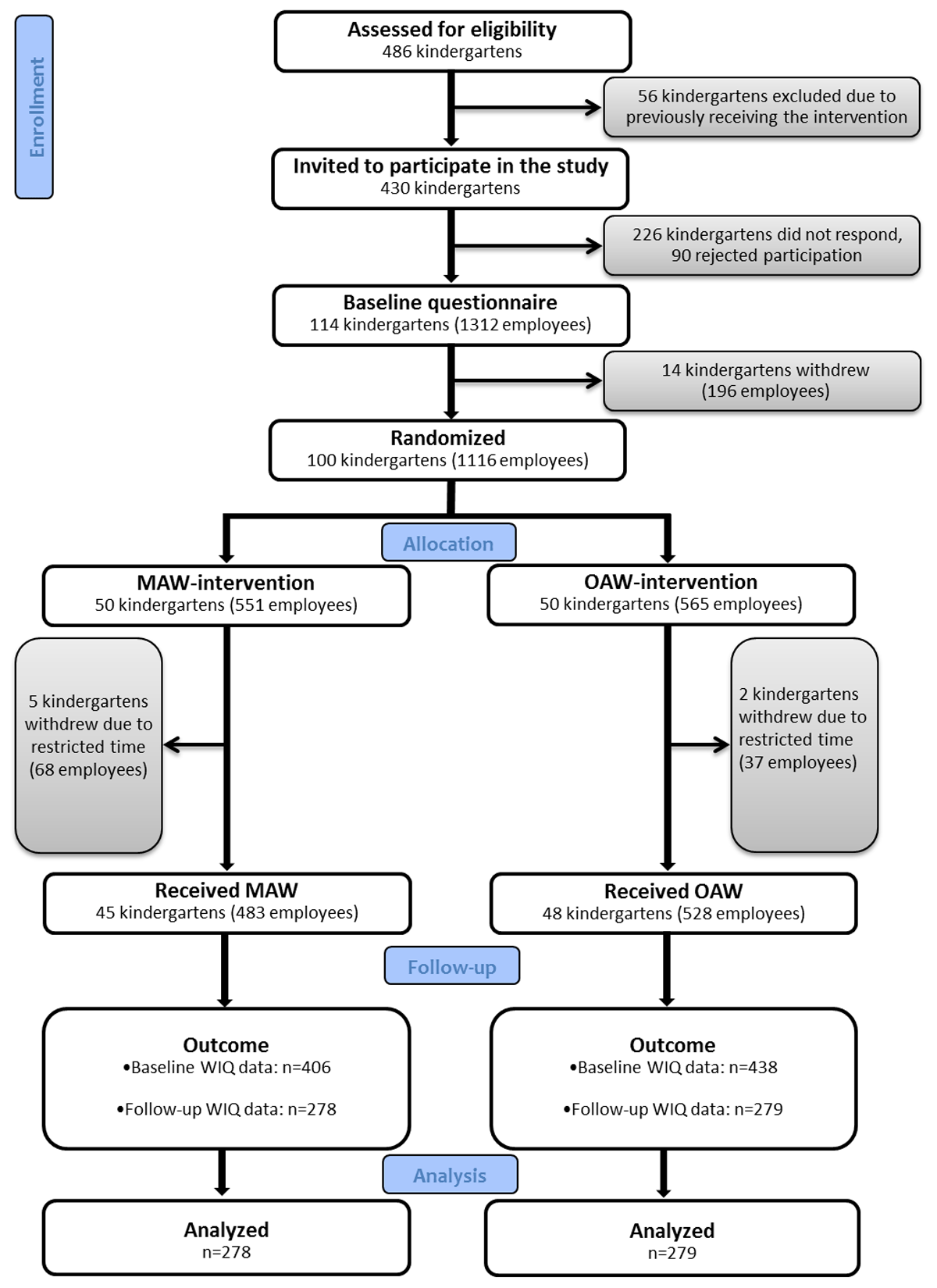
Figure 1
Flowchart of enrollment, allocation, follow-up, and data analysis, modified from the CONSORT 2010 Statement.
Baseline questionnaires were distributed to all employees at enrolment, using electronic survey software (Qualtrics®), and 893 out of the 1011 individual employees (88% response rate) answered the questionnaire (Johnsen et al., 2018). The data related to this article were from the Workplace Inclusion Questionnaire (WIQ) (Sveinsdottir et al., 2021). When answering the baseline questionnaire, respondents were randomly allocated to five out of eleven case stories from the WIQ. At baseline, more than 99% of the respondents answered the questions they were randomized to (n = 844). At follow-up, respondents were asked to answer the same cases as they were allocated to at baseline and the response rate was between 55.3 and 67.4% (see Table 1).
Table 1
Number of participants randomized to cases at baseline and response rates for baseline and follow-up questionnaires.
| BASELINE | FOLLOW-UP | |||
|---|---|---|---|---|
| RANDOMIZED (N) | RESPONSE RATE (%) | ANSWERED (N) | RESPONSE RATE (%) | |
| Somatization disorder | 372 | 100 | 223 | 60.0 |
| Schizophrenia | 378 | 99.7 | 229 | 60.7 |
| Depression | 420 | 100 | 267 | 64.8 |
| ADHD | 362 | 100 | 230 | 64.8 |
| Spine fracture | 378 | 100 | 221 | 58.5 |
| Chronic back pain | 389 | 100 | 259 | 66.6 |
| Unhealthy lifestyle | 381 | 99.7 | 234 | 61.6 |
| Previous drug addiction | 374 | 99.7 | 244 | 65.4 |
| Minority background | 380 | 99.5 | 230 | 60.8 |
| Single mother | 403 | 100 | 233 | 55.3 |
| Older worker | 373 | 99.5 | 250 | 67.4 |
Mean age of the respondents was 40.8 years (SD = 10.6), 93% were female, and 51.2% had higher education. At follow-up, women had significantly higher response rate compared to men, and the respondents were older and had higher education compared to the non-responders. There were no differences in gender, age, or education for respondents lost to follow-up between the OAW and MAW groups.
Interventions
The interventions were conducted between January 2015 and August 2016 (Johnsen et al., 2018). The MAW consisted of one introductory session for managers, health and safety representatives, and local union representatives, one workplace session targeting mental health complaints, one workplace session targeting musculoskeletal complaints, and one reflection and review session for managers and workplace representatives. The OAW consisted of three workplace sessions targeting musculoskeletal complaints, and peer support. Peer support involved selecting a peer adviser in each kindergarten, a fellow worker who participated in two sessions with more in-depth knowledge about musculoskeletal complaints. For a more detailed description of the interventions, see the study protocol (Johnsen et al., 2016). The workplace sessions were for all employees at the workplace, including managers and workplace representatives, and conducted at group level.
The development of the atWork intervention is based on years of clinical experience and research on interventions for patients with low back pain (Indahl et al., 1998; Indahl et al., 1995), indicating that the information given to patients in a clinical setting might be beneficial to give at a much earlier stage in the course of the complaints. Three research projects, one quasi-experimental study (Werner et al., 2007) and two randomized controlled trials (Frederiksen et al., 2017; Odeen et al., 2013), have shown a reduction in sick leave and a decrease in faulty beliefs about back pain (e.g., that lifting is usually the cause of back pain (Deyo, 1998)) when providing information about musculoskeletal complaints at the workplace (OAW). By modifying the atWork intervention to also comprise mental health complaints (MAW), the goal was to further decrease sick leave and increase the effect on other health-related outcomes. The comorbidity between musculoskeletal and mental health complaints is well recognized and a simultaneous approach may be beneficial (Goetzel & Ozminkowski, 2008; Reme et al., 2011; Scott et al., 2009). Based on participants’ feedback, stating that three sessions on the same topic were too much repetition, the sessions targeting musculoskeletal complaints were reduced to one in the MAW. Furthermore, the peer support sessions were replaced with sessions for managers and workplace representatives due to feedback about role interference (Johnsen et al., 2018).
Outcome
Workplace inclusion, that is, how well individuals with different health problems and/or limitations were perceived to fit into the respondent’s work group, was measured by the Workplace Inclusion Questionnaire (WIQ) (Sveinsdottir et al., 2021). The questionnaire consists of short case stories describing individuals with various diagnoses, such as back pain and depression, as well as common social groups that may be discriminated for other reasons. Respondents were asked to indicate how well the various individuals fit into their own work group, encompassing how stereotypes about different people may influence perceptions of how suited they are for the job and the work environment. The persons in the case stories were all described as having the formal qualifications needed for employment.
Six cases described persons having different musculoskeletal, mental, or behavioral disorders. This included a person having chronic back pain (Lisa), a person with a healing spine fracture (Matthew), a person having a mild to moderate depressive episode with symptoms of anxiety (Jennifer), a person having schizophrenia with stable deficit (Michael), a person having Attention-Deficit Hyperactivity Disorder (ADHD) (Ashley), and a person having a somatization disorder (Melissa). Five cases described common social groups who might be stigmatized for other reasons than illness and current health problems. These cases included a person with a previous drug addiction (Christopher), a person having an unhealthy lifestyle (John), a single mother with a young child (Sarah), an older worker with possibility for early retirement (James), and a person with minority background (Abdul).
For each case story, respondents were asked to assess if the described person would fit into their work group. Answers were scored on a 5-point Likert scale ranging from 1 – “very poorly” to 5 – “very well.” If respondents did not think the person in the case story fitted quite or very well into their workplace, they were asked about the main barrier to this. In addition to an open response category (“other”), a list with the following reasons was provided: “need for accommodation,” “economic consequences,” “collaboration/interaction with colleagues,” “ability to provide service,” “increased workload for colleagues,” “work capacity,” or “work ability.” Lastly, respondents were asked if they had previous experience with colleagues or employees like the case story in question.
Sample Size
The sample size estimation was based on a prior atWork trial (Odeen et al., 2013) and the primary outcome in the main study (sick leave at cluster level) (Johnsen et al., 2018). Convenience sampling was used to recruit a minimum of 50 units in each intervention group.
Randomization
The randomization processes to the OAW or the MAW group were concealed and performed at cluster level using a computer-generated randomization list stratified by county and size of the kindergarten (small: <11 employees, large: ≥11). The trial statistician generated the random allocation sequence, and the research technician at the randomizing unit (Uni Research Health) performed the randomization after the baseline questionnaires were completed. There was no blinding to group allocation.
Statistical Methods
Differences in demographic variables between responders and those lost to follow-up, and for dropouts between intervention groups, were tested with Chi-Square tests for gender and education, and independent sample t-test for age. The variables measuring how well the persons in the case stories fit into the work group were dichotomized into 0 – “no fit/neutral” or 1 – “fit.” Relative risks (RR) with 95% confidence intervals (CI) were calculated to investigate differences in workplace inclusion between the various cases at baseline, and for the relationship between previous experience and workplace inclusion. Difference in workplace inclusion between baseline and at one-year follow-up was tested using McNemar tests, within intervention groups. Between intervention group differences were tested using multinomial logistic regression with robust variance estimator, to account for kindergarten clusters. RR with 95% CI was calculated to investigate the relationship between barriers to inclusion at baseline and change in workplace inclusion. Analyses were performed using STATA IC V.14.2 (College Station, Texas, USA) and SPSS version 25.0 (Chicago: SPSS Inc).
Ethics
The research was approved by the appropriate ethics committee (Registration 2014/162/REC South East) and carried out in compliance with the Helsinki declaration (WMA, 2013). Written informed consent was collected from all participants.
Results
Using baseline data, an evaluation of how well the participants perceived the cases to fit into their workplace was performed (see Table 2). The case with the older worker was rated most favorable in workplace inclusion and hence used as the reference case. When compared to the older worker, the person with a somatization disorder and the person with schizophrenia were almost six times as likely to be rated less favorably, and the person with depression and the person with ADHD almost five times as likely to be rated less favorably in workplace inclusion. The person with a spine fracture and the person with chronic back pain had over twice the risk of a less favorable rating compared to the older worker. For the cases without current health problems, the person having an unhealthy lifestyle had over three times the risk, and the person having a previous drug addiction and the person with minority background had 46% and 31% increased risk of receiving a less favorable rating than the older worker, respectively. There was no statistically significant difference in workplace inclusion between the single mother and the older worker.
Table 2
Baseline percentages showing how well each case story fit into respondents’ own work group, and the relative risk of not fitting quite or very well into the work group when compared to the older worker.
| VERY POORLY | QUITE POORLY | NEITHER | QUITE WELL | VERY WELL | RR | 95% CI | ||
|---|---|---|---|---|---|---|---|---|
| N | % | % | % | % | % | |||
| Somatization disorder | 372 | 14.0 | 34.9 | 39.8 | 11.0 | 0.3 | 5.87 | 4.38–7.88 |
| Schizophrenia | 377 | 23.6 | 34.2 | 30.5 | 10.9 | 0.8 | 5.68 | 4.26–7.57 |
| Depression | 420 | 13.1 | 36.9 | 36.7 | 12.4 | 1.0 | 4.97 | 3.86–6.41 |
| ADHD | 362 | 10.8 | 35.6 | 39.2 | 14.4 | 0 | 4.62 | 3.55–6.00 |
| Spine fracture | 378 | 8.7 | 20.9 | 40.2 | 26.2 | 4.0 | 2.20 | 1.86–2.61 |
| Chronic back pain | 389 | 7.2 | 23.9 | 37.0 | 28.3 | 3.6 | 2.08 | 1.77–2.45 |
| Unhealthy lifestyle | 380 | 12.9 | 29.7 | 36.6 | 19.0 | 1.8 | 3.19 | 2.59–3.93 |
| Previous drug addiction | 373 | 9.9 | 12.6 | 32.2 | 40.5 | 4.8 | 1.46 | 1.28–1.67 |
| Minority background | 378 | 4.0 | 10.3 | 35.2 | 44.2 | 6.3 | 1.31 | 1.16–1.48 |
| Single mother | 403 | 2.2 | 8.9 | 29.5 | 49.5 | 9.9 | 1.12 | 1.00–1.25 |
| Older worker | 371 | 1.6 | 7.0 | 25.1 | 50.1 | 16.2 | 1 |
To explore if there was a difference in the likelihood of workplace inclusion between participants with and without previous experience with colleagues or employees like the case story in question at baseline, the participants were divided into two categories: 1) the number of participants with experience who rated the persons in the different case stories to fit into their work group and 2) the number of participants without previous experience who rated the person to fit in (see Table 3). The probability of rating the cases to fit into the work group when having previous experience with colleagues or employees like the case story in question versus no such experience was then calculated. For five of the case stories, there was a relationship between previous experience and workplace inclusion (see Table 3). For the cases describing persons with current health problems, respondents who had previous experience with colleagues’ resembling the case describing a person with ADHD were more likely to include this person into their own work group than those without previous experience. For the cases describing persons without current health problems, respondents who had previous experience with colleagues’ resembling the cases describing a person with an unhealthy lifestyle, a previous drug addict, a person with minority background, and a single mother were more likely to include these persons into their own work group than those without previous experience. No difference was found for the cases describing persons with somatization disorder, schizophrenia, depression, spine fracture, or chronic back pain, or for the older worker.
Table 3
Percent of employees having experience with colleagues or employees resembling the different cases and the relative risk for rating cases to fit into the work group when having previous experience versus no previous experience.
| CASES | PREVIOUS EXPERIENCE | NO PREVIOUS EXPERIENCE | RR | 95% CI | |||||
|---|---|---|---|---|---|---|---|---|---|
| FIT | NO FIT | FIT | NO FIT | ||||||
| TOTAL N | N | % | % | N | % | % | |||
| Somatization disorder | 372 | 226 | 13.3 | 86.7 | 146 | 8.2 | 91.8 | 1.62 | 0.85–3.05 |
| Schizophrenia | 377 | 60 | 15.0 | 85.0 | 317 | 11.0 | 89.0 | 1.36 | 0.69–2.68 |
| Depression | 420 | 228 | 15.4 | 84.6 | 192 | 10.9 | 89.1 | 1.40 | 0.85–2.33 |
| ADHD | 362 | 210 | 18.6 | 81.4 | 152 | 8.6 | 91.4 | 2.17 | 1.20–3.93 |
| Spine fracture | 378 | 141 | 31.9 | 68.1 | 237 | 29.1 | 70.9 | 1.10 | 0.80–1.50 |
| Chronic back pain | 389 | 301 | 32.2 | 67.8 | 88 | 30.7 | 69.3 | 1.05 | 0.74–1.50 |
| Unhealthy lifestyle | 380 | 159 | 28.9 | 71.1 | 221 | 14.9 | 85.1 | 1.94 | 1.30–2.88 |
| Previous drug addiction | 372 | 84 | 56.0 | 44.0 | 288 | 42.4 | 57.6 | 1.32 | 1.05–1.67 |
| Minority background | 377 | 234 | 57.3 | 42.7 | 143 | 39.9 | 60.1 | 1.44 | 1.14–1.81 |
| Single mother | 403 | 349 | 61.9 | 38.1 | 54 | 42.6 | 57.4 | 1.45 | 1.05–2.00 |
| Older worker | 370 | 187 | 71.1 | 28.9 | 183 | 61.7 | 38.3 | 1.15 | 1.00–1.33 |
[i] P-value < 0.05 when numbers are in bold.
Changes in Workplace Inclusion
After the intervention, the MAW group was more positive to include the older worker, the previous drug addict, and the person with minority background in their own work environment (see Table 4). No differences were found for any of the cases describing persons with current health problems or for the single mother and the person having an unhealthy lifestyle. In the OAW group, participants were more positive to include the person with a spine fracture and the person with ADHD after the intervention. No differences were found for cases describing persons without health problems, or for the cases describing persons with somatization disorder, schizophrenia, depression, or chronic back pain. There was no difference in change over time between intervention groups, for any of the case stories.
Table 4
Percentage of participants rating the person in the different case stories to fit into their work group at baseline and one year after, and test for change between baseline and follow-up in MAW1 and OAW2. Percent within intervention group change. Test for difference in change between the intervention groups.
| MODIFIED ATWORK INTERVENTION (MAW) | ORIGINAL ATWORK INTERVENTION (OAW) | BETWEEN GROUPS | |||||||||||||
|---|---|---|---|---|---|---|---|---|---|---|---|---|---|---|---|
| TOTAL | BASELINE | 1 YEAR | CHANGE | BASELINE | 1 YEAR | CHANGE | |||||||||
| FIT | FIT | NEGATIVE | SAME | POSITIVE | TOTAL | FIT | FIT | NEGATIVE | SAME | POSITIVE | |||||
| n | % | % | p-VALUE | % | % | % | n | % | % | p-VALUE | % | % | % | p-VALUE | |
| Cases | |||||||||||||||
| Somatization disorder | 113 | 16.8 | 22.1 | 0.286 | 7.1 | 80.5 | 12.4 | 110 | 8.2 | 15.5 | 0.115 | 5.5 | 81.8 | 12.7 | 0.888 |
| Schizophrenia | 109 | 12.8 | 12.8 | 1.000 | 6.4 | 87.2 | 6.4 | 120 | 10.0 | 6.7 | 0.455 | 8.3 | 86.7 | 5.0 | 0.804 |
| Depression | 138 | 16.7 | 16.7 | 1.000 | 12.3 | 75.4 | 12.3 | 129 | 7.8 | 14.0 | 0.134 | 5.4 | 82.9 | 11.6 | 0.151 |
| ADHD | 116 | 18.1 | 27.6 | 0.099 | 11.2 | 68.1 | 20.7 | 113 | 9.7 | 26.5 | 0.001 | 6.2 | 70.8 | 23.0 | 0.269 |
| Spine fracture | 111 | 32.4 | 43.2 | 0.111 | 16.2 | 56.8 | 27.0 | 109 | 27.5 | 44.0 | 0.008 | 11.0 | 61.5 | 27.5 | 0.584 |
| Chronic back pain | 121 | 32.2 | 42.1 | 0.104 | 14.0 | 62.0 | 24.0 | 137 | 32.8 | 33.6 | 1.000 | 14.6 | 70.1 | 15.3 | 0.242 |
| Unhealthy lifestyle | 109 | 26.6 | 28.4 | 0.851 | 11.9 | 74.3 | 13.8 | 124 | 17.7 | 18.5 | 1.000 | 8.9 | 81.5 | 9.7 | 0.504 |
| Previous drug addiction | 125 | 44.8 | 56.0 | 0.039 | 10.4 | 68.0 | 21.6 | 117 | 52.1 | 52.1 | 1.000 | 17.9 | 64.1 | 17.9 | 0.213 |
| Minority background | 119 | 50.4 | 63.9 | 0.017 | 10.1 | 66.4 | 23.5 | 110 | 54.5 | 55.5 | 1.000 | 12.7 | 73.6 | 13.6 | 0.149 |
| Single mother | 106 | 67.9 | 64.2 | 0.557 | 14.2 | 75.5 | 10.4 | 127 | 62.2 | 64.6 | 0.736 | 12.6 | 72.4 | 15.0 | 0.564 |
| Older worker | 128 | 64.8 | 77.3 | 0.011 | 7.8 | 71.9 | 20.3 | 121 | 68.6 | 77.7 | 0.080 | 9.1 | 72.7 | 18.2 | 0.852 |
[i] 1 Modified atWork intervention, 2 Original atWork intervention.
P-value < 0.05 when numbers are in bold.
Barriers for Inclusion
When investigating if reported barriers at baseline were related to positive change in workplace inclusion, there were no systematic findings across cases, but for five of the cases, there were statistically significant results. For the case describing the person with a somatization disorder, respondents reporting work ability as the main barrier at baseline had two and a half times the likelihood of positive change (see Table 5). For the case describing the person having a spine fracture, respondents reporting ability to provide service as the main barrier at baseline had two times the likelihood of positive change. For the cases without current health problems, the investigated barriers were of significance for three cases. For the cases with the previous drug addict and the single mother, respondents reporting economic consequences as the main barrier at baseline had two times the likelihood of positive change. For the case with the older worker, respondents reporting ability to provide service as the main barrier at baseline had 70% increased likelihood of positive change. Barriers related to accommodation, collaboration, workload, and work capacity did not affect the likelihood of inclusion for any cases.
Table 5
Barriers for workplace inclusion reported for each case story at baseline and the relative risk for positive change if barrier was reported.
| n | NEED FOR ACCOMMODATION | ECONOMIC CONSEQUENCES | COLLABORATION WITH COLLEAGUES | WORK ABILITY | INCREASED WORKLOAD FOR COLLEAGUES | ABILITY TO PROVIDE SERVICE | WORK CAPACITY | OTHER | |||||||||
|---|---|---|---|---|---|---|---|---|---|---|---|---|---|---|---|---|---|
| % | RR (95% CI) | % | RR (95% CI) | % | RR (95% CI) | % | RR (95% CI) | % | RR (95% CI) | % | RR (95% CI) | % | RR (95% CI) | % | RR (95% CI) | ||
| Somatization disorder | 195 | 3.6 | 1.00 (0.16–6.31) | 8.7 | 0.39 (0.06–2.68) | 6.2 | 0.57 (0.08–3.81) | 15.9 | 2.51 (1.25–5.02) | 34.4 | 0.64 (0.29–1.42) | 1.5 | – | 25.1 | 1.19 (0.56–2.53) | 4.6 | 0.77 (0.12–5.02) |
| Schizophrenia | 203 | 6.9 | – | 3.0 | 2.74 (0.42–17.78) | 16.7 | 1.49 (0.43–5.14) | 26.1 | 1.77 (0.61–5.17) | 11.3 | 0.65 (0.09–4.79) | 8.4 | – | 4.4 | 1.80 (0.26–12.34) | 23.2 | 0.60 (0.14–2.63) |
| Depression | 234 | 2.1 | 1.48 (0.25–8.79) | 3.4 | 0.91 (0.14–5.87) | 29.5 | 1.64 (0.86–3.13) | 15.4 | 0.79 (0.29–2.11) | 12.0 | 0.49 (0.12–1.94) | 10.3 | 1.62 (0.69–3.81) | 15.8 | 0.76 (0.28–2.04) | 11.5 | 0.51 (0.13–2.02) |
| ADHD | 197 | 3.0 | 2.03 (0.88–4.70) | 0.0 | – | 54.3 | 0.91 (0.57–1.48) | 9.1 | 1.36 (0.67–2.74) | 17.3 | 1.20 (0.67–2.15) | 2.0 | – | 5.6 | 0.71 (0.20–2.53) | 8.6 | 0.68 (0.24–1.94) |
| Spine fracture | 154 | 14.9 | 0.88 (0.48–1.59) | 7.1 | 0.45 (0.13–1.60) | 1.3 | – | 15.6 | 0.83 (0.45–1.52) | 17.5 | 1.30 (0.83–2.05) | 2.6 | 1.97 (1.08–3.60) | 32.5 | 0.96 (0.63–1.48) | 13.0 | 0.99 (0.48–2.02) |
| Chronic back pain | 173 | 10.4 | 1.20 (0.60–2.42) | 5.8 | 0.69 (0.20–2.45) | 0.6 | – | 17.9 | 1.18 (0.66–2.09) | 33.5 | 1.05 (0.64–1.73) | 2.3 | 0.88 (0.16–4.89) | 21.4 | 0.61 (0.30–1.25) | 8.1 | 1.29 (0.61–2.72) |
| Unhealthy lifestyle | 181 | 3.3 | 1.17 (0.19–7.24) | 7.7 | 2.17 (0.87–5.42) | 3.3 | – | 14.9 | 1.04 (0.39–2.77) | 14.4 | 1.42 (0.59–3.43) | 2.8 | 1.41 (0.24–8.44) | 40.9 | 0.90 (0.43–1.88) | 12.7 | 0.28 (0.04–1.93) |
| Previous drug addiction | 123 | 5.7 | – | 4.1 | 2.25 (1.36–3.71) | 10.6 | 0.59 (0.21–1.66) | 22.0 | 0.87 (0.48–1.56) | 10.6 | 1.27 (0.67–2.40) | 6.5 | 0.65 (0.19–2.22) | 11.4 | 1.64 (0.97–2.76) | 29.3 | 1.06 (0.65–1.73) |
| Minority background | 108 | 7.4 | 1.32 (0.63–2.75) | 0.0 | – | 21.3 | 0.87 (0.47–1.61) | 15.7 | 1.46 (0.86–2.47) | 4.6 | 0.50 (0.09–2.95) | 5.6 | 0.42 (0.70–0.52) | 5.6 | 1.31 (0.57–3.02) | 39.8 | 0.93 (0.57–1.52) |
| Single mother | 82 | 2.4 | 1.38 (0.34–5.68) | 11.0 | 2.03 (1.15–3.57) | 1.2 | – | 2.4 | 1.38 (0.35–5.68) | 57.3 | 0.57 (0.32–1.01) | 0.0 | – | 15.9 | 1.06 (0.50–2.26) | 9.8 | 1.03 (0.40–2.64) |
| Older worker | 82 | 4.9 | 0.85 (0.31–2.30) | 2.4 | 0.85 (0.21–3.44) | 11.0 | 0.54 (0.21–1.39) | 19.5 | 1.23 (0.83–1.82) | 4.9 | 1.30 (0.71–2.36) | 1.2 | 1.72 (1.43–2.07) | 39.0 | 0.86 (0.58–1.27) | 17.1 | 1.28 (0.86–1.89) |
[i] P–value < 0.05 when numbers are in bold.
Discussion
The results of this study indicate that knowledge about health complaints at the workplace may change employees’ willingness to include persons with different health or social challenges into their work environment, although there were no significant differences in change in workplace inclusion between the MAW and OAW interventions. In the MAW group, there were positive changes in workplace inclusion for three case stories representing different social groups (the older worker, the previous drug addict, and the person with minority background). In the OAW, there were positive changes in workplace inclusion for two of the case stories representing persons with health problems (the person with a spine fracture and the person with ADHD). Interventions aimed at targeting faulty beliefs about health, illness, and work participation, modifying participants’ expectations, and strengthening their beliefs in a positive outcome, such as the atWork intervention (Johnsen et al., 2018; Odeen et al., 2013), may have a positive impact on employees’ behavior (Corrigan et al., 2012; Corrigan & Watson, 2002). This entails both social behavior and individual behavior. Previous research has confirmed the latter; when experiencing health complaints, positive expectancies about prognosis, future function, and work participation may influence both the interpretation of the health complaint and the individuals’ sickness behavior (Atlas & Wager, 2012; Løvvik, Shaw, et al., 2014; Løvvik, Øverland, et al., 2014; Opsahl et al., 2016; Ree et al., 2014). Changes in social behavior, at least regarding colleagues’ health complaints, are less studied. It is reasonable to assume that changes in beliefs also may influence how we respond to other people’s health complaints (Goffman, 2009; Link & Phelan, 2001). The WIQ measures perceptions of how well a described person fits into one’s own work group. Accordingly, we considered the WIQ to be an appropriate measure to capture intervention effect on employees’ potential social behavior, that is, how they would respond to including a colleague with health or social challenges into their work group, and positive changes were observed.
Between intervention groups, there were no difference in change over time on workplace inclusion for any of the case stories. This was also the case for sick leave and other health-related measures (Johnsen et al., 2018). It may be that the two different models of the atWork intervention were too similar to produce statistically significant differences on these outcome variables. Even so, the intervention groups differed regarding which of the case stories they became more positive to include into their work group after the interventions. This may be explained by differences in focus and dose delivered in the different atWork models.
In the MAW intervention, the importance of work for general health was more explicitly addressed than in the OAW intervention. This focus and awareness may explain the observed positive change in workplace inclusion for common social cases. These were, however, not the cases we expected the intervention to influence, as the MAW focuses on normalizing and debunking common myths about musculoskeletal and mental health complaints. We know that myths and maladaptive beliefs may trigger stigmatizing attitudes, including discrimination, and one strategy to overcome public stigma is education (Corrigan & Watson, 2002). Previous results from this trial showed a reduction in maladaptive beliefs about both musculoskeletal and mental health complaints among participants in the MAW group (Johnsen et al., 2018). Even so, the results from the current study indicate that these changes in beliefs were not sufficient, or even irrelevant, to influence workplace inclusion for cases describing persons with musculoskeletal and mental health complaints in this group.
The OAW intervention targeted back pain and spine conditions and three sessions were used to explain and discuss this topic (versus one session in the MAW group). During these three sessions, participants in the OAW group received more detailed information regarding spine anatomy and specific conditions (e.g., spine fracture) than the MAW group. Consequently, the decrease in faulty beliefs about back pain was larger in the OAW group compared to the MAW group (Johnsen et al., 2018). Results from this study show that the participants in the OAW group became more positive to include the case describing a person with a spine fracture after the intervention, and it is reasonable to assume that this change is a result of the in-depth information given about back pain. Even though there was no difference in change between groups on workplace inclusion for this case, this finding does raise a question about dose response. The reduction from three sessions about back pain in the OAW to one session about back pain in the MAW (Johnsen et al., 2018) may have been too large to produce the same positive effect in the MAW group. As in the MAW group, there was also an observed positive change in workplace inclusion for one case story describing a condition the OAW intervention not specifically targeted (ADHD).
There were no systematic findings showing specific barriers as predictors for change in workplace inclusion, and there were rather few respondents who reported the barriers providing statistically significant results. The practical significance may thus be limited and should be further explored in a study with more participants. The descriptive results providing information about the most frequently reported barriers for each case is however valuable data that may be used to adjust the intervention. For instance, increased workload for colleagues was the most frequently reported barrier for the case describing the person with chronic back pain, work capacity was the most frequently reported barrier for the case describing the person with a spine fracture, and collaboration with colleagues was the most frequently reported barrier for the case with depression. If the atWork intervention more specifically addressed the main barriers for workplace inclusion, and faulty beliefs concerning how much recovery time and adjustments that might be needed in these cases, it may have produced more favorable attitudes concerning workplace inclusion. In a focus group study with some of the participants in the atWork trial, it was emphasized that negative consequences for kindergarten children were a barrier for workplace inclusion (Ree et al., 2018). This finding was however not supported by the questionnaire data on barriers for inclusion in this study and may be explained by social bias, where participants choose the most socially desirable or socially accepted response. Furthermore, the focus group participants expressed a disparity between the ideals and the realities of inclusion practices, where accommodation and adjustments were the ideal, but rarely functioned well in practice in small workplaces like kindergartens (Ree et al., 2018). This may explain why increased workload for colleagues and work capacity was the most frequently reported barrier in six out of the eleven case stories.
At baseline, the older worker and the single mother were rated as most favorable for inclusion at the workplace, while the person with a somatization disorder and the person with schizophrenia were rated least favorable. The case stories describing the person with somatization disorder, the person with schizophrenia, and the person with depression had the highest risk of workplace exclusion. This is similar to what was found in a previous study of kindergarten employees (Sveinsdottir et al., 2021). An important finding in the current study is that there was dispersion in the responses, where over 10% of employees answered that these cases would fit quite or very well into their workplace. To explain why some people were willing to include persons whom the majority do not consider suitable for the job, one hypothesis may be that they had positive previous experiences (Allport, 1954; Pettigrew & Tropp, 2006). This corresponds with the results of this study. For about half of the case stories, respondents who had previous experience with similar cases were more likely to include the person in question. The WIQ does not differentiate between positive and negative experiences, but in light of the contact hypothesis (Allport, 1954; Pettigrew & Tropp, 2006) it is reasonable to assume that the experience these respondents had were positive. However, it was striking that it was mainly experiences with cases describing common social groups and not cases with medical diagnoses that affected workplace inclusion.
It is important to remember that workplace inclusion has multiple facets. Inclusion is not only facilitated by individuals’ own attitudes and behavior but also by norms, practices, and processes that operate at the individuals’ workplace (Ferdman & Deane, 2014). A change in beliefs may thus not be enough to influence inclusion practices. One aspect of stigma, namely performance impact, is found to be particularly important for the acceptance of workers with disabilities (McLaughlin et al., 2004). Performance impact includes believing that the disability would make the person difficult to work with, strongly impair function, cause problems with coworker relations, and put coworkers at risk. As addressed above, experiencing what works in practice may therefore influence which of the cases they were most willing to include. The perceived negative consequences for oneself and the kindergarten children may be too large a barrier to include cases with major or unspecific health problems. We know from previous studies that workplace inclusion of persons with unspecific and chronic health complaints is challenging (Lasalvia et al., 2013; Ree et al., 2018). Generally, the cases with positive changes in workplace inclusion in both groups may be perceived as the cases where the described challenges are specific and easy to accommodate. Furthermore, it is likely that there is a difference in employees’ willingness to include and safeguard current colleagues experiencing health or social challenges and their willingness to include new individuals into their work environment (Bear & Rand, 2016; Otten & Moskowitz, 2000; Van Bavel et al., 2008). The wording of the questions in the WIQ may be interpreted as a question concerning inclusion of a new person into an existing work environment, and it is likely that outgroup bias has influenced the results. If the wording of the questions specifically targeted current employees or colleagues, the results might have been different.
Strengths and Limitations
The main strength of this study was the randomized controlled design. However, the interventions delivered in the trial possessed several interacting components. RCTs of such interventions may be criticized as a “black box” approach to intervention evaluation because RCTs generally only measure outcomes and not implementation fidelity (Harachi et al., 1999). A process evaluation alongside an RCT, measuring the degree to which interventions are implemented as intended, may contribute to explaining why an intervention worked or why it did not work (Dusenbury et al., 2003). A systematic process evaluation was not conducted in this research project due to a lack of resources and time. However, several actions were implemented to maintain fidelity. In each intervention group, there was a detailed protocol for all sessions. The facilitators conducting the intervention had longstanding experience with delivering the atWork intervention. They were thoroughly trained in what information to distribute and how to communicate this information in a nondirective manner. The same facilitators delivered the information in both the MAW and the OAW groups, which means they had the same amount of training. However, objective data on facilitators’ adherence to this protocol was not collected, and as the same facilitators delivered both interventions spill-over effects may be present. Concerning dose, 98% of the kindergartens completed the intervention they were randomized to. In addition, the reach of the intervention was generally good (Johnsen, 2018).
This is the second study measuring workplace inclusion with the WIQ. Both the sample in this study and the sample in the previous study (Sveinsdottir et al., 2021) consisted of kindergarten employees, which limits the ability to generalize the results to other working groups. However, it is to be expected that workplace inclusion may differ for various types of occupations and work environments and interventions such as the atWork intervention may produce different results in other occupational groups. By using a sample representing only one occupational group the variability in the data is limited, but this also limits uncertainty in the conclusion. However, it should be kept in mind that the work context in this study concerns the care for children. This is a vulnerable group and worries regarding safety issues and relatives’ concerns may play a role in kindergarten employees’ willingness to include the different cases.
The trial had a comparative effectiveness design, and as statistical power depends upon effect size, the similarities between the two interventions may have made the trial insufficiently powered to detect differences between groups. The use of convenience sampling restricted the availability of participants. All private kindergartens located in the four counties where the atWork intervention was available were invited to participate in the study, but only 93 kindergartens chose to participate. A similar intervention, based on the atWork intervention, is now available to interested organizations in most parts of Norway. This provides possibilities for further research on workplace inclusion in different occupations and working groups.
Implications
The results from this study showed positive changes for some of the described case stories, indicating that interventions aiming to debunk common myths, reduce fear related to symptoms, and increase positive outcome expectancies concerning health complaints and work ability is a viable path to workplace inclusion. Workplace inclusion is indeed multifactorial, operating at the individual, interpersonal, group, organizational, and societal level, but an increase in willingness from employers and employees to include different individuals into their work group may be a good starting point. From both an individual and a societal perspective, increased willingness to include persons with different health and social characteristic at work may be just as valuable as a reduction in sick leave.
The results in this study indicate that the observed difference in faulty beliefs about back pain between groups, presented in a previously published article from this trial (Johnsen et al., 2018), may have important practical implications and that in-depth knowledge about a health condition may change employees’ response to a colleague’s health problem. It furthermore indicates that repeated information may be of significance for behavioral change. The last workplace session in the OAW was mainly a repetition of the information distributed in the two former workplace sessions. This session accordingly provided more room for questions and interaction with the group. It may be that adding a third session in the MAW, focusing on repetition of the message distributed in the two former sessions would be beneficial.
Even though there were no statistically significant differences in workplace inclusion between the OAW and MAW, there are several good arguments for including information about mental health complaints in the atWork intervention. As mentioned, the comorbidity between musculoskeletal and mental health complaints is high, and one of the identified key factors in effective workplace health promotion programs is to target several health complaints simultaneously (Goetzel & Ozminkowski, 2008; Goetzel et al., 2007). Unfortunately, stigmatizing attitudes towards people experiencing mental health complaints are common and are more prevalent than for other disorders (Brouwers, 2020; OECD, 2012). Negative attitudes at the workplace decrease the chance of both hiring and supporting people experiencing mental health complaints, and that is a societal problem of considerable scope (Brouwers, 2020). Consequently, there is a large political and governmental focus on mental health and illness. For these reasons, recommendation for future intervention implementation is the MAW rather than the OAW. However, there is still a need for more knowledge about intervention effects on workplace exclusion, preferably focusing on long-term follow-up, including repetition of the information over time, more focus on specific barriers for workplace inclusion, or testing effects of other teaching strategies. A sustainable change in workplace inclusion practices is likely to require long-term commitment.
Conclusions
The MAW intervention did not have a different effect on workplace inclusion compared to the OAW intervention. For both intervention groups, there were some positive changes in workplace inclusion after participating in the interventions. In the MAW group, positive changes were observed only for cases describing persons with different social challenges. In the OAW group, positive changes were observed only for cases describing people with current health problems. There were no systematic findings showing specific barriers as predictors for change in workplace inclusion.
Data Accessibility Statement
The data generated and analyzed during the current study is not publicly available due to participants’ lack of consent to distribution of data.
Ethics and Consent
The study was approved by the Regional Committee for Medical and Health Research Ethics for South-Eastern Norway (2014/162/REK sør-øst). The research was carried out in compliance with the Helsinki declaration. All participants gave their informed consent to participate in the study.
Acknowledgements
We want to thank The National Association of Private Kindergartens for recommending the project to its members, and all participating kindergartens and employees for their engagement and their valuable contribution to the study. We also want to thank all members of the research staff, clinicians, and the Norwegian Welfare and Labor Administration for their contribution to this project.
Funding Information
This work was supported by Vestfold Hospital Trust.
Competing Interests
The authors have no competing interests to declare.