
Introduction
Older adults constitute the population aged 60 years and older and the onset of aging leads to physical and mental deteriorating health, ultimately leading to death (WHO 2022). Population aging is a global phenomenon, and life expectancy is increasing due to improvements in medicine, healthy diet, and lifestyle among other factors (Mishra 2016; WHO 2022). The number of persons aged 60 years and older has increased exponentially, and the population is projected to increase further from 901 million in 2015 to 1.4 billion by 2030 and 2.1 billion by 2050 (UN DESA Population Division 2015). Therefore, aging is a crucial but underappreciated development issue that directly affects 12.2% of the world’s population (UNDP 2018). While successful aging including quality physical, mental, and social functioning at old age is an ideal situation advocated by researchers and clinicians (Urtamo et al. 2019; Ojembe & Kalu 2018), there are several medical, mental, emotional, and social issues that older people face which impede their general happiness and well-being, including the lack of social inclusion (Iwuagwu & Kalu, 2021). Yet, little is known about the barriers to social inclusion and participation of older adults with disabilities in low-resource countries, such as Nigeria. Social inclusion means participating in community life and having equal access to opportunities like others, such as involvement in community social, political, and religious activities (Simplican et al. 2015; Overmars-Marx et al. 2014; Cobigo et al. 2012; Bezyak et al. 2017).
At least 46% of persons aged 60 and older have one or more disabilities (UN 2021). Globally, about 15% (1 billion) of the world population have one or more disabilities, the majority of whom live in low-resource countries such as Nigeria (UNDP 2018). Although the precise number of persons with disability in Nigeria is unknown (Martinez & Vemuru 2020), the World Bank (2020) estimated that 29 million Nigerians were living with a disability in 2018. The term “disability” encompasses a variety of impairments, activity restrictions, and participation limitations (WHO 2021). Some of the most typical factors leading to disabilities among older adults are arthritis, cognitive impairment, heart problems, vision and hearing issues, cerebrovascular illness, and hip fractures (Griffiths et al. 2010).
An association between aging and functional decline has been reported (Cadmus et al. 2021; Rahman et al. 2021). As the population ages, the number of older “persons with disabilities” (henceforth referred to as PWDs) will increase. About 5% (10 million) of Nigeria’s population is 60 years or older and by 2050, the number is projected to increase to 25.3 million (Cadmus et al. 2021). According to the 2018 Nigeria Demographic and Health Survey, about 9% of older adults in Nigeria report problems in at least one functional area, including vision, hearing, communication, cognition, movement, or self-care (Martinez & Vemuru 2020). For instance, older adults are more susceptible to physical and cognitive disability as their immunity diminishes (Jaul & Barron 2017). Further, with the increase in life expectancy, more PWDs are expected to grow into old age, thus increasing the number of older persons with a disability. For instance, in South Korea, the average life expectancy of persons with an impairment grew by 8.3 and 9.1 years for females and males respectively between 2004 and 2017 (Bahk et al. 2019). For older people with disabilities eager to participate in mainstream chances for social interaction, the intersection of disability and aging frequently presents barriers and discomfort (Raymond 2019). Mithen et al. (2015) posit that aging comes with mobility and cognitive limitation, and older adults are often socially excluded and isolated.
Globally, people with disabilities face several difficulties, such as institutional, environmental, and attitude barriers that prevent them from fully participating in all facets of life (Bonsang & Klein 2012). Older persons with disabilities are typically among those who suffer the most, and they have to contend with additional age restrictions in society (van Asselt-Goverts et al. 2015). Compared to the general population, PWDs are significantly excluded from several social metrics, including relationships, opportunities, and community involvement (McCausland et al. 2021; Xiao & O’Neil 2021), thus are at risk of poorer well-being and lower quality of life [QOL]. Because impairment in old age is common and significantly impacts the quality of life of older adults, these social barriers are worse for older persons who are more susceptible and at risk (Bonsang & Klein 2012). Both physical and mental impairments raise the risk of hospitalization, the need for residential care, and mortality. In Nigeria, people with disabilities face stigma, marginalization, discrimination, and obstacles to accessing essential social services and employment possibilities in Nigeria (Bello 2020). The availability of accessible hospitals and staff, who are aware of and skilled in disability inclusion and providing services for people with disabilities, frequently restricts access to proper health services for people with disabilities (Faronbi et al. 2019).
Globally and in Nigeria, PWDs across age groups feel lonely, socially isolated, not engaging in formal or informal social networks, lack access to leisure activities, and decreased social participation (Iwuagwu & Kalu 2021; Holt-Lundstad 2017; Bonsang & Klein 2012). However, studies show that older adults with disabilities are more susceptible and have been at a higher risk of these challenges (Jaiswal et al. 2020; Mick et al. 2018). Historically, in ancient Greek and African societies, disability has been perceived differently. For example, disability was seen as a punishment from the gods for an act of wrong-doing, and persons with disability are seen as objects of fun and mockery (court jesters), or people to be pitied (Munyi 2012). Worse still, older adults with disabilities are historically socially isolated and excluded, as they are perceived as witches or wizards, or people portending bad omens (Bello 2020).
While aging and disability intersect, scholars have argued that those who age with disability do not follow effective aging norms, which implies a lack of illness and disability (Minkler & Fadem 2002; Rowe & Kahn 1997). Promoting and safeguarding older people’s rights and dignity, and promoting their full involvement in society, is a key component of the Sustainable Development Agenda 2030, which promises to be inclusive across age and disability grouping (UNDP 2018). Nigeria is a signatory to international acts aimed at promoting the well-being of people living with disabilities—including older adults through inclusive practice. For instance, in 2010 Nigeria ratified the 2006 Convention of the Rights of Persons with Disability, and as of January 23, 2019, adopted the Discrimination against Persons with Disabilities (Prohibition) Act 2018 which stipulates that all public buildings must be accessible to people with disabilities and outlaws all types of discrimination based on disability (Federal Republic of Nigeria 2020). To date, not much has been done in terms of implementing the basic provision of these laws. Therefore, to create an intervention that is effective in promoting the inclusion of older individuals with impairments, it is necessary to have a complete awareness of potential obstacles as well as their respective influences on social inclusion (Jaiswal et al. 2020).
Globally, studies on the relationship between aging and disability have primarily centered on issues like visual impairment (Cimarolli et al. 2017; Laliberté Rudman et al. 2016), hearing impairment (Kurková 2016), complex communication needs (Balandin 2011), and mental disorder (Van Schijndel-Speet et al. 2014). Other research (Anaby et al. 2009; Tang 2009) have concentrated on how specific cognitive, sensory, and physical impairments affect older person’s social inclusion and how those findings could steer suitable interventions by rehabilitation specialists at the micro level. Yet it is difficult to find more in-depth research findings on whether and how older individuals with a disability are socially included or excluded, particularly in the Nigerian context. Nigerian social researchers on aging have mostly focused on loneliness (Ojembe & Kalu 2018), caregiving (Faronbi et al. 2019), social support (Ebimgbo et al. 2021), and gendered exclusion (Iwuagwu et al. 2022). A few studies on functional limitations and dependence on caregivers have also been reported (Lasisi & Gureje 2013; Abdulraheem et al. 2011). Currently, no Nigerian study has tried to investigate the barriers to social inclusion of older adults with disabilities while exploring their lived experiences. Hence, our study aimed to explore the barriers to social inclusion among older adults with disabilities in Imo State, Nigeria to influence policies and practices targeting older adults.
Methods
Our research adopted the Heideggerian hermeneutic phenomenology research design due to its applicability for examining people’s lived experiences of a phenomenon (Van 1990). Hermeneutic phenomenology is concerned with examining and explaining individuals’ experiences from their viewpoints and interpretations (Van 1990). Using the participants’ viewpoints and interpretations, hermeneutic phenomenology aims to investigate and explain the participants’ lived experiences (Van 1990). Due to its applicability in defining and analyzing a phenomenon—in this case, the barriers to social inclusion among older persons with disabilities in Imo state, we chose to follow this research tradition as a suitable design for our study. Other scholars have also explored the lived experience of older adults on a phenomenon using hermeneutic phenomenological inquiry (Liu et al. 2020; Toivonen et al. 2018; Jang & Yi 2017).
We utilized semi-structured one-to-one interviews to collect data from older adults with disabilities. This was done to make sure that a rich source of data would be obtained for analysis following the interviews, as is the tenet of phenomenological interviews. The Research Ethics Review Board of the authors’ institution granted us ethical clearance having followed the established guidelines. Only participants who gave their consent were interviewed and enlisted in the study.
Study setting, sampling, and recruitment
We conducted this study in Imo state, Nigeria which is one of the five Southeastern States in Nigeria and predominantly occupied by Igbo ethnic groups. The population of Imo state, Nigeria is estimated at 6,347,078 (Igwenagu 2021). The population of PWDs in Imo state and the number of disability clusters (otherwise called disability groups) is unknown, however, the most commonly identified disability clusters are physical (spinal cord injury), auditory, visual, and albinism. A study by Anazonwu and colleagues (2023) shows different numbers of disability clusters across States in Southeast Nigeria (Anambra=4, Abia=7, Ebonyi=5, Enugu=5), however, the specific number of disability clusters in Imo state is uncertain, often classified as four or five clusters. In the selection process, we utilized non-probability sampling methods such as snowball and criterion purposive sampling to recruit participants, while applying gender and disability cluster sensitivity in the selection to ensure a balanced view across gender and disability. Participants were recruited through the help of gatekeepers that include the Joint National Association of Persons with Disability [JONAPWD] chairperson and the chairpersons of each disability cluster. For instance, we requested the gatekeepers to reach out to the older adults with disabilities about the study using a participant information sheet detailing the research objectives and participants’ right to participate or not. The gatekeepers provided the researchers with a directory of those who were willing to hear from the researchers directly before deciding whether to take part in the study or not. The researchers contacted the participants and directly sought consent for participation.
Following the tenets of criteria-based purposive sampling in selecting participants, we included only those who meet the following criteria (1) aged 60 years or older, (2) able to give consent and communicate in either English or Igbo, (3) self-identify as a person with a disability and, (4) reside in Imo state, Nigeria at the time of the study. Participants were asked to recommend others who met our inclusion criteria. The researchers stopped sampling when narratives became repetitive and no new information emerged. Experts have suggested that sampling in qualitative studies that use phenomenology design is based on the concept of data saturation—a situation where no new information emerges during interviewing (Mapp 2008). The researchers, therefore, stopped collecting data when they reached data saturation at 19 interviews (see Table 1). This sample size was considered adequate as a smaller sample size is required in phenomenological research to guarantee an in-depth exploration of participants’ experiences (Carpenter 1999).
Table 1
Socio-demographic of study participants.
| S/N | PARTICIPANTS | AGE (YEARS) | GENDER | HIGHEST LEVEL OF EDUCATION* | DISABILITY TYPE** | PROFESSIONAL STATUS |
|---|---|---|---|---|---|---|
| 1 | Mr Pr | 65 | Male | NFE | VI | Self-employed |
| 2 | Mr Ad | 70 | Male | NFE | VI | Self-employed |
| 3 | Mr Od | 77 | Male | WASSCE | PD | Retiree |
| 4 | Mrs. GI | 74 | Female | WASSCE | AI | Retiree |
| 5 | Mr. On | 64 | Male | BSC | AB | Technician |
| 6 | Mrs. Ay | 68 | Female | BSC | AI | Self-employed |
| 7 | Mrs Nk | 71 | Female | FSLC | AI | Self-employed |
| 8 | Mrs Oz | 66 | Female | FSLC | VI | Self-employed |
| 9 | Mrs Ow | 70 | Female | FSLC | PD | Self-employed |
| 10 | Mrs Ok | 65 | Female | BSC | AI | Self-employed |
| 11 | Chief Er | 61 | Male | WASSCE | AB | Technician |
| 12 | Mrs Fi | 62 | Female | WASSCE | PD | Self-employed |
| 13 | Mr Ag | 74 | Male | MSC | VI | Retiree |
| 14 | Mrs Ug | 60 | Female | MSC | PD | Civil-servant |
| 15 | Mrs Be | 71 | Female | WASSCE | AB | Self-employed |
| 16 | Mr Om | 75 | Male | FSLC | VI | Self-employed |
| 17 | Mrs Br | 68 | Female | BSC | PD | Retiree |
| 18 | Mr Wh | 76 | Male | FSLC | VI | Self-employed |
| 19 | Mr Ch | 65 | Male | BSC | AB | Retiree |
[i] * NFE = No formal Education, FSLC = First School Leaving Certificate [certificate issued after completing 6 years of primary education], WASSCE = West African Senior Secondary Certificate Examination [certificate issued after completing 6 years of secondary school], M.Sc = Masters degree, B.Sc = Bachelor of Science degree. **PD = Physical disability, VI = Visual impairment (VI), Albinism (AB), Auditory Impairment (AI).
Data collection
Data was collected between July–September 2021, from four identified clusters of disability (Physical Disability (PD), Visual Impairment (VI), Albinism (AB), and Auditory Impairment (AI) in Imo state. Two researchers (AI, NC) conducted the interviews. The researchers invited each participant to an in-depth semi-structured one-on-one interview. The interview guide contained some probing questions to elicit information from the older adults. For instance: (a) Do you feel included in mainstream society?; (b) What specific factors act as barriers to your social inclusion?; (c) What are your personal experiences of social exclusion? These helped the researchers to get the responses of participants explaining what their lived experiences as an older adult with a disability meant with some specific scenarios to back up any important arguments or claims made. Other ethical considerations, such as confidentiality, anonymity, and the option to withdraw from the study at any time, were also explained to the participants. All the participants opted to be interviewed in the English language. The interviews began with an informal discussion to help the participants feel more relaxed. The researchers obtained participants’ consent to have their opinions recorded. This conforms to phenomenological interview methods where all interviews are tape-recorded to ensure nuances of description are not missed by handwriting notes of the interview (Mapp 2008). Before conducting the study, the researchers did a pilot interview with two older persons with disabilities to assess the suitability of the questions to ask and the appropriate length of time to allot for each interview (piloted data was not included in this study). Each interview took between 40 and 50 minutes.
Data analysis
Data analysis was done simultaneously with data collection, allowing us to achieve data saturation (Saunders et al. 2018). All authors did a verbatim transcription of the interviews. The data were analyzed thematically in accordance with hermeneutic phenomenological research’s reflection, immersion, and classification tenets (Fuster 2019). The transcripts were distributed to all the researchers, and manual coding was done by immersing oneself in the text and looking for common themes. The authors reflected on the respondents’ narratives by repeatedly reading both the individual transcripts and the entire interview as a single text as well as bringing our own experiences and knowledge into the interpretation according to Heideggerian hermeneutic phenomenology (Mapp 2008). We defined the units of analysis as sentences on barriers to social inclusion among older adults with disabilities. Three coders read the transcripts severally, and the emergent ideas from each author’s list were organized to form initial codes. A working draft coding book was developed, and different units of analysis were identified and applied as the authors continued data collection and analysis. Although the coders had a working draft coding book, they continued to code line by line so that the original views of the respondents would not be lost (Braun & Clarke 2006). To ensure consistency, all the coders switched notes and had a meeting where the central themes and disagreements identified were discussed and resolved alongside other members of the research team. For data analysis and reporting, pseudonyms (fake names) were used to keep participants anonymous. All data management for this research analysis was done using the NVivo software.
Findings
From the accounts of the respondents’ real-life experiences, three main themes emerged. The key themes highlight the personal, social, and structural barriers, and how they affect the inclusion of older adults living with disabilities. The three major themes and sub-themes emerged and are discussed in the findings of the study (See Table 2 for themes and sub-themes).
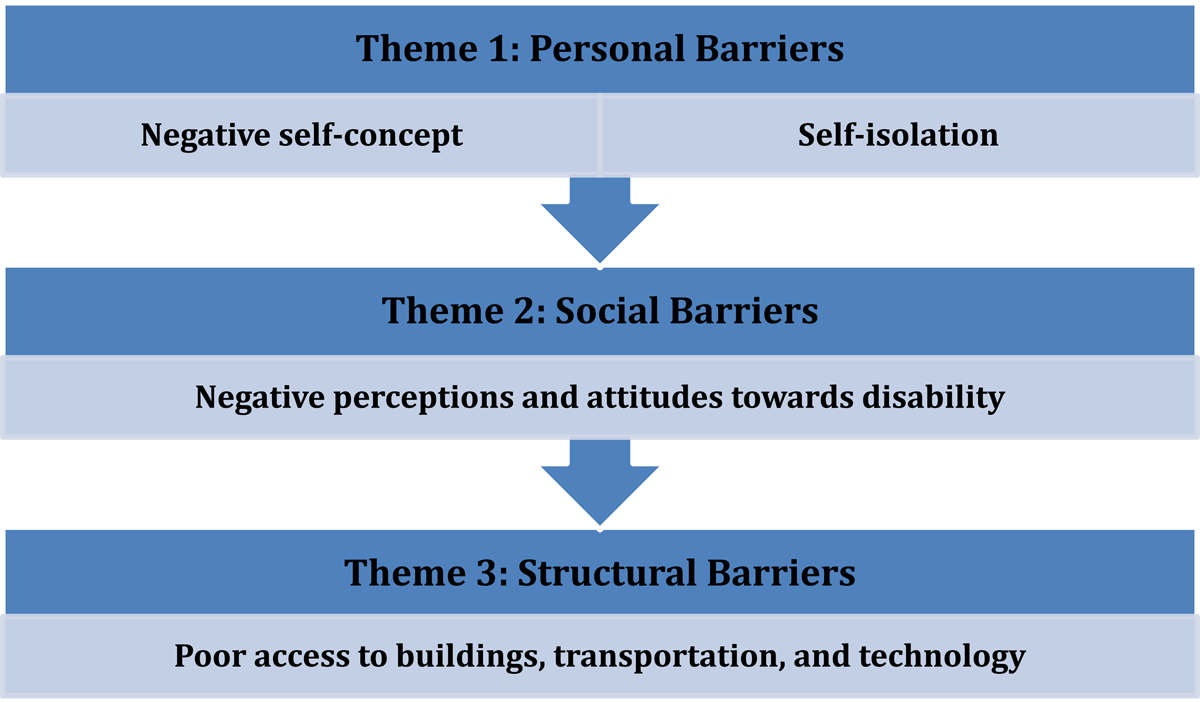
Table 2
Themes and Subthemes.
Theme1: Personal barriers
Our study findings show that from participants’ lived experiences, some personal factors serve as barriers to the social inclusion of older adults with disabilities. Participants hold the view that their negative personal self-concept as older adults with disability is a factor limiting their full participation in social life and in turn, this negative self-concept has led to increased self-isolation for them. Most of the participants also stated that the onset of aging is depressing and the lack of acceptance of the disability that follows has heightened their exclusion from social activities.
Negative self-concept
We found that our participants had a negative self-concept toward their aging and accompanying disability and this has served as a barrier to their inclusion in community life. While most of the participants view themselves as unfit to contribute meaningfully to their society because of their disability and aging, they would rather stay away and give room for other vibrant younger persons to make a change. We also found that participants view themselves as a burden to their families and societies. The following quotes represent our participants’ expression on negative self-concepts:
…what does an old person have to contribute? Worse still, what does an old person with a chronic illness or a disability has to offer? Being old and with a disability is like going closer to your grave and nothing else matters but to make peace with your creator and prepare for death rather than seeking to be included in social affairs. … although, at this stage, I may find some relief in talking with people sometimes, still, I feel like I am offering almost nothing to them and taking away their precious time (Mr. Od, 67 years old, PD).
I feel for my children taking care of me …. I know I have become a burden to them, especially with my disability … sometimes when they want to come around, I decline because they would be leaving many things behind to travel to the village to be with me for the weekend and all I offer them is irrelevant discussions. This is the same way I feel when they call for a community meeting; I feel I will end up becoming a burden to younger persons who would assist me to the venue and back. Also, I have not been contributing meaningfully in such meetings I attend in the past as my concern and thoughts are always on my health issues and death possibly … (Mrs. Oz, 66 years old, VI).
Some of the participants also perceived themselves as dying and as such, they find no joy in social participation and would rather use that time to prepare for their death. One of the respondents noted thus: ‘Yes … younger persons are more vibrant and articulated than people like me who are old and sick, we should therefore not compete space with them …. We should be more concerned about our health and making peace in preparation for what may come- death’ (Mrs. Gl, 74 years old, AI).
Self-isolation
Our study result shows that some of the participants have low self-concepts of themselves. They, therefore, self-isolate themselves from society or communal life. This has also constituted a barrier to their social inclusion. Some of the participants believed that it is shameful and depressing to grow from a vibrant young person to an old weak and vulnerable person and to cover such shame, it is better to stay away from the public eye. Other respondents were of the view that they self-isolate to have a better relationship with their maker whom they are preparing to meet. Clearly stating their lived experience of self-isolation, two of the respondents said thus;
When I was younger, I was practically everywhere, I was vibrant and could easily challenge opinions and decisions. I was equally employed and financially stable. People respected and feared to challenge my opinion because I could easily influence things with my vibrant nature and economic strength. … Times have changed, I am now old and blind and such respect I used to command has diminished. I, therefore, find no joy in attending such social gatherings or community meetings because I can no longer influence things as I used to. I would rather remain in my own space than expose myself to little children to insult or mock me. … indeed, I made lots of enemies and I cannot expose my vulnerability to them in the open hence I don’t participate whatsoever (Mr. Ag, 74 years old, VI).
I spend most of my time at home and in the church. I don’t need social gatherings- political or otherwise because I am more concerned with life hereafter. I need to make up with my Chi (God) and seek forgiveness for my transgressions while younger. What I need most at this stage in my life is family love and the love of God, nothing else. … Ermm … even as a young person born with albinism in Nigeria, inclusion is hardly practical and I have been made to self-isolate over time given many factors. So, discussing inclusion with me as an old person with a severe disability is like fixing square pegs in round holes … (Mrs. Be, 71 years old, AB).
Again, respondents continued to ask questions for clarity which established the fact that they have a negative self-concept due to their age and disability and that they were self-isolated. These actions in turn serve as a personal barrier to the social inclusion of older persons with disabilities.
Theme 2: Social barriers
Also, some participants affirmed that there are varied social barriers that impeded older adults from full participation in social and community life. According to them, the perceptions of society towards disability and the resultant attitude towards older adults with a disability are negative and non-inclusive. These negative and non-inclusive attitudes and perceptions community members hold about disability include: they are incapable, they are frail, and cannot contribute positively to the growth of the community. Hence, society continues to exclude older adults especially one with disabilities on many social fronts.
Negative perceptions and attitudes towards disability
We noted that society holds negative perceptions of disability and this, in turn, influences their behavior towards and acceptability of persons with disability. Our participants feel excluded and marginalized by society given the misconceptions that an older adult with a disability is a charity case that should be pitied and may be provided for rather than included. The views of the respondents on societal perceptions and attitudes towards older adults with disability as expressed are illustrated with the following quotes:
They treat us like a charity case, they feel we are not capable to perform or contribute meaningfully, they feel we are a nuisance … they, therefore, are no reason to get us involved. We get no assistance to attend public gatherings such as political manifesto gatherings and even traditional ceremonies … and we are also not even invited to start with. During my younger days and before disability set in, I used to get more invitations to social and political events compared to now (Mrs. Oz, 66 years old, VI).
Our people believe that an invitation to an older adult with a disability is a waste of time at worse and a formality at best … they conclude that an older person with a disability will not serve any purpose in their gathering. For instance, people may believe that such older adults with a disability are socially irrelevant and impoverished and would constitute a nuisance in public gatherings as they cannot function unaided (Mr. Wh, 76 years old, VI).
People in my community find it difficult to communicate with me because of my disability and as we know, only very few people understand sign language in this locality. People feel there is no need to involve me in events because I have a hearing challenge …. I perceive that they feel if I cannot hear and understand what they are saying and communicate as well in a language they understand, the aim of inviting me to such gatherings or including me in events is defeated. Oral communication has become the bane to social inclusion in our society and that is indeed sad (Mrs. Ay, 68 years old, AI).
Other respondents continued to cite examples of social exclusion among them in their locality due to how people perceive them and consequently treat them. Findings show that respondents with visual impairment and those with auditory impairment were excluded more frequently due to societal perceptions of them.
Theme 3: Structural barriers
We also found that older adults with disabilities cannot access buildings, public transportation services, technologies, or assistive devices and this has further disadvantaged them from full participation in community life. Many of the older adults shared their experiences about remaining unemployed for the greater part of their lives as they were socially excluded from the job markets.
Poor access to buildings, transportation, and technology
We noted that older adults with disabilities are socially excluded as structures such as houses, offices, and churches are not disability friendly, thus they find it difficult to access these structures like their non-disabled peers. Even when ordinarily they could have managed but other old age-related ailments like arthritis have made their situation worse. The transportation system has also contributed to discouraging social inclusion among older adults with disabilities who cannot function unaided. Worse still, participants decried the lack of assistive technologies to support them and help integrate them into the mainstream life of the nation. The narratives of three of our participants are captured as follows:
People in my cluster of disabilities (physical disability) are vastly excluded by the arrangement and structures and buildings. You can hardly find a building with ramps in Nigeria … this alone is a form of social exclusion for people who are in wheelchairs …. Shops, the church I attend, and the banks I transact with, are non-wheelchair friendly. Now tell me if I should be happy to visit any of these places if they cannot accommodate my peculiar challenges as an old woman in a wheelchair (Mrs. Br, 68 years, PD).
I lost one of my closest friends to a car accident- he was a visually impaired person. He was trying to board public transport on a major road and a car ran over him …. We hear stories like this every day. Because persons with disabilities can hardly access transportation, they would rather limit their movement than risk their lives trying to attend social, religious, and political events in the name of social inclusion. For example, I do not border myself trying to socially participate in events because I know I cannot see and now I also need a walking stick which has compounded my problem. (Mr. Om, 75 years old, VI).
Other respondents shared views regarding the lack of assistive technologies as a factor limiting the social participation of older adults with disabilities. Some participants believed that if they had access to assistive technologies, that will cater to their age and disability at the same time, it would aid them to live more satisfactory lives and help them to participate and contribute more meaningfully in their communities. As opined by a respondent:
Unlike in countries like the UK, Australia, and the US, we don’t have access to laptops and smartphones among other technologies that persons with disabilities should have. For example, I don’t have a hearing aid. This would have helped me understand what people are saying in social gatherings and a laptop or smartphone would have aided me to communicate my understanding and ideas during such social gatherings. And now I have to wear glasses because of my age. This has made matters worse (Mrs. Gl, 74 years old, AI).
Discussion
Gerontology researchers are currently worried about the impact of social exclusion and participation rhetoric on successful aging (Holt-Lundstad 2017; Fakoya et al. 2020, Iwuagwu & Kalu, 2021). If participation is restricted to people who lead self-sufficient, active, and healthy lifestyles (Laliberté Rudman 2016), it can create barriers to social participation for older adults, especially those living with a disability. The current study investigated the barriers to social inclusion to better comprehend and draw lessons from the lived experiences of older persons with disability. Our research reveals some key factors that older adults with disabilities through their lived experiences have reported as barriers to their social participation in society. Despite various degrees of disabilities, participants in this study unanimously expressed their lack of social inclusion and participation which aging has exacerbated.
The intrinsic behavior of older adults towards aging is critical for their overall choices and well-being in a community and personal barriers influence the social participation of older adults with disabilities (Cadmus et al. 2021; Raymond & Greiner 2013). For instance, in the reports of late-life engagement, thoughts, and feelings (intrinsic factors) were prevalent, as was the concept of self-determination—the ability to make life decisions from many realistic options (Age Platform Europe 2021). Our study found that older adults with personal/emotional (intrinsic) factors, such as a negative self-concept, often do not participate in social activities and the decision to self-isolate is dependent on the older adult’s self-determination. These intrinsic factors have served as barriers to their social inclusion. Unfortunately, some of these negative self-concepts were developed due to societal attitudes and perceptions of PWDs long before old age factors set in. This finding agrees with a previous study among older adults with disabilities in Quebec which found that personal factors such as the personal choice and option to self-isolate (self-determination) have served as barriers to social inclusion (Raymond et al. 2014). A UK study found that some older adults often avoid social opportunities for integration because of personal/emotional barriers such as esteem issues, the anxiety of social rejection, and the worry that they may lose important components of their identity (Goll et al. 2015). In sum, some social barriers inform the personal barriers to inclusion that fit older adults with disability.
Societal perceptions and attitudes affect the participation of older adults with disabilities in community life. Our study found that old age and disability are perceived negatively. Therefore, individuals who happen to be in the same group (aged and with disability) are treated as charity cases. Participants in the study noted that they were neither accepted nor included in social events as they are seen as being incapable of contributing positively. Okoye and Obikeze (2005) noted that in Nigeria younger members of the society have negative perceptions of older adults as being sickly and often behaving like children and a burden to society. This perception has not changed especially when matched with a disability. Literature has shown that despite high regard for older adults, many Nigerians have an inherent ageism attitude (Iwuagwu et al. 2023; Okoye & Obikeze 2005; Ojembe & Kalu 2018). By implication, these societal stereotypes and attitudes towards older adults with disabilities may have served as a barrier to their inclusion in social and community life and could as well inform other negative attitudes toward them. On the other hand, these societal views and attitudes towards older adults with a disability could have been internalized by the older people creating their personal barriers, including negative self-concept and self-isolation.
The importance of accessing public structures and facilities among older adults with disabilities cannot be overemphasized. Despite the numerous policies in Nigeria such as the 2019 Senior Citizens Act—to promote access to buildings, transportation systems, and assistive technologies, older adults with disability continue to be a disadvantaged group, thus, their social participation is limited. In the present study, we found that older adults with disability lack access to public buildings such as banks, churches, shops, etc. This is corroborated by Remillard et al. (2022), in a study in Illinois reported, that older adults with disability face difficulties using public and private transport as well as negative societal attitudes. Whereas they could have managed when they were younger, old age has made their situation more complicated. Facilities such as assistive technologies were equally inaccessible for older adults with disability, and these serve as a barrier to full participation in social or community life. Previous studies and grey literature corroborated our findings that structures in Nigeria are without ramps and pose a barrier to accessibility. For instance, a report by Aderibigbe (2020) notes that PWDs in Nigeria have problems accessing services such as education, and health, and also access to public and leisure areas. Ubani et al. (2020) also corroborated our findings when they reported that public buildings in Rivers state, Nigeria do not have the necessary facilities for disability management.
Implications for policy and practice
The implications of negative self-concept and self-isolation of older adults with disabilities are enormous and impede their health and well-being. This has implications for policies on older adults with disabilities in Nigeria. According to Jaiswal et al. (2020) understanding potential barriers, as well as their relative influences on social participation, will potentially influence aging policies and practices, especially in low-resource countries like Nigeria. Therefore, there is a need for aging policies and programs to address the issue of the negative self-concept of older adults with disability. For instance, the introduction of psychotherapy for at-risk older adults would help enhance a positive self-concept and this could also be achieved by the use of a nudge reminder signage at all clinics and aging homes- reminding older adults with disabilities how important they are to the society and how they can continue to contribute meaningfully to nation-building. The use of psychotherapy is a helpful macro-level intervention as it would help reduce the internalization of the stereotypes of aging with disability and improve their self-esteem, thus ameliorating self-isolation.
Further, policies should be raised to discourage negative perceptions and attitudes toward older adults with disability. A positive attitudinal change from the public towards older adults with disabilities would improve their self-concept and consequently reduce self-isolation among this population in Nigeria.
There is a dire need for the implementation of policies championing structural change for persons with disability in Nigeria. This is because our study found that structural barriers are among the reasons for the exclusion and non-participation of older adults with disabilities in community life. We, therefore, advocate a revisit and facilitation of the Discrimination against Persons with Disabilities (Prohibition) Act, 2018 which stipulated a ‘5-year transitional period within which public buildings, structures, or autos are to be renovated for access and usage by persons with impairments, including those on wheelchairs (Ikem 2021). In the interim, efforts should be put in place to ensure quality housing for aging in place, ramps and signage innovations, and the state implementation of the disability bill in Imo state among others. This will go a long way in making the lives of older adults with disabilities easier. We found that transportation accessibility is one of the barriers to social participation for older adults with disabilities. While we advocate for policies to make transportation accessible to this population, it is not enough. It must also be affordable, available, accessible, reliable, and comfortable. Also, transportation security for the disabled is important hence we call for a revisit of the Discrimination against Persons with Disabilities (Prohibition) Act, 2018 to specifically consider these variables for rounded transportation security and true inclusive practice for older adults with disability.
Limitations of the study
We acknowledge that this research is not without some limitations. We collected data from older adults with disabilities from only four clusters of persons with disability, Physical Disability (PD), Visual Impairment (VI), Albinism (AB), and Auditory Impairment (AI), in Imo state which we could only identify through the gatekeepers. Other clusters of persons with disabilities such as the persons affected by leprosy, spinal cord injury, and little persons (Dwarfs) were left out. We, therefore, cannot generalize our findings to the entire population or cluster of persons with disability in Imo State. We, therefore, recommend further studies to expand to other clusters of persons with disabilities in Imo state.
Conclusion
The importance of social inclusion for successful aging cannot be overemphasized yet older adults with disabilities in Nigeria decries the lack of inclusion. Although older adults with disabilities do not make efforts to be included because of personal factors, social factors and structural factors, including stigma and an inaccessible environment, have exacerbated the situation. It is therefore imperative for policymakers and clinicians to take adequate measures combating these barriers to promote successful aging among people living with disabilities.
Acknowledgement
We thank our research funders, the gatekeepers and the participants who made this research a success. The research team also acknowledge and thank the African Polling Institute [API] with support from Ford Foundation for providing funds for the Nigeria Disability Research Project which allowed us to conduct this study.
Funding information
This study was funded by the African Polling Institute (API), Abuja Nigeria.
Competing Interests
The authors have no competing interests to declare.
Author contributions
All authors contributed to the manuscript conceptualization, methods, revision, and read, and approved the submitted version.