
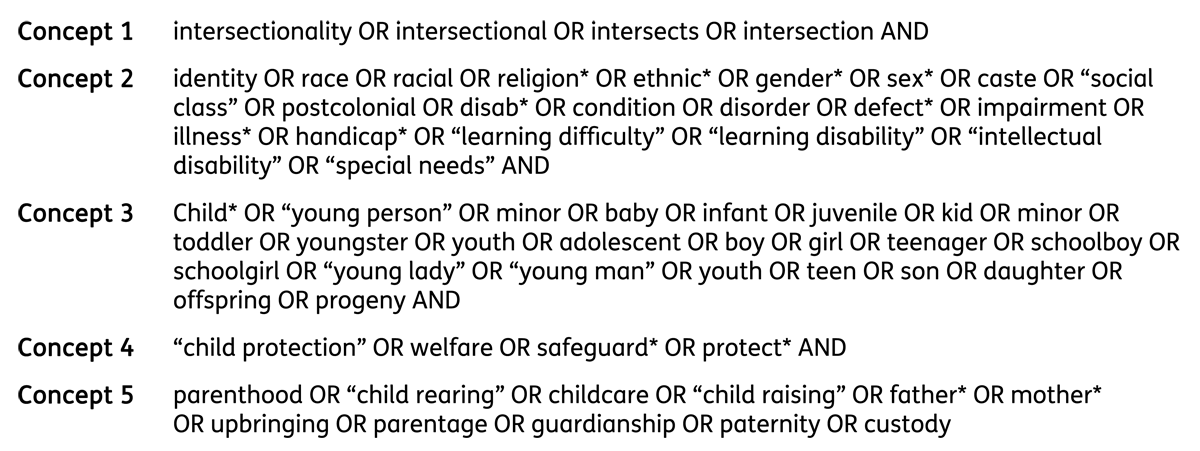
Figure 1
Key words and search strings.
Table 1
Percentage (%) of Referenced Disabilities in Final Sample.
| TYPE OF DISABILITY | PERCENTAGE (%) |
|---|---|
| Mental health | 61.9 |
| General children’s mental health concern or general impact of maltreatment on developmental outcomes | 14.3 |
| Generic disability mentions | 9.5 |
| Intellectual/developmental disability, including Autism spectrum disorder | 9.5 |
| Cerebral palsy | 4.8 |
Table 2
Context of intersectional framework in sample articles.
| A. ARTICLE ID – AUTHOR | B. NATION | C. YEAR | D. DISABILITY DEFINITION | E. CONTEXT OR ASPECT OF CHILD WELFARE (E.G., ADVOCACY, ASSESSMENT) | F. WHICH FOCAL SOCIAL IDENTITIES ARE DESCRIBED AS THE INTERSECTIONS IN THIS LITERATURE? | G. WHICH OTHER SOCIAL IDENTITIES ARE INCLUDED IN THIS LITERATURE? |
|---|---|---|---|---|---|---|
| Shade, Kools, Weiss & Pinderhughes | United States | 2011 | Mental Health | Young fathers involved getting parenting classes | SES, race, gender, hyperactive kid, school dropout, foster youth, street adolescent, drug dealer, and juvenile delinquent | None |
| Goodkind, Shook, Kim, Pohlig & Herring | United States | 2013 | Mental Health and substance abuse | Child welfare services | Race and gender | Mental health status, care- experienced status, age, criminal status, illicit substance user |
| Marshall & Haight | United States | 2014 | Mental Health | African American youth cross over from child welfare to juvenile justice system | Race/ethnicity and class | Cultural variations in patterns of communication, poverty and differences between White and African American communities, low income |
| Bruno | Sweden | 2015 | Developmental Psychology | Court orders | Age, ethnicity and race and gender | Socio-economic status. |
| Gupta & Featherstone | England | 2016 | Mental health (removal cause) | Child protection and family court systems | Gender, race, poverty status and immigration status | Care-experienced status, age, criminal status |
| Lüdtke, In-Albon, Schmeck, Plener, Fegert & Schmid | Switzerland | 2017 | Mental Health | Adolescent mental health and institutional placements, youth welfare, juvenile justice | Age, gender and therapeutic treatment/mental disorders | Placement type |
| Harris & Ford | United States | 2017 | Mental Health | Adoption | Race, gender and class | Sexuality |
| Collings, Dew, Gordon, Spencer & Dowse | Australia | 2018 | Intellectual Disability | Investigation triggers and outcomes where engaged in care proceedings | Disability, race/ethnicity (Aboriginal/non-Aboriginal) | Gender, age, socio-economic status, mental health |
| Robinson | United States | 2018 | Mental health, addiction, health/illness | Experiences of LGBTQ homeless youth of child welfare | Gender expression, sexuality, race | None |
| Cage, Corley & Harris | United States | 2018 | Developmental outcomes | Maltreated youth involved with the child welfare system | Race, gender | Age, ethnicity, socio-economic status. |
| Kildahl, Engebretsen & Helverschou | Norway | 2019 | Autism spectrum disorder, intellectual disability | Attachment, ASD and intellectual disability, and inadequate care | Disability – Autism Spectrum Disorder +Intellectual disability | Age |
| Walls, Kattari, Speer & Kinney | United States | 2019 | Disability in general – not specified | Parenting experiences of transgender and gender non- conforming individuals | Gender, race and ethnicity, income, sexual orientation, age, educational level, relationship status, and disability status | Nil |
| Lloyd Sieger | United States | 2020 | Child mental health, developmental disability | Child substance – removal status and reunification | Child race/ethnicity and age | Parent substance abuse, disability |
| Middel, Lopez, Flike & Grietens | England, Netherlands, Germany | 2020 | Mental health/addiction | Post-investigation services in child welfare | Ethnicity, gender, immigration status | Family mental health issues |
| Kobulsky, Wildfeuer, Yoon and Cage | United States | 2020 | Mental health, emotional and behavioural problems | Child protection investigations outcomes | Gender and race or care giver | Relationship status of parent, age and gender of child |
| Vadivelan, Sekar, Sruthi & Gopichandran | India | 2020 | Cerebral palsy | Parental stressors for caregivers | Gender, poverty, rural background (low- to mid-income), mother of a child with a disability | N/A |
| Sawyer | Sweden | 2020 | Mental health, addiction, health/illness | Family assessment setting for child welfare | Gender, race/ethnicity, class, Sexuality | None |
| Recto & Lesser | United States | 2020 | Mental health/addiction | Fatherhood program for people mandated by Child Protection or Juvenile Justice Services | Race, ethnicity, age, mental health | None |
| Flynn | Ireland | 2020 | Spectrum of disability | Spectrum of child protection system work | Race, ethnicity, disability | Gender |
| Slayter | United States | 2020 | Disability – generic, mental health, emotional disturbance, medical | Adoption outcomes from foster care | Race, ethnicity, disability | Age and gender |
| Mountz & Capous-Desyllas | United States | 2020 | Mental health/addiction | Aging-out of child welfare care | Sexuality, gender identity, gender Expression | None |
Table 3
Analysis of intersectionality content in study sample.
| A. ARTICLE ID – AUTHOR | H. IS INTERSECTIONALITY APPLIED AS A THEORETICAL LENS, TOOL FOR DATA ANALYSIS OR BOTH? | I. INTERSECTIONALITY IN INTRODUCTION OR BACKGROUND | J. INTERSECTIONALITY IN LITERATURE REVIEW | K. INTERSECTIONALITY IN THEORETICAL FRAMEWORK | L. INTERSECTIONALITY IN STUDY AIMS (OVERT OR IMPLICIT) | M. INTERSECTIONALITY IN THE METHODS (INCLUDE SAMPLE SIZE) | N. INTERSECTIONALITY IN DATA ANALYSIS (OVERT OR COVERT) | 0. INTERSECTIONALITY IN FINDINGS (OVERT OR COVERT) | IP. INTERSECTIONALITY IN DISCUSSION | Q. INTERSECTIONALITY IN LIMITATIONS | R. INTERSECTIONALITY IN CONCLUSIONS | S. FUTURE RESEARCH | T. OVERALL OVERT/COVERT DISCUSSION OF INTERSECTIONALITY |
|---|---|---|---|---|---|---|---|---|---|---|---|---|---|
| Shade, Kools, Weiss & Pinderhughes | TL | YO | YO | YO | YO | YC | N | YC | YO | N | N | N | EOC |
| Goodkind, Shook, Kim, Pohlig & Herring | YC | YO | YO | YC | YO | YC | YC | YC | YC | YO | N | OO | |
| Marshall & Haight | N | N | YC | N | N | N | YC | YC | YC | YC | YC | YC | OC |
| Bruno | DA | YC | YC | YO | YC | YC | YC | YC | YC | N | N | N | OC |
| Gupta & Featherstone | B | YO | YO | YO | YC | YC | YO | YO | YO | N | YO | YO | OO |
| Lüdtke, In-Albon, Schmeck, Plener, Fegert & Schmid | N | N | N | N | YC | YO | YC | YC | YC | N | YC | YC | OC |
| Harris & Ford | TL | YC | YC | YC | YC | N | YC | YC | YO | N | YO | N | OO |
| Collings, Dew, Gordon, Spencer & Dowse | B | N | YO | YO | YC | YO | YC | YC | YO | N | YO | YO | OO |
| Robinson | TL | YO | N | N | N | N | N | YC | YC | N | N | N | OC |
| Cage, Corley & Harris | B | YO | YO | YO | YO | YO | YO | YO | YO | YO | YC | YO | OO |
| Kildahl, Engebretsen & Helverschou | N | N | N | N | N | N | N | N | YC | N | YC | YC | OC |
| Walls, Kattari, Speer & Kinney | B | YC | YC | N | YC | N | YC | YO | YO | N | N | YC | OC |
| Lloyd Sieger | B | YO | YO | YO | YO | YO | YC | YO | YO | YO | YO | YC | OO |
| Middel, Lopez, Flike & Grietens | B | YO | YO | N | YO | N | N | YC | YO | YO | N | N | OO |
| Kobulsky, Wildfeuer, Yoon and Cage | B | YO | N | N | YO | N | YC | YO | YC | YO | YC | YC | OC |
| Vadivelan, Sekar, Sruthi & Gopichandran | TL | YC | N | N | YO | N | N | N | YO | N | N | N | OO |
| Sawyer | TL | YO | N | N | YO | N | N | YC | YC | N | N | N | OC |
| Recto & Lesser | TL | N | N | N | N | N | N | YC | N | N | N | N | OC |
| Flynn | TL | YO | YO | YO | YO | N | N | YO | YO | N | YO | YO | OO |
| Slayter | B | YO | YO | YO | YO | N | YO | YC | YO | YO | N | YO | OO |
| Mountz & Capous-Desyllas | TL | YO | YO | YO | N | N | N | N | N | N | N | N | OO |
| Number n/21 | 8 TL/9 B/1 DA/4 N | 16 | 14 | 11 | 16 | 8 | 12 | 18 | 19 | 7 | 11 | 11 | 1 EOC /11 OO/9 OC |
| Overt | 11 | 10 | 10 | 9 | 5 | 3 | 6 | 11 | 5 | 6 | 5 | ||
| Covert | 5 | 4 | 1 | 7 | 3 | 9 | 12 | 8 | 2 | 5 | 6 |
[i] Legend
Theoretical Framework = TF; Theoretical Lens = TL; Data Analysis = DA; Both = B; No Mention = N; Yes – Covert = YC; Yes – Overt = YO; No mention = N; Overall Overt = OO; Equally Overt and Covert = EOC; Overall Covert = OC.
Table 4
Summary of how intersectionality, disability & child protection are examined in literature.
| ARTICLE ID – AUTHOR | HOW INTERSECTIONALITY WAS USED E.G. FRONT MATTER/EXTENT ETC | CONNECTION/ENGAGEMENT WITH DISABILITY & CP |
|---|---|---|
| Shade, Kools, Weiss & Pinderhughes | Intersectionality was overtly applied through literature and conceptualisation (front matter) and discussion, then covertly applied in methods and findings. There was no engagement with intersectionality in 4 out of the 12 criterion. Moderate coverage | No direct engagement or connection of disability and child protectional intersectionality. This article was concerned with the care and incarceration of adolescent fathers on identity development. |
| Goodkind, Shook, Kim, Pohlig & Herring | Intersectionality was applied either overtly or covertly throughout the article (11 out of 12 criterion) with the exception of future research. Good coverage | No direct engagement or connection of disability and child protectional intersectionality. This article was concerned with neglect or maltreatment associated with juvenile justice and substance abuse. Mental health mentioned as outcome of maltreatment and includes behavioural issues and juvenile delinquency. |
| Marshall & Haight | Covertly mentioned in 7 of 12 criterion – mentioned only in the lit review in the forward matter but predominantly data analysis and back matter of the paper. Low to moderate coverage | No direct engagement or connection of disability and child protectional intersectionality. This article was focussed on race and cultural variation outcomes. |
| Bruno | Intersectionality mental 9/12 criterion but omitted from limitations, conclusions and further research. Moderate to good coverage | No direct engagement or connection of disability and child protection intersectionality. This article was concerned with how white male privilege overrides children’s rights in court orders/proceedings |
| Gupta & Featherstone | Mentioned in 11/12 criterion excluding limitations, mostly overt except convert in study aims and methods. Good coverage | No direct engagement or connection of disability and child protection intersectionality. This article was concerned fathers access to children looking at intersection of fathers of colour. |
| Lüdtke, In-Albon, Schmeck, Plener, Fegert & Schmid | Mentioned intersectionality in 7 of the 12 criterion – minimal in the front matter and covertly in the aims. Only once overtly mentioned in methods and absent in limitations. Low to moderate coverage | No direct engagement or connection of disability and child protectional intersectionality. This article is focused on the cause of removal e.g. mental health and substance abuse of mother, no consideration of father interaction with child in removal proceedings. |
| Harris & Ford | Throughout literature 9/12 criterion – no mention in methods, limitations and future research. Moderate coverage | No direct engagement or connection of disability and child protectional intersectionality. This article looks at intersections of adoption recipients and impact of social identity in successful application |
| Collings, Dew, Gordon, Spencer & Dowse | 10/12 throughout – omitted from introduction/background and limitations and covertly discussed in study aims, data analysis and findings. Good to excellent coverage | Explicit engagement of intersectionality of disability and child protection throughout article. Consideration of Indigenous vs non-Indigenous parents with intellectual disability involved in the child protection system |
| Robinson | Omission of intersectionality in 8 of the 12 criterion and present in the introduction/background, theoretical lens, findings and discussion. Overall intersectionality was not a key focus of the study aims. Low coverage | No direct engagement or coherent relationship between intersectional connection of disability to child welfare/child protection – more focused on LGBTIQ+ identity development and expression based on race and culture |
| Cage, Corley & Harris | This paper covered intersectionality in all assessed criterion. Excellent coverage | No direct engagement or connection of disability and child protectional intersectionality. This article discussed the intersection of maltreated children in Welfare care – mentions developmental stages but not specifically disability or mental health |
| Kildahl, Engebretsen & Helverschou | Intersectionality only present 3 out of the 12 criterion and not methodologically applied. Covertly raised in discussion, conclusion and future research. Very low coverage | No direct engagement or connection of disability and child protectional intersectionality. This article discussed ASD and generalised insufficient care conditions |
| Walls, Kattari, Speer & Kinney | Intersectionality is covered in 8 of the 12 criterion. It is not considered in theoretical framework, methods, limitations and conclusion – mostly back matter of the paper and only overtly in the findings and discussion. Moderate coverage | No direct engagement or connection with disability – This paper explicitly states that this intersection is rarely explored and is required |
| Lloyd Sieger | 12/12 criterion only 2 were covert the remainder overt. Excellent coverage | Explicit engagement of intersectionality of disability and child protection throughout article. Intersection of disability/CP in reunification/removals |
| Middel, Lopez, Flike & Grietens | 7/12 criterion contained overt intersectionality coverage and covertly mentioned in the findings. No engagement with methodological and theoretical framework, data analysis, conclusions and future research. Moderate coverage | Explicit engagement of intersectionality of disability and child protection throughout article through the consideration of the child’s mental health status or carers mental health intersecting with CP responses. |
| Kobulsky, Wildfeuer, Yoon and Cage | Coverage in 9/12 criterion – overtly stated in the introduction and study aims, however. Not present in literature review and methods. Good Coverage | Minimal engagement of intersectionality of disability and child protection – primarily covert association and focussed on parental mental health impact on child development and maltreatment. |
| Vadivelan, Sekar, Sruthi & Gopichandran | Only present in 4 out of the 12 criterion – largely absent throughout the article but when mentioned – mostly overt. No methodological engagement or coverage in lit review. Low coverage | Minimal engagement of intersectionality of disability and child protection. Article covers stressor of carers but no mention of child welfare intervention |
| Sawyer | Only present in 5/12 criterion eventhough used as a keyword. When mentioned it is mostly covert. Low to moderate coverage | Minimal engagement of intersectionality of disability and child protection. Article covers parental assessment – minimal disability related context |
| Recto & Lesser | 2/12 criterion mentions intersectionality as a theoretical lens and covertly. Low coverage | Minimal engagement of intersectionality of disability and child protection. Minimal engagement with the concept of intersectionality and minimal coverage of CP and disability |
| Flynn | Overtly covered in 9/12 criterion – no coverage methods, data analysis and limitations. Good Coverage | Explicit engagement of intersectionality of disability and child protection throughout article |
| Slayter | Intersectionality captured in 10/12 criterion (only 1 of these covertly) – no coverage in methods or conclusions. Good to excellent coverage | Explicit engagement of intersectionality of disability and child protection throughout article |
| Mountz & Capous- Desyllas | Only mentioned in 4/12 criterion and this occurred in the front matter only. Low coverage | Minimal engagement of intersectionality of disability and child protection. Article of intersectionality of disability and child protection. Article considers familial history and intergeneration impact of mental health within and transition from care. |