
Introduction
Child welfare researchers have examined the potential influences of a variety of social identities on the trajectories and outcomes of children and families involved in this system, including race, ethnicity, gender, and disability (e.g., Pelton 2015; Wilson & Kastanis 2015). We argue that considerations of the disability community within the child protection sector are well-served using an intersectional analytical lens. The concept of intersectionality is about the interrelatedness of our multiple social identities. Further, it is about how these combinations of social identities affect our self-perception and how we are viewed and treated by other individuals, groups, institutions, and larger social structures (Slayter 2016).
This paper intends to study the application of this theoretical framework as it relates to children and parents with disabilities by exploring how intersectionality is examined in the child welfare literature in the context of disability. It is our contention that the study of intersectionality as it relates to the disability community remains critical due to persistent scarcity of scholarship on the subject matter in a broad sense, and specifically in the child protection and welfare context (Flynn 2021). Intersectionality provides a framework for considering the person as a whole, their identities and complexities. No longer can a siloed approach be taken to policy and practice as it traditionally looks at social identities singularly which at times is counter intuitive to the well-being of the individual and broader disability communities. Accordingly, we examine the scope of scholarship to date addressing intersectionality and disability.
Intersectionality as a Conceptual Framework in Child Welfare and Child Protection Literature
The intersectionality framework theorizes that ‘people simultaneously occupy multiple positions within the socio-political and structural fabric of society’ (Ortega & Faller 2011: 31). Use of an intersectional lens may expose potential inequities in child welfare processes and outcomes that are not produced or maintained by a single factor (such as ableism or racism). Instead, inequities may exist due to the complex interactions between multiple manifestations of privilege and oppression or advantage and disadvantage at interpersonal and institutional levels (Lawrence & Keleher 2004).
The explicit use of intersectionality as framework is relatively recent in child welfare literature. The earliest point at which a critical mass of articles appears in the literature is around 2008 with primary focus on the intersections of race and gender as opposed to service response and need (Cho et al. 2013; Corus & Saatcioglu 2015; Steinfield et al. 2019). This is likely linked to the initial articulation of intersectionality within Black American feminism, or womanism, as a necessary co-consideration of racism and sexism (Howe 2009). As attention to intersectionality in child welfare has increased, inclusion of other identities, including disability, has grown (see, for example, Johnson et al. 2020; Wehbi & Lakkis 2010). This expanded inclusion of identities has also been influenced by the national and cultural contexts in which intersectionality in child welfare is being explored.
Most of the applications of intersectionality in the child welfare literature have focused on practice and theory (e.g., Ortega & Faller 2011). More recently published articles in this area include those employing intersectionality in statistical (e.g., Nadan et al. 2015) and policy (e.g., Williams-Butler et al. 2020) analyses. This growing body of literature addresses the ways in which ‘…intersectionality is important for understanding connections, client characteristics and behaviour, for service agencies for developing more holistic service provision, and for organisations in understanding and advancing equity’ (Thomas et al. 2021: 3).
Study aims
The present study is guided by two study aims. The first aim is to determine how intersectionality is listed in the child welfare literature in the context of disability. The second aim is to describe how and to what extent researchers integrate, embed, and engage intersectionality in the conduct of their research studies.
Methodology
The method of this paper was critical literature review informed by scoping review strategies, with qualitative thematic analysis to help us to produce descriptive patterns (Silverman 2017). Critical literature review is a desk-based method and form of secondary data analysis (Jesson & Lacey 2006; Jesson et al. 2011). As one sub-type of literature review, it involves analysis and synthesis of secondary data (Grant & Booth 2009). An a priori protocol for the review was developed, informed by the Joanna Briggs Methods Manual for Scoping Reviews (Peters et al. 2020), which went through several iterations. The central research question was ‘what is the conceptualization of intersectionality in child welfare and child protection practice globally in the context of disability?’ Both child welfare and child protection were included in the question as child welfare encompasses child protection, and in many practice contexts, these terms are used interchangeably. Development of the electronic database search strategy for the review utilised McGowan et al. (2016) PRESS guidelines. To assist with application of the PRESS Guidelines (McGowan 2016), a subject librarian was liaised with in February 2021. The subject librarian provided advice and guidance but did not undertake any of the searches for literature or carry out research work.
Predetermined inclusion and exclusion criteria were used to select the sample of documents for analysis and add transparency to the research (Tight 2019). Inclusion criteria comprised material based in qualitative and/or quantitative research strategies; literature of any publication status; and literature derived from peer-reviewed journal articles, books and book chapters, and reports. Exclusion criteria included publications older than 2010 that were not ‘seminal’ as defined in line with the Cambridge Dictionary as ‘containing important new ideas and having a great influence on later work’ (Cambridge University 1995). Researchers decided if an article contained important new ideas or influenced later work by reviewing the article and then discussing whether there was agreement about an article meeting these criteria. In practice, researchers showed strong consensus about this.
Material published in a language other than English and literature that focused on one or more identities without taking an intersectional approach as a central theme were excluded. Researchers determined if an article took an intersectional approach based on using their expertise on intersectionality. Finally, research studies deemed to be of insufficient quality as determined using the Caldwell, Henshaw, and Taylor (2011) research critique framework, as well as the Critical Appraisal Skills Program (CASP) framework (Critical Appraisal Skills Programme 2018) were omitted, as well as journals that required hand searching.
To improve the quality and reliability of the process, duplicate electronic database searches and duplicate data extraction work on a sample of two papers was undertaken to check for consistency in coding and searching across researchers, as well as perform a pilot test of the method. Specifically, this pilot test was undertaken by analysing two papers separately and then bringing together the findings to check if there was proper consistency between researchers who acted in isolation. Once satisfied that there was consistency and the method worked well, the researchers were confident that they would later be able to proceed to the main analysis of all articles. Electronic database searches of keyword, title, and abstract for the final sample were undertaken between April 7, 2021, and May 1, 2021. Electronic databases were searched from three universities in the United States of America, Australia, and Ireland using the following databases: Psychology and Behavioral Science Collection, PsychArticles, PsycINFO, PubMed, Academic Search Complete (ASC), Social Work Abstracts, Socindex, Taylor & Francis Online, Proquest, Applied Social Sciences Indexes and Abstracts (ASSIA), Primo Search (a higher education library search engine which uses a simple intuitive search function across databases and catalogues), and Social Science Premium Collection (SSPC). These databases are academic databases utilised by social science researchers and cover the scope of this scoping review. Keywords with truncation, phrasing and Boolean Operators within search strings are illustrated in Figure 1.
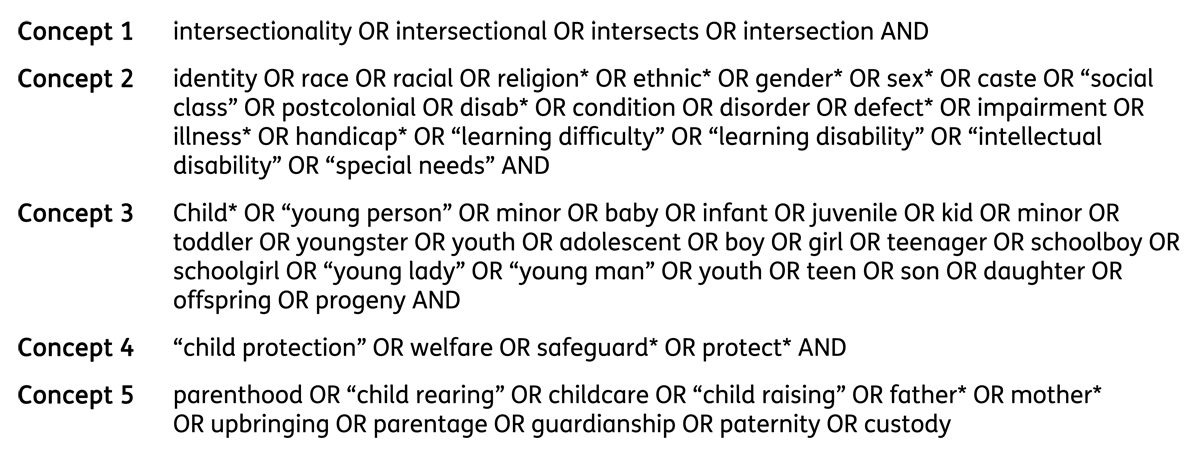
Figure 1
Key words and search strings.
Retrieval of results within electronic database searches were recorded by each researcher with reference to the search date, database search terms, results retrieved and any comments. The reference management tool EndNote was used to collect the initial sample of 236 documents and to remove duplicates. To then refine the sample further, sources were ‘scan read’ in line with Fabianowska (2018) using Jesson and colleagues’ (2011) adaption of Hart’s (2003) questions:
What are the key sources? What are the key theories, concepts and ideas? What are the key epistemological and ontological grounds for the discipline? What are the main questions and problems that have been addressed to date? How has knowledge in the topic been structured and organised? How have approaches to these questions increased our understanding and knowledge? What are the origins and definitions of the topic? What are the major issues and debates about the topic? (p. 86)
Scan-reading and hand searching documents from the EndNote library, taking account of the study’s central research question and guiding questions, refined the existing sample down to 38 for analysis. At this stage, qualitative thematic analysis began by coding the sample toward producing themes (Bryman 2016; Silverman 2017). This involved applying a predetermined framework that had been pilot tested resulting in amendments. Each document was coded using the framework for 23 separate indicators, including identifying how disability was operationalised in the document and whether intersectionality was applied theoretically in the document. The researchers also engaged in additional moderation around disagreement about coding of presence of intersectionality versus depth of meaning/presence of intersectionality. Information extracted from documents under each indicator were inputted on an excel spreadsheet including, where relevant, excerpts and page numbers. The result was a visual chart, similar to that produced within the framework method of analysis (see Gale et al. 2013). At this juncture, researchers critically discussed the preliminary findings and identified that several documents within the sample did not sufficiently fall within the scope of the central research question. Therefore, the sample was refined further, leading to the exclusion of an additional 17 documents, resulting in 21 documents that met the full parameters of the study. Finally, themes were extracted and named based on the final reduced spreadsheet. The PRISMA-ScR 2018 (Tricco et al. 2018) was consulted to inform review reporting including presentation of findings in this paper. Findings were illuminating with interesting patterns and perceived omissions which will be presented later in this paper. Overall, the purpose of the method was to establish if there was a genuine intersectional approach taken to matters relating to disability and child protection practice in the articles that were analysed within the sample.
Summary of Final Sample
As could be expected, there was both variance and continuity presented in the final sample of articles (n = 21) insofar as all pertained to intersectionality, child protection and disability. Some articles had a criminogenic sub-focus in their subject matter such as Shade and colleagues’ (2011) examination of parenting and incarcerated adolescent fatherhood, and the exploration of African American youth cross over from child welfare to juvenile justice system presented by Marshall and Haight (2014). The latter focus on juvenile justice also presented in Lüdtke and colleagues (2018) who considered adolescent mental health, institutional placements, and youth welfare, whilst Goodkind and colleagues (2013) furnished a second examination of the transition from child welfare to juvenile justice, this time in terms of experiences. Alternatively, adoption was more pertinent in some studies such as Johnson and colleagues (2020), who examined adoption outcomes from foster care, and Harris and Ford (2017) who examined Single Mothers by Choice (SMC) and adoption.
Lesbian, gay, bisexual, transgender, queer or questioning (LGBTQ) and other gender non-conforming identities were to the forefront in studies such as Robinson (2018), who considered youth homelessness, gender segregation, and instability. Similarly, Walls and colleagues (2019) examined transgender identities, discrimination, and likelihood of being a parent, whilst Mountz (2020) explored the families of origin of LGBTQ former foster youth and their trajectories throughout care.
Kobulskey and colleagues (2020) considered child protection investigations outcomes for maltreatment by fathers, whilst Middel and colleagues (2020) examined child protection decision making and post-investigation services in child welfare. Moreover, some studies focussed more on court processes like Bruno (2015) who examined Swedish court orders and Gupta and Featherstone (2016) who were concerned with Black fathers and family court systems alongside child protection.
Several papers placed parents and parenthood in the spotlight, such as Recto and Lesser (2020), who focussed on Hispanic adolescent fathers and Vadivelan and colleagues (2020), who looked at the challenges faced by caregivers of children with cerebral palsy. Specific identity markers were featured in papers, such as Collings and colleagues (2018), that examined differences between Aboriginal and non-Aboriginal parents with intellectual disability in the New South Wales child protection system and Kildahl and colleagues (2019), who were concerned with attachment, autism spectrum disorder (ASD), intellectual disability, and inadequate care.
Variance in scope of focus across studies was also anticipated, with Flynn (2020) broadly examining ethnic minority status and childhood disability across Irish safeguarding work, and Cage and colleagues adopting a wider lens on maltreated youth involved with the child welfare system. Alternatively, Sawyer (2012) specifically focussed on the Swedish family assessment setting, whilst Lloyd Sieger (2020) explored reunification in the context of substance misuse. Overall, this final sample of 21 articles, insofar as they probed beneath the surface of intersectionality, child protection and disability, presented us with varied and rich lines of inquiry.
Findings
We report on our findings from the analysis of 21 articles that met our criteria. Of these studies, 42.9 percent were qualitative (n = 9), 23.8 percent were quantitative, 4.8 percent were mixed methods and 28.6 percent were unclear in their methodological approach. The articles came from twelve countries, although the majority were based in the United States (n = 12). Other countries included in the sample were Australia, Belgium, England, Germany, India, Ireland, Netherlands, Norway, Rwanda, Sweden, and Switzerland. Most of the articles were published in the latter three years of the time frame considered: 2018 (n = 3), 2019 (n = 2), and 2020 (n = 9). The disabilities referenced in the studies were primarily mental health disorders, at 61.9 percent of the sample. Our summary of the types of disabilities noted in these articles presented in Table 1 is characterized according to the way types were noted in the literature versus according to a standardized disability classification system. This is also the case for descriptive terminology utilized by original authors of the studies included in this review.
Table 1
Percentage (%) of Referenced Disabilities in Final Sample.
| TYPE OF DISABILITY | PERCENTAGE (%) |
|---|---|
| Mental health | 61.9 |
| General children’s mental health concern or general impact of maltreatment on developmental outcomes | 14.3 |
| Generic disability mentions | 9.5 |
| Intellectual/developmental disability, including Autism spectrum disorder | 9.5 |
| Cerebral palsy | 4.8 |
The focus of the studies in the sample varied a great deal as shown in Table 2. The largest grouping of studies focused on youth experiences in child welfare (28.6%, n = 6). This was followed by studies that looked at parenting courses, generic child welfare services, family court, child protection investigation, adoption, and parenting experiences at 9.5 percent each (n = 2 each). The topics of family assessment, child substance abuse removal status and reunification and post-investigation services each accounted for 4.8 percent of the areas of focus in the study sample (n = 1 each).
Table 2
Context of intersectional framework in sample articles.
| A. ARTICLE ID – AUTHOR | B. NATION | C. YEAR | D. DISABILITY DEFINITION | E. CONTEXT OR ASPECT OF CHILD WELFARE (E.G., ADVOCACY, ASSESSMENT) | F. WHICH FOCAL SOCIAL IDENTITIES ARE DESCRIBED AS THE INTERSECTIONS IN THIS LITERATURE? | G. WHICH OTHER SOCIAL IDENTITIES ARE INCLUDED IN THIS LITERATURE? |
|---|---|---|---|---|---|---|
| Shade, Kools, Weiss & Pinderhughes | United States | 2011 | Mental Health | Young fathers involved getting parenting classes | SES, race, gender, hyperactive kid, school dropout, foster youth, street adolescent, drug dealer, and juvenile delinquent | None |
| Goodkind, Shook, Kim, Pohlig & Herring | United States | 2013 | Mental Health and substance abuse | Child welfare services | Race and gender | Mental health status, care- experienced status, age, criminal status, illicit substance user |
| Marshall & Haight | United States | 2014 | Mental Health | African American youth cross over from child welfare to juvenile justice system | Race/ethnicity and class | Cultural variations in patterns of communication, poverty and differences between White and African American communities, low income |
| Bruno | Sweden | 2015 | Developmental Psychology | Court orders | Age, ethnicity and race and gender | Socio-economic status. |
| Gupta & Featherstone | England | 2016 | Mental health (removal cause) | Child protection and family court systems | Gender, race, poverty status and immigration status | Care-experienced status, age, criminal status |
| Lüdtke, In-Albon, Schmeck, Plener, Fegert & Schmid | Switzerland | 2017 | Mental Health | Adolescent mental health and institutional placements, youth welfare, juvenile justice | Age, gender and therapeutic treatment/mental disorders | Placement type |
| Harris & Ford | United States | 2017 | Mental Health | Adoption | Race, gender and class | Sexuality |
| Collings, Dew, Gordon, Spencer & Dowse | Australia | 2018 | Intellectual Disability | Investigation triggers and outcomes where engaged in care proceedings | Disability, race/ethnicity (Aboriginal/non-Aboriginal) | Gender, age, socio-economic status, mental health |
| Robinson | United States | 2018 | Mental health, addiction, health/illness | Experiences of LGBTQ homeless youth of child welfare | Gender expression, sexuality, race | None |
| Cage, Corley & Harris | United States | 2018 | Developmental outcomes | Maltreated youth involved with the child welfare system | Race, gender | Age, ethnicity, socio-economic status. |
| Kildahl, Engebretsen & Helverschou | Norway | 2019 | Autism spectrum disorder, intellectual disability | Attachment, ASD and intellectual disability, and inadequate care | Disability – Autism Spectrum Disorder +Intellectual disability | Age |
| Walls, Kattari, Speer & Kinney | United States | 2019 | Disability in general – not specified | Parenting experiences of transgender and gender non- conforming individuals | Gender, race and ethnicity, income, sexual orientation, age, educational level, relationship status, and disability status | Nil |
| Lloyd Sieger | United States | 2020 | Child mental health, developmental disability | Child substance – removal status and reunification | Child race/ethnicity and age | Parent substance abuse, disability |
| Middel, Lopez, Flike & Grietens | England, Netherlands, Germany | 2020 | Mental health/addiction | Post-investigation services in child welfare | Ethnicity, gender, immigration status | Family mental health issues |
| Kobulsky, Wildfeuer, Yoon and Cage | United States | 2020 | Mental health, emotional and behavioural problems | Child protection investigations outcomes | Gender and race or care giver | Relationship status of parent, age and gender of child |
| Vadivelan, Sekar, Sruthi & Gopichandran | India | 2020 | Cerebral palsy | Parental stressors for caregivers | Gender, poverty, rural background (low- to mid-income), mother of a child with a disability | N/A |
| Sawyer | Sweden | 2020 | Mental health, addiction, health/illness | Family assessment setting for child welfare | Gender, race/ethnicity, class, Sexuality | None |
| Recto & Lesser | United States | 2020 | Mental health/addiction | Fatherhood program for people mandated by Child Protection or Juvenile Justice Services | Race, ethnicity, age, mental health | None |
| Flynn | Ireland | 2020 | Spectrum of disability | Spectrum of child protection system work | Race, ethnicity, disability | Gender |
| Slayter | United States | 2020 | Disability – generic, mental health, emotional disturbance, medical | Adoption outcomes from foster care | Race, ethnicity, disability | Age and gender |
| Mountz & Capous-Desyllas | United States | 2020 | Mental health/addiction | Aging-out of child welfare care | Sexuality, gender identity, gender Expression | None |
Within these studies, a range of different social identities beyond disability were considered. These were not consistent across the studies, although race and gender were the most drawn upon social identities. The full list includes race, ethnicity, gender, socioeconomic status, gender identity, sexuality, age, parenting status, nationality, poverty status, combined race/ethnicity, gender expression, immigration, juvenile delinquency status, drug dealer status, street adolescent status, foster youth status, school dropout identity, being a hyperactive child, mental health status, rural/urban, income, and educational level. Generally, there was hardly any analysis of disability as it intersected with other social identities.
Treatment of Intersectionality in Child Welfare Literature on Disability
The core of this research was to examine the treatment of intersectionality in child welfare literature on disability. An overview of findings is provided in Table 3 below. Given the rigour of the sample article selection, it was unexpected that less than half (47.6%) of the articles engaged in the intersectionality of child protection or child welfare and disability, and in only 23.8 percent or five of the sample articles was this explicitly engaged. For example, Lloyd Seiger (2020) considered the intersection of disability and child protection in relation to either reunification and/or removal, and Middel and colleagues (2020) articulated the need for consideration of children’s mental health status in and during child protection responses. A further 23.8 percent or five of the sample articles had minimal engagement, such as Kobulsky and colleagues (2020), who focused on the mental health wellbeing (or impact) of parents on both child development and maltreatment, or Mountz and Capous-Desyllas (2020), who covered the familial or intergenerational impacts of mental health within and in the transition from care. There were 11 articles (52.4%) that had no direct engagement with the intersection of child protection and disability, such as Harris and Ford (2017), who considered the intersections of adoptive parents’ identities and the impact on being successful in an adoption process. Of note was the article by Walls and colleagues (2019: 141–142), which had minimal engagement with the topic at hand by clearly stating ‘…More nuanced research unpacking the intersection of disability and gender in regard to transgender parenting might help shed light on these differences’ is required.
Table 3
Analysis of intersectionality content in study sample.
| A. ARTICLE ID – AUTHOR | H. IS INTERSECTIONALITY APPLIED AS A THEORETICAL LENS, TOOL FOR DATA ANALYSIS OR BOTH? | I. INTERSECTIONALITY IN INTRODUCTION OR BACKGROUND | J. INTERSECTIONALITY IN LITERATURE REVIEW | K. INTERSECTIONALITY IN THEORETICAL FRAMEWORK | L. INTERSECTIONALITY IN STUDY AIMS (OVERT OR IMPLICIT) | M. INTERSECTIONALITY IN THE METHODS (INCLUDE SAMPLE SIZE) | N. INTERSECTIONALITY IN DATA ANALYSIS (OVERT OR COVERT) | 0. INTERSECTIONALITY IN FINDINGS (OVERT OR COVERT) | IP. INTERSECTIONALITY IN DISCUSSION | Q. INTERSECTIONALITY IN LIMITATIONS | R. INTERSECTIONALITY IN CONCLUSIONS | S. FUTURE RESEARCH | T. OVERALL OVERT/COVERT DISCUSSION OF INTERSECTIONALITY |
|---|---|---|---|---|---|---|---|---|---|---|---|---|---|
| Shade, Kools, Weiss & Pinderhughes | TL | YO | YO | YO | YO | YC | N | YC | YO | N | N | N | EOC |
| Goodkind, Shook, Kim, Pohlig & Herring | YC | YO | YO | YC | YO | YC | YC | YC | YC | YO | N | OO | |
| Marshall & Haight | N | N | YC | N | N | N | YC | YC | YC | YC | YC | YC | OC |
| Bruno | DA | YC | YC | YO | YC | YC | YC | YC | YC | N | N | N | OC |
| Gupta & Featherstone | B | YO | YO | YO | YC | YC | YO | YO | YO | N | YO | YO | OO |
| Lüdtke, In-Albon, Schmeck, Plener, Fegert & Schmid | N | N | N | N | YC | YO | YC | YC | YC | N | YC | YC | OC |
| Harris & Ford | TL | YC | YC | YC | YC | N | YC | YC | YO | N | YO | N | OO |
| Collings, Dew, Gordon, Spencer & Dowse | B | N | YO | YO | YC | YO | YC | YC | YO | N | YO | YO | OO |
| Robinson | TL | YO | N | N | N | N | N | YC | YC | N | N | N | OC |
| Cage, Corley & Harris | B | YO | YO | YO | YO | YO | YO | YO | YO | YO | YC | YO | OO |
| Kildahl, Engebretsen & Helverschou | N | N | N | N | N | N | N | N | YC | N | YC | YC | OC |
| Walls, Kattari, Speer & Kinney | B | YC | YC | N | YC | N | YC | YO | YO | N | N | YC | OC |
| Lloyd Sieger | B | YO | YO | YO | YO | YO | YC | YO | YO | YO | YO | YC | OO |
| Middel, Lopez, Flike & Grietens | B | YO | YO | N | YO | N | N | YC | YO | YO | N | N | OO |
| Kobulsky, Wildfeuer, Yoon and Cage | B | YO | N | N | YO | N | YC | YO | YC | YO | YC | YC | OC |
| Vadivelan, Sekar, Sruthi & Gopichandran | TL | YC | N | N | YO | N | N | N | YO | N | N | N | OO |
| Sawyer | TL | YO | N | N | YO | N | N | YC | YC | N | N | N | OC |
| Recto & Lesser | TL | N | N | N | N | N | N | YC | N | N | N | N | OC |
| Flynn | TL | YO | YO | YO | YO | N | N | YO | YO | N | YO | YO | OO |
| Slayter | B | YO | YO | YO | YO | N | YO | YC | YO | YO | N | YO | OO |
| Mountz & Capous-Desyllas | TL | YO | YO | YO | N | N | N | N | N | N | N | N | OO |
| Number n/21 | 8 TL/9 B/1 DA/4 N | 16 | 14 | 11 | 16 | 8 | 12 | 18 | 19 | 7 | 11 | 11 | 1 EOC /11 OO/9 OC |
| Overt | 11 | 10 | 10 | 9 | 5 | 3 | 6 | 11 | 5 | 6 | 5 | ||
| Covert | 5 | 4 | 1 | 7 | 3 | 9 | 12 | 8 | 2 | 5 | 6 |
[i] Legend
Theoretical Framework = TF; Theoretical Lens = TL; Data Analysis = DA; Both = B; No Mention = N; Yes – Covert = YC; Yes – Overt = YO; No mention = N; Overall Overt = OO; Equally Overt and Covert = EOC; Overall Covert = OC.
Use of Intersectionality Framework in Front Matter, Study Aims, and Literature Review
In the consideration of how study authors used the intersectionality framework in the front matter sections of their papers (Table 3, column H), we noted that 80.9 percent referenced the term. Further, we conducted an analysis to determine whether mentions of intersectionality were overt or covert and found that 70.5 percent of the mentions in these articles were overt. Examples of overt discussions of intersectionality in the front matter of the articles include a discussion by authors Harris and Ford (2017) talking about ‘the racialized, gendered, and classed aspects of our respective processes merited deeper consideration, which prompted us to take on the task of sociologically analysing our experiences through an intersectional lens’ (Harris & Ford 2017: 28).
Examples of covert discussions of intersectionality in the front matter of the articles, on the other hand, include Walls and colleagues’ (2019) commentary in the background section in which they talk generally about the concept. In this example, the authors talk about how ‘the purpose of this study was to examine the differences in the likelihood of being a parent within the U.S. transgender/GNC community and, among those who were assigned a male sex at birth (AMAB) and who are currently on the transfeminine spectrum (AMAB-transfeminine), identify differences in likelihood of parenting based on other identities, as well as describe different aspects of their parenting relationship’ (Walls et al.: 133).
Looking at the study aims sections of our sample of articles (Table 3, column L), we noted that 52.4 percent did not explicitly mention the intersectionality framework. Among the 38.1 percent of articles that did explicitly mention the framework, 62.5 percent gave it an overt mention. An example of an overt mention of intersectionality in the study aim section of the articles is ‘using the framework of intersectionality, this study seeks to determine if maltreated youth involved in child welfare system experience similar patterns of educational attainment as the youth in the general population’ (Cage et al. 2018: 551). An example of a covert mention of intersectionality in the study aim section of the articles is found in the following excerpt from Gupta and Featherstone’s (2016) article:
Drawing upon theories of social justice, this article explores the construction of black men as fathers and contextualises the discussion in relation to gender, race, poverty and immigration issues, as well as the current policy and legal context of child protection work in England. The article examines how beliefs and assumptions about black men can influence how they are constructed, and subsequent decision-making processes. (p. 77)
Our examination of the literature review sections of the 21 studies (Table 3, column J) revealed that 66.6 percent of them explicitly mentioned the intersectionality framework, sometimes labelling an entire section with this or a related term, such as ‘intersecting risk factors’ (Lloyd Seger 2020) or ‘intersections of disability, race and ethnicity’ (Johnson et al. 2020). Of these mentions, 71.4 percent were overt mentions, such as those named above. A covert mention might involve referencing multiple social identities, such as race, class, and gender (Harris & Ford 2017) or talking about ‘multifaceted issues’ (Marshall & Haight 2014: 84).
Use of Intersectionality as a Theoretical Framework, Methods, or Data Analysis Tool
Our review of the study sample included a judgement call about whether the article favoured the use of the intersectionality framework as a theoretical model, a data analysis tool, or as a combination (Table 3, column H). Our analysis revealed that study authors used the intersectionality framework in different ways with respect to this topic. Thirty-eight percent used it as a theoretical framework alone, while another 38 percent used it as a theoretical framework as well as a specific framework to guide data analysis. Nineteen percent of the studies reviewed did not explicitly mention the intersectionality framework as either a theoretical framework or as a tool for structuring data analysis. Four percent of the studies referenced the framework as a tool for data analysis only.
However, looking within the theoretical framework sections of these articles (Table 3, column K), we note that only 52.3 percent of the studies explicitly mention intersectionality, 90.9 percent of which are discussed overtly. An example of overt discussion of intersectionality in the theoretical framework section of the articles can be found in Gupta and Featherstone (2016), who state in the theories of social justice section that they
draw on concepts from critical race theory (CRT) and intersectionality to make a contribution to understanding how macro-level structural power relationships intersect with and impact on micro-level social work practices and the lives of service users……the concept of intersectionality to understand how multiple identities such as gender and socioeconomic status, intersect with race at the individual level…. (p. 81)
The one study that uses a covert discussion of intersectionality in the theoretical framework section of the article addresses how as Black Single Mothers by Choice (SMC), they are marked by race, gender, and class (Harris & Ford 2017: 31).
Looking at the methods sections of the study sample articles (Table 3, column M) showed that 52.4 percent did not reference intersectionality. Of the 38.1 percent that did reference the framework, over half of which were in overt mentions (62.5%). For example, the study by Collings and colleagues (2018) looked at differences between Aboriginal and non-Aboriginal parents within the sample through ‘exploratory investigation of intra-group differences in a small sample’ and the ‘intersection of indigeneity and disability’ as well as the ‘investigation of intersectional disadvantage’ (p. 175). Covert mentions tended to use language that mentioned the use of different identities in a more general way (Bruno 2015; Gupta & Featherstone 2016).
Additionally, looking just at the data analysis sections of our study sample (Table 3, column N), we noted that 57.1 percent specifically reference the intersectionality framework. However, of that group, only 25 percent overtly reference the framework. For example, Johnson and colleagues (2020) state that ‘bivariate and multivariate analyses’ are conducted in which ‘intersecting identities of race, ethnicity and disability status’ are considered (p. 12). Seventy-five percent of the mentions are covert, using much more general language such as that noted in Harris and Ford (2017) who state, ‘from those interactions, we focused on those that repeated in similar or different contexts for one or both of us and examined the extent to which these were a function of race, class, and/or gender’ (p. 33).
Use of Intersectionality in Interpretation of Study Findings
Our study examined how the sample articles interacted with intersectionality in the findings section (Table 3, column O). Eighteen of the 21 (85.7%) articles mentioned intersectionality in this section; however, the majority of those articles engaged in a covert way (12 of the 18 [66.7%]). There were six articles that incorporated overt mentions of intersectionality in the findings (33.3%) For example, Walls and colleagues (2019) reported in their findings/results, ‘We used a between-group comparisons intersectional model… to determine whether the likelihood of being a parent differs based on sociodemographic differences….’ (p. 138).
Reference to Intersectionality in Study Discussion and Conclusion
Our consideration of the discussion sections of the study sample articles (Table 3, column P) showed that 90.5 percent referenced intersectionality directly, over half of which were in overt mentions (57.9%). For example, Flynn (2020) explicitly applies ‘intersectionality towards generating recommendations for future practice’ (p. 649). Covert mentions tended to use language such as how they considered ‘…perpetrator gender, race, and gender times race disparities in child protection service (CPS) investigation outcomes…’ (Kobulsky et al. 2020: 8).
Looking at the conclusion sections of the study sample articles (Table 3, column R) showed that 52.4 percent referenced intersectionality, over half of which were in overt mentions (54.5%). For example, Flynn (2020) states, ‘in this paper, some headway towards an intersectional analysis of childhood disability and ethnic minority status has been made. Although themes of utility in safeguarding practice have been refined and explained, further scope for literature on this complex area of practice remains’ (p. 654). However, covert mentions tended to use language that addressed the compounding nature of social identity risk factors, such as disability, foster care status, and criminal behaviours (Kildahl et al. 2019) or addressed the need for competence in understanding the nature of intersecting identities in educational interventions, for example (Cage et al. 2018).
A review of the limitations sections of the study sample articles (Table 3, column Q) showed that a majority, 66.7 percent, did not reference intersectionality. Of those that did reference it, 71.4 percent were in overt mentions. For example, Middel and colleagues (2020) note that they
need to acknowledge that the use of interaction effects in our models does not fully account for the nuanced understanding of intersectionality and is just a quantitative expression of the intersectional approach…However, interactions can be a useful tool when used to identify patterns of disparities among combinations of power structures and identities…which we believe was also the case for our study. (p. 12)
Covert mentions include, for example, studies that address the capacity to do intersectional work with available secondary data or the lack of intersectional research in the field (Goodkind 2013: 255).
Looking at the future research sections of the study sample articles (Table 3, column S) showed that 57.1 percent referenced intersectionality, 58.3 percent of which were in covert mentions. For example, the study conducted by Lloyd Sieger (2020) mentions that ‘future research is needed to understand the differential effects of child ages categories among children with substance removals across racial and ethnic groups’ (p. 10). Overt mentions, on the other hand, tended to use language such as that in Gupta and Featherstone’s (2016) article which states that ‘attention to…intersectional power relationships…[is] needed’ and that their research project is ‘offered as a contribution in the hope that further research is carried out in this neglected area, and to open up debate on what is required for all families to flourish and care safely’ (p. 88).
Overall Use of the Intersectionality Framework in the Study Sample Articles
As noted in Table 3, column T, of the 21 articles, 52.4 percent were assessed as using an overall overt intersectional framework or approach in the article, 42.9 percent were covert, and 4.7 percent equally covert and overt. However, this did not take into consideration the number of sections assessed in the article. For example, the Vadivelan and colleagues’ (2020) article was assessed as overall overt in the usage of an intersectional framework but only mentioned intersectionality in four out of the twelve criterion the article was assessed against. The other eight criteria had no mention of intersectionality. Lloyd Seiger’s (2020) article on the other hand has a true engagement by incorporating an intersectionality framework in all twelve criteria (10 assessed as overt and 2 covert).
The overall focus on intersectionality was mixed across the criterion. There was a clear demonstration overall of intersectionality being incorporated in the discussion section of 90.5 percent of the sample. Within this section 11 of those 19 articles mention intersectionality in an overt way. In considering the engagement of intersectionality, it is more overtly presented in the front matter of the sample articles as opposed to the back matter. Interestingly, even though 18 of the articles (Table 3, column H) indicated an overall theoretical or data analysis lens (or both), there was limited mention of intersectionality in both the methods (column M) and data analysis (column N) sections. Intersectionality was largely covered (85.7%) in the findings section (column O) of the sample articles, but mostly in a covert way (12 covert and 6 overt).
Discussion
Our primary finding is that researchers seem to be using the term intersectionality in these papers but are not always rigorously engaging with the concept methodologically. As intersectionality is already ambiguously understood and can be tokenistically employed as a ‘buzzword’ (Davis 2008: 67), it has been vital to discern what the depth and nature of literary engagement with intersectionality has been with respect to child welfare and disability. Of the small number of papers in the current sample that do engage with the concept in a rigorous way, the focus is most commonly on disability, race, and ethnicity. These papers also tend to consider outcomes of child protection assessment and interventions such as reunification, removals, adoption outcomes and child protection responses (Collings et al. 2018; Flynn 2021; Johnson et al. 2020; Middel et al. 2020; Seiger 2020). Findings of our study show that there is significant complexity and variance in the literature around the occurrence and form of intersectionality, and as such, intersectionality in child protection and disability literature ought not to be thought of as straightforward. Table 4 demonstrates some of this variance in intersectionality coverage and connection across our final sample.
Table 4
Summary of how intersectionality, disability & child protection are examined in literature.
| ARTICLE ID – AUTHOR | HOW INTERSECTIONALITY WAS USED E.G. FRONT MATTER/EXTENT ETC | CONNECTION/ENGAGEMENT WITH DISABILITY & CP |
|---|---|---|
| Shade, Kools, Weiss & Pinderhughes | Intersectionality was overtly applied through literature and conceptualisation (front matter) and discussion, then covertly applied in methods and findings. There was no engagement with intersectionality in 4 out of the 12 criterion. Moderate coverage | No direct engagement or connection of disability and child protectional intersectionality. This article was concerned with the care and incarceration of adolescent fathers on identity development. |
| Goodkind, Shook, Kim, Pohlig & Herring | Intersectionality was applied either overtly or covertly throughout the article (11 out of 12 criterion) with the exception of future research. Good coverage | No direct engagement or connection of disability and child protectional intersectionality. This article was concerned with neglect or maltreatment associated with juvenile justice and substance abuse. Mental health mentioned as outcome of maltreatment and includes behavioural issues and juvenile delinquency. |
| Marshall & Haight | Covertly mentioned in 7 of 12 criterion – mentioned only in the lit review in the forward matter but predominantly data analysis and back matter of the paper. Low to moderate coverage | No direct engagement or connection of disability and child protectional intersectionality. This article was focussed on race and cultural variation outcomes. |
| Bruno | Intersectionality mental 9/12 criterion but omitted from limitations, conclusions and further research. Moderate to good coverage | No direct engagement or connection of disability and child protection intersectionality. This article was concerned with how white male privilege overrides children’s rights in court orders/proceedings |
| Gupta & Featherstone | Mentioned in 11/12 criterion excluding limitations, mostly overt except convert in study aims and methods. Good coverage | No direct engagement or connection of disability and child protection intersectionality. This article was concerned fathers access to children looking at intersection of fathers of colour. |
| Lüdtke, In-Albon, Schmeck, Plener, Fegert & Schmid | Mentioned intersectionality in 7 of the 12 criterion – minimal in the front matter and covertly in the aims. Only once overtly mentioned in methods and absent in limitations. Low to moderate coverage | No direct engagement or connection of disability and child protectional intersectionality. This article is focused on the cause of removal e.g. mental health and substance abuse of mother, no consideration of father interaction with child in removal proceedings. |
| Harris & Ford | Throughout literature 9/12 criterion – no mention in methods, limitations and future research. Moderate coverage | No direct engagement or connection of disability and child protectional intersectionality. This article looks at intersections of adoption recipients and impact of social identity in successful application |
| Collings, Dew, Gordon, Spencer & Dowse | 10/12 throughout – omitted from introduction/background and limitations and covertly discussed in study aims, data analysis and findings. Good to excellent coverage | Explicit engagement of intersectionality of disability and child protection throughout article. Consideration of Indigenous vs non-Indigenous parents with intellectual disability involved in the child protection system |
| Robinson | Omission of intersectionality in 8 of the 12 criterion and present in the introduction/background, theoretical lens, findings and discussion. Overall intersectionality was not a key focus of the study aims. Low coverage | No direct engagement or coherent relationship between intersectional connection of disability to child welfare/child protection – more focused on LGBTIQ+ identity development and expression based on race and culture |
| Cage, Corley & Harris | This paper covered intersectionality in all assessed criterion. Excellent coverage | No direct engagement or connection of disability and child protectional intersectionality. This article discussed the intersection of maltreated children in Welfare care – mentions developmental stages but not specifically disability or mental health |
| Kildahl, Engebretsen & Helverschou | Intersectionality only present 3 out of the 12 criterion and not methodologically applied. Covertly raised in discussion, conclusion and future research. Very low coverage | No direct engagement or connection of disability and child protectional intersectionality. This article discussed ASD and generalised insufficient care conditions |
| Walls, Kattari, Speer & Kinney | Intersectionality is covered in 8 of the 12 criterion. It is not considered in theoretical framework, methods, limitations and conclusion – mostly back matter of the paper and only overtly in the findings and discussion. Moderate coverage | No direct engagement or connection with disability – This paper explicitly states that this intersection is rarely explored and is required |
| Lloyd Sieger | 12/12 criterion only 2 were covert the remainder overt. Excellent coverage | Explicit engagement of intersectionality of disability and child protection throughout article. Intersection of disability/CP in reunification/removals |
| Middel, Lopez, Flike & Grietens | 7/12 criterion contained overt intersectionality coverage and covertly mentioned in the findings. No engagement with methodological and theoretical framework, data analysis, conclusions and future research. Moderate coverage | Explicit engagement of intersectionality of disability and child protection throughout article through the consideration of the child’s mental health status or carers mental health intersecting with CP responses. |
| Kobulsky, Wildfeuer, Yoon and Cage | Coverage in 9/12 criterion – overtly stated in the introduction and study aims, however. Not present in literature review and methods. Good Coverage | Minimal engagement of intersectionality of disability and child protection – primarily covert association and focussed on parental mental health impact on child development and maltreatment. |
| Vadivelan, Sekar, Sruthi & Gopichandran | Only present in 4 out of the 12 criterion – largely absent throughout the article but when mentioned – mostly overt. No methodological engagement or coverage in lit review. Low coverage | Minimal engagement of intersectionality of disability and child protection. Article covers stressor of carers but no mention of child welfare intervention |
| Sawyer | Only present in 5/12 criterion eventhough used as a keyword. When mentioned it is mostly covert. Low to moderate coverage | Minimal engagement of intersectionality of disability and child protection. Article covers parental assessment – minimal disability related context |
| Recto & Lesser | 2/12 criterion mentions intersectionality as a theoretical lens and covertly. Low coverage | Minimal engagement of intersectionality of disability and child protection. Minimal engagement with the concept of intersectionality and minimal coverage of CP and disability |
| Flynn | Overtly covered in 9/12 criterion – no coverage methods, data analysis and limitations. Good Coverage | Explicit engagement of intersectionality of disability and child protection throughout article |
| Slayter | Intersectionality captured in 10/12 criterion (only 1 of these covertly) – no coverage in methods or conclusions. Good to excellent coverage | Explicit engagement of intersectionality of disability and child protection throughout article |
| Mountz & Capous- Desyllas | Only mentioned in 4/12 criterion and this occurred in the front matter only. Low coverage | Minimal engagement of intersectionality of disability and child protection. Article of intersectionality of disability and child protection. Article considers familial history and intergeneration impact of mental health within and transition from care. |
During our review of the articles that met our criteria, we did notice that not all disability identities were represented in this body of work. Rather, we noticed that the sample seemed to lean primarily towards mental health disabilities with less representation from people with visual, hearing, physical, and intellectual disabilities. Those papers that did achieve depth and breadth of engagement with the concept of disability, its speculative boundaries, and its connection to other intersecting identities in child protection, did so with insistence on the multidimensionality of their topics (Collings et al. 2018; Flynn 2021; Johnson et al. 2020; Llyod Seger 2020; Middell et al. 2020). Here they recuperated the ethos of intersectionality by not just refusing to accept single factor explanations of inequities, such as related to racism or ableism (Lawrence & Keleher 2004; Ortega & Faller 2011), but by almost refusing to accept single factors explanations of anything. As such, these papers engaged more deeply with convolution of their subject matter, including intersectionality, and didn’t omit attention to the intersections of identities including disability. Nor did these papers accept child protection systems as any less complex than being composed of non-static and multiple manifestations of privilege and disadvantage all the way from the interpersonal, intrapsychic level to the broad societal context (Lawrence & Keleher 2004). This approach lends itself to clarity for the authors in explaining complex concepts without recourse to overly simplified explanations that are no longer faithful to the complexities and nuance of the concepts they seek to explain. In this sense, other than a few good examples of studies mentioned, we noticed that very few articles in our sample engaged in an analysis of the true intersectionality of disability and other social identities, such as race and gender, as they related to child protection.
Whilst it fell beyond the scope of our review to critique the relevance of intersectionality to each article’s area of focus, we remain concerned with our research questions, one of which being, ‘how do researchers integrate, embed, and engage intersectionality in the conduct of their research studies, and to what extent?’ With regard, therefore, to the varying foci in child protection work just listed, we were partially concerned with whether intersectionality was embedded and integrated within each of these explorations. Here we found that whilst all studies dealt with intersectionality at some point, for instance, in their front matter, methods section, or conclusion, few took a longitudinal approach in which intersectionality ran all the way through the paper. Only a few examples, such as Llyod Sieger’s (2020) intersectional analysis of reunification for young children of colour, showed strong persistent, integrated engagement with intersectionality. Worth accenting here is our concern that intersectionality theory and phraseology might not be longitudinally engaged with in papers, either because the authors do not fully understand it, or in-depth engagement is too methodologically complex. Moreover, lack of longitudinal application could also be because intersectionality is fashionable and thereby used opportunistically to appeal to the readership or used simply to comply with common discourses in the social sciences, including the increasing merit of intersectionality (Davis 2008).
Finally, we concede that the treatment of intersectionality in the papers reviewed was not what one would expect. This is the case both with reference to how intersectionality has been envisioned and articulated by Professor Kimberlé Crenshaw and her predecessors (Annamma et al. 2019; Carastathis 2016), and on a practical level, with reference to the keywords papers are providing. In the latter case, we found in our initial database searches that research papers included keywords such as ‘disability’ and ‘intersectionality’, perhaps within a bid for search engine optimisation. Yet, when some papers were then reviewed by us, these terms were not always indicative of the paper’s content. Whilst it was beyond the scope of our study to explore the origin or method of the allocation of these keywords, we accept that for the most part, authors chose keywords to reflect the content of their paper alongside input from other arbiters of knowledge construction such as peer-reviewers, editors, and publishers (Simula & Scott 2020).
We also note that intersectionality as a prism, rather than distinct theory, having arose from Black feminism (Carastathis 2016; Howe 2009), was partly intended to address the simple binary divisions (such as White:Black, male:female) that were prolifically misrepresenting social inequality (Annamma et al. 2019). Yet, in the papers we looked at, intersectionality was sometimes used differently to its origins, such as being equated with the simple interaction of more than one identity in an analysis. Perhaps, this is because when meaningfully applying intersectionality, the task at hand demands no less than the utmost attention and skill. Here it may have been overly ambitious for authors to seek to achieve an intersectional analysis alongside other sophisticated tasks within the confines of one research paper. Whatever the case may be, our review indicated across multiple and varied lines, that there is much scope for development in the existing corpus of literature on disability, intersectionality, and child protection. We hope that findings of our analysis offer a yardstick by which researchers can appraise, and accordingly amend, their use of intersectionality towards the betterment of this academic and practice field.
Limitations
We have identified two limitations in our study. First, our search process was limited by the fact that it is unclear who assigns ‘intersectionality’ as a keyword. In some instances, this is assigned by the author, in others it can be assigned by the journal editor or database search company. This creates a challenge to future researchers who would like to replicate this study. Second, we did not search beyond peer reviewed journal articles into the grey literature to capture other materials that focused on intersectionality, child protection, and disability.
Conclusion
If child welfare researchers are serious about embedding intersectionality in all aspects of research and practice, we need to rethink how we are doing this work. In the realm of empirical inquiries regarding intersectionality, there is increased scrutiny regarding how to engage in rigorous intersectional research. Recently, this has been the subject of a special issue of Social Work Research (Jiwatram-Negrón et al. 2021). We can draw on the knowledge presented in this special issue as well as that of other experts in the field to inform a path forward for disability scholars in the child protection research arena. For example, Dill and Kohlmann (2012) encourage scholars to be mindful of ‘strong intersectionality’ versus ‘weak intersectionality’ in research. They state:
‘Strong intersectionality’ may be found in theoretical and methodological rubrics that seek to analyze institutions and identities in relation to one another. That is, ‘strong intersectionality’ seeks to ascertain how phenomena are mutually constituted and interdependent, how we must understand one phenomenon in deference to understanding another. On the other hand, ‘weak intersectionality’ explores differences without any true analysis…[eschewing] the difficult dialogue(s) of how our differences have come to be-or how our differences might become axes of strength, fortification…. (p. 169)
These authors also speak to how criteria for ‘strong’ intersectional research criteria should encompass the transformational component for practice. Intersectional research and reporting is one key aspect to drill into the circumstances of privilege/oppression and cumulative advantage/disadvantage for practice with various groups and in various settings. As Dill and Kohlmann (2012) note in their closing, intersectionality scholarship is most effective when it ‘respects its crucial commitments to laying bare the roots of power and inequality, while continuing to pursue an activist agenda of social justice’ (p. 170).
Though intersectionality in child welfare research is growing, the field needs to be more intentional about engaging in disability-focused analyses of the intersections of various social identities and experience in different child protection settings and interactions. It is our hope that researchers will continue to develop more sophisticated methodological approaches that apply ‘strong intersectionality’ research criteria that address, in a critical manner, a variety of positionalities.
Competing Interests
The authors have no competing interests to declare.