
Introduction
This article focuses on the housing situation for people with psychiatric disabilities (PDs) and the classification of supported accommodation based on a sample of 122 service units in 12 local municipalities in Sweden; these were examined and classified according to the Simple Taxonomy for Supported Accommodation (STAX-SA) (McPherson, Krotofil & Killaspy 2018).
The housing situation for people with PDs (i.e., people with long-term consequences of mental health problems) in western European and Anglo-Saxon countries has been radically reformed during the deinstitutionalisation era (European Commisson 2013). From (mainly) institutional environments in the mental hospital era, the current housing context is characterised by a diversity of community-based accommodations. Broadly, the transferring process from mental hospitals to community-based accommodations has been influenced by policies on normalisation, participation, and integration (Markström & Lindqvist 2015; Nirje 1994). As regards the sector of mental health treatment and accommodation, the process has also revolved around the concept of recovery as a guiding principle (Slade 2009). Recovery can be understood as regaining control over one’s own life (Lindvig et al. 2019) in terms of connectedness, hope, meaning in life, identity, and empowerment (Leamy et al. 2011).
The field of supported accommodation shows a wide variation in service structure and models of supported accommodation according to differences between health care systems as well as local economic, political and governance factors (Mc Pherson et al. 2018). Moreover, there is widespread inconsistency in terminology demonstrating numerous service definitions in the existing research literature (Gustafsson et al. 2009). The heterogeneity of the field and terminology issues has made comparisons between models difficult and obscures the understanding of what works and for whom. In order to address this inconvenience and the lack of precision, various attempts to classify or measure quality of supported accommodation have been made. Siskind and colleagues (2013) reviewed existing classification systems and developed a domains-based taxonomy of supported accommodation (DTSA) comprising 17 dimensions across four domains. Although comprehensive, it made no major impression in the research field. A few years later, Killaspy and colleagues (2016) addressed the issue of effectiveness by adapting the Quality Indicator for Rehabilitative Care (QuIRC) for assessing the quality of mental health-supported accommodation services (QuIRC-SA). Like DTSA, QuIRC-SA is a comprehensive and detailed tool comprising seven domains and not less than 143 items. In 2018, McPherson and colleagues (2018) used the data from DTSA and developed a simple taxonomy for the classification of supported accommodation services (STAX-SA) that could be used to synthesise the existing literature and to compare outcomes across models. It is presented as a more user-friendly and simple taxonomy where the focus is on utility rather than comprehensiveness and on defining the features of different service models. Both taxonomies are developed in the UK.
STAX-SA (Figure 1) is based on critical characteristics that are applicable in different contexts. It comprises five Types of supported accommodation that are identified by classifying services based on four domains, namely Staffing Location (on-site/no staff on site), Level of Support (high/moderate/low/no support), Emphasis on Move-On (strong/limited), and Physical Structure (congregate setting/individual accommodation).
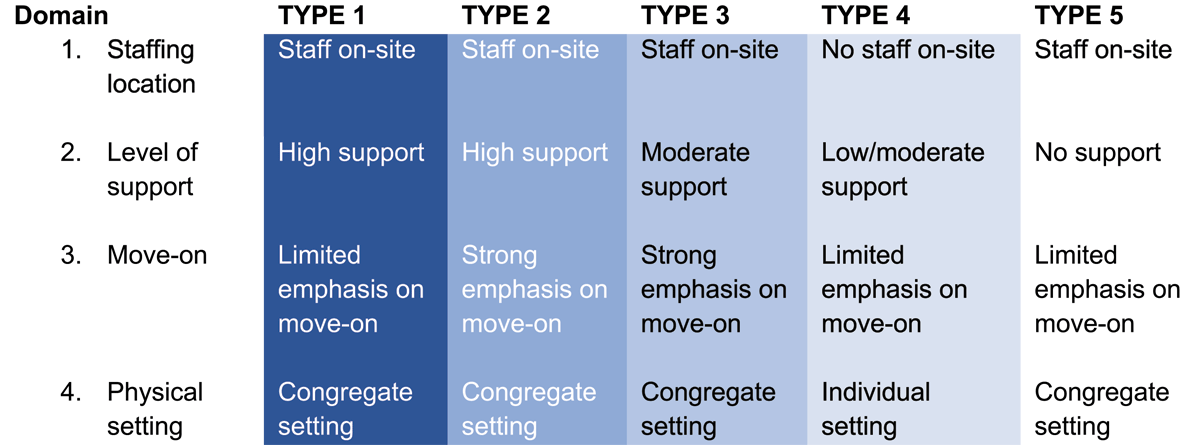
Figure 1
STAX-SA (from McPherson, Krotofil & Killaspy 2018).
The five service Types cover traditional residential care accommodations (Type 1), supported housing (Types 2 and 3), and individual accommodation with floating outreach support (Type 4). Type 5 had only one incidence in McPherson and colleagues’ study, which suggests that this type is uncommon. In the distribution of services, Types 1 and 4 emerged as the most frequently used, followed by Type 2 and Type 3.
STAX-SA has been welcomed by researchers in the field, with the anticipation of enabling more robust evidence for good practice in the area of supported accommodation (Barbato et al. 2020; Brunt 2020; Parker et al. 2019), and recent studies on supported accommodation indicate a positive response. A number of studies have used the taxonomy as a tool for describing and classifying empirical material (Apostolopoulou et al 2020; Fossey, Harvey & McDermot 2020; Jose et al. 2021). Briefly, it seems as though the STAX-SA domains are applicable and relevant, while the Types are more difficult to apply (see Piat, Seida & Padgett 2020). This is encouraging, but also indicates the importance of further validation of the taxonomy in order to explore its applicability to international supported accommodation models, as recommended by McPherson, Krotofil & Killasby (2018).
In summary, STAX-SA covers the main kinds of supported accommodation and is a brief and straightforward tool. However, given the lack of a detailed picture of supported accommodation services, the comprehensiveness of STAX-SA is still ambiguous, and some researchers argue against the reductive approach as an obstacle in capturing variation between service models (Felx et al. 2020).
Supported accommodation in Sweden
As in other countries, the field of supported accommodation in Sweden has evolved and has been reformed in the deinstitutionalisation era guided by policies based on the recovery logic (Markström & Lindqvist 2015). A mental health reform in 1995 was one of the last big reforms in the deinstitutionalisation in Sweden and positioned the local municipalities as responsible for supporting people with PDs with housing. The mental health reform, new policies and national guidelines have informed today’s landscape of supported accommodation. Recovery is an established approach, reflected, e.g., in the national guidelines for schizophrenia (NBHW, 2018b) that explicitly recommend recovery-oriented support and the recovery model has been welcomed by the Swedish survivors’ movement (Näslund, Sjöström & Markström 2020). Support to people with PDs in Sweden is mainly regulated by the Social Services Act (SFS 2001:453), the core paragraph of which is designed to ensure a reasonable standard of living for vulnerable and exposed groups. Further, the Act concerning Support and Service for People with Certain Functional Impairments (SFS 1993:387), a law targeted to people with extensive and persistent disabilities, strives to ensure good living conditions. All support, irrespective of regulating act, is based on a needs assessment of everyday life function, and compared to other countries such as England the support is not time-limited so long as the needs remain. Social Services are, overall, responsible for the delivery of mental health support, but there is no mandated form for the organisation and management of support, e.g., community mental health services (Markström & Lindqvist 2015).
The supply of community-based accommodation services in Sweden developed primarily after the mental health reform in 1995. At that time, the number of inpatient beds had decreased, and the development of housing facilities and supported accommodation services was further stimulated by the reform. When the number of inpatient beds decreased, persons with extensive and complex needs as consequence mainly from severe and long-term mental illness were housed in group homes. The field continued to expand, and in the early 21st century about 8,000 individuals received housing support in group homes, i.e., residential care homes or supported housing services (National Board of Health and Welfare (NBHW) 2003). Private contractors accounted for a substantial part of the increase (NBHW 2003), and the private sector has subsequently been further stimulated by the Act on Freedom of Choice System (SFS 2008:962). The act regulates what will apply when municipalities and regions expose their operations to competition by setting up systems of choice for healthcare and social services, e.g., social care for people with PDs. Since the early 21st century, the housing stock has not been thoroughly examined and described, but the number of group homes seems to be rather stable. Today, the most common form of housing support in Sweden is floating outreach, a common concept for visiting support to people living in a self-contained, individual tenancy. Accommodation support is thus increasingly provided in the service user’s private home, as in line with other welfare service in Sweden (Davey, Malmberg & Sundström, 2013). Floating outreach support has doubled over the last decade (NBHW 2018a), and about 27,000 people receive this form of housing support (NBHW 2020). It is the most common housing support to persons aged 20–54 years (NBHW 2020), and the target group is heterogenous, including persons with psychosis diagnoses and neuropsychiatric disorders, but also persons with mood disorders, comorbidities, neurotic syndromes, etc. (NBHW 2019). The NBHW (2019) articulates a tentative suggestion that persons with neuropsychiatric disorders is a growing group of individuals receiving floating outreach support. In summary, the distribution of housing support services in Sweden has shifted over time, from primarily group homes with high service level early on after the reform towards a more pronounced focus on individual support, thus engaging a growing number of people with a broad variation/heterogenous spectrum of diagnoses. However, there is no detailed description or analysis of the stock of housing facilities and supply of housing services for people with PDs in Sweden. Existing data are mainly based on limited information reported from municipalities to the NBHW, e.g., the sources referred to previously in this section.
The aim and contribution of this article is twofold. First, we aim to examine the available housing provision for people with PDs in Sweden through a case study. Second, we aim to explore how the supply of housing services corresponds to the domains and Types in STAX-SA. Based on the examination of the housing stock, we will analyse and discuss possible shortcomings with and amendments of STAX-SA. This will enable comparisons with other countries and might offer useful insights into the development and targeting of sustainable living environments for people with PD.
Methods
The present study is part of a multiple case study, a larger research project examining housing and living environments for people with PDs, including studies with different designs conducted by researchers from the disciplines of social work and urban planning. Within this larger project, ten municipalities were strategically selected to provide variation in regard to size, geographical location and demographic features (Table 1). The selection was made based on the Swedish Association of Local Authorities and Regions (SALAR) classification. The researchers established contact with the municipalities’ social service and city planning office, and a selection of key informants was made.
Table 1
Municipalities included in the study.
| SITE | MUNICIPALITY TYPE | POPULATION | LOCATION | ACCOMMODATION UNITS |
|---|---|---|---|---|
| A | Large city | 130,000 | North | 34 |
| B | Rural | 4,000 | North | 3 |
| C | Smaller city | 60,000 | North | 6 |
| D | Smaller city | 11,000 | Mid | 2 |
| E | Municipality close to metropolitan area | 100,000 | Mid | 6 |
| F | District in metropolitan area | 100,000 | Mid | 5 |
| G | Smaller city | 15,000 | South | 3 |
| H | Smaller city | 65,000 | South | 12 |
| I | Rural | 9,000 | South | 2 |
| J | Large city | 90,000 | South | 15 |
| Total: | 88 | |||
| Additional sites | ||||
| K | Large city | 100,000 | Mid | 20 |
| L | Large city | 115,000 | South | 14 |
| Total: | 122 |
Material and procedure
To specifically examine the stock of accommodation service units for people with PDs in Sweden, we conducted interviews with key informants, e.g., managers for the municipality’s accommodation services for people with PD, and we collected data regarding each service in the municipalities in a protocol. The data were collected during an interview that also focused on issues that will be reported elsewhere, or in a separate session with the interviewee. In a few municipalities, other service managers than the key informants assisted in compiling the protocols in order to assess the most detailed and updated information regarding the services. In a few cases, the interviewee completed the protocols followed by a review with the researcher by telephone. When gathering the data, we observed an excess of accommodation units, especially residential care homes, in one of the large city municipalities (municipality A). This was a deviation from the distribution of units in other municipalities and might have indicated a non-representative service model in the material. In order to avoid distortion in the data and to validate the pattern from the deviating municipality, we decided to collect data from two additional municipalities of the same size. We contacted service managers (n = 2) in two further large municipalities (K and L) and collected information on housing variables for 14 and 20 accommodation units, respectively.
The protocols aimed to map each specific service unit and covered questions on geographical location and vicinity, characteristics of the service users (distribution of age, gender, PD) and the staff. Further, they comprised one set of questions based on QuIRC-SA (domain A: visitors, access to kitchen, served/common meals; domain B: throughput of service users, contact person; domain C: health care) (Killaspy et al. 2016). The protocols also included one set of questions based on the domains in STAX-SA (McPherson, Krotofil & Killaspy 2018), i.e., Staffing Location (staff on-site/off-site), Level of Support (high/moderate/low/no support), emphasis on Move-On (strong/limited), and Physical Structure (congregate setting/individual accommodations) (McPherson, Krotofil & Killaspy 2018). There was a mix of closed- and open-ended questions in the protocols, and closed-ended questions had comments sections. Further, because the protocol was compiled in dialogue with the informant, the researchers could add further information in order to capture rich descriptions of the service units. This study is based on the data from the protocols and more specifically on the data regarding the STAX-SA domains.
Analysis
Descriptive analyses were conducted according to the following steps.
All information from the first round of data gathering, 88 protocols, was transferred to an Excel file.
The accommodation units were classified according to STAX-SA. Those units that corresponded completely to a certain Type and thus fit within the taxonomy were classified as one of the Types.
We then analysed the units that could not be classified by means of a more inductive approach. First, we identified the characteristics of each unit based on dialogue with the key informant during the interview. Then, we looked for similarities and differences between the units in order to categorise them into clusters. In this step, the authors jointly discussed the categorisation until consensus was reached (Kvale 1996). The analysis ended up in three clusters of service units: Type 4, with a strong emphasis on Move-On; Hybrids, i.e., service units that were hybrids between two Types; and Sub-types, i.e., service units of a certain Type that had extended their activity to include, for example, short-term accommodation or floating outreach support to other service users.
We then added the information on accommodation units from the additional municipalities, including 20 units from municipality K and 14 units from municipality L (n = 122), and classified them according to STAX-SA and the clusters that we had identified in step 3. Other than one new sub-type and one new hybrid, we found a similar variation of STAX-SA Types, hybrids, and sub-types as in the rest of the material.
The project was approved by [ed.: redacted for blind review] and was assessed not to pose research ethical challenges.
Results
The results are provided in three parts. An overall description of the accommodation service units is presented in terms of the number of service users, staff and types of disabilities (1). The available housing provision for people with PD in Sweden is further described by means of the distribution of STAX-SA Types (2) and a presentation of the clusters of service units that did not correspond to STAX-SA (3).
Altogether, the 122 accommodation units provided housing support to 3,059 service users with a total staff of 1,067 employees (Table 2). The distribution of sex among service users was quite even. Three out of four accommodation units had service users with various PDs and were not specialised towards a specific clinical client group. However, the vast majority of accommodation units had service users with disabilities related to a psychosis diagnosis (71.5%), and about half of the units had service users with neuropsychiatric disorders (53%) (based on data from municipality A-J).
Table 2
Demographic data.
| SITE | A-J | K, L | TOTAL |
|---|---|---|---|
| Accommodation services | 88 | 34 | 122 |
| Number of service users | 2,165 | 894 | 3,059 |
| Distribution of sex | |||
| - Women | - 46.4 | ||
| - Men | - 53.4 | ||
| - Other | - 0.2 | ||
| Staff | 766 | 301 | 1,067 |
Distribution of STAX-SA Types
Of the 122 units, 58 units (48%) fit one of the Types in STAX-SA, i.e., corresponded to all four domains with one of the Types. As pictured in Table 3, the distribution among Types shows that accommodation services were mainly provided by Type 1 and Type 4 units. No Type 5 service was found. This is in line with the distribution of Types in McPherson, Krotofil & Killaspy (2018). A description of the services according to types in STAX-SA is given below, followed by a more detailed description of the hybrids and sub-types that were identified in the analysis.
Type 1 services (n = 24)
Type 1 services, e.g., residential care homes, were one of the two largest Types in the material and appeared in nine of the municipalities, with the highest representation in the large city municipalities A and K. As described in STAX-SA, these accommodation units had staff on-site 24 hours, offered a high Level of Support, and expressed a limited emphasis on Move-On. Physically, these services were organised as congregate settings for 4–17 tenants (median: 10), and the tenants were more often men (60%). Concerning types of PD among service users, there was a fairly even distribution between units with a main type of disability (and similar needs among service users) and units with a profound diversity among users. Most units, however, consisted of people with disabilities related to a psychosis diagnosis. A few services were focused on an older target group of people described by key informants as ‘chronic’ service users with complex needs.
Type 2 services (n = 7)
Type 2 services appeared as the second smallest Type and were found in four of the municipalities (smaller city to large city, but were not represented in rural municipalities). These units were overall very similar to Type 1 services except that the Move-On emphasis—in line with the STAX-SA description—was strong, with an explicit ambition to motivate the tenants to move to more independent housings. However, as long as the needs remained, the accommodation support was not time limited. The accommodation units had staff on-site, offered a high Level of Support, and were structured as congregate physical settings. The distribution of PDs among tenants was similar to the distribution in Type 1 services, with most users with disabilities related to a psychosis diagnosis (appearing in 5 units). The tenants were in general slightly younger than in the Type 1 services, and were more often men (59.5%) than women (40.5%).
Type 3 services (n = 3)
This was the smallest type in the material, consisting of only three accommodation units that were found in two of the municipalities (small city and large city). Two units had service users with disabilities related to a psychosis diagnosis, and one unit was a short-term accommodation for service users with rather moderate service needs. Tenants were more often women (70%) than men (30%). All units had staff-on site at specific hours (daytime and evenings) and offered a moderate Level of Support, and the housings were organised as congregate settings. The emphasis on move on was described as strong in all three units, but in practice the throughput of service users in the units targeted to people with psychosis diagnoses was very low.
Type 4 (n = 24)
Type 4 was, together with Type 1, the largest Type in our material, and was found in nine of the municipalities and was represented in rural to large city municipalities. These 24 accommodation units were floating outreach services with service users living in self-contained, ordinary apartments. The staff was placed off-site in an apartment of their own, delivering support to service users living in a defined catchment area and visiting the service users at specific times. The staff apartment sometimes also functioned as a community space for the service users. Two service units deviated from this staff structure in that they were staffed by personnel from a nearby residential care home for persons with intellectual disability (municipality B). The service level varied (low to moderate) between units but also between service users within the same unit. Service was offered with a variation between only daytime on weekdays to day and night-time all week. The emphasis on Move-On was in most services explicitly low; however, indications of recovery-oriented influences were voiced in comments on the Move-On domain, like ‘Are working towards no need for support’ (municipality D) or ‘We are assigned to work towards independence’ (municipality J), but this effort was difficult to observe in practice, ‘there is a strong emphasis [on Move-On] in theory, but it’s difficult in practice’ (municipality J). As regards service users, these units were not targeted to disabilities related to specific diagnoses but towards a geographical catchment area, and thus the variation within the same service was often broad. However, service users with neuropsychiatric disorders were most common, and appeared in just about half of the units, followed by users with disabilities related to a psychosis diagnosis as the second most common. There was a quite equal distribution of sexes between tenants, with slightly more women (55.3%) than men (44.7%) and a broad variation in age, ranging from young adults (18 years) to old-aged (78 years) service users.
Distribution of units that did not fit STAX-SA
Among the 64 units that did not fit one of the Types, we found three clusters; Type 4 services with a strong emphasis on Move On (n = 21), Hybrids (n = 33) and Sub-types (n = 9). Each cluster is described below.
Type 4 with a strong emphasis on Move-On (n = 21)
The first cluster was constituted by 21 service units that corresponded with Type 4 but deviated in the Move-On domain. These were organised as floating outreach services (no staff on-site, low/moderate support, and individual accommodations in a geographical catchment area) but had an explicit and strong emphasis on Move-On, indicating that the end point of support was stretched beyond low support in an individual setting (i.e., decreased Level of Support or even no support). These accommodation units were found in six municipalities (from rural to large city municipalities), but half of them (10 units) were in one of the large city municipalities (A). In almost all units, disabilities among service users varied widely. Overall, service users with neuropsychiatric disorders were common (n = 11), as were users with disabilities related to a psychosis diagnosis (n = 7), and a few units had service users with disabilities related to depression and burn-out syndrome diagnoses. There was a quite equal distribution of sex between tenants, with slightly more men (55.8%) than women (44.2%) and a broad variation in age ranging from young adults (18 years) to old aged (80 years) service users.
Hybrids (n = 34) and Sub-types (n = 9)
The service units in the second cluster, Hybrids (n = 34), resembled one Type 1 (n = 18), 2 (n = 7), or 3 (n = 8) in most respects, but deviated in one domain. Consequently, they did not correspond to any of the STAX-SA Types but were rather hybrids between two Types. Hybrids were found in six municipalities (small and large city municipality) and served more male (63.2%) than female (34.8%) tenants. The vast majority (n = 28) deviated in the domain of physical setting. For Types 1, 2, and 3 in STAX-SA, the physical setting is indicated as congregate. The service units in the hybrid cluster were most often described as a mix between ‘individual’ and ‘congregate’ settings, and in a few cases as individual. In general, this meant that service users lived in individual apartments and received individual support, but also spent much time together in community spaces within the unit, sometimes at specific hours. In some units the physical setting consisted of a number of individual apartments (including a kitchen and bathroom) within the unit that also housed a shared kitchen and community spaces. Other examples were units where the service users lived in apartments with the same stairwell but spent much time in a community space, either an apartment in the stairwell or one nearby, that was shared by all service users. In Sweden, these services are commonly called ‘stairwell accommodation’. Some units had a pronounced corporate touch where users spent most of their time together in shared spaces in the units. One hybrid had a unique design—a floating outreach service where the service users lived in the same apartment block—some of them in shared apartments—where they shared meals with the other users in a community space that belonged to the unit (classified as a hybrid between Type 3 and 4, municipality A).
Seven units described the physical setting as individual but with a high service level (not in line with any of the Types). In one example, a group accommodation with high service level, the service users lived in small, detached houses on a ground plot and spent time together in a community house on the plot (municipality J). One unit was a special arrangement for only one service user with very complex needs in need of support around the clock (municipality A).
A number of hybrid units focused on a specific group of service user, and the hybridisation between Types might be connected to how the units complied to service user’s needs. One unit was designed to support service users that were brought back home from forensic psychiatry care outside the municipality (municipality H), and two units had profiled older service users (ages around 60 and 80 years, municipality H and municipality A). These three units were similar to Type 1 but deviated in the domain of Physical Setting, indicated as ‘individual’ or ‘individual/congregate’, and were thus classified as hybrids between Type 1 and 4. One unit was targeted to service users with a psychosis diagnosis and with former experiences from mental health institutions (municipality A). This unit was similar to a Type 3 but deviated in the Move-On domain, which was indicated as ‘limited’ and thus classified as a hybrid between Type 1 and 3 (staff on-site, moderate service level, limited emphasis on Move-On, and congregate setting). A further hybrid version was found in one of the large city municipalities, a service unit whose group of service users had shifted and broadened over time. There were two types of service users living at the unit, half of the service users were older and the other half were younger. Regarding the older group, the unit was a Type 1 service, but regarding the younger group the Move-On emphasis was ‘strong’ and thus was a Type 2 service.
The third cluster, Sub-types (n = 9), is constituted of units with an original and main function as Type 1, Type 2, or hybrid units that had extended their activity to also include floating outreach support or short-term accommodation in their supply of services. Sub-types were found in four municipalities (small and large city), all of which also had hybrids in their stock of services. Subtype services had an even sex distribution between tenants (53% women, 47% men). In one municipality, the sub-types were traditional residential services (Type 1 or 2) that also functioned as floating outreach service to a number of service users nearby. Overall, there were a number of special arrangements, such as a Type 1 service designed to a single service user with very complex needs that, as the service user improved, had extended to also offer floating outreach support to a few service users nearby. Another example is a hybrid between Type 1 and 4 for 14 tenants that also offered short-term accommodation to two persons and night support to a number of other service users with floating outreach support in the local area around the service.
In one of the large city municipalities (L) we noted an interesting development. At the time for data collection the municipality was facing a reorganisation that implied connecting all staff involved in supported accommodation to group home services. Their job description would include support and service to service users at group homes and to service users in floating outreach support concurrently. In practice this would mean combining work stationed at a group home with mobile support to service users in ordinary housing (in terms of our analysis, a new kind of sub-type).
In summary, about half of the service units could be classified according to STAX-SA while the deviating units, just more than half of the material, were categorised into three clusters (Type 4 with a strong emphasis Move-On, Hybrids, and Sub-types). No Type 5 service units were found. When incorporating the clusters into STAX-SA and incorporating the cluster units into the classification, i.e., considering the Types as constructs or wider concepts rather than types of supported accommodation services (McPherson, Krotofil & Killaspy 2018), an interesting variation and movement in the field of housing stock for people with PD in Sweden was seen (Table 4). First, Type 1 and Type 4 remained the largest Types. Second, cluster units were identified in all four STAX-SA Types that emerged in the material. Third, the number of cluster units overrode the number of “pure” STAX-SA units in three of the Types.
Discussion
To the best of our knowledge, this is the first study that specifically examined a large body of housing data material and analysed its correspondence to STAX-SA. The study provides an in-depth picture of what characterises the Swedish supply of supported accommodation services, and the use of STAX-SA.
Examining the Swedish provision of supported accommodation services
First, in broad terms, the examination of the housing stock in our selected municipalities singles out Type 1 and Type 4 service units, i.e., residential care homes and floating outreach support, as the centrepieces of mental health-supported accommodation services. However, the notable number of service units that did not fit STAX-SA and their analysis revealed some interesting observations. The field is dynamic and complex, with a wide diversity of service unit designs and arrangements. Further, the field seems to be in motion. A most obvious finding is the movement towards individuality, a movement previously noted in other countries, and does not seem to be exclusive for Sweden (Barbato et al. 2020; McPherson, Krotofil & Killasby 2018). In our analysis we found that group homes (Types 1, 2 and 3) are moving towards more individuality in the physical settings, often emphasising a mix between the collective and the individual (hybrid units). A suggestion is that a focus on ‘recovery’ might have stirred the field against a strong drive for independence, influencing the physical settings to a more individual design, e.g., designing group homes consisting of individual apartments. This was most obvious in Type 1 services, which might indicate a liquidation or a phasing-out of the most institutionalised services. We also found how floating outreach support has extended the endpoint of support from individual housing to decreased support or even to no support (Type 4 with a strong emphasis on Move-On). Another movement concerns relaxation of service units’ boundaries concerning commitment and targets groups. We found that some units no longer focus on one function (providing staff on-site, a certain Level of Support in a physical setting) to one target group (e.g., service users with quite similar needs) but rather extend their activities and targets groups (sub-types). The reorganisation in municipality L is an interesting example of this relaxation movement at a broader municipality level that other municipalities might follow. In terms of PD, the entry of new target groups, e.g., people with neuropsychiatric disorders, in the field of supported accommodation in Sweden, has previously been noted and discussed by Markström & Lindqvist (2015) as a novel phenomenon for both the field and the frontline staff in the post-deinstitutionalisation era. Based on our results, we can confirm that the previously roughly described heterogeneity within the target group (NBHW 2020) is well established.
Correspondence to STAX-SA
The analysis of how SA services in the study corresponded to the domains and types in STAX-SA provides some interesting points for consideration. First of all, the correspondence was quite low, and only 48% of the services fit STAX-SA. Concerning those services that did fit the taxonomy, we found services of four of the STAX-SA types (Type 1–Type 4) in the material. The distribution of services between the types was in line with McPherson, Krotofil & Killaspy (2018), with Type 1 and Type 4 being the most common types and Type 3 being the most uncommon type. We found no Type 5 service in our data, and this was also in line with McPherson, Krotofil & Killaspy (2018), which confirms their suggestion to remove Type 5 from the taxonomy.
To analyse and understand the low correspondence, it is important to remember that our data are novel and detailed and that STAX-SA is reductive. STAX-SA is based on data from already existing papers and is anticipated to be useful in synthesising already existing research (McPherson, Krotofil & Killaspy 2018). However, in the testing and validation procedures of STAX-SA, the taxonomy’s external validity (i.e., its effectiveness in differentiating between ‘real world’ service models) was tested by service managers on a set of 32 ‘real world’ services in England. McPherson, Krotofil & Killaspy (2018) concluded that the taxonomy indeed can differentiate between ‘real world’ service models but less clearly between housing models that have a large variation. In McPherson, Krotofil & Killaspy (2018), this was most obvious for services in the supported housing sector (Type 2 and Type 3 services) and was explained by local pressure that resulted in unique service models in this sector in England. When we analysed the non-classifiable service units in our material by identifying clusters and then incorporating them in STAX-SA (see Table 4), the meaning of ‘Types’ was broadened to wider and more generous concepts. The inclusion of units that deviated from the original STAX-SA types showed substantial deviations throughout the field, and such diversity escaped STAX-SA. This was most obvious in Type 3, where the numbers of deviating services surmounted those that fit the original Type 3. In Types 1, 2 and 4, the distribution between deviating and original type services was quite equal. Piat and colleagues’ (2020) use of STAX-SA to describe their studied service units confirms our findings. Of five study sites of supportive housing projects in Canada, only one fit a Type in STAX-SA, and the other four were what we in our analysis named Hybrids. In their paper, they, in line with McPherson, Krotofil and Killaspy’s (2018) suggestion, made use of the domains, not the Types, to describe the studied units. This was a most informative approach that captured the variation within models and is an example we believe is worth following in other studies.
Looking at what was deviating, we might get some clues to better understand changes and movements in the field of SA in Sweden. We found deviations in the domains of physical setting and Move-On and a general relaxation of boundaries concerning commitment and target types in originally traditional residential services (sub-types, Type 1, and Type 2). Regarding deviations in the domain physical setting (found in hybrid services), our results show a clear trend towards individuality even in residential care services (Type 1, 2, and 3).
The trend towards individuality also concerns the identified deviation in the Move-On domain. In STAX-SA, the emphasis on Move-On is captured in a rather close span, between ‘strong’ and ‘limited’. Picturing a housing support career according to STAX-SA, it ends in Type 4, an individual living with low support and a limited emphasis on Move-On. However, we found a continued strong emphasis on Move-On in Type 4 services (Type 4 with a strong emphasis on Move-On) that, in concrete terms, meant reduced support or even no support. It is worth noting that this finding was a stroke of luck due to informants spontaneously talking about a pronounced strong ambition to Move-On in Type 4 services. In the analysis of deviating services, this stood out as a pattern and eventually emerged as a cluster. The endpoint of Move-On and Level of Support in the field of housing support is thus more far-reaching (at least in Sweden) than what is captured by STAX-SA. However, the idea of Move-On in STAX-SA must be considered in regard to national regulations that to some degree differ between countries. For example, in Sweden supported accommodation interventions continue as long as the needs remain and the supported housing contracts are not time-limited. The home, and the individuals’ right to have a home, has long been protected in Sweden, and movement between supported housing services is thus determined first and foremost by the intention of the individual. In England, services are contracted to work with individuals for around two years, something that might have influenced the idea of Move-On in the construction of STAX-SA.
As noted by McPherson and colleagues (2018), STAX-SA may need to adapt according to improvements in the supported accommodation research, i.e., complex and detailed described interventions. In line with our results, the value of adaptation might also be true according to an increasingly varied and complex field of ‘real world’ service models of supported accommodation. The variation within our material is obvious, and the many examples of special arrangements suggest creativity and mobility in the field (but it is, of course, simultaneously a challenge to do justice to this in research). The incentive for this development, however, is another and a most central issue. Whether the variation can be explained by adaptations to a more heterogenous target group, cost effectiveness, ideology, or a mix of several is an important issue for future studies but beyond of scope of this paper to determine. Even so, we find it important to draw attention to what this development means for the comprehensiveness of STAX-SA. Two observations from our results regard how the field is verging towards individuality and how the emphasis on Move-On seems to be expanding into and beyond floating outreach support. As regards individuality, the development is generally in line with housing preferences within the target group (Richter & Hoffmann 2017), but the type of housing, the settings, and the services must also be organised out of their perspective and preferences. Recent studies from a target group perspective offer guidance and emphasise recovery-oriented preferences such as choice, control, privacy, and security (Fossey, Harvey & McDermot 2020) as well as connectivity, hope, meaning, and empowerment (Apostolopoulou et al. 2020). Piat and colleagues (2020) showed that everyday recovery-supporting choices for the individual, such as ‘home-making’ (e.g., spatial aspects and living environment) and ‘alone time’ (e.g., choosing when to socialise) contribute to wellbeing and mental health recovery. In summary, these two observations bring recovery to the fore and highlight the absence of this perspective/domain in STAX-SA. STAX-SA, in its current version, gives no guidance regarding outcome. In the construction of the taxonomy, an intended recovery domain was omitted for the benefit of utility to the existing literature. In further validation of the taxonomy, it would be fruitful, in line with what McPherson, Krotofil & Killasby (2018) discussed when introducing STAX-SA, to re-introduce this domain in order to improve the external validity. Further, for assessment of quality of supported accommodation, it is worth emphasising the benefits of QuIRC-SA (Killaspy et al. 2016) that enables a broader understanding of what supported accommodation deliver.
Strengths and shortcomings
There are some obvious methodological strengths of this study. First, it is based on a unique material of supported accommodation services. The extensive data allowed us to picture the characteristics of included services and to describe variation between models that will enable comparisons with other countries, and the analysis of correspondence to STAX-SA might offer useful insights into the development and targeting of sustainable living environments for people with PD. Second, this is the first descriptive study that has specifically examined the stock of supported accommodation services in Sweden. A further strength is the dialogical approach between researchers and key informants when gathering data and within the research team when categorising unclassifiable service units into clusters.
The descriptive and dialogical approach also has some shortcomings. First, the study is not based on a clear hypothesis or a theoretical framework. Although informative and a valuable contribution, the analysis is based on descriptive compilations of the material. The material did not allow us to thoroughly address and analyse issues such as outcomes, effectiveness or long-term change. This requires longitudinal design and amendments of the chosen taxonomy (STAX-SA). In addition, the data covered service units in a limited number of municipalities and cannot be strictly generalised to Sweden as a whole, though the selection strived to roughly reflect conditions in a ‘mini-Sweden’. As regards the dialogical approach, the shortcoming concerns the process of dialogical intersubjectivity when it comes to categorising. This is certainly a process that can be contaminated by preconceptions. However, the composition of the researchers’ varied experiences and familiarity with the field of supported accommodation helped reduce the possibility of a ‘group think’ contamination (Janis 1982).
Worth noting when considering our results is that they concern community-based accommodation services and give no information on privately operated services. From interviews with key informants, we learned that at least eight of the municipalities had individuals located at such services (sometimes outside of the municipality). This was most common in large city municipalities that could have up to 75 individuals (L) in external placements, and this was motivated by a lack of in-housing alternatives and the complex needs of the individuals that could not be handled within the organisation. In some cases, this explained the rather low number of residential services in these municipalities. This might be a strategy for municipalities to decrease the service of residential housing while increasing the export of complicated cases to private providers, and this is essential to take into account in further studies.
Conclusion
This article gives a unique picture of the present stock of supported accommodation services in Sweden and sheds light on developments and trends in the post-deinstitutionalised era. The applicability of STAX-SA to ‘real world’ services and its ability to effectively discriminate between service types in Sweden is unsatisfactory. As discussed by both McPherson, Krotofil & Killaspy (2018) and Felx et al. (2020), STAX-SA is useful for classification of supported housing models and for synthesising the supported accommodation literature in broad terms, but when striving for capturing variation and change in a rich set of data it is an overly reductive tool. Based on our application, we suggest some adjustments to increase STAX-SA’s applicability to other contexts. First, we suggest removing Type 5 from the taxonomy. Second, we suggest broadening and relaxing the Types into wider constructs that allow the capture of deviations and movements in the field. Third, we suggest extending the endpoint in the Level of Support domain from low support to no support. Fourth, we suggest re-introducing a recovery domain.
However, we still found it most fruitful to apply STAX-SA. While being reductive, it simultaneously proved to be a successful point of departure in the analysis that opened up for identifying diversities and movements in the field that we truly recommend other researchers to consider. To authors using STAX-SA to describe data, we recommend making use of the domains rather than the types in order to make variations within service models visible and not hidden.
Funding Information
The research project “LEX – sustainable living environments for people with psychiatric disabilities” was supported by grants from FORTE (2018-01325) and Formas (2018-00058).
Competing Interests
The authors have no competing interests to declare.
Authors Contributions
UM designed the project and collected the data together with MF and EH. SL organised the data, performed the analysis, and drafted the manuscript, which was commented on and reviewed by all authors.