
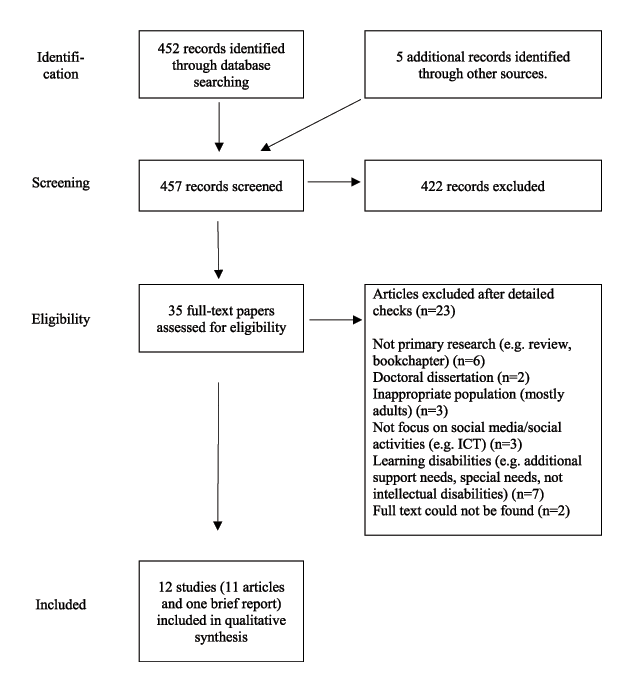
Figure 1
PRISMA flow diagram. Adapted from ‘Preferred Reporting Items for Systematic Reviews and Meta-analysis: The PRISMA Statement’ (Caton and Chapman 2016; Moher et al. 2009).
Table 1
Details of studies included in the review.
| Authors | Country | Internet issues | Participants | Methods | Key findings |
|---|---|---|---|---|---|
| Buijs et al. (2016) | Canada | Internet safety | 3 adolescents and adults with an intellectual disability (22q11.2 deletion syndrome): 2 in their early twenties (1 male and 1 female) and one 16-year-old (female). | Qualitative method. Case vignettes. | Internet risks may also be indicative for adolescents and adults with intellectual disabilities. Clinicians should discuss Internet safety in their practice. |
| Didden et al. (2009) | Netherlands | Cyberbullying | 114 students with intellectual disabilities and/or developmental disorders. Total IQ level of at least 50. Age 12–19 years (72% boys and 28% girls). | Quantitative method. Questionnaires. | Cyberbullying present among students with an intellectual and/or developmental disability in special education settings. Call for programmes. |
| Holmes and O’Loughlin (2012) | UK | Online social identity/social networking sites (Facebook) | 3 participants: one 25-year-old woman with a mild learning disability and autistic traits, one 30-year-old woman with a mild learning disability and one 28-year-old woman with a learning disability. | Qualitative method. Vignettes. | Important to offer people with intellectual disabilities the same rights and freedom as all others, but empower them to deal with difficulties on the Internet. |
| Jahoda and Pownall (2014) | UK (Scotland) | Sexual understanding, sources of information and social networks | 60 participants (16–21 years). 30 adolescents with a mild intellectual disability (16 men, 14 women) and 30 non-disabled adolescents (15 men and 15 women). | Quantitative method. Structured interviews, self-report measures. | Need to tackle barriers to sexual knowledge for young people with intellectual disabilities, in particular attitudes to the developing sexuality of young women with intellectual disabilities. |
| Lough, Flynn and Riby (2015) | UK | Online vulnerability | Illustrations from autism spectrum disorder (ASD) and Williams syndrome (WS). | Qualitative method. Hypothetical scenarios based on previous knowledge | There may be risk factors that need to be taken into consideration. Individuals with developmental disorders who are vulnerable offline might encounter risks online. |
| Löfgren-Mårtenson (2008) | Sweden | Love in Cyperspace | 22 participants: 10 young people with an intellectual disability aged 18–31 (6 men, 4 women). Mainly with a very mild form of intellectual disability. 12 adults (teachers, staff members and IT personnel) aged 25–62 (10 men, 2 women). | Qualitative, ethnographic method. Qualitative interviews. | Discrepancy in the views of the Internet between young people with intellectual disabilities and adults. Young people with intellectual disabilities view the Internet as an arena where they can be ‘like everybody else’, whilst the people around them mainly focus on the risks. |
| Löfgren-Mårtenson, Sorbring and Molin (2015) | Sweden | Internet use for sexual purposes | 8 professionals (7 females and 1 male). 5 parents (3 females and 2 males) of pupils in the same upper secondary special programme class (age 18–20). | Qualitative method. Focus groups, interviews. | In-depth knowledge about parents’ and professionals’ perspectives on the Internet and sexuality is important when young people with intellectual disabilities live in an independent situation towards their surroundings. |
| Molin, Sorbring and Löfgren-Mårtenson (2015) | Sweden | Teachers’ and parents’ views on the Internet and social media use. | Same as above | Same as above | Teachers emphasize the importance of the Internet for interactive purposes, whilst parents highlight the Internet as an opportunity for their children to increase awareness of their own disability and meet peer group pupils. |
| Salmerón, Gómez and Fajardo (2016) | Spain | Evaluate recommendations from Internet forums | 40 students with intellectual disabilities (47.5% female), age 17–23. Verbal and mental age-matched group. 40 students (52.5% female), age 11–12. Chronological age-matched group. 40 students (80% female), age 1–21. | Quantitative method. Experiment. | Students with intellectual disabilities have a limited capability to evaluate recommendations from Internet forums. They do not present a delay in but an atypical development of these skills. |
| Seale (2001) | UK | Self-presentation | 20 personal home pages by adults with Down syndrome. Average age 18. 11 men. | Qualitative method Opportunistic sampling technique. | Personal home pages have the potential to allow adults with Down syndrome to express multiple identities. Further work needs to be done to support adults with Down syndrome to take more control over the construction and presentation process. |
| Sorbring, Molin and Löfgren-Mårtenson (2017) | Sweden | Barriers and support for Internet participation | 22 guardians (19 biological parents, 2 older sisters and 1 stepmother) of people with intellectual disabilities (8 daughters and 9 sons, aged 16–21). | Qualitative method. Individual interviews, pair-interviews, group interview. | Parents see great opportunities for their children on the Internet, but they are also afraid that they are more sensitive to the contents of and interactions on the Internet due to their disability. |
| Wright (2017) | US | Cyber victimization and depression | 131 adolescents (73 % male, age 13–15) with intellectual disabilities and/or developmental disorders. IQ from 56 to 121, most students (84%) have an IQ below 85. | Quantitative method. Self-report questionnaire, completed the questionnaire one year later. | Perceived social support from parents and teachers weakened the relationship between cyber victimization and depression. Call for programmes. |
Table 2
Concept matrix identifying main themes (Watson and Webster 2002).
| Article | Theme | |||||
|---|---|---|---|---|---|---|
| Opportunities | Risk and vulnerability | Sexuality | Identity | Barriers | Support | |
| Buijs et al. (2016) | x | x | ||||
| Didden et al. (2009) | x | x | ||||
| Holmes and O’Loughlin (2012) | x | x | x | |||
| Jahoda and Pownall (2014) | x | x | x | |||
| Lough, Flynn And Riby (2015) | x | |||||
| Löfgren-Mårtenson (2008) | x | x | x | |||
| Löfgren-Mårtenson, Sorbring and Molin (2015) | x | x | x | x | ||
| Molin, Sorbring and Löfgren-Mårtenson (2015) | x | x | ||||
| Salmerón, Gómez and Fajardo (2016) | x | x | ||||
| Seale (2001) | x | |||||
| Sorbring, Molin and Löfgren-Mårtenson (2017) | x | x | ||||
| Wright (2017) | x | x | ||||
| Totals | 4 | 7 | 3 | 2 | 3 | 8 |